Field Armor in Maximilian Style
Augsburg armorers' workshops (helmet attributed to Lorenz Helmschmid) · c. 1510-15
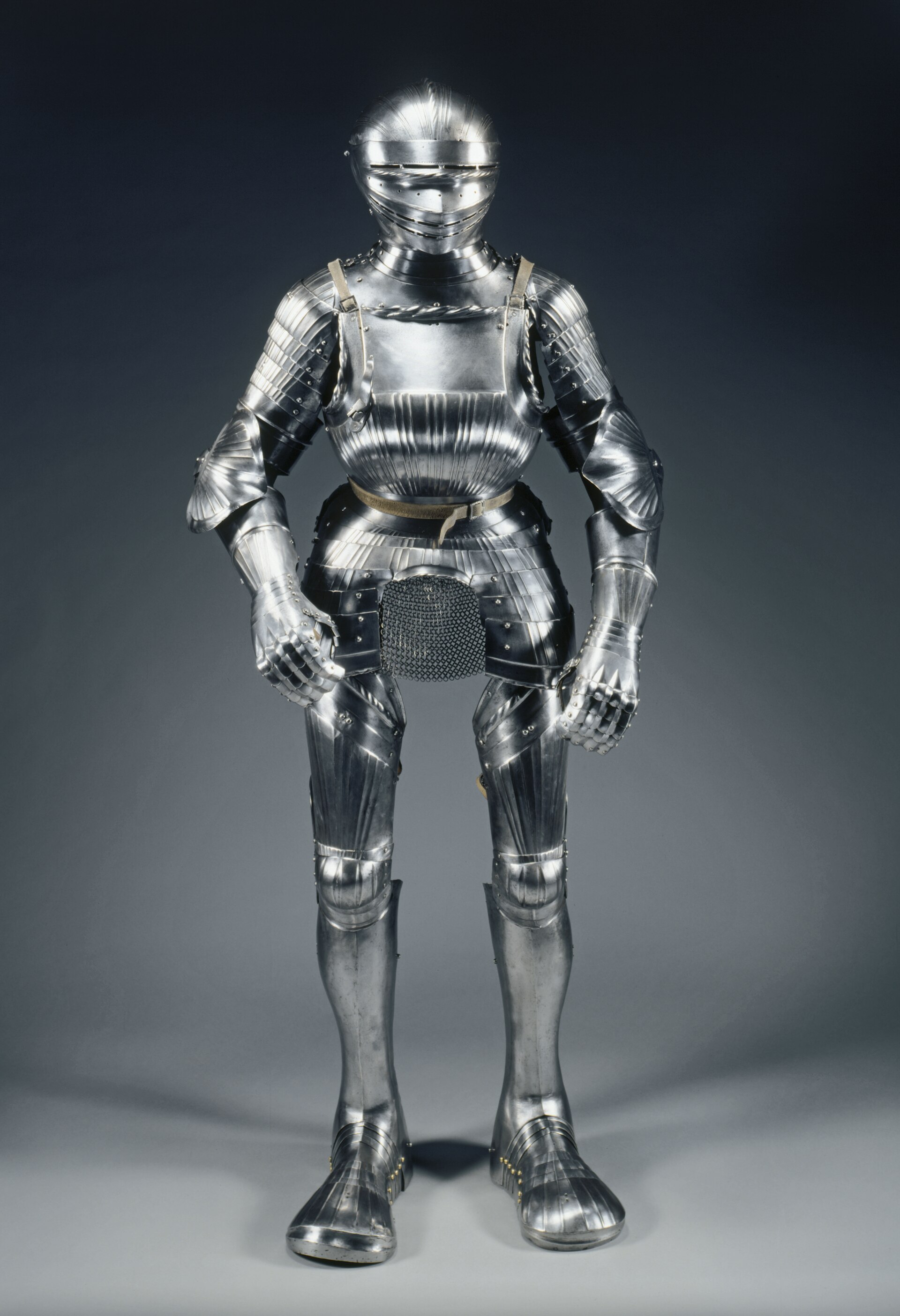
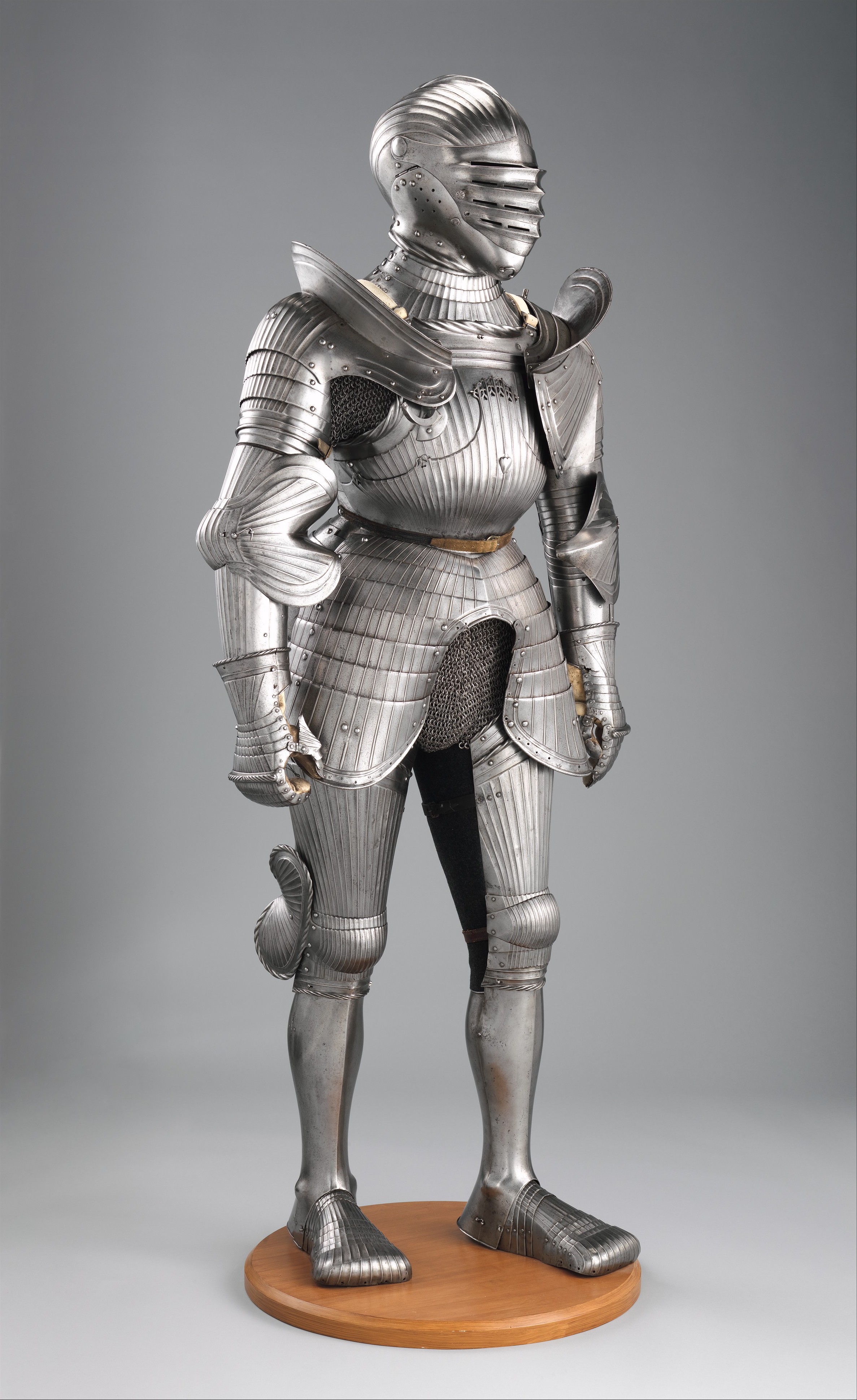
The record subject, in full. Fluted steel with leather straps and a mail panel, Germany, Augsburg(?), c. 1510-15. Cleveland Museum of Art, accession 2012.38.
| Artist | Augsburg armorers' workshops (helmet attributed to Lorenz Helmschmid) |
|---|---|
| Date | c. 1510-15 |
| Medium | Fluted steel with leather straps and a mail panel |
| Dimensions | Overall height 170.2 cm (67 in.) |
| Where it is now | Cleveland Museum of Art, Cleveland, Ohiolast confirmed |
| Inventory number | 2012.38 |
| Attribution | UnknownCleveland catalogues the armor's origin as 'Germany, Augsburg(?), early 16th century' - the question mark is the museum's own. Full note |
| Object type | Arms and armour |
| Period | German, early 16th century (the reign of Emperor Maximilian I, 1493-1519) |
| Cases | Has a provenance gap |
| Inscriptions | None published. No maker's mark or guild inspection stamp is cited by Cleveland for any element of this suit. |
| Owners on record | 7 links5 documented, 2 unknown |
| Sources | 19 cited |
About this record Last verified · 19 sources cited · Change log
On this page 10 sections
ContentsClose
A nearly complete field armor of fluted steel, made in Germany around 1510-15 and catalogued by the Cleveland Museum of Art with its own question mark: 'Augsburg(?).' Its title carries the era's most misunderstood cataloguing term, 'Maximilian style' - a modern label for a fashionable fluted surface treatment of the early sixteenth century, not a claim that Emperor Maximilian I ever owned or commissioned this specific suit. No owner at all is documented for this armor before the twentieth century.
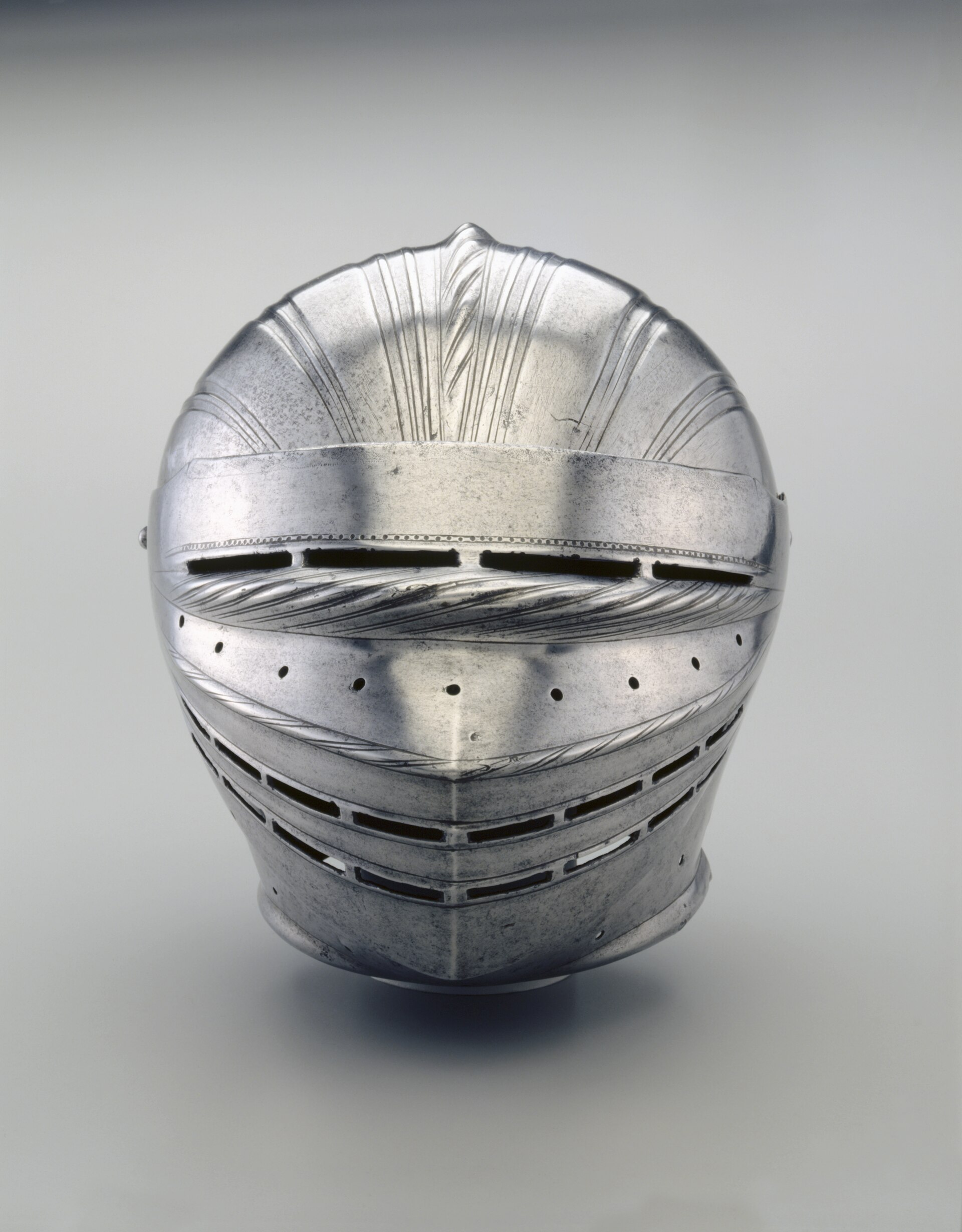
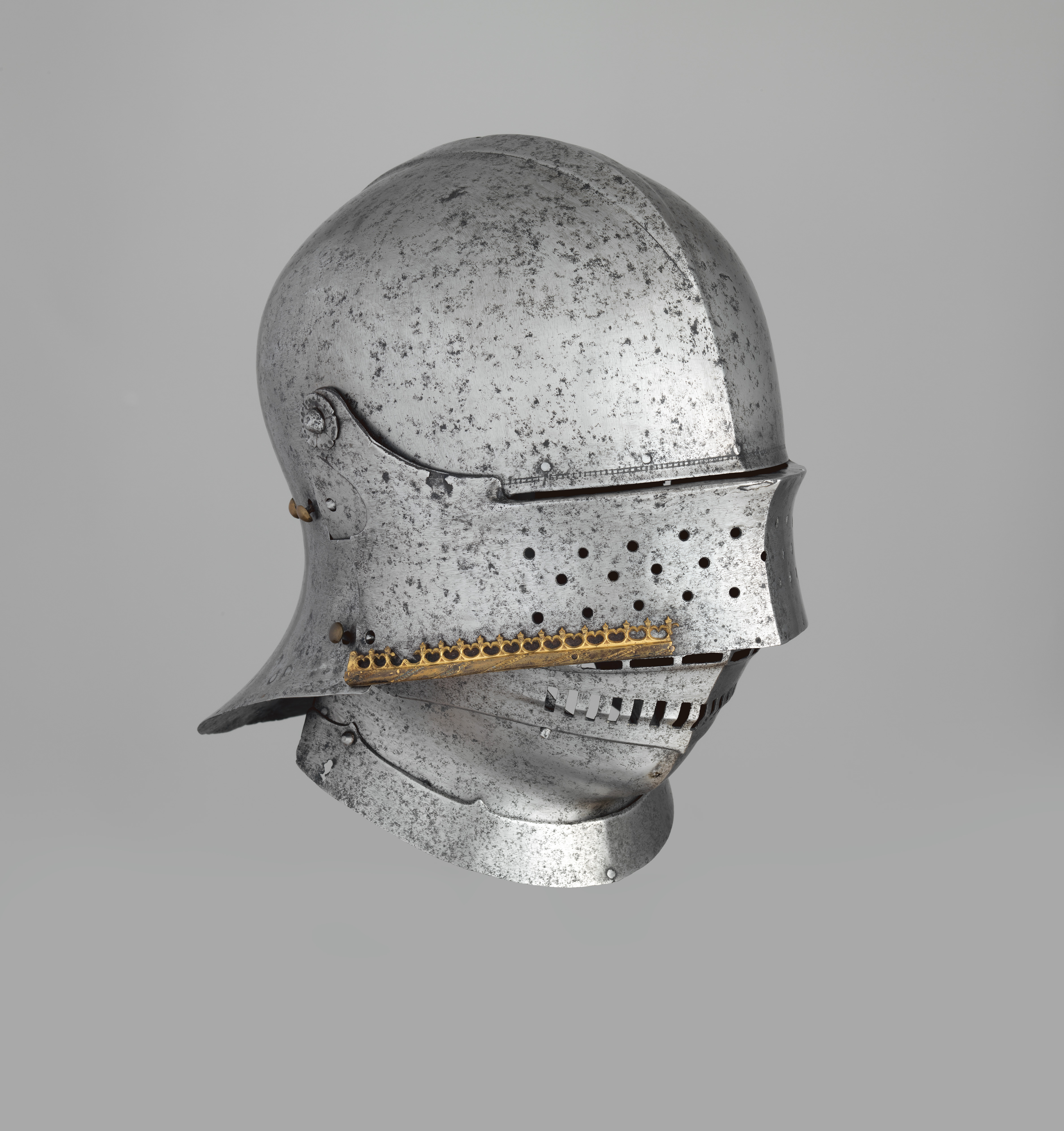
Only the helmet carries any maker attribution, and even that is hedged: Cleveland states it is 'believed to be' the work of the real, documented Augsburg court armorer Lorenz Helmschmid, on stylistic grounds, unsigned. The rest of the suit's Augsburg origin sits awkwardly against the Metropolitan Museum's own description of fluting as a Nuremberg specialty - the likely reason for Cleveland's question mark. The documented chain of ownership is short and modern: William Randolph Hearst, a Sotheby's London sale in 1961, the Washington architect David Norton Yerkes, his daughter Catharine Y. Kulski, and Cleveland's 2012 purchase through the J. H. Wade Fund, four years after the museum had already borrowed the piece for exhibition.
This record treats the maker attribution, the city attribution and the ownership gap as three separate, honestly graded uncertainties, and treats the object's own name as a description of a decade's fashion, not a description of an emperor's collection.
Provenance
Each link is graded. Documented: a cited source supports it. Disputed: the identification is argued but not established. Unknown: no owner for that span, and the gap is not smoothed into a narrative. The grades in the glossary.
- c. 1510-15 -Made in Germany, probably Augsburg; helmet believed to be the work of Lorenz Helmschmidunknown
Cleveland's own culture line carries a question mark against Augsburg. The helmet attribution to Helmschmid is stated by the museum as a belief, not a documented or signed fact. No original owner or patron is recorded.1212
- c. 1515 - 1951 or beforeUnrecordedunknown
No owner, collection, inventory or dealer record has been identified connecting the object across roughly four centuries between its manufacture and its documented appearance in the Hearst collection.3
- by 1951 - 1961William Randolph Hearst (1863-1951), San Francisco, Californiadocumented
Listed by Cleveland as the armor's first documented owner. Hearst died in 1951; the object was sold, evidently from his estate's continuing dispersal of his holdings, a decade later. No source consulted records when or from whom Hearst acquired it.3
- 1961-06-09 - 1961-06-09Sold at Sotheby's, London, lot 153documented
The sale that moved the armor from the Hearst estate's holdings into David Norton Yerkes's collection. Cleveland's provenance record gives the date and lot number but not a price.3
- 1961 - 2011David Norton Yerkes (1911-2011), Washington, D.C.documented
Yerkes was a practicing architect, principal of the Washington firm Deigert and Yerkes, who assembled a private arms and armor collection. He bought this armor at the 1961 Sotheby's sale.319
- 2011 - 2012Catharine Y. Kulski (Yerkes's daughter, by inheritance)documented
Kulski inherited the armor on her father's death in 2011 and sold it to Cleveland the following year. The piece had already been lent to Cleveland in 2008, four years before this sale, for the exhibition Arms and Armor from Imperial Austria.38
- 2012 - presentCleveland Museum of Art, Cleveland, Ohiodocumented
Purchased from Kulski using the J. H. Wade Fund. No purchase price has been published in the sources consulted.13
Prices realised
| Date | Sale | Estimate | Result | Note |
|---|---|---|---|---|
| 9 June 1961 | Sotheby's | Not published in the sources consulted | Hammer Not published in the sources consulted With premium Not published in the sources consulted GBP (presumed; a London sale of this date, unconfirmed in the sources consulted) | Sale, London, lot 153. The consignor is understood, from Cleveland's own sequencing of its provenance list, to have been the estate or continuing dispersal of William Randolph Hearst's holdings; this is an inference from the order of Cleveland's provenance entries, not a statement made outright in the source. The buyer was David Norton Yerkes. No hammer price, premium or estimate for this lot was located. |
Hammer is the price at which the bidding stopped; with premium adds the fee the house charges the buyer on top. Hammer price and buyer's premium in the glossary.
Technical evidence
| Attribution note | Cleveland catalogues the armor's origin as 'Germany, Augsburg(?), early 16th century' - the question mark is the museum's own. Only the helmet carries a maker attribution at all, and even that is hedged: the museum's own language is that it is 'believed to be the work of the esteemed Augsburg armorer, Lorenz Helmschmied,' not that it is signed or documented as his. No mark is cited for the helmet, and none is cited for the breastplate, tassets, greaves or any other element of the suit. The attribution therefore rests on two separate, unequal claims: a probable maker for one component, and a probable city for the whole, neither backed by a signature, a guild mark or a contract. Fluted armor of this exact kind is also independently associated with Nuremberg rather than Augsburg in the Metropolitan Museum's own cataloguing of comparable suits, which is the specific tension behind Cleveland's question mark and is treated at length in this record. |
|---|---|
| Construction | A field armor of fluted steel plates joined by leather straps at the shoulders and waist, with a rectangular panel of mail covering the groin. Most elements were made together as a single suit.13 |
| Medium | Fluted steel, leather straps, mail.1 |
| Dimensions | Overall height 170.2 cm (67 in.).1 |
| Fluting technique | Narrow, closely spaced parallel ridges hammered into the plate over shaped stakes or dies, in the broader tradition of embossing and raising described in the Metropolitan Museum's own account of arms-and-armor decoration technique. The ridges stiffen the plate against bending, in the manner of a corrugated sheet, while visually reproducing the deep pleats of contemporary fashionable dress.910 |
| Footwear | Broad sabatons terminating in flattened toes, finished with gilt rivets.1 |
| Condition | The lower legs contain modern restorations; the museum does not specify their date or the restorer. The remaining elements are described as made together as a single original suit.12 |
| Helmet attribution | Believed to be the work of the Augsburg armorer Lorenz Helmschmid (documented master from 1477, court armorer from 1491, died 1515/16), on stylistic grounds. No mark or signature is cited.212 |
| Marks | No maker's mark or guild inspection stamp is published for any element of this suit, in contrast to other Helmschmid-attributed work that does carry his mark (a pair of tournament pauldrons in the Metropolitan Museum, ca. 1500) and to Nuremberg guild practice of stamping inspected armor (as on the Philadelphia Museum's 1507 horse armor by Wilhelm von Worms the Elder).1314 |
Images
The record in full
Chapter 1What it is
A nearly complete field armor for a man, standing 170.2 centimetres (67 inches) overall, made of steel worked into narrow, closely spaced vertical flutes across the helmet, breastplate, arms and legs.
A nearly complete field armor for a man, standing 170.2 centimetres (67 inches) overall, made of steel worked into narrow, closely spaced vertical flutes across the helmet, breastplate, arms and legs. Leather straps join the plates at the shoulders and waist; a rectangular panel of mail hangs between the thighs, covering the gap the plate cannot; the feet end in wide, flattened sabatons finished with gilt rivets. Cleveland dates the suit to about 1510-15 and catalogues its origin as Germany, Augsburg, with its own question mark attached to that city.
Most of the elements were made together as a single suit, which is worth stating plainly because it is not the usual condition of a surviving harness this old: field and tournament armor was disassembled, refitted, cannibalised for parts and recombined by dealers for three centuries after it stopped being worn, and a genuinely unified suit of this date is the exception rather than the rule. Cleveland records one exception within the exception: the lower legs carry modern restoration work, meaning that the suit as it stands today is not in every part the suit as it left the workshop.
Chapter 2A name that means a decade, not a person
The object's own title contains the trap this record exists to defuse.
The object's own title contains the trap this record exists to defuse. 'Maximilian style' is not a claim that Emperor Maximilian I owned, commissioned or ever saw this armor. It is a nineteenth-century art-historical label attached, after the fact, to a fluted decorative treatment that became fashionable in German and Austrian armor roughly between 1500 and 1530 - a period that happens to overlap Maximilian's reign as Holy Roman Emperor (1493-1519). The Metropolitan Museum's own curatorial language, in an essay on armor fashion by Dirk H. Breiding of its Department of Arms and Armor, calls fluted armor 'commonly referred to as Maximilian armor' precisely because its development 'roughly coincided with the reign of Emperor Maximilian I,' and flags the label as a modern convenience rather than a documented dedication.
The confusion the label invites is not hypothetical. Not every armor Maximilian actually wore was in this fluted style at all - his best-documented personal armors, made for him by name, are Gothic in style, from earlier in his life, and separately catalogued and separately housed from the fluted suits that carry his name today. And the confusion cuts the other way too: Wikipedia's summary of the style notes that an alternative scholarly reading ties the name instead to Maximilian II, since the last documented armor in the style was made in 1557, decades after Maximilian I's death and long after the fashion had gone out of use among working armor - a genuine live disagreement about whose name the label actually preserves, not a settled fact this record can resolve. That citation is tertiary and is flagged for replacement with the primary literature (Oakeshott, Niehoff, Quaas and Silver are the names attached to the debate) rather than treated as authoritative here.
The safest statement the evidence supports is the narrow one: this armor is called 'Maximilian style' because of when its decorative technique was fashionable, not because of who owned it. No owner is documented for this specific suit before the twentieth century, imperial or otherwise.
Chapter 3How the flutes were made, and what they were for
Fluting was not paint-on ornament. The Metropolitan Museum's essay on decorative technique in arms and armor places it in the tradition of embossing and raising: a plate was worked from the inside so...
Fluting was not paint-on ornament. The Metropolitan Museum's essay on decorative technique in arms and armor places it in the tradition of embossing and raising: a plate was worked from the inside so the design stood up in relief on the outside, then finished from the outside with a chasing tool. For fluting specifically, the plate was hammered over shaped stakes or dies, working the metal into the parallel ridges seen across this suit's breastplate, limbs and helmet, and the surviving evidence indicates armorers used heat to make that forming practical across a plate this size rather than attempting it cold on hardened steel.
The result did two things at once. Decoratively, the ridges were understood at the time - and are understood by curators now - as a steel translation of the deeply pleated, fashionable civilian dress of the same decades; Cleveland's own description of this exact suit states plainly that 'this armor was made to mimic the trend of pleated clothing that was popular at the time.' Structurally, the same ridges behaved the way a corrugated sheet behaves under load: they stiffened the plate against bending and were credited, in period use, with helping to deflect the points and edges of weapons rather than presenting a flat surface for a blow to bite into. The Metropolitan's Nuremberg suit (35922), fluted in the same manner and of the same general period, records the same account of the technique's dual purpose - the disciplined visual language of court fashion, laid over a genuine gain in the metal's resistance to a strike. It is a rare case in this armor's story where the decorative and the practical explanation are not in tension; they are the same explanation, told twice.
Chapter 4Augsburg or Nuremberg - the city behind the question mark
Augsburg and Nuremberg were the two dominant armor-producing cities of southern Germany in this period, both feeding the Habsburg court and both capable of work at the highest level; Innsbruck, seat...
Augsburg and Nuremberg were the two dominant armor-producing cities of southern Germany in this period, both feeding the Habsburg court and both capable of work at the highest level; Innsbruck, seat of Maximilian's own court workshop from 1504, was a third. Cleveland's catalogue entry places this suit in Augsburg, with the parenthetical question mark built into the culture line itself - 'Germany, Augsburg(?), early 16th century' - rather than stated as settled fact.
The tension a careful reader should notice is this: the Metropolitan Museum's own cataloguing of a comparable fluted suit (35922, German, Nuremberg) states, without qualification, that 'fluted armor appears to have been a specialty of Nuremberg.' If that specialization holds as a general rule, an unmarked, heavily fluted suit is, on the technique alone, at least as plausibly Nuremberg work as Augsburg work. Cleveland's case for Augsburg does not appear to rest on the fluting at all; it appears to rest entirely on the helmet, and on the attribution of that one element to an Augsburg master, Lorenz Helmschmid. Whether the rest of the suit was made in the same city as its helmet, by the same hand as its helmet, or was assembled - as harness elements very often were, in period and afterward - from plates made in more than one workshop, is not addressed in the sources this record was able to consult. The question mark in Cleveland's own culture line is, on this reading, doing real work: it is not decorative caution, it is an accurate flag over a genuine evidentiary gap.
Chapter 5The helmet and Lorenz Helmschmid
Lorenz Helmschmid was a real, documented figure, not a connoisseurial reconstruction.
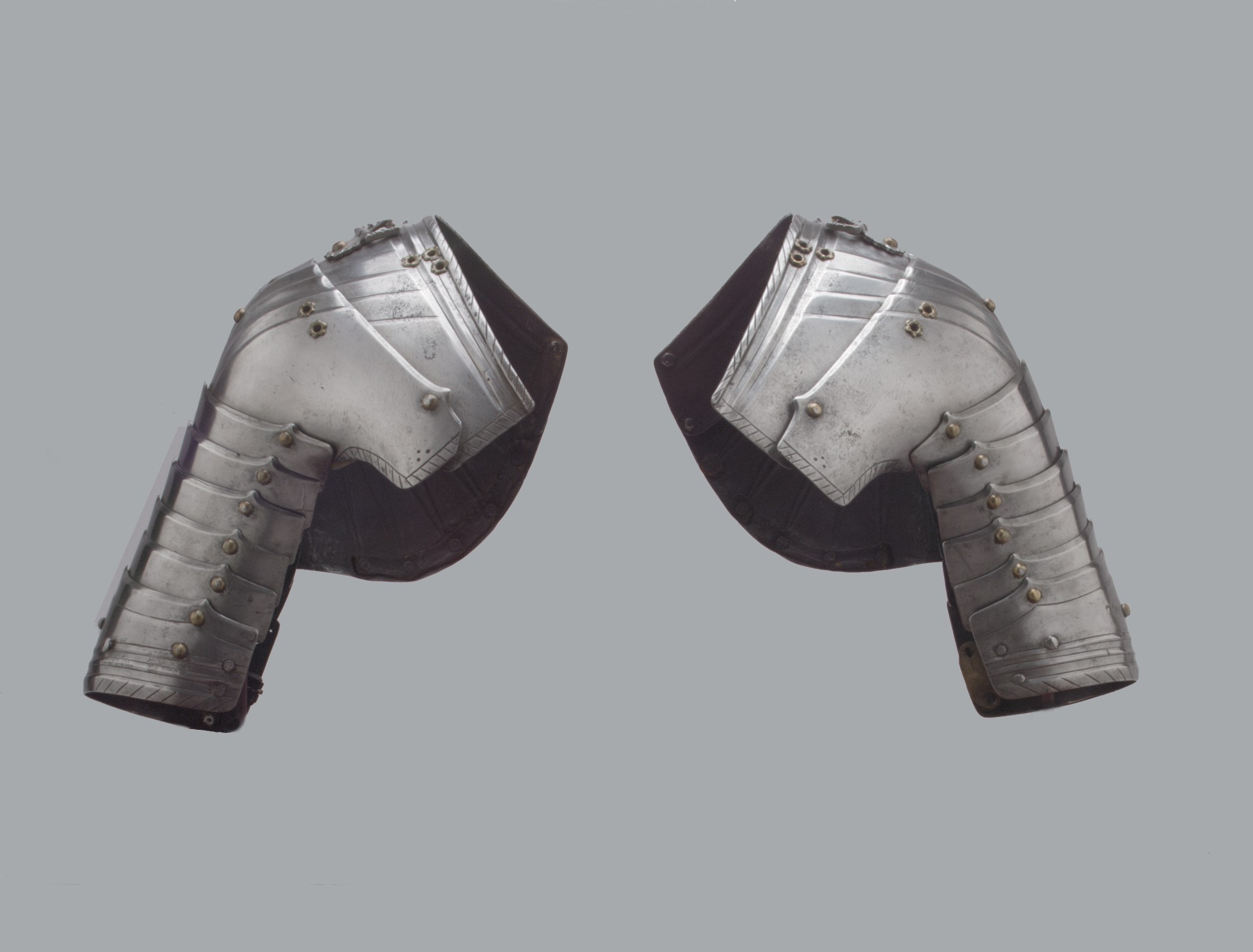
Lorenz Helmschmid was a real, documented figure, not a connoisseurial reconstruction. Augsburg tax records place him working there from 1469, name him a master in his own right from 1477, and record his commissions for Holy Roman Emperor Frederick III that same year. In 1491 he was formally invested with the title and privileges of court armorer, a post he held for the rest of his life, and he is credited - alongside the Innsbruck armorer Conrad Seusenhofer - with the most technically ambitious armors made for Frederick's son and successor, Maximilian I, in the years around and after 1493. Some of that documented output survives and is public: the Metropolitan Museum holds a sallet attributed to Helmschmid and catalogued outright as the 'Sallet of Emperor Maximilian I' (23213), and a pair of tournament pauldrons from around 1500 that the Museum states are marked by Helmschmid himself (23208) - an actual signature, on an actual object, made for an actual member of the Habsburg court.
That real connection is exactly why this suit needs careful handling rather than looser handling. Cleveland's helmet is 'believed to be' Helmschmid's work - a stylistic judgment, not a marked or documented one - and even if that attribution is correct, it establishes only that the same hand that made documented armor for Maximilian I also, on this reading, made a helmet that ended up on a different, undocumented suit with no recorded owner before the twentieth century. A real link from a maker to Maximilian personally does not transfer to every object that maker is thought to have touched. This record treats the Helmschmid attribution as a probable authorship claim for one element, sourced to Cleveland's own hedged language, and treats any inference from it to imperial ownership of this suit as unsupported.
Chapter 6What the fashion said, and what it did not need to say
There is a genuine documented meaning behind this suit's decoration, and it is an ordinary one rather than a hidden one.
There is a genuine documented meaning behind this suit's decoration, and it is an ordinary one rather than a hidden one. Fluted armor's imitation of pleated court dress was a public, legible statement of magnificence and fashionable alignment with the imperial court's own aesthetic - the same purpose civilian slashed and pleated clothing served for the same class of client in the same decades. It marked its wearer as current, prosperous and connected to a specific, expensive, short-lived vogue rather than to an older or plainer style of harness. That is the whole of the documented symbolic content available for this object: a display of fashion and means, translated from cloth into steel by a demanding technique that few workshops outside two or three cities could execute well.
No source consulted for this record attaches a religious, dynastic or personal iconographic program to this specific suit - no owner's device, no inscription, no heraldic charge is recorded on it. Where a record like this one goes looking for a deeper intellectual or devotional program behind an object's materials and form, as this archive does as a matter of course, the honest finding here is that there is not one to report beyond court fashion and craft display. That absence is itself worth stating plainly rather than glossing over.
Chapter 7Centuries unaccounted for
Between its manufacture around 1510-15 and its appearance in a documented twentieth-century collection, this suit's ownership is entirely unrecorded in the sources available to this record.
Between its manufacture around 1510-15 and its appearance in a documented twentieth-century collection, this suit's ownership is entirely unrecorded in the sources available to this record. No church, arsenal, princely armory, family inventory or dealer stock book has been identified connecting the object across that gap. That is not unusual for German field armor of this date - complete, unified suits routinely passed through undocumented private and antiquarian hands for centuries before entering the market in a form modern museums could trace - but it means the suit's whereabouts for roughly four hundred years are simply unknown, not merely unpublished.
Chapter 8From a Hearst warehouse to a Washington architect's collection
The documented chain begins with William Randolph Hearst (1863-1951), whose acquisitions of European arms and armor were made on the same enormous scale as his acquisitions of everything else, and...
The documented chain begins with William Randolph Hearst (1863-1951), whose acquisitions of European arms and armor were made on the same enormous scale as his acquisitions of everything else, and whose collections were sold off gradually - during his lifetime under Depression-era financial pressure, and further after his death in 1951 - through galleries and auction houses on both sides of the Atlantic. Cleveland's own provenance record lists Hearst in San Francisco as the piece's first documented owner, followed directly by its sale at Sotheby's London on 9 June 1961, lot 153. No source consulted records when or from whom Hearst acquired it, or whether it was bought as part of a larger lot of armor; his papers and the Hearst photographic archive at Long Island University may hold that answer, but it has not surfaced in the sources checked for this record.
The 1961 sale is where the piece enters the collection of David Norton Yerkes (1911-2011), a practicing Washington, D.C. architect and principal of the firm Deigert and Yerkes, known for private residences and government buildings rather than for art dealing. Cleveland's companion object from the same source, a Cuirassier's Armor of about 1600-20 (2012.37), carries a fuller published provenance that helps confirm the pattern: that suit passed from Archduke Eugen of Austria's armory at the Castle of Hohenwerfen, through Anderson Galleries in New York in 1927, to Hearst in 1956, and then to Yerkes - the same eventual destination as this field armor, by a parallel but separately documented route. Yerkes assembled what became a substantial private armor collection in Washington; on his death in 2011, this piece and others passed by inheritance to his daughter, Catharine Y. Kulski.
Chapter 9On loan before it was purchased
Cleveland's own exhibition record for this object lists it as having appeared in the Museum's 2008 exhibition Arms and Armor from Imperial Austria (24 February - 1 June 2008) - four years before...
Cleveland's own exhibition record for this object lists it as having appeared in the Museum's 2008 exhibition Arms and Armor from Imperial Austria (24 February - 1 June 2008) - four years before Cleveland acquired it. That exhibition drew most of its material from the Landeszeughaus in Graz, Austria, but its presence on this specific object's exhibition history indicates Cleveland borrowed the piece, most likely from Kulski, to show alongside the Graz material. A museum reaching an agreement to exhibit a privately owned piece and later purchasing that same piece is a common and unremarkable acquisition pattern, but it is worth recording as a fact about how this suit's public life began four years before its accession date, not in 2012.
Chapter 10The 2012 acquisition
Cleveland purchased the armor from Kulski in 2012 using the J.
Cleveland purchased the armor from Kulski in 2012 using the J. H. Wade Fund, one of the Museum's oldest endowed purchase funds. No source consulted for this record publishes the price paid. Museum purchase-fund acquisitions of this kind are not auction transactions and carry no hammer price or premium to report or separate; the acquisition is a private sale between the Museum and the owner, and this record treats the absence of a published figure as an open question rather than filling it with an estimate.
Chapter 11Comparanda: the type as a class, and what must not be confused with it
Fluted 'Maximilian style' armor survives in comparable examples at several institutions, and setting them beside this suit is the clearest way to show what the type is without implying any of them is...
Fluted 'Maximilian style' armor survives in comparable examples at several institutions, and setting them beside this suit is the clearest way to show what the type is without implying any of them is this object. The Metropolitan Museum's Nuremberg armor (35922, steel and leather, dated by the Museum to about 1520 and later) shows the same technique from the city most associated with it. Cleveland holds a second, independent example of its own: a Partial Suit of Armor in Maximilian Style (1916.1714), German, Nuremberg, about 1525 - a different object, a different accession decades apart from this one, and, notably, catalogued to Nuremberg rather than Augsburg. The Philadelphia Museum of Art's horse armor of 1507, made by the Nuremberg armorer Wilhelm von Worms the Elder for Duke Ulrich of Wurttemberg (accession object 309965), is not fluted in this style at all - it is etched and gilded - but it carries a genuinely documented link to Maximilian I the person: Ulrich commissioned it in anticipation of riding with Maximilian to Rome for his imperial coronation, a journey that never took place because Venice refused the party safe passage. That object is the useful contrast this record wants on record: a real, sourced, personal connection to Maximilian I, on an armor that is not called 'Maximilian style,' set against this suit, which carries his name stylistically and has no personal connection to him documented at all.
The Wallace Collection in London and the Kunsthistorisches Museum in Vienna's Imperial Armoury both hold major fluted armors of the same general class and period; neither has been consulted here closely enough to name a specific accession as a direct comparandum with confidence, and none of their images appear in this record. Their holdings are noted for a reader doing further comparison, not treated as verified here.
Chapter 12Cleveland's other Maximilians, and the one that is a different man entirely
Cleveland's own collection is, on its own, a warning about the exact confusion this record is built to prevent.
Cleveland's own collection is, on its own, a warning about the exact confusion this record is built to prevent. Beyond this suit (2012.38) and the Nuremberg partial suit already discussed (1916.1714), the Museum holds several other separate pieces catalogued in the Maximilian style from different original harnesses entirely - among them breast-and-backplates (1916.1640), a close helmet (1916.1651) and a chanfron (1916.1845) - none of which belong to this suit or to each other as a single original object.
More pointedly, Cleveland also owns a jousting armor associated with an actual historical Archduke Maximilian - identified in the Museum's own photography and in the Wikimedia Commons record of it as Archduke Maximilian III, made by the Augsburg armorer Anton Pfeffenhauser in 1571, more than half a century after this suit was made and in a completely different armor tradition (heavy jousting harness, not fluted field armor). That object's connection to a man named Maximilian is genuine and personal; its connection to this record's subject is nothing at all beyond the coincidence of a shared name, and it is named here only to be excluded, not to be compared.
Chapter 13What is still unresolved
The honest state of this record is that two attributions sit on top of a large gap.
The honest state of this record is that two attributions sit on top of a large gap. The city of manufacture carries the museum's own question mark. The one named maker is attached to one element, on stylistic grounds, without a signature. The suit's first four centuries have no documented owner at all. And the price at every sale that is documented - 1961 and 2012 alike - has not been published in any source this record was able to check. None of that is a defect in this record; it is the accurate shape of what is currently known, and it is recorded as such rather than smoothed over.
The artist
Lorenz Helmschmid, also recorded as Lorenz Helmschmied
The dossier subject here is not a signed hand but a city and a family workshop, because that is what the evidence actually supports. Only one element of this armor, the helmet, carries any maker attribution at all, and Cleveland's own language for it is 'believed to be,' not 'signed by' or 'documented as.' The rest of the suit is catalogued to Augsburg with the museum's own question mark attached. What follows is the documented record of Lorenz Helmschmid and the Augsburg armor trade he worked in, offered as the closest verifiable context for that hedged attribution, not as a settled biography of this object's maker.
Related works
| Work | Relation | Where it is |
|---|---|---|
| Sallet of Emperor Maximilian I (1459-1519) Attributed to Lorenz Helmschmid | Same attributed maker; a documented, catalogued object made for Maximilian I personally This is NOT the object described in this record. It is included to show what an actual, catalogued Maximilian I possession looks like, in contrast to the stylistic label carried by 2012.38, which has no comparable personal ownership evidence. | Metropolitan Museum of Art, New York (object 23213) |
| Pair of Tournament Pauldrons (Shoulder Defenses) Marked by Lorenz Helmschmid | Same attributed maker; a signed, marked example of his documented work NOT the object described in this record. Included to show that Helmschmid's authenticated work does sometimes carry his mark, unlike the unmarked helmet attributed to him on this suit. | Metropolitan Museum of Art, New York (object 23208) |
| Armor Unknown armorer, German, Nuremberg | Comparable fluted 'Maximilian style' armor from the city the Metropolitan Museum credits as the specialist center for this technique NOT the object described in this record. Cited for the tension between Nuremberg's documented specialization in fluting and Cleveland's tentative Augsburg attribution for 2012.38. | Metropolitan Museum of Art, New York (object 35922) |
| Partial Suit of Armor in Maximilian Style Unknown armorer, German, Nuremberg | A separate, independently accessioned Maximilian-style armor in Cleveland's own collection NOT the object described in this record, and not part of the same original harness. Dated about 1525, a decade or more later, and catalogued to Nuremberg rather than Augsburg. | Cleveland Museum of Art (accession 1916.1714) |
| Cuirassier's Armor Unknown armorer, Austria, Graz | Companion acquisition: purchased the same year, from the same J. H. Wade Fund, via the same Hearst-Yerkes-Kulski chain of ownership NOT the object described in this record and roughly a century later in date. Its fuller published provenance (Archduke Eugen of Austria; Anderson Galleries, New York, 1927; Hearst, 1956) is used in this record to corroborate the pattern of 2012.38's own Hearst-to-Yerkes chain. | Cleveland Museum of Art (accession 2012.37) |
| Horse Armor (Bard) Wilhelm von Worms the Elder | Not fluted or 'Maximilian style,' but carries a documented personal connection to Emperor Maximilian I that this record's subject does not NOT the object described in this record. Made in 1507 for Duke Ulrich of Wurttemberg's planned journey escorting Maximilian I to Rome for his coronation, a journey that never took place. Included as the clearest available contrast between a genuine biographical link to Maximilian I and this suit's purely stylistic one. | Philadelphia Museum of Art (object 309965) |
| Archduke Maximillian III jousting armor Anton Pfeffenhauser | No relation beyond the shared name 'Maximilian' and the shared home institution NOT the object described in this record and not the same Maximilian. Made in 1571, decades after fluted armor went out of fashion, for a documented Archduke named Maximilian III - a real historical person, unconnected to this record's subject. Named here solely to prevent confusion, per this record's version-safety standard. | Cleveland Museum of Art |
Open questions
- What price did Cleveland pay for this armor via the J. H. Wade Fund in 2012? Not published in the sources consulted.
- What price did David Norton Yerkes pay at the Sotheby's London sale of 9 June 1961, lot 153? Not published in the sources consulted.
- When and from whom did William Randolph Hearst acquire this armor, and was it bought singly or as part of a larger lot of arms and armor? Not documented in the sources consulted.
- Is the Augsburg attribution for the body of the suit correct, given that fluted armor of this kind is independently described as a Nuremberg specialty? The evidence located for this record does not resolve the question Cleveland's own question mark records.
- What specific stylistic or documentary evidence underlies the attribution of the helmet to Lorenz Helmschmid, beyond the museum's own hedged 'believed to be'? No published connoisseurship argument for the attribution was located.
- Was this suit made for an identifiable original owner or patron, or was it produced as unattributed court or arsenal stock? No original owner is documented for the sixteenth, seventeenth, eighteenth or nineteenth centuries.
Questions about this object
What is Field Armor in Maximilian Style?
Field Armor in Maximilian Style is an arms and armour, dated c. 1510-15. Medium: Fluted steel with leather straps and a mail panel.
Who made Field Armor in Maximilian Style, and is the attribution settled?
The attribution to Augsburg armorers' workshops (helmet attributed to Lorenz Helmschmid) is recorded here as unknown. Cleveland catalogues the armor's origin as 'Germany, Augsburg(?), early 16th century' - the question mark is the museum's own. Only the helmet carries a maker attribution at all, and even that is hedged: the museum's own language is that it is 'believed to be the work of the esteemed Augsburg armorer, Lorenz Helmschmied,' not that it is signed or documented as his. No mark is cited for the helmet, and none is cited for the breastplate, tassets, greaves or any other element of the suit. The attribution therefore rests on two separate, unequal claims: a probable maker for one component, and a probable city for the whole, neither backed by a signature, a guild mark or a contract. Fluted armor of this exact kind is also independently associated with Nuremberg rather than Augsburg in the Metropolitan Museum's own cataloguing of comparable suits, which is the specific tension behind Cleveland's question mark and is treated at length in this record.
Where is Field Armor in Maximilian Style now?
Cleveland Museum of Art, Cleveland, Ohio. Inventory number 2012.38. Last confirmed 5 September 2026. Purchase from the J. H. Wade Fund, 2012, from Catharine Y. Kulski.
What has Field Armor in Maximilian Style sold for?
Hammer Not published in the sources consulted; with premium, Not published in the sources consulted. Sotheby's, 1961-06-09.
What is still unknown about Field Armor in Maximilian Style?
What price did Cleveland pay for this armor via the J. H. Wade Fund in 2012? Not published in the sources consulted.
Sources
- 1Cleveland Museum of Art, collection record for accession 2012.38, 'Field Armor in Maximilian Style.' clevelandart.org/art/...
- 2Cleveland Museum of Art, collection record for accession 2012.38.a, 'Field Armor in Maximilian Style: Helmet.' clevelandart.org/art/...
- 3Cleveland Museum of Art, full catalogue (print) view of accession 2012.38, carrying the object's provenance list (William Randolph Hearst; Sotheby's London, 9 June 1961, lot 153; David Norton Yerkes; Catharine Y. Kulski; Cleveland Museum of Art, 2012) and exhibition history (Arms and Armor from Imperial Austria, 2008). clevelandart.org/print/...
- 4Wikimedia Commons, file record (MediaWiki API, ) for 'File:Germany, Augsburg(?), early 16th century - Field Armor in Maximilian Style - 2012.38 - Cleveland Museum of Art.tif,' license CC0, credited to clevelandart.org. commons.wikimedia.org/wiki/...
- 5Wikimedia Commons, file record (MediaWiki API, ) for 'File:Germany, Augsburg(?), early 16th century - Field Armor in Maximilian Style- Helmet - 2012.38.a - Cleveland Museum of Art.tif,' license CC0. commons.wikimedia.org/wiki/...
- 6Google Arts and Culture, asset page for 'Field Armor in Maximilian Style,' mirroring the Cleveland Museum's own catalogue text, date, medium and CC0 rights statement. artsandculture.google.com/asset/...
- 7Cleveland Museum of Art, full catalogue (print) view of accession 2012.37, 'Cuirassier's Armor,' the companion object purchased the same year from the same fund, carrying fuller published provenance for the same Hearst-Yerkes-Kulski chain (Archduke Eugen of Austria, Castle of Hohenwerfen; Anderson Galleries, New York, 1927; Hearst, 1956). clevelandart.org/print/...
- 8Cleveland Museum of Art, exhibition record for 'Arms and Armor from Imperial Austria,' 24 February - 1 June 2008. clevelandart.org/exhibitions/...
- 9Metropolitan Museum of Art, Dirk H. Breiding, 'Fashion in European Armor, 1500-1600,' Heilbrunn Timeline of Art History. Discusses the origin and misleading nature of the 'Maximilian armor' label and the development of fluting. metmuseum.org/essays/...
- 10Metropolitan Museum of Art, 'Techniques of Decoration on Arms and Armor,' Heilbrunn Timeline of Art History. Describes embossing, raising and fluting technique. metmuseum.org/essays/...
- 11Metropolitan Museum of Art, collection record for object 35922, 'Armor,' German, Nuremberg, ca. 1520 and later, describing fluted armor as 'a specialty of Nuremberg.' metmuseum.org/art/...
- 12Metropolitan Museum of Art, collection record for object 23213, 'Sallet of Emperor Maximilian I (1459-1519),' attributed to Lorenz Helmschmid, German, Augsburg, ca. 1490-95. metmuseum.org/art/...
- 13Metropolitan Museum of Art, collection record for object 23208, 'Pair of Tournament Pauldrons (Shoulder Defenses),' marked by Lorenz Helmschmid, German, Augsburg, ca. 1500. metmuseum.org/art/...
- 14Philadelphia Museum of Art, object record for object 309965, 'Horse Armor (Bard),' 1507, by Wilhelm von Worms the Elder, German (Nuremberg), including the documented account of Duke Ulrich of Wurttemberg's planned 1507-08 journey with Emperor Maximilian I to Rome. philamuseum.org/objects/...
- 15Cleveland Museum of Art, collection record for accession 1916.1714, 'Partial Suit of Armor in Maximilian Style,' German, Nuremberg, c. 1525. clevelandart.org/art/...
- 16Wikimedia Commons, file record for 'Archduke Maximillian III jousting armor - Cleveland Museum of Art,' a separate Cleveland object (jousting armor by Anton Pfeffenhauser, Augsburg, 1571), cited here only to document and exclude it from this record. commons.wikimedia.org/wiki/...
- 17Wikipedia, 'Lorenz Helmschmied,' for biographical dates and the succession of the Augsburg workshop. en.wikipedia.org/wiki/...
- 18Wikipedia, 'Maximilian armour,' for the alternative naming theory linking the style's name to Maximilian II rather than Maximilian I, and its attribution to named historians (Oakeshott, Niehoff, Quaas, Silver). en.wikipedia.org/wiki/...
- 19Legacy.com / Washington Post, obituary of David Norton Yerkes (1911-2011), Washington, D.C. architect, principal of Deigert and Yerkes. legacy.com/us/...
.jpg)
Last verified · Published
Change log
5 September 2026 - Record created at the house standard: researched narrative, technical evidence, maker dossier, graded provenance chain, prices with hammer and premium separated, related works, open questions and sources.