Plate from the Swan Service
Johann Joachim Kaendler, chief modeler, Meissen Porcelain Manufactory · c. 1737-1741
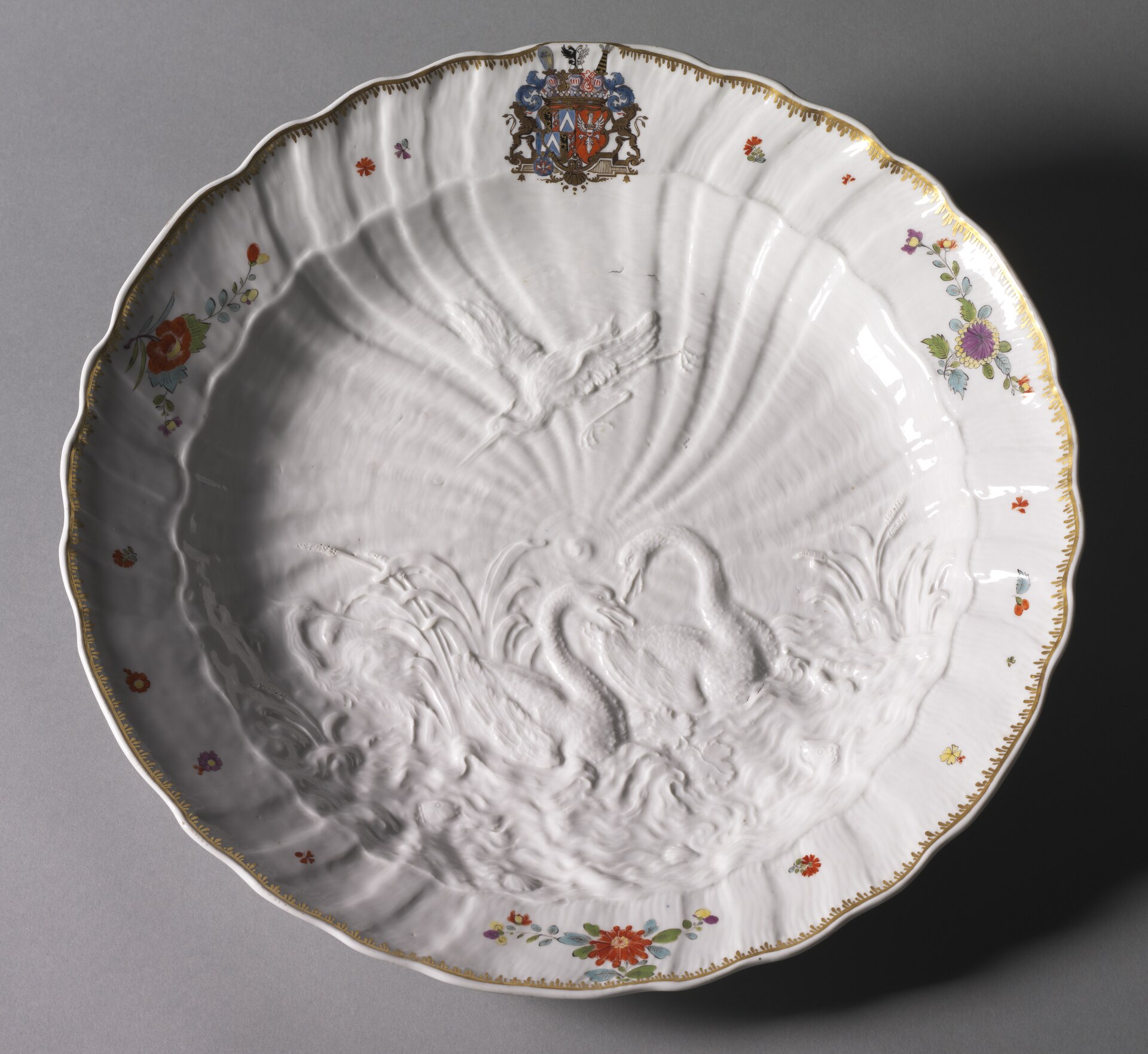
The record subject. Hard-paste porcelain, diameter 42 cm, c. 1737-1741, designed by Johann Joachim Kaendler for Heinrich Graf von Bruhl. Cleveland Museum of Art, accession 1951.103.
| Artist | Johann Joachim Kaendler, chief modeler, Meissen Porcelain Manufactory |
|---|---|
| Date | c. 1737-1741 |
| Medium | Hard-paste porcelain, molded in low relief, with polychrome enamels and gilding |
| Dimensions | Diameter 42 cm (16 9/16 in.) |
| Where it is now | Cleveland Museum of Art, Cleveland, Ohio (Decorative Art and Design, gallery 216A, French and German)last confirmed |
| Inventory number | 1951.103 |
| Attribution | AcceptedThe Cleveland Museum of Art catalogues this plate as designed by Johann Joachim Kaendler, Meissen's chief modeler from 1733. Full note |
| Object type | Ceramic |
| Period | German (Saxon), Baroque to early Rococo, eighteenth century |
| Cases | Has a provenance gap |
| Inscriptions | No mark or inscription is recorded in the Cleveland Museum of Art's published catalogue entry for this plate. Other Swan Service pieces that have passed through the auction market are typically marked with crossed swords in underglaze blue, the standard Meissen factory mark of the period; this record does not assert that mark for this specific plate without confirmation. |
| Owners on record | 5 links4 documented, 1 unknown |
| Sources | 18 cited |
About this record Last verified · 18 sources cited · Change log
On this page 9 sections
ContentsClose
A single plate, 42 centimetres across, from a dinner, coffee, tea and chocolate service of more than 2,200 pieces that Meissen's chief modeler Johann Joachim Kaendler and his colleague Johann Friedrich Eberlein built for Heinrich Graf von Bruhl between about 1736 and 1741. Bruhl was prime minister of Saxony, director of the Meissen manufactory, and by his own government's later account a man who had diverted more than five million talers of public money into a private life of watches, wigs and porcelain. He died in disgrace weeks after his king, in October 1763, as Prussian occupation left Saxony broken by the Seven Years War, and his heirs spent years selling off what he had built.
This plate's own paper trail, as the Cleveland Museum of Art records it, runs from Bruhl through a descendant, Count Szembek, at the Bruhl palace in Warsaw, to the New York dealers Rosenberg and Stiebel, refugees themselves from Nazi persecution of an older Frankfurt art-dealing family, who gave it to Cleveland in 1951. That route appears to have taken the plate out of Poland before 1945, the year Soviet troops burned and looted the Bruhl family's other seat at Pforten, where most of what remained of the service is reported, on a single hedged and only partly corroborated account, to have been destroyed.
Pieces of the service that did survive are now scattered across at least a dozen public collections on three continents, from Chicago to Nuremberg to Warsaw, and a trickle still reaches the auction room. No scholarly source consulted for this record gives a reliable total for how many of the original 2,200-plus pieces exist today; published estimates range from about one hundred to several hundred, and none of them is sourced to a documented census.
Provenance
Each link is graded. Documented: a cited source supports it. Disputed: the identification is argued but not established. Unknown: no owner for that span, and the gap is not smoothed into a narrative. The grades in the glossary.
- c. 1737 - 1763Heinrich Graf von Bruhldocumented
Made for Bruhl, director of the Meissen manufactory and prime minister of Saxony, as part of a dinner, coffee, tea and chocolate service of more than 2,200 pieces produced c. 1736-1741/42. He owned it until his death at Dresden on 28 October 1763.1257
- 1763 -The Bruhl family, heirs and descendantsunknown
Bruhl's estate was sequestered after his death, investigated, and substantially restored to his family; his picture gallery was sold to Catherine II of Russia in 1768 and his sons sold further property gradually over subsequent years. No source consulted documents the specific chain by which this individual plate passed within the family after 1763, or when it reached the Warsaw branch of the family at the Bruhl palace. The gap between 1763 and the Szembek ownership recorded by Cleveland is not bridged by any source found.910
- Count Szembek, Palais Bruhl, Warsawdocumented
Recorded in the Cleveland Museum of Art's own published provenance for this plate as a direct descendant of the Bruhl family, owning the plate at the Bruhl palace in Warsaw. No dates are given by the museum, and this record could not independently verify the genealogical connection beyond the museum's own statement.2
- - 1951Rosenberg and Stiebel, Inc., New Yorkdocumented
Acquired by the New York dealership descended from the Frankfurt firm founded in 1874 by Jakob Rosenbaum, whose later generations relocated to Amsterdam, London and finally New York from 1939 in the course of fleeing Nazi persecution. No acquisition date from the Szembek line is given.2
- 1951 - presentCleveland Museum of Artdocumented
Accessioned 21 March 1951 as a thirty-fifth-anniversary gift from Rosenberg and Stiebel, Inc. Shown in the museum's own 35th Anniversary Exhibition, 20 June to 30 September 1951, and published in the museum's Bulletin later that year and in its 1958 handbook as catalogue number 312. The Cleveland Museum of Art's own records flag this acquisition as not involving Nazi-era provenance concerns.1234
Technical evidence
| Attribution note | The Cleveland Museum of Art catalogues this plate as designed by Johann Joachim Kaendler, Meissen's chief modeler from 1733. The wider Swan Service is credited in the scholarly and museum literature jointly to Kaendler and his colleague Johann Friedrich Eberlein, with a third modeler, Johann Gottlieb Ehder, joining the project from about 1741. No individual piece of the service is signed; attribution rests on Meissen's own factory production records, principally Kaendler's monthly work reports (the Taxa), rather than on a signature or a contract naming this exact plate. |
|---|---|
| Support and medium | Hard-paste (true) porcelain, molded in low relief and painted in polychrome enamels with gilding over the glaze.15 |
| Dimensions | Diameter 42 cm (16 9/16 in.), as measured by the Cleveland Museum of Art.12 |
| Relief decoration | The cavetto is molded as a shallow shell form; two swans swim among reeds and bulrushes with a third waterbird in flight overhead, all rendered in low relief rather than painted alone.1 |
| Armorial device | Painted at the rim with the alliance coat of arms of Heinrich Graf von Bruhl and his wife, Maria Anna Franziska von Kolowrat-Krakowska, flanked by two figures.1 |
| Modelers of record | Designed and modeled 1736-1741 by Johann Joachim Kaendler, Meissen's chief modeler from 1733, with Johann Friedrich Eberlein, active at the factory from 1735 until his death in 1749. Johann Gottlieb Ehder joined the project from about 1741.5712 |
| Production window | Manufactory records place the order in May 1736; mould production began in December 1737; most shapes of the service were completed by 1741, with residual work running to about 1742. This plate is dated by Cleveland to c. 1737-1741.17 |
| Maker's mark | Not recorded in Cleveland's published entry for this plate. Comparable Swan Service pieces sold at auction elsewhere are consistently marked with crossed swords in underglaze blue, the standard Meissen mark of the period, but this record does not extend that observation to this specific plate without confirmation.1617 |
| Kaendler's death year, a database discrepancy | The Cleveland Museum of Art's own open-access database currently gives Kaendler's dates as 1706-1768. The standard scholarly dating, given by the Institut fur Sachsische Geschichte und Volkskunde's Sachsische Biografie and repeated across other museum catalogues consulted for this record, is 1706-1775. This record uses 1775 and flags the discrepancy for Cleveland's own data to be corrected.212 |
Images
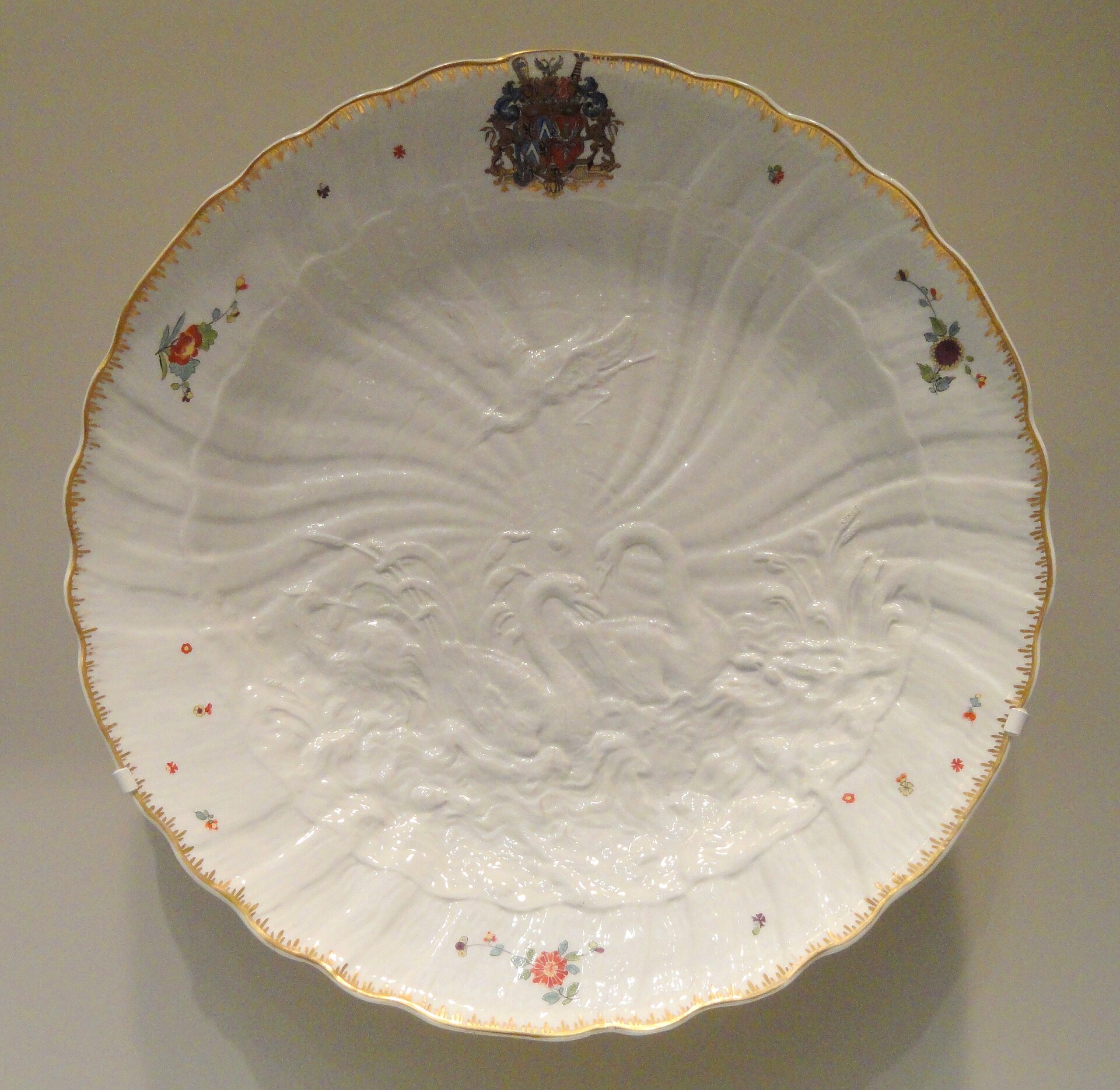
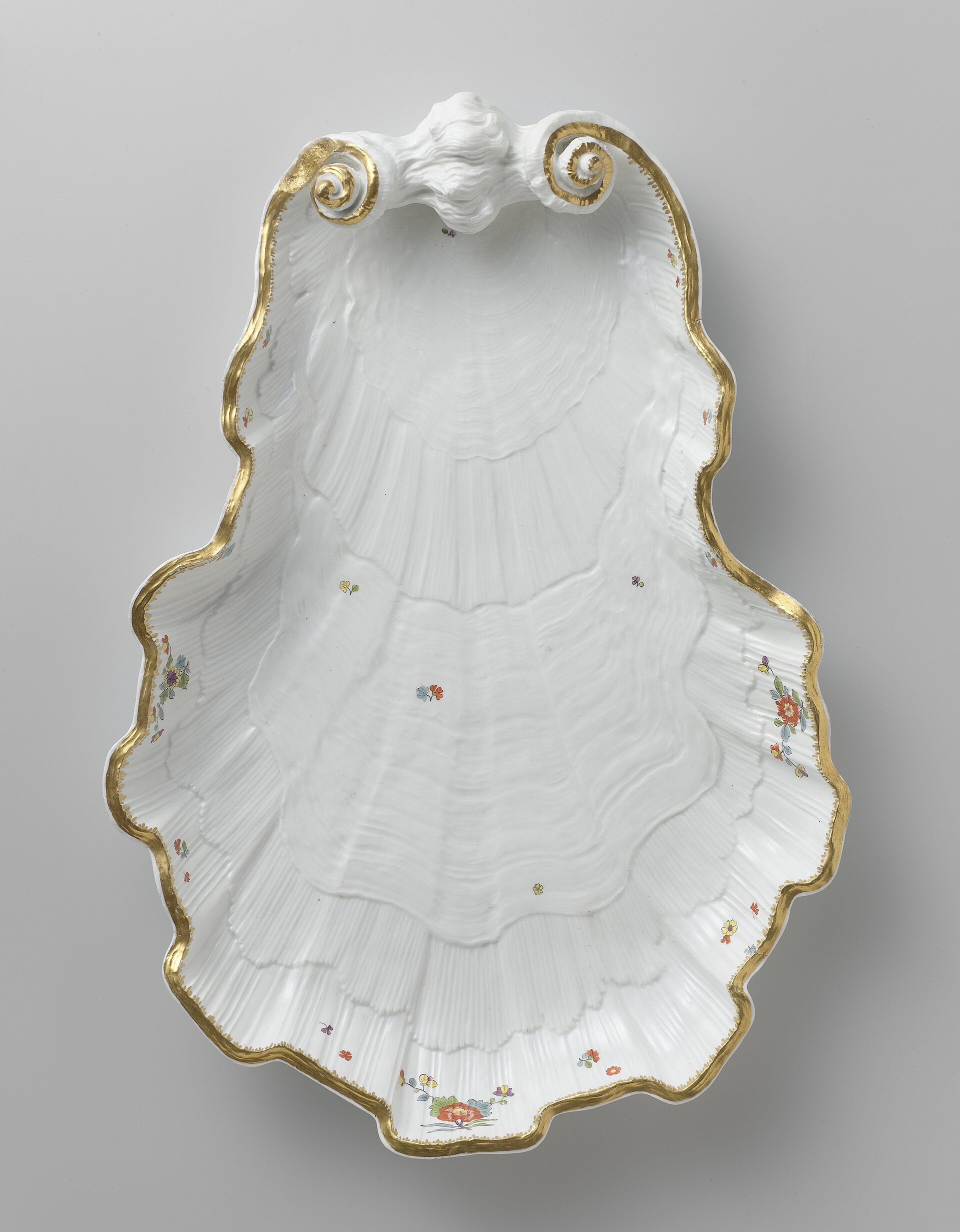
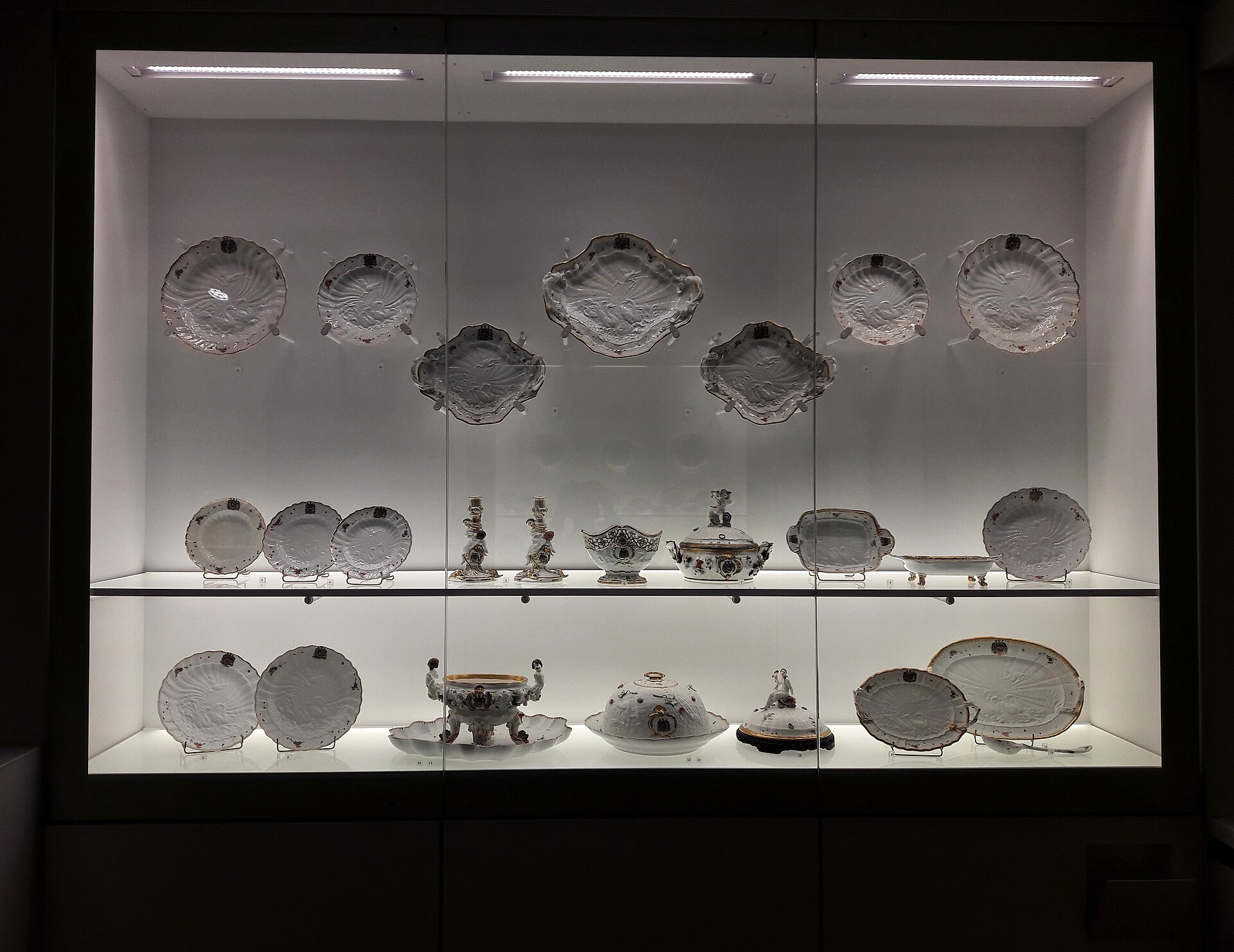
The record in full
Chapter 1What it is
The plate is a large, scalloped charger, 42 centimetres in diameter, molded in low relief so that its whole cavetto reads as a shallow, curling shell.
The plate is a large, scalloped charger, 42 centimetres in diameter, molded in low relief so that its whole cavetto reads as a shallow, curling shell. Two swans swim across it through reeds and rushes, worked into the porcelain itself rather than merely painted on, with a third waterbird shown in flight overhead. Multicolored sprigs of flowers, in the loose, scattered Meissen manner known as indianische Blumen, are painted across the surface between the relief elements, and the rim is trimmed in gold. At the top edge sits a painted heraldic cartouche, the alliance coat of arms of Heinrich von Bruhl and his wife, flanked by two figures, the whole surrounded by further gilding.
It is one plate from a service that was, when finished, the largest single order Meissen had ever executed: more than 2,200 pieces for a table for around one hundred people, with a coffee, tea and chocolate service added on top that some accounts put the grand total closer to 3,000. This plate is not exceptional within that run. Its importance is that it is a documented, accessioned survivor of an object whose own history is a near-total loss.
Chapter 2How it was made
Meissen's own manufactory report from May 1736 records that a new table service of entirely new design had been ordered for Bruhl, the manufactory's director.
Meissen's own manufactory report from May 1736 records that a new table service of entirely new design had been ordered for Bruhl, the manufactory's director. Kaendler began with sample plates that year; the plaster and metal moulds for the service went into production in December 1737, and most of its individual shapes were finished by 1741, with the last additions running to about 1742. Cleveland dates this plate to that central window, c. 1737-1741.
Kaendler did not invent the shell-and-water forms from imagination alone. In January 1738 he traveled to Dresden and spent three days at the elector's Naturalienkammer, the royal natural-history cabinet, drawing and examining actual shells so that the service could be built on observed nature rather than a generic ornamental vocabulary. That trip is documented in Kaendler's own monthly work reports to the factory, the Taxa, which he was required to file listing everything he had modeled. The reports are the closest thing that exists to the maker's voice on this object: a salaried craftsman accounting for his hours, not a signed declaration of authorship, and that is the correct way to read every attribution made about this service, including the one on this page.
Kaendler did not work alone. Johann Friedrich Eberlein, active at Meissen from 1735 until his death in 1749, is credited as co-modeler across the standard literature and by the Art Institute of Chicago's own catalogue of its Swan Service dish. A third modeler, Johann Gottlieb Ehder, joined the project from around 1741, toward the end of the main production run.
Chapter 3The commission
Heinrich Graf von Bruhl rose from page at the Dresden court to Saxony's most powerful minister under two electors.
Heinrich Graf von Bruhl rose from page at the Dresden court to Saxony's most powerful minister under two electors. He secured the succession of Frederick Augustus II, who reigned in Poland as Augustus III, after the death of Augustus the Strong in 1733, was made a Reichsgraf in 1737, and was appointed director of the Meissen manufactory in 1739, a post that let him commission and receive porcelain free of charge, a privilege the king himself, who nominally owned the factory, did not extend to himself in the same way.
The service bears the combined arms of Bruhl and his wife, Maria Anna Franziska von Kolowrat-Krakowska, whom he had married on 29 April 1734. Several secondary accounts describe the Swan Service loosely as a wedding gift from the king, but the marriage itself predates the order by roughly two to three years; the manufactory's own May 1736 report simply records a new service commissioned for Bruhl, without stating an occasion. This record treats the wedding-gift framing as unconfirmed rather than repeats it as fact: the arms on the porcelain mark a marriage that had already taken place, not necessarily the reason the service was ordered.
What is not in doubt is the scale of the thing. A private table service of more than 2,200 pieces, designed, modeled and fired over roughly five years by a factory that was simultaneously the most prestigious and the most tightly controlled porcelain works in Europe, was without precedent when it was made and has had no real successor since.
Chapter 4A name built into the porcelain
The central image on every plate, dish and tureen in the service is not a generic Rococo flourish.
The central image on every plate, dish and tureen in the service is not a generic Rococo flourish. It is a specific and, for its first audience, an obvious pun. The German word Bruhl (more properly Bruch or Bruehl in regional usage) denotes a wet, marshy meadow, and the swans swimming through reeds across every piece of the dinner service are a visual play on the count's own name, worked directly into the object he ate from. The rippling, shell-formed ground beneath the birds carries the same watery theme through the whole design vocabulary of the service, down to individual pieces modeled as shells and to figures drawn from classical sea mythology, among them Glaukos and Galatea, that appear on the service's larger set-pieces.
This is iconography built for one specific, private viewer and his guests: a court minister literally eating off his own name, in a period when heraldic and emblematic wordplay of this kind was a normal and expected part of aristocratic self-presentation, not an eccentricity. It required no text to explain it to the people it was made for. Kaendler's shell studies at the Naturalienkammer were not naturalism for its own sake; they were the technical means by which the pun was made to look convincingly like the natural world rather than like decoration.
Chapter 5The patron
Bruhl drew combined salaries reported at 67,000 talers a month from his various offices, kept some 200 domestics, and built what contemporaries and later inventories describe as Europe's largest...
Bruhl drew combined salaries reported at 67,000 talers a month from his various offices, kept some 200 domestics, and built what contemporaries and later inventories describe as Europe's largest collection of watches, an equally large collection of ceremonial wigs and hats, the largest private collection of Meissen porcelain in the world, and one of the largest collections of Kabbalah literature in Europe. His library ran to 70,000 volumes, among the largest private libraries in the Holy Roman Empire. A government inquiry opened after his death found that he had diverted more than five million talers of public money to his own use over the course of his career, though the same inquiry concluded that his fortune derived chiefly from the king's own prodigal generosity rather than from clearly unlawful means. The Kabbalah collection is recorded in the general literature on Bruhl without a citable inventory or catalogue this record could locate; it is included here as a documented claim about his library, not as evidence of any belief he held, and is flagged for replacement with a primary bibliographic source.
The Swan Service was one part of a much larger pattern of collecting and commissioning that also produced the Meissen Fountain, described as the largest assemblage of its kind ever made at the factory, and that funded a picture gallery large enough that, after his death, Catherine II of Russia bought it outright to help found what became the Hermitage. Bruhl was, by every account consulted for this record, an informed and serious collector as well as an extravagant one; the two things are not presented here as contradictory, because for a court minister of his rank and period they were not.
Chapter 6War and collapse
Bruhl's foreign policy helped bring Frederick II of Prussia's army into Saxony in 1756, opening the Seven Years War.
Bruhl's foreign policy helped bring Frederick II of Prussia's army into Saxony in 1756, opening the Seven Years War. The Saxon army, some 17,000 men, was forced to surrender at Pirna within weeks for lack of supplies. Bruhl and Augustus III fled to Bohemia, and in the course of leaving Dresden they evacuated paintings and porcelain from the electoral and their own collections, while the state's archives were left behind and fell to the Prussians. Saxony remained a Prussian-occupied war theatre for most of the following seven years.
The Bruhl family's country seat at Pforten, southeast of Dresden in what is today Brody in western Poland, was devastated during the war on Frederick II's explicit order, one of the direct costs of Bruhl's own diplomacy landing on his own property. The Peace of Hubertusburg in February 1763 ended the war and, with it, Saxony's standing as a significant European power. Augustus III died that October; Bruhl, who had already surrendered his offices, followed him within weeks, dying at Dresden on 28 October 1763.
The new elector, Frederick Christian, ordered an immediate inquiry into Bruhl's administration. It found the diversion of public funds described above, sequestered his estate, and then restored a large part of it to his family once the inquiry concluded that the money had come chiefly from royal favour rather than clear-cut crime. Bruhl's heirs inherited a fortune that was, on paper, still substantial, and a reputation that was not.
Chapter 7The estate after Bruhl
A large part of Bruhl's collection was sold off after his death to settle what remained of his debts.
A large part of Bruhl's collection was sold off after his death to settle what remained of his debts. The best-documented sale is the picture gallery, bought by Catherine II of Russia in 1768 and folded into the founding holdings of what became the Hermitage Museum in Saint Petersburg. His sons, unable to sustain the household on the scale their father had built it, sold estates and property gradually over the following years rather than in a single liquidation.
Pforten itself passed to Bruhl's eldest son, Alois Friedrich von Bruhl, a Saxon politician, soldier and dramatist, who lived out his last years there. The porcelain, unlike the pictures, is not documented in this record's sources as having been sold as a single lot at any point in the eighteenth or nineteenth century; the working assumption in the specialist literature, though not one this record can source to a specific inventory, is that it descended within the family and its Warsaw branch, was gradually broken up piece by piece across generations, and only entered the market in scattered individual sales from the later nineteenth century onward. That gradual, undocumented dispersal is itself the reason the service now exists mostly as isolated plates and dishes in different museums rather than as a coherent set anywhere.
Chapter 8From the Bruhl palace in Warsaw to Cleveland
Cleveland's own published provenance note for this plate is short and specific: made for Count Heinrich Bruhl; then Count Szembek, at the Palais Bruhl in Warsaw, described by the museum as a direct...
Cleveland's own published provenance note for this plate is short and specific: made for Count Heinrich Bruhl; then Count Szembek, at the Palais Bruhl in Warsaw, described by the museum as a direct descendant of the Bruhl family; then the New York dealers Rosenberg and Stiebel, Inc. No dates are given by the museum for the Szembek ownership or for when Rosenberg and Stiebel acquired the plate, and this record was not able to independently verify the exact genealogical link between the Szembek and Bruhl families beyond Cleveland's own catalogue statement. That gap is recorded as a gap, not bridged with a guess.
Rosenberg and Stiebel were not an anonymous trade name. The firm descended from Antiquitaten J. Rosenbaum, founded in Frankfurt in 1874 by Jakob Rosenbaum, which under his son Isaak Rosenbaum began dealing in Old Master paintings and brought in family members Saemy Rosenberg and Eric Stiebel. With the rise of the Nazi regime the family opened branches outside Germany, first in Amsterdam and London; Eric Stiebel established the New York gallery in 1939, and Saemy Rosenberg and Hans Stiebel joined him there after the Second World War, once it was no longer possible or safe to continue trading from continental Europe. The firm that eventually gave this plate to Cleveland was itself a product of forced emigration from the same part of Europe the plate had come from.
Cleveland accessioned the plate on 21 March 1951 as a gift marking the museum's thirty-fifth anniversary, from Rosenberg and Stiebel, Inc. It was shown that year in the museum's own 35th Anniversary Exhibition, running from 20 June to 30 September 1951, and was published shortly afterward in Helen Foote's article on new porcelain acquisitions in the museum's Bulletin, and again in the museum's 1958 handbook as catalogue number 312.
Chapter 9What happened to the rest of the service
The most widely repeated account of the Swan Service's later history concerns Pforten again, this time in 1945.
The most widely repeated account of the Swan Service's later history concerns Pforten again, this time in 1945. According to Wikipedia's account of the service, sourced to a 2024 academic study of armorial porcelain, all pieces of the service that were not on loan to a Dresden museum at the time were lost in the final stages of the Second World War, when the advancing Red Army set fire to the Bruhl family's Pforten castle; the same account states, in explicitly hedged language, that surviving pieces hidden in the castle's cellars are said to have been used by Soviet soldiers as targets in an improvised version of clay pigeon shooting. This record was not able to independently examine the cited academic study and repeats the claim with the same hedge the secondary source uses, rather than presenting it as a fully documented fact. Independent sources on the wider history of the Pforten building corroborate that it was looted and burned again by Soviet forces in 1945, consistent with the general destruction, even though none of the sources consulted here independently confirms the clay-pigeon detail.
What this record can state with more confidence is that this particular plate was not at Pforten in 1945. Cleveland's provenance places it with Count Szembek at the Warsaw palace and then with a New York dealership, a route that, on the timeline the museum gives, had already taken the plate out of the Bruhl family's direct possession and out of Poland before the war reached its final, most destructive phase. The plate's survival looks less like luck at the point of destruction and more like the ordinary, earlier churn of the international art trade getting it out of harm's way well beforehand, though the exact date of that removal is not recorded by Cleveland and remains an open question.
Chapter 10Where the pieces are now
Surviving pieces of the Swan Service are today held by, at minimum, the Cleveland Museum of Art; the Art Institute of Chicago; the Frick Collection, New York; the Philadelphia Museum of Art; the...
Surviving pieces of the Swan Service are today held by, at minimum, the Cleveland Museum of Art; the Art Institute of Chicago; the Frick Collection, New York; the Philadelphia Museum of Art; the Metropolitan Museum of Art; the Gardiner Museum, Toronto; the Nelson-Atkins Museum of Art, Kansas City; the Krannert Art Museum at the University of Illinois; the Wadsworth Atheneum, Hartford; the Los Angeles County Museum of Art; the Smithsonian's National Museum of American History; the Spencer Museum of Art at the University of Kansas; the Germanisches Nationalmuseum, Nuremberg; the Staatliche Kunstsammlungen Dresden, whose loaned pieces are the ones specifically said to have escaped the 1945 destruction; the Rijksmuseum, Amsterdam; and the National Museum in Warsaw. Individual pieces also remain in private hands and continue to appear at auction.
No total survival figure in the sources consulted for this record is sourced to an actual, published census of the service. The Frick Collection's own public-facing curatorial content states that about one hundred pieces survive from the original run of more than 2,200. Other sources describe the surviving material only in general terms, as scattered across many museums with a trickle still reaching the market, without committing to a number. This record does not adopt a single figure as fact; it reports the range and names where the higher-confidence figure comes from.
Chapter 11The market
Individual Swan Service pieces reach public auction with some regularity, almost always in London.
Individual Swan Service pieces reach public auction with some regularity, almost always in London. Bonhams sold a chocolate cup and saucer from the service on 5 December 2012, as part of the Marouf Collection, Part I, a single-owner sale of eighteenth-century Meissen, for a recorded price of 55,250 pounds sterling; that lot's own provenance was given as the Baron von Born Collection, Budapest, a named prior owner rather than an anonymous consignor. On 2 December 2015, in Bonhams' Fine European Ceramics sale in London, a teacup and saucer from the service made 31,250 pounds. On 4 July 2024 Bonhams sold a circular dish from the service for 24,320 pounds, and on 3 December 2024 a pair of circular dishes for 30,720 pounds; the pair's own catalogue entry traced one dish to a sale at Galerie Koller, Zurich, on 11 December 1997 and the other to Christie's New York on 23 April 1998, before the two were reunited for the 2024 sale.
None of the Bonhams listings consulted for this record separated a hammer price from the buyer's premium; each gave a single total, described as inclusive of premium, with no breakdown. That is recorded here as a limitation of the source rather than smoothed over: this record cannot state what any of these lots hammered for before fees, only what the buyer's all-in cost was. A separately reported Christie's New York sale of an armorial tureen from the service in May 2014, with a headline result around 149,000 US dollars against an estimate of 80,000 to 120,000 dollars, could not be confirmed against a Christie's-hosted primary source within the time available for this record and is omitted from the figures above rather than presented as verified.
Chapter 12What is still unresolved
This plate's own file has two clean gaps: the years and circumstances of the Szembek ownership at the Bruhl palace in Warsaw, and the exact date the plate passed to Rosenberg and Stiebel before its...
This plate's own file has two clean gaps: the years and circumstances of the Szembek ownership at the Bruhl palace in Warsaw, and the exact date the plate passed to Rosenberg and Stiebel before its 1951 gift to Cleveland. Both are recorded as gaps rather than filled with a plausible guess.
The wider service's file has a larger and more consequential gap: no source consulted for this record gives a documented, citable total for how many of the original 2,200-plus pieces survive today, and the one specific, dramatic account of the 1945 loss at Pforten rests on a single secondary citation this record could not independently examine. Both points are carried into the open questions below rather than resolved by preferring the more dramatic or the more comfortable version of events.
The artist
Johann Joachim Kaendler, with Johann Friedrich Eberlein; commissioned by Heinrich Graf von Bruhl
No piece of the Swan Service carries a signature. What can be said about who made it rests on Meissen's own internal paperwork, principally the monthly work reports, called the Taxa, that the factory required its modelers to file, and on the later scholarly and museum consensus built from those records. Kaendler is the name attached to the service because he was Meissen's chief modeler and its documented lead designer; Eberlein is named beside him because factory records and the standard literature credit him as co-modeler through most of the run; and Bruhl belongs in the same entry because the service cannot be separated from the man who ordered it, funded it through means a government inquiry later called into question, and lost almost all of it within thirty years of its completion.
Related works
| Work | Relation | Where it is |
|---|---|---|
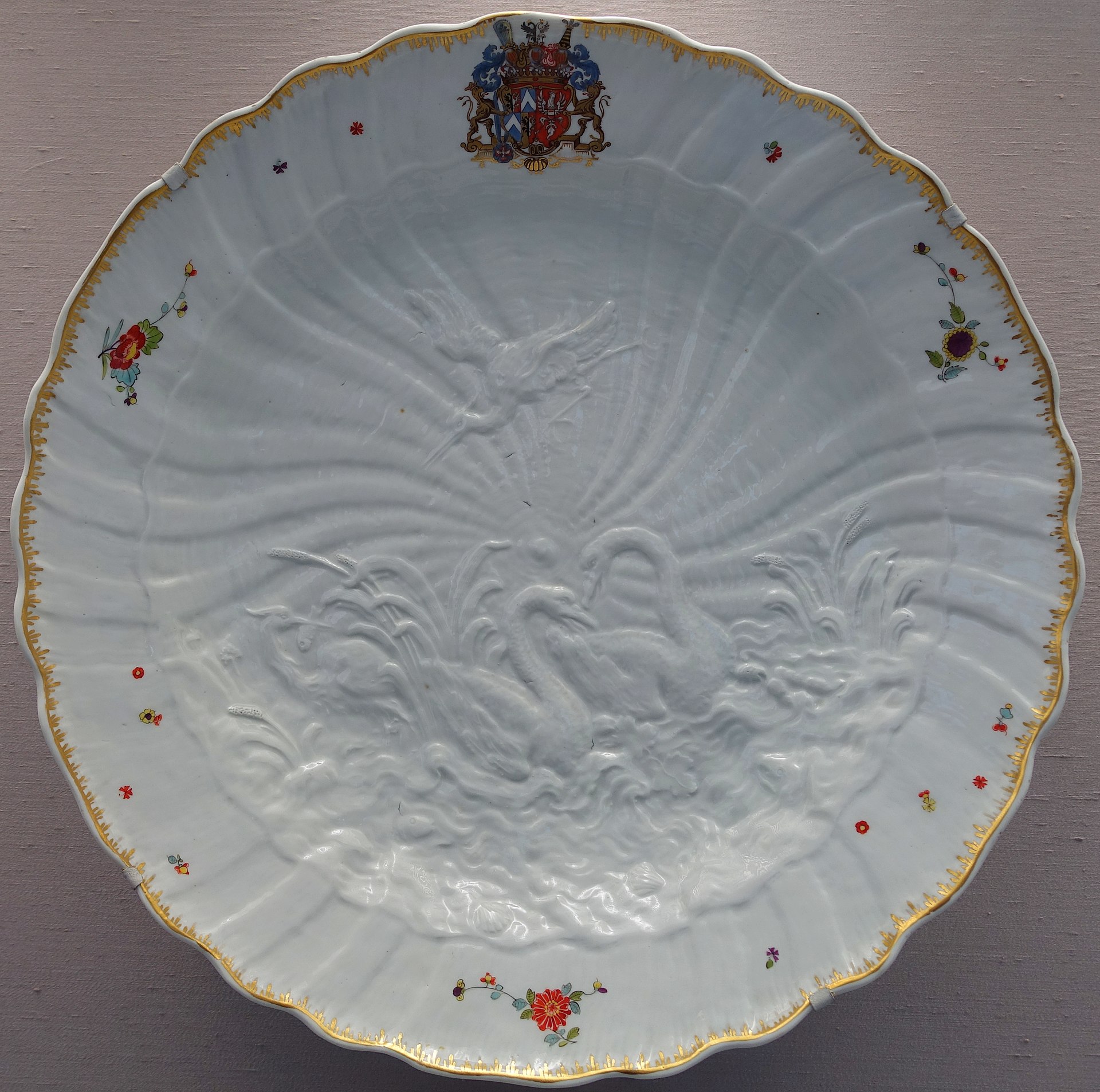
| Charger from the Swan Service Johann Joachim Kaendler and workshop | Different piece from the same service A charger from the same production run, photographed on display in Nuremberg. Not the Cleveland plate. | Germanisches Nationalmuseum, Nuremberg |
| Dish from the Swan Service Johann Joachim Kaendler and Johann Friedrich Eberlein | Different piece from the same service Dated 1738 by the Art Institute, whose own catalogue entry credits both modelers by name and gives the 1734 marriage date and 1736 commission date used in this record. | Art Institute of Chicago, Bessie Bennett Fund |
| Parts of a service, known as the Swan Service Meissen Porcelain Manufactory | Different pieces from the same service Several individual pieces, catalogued as BK-1965-105 and related numbers, entered the Rijksmuseum's collection separately across the twentieth century. | Rijksmuseum, Amsterdam |
| Swan Service group Meissen Porcelain Manufactory | Different pieces from the same service The Warsaw museum's holding is notable because it places surviving pieces of the service back in the city where Count Szembek is recorded as having owned this Cleveland plate, at the Bruhl palace. | National Museum in Warsaw |
| Spicebox, cup and saucer from the Swan Service Johann Joachim Kaendler and Johann Friedrich Eberlein | Different pieces from the same service Discussed by the Frick's chief curator Xavier F. Salomon in the museum's Cocktails with a Curator series, the source for the approximate figure of one hundred surviving pieces used in this record. | The Frick Collection, New York |
| Dish, plate, tureen stand and teacup with saucer from the Swan Service Johann Joachim Kaendler and Johann Friedrich Eberlein | Different pieces from the same service A small group of pieces the Gardiner catalogues individually, dated c. 1737-1741, the same production window given by Cleveland for this plate. | Gardiner Museum, Toronto |
| Plate from the Swan Service Johann Joachim Kaendler and Johann Friedrich Eberlein | Different piece from the same service A second surviving plate from the same 1737-1741 production run, in a separate American collection. | Nelson-Atkins Museum of Art, Kansas City |
Open questions
- How many pieces of the Swan Service survive today, across all museums and private collections combined. No source consulted for this record gives a documented total; the Frick Collection's own figure of about one hundred is the most specific number found, and it is not sourced to a published census.
- When did Count Szembek acquire the plate, and what is the documented genealogical link between the Szembek family and the Bruhl family. Cleveland's own catalogue states the relationship as fact but gives no supporting detail.
- When exactly did Rosenberg and Stiebel acquire the plate from the Szembek line, and by what route did it leave Poland. The gap between an undated Warsaw ownership and the 1951 Cleveland gift is not documented in the sources consulted.
- Is the account of the 1945 destruction at Pforten, including the specific claim that surviving pieces were used as targets by Soviet soldiers, corroborated by any source beyond the single secondary citation this record could not independently examine.
- Does any part of the large table centrepiece described in the general literature on the service, with its shells and mythological marine figures, survive intact today, or only as fragments distributed among the same museums that hold the tableware.
- What did the Christie's New York sale of a Swan Service tureen in May 2014 actually hammer for, with premium separated. This record could not confirm the widely repeated figure against a primary Christie's source and has omitted it rather than repeat an unverified number.
- What was the precise nature and extent of Bruhl's Kabbalah book collection, cited in general biographical accounts of him without a supporting inventory or bibliography this record could locate.
Questions about this object
What is Plate from the Swan Service?
Plate from the Swan Service is a ceramic, dated c. 1737-1741. Medium: Hard-paste porcelain, molded in low relief, with polychrome enamels and gilding.
Who made Plate from the Swan Service, and is the attribution settled?
The attribution to Johann Joachim Kaendler, chief modeler, Meissen Porcelain Manufactory is recorded here as accepted. The Cleveland Museum of Art catalogues this plate as designed by Johann Joachim Kaendler, Meissen's chief modeler from 1733. The wider Swan Service is credited in the scholarly and museum literature jointly to Kaendler and his colleague Johann Friedrich Eberlein, with a third modeler, Johann Gottlieb Ehder, joining the project from about 1741. No individual piece of the service is signed; attribution rests on Meissen's own factory production records, principally Kaendler's monthly work reports (the Taxa), rather than on a signature or a contract naming this exact plate.
Where is Plate from the Swan Service now?
Cleveland Museum of Art, Cleveland, Ohio (Decorative Art and Design, gallery 216A, French and German). Inventory number 1951.103. Last confirmed 18 August 2026. Accessioned 21 March 1951 as a thirty-fifth-anniversary gift from Rosenberg and Stiebel, Inc.
What is still unknown about Plate from the Swan Service?
How many pieces of the Swan Service survive today, across all museums and private collections combined. No source consulted for this record gives a documented total; the Frick Collection's own figure of about one hundred is the most specific number found, and it is not sourced to a published census.
Sources
- 1Cleveland Museum of Art, catalogue entry for 'Plate from the Swan Service,' accession 1951.103. clevelandart.org/art/...
- 2Cleveland Museum of Art, Open Access API, structured data record for accession 1951.103, including provenance note, credit line, creators, dimensions, exhibitions and citations, accessed 2026-08-18. openaccess-api.clevelandart.org/api/...
- 3Helen Foote, 'Important Additions to the Porcelain Collection,' The Bulletin of the Cleveland Museum of Art 38, no. 8 (October 1951): 199-200. Citation supplied by the Cleveland Museum of Art's own catalogue record; the article text itself was not independently examined for this record. jstor.org/stable/...
- 4The Cleveland Museum of Art Handbook (Cleveland: The Cleveland Museum of Art, 1958), catalogue no. 312. Citation supplied by the Cleveland Museum of Art's own catalogue record; the handbook text itself was not independently examined for this record. archive.org/details/...
- 5Art Institute of Chicago, Open Access API, catalogue entry for 'Dish from the Swan Service,' object 74737. api.artic.edu/api/...
- 6The Frick Collection, 'Cocktails with a Curator: Meissen Swan Service,' curator Xavier F. Salomon. frick.org/interact/...
- 7Wikipedia, 'Swan Service.' source, with a specialist Meissen catalogue raisonne; used here for the 1945 Pforten account (itself further sourced by Wikipedia to note 8 below), the production chronology, and the museum list. en.wikipedia.org/wiki/...
- 8Rachel L. Denyer, Morgan C. T. Denyer and Howell G. M. Edwards, Armorial Porcelain: The Genesis (Springer, 2024), pp. 148-151. Identified as the underlying citation for the 1945 Pforten destruction account via Wikipedia's own reference list; the book itself was not independently examined for this record and the claim is reported with that caveat. Not independently examined; identified only via Wikipedia's own reference list (source 7), which is the URL given here pending direct verification of the original 2024 book. en.wikipedia.org/wiki/...
- 9Wikipedia, 'Heinrich von Bruhl.' source, with a scholarly biography; used here for Bruhl's career, wealth, the post-death inquiry, and the estate settlement. en.wikipedia.org/wiki/...
- 10Heinrich Graf von Bruhl (heinrich-graf-von-bruehl.de), 'Biography of Bruhl.' heinrich-graf-von-bruehl.de/en/...
- 11Wikipedia, 'Brody, Zary County.' source, ; used here for the Seven Years War and 1945 destruction of the Bruhl family palace at Pforten/Brody. en.wikipedia.org/wiki/...
- 12Sachsische Biografie, Institut fur Sachsische Geschichte und Volkskunde, entry on Johann Joachim Kaendler (1706-1775). saebi.isgv.de/biografie/...
- 13German Wikipedia, 'Schwanenservice.' source, ; used here to corroborate modelers named and the shell-mirror plate form. de.wikipedia.org/wiki/...
- 14Bonhams, 'A Meissen dish from the Swan Service, circa 1738-39,' sale of 4 July 2024, lot 164. bonhams.com/auction/...
- 15Bonhams, 'A pair of Meissen circular dishes from the Swan Service, circa 1738-39,' sale of 3 December 2024, lot 146. bonhams.com/auction/...
- 16Bonhams, 'A very rare Meissen teacup and saucer from the Swan Service, circa 1738,' Fine European Ceramics, 2 December 2015, lot 46. bonhams.com/auctions/...
- 17Bonhams, 'A very rare Meissen chocolate cup and saucer from the Swan service, circa 1739-40,' The Marouf Collection, Part I, 5 December 2012, lot 39. bonhams.com/auctions/...
- 18Wikimedia Commons, category and file-level licence metadata for images used in this record, verified via the Commons API field for each file. commons.wikimedia.org/wiki/...
Last verified · Published
Change log
18 August 2026 - Record created at the house standard: researched narrative, technical evidence, maker dossier, graded provenance chain, prices with hammer and premium separated, related works, open questions and sources.