The Wade Cup with Animated Script
Unidentified metalworker, eastern Iran (Khorasan) or Azerbaijan - region disputed · c. 1200-1221 (Cleveland Museum of Art catalogue, following R. Ettinghausen's 1957 case for Khorasan before the Mongol destructions of 1221-22); alternatively 'the third decade of the thirteenth century' (c. 1221-1230) in D. S. Rice's 1955 monograph, which argued for Azerbaijan or the Caucasus
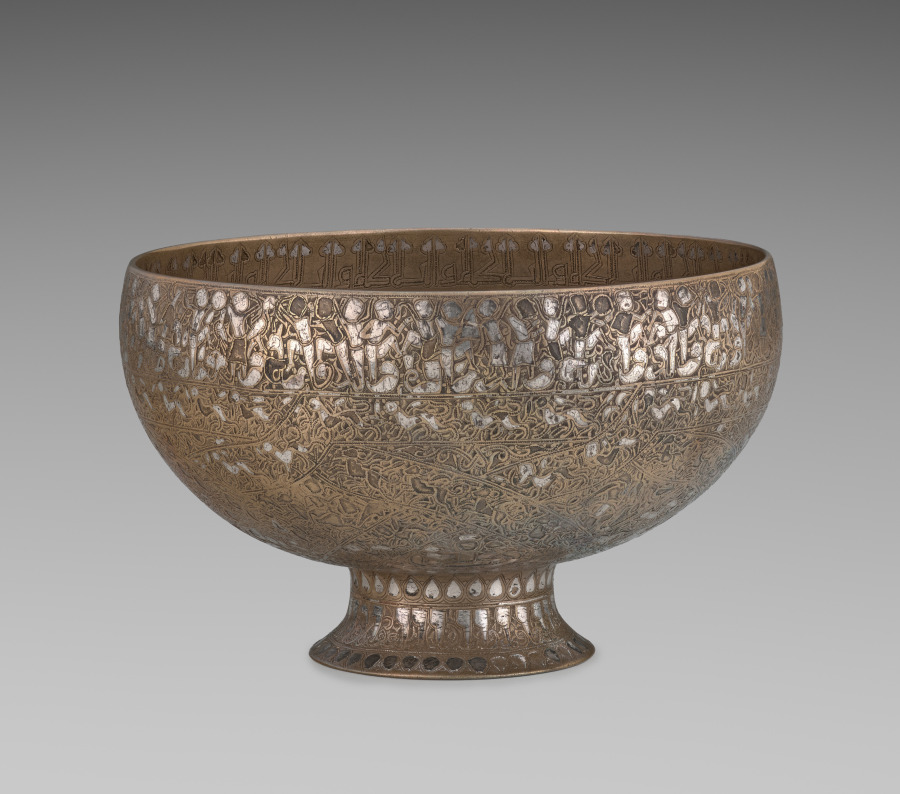
The record subject, in three-quarter view. Cast brass inlaid with silver, 11.5 cm high, 16.1 cm in diameter. The animated rim inscription is visible along the top edge; the crossing exterior bands and zodiac interstices cover the body, and the pierced, tassel-bordered foot is at the base.
| Artist | Unidentified metalworker, eastern Iran (Khorasan) or Azerbaijan - region disputed |
|---|---|
| Date | c. 1200-1221 (Cleveland Museum of Art catalogue, following R. Ettinghausen's 1957 case for Khorasan before the Mongol destructions of 1221-22); alternatively 'the third decade of the thirteenth century' (c. 1221-1230) in D. S. Rice's 1955 monograph, which argued for Azerbaijan or the Caucasus |
| Medium | Brass, cast, inlaid with silver (silver inlay now partly lost) |
| Dimensions | Overall height 11.5 cm (4 1/2 in.); diameter 16.1 cm (6 5/16 in.) |
| Where it is now | Cleveland Museum of Art, Cleveland, Ohio, Gallery 116 (Islamic)last confirmed 6 August 2026 |
| Inventory number | 1944.485 |
| Attribution | DisputedThe cup is unsigned, undated and names no patron. Full note |
| Object type | Islamic metalwork |
| Period | Late Seljuq or Khwarazmian-era Iran, early thirteenth century. The Cleveland Museum of Art's own period label, 'Iran, Seljuq period of Iran (1037-1194),' predates the object's own catalogued date range of 1200-1221 by several years; Great Seljuq authority in Khorasan had already given way to the Khwarazmshahs by about 1200, so the label and the date range sit awkwardly together in the museum's own record. This is noted as a minor cataloguing inconsistency, not a scholarly claim about the object. |
| Cases | Disputed attribution · Has a provenance gap |
| Inscriptions | Rim: a band of 'animated' naskhi in which the upper strokes of the letters are formed from human figures and the lower strokes from animal parts, reading (Rice's translation, accepted with minor reservations by Ettinghausen): 'Glory, and success, and government, and bliss, and soundness, and peace of mind, and mercy, and well-being, and good health, and duration, and increase, and satisfaction, and care, and continuance to its owner.' It names no owner, patron or maker. Foot: a narrower band of 'human-headed' naskhi, the letters' upper strokes ending in human heads, giving what Ettinghausen describes only as 'a brief formula of good wishes'; no source consulted for this record publishes a full transliteration or translation of the foot text. Interior rim: a continuous Kufic frieze that Rice read as a repetition of the single word wal-harakah ('and blessing'), except that one instance, once, in fact reads wal-dawlah ('and government', with the letter lam missing) - a variant Rice's monograph did not note and Ettinghausen's review corrects. |
| Owners on record | 5 links3 documented, 1 disputed, 1 unknown |
| Sources | 11 cited |
About this record Last verified 6 August 2026 · 11 sources cited · Change log
On this page 12 sections
ContentsClose
A small footed brass bowl, 11.5 centimetres high and 16.1 in diameter, cast in one piece and inlaid all over with silver, most of it now lost. Below the rim runs the most celebrated single inscription in Islamic metalwork: a band of good wishes to its owner written in letters built entirely from human figures and animals, the fullest development of what is called animated script. Below that, bands of confronted and processing beasts frame the twelve signs of the zodiac, and the interior floor carries four sphinxes revolving around a knot of fish.
The cup is unsigned, undated and names no owner. It surfaces on paper for the first time in a February-March 1943 exhibition catalogue at the University of Michigan, and was bought later that same period by the Cleveland Museum of Art from Heeramaneck Galleries in New York, using a fund established by the bequest of J. H. Wade, a museum trustee who had died in 1926. D. S. Rice's 1955 monograph placed it in Azerbaijan around 1221-1230; Richard Ettinghausen's 1957 review-article in Ars Orientalis, running to forty pages, contested almost every point and built a ten-strand case for Khorasan around 1200 instead. The dispute was never formally resolved by a third study, and the Cleveland Museum's own current catalogue quietly follows Ettinghausen's date without committing to either scholar's region.
Nothing about the maker survives: no name, no workshop mark, no city. What is known instead is the milieu - a small group of dated comparanda, a metalworking culture destroyed within a generation by the Mongol invasions of 1221-22, and two of the twentieth century's leading Islamic art historians reading the same unsigned object and reaching different conclusions from the same evidence.
Provenance
Each link is graded. Documented: a cited source supports it. Disputed: the identification is argued but not established. Unknown: no owner for that span, and the gap is not smoothed into a narrative. The grades in the glossary.
- c. 1163-1221 - unknownUnidentified metalworker and first ownerdisputed
Region and date are both scholarly disagreements rather than documented facts. D. S. Rice (1955) argued Azerbaijan or the Caucasus, c. 1221-1230; Richard Ettinghausen (1957) argued Khorasan, probably Herat or Nishapur, c. 1200 and before 1221. No inscription on the object names a maker, patron, place or date.234
- unknown - by 1943Unknownunknown
No owner is documented between manufacture and 1943. Whether or when the piece left Iran or Afghanistan, and by what route, is not recorded in the sources consulted.2
- by 1943 - 1943Unrecorded lenderdocumented
First documented appearance: 'Metalwork from Islamic Countries', Rackham Building, University of Michigan, Ann Arbor, 25 February - 11 March 1943, where the cup was, in Ettinghausen's own words, 'first briefly described and illustrated'. The lender is not named in the sources consulted; it is not confirmed here that the lender was Heeramaneck Galleries.25
- unknown - 1944Heeramaneck Galleries, New York (Nasli Heeramaneck)documented
The only named private holder in the museum's own provenance record, dated by the museum '?-1944'. Sold to the Cleveland Museum of Art. No date is given for when Heeramaneck acquired it.1
- 1944 - presentThe Cleveland Museum of Art, Cleveland, Ohiodocumented
Accessioned 15 December 1944 as 1944.485, purchased from the J. H. Wade Fund, an endowment established by the bequest of J. H. Wade (died 1926) rather than a personal acquisition by Wade himself. Exhibited within weeks at the museum's own Islamic Art show (3 November 1944 - 2 February 1945) and repeatedly thereafter. Still in the collection, Gallery 116 Islamic.1
Prices realised
This object has never been offered at public auction. It was bought privately from Heeramaneck Galleries, New York, with the sale completed by the accession date of 15 December 1944. No purchase price has been published in the sources consulted; the only figure that could exist is a dealer's invoice. There is accordingly no hammer price and no buyer's premium to separate.
Technical evidence
| Attribution note | The cup is unsigned, undated and names no patron. D. S. Rice's 1955 monograph placed it in Azerbaijan or a region near the Caucasus, in the third decade of the thirteenth century (c. 1221-1230), reasoning that Herat, the main center of this metalworking tradition, had been sacked by the Mongols in 1222. Richard Ettinghausen's 1957 review-article in Ars Orientalis contested this at length, assembling ten independent categories of comparative evidence (construction, shape, inscriptions, and eight decorative motifs) that he argued point instead to Khorasan, probably Herat or Nishapur, and to a date of roughly 1200, before the Mongol destruction of Merv and Nishapur in 1221 and of Herat in 1222. Neither position rests on an inscription naming a place; both are built entirely from comparison with a small number of dated pieces. The Cleveland Museum of Art's own current catalogue entry gives a date range, 1200-1221, that follows Ettinghausen's chronology rather than Rice's, but does not commit to a region beyond 'Iran'. |
|---|---|
| Construction | Cast brass. The bowl and foot were cast as a single unit; only the interior base disc was inserted separately.2 |
| Material | Brass, inlaid with silver. The silver inlay is now partly lost across the surface.12 |
| Dimensions | Overall height 11.5 cm (4 1/2 in.); diameter 16.1 cm (6 5/16 in.).1 |
| Rim inscription | Animated naskhi, letters formed from human figures (upper strokes) and animal parts (lower strokes), reading: 'Glory, and success, and government, and bliss, and soundness, and peace of mind, and mercy, and well-being, and good health, and duration, and increase, and satisfaction, and care, and continuance to its owner.' Names no owner, patron or maker.12 |
| Foot inscription | Human-headed naskhi, a narrower band bordered top and bottom by tassel-like leaves. Described by Ettinghausen only as 'a brief formula of good wishes'; no full transliteration or translation has been located in the sources consulted.2 |
| Interior rim frieze | Continuous Kufic, read by Rice as a repetition of wal-harakah ('and blessing'); Ettinghausen notes one instance instead reads wal-dawlah ('and government', with the letter lam missing).2 |
| Interior figural scheme | Four sphinxes with interlaced wingtips revolving clockwise around a central point, surrounded by a double row of fish moving counterclockwise, small birds between them, and twelve radiating stalks each ending in a lemon-shaped finial.2 |
| Exterior figural scheme | Bands swathed around the body creating triangular and lozenge-shaped interstices filled with the twelve signs of the zodiac (read as the domiciles of the seven planets and the lunar nodes); the bands themselves carry processions of real and imaginary animals, generally the same animal repeated within a unit.2 |
| Condition | Silver inlay partly lost, exposing bare brass within the engraved outlines. No conservation treatment record has been located.12 |
| Alloy analysis | No metallurgical or alloy composition analysis specific to this object has been published in the sources consulted. Ettinghausen, writing in 1957, explicitly declined to judge whether its alloy matched related footless bowls and northwest Persian candlesticks.2 |
Images
The record in full
Chapter 1What it is
A footed bowl of cast brass, 11.5 centimetres high and 16.1 in diameter, its bowl and foot cast as a single unit with only the interior base disc inserted separately.
A footed bowl of cast brass, 11.5 centimetres high and 16.1 in diameter, its bowl and foot cast as a single unit with only the interior base disc inserted separately. The entire outer surface and the interior floor are covered with engraved and silver-inlaid decoration; the inlay is now partly lost, exposing bare brass in patches across the design.
Below the rim runs a band of naskhi script in which the upper strokes of the letters are formed from human figures, mostly in motion, and the lower strokes from animal parts: this is animated script, and the museum's own description calls the Wade Cup's rim inscription the pinnacle of the form. Below that band, the body is wrapped in bands that cross and swathe around it, the resulting triangular and lozenge-shaped gaps filled with the twelve signs of the zodiac. The foot carries a second, narrower inscription band, its letters ending in human heads rather than built from full figures, bordered above and below by rows of tassel-like leaves pointing up and down. Inside, the floor shows four sphinxes with interlocked wings revolving clockwise around a central point, surrounded by a double row of fish moving the other way, with small birds scattered between them and twelve stalks radiating outward, each ending in a lemon-shaped finial. A continuous Kufic frieze runs around the interior rim.
Chapter 2How the animated script actually works
Animated script is not decoration added around writing; it is writing built out of figures.
Animated script is not decoration added around writing; it is writing built out of figures. Dr. Rice, in the monograph that remains the closest study of this specific inscription, identified three related but distinct techniques current in this period: fully 'animated' naskhi, where human and animal bodies form the letters themselves; 'human-headed' naskhi, where only the tops of the letters end in heads; and script merely accompanied by animal fillers in the gaps between ordinary letters. The Wade Cup carries two of the three on one object: the fully animated form on the rim, the human-headed form on the foot.
Richard Ettinghausen, reviewing Rice's reading of the rim inscription letter by letter, accepted nearly all of it but queried one word: where Rice read wal-zinah ('beauty, ornament') formed from a duck holding a fish in its bill, Ettinghausen argued the fish was not part of the letter at all, and proposed wal-rutbah ('rank, dignity') on a suggestion from the Arabist Harold W. Glidden. The disagreement is a reminder of how difficult these inscriptions are to read even when, as the museum's own record notes, the Wade Cup's text is comparatively easy by the standards of the group: some of Rice's other examples in this tradition, on other objects, defeated confident reading altogether.
Ettinghausen's paleographic case rests on details this granular. He matched the rim inscription's opening word, al-izz, against the same word on the Freer pen case of 1210, and found both inscriptions share an unusually elongated stem on the letter ta marbutah and an identical form of the letter sad in the phrase li-sahibihi ('to its owner'). Most tellingly, both inscriptions carry the same misspelling: da'im written for the correct da'iman, an error that does not correct itself between two different objects unless the hands or the training behind them are connected. He traced the wider technique back further still: fully anthropomorphic letters begin with the Bobrinski Bucket in 1163, but a related 'ornithomorphic' Kufic, in which birds form parts of the letters, appears on Nishapur pottery as early as the late tenth or early eleventh century, roughly a century and a half before the Wade Cup on any chronology, and the Freer pen case's own signature is written in that older ornithomorphic style. On that evidence the whole family of figural scripts, not just the Wade Cup's own variant of it, reads as a Khorasan invention with a documented lineage of two hundred years by the time this cup was made.
Chapter 3What the decoration meant
Ettinghausen did not stop at cataloguing the Wade Cup's motifs; he grouped them by what he argued they were for, an interpretation he offered as his own reading rather than as a fact recovered from...
Ettinghausen did not stop at cataloguing the Wade Cup's motifs; he grouped them by what he argued they were for, an interpretation he offered as his own reading rather than as a fact recovered from any text. He divided the decorative programme into three bands of meaning. The first is explicitly Islamic: the benedictory inscriptions, repeated in three separate places on the vessel, are in Arabic, the language of the Koran and of formal address, and the only element on the cup he reads as carrying religious weight beyond that is the sphinx motif's possible echo of Buraq, the winged creature of the Prophet's night journey.
The second band he classed as decorative features of older, magical origin surviving inside an Islamic vessel: the zodiac signs, which he read as retaining real apotropaic force alongside their decorative role; the knot forms, which recur six times in the exterior bands and again in the interlaced wings of the interior sphinxes, and which he traced to the same magic function on inscribed 'magic bowls' and on a tenth or eleventh-century Nishapur plate in the Freer Gallery whose entire decoration is a single large knot; and the revolving wheel of sphinxes, fish and birds on the interior floor, which he read as a solar motif with roots older than Islam. The third band he called simply the pleasant aspects of life: the drinking, harp- and tambourine-playing, dancing and a possible sword dance folded into the figures of the rim inscription itself, the hunting scenes of dogs and cheetahs chasing antelope and birds worked into the swathing bands, and the fantastic creatures, sphinxes and harpies, that a medieval viewer in Khorasan, sitting at the crossroads between the Muslim heartland, Central Asia, India and the Far East, would have taken as exotic rather than imaginary - travellers' reports of strange lands rendered as ornament. Ettinghausen's own summary of the whole scheme is that its common denominator is 'the hope for and the auspicious evocation of a pleasant, successful and long-lasting life without sickness and misfortune' - the same wish, in other words, that the rim inscription states outright in words, repeated a second time in pictures.
Chapter 4The zodiac, the sphinxes, and what the decoration was for
The zodiac signs set into the swathing bands are not generic ornament.
The zodiac signs set into the swathing bands are not generic ornament. Following the astronomer Willy Hartner's identification, Rice's monograph read them as the domiciles of the seven classical planets and the pseudo-planetary lunar nodes, a specific astrological scheme rather than a simple calendar of the twelve signs, though with a few deviations from the standard system that neither Rice nor Ettinghausen could fully explain from the object alone.
Ettinghausen situated that choice of subject in a documented intellectual climate rather than treating it as mere fashion. Astronomers including al-Khazini, Muhammad al-Kharaqi and al-Muzaffar al-Tusi were active in Khorasan in the twelfth and early thirteenth centuries, and a relatively large number of surviving illuminated manuscripts of al-Sufi's Kitab suwar al-kawakib, the standard Islamic treatise on the constellations, date from before the Mongol conquest. Astrology in the magical rather than the purely observational sense was, in Ettinghausen's words, in great vogue at this period from the highest to the lowest social levels, attested by zodiac symbols applied to coins and to inscribed bowls made under stated propitious astrological conditions. In 595 H./1198-99, within a few years of the most likely date for this cup on either scholar's chronology, Nizami completed the Haft Peykar, a long poem whose subject is the conforming of a life to astrological principles - which Ettinghausen calls composed by a contemporary of the Master of the Wade Cup. The likeliest use proposed for the object, on the evidence of Persian miniature painting, is as one of a set of dishes for sweetmeats at a reception, which would account for its wide mouth and low profile; if that use is correct, an object made for a banquet table carried, on its surface, a full working model of the heavens.
Chapter 5First appearance: an exhibition catalogue, not a collection
The Wade Cup has no owner on paper before 1943.
The Wade Cup has no owner on paper before 1943. Richard Ettinghausen's 1957 article states plainly that the cup 'was first briefly described and illustrated in the catalogue of the metal exhibition in Ann Arbor in 1943' - an exhibition titled Metalwork from Islamic Countries, held at the Rackham Building, University of Michigan, from 25 February to 11 March 1943. That is the earliest documented sighting of the object found for this record. Who lent it to that exhibition is not stated in the sources consulted; it is not established here that the lender was Heeramaneck Galleries, though the dealership is the next documented holder.
Less than two years later the cup entered the Cleveland Museum of Art. Everything before the Ann Arbor catalogue - who owned it across seven centuries or so of possible existence, whether it left Iran or Afghanistan at partition, sale, or looting, and by what route it reached a New York dealership by the early 1940s - is undocumented in the sources consulted for this record.
Chapter 6The purchase, and what 'the Wade Cup' actually commemorates
The Cleveland Museum of Art bought the cup from Heeramaneck Galleries, New York, accessioning it on 15 December 1944 as 1944.485, using funds from the J.
The Cleveland Museum of Art bought the cup from Heeramaneck Galleries, New York, accessioning it on 15 December 1944 as 1944.485, using funds from the J. H. Wade Fund. It is a fact worth stating carefully, because the object's own popular name invites a wrong inference: J. H. Wade did not select this cup, did not own it personally, and did not live to see it. Jeptha Homer Wade II, a Cleveland financier and one of the museum's founding trustees, died in 1926, eighteen years before the purchase. He gave the land the museum stands on and endowed the purchase fund that bears his name; the fund, not the man, bought the cup, and the museum's own 'did you know' note for the object makes the distinction explicit: it is named after Wade because he bequeathed the funds for its acquisition, not because he acquired it.
The dealer on the other side of the sale, Nasli Heeramaneck, was a Parsi-American dealer born in Bombay who had worked in New York since the 1920s, specializing in Asian, Islamic and pre-Columbian art; his and his wife Alice's later personal collection forms the core of the Los Angeles County Museum of Art's Islamic and South Asian holdings. Heeramaneck's gallery was not a one-object supplier of this material: writing in 1957, Ettinghausen thanks the Heeramaneck Galleries by name for granting publication rights to a second, separate silver-and-copper-inlaid brass platter in its stock, carrying a related but distinct figural script that fuses letters with the heads of real and fanciful animals. The gallery was, in other words, an active dealer in exactly this category of Khorasan metalwork around the years of the Wade Cup's sale, not a single-item intermediary. No purchase price for the Wade Cup has been found in the sources consulted for this record; there was no auction, so there is no hammer price and no premium to separate, only a dealer's invoice that has not been published.
Chapter 7D. S. Rice's 1955 monograph
The first sustained scholarly study of the object was D.
The first sustained scholarly study of the object was D. S. Rice's The Wade Cup in the Cleveland Museum of Art, a 1955 portfolio published in Paris: forty loose pages, thirty-one text figures and twenty plates. Rice, who had already published a similar monograph on the Baptistere de Saint-Louis in 1951, set the Wade Cup beside a small group of related footed vessels, among them the Vaso Vescovali (then recently acquired by the British Museum) and a piece formerly in the Peytel Collection carrying a historical inscription he read as naming two sadrs.
Rice's method was comparative: he traced the cup's shape to a Kashan pottery type first dated 1203, argued the metal form was 'unlikely to be earlier' than that ceramic model, and set the cup's inscription style after the Freer Gallery's pen case (dated 1210) and before the Blacas Ewer in the British Museum (dated 1232). That bracket gave him the third decade of the thirteenth century, roughly 1221 to 1230. For region, Rice reasoned that Herat, the leading center of this tradition, had been destroyed by the Mongols in 1222, and on that basis he ruled it out and attributed the cup instead to Azerbaijan or a region near the Caucasus, citing as his strongest evidence a pair of parallels for the interior sphinx-wheel motif on metalwork made for Badr al-Din Lu'lu' of Mosul between 1233 and 1259 - a ruler and a region both a generation and, in Ettinghausen's phrase, from a different region than the cup itself.
Chapter 8Ettinghausen's rebuttal: ten strands pointing to Khorasan
Richard Ettinghausen's response appeared two years later in Ars Orientalis, nominally a book review but running to forty pages under the title 'The Wade Cup in the Cleveland Museum of Art, Its Origin...
Richard Ettinghausen's response appeared two years later in Ars Orientalis, nominally a book review but running to forty pages under the title 'The Wade Cup in the Cleveland Museum of Art, Its Origin and Decorations.' He credited Rice's monograph as unusually stimulating and methodologically important, then set out, point by point, why he read the same evidence differently.
His central objection to Rice's regional argument was that the supporting parallels were either geographically displaced or chronologically late: the Mosul comparanda for the interior sphinx wheel came from a workshop making metal for a different ruler in a different city, decades after the Mongol invasion had already scattered craftsmen across the Near East. Ettinghausen then assembled his own case in ten categories - construction technique, the vessel's shape lineage, the swathing bands, the inscriptions (including a grammatical error shared with the dated Freer pen case), the zodiac figures, the decorative knots, the birds, the tassel-frames, the rotating fish motif, and the sphinxes themselves - arguing that every one of them, individually inconclusive, pointed collectively to Khorasan, and most specifically to the two great pre-Mongol centers of Herat and Nishapur. 'While any single one of these clues probably would not in itself prove an origin in Khorasan,' he wrote, 'all together (and they comprise about every single aspect of the Wade Cup) they indicate that origin.' On dating he was more cautious than on region: rejecting Rice's narrow three-to-twelve-year gap before the 1232 Blacas Ewer as too short given how much more advanced that ewer's script had become, he set the Wade Cup's likely date only within the broad span 1163 to 1221, tentatively 'sometime around 1200' - a conclusion built, by his own account, to be replaced once more dated comparanda surfaced.
Chapter 9What the debate has never had: a third study
No dedicated technical or archival study revisiting the Wade Cup's attribution after Ettinghausen's 1957 article has been located for this record.
No dedicated technical or archival study revisiting the Wade Cup's attribution after Ettinghausen's 1957 article has been located for this record. The Cleveland Museum of Art's own current online catalogue entry gives a date range, 1200 to 1221, that follows Ettinghausen's terminus - the Mongol destruction of Merv and Nishapur in 1221 - rather than Rice's third-decade window, but the museum's public record does not name a region more specific than Iran, and does not explain, in the text available for this record, why it adopted one scholar's date and neither scholar's precise geography.
Both Rice's and Ettinghausen's arguments rest entirely on comparison with a small set of dated objects, none of which is the Wade Cup itself. Neither scholar had, or claimed to have, an inscription, an excavation record or a documented early owner to settle the question. That is the honest state of the evidence: a well-published, frequently exhibited object whose region of manufacture has been argued twice, in print, by two of the leading Islamic art historians of the twentieth century, without a resolution either side of the argument could claim as final.
Chapter 10The comparanda: what a group of unsigned vessels is compared against
The Bobrinski Bucket, in the State Hermitage Museum, is the fixed point against which this entire tradition is measured.
The Bobrinski Bucket, in the State Hermitage Museum, is the fixed point against which this entire tradition is measured. Made in Herat and dated by its own inscription to Muharram 559 H./December 1163, it names, unusually, four people: the caster Muhammad ibn 'Abd al-Wahid, the inlayer Mas'ud ibn Ahmad, the patron who commissioned it, and the merchant who received it. It carries the earliest known example of the fully animated inscription and, together with the Wade Cup, is the only other object either Rice or Ettinghausen classed in that specific subcategory of the script.
The Freer Gallery's pen case, dated 1210, was made for Majd al-Mulk, described in its own inscription as al-sadr al-ajall and specifically as sadr of Khorasan, grand vizier to the Khwarazmshah 'Ala al-Din Muhammad. It shares construction and decorative details with the Wade Cup that Ettinghausen used as Khorasan evidence, and, more tellingly, the same grammatical error in its benedictory formula. The Blacas Ewer in the British Museum, dated 1232, is the fixed later point: Ettinghausen judged its animated inscription too far advanced, almost degenerated in his word, to sit only a few years after the Wade Cup, which is part of why he pushed the Wade Cup's own date earlier than Rice did. The Peytel Cup, formerly in the Peytel Collection and of unrecorded present whereabouts, is inscribed for two sadrs; Rice tentatively linked them to the fourteenth-century Sarbadars of Sabzavar, while Ettinghausen, pointing to the Khorasan sadr on the 1210 Freer pen case, argued a thirteenth-century date should not be ruled out. The Vaso Vescovali, now in the British Museum and the subject of its own record in this archive, is closer to the Wade Cup than any of these: a comparable footed, silver-inlaid high-tin bronze vessel of the same broad tradition and period, though it carries no inscription of any kind and its decorative programme is built around the zodiac and planets rather than figural script.
Chapter 11The wider Khorasan school in the Cleveland collection itself
Cleveland holds several other CC0-released objects catalogued to the same Khorasan tradition, and they show the vocabulary Ettinghausen was arguing from persisting on both sides of the Mongol...
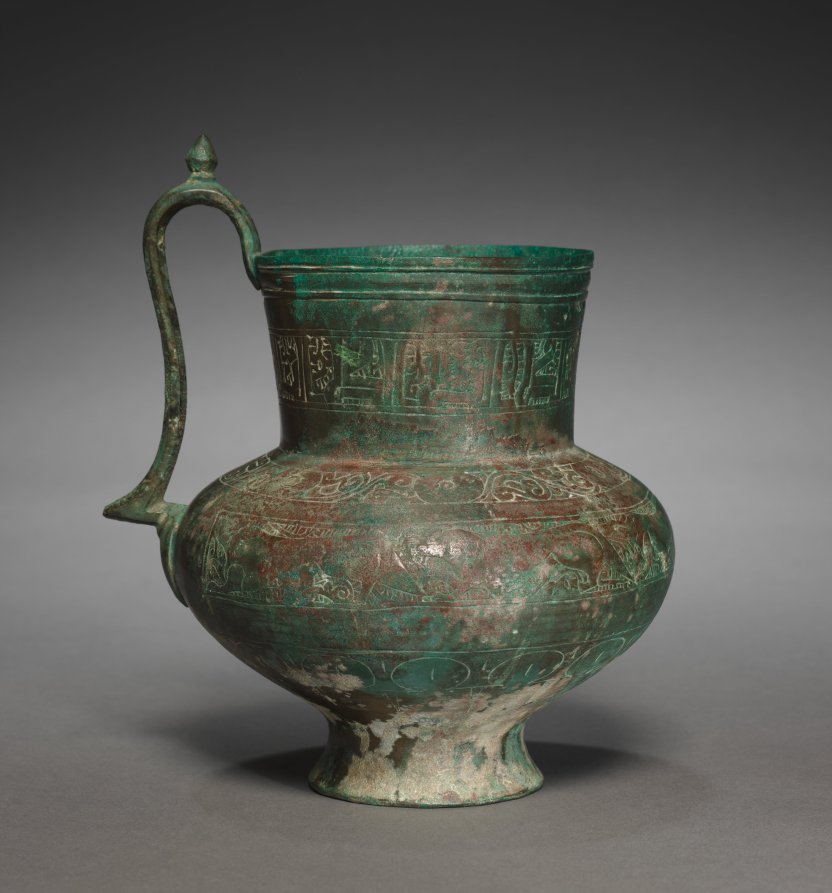
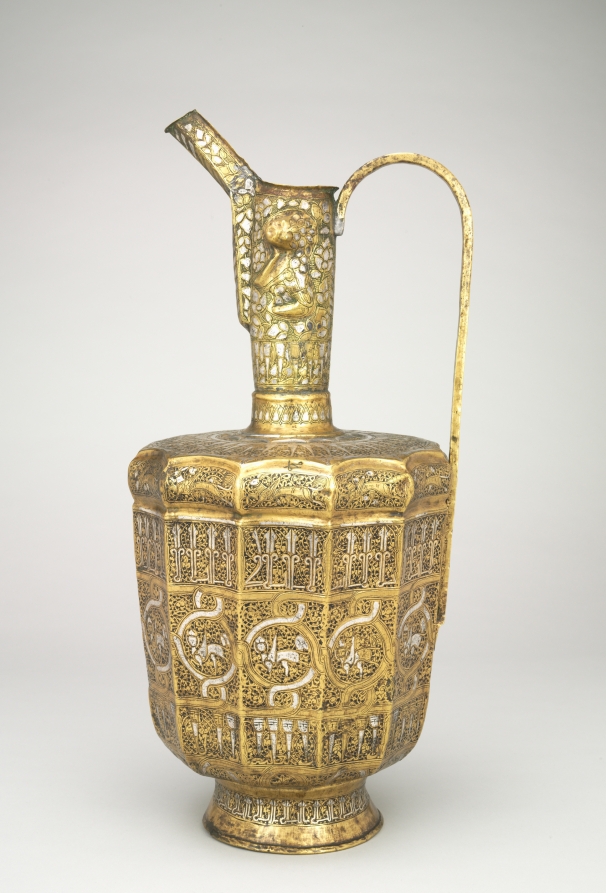
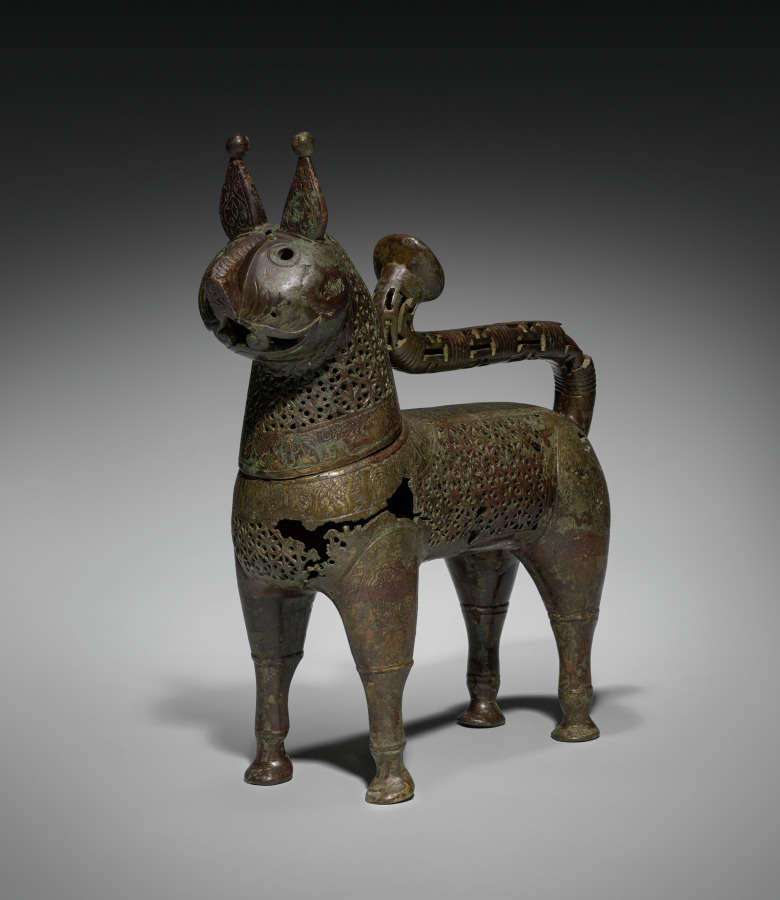
Cleveland holds several other CC0-released objects catalogued to the same Khorasan tradition, and they show the vocabulary Ettinghausen was arguing from persisting on both sides of the Mongol destruction. A cast brass jug from Nishapur itself, one of Ettinghausen's two named centers, is dated only broadly to the 1100s. A twelve-sided ewer of 1300-1350, more than a century after the Wade Cup on any chronology, still carries processing sphinxes and a band of human-headed inscription around its lower body - the same two decorative ideas Ettinghausen traced through the Wade Cup's own interior floor and foot, still current in Khorasan under Ilkhanid rule a hundred years after the tradition's supposed high point. Neither object proves anything about the Wade Cup specifically; both illustrate the regional vocabulary the attribution argument is fought over.
Chapter 12Exhibition and publication history since 1944
Once at Cleveland, the cup entered the museum's own Islamic Art exhibition within weeks of accession, running 3 November 1944 to 2 February 1945, and has been reproduced in the museum's own handbooks...
Once at Cleveland, the cup entered the museum's own Islamic Art exhibition within weeks of accession, running 3 November 1944 to 2 February 1945, and has been reproduced in the museum's own handbooks in 1958, 1966, 1969 and 1978. It travelled internationally twice in its first two decades at Cleveland: to Rome in 1956 for the Exhibition of Persian Art at the Italian Institute for the Middle and Far East, and to Paris from October 1961 to January 1962 for Sept mille ans d'art en Iran at the Petit Palais, one of the exhibitions credited with shaping postwar European taste for Persian art. It appeared again in the museum's own 1991 retrospective on its own founding, Object Lessons: Cleveland Creates an Art Museum, and most recently in a 2021-2022 Islamic art gallery rotation. Scholarly citation continued past Ettinghausen: Sheila Blair's Text and Image in Medieval Persian Art (2014) and Louise Mackie's Symbols of Power (2015), the museum's own survey of its Islamic textile and luxury arts holdings, both cite or reproduce it, as does a 2016 Dumbarton Oaks symposium volume on script as image.
Chapter 13Condition and what has never been published
The silver inlay is now partly lost across the surface, visible as bare brass within the engraved outlines where the inlay has fallen away; Ettinghausen noted this condition in 1957 and it is...
The silver inlay is now partly lost across the surface, visible as bare brass within the engraved outlines where the inlay has fallen away; Ettinghausen noted this condition in 1957 and it is consistent with what is visible in the museum's own current photography. No conservation report, treatment record or alloy analysis specific to this object has been located for this record. Ettinghausen himself, comparing the Wade Cup's alloy to a group of related footless bowls and northwest Persian candlesticks, wrote that he did not feel qualified to judge whether the alloys were identical - a caution about metallurgical claims that nobody in the sources consulted appears to have revisited with instrumentation in the near seven decades since.
Chapter 14What is still unresolved
The region of manufacture remains a genuine, unresolved scholarly disagreement, not a settled fact with one dissenting voice: Rice for Azerbaijan or the Caucasus, Ettinghausen for Khorasan, and the...
The region of manufacture remains a genuine, unresolved scholarly disagreement, not a settled fact with one dissenting voice: Rice for Azerbaijan or the Caucasus, Ettinghausen for Khorasan, and the Cleveland Museum's own current catalogue silently declining to choose. The precise date within the broad window of roughly 1163 to 1221 is equally open. Nobody has proposed a name for the maker, the patron, or the original owner the rim inscription addresses only as 'its owner.' The foot inscription, in human-headed naskhi, has not been published in full translation in any source consulted here. What the cup's own decade of undocumented existence looked like before its first appearance in a 1943 exhibition catalogue is unknown, as is the identity of whoever lent it to that exhibition and whether that lender was Heeramaneck Galleries, the dealer who is the first documented owner. The price Cleveland paid in 1944 has not been found. And in a field where twentieth-century Persian metalwork and textiles reaching the market through exactly this kind of dealer network have, in other documented cases within this same museum's own collection, later been shown by radiocarbon and technical analysis to be modern, no equivalent instrumental study of the Wade Cup itself has been located in the sources consulted - not because there is any specific reason to doubt it, but because the absence of that check is itself worth recording plainly rather than assuming away.
The artist
The eastern Iranian animated-script tradition, Khorasan or the Caucasus (the maker's own region is the unresolved question)
No name survives for whoever made this cup. It carries no maker's signature, no workshop mark, no patron's name and no date - only a generic band of good wishes 'to its owner'. What follows is not a biography but the milieu the two competing attributions place the maker in: a small, tightly interlinked group of dated and named comparanda, against which every unsigned piece in this tradition, including this one, is measured.
Exhibited
- 1943Metalwork from Islamic CountriesRackham Building, University of Michigan, Ann Arbor, 25 February - 11 March 1943 (pre-acquisition; lender not documented in sources consulted)
- 1944-1945Islamic ArtThe Cleveland Museum of Art, Cleveland, OH, 3 November 1944 - 2 February 1945
- 1948For Modern America from the Ancient Near EastThe Cleveland Museum of Art, Cleveland, OH, 24 February - 21 March 1948
- 1956Exhibition of Persian ArtItalian Institute for the Middle and Far East, Rome, 31 May - 30 September 1956
- 1961-1962Sept mille ans d'art en Iran (The Exhibition of Persian Art: 7000 Years of Art in Iran)Petit Palais, Musee des Beaux-Arts de la Ville de Paris, 19 October 1961 - 31 January 1962
- 1991Object Lessons: Cleveland Creates an Art MuseumThe Cleveland Museum of Art, Cleveland, OH, 7 June - 8 September 1991
- 2021-2022Art of the Islamic World (Islamic art rotation)The Cleveland Museum of Art, Cleveland, OH, 21 May 2021 - 31 May 2022
Literature
- D. S. Rice, The Wade Cup in the Cleveland Museum of Art. Paris: Editions du Chene, 1955. Portfolio, 40 loose pp., 31 text figures, 20 plates.
- Richard Ettinghausen, 'The Wade Cup in the Cleveland Museum of Art, Its Origin and Decorations', Ars Orientalis, vol. 2, 1957, pp. 327-366.
- The Cleveland Museum of Art Handbook. Cleveland, OH, 1958. Mentioned and reproduced, cat. no. 708.
- Handbook of the Cleveland Museum of Art, 1966. Reproduced p. 209.
- Handbook of the Cleveland Museum of Art, 1969. Reproduced p. 209.
- Handbook of the Cleveland Museum of Art, 1978. Reproduced p. 265.
- Sally Ruth May, Jane Takac and Barbara J. Bradley, Knockouts: A Pocket Guide. Cleveland, OH, 2001. Mentioned no. 73, p. 118; reproduced p. 70.
- David Franklin and C. Griffith Mann, Treasures from the Cleveland Museum of Art. Cleveland, OH, 2012. Reproduced pp. 102-103.
- Sheila Blair, Text and Image in Medieval Persian Art. Edinburgh: Edinburgh University Press, 2014. Mentioned p. 107, note 65.
- Louise W. Mackie, Symbols of Power: Luxury Textiles from Islamic Lands, 7th-21st Century. Cleveland; New Haven: Cleveland Museum of Art and Yale University Press, 2015. Reproduced and mentioned p. 33, fig. 1.17.
- Irvin Cemil Schick, 'The Content of Form: Islamic Calligraphy between Text and Representation', in Sign and Design: Script as Image in a Cross-Cultural Perspective (300-1600 CE), Brigitte Bedos-Rezak and Jeffrey F. Hamburger, eds. Washington, D.C.: Dumbarton Oaks Research Library and Collection, 2016, pp. 173-194. Reproduced p. 177, fig. 9.2.
- Meghan E. Strong, 'Art of the Islamic World', Cleveland Art: Cleveland Museum of Art Members Magazine 61, no. 3 (Summer 2021): 28-30. Reproduced and mentioned p. 30.
- Corinne Muhlemann, Complex Weaves: Technique, Text, and Cultural History of Striped Silks. Affalterbach: Didymos-Verlag, 2023. Mentioned and reproduced pp. 78-79, figs. 41-42.
Related works
| Work | Relation | Where it is |
|---|---|---|
| The Bobrinski Bucket Muhammad ibn 'Abd al-Wahid (caster) and Mas'ud ibn Ahmad (inlayer), Herat | The dated, signed anchor of the whole tradition; the only other object either Rice or Ettinghausen classed in the same fully 'animated' (as opposed to merely human-headed) naskhi subcategory as the Wade Cup's rim inscription Dated by inscription to Muharram 559 H./December 1163. Names its caster, inlayer, patron and recipient in full - everything the Wade Cup's own inscriptions withhold. | State Hermitage Museum, St Petersburg |
| Pen case of Majd al-Mulk Unknown craftsman, made for Majd al-Mulk, vizier to the Khwarazmshah 'Ala al-Din Muhammad | Dated comparanda cited by Ettinghausen for both inscription paleography (a shared grammatical error) and regional attribution to Khorasan Dated 1210. Its inscription titles Majd al-Mulk 'sadr of Khorasan', the same title Rice and Ettinghausen dispute the reading of on the untraced Peytel Cup. | Freer Gallery of Art, Smithsonian, Washington, D.C. |
| The Blacas Ewer Unknown craftsman | Later dated fixed point in the same animated-script tradition; its more advanced script led Ettinghausen to argue the Wade Cup must be earlier than the three-to-twelve-year gap Rice proposed Dated by inscription to 1232. | British Museum, London |
| The Vaso Vescovali Unknown, Khurasan (Herat argued) | The closest comparandum in form and period: a footed, silver-inlaid high-tin bronze vessel of the same broad eastern Iranian tradition, covered instead in an uninscribed zodiac and planetary programme rather than figural calligraphy c. 1200, Khurasan. The subject of its own record in this archive, where the Wade Cup is already listed as a comparandum in the other direction. | British Museum, London |
| The Peytel Cup Unknown, made for two sadrs (father and son) | Rice's other principal dating anchor for the Wade Cup; the reading of its patrons' title and period is itself disputed between Rice and Ettinghausen Rice tentatively linked its patrons to the fourteenth-century Sarbadars of Sabzavar (1337-86); Ettinghausen, citing the 1210 Freer pen case's Khorasan sadr, argued a thirteenth-century date should not be ruled out. | Formerly Peytel Collection; present whereabouts not traced for this record |
Open questions
- Which region made it: Khorasan (Ettinghausen, 1957) or Azerbaijan/the Caucasus (Rice, 1955)? No third dedicated study has been located that revisits the question, and the Cleveland Museum's own current catalogue does not choose between them.
- What is the cup's precise date within the broad window of c. 1163 to 1221 that the comparative evidence allows? Ettinghausen himself called his 'sometime around 1200' only a tentative conclusion pending further dated comparanda.
- Who was the cup made for? The rim inscription addresses only 'its owner', naming no one, unlike the Freer pen case (Majd al-Mulk) or the Peytel Cup (two named sadrs).
- What does the foot inscription actually say in full? Ettinghausen describes it only as 'a brief formula of good wishes' in human-headed naskhi; no source consulted publishes a complete transliteration or translation.
- Where was the object between its manufacture and its first documented appearance in a 1943 Ann Arbor exhibition catalogue? No owner is recorded for the intervening centuries.
- Who lent the cup to the 1943 Ann Arbor exhibition, and was that lender Heeramaneck Galleries? The catalogue's lender is not named in the sources consulted for this record.
- What did the Cleveland Museum of Art pay Heeramaneck Galleries in 1944? No price has been published; there was no auction.
- Has the alloy ever been analysed instrumentally? Ettinghausen declined to compare it to related pieces in 1957, and no metallurgical study of this specific object has been located since.
Questions about this object
What is The Wade Cup with Animated Script?
The Wade Cup with Animated Script is an islamic metalwork, dated c. 1200-1221 (Cleveland Museum of Art catalogue, following R. Ettinghausen's 1957 case for Khorasan before the Mongol destructions of 1221-22); alternatively 'the third decade of the thirteenth century' (c. 1221-1230) in D. S. Rice's 1955 monograph, which argued for Azerbaijan or the Caucasus. Medium: Brass, cast, inlaid with silver (silver inlay now partly lost).
Who made The Wade Cup with Animated Script, and is the attribution settled?
The attribution to Unidentified metalworker, eastern Iran (Khorasan) or Azerbaijan - region disputed is recorded here as disputed. The cup is unsigned, undated and names no patron. D. S. Rice's 1955 monograph placed it in Azerbaijan or a region near the Caucasus, in the third decade of the thirteenth century (c. 1221-1230), reasoning that Herat, the main center of this metalworking tradition, had been sacked by the Mongols in 1222. Richard Ettinghausen's 1957 review-article in Ars Orientalis contested this at length, assembling ten independent categories of comparative evidence (construction, shape, inscriptions, and eight decorative motifs) that he argued point instead to Khorasan, probably Herat or Nishapur, and to a date of roughly 1200, before the Mongol destruction of Merv and Nishapur in 1221 and of Herat in 1222. Neither position rests on an inscription naming a place; both are built entirely from comparison with a small number of dated pieces. The Cleveland Museum of Art's own current catalogue entry gives a date range, 1200-1221, that follows Ettinghausen's chronology rather than Rice's, but does not commit to a region beyond 'Iran'.
Where is The Wade Cup with Animated Script now?
Cleveland Museum of Art, Cleveland, Ohio, Gallery 116 (Islamic). Inventory number 1944.485. Last confirmed 6 August 2026. Purchase from the J. H. Wade Fund, accessioned 15 December 1944, bought from Heeramaneck Galleries, New York.
What is still unknown about The Wade Cup with Animated Script?
Which region made it: Khorasan (Ettinghausen, 1957) or Azerbaijan/the Caucasus (Rice, 1955)? No third dedicated study has been located that revisits the question, and the Cleveland Museum's own current catalogue does not choose between them.
Sources
- 1The Cleveland Museum of Art, collection record 1944.485, The Wade Cup with Animated Script. Tombstone, dimensions, inscriptions, provenance, exhibition and citation history, and CC0 images, read via the museum's Open Access API (object id 123985) and its public catalogue page. clevelandart.org/art/...
- 2Richard Ettinghausen, 'The Wade Cup in the Cleveland Museum of Art, Its Origin and Decorations', Ars Orientalis, vol. 2 (1957), pp. 327-366. Read in full from the digitized volume of Ars Orientalis vol. 2 (1957) on the Internet Archive (identifier arsorientalisart21957univ), OCR text. archive.org/details/...
- 3D. S. Rice, The Wade Cup in the Cleveland Museum of Art (Paris: Editions du Chene, 1955). NOT read directly; the 1955 portfolio was not located in a digitized, openly accessible form. Rice's arguments and specific wording as cited in this record are taken from Ettinghausen's 1957 review-article (source 2), which quotes and paraphrases the monograph at length, and from Gaston Wiet's contemporary review (source 4). Flagged for replacement with the monograph itself. mazdapublishers.com/book/...
- 4Gaston Wiet, review of D. S. Rice, The Wade Cup in the Cleveland Museum of Art, in Syria, vol. 34 (1957), p. 194 onward. persee.fr/doc/...
- 5HathiTrust catalog record for 'Metalwork from Islamic countries: [exhibition] Rackham Building, February 25-March 11, 1943', University of Michigan, Ann Arbor. Consulted for bibliographic confirmation of the exhibition's dates and venue only; the catalogue text itself was not read, and no claim about who wrote its introduction or who lent the Wade Cup to it is made in this record. catalog.hathitrust.org/Record/...
- 6Wikipedia, 'Bobrinski Bucket', for the names given in that object's inscriptions (caster, inlayer, patron, recipient), its date and place of manufacture, and its present location. Tertiary source, flagged for replacement with N. I. Vesselofski's original 1910 publication or a specialist study. en.wikipedia.org/wiki/...
- 7Wikipedia, 'Nasli Heeramaneck', for the dealer's biography. Tertiary source, flagged for replacement with an obituary or the LACMA collection history of the Nasli M. Heeramaneck Collection. en.wikipedia.org/wiki/...
- 8'WADE, JEPTHA HOMER II', Encyclopedia of Cleveland History, Case Western Reserve University, for J. H. Wade's dates (1857-1926), his role as a museum founder and trustee, and the establishment of the J. H. Wade Fund. case.edu/ech/...
- 9The Cleveland Museum of Art, collection record 1985.22, Jug (Nishapur, Khurasan, 12th century). Used for the comparison plate. clevelandart.org/art/...
- 10The Cleveland Museum of Art, collection record 1945.27, Twelve-sided Ewer with Sphinxes and Human-Headed Inscriptions. Used for the comparison plate. clevelandart.org/art/...
- 11The Cleveland Museum of Art, collection record 1948.308, Feline Incense Burner (Khurasan, Seljuq period). Used for the comparison plate. clevelandart.org/art/...
Last verified 6 August 2026 · Published 6 August 2026
Change log
6 August 2026 - Record created at the house standard: researched narrative, technical evidence, maker dossier, graded provenance chain, prices with hammer and premium separated, related works, open questions and sources.