Twelve-sided Ewer with Sphinxes and Human-Headed Inscriptions
Unidentified metalworking workshop, Iran, Khurasan (region and continuity of tradition disputed for this date) · 1300-1350 (Cleveland Museum of Art's own dating, per its Open Access API tombstone)
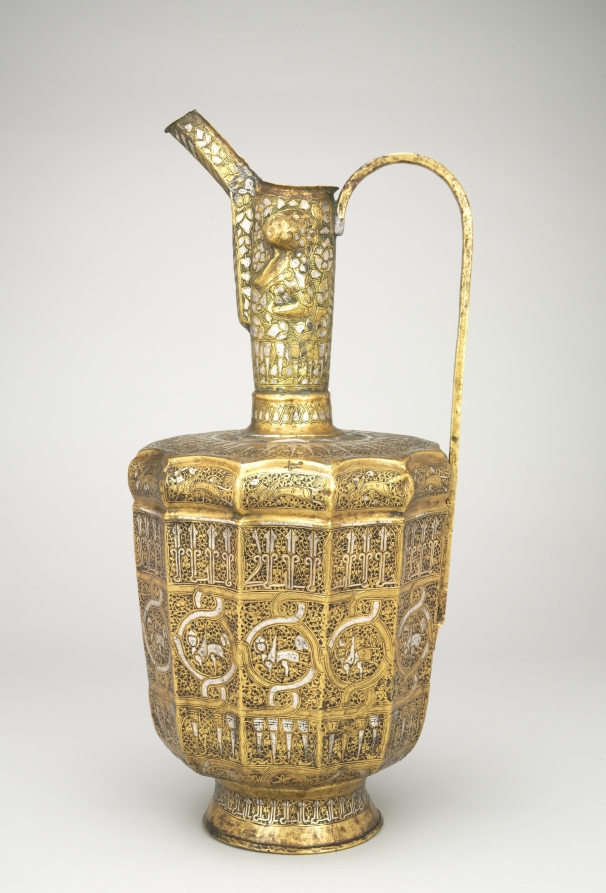
The record subject. Hammered brass inlaid with silver, 44.8 cm high, dated by the museum to 1300-1350, Iran, Khurasan, Ilkhanid period. The relief lion on the neck, the twelve-sided faceted body, and the sphinx band are visible; the human-headed inscription runs around the lower body, out of frame at this scale.
| Artist | Unidentified metalworking workshop, Iran, Khurasan (region and continuity of tradition disputed for this date) |
|---|---|
| Date | 1300-1350 (Cleveland Museum of Art's own dating, per its Open Access API tombstone) |
| Medium | Hammered sheet brass, inlaid with silver |
| Dimensions | Overall height 44.8 cm (17 5/8 in.); no further dimensions published in the sources consulted |
| Where it is now | The Cleveland Museum of Art, Cleveland, Ohio, Gallery 116 (Islamic)last confirmed |
| Inventory number | 1945.27 |
| Attribution | DisputedThe Cleveland Museum of Art's own current catalogue and Open Access API both give the vessel as Iran, Khurasan, Ilkhanid period (1256-1353), dated 1300-1350. Full note |
| Object type | Islamic metalwork |
| Period | Ilkhanid period (1256-1353), per the Cleveland Museum of Art's own culture field |
| Cases | Disputed attribution · Has a provenance gap |
| Inscriptions | A band encircling the lower body, in human-headed naskhi: the tops of the letters end in human heads rather than the letters being built entirely from human and animal figures (the fuller 'animated' form seen on the Bobrinski Bucket and on the rim of the Wade Cup, both discussed below as comparanda). The Cleveland Museum of Art's own structured collection data lists no inscriptions field content and does not publish a transliteration or translation; its narrative description characterizes the text only as conventional in the sense that human-headed lettering is 'a feature unique to Islamic metalwork' as a technique, not that this specific text is unusual in content. No source consulted for this record gives the inscription's wording. |
| Owners on record | 6 links2 documented, 2 disputed, 2 unknown |
| Sources | 13 cited |
About this record Last verified · 13 sources cited · Change log
On this page 10 sections
ContentsClose
A tall, twelve-sided ewer of hammered brass inlaid with silver, dated by the Cleveland Museum of Art to 1300-1350 and cataloged to Iran, Khurasan, in the Ilkhanid period. Crouching and seated lions stand in relief on the spout and neck; the upper body carries winged hare-like creatures among foliate scrolls; a band of sphinxes processes around the center; and the base is encircled by an inscription in human-headed naskhi, letters whose upper strokes terminate in human heads, a decorative technique the museum itself calls unique to Islamic metalwork.
The museum's own regional label sits in tension with the wider documented history of the craft: the Mongol conquest ended the major pre-conquest Khurasan metalworking centers of Herat, Nishapur and Merv in 1220-1222, and the standard modern survey of the discipline attributes most luxury metalwork of this ewer's own date range instead to Azarbaijan and Fars. Whether this vessel is a genuine surviving Khurasan tradition, a workshop elsewhere consciously reproducing an inherited Khurasan repertoire, or a later revival built from surviving older objects as models, is not settled in the sources consulted.
Its documented ownership begins only with the New York dealer Hagop Kevorkian, who sold it to Cleveland in 1945 using the J. H. Wade Fund, the same fund that had bought the museum's Wade Cup the year before. A 1913 note in The Burlington Magazine describes and illustrates an inlaid brass ewer with an embossed lion and a human-headed inscription band, then in the Preece Collection of the British consul-collector John Richard Preece and on exhibition at Vincent Robinson's Galleries in London, attributed at the time to 13th-century Mosul; Cleveland's own published bibliography for this accession cites that exact note, but no source consulted independently confirms the two objects are one and the same, and this record does not bridge that gap with a guess.
Provenance
Each link is graded. Documented: a cited source supports it. Disputed: the identification is argued but not established. Unknown: no owner for that span, and the gap is not smoothed into a narrative. The grades in the glossary.
- 1300-1350 -Unidentified workshop, region disputed (Khurasan per Cleveland's own current catalogue)disputed
Cleveland's own catalogue and Open Access API date the vessel 1300-1350 and assign it to Iran, Khurasan, Ilkhanid period. Encyclopaedia Iranica's own survey of the discipline states that post-Mongol luxury metalwork of this exact date range is largely attributable instead to Azarbaijan and Fars, since the Mongol conquest had already ended the major pre-conquest Khurasan metalworking centers by 1222. No source consulted resolves the tension between the museum's regional label and that broader synthesis, or establishes whether the vessel reflects a surviving Khurasan tradition, a workshop elsewhere copying an inherited repertoire, or a later revival.1789
- 1350 - by 1913Unknownunknown
No owner, findspot or location is documented for roughly five and a half centuries between the vessel's proposed manufacture and its earliest possible documented sighting.1
- by 1913 - unknownPossibly the Preece Collection (John Richard Preece), on exhibition at Vincent Robinson's Galleries, Londondisputed
A July 1913 note in The Burlington Magazine for Connoisseurs, cited in Cleveland's own published bibliography for this accession, describes and illustrates an inlaid brass ewer with a relief lion and a human-headed inscription band, stating it 'belongs to the Preece Collection, now on exhibition in Messrs. Vincent Robinson's Galleries.' John Richard Preece (1843-1917), British consul and consul-general at Isfahan, is independently documented as a real collector of Persian art whose collection entered the market around 1913. The identification of the 1913 object with this specific accession rests on Cleveland's own bibliographic citation; it is not independently confirmed, the 1913 note does not mention sphinxes or twelve facets, and the note's own attribution (13th-century Mosul) is superseded by Cleveland's current cataloguing (14th-century Khurasan).210
- 1913 or unknown - unknown, by 1945Unknownunknown
No owner or location is documented between the possible 1913 London sighting (or, if that identification is wrong, manufacture) and Hagop Kevorkian's ownership by 1945. A citation in Cleveland's own bibliography to a 1916 Cleveland Museum of Art Bulletin, covering the museum's own inaugural exhibition, could not be read in full and may or may not document an intermediate appearance of this object in Cleveland itself, possibly on loan, three decades before purchase.1
- unknown - 1945Hagop Kevorkian, New Yorkdocumented
The only privately named owner in Cleveland's own provenance record, dated by the museum '?-1945.' Kevorkian is independently documented as a major New York dealer in Persian and Islamic material across exactly this period, and as the dealer who separately sold the Freer Gallery its Ayyubid canteen in 1941. No date is given for when Kevorkian himself acquired this ewer, and no purchase price paid to him by Cleveland has been found.111
- 1945 - presentThe Cleveland Museum of Art, Cleveland, Ohiodocumented
Accessioned 21 February 1945 as 1945.27, purchased from the J. H. Wade Fund, an endowment from the bequest of J. H. Wade (died 1926) rather than a personal acquisition by Wade himself. Added to the museum's own Islamic Art exhibition already in progress (3 November 1944-2 February 1945), and exhibited repeatedly since, most recently in the 2021-2022 Islamic art gallery rotation. Still on display, Gallery 116 Islamic, and digitized as a rotatable 3D model.1
Prices realised
This object has never been offered at public auction in any source consulted. It was bought privately from the dealer Hagop Kevorkian, with the sale completed by the accession date of 21 February 1945. No purchase price has been found; there is accordingly no hammer price and no buyer's premium to separate.
Technical evidence
| Attribution note | The Cleveland Museum of Art's own current catalogue and Open Access API both give the vessel as Iran, Khurasan, Ilkhanid period (1256-1353), dated 1300-1350. That regional label sits in real tension with the wider synthesis of the field: the Mongol conquest brought a documented, abrupt end to the major pre-conquest metalworking centers of Khurasan (Herat, Nishapur, Merv) in 1220-1222, and Encyclopaedia Iranica's own survey of the discipline states that post-Mongol luxury metalwork of exactly this date range, the first half of the 14th century, is 'largely attributable to Azarbaijan and Fars' rather than to Khurasan itself, with Ilkhanid-period pieces from that later milieu sometimes read as 'more closely related to Mamluk metalwork than to other contemporaneous objects from Iran.' Whether this ewer represents a genuine surviving Khurasan workshop tradition carried forward by descendants or heirs of the pre-Mongol craft milieu, a workshop elsewhere in Iran or the Jazira consciously copying an inherited repertoire of Khurasan forms and motifs (sphinxes, human-headed inscription, foliate scroll, relief lion) onto a vessel later cataloged by region of style rather than region of manufacture, or a full century-later revival drawing on surviving pre-Mongol objects as models, is not resolved in the sources consulted for this record, and no scholar consulted here proposes a single answer. This record does not choose between them. |
|---|---|
| Construction | Hammered sheet brass, raised and worked into a twelve-sided faceted profile, rather than cast.17 |
| Inlay | Silver, inlaid across the engraved decoration on all registers of the body, neck and spout.1 |
| Dimensions | Overall height 44.8 cm (17 5/8 in.). No further dimensions published in the sources consulted.1 |
| Spout and neck | A crouching lion and a seated lion, worked in raised relief rather than engraved line, the only modeled (as opposed to inlaid) figural elements on the vessel.1 |
| Upper body register | Winged, hare-like creatures moving through foliate scrollwork.1 |
| Center register | A procession of sphinxes around the twelve facets of the body; discussed in Eva Baer's 1965 iconographic study of the motif (Sphinxes and Harpies in Medieval Islamic Art), which the Cleveland Museum's own bibliography cites for this object at p. 14, fn. 53, and pl. XIV, fig. 24. Baer's monograph was not read directly for this record.16 |
| Base inscription | A continuous band in human-headed naskhi encircling the lower body, the letters' upper strokes ending in human heads. No transliteration or translation is published in the sources consulted.1 |
| Digitization | A three-dimensional photogrammetric model of the object is hosted on Sketchfab and linked from the museum's own Open Access API record, allowing rotation and close inspection independent of gallery photography.1 |
Images
The record in full
Chapter 1What it is
A tall brass ewer, 44.8 centimetres high, its body worked into twelve flat facets rather than raised as a smooth curve.
A tall brass ewer, 44.8 centimetres high, its body worked into twelve flat facets rather than raised as a smooth curve. The whole surface was made from hammered sheet brass rather than cast, then engraved and inlaid with silver across every register from the spout to the foot. The spout and neck carry a crouching lion and a seated lion worked in raised relief, an unusual choice of technique on a vessel otherwise decorated in engraved and inlaid line rather than modeled form.
Below the neck, a band of winged, hare-like creatures moves around the body among foliate scrolls. Centered on the twelve facets, a further band shows sphinxes in procession. The lower body, just above the foot, carries a continuous inscription in human-headed naskhi, the letters' upper strokes ending in human heads. The museum's own account is explicit that this last feature, rather than the sphinxes or the lions, is what it considers unique to Islamic metalwork as a decorative technique.
Chapter 2How it was made
The construction method is worth stating plainly because it distinguishes this vessel from some of its closest comparanda.
The construction method is worth stating plainly because it distinguishes this vessel from some of its closest comparanda. The Bobrinski Bucket of 1163 and the Wade Cup, both discussed below, were cast in bronze or brass; this ewer instead began as a hammered sheet of brass, raised and faceted into its twelve-sided profile by beating rather than by casting in a mold, before the surface was engraved and the silver wire and sheet inlaid into the recessed design. Hammered sheet construction of this kind is characteristic of a wide range of Khurasan-associated brass vessels of faceted or fluted profile, a shape family that Encyclopaedia Iranica's own survey of the discipline singles out as one of the most distinctive products of the tradition: 'Khorasanian inlaid wares are notable for the wide variety and virtuosity of their shapes: faceted or fluted ewers, candlesticks... and circular inkwells.'
Chapter 3The decorative programme, register by register
Reading from the top down: the spout and neck carry the two relief lions, crouching and seated, the only elements of the design worked in raised modeling rather than engraved line.
Reading from the top down: the spout and neck carry the two relief lions, crouching and seated, the only elements of the design worked in raised modeling rather than engraved line. Below them, a band of winged hare-like creatures moves through foliate scrollwork around the shoulder of the vessel. The center of the twelve-sided body carries the sphinx procession, the motif that gives the object its modern title alongside the inscription. The lower body is encircled by the human-headed inscription band before the vessel narrows toward its foot.
None of the published descriptions consulted for this record identify a narrative sequence connecting these bands to one another or to a specific text, myth or owner. As with the comparable programme on the Bobrinski Bucket, discussed below, the decoration reads as a repertoire of courtly and apotropaic motifs, real and imaginary animals, applied to a luxury object rather than as an illustrated story.
Chapter 4The sphinx, and what has been written about it
The sphinx as a decorative motif in medieval Islamic metalwork has one dedicated modern iconographic study, Eva Baer's Sphinxes and Harpies in Medieval Islamic Art, published by the Israel Oriental...
The sphinx as a decorative motif in medieval Islamic metalwork has one dedicated modern iconographic study, Eva Baer's Sphinxes and Harpies in Medieval Islamic Art, published by the Israel Oriental Society in 1965. The Cleveland Museum of Art's own bibliography for this accession cites Baer's book directly, with the ewer mentioned on page 14, footnote 53, and reproduced as plate XIV, figure 24, meaning Baer's study treats this specific object as part of the iconographic corpus. The monograph itself could not be read directly for this record: the digitized copy located, on the Internet Archive, is available only to logged-in borrowers and returned an authorization error on direct access. Baer's argument about what the sphinx motif specifically meant to a Khurasan or Ilkhanid patron, as opposed to simply being catalogued as present, is accordingly not characterized here and should be read from the monograph itself before this record is treated as final.
Chapter 5The human-headed inscription and the wider animated-script tradition
Calligraphy in which the letters carry or terminate in human heads, known in the literature as animated or anthropomorphic script, is documented as having developed in northeastern Iran, the Khurasan...
Calligraphy in which the letters carry or terminate in human heads, known in the literature as animated or anthropomorphic script, is documented as having developed in northeastern Iran, the Khurasan region, in the 12th century; the Cleveland Museum's own note for this object states plainly that 'calligraphy with human heads, known as animated script, developed in northeast Iran during the 1100s,' placing this ewer's own inscription band within a decorative tradition already some two centuries old by the date Cleveland assigns the vessel.
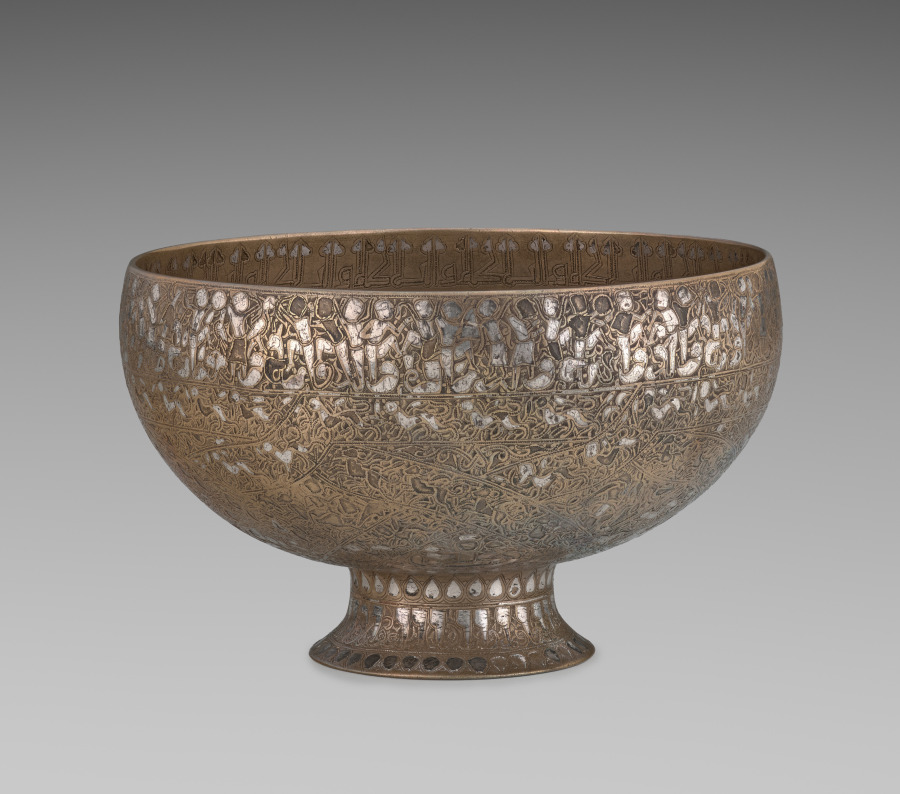
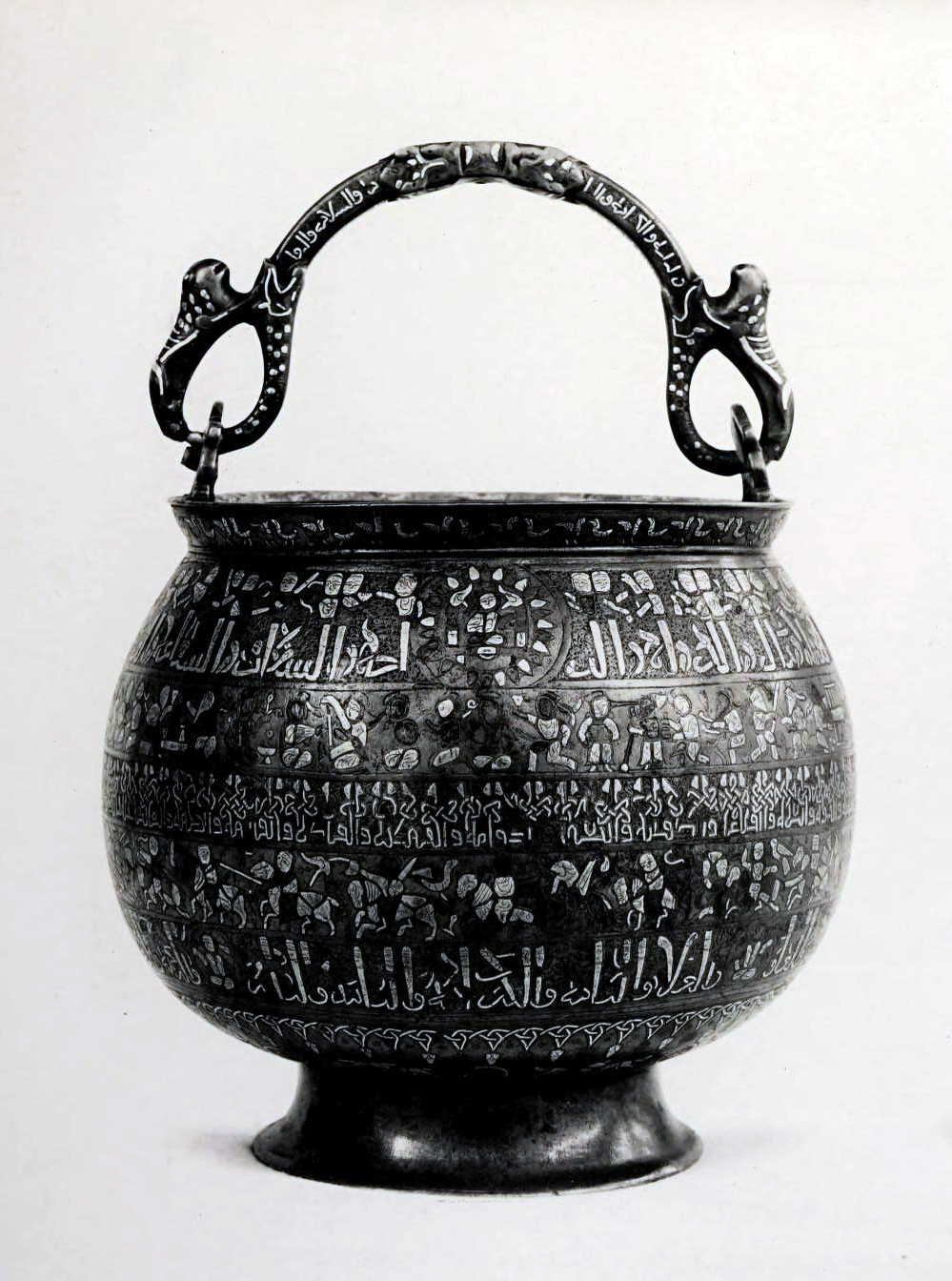
The tradition has at least two distinct registers, established in the scholarship on the closely related Wade Cup, also in this collection: a fully 'animated' form, in which human and animal bodies form the letters themselves, seen at its most developed on the Bobrinski Bucket (1163) and the Wade Cup's own rim; and a plainer 'human-headed' form, in which only the tops of the letters end in heads, seen on the Wade Cup's foot and, on the evidence of Cleveland's own description, on this ewer's base inscription. This ewer therefore carries the same subtype of the script as the Wade Cup's foot text, not the fuller form of its rim, though no source consulted compares the two inscriptions directly letter by letter.
Chapter 6What such a vessel was for
The Cleveland Museum's own catalogue text states that vessels of this kind 'served ceremonial purposes in court banquets and elite homes across the Islamic world,' explicitly naming both a courtly...
The Cleveland Museum's own catalogue text states that vessels of this kind 'served ceremonial purposes in court banquets and elite homes across the Islamic world,' explicitly naming both a courtly and a broader elite domestic setting rather than limiting the object's audience to a royal court alone. That formulation is worth reading against two other objects already in this archive. The Bobrinski Bucket of 1163 is a dated, signed object whose inscription names its actual first owner: not a ruler, but Rukn ad-Din Rashid ad-Din Azizi ibn Abu'l-Husayn az-Zanjani, a merchant and hajji, commissioned for him by a named intermediary. That is direct documentary evidence, on a related but earlier object in the same broad Khurasan tradition, that the market for the finest inlaid metalwork of this kind reached well beyond royal patronage into an urban mercantile elite. The Freer Gallery's Ayyubid canteen, a different tradition and region entirely (Syria or the Jazira, Christian imagery, mid-13th century), raises a comparable question about audience from the opposite direction: forty years of published argument over whether that object was made for a Christian patron, a mixed Muslim-Christian public, or a fully shared visual culture, without the object's own inscriptions naming anyone. This ewer, unlike either comparandum, names no owner or patron at all in the portion of its inscription described in the sources consulted, so its own audience, court, merchant household, or a broader elite market, remains a plausible parallel to draw rather than a settled fact about this specific vessel.
Chapter 7The Khurasan-school problem: one tradition, several workshops, or a later convergence
Whether the sustained group of inlaid brass and bronze vessels attributed on stylistic grounds to greater Khurasan, from the Bobrinski Bucket of 1163 through the Wade Cup of around 1200 to this ewer...
Whether the sustained group of inlaid brass and bronze vessels attributed on stylistic grounds to greater Khurasan, from the Bobrinski Bucket of 1163 through the Wade Cup of around 1200 to this ewer of 1300-1350, represents a single continuous regional workshop tradition, several independent workshops sharing a common repertoire of forms and motifs, or a later, trade-driven convergence of styles onto a recognizable 'Khurasan look,' is argued rather than settled in the literature, and this ewer sits at the hardest point of that argument because it falls a century or more after the tradition's own conventionally dated core group was destroyed.
A. S. Melikian-Chirvani's 1982 Victoria and Albert Museum catalogue, Islamic Metalwork from the Iranian World, 8th-18th Centuries -- cited here from a bibliographic listing rather than the monograph itself, which was not read directly for this record -- classifies hammered-sheet brass wares engraved and inlaid with silver, this ewer's own construction method, as products of what he terms the Khorasan school of the later 12th and early 13th centuries, treating the group as a coherent regional tradition defined by shared technique and repertoire rather than by a single named workshop. Richard Ettinghausen's 1957 Ars Orientalis study of the Wade Cup, discussed at length in that object's own record in this archive, built essentially the same kind of case for a different single object: ten independent categories of construction, shape, inscription and decorative motif, each individually inconclusive, together read as evidence of a shared Khorasan milieu centered on Herat and Nishapur. Neither scholar's method, comparison across a small set of objects sharing technique and motif rather than documentary proof of a single workshop's output, can distinguish a genuinely continuous atelier tradition from several separate workshops trained in a shared repertoire, and neither claims to.
Encyclopaedia Iranica's own synthesis of the discipline complicates the question further for an object of this ewer's specific date. It states that the Mongol invasion 'brought to an abrupt end the important metalwork centers in Khorasan' in the 1220s, and that 'post-Mongol metalwork, largely attributable to Azarbaijan and Fars, exhibits simpler and less varied shapes' than the pre-conquest Khurasan group; it further notes that Ilkhanid-period pieces inscribed for named patrons of this ewer's own generation, including the Il-khan Abu Sa'id Bahador Khan (r. 1317-1335) and the Injuid ruler of Fars, Abu Eshaq (r. 1321-1359), are 'more closely related to Mamluk metalwork than to other contemporaneous objects from Iran.' If that synthesis is right, an ewer confidently dated 1300-1350 and cataloged simply to 'Khurasan' sits awkwardly against the documented geography of where luxury metalworking was actually concentrated in exactly that half-century. This record does not resolve the tension; it states it, because no source consulted resolves it either.
Chapter 8A third object, not a version of the other two
This ewer is a distinct object from two others already in this archive and must not be read as a variant, duplicate or later state of either.
This ewer is a distinct object from two others already in this archive and must not be read as a variant, duplicate or later state of either. The Bobrinski Bucket, in the State Hermitage Museum, is dated by its own inscription to December 1163 and names its caster and inlayer; it is a cast bronze vessel, not a hammered-sheet one, and it has never been in Cleveland's or any American collection. The Wade Cup, also at the Cleveland Museum of Art (accession 1944.485, a different number from this ewer's 1945.27), is a cast brass footed bowl of around 1200, bought from a different dealer (Heeramaneck Galleries) one year before this ewer entered the collection, though through the same J. H. Wade Fund. All three share a broad decorative and technical vocabulary, sphinxes, human-headed or fully animated inscription, silver inlay on brass, because all three are conventionally placed within the same wide Khurasan-associated tradition; none of the three shares an owner, an inscription, a findspot or a documented workshop with either of the others. Facts, images, dates and provenance belonging to the Bucket or the Cup are not used in this record, and nothing in this record should be read back onto either of them.
Chapter 9A possible early sighting: the Preece Collection, 1913
The Cleveland Museum's own published bibliography for this accession includes a citation to W.
The Cleveland Museum's own published bibliography for this accession includes a citation to W. R. Lethaby, 'Notes,' The Burlington Magazine for Connoisseurs, volume 23, number 124 (July 1913), pages 246-251, with the object 'mentioned' on page 247 and 'reproduced' on page 248. That volume was read in full from a digitized copy on the Internet Archive. The Notes section of that July 1913 issue contains an unsigned short item titled 'A 13th-Century Ewer Probably Made at Mosul,' immediately followed on the same pages by a separately signed piece by Lethaby on an unrelated wooden statuette; Cleveland's citation appears to attribute the whole Notes section to Lethaby as its best-known contributor, a common period convention rather than an indication that Lethaby personally wrote the ewer item.
The 1913 item describes a bronze vessel 'encrusted with silver,' its ornament including 'an embossed lion,' 'a frieze of animals and its monsters enclosed in a series of interlacing circles,' and, in its lower band, an inscription whose letters terminate in human heads, a feature the 1913 writer calls 'not infrequent in objects of this nature.' The piece is ascribed in the note to the first half of the 13th century and to manufacture at Mosul, 'the best-known centre of manufacture in Western Asia' as understood at that date. The note states plainly: 'The ewer belongs to the Preece Collection, now on exhibition in Messrs. Vincent Robinson's Galleries, to whose courtesy we owe the present opportunity for illustration.'
John Richard Preece (1843-1917) was a genuine collector this note could plausibly describe: an Englishman who worked for the Indo-European Telegraph Department in Persia from 1868, then served as British consul and later consul-general at Isfahan from 1891 until his retirement in 1906, and whose own 1917 obituary describes him as 'a noted collector of Persian carpets, china, and curios.' Independent research into the history of Persian art collecting in Britain records that Preece's collection, numbering around a thousand objects, was exhibited and began entering the market in 1913, the same year as this Burlington Magazine note, with part of it later bought by Friedrich Sarre for Berlin's Islamic art department in 1927.
What is not established, in any source consulted for this record, is that the ewer described in 1913 is this specific accession. The relief lion and the human-headed inscription band are consistent with Cleveland's own description of 1945.27; the 1913 note does not mention sphinxes, does not state the number of facets on the body, and attributes the piece to Mosul and the 13th century rather than Khurasan and the 14th, an attribution now superseded by a full three-plus decades and a different region on Cleveland's own current cataloguing. Cleveland's own curators evidently judged the identification close enough to list in the accession's bibliography; this record repeats that citation and the passage it points to, without independently confirming that the two objects are one and the same.
Chapter 10A second citation from 1916, unread
Cleveland's own bibliography for this accession also lists '"Closing Days of the Inaugural Exhibition," The Bulletin of the Cleveland Museum of Art 3, no.
Cleveland's own bibliography for this accession also lists '"Closing Days of the Inaugural Exhibition," The Bulletin of the Cleveland Museum of Art 3, no. 3 (1916): 1-4,' with the object reproduced on page 8 and mentioned on page 9. The Cleveland Museum of Art itself opened to the public in 1916, twenty-nine years before this ewer was accessioned in 1945; a reproduction of the object in a bulletin covering that museum's own inaugural exhibition would mean the piece was seen, and perhaps lent, in Cleveland before the museum owned it.
This record could not access the article's full text; the JSTOR record for it (stable/25136049) returned only an access-restricted page. It is accordingly not established here whether the ewer appeared in 1916 as a loan, whose loan it might have been, or whether the citation in fact concerns this specific accession at all, as opposed to a different inlaid brass object reproduced in the same bulletin issue. The citation is repeated from Cleveland's own bibliography and flagged, not resolved.
Chapter 11Kevorkian, and the sale to Cleveland
The only ownership Cleveland's own provenance record documents before its own acquisition is Hagop Kevorkian (1872-1962), the Armenian-born, New York-based dealer and excavator, recorded by the...
The only ownership Cleveland's own provenance record documents before its own acquisition is Hagop Kevorkian (1872-1962), the Armenian-born, New York-based dealer and excavator, recorded by the museum simply as holding the piece '?-1945' before selling it to the Cleveland Museum of Art. Kevorkian is a documented and prolific figure in exactly this trade: born in Kayseri in the Ottoman Empire, he settled in New York after study at Robert College in Istanbul, ran commercial excavations at Sultanabad and Rey in Persia from the early 1900s, and built two galleries, in New York and Paris, that supplied Islamic and Persian material to major American collections for half a century. Per Wikipedia's biography of Kevorkian -- a tertiary source this record has not independently verified against a primary account -- his 1911 Paris and London exhibitions of excavated Persian material were criticized at the time by archaeologists as part of a broader pattern of foreign-led looting of Iranian sites for the Western art market. He is independently documented, in this same archive, as the dealer who sold the Freer Gallery its Ayyubid canteen in 1941, four years before this sale to Cleveland, confirming he was actively moving comparable material through New York across exactly this period.
The purchase itself is precisely dated: the object was accessioned 21 February 1945, using the J. H. Wade Fund, an endowment from the bequest of Jeptha Homer Wade II, a Cleveland financier and museum trustee who had died in 1926 and so, as with the Wade Cup bought from the same fund the year before, neither selected nor personally acquired this piece. No purchase price paid to Kevorkian has been found in the sources consulted.
Chapter 12In the collection since 1945
The ewer entered the museum's own Islamic Art exhibition, which ran from 3 November 1944 to 2 February 1945, during the final weeks before its own accession date, meaning it was added to a show...
The ewer entered the museum's own Islamic Art exhibition, which ran from 3 November 1944 to 2 February 1945, during the final weeks before its own accession date, meaning it was added to a show already in progress rather than waiting for a later rotation. It appeared again in 'For Modern America from the Ancient Near East' (24 February-21 March 1948), in the museum's own 1991 retrospective on its founding, 'Object Lessons: Cleveland Creates an Art Museum,' and most recently in the 2021-2022 Islamic art gallery rotation, 'Art of the Islamic World.' It remains on display in Gallery 116, Islamic.
The object has also been digitized as a three-dimensional model, hosted on Sketchfab and linked from the museum's own Open Access API record, part of Cleveland's wider program of photogrammetric documentation of its collection. This is a live, present-tense fact about the object rather than a historical one: a reader today can examine the vessel's twelve facets, relief lions and inscription band in rotation, independent of gallery hours or the two-dimensional photography this record otherwise relies on.
Chapter 13What is still unresolved
The region of manufacture is not a settled fact but a live tension between the museum's own 'Khurasan' label and the documented post-Mongol geography of the craft, which the standard modern survey of...
The region of manufacture is not a settled fact but a live tension between the museum's own 'Khurasan' label and the documented post-Mongol geography of the craft, which the standard modern survey of the field places instead in Azarbaijan and Fars for objects of exactly this date. Whether the wider group of Khurasan-associated inlaid brasswork, from the signed 1163 Bobrinski Bucket to this unsigned mid-14th-century ewer, is one continuous workshop lineage, several workshops sharing a repertoire, or a later convergence onto a recognizable style, has been argued in the scholarship on individual objects but never resolved for the group as a whole. The identification of the object described in a 1913 Burlington Magazine note, then in the Preece Collection and on exhibition at Vincent Robinson's Galleries in London, with this specific accession rests on Cleveland's own bibliographic citation and is not independently confirmed. A second citation, to a 1916 Cleveland Museum Bulletin covering the museum's own inaugural exhibition, could not be read in full and may or may not document a pre-purchase appearance of this exact object in this exact city three decades before its accession. No purchase price paid to Hagop Kevorkian in 1945 has been found. The base inscription has not been published in full transliteration or translation in any source consulted. And Eva Baer's 1965 iconographic study, which the museum's own bibliography confirms discusses this specific object's sphinx band, could not be read directly for this record and should be consulted before any claim about what the sphinx motif specifically meant on this vessel is treated as settled.
The artist
Unidentified metalworking workshop, cataloged by the Cleveland Museum of Art to Iran, Khurasan, Ilkhanid period
No name, workshop mark or patron survives anywhere on this vessel. What follows is not a biography but an account of the tradition the object is cataloged into, and of a real disagreement over whether that tradition, by the date this ewer was made, still meant a place as much as it meant a style.
Related works
| Work | Relation | Where it is |
|---|---|---|
| The Wade Cup with Animated Script Unidentified metalworker, eastern Iran (Khorasan) or Azerbaijan; region disputed | Bought through the same J. H. Wade Fund one year earlier; shares the sphinx motif and the human-headed register of animated script (on its foot, not its rim); a separately catalogued object in this archive, not a version of this ewer Cast brass, c. 1200 on the museum's current dating; already the subject of its own record, which lists this ewer as unrelated context. No fact or image belonging to it is used here beyond that comparison. | Cleveland Museum of Art (accession 1944.485) |
| The Bobrinski Bucket Muhammad ibn Abd al-Wahid (caster) and Mas'ud ibn Ahmad (inlayer), Herat | The dated, signed anchor of the whole Khurasan-associated inlaid-metalwork tradition this ewer is cataloged into; its named merchant patron is the closest documented parallel for who this ewer's own audience might have been Cast bronze, dated by inscription to December 1163. A separately catalogued object in this archive; no fact or image belonging to it is used for this ewer beyond that comparison. | State Hermitage Museum, St Petersburg |
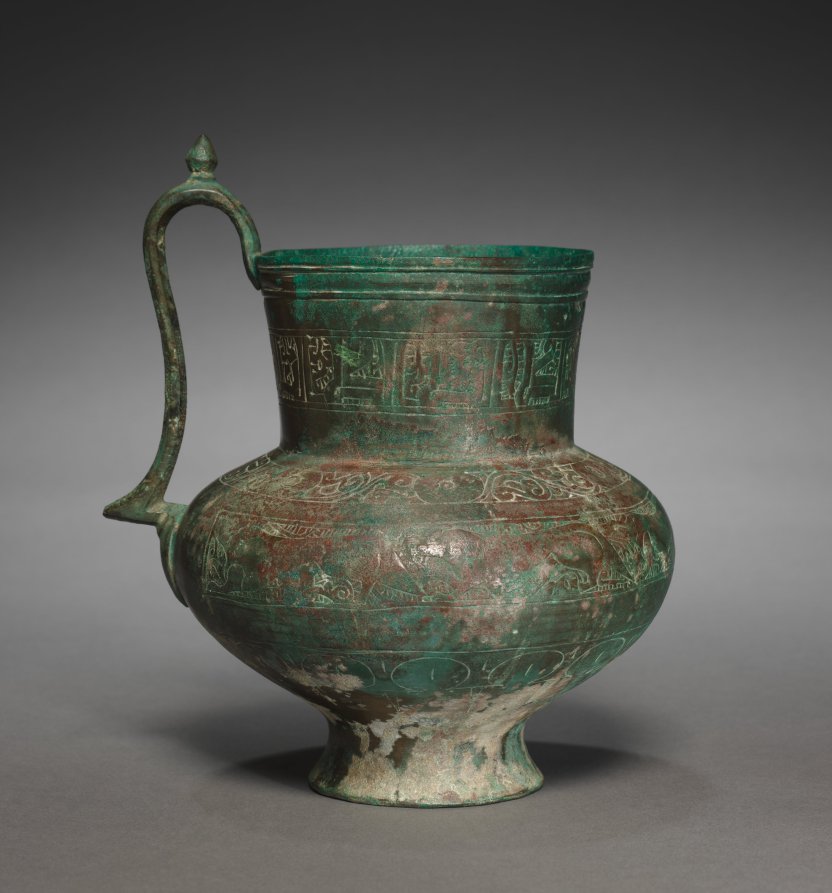
| Jug, Nishapur, Khurasan, 12th century Unidentified workshop | A Cleveland-held, CC0-released object from Nishapur, one of the two pre-Mongol Khurasan centers (with Herat) whose destruction in 1221 is the pivot of this ewer's own attribution problem Cast brass with Kufic inscription, dated broadly to the 1100s. Already used as comparanda in the Wade Cup's own record. | Cleveland Museum of Art (accession 1985.22) |
| Faceted ewer of Mahmud ibn Muhammad of Herat (the 'Tiflis Ewer') Mahmud ibn Muhammad, Herat | The closest documented shape comparandum: a faceted, silver-inlaid ewer of the same broad type, dated by its own inscription rather than by style Dated Sha'ban 577 AH (December 1181-January 1182 CE), eighteen years after the Bobrinski Bucket and well over a century before this ewer. | Simon Janashia Museum of Georgia, Tbilisi |
| Canteen Unidentified workshop of the Mosul tradition of inlaid metalwork | A different tradition and region (Ayyubid Syria or the Jazira, mid-13th century, Christian imagery) cited only for a parallel question: who a densely decorated luxury inlaid-metal vessel with no named patron was actually made for Also sold to its present museum by Hagop Kevorkian, in 1941, four years before he sold this ewer to Cleveland. A separately catalogued object in this archive; no fact or image belonging to it is used here beyond that comparison. | Smithsonian's National Museum of Asian Art (Freer Gallery of Art), Washington, DC (accession F1941.10) |
Open questions
- Is the ewer described and illustrated in a 1913 Burlington Magazine note, then in the Preece Collection and on exhibition at Vincent Robinson's Galleries, London, the same object as this accession? Cleveland's own bibliography cites the note for this accession, but the 1913 text does not mention sphinxes or twelve facets, and attributes the piece to 13th-century Mosul rather than 14th-century Khurasan.
- Does a 1916 Cleveland Museum of Art Bulletin article on the closing days of the museum's own inaugural exhibition, also cited in Cleveland's bibliography for this accession, document a loan appearance of this specific object in Cleveland three decades before its 1945 purchase? The article's full text could not be accessed for this record.
- Where was the object, under whichever attribution, between its manufacture (1300-1350) and its first documented sighting, at the earliest in 1913 and at latest by 1945? No owner is recorded for the gap.
- How and when did Hagop Kevorkian acquire the piece, and what did the Cleveland Museum of Art pay him for it in 1945? Neither fact is published in the sources consulted.
- Is 'Khurasan' still the correct region for an inlaid brass object of this construction dated 1300-1350, given that the standard modern survey of the field attributes most post-Mongol luxury metalwork of exactly this date range to Azarbaijan and Fars instead? No source consulted addresses this specific object against that broader synthesis.
- Does this ewer represent a continuous Khurasan workshop lineage surviving the Mongol conquest, several workshops elsewhere copying an inherited Khurasan repertoire, or a later revival modeled on surviving pre-Mongol objects? The scholarship argues methods for individual objects but does not resolve this question for the group as a whole.
- What does the base inscription actually say? No source consulted publishes a transliteration or translation.
- What does Eva Baer's 1965 iconographic study specifically argue about the sphinx band on this object, beyond citing its existence? The monograph could not be accessed directly for this record.
Questions about this object
What is Twelve-sided Ewer with Sphinxes and Human-Headed Inscriptions?
Twelve-sided Ewer with Sphinxes and Human-Headed Inscriptions is an islamic metalwork, dated 1300-1350 (Cleveland Museum of Art's own dating, per its Open Access API tombstone). Medium: Hammered sheet brass, inlaid with silver.
Who made Twelve-sided Ewer with Sphinxes and Human-Headed Inscriptions, and is the attribution settled?
The attribution to Unidentified metalworking workshop, Iran, Khurasan (region and continuity of tradition disputed for this date) is recorded here as disputed. The Cleveland Museum of Art's own current catalogue and Open Access API both give the vessel as Iran, Khurasan, Ilkhanid period (1256-1353), dated 1300-1350. That regional label sits in real tension with the wider synthesis of the field: the Mongol conquest brought a documented, abrupt end to the major pre-conquest metalworking centers of Khurasan (Herat, Nishapur, Merv) in 1220-1222, and Encyclopaedia Iranica's own survey of the discipline states that post-Mongol luxury metalwork of exactly this date range, the first half of the 14th century, is 'largely attributable to Azarbaijan and Fars' rather than to Khurasan itself, with Ilkhanid-period pieces from that later milieu sometimes read as 'more closely related to Mamluk metalwork than to other contemporaneous objects from Iran.' Whether this ewer represents a genuine surviving Khurasan workshop tradition carried forward by descendants or heirs of the pre-Mongol craft milieu, a workshop elsewhere in Iran or the Jazira consciously copying an inherited repertoire of Khurasan forms and motifs (sphinxes, human-headed inscription, foliate scroll, relief lion) onto a vessel later cataloged by region of style rather than region of manufacture, or a full century-later revival drawing on surviving pre-Mongol objects as models, is not resolved in the sources consulted for this record, and no scholar consulted here proposes a single answer. This record does not choose between them.
Where is Twelve-sided Ewer with Sphinxes and Human-Headed Inscriptions now?
The Cleveland Museum of Art, Cleveland, Ohio, Gallery 116 (Islamic). Inventory number 1945.27. Last confirmed 15 August 2026. Purchase from the J. H. Wade Fund, accessioned 21 February 1945, bought from Hagop Kevorkian, New York.
What is still unknown about Twelve-sided Ewer with Sphinxes and Human-Headed Inscriptions?
Is the ewer described and illustrated in a 1913 Burlington Magazine note, then in the Preece Collection and on exhibition at Vincent Robinson's Galleries, London, the same object as this accession? Cleveland's own bibliography cites the note for this accession, but the 1913 text does not mention sphinxes or twelve facets, and attributes the piece to 13th-century Mosul rather than 14th-century Khurasan.
Sources
- 1The Cleveland Museum of Art, collection record 1945.27, Twelve-sided Ewer with Sphinxes and Human-Headed Inscriptions. Tombstone, dimensions, medium, culture, date, description, did-you-know note, provenance, exhibition history, citation bibliography, CC0 image and Sketchfab 3D model, read via the museum's Open Access API (object id 124286) and its public catalogue page. clevelandart.org/art/...
- 2[W. R. Lethaby, ed.], 'Notes,' The Burlington Magazine for Connoisseurs, vol. 23, no. 124 (July 1913), pp. 246-251, including the unsigned item 'A 13th-Century Ewer Probably Made at Mosul.' Read in full from the digitized volume on the Internet Archive (identifier burlingtonmagazi23londuoft), OCR text. Cited in the Cleveland Museum of Art's own bibliography for accession 1945.27 as 'Mentioned: p. 247; Reproduced: p. 248'; the identification of the object described with this accession is not independently confirmed in this record. archive.org/details/...
- 3'Closing Days of the Inaugural Exhibition,' The Bulletin of the Cleveland Museum of Art 3, no. 3 (1916), pp. 1-4. Cited in the Cleveland Museum of Art's own bibliography for accession 1945.27 as 'Reproduced: p. 8; mentioned: p. 9.' Full text not accessible during this research (JSTOR access-restricted). Flagged for direct verification. jstor.org/stable/...
- 4Howard Hollis, 'Two Inlaid Brasses,' The Bulletin of the Cleveland Museum of Art 33, no. 4 (April 1946), pp. 39-43. Cited in the Cleveland Museum of Art's own bibliography for accession 1945.27 as 'Mentioned: pp. 39-40; Reproduced: p. 41.' Full text not accessible during this research (JSTOR access-restricted). Hollis was the museum's own curator of Oriental Art, 1929-1945; given the title and date, this article plausibly discusses both this ewer and the Wade Cup, bought within months of each other via the same fund, but that connection is not confirmed by any text read for this record. jstor.org/stable/...
- 5'Part II. Annual Report Issue for the Year 1945,' The Bulletin of the Cleveland Museum of Art, vol. 33, no. 6 (1946), pp. 103-130. Cited in the Cleveland Museum of Art's own bibliography for accession 1945.27 as 'Mentioned: p. 107.' Full text not accessible during this research. Flagged for direct verification. jstor.org/stable/...
- 6Eva Baer, Sphinxes and Harpies in Medieval Islamic Art: An Iconographical Study (Jerusalem: Israel Oriental Society, 1965). Cited in the Cleveland Museum of Art's own bibliography for accession 1945.27 as 'Mentioned: p. 14, fn. 53; Reproduced: Pl. XIV, fig. 24.' A digitized copy exists on the Internet Archive but requires an authenticated loan to read and returned an authorization error during this research. Flagged for direct verification before any specific claim about Baer's own argument regarding this object is treated as settled. archive.org/details/...
- 7Encyclopaedia Iranica, 'Metalwork.' Read via an archived copy of the page. Source for the account of Khurasan production centers, the Mongol destruction of those centers in the 1220s, the post-Mongol shift of luxury metalwork production to Azarbaijan and Fars, and Ilkhanid-period patrons including Abu Sa'id Bahador Khan and the Injuid ruler Abu Eshaq. iranicaonline.org/articles/...
- 8Richard Ettinghausen, 'The Wade Cup in the Cleveland Museum of Art, Its Origin and Decorations,' Ars Orientalis, vol. 2 (1957), pp. 327-366. Read in full from the digitized volume of Ars Orientalis vol. 2 (1957) on the Internet Archive (identifier arsorientalisart21957univ), OCR text. Cited here for the historiography and method of the Khurasan-school attribution debate and the chronology of the Mongol destruction of Herat, Nishapur and Merv, not for any claim that Ettinghausen discussed this specific ewer. archive.org/details/...
- 9A. S. Melikian-Chirvani, Islamic Metalwork from the Iranian World, 8th-18th Centuries (London: Victoria and Albert Museum, 1982). The monograph itself was not read directly during this research; its classification of hammered-sheet, silver-inlaid brass wares as products of 'the Khorasan school' of the later 12th and early 13th centuries is cited here via a bibliographic listing and secondary characterization. Flagged for direct verification. books.google.com/books/...
- 10Graces Guide, 'John Richard Preece.' Source for Preece's dates (1843-1917), his career with the Indo-European Telegraph Department and as British consul and consul-general at Isfahan, and the obituary description of him as 'a noted collector of Persian carpets, china, and curios.' gracesguide.co.uk/John_Richard_Preece
- 11Wikipedia, 'Hagop Kevorkian.' source for the dealer's biography: dates, excavations at Sultanabad and Rey, New York and Paris galleries, and criticism of his 1911 exhibitions. en.wikipedia.org/wiki/...
- 12The Cleveland Museum of Art, collection record 1944.485, The Wade Cup with Animated Script. Used for the comparison plate; CC0 status and image confirmed directly via the museum's Open Access API during this research. clevelandart.org/art/...
- 13The Cleveland Museum of Art, collection record 1985.22, Jug (Nishapur, Khurasan, 12th century). Used for the comparison plate; CC0 status and image confirmed directly via the museum's Open Access API during this research. clevelandart.org/art/...
Last verified · Published
Change log
15 August 2026 - Record created at the house standard: researched narrative, technical evidence, maker dossier, graded provenance chain, prices with hammer and premium separated, related works, open questions and sources.