Cabinet
Andre-Charles Boulle · c. 1690
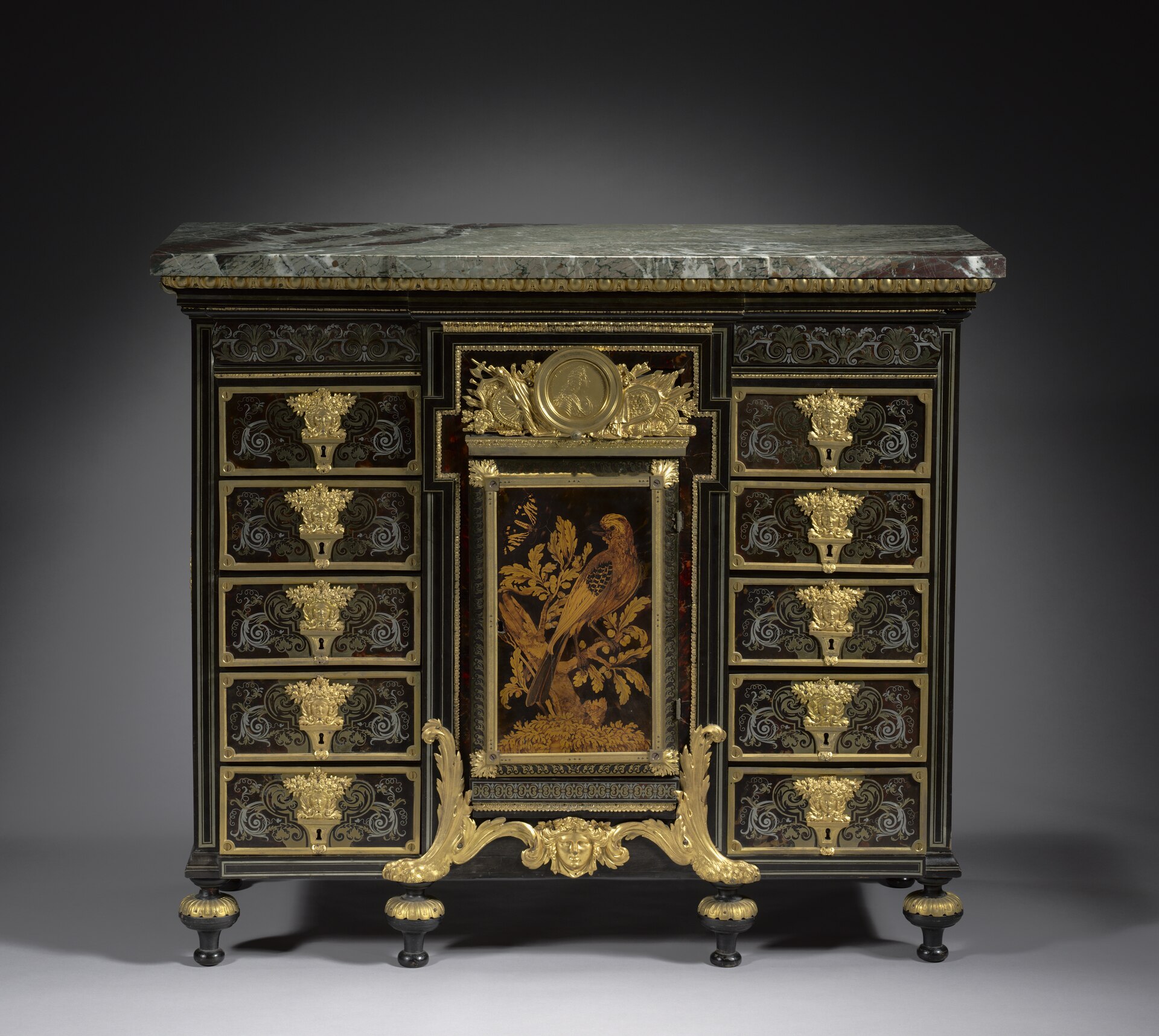
The record subject. Ebony veneer with marquetry in brass and tortoiseshell and gilt-bronze mounts, c. 1690. Cleveland Museum of Art, 1949.539. High-resolution museum photograph released under CC0.
| Artist | Andre-Charles Boulle |
|---|---|
| Date | c. 1690 |
| Medium | Ebony veneer over a carcase (wood species not published by the museum), with marquetry in brass and tortoiseshell (boulle marquetry) on the frame and wood marquetry on a tortoiseshell ground on the central and side panels, and gilt-bronze (ormolu) mounts |
| Dimensions | 101.3 x 117.6 x 50 cm (39 7/8 x 46 5/16 x 19 11/16 in) |
| Where it is now | Cleveland Museum of Art, Gallery 215 (French, German, and Dutch), Samuel Rosenthal Family Gallerylast confirmed |
| Inventory number | 1949.539 |
| Attribution | AcceptedThe Cleveland Museum of Art currently attributes the cabinet to Andre-Charles Boulle without qualification, both on its public catalogue page and in its own collection database, where the maker field reads 'made by' with no 'attributed to', 'workshop of' or 'circle of' qualifier. Full note |
| Object type | Furniture |
| Period | French, Louis XIV, late seventeenth century |
| Cases | Has a provenance gap |
| Inscriptions | None. Boulle furniture of this period was never signed or stamped; the attribution rests entirely on stylistic and technical comparison. |
| Owners on record | 6 links5 documented, 1 unknown |
| Sources | 14 cited |
About this record Last verified · 14 sources cited · Change log
On this page 9 sections
ContentsClose
An ebony cabinet inlaid with brass and tortoiseshell in the technique that carries Andre-Charles Boulle's name, its front panel centred on a gilt-bronze medallion of Louis XIV beneath a trophy of arms, and its central and side panels filled with parakeets and butterflies cut in wood marquetry against a tortoiseshell ground. Cleveland dates it about 1690 and attributes it to Boulle outright; the museum's own 1951 acquisition report was more careful, calling the attribution probable but not certain, built from comparison with a pendant piece at Versailles, a related armoire in the Louvre, a documented coin cabinet made for a Bavarian prince, and a cabinet at Drumlanrig traditionally linked to a gift from Charles II of England.
The cabinet came to Cleveland in 1949 from the New York dealers Rosenberg and Stiebel, out of the Vienna collections of Baron Nathaniel de Rothschild and then Baron Alphonse de Rothschild. That single Vienna name sits over one of the twentieth century's most documented confiscations of a private collection - the Gestapo's seizure of the Alphonse von Rothschild household on the day after the Anschluss in March 1938 - without Cleveland's own record saying whether the cabinet left the family before that date or was restituted afterward. The museum's Nazi-era provenance research project, by its own description, currently covers only its European paintings and sculpture; this piece, and the rest of its decorative arts collection, has not been run through that process.
What is not in dispute is the object itself: an early, largely unaltered example of the cabinet-on-a-stand form Boulle helped establish at the height of his royal patronage, missing only the tall base it was built to sit on, removed at some point in the late eighteenth century to suit a lower, more fashionable silhouette.
Provenance
Each link is graded. Documented: a cited source supports it. Disputed: the identification is argued but not established. Unknown: no owner for that span, and the gap is not smoothed into a narrative. The grades in the glossary.
- c. 1685-1695 -Workshop of Andre-Charles Boulle, Parisdocumented
Cleveland dates the cabinet c. 1690 (working range 1685-1695) and attributes it to Boulle without qualification. The museum's own 1951 scholarly account of the same piece, by then-director William M. Milliken, reached the same conclusion by comparison with related documented and traditionally-dated pieces, but stated the attribution as probable rather than certain, since no work by Boulle is signed and no document names this specific object.123
- c. 1695 - unknownUnrecordedunknown
No owner, sale, location or document is published for this cabinet between its creation and its first recorded owner, Baron Nathaniel de Rothschild. Cleveland's own provenance record and Milliken's 1951 account, the fullest published study, both begin with the Rothschild ownership, undated.123
- unknown - unknownBaron Nathaniel de Rothschilddocumented
The earliest named owner in Cleveland's own provenance record, with no acquisition date, dealer, or circumstance given. If this is Nathaniel Mayer von Rothschild (1836-1905) of the Vienna banking family, whose Palais Rothschild housed a celebrated decorative arts collection, that identification fits the Vienna-centred chain that follows, but it is not confirmed in the sources consulted.1214
- unknown - by 1949Baron Alphonse de Rothschild, Viennadocumented
The second and last named owner before Cleveland, per the museum's own provenance record, again undated. Baron Alphonse Mayer von Rothschild's Vienna palace was sealed and his collection of close to 3,500 objects confiscated by the Gestapo on 14 March 1938, immediately after the Anschluss, with furnishings assigned largely to the Neue Burg and the Palais Pallavicini; his widow Clarice recovered much of the collection and property after the war, in exchange for a forced surrender of over two hundred objects to Austrian museums. Whether this cabinet left the collection before the 1938 confiscation through an ordinary sale, or was confiscated and later restituted before reaching the New York market, is not documented in the sources consulted. Cleveland's own open-access database flags this specific object's Nazi-era-provenance status as false, but the museum's own published Nazi-era provenance research is stated to cover only its European paintings and sculpture collections, not decorative arts.121011
- by 1949 - 1949Rosenberg and Stiebel, Inc., New York (dealer)documented
Named in Cleveland's own provenance record as the dealer through which the museum acquired the piece from the Alphonse de Rothschild, Vienna ownership. Rosenberg and Stiebel traced its roots to a Frankfurt firm founded in 1874; its principals dispersed to Amsterdam, London and New York during the 1930s to escape Nazi Germany, with the New York branch opening in 1939. No sale date, price, or the specific route by which the piece reached the gallery is published in the sources consulted.1212
- 1949 - presentCleveland Museum of Artdocumented
Purchased through the John L. Severance Fund and accessioned 23 December 1949, per the museum's own accession-date field. Announced publicly the following month by director William M. Milliken in the museum's own Bulletin. No purchase price has been located in the sources consulted.123
Technical evidence
| Attribution note | The Cleveland Museum of Art currently attributes the cabinet to Andre-Charles Boulle without qualification, both on its public catalogue page and in its own collection database, where the maker field reads 'made by' with no 'attributed to', 'workshop of' or 'circle of' qualifier. This is a more confident position than the museum's own founding scholarship took. In the January 1951 Bulletin article that announced the acquisition, director William M. Milliken built the case from comparison alone - a pendant piece then at Versailles, a related armoire in the Louvre, a documented coin cabinet made for the Elector of Bavaria, and a cabinet at Drumlanrig traditionally dated to the reign of Charles II - and concluded that the piece 'can be attributed with every probability, but not with certainty, to the hand of the master himself.' No work by Boulle is signed or stamped; nothing has changed since 1951 to convert that comparison-based case into documentary proof. This record treats the attribution as accepted, on the strength of the comparanda Milliken assembled and Cleveland's own citation of Jean Nerhee Ronfort's 2003 revisionist chronology of the surviving cabinets on stands, while noting plainly that it rests on connoisseurship, not a signature or a contract. |
|---|---|
| Materials | Ebony veneer over a carcase whose wood species Cleveland has not published; marquetry in brass and tortoiseshell (boulle work) on the frame; wood marquetry on a tortoiseshell ground on the central and side panels; gilt-bronze (ormolu) mounts.13 |
| Dimensions | 101.3 x 117.6 x 50 cm (39 7/8 x 46 5/16 x 19 11/16 in), overall, as currently mounted without its original stand.12 |
| Marquetry technique on the central and side panels | Wood marquetry (not metal) let into a tortoiseshell ground, depicting parakeets and butterflies among foliage. Milliken (1951) identified this specifically as a sub-type of boulle work distinct from the metal-into-tortoiseshell inlay used on the frame, and cross-referenced it against a documented 1720 inventory of marquetry material lost in the fire at Boulle's own workshop, described there as made 'in his youth.'3 |
| Premiere-partie / contre-partie classification | Not stated by Cleveland or by Milliken's 1951 account for this specific object. Whether the cabinet is the premiere-partie or contre-partie half of a matched pair, and whether the Versailles pendant Milliken identified is that matching half, is unresolved in the sources consulted.13 |
| Gilt-bronze medallion and trophy | A trophy of arms and banners in gilt bronze above the central panel, set with a medallion of high quality depicting Louis XIV at an age consistent with a portrait type of about 1680.3 |
| Decorative motifs | Milliken (1951) describes 'parakeets and butterflies' on the central and side panels; Cleveland's current catalogue text describes 'a parrot on the central panel' in the singular. The two descriptions are not necessarily inconsistent, since a parakeet is a small parrot, but the sources use different terms for the same motif.13 |
| Loss and alteration of the stand | Cleveland's catalogue states the cabinet 'was likely altered in the late 1700s to reduce its scale and height,' consistent with removal of an original tall supporting stand. Milliken (1951) independently concluded the same for this class of Boulle cabinet on a stand, generally.13 |
| Dating basis | Cleveland dates the piece c. 1690, with an internal working range of 1685-1695. Milliken (1951) argued a date before 1700 from the character of the wood marquetry, comparison with the 1720 fire-loss inventory, and comparison with a cabinet at Drumlanrig Castle traditionally linked to a gift from Charles II of England, whose reign ended in 1685.1239 |
Images
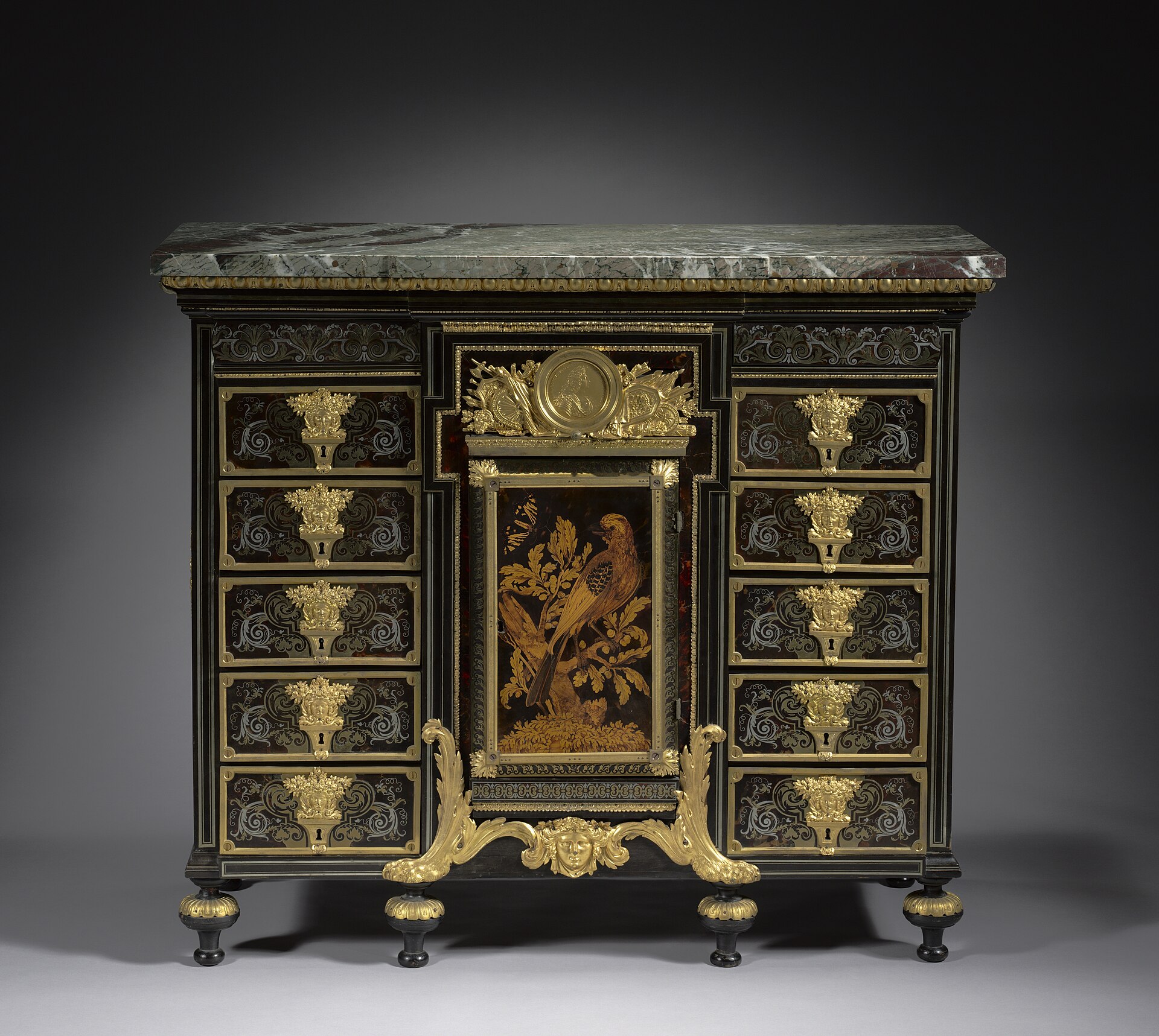
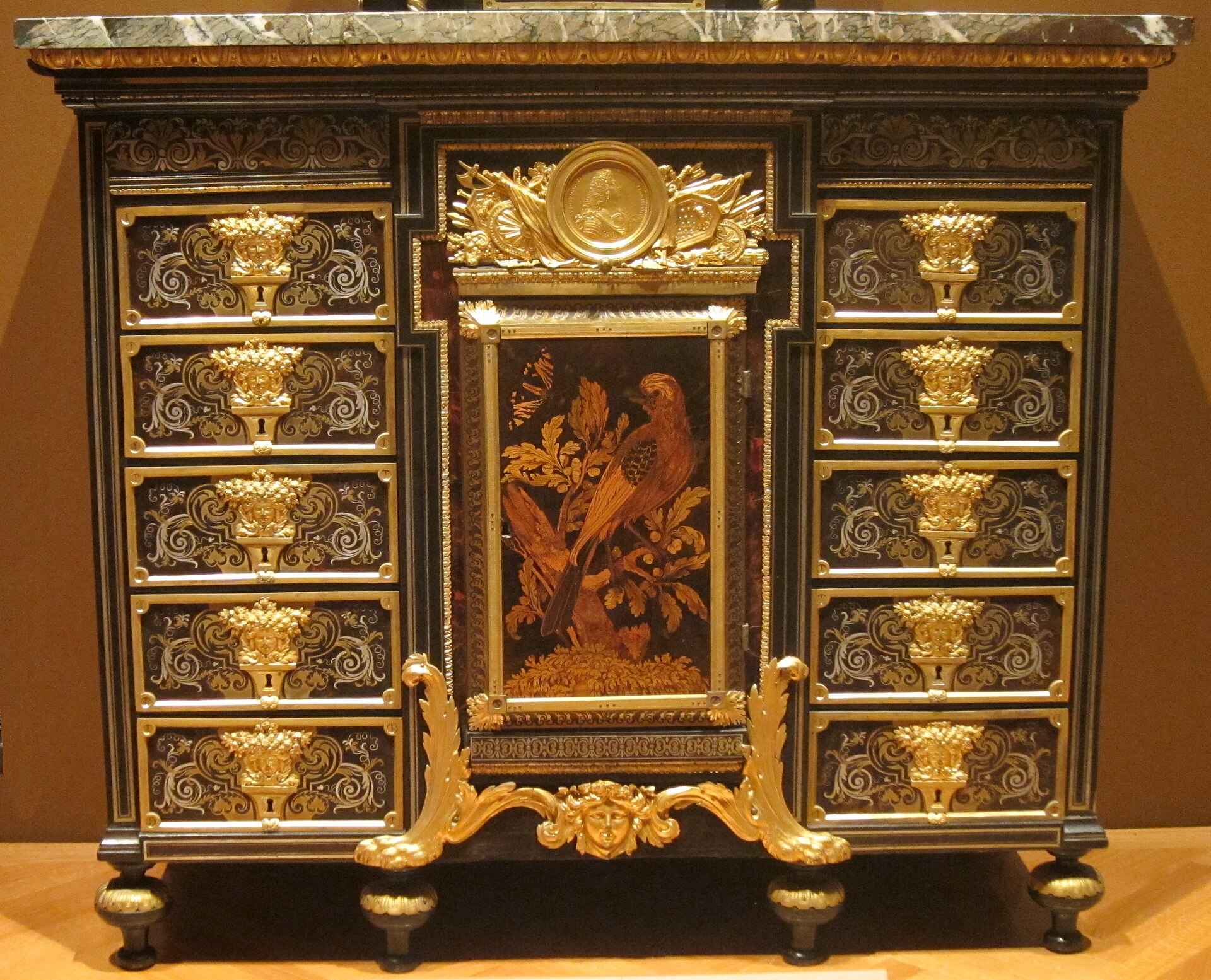
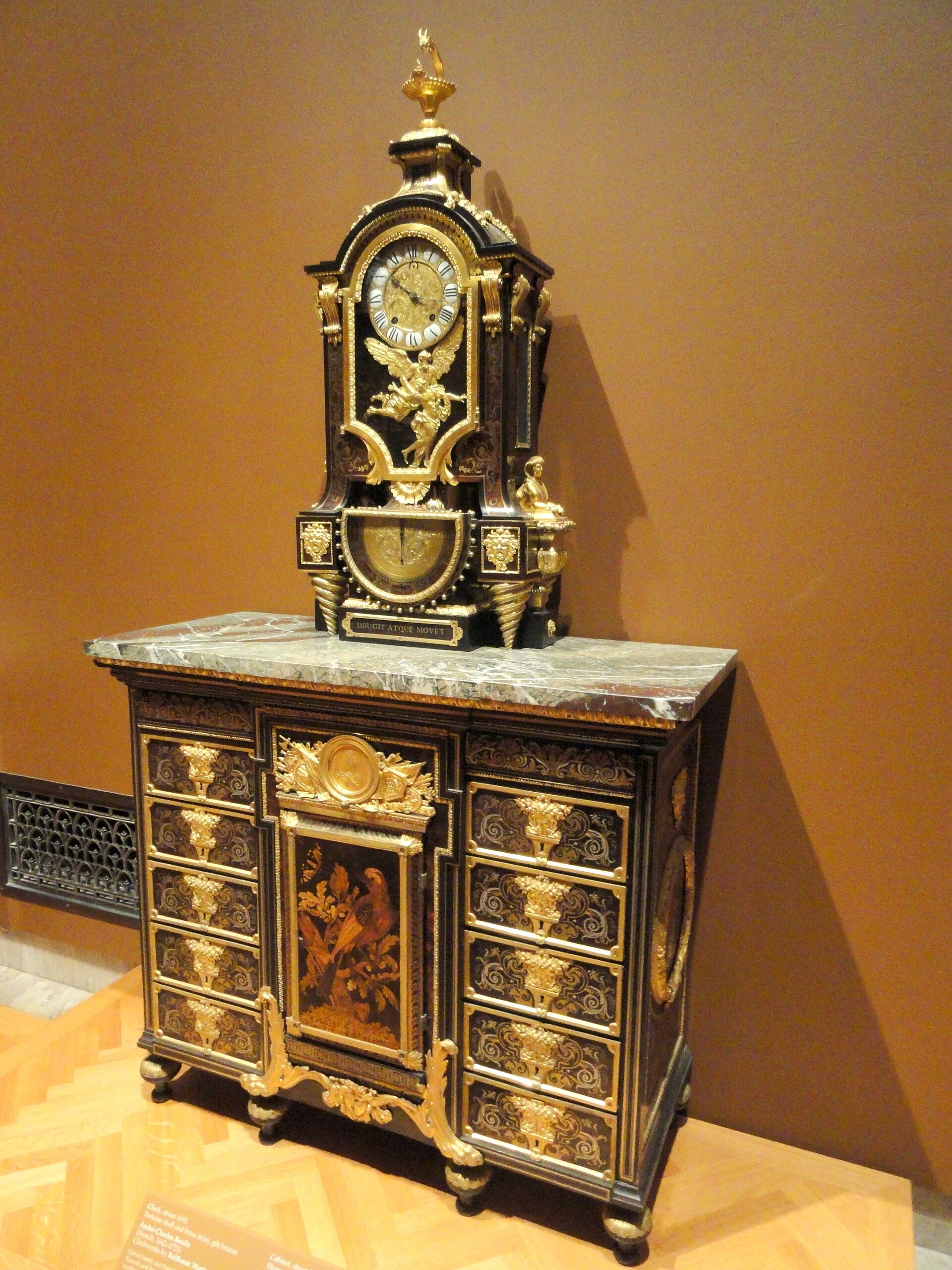
The record in full
Chapter 1What it is
The cabinet is a rectangular case, 101.3 by 117.6 by 50 centimetres, veneered in ebony and fitted with doors and drawers behind a facade built around a large central panel.
The cabinet is a rectangular case, 101.3 by 117.6 by 50 centimetres, veneered in ebony and fitted with doors and drawers behind a facade built around a large central panel. The frame around that panel is worked in the inlay most people mean when they say boulle work: sheets of brass and tortoiseshell cut together and set into each other so that metal traces a pattern against a dark tortoiseshell ground. The central panel itself, and the circular panels set into the sides of the case, use a related but distinct technique - wood marquetry, not metal, let into a tortoiseshell ground - to depict parakeets and butterflies among scrolling foliage. Above the central panel sits a trophy of arms and banners in gilt bronze, and set within that trophy, a medallion of high quality showing Louis XIV, apparently at an age consistent with a portrait type of about 1680.
The case sits directly on the floor today. It did not start that way. Cabinets of this exact form and date were built to sit on a separate, elaborately carved and gilded stand, often taller than the cabinet itself, and Cleveland's own catalogue entry states plainly that this piece was 'likely altered in the late 1700s to reduce its scale and height,' the stand presumably removed to let the case double as a lower, self-supporting piece more suited to later eighteenth-century interiors.
Chapter 2How the marquetry was made
The technique now called boulle work did not originate with Andre-Charles Boulle, but he industrialised and perfected it to the point that his name replaced its own description.
The technique now called boulle work did not originate with Andre-Charles Boulle, but he industrialised and perfected it to the point that his name replaced its own description. A sheet of tortoiseshell and a sheet of metal, usually brass, were glued together and the desired pattern was cut through both at once with a fine marquetry saw. Separating the two sheets afterward yielded two complementary panels from a single cutting: one with the pattern in brass set against a tortoiseshell ground, called premiere-partie, and its mirror opposite, with tortoiseshell set into a brass ground, called contre-partie. A workshop could therefore sell two related but non-identical pieces of furniture from one act of cutting, a fact that shaped both the surviving corpus and its cataloguing difficulties: many boulle pieces exist as one half of a pair whose other half is untraced, in a different collection, or was never made to match.
Neither Cleveland's catalogue entry nor Milliken's 1951 account classifies this specific cabinet as premiere-partie or contre-partie, and the sources consulted for this record do not resolve which, if either, term applies to it. What Milliken's account does specify is that the central and side panels are not metal-on-tortoiseshell at all, but a related sub-type - wood marquetry on a tortoiseshell ground - that he identified, by comparison with a documented fire-loss inventory from Boulle's own workshop, as characteristic of the master's earlier work rather than his later, more purely metallic style.
Chapter 3A parrot, a trophy, and a king
None of the decoration on this cabinet is neutral.
None of the decoration on this cabinet is neutral. The medallion of Louis XIV set within a trophy of arms was not incidental ornament; Cleveland's own catalogue text states that 'the inclusion of a medallion depicting Louis XIV within the bronze decoration of this chest would have identified the owner with the royal court' - a piece of furniture doing the work of a portrait miniature or a courtier's ribbon, announcing proximity to the king to anyone who saw it in a room. Boulle's own position, as cabinetmaker lodged inside the Louvre by royal favour, made him the obvious source for furniture that performed that kind of identification, and the museum's own description frames his broader output as 'an example of the intellectual fashion for contrasting ideas, materials, and motifs' current at Louis XIV's court.
The birds and butterflies worked into the central and side panels belong to the same fashion from a different angle. A comparable coin cabinet Boulle made for the Bavarian Elector Max Emanuel, nephew of Louis XIV, carries thistlefinches on its outer panels and, on the inside, what a modern German cataloguer describes as exotic parrots - the same pairing of a native songbird with an imported, expensive bird that had to be brought from far outside Europe. Parrots and parakeets were luxury imports in the late seventeenth century, kept and traded as living curiosities by exactly the court and diplomatic circle this cabinet's medallion was designed to flatter; putting one in wood marquetry on a piece of ebony and tortoiseshell furniture layers one exotic, costly material over the image of another. The tortoiseshell ground itself came from the hawksbill turtle, hunted across the Caribbean and traded through ports such as those in Jamaica into the European luxury market of exactly this period - meaning the raw material of the cabinet's surface, not only its imagery, was itself an imported and increasingly commodified product of transatlantic trade.
Chapter 4Andre-Charles Boulle: cabinetmaker to the Sun King
Andre-Charles Boulle was born, by his own later claim, in Paris in 1642, though historians treat both the date and the birthplace as uncertain.
Andre-Charles Boulle was born, by his own later claim, in Paris in 1642, though historians treat both the date and the birthplace as uncertain. His grandfather Pierre Boulle had served Louis XIII as a cabinetmaker, and his father Jean Boulle held the same trade before him; the family's own origin was said to lie further off, in Gelderland. No apprenticeship record for Andre-Charles survives, and his early training was presumably absorbed inside his father's own Louvre workshop rather than documented through a guild.
What is documented is the turn his career took in 1672, when Jean-Baptiste Colbert, recommending him to the crown as the most skilled cabinetmaker working in Paris, secured him lodgings in the Louvre galleries and the title of cabinetmaker, chaser, gilder and maker of marquetry to the king. The appointment freed him from the ordinary restrictions of the Parisian guild system and let him run a large, multi-disciplinary workshop producing furniture, gilt-bronze mounts, and marquetry design under one roof - the organisational model that let his name become a generic term for a technique rather than staying the name of one man's output.
Success did not translate into financial stability. Boulle was a compulsive collector of drawings, prints, and sculpture in his own right, and repeatedly ran into debt funding that habit rather than through any failure of his furniture business. In 1720 a fire destroyed his Louvre workshop and, with it, a large part of that personal collection; a contemporary inventory of the loss lists, among other things, forty-eight drawings attributed to Raphael, wax models attributed to Michelangelo, and a manuscript journal kept by Rubens during his travels in Italy. Boulle transferred control of the workshop to his four sons in 1715, before the fire, and died in his Louvre lodgings on 29 February 1732. Three of his four sons are recorded as having died in debt themselves, a detail that complicates any assumption that a Boulle-attributed piece from the years around 1715-1732 necessarily passed through the hand of the master rather than his sons' own, separately run ateliers.
Chapter 5An attribution built from comparison, not a signature
Furniture attributed to Boulle is a famously difficult connoisseurship problem, and this cabinet is a clean illustration of why.
Furniture attributed to Boulle is a famously difficult connoisseurship problem, and this cabinet is a clean illustration of why. Nothing that left his workshop was signed or stamped with a maker's mark of the kind that identifies, for instance, an eighteenth-century ebeniste working under the later Paris guild system. Boulle also kept no accurate accounting of his own output. Scholars reconstructing his corpus - among them Jean-Pierre Samoyault, Alexandre Pradere, Jean Nerhee Ronfort, Theodore Dell, and Peter Hughes - have had to work from indirect evidence: payment records in the accounts of the Batiments du Roi, engraved furniture designs published under Boulle's name by Pierre-Jean Mariette around 1720, comparison of gilt-bronze mount patterns across pieces, and the technical character of the marquetry itself. Only a small number of pieces, chief among them a pair of commodes supplied to the Grand Trianon in 1708-1709, are tied to Boulle by a contemporary document rather than by comparison.
Milliken's 1951 case for this cabinet follows exactly that comparative method, and states its own limits candidly. He compared the piece to four others: a cabinet then at Versailles that he identified as its pendant; a large armoire in the Louvre, restored in the eighteenth century but datable by a surviving preparatory sketch; a coin cabinet documented as made for Max Emanuel of Bavaria; and a cabinet at Drumlanrig Castle in Scotland, which family tradition held had been a gift from Charles II of England, whose reign ended in 1685 - making it, if the tradition is accurate, the earliest possible fixed point for the type. From that comparison, and from the character of the wood-marquetry panels, which he cross-referenced against the 1720 fire-loss inventory's description of marquetry 'made in his youth' by 'Sieur Boulle pere,' Milliken dated the Cleveland cabinet before 1700 and wrote that it 'can be attributed with every probability, but not with certainty, to the hand of the master himself.' That sentence, written by the museum's own director in the same publication that announced the acquisition, is more cautious than the unqualified 'made by' the museum's current catalogue and open-access database both use for the same object.
The broader reason this kind of caution matters is that Boulle's workshop, his sons' successor workshops, and a long line of nineteenth-century revival cabinetmakers - Beurdeley, Sormani, Fourdinois, Henry Dasson, and Francois Linke among the best documented - all produced boulle-technique furniture at a very high level of technical skill, sometimes explicitly signed and dated by the later makers, sometimes not. Distinguishing a genuine late-seventeenth or early-eighteenth-century Boulle piece from a later workshop or revival production is a live, ongoing problem in the field, resolved case by case through archival research, mount comparison, and increasingly material analysis, rather than through any single decisive test. Nothing found for this record alleges that the Cleveland cabinet is a later production; the point is that the caution built into the museum's own founding scholarship on this specific piece is the correct caution to carry forward, not an oversight to smooth away.
Chapter 6The cabinet's cousins
Milliken's 1951 case rested on naming specific comparanda, and locating them shows how tightly this piece sits inside a small, cross-referenced group.
Milliken's 1951 case rested on naming specific comparanda, and locating them shows how tightly this piece sits inside a small, cross-referenced group. He identified a pendant cabinet then at the Palace of Versailles, placed there in the nineteenth century by King Louis Philippe during his restoration of the chateau, and proposed that both pieces might originally have been part of the furniture dispersed from Versailles at auction during the French Revolution - a proposal, not a documented fact, since no inventory record ties either piece to a specific pre-Revolutionary Versailles room. He also pointed to a large armoire in the Louvre with side panels almost identical in design to the Cleveland piece, and to a coin cabinet made for Max Emanuel, Elector of Bavaria, now in the Staatliche Munzsammlung in Munich, whose closest design parallels a later German cataloguer places in the Louvre and the J. Paul Getty Museum in Los Angeles.
A further pair of cabinets at Drumlanrig Castle in Scotland, seat of the Duke of Buccleuch, is traditionally said to have been a gift from Louis XIV to Charles II of England, passed on to Charles's illegitimate son the Duke of Monmouth, and to have remained in the same family ever since - the kind of unbroken, family-recorded chain that is exceptionally rare for Boulle furniture. According to the Buccleuch collection's own account, the larger of the two Drumlanrig cabinets has a near-identical twin at the Getty Museum, and the smaller has a companion piece in the Wallace Collection in London. None of these comparanda have been verified against the Cleveland cabinet for this record beyond what Milliken and the institutions themselves publish, and no image of any of them has been included here, in keeping with this publication's rule against attaching an unverified picture to an object it may not in fact show.
Chapter 7The stand that is missing
Cabinets of this Louis XIV type were architectural objects in two parts: the case itself, and a separate, usually taller, carved and gilded stand that lifted it to a standing height and gave it a...
Cabinets of this Louis XIV type were architectural objects in two parts: the case itself, and a separate, usually taller, carved and gilded stand that lifted it to a standing height and gave it a base as ornamented as the cabinet above. Milliken observed in 1951 that the whole class of pieces he was comparing - the Cleveland cabinet, the Versailles pendant, and the related pieces now in the Galerie d'Apollon at the Louvre - had 'in all probability' originally been fitted with such stands, which were eliminated at some later point 'to make the pieces more adaptable in an eighteenth-century interior.' Cleveland's own current catalogue text makes the same point independently, dating the alteration to the late 1700s. Neither source identifies when, by whom, or under what ownership the stand was removed, and no trace of the original stand for this specific cabinet has been located in the sources consulted.
Chapter 8Vienna, the Rothschilds, and a chain with a real gap in it
Cleveland's own provenance record for the cabinet lists exactly two owners before the museum itself: Baron Nathaniel de Rothschild, and then Baron Alphonse de Rothschild, Vienna, parenthetically...
Cleveland's own provenance record for the cabinet lists exactly two owners before the museum itself: Baron Nathaniel de Rothschild, and then Baron Alphonse de Rothschild, Vienna, parenthetically noting Rosenberg and Stiebel, Inc., New York as the dealer through which Cleveland bought the piece. No dates, no acquisition mechanism, and no first names beyond the title 'Baron' are given for either Rothschild link. If the Nathaniel in question is Nathaniel Mayer von Rothschild (1836-1905) of the Vienna banking house, his Palais Rothschild on the Theresianumgasse housed one of the most celebrated decorative-arts collections in nineteenth-century Vienna; that identification is plausible given the Vienna-centred chain that follows it, but it is not confirmed in the sources consulted for this record, and Cleveland's own published documentation does not make the link explicit.
The second name carries more weight than its bare appearance in a provenance list suggests. Baron Alphonse Mayer von Rothschild's Vienna palace was sealed by the authorities on 14 March 1938, immediately after the Anschluss, and the Gestapo confiscated the collection housed there - by one accounting nearly 3,500 objects, moved to the depot of the Kunsthistorisches Museum in the Hofburg, with furnishings assigned for the most part to the Neue Burg and the Palais Pallavicini in Vienna and works reserved for possible transfer to Berlin, Munich, or Hitler's planned museum at Linz. After the war, Alphonse's widow Clarice recovered much of the collection and the family's Austrian property, though Austria required the surrender of more than two hundred works as a condition of export permission; a further 186 objects from that same collection reached the Museum of Fine Arts, Boston as a family gift as recently as 2015.
Whether the Cleveland cabinet was among the objects seized in March 1938 and later restituted, or had already left Alphonse von Rothschild's ownership through an ordinary prewar sale before that date, is not stated anywhere in the sources consulted for this record. Cleveland's own open-access database carries a specific field flagging Nazi-era provenance concerns for each object in its collection, and the field for this cabinet is set to false - the museum's own current determination is that this is not a Nazi-era provenance case. At the same time, Cleveland's own public description of its Nazi-era provenance research states that the published findings are 'limited to the 373 works of art in our European paintings collection and the 86 in our European sculpture collection'; on the museum's own terms, its decorative arts holdings, including this cabinet, have not been run through that dedicated research process. Neither fact contradicts the other, but together they describe an object whose most sensitive provenance question, the exact date and mechanism by which it left a collection that was confiscated by the Gestapo within the likely lifetime of one of its two named owners, has not been publicly answered by anyone who holds the archive to answer it.
Chapter 9Rosenberg and Stiebel: the dealer of record
The gallery that sold the cabinet to Cleveland in 1949 has its own history bound up with the same displacement.
The gallery that sold the cabinet to Cleveland in 1949 has its own history bound up with the same displacement. Rosenberg and Stiebel traced its roots to a firm founded in Frankfurt in 1874 by Jakob Rosenbaum, which grew under his son Isaak Rosenbaum and Isaak's nephews Saemy Rosenberg and Eric Stiebel into a dealer of Old Master paintings and decorative arts with a transatlantic clientele. As Nazism took hold in Germany during the 1930s, the family dispersed its business geographically to survive: Isaak opened in Amsterdam, Saemy and his brother Raphael Rosenberg opened in London, and in 1939 Eric Stiebel established the New York branch, where Saemy Rosenberg and Hans Stiebel joined him after the war. That New York gallery, trading as Rosenberg and Stiebel, Inc. from a Manhattan address it held from 1944 to 2000, was exactly the kind of firm through which European aristocratic and formerly persecuted collections moved onto the American museum market in the years immediately after 1945 - though this record has found no document specifying whether the Cleveland cabinet reached the gallery as a straightforward dealer purchase or through some other route. The firm's surviving business archive is now held by the Frick Collection in New York.
Chapter 10Cleveland acquires the cabinet, 1949
Cleveland's own accession records give a purchase date of 23 December 1949, funded by the John L.
Cleveland's own accession records give a purchase date of 23 December 1949, funded by the John L. Severance Fund, one of the museum's oldest and most significant acquisition endowments, named for the Cleveland industrialist and museum benefactor whose earlier gift of French Renaissance furniture already hung in the same galleries. The purchase was announced publicly the following month, in the January 1951 issue of the museum's own Bulletin, in the article by director William M. Milliken that remains the fullest published study of the piece. No purchase price for the 1949 acquisition has been located in the sources consulted; museum bulletins of that period did not customarily publish what an object cost. The cabinet has remained in Cleveland's collection continuously since 1949 and is on permanent display today in Gallery 215, among the museum's French, German, and Dutch decorative arts.
Chapter 11The catalogue entry, then and now
Comparing Cleveland's 1951 and current published positions on this cabinet is itself a small case study in how a catalogue entry can harden over time.
Comparing Cleveland's 1951 and current published positions on this cabinet is itself a small case study in how a catalogue entry can harden over time. Milliken's 1951 text is explicit about method and explicit about doubt: he lists his comparanda, explains his dating logic from the 1720 fire inventory, and ends on a sentence that names uncertainty directly. The museum's present-day web catalogue entry and its structured open-access database both drop that hedge entirely, listing Andre-Charles Boulle as the maker with no qualifying language at all, in contrast to the Metropolitan Museum's own comparable holding, catalogued as 'Attributed to Andre Charles Boulle,' and to the J. Paul Getty Museum's Boulle-attributed pieces, which carry the same qualified phrasing. This record has found no new evidence published between 1951 and today that would justify Cleveland's shift from a probable attribution to an unqualified one; the most likely explanation is simply that popular catalogue language tends to simplify over decades of reprinting, not that a new document surfaced. Milliken's own 1951 caution is the more defensible position on the evidence this record has been able to verify, and it is the one this record has adopted.
The artist
Andre-Charles Boulle
Andre-Charles Boulle gave his name to a marquetry technique before he gave it to a documented body of work. He signed nothing, kept no reliable account of his own output, and lost a large part of his personal art collection to a workshop fire in 1720 along with, presumably, some of the records that might have helped later scholars. The corpus of furniture attributed to him today is a reconstruction built from royal payment records, engraved designs published under his name, and comparison of marquetry and mounts across surviving pieces - which means that, as with the piece on this page, an attribution to Boulle is nearly always an attribution built from evidence around the object rather than a document naming the object itself.
Related works
| Work | Relation | Where it is |
|---|---|---|
| Pendant cabinet Andre-Charles Boulle (attributed) | Identified by Milliken in 1951 as a pair with the Cleveland cabinet, sharing the same frame construction and central and side panel design Placed at Versailles in the nineteenth century by King Louis Philippe during his restoration of the chateau. Its modern inventory number and current scholarly status have not been independently verified for this record; whether it is still catalogued as a pendant to the Cleveland piece is unconfirmed. | Palace of Versailles |
| Armoire Andre-Charles Boulle (attributed) | Side panels almost identical in design to the Cleveland cabinet, cited by Milliken as comparative evidence for an early, pre-1700 date Restored in the eighteenth century; a surviving preparatory sketch in the Musee des arts decoratifs supports an early date for the design. | Musee du Louvre, Departement des objets d'art |
| Coin cabinet made for Max Emanuel, Elector of Bavaria Andre-Charles Boulle | Documented royal commission cited by Milliken as comparative evidence; carries a related exotic-bird marquetry programme (parrots and thistlefinches) Probably acquired by Max Emanuel during a stay in Paris before 1700. A German cataloguer places its closest design parallels in the Louvre and the J. Paul Getty Museum. | Staatliche Munzsammlung, Munich (Residenz) |
| Pair of cabinets Andre-Charles Boulle (attributed, by family tradition) | Comparanda cited by Milliken; traditionally said to have been made for Versailles and given by Louis XIV to Charles II of England Family tradition holds the pieces passed from Charles II to his son the Duke of Monmouth and have remained in the same family since. If accurate, this is an unusually well-documented ownership chain for Boulle furniture; the tradition itself has not been independently verified for this record. | Drumlanrig Castle, Dumfriesshire (Duke of Buccleuch collection) |
| Cabinet Andre-Charles Boulle (attributed, by family tradition) | Said by the Buccleuch collection to be a near-identical twin of the larger Drumlanrig cabinet Not to be confused with the Getty's separately catalogued Cabinet des Medailles, attributed to Boulle and dated about 1710-1715, a later and different object. | J. Paul Getty Museum, Los Angeles |
| Cabinet Andre-Charles Boulle (attributed, by family tradition) | Said by the Buccleuch collection to be a companion piece to the smaller Drumlanrig cabinet Not independently verified against the Cleveland piece for this record. | The Wallace Collection, London |
Open questions
- Where and with whom was the cabinet between its creation, c. 1685-1695, and its first documented owner, Baron Nathaniel de Rothschild? No date is published for when it entered the Rothschild collection.
- Exactly which Nathaniel de Rothschild and which Alphonse de Rothschild are named in Cleveland's provenance record, and by what mechanism, inheritance or purchase, did the piece pass between them? The museum's record gives titles only, no first names, dates or transfer method.
- Did the cabinet leave Baron Alphonse von Rothschild's Vienna collection before the Gestapo's confiscation of the household on 14 March 1938, or was it among the confiscated objects and later restituted? Cleveland's own Nazi-era provenance research, by the museum's own description, currently covers only its European paintings and sculpture collections, not its decorative arts, so this has not been formally investigated.
- Is the cabinet Milliken identified as the Cleveland piece's pendant still at Versailles today, and does modern scholarship, including Ronfort's 2003 revised chronology, still treat it as a genuine pair, a later associated piece, or something else?
- Was the cabinet, or its identified Versailles pendant, ever actually part of the furniture of the Chateau de Versailles dispersed at the Revolutionary sales of the 1790s, as Milliken proposed by comparison, or is that connection unsupported by any surviving inventory?
- What did the cabinet's original stand look like, when precisely was it removed, and does the stand survive separately, unrecognised, anywhere?
- What price did Cleveland pay for the cabinet in 1949? No figure has been located in the museum's published Bulletin announcement or elsewhere in the sources consulted.
- Does Jean Nerhee Ronfort's 2003 article, which Cleveland itself cites as reproducing this cabinet, revise Milliken's 1951 dating or attribution reasoning? The article is paywalled on JSTOR and was not accessible for this record.
Questions about this object
What is Cabinet?
Cabinet is a furniture, dated c. 1690. Medium: Ebony veneer over a carcase (wood species not published by the museum), with marquetry in brass and tortoiseshell (boulle marquetry) on the frame and wood marquetry on a tortoiseshell ground on the central and side panels, and gilt-bronze (ormolu) mounts.
Who made Cabinet, and is the attribution settled?
The attribution to Andre-Charles Boulle is recorded here as accepted. The Cleveland Museum of Art currently attributes the cabinet to Andre-Charles Boulle without qualification, both on its public catalogue page and in its own collection database, where the maker field reads 'made by' with no 'attributed to', 'workshop of' or 'circle of' qualifier. This is a more confident position than the museum's own founding scholarship took. In the January 1951 Bulletin article that announced the acquisition, director William M. Milliken built the case from comparison alone - a pendant piece then at Versailles, a related armoire in the Louvre, a documented coin cabinet made for the Elector of Bavaria, and a cabinet at Drumlanrig traditionally dated to the reign of Charles II - and concluded that the piece 'can be attributed with every probability, but not with certainty, to the hand of the master himself.' No work by Boulle is signed or stamped; nothing has changed since 1951 to convert that comparison-based case into documentary proof. This record treats the attribution as accepted, on the strength of the comparanda Milliken assembled and Cleveland's own citation of Jean Nerhee Ronfort's 2003 revisionist chronology of the surviving cabinets on stands, while noting plainly that it rests on connoisseurship, not a signature or a contract.
Where is Cabinet now?
Cleveland Museum of Art, Gallery 215 (French, German, and Dutch), Samuel Rosenthal Family Gallery. Inventory number 1949.539. Last confirmed 18 August 2026. On permanent display at the Cleveland Museum of Art; purchased through the John L. Severance Fund and accessioned 23 December 1949.
What is still unknown about Cabinet?
Where and with whom was the cabinet between its creation, c. 1685-1695, and its first documented owner, Baron Nathaniel de Rothschild? No date is published for when it entered the Rothschild collection.
Sources
- 1Cleveland Museum of Art, 'Cabinet' (object page, accession 1949.539). clevelandart.org/art/...
- 2Cleveland Museum of Art, Open Access API record for accession 1949.539 (internal id 127221), including provenance, technique, accession date and the museum's own is_nazi_era_provenance field. openaccess-api.clevelandart.org/api/...
- 3Milliken, William M. 'A Boulle Cabinet.' The Bulletin of the Cleveland Museum of Art 38, no. 1 (January 1951): 6-10. archive.org/details/...
- 4Ronfort, Jean Nerhee. 'The Surviving Cabinets on Stands by Andre-Charles Boulle and the New Chronology of the Master's Oeuvre.' Cleveland Studies in the History of Art 8 (2003): 44-67. Cited by the Cleveland Museum of Art as reproducing this cabinet at pp. 52-53, fig. 11. Paywalled on JSTOR; not independently accessible for this record and flagged for follow-up. jstor.org/stable/...
- 5Wikipedia, 'Andre-Charles Boulle.' source, used for family background, the 1642 birth-date uncertainty, the 1720 fire inventory, and the list of modern Boulle scholars. en.wikipedia.org/wiki/...
- 6The Wallace Collection, 'The Cabinetmaker' (Boulle's Furniture, explore in depth). wallacecollection.org/explore/...
- 7The Metropolitan Museum of Art, 'Attributed to Andre Charles Boulle - Cabinet' (comparanda for current museum attribution language). metmuseum.org/art/...
- 8Ernst von Siemens Kunststiftung, 'Munzkabinett von Andre Boulle' (Staatliche Munzsammlung Munchen). ernst-von-siemens-kunststiftung.de/objekt/...
- 9Buccleuch Living Heritage Trust / Drumlanrig Castle, 'The World Class Buccleuch Art Collection' and 'Drumlanrig Castle'. drumlanrigcastle.co.uk/drumlanrig-castle/...
- 10Cleveland Museum of Art, 'Nazi-Era Provenance' (statement of the scope of the museum's provenance research project). clevelandart.org/about-collection/...
- 11Kunst, Raub, Ruckgabe (Nazi-era art theft and restitution research project), 'Alphonse von Rothschild: Art, theft and restitution.' kunst-raub-rueckgabe.de/en/...
- 12The Frick Collection Archives, 'Rosenberg and Stiebel Archive' (dealer firm history). archives.frick.org/repositories/...
- 13Victoria and Albert Museum, 'Tortoiseshell combs from Jamaica' (hawksbill turtle tortoiseshell trade, used for materials-sourcing context). vam.ac.uk/articles/...
- 14Wikipedia, 'Nathaniel Mayer von Rothschild.' source, used only for basic biographical context on the Vienna Rothschild branch and its collection. en.wikipedia.org/wiki/...
Last verified · Published
Change log
18 August 2026 - Record created at the house standard: researched narrative, technical evidence, maker dossier, graded provenance chain, prices with hammer and premium separated, related works, open questions and sources.