Tomb Cover
Unidentified weaver, Iran or Iraq · 1640-1950 (radiocarbon date, 95 per cent probability). Acquired, published and exhibited as c. 945-1055
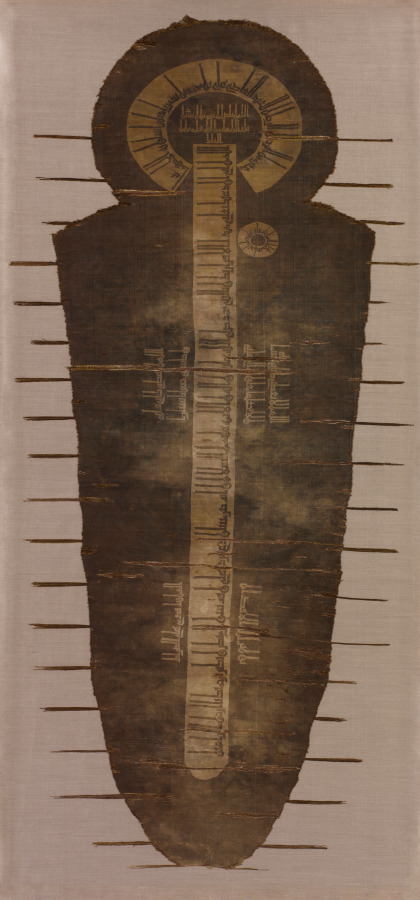
The record subject. Silk compound tabby, 210.2 by 102.5 cm, a complete loom piece cut to the shape of a body with a circle for the head. Bought in 1954 as tenth or eleventh century; radiocarbon dated 1640 to 1950.
| Artist | Unidentified weaver, Iran or Iraq |
|---|---|
| Date | 1640-1950 (radiocarbon date, 95 per cent probability). Acquired, published and exhibited as c. 945-1055 |
| Medium | Silk, compound tabby |
| Dimensions | 210.2 x 102.5 cm |
| Where it is now | Cleveland Museum of Art, Cleveland, Ohiolast confirmed 4 August 2026 |
| Inventory number | 1954.780 |
| Attribution | DisputedBought in 1954, published and exhibited internationally for four decades as a tenth or eleventh century silk woven under the Buyid dynasty. Full note |
| Object type | Textile |
| Period | Catalogued as in the style of the Buyid period (945-1055); dated by radiocarbon to 1640-1950 |
| Cases | Disputed attribution |
| Inscriptions | Kufic, reserved in beige on bands against a dark brown ground. The museum records the text as: Maghfirah min al-Rahman al-Rahim lil-'abd al-'asi 'Ali bin Muhammad bin Shahrazad bin Rastawayh al-Isbahani, translated as: Forgiveness [be] from the Merciful, the Compassionate to the disobedient servant 'Ali bin Muhammad bin Shahrazad bin Rastawayh al-Isbahani. Further inscriptions refer to the part of the body over which each band lies. |
| Owners on record | 4 links2 documented, 2 disputed |
| Sources | 9 cited |
About this record Last verified 3 September 2026 · 9 sources cited · Change log
On this page 12 sections
ContentsClose
A complete loom-woven funeral pall, 210 by 102 centimetres, cut to the shape of a body with a circle for the head, its Kufic bands asking forgiveness for a named dead man and labelling which part of the corpse each band covers. Cleveland bought it in 1954 as a masterpiece of tenth-century Buyid weaving, reproduced it in four museum handbooks, and lent it to Paris in 1961, to the Hayward Gallery in 1976 and to a four-city American tour in 1982.
An epigraphic study in 1989 raised such doubts about the whole group of so-called Buyid silks that sixteen were radiocarbon dated by accelerator mass spectrometry. This one came back at 1640 to 1950 with 95 per cent probability. The museum did not quietly withdraw it. It changed the date line on its own public catalogue record to the radiocarbon range and changed the culture line to read in the style of the Buyid period, and it did the same across roughly thirty accessions.
Two of those objects, a tunic bought in 1982 and a caftan bought in 1985, date to after 1950, identifiable because they carry radioactive isotopes from atmospheric nuclear testing. One piece in the group, given to the museum in 1975 and reportedly from the same necropolis, tested at 899 to 1160 and keeps its medieval attribution. That single survivor is why this is a story about evidence rather than about a scandal.
Provenance
Each link is graded. Documented: a cited source supports it. Disputed: the identification is argued but not established. Unknown: no owner for that span, and the gap is not smoothed into a narrative. The grades in the glossary.
- 1640-1950 - unknownUnidentified weaver or workshop, Iran or Iraqdisputed
The radiocarbon range covers three centuries, but the documented behaviour of the market places the likely date in the decades after the 1925 Rayy finds, when high prices for genuine excavated silks produced a supply of larger and complete pieces. No workshop, weaver or town has been identified in the literature consulted.12
- unknown - 1954Reportedly found at Bibi Shahr Banu, the necropolis near Rayy, Irandisputed
The museum's own provenance line is hedged: originally reported as having been found in Bibi Shahr Banu, near Rayy, Iran. No excavation record, permit, findspot photograph or export document has been published, and the same reported findspot appears on Cleveland silks bought from at least seven different firms in six countries between 1941 and 1988. A radiocarbon range beginning in 1640 makes a medieval burial deposit impossible; if the object was ever in that necropolis it was placed there recently.124
- unknown - 1954Adolph Loewi (1888-1977), Los Angelesdocumented
The only named private holder in the chain. The museum's record gives no date for his acquisition and names no earlier owner. Loewi sold the pall to the Cleveland Museum of Art in 1954.1
- 1954 - presentThe Cleveland Museum of Art, Cleveland, Ohiodocumented
Bought in 1954 from the J. H. Wade Fund. Published as Buyid in the museum handbooks of 1958, 1966, 1969 and 1978, lent to Paris in 1961-62, to the Hayward Gallery in 1976 and to a four-city American tour in 1982-83. Recatalogued after the 1992 radiocarbon study as in the style of the Buyid period, with the radiocarbon range printed in the date field. Still in the collection; not deaccessioned.13
Prices realised
This object has never been offered at auction, so there is no hammer price and no buyer's premium to separate. It was bought privately from a dealer in 1954 and the price has not been published; the only figure that could exist is an invoice. The relevant market fact is structural rather than particular: the few genuine textiles excavated at Rayy sold for relatively high prices in the 1930s, and the documented response of the forgers was to produce more pieces, and larger or complete ones, because completeness commands a premium in a category otherwise made of fragments.
Technical evidence
| Attribution note | Bought in 1954, published and exhibited internationally for four decades as a tenth or eleventh century silk woven under the Buyid dynasty. Radiocarbon analysis by accelerator mass spectrometry places its manufacture between 1640 and 1950 at 95 per cent probability. The Cleveland Museum of Art now catalogues it as Iraq or Iran, in the style of the Buyid period, and prints the radiocarbon range where the date used to be. The attribution is not merely revised: the object has moved from the tenth century to a range that ends five years before the museum bought it. |
|---|---|
| Structure | Compound tabby, silk. A complete loom piece rather than a fragment, woven to shape in a single operation.1 |
| Dimensions | 210.2 x 102.5 cm.1 |
| Form | A circle at the top to cover the head, and below it a long tapering shape for the body.1 |
| Decoration | Kufic inscriptions reserved in beige on bands against a dark brown ground; no other ornament.1 |
| Inscription | Maghfirah min al-Rahman al-Rahim lil-'abd al-'asi 'Ali bin Muhammad bin Shahrazad bin Rastawayh al-Isbahani, given by the museum as: Forgiveness [be] from the Merciful, the Compassionate to the disobedient servant 'Ali bin Muhammad bin Shahrazad bin Rastawayh al-Isbahani. Other bands name the part of the body each covers.1 |
| Radiocarbon date | 1640 to 1950, 95 per cent probability, by accelerator mass spectrometry. The museum prints this range in the date field of its own catalogue record; the underlying analysis is the study of sixteen textiles published in 1992.123 |
| Method that raised the alarm | Epigraphic analysis of the inscriptions, carried out in 1989. Radiocarbon followed the epigraphy, not the reverse.2 |
| Post-1950 marker in the wider group | Objects in this group made after 1950 are identified by radioactive isotopes produced by nuclear explosions and tests. Two Cleveland accessions, a tunic of 1982.23 and a caftan of 1985.59, carry the date after 1950.256 |
| Control result | Fragments with winged lions in roundels, 1975.45, with the same reported findspot, radiocarbon dated 899 to 1160 at 95 per cent probability, and still catalogued as Buyid or Seljuk. The technique returns medieval answers when the object is medieval.4 |
Images
The record in full
Chapter 1An object made to be buried with a named man
This is not a fragment. It is a complete loom piece, 210.2 by 102.5 centimetres, woven in one operation to a shape: a circle at the top to cover the head, and below it a long tapering form for the...
This is not a fragment. It is a complete loom piece, 210.2 by 102.5 centimetres, woven in one operation to a shape: a circle at the top to cover the head, and below it a long tapering form for the body. The ground is dark brown and the only ornament is Kufic writing reserved in beige on bands.
The text is doing two different jobs. Around the circle at the top it names the deceased and asks forgiveness for him: forgiveness from the Merciful, the Compassionate, to the disobedient servant Ali bin Muhammad bin Shahrazad bin Rastawayh al-Isbahani. Further inscriptions down the length identify the part of the body each band lies over. A funeral pall that labels its own anatomy is an unusual object, and the museum's own description says the text was undoubtedly composed for the decoration of a funeral pall.
Hold that thought about how much this object tells you. It will matter.
Chapter 2What the museum's catalogue says today
The tombstone on the Cleveland Museum of Art's public record now reads: Tomb Cover, 1640 to 1950, radiocarbon date, 95 per cent probability.
The tombstone on the Cleveland Museum of Art's public record now reads: Tomb Cover, 1640 to 1950, radiocarbon date, 95 per cent probability. Iraq or Iran, in the style of the Buyid period, 945 to 1055.
Two things are worth pausing on. The first is that a museum has printed a scientific date range in the slot where a date of manufacture normally goes, which is an unusually candid piece of cataloguing. The second is the range itself. Its upper end, 1950, is four years before Cleveland bought the object. On the published evidence there is a real probability that this pall was younger than the curator who acquired it.
Chapter 3How the Buyid silks came to exist as a category
The group to which this object belongs is a large body of complex drawloom silks attributed to the patronage of the Buyid dynasty, which ruled in Iran and Iraq in the tenth and eleventh centuries.
The group to which this object belongs is a large body of complex drawloom silks attributed to the patronage of the Buyid dynasty, which ruled in Iran and Iraq in the tenth and eleventh centuries. In Sheila Blair's summary they have been the subject of a long and vitriolic debate ever since some fragments were uncovered at Rayy in 1925.
The mechanism that followed is documented and simple. The few textiles genuinely excavated at Rayy sold for relatively high prices in the 1930s. Forgers responded by producing more, and often larger or complete, pieces. The market that made the category also filled it. The 1931 Exhibition of Persian Art in London is the event usually credited with making Persian art popular and expensive, and the timing of the supply follows the timing of the demand exactly.
Almost every one of these objects arrives in a museum with the same story: reportedly found at Bibi Shahr Banu, the necropolis at Rayy. Cleveland's own provenance lines say so in those words, hedged in the museum's own voice as originally reported. A findspot repeated by dealers across three decades and documented by nobody is not a provenance. It is a sales line, and this archive treats it as one.
Chapter 4The inscriptions gave them away before the physics did
The order of the investigation is important and is usually told backwards.
The order of the investigation is important and is usually told backwards. Radiocarbon did not raise the suspicion. Epigraphy did. A study of the inscriptions carried out in 1989 raised such grave doubts about the authenticity of the group that sixteen textiles were selected for radiocarbon analysis using an accelerator mass spectrometer. The results were published by Sheila S. Blair, Jonathan M. Bloom and Anne E. Wardwell in Ars Orientalis in 1992.
The testing confirmed what the epigraphy had suggested. Only a handful of the textiles proved medieval, mainly but not exclusively those associated with the 1924 and 1925 finds at Rayy and carrying inscriptions that name known historical figures. Most are forgeries produced in the early twentieth century, just after the initial finds.
Blair's characterisation of the worst of them is the sentence that best explains the object on this page: some, including those with very strange iconography and over-informative inscriptions, were made after 1950. An over-informative inscription is one that answers questions a real object would leave open. A pall that names its occupant in full with four generations of patronymic and then labels which band covers which limb is answering a great many questions.
Chapter 5The bomb pulse
The pieces made after 1950 are identifiable by a specific mechanism: they contain radioactive isotopes produced by nuclear explosions and tests.
The pieces made after 1950 are identifiable by a specific mechanism: they contain radioactive isotopes produced by nuclear explosions and tests. Atmospheric testing from the early 1950s raised the level of carbon-14 in the atmosphere sharply, and anything that grew, or any silkworm that ate leaves that grew, after that point carries the signature. It is a physical timestamp that cannot be forged backwards.
Two objects in Cleveland's own group carry it. A tunic with a lion killing a khilin in octagons, accessioned in 1982, is dated after 1950. A caftan accessioned in 1985 is dated after 1950. In both cases the museum bought a garment that was, at the outside, thirty-five years old and in all probability younger, as a thousand-year-old survival. Neither of those two records is released as CC0, so neither can be shown here; the dates are in the museum's public catalogue.
Chapter 6The one that passed
A record that only lists the failures would be propaganda.
A record that only lists the failures would be propaganda. So here is the control.
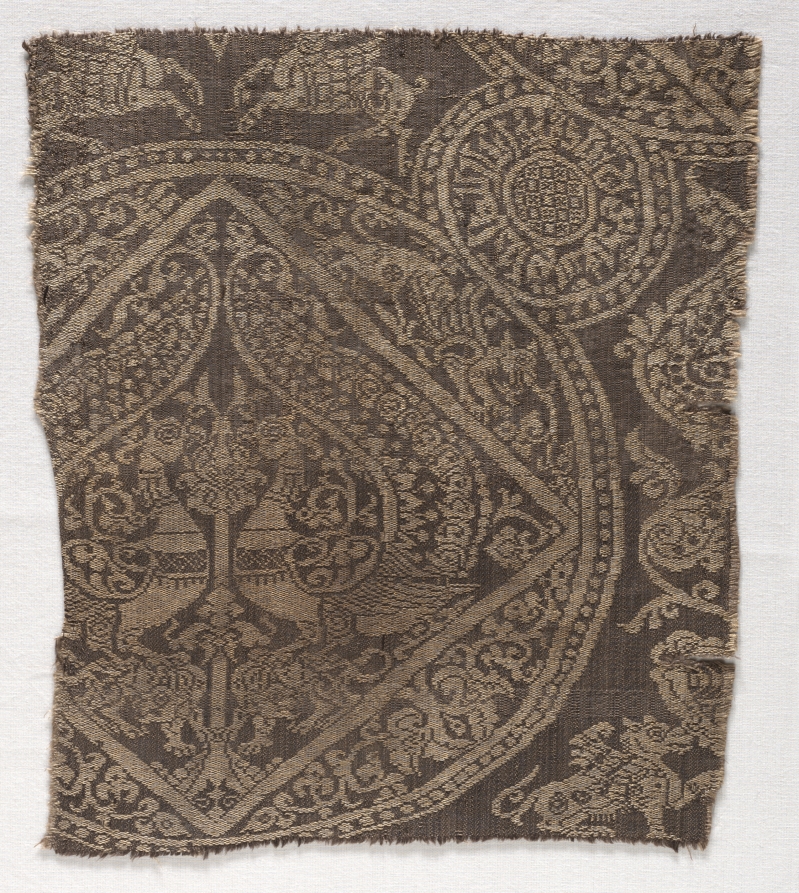
Fragments with winged lions in roundels, given to the museum by Paul and Marguerite Mallon in 1975, accession 1975.45, carry the same reported findspot: Bibi Shahr Banu. Their radiocarbon date is 899 to 1160 at 95 per cent probability. The museum's culture line for that object does not say in the style of. It says Iran, Buyid or Seljuk period, and it is the only object discussed on this page that is still catalogued as what it was bought as.
That result does two things at once. It shows that the method can return a medieval answer, so the negative results are not an artefact of the technique. And it shows that the same dealer network, and the same reported necropolis, handled both real and false material, which is why the group could not be sorted by provenance, by eye, or by reputation. It had to be sorted by measurement.
Chapter 7The catalogue history is the attribution history
What makes this object worth a record rather than a footnote is that its false attribution is fully documented at every stage, in print, by the institution that held it.It was reproduced in the...
What makes this object worth a record rather than a footnote is that its false attribution is fully documented at every stage, in print, by the institution that held it.
It was reproduced in the Cleveland Museum of Art Handbook of 1958 as catalogue number 676, and again in the handbooks of 1966 and 1969 at page 215 and of 1978 at page 272. It travelled to the Petit Palais in Paris for Sept mille ans d'art en Iran, the seven thousand years of art in Iran exhibition, from 19 October 1961 to 31 January 1962. It was number 7, page 76, in Dalu Jones and George Michell's catalogue of The Arts of Islam at the Hayward Gallery in London, 8 April to 4 July 1976, the exhibition that defined the field for a generation of British visitors. It went round the United States in The Heritage of Islam from 10 March 1982 to 5 September 1983, to Houston, Pittsburgh, San Francisco and Washington, and is number 32, page 50, in the notes for that tour.
Then it appears in the 1992 Ars Orientalis paper, reproduced at page 35 and discussed at page 15, and the object's public life changes tense. Louise Mackie's Symbols of Power, the museum's own 2015 survey of Islamic luxury textiles, illustrates it at page 154 as figure 4c and discusses it across pages 154 and 155.
The sequence is the argument. Four handbooks, three international exhibitions, four decades: this object was not obscure and its status was not marginal. It was a headline piece of Islamic textile art in the mid-twentieth century, and the discipline was wrong about it in public for as long as it was on display.
Chapter 8The chain, and why it is so short
The museum's provenance list has three lines.
The museum's provenance list has three lines. Originally reported as having been found in Bibi Shahr Banu, near Rayy, Iran. Adolph Loewi, 1888 to 1977, Los Angeles, sold to the Cleveland Museum of Art. The Cleveland Museum of Art, 1954 to the present.
A reader used to this archive will notice that only two of those are owners and only one of them is a private one. That is not an accident and it is not a gap in the research. An object manufactured to be sold has no history before the sale, and the shortness of the chain is the single most consistent feature of the whole group: a reported findspot with no excavation record, one dealer, one museum.
The pattern is visible across the accession numbers themselves. Cleveland's Buyid-style silks came in from Marguerite Mallon in Paris and New York, from Nassiri Amini in Tehran, from Heeramaneck Galleries and Rabenou Antiquities in New York, from Spink and Son in London, from Adolph Loewi in Los Angeles, from Galerie Heidi Vollmoeller in Zurich, and from Goumaronart in Paris, over more than forty years from 1941 to 1988. Six countries, a dozen firms, one findspot, and in almost every case no owner named before the dealer.
Chapter 9What it cost, and what the money did
The purchase price has not been published.
The purchase price has not been published. There was no auction, so no hammer price and no buyer's premium exist for this object, and the only figure that could ever be produced is the museum's invoice from Adolph Loewi in 1954. The acquisition was made from the J. H. Wade Fund, the endowment that also paid for most of Cleveland's other purchases in this group.
The wider money question is answerable even though the specific price is not, and it is the more interesting one. The forgery of these silks was a supply response to a price signal. High prices in the 1930s for the genuine Rayy finds produced a market for more of them; the forgers' documented adaptation was to make pieces that were larger and complete, because larger and complete objects fetch more than fragments. A collector reading this record should take the general lesson rather than the particular one. In a category defined by fragments, completeness is not a bonus. It is a question.
Chapter 10What is unresolved, and what the museum did right
Nobody has published who made this. The forgers of the Rayy silks are not named in the literature consulted here, no workshop has been identified, and the question of whether the twentieth-century...
Nobody has published who made this. The forgers of the Rayy silks are not named in the literature consulted here, no workshop has been identified, and the question of whether the twentieth-century weavers were working from genuine excavated fragments or from photographs remains open. Nor is it established whether the pall was ever in the ground at Bibi Shahr Banu at all: a modern textile can be buried in an ancient necropolis, and that would be the efficient way to sell one.
What deserves saying plainly is that the Cleveland Museum of Art has handled this better than most institutions handle a bad attribution. It did not deaccession the object quietly, it did not leave the old date on the label, and it did not bury the finding in a scholarly journal. It printed a radiocarbon range on its own public record, in the date field, on roughly thirty objects, and released photographs of them under CC0 so that anyone can look. This record exists because that decision made it possible.
The artist
The Rayy workshops and the market that commissioned them
The maker of this object is unknown and probably unknowable, and the honest dossier is not about a weaver but about an industry. Forging Persian works of Islamic art became widespread in the late nineteenth century, and of all types of Islamic art Persian art appears to be the one most often forged. In a few cases the motive may have been genuine reverence for the past. In most cases it was a response to the prices museums and collectors were paying. What follows is what is documented about how that industry worked, because it is the only maker this textile has.
Exhibited
- 1961-1962Sept mille ans d'art en Iran (The Exhibition of Persian Art: 7000 Years of Art in Iran)Petit Palais, Musee des Beaux-Arts de la Ville de Paris, 19 October 1961 to 31 January 1962
- 1976The Arts of IslamHayward Gallery, Arts Council of Great Britain, London, 8 April to 4 July 1976
- 1982-1983The Heritage of IslamHouston, Pittsburgh, San Francisco and Washington, 10 March 1982 to 5 September 1983
Literature
- The Cleveland Museum of Art Handbook, cat. no. 676, mentioned and reproduced. (1958)
- Handbook of the Cleveland Museum of Art, reproduced p. 215. (1966)
- Handbook of the Cleveland Museum of Art, reproduced p. 215. (1969)
- Dalu Jones and George Michell, The Arts of Islam: Hayward Gallery, 8 April-4 July 1976, Arts Council of Great Britain, no. 7, p. 76.
- Handbook of the Cleveland Museum of Art, reproduced p. 272. (1978)
- Nancy Thomson, The Heritage of Islam: Notes, London: PCET, no. 32, p. 50. (1982)
- Sheila S. Blair, Jonathan M. Bloom and Anne E. Wardwell, 'Reevaluating the Date of the Buyid Silks by Epigraphic and Radiocarbon Analysis', Ars Orientalis 22, pp. 1-41; this object reproduced p. 35 and mentioned p. 15. (1992)
- Louise W. Mackie, Symbols of Power: Luxury Textiles from Islamic Lands, 7th-21st Century, Cleveland Museum of Art and Yale University Press; this object reproduced p. 154 fig. 4c and discussed pp. 154-155. (2015)
Related works
| Work | Relation | Where it is |
|---|---|---|
| Fragments with winged lions in roundels Unidentified weaver | The control: same reported findspot, medieval radiocarbon date, attribution retained 899 to 1160 at 95 per cent probability. Gift of Paul and Marguerite Mallon, 1975. | Cleveland Museum of Art, 1975.45 |
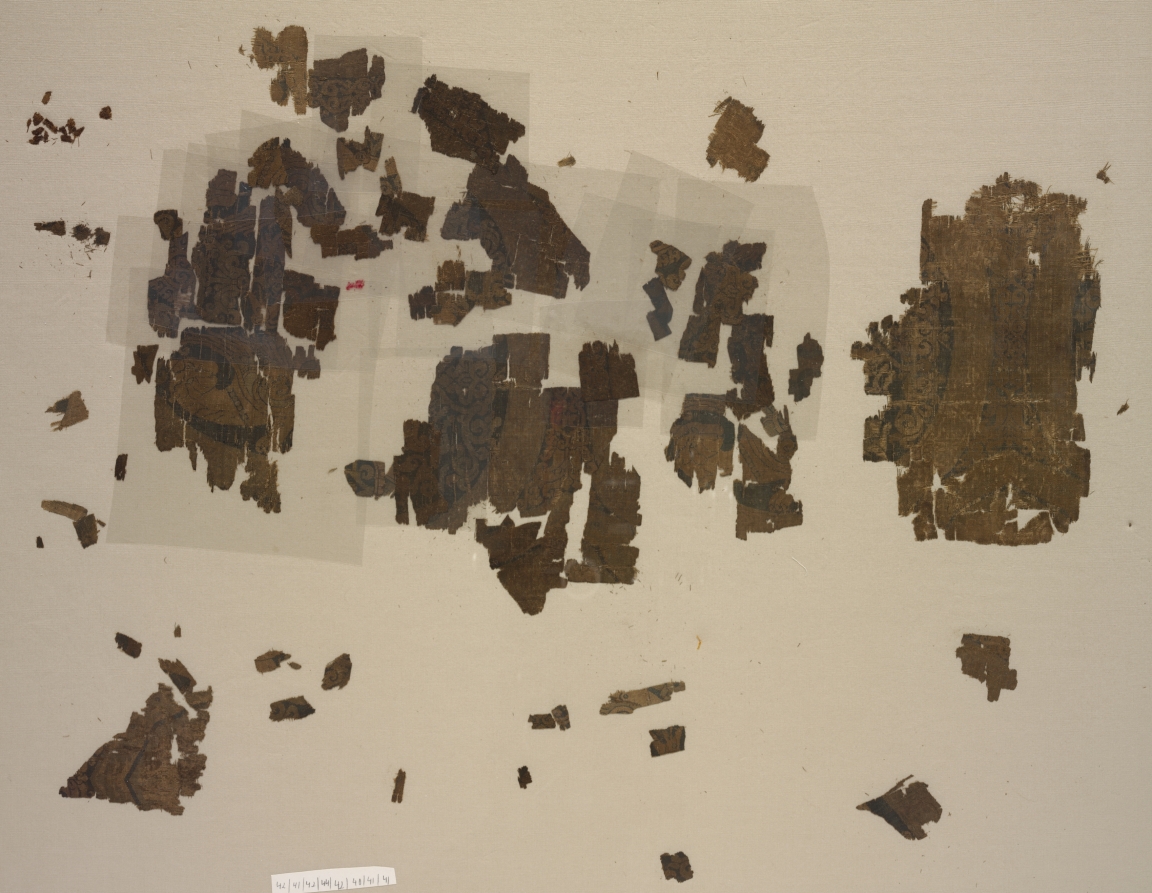
| Fragment from a funeral garment or pall Unidentified weaver | The nearest functional parallel in the same collection Radiocarbon 1649 to 1955. Bought from Nassiri Amini, Tehran, 1968. | Cleveland Museum of Art, 1968.227 |
| Caftan Unidentified weaver | The post-1950 case Radiocarbon: after 1950. Bought from Rabenou Antiquities, New York, in 1985. The museum's image of this object is not released under a free licence, so it cannot be reproduced here. | Cleveland Museum of Art, 1985.59 |
| Tunic fragment with lion killing khilin in octagons Unidentified weaver | The other post-1950 case Radiocarbon: after 1950. Accessioned in 1982. Also not released under a free licence. | Cleveland Museum of Art, 1982.23 |
| Silver salver inscribed with the name of Alp Arslan and the date 459 (1066-67) Unidentified metalworker | The most frequently questioned Islamic metalwork object, by the same author Blair notes its long and muddled titulature as the ground for doubt, and groups it with questionable gold and silver that reached the market in the 1940s and 1950s. | Museum of Fine Arts, Boston |
| Pair of carved and painted doors Unidentified woodworker | An earlier scientific unmasking in the same field A carbon-14 test carried out in 1951 returned a modern date. The method that convicted the Buyid silks in 1992 had already convicted Persian woodwork forty years earlier. | Freer Gallery of Art, Washington, no. 35.1 |
Open questions
- Who wove it? No workshop, weaver or town has been identified in the literature consulted, and the forgers of the Rayy silks are not named.
- Was the pall ever buried at Bibi Shahr Banu? A modern textile can be placed in an ancient necropolis, and doing so would be the efficient way to sell one. Nothing establishes the object was ever there.
- Were the twentieth-century weavers copying genuine excavated fragments in front of them, or photographs? The question bears directly on how much technical information about medieval Iranian weaving these objects preserve.
- What did Cleveland pay Adolph Loewi in 1954? No price has been published and there was no auction.
- Where was the object between manufacture and 1954, and who held it before Adolph Loewi? The museum's record names nobody.
- How many of the sixteen textiles radiocarbon dated in the 1992 study were Cleveland's? The paper is cited on numerous Cleveland records but the museum does not state which of its objects were among the sixteen.
- Are the roughly thirty Cleveland objects now catalogued in the style of the Buyid period the work of one operation or several? Their acquisition dates span 1941 to 1988 and their dealers span six countries.
Questions about this object
What is Tomb Cover?
Tomb Cover is a textile, dated 1640-1950 (radiocarbon date, 95 per cent probability). Acquired, published and exhibited as c. 945-1055. Medium: Silk, compound tabby.
Who made Tomb Cover, and is the attribution settled?
The attribution to Unidentified weaver, Iran or Iraq is recorded here as disputed. Bought in 1954, published and exhibited internationally for four decades as a tenth or eleventh century silk woven under the Buyid dynasty. Radiocarbon analysis by accelerator mass spectrometry places its manufacture between 1640 and 1950 at 95 per cent probability. The Cleveland Museum of Art now catalogues it as Iraq or Iran, in the style of the Buyid period, and prints the radiocarbon range where the date used to be. The attribution is not merely revised: the object has moved from the tenth century to a range that ends five years before the museum bought it.
Where is Tomb Cover now?
Cleveland Museum of Art, Cleveland, Ohio. Inventory number 1954.780. Last confirmed 4 August 2026. Purchased 1954 from Adolph Loewi, Los Angeles, from the J. H. Wade Fund.
What is still unknown about Tomb Cover?
Who wove it? No workshop, weaver or town has been identified in the literature consulted, and the forgers of the Rayy silks are not named.
Sources
- 1Cleveland Museum of Art, collection record 1954.780, Tomb Cover. Tombstone with the radiocarbon range in the date field, the culture line 'in the style of the Buyid period', the structure, measurements, the Kufic inscription and its translation, the museum's description of the object as a funeral pall, the three-line provenance and the full bibliography and exhibition history. clevelandart.org/art/...
- 2Sheila S. Blair, 'FORGERIES iii. OF ISLAMIC ART', Encyclopaedia Iranica, vol. X, fasc. 1, pp. 95-100, published 15 December 1999, last updated 19 August 2015. Read in the in-app browser after the site returned HTTP 403 to both WebFetch and a browser-agent curl. The 1925 Rayy finds, the 1989 epigraphic study, the sixteen textiles, the post-1950 isotope marker, the price mechanism and the parallel forgeries in metal, ceramics, carpets, manuscripts and woodwork. iranicaonline.org/articles/...
- 3Sheila S. Blair, Jonathan M. Bloom and Anne E. Wardwell, 'Reevaluating the Date of the "Buyid" Silks by Epigraphic and Radiocarbon Analysis', Ars Orientalis 22 (1992), pp. 1-41. NOT READ IN FULL: JSTOR returns HTTP 403 to automated requests. Cited here from the Cleveland Museum of Art's own bibliography for this object, which records the pages on which this pall is reproduced and discussed, and from Blair's summary of the study in the Encyclopaedia Iranica. Replace with the article itself. jstor.org/stable/...
- 4Cleveland Museum of Art, collection record 1975.45, Fragments with winged lions in roundels. The control: same reported findspot at Bibi Shahr Banu, radiocarbon 899-1160, attribution retained. clevelandart.org/art/...
- 5Cleveland Museum of Art, collection record 1985.59, Caftan, radiocarbon date 'after 1950'. Image not released under a free licence. clevelandart.org/art/...
- 6Cleveland Museum of Art, collection record 1982.23, Tunic fragment with lion killing khilin in octagons, radiocarbon date 'after 1950'. Image not released under a free licence. clevelandart.org/art/...
- 7Cleveland Museum of Art, collection record 1996.2, A Child's Coat with Ducks in Pearl Medallions, whose bibliography carries Anne E. Wardwell's articles in the museum's own magazine and her co-authorship of When Silk Was Gold with the Metropolitan Museum of Art in cooperation with the Cleveland Museum. Used only to establish that Wardwell published as a Cleveland author. clevelandart.org/art/...
- 8The Cleveland Museum of Art Handbook, 1958, in which this object is catalogue number 676. Digitised by the Internet Archive. archive.org/details/...
- 9Handbook of the Cleveland Museum of Art, 1978, in which this object is reproduced at page 272. Digitised by the Internet Archive. archive.org/details/...
Last verified 3 September 2026 · Published 4 August 2026
Change log
4 August 2026 - Record created at the house standard: researched narrative, technical evidence, maker dossier, graded provenance chain, prices with hammer and premium separated, related works, open questions and sources.
3 September 2026 - Re-verified 2026-09-03: fresh search for post-1990s developments on the Buyid-silk forgery question and Clevelands own re-cataloguing found nothing beyond the already-cited 1992 radiocarbon study and Group D forgery findings already in this record. clevelandart.org/art/1954.780 and jstor.org/stable/4629423 resolve 200. iranicaonline.org/articles/forgeries-iii/ 403d on both a plain curl and the in-app browser (bot wall, not dead - a Wayback Machine snapshot from 2025-10-10 confirms the page is live and unchanged in substance). No substantive change; last_verified bumped as a finding in itself.