The Cleveland Apollo: Apollo Sauroktonos (Lizard-Slayer) or Apollo the Python-Slayer
Attributed to Praxiteles, or a follower · c. 350 BCE; the museum's catalogue range is c. 350-200 BCE
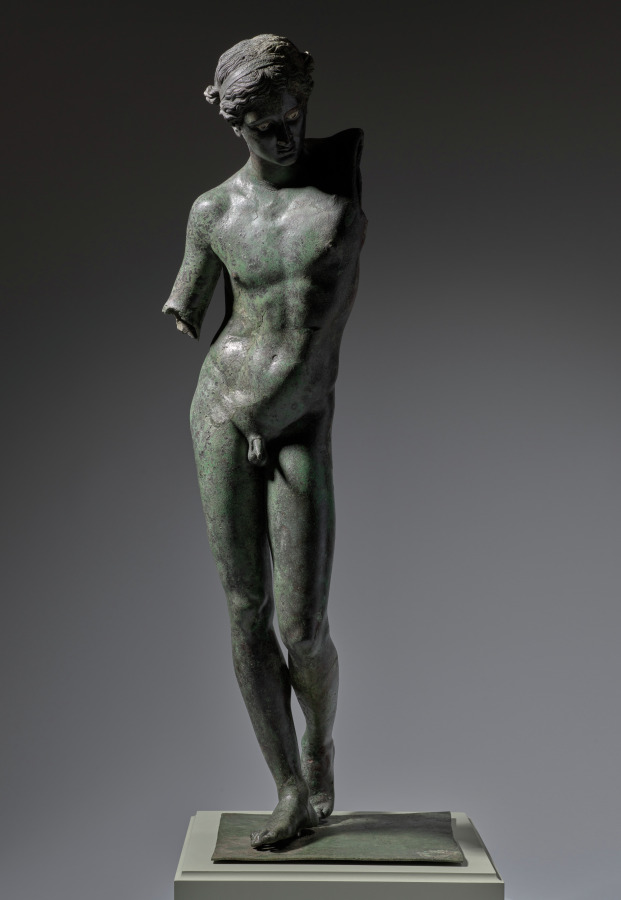
The record subject. Bronze with copper and stone inlay, 150 cm tall, the only life-size bronze version of a sculptural type that survives about twenty times in marble. The tree trunk the creature climbed is lost, and with it the object's clearest iconographic evidence.
| Artist | Attributed to Praxiteles, or a follower |
|---|---|
| Date | c. 350 BCE; the museum's catalogue range is c. 350-200 BCE |
| Medium | Bronze, with copper and stone inlay |
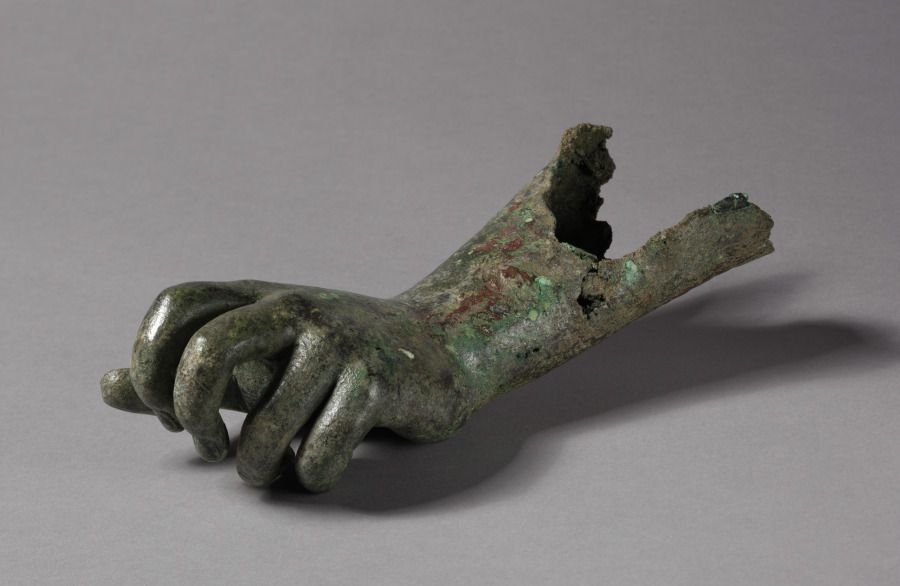
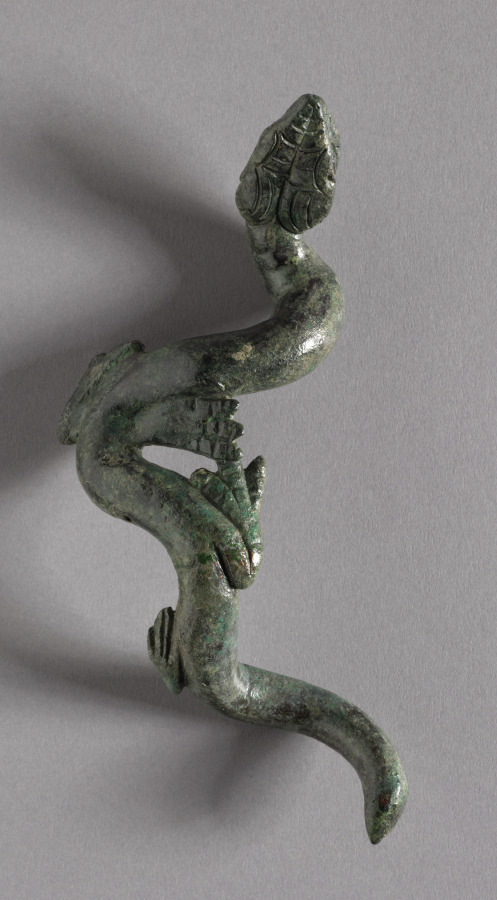
| Dimensions | Overall 150 x 50.3 x 66.8 cm. Bronze baseplate (2004.30.d) 0.5 x 45.8 x 40.3 cm. Detached left forearm and hand (2004.30.b) 25.9 x 8.8 x 8.7 cm. Detached creature (2004.30.c) 14.8 x 9.4 x 3.6 cm |
| Where it is now | Cleveland Museum of Art, Cleveland, Ohiolast confirmed 4 September 2026 |
| Inventory number | 2004.30 |
| Attribution | DisputedThe Cleveland Museum of Art catalogues the bronze as attributed to Praxiteles, or a follower, and its curator of Greek and Roman art argued in 2013 that it is an original by Praxiteles himself. Full note |
| Object type | Antiquity |
| Period | Greek, fourth century BCE, or Hellenistic |
| Cases | Disputed attribution · Has a provenance gap |
| Inscriptions | None recorded. |
| Owners on record | 7 links3 documented, 3 disputed, 1 unknown |
| Sources | 9 cited |
About this record Last verified 4 September 2026 · 9 sources cited · Change log
On this page 12 sections
ContentsClose
A life-size bronze of a young Apollo, the only bronze version of a sculptural type that survives about twenty times in marble, bought by the Cleveland Museum of Art in 2004 from a Geneva dealer for a price the museum has never published. Its owner before 1994 was a German lawyer who says he found it broken in the grounds of a family estate in what had been East Germany, and there is no document of any kind for it before that date.
Greece said publicly that it had been fished out of the sea between Italy and Greece in the 1990s and got the Louvre to leave it out of a Praxiteles exhibition by threatening to withhold every loan it had promised. Fourteen years of metallurgy, published in full by the Getty in 2017, established that the figure had been in a fire, had never been in salt water, and had been soldered onto its display plate some time between the seventeenth and the nineteenth centuries. The same analysis found that the lead in the bronze does not come from the Aegean.
In 2013 the museum concluded that the creature at the god's feet is not the lizard Pliny describes but the Python of Delphi, and renamed the object accordingly. On that reading the sculpture is not a copy of a famous statue at all: it is the statue, and it stood at Delphi.
Provenance
Each link is graded. Documented: a cited source supports it. Disputed: the identification is argued but not established. Unknown: no owner for that span, and the gap is not smoothed into a narrative. The grades in the glossary.
- c. 350 BCE - unknownUnrecorded ancient setting; proposed as the Sanctuary of Apollo at Delphidisputed
Michael Bennett argued in 2013 that the object was made for Delphi, on the reading that the creature is the Python rather than a lizard. No inscription, base block or excavation record supports a findspot. Ancient solder under the left little toe shows the figure was fixed to metal in antiquity, which tells us it was mounted but not where.23
- unknown - c. 1700-1900Unknownunknown
No owner, location or transaction is documented between antiquity and the eighteenth or nineteenth century. The object was in the ground for a long period and then above ground again: the corrosion is stratified in a way that indicates a change of environment. The creature was reattached to the tree when the statue was first displayed after excavation, so an early restoration happened, undated and unrecorded.2
- c. 1700-1900 - 1990An estate in eastern Germany, in the family of Ernst-Ulrich Walterdisputed
The baseplate was soldered on in the eighteenth or nineteenth century, which is physical evidence that the statue was mounted for display in that period. The museum's account is that the object stood in the garden of a private estate in the eastern part of Germany well before the Second World War and was taken for a late eighteenth or nineteenth century cast. No photograph, inventory, insurance schedule or estate record from that period has been published, so the physical evidence for a display mounting is documented while the specific German location is not.246
- 1990 - 1994Ernst-Ulrich Walter, Germanydocumented
Walter reclaimed the family estate after German reunification in 1990 and found the sculpture in pieces. Lucia Marinescu, formerly director of the National History Museum of Romania, saw the fragments while touring the estate in 1994 and later presented a paper on the sculpture at the sixteenth International Congress of Antique Bronzes in May 2003. Walter is the earliest name in the Cleveland Museum of Art's own provenance list.14
- 1994 - 2001Unnamed purchaser; reported as a Dutch dealerdisputed
The sculpture was sold in 1994 and afterwards reassembled and restored. The museum's provenance list carries no entry between Walter and Phoenix Ancient Art. A Cleveland account identifies the 1994 buyer as a Dutch dealer and reports a further sale to the Aboutaam brothers in 2001 through an anonymous collector. Neither step is supported by a published document, and the restorer has not been named.46
- 2001 - 2004Phoenix Ancient Art S.A., Geneva (Ali and Hicham Aboutaam)documented
A representative of the Cleveland Museum of Art saw the sculpture at the Geneva gallery in 2002. The gallery has not disclosed the person from whom it acquired the object. Ali Aboutaam's public position was that the firm stands by its provenance.1468
- 2004 - presentThe Cleveland Museum of Art, Cleveland, Ohiodocumented
Acquired 2004 through the Severance and Greta Millikin Purchase Fund and announced by the museum on 22 June 2004. No purchase price has been published by the museum. No claim has been filed against the object and no restitution agreement exists.14
Prices realised
This object has never been offered at auction. It was bought privately from a dealer in 2004, so there is no hammer price and no buyer's premium to separate, and the only figure that could exist is an invoice the museum has not published. The sums repeated in print, five million United States dollars and 5.2 million, are journalistic reports and are recorded here as reports rather than as prices.
Technical evidence
| Attribution note | The Cleveland Museum of Art catalogues the bronze as attributed to Praxiteles, or a follower, and its curator of Greek and Roman art argued in 2013 that it is an original by Praxiteles himself. No ancient sculpture is signed by Praxiteles, and no work universally accepted as an original by him survives, so an attribution to Praxiteles is an attribution to a hand reconstructed from Roman marble copies and from a list in Pliny. Scholars outside the museum have questioned both the attribution and the date; the museum's own catalogue date range of c. 350-200 BCE is itself an admission that the object may be Hellenistic rather than fourth-century. |
|---|---|
| Medium | Bronze, with copper inlaid at the lips and nipples and stone inlaid in the eyes. The right eye is original.12 |
| Dimensions | Overall 150 x 50.3 x 66.8 cm; the bronze baseplate 0.5 x 45.8 x 40.3 cm.1 |
| Casting | Indirect lost-wax, in large individually cast sections with walls about half a centimetre thick in many places. Wax manipulation marks survive inside the openings at the arms and feet. Rectangular patches and square chaplet holes are evidence of original manufacture. The front half of the right foot was cast separately and welded on.2 |
| Alloy | Low to medium tin bronze: 6.7 to 7.6 per cent tin and 8.6 to 16.3 per cent lead in the creature; mean 7.08 per cent tin and 4.70 per cent lead in the right arm. The baseplate is a different metal, mean 3.44 per cent tin and 19.52 per cent lead.2 |
| Lead isotopes | All bronze parts of the statue are isotopically virtually indistinguishable, establishing that the reassembled fragments were cast from the same melt. The ratios of both statue and solder exclude a geological provenance in the Aegean, and therefore Laurium. The Cevennes in France and the Balkans are given as possibilities.2 |
| Lead-210 alpha spectrometry | No measurable activity in the later samples, indicating the lead in the solder, the baseplate and the cast-on front of the right foot is older than about 110 years. An earlier solder sample had shown measurable radioactivity, which would indicate production within the last hundred years. The two rounds conflict and both are published.2 |
| Burial and fire | Corrosion consistent with long burial followed by renewed atmospheric exposure. Internal oxidation and cassiterite crystals show the figure was exposed to extreme heat early in its history. The baseplate shows no fire damage. Corrosion products exclude burial in a marine environment.23 |
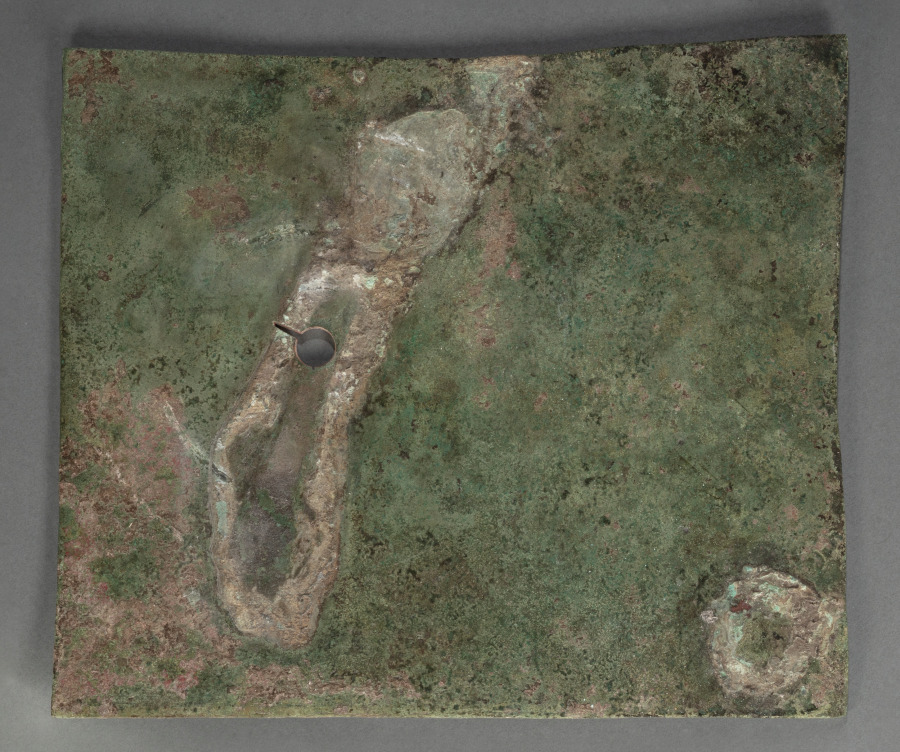
| Baseplate | A thin bronze plate that could not have supported the sculpture on its own; barely corroded relative to the figure; soft solder of a composition inappropriate for an ancient solder, with the eta phase still preserved. Attached in the eighteenth or nineteenth century.2 |
| Ancient solder | Under the little toe of the left foot only a thin layer of the epsilon phase survives, separated from heavily corroded bronze by up to 100 micrometres of corrosion product. The solder there is ancient, so the toe was once soldered to metal in antiquity.2 |
| Modern restoration | Head joined to neck and lower left leg joined to calf with modern adhesives and a modern internal armature; plaster and resin fills at neck and shoulders. Radiography shows the figure is otherwise nearly complete.2 |
| Losses | Parts of both arms and the tree trunk. A circle in the corner of the baseplate may mark where a bronze tree was once attached.2 |
| Comparanda | About twenty other sculptures of the type are known, all marble apart from one reduced-scale bronze copy. This is the only life-size bronze version.2 |
Images
The record in full
Chapter 1The only one in bronze
Roughly twenty sculptures of this type are known.
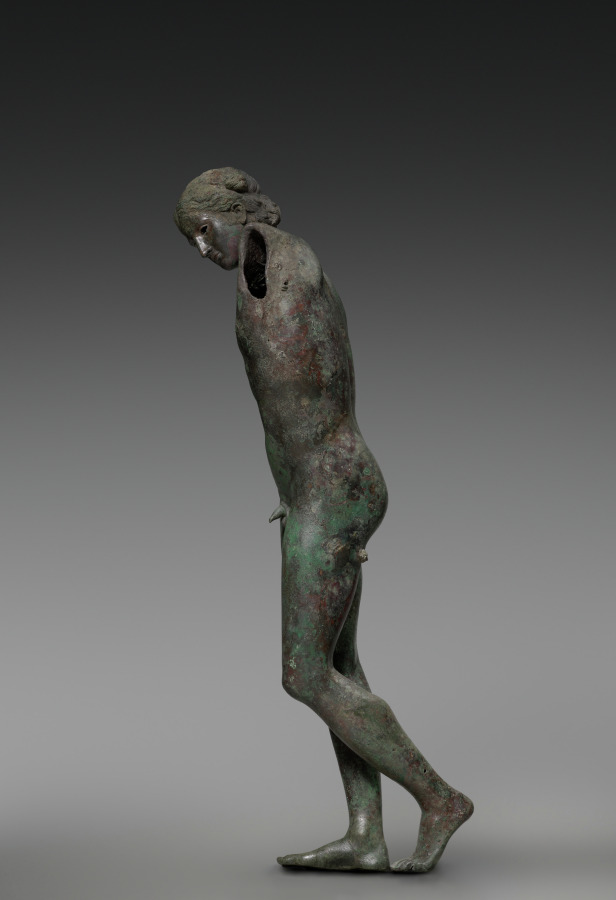
Roughly twenty sculptures of this type are known. Every one of them is marble except a single reduced-scale bronze copy and this object, which is life size, 150 centimetres tall, cast in bronze with copper inlaid at the lips and nipples and stone inlaid in the eyes. The right eye is the original. The god stands with his weight on one leg, one arm raised, the other lowered toward a small creature on a tree trunk that has not survived; the figure leans, and the lean is the thing every marble copyist tried to reproduce.
The physical consequence of being the only bronze is that this object carries information no marble copy can. A marble copy records a silhouette. A bronze records an alloy, a casting method, a set of joins, a corrosion history and, through its lead, a mine. Almost everything contested about this sculpture has been argued from that evidence rather than from its face.
Chapter 2What Pliny wrote, and why Cleveland stopped believing it
The type is named from one sentence. Pliny the Elder, listing the bronzes of Praxiteles in the Natural History, records a youthful Apollo called the Sauroktonos because he is aiming an arrow at a...
The type is named from one sentence. Pliny the Elder, listing the bronzes of Praxiteles in the Natural History, records a youthful Apollo called the Sauroktonos because he is aiming an arrow at a lizard creeping towards him. That sentence is the whole ancient authority for the subject, and for two hundred years it has governed how every version of the type is catalogued and displayed.
In 2013 Michael Bennett, then the museum's curator of Greek and Roman art, argued that the creature on the Cleveland bronze is not a lizard. He identified it as the Python, the serpent Apollo killed at Delphi, and proposed that the sculpture originally stood in the Sanctuary of Apollo there. The museum renamed the object in its own catalogue, which is why its title now carries both readings joined by an or. Bennett's statement of the case was that the sanctuary at Delphi is the only place in the ancient world where a Python-Slayer by Praxiteles belongs, and that the subject is Apollo's victory over the Python, a triumph of order over chaos at the place the Greeks called the Omphalos, the navel of the world.
This matters far beyond iconography. If the creature is a lizard, the Cleveland bronze is a version of a famous statue and could be a Roman copy of it. If the creature is the Python and the setting is Delphi, then the object is not a copy of anything, and the marble Sauroktonoi in the Louvre and the Vatican are copies of it. The reidentification and the attribution stand or fall together, and both remain contested outside the museum.
Chapter 3How it was cast
The bronze was made by the indirect lost-wax process.
The bronze was made by the indirect lost-wax process. Wax manipulation marks survive inside the openings at the arms and feet where modern resin repairs do not obscure them, and the walls are thick, about half a centimetre in many places, cast in large individual sections. Rectangular patches and square chaplet holes across the surface are evidence of original ancient manufacture rather than later repair. The front half of the right foot was cast separately and welded on.
Radiography carried out before the 2004 purchase showed that the head had been joined to the neck and the lower left leg to the calf in a recent restoration, using modern adhesives and a modern internal armature, and that plaster and resin fill the neck and shoulders. The same radiographs showed the figure was nearly complete. What is missing is parts of both arms and the tree trunk the creature climbed.
Chapter 4The lead is not Greek
Lead isotope analysis was run on the figure, the detached hand, the creature, the baseplate and the solder.
Lead isotope analysis was run on the figure, the detached hand, the creature, the baseplate and the solder. Every bronze part of the statue proved isotopically almost indistinguishable, which settles the question of whether the reassembled pieces belong together: they were cast from the same melt.
The second result is more awkward. The lead isotope ratios of both the statue and the solder exclude a geological source in the Aegean, and therefore exclude Laurium, the largest source of Aegean lead in antiquity. The published candidates are the Cevennes in France and the Balkans. This does not prove where the statue was made or where it stood, because metal travelled, and a fourth-century Athenian foundry could buy lead from anywhere in the Mediterranean. It does mean that the one piece of hard geological evidence in the object points away from Greece rather than towards it, in a case where a Greek ministry has asserted Greek origin.
The alloy itself is a low to medium tin bronze. Published figures give 6.7 to 7.6 per cent tin and 8.6 to 16.3 per cent lead for the creature, with means of 7.08 per cent tin and 4.70 per cent lead in the right arm. The baseplate is a different metal: a mean of 3.44 per cent tin against 19.52 per cent lead.
Chapter 5It burned, and it was never in the sea
The corrosion on the figure is consistent with an object buried for a long period and then exposed again to weather.
The corrosion on the figure is consistent with an object buried for a long period and then exposed again to weather. Beneath the surface, metallography found a band of cuprite particles formed by oxygen diffusing inward at high temperature, and lumps on the back of the left thigh containing cassiterite crystals that solidified from an oxygen-rich melt at around a thousand degrees. The figure was in a fire, early in its history. The baseplate was not.
The corrosion products also excluded the possibility that the sculpture had been buried in a marine environment. That is a direct answer to the specific allegation Greece made, and it is the reason the museum was able to state in 2013 that laboratory tests conclusively prove the sculpture was not a recent discovery and was not recovered from the sea. A reader should note that this is a negative finding about salt water, not a positive finding about a German garden. It rules out one account of where the object came from. It does not establish another.
Chapter 6The baseplate is the clock
The most useful object in this record is the thin bronze plate the statue stands on, catalogued separately as 2004.30.d.
The most useful object in this record is the thin bronze plate the statue stands on, catalogued separately as 2004.30.d. It could never have supported the sculpture on its own, so it is a display fitting rather than an ancient base; ancient bronze statue bases are stone. It is barely corroded compared with the figure, and what corrosion it has is different in character. The soft solder holding it on has a composition inappropriate for an ancient solder, and its eta phase is still preserved where the eta phase has vanished from every other solder on the object. The published conclusion is that the plate was attached in the eighteenth or nineteenth century.
That single finding is the strongest argument the museum has. A statue mounted for display two hundred years ago was above ground two hundred years ago. It cannot have been dug up or fished up in the 1990s.
Two further details in the same study are rarely quoted and are worth more than the headline. Substantial epsilon-phase corrosion survives on the feet of the creature, consistent with its having been reattached to the tree when the statue was first displayed after excavation, which means there was an earlier restoration campaign nobody has dated. And under the little toe of the left foot the solder is ancient: the toe was once soldered to a piece of metal in antiquity, so how the statue was displayed in its own time has to be reconsidered.
Chapter 7One test said the opposite
The alpha spectrometry is the part of the technical record that has been reported as simpler than it is.
The alpha spectrometry is the part of the technical record that has been reported as simpler than it is. The method tests for the radionuclide lead-210, which has a half-life of 22.3 years and cannot be renewed once smelting has broken the decay chain, so it is only measurable in metal younger than about 110 years. No measurable activity was detected in the samples taken for the later study, and the conclusion drawn was that the lead in the solder, in the bronze of the baseplate and in the cast-on front half of the right foot is all older than about 110 years.
In the earlier phase of work the result went the other way. Two solder samples were tested; one gave no usable result, and the other showed measurable radioactivity, which would indicate that the lead or the tin had been produced within the last hundred years. That is in the published paper, and it is the finding that lay behind the museum's 2008 statement to the Cleveland press that the solder was in the vicinity of a hundred years old. The two rounds of testing do not say the same thing. A record that quotes only the later one is quoting the half of the evidence that suits the object.
Chapter 8The garden in eastern Germany
The museum's own provenance line has three entries: Ernst-Ulrich Walter, Germany; Phoenix Ancient Art, 2004; the Cleveland Museum of Art, 2004 to the present.
The museum's own provenance line has three entries: Ernst-Ulrich Walter, Germany; Phoenix Ancient Art, 2004; the Cleveland Museum of Art, 2004 to the present. Everything before Walter is narrative rather than record.
The account the museum gave on acquisition is that the statue had been on a private estate in the eastern part of Germany, later East Germany, well before the Second World War, installed in the garden and taken for a late eighteenth or nineteenth century cast. After reunification in 1990 Walter reclaimed the family estate and found the sculpture in pieces. In 1994 Lucia Marinescu, formerly director of the National History Museum of Romania, saw the fragments while touring the estate; in the same year the sculpture was sold, and it was then reassembled and restored. Marinescu presented a paper on it at the sixteenth International Congress of Antique Bronzes in May 2003. A Cleveland representative saw it at the Geneva gallery of Phoenix Ancient Art in 2002, and the museum bought it in 2004, announcing the purchase on 22 June that year.
Reporting since has added intermediate steps the museum does not list: a sale to a Dutch dealer in 1994 and a sale to the Aboutaam brothers in 2001 through an anonymous collector. Those are journalistic attributions, not documents, and this record grades them accordingly. No photograph of the statue in the garden, no estate inventory, no customs entry and no export licence has been published.
Chapter 9What Greece said, and what it did
Greece raised the object publicly in 2006.
Greece raised the object publicly in 2006. In December that year a French news agency quoted an unnamed source in the Greek Ministry of Culture saying the Apollo had not been found in a German garden at all but was probably sold illegally after being found in the 1990s by an Italian vessel in international waters between Italy and Greece.
The consequential move was not the allegation but the loan policy. When the Louvre assembled its Praxiteles exhibition in 2007, Greece made clear that if the Cleveland bronze were included it would stop lending to French museums, and it withheld the Ephebe of Marathon, itself a bronze recovered from the sea in 1925. The Cleveland Apollo was not shown. A single object was kept out of the one exhibition where it could have been compared directly with the securely provenanced bronzes that would have tested it, and the comparison has still not been made.
The polemic that followed, in the magazine Apollo, called this cultural blackmail and argued that comparison with the Marathon bronze would have revealed, as photographs cannot, whether the Cleveland figure is an early or a late copy of Praxiteles. That sentence concedes more than its author intended: the writer defending the object assumed it was a copy.
Chapter 10What the dealers said
Phoenix Ancient Art is the Geneva and New York gallery of the brothers Ali and Hicham Aboutaam.
Phoenix Ancient Art is the Geneva and New York gallery of the brothers Ali and Hicham Aboutaam. They have not named the person from whom they acquired the Apollo. Ali Aboutaam's public position was that the gallery stands by its provenance. Hicham Aboutaam told the New York Times in March 2007 that the Apollo was proven to have been in circulation more than a hundred years ago, that the Greeks were not saying it should not be in Cleveland or that it was stolen, and that the objection was a public relations exercise.
The museum's own position, given by a spokeswoman in 2006, was that it had acquired the Apollo after more than a year of research by an international team of specialists working from legal, art-historical and technical angles, with an emphasis on the object's history.
Chapter 11The report nobody outside the museum could read
The methodological complaint against this acquisition was never really about the German garden.
The methodological complaint against this acquisition was never really about the German garden. It was about who could see the evidence. When the museum told the Cleveland press in 2008 that the solder was about a hundred years old, the report behind that statement was not in the public domain, and the reporter said so in the same article. The archaeologist David Gill made the sharper point: the statue had been in fragments when first recorded, so a date for the solder joining it to a plate cannot by itself date the statue, and the full technical report was needed before anyone outside the museum could judge.
That objection was met, nine years later and largely on its own terms, when the Getty published the full analysis by Colleen Snyder, Ernst Pernicka and Peter Northover in 2017 under a Creative Commons licence, complete with the sample tables. The delay is part of the history of the object. For thirteen years the strongest evidence for the museum's case existed only inside the museum, and during those thirteen years the argument was conducted on assertion.
Chapter 12The price, and what a museum purchase price is
The Cleveland Museum of Art has not published what it paid.
The Cleveland Museum of Art has not published what it paid. The figure most often repeated is five million United States dollars; one account gives 5.2 million. Both are reported rather than confirmed, and this record does not treat either as established.
What is documented is the source of the money. The purchase was made from the Severance and Greta Millikin Purchase Fund, an endowment rather than an appropriation, which is why the acquisition required no public vote and no external approval. There was no auction, so there is no hammer price and no buyer's premium to separate; this was a private treaty purchase from a dealer, and the only number that could ever exist is the invoice.
Chapter 13What the object is now
It is on view in Cleveland, catalogued under both names, with its detached forearm, its detached creature and its baseplate accessioned as separate objects and separately photographed.
It is on view in Cleveland, catalogued under both names, with its detached forearm, its detached creature and its baseplate accessioned as separate objects and separately photographed. All of that photography is released by the museum under CC0, which is why this record can show the parts as well as the whole.
No claim has been filed. Greece has not gone to court, no restitution agreement exists, and the museum has not deaccessioned. Cleveland has returned other antiquities in the same period, including a bronze figure sent back to Turkiye, which shows the institution is capable of acting when the evidence turns; it has not turned here. The position is a stalemate resting on an absence: there is no document before 1994, and there is no proof that a document ever existed.
The artist
Praxiteles of Athens
Praxiteles is the most famous sculptor of the fourth century BCE and one of the least verifiable. Nothing survives that is universally accepted as an original by him. The corpus is assembled from Roman marble copies, from coins and gems, and from lists in Pliny and Pausanias, which means that every attribution to Praxiteles, including this one, is an attribution to a hand reconstructed from later evidence rather than to a documented artist. Readers should hold that in mind when they see his name on a label: it is a proposition, not a record.
Exhibited
- 2013-2014Praxiteles: The Cleveland ApolloCleveland Museum of Art, Julia and Larry Pollock Focus Gallery, 29 September 2013 to 5 January 2014
- 2007Praxitele (the object was NOT shown; Greece withheld loans on condition it be excluded)Musee du Louvre, Paris
Literature
- Michael Bennett, Praxiteles: The Cleveland Apollo, 124 pages, published to accompany the 2013 focus exhibition.
- Colleen Snyder, Ernst Pernicka and Peter Northover, 'The Cleveland Apollo: Recent Research and Revelations', in Artistry in Bronze: The Greeks and Their Legacy, J. Paul Getty Museum. (2017)
Related works
| Work | Relation | Where it is |
|---|---|---|
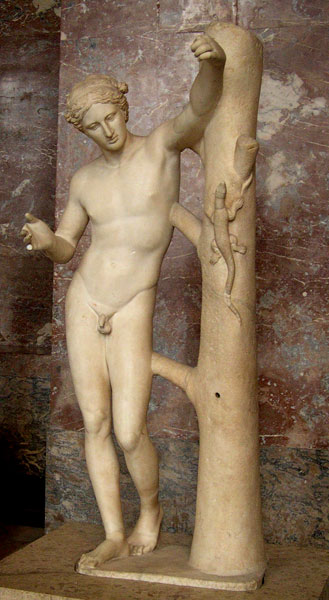
| Apollo Sauroktonos After Praxiteles | Marble version of the same type One of about twenty marble versions. Whether these copy the Cleveland bronze or a lost original is the question the whole dispute turns on. | Musee du Louvre, Paris, Ma 441 |
| Apollo Sauroktonos After Praxiteles | Marble version of the same type Catalogued as first or second century CE after an original of about 350 BCE attributed to Praxiteles. | Musei Vaticani, Rome |
| Ephebe of Marathon Unknown Greek | Comparison bronze withheld from the same exhibition A securely provenanced Greek bronze recovered from the sea in 1925. Greece declined to lend it to the Louvre in 2007, and the direct comparison with the Cleveland figure has never been made. | National Archaeological Museum, Athens |
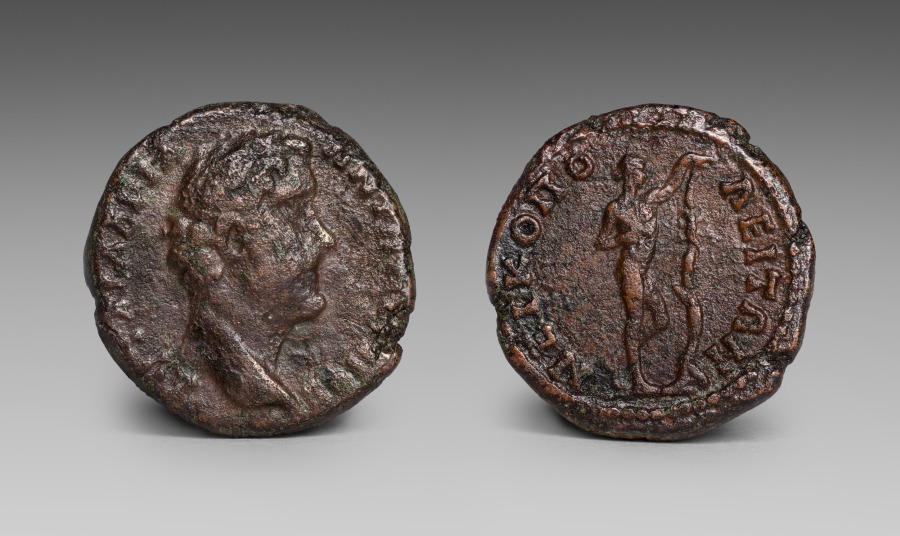
| Provincial coin of Antoninus Pius, Apollo Sauroktonos reverse Unknown die-cutter | The type in circulation in the Roman period Bought by Cleveland in the same year as the bronze, 2 cm across. Shows the tree that the bronze has lost. | Cleveland Museum of Art, 2004.93 |
| Hermes and the Infant Dionysos Praxiteles, disputed | The other candidate for a surviving original Found in 1877 and argued over ever since. If it is not an original, no accepted original by Praxiteles exists at all. | Archaeological Museum of Olympia |
| Draped Male Figure, said to be Marcus Aurelius Unknown Roman | A Cleveland antiquity that did go back Included here because it shows what a Cleveland restitution looks like when the evidence turns. It has not turned on the Apollo. | Returned to Turkiye |
Open questions
- Where was the statue between antiquity and the eighteenth or nineteenth century, when someone soldered it onto a display plate? The corrosion proves the gap; nothing fills it.
- Who mounted it on the baseplate, and in what country? The plate is the earliest datable event in the object's modern life and its maker is unknown.
- Where exactly was the German estate, and when did the family acquire the statue? No photograph, estate inventory, insurance schedule or customs document from before 1994 has been published.
- Who sold the sculpture to Phoenix Ancient Art, and who bought it in 1994? The gallery has never named its source and the museum's provenance list has no entry between 1994 and 2004.
- What did the Cleveland Museum of Art pay in 2004? The figures of five million and 5.2 million United States dollars are reported, not confirmed by the museum.
- Who reassembled and restored the sculpture after the 1994 sale, and what evidence did that campaign remove? The restorer has not been named in any published account.
- Is the creature a lizard or the Python? The museum's own catalogue title carries both readings, which is an unusual admission that its reidentification has not been settled.
- Was the object ever the subject of a German export application, and if so on what declared value and description? Nothing has been published either way.
Questions about this object
What is The Cleveland Apollo: Apollo Sauroktonos (Lizard-Slayer) or Apollo the Python-Slayer?
The Cleveland Apollo: Apollo Sauroktonos (Lizard-Slayer) or Apollo the Python-Slayer is an antiquity, dated c. 350 BCE; the museum's catalogue range is c. 350-200 BCE. Medium: Bronze, with copper and stone inlay.
Who made The Cleveland Apollo: Apollo Sauroktonos (Lizard-Slayer) or Apollo the Python-Slayer, and is the attribution settled?
The attribution to Attributed to Praxiteles, or a follower is recorded here as disputed. The Cleveland Museum of Art catalogues the bronze as attributed to Praxiteles, or a follower, and its curator of Greek and Roman art argued in 2013 that it is an original by Praxiteles himself. No ancient sculpture is signed by Praxiteles, and no work universally accepted as an original by him survives, so an attribution to Praxiteles is an attribution to a hand reconstructed from Roman marble copies and from a list in Pliny. Scholars outside the museum have questioned both the attribution and the date; the museum's own catalogue date range of c. 350-200 BCE is itself an admission that the object may be Hellenistic rather than fourth-century.
Where is The Cleveland Apollo: Apollo Sauroktonos (Lizard-Slayer) or Apollo the Python-Slayer now?
Cleveland Museum of Art, Cleveland, Ohio. Inventory number 2004.30. Last confirmed 4 September 2026. Purchased 2004 from Phoenix Ancient Art, Geneva, through the Severance and Greta Millikin Purchase Fund.
What is still unknown about The Cleveland Apollo: Apollo Sauroktonos (Lizard-Slayer) or Apollo the Python-Slayer?
Where was the statue between antiquity and the eighteenth or nineteenth century, when someone soldered it onto a display plate? The corrosion proves the gap; nothing fills it.
Sources
- 1Cleveland Museum of Art, collection record 2004.30, The Cleveland Apollo: Apollo Sauroktonos (Lizard-Slayer) or Apollo the Python-Slayer. Tombstone, measurements, credit line and the museum's own three-entry provenance list. clevelandart.org/art/...
- 2Colleen Snyder, Ernst Pernicka and Peter Northover, 'The Cleveland Apollo: Recent Research and Revelations', in Artistry in Bronze: The Greeks and Their Legacy (J. Paul Getty Museum, 2017). The full technical study, with sample tables, released under a Creative Commons licence. getty.edu/publications/...
- 3Cleveland Museum of Art press release, 'Cleveland Museum of Art Presents Praxiteles: The Cleveland Apollo', for the exhibition of 29 September 2013 to 5 January 2014, including Michael Bennett's Delphi argument and the museum's statement that laboratory tests prove the sculpture was not a recent discovery and was not recovered from the sea. clevelandart.org/about/...
- 4David Gill, 'The Cleveland Apollo: New Comments', Looting Matters, post dated 18 February 2008. Collects the museum's June 2004 acquisition release, the Walter and Marinescu chronology, the Rub and Bennett statement on the solder, the Guardian and New York Times coverage, and the Apollo magazine polemic on the Louvre loans. lootingmatters.blogspot.com/2007/...
- 5Jean Marie Carey, 'The Cleveland Apollo: Roman Copy or Greek Original?', Italian Art Society blog, 17 September 2017. Gives the reported purchase figure of five million United States dollars and notes that the museum holds a second, Roman, sculpture also commonly called the Cleveland Apollo. italianartsociety.org/2017/...
- 6Cleveland Scene, 'An ancient Apollo statue landed in Cleveland and touched off an international outcry'. Reports the 1994 sale to a Dutch dealer, the 2001 sale to the Aboutaam brothers through an anonymous collector, the reported price of 5.2 million United States dollars, and the December 2006 Greek Ministry of Culture allegation. clevescene.com/news/...
- 7Pliny the Elder, Natural History 34.70, in the Bostock and Riley translation, Perseus Digital Library. TERTIARY for the biography, PRIMARY for the Sauroktonos sentence itself. Replace with a critical edition of the Latin. perseus.tufts.edu/hopper/...
- 8Wikipedia, 'Cleveland Apollo', consolidating the 1990 rediscovery account, the 2002 Geneva viewing, the exclusion from the 2007 Louvre exhibition and the 2009-2021 testing. TERTIARY; flagged for replacement with Bennett 2013 and the Getty publication. en.wikipedia.org/wiki/...
- 9Hyperallergic, "Why Do So Many Museums Hold a Convicted Antiquity Dealer's Treasures?", 15 July 2026. Reports the Manhattan DA's Office seizure of nine Phoenix Ancient Art artifacts worth nearly 5 million US dollars from institutions since 2021, including a Roman marble bust repatriated from the Met to Turkey in February 2026, documenting continuing law-enforcement scrutiny of the Aboutaam/Phoenix Ancient Art dealer network this object passed through in 2001-2004. Does not name this object or the Cleveland Museum of Art. hyperallergic.com/why-do-so-many-museums-hold-a-convicted...
Last verified 4 September 2026 · Published 4 August 2026
Change log
4 August 2026 - Record created at the house standard: researched narrative, technical evidence, maker dossier, graded provenance chain, prices with hammer and premium separated, related works, open questions and sources.
4 September 2026 - Re-verified. The Cleveland Museum of Art's own current object page (clevelandart.org/art/2004.30) confirms the sculpture remains on view (100 1916 Lobby gallery) with no repatriation, seizure or new claim noted by the museum itself. No confirmed 2026 Italian repatriation agreement specific to this object was found despite a targeted search; a 15 July 2026 Hyperallergic report on Manhattan DA seizures of Phoenix Ancient Art material (nine artifacts, ~5 million dollars, since 2021, including a Met bust repatriated to Turkey in February 2026) documents continuing law-enforcement scrutiny of the same dealer network (Ali and Hicham Aboutaam) this object passed through in 2001-2004, but does not name Cleveland or this object specifically - recorded as relevant standing context, not as a claim against this piece. No development on the unnamed 1994 buyer, the German estate, or the restorer's identity.