Vase
Emile Galle · c. 1900
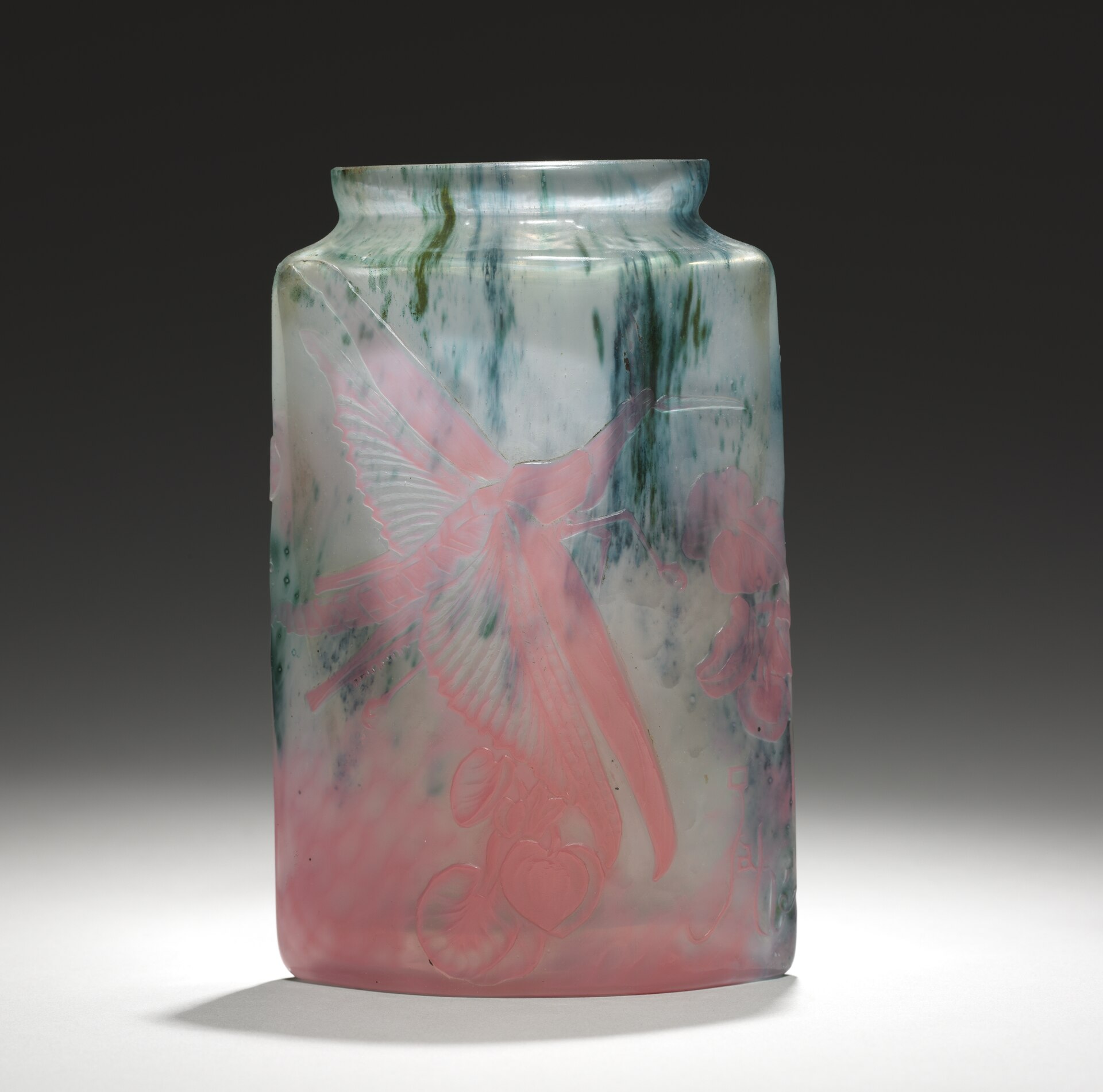
The object described in this record. Cameo-cut cased glass, 13.5 x 8.6 x 4.7 cm, cut with a winged insect and blossoms over an internally colored ground. Accession 1979.10, purchased 1979 through the Andrew R. and Martha Holden Jennings Fund.
| Artist | Emile Galle |
|---|---|
| Date | c. 1900 |
| Medium | Glass with pink and green inclusions, cameo cut |
| Dimensions | 13.5 x 8.6 x 4.7 cm (5 5/16 x 3 3/8 x 1 7/8 in.) |
| Where it is now | Cleveland Museum of Art, Gallery 221, 19th Century Decorative Arts, Cleveland, Ohiolast confirmed |
| Inventory number | 1979.10 |
| Attribution | AcceptedCatalogued by the Cleveland Museum of Art to Emile Galle (French, 1846-1904) without qualification, on the basis of the cameo signature Galle cut into the glass and the piece's consistency with Galle's documented cased and cameo production. Full note |
| Object type | Glass |
| Period | French Art Nouveau, Ecole de Nancy, c. 1900 |
| Cases | Has a provenance gap |
| Inscriptions | Signed in cameo, lower right, arranged vertically in the manner Galle borrowed from Japanese seals: Galle. No star accompanies the signature. |
| Owners on record | 4 links3 documented, 1 unknown |
| Sources | 22 cited |
About this record Last verified · 22 sources cited · Change log
On this page 9 sections
ContentsClose
A small cameo glass vase cut with a large winged insect and a spray of blossoms, made in Emile Galle's Nancy workshop around 1900 and bought by the Cleveland Museum of Art in 1979 from Macklowe Gallery in New York. It is ordinary in the best sense: an example of the industrial cameo line that carried Galle's Art Nouveau glass beyond the small circle who could afford his unique marqueterie-sur-verre showpieces, signed but undated, unstarred, and undocumented for the better part of a century before it reached New York.
Galle founded the Ecole de Nancy in 1901, died of leukemia in 1904, and left a firm that his widow and son-in-law ran under his name for another three decades - production that a still-active, named scholarship has spent the last several years re-dating year by year, because the difference between a Galle made by Galle and a Galle made afterward, honestly or not, still moves real money on the market this vase belongs to.
This record sets out what the Cleveland Museum's own accession file documents, what the current scholarship on Galle's posthumous and fraudulent production establishes in general, and where the specific chain of ownership for this vase runs out.
Provenance
Each link is graded. Documented: a cited source supports it. Disputed: the identification is argued but not established. Unknown: no owner for that span, and the gap is not smoothed into a narrative. The grades in the glossary.
- c. 1900 -Manufactured in Emile Galle's firm, Nancy, Francedocumented
Cleveland dates the vase c. 1900, within a supporting range of 1895 to 1905. The unstarred signature is consistent with manufacture during Galle's lifetime, or in the short window between his death in September 1904 and the introduction of the posthumous star mark in 1905; the museum's dating does not distinguish between the two.29
- - before 1979Unknownunknown
No owner is documented between the vase's manufacture and its appearance in the stock of Macklowe Gallery, New York, at some point before the Cleveland Museum's 7 May 1979 accession date. Three quarters of a century, two world wars and a transatlantic crossing fall inside this gap, and none of it is recorded in the sources consulted.
- before 1979 - 1979-05-07Macklowe Gallery, New York (Lloyd and Barbara Macklowe)documented
Cleveland's own provenance field records the immediate source as (Macklowe Gallery, New York); the parenthetical form is the museum's convention for a dealer rather than a private owner. Macklowe Gallery had specialized in French Art Nouveau glass, including Galle, since it opened in 1971. No date of Macklowe's own acquisition, nor any price paid by Macklowe or charged to Cleveland, is published in the sources consulted.27
- 1979-05-07 - presentCleveland Museum of Artdocumented
Accessioned 7 May 1979 as 1979.10, acquired through the Andrew R. and Martha Holden Jennings Fund, an acquisitions fund built on a bequest from the estate of the IBM executive Andrew R. Jennings (d. 1931) and administered by his widow Martha Holden Jennings and later by the foundation bearing her name. The fund credit indicates a purchase rather than a gift; contrast the museum's Gift of Dr. and Mrs. Roland Burelli credit on a different Galle vase in the same collection, 1983.225. The purchase price is not published in the sources consulted.236
Technical evidence
| Attribution note | Catalogued by the Cleveland Museum of Art to Emile Galle (French, 1846-1904) without qualification, on the basis of the cameo signature Galle cut into the glass and the piece's consistency with Galle's documented cased and cameo production. The museum's own supporting date range, 1895 to 1905, spans Galle's death in September 1904; no star accompanies the signature, which is consistent with either lifetime manufacture or the small window between his death and the introduction of the posthumous star mark in 1905. This record does not resolve which. |
|---|---|
| Support and casing | Blown glass, cased with an outer layer worked with dark green streaking over a grey-white ground, and colorants including pink and green fused into the wall as inclusions, over an inner layer of pink glass.12 |
| Decoration technique | Cameo cut: the outer casing is cut back with a wheel (or etched with acid) so the design stands in relief and the pink inner layer glows through the cuts. Distinct from marqueterie sur verre, Galle's harder, patented (1898) technique of pressing separate hot glass fragments into the body, which this vase does not use.121416 |
| Dimensions | 13.5 x 8.6 x 4.7 cm (5 5/16 x 3 3/8 x 1 7/8 in.).2 |
| Inscription | Signed in cameo, lower right, arranged vertically in a manner Galle adopted from Japanese seals: Galle. No star precedes or follows the signature.2 |
| Dating | Cleveland dates the piece c. 1900, with a supporting range of 1895 to 1905. The range spans Galle's death (September 1904); the absence of a star is consistent with either lifetime manufacture or production in the months immediately after his death, before the star mark was introduced (no earlier than January 1905). Cleveland's record does not choose between these readings.29 |
| Accession and credit line | Cleveland Museum of Art, accession 1979.10, accessioned 7 May 1979. Credit line: Andrew R. and Martha Holden Jennings Fund. A fund credit, rather than a named-donor Gift of credit, indicates a museum purchase.23 |
| Department and classification | Department of Decorative Art and Design; classified by the museum under the Glass type and the culture line France, early 20th Century. On permanent display, Gallery 221, 19th Century Decorative Arts.12 |
Images
The record in full
Chapter 1What it is
The Cleveland Museum of Art catalogues object 1979.10 simply as Vase: a small cylindrical glass vessel, 13.5 centimeters high, 8.6 centimeters in diameter and 4.7 centimeters deep, with a short...
The Cleveland Museum of Art catalogues object 1979.10 simply as Vase: a small cylindrical glass vessel, 13.5 centimeters high, 8.6 centimeters in diameter and 4.7 centimeters deep, with a short flared neck. The museum's own accession record dates it about 1900 and gives a supporting range of 1895 to 1905 - a bracket that happens to straddle Emile Galle's death in September 1904 without resolving which side of it the piece falls on.
The body is cased glass worked with pink and green coloring agents fused into the wall before cutting, so the ground reads as a mottled grey-white streaked with dark green, thinning toward the shoulder, over an inner layer of glowing pink. A large winged insect, its wings swept back and its long jointed hind legs bent beneath it, is cut in relief across the front of the vessel, cameo-style, so the design stands proud of the ground and the pink layer glows through the cuts. Smaller five-petaled blossoms on curling stems fill the space to the insect's right. The museum's own online image description, evidently written for accessibility rather than as catalogue text, calls the motif a winged figure; examined directly, it is an insect, not a person, its silhouette closer to a grasshopper or a cicada than to anything with a human torso.
Chapter 2How it was made
Galle's cameo glass is built and then cut.
Galle's cameo glass is built and then cut. A parison of glass is cased with a further layer or layers of colored glass, and colorants - here pink and green - are worked into the wall itself before the vessel is blown to final shape, producing the streaked, internally mottled ground characteristic of his industrial line. Once annealed, the decoration is cut back through the outer casing with a rotating wheel, or bitten out with acid, so the design stands in relief and the ground is left as a field around it. Cutting through the streaked outer layer here exposes the pink layer beneath, which is what gives the insect and the flowers their glow against the smokier ground.
This is not marqueterie sur verre, the harder and more failure-prone technique Galle patented in April 1898, in which separate fragments of hot colored glass were pressed into the still-soft body of a piece like inlaid wood and reserved for unique showpieces. This vase belongs instead to the ordinary run of Galle's cased and cameo-cut production: the technique that, standardized across a workshop of several hundred employees by the end of the 1880s, made his glass available in volume to a market that could never have bought the exhibition pieces.
Chapter 3The insect, and what is not claimed about it
Insects were part of Galle's regular vocabulary from early in his career - dragonflies, cicadas, mayflies and grasshoppers recur across his glass and his furniture, drawn from the botany and...
Insects were part of Galle's regular vocabulary from early in his career - dragonflies, cicadas, mayflies and grasshoppers recur across his glass and his furniture, drawn from the botany and entomology he studied as a young man in Nancy and in Weimar. The cicada in particular carried, for Galle and for the wider Symbolist culture he worked inside, an established association with mortality and the brevity of pleasure, tied to the insect's short adult life after years spent unseen underground.
The Cleveland Museum's own record does not name the species cut into this vase, and this record does not supply one it cannot support: the insect's swept wings and long hind legs are consistent with a grasshopper or a cicada, and no more precise identification is offered here. What can be said without qualification is that nothing about this particular vase should be read into Galle's separately documented practice of engraving glass with lines of contemporary poetry - the vases parlants, or speaking vases, through which he carried literary and political statements, including his public support for Alfred Dreyfus, into decorative objects. The inscription recorded on this vase is the signature and nothing else. It is not a vase parlant, and no text beyond the maker's name should be assumed onto it.
Chapter 4The signature, read carefully
Cleveland records the inscription as "inscribed in Japanese style, lower right: Galle." Galle used a vertical, seal-like arrangement of his signature on a number of pieces, a mannerism drawn from the...
Cleveland records the inscription as "inscribed in Japanese style, lower right: Galle." Galle used a vertical, seal-like arrangement of his signature on a number of pieces, a mannerism drawn from the Japanese export ceramics and prints that shaped his ornament generally and that became fashionable across French decorative arts in the last third of the nineteenth century. The mark here is cameo, cut from the same layer as the rest of the design rather than applied afterward - the normal method on Galle's industrial cameo range.
No star accompanies the signature, and that omission carries information. After Galle's death, his widow and successor Henriette Galle added a five-pointed star before the signature on the firm's industrial output, to mark it as posthumous production; the decision was taken no earlier than January 1905, and the mark was in general use through the bulk of that year before being withdrawn in May 1908. A vase signed Galle with no star is therefore either lifetime work, or - if it in fact falls at the late end of Cleveland's own 1895-1905 range - one of a small number of pieces made in the several months between Galle's death and the star's introduction. Cleveland's own dating does not choose between these two readings, and this record does not choose for it.
Chapter 5Emile Galle before the school bore his name
Emile Galle was born in Nancy on 4 May 1846, the son of Charles Galle, who ran a faience and furniture business in the city.
Emile Galle was born in Nancy on 4 May 1846, the son of Charles Galle, who ran a faience and furniture business in the city. He studied philosophy, botany and drawing at the Lycee Imperial in Nancy, working under the botanist D. A. Godron, then continued his studies in Weimar between 1862 and 1866. In 1866 he apprenticed at the Burgun and Schverer glassworks at Meisenthal, learning glass chemistry and technique from the inside of an existing factory rather than only from his father's business.
He took over design leadership of the family firm through the 1870s and assumed full direction in 1877, the year he also married Henriette Grimm. Larger workshops followed in 1883, and by 1889 the firm employed some three hundred workers. Galle showed at the 1878 and 1889 Paris expositions, opened a shop in Paris in 1885, and reached what is generally reckoned the summit of his public recognition at the 1900 Paris Universal Exposition, where he took two Grand Prizes, a gold medal, and appointment as a commander in the Legion of Honor. His most consequential technical patent, for the marqueterie-sur-verre process, dates to April 1898 - two years before this vase's likely date of manufacture, and squarely inside the period in which his industrial cameo line, of which this vase is an example, was already an established, separate product alongside his unique work.
Chapter 6The Ecole de Nancy, 1901
In 1901 Galle founded the Ecole de Nancy, formally the Alliance Provinciale des Industries d'Art, and drew up its articles of association himself.
In 1901 Galle founded the Ecole de Nancy, formally the Alliance Provinciale des Industries d'Art, and drew up its articles of association himself. The stated purpose was to promote the decorative and industrial arts of Lorraine, bringing together glassmakers, furniture makers, stained-glass artists, ceramicists, leatherworkers, ironworkers and architects under a shared commitment to nature-derived ornament. Antonin Daum of the rival Daum Freres glassworks and the furniture makers Louis Majorelle and Eugene Vallin served as vice presidents alongside Galle. An 1894 precursor exhibition had already drawn more than seventy exhibitors from Lorraine, giving the 1901 alliance an existing base to formalize.
Galle served as the school's first president until his death three years later. The organization did not end with him: an exhibition opened at the Galerie Poirel in Nancy the same year he died, and the Ecole de Nancy's last major collective showing came at the 1909 International Exhibition of Eastern France, for which Eugene Vallin designed the group's pavilion.
Chapter 7Death, and the firm that outlived him
Galle died of leukemia in Nancy on 23 September 1904, at fifty-eight.
Galle died of leukemia in Nancy on 23 September 1904, at fifty-eight. His widow, Henriette Galle, and his son-in-law, the Nancy University professor Paul Perdrizet, took over direction of the firm, which continued to produce and sign glass under the name Galle for more than three decades after his death - a fact that sits behind almost every authentication question the maker's name now raises.
The firm was not static across those three decades. Its signature dropped an underscore around 1920, following a round of dismissals that included the designer Albert Daigueperce in August 1920. It reorganized as a societe anonyme par actions around 1925, the year of the Paris Exposition des Arts Decoratifs, and brought in new designers, including George Dethorey and Theodore Ehrhart by 1927, at a time recruitment was reportedly difficult. Jean Bourgogne became administrator around 1929 to 1930, in a tenure a later archival account describes as short-lived, since within two years the family had decided to wind the factory down. The main furnace shut down in 1931. Documentation for the following years is thin - one specialist account describes 1928 to 1936 as a period with almost no hard archival data - and the firm's exhibition presence contracted to commercial fairs in Lyon and Leipzig before production and signing ended altogether in 1936.
Chapter 8The posthumous star, and why it did not last
The decision to mark posthumous Galle glass with a star preceding the signature was Henriette Galle's, taken no earlier than January 1905 and, on the evidence of her surviving letters to Albert...
The decision to mark posthumous Galle glass with a star preceding the signature was Henriette Galle's, taken no earlier than January 1905 and, on the evidence of her surviving letters to Albert Daigueperce, put into effect across the bulk of that year's production. It corrects an older, widely repeated dating of 1904 to 1906 that rested on the testimony of a former employee, Rene Dezavelle, given decades after the fact; the letters are treated by the specialist who reviewed them as the stronger evidence.
The star did not last. By May 1908 the firm's director, Emile Lang, was writing to Daigueperce that clients had begun claiming that everything bearing the star was no longer really Galle, and that Henriette Galle had decided to drop it and revert the signature to the unstarred form. Henriette's own reported response to concern that removing the star would ease forgery was blunt: it would be easy enough for anyone to make a star disappear, she said, but no one could turn an ordinary hydrangea vase into a rare one by doing so. Production carrying the star during its roughly three-and-a-half-year run has been estimated, on the same archival basis, at somewhere in the tens of thousands of pieces - a volume that makes the star, on its own, a weak signal of rarity even when it is genuine.
Chapter 9The genuine dispute: telling a Galle from a Galle
The market problem with Galle's name is not hypothetical and it is not settled.
The market problem with Galle's name is not hypothetical and it is not settled. It has three distinct layers, and collapsing them into one another is itself a common error. The first layer is legitimate posthumous production: glass made and signed by the Etablissements Galle between 1904 and 1936, under Henriette Galle's and later administrators' direction, using Emile Galle's name with the firm's own authority to do so. The second layer is what one specialist survey of the problem calls rebaptized glass - pieces made by other factories, including Galle's own suppliers and competitors such as Paul Nicolas, De Vez, and Burgun and Schverer, later fitted with a false Galle signature to raise their value. The third layer is outright modern fakes with no authorized origin at all, including documented waves of reproduction glass made in Romania and, more recently, China, along with genuine Galle pieces that have been physically altered - reworked or added to - after the fact, which the same scholarship treats as a fourth, separate category: no longer properly a Galle original even though the glass itself started out as one.
Trade and auction-house guidance converges on a similar set of physical checks, applied with the caveat that none of them is conclusive alone. An appraiser who specializes in the field estimates that roughly half of the Galle-signed pieces brought to him for appraisal turn out to be fake, and lists the accent over the e in the signature, the proportion and finish of the foot, and whether the rim has been ground flat or left with its original rounded, polished edge as recurring tells; a signature missing its accent, an oversized bulbous foot, or a dark banded, straight-cut rim are treated as warning signs rather than proof. A London auction house's own published guidance to collectors makes a parallel case on the decoration itself: genuine cameo work shows carefully layered, wheel-polished cutting with real gradation of color and depth, where counterfeits tend toward flatter, more uniform surfaces, particularly on the base - and the same guidance treats the star as a real but limited signal, since it marks posthumous work but does not by itself make a piece false. None of these criteria bears on this Cleveland vase's authenticity as a Galle-made object; they are recorded here because they are the terms in which the wider dispute the object type belongs to is actually argued, by name, by people who handle this material for a living.
Chapter 10From Nancy to Macklowe Gallery to Cleveland
The documented chain of ownership for this specific vase is short.
The documented chain of ownership for this specific vase is short. Cleveland's own provenance field records the immediate source as Macklowe Gallery, New York - the parenthetical form the museum uses in its own records for a dealer rather than a private collector. Macklowe Gallery had been trading since September 1971, when Lloyd and Barbara Macklowe opened a 420-square-foot space at 82nd and Madison, specializing from early on in French Art Nouveau glass and furniture including Galle, alongside Tiffany glass and jewelry; by the time this vase passed through their hands the gallery was already an established destination for the material.
Nothing in the sources consulted for this record documents who owned the vase, or where it was, between its manufacture around 1900 and its appearance in Macklowe's stock some time before 1979. The Cleveland Museum of Art accessioned it on 7 May 1979 as 1979.10, acquired through the Andrew R. and Martha Holden Jennings Fund - a fund built on part of a 5.5 million dollar bequest from the estate of Andrew R. Jennings, an International Business Machines executive who died in 1931, and administered in Cleveland by his widow Martha Holden Jennings until her own death in 1962 and by the foundation bearing her name afterward. A credit line naming a fund, rather than a named individual with the words Gift of before it, is the museum's own way of recording a purchase; the museum's contemporaneous acquisition of a different Galle vase, 1983.225, carries exactly that donor phrasing, Gift of Dr. and Mrs. Roland Burelli, by contrast. No purchase price, either what Macklowe charged Cleveland or what Macklowe itself paid to acquire the vase, is published in the sources consulted.
Chapter 11On view, and in print, since 1979
The vase entered the museum's own record almost immediately: it appears as catalogue number 57 in Sherman E.
The vase entered the museum's own record almost immediately: it appears as catalogue number 57 in Sherman E. Lee's Year in Review for 1979, published in The Bulletin of the Cleveland Museum of Art, and was shown in the museum's own Year in Review exhibition from February to March 1980. It was included again in 1988 in Art Nouveau in France, a Cleveland Museum of Art exhibition running from July to November of that year, and appears in Henry H. Hawley's 1997 Cleveland Museum of Art publication Glass Today: American Studio Glass from Cleveland Collections, reproduced as figure 5. Both citations are recorded here as transcribed from the museum's own accession file; neither the original Bulletin article nor the 1997 volume was independently retrieved for this record, and both are flagged in the sources below for direct verification.
The vase remains on permanent display in Gallery 221, among the museum's nineteenth-century decorative arts, and is released by the museum under a CC0 public-domain dedication as part of its Open Access program.
Chapter 12What is settled, and what is not
What is settled is straightforward: an Emile Galle cameo vase, cut with an insect and flowers over an internally colored ground, made around 1900 in a Nancy workshop producing hundreds of comparable...
What is settled is straightforward: an Emile Galle cameo vase, cut with an insect and flowers over an internally colored ground, made around 1900 in a Nancy workshop producing hundreds of comparable pieces a year, signed without the mark that would identify it as posthumous, bought by a New York gallery specializing in exactly this material, and purchased by the Cleveland Museum of Art in 1979 for a price the record does not give.
What is not settled is everything about the object's life before 1979, and one narrower technical question the museum's own dating leaves open rather than closes: whether it left Galle's furnace before his death or in the short window immediately after it. Both gaps are recorded as gaps rather than bridged with a guess, and both are worth stating plainly, because a Galle vase's value and its history are read, correctly, off exactly the kind of detail this record has tried to pin down rather than assume.
The artist
Emile Galle
Emile Galle designed this vase's decoration and ran the firm that made it, but he did not personally cut every piece that left it bearing his name - by 1889 his Nancy workshops employed some three hundred people, and the industrial cameo line this vase belongs to was built specifically to be reproducible across that workforce. Reading a Galle signature is therefore reading a firm's mark as much as an individual's, a fact that only becomes more pointed after 1904, when the firm went on making and signing glass for another thirty-two years without him.
Related works
| Work | Relation | Where it is |
|---|---|---|
| Vase (enameled glass) Emile Galle | Also by Galle, in the same collection, in the earlier enamel technique he largely set aside as he concentrated on cased and cameo glass. Gift of Dr. and Mrs. Roland Burelli - a donor credit, in contrast to this vase's purchase-fund credit. | Cleveland Museum of Art, 1983.225 |
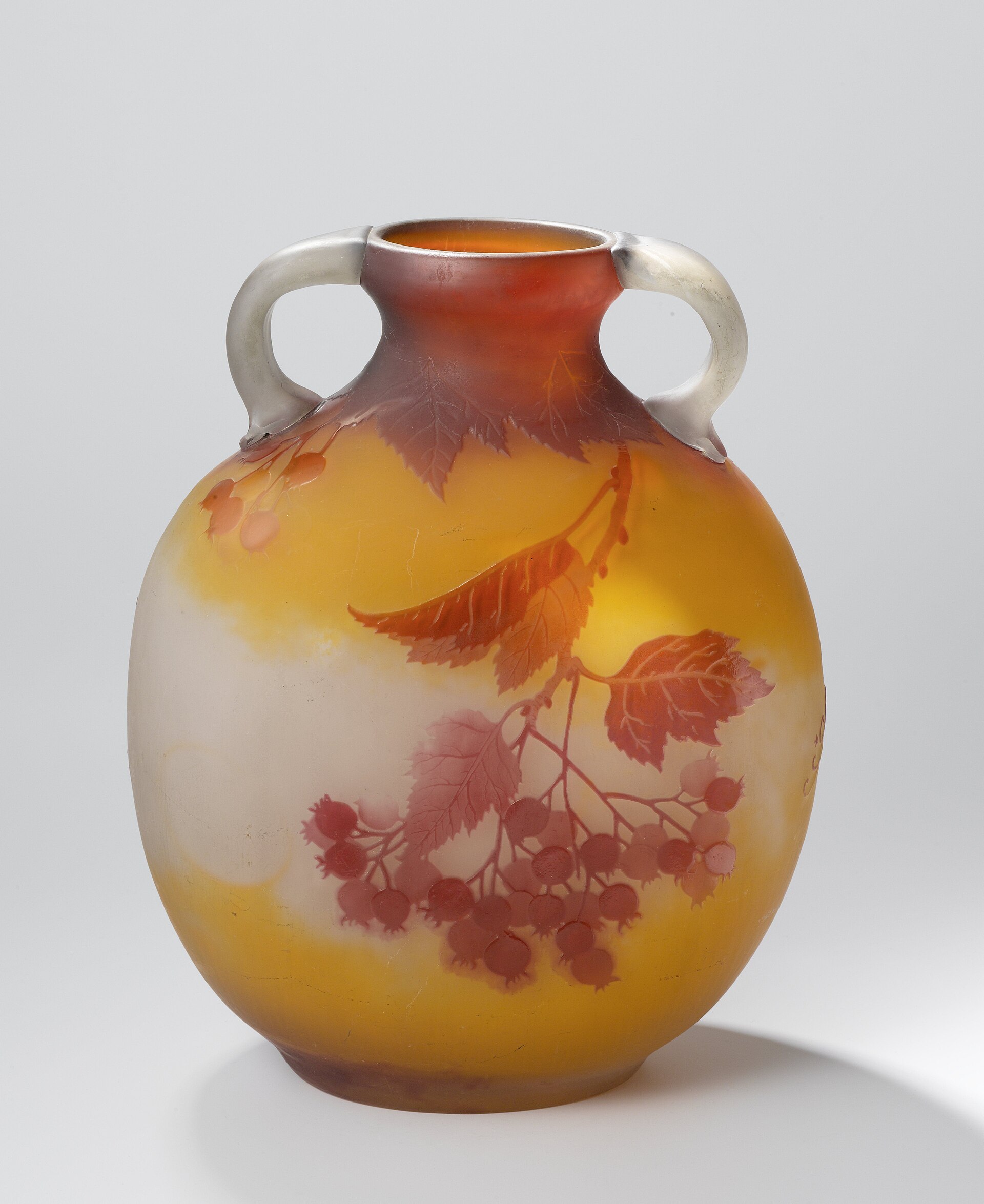
| Vase with maple branches Workshop of Emile Galle (posthumous, star-marked) | Comparandum for the posthumous star mark that this vase's signature does not carry. Catalogued by the Rijksmuseum to the workshop of Emile Galle rather than to the man, and signed Galle with a star, the mark used for industrial production made after his death. | Rijksmuseum, Amsterdam, BK-1983-35 |
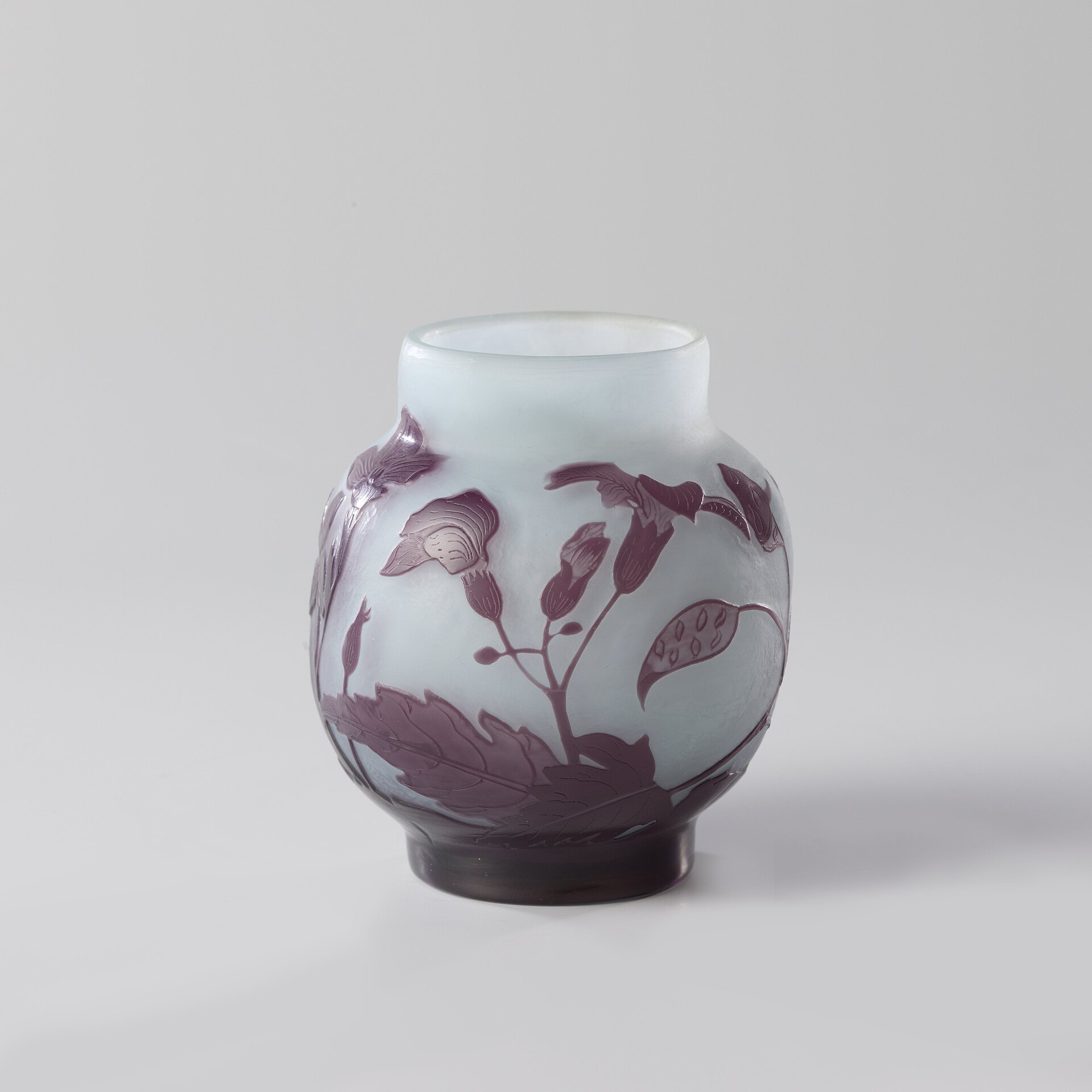
| Vase with honesty seed-pods Workshop of Emile Galle (posthumous, star withdrawn) | Comparandum showing the later, unstarred posthumous signature, after the star was dropped in 1908. Also catalogued to the workshop rather than to Galle; demonstrates that an unstarred Galle signature alone, without other evidence, does not prove lifetime manufacture. | Rijksmuseum, Amsterdam, BK-1972-74 |
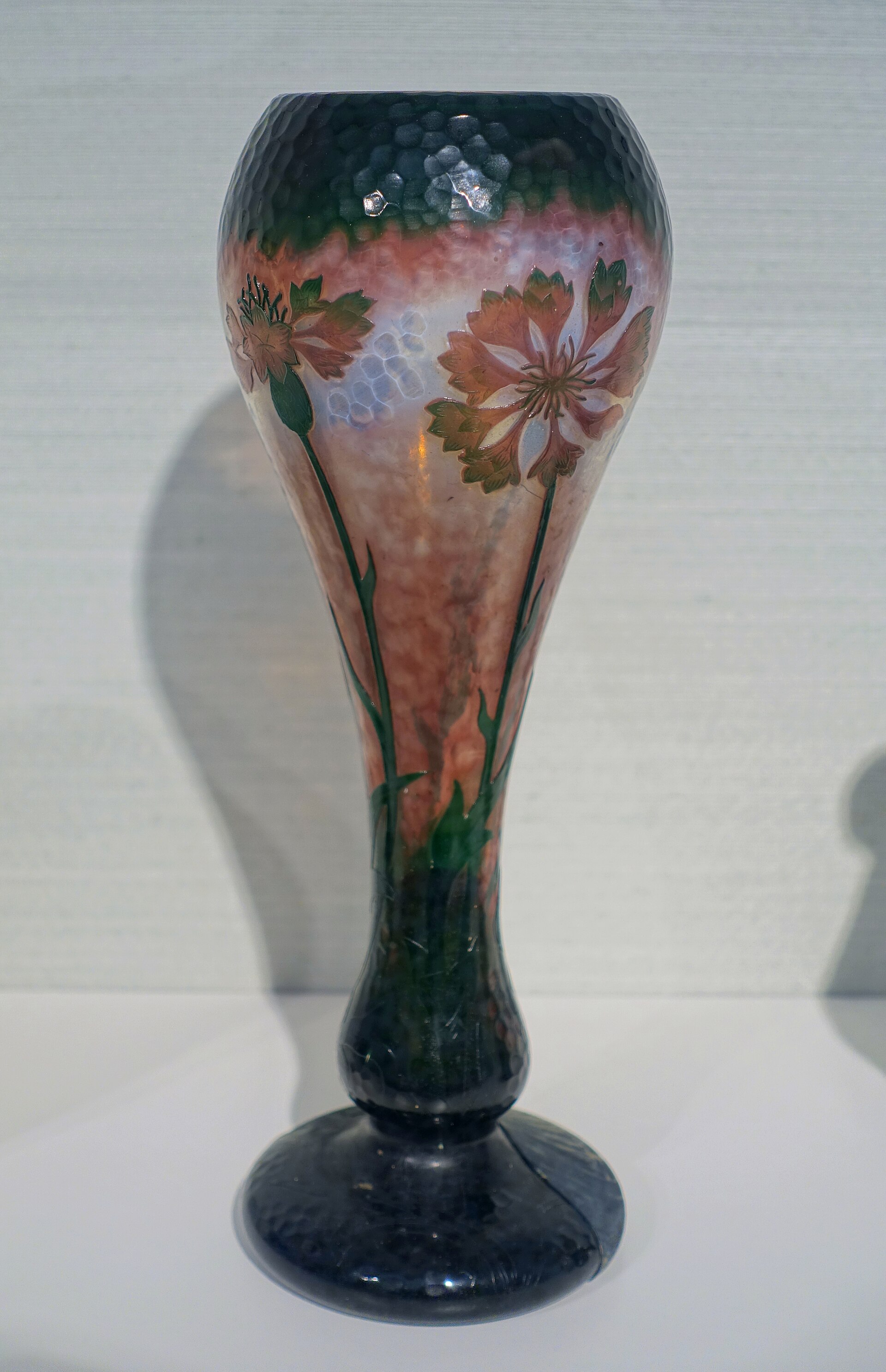
| Vase with cornflowers Daum Freres | The rival Nancy glasshouse, a fellow founding member of the Ecole de Nancy alongside Galle. Included to place this vase inside the wider Nancy cameo-glass trade, not to be confused with Galle's own output; Daum and Galle are separate firms with separate signatures. | Hessisches Landesmuseum Darmstadt |
Open questions
- Who owned this vase between its manufacture around 1900 and its appearance in Macklowe Gallery's stock before 1979? No owner is documented across that span.
- What did the Cleveland Museum pay for it in 1979, and what, if anything, did Macklowe Gallery pay to acquire it? Neither figure is published in the sources consulted.
- Is this piece lifetime work, or was it made in the several months between Galle's death in September 1904 and the star mark's introduction in 1905? The museum's own 1895-1905 date range does not resolve this, and the unstarred signature is consistent with either reading.
- What insect is depicted? Cleveland's own record does not name the species, and this record has been unable to go beyond noting a general resemblance to a grasshopper or a cicada.
- Does this vase carry a model or pattern name in Galle's own production records or in any dealer catalogue? None is published in the sources found for this record.
- Did the 1988 Art Nouveau in France exhibition at Cleveland produce a catalogue with further discussion of this piece, beyond the citation recorded in the accession file? Not established here.
Questions about this object
What is Vase?
Vase is a glass, dated c. 1900. Medium: Glass with pink and green inclusions, cameo cut.
Who made Vase, and is the attribution settled?
The attribution to Emile Galle is recorded here as accepted. Catalogued by the Cleveland Museum of Art to Emile Galle (French, 1846-1904) without qualification, on the basis of the cameo signature Galle cut into the glass and the piece's consistency with Galle's documented cased and cameo production. The museum's own supporting date range, 1895 to 1905, spans Galle's death in September 1904; no star accompanies the signature, which is consistent with either lifetime manufacture or the small window between his death and the introduction of the posthumous star mark in 1905. This record does not resolve which.
Where is Vase now?
Cleveland Museum of Art, Gallery 221, 19th Century Decorative Arts, Cleveland, Ohio. Inventory number 1979.10. Last confirmed 18 August 2026. Purchased 1979 through the Andrew R. and Martha Holden Jennings Fund; on permanent display in the museum's 19th Century Decorative Arts gallery.
What is still unknown about Vase?
Who owned this vase between its manufacture around 1900 and its appearance in Macklowe Gallery's stock before 1979? No owner is documented across that span.
Sources
- 1Cleveland Museum of Art, collection webpage, Vase, Emile Galle, c. 1900, accession 1979.10. clevelandart.org/art/...
- 2Cleveland Museum of Art Open Access API, full record for accession 1979.10 (object id 149466): tombstone, dimensions, inscription, provenance, exhibitions, citations, credit line and accession date. openaccess-api.clevelandart.org/api/...
- 3Cleveland Museum of Art, collection webpage, Vase (Emile Galle, enameled glass), accession 1983.225, for the museum's contrasting Gift of donor-credit convention. clevelandart.org/art/...
- 4Lee, Sherman E. "The Year in Review for 1979." The Bulletin of the Cleveland Museum of Art 67, no. 3 (1980): 58-99, this vase reproduced as cat. no. 57, p. 76. Citation as transcribed in the museum's own accession record (source 2); the original Bulletin article was not independently retrieved for this record and is flagged for direct verification. jstor.org/stable/...
- 5Hawley, Henry H. Glass Today: American Studio Glass from Cleveland Collections. Cleveland: Cleveland Museum of Art, 1997, this vase reproduced as fig. 5, p. 14, and mentioned p. 15. Citation as transcribed in the museum's own accession record (source 2); the volume was not independently retrieved for this record and is flagged for direct verification. Not independently retrieved; relayed exactly as transcribed on Cleveland's own accession page (source 1), which is the URL given here pending direct verification of the original 1997 volume. clevelandart.org/art/...
- 6Encyclopedia of Cleveland History, Case Western Reserve University, "Martha Holden Jennings Foundation." case.edu/ech/...
- 7Macklowe Gallery, "About," gallery history page. macklowegallery.com/pages/...
- 8Macklowe Gallery, "The Visual Poetry of Emile Galle," gallery news/blog. macklowegallery.com/blogs/...
- 9Samuel Provost, "The Galle signatures on glass after 1904: a tentative chronology, part I, 1904-1920," 28 December 2020. Specialist chronology for the posthumous star mark's introduction (no earlier than January 1905) and withdrawal (May 1908), based on Henriette Galle's letters to Albert Daigueperce and the firm director Emile Lang's 1908 correspondence. galle.substack.com/p/...
- 10Samuel Provost, "The Galle signatures on glass after 1904: a tentative chronology, part II, 1920-1936." Specialist chronology for the firm's 1920s reorganizations, the 1931 furnace closure, the 1928-1936 documentation gap, and the 1936 end of production and signing. galle.substack.com/p/...
- 11Samuel Provost, "Fake Galles I: when a floral design...", April 2023. Specialist categorization of Galle forgeries: rebaptized rival-house glass, modern reproductions (Romanian, Chinese), and altered genuine pieces. galle.substack.com/p/...
- 12Philip Chasen, "More information on how to spot reproduction Galle vases," Philip Chasen Antiques, 25 November 2010. TRADE SOURCE (appraiser), not peer-reviewed scholarship. blog.chasenantiques.com/2010/...
- 13Chiswick Auctions, "Galle Glass: Art Nouveau Craftsmanship in Colour and Form." AUCTION-HOUSE SOURCE, published collecting guidance rather than a specific lot's condition report. chiswickauctions.co.uk/news-item/...
- 14Used for biographical dates, the marqueterie sur verre patent, exhibition history, the Ecole de Nancy founding, political engagement, insect and floral motifs, and the 1904 death. en.wikipedia.org/wiki/...
- 15Musee de l'Ecole de Nancy, "The Ecole de Nancy," official museum history page. musee-ecole-de-nancy.nancy.fr/en/...
- 16Barnebys Magazine, "Floral Grace: The Art Glass of Emile Galle." barnebys.com/blog/...
- 17TeacherCurator, "Emile Galle," educational reference page, for Galle's stated aim of his work and the motto over his workshop door. teachercurator.com/art/...
- 18WorldCollectorsNet, "Emile Galle Glass," collector reference feature. worldcollectorsnet.com/features/...
- 19Wikimedia Commons file record, Rijksmuseum vase with maple branches, BK-1983-35. commons.wikimedia.org/wiki/...
- 20Wikimedia Commons file record, Rijksmuseum vase with honesty seed-pods, BK-1972-74. commons.wikimedia.org/wiki/...
- 21Wikimedia Commons file record, Daum Freres vase with cornflowers, Hessisches Landesmuseum Darmstadt. commons.wikimedia.org/wiki/...
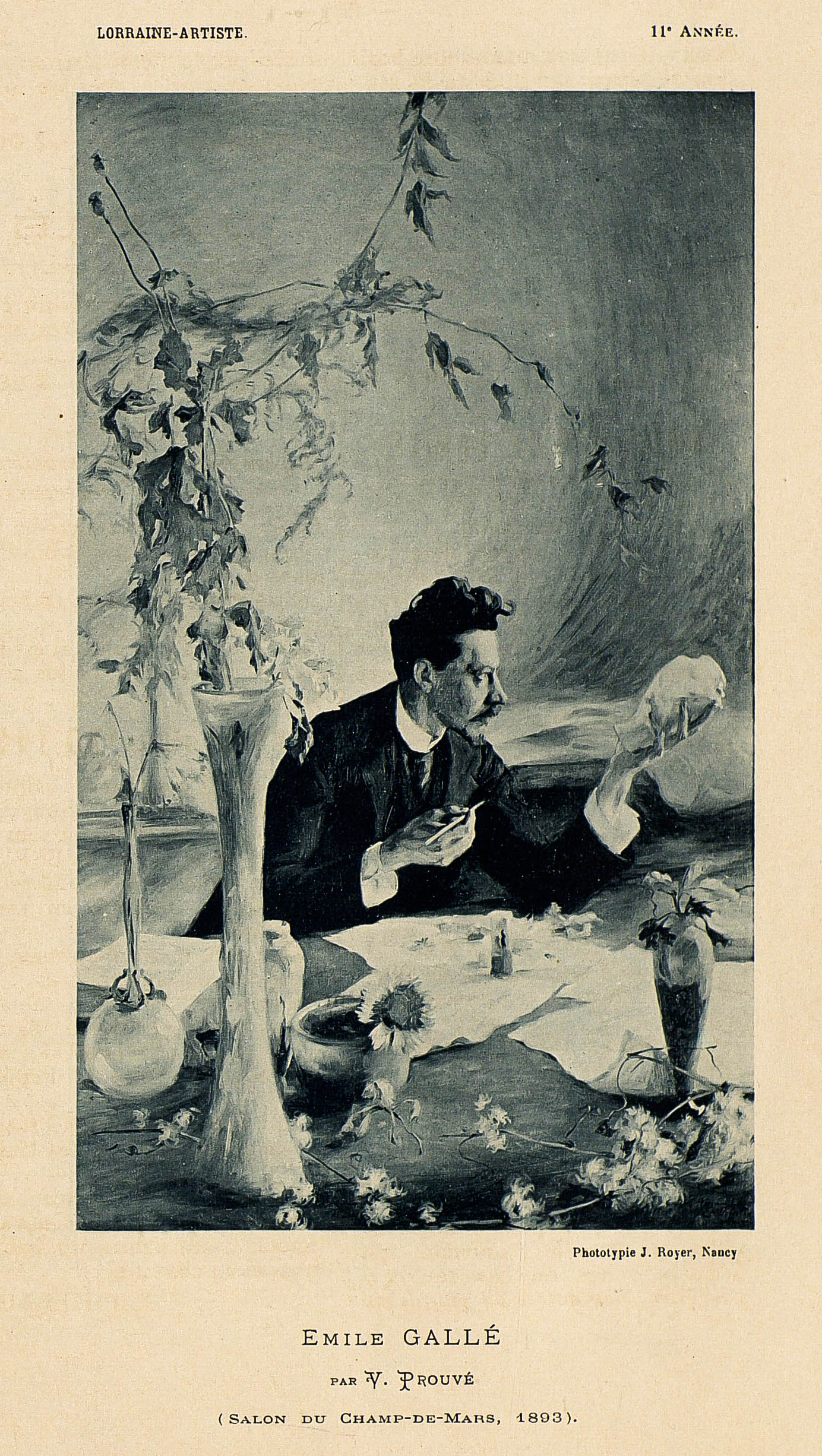
- 22Wikimedia Commons file record, portrait of Emile Galle by Victor Prouve, 1893, Bibliotheque municipale de Nancy. commons.wikimedia.org/wiki/...


Last verified · Published
Change log
18 August 2026 - Record created at the house standard: researched narrative, technical evidence, maker dossier, graded provenance chain, prices with hammer and premium separated, related works, open questions and sources.