Tray
Paul de Lamerie · 1745-1746
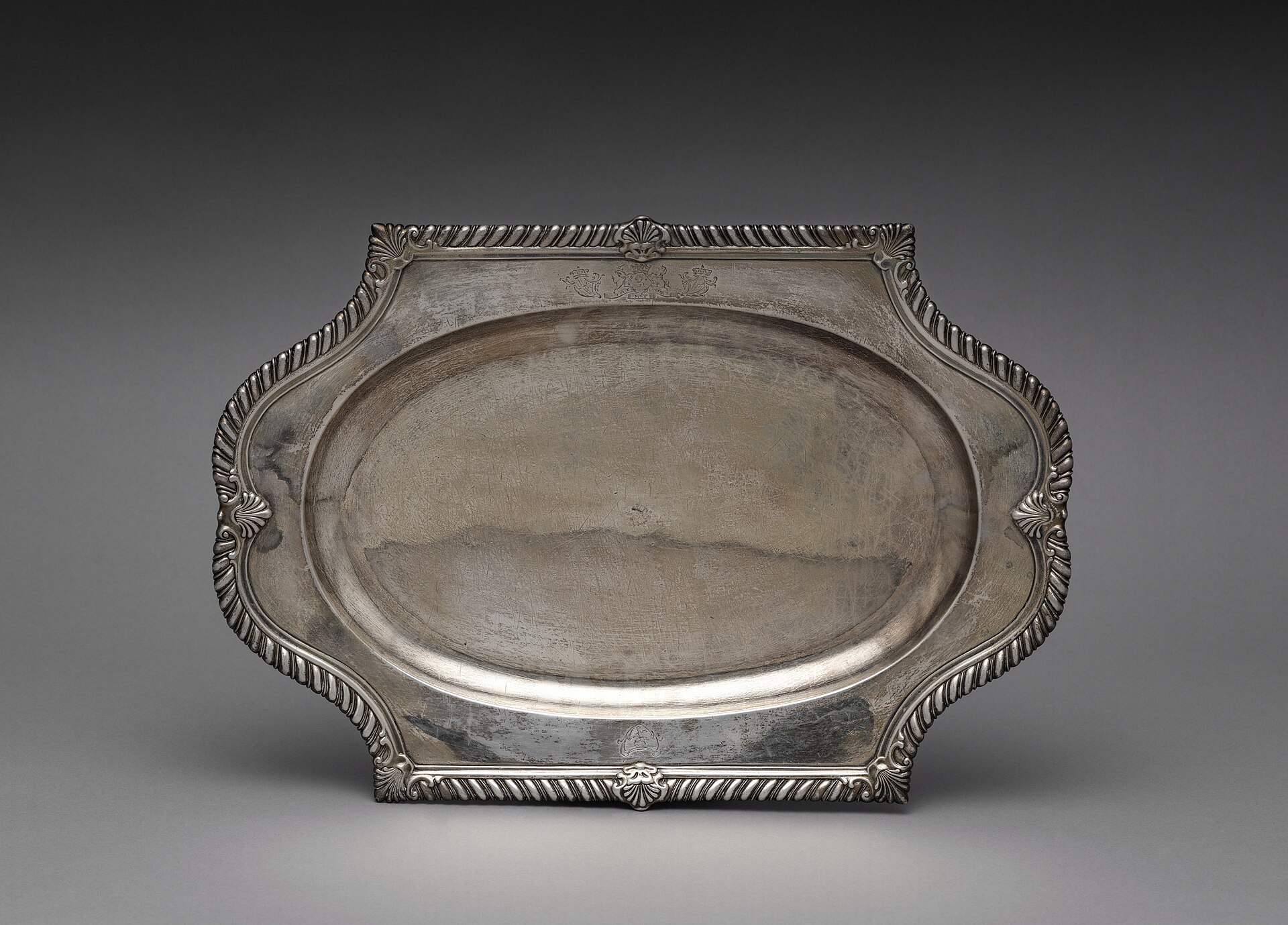
The record subject. Cleveland Museum of Art's own open-access photograph of accession 1941.601, the tray this record describes.
| Artist | Paul de Lamerie |
|---|---|
| Date | 1745-1746 |
| Medium | Silver |
| Dimensions | 29.2 x 41.8 cm (11 1/2 x 16 7/16 in.), overall |
| Where it is now | Cleveland Museum of Art, Cleveland, Ohiolast confirmed |
| Inventory number | 1941.601 (Department of Decorative Art and Design; museum's internal object id 120890) |
| Attribution | AcceptedMade by Paul de Lamerie and bearing his third and final registered maker's mark, entered at Goldsmiths' Hall on 27 June 1739 and used continuously until his death in 1751. Full note |
| Object type | Silver |
| Period | Georgian, mid-eighteenth century |
| Cases | Has a provenance gap |
| Inscriptions | Two crests engraved on either side of the face: a lion, and a second bearing the motto TOUT EST VANITE. Scratched on the underside: 'No 4.' and '41 = 0 1/2'. |
| Owners on record | 4 links3 documented, 1 unknown |
| Sources | 13 cited |
About this record Last verified · 13 sources cited · Change log
On this page 9 sections
ContentsClose
An oval silver dish by Paul de Lamerie, London, 1745-6, bearing the third and last of his three registered maker's marks and dating from the year he served as Third Warden of the Goldsmiths' Company, the guild whose own standard his shop's silver was tested against. Two engraved crests on its face, a lion and a shield reading TOUT EST VANITE, belong to a patron this record has not been able to identify.
Cleveland received the dish in 1941 as part of a larger gift from Mrs. Otto Miller that also included silver by Paul Storr and Ebenezer Coker and a portrait by Matthew Harris Jouett. No owner, dealer, or sale is documented for the dish across the roughly two centuries between its manufacture and that gift; this record states that gap plainly rather than inventing a chain to fill it.
Distinct from this project's other two de Lamerie records, which cover a documented fraudulent companion object and the Goldsmiths' Company's modern scholarship on forged marks, nothing in the sources consulted here raises any question about this dish's own authenticity or its history since 1941. Its most substantial open questions are the identity of its original patron and the two centuries the object spent outside any documented record.
Provenance
Each link is graded. Documented: a cited source supports it. Disputed: the identification is argued but not established. Unknown: no owner for that span, and the gap is not smoothed into a narrative. The grades in the glossary.
- 1745-1746 -Unidentified original patron (bore a lion crest and a shield with the motto TOUT EST VANITE)documented
Manufacture and date are established by the maker's mark (de Lamerie's third mark, entered 1739) and the London hallmarks read by Cleveland's catalogue as 1745-46. The identity of the patron who commissioned it and bore the engraved crests is not established by any source consulted; the armorial bearings have not been matched to a specific family here.1247
- 1745-1746 - 1941Unknownunknown
No owner, dealer, or sale is documented for this dish across the nearly two centuries between its manufacture and its appearance in the Otto Miller gift. Neither Cleveland's current catalogue nor the museum's 1942 Bulletin article announcing the gift records any earlier provenance.124
- 1941 - 1941Mrs. Otto Miller, Clevelanddocumented
Given to the Cleveland Museum of Art in 1941 as part of a larger gift that also included Paul Storr coasters and a cruet stand (1814-15), an Ebenezer Coker salver (1769-70), and Matthew Harris Jouett's portrait of Colonel Thomas Hart Benton. No purchase price or dealer is recorded for the silver in the sources consulted. This record has not been able to independently confirm Mrs. Miller's identity beyond the name on the credit line and the museum's own 1942 account of the gift.134
- 1941 - presentCleveland Museum of Art (accession 1941.601)documented
Held in the Department of Decorative Art and Design. Cleveland's own catalogue records the object as not currently on view as of this record's last verification.12
Technical evidence
| Attribution note | Made by Paul de Lamerie and bearing his third and final registered maker's mark, entered at Goldsmiths' Hall on 27 June 1739 and used continuously until his death in 1751. Cleveland's own catalogue and the museum's 1942 Bulletin both identify the dish as his work on the strength of the mark itself; no dispute over the attribution has been found in the sources consulted. |
|---|---|
| Medium | Silver.1 |
| Dimensions | 29.2 x 41.8 cm (11 1/2 x 16 7/16 in.), overall.1 |
| Maker's mark | Paul de Lamerie's third and final registered mark, entered at Goldsmiths' Hall on 27 June 1739 on his move to Gerrard Street, and used on his work until his death in 1751. This dish carries that mark.456 |
| Assay marks | London leopard's head crowned (town mark) and lion passant (sterling standard mark), with a London date letter for the 1745-46 assay year, the standard set of marks for London silver of the period.7 |
| Inscriptions | Two crests engraved on either side of the face: a lion, and a second with the motto TOUT EST VANITE. Scratched on the underside: 'No 4.' and '41 = 0 1/2', in the general convention of a working weight in troy ounces and pennyweights, though the museum's own catalogue does not itself interpret the notation.2 |
| Form and ornament | Oval plateau rising to a cinquefoil rim bordered with molding and gadrooning, with cast acanthus leaves applied intermittently around the edge.4 |
Images
The record in full
Chapter 1What the dish is
An oval silver serving dish, 29.2 by 41.8 centimetres, made in London in 1745-6.
An oval silver serving dish, 29.2 by 41.8 centimetres, made in London in 1745-6. Cleveland's own 1942 description, written by curator Helen S. Foote the year after the museum received it, is the most exact account of its form that this record has found: an oval plateau rising to a cinquefoil, or five-lobed, rim, bordered with an edge of molding and gadrooning, with cast acanthus leaves applied intermittently around the border.
Cleveland's current online catalogue calls it a Tray. The 1942 Bulletin, written a year after the museum acquired it, calls it a meat dish. Both are the same object; the title has simply migrated over eighty years of cataloguing, a small but real reminder that an object's name is not fixed even when the object itself has not moved.
Chapter 2Two crests and an unread motto
The face carries two engraved crests, one on either side.
The face carries two engraved crests, one on either side. One shows a lion. The other carries a motto: TOUT EST VANITE, French for 'all is vanity,' the standard eighteenth-century rendering of the Vulgate's vanitas vanitatum, omnia vanitas from Ecclesiastes. That the phrase is there, engraved into a piece of dining silver, is a documented fact about the object. Whose choice it was, and what family bore the lion above it, is not: no source consulted here identifies the armorial bearings, and this record has not been able to match the crests to a specific patron or family.
The underside carries two further scratched marks, transcribed by the museum as 'No 4.' and '41 = 0 1/2.' Scratched notations of this kind are a routine feature of English silver of the period, generally understood as a goldsmith's or retailer's working record of weight, given in troy ounces and pennyweights (twenty pennyweights to the ounce). Read that way, '41 = 0 1/2' would put the dish at roughly forty-one troy ounces, a little under 1.3 kilograms, though Cleveland's own catalogue entry does not gloss the notation and this record has not independently confirmed that reading. The 'No 4' is more suggestive: a number scratched under a piece of this kind ordinarily marks its place in a numbered set.
Chapter 3What the marks establish, and to what certainty
English silver of this date carries four marks struck together at assay, and together they are read as close to documentary proof: a town mark (for London, the leopard's head crowned), a standard...
English silver of this date carries four marks struck together at assay, and together they are read as close to documentary proof: a town mark (for London, the leopard's head crowned), a standard mark (the lion passant, for sterling), a date letter unique to that assay office's yearly cycle, and the maker's or sponsor's punch. Cleveland's dating of this dish to 1745-6 rests on that date letter, read against the London office's published cycle.
The maker's mark is the third of three that Paul de Lamerie registered across his working life. He entered his first mark in 1712, not long after taking his freedom of the Goldsmiths' Company; a second on 17 March 1732, at the same time he adopted the sign of the Golden Ball on Windmill Street; and a third, the one this dish bears, on 27 June 1739, when he moved his workshop to Gerrard Street, Soho. That third mark was in continuous use for the rest of his life, so it dates this dish to somewhere in the last twelve years of his career, and the London date letter narrows it further, to 1745-6, five to six years before he died.
Chapter 4A dish made the year he became Third Warden
By 1745-6 de Lamerie was no longer simply a supplier submitting work to Goldsmiths' Hall for assay; he was rising through the Hall's own governance.
By 1745-6 de Lamerie was no longer simply a supplier submitting work to Goldsmiths' Hall for assay; he was rising through the Hall's own governance. He was made Liveryman of the Company in 1717 and an Assistant of its Court in 1731. He became Fourth Warden in 1743, Third Warden in 1746, and Second Warden in 1747; only his declining health, in the account given by the sources consulted, kept him from the top position of Prime Warden before his death. This dish's date letter places its assay in the very year, 1746, in which he held the office of Third Warden, one of the officers responsible for the standard his own workshop's silver was tested against.
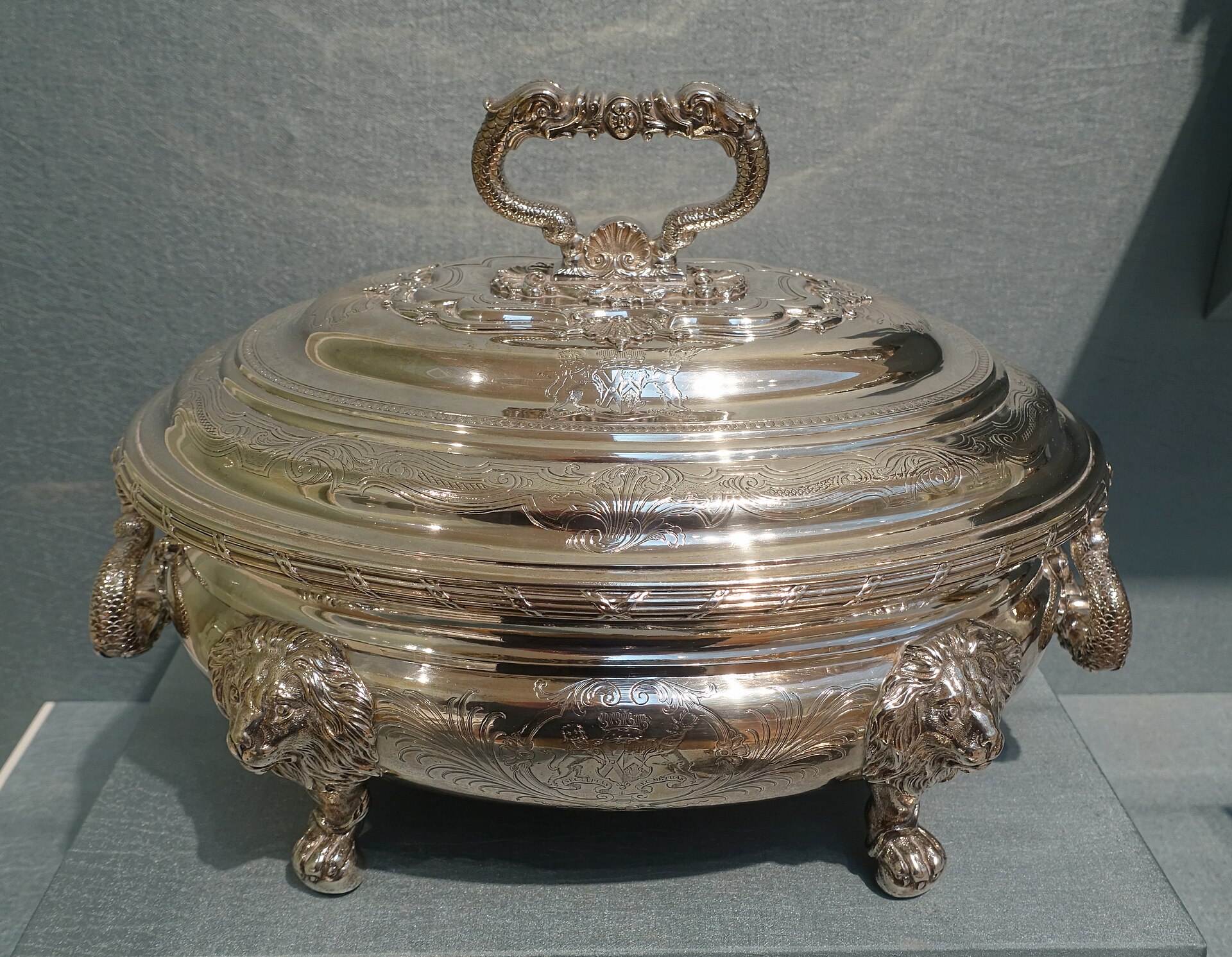
This is a different thread from the Company's documented trouble with de Lamerie's mark, already covered at length in this project's record for the Hardwicke tureen, where an object bearing his 1732 sterling mark was shown to be a fraudulent reassembly, and where the Goldsmiths' Company's own modern scholarship on forged de Lamerie marks is discussed. Nothing in the sources consulted for this dish raises any question about its own marks, its authenticity, or its history of ownership after 1941. Where the Hardwicke record is a story about a mark under suspicion, this dish's own documented history is, so far as it goes, uneventful, and that absence of controversy is itself worth recording plainly rather than manufacturing a problem to match the other record.
Chapter 5A busy final decade
De Lamerie's output did not slow in this period.
De Lamerie's output did not slow in this period. He had been appointed goldsmith to King George I in 1716, supplied Sir Robert Walpole and the Duke of Bedford among English patrons, and worked for foreign clients including the Russian empresses Catherine I and Anna. His only documented royal commission on record from George II's reign came in 1750, a year before his death: a christening gift, described in the sources as a 'Regium donum,' given on the king's behalf to the Earl of Lincoln at the birth of his son George. He died on 1 August 1751 and was buried at St Anne's Church, Soho, close to the Gerrard Street workshop whose address his last mark records; a memorial plaque was placed at the Gerrard Street site in 1992.
This dish sits inside that late decade of continuing royal and aristocratic custom, made by a workshop whose head was simultaneously judging his own trade's silver at the Hall. Whether this particular commission came from an aristocratic table or a more modest one is not established by any source consulted; only the crests, still unidentified, would say.
Chapter 6One dish from a larger 1941 gift
Cleveland's credit line for 1941.601 reads simply: Gift of Mrs.
Cleveland's credit line for 1941.601 reads simply: Gift of Mrs. Otto Miller. The museum's own October 1942 Bulletin fills in the context that the modern object page does not: this dish arrived in 1941 as one piece of a substantial group gift from Mrs. Miller that also included a pair of silver-gilt wine coasters and a cruet stand by Paul Storr, made for the royal goldsmiths Rundell, Bridge and Rundell in 1814-15, a mid-century salver by Ebenezer Coker dated 1769-70, and, outside the silver, Matthew Harris Jouett's portrait of Colonel Thomas Hart Benton. Helen Foote's Bulletin article, titled 'Paul de Lamerie and Paul Storr, English Silversmiths,' was written specifically to introduce the silver portion of this gift to the museum's members.
Neither Cleveland's current catalogue entry nor the 1942 Bulletin records a purchase price, a dealer, or any prior owner for this dish. This record has not been able to identify Mrs. Otto Miller's own collecting history, or to confirm with any fetched source exactly who she was beyond the name on the credit line; a period Cleveland biographical sketch of a bond broker named Otto Miller could not be verified as the same family, and this record does not assert that connection.
Chapter 7The two-hundred-year gap
Between the dish's manufacture in 1745-6 and its appearance in Mrs.
Between the dish's manufacture in 1745-6 and its appearance in Mrs. Miller's 1941 gift, no owner, sale, or dealer is documented in any source this record has consulted. That is not a small gap to wave past: it covers essentially the entire documented existence of the object before it entered a public collection. Helen Foote's 1942 article, written from whatever information the museum had at the point of accession, offers nothing about the intervening two centuries beyond the object itself. Where this record cannot state a fact, it says so rather than filling the space with a plausible-sounding guess.
Chapter 8Set against the rest of the shop's output
De Lamerie's workshop, across four decades, produced work ranging from the restrained Queen Anne-influenced pieces of his early career to the full rococo idiom for which he is best known today.
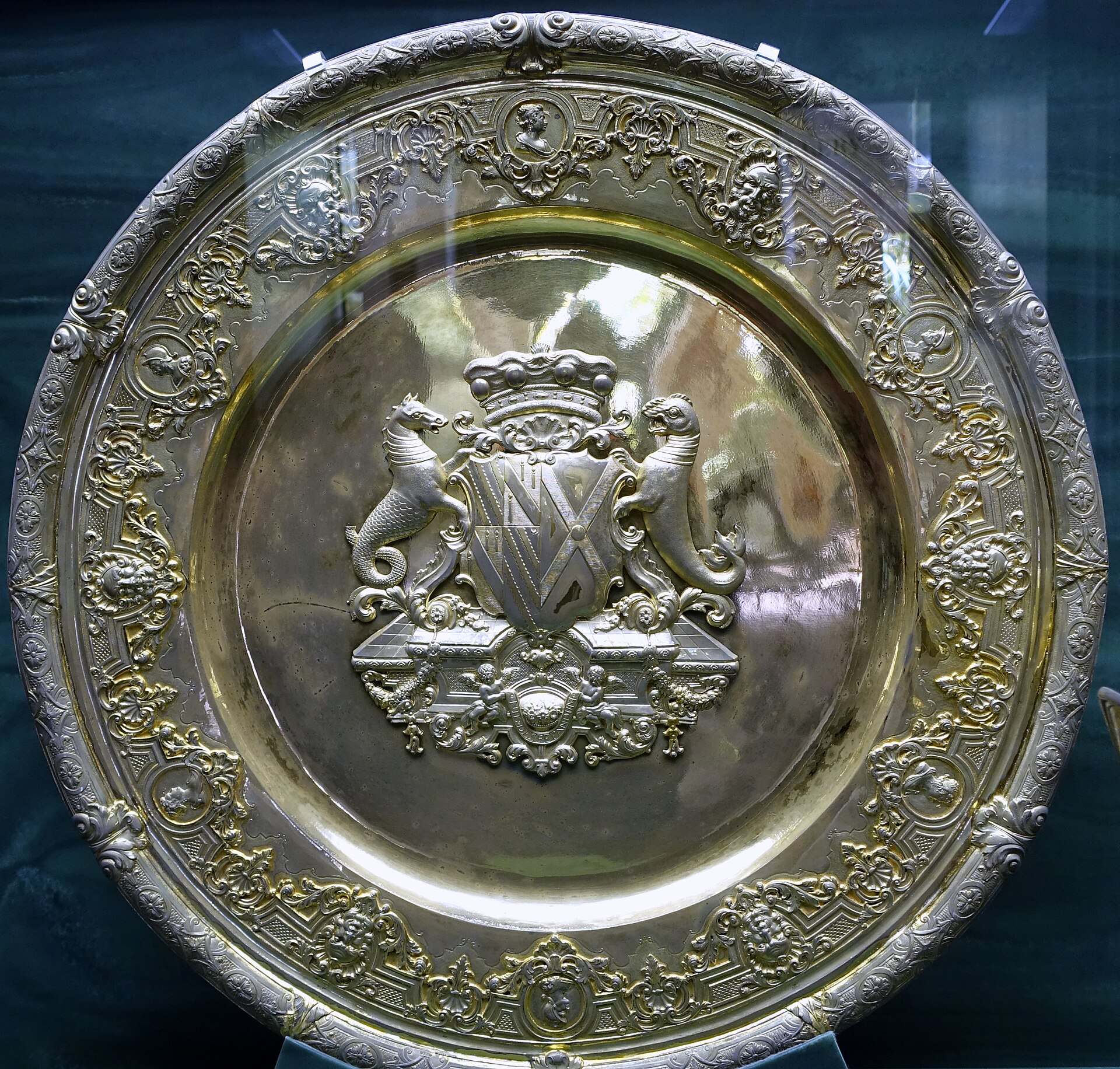
De Lamerie's workshop, across four decades, produced work ranging from the restrained Queen Anne-influenced pieces of his early career to the full rococo idiom for which he is best known today. A useful point of comparison is the Maynard Dish, a large circular presentation dish hallmarked for the Maynard family in the mid-1730s and now at the Metropolitan Museum, whose border of the four elements and grotesque masks is generally credited to an unidentified specialist chaser working for de Lamerie's shop rather than to de Lamerie's own hand. Set beside that dish's dense figural ornament, this Cleveland tray's molded, gadrooned, and cinquefoil-lobed border reads as considerably more architectural and restrained, consistent with the plainer late-1740s pieces more generally associated with his final working decade. This record has not been able to verify who in the workshop chased or finished this particular dish's border; as with the Maynard Dish, division of labor within de Lamerie's shop is well documented as a general practice but not, for this specific object, by name.
Chapter 9What remains open
Two questions matter more than the others.
Two questions matter more than the others. First, whose crest and motto are engraved on the face: without an identified armiger, this dish has no documented patron, only a documented maker. Second, where it was for roughly two hundred years before it reached Cleveland. Both are recorded here as unresolved rather than smoothed over, because a gap honestly stated is worth more to the next researcher than an invented bridge across it.
The artist
Paul de Lamerie (baptised Bois-le-Duc, 1688 - died London, 1751)
By the time this dish was made, de Lamerie was no longer the young Huguenot craftsman building a reputation; he was a senior officer of his own trade guild, still running a busy workshop, and within a few years of his death. This dossier covers facts about his final working decade specifically, since his earlier career, his first two marks, and the Goldsmiths' Company's modern trouble with forgeries of his mark are covered in this project's other two de Lamerie records and are not repeated here.
Related works
| Work | Relation | Where it is |
|---|---|---|
| The Hardwicke Soup Tureen and Cover Paul de Lamerie | Same maker, earlier work (assayed 1737-8), bearing his second mark rather than the third mark on this dish Already the subject of a separate Iconotheca record (lamerie-hardwicke-tureen), which covers a documented fraudulent companion ewer and the Goldsmiths' Company's modern scholarship on forgeries of de Lamerie's mark. That material is not repeated here because it does not bear on this dish's own history. | Portland Art Museum, Portland, Oregon (69.45a-c) |
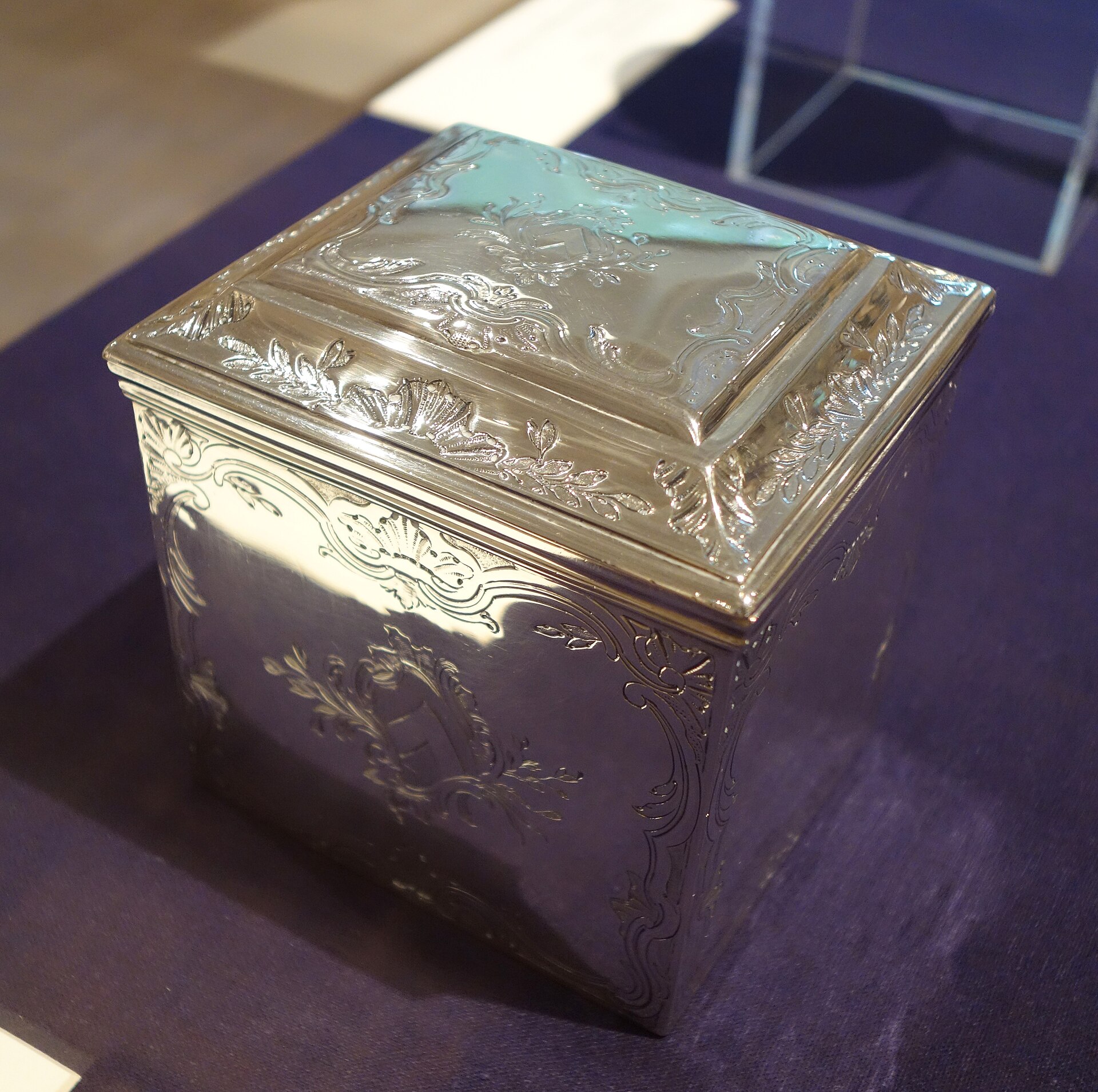
| Tea Caddy Paul de Lamerie | Same maker, same museum, made about two years before this dish Already the subject of a separate Iconotheca record (lamerie-tea-caddy-cleveland). A different accession, a different donor, and a different object; not to be merged with this record. | Cleveland Museum of Art (1943.179) |
| The Maynard Dish Paul de Lamerie | Earlier presentation dish from the same workshop, hallmarked for the Maynard family in the mid-1730s, in the fuller rococo idiom that this Cleveland dish's plainer late-1740s border can be read against Its elaborate border is generally credited to an unidentified chaser working for de Lamerie rather than to de Lamerie's own hand, a documented instance of the labor division inside his shop. This record could not directly verify dealer commentary on the dish due to a blocked fetch; the description here is limited to what is independently corroborated. | The Metropolitan Museum of Art, New York |
| Dish and Ewer for Baron George Anson of Soberton Paul de Lamerie | Earlier-career pairing from 1726-7, before de Lamerie's 1732 change to the sterling standard mark Illustrates the earlier phase of his output for comparison with this dish's late-career mark and ornament. | Fowler Museum at UCLA, Los Angeles |
Open questions
- Who was the original patron: whose lion crest and whose motto, TOUT EST VANITE, are engraved on the face? No source consulted identifies the armorial bearings or matches them to a family.
- Where was the dish between its manufacture in 1745-6 and its appearance in the Otto Miller gift of 1941? No owner, dealer, or sale is documented across that span in any source this record has found.
- Does the 'No 4' scratched on the underside mean this dish was one of a larger numbered set or dinner service, as Helen Foote's 1942 description speculated? No sibling pieces bearing a matching crest or scratch number have been identified here.
- What was Mrs. Otto Miller's own collecting history, and how and from whom did she acquire this dish and the rest of the 1941 gift? Cleveland's records as consulted do not say.
- Who chased or finished the applied ornament on this dish within de Lamerie's workshop? Division of labor in his shop is documented as a general practice but not, for this specific object, by name.
Questions about this object
What is Tray?
Tray is a silver, dated 1745-1746. Medium: Silver.
Who made Tray, and is the attribution settled?
The attribution to Paul de Lamerie is recorded here as accepted. Made by Paul de Lamerie and bearing his third and final registered maker's mark, entered at Goldsmiths' Hall on 27 June 1739 and used continuously until his death in 1751. Cleveland's own catalogue and the museum's 1942 Bulletin both identify the dish as his work on the strength of the mark itself; no dispute over the attribution has been found in the sources consulted.
Where is Tray now?
Cleveland Museum of Art, Cleveland, Ohio. Inventory number 1941.601 (Department of Decorative Art and Design; museum's internal object id 120890). Last confirmed 20 August 2026. Gift of Mrs. Otto Miller, 1941.
What is still unknown about Tray?
Who was the original patron: whose lion crest and whose motto, TOUT EST VANITE, are engraved on the face? No source consulted identifies the armorial bearings or matches them to a family.
Sources
- 1Cleveland Museum of Art, object page for Tray, accession 1941.601. clevelandart.org/art/...
- 2Cleveland Museum of Art Open Access API, object record 120890 (Tray, 1941.601), including catalogued inscriptions, dimensions, and citation list. openaccess-api.clevelandart.org/api/...
- 3Cleveland Museum of Art, object page for Decanter Stand by Paul Storr, accession 1941.598, part of the same 1941 Otto Miller gift. clevelandart.org/art/...
- 4Helen S. Foote, 'Paul de Lamerie and Paul Storr, English Silversmiths,' The Bulletin of the Cleveland Museum of Art 29, no. 8 (October 1942): 121-123, including the note on the Jouett portrait gift on the same page (p. 78 of the scanned issue). archive.org/details/...
- 5silvercollection.it, 'Paul De Lamerie,' for the three registered maker's marks and their dates and addresses. silvercollection.it/ENGLADELAMERIE.html
- 6Huguenots of Spitalfields, 'LAMERIE, Paul de,' for biography, Goldsmiths' Company wardenships, royal appointment, clientele, death and burial. huguenotsofspitalfields.org/famoushuguenots/...
- 7The Silver Society, 'Identify Your Silver,' for the mechanics of English hallmarking (town mark, standard mark, date letter, maker's mark). thesilversociety.org/research/...
- 8Wikipedia, 'Pennyweight,' for the troy-weight unit convention (20 pennyweight to the troy ounce) used to interpret the scratched underside notation. en.wikipedia.org/wiki/...
- 9Koopman Rare Art, 'The Mystery of the Maynard Master,' on the Maynard Dish and its unidentified chaser. Direct fetch was blocked (403); content drawn from search-indexed text and treated cautiously in the narrative. koopmanrareart.wordpress.com/2017/...
- 10Wikimedia Commons file page, confirming CC0 licensing for the Cleveland Museum of Art's own open-access photograph of this tray. commons.wikimedia.org/wiki/...
- 11Wikimedia Commons file page, confirming public-domain licensing for the Hardwicke Soup Tureen comparison photograph. commons.wikimedia.org/wiki/...
- 12Wikimedia Commons file page, confirming CC0 licensing for the Huntington Museum tea caddy comparison photograph. commons.wikimedia.org/wiki/...
- 13Wikimedia Commons file page, confirming public-domain licensing for the Fowler Museum Anson dish comparison photograph. commons.wikimedia.org/wiki/...
_-_Tray_-_1941.601_-_Cleveland_Museum_of_Art.jpg)


Last verified · Published
Change log
20 August 2026 - Record created at the house standard: researched narrative, technical evidence, maker dossier, graded provenance chain, prices with hammer and premium separated, related works, open questions and sources.