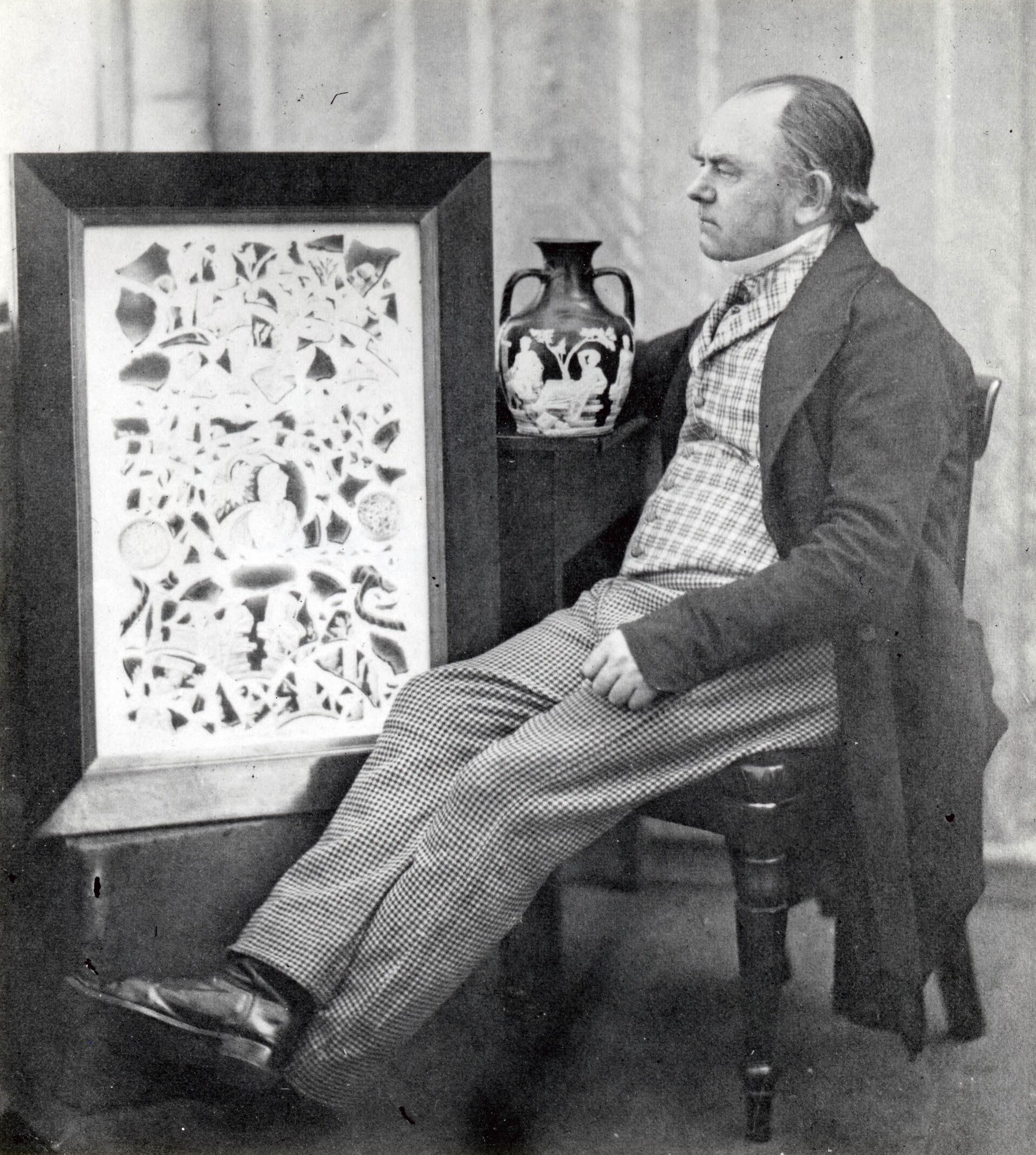
The Portland Vase
c. AD 5-25, disputed. Low dates in the range c. · Cameo glass
British Museum
 Roman, probably working in Rome · active 25 BC-50
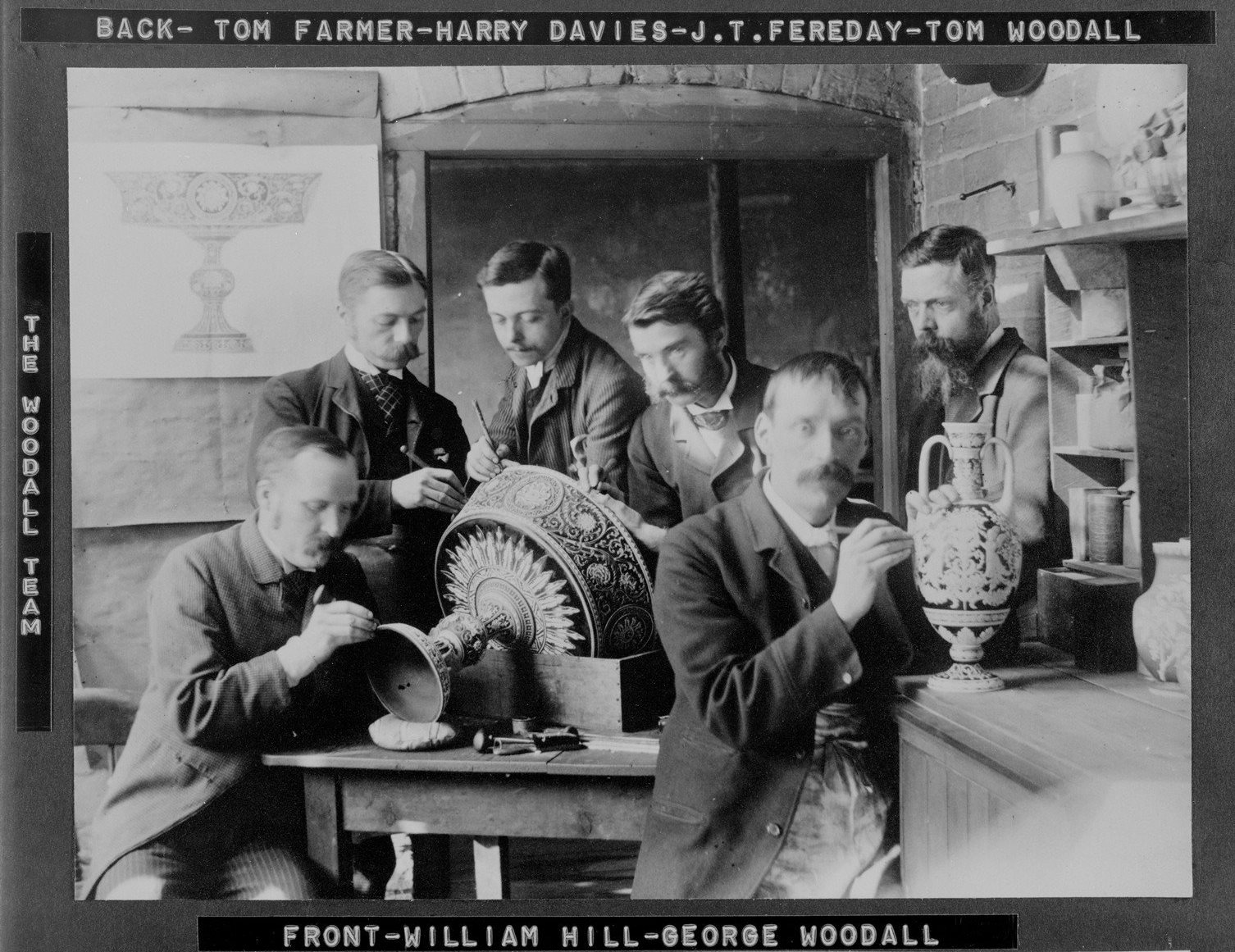
There is no portrait of a Roman cameo glass maker and there never will be one. No likeness was made, none survives, no name is recorded, and two separate trades were involved in every object, so there would be two sitters and not one. What is shown instead is the closest documented equivalent from the only other moment in history when this work was done: the cameo glass team at Thomas Webb and Sons, Stourbridge, photographed in 1891 around the Great Tazza and a two-handled vase. The labels on the print read, standing, Tom Farmer, Harry Davies, J. T. Fereday and Tom Woodall; seated, William Hill and George Woodall. These are Victorian Englishmen, not Romans, and the picture is here to show the division of labour and the scale of the undertaking, not to stand in for a Roman workshop. From the Juliette and Leonard Rakow collection, Rakow Research Library, Corning Museum of Glass.
Rakow Research Library, Corning Museum of Glass (Juliette and Leonard Rakow collection)| Full name | No name survives, and none is likely to. Roman cameo glass carries no maker's signature, no workshop stamp and no... |
|---|---|
| Worked as | Glassworker (vitrearius), Cutter, trained on hardstone, Cameo glass workshop |
| Born | Not applicable. This is a craft, not a person · Italy, and probably Rome, inferred from the concentration... |
| Died | The early phase ends around AD 60 to 68. · Unknown |
| Nationality | Roman, probably working in Rome |
| Movement | Early Imperial Roman luxury glass |
| In this archive | 1 artwork |
| Sources | 34 cited |
| Last verified | 17 September 2026 |
About this page 1 artwork in the archive · Last verified 17 September 2026 · 34 sources cited
This page is about a hand that left fewer than twenty whole objects, some two hundred fragments and not one name. Roman cameo glass is an opaque white layer fused over a dark, usually cobalt-blue body, the white then cut back with a wheel until the figures stand proud and the ground shows through. In 1990 Kenneth Painter and David Whitehouse catalogued fifteen major surviving vessels and objects; a year later the same list ran to sixteen with the Portland Vase's separate base disc counted in; one further vessel was published in 2015; and the most recent count in print, from 2019, is fewer than twenty complete or almost complete pieces. The British Museum alone holds over seventy pieces of all kinds. That is the entire evidence base for the technique that produced the Portland Vase.
Not one of them is signed. There is no ancient author who describes the process, no inscription naming a cameo glass workshop, no contract, no delivery note, no tomb relief of a cameo cutter at his bench. What there is instead is a structural fact that makes the question harder than mere anonymity: one of these objects required two different trades with two different training routes, two tool kits and two working temperatures. A glasshouse made the blank hot. A lapidary cut it cold. Roman writing gives the glassworker a name, vitrearius, and gives a cutter of pierced work another, diatretarius, though whether the second man worked in glass at all is itself disputed. So the question is not who the maker was. It is whether there was ever a single maker to find.
The cutting was so convincingly gem-like that Europe did not know what the Portland Vase was made of. Girolamo Teti described it in print in 1642. It was not until Pierre-Jean Mariette published his treatise on engraved gems in Paris in 1750 that anyone proved the object was glass rather than carved hardstone. For a hundred and eight years educated Europeans looked at it and saw sardonyx. That is the measure of the second trade, and it is also the beginning of the authentication problem this material still presents.
How the blank was made is not settled either. The orthodox account, on every museum label and reproduced by experiment at the Corning Museum of Glass, is that it was blown: a bubble of blue glass gathered on a blowpipe and dipped into molten white, then inflated as one body. A minority position, argued from the 1990s by Rosemarie Lierke and given new physical evidence in 2017 by Richard Whiteley at the Australian National University, holds that the blanks were never blown at all but pressed in moulds from granulated glass. Both positions are held by people who have handled the material. This page gives both and names who holds each.
Two more things a reader should have before anything else. There are two cameo glass corpora in the world and only one is Roman: between 1876 and about 1910 the glasshouses of Stourbridge made a second body of cameo glass in deliberate imitation of the Portland Vase, and it is far larger than the ancient one, catalogued, traded and sometimes signed. And the last major Roman cameo glass vessel to surface did so in 2009, at Bonhams in London, bigger than the Portland Vase and carrying between thirty and thirty-eight figures depending on which report you read. It was studied at the British Museum, never offered for sale, and returned to an owner nobody will name. Nobody knows where it is now.
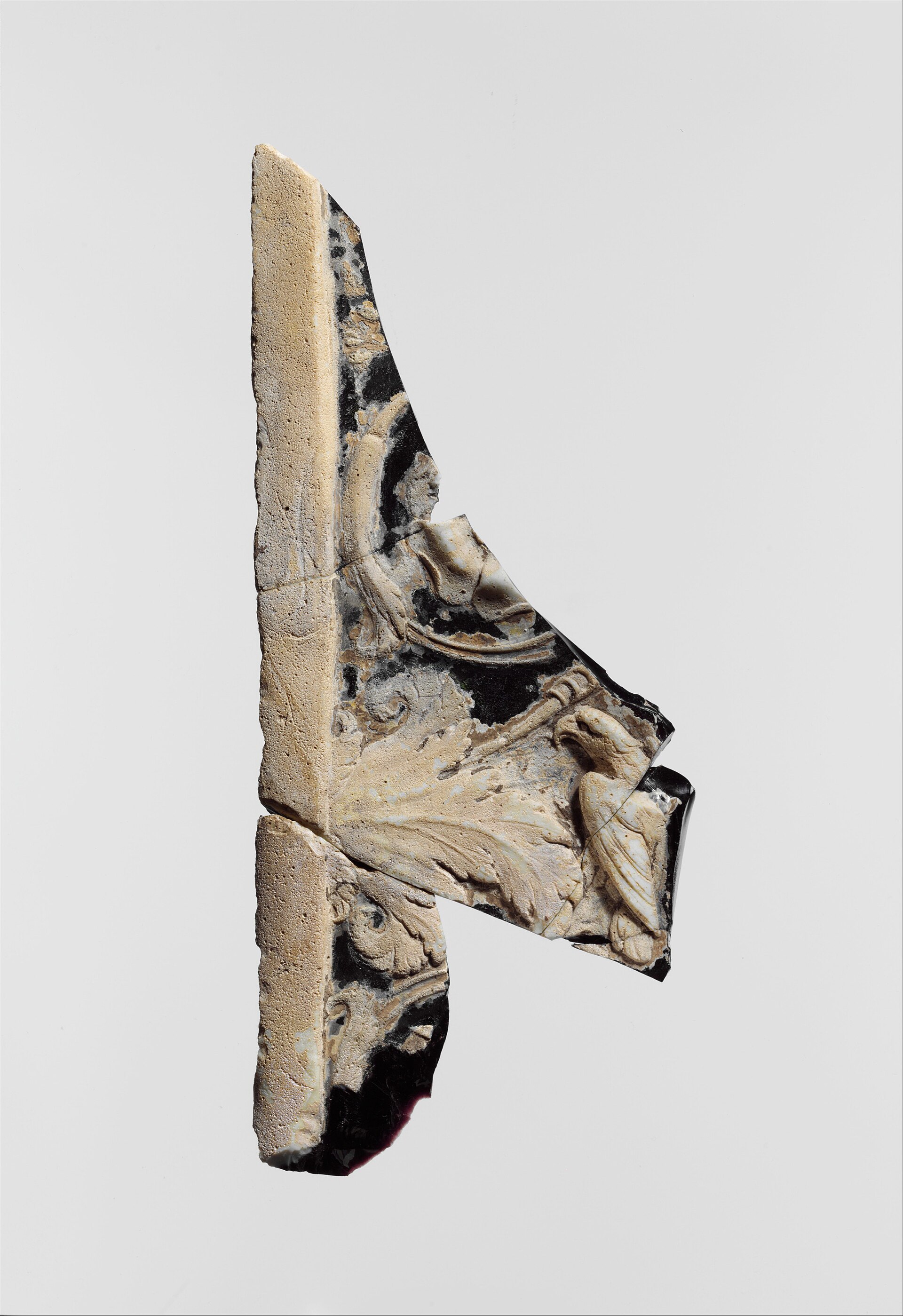
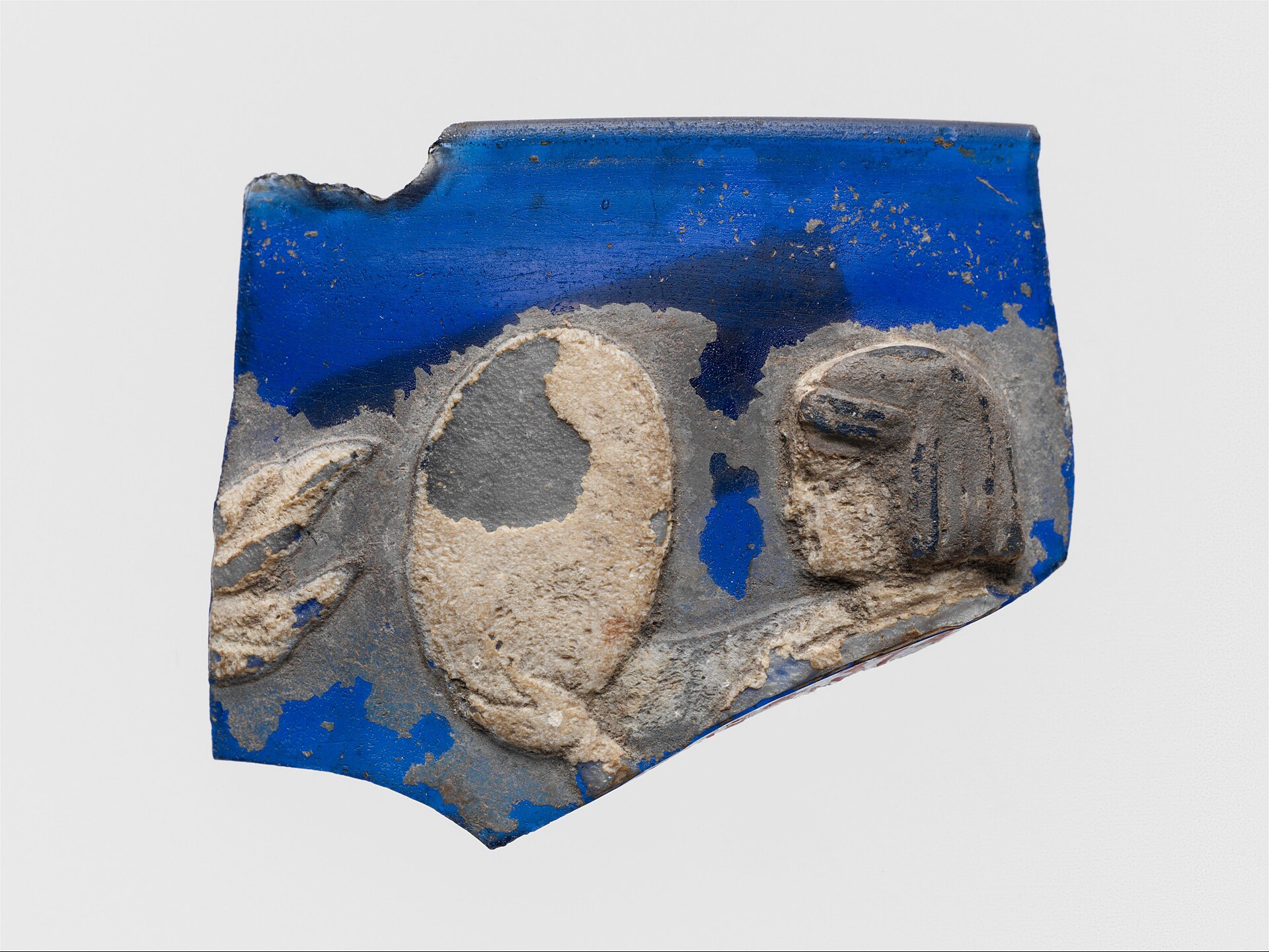
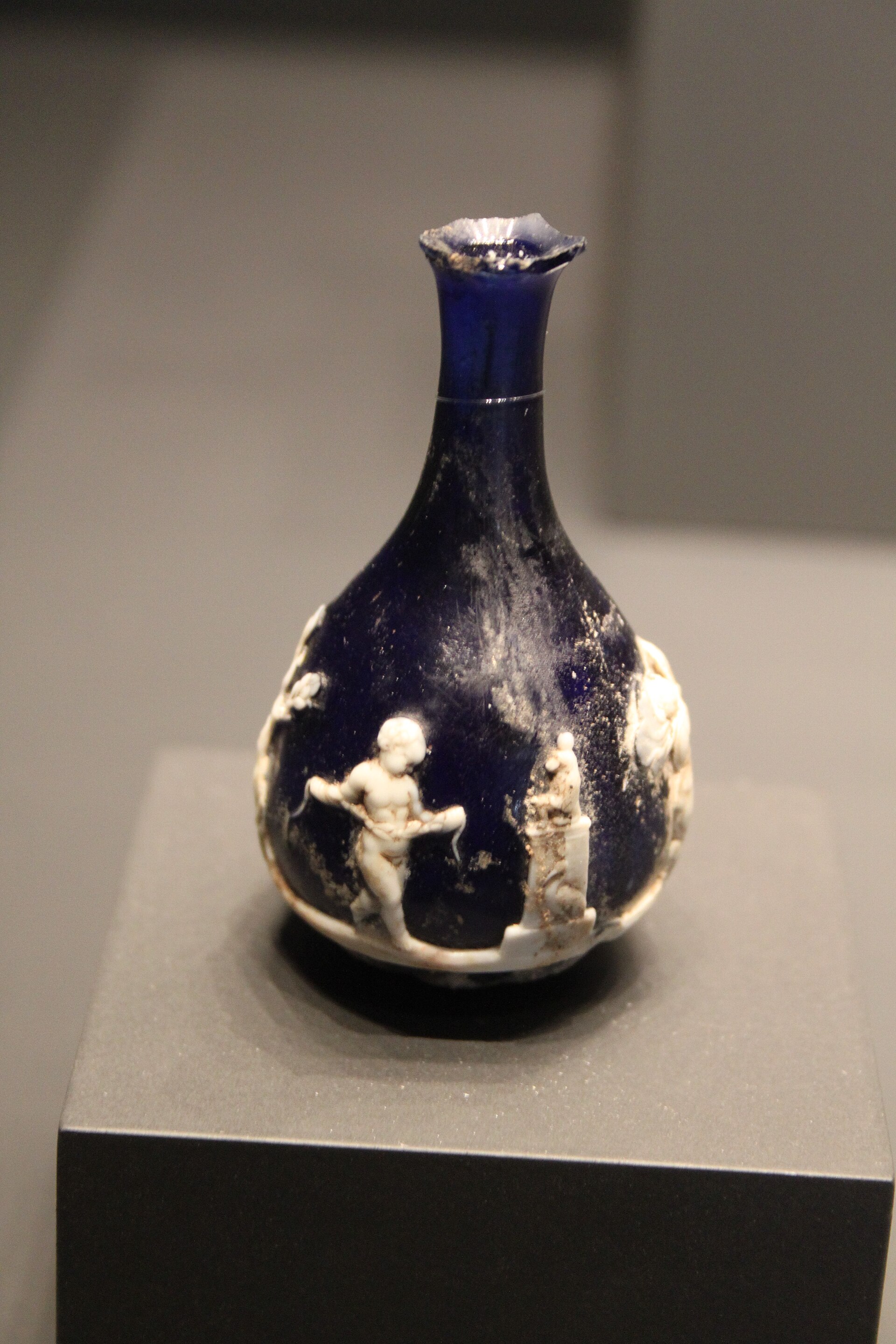
Glassblowing is new in the Roman world. Cameo glass vessels have been read as experimental work of the decades that followed, which is an argument only if the blowing hypothesis is right.32
The usual start of the early cameo glass phase. The technique is a Roman innovation with no glass precedent, though it has a direct precedent in carved sardonyx.12
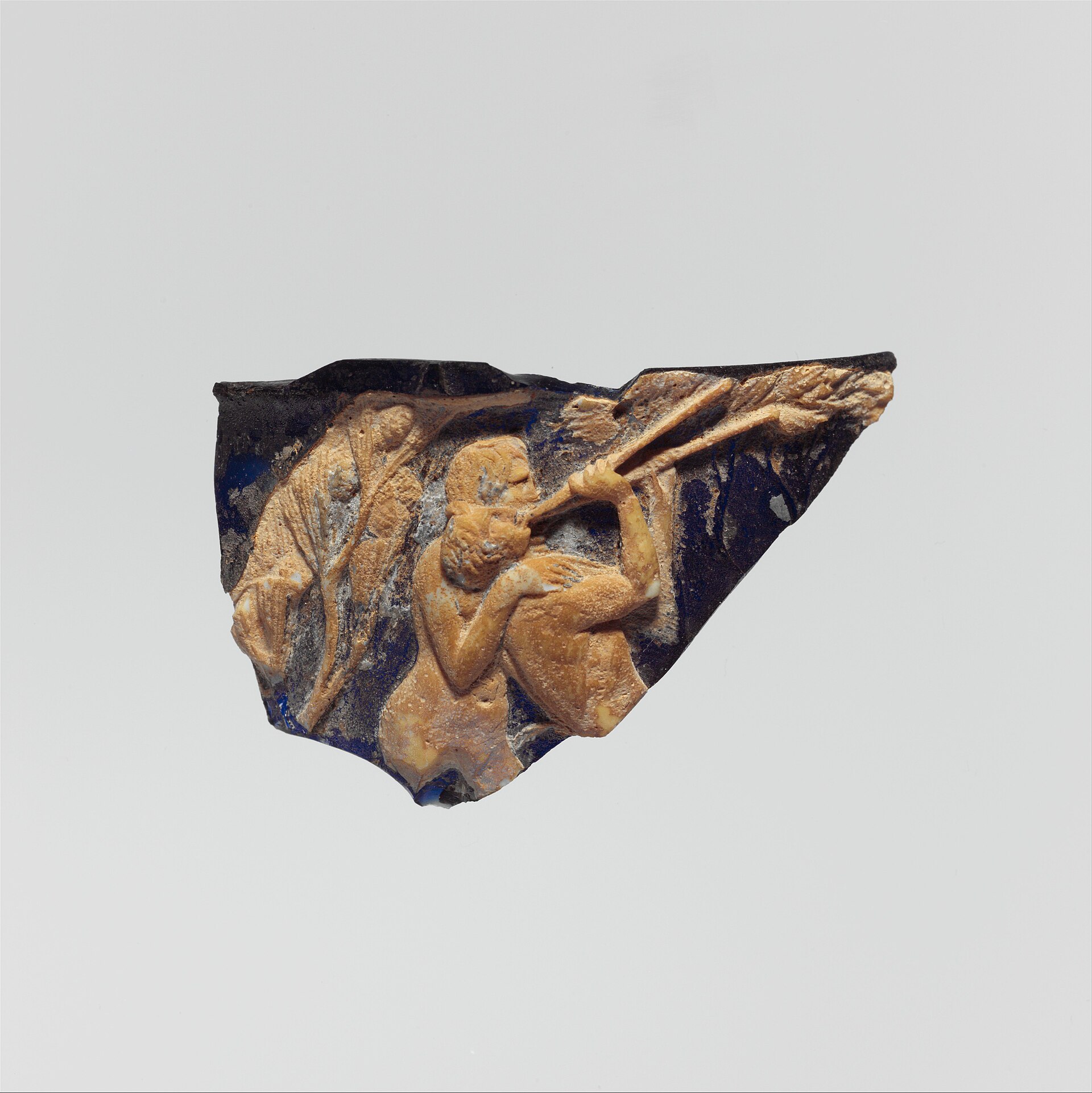
The Metropolitan Museum's largest cameo panel fragment, 18.145.38a, 12.9 by 30.2 centimetres, catalogued Early Imperial, Augustan or early Julio-Claudian.4
The Morgan Cup, made probably in Italy: transparent blue with opaque white, 6.2 centimetres high, the only early Roman cameo glass vessel to survive intact.22
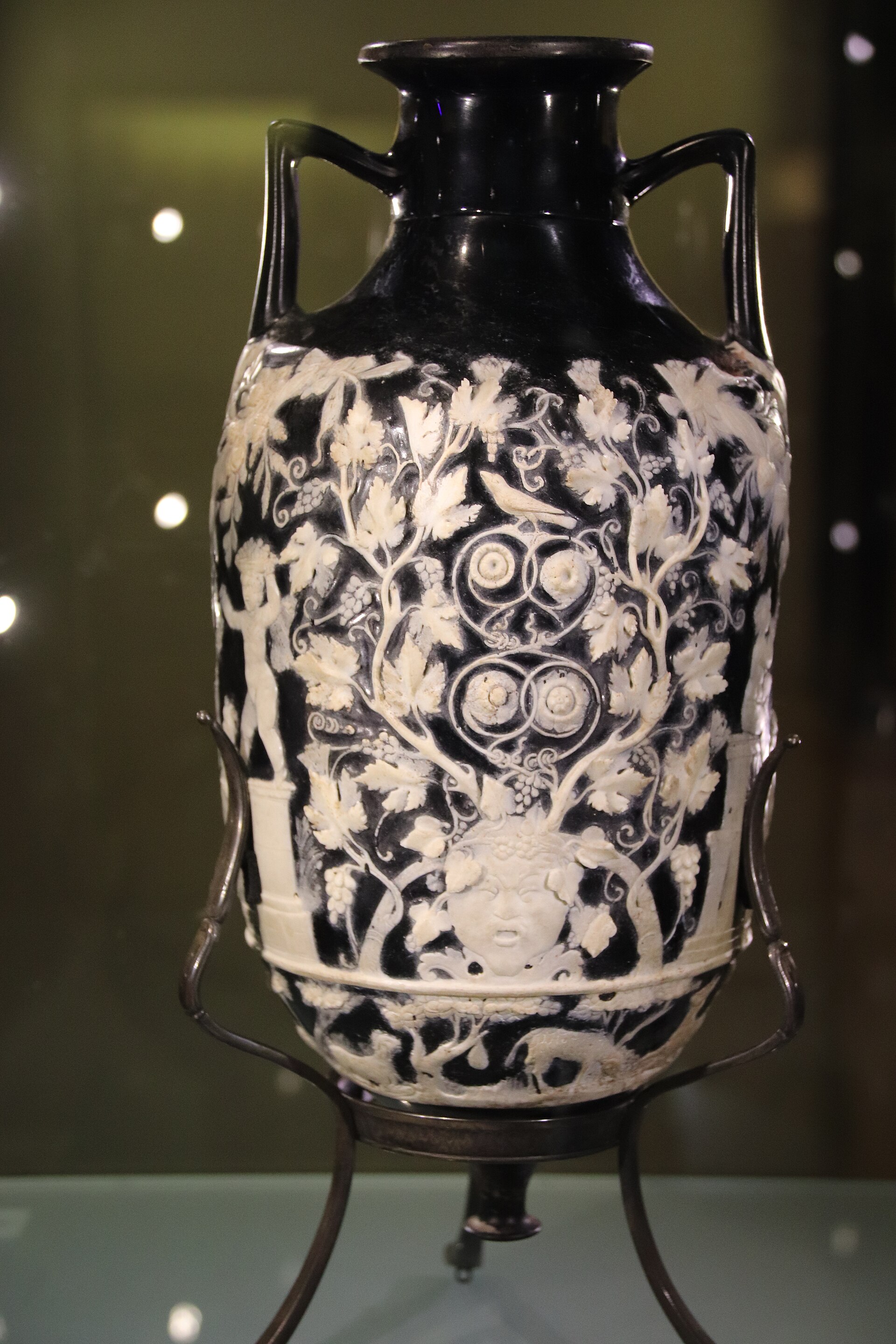
The Portland Vase, on the British Museum's dating. Low dates in the range 30 to 20 BC retain support.3
The Auldjo Jug. The British Museum's online record carries both ranges at once: its long-standing date of about AD 25 to 50, and the redating proposed by Roberts, Gudenrath, Tatton-Brown and Whitehouse in 2010. They do not overlap.5
The early phase ends. No explanation for the stop is agreed. The whole early production has been read as the work of about two generations.1232
Vesuvius. Five of the surviving complete or near-complete cameo glass objects were found at Pompeii, giving the whole group its only fixed terminus.252
The second and much smaller phase, from the late third century to the reign of Constantine and his sons. Examples are extremely rare.12
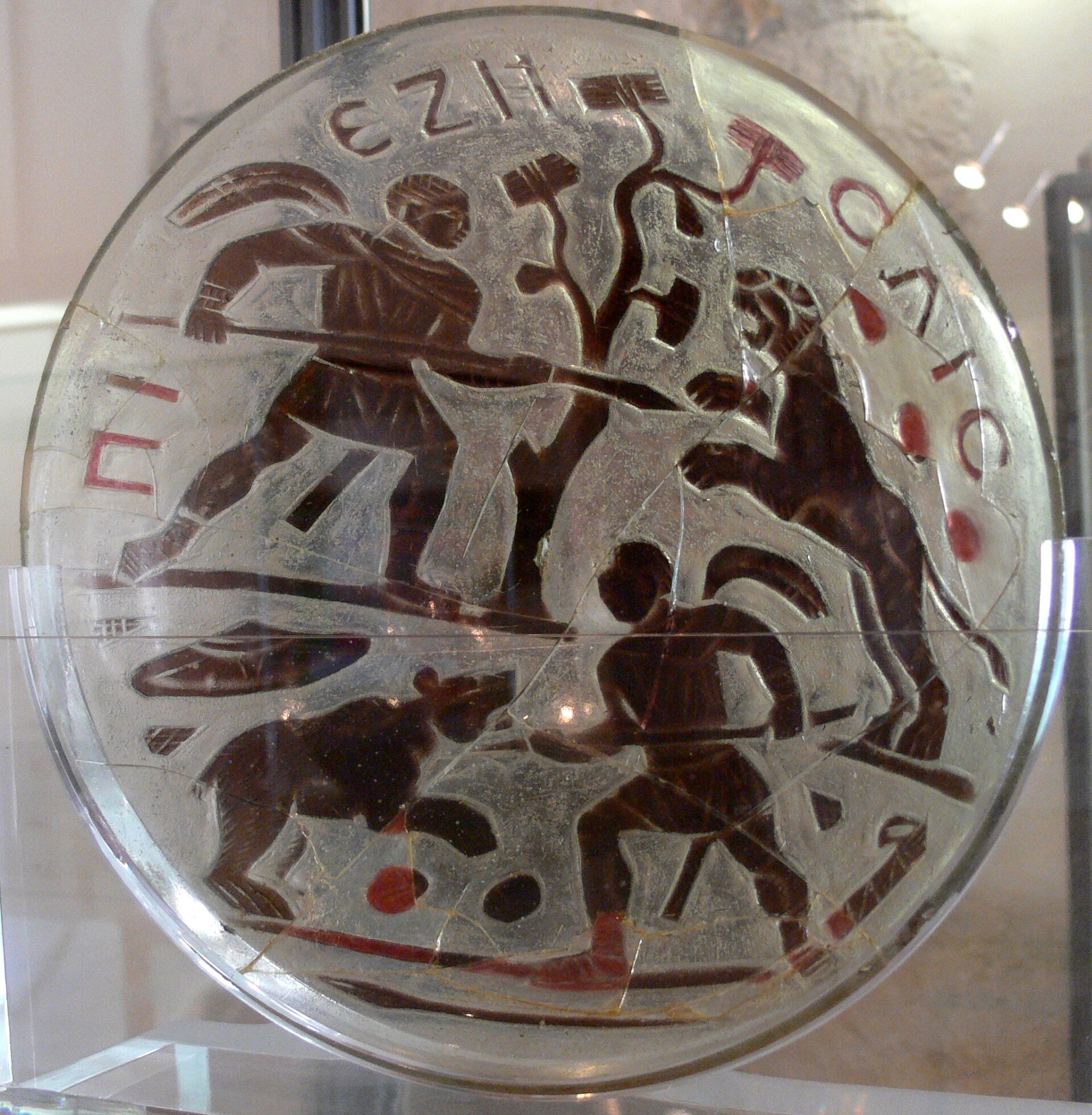
The Jagdschale from Tasgetium near Stein am Rhein, a two-colour cut glass bowl with an arena hunt and the acclamation PIE ZESAIS, now at Schaffhausen. Excavated 1969-70.6
The reported discovery of the Portland Vase at the Monte del Grano outside Rome. Rejected as a fable in 1909; Filippo Coarelli argued in 2025 that the report is authentic. His paper is a contribution, not a settled conclusion.37
Girolamo Teti publishes the first description of the Portland Vase, in Aedes Barberinae, Rome, pages 26 to 30. Nobody yet knows what it is made of.24
Pierre-Jean Mariette publishes the first proof that the vase is glass and not carved hardstone, in the second volume of his Traite des pierres gravees, Paris, pages 282 to 284. The misidentification had stood for over a century.24
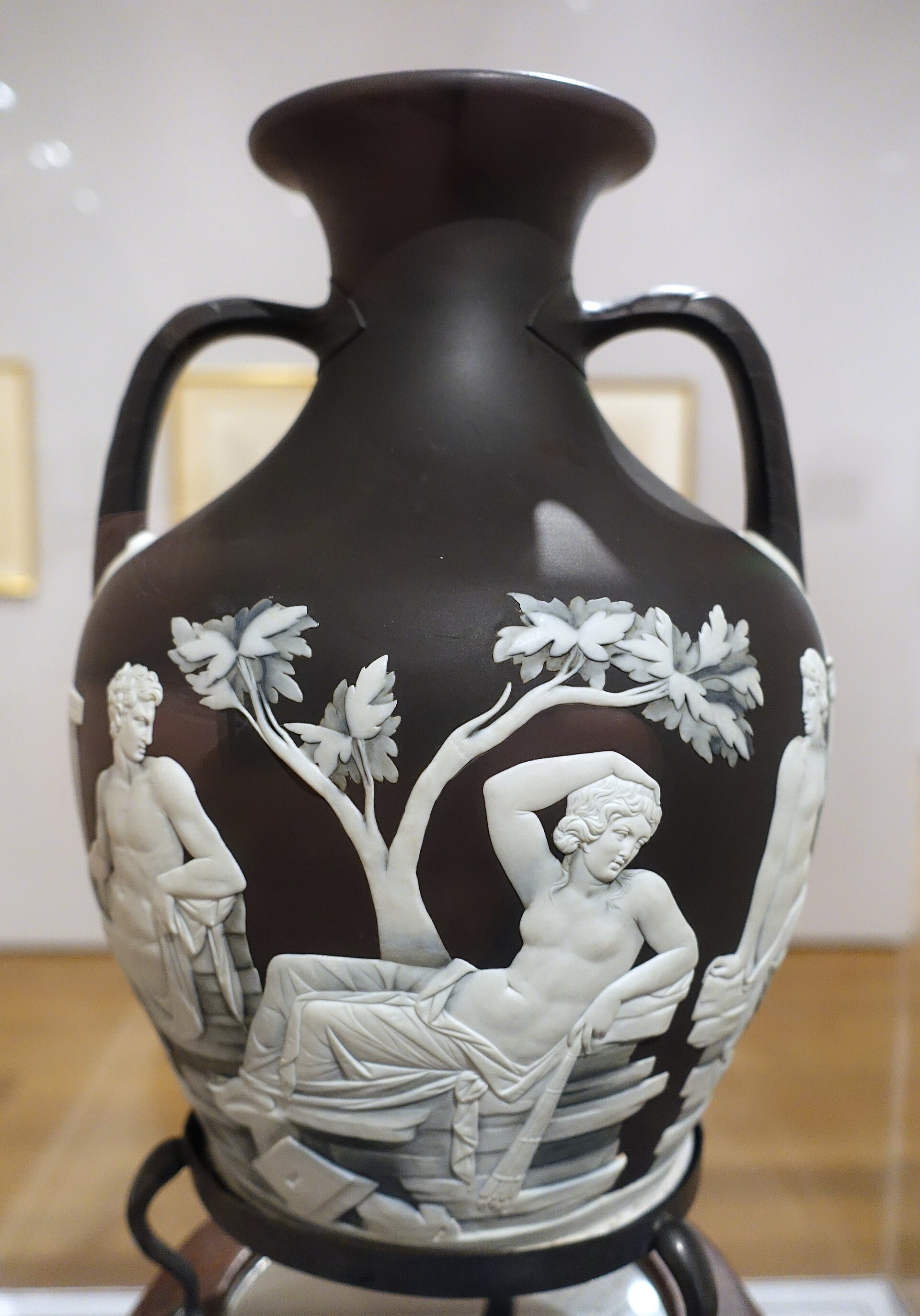
The 3rd Duke of Portland lends the vase to Josiah Wedgwood to be copied. The jasperware copies become the reason most images captioned Portland Vase online are of English pottery.3
Excavation of the House of the Faun at Pompeii begins, in the first weeks of Ferdinand II's reign.25
The House of the Faun yields the Dancing Faun, the Alexander Mosaic on 24 October, and the broken fragments of a blue and white cameo glass jug. The jug is not entered in the official inventory of finds.25
Sir Walter Scott winters in Naples in broken health. He attends the King's birthday reception on 12 January 1832, is formally presented within a fortnight, has an excavation opened for him at Pompeii by royal command, and is allowed to drive through the streets of Pompeii in a carriage, a privilege normally reserved for the royal family.25
Prince Charles of Capua removes over three dozen objects from the Pompeii storeroom, among them the mouth and handle of a blue and white nasiterno. The received account identifies this as the Auldjo handle; Michael Heafford argues in 2019 that it cannot be.25
Heinrich von Minutoli is shown roughly half the jug in Naples and told a lady holds another substantial part. He publishes a reconstruction drawing in 1836; it is the image through which the antiquarian world first learns of the object.25
The British Museum buys a Greek psalm fragment from Dr Edward Hogg, catalogued as British Museum Papyrus 37. It is the evidence that identifies the Dr Hogg of the Auldjo Jug.25
The British Museum buys the base of the Auldjo Jug, seven fragments, from Dr Hogg, registering it as 1840,1205.41.525
Apsley Pellatt puts Minutoli's drawing on the title-page vignette of Curiosities of Glass-Making. A reviewer in the Gentleman's Magazine calls the object the Auldjo Vase and deprecates the continuance of its division between two owners.25
Edward Trollope uses the same drawing for the frontispiece of Illustrations of Ancient Art and titles it the Auldjo Vase. The name sticks.25
The neck and handle of the jug reach the British Museum under the bequest of Miss M. H. H. Auldjo, and the object is registered as 1859,0216.1.525
John Northwood completes a cameo glass copy of the Portland Vase on a blank made by Philip Pargeter, after more than three years, against Benjamin Richardson's standing offer of 1,000 pounds. The English cameo glass industry starts here.310
Northwood carves the Milton Vase for Pargeter, now at the Chrysler Museum of Art.11
Northwood becomes art director at Stevens and Williams, Brierley Hill. The Woodall brothers, by contrast, run the cameo department at Thomas Webb and Sons.1012
George Woodall makes the first two versions of The Origin of Painting, a circular plaque now at Corning and a vase signed and dated 1887. A third vase, his own copy, follows and never enters the Thomas Webb price book.28
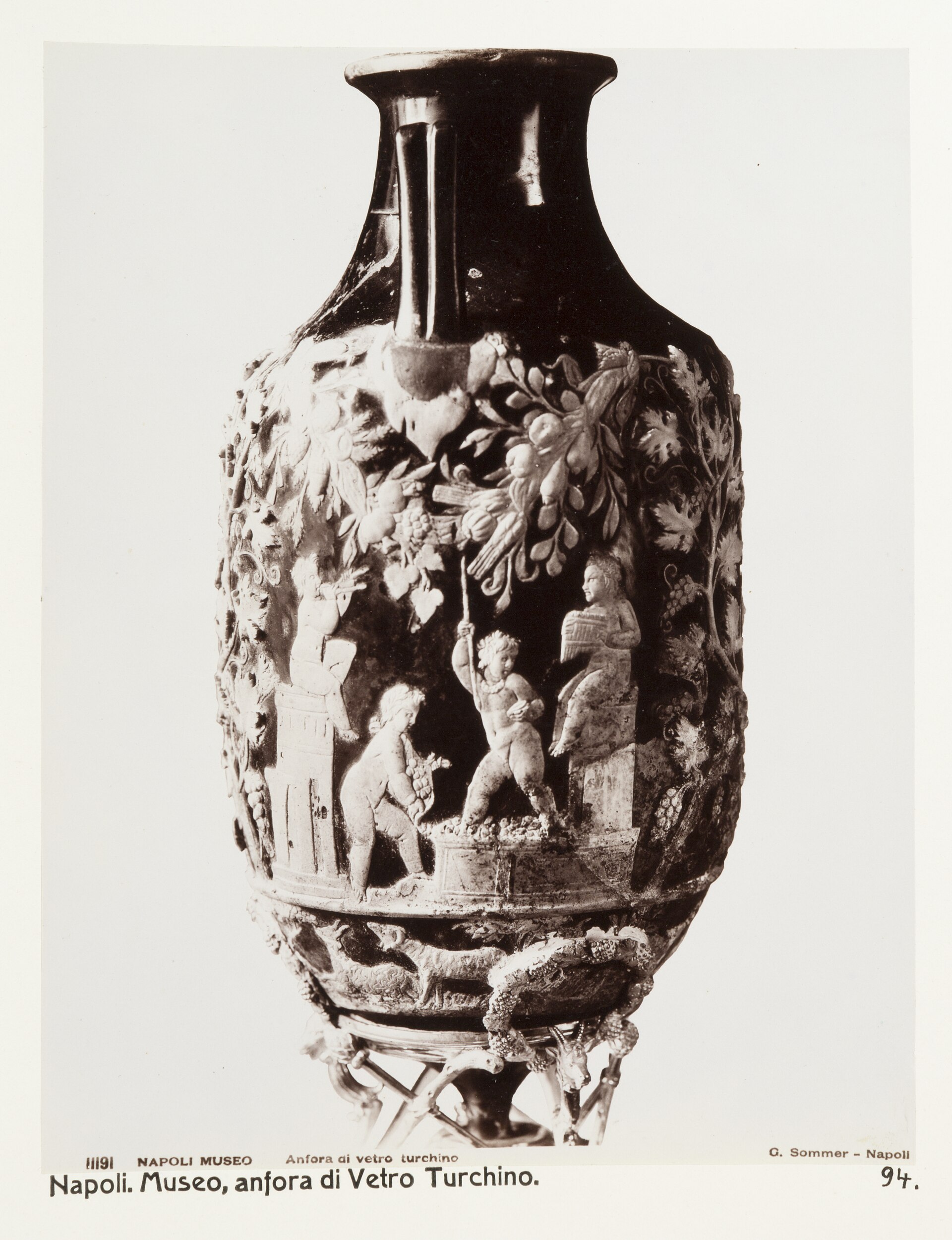
Giorgio Sommer's photograph of the Blue Vase in the Naples museum is bought in Naples by Johanna Kempe. The print survives in the Hallwyl Museum in Stockholm.13
The Woodall team is photographed at Thomas Webb and Sons around the Great Tazza. The print is in the Rakow Research Library at Corning.12
Thomas and George Woodall complete the cameo plaque The Attack at the Dennis Glassworks, too late for the Chicago exhibition of 1893 it was made for. Thomas Webb and Sons enter it as W3172 in the price book at 190 pounds, asking 350.34
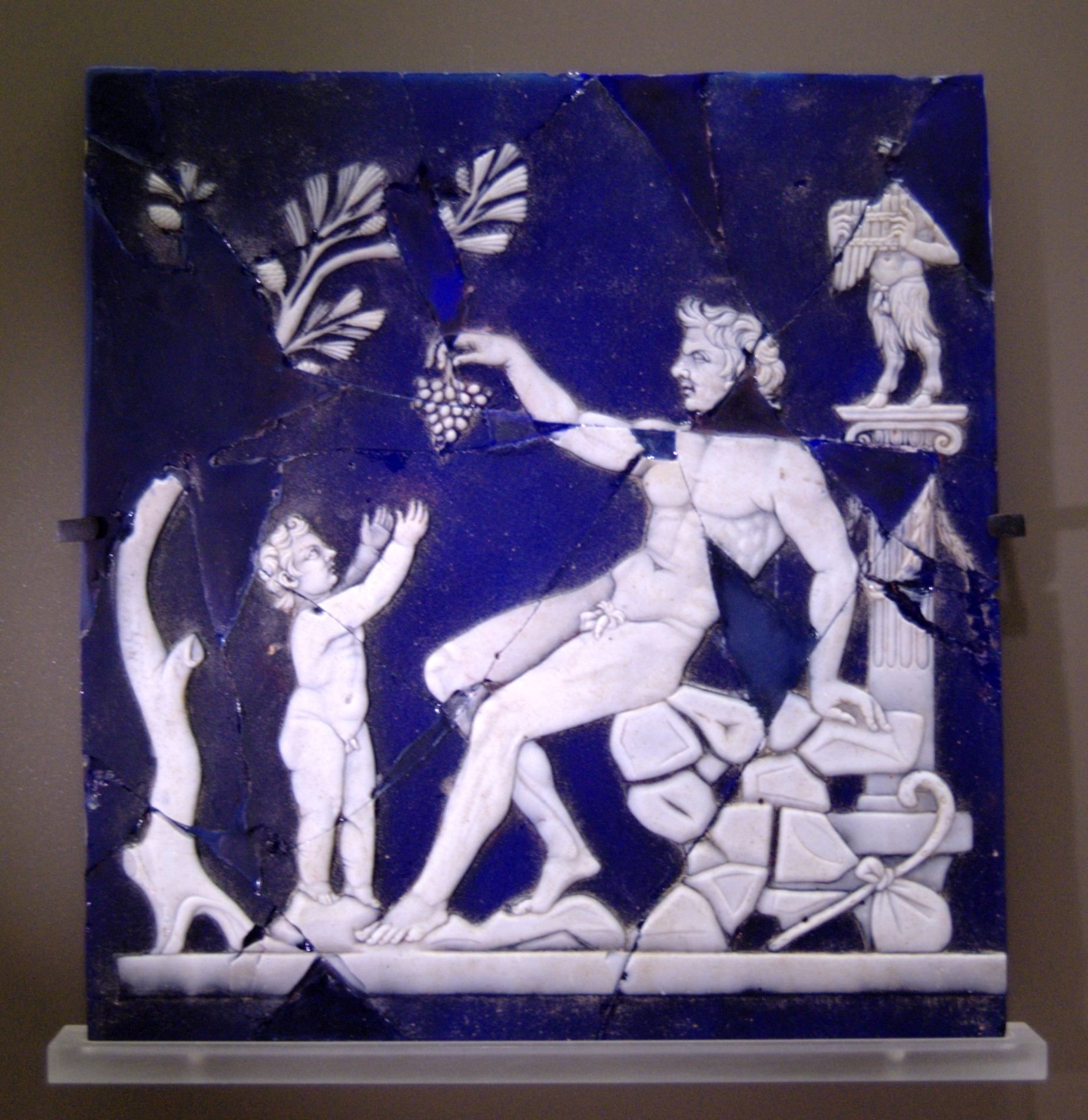
The Dutuit bequest brings a first-century Roman cameo glass relief of a satyr and the infant Bacchus to the Petit Palais in Paris. John Northwood dies the same year.1410
A fourth version of The Origin of Painting, a plaque, burns in a fire at the Brussels exhibition. Woodall calls it the worst thing that has ever happened to his work.28
Arthur A. Houghton Jr gives the Morgan Cup to the Corning Museum of Glass.22
George Woodall's third Origin of Painting vase is recovered from a floor safe at Luton House on the death of his second daughter Alice. It stays in the family for another sixty-five years.28
Journal of Glass Studies 25 carries Donald Harden on the history and technique of the Portland and Auldjo vessels at pages 48 to 53, and Mavis Bimson and Ian Freestone's comparative analytical study of the Portland Vase against other Roman cameo glasses at 55 to 64. The analytical baseline dates from here.1525
Glass of the Caesars travels from the Corning Museum of Glass to the British Museum to the Roemisch-Germanisches Museum in Cologne to the Museo Capitolino in Rome. The Auldjo Jug and the Morgan Cup are both in it.52223
Journal of Glass Studies 32 is devoted to the Portland Vase. Painter and Whitehouse's appendix Early Roman Cameo Glasses, pages 138 to 165, catalogues fifteen major surviving objects and becomes the corpus list the subject rests on. Freestone's laboratory studies run 103 to 107, Gudenrath and Whitehouse's manufacture and ancient repair 108 to 121.2426
Newby and Painter list the corpus again in Roman Glass: Two Centuries of Art and Invention, pages 19 to 25, reaching sixteen by counting the Portland Vase's base disc separately.251
Rosemarie Lierke publishes Antike Glastoepferei, arguing that ancient glass vessels including cameo glass were formed by rotary pressing rather than blowing.17
Birgitta Hoffmann publishes a critical assessment of Lierke's case in the Journal of Roman Archaeology.17
Bonhams in London announces a Roman cameo glass vase larger than the Portland Vase, with figures in two friezes, broken, and with no provenance. Martine Newby examines it first; seven specialists study it at the British Museum beside the Portland Vase and the Auldjo Jug. It is never offered for sale.2629
Lierke publishes Die nicht-geblasenen antiken Glasgefaesse, 135 pages with English translations, Deutsche Glastechnische Gesellschaft, Offenbach am Main.18
Roberts, Gudenrath, Tatton-Brown and Whitehouse publish Roman Cameo Glass in the British Museum, the first complete publication of the largest collection, over seventy pieces. Newby publishes her first report on the Bonhams vase in Glass News.1926
E. Marianne Stern reviews Lierke's 2009 book in the Journal of Roman Archaeology 24.18
Carina Weiss reviews the British Museum catalogue in the Journal of Roman Archaeology 25, pages 644 to 650.19
The Attack, lot 123 at Bonhams New Bond Street, makes 169,250 pounds including premium, a world record for English cameo glass. Two other glass records fall in the same sale.3427
Alastair Sooke publishes the disappearance of the 2009 cameo vase: the abandoned Cardiff analysis, the North Africa rumour, the suspicion of recent damage passed off as old, and the return of the vase to an unnamed owner.26
Martine Newby Haspeslagh publishes the vase as chapter 12 of Glass of the Roman World, pages 138 to 145, taking the corpus of major objects to seventeen.3125
Richard Whiteley CT-scans a Roman cameo glass fragment at the Australian National University and reports bubble structures and cold working marks inconsistent with blowing. He presents the finding at a historical glassworks conference at the British Museum in the week following 27 October.20
Michael Heafford argues in the Proceedings of the Society of Antiquaries of Scotland that Sir Walter Scott received all the Auldjo Jug fragments as a royal gift and divided them, and that the object might better be called the Scott Jug. He also records that fewer than twenty complete or near-complete Roman cameo glasses are known.25
George Woodall's own version of The Origin of Painting sells at Bonhams Knightsbridge for 206,312.50 pounds including premium against a 120,000 to 150,000 estimate: a world record for English cameo glass and the first time the vase had been at auction.2728
Paul Barford reports that information on the 2009 vase has gone to United States Homeland Security and to a lawyer acting for Algeria, and that the Getty Museum inspected the vase in California and declined it.30
Filippo Coarelli argues in the Journal of Roman Archaeology that the Portland Vase did come from the Monte del Grano, identified as the tomb of Alexander Severus. A third-century tomb does not date a first-century vessel.7
There are two markets here and only one of them functions. Roman cameo glass does not trade: every named survivor is in a public collection and has been for a century or more, and the one modern candidate for a sale was withdrawn over its ownership history rather than its quality. Nineteenth-century English cameo glass trades regularly and at six figures.
The Portland Vase supplies the only historic prices any Roman cameo glass object has. They are given here because the shape of them is instructive: the vase lost money at its only completed auction and failed to sell at its only modern one.
The Bonhams results below are reported premium-inclusive, which is that house's practice. No hammer price is published for any of them, and this record has not obtained Bonhams' conditions of sale for either year. The implied hammers in the notes are this record's arithmetic on an assumed premium scale and are inferences, not published figures. Two of them land on clean bid increments, which is a reasonable sign the assumed scale is right; the 2013 figure depends on where the premium band broke that year, and on the alternative scale it does not land cleanly at all.
The practical warning for a buyer in the revival market is the reverse of the usual one. The risk is not a modern fake of an old object. It is an acid-etched commercial piece sold as hand-cut exhibition work, or a Woodall attribution attached to something the Woodalls did not cut.
| Date | Sale | Work | Result | Note |
|---|---|---|---|---|
| 7 June 1786 | Mr Skinner and Co, at Privy Garden, Whitehall | The Portland Vase, lot 4155, sale of the Portland Museum | Hammer 980 guineas (1,029 pounds) With premium None. A buyer's premium was not a feature of English auction practice in 1786; the hammer is the whole price. Guineas, sterling | Bought by a Mr Tomlinson acting for the 3rd Duke of Portland. Less than the 1,800 guineas the Dowager Duchess had paid Sir William Hamilton two years earlier. The only completed auction of a Roman cameo glass vessel on record, and it lost money. |
| 1 May 2013 | Bonhams, New Bond Street, London: British and European Glass including the Meyer Collection, lot 123 | The Attack, cameo glass plaque by Thomas and George Woodall for Thomas Webb and Sons, completed March 1896. Circular dished plaque, 43.5 cm diameter, dark amethyst glass with white overlay, signed T and G Woodall | Hammer Not published; 140,000 pounds implied With premium 169,250 pounds reported as the total including premium GBP | The world record for English cameo glass until 2019, and on Simon Cottle's statement for Bonhams possibly for any English glass at that date. Made for the Chicago exhibition of 1893 and finished too late for it. Provenance: the collection of H. C. Ash, thence by descent in his family to a British private owner. Thomas Webb and Sons' factory records give it the number W3172 and the price book values it at 190 pounds with an asking price of 350 pounds. The implied hammer assumes the buyer's premium scale then standard at this level, 25 per cent to 25,000 pounds and 20 per cent above; it is this record's arithmetic rather than a published figure. |
| 1 May 2013 | Bonhams, New Bond Street, London: British and European Glass including the Meyer Collection | Venetian cameo glass vase by Attilio Spaccarelli | Hammer Not published With premium 26,250 pounds reported as the total including premium GBP | Reported as more than ten times its estimate and a record for the artist. Included here because it is the only figure this record has located for cameo glass outside the English school, and because it shows how far behind the Stourbridge names the rest of the field trades. |
| 20 November 2019 | Bonhams, Knightsbridge, London: Fine Glass and British Ceramics, lot 108 | The Origin of Painting, cameo glass vase by George Woodall, late 19th century, 23 cm, signed Geo Woodall | Hammer Not published; 165,000 pounds implied With premium 206,312.50 pounds reported as the total including premium GBP | Estimate 120,000 to 150,000 pounds. A world record for English cameo glass and for English glass generally. The third and final known vase version of the subject, George Woodall's personal copy, absent from the Thomas Webb price book. From the Woodall family collection, recovered from a floor safe at Luton House on the death of Woodall's second daughter Alice in 1954, and offered at auction for the first time. Bonhams' glass specialist Jim Peake credited the provenance as much as the carving. The implied hammer follows from Bonhams' UK premium scale of 27.5 per cent on the first 2,500 pounds and 25 per cent thereafter at this level, and resolves exactly; it is this record's arithmetic, not a published figure. |
| 20 November 2019 | Bonhams, Knightsbridge, London: Fine Glass and British Ceramics | Cameo glass by George Woodall depicting Sappho with a lyre | Hammer Not published; 40,000 pounds implied With premium 50,063 pounds reported as the total including premium GBP | Estimate 40,000 to 60,000 pounds, in the same sale as the record lot. Useful as the second data point: the record price is not the market, and a good Woodall subject makes about a quarter of what the family's own trophy piece made. On the same assumed scale a hammer of 40,000 pounds gives 50,062.50; the reported 50,063 is that figure rounded. This record's arithmetic, not a published hammer. |
Hammer is the price at which the bidding stopped; with premium adds the fee the house charges the buyer on top. Hammer price and buyer's premium in the glossary.
| Institution | City | Holdings | Note |
|---|---|---|---|
| British Museum | London | Over seventy pieces of Roman cameo glass, the largest and finest collection anywhere, including the Portland Vase (1945,0927.1) and the Auldjo Jug (1859,0216.1), the latter on display in Room 70, case dc13. Also the 1826-27 draughtsman's drawing of a four-colour cameo fragment, 2010,5006.570. | The whole holding was published in 2010 as Roman Cameo Glass in the British Museum. The collection online carries full records, including the two conflicting production dates for the Auldjo Jug, but blocks automated retrieval; check by hand. |
| Corning Museum of Glass | Corning, New York | Forty catalogued pieces of cameo glass, including the Morgan Cup (52.1.93), the only early Roman cameo glass vessel to survive intact, on view in the Ancient Gallery. Also John Northwood's 1876 cameo glass copy of the Portland Vase on Philip Pargeter's blank, George Woodall's 1884 Origin of Painting plaque, and two Wedgwood jasperware copies of the Portland Vase. | Corning holds both corpora, Roman and English revival, and the Wedgwood copies as well, which makes it the one place a visitor can put all three side by side. The Rakow Research Library holds the 1891 photograph of the Woodall team. The museum's collection site blocks automated retrieval. |
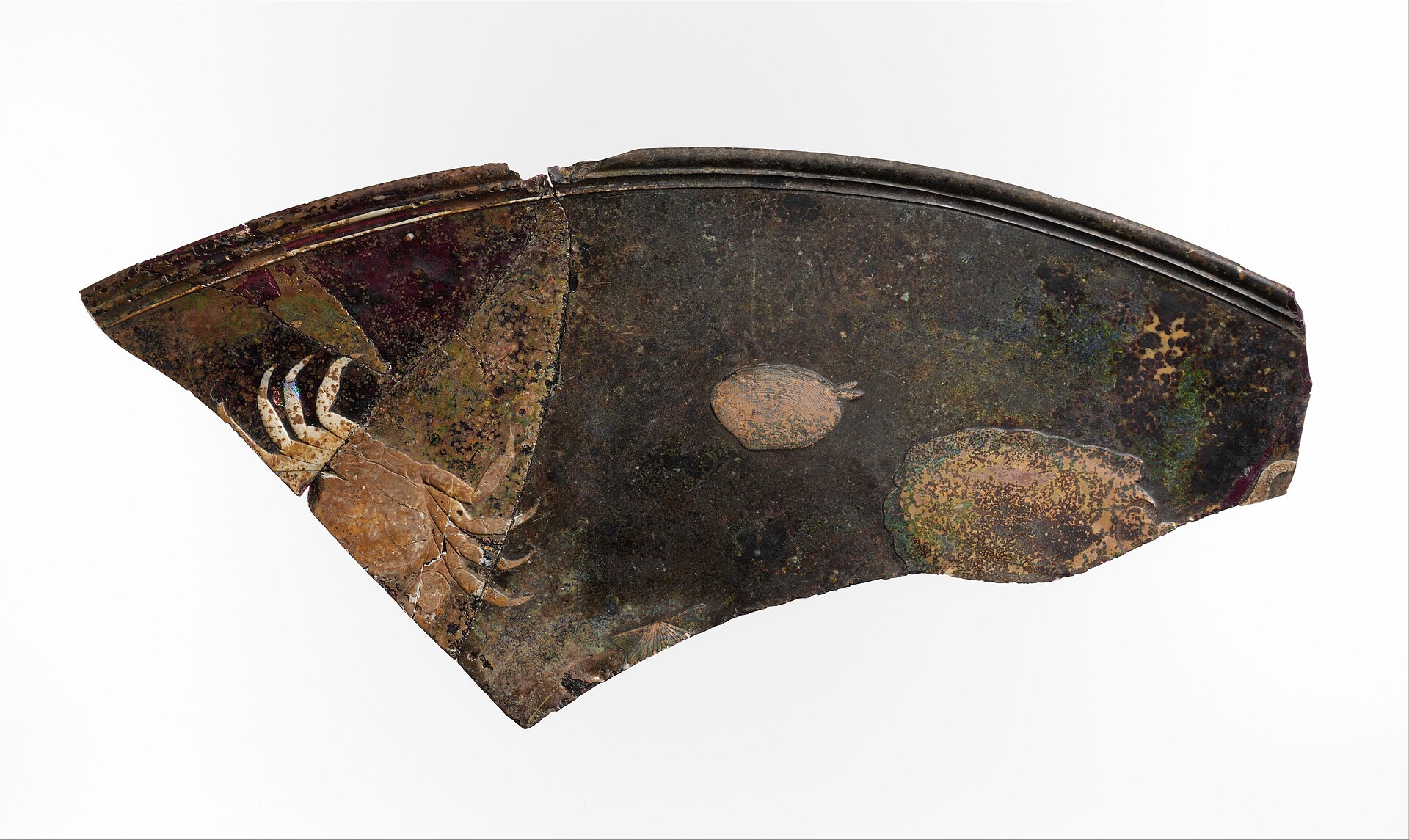
| Metropolitan Museum of Art | New York | At least twenty-two catalogued Roman cameo glass fragments in the Department of Greek and Roman Art, including a panel of about AD 1-25 measuring 12.9 by 30.2 cm (18.145.38a), a fragment of a large platter or table top (81.10.347), a run of scyphus fragments (11.91.5a-c, 12.229.22) and cup fragments from the Greau material acquired in 1917. | The best online access to the corpus anywhere: full records and open-access images, which is why most of the fragment plates on this page are Metropolitan objects. |
| Museo Archeologico Nazionale | Naples | The Blue Vase (inventory 13521), found in a monumental tomb outside the Herculaneum Gate at Pompeii, plus further Pompeian cameo glass. | Five of the surviving complete or near-complete Roman cameo glasses came from Pompeii, and the Neapolitan royal system kept nearly all of them in Naples. That is the reason British holdings of Pompeian cameo glass are so thin, and the reason the Auldjo Jug's escape is itself a historical problem. |
| J. Paul Getty Museum, Getty Villa | Pacific Palisades, Los Angeles | Early Roman cameo glass dated about 25 BC to AD 25. | Displayed with the Roman, Greek and Etruscan antiquities. The Getty is also, on a 2022 report, the museum that inspected the unprovenanced 2009 vase in California and declined it. |
| Petit Palais, Musee des Beaux-Arts de la Ville de Paris | Paris | A cameo glass relief of a satyr handing a bunch of grapes to the infant Bacchus, from Italy, first half of the first century AD, inventory ADUT00240. | Part of the Dutuit bequest of 1902. An easily overlooked piece of the corpus, in a collection nobody searches for Roman glass. |
| Museum zu Allerheiligen | Schaffhausen | The Jagdschale from the cemetery I de Hofwiese at Tasgetium near Stein am Rhein, a two-colour cut glass bowl with a panther and bear hunt and the inscription PIE ZESAIS, third or fourth century, excavated 1969-70. | A piece of the late phase rather than the Augustan one, and useful precisely for that: it shows how different the second cameo glass moment looks, which is why continuity between the two has never been demonstrated. |
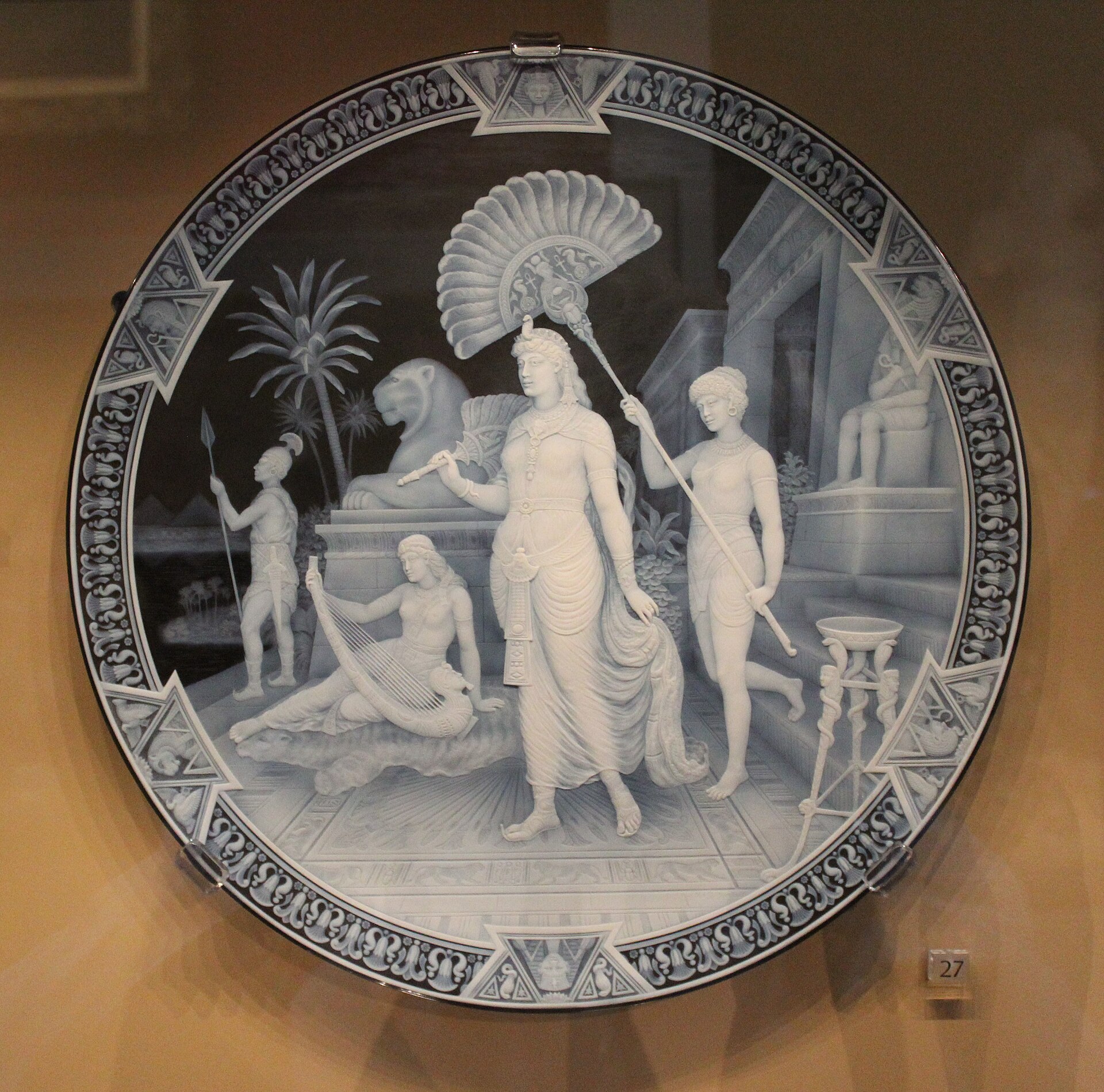
| Victoria and Albert Museum | London | Cleopatra and her Attendants, cameo glass of about 1898 designed and cut by Thomas and George Woodall for Thomas Webb and Sons, museum number LOAN:ANON.2-2001. Also a Wedgwood first-edition Portland Vase. | The revival at its most ambitious, and the best place to see what a Victorian cameo glass plaque was trying to be. |
| Chrysler Museum of Art | Norfolk, Virginia | John Northwood's Milton Vase of 1878, and Woodall brothers work including The Attack (1896), The Race (about 1890) and Intruders (about 1893). | A first-rank glass collection in a museum most provenance researchers never open. Bonhams recorded in 2013 that Intruders, the companion piece to The Attack, was already here; a plaque titled The Attack and dated 1896 was photographed on display here in September 2022, which suggests but does not prove that the museum bought the 2013 record lot and reunited the pair. |
| Hallwyl Museum | Stockholm | Giorgio Sommer's photographs of the Naples museum, including the Blue Vase, bought in Naples in 1888 by Johanna Kempe (HWY LXVI:K.G.94). | Not a glass collection. It is where the earliest freely usable photographs of the Blue Vase happen to survive, which is the sort of thing that decides what a publication can illustrate. |
An unknown maker is a person whose name has been lost.
An unknown maker is a person whose name has been lost. That is the ordinary condition of most ancient art and it is what the phrase usually means. Roman cameo glass is a harder case, because the object is the product of two crafts that did not share a workshop, a temperature range or a training.
The first trade is hot. A glasshouse gathers cobalt-blue glass, introduces an opaque white layer over it, and works the two together into a vessel. Everything about that operation is fast, communal and irreversible: a team, a furnace, a working window measured in seconds, no way to correct a fault once the glass has stiffened. The second trade is cold and solitary. A cutter takes the finished blank, sets it against a rotating wheel fed with abrasive, and removes the white layer everywhere it is not wanted. That work is measured in months. Modern reproduction puts the cutting of a Portland Vase at not less than two years.
The two skills are not adjacent. Cutting hard, brittle material on a wheel is the gem engraver's trade, and the visual evidence says the cutting on Roman cameo glass was done by gem engravers rather than by glass decorators: the undercutting, the modelling of translucent white down to a veil, the handling of drapery are the habits of a man trained on sardonyx and agate.
The written evidence usually produced for the division is weaker than the object, and it is worth being exact about it, because it is quoted loosely everywhere. Two Latin trade names exist. A vitrearius is a glassmaker or glassworker; the word is not in doubt. A diatretarius is a maker of diatreta, from a root meaning pierced or perforated, and the standard reference literature translates it as glass cutter, adding that such a man, versed in lathes and drills, may have come to glass from a career cutting gems, and that the two occupations are distinguished in the legislation of Constantine, Theodosius and Justinian.
Sylvia Fuenfschilling, reviewing the Corning Museum of Glass volume on cage cups for the Journal of Roman Archaeology in 2020, states flatly that rendering diatretarius as glass cutter is in her view incorrect. Her grounds are specific. The Constantinian list at Codex Theodosianus 13.4.2 does not name the vitrearius and the diatretarius together, which she suggests may mean the second man did not work in glass at all. The often-quoted sixth-century passage in the Digest, on a craftsman who is liable if he breaks a diatretum cup through lack of skill, never says what the cup was made of. And the earliest use of the word, in Martial at the end of the first century AD, is so far in time from Constantine and from the Digest that the sense may have moved in between.
What survives, then, is a two-trade division that the objects demand and the documents do not quite supply. A cameo glass vessel cannot be made by one pair of hands in one operation; that much is physical. Whether the man who cut it was called a diatretarius, and whether that word meant anything to do with glass, is a separate question and an open one.
So the honest attribution of a Roman cameo glass vessel is not one name withheld. It is two names, neither recorded, and no evidence at all about how the two men met: whether they worked under one roof, whether the cutter bought blanks on the open market, whether one patron commissioned both. The literature has no answer because no document exists that could contain one. This is why the Iconotheca record for the Portland Vase carries a two-trade attribution rather than a name, and why the recurring proposal that the cutting is by Dioskourides, the gem engraver who worked for Augustus, has to be treated as a stylistic suggestion and nothing more. There is no signature, no inscription and no ancient text connecting him to any surviving cameo glass object.
One consequence is worth stating because it cuts against the way attribution normally works. On a painting a disputed attribution can in principle be settled: there was one hand, and the question is whose. Here the object is evidence of a relationship between two trades, and settling who cut it would still leave the glasshouse unnamed. A complete answer would be two answers. The field has never had one of them.
Six figures circulate and all of them are correct about something different.
Six figures circulate and all of them are correct about something different. Here is what each one counts.
Fifteen. The canonical list is Kenneth Painter and David Whitehouse, 'Early Roman Cameo Glasses', published as an appendix to the Portland Vase volume of the Journal of Glass Studies in 1990, volume 32, pages 138 to 165. Twenty-eight pages, fifteen major extant vessels and objects described in detail. When a museum label or a news report says fifteen, this is where the number comes from.
Sixteen. In 1991 the same material was listed again by David Whitehouse, inside his essay on cameo glass in Roman Glass: Two Centuries of Art and Invention, the volume edited by Martine Newby and Kenneth Painter; the listing runs from page 19 to page 25 and adds the Portland Vase's base disc as a separate item. The disc is a cameo glass roundel cut down from a different composition and fitted under the truncated vase; whether it is one object or two is a cataloguing decision, not a discovery. That single decision is the whole difference between fifteen and sixteen.
Seventeen. One further Roman cameo glass vessel was published in 2015 by Martine Newby Haspeslagh, as chapter twelve of Glass of the Roman World, pages 138 to 145. It is the vase that appeared at Bonhams in 2009 and has since disappeared, and it has no provenance. A section below deals with it.
Fewer than twenty. This is the figure Michael Heafford used in 2019 in the Proceedings of the Society of Antiquaries of Scotland, writing about complete or almost complete pieces. He adds the detail nobody else states plainly: of those, five were found at Pompeii.
Two other numbers circulate and both are correct about something else. A dozen complete vessels appears in the Corning Museum of Glass literature; that counts vessels and excludes plaques and panels. And about two hundred fragments is the usual figure for everything else, though no published survey has ever tested how many original objects those fragments represent.
Institutionally the material is concentrated to a degree unusual even for ancient glass. The British Museum holds over seventy pieces, the largest and finest collection anywhere, published complete for the first time in 2010. The Corning Museum of Glass catalogues forty pieces of cameo glass in the first volume of its Roman glass catalogue, all but one made between the late first century BC and the middle of the first century AD, though the museum's own summary of those figures should be checked against the printed catalogue. The Metropolitan Museum of Art holds at least twenty-two catalogued cameo glass fragments in its Greek and Roman department, from the acquisitions of 1881, 1911, 1912, 1917, 1918 and 1926. Naples holds the Pompeian material. The Getty Villa, the Petit Palais in Paris and the Museum zu Allerheiligen in Schaffhausen hold single pieces or small groups.
Put those together and the picture is stark. Two collections, London and Corning, hold something over a hundred pieces between them, and a student can see most of the surviving corpus in four cities. For comparison, the surviving corpus of Attic red-figure pottery runs to tens of thousands of objects. Cameo glass is not rare the way a Vermeer is rare. It is rare the way an entire technique can be rare when it was practised for a few decades, by a very small number of people, for a market of a few dozen households.
The number that matters most in the hand is a different one again. Of all of them, exactly one early Roman cameo glass vessel is described as having survived intact: the Morgan Cup at Corning, accession 52.1.93, 6.2 centimetres high with a rim 7.6 centimetres across. That claim comes from the museum that owns it and this record has not been able to check it against the printed catalogue. The Portland Vase is a truncated vessel smashed in 1845 and rebuilt three times. The Auldjo Jug is fifteen fragments that reached London in two consignments nineteen years apart. Everything else is fragmentary, restored, or both.
Every account of how a cameo glass vessel was made is an argument about the blank, because once you have a two-layer blank the rest is cutting and nobody disputes how cutting works.The orthodox...
Every account of how a cameo glass vessel was made is an argument about the blank, because once you have a two-layer blank the rest is cutting and nobody disputes how cutting works.
The orthodox account has two variants and the Metropolitan Museum states both. Casing places a globular blank of the background colour inside a hollow outer blank of the overlay colour, allows the two to fuse, and blows them together into the final shape. Flashing, also called the dip-overlay method, shapes the inner blue blank first and then dips it into a vat of molten white before the two are inflated together. The British Museum's record for the Portland Vase gives dip-overlay. The Corning Museum of Glass records the Morgan Cup as blown, cased, carved, ground and polished, which is the orthodoxy stated as an object fact on a collection record rather than as an argument.
The orthodoxy's real strength is not a label but an experiment. For the 1990 Portland Vase volume of the Journal of Glass Studies, William Gudenrath and David Whitehouse set out to remake the thing: a full gather of blue glass on the blowpipe, dipped into a pot of hot white, inflated into a sphere and elongated into a vase with the white lying over the blue. Their paper, 'The Manufacture of the Vase and Its Ancient Repair', runs from page 108 to page 121 of that volume, with a further appendix on the internal grinding of the vase at page 137. The method produces an object that looks like the object. That is a serious argument and no rival has matched it.
Against it stands a position that has never gone away. Rosemarie Lierke, born in Berlin in 1934, read mathematics, ran her own glassblowing workshop at Schwalbach am Taunus from 1977 to 1987, and turned to ancient glass after moving to California in 1987. Her books - Antike Glastoepferei, Ancient Glass Pottery, of 1999, and Die nicht-geblasenen antiken Glasgefaesse, The Non-Blown Ancient Glass Vessels, of 2009 - argue that the blanks were rotary-pressed into moulds, with the white introduced as granulated glass rather than as a molten skin. Her central technical observation concerns the flattened bubbles found at the boundary between the two colours: she argues that pressing glass into a mould on a rotating former produces the same distribution, so a feature that had been taken to follow from inflation does not in fact require it. Whiteley goes further and reads the flattened bubbles as positively inconsistent with blowing. No account located for this record sets out what the blowing side says the bubbles show, which is itself part of why the argument has lasted.
Lierke has been reviewed by the field rather than ignored by it. Birgitta Hoffmann published a critical assessment in the Journal of Roman Archaeology in 2004. E. Marianne Stern reviewed the 2009 book in the same journal in 2011, under the title a new window on ancient glass technology, including cameo glass and cage cups; the review is behind a paywall and this record does not know which way she comes down. The Australian National University's own account of Whiteley's work in 2017 says Lierke's case had not been accepted for lack of evidence, which is a summary by an interested party rather than a survey of the field.
In 2017 physical evidence arrived, from a different fragment. Richard Whiteley of the Australian National University put a Roman cameo glass fragment from the ANU Classics Museum through a computed tomography scanner at the ANU Research School of Physics and Engineering. The scan resolved the shape, direction and composition of the air bubbles trapped between the blue and the white layers, and Whiteley reported cold working marks on the surface inconsistent with blown production. His proposed sequence is specific: cold granulated glass packed into a mould, then a blob of molten blue glass introduced and pressed against the mould so that the white granules fuse from behind. He described the process as a form of pate de verre and presented the work at a historical glassworks conference at the British Museum in the week following 27 October 2017.
Lierke also has support in the peer-reviewed literature, on the neighbouring class of objects, and it is worth setting out because it is the strongest thing said for her position by somebody who is not her. Cage cups - diatreta, late Roman vessels with an openwork cage standing free of the body on struts - present the same argument in a harder form, and Whitehouse's posthumous Corning volume of 2015 argued for cutting from a solid thick-walled blank. Reviewing it for the Journal of Roman Archaeology in 2020, Sylvia Fuenfschilling observed that Whitehouse's preference shows in every line of the argumentation, described Lierke as a shrewd observer who has worked with glass herself, and listed features she has seen on original vessels which she says support Lierke and are not answered by cutting from a solid blank: semicircular struts, rounded where they meet the inner cup; bubbles that have not been cut open but are horizontally elongated; the inner wall of the cage running parallel to the wall of the inner cup; the completely smooth inner surface of the cage; continuous links between cage, struts and cup, with a twist visible inside the struts under a microscope. She credits a detailed description of the Trier cage cups by A. Gerick, conservator at the Rheinisches Landesmuseum, as confirming many of Lierke's observations. She also notes, against the assumption that pressing would have been the cheap option, that the method would have needed craftsmen at least as skilled as cutting did.
The same review makes the methodological point that bears directly on the strongest argument for the orthodoxy. A successful modern replica shows that a method is possible. It does not show that it was the method used, and modern tools, modern glass and modern habits of thought are not the ancient ones. That objection applies to Gudenrath and Whitehouse's Portland Vase reconstruction exactly as it applies to the cage cup replicas cut by George Scott and Josef Welzel.
This record does not adjudicate, and it flags four things a reader should hold on to. Whiteley scanned a fragment, not the Portland Vase, and one fragment is not the corpus: a technique used for a small panel need not be the technique used for a two-handled amphora, and the corpus contains both. Cage cups are not cameo glass, and evidence from one class does not automatically transfer to the other, though the same two people are arguing about both. The object at the centre of the orthodoxy has been dismantled and reassembled three times with three different adhesives, which complicates any argument drawn from its surface. And the two positions are not necessarily exclusive across two generations of production by a handful of workshops. The way to close the question is to scan more fragments in more collections, and the fragments are sitting in New York, London and Corning waiting for somebody to do it.
Whatever produced the blank, everybody agrees about what happened next: somebody sat down with a wheel and removed almost all of the white.The tool is a lapidary's lathe.
Whatever produced the blank, everybody agrees about what happened next: somebody sat down with a wheel and removed almost all of the white.
The tool is a lapidary's lathe. A small rotating disc of copper or iron is charged with an abrasive slurry, and the workpiece is pushed against the wheel rather than the wheel being driven into the work. Nothing is cut by the metal itself; the cutting is done by loose grit, and the operator's control is over pressure, angle and time. It is the same equipment used on sardonyx, agate and rock crystal, and the same muscle memory.
The intention behind the material follows from that. Cameo glass exists because carved sardonyx existed first and was scarce. Layered agates cut into cameos were among the most prestigious luxury objects in the Hellenistic courts, and the imperial family at Rome inherited both the taste and the workshops. Glass gave a cutter something stone could not: layers where he wanted them, in the thickness he wanted, rather than wherever geology had put them. The Metropolitan Museum makes the point precisely, that a craftsman working in glass was not constrained by the random patterns of natural veining. Cameo glass is an engineered sardonyx.
How well it worked is measurable, and the measure is embarrassing. The Portland Vase was first described in print by Girolamo Teti in Aedes Barberinae, Rome, 1642, on pages 26 to 30. For the next hundred and eight years the learned world took it for carved stone. The first published proof that it is made of glass came in 1750, in the second volume of Pierre-Jean Mariette's Traite des pierres gravees, Paris, pages 282 to 284. Both texts were thought important enough to be reprinted as appendices in the 1990 Journal of Glass Studies volume. The most famous piece of Roman glass in the world spent its first hundred and eight years in the modern record misidentified as a hardstone by the people best placed to know, because the cutting was that good.
The tell of the trade is in what the cutter does with translucency. On the best Roman pieces the white is not a flat silhouette. It is graded, thinned down over a limb until the blue shows through and the flesh reads as shadowed, left thick where a fold catches light, undercut at the edges so the figure appears to stand free of the ground. A glass decorator does not think that way; a gem engraver does, because on sardonyx that is the only way to get modelling at all. The cost is time, and the time is why the objects are rare. A modern reproduction of the Portland Vase in glass took its carver more than three years, which is the basis for the usual estimate of at least two years of skilled cutting on the original.
The dating of Roman cameo glass rests on three legs, and only one of them is archaeological.The archaeological leg is Pompeii.
The dating of Roman cameo glass rests on three legs, and only one of them is archaeological.
The archaeological leg is Pompeii. Five of the surviving complete or near-complete pieces came from there. The Blue Vase, an amphoriskos with cupids harvesting grapes, was found in a monumental tomb outside the Herculaneum Gate and is now in the Museo Archeologico Nazionale in Naples. The Auldjo Jug came out of the House of the Faun, on Michael Heafford's account during the 1831 season, and is in the British Museum; the museum's own record dates the find only to somewhere between 1830 and 1832. Nothing at Pompeii was buried after AD 79. That is a hard terminus for those objects and, by style, for the group they belong to. Every other dating argument in this field is anchored to them.
The stylistic leg is Augustan court art. The subjects, the figure types, the vegetal scrollwork and the handling of drapery sit alongside the great sardonyx cameos of the Augustan period and the wall painting of the same decades. The Metropolitan Museum's position is that cameo glass is a Roman innovation of exactly this moment, that the revitalised artistic culture of the Augustan period fostered it, and that its market was the imperial family and the senatorial households of Rome. That is a strong argument for the beginning of the sequence and a weak one for the year of any individual piece.
The third leg is technical, and it is the shakiest. The vessels have been read as experimental work of the decades when glassblowing was still new in the Roman world. That gives a terminus post quem of sorts, but only if the blowing hypothesis is right, which is the very thing in dispute. The technical dating argument and the manufacturing argument are the same argument, and neither can be used as independent support for the other.
The result is a range. The production window generally given for the early phase is about 30 BC to about AD 60, sometimes extended to AD 68. The Portland Vase is placed at about AD 5 to 25 by the British Museum, and low dates in the range 30 to 20 BC retain scholarly support. The Metropolitan's fragments are catalogued as Augustan or early Julio-Claudian, late first century BC to the middle of the first century AD, which is the honest width of the evidence.
How wide that width really is can be read off a single museum record. The British Museum's own entry for the Auldjo Jug carries two production dates at once: about AD 25 to 50, its long-standing date, and 15 BC to AD 25, the date proposed by Roberts, Gudenrath, Tatton-Brown and Whitehouse in the 2010 catalogue. Those two ranges do not overlap. One object, one collection, one online record, and a forty-year disagreement printed twice on the same page. This is the normal condition of dating in this material, and the British Museum is being more honest than most by showing it.
One trap deserves naming because the Portland Vase has just walked into it. In December 2025 Filippo Coarelli argued in the Journal of Roman Archaeology that the old report of the vase coming from a sarcophagus in the Monte del Grano is authentic, and identified that monument as the tomb of Alexander Severus. The Monte del Grano is a third-century tomb. A first-century vessel deposited in a third-century burial is entirely ordinary. A findspot is not a date, and on this material the two have to be argued separately.
The list of early Roman cameo glass objects that have names rather than accession numbers is short enough to give in full.The Portland Vase, British Museum 1945,0927.1.
The list of early Roman cameo glass objects that have names rather than accession numbers is short enough to give in full.
The Portland Vase, British Museum 1945,0927.1. Cobalt blue under opaque white, 24.5 centimetres high, weighing about 1.3 kilograms, seven figures and a sea creature over two scenes divided by horned masks under the handles. Truncated, its pointed base lost, standing on a cameo glass disc cut down from a different composition. Iconotheca's record for the vase, which has the fuller account, gives the disc as associated with it since at least the early seventeenth century and possibly fitted in antiquity.
The Blue Vase, Museo Archeologico Nazionale, Naples, inventory 13521. An amphoriskos with cupids and erotes harvesting and treading grapes among vine scrolls, with theatrical masks below, found in a monumental tomb outside the Herculaneum Gate at Pompeii. Deposition before AD 79. Because the context is recorded it is in one respect a better object than the Portland Vase: it is the major cameo glass vessel whose burial date is actually known.
The Auldjo Jug, British Museum 1859,0216.1. Translucent dark blue with opaque white, made at Rome, found at Pompeii. Trefoil mouth, high handle from rim to shoulder, the back of the neck flattened, the shoulder sloping to a carination marked by a white ground line, ovoid body with a rounded bottom, ring foot with a moulded rim. Height 22.8 centimetres including the handle, maximum diameter 14.3 centimetres, base 7.8 centimetres. Dense vine and ivy, with a bird. On display in Room 70. Fifteen fragments, and a modern history so tangled that it has its own section below.
The Morgan Cup, Corning Museum of Glass 52.1.93, gift of Arthur A. Houghton Jr. Transparent blue with opaque white, half-ovoid body, height 6.2 centimetres, rim diameter 7.6 centimetres, dated AD 1 to 50 and made probably in Italy. A woman worships at an outdoor sanctuary. Formerly J. Pierpont Morgan's. It is the only early Roman cameo glass vessel that survives intact, and it is small enough to close a hand around.
Beyond those four the material is fragments and plaques. The Getty Villa holds early Roman cameo glass dated about 25 BC to AD 25. The Petit Palais in Paris holds a cameo glass relief of a satyr handing a bunch of grapes to the infant Bacchus, from Italy, first half of the first century, part of the Dutuit bequest of 1902. The Metropolitan's fragments include a panel of about AD 1 to 25 measuring 12.9 by 30.2 centimetres, a piece of a large platter or table top, and a run of fragments from cameo glass scyphoi. The British Museum holds, among its seventy-odd pieces, a fragment of an open vessel in four colours - translucent dark blue, opaque light green, opaque white and opaque brownish red - which is one of the very few Roman cameo glasses to use more than two layers.
And there is a seventeenth object, published in 2015, whose whereabouts are unknown.
The Auldjo Jug is the best-documented modern history of any Roman cameo glass object, and every part of it is contested.
The Auldjo Jug is the best-documented modern history of any Roman cameo glass object, and every part of it is contested. It is worth setting out at length because it is a model of what provenance research on this material actually looks like.
Excavation of the House of the Faun at Pompeii began in November 1830, in the first weeks of Ferdinand II's reign. Through 1831 the site produced the Dancing Faun and, on 24 October, the Alexander Mosaic. It also produced the broken fragments of a blue and white glass jug. Those fragments were not recorded in the official inventory of finds, which under the Neapolitan system was unusual to the point of being significant: everything excavated at Pompeii belonged to the royal family, removal and sale were absolutely forbidden, and finds were routinely transferred to the Royal Museum in Naples.
The first publication of the jug's existence is Prussian. Heinrich von Minutoli, visiting Naples in 1834, was shown roughly half of it by an owner who was said to have acquired it, and was told that a lady held another substantial part, given to her by an important person. The owner had commissioned a skilled draughtsman to draw how the complete jug would have looked. Minutoli published that reconstruction in 1836, and it is the image through which the antiquarian world first knew the object. Edward Trollope used the same drawing to make the frontispiece of his Illustrations of Ancient Art in 1854 and titled it the Auldjo Vase; Apsley Pellatt had already put Minutoli's drawing on the title-page vignette of his Curiosities of Glass-Making in 1849. A reviewer in the Gentleman's Magazine that year noted that the object was in two places at once and said the continuance of the disunion was much to be deprecated.
The British Museum bought the base, seven fragments, from a Dr Hogg in 1840, registering it separately as 1840,1205.41. It received the neck and handle in 1859 under the bequest of Miss M. H. H. Auldjo. Donald Harden, reviewing all this in the Journal of Glass Studies in 1983, reasoned that since there are fifteen fragments in total and Hogg sold seven, the Auldjo bequest must have contained eight.
The received explanation, set out in the 2010 British Museum catalogue, is that the two parts came to two British owners from two different sources at two different times. Prince Charles of Capua, brother of the King, visited the Pompeii storeroom on 11 June 1833 and removed a list of objects that included the mouth and handle of a blue and white nasiterno; that piece is taken to be the Auldjo handle, and is supposed to have been given to John Auldjo, whose Sketches of Vesuvius was dedicated to the Prince. Dr Hogg's identity was left open, the museum register carrying only the surname, with the initials J and B inserted at some later point.
Michael Heafford took that account apart in the Proceedings of the Society of Antiquaries of Scotland in 2019. The list Prince Charles removed ran to over three dozen objects, including a statuette with a theatrical mask, an ox's head, a preening goose, carbonised nuts and a piece of carbonised bread; a man assembling a small palace display, not choosing presents. A nasiterno is simply a jug with a trefoil spout and was not an uncommon form. John Auldjo was out of Naples from early April to mid-August 1833, on an expedition to Constantinople. He was neither aristocratic nor titled, and the dedication ran the other way: the Prince did Auldjo the favour by permitting it. Minutoli's informant in 1834 said the handle belonged to a lady, which points to Annie Maria Auldjo, John's sister-in-law, not to John. And no reading of the Neapolitan system makes it plausible that two socially insignificant British residents separately acquired parts of the same royal find.
Heafford also settles Dr Hogg. He is Dr Edward Hogg, 1782 to 1848, trained at St Bartholomew's - a certificate of May 1807 signed by the surgeon John Abernethy survives in private hands - in practice at Hendon, resident in Naples from the late 1820s for his health, and already known to the British Museum, which had bought a Greek psalm fragment from him in 1836, catalogued as British Museum Papyrus 37. No other Dr Hogg was in Naples in the relevant years. Apart from the jug, the only other Roman object Hogg sold the museum in 1840 was a mould-made pottery lamp; he was not a collector of Roman antiquities.
The alternative Heafford proposes is that both men received their fragments from the same person at the same time, and that the person was Sir Walter Scott. Scott wintered in Naples from December 1831 for his health, after a series of strokes. He was a European celebrity - three of his novels had been made into operas premiered at the San Carlo - and the young King treated him as one: an invitation to the royal birthday reception on 12 January 1832, a formal presentation within a fortnight, an excavation opened at Pompeii by royal command, permission to drive through the streets of Pompeii in a carriage, a privilege normally reserved for the royal family, and a manuscript sent from the Royal Library to his house to be copied. Painter and Whitehouse record that on royal visits previously excavated tombs were sometimes refilled with objects, closed and reopened in front of the guests. In that world a gift of freshly found cameo glass to such a visitor is ordinary, and its absence from the inventory is what one would expect.
Scott, on Sir William Gell's evidence, had almost no interest in Roman antiquities; what engaged him in Naples was the medieval and the ghostly, monastery libraries and rooms with resident spectres. Edward Hogg acted as his physician in Naples and lived with the family; John Auldjo accompanied him on excursions and gave him books; Annie Maria Auldjo made one of the last drawings of Scott, dated Naples, April 1832, and now in the Writers' Museum in Edinburgh. Dividing an incomplete jug between two people to whom he owed kindnesses, rather than carrying it home, fits both the man and the circumstances. The split of seven fragments to Hogg and eight to the Auldjos looks, on that reading, like a deliberate sharing.
Heafford is careful, and this record is careful after him: the evidence is entirely circumstantial and he says so. What it does is remove the implausibility from the received account rather than replace it with proof. His closing suggestion is that the object might better be called the Scott Jug. Iconotheca records the proposal and keeps the existing name, and notes what the naming history really shows - the jug is named after the family that gave the museum the handle, while the man who assembled the fragments, commissioned the drawing that made the object famous and sold the museum the base has been written out of the title.
In October 2009 Bonhams in London announced that its specialists had identified a Roman cameo glass vase.
In October 2009 Bonhams in London announced that its specialists had identified a Roman cameo glass vase. The head of antiquities, Chantelle Rountree, called it of major international importance. It had been shown for the first time at a glass conference in Greece the month before.
The object is bigger than the Portland Vase in every dimension that matters. Reported heights differ - Bonhams gave 33.5 centimetres in its 2009 announcement, Alastair Sooke's 2013 report gives 35.5 centimetres, and the specialist publication of 2015 was not obtainable for this record - and it weighs 2.85 kilograms against the Portland Vase's 1.3. It is dark blue with an opaque white overlay, and it carries thirty-eight figures in two dense friezes against the Portland Vase's seven; the 2009 announcement said about thirty. The upper frieze includes the punishment of Dirce, tied to the horns of a bull. The lower is a battle with eighteen figures, five of them mounted and five of them dead. It is broken. Its base and lower register survive, which the Portland Vase's do not, and that is itself an argument about the Portland Vase: the surviving lower frieze indicates that vessels of this class tapered like an amphora rather than standing flat, which is the strongest external support for the view that the Portland Vase lost a pointed base.
Martine Newby, a Fellow of the Society of Antiquaries of London, was the first person Bonhams invited to examine it, in 2009, and published her findings in Glass News the following year and at length in 2015. She reads it as a cinerary urn made for someone of the highest rank, either an imperial gift or a commission by somebody who could buy the most expensive objects then obtainable in any material. The glassmaker David Hill, one of seven people invited to the British Museum to study it beside the Portland Vase and the Auldjo Jug, called it the single most important piece of glass to appear since the Portland Vase and said it dwarfs it.
Then the file went cold. Bonhams say the vase was never for sale: it was consigned for study, restoration and public exposure, and returned to its owner. Its provenance is unknown. The account given by experts is that the consignor was the daughter of a dead European collector who had been given the vase by an Italian friend shortly after the Second World War. Nobody has been able to establish that the Italian friend existed.
A plan to send the vase to Cardiff University for scientific analysis was not carried out. Before it could go, rumours circulated that it had been found recently in North Africa and had been broken when found, and that the damage was of the last decade rather than of antiquity - either a botched restoration or a deliberate one, aged to make a modern intervention look old. The vase went quietly back to its owner. Newby's own account of the end of the work is that the doors closed on her. Paul Roberts of the British Museum, who examined it, declined to comment when the story was published by Alastair Sooke for the BBC in 2013.
Where it is now, nobody will say. The trade rumour reported in 2013 places it in a bank vault in Brussels. In 2022 the archaeologist Paul Barford, who covers the antiquities market, reported that information about the object had been passed to United States Homeland Security and to a lawyer acting for Algeria, and that the vase had been offered to the J. Paul Getty Museum, taken to California for inspection, and declined. Barford's blog is a partisan source on the trade and is flagged as such here; the underlying reporting is Sooke's.
Two lessons sit in this file and they point in opposite directions, which is why it belongs on a provenance site. The first is that the corpus of Roman cameo glass is not closed: a seventeenth major object entered the published literature in 2015 and could be joined by another tomorrow. The second is that on this material a great object with no ownership history is worth nothing. A vase that specialists believe would be a masterpiece in any material has no buyer, no museum and no address, because nobody can say where it came from. The market did not punish the object for being bad. It punished it for being undocumented.
Nothing about cameo glass is domestic. The material exists to imitate a stone that was itself a marker of court status, the labour content is measured in years, and the surviving find contexts are...
Nothing about cameo glass is domestic. The material exists to imitate a stone that was itself a marker of court status, the labour content is measured in years, and the surviving find contexts are wealthy.
The Metropolitan's account puts the market plainly: a fine cameo glass vessel would have found a ready market among the imperial family and the elite senatorial families at Rome. Nothing in the distribution contradicts that. The vessels are small - the Portland Vase under twenty-five centimetres, the Morgan Cup barely six - which is the scale of an object meant to be picked up and looked at closely by one person at a time, not displayed across a room.
Several of the survivors came out of tombs. The Blue Vase came from a monumental tomb at Pompeii; the Portland Vase, on the account revived in 2025, from a sarcophagus; the vase Bonhams showed in 2009 is read by the specialist who handled it as a cinerary urn. Whether such vessels were made as funerary objects or simply ended in graves as valued possessions is not answerable from the objects, and it is likely enough that both happened. What can be said is that the surviving subjects are overwhelmingly Dionysiac: vine, ivy, grape harvest, masks, satyrs, the child Bacchus. That is the visual language of the symposium and of the good afterlife at once, and on this material the two readings are not in competition. The Blue Vase carries a grape harvest; the Petit Palais relief shows a satyr giving grapes to the infant Bacchus; the Auldjo Jug is covered in vine and ivy and carries a bird. A cameo glass vessel is a wine vessel decorated with the imagery of wine, made for households in which that imagery also carried a promise about death, and several of them ended up holding the ashes of the people who owned them. There is nothing hidden in that. Saying so plainly is more useful than manufacturing a mystery.
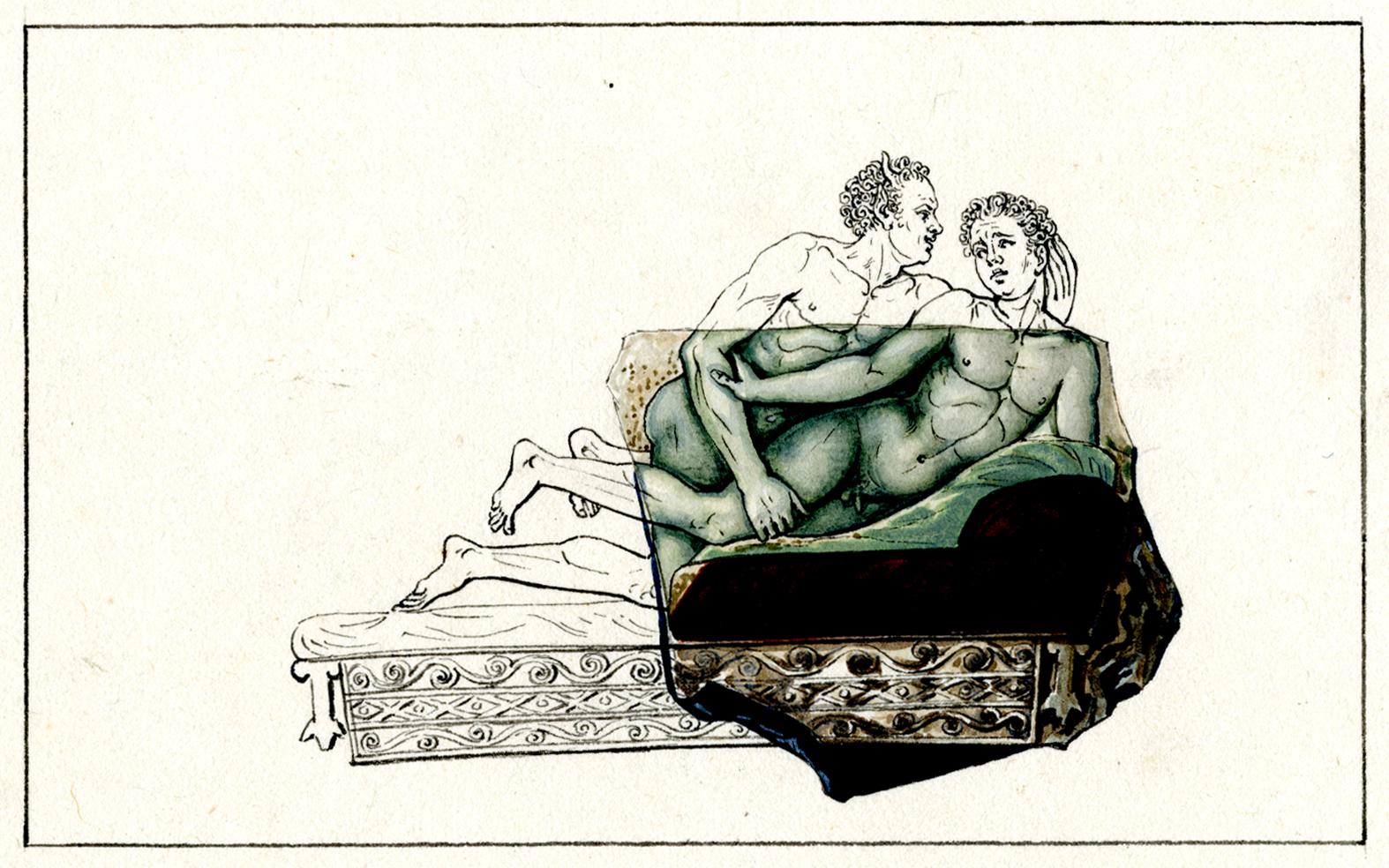
The repertoire is wider than the Portland Vase suggests, and a cataloguer should know it. A British Museum fragment of an open vessel, drawn in pen, ink and watercolour in 1826 or 1827 and now catalogued as BM 2010,5006.570, shows an explicit homosexual scene; a small blue and white cameo glass perfume flask with a similar subject is also known. This was luxury tableware for adults in private rooms.
The early cameo glass industry stops. The usual end date is somewhere around AD 60 to 68, and there is no agreed explanation.
The early cameo glass industry stops. The usual end date is somewhere around AD 60 to 68, and there is no agreed explanation. The Pompeian pieces show the technique in use in the middle of the century; after that the fragments thin out and stop. The whole early production has been read as the work of about two generations.
It comes back once. From the late third century into the reigns of Constantine and his sons, a span the literature calls about a century, cameo and two-colour cut glass is made again, in very small numbers and in a visibly different idiom. The Metropolitan describes examples from this later Roman period as extremely rare. The characteristic late object is not a blue and white amphora but a cut vessel in two contrasting colours with circus, hunt or drinking imagery and an acclamation on it. The Museum zu Allerheiligen at Schaffhausen holds one, the Jagdschale from a grave in the cemetery known as I de Hofwiese at Tasgetium near Stein am Rhein, excavated in 1969 to 1970: a two-colour glass bowl with a panther and bear hunt in the arena and the inscription PIE ZESAIS, drink and live, dated to the third or fourth century.
Nobody has demonstrated a transmission route across the two-century gap, and the two phases look different enough that reinvention is as good a hypothesis as continuity. After the fourth century the technique goes out of European practice entirely. Cameo-cut glass reappears in the Islamic world in the ninth and tenth centuries, again with no demonstrated connection in either direction. In the West nothing comparable is made again until the eighteenth century, and nothing in glass until 1876.
The English cameo glass revival is unusual among revivals because it has a start date, a prize fund and a named target object.Benjamin Richardson, a Stourbridge glass manufacturer, offered one...
The English cameo glass revival is unusual among revivals because it has a start date, a prize fund and a named target object.
Benjamin Richardson, a Stourbridge glass manufacturer, offered one thousand pounds to any glassmaker who could reproduce the Portland Vase in glass. Philip Pargeter, Richardson's nephew, who ran the Red House Glassworks at Wordsley, made the blue and white blank. John Northwood, a Wordsley-born decorator with his own workshop, carved it, working with steel tools of his own design over more than three years, and finished in 1876. That object is now at the Corning Museum of Glass. Sources differ over the exact division of labour between Pargeter and Northwood and both names belong on it.
Northwood did not stop. The Milton Vase of 1878, carved for Pargeter with a scene from Paradise Lost in blown cased glass, etched and cameo-carved, is at the Chrysler Museum of Art in Norfolk, Virginia. In 1881 he became art director at Stevens and Williams at Brierley Hill, where his mechanical inventions - a geometric etching machine, improved cutting equipment - did as much for the industry as his carving. He died in 1902.
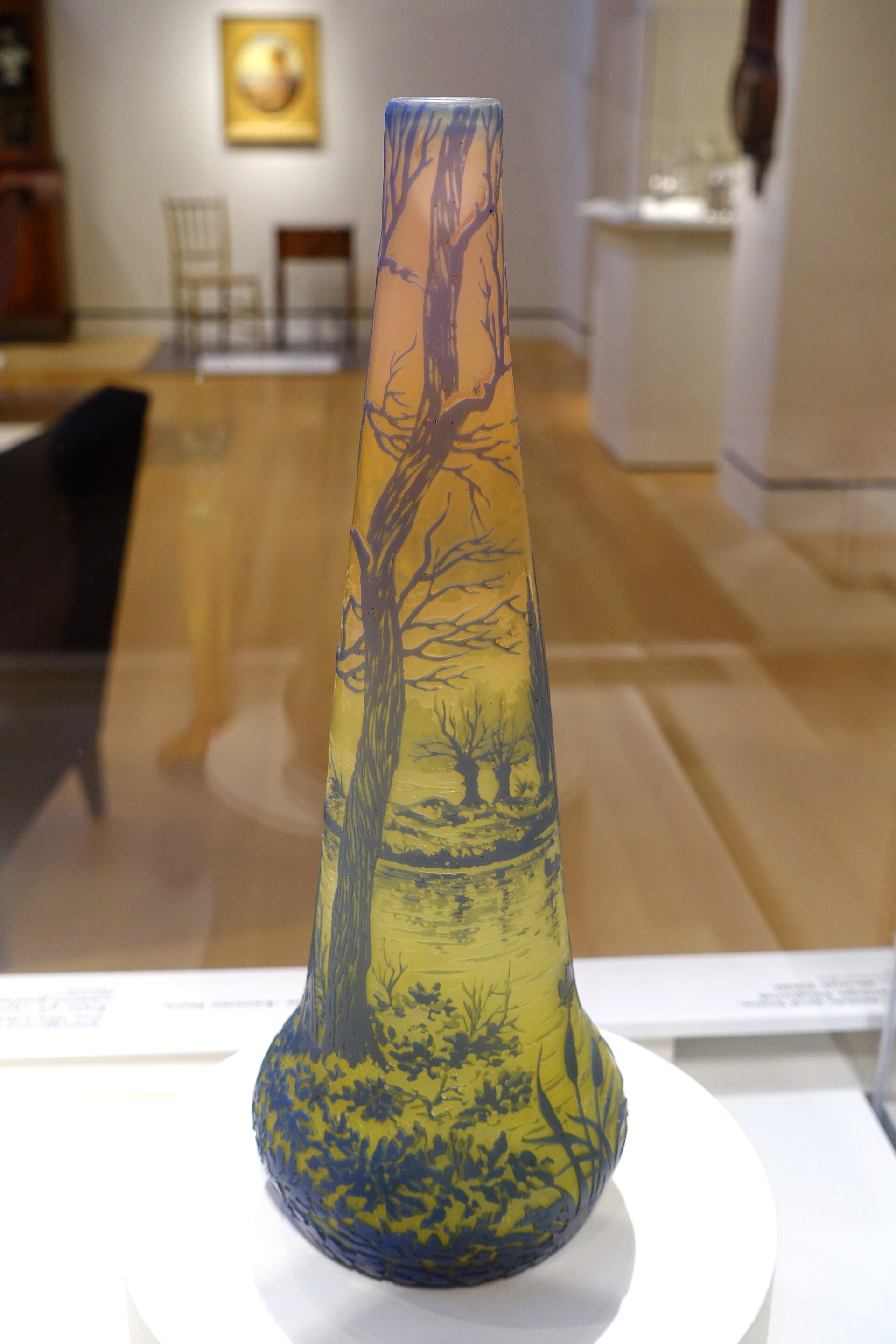
The commercially decisive move was made at the other Stourbridge house. Thomas Webb and Sons put cameo glass into production and employed George Woodall and his elder brother Thomas, who ran the cameo department at Webb's Dennis Glassworks and made the most ambitious pieces of the revival: multi-figure classical plaques and vases, some of them in several colours, cut over months. The Origin of Painting exists in three known versions - a circular plaque of 1884 now at Corning, a vase signed and dated 1887, and a third vase that was George Woodall's personal copy and never appeared in the Thomas Webb price book. The Attack, a plaque completed in March 1896, was in private hands until 2013; Intruders, its companion piece, is at the Chrysler Museum of Art, which also holds The Race, a vase of about 1890. Cleopatra and her Attendants, about 1898, designed and cut by both brothers, is in the Victoria and Albert Museum as LOAN:ANON.2-2001. A further plaque of the Origin of Painting subject, recorded as GW145 and dated 1910, burned in a fire at the Brussels exhibition, and Woodall called it the worst thing that had ever happened to his work.
A photograph of 1891, in the Juliette and Leonard Rakow collection at the Rakow Research Library in Corning, shows the whole team at Webb's around the Great Tazza and a two-handled vase, with the sitters named on the print: standing, Tom Farmer, Harry Davies, J. T. Fereday and Tom Woodall; seated, William Hill and George Woodall. It is the only picture on this page of people who actually did this work, and they are Victorians.
Note the correction, because it is frequently got wrong and it propagates into catalogue entries. The Woodall brothers were Thomas Webb and Sons men, at the Dennis Glassworks. It was John Northwood who went to Stevens and Williams, in 1881. The two firms are a few miles apart in the same district and their output is regularly swapped in trade descriptions.
Roman cameo glass has no market. The English revival has a rising one, documented to the pound at the top.
Roman cameo glass has no market. The English revival has a rising one, documented to the pound at the top. The two are worth setting side by side because the contrast is the whole lesson.
There is effectively no market in Roman cameo glass. Every named survivor is in a public collection and has been for a century or more. The Portland Vase is the only one with a price history at all, and it is not encouraging: 980 guineas at auction in 1786, less than the 1,800 guineas paid privately two years earlier, and unsold at Christie's between 1929 and 1932 when the sixth Duke of Portland tried to sell it out from under the British Museum. The one modern candidate for a sale, the vase Bonhams showed in 2009, was never offered, and the reason was provenance rather than quality.
The English revival, by contrast, has a real and rising market, and the top of it is documented to the pound. On 20 November 2019, at Bonhams in Knightsbridge, in the Fine Glass and British Ceramics sale, lot 108 was the third version of The Origin of Painting: a tapering ovoid vase 23 centimetres high, overlaid in opaque white and carved through to a raisin-brown body, showing Cupid encouraging the maiden Bonhams names as Fielea to trace the silhouette of her Corinthian lover Ariston on the wall, with a palette and brush on the reverse, signed Geo Woodall and titled under the foot. It had come out of the Woodall family, recovered from a floor safe at Luton House on the death of Woodall's second daughter Alice in 1954, and had never been at auction. Estimate 120,000 to 150,000 pounds. It sold for 206,312.50 pounds including premium, a world record for English cameo glass, and Bonhams' glass specialist Jim Peake attributed the result to the provenance as much as to the carving. In the same sale a Woodall of Sappho with a lyre made 50,063 pounds including premium against a 40,000 to 60,000 estimate.
The previous record was The Attack, lot 123 at Bonhams New Bond Street on 1 May 2013 in the sale British and European Glass including the Meyer Collection: a circular, slightly dished plaque 43.5 centimetres across, dark amethyst glass with a white overlay, a classical maiden on a terrace with two cupids, signed T and G Woodall at the lower left, completed in March 1896 after missing the Chicago exhibition of 1893 it was made for. It came out of the collection of H. C. Ash and had descended in his family to a British private owner. It made 169,250 pounds including premium after what Bonhams described as a lengthy contest in the room. Bonhams' European director of glass, Simon Cottle, said at the time that it might hold the record for any piece of English glass ever sold at auction. Two other records fell in the same sale: a Venetian cameo glass vase by Attilio Spaccarelli at 26,250 pounds, more than ten times its estimate, and a Beilby wine goblet at 63,650 pounds.
The Attack also supplies something no other object here does: a price from the period. Thomas Webb and Sons' own factory records give the plaque the inventory number W3172 and enter it in the price book as a seventeen-and-a-quarter-inch white-on-brown plaque valued at 190 pounds, with an asking price of 350 pounds. That is what the finest cameo glass of the revival was worth new. A hundred and seventeen years later the same object made about four hundred and eighty times that asking price, and about eight hundred and ninety times the value the factory's own book put on it. Both multiples divide a premium-inclusive total by a net factory price; against the implied hammer of 140,000 pounds they fall to about four hundred and seven hundred and forty.
One provenance loose end belongs in the open. Bonhams recorded in 2013 that the companion piece to The Attack, a plaque called Intruders, was already in the Chrysler Museum of Art in Virginia. A plaque titled The Attack and dated 1896 was photographed on display at the Chrysler in September 2022. The straightforward reading is that the Chrysler was the buyer in the room in 2013 or acquired it soon after, which would reunite the pair. This record has not found a museum announcement confirming it and does not assert it.
Every one of those figures is premium-inclusive, which is how Bonhams reports. No hammer price is published for any of them, and this record has not obtained Bonhams' conditions of sale for either year, so the working below is an inference and is labelled as one.
On a two-tier scale of 27.5 per cent on the first 2,500 pounds and 25 per cent thereafter, 206,312.50 resolves to a hammer of exactly 165,000 pounds, which is a plausible bid increment; a flat 25 per cent would give 165,050, which is not. On the same scale the Sappho total implies a hammer of 40,000 pounds, the fifty-pence difference being the rounding in the reported total. The 2013 figure is weaker. A hammer of 140,000 pounds fits 169,250 exactly on a 25 and 20 per cent scale breaking at 25,000 pounds, but if the band in fact broke at 50,000 pounds that year the implied hammer is 138,958.33, which is not a bid increment. The clean fit is therefore evidence about the scale as much as about the price, and none of these three numbers should be quoted as a hammer until the conditions of sale are checked. What can be said flatly is that the buyer of The Origin of Painting paid roughly a quarter again on top of what the bidding reached.
The difference between an acid-etched commercial piece and a hand-cut exhibition piece is a factor of a hundred in price, and the price book that fixes it survives. That is a better authentication position than the Roman material will ever offer.
This is the practical content, and the first thing to say is that subject matter is almost useless.
This is the practical content, and the first thing to say is that subject matter is almost useless. The revival was explicitly classicising. A Victorian plaque of a maenad among vine scrolls is doing its best to look like the thing in Bloomsbury. The tests that work are physical.
The ground. Roman cameo glass is cut throughout. Every square millimetre of the blue ground was reached by a wheel or a hand tool, and under magnification the surface is a fabric of overlapping curved facets. Most commercial English cameo glass from about 1880 had the bulk of the white removed with acid before any wheel touched it, because acid was very much cheaper than a carver's month; Northwood himself built a geometric etching machine, and the usual account puts the general adoption of the shortcut in the 1880s, a date this record has not been able to source directly. An acid ground is uniformly matte, carries no directional tool marks, and stops dead at the resist line. Finding acid on the ground rules Rome out. Not finding it proves nothing, because the best revival work - the Northwood pieces, the Woodall exhibition plaques - was cut.
The layers. Roman practice is two layers, dark under white. Pieces with more are exceptional enough to be individually notable: the British Museum's four-colour fragment is one of very few. Multi-coloured stacked layers, and particularly opaque coloured overlays in pink, amber or green, are a signature of the late English and French cameo industries. So is a body colour that is not blue: the record-setting Woodall vase of 2019 is white over raisin brown and the record-setting plaque of 2013 is white over dark amethyst, and Thomas Webb's own price book describes the latter as white on brown. Neither combination has a parallel in the surviving Roman corpus, where the ground is overwhelmingly cobalt blue.
The composition. This is the decisive test and it requires a laboratory. Roman glass of this period is a soda-lime-silica glass fluxed with natron, a mineral soda from Egypt, giving a characteristic low-potash, low-magnesia chemistry, the white opacified with calcium antimonate and the blue coloured with cobalt. English nineteenth-century glass is a different material: lead crystal in many cases, plant-ash or synthetic soda in others, with arsenic or fluorine compounds doing the opacifying. The analytical baseline exists and has since 1983, when Mavis Bimson and Ian Freestone published a comparative study of the Portland Vase against other Roman cameo glasses in the Journal of Glass Studies, in the same volume as Donald Harden's paper on the history and technique of the Portland and Auldjo vessels; Freestone published laboratory studies of the vase itself in the 1990 volume. Any competent glass laboratory can separate a Roman body from a Victorian one without ambiguity, and the specialists who handled the 2009 vase said as much in public: the argument ends when the blue and the white are tested.
Signatures. No Roman cameo glass is signed. A signature is therefore either modern or false. George Woodall signed a great deal of his exhibition work and titled pieces under the foot; Thomas Webb and Sons marked pieces; and firm price books survive against which a Webb piece can be checked. Absence from the price book is informative rather than damning, since Woodall's own copy of The Origin of Painting is not in it.
Condition and burial. Glass buried for two thousand years usually shows it: weathering layers, iridescence, pitting, dulling of cut surfaces. Its absence on a supposedly excavated piece is a question to be answered. It is not conclusive - sealed contexts and heavy cleaning both exist - and the 2009 vase shows the trap working in reverse, where damage of the last decade may have been introduced to make a modern restoration read as an old one.
The wrong material entirely. The largest single source of misidentification is not Victorian glass at all. It is Wedgwood. Josiah Wedgwood copied the Portland Vase in jasperware - unglazed stoneware, not glass - from 1786, issued his first edition in 1790, and sold about thirty-one copies between 1789 and 1795; later editions and other manufacturers' copies run into the hundreds, and Corning itself holds two of them. If the object is opaque, matte and ceramic to the fingernail, it is pottery, and the question of Roman or Victorian does not arise.
The literature is small, technical and mostly in three places.The Journal of Glass Studies, volume 32, 1990.
The literature is small, technical and mostly in three places.
The Journal of Glass Studies, volume 32, 1990. The single most important item, an entire issue on the Portland Vase. Its contents are worth listing because the volume is routinely cited as though it were one paper. Gudenrath, Painter and Whitehouse open it at pages 14 to 23. Painter and Whitehouse then give the history in three parts: the vase in Italy, 24 to 37; the vase in England 1780 to 1800, 37 to 61; the vase in England 1800 to 1989, 62 to 84. Then recent research: the discovery of the vase, 85 to 102; Ian Freestone on laboratory studies, 103 to 107; Gudenrath and Whitehouse on the manufacture and the ancient repair, 108 to 121; style, date and place of manufacture, 122 to 125; the place of the vase in Roman glassmaking, 126 to 129; the interpretation of the scenes, 130 to 136. The appendices carry the internal grinding of the vase at 137, Early Roman Cameo Glasses at 138 to 165 - the corpus list this whole subject rests on - Teti's first published description of 1642 at 166 to 168, Mariette's 1750 proof that it is glass at 169 to 171, earlier interpretations of the scenes at 172 to 176, and a bibliography at 177 to 188.
The British Museum catalogue. Paul Roberts, William Gudenrath, Veronica Tatton-Brown and David Whitehouse, Roman Cameo Glass in the British Museum, London 2010: 110 pages, 130 colour illustrations, 81 drawings on 11 pages. Begun by Tatton-Brown and Gudenrath and completed by Roberts, Whitehouse and Gudenrath, it publishes over seventy pieces - the largest collection in existence - in its entirety for the first time. Carina Weiss reviewed it in the Journal of Roman Archaeology 25, 2012, pages 644 to 650.
The exhibition catalogues. Glass of the Caesars, by Donald Harden with Hansgerd Hellenkemper, Kenneth Painter and David Whitehouse, Milan 1987, 314 pages and 161 objects, for the exhibition that travelled from Corning to the British Museum to Cologne to the Museo Capitolino in Rome between April 1987 and January 1989; the Auldjo Jug was catalogue 34 and the Morgan Cup was in it too. Corning's earlier Cameo Glass: Masterpieces from 2000 Years of Glassmaking covers both corpora, Roman and revival.
The dissenting case. Lierke's own books, and the responses: Birgitta Hoffmann in the Journal of Roman Archaeology in 2004, E. Marianne Stern in the same journal in 2011.
The provenance literature. Michael Heafford in the Proceedings of the Society of Antiquaries of Scotland 148, 2019, pages 267 to 281, on the Auldjo Jug: open access, and the best worked example of provenance research on this material in print. Donald Harden in the Journal of Glass Studies 25, 1983, pages 48 to 53, on the history and technique of the Portland and Auldjo vessels.
For the objects themselves the online routes are uneven and worth knowing before you waste an afternoon. The Metropolitan Museum publishes its cameo glass fragments under open access with full records and downloadable images, and is the best online access to the corpus anywhere. The British Museum's collection online carries the Portland Vase and the Auldjo Jug with full records including conflicting production dates, but blocks automated retrieval. The Corning Museum of Glass publishes the Morgan Cup and its catalogues but also blocks automated retrieval. All of them should be consulted by hand.
The one thing none of them does is put the counts, the institutions, the manufacturing dispute, the provenance cases and the revival between the same two covers. That is the gap this page fills.
Glassworker (vitrearius); Cutter, trained on hardstone; Cameo glass workshop. active c. 30 BC - c. AD 60, with a second and much smaller phase c. AD 275 - mid 4th century.
Born Not applicable. This is a craft, not a person., Italy, and probably Rome, inferred from the concentration of finds and from the Augustan court context; not documented. No cameo glass workshop site has ever been excavated; died The early phase ends around AD 60 to 68. Cameo glass reappears briefly from the late third century into the reigns of Constantine and his sons, and then stops in Europe until the eighteenth century, and in glass until 1876., Unknown.
The structural exposure is misattribution and missing provenance, not forgery. No case of a faked Roman cameo glass vessel is recorded in the sources consulted for this record. The specialists who examined the 2009 vase argued that faking this material is close to impossible, on the grounds that a forger would have to reproduce features known only to the handful of people who have handled ancient cameo glass in pieces.
British Museum (London); Corning Museum of Glass (Corning, New York); Metropolitan Museum of Art (New York); Museo Archeologico Nazionale (Naples); J. Paul Getty Museum, Getty Villa (Pacific Palisades, Los Angeles); Petit Palais, Musee des Beaux-Arts de la Ville de Paris (Paris).
There are two markets here and only one of them functions. Roman cameo glass does not trade: every named survivor is in a public collection and has been for a century or more, and the one modern candidate for a sale was withdrawn over its ownership history rather than its quality.
Was the blank blown or pressed? The orthodoxy has a successful experimental reconstruction on its side; the minority has CT evidence from one fragment.
Across 1,322 provenance events in this archive nineteen name a woman, and four of those give her no personal name at all.
11 min read
Of 187 auction results in this archive, 106 state a currency and they use sixteen different descriptions of it.
11 min read
One object in this archive was displayed under a British Museum number for 135 years before the Museum bought it, and the...
11 min read
Of 204 published records in this archive, 85 state that no price for the object exists.
9 min read
Twenty-nine of 250 records in this archive name why an object came to market: death duties, gambling debts, a bankruptcy, a...
8 min read
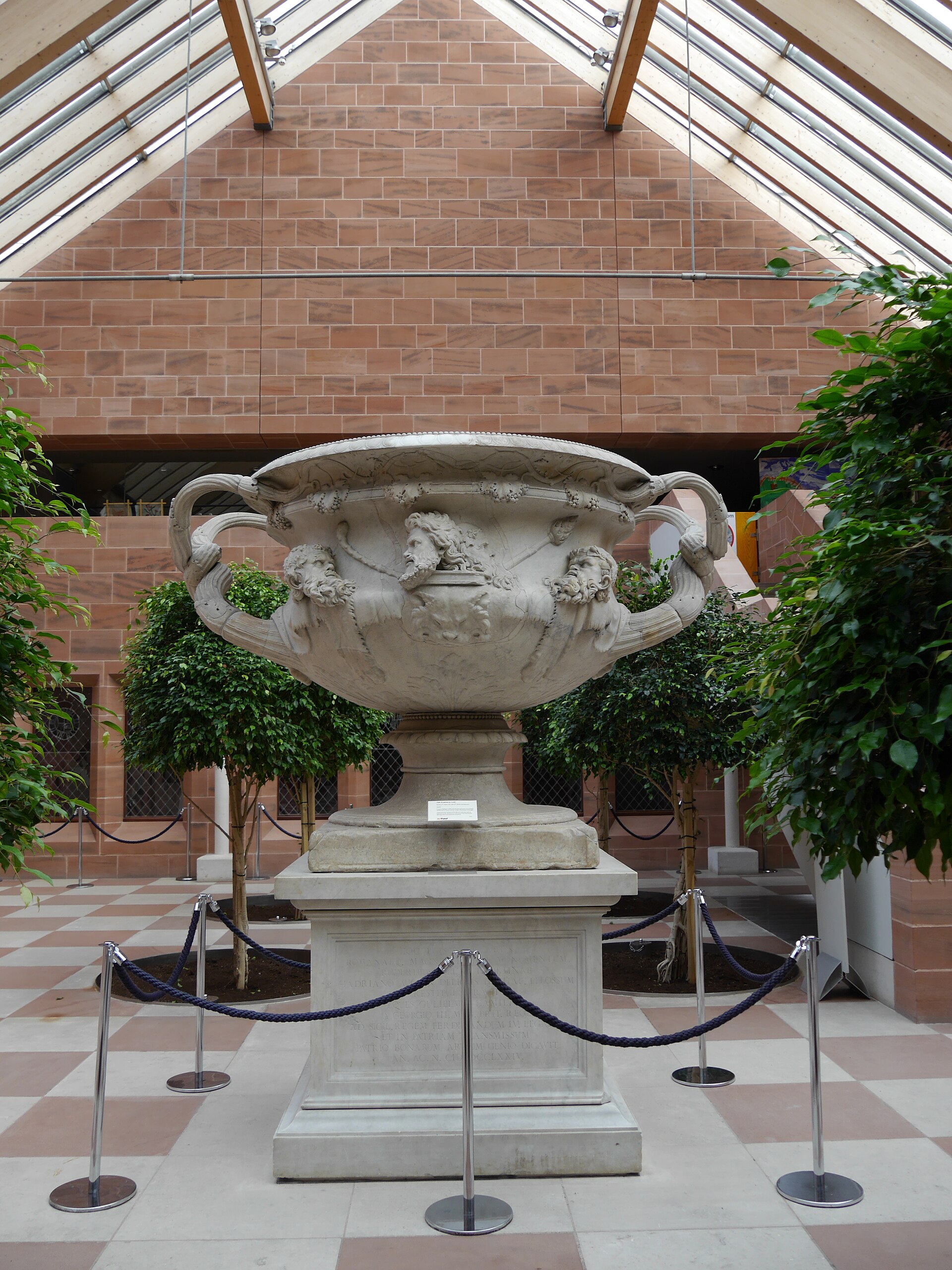
Across 291 objects the recurring names in a provenance line are dealers, not collectors.
9 min read
Six objects in this archive were offered at auction and not sold. An unsold lot is a price nobody paid and a date the object went...
10 min read
Last verified 17 September 2026
One artwork and its story every Tuesday, with the picture: who owned it, what it made, and what closes soon in the exhibition calendar. No promotion, and nothing we cannot cite.
We send one email to confirm the address and keep nothing else. Every letter carries a one-click unsubscribe. How we handle your data.

.jpg)


