The Reason the Object Was for Sale
Twenty-nine of 250 records in this archive name why an object came to market: death duties, gambling debts, a bankruptcy, a shrine needing repairs. The sale catalogue almost never says.
Records in this piece: The Devonshire Hunting Tapestries, The Portland Vase, The Ardabil Carpet, Crown of the Virgin of the Immaculate Conception, known as the Crown of the Andes, The Great Wave, Sete, Fonthill Vase, Minister Kibi's Adventures in China (Kibi daijin nitto emaki), Codex Leicester, "Tahmuras Defeats the Divs", Folio 23v from the Shahnama (Book of Kings) of Shah Tahmasp, The Benin Bronzes
On this page 10 sections
ContentsClose
In short
- Twenty-nine of the 250 published records in this archive state why an object came to market. In the other 221 the reason is either unrecorded or was never asked, and a sale catalogue is not obliged to supply it.
- The reasons that do get recorded cluster into six kinds, and most of them are involuntary: a death and the tax that follows it, a debt, a bankruptcy, an institution needing funds, a family breaking up, and a museum deaccessioning.
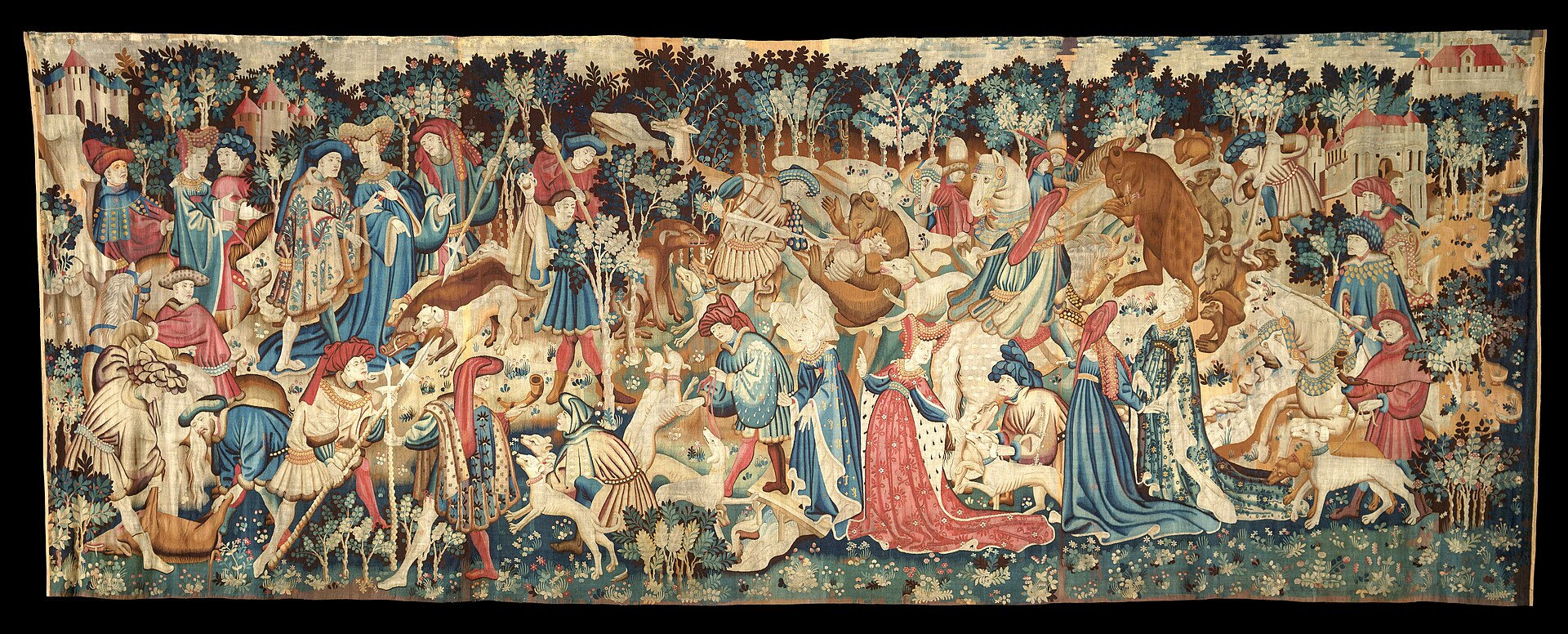
- The Victoria and Albert Museum states the mechanism openly on its own object record. The credit line for the earliest Devonshire hunting tapestry reads that it was accepted by HM Government in lieu of tax payable on the estate of the 10th Duke of Devonshire.
- The reason for sale is the most predictive fact about a price and the one most reliably absent from the document that sets it. A forced seller and a willing seller produce the same catalogue entry.
A catalogue records what is sold and not why
A sale catalogue tells you what the object is, who made it, how big it is and what the house thinks it will fetch. It does not tell you why it is in the sale. The consignor is usually anonymous by contract, and the circumstance that put the object on the block, which is the single fact that most affects how hard the seller will push and how low they will go, is the one thing the document is designed not to carry.
That absence is not an oversight. Anonymity is a service the auction houses sell, and a stated reason for sale is information that helps the buyer and costs the seller money. A catalogue that said this lot is here because the estate owes tax and the executors have nine months would be a catalogue nobody consigned to twice.
So the reason has to be recovered from outside the market's own paperwork, from wills, tax settlements, court records, museum credit lines and the family papers of the people who sold. Across 250 published records this archive has recovered it 29 times. What those 29 show is that the commonest reason an object comes to market is that somebody had no choice.
Six reasons, and only one of them is a decision to sell
The 29 recorded reasons in this archive fall into six kinds. Sorting them that way makes one thing obvious immediately: in five of the six the seller is being acted upon rather than acting, and only the deaccession category involves an institution choosing freely to sell a thing it could have kept.
| Reason | Example in this archive | What triggered it |
|---|---|---|
| Death and the tax on it | Devonshire hunting tapestries, V&A T.204-1957 | Death of the 10th Duke of Devonshire in 1950 |
| Debt | The Portland Vase | Settlement of Barberini gambling debts |
| Bankruptcy | Gustave Le Gray, The Great Wave, Sete | Collapse of the photographer's Paris studio |
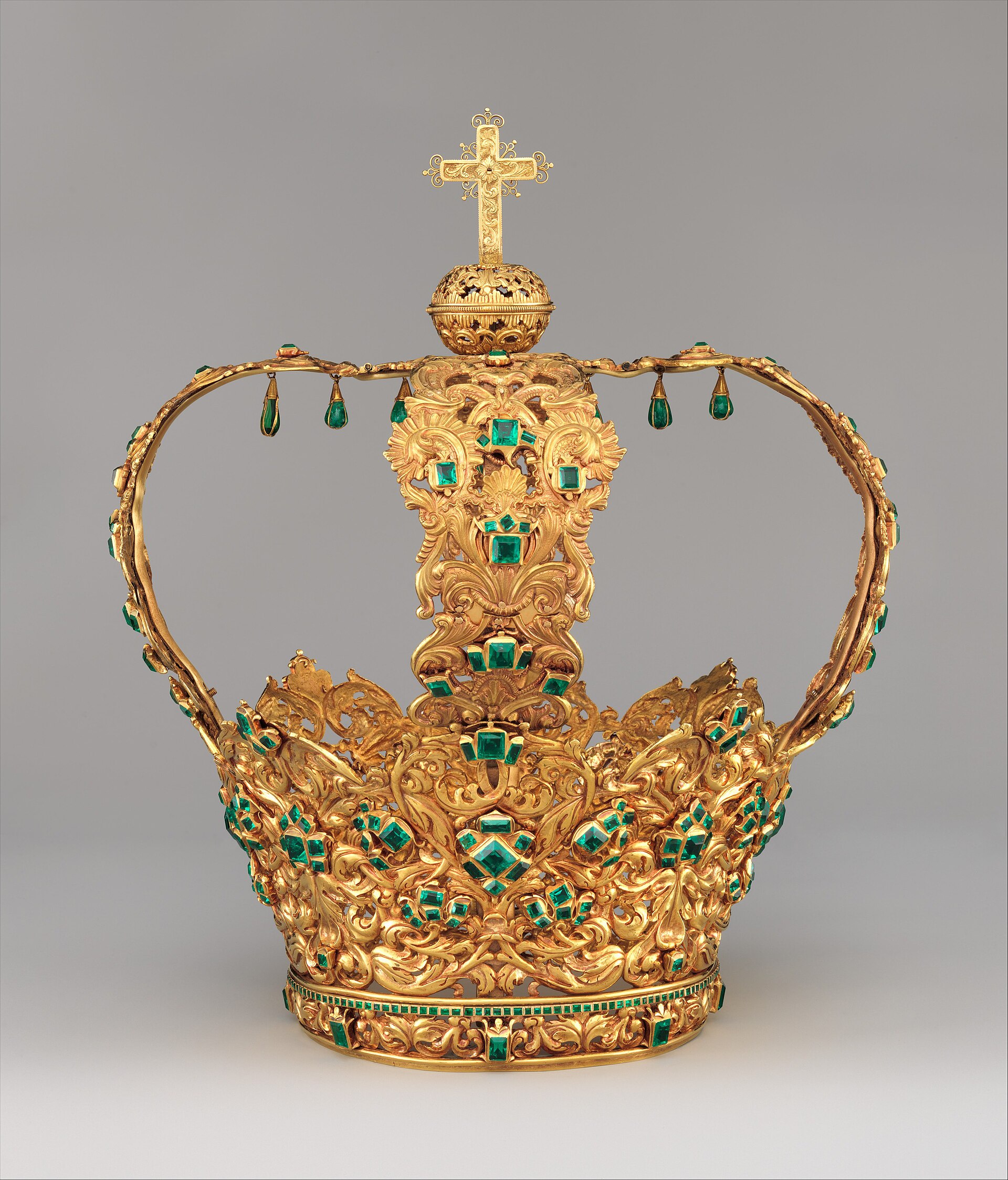
| An institution raising funds | The Ardabil Carpet; the Crown of the Andes | Shrine restoration, on the museum's inference; papal permission of 1914 |
| A family or class breaking up | Kibi Daijin scroll; Fonthill vase | Former daimyo collections dispersed; Hamilton Palace debts |
| Deaccession | Benin plaques; Shahnameh folios | Museum decision to sell or disperse holdings |
Set against the market's own self-description, which is a place where owners choose to realise value at a moment of their choosing, that is close to an inversion. The great objects reach the room because someone died, someone owed money, or an institution ran out of it.
The museum will tell you what the auction house will not
The Victoria and Albert Museum states the reason for the transfer in the credit line it publishes for the earliest of the Devonshire hunting tapestries, museum number T.204-1957: accepted by HM Government in lieu of tax payable on the estate of the 10th Duke of Devonshire and allocated to the Victoria and Albert Museum. The Duke died in 1950, the estate faced death duties, and four fifteenth-century Netherlandish tapestries that had hung at Hardwick Hall went to the nation instead of cash.
Read that credit line as a market document and it is remarkable. It names the seller, the reason, the pressure and the mechanism, in one sentence, on a public page. No auction catalogue in the world would print any of the four. The difference is that a museum's credit line exists to explain how the object arrived, while a catalogue entry exists to sell it, and those two purposes select for opposite disclosures.
This is why credit lines are underused as market evidence. Acceptance in lieu, presented gifts, purchase funds and bequest terms all encode a circumstance, and the institution has no reason to hide it and every reason to record it accurately, since the arrangement had tax consequences somebody had to certify.
A debt moved the most famous Roman glass vessel in the world
The Portland Vase left the Barberini family in settlement of gambling debts. The reported mechanism is the settlement of the debts of Donna Cordelia Barberini-Colonna, after which the vase passed through the Scottish dealer James Byres to Sir William Hamilton and then to the Duchess of Portland, and eventually to the British Museum. A cameo-glass vessel that had been in one Roman family for roughly a century and a half moved because a member of that family lost money.
The Fonthill vase, the earliest documented Chinese porcelain to reach Europe, was sold out of the Hamilton Palace collection in a sale driven by debt, already stripped of its mount, and was not recognised for what it was for decades afterwards. In each case the debt is the reason the object is available and the reason it sells for what it sells for. It is also the reason it was catalogued carelessly: a forced sale is a fast sale, and a fast sale does not fund research.
A bankruptcy scattered the work of the best photographer in France
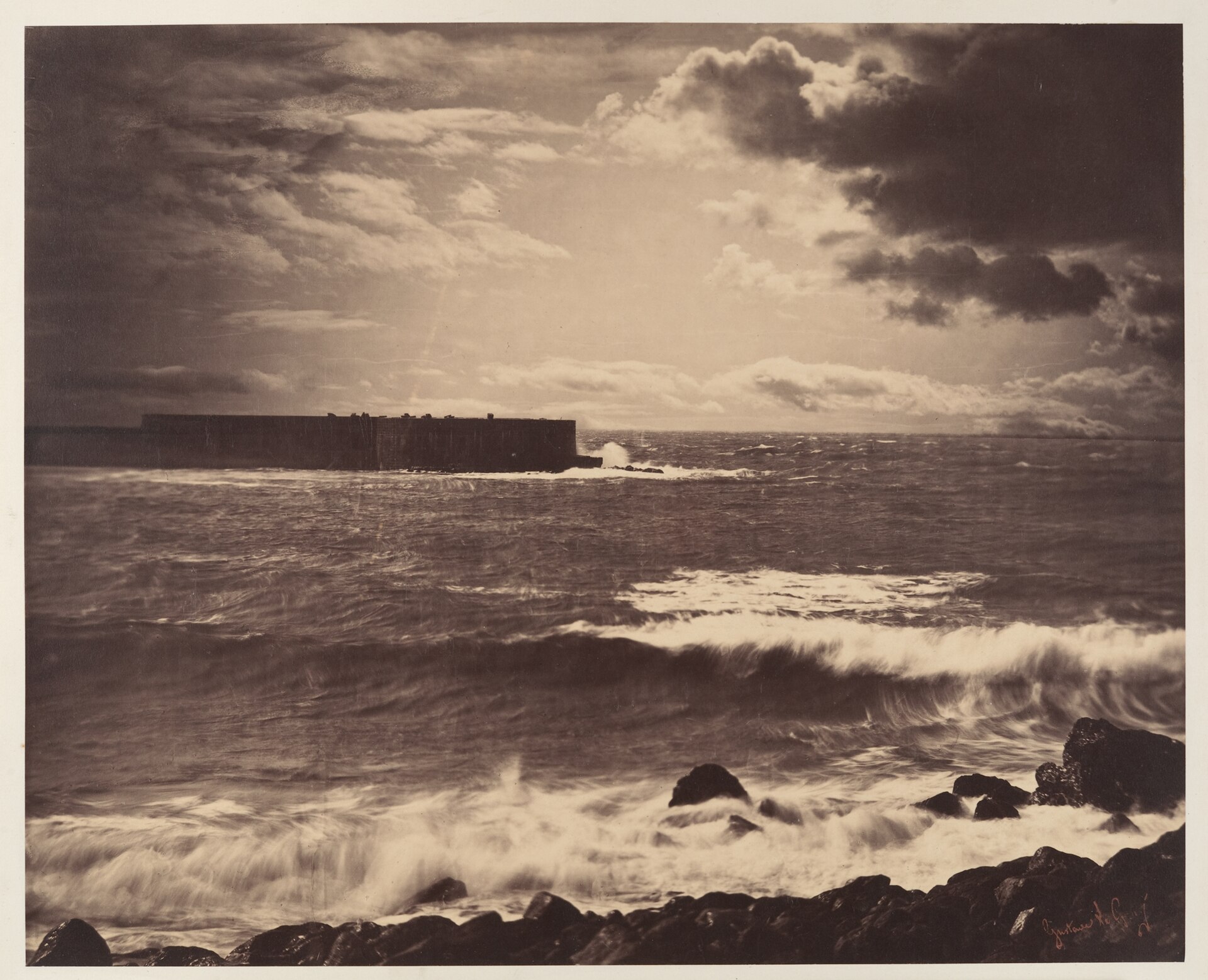
Gustave Le Gray went bankrupt in Paris and left France, and his negatives and prints dispersed. He had been the most technically ambitious photographer working in the country, the man who solved the problem of holding both a bright sky and a dark sea in a single print, and the seascapes he made on the Mediterranean coast in the later 1850s were bought by collectors across Europe. The studio failed anyway.
What that did to the record is visible in every institution that now holds his work. Prints of The Great Wave survive in numbers, and this archive's reference impression is the Metropolitan's, accession 1976.646, given by John Goldsmith Phillips in 1976; the Getty holds another. What does not survive in the same way is the order in which they were made and sold, because the studio that would have known was liquidated.
A bankruptcy is the most destructive of the six reasons, worse for the record than a death. An estate is inventoried by law. A failed business is stripped by creditors.
A shrine sold its carpet to pay for repairs
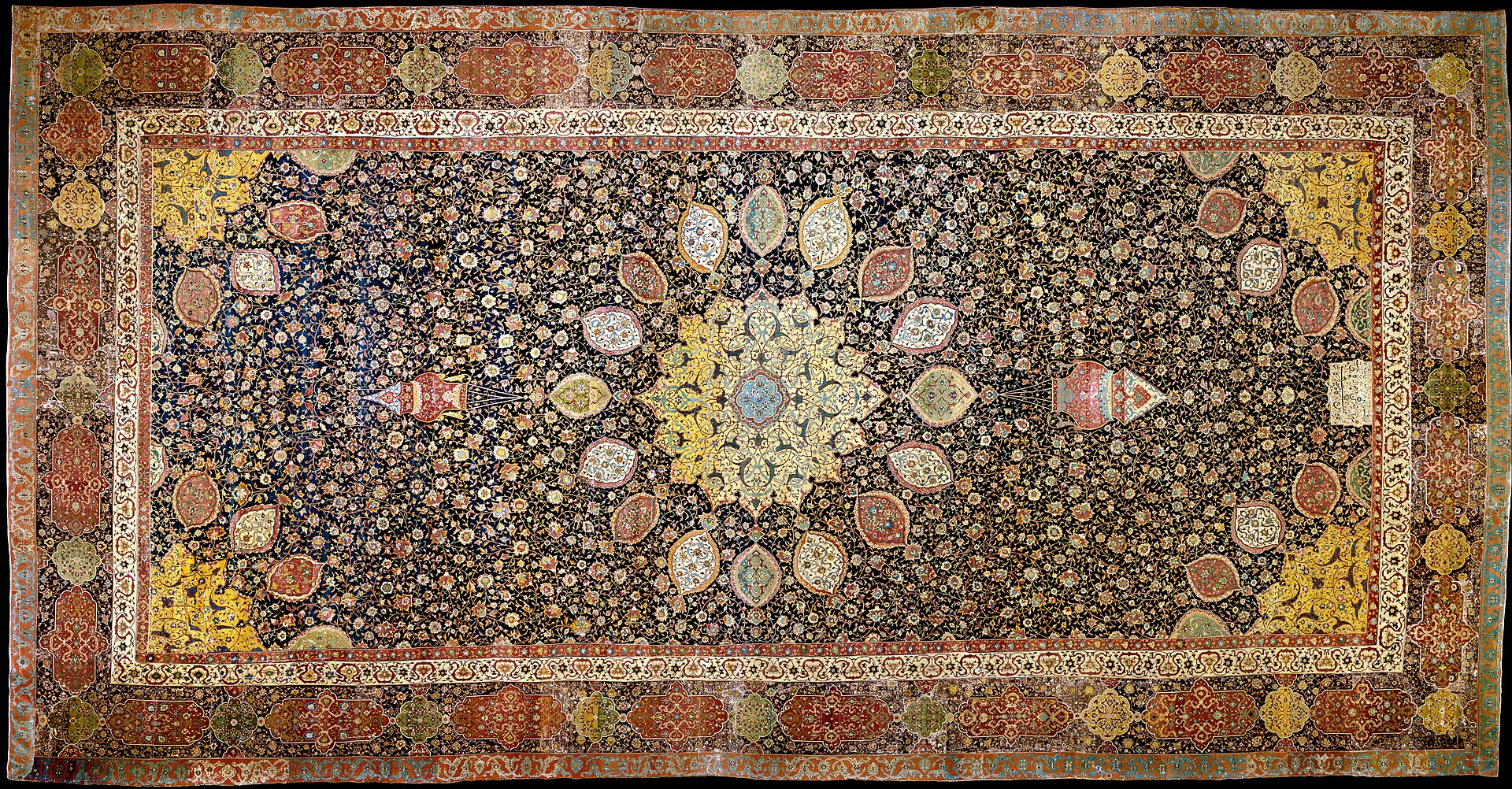
The Ardabil Carpet is the clearest case in this archive of a reason for sale that is inferred rather than documented. It was woven about 1539 to 1540 for the shrine of Shaykh Safi al-Din at Ardabil in north-west Iran, and it carries a dated panel naming Maqsud of Kashan, which is why the Victoria and Albert Museum calls it the world's oldest dated carpet. Ziegler and Co, a trading firm with offices at Tabriz and Sultanabad, bought it from the shrine in 1888, and the museum acquired it in March 1893 for 1,750 pounds as museum number 272-1893.
What connects the sale to a reason is a coincidence of dates. In 1889 and 1890 the shrine authorities completed restoration works on buildings of the complex, and the museum's inference is that the carpet was sold to fund that renovation. It is an inference, and this archive records it as one. The earthquake usually named as the cause of the damage is a later tradition that the museum does not assert.
What the sale did to the objects is not in doubt. The carpet was one of a matching pair, and between about 1890 and 1893 the London art-import firm that held both had one of them repaired into a complete carpet at the expense of the other. The second carpet went to Charles Tyson Yerkes for 80,000 dollars and is now in Los Angeles. A pair woven on what may have been back-to-back looms was made into one saleable object and one diminished one, because that is what the market would pay for.
The crown the church could not sell
Pope Pius X granted permission in 1914 for the Crown of the Andes to be sold to fund charitable works, reported as a hospital, an orphanage and a school, and no buyer was found for twenty-two years. The crown is gold set with Colombian emeralds, made in Popayan for a figure of the Virgin of the Immaculate Conception, and it is one of the most spectacular surviving objects of colonial American goldsmiths' work. For over two decades it was an asset a church had been authorised to liquidate and could not.
That gap is the most useful thing in the story. Permission to sell is not a sale, and an object can carry an intention to sell for a generation without ever producing a price. The Metropolitan eventually acquired it in 2015 under accession 2015.437, more than a century after the permission was granted, with a credit line naming three separate funds.
An object with a twenty-two year hole between the decision to sell and the sale is telling you something about its market, and it is not that the object was undesirable.
What the reason predicts that the estimate does not
The reason for sale predicts the seller's reserve, the speed of the sale, the quality of the cataloguing and the odds of a bargain, and none of those is visible in the estimate. An executor working to a tax deadline and a collector trading up produce identical catalogue entries and behave in opposite ways in the room. Somebody in that room usually knows which is which, and it is not the underbidder reading the catalogue on the morning of the sale.
It also predicts what the object's record will look like afterwards. A forced sale disperses a collection quickly, often without an inventory, and it breaks exactly the documentation that later provenance research depends on. The Hamilton Palace and Fonthill dispersals are the reason a Chinese porcelain vase of the first importance sat unrecognised, and the daimyo collections broken up in the Meiji decades scattered objects whose family histories had been continuous for centuries.
So the reason for sale is not gossip about the seller. It is a structural fact about the resulting record, and it belongs in a provenance line as much as the price does.
How to find the reason, and how to write it down
Start with the credit line of whatever institution holds the object now, because that is where the circumstance is most likely to be stated plainly. Acceptance in lieu, presented by, bequest of and purchased with a named fund each encode a different route and a different pressure, and museums publish them because the arrangements were certified by somebody. This archive recovered the Devonshire mechanism entirely from the V and A's own object page.
Then go to the documents that record compulsion rather than choice: probate and estate records, tax settlements, bankruptcy filings, court judgments and the correspondence of dealers who bought from families in trouble. Sale catalogues are the last place to look, not the first, and they are usually silent by design.
When you do establish the reason, write it into the provenance note against the sale event rather than into a general history, so that anyone reading the chain sees the pressure next to the transaction it produced. And when you cannot establish it, say so. Two hundred and twenty-one of the records in this archive do not state why the object was sold, and that number is a finding about the market's paperwork rather than a gap in the research.
Why this archive is free to read
We do this for everyone who loves art. The people who have studied it for years, and the people who just stopped to look. Iconotheca exists so that what we learn belongs to all of them.
Nobody pays us for this. No ads, no sponsors, no commercial interest. These works belong to all of us, and we would rather share them with as many people as we can than keep them to ourselves.
If it gave you something today, tell us to keep going. Follow us, leave a like, or write a positive comment. We read every one, and they are what keeps us going.
Questions
Because consignor anonymity is part of what an auction house sells, and a stated reason for sale is information that helps the buyer at the seller's expense. A catalogue disclosing that an estate must settle tax within a deadline would weaken the seller's position in the room.
A United Kingdom arrangement under which an object is transferred to a public collection in settlement of tax rather than the tax being paid in cash. The Victoria and Albert Museum's credit line for the earliest Devonshire hunting tapestry, museum number T.204-1957, records that it was accepted by HM Government in lieu of tax payable on the estate of the 10th Duke of Devonshire.
In this archive, 29 times across 250 published records. The remaining 221 records either do not state a reason or the reason was never documented in the sources consulted, which is the normal condition rather than an unusual one.
Ziegler and Co bought it from the shrine in 1888, and the Victoria and Albert Museum acquired it in March 1893 for 1,750 pounds as museum number 272-1893. The reason is inferred rather than documented: the shrine completed restoration works in 1889 and 1890, and the museum proposes that the carpet was sold to fund them.
Yes, and usually badly. A sale under time pressure is catalogued quickly and often without an inventory of the collection being broken up, which destroys the documentation that later provenance research depends on. The Hamilton Palace dispersal is why the Fonthill vase went unrecognised for decades.
Sources
- 1Victoria and Albert Museum, online collections catalogue, Devonshire hunting tapestry, museum number T.204-1957, credit line: 'Accepted by HM Government in lieu of tax payable on the estate of the 10th Duke of Devonshire and allocated to the Victoria and Albert Museum.' Read 5 September 2026. collections.vam.ac.uk/item/...
- 2Victoria and Albert Museum, 'The Ardabil Carpet', museum article, for the 1539 to 1540 date, the inscription naming Maqsud Kashani and museum number 272-1893. Read 5 September 2026. vam.ac.uk/articles/...
- 3Metropolitan Museum of Art, Open Access Collection API, object 21698, Crown of the Virgin of the Immaculate Conception, known as the Crown of the Andes, accession 2015.437, credit line Purchase, Lila Acheson Wallace Gift, Acquisitions Fund and Mary Trumbull Adams Fund, 2015. collectionapi.metmuseum.org/public/...
- 4Metropolitan Museum of Art, Open Access Collection API, object 261941, Gustave Le Gray, [The Great Wave, Sete], accession 1976.646, credit line Gift of John Goldsmith Phillips, 1976. collectionapi.metmuseum.org/public/...
- 5Milo Keynes, 'The Portland Vase: Sir William Hamilton, Josiah Wedgwood and the Darwins', for the passage of the vase out of the Barberini collection and through James Byres to Hamilton and the Duchess of Portland. darwin-online.org.uk/converted/...
- 6Victoria and Albert Museum, online collections catalogue, further Devonshire hunting tapestry entries recording the same acceptance in lieu arrangement. collections.vam.ac.uk/item/...
- 7Metropolitan Museum of Art, collection catalogue entry, Crown of the Virgin of the Immaculate Conception, known as the Crown of the Andes, giving the object history and the twenty-two years during which no buyer was found. metmuseum.org/art/...
- 8Victoria and Albert Museum, Explore the Collections, catalogue record for The Ardabil Carpet, museum number 272-1893, for the 1888 Ziegler purchase, the 1889 to 1890 shrine restoration works and the March 1893 acquisition at 1,750 pounds. collections.vam.ac.uk/item/...
- 9Los Angeles County Museum of Art, collection record for the second Ardabil carpet, accession 53.50.2, gift of J. Paul Getty, 1953. collections.lacma.org/object/...
- 10J. Paul Getty Museum, collection catalogue entry, Gustave Le Gray, The Great Wave, Sete, for the photographer's Paris studio and the dispersal of his work. getty.edu/art/...
More in The Market
The partThe hammer is the one number most auction houses do not print
Of 232 auction results in this archive, 53 carry no hammer price published by the house that sold the object.
The Objects Whose Price Was Set by a Tax Bill and Not a Buyer
The Louvre did not buy the most famous Vermeer in France. It accepted it against a death duty, and the acquisition price is not withheld, it does not...
The House That Cannot Be Asked: Who Keeps the Price After the Sale
Half this archive's sale record sits with two firms you can still write to. The other half sits with houses that shut, and with bodies that were...