The Portland Vase
Unrecorded Roman glassworker and gem-cutter · c. AD 5-25, disputed. Low dates in the range c. 30-20 BC retain scholarly support, and the vase is often placed generally in the reign of Augustus, 27 BC to AD 14.
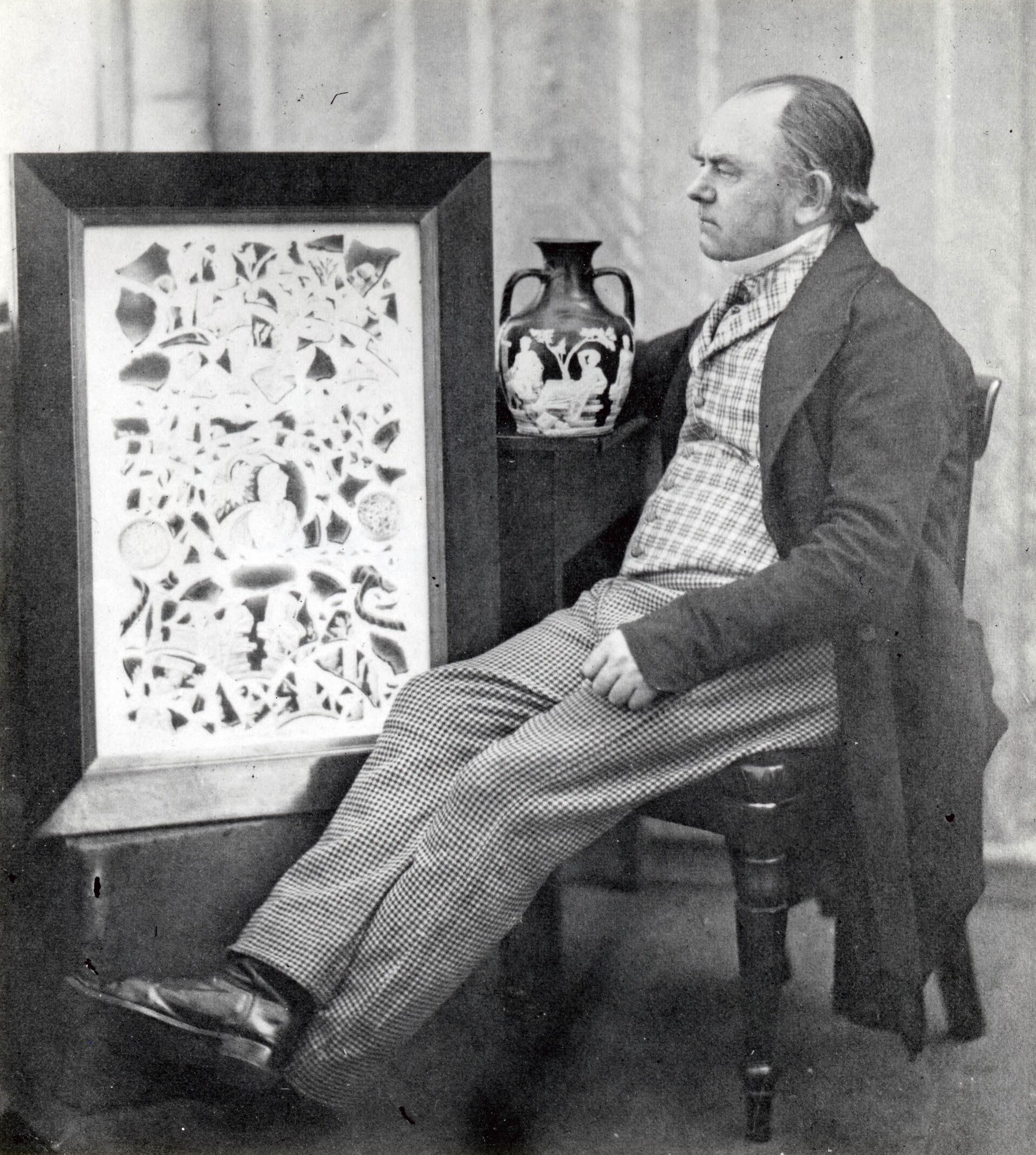
The restorer photographed with the same object after his reconstruction, completed 10 September 1845. Doubleday's work was dismantled in 1948 and again in 1988; his signed disc under the foot survives.
| Maker | Unrecorded Roman glassworker and gem-cutter |
|---|---|
| Date | c. AD 5-25, disputed. Low dates in the range c. 30-20 BC retain scholarly support, and the vase is often placed generally in the reign of Augustus, 27 BC to AD 14. |
| Medium | Cameo glass: cobalt-blue glass with an opaque white glass overlay, the white cut back in relief |
| Dimensions | Height 24.5 cm; maximum diameter 17.7 cm; mouth diameter 9.3 cm |
| Where it is now | British Museum, London |
| Inventory number | 1945,0927.1 (also cited as GR 1945.9-27.1 and as Gems 4036) |
| Attribution | UnknownNo maker is named, signed or documented. Full note |
| Object type | Glass |
| Period | Early Imperial (Julio-Claudian), 27 BC-68 |
| Cases | Has a provenance gap |
| Culture | Roman |
| Genre | mythological narrative |
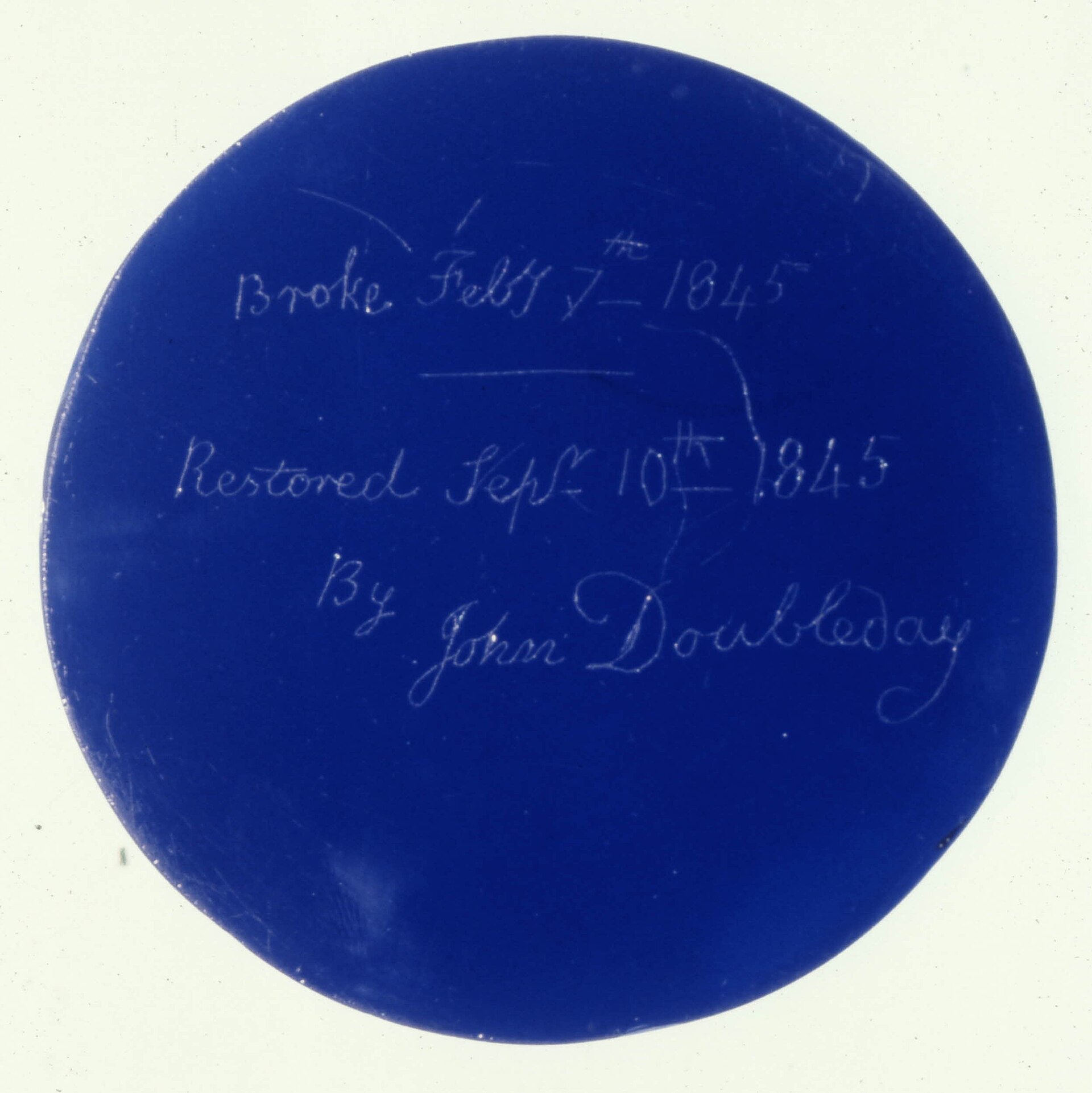
| Inscriptions | Nothing ancient. Under the foot is a disc fitted by the restorer John Doubleday in 1845, inscribed: Broke Feby 7th 1845 / Restored Sept 10th 1845 / By John Doubleday. |
| Owners on record | 11 links8 documented, 2 disputed, 1 unknown |
| Sources | 15 cited |
About this record Last verified 29 August 2026 · 15 sources cited · Change log
On this page 10 sections
ContentsClose
A Roman cameo glass vessel of about AD 5 to 25, cobalt blue under an opaque white overlay cut back in relief, 24.5 centimetres high. It is the most celebrated surviving object in a material of which perhaps fifteen more or less complete pieces exist anywhere in the world. Nobody knows who made it, where it was found, when exactly it was made, or what the seven figures on it are doing.
It reached the modern world already incomplete, its pointed base gone and a cameo disc cut from somebody else's Roman relief fitted underneath in its place. On 7 February 1845 a drunk visitor to the British Museum threw a piece of Persepolis sculpture through its case and reduced it to a heap of fragments; he could be prosecuted only for the case, because the statute on wilful damage reached objects worth up to five pounds and no further. It has been reassembled three times since, in 1845, in 1948 to 1949 and in 1988 to 1989, and each attempt left pieces out.
Its fame is not Roman. It is Staffordshire. Josiah Wedgwood borrowed it in 1786, spent years failing to copy it in jasperware, and succeeded in 1790. The copies went everywhere. That is why almost every photograph captioned Portland Vase online shows a piece of English pottery rather than the Roman glass in Bloomsbury.
Provenance
Each link is graded. Documented: a cited source supports it. Disputed: the identification is argued but not established. Unknown: no owner for that span, and the gap is not smoothed into a narrative. The grades in the glossary.
- c. AD 5-25 -Made, probably at Romedisputed
No maker, workshop or patron is recorded. The date is the British Museum's and is contested; low dates to about 30-20 BC have scholarly support. Place of manufacture is inferred from the concentration of comparable cameo glass in Italy, not documented.17
- 1582 -Reportedly recovered from a sarcophagus in the Monte del Grano, via Tusculana, outside Romedisputed
Transmitted by Pietro Santi Bartoli. Accepted without question until Henry Stuart Jones rejected it in 1909. Reinstated as authentic by Filippo Coarelli in the Journal of Roman Archaeology in December 2025, who identifies the monument as the tomb of Alexander Severus. Both positions are current. Note that a third-century tomb would not date a first-century vessel.37
- 1582 - c. 1601Unknownunknown
No owner is recorded between the reported discovery and the vase's appearance in Roman collecting records.27
- c. 1601 - 1626Cardinal Francesco Maria Del Monte, Romedocumented
First secure record of the object. Del Monte is best known as Caravaggio's early patron.27
- 1626 - 1780The Barberini family, Rome (acquired by Cardinal Francesco Barberini)documented
Bought for 500 scudi. Held for about 150 years, during which the object was known as the Barberini Vase, the name it carries in all eighteenth-century sources.27
- 1780 - 1782James Byres, Scottish antiquarian and dealer, Romedocumented
Acquired from the Barberini. The reported mechanism is the settlement of the gambling debts of Donna Cordelia Barberini-Colonna.2
- 1782 - 1784Sir William Hamilton, British plenipotentiary at Naplesdocumented
Bought from Byres for 1,000 pounds late in 1782 according to Milo Keynes. Other accounts place Hamilton's acquisition in 1778 or 1783; the British Museum record gives 1778. The conflict is unresolved in the sources consulted.12
- 1784 - 1785Margaret Cavendish Bentinck, Dowager Duchess of Portlanddocumented
Bought privately from Hamilton for 1,800 guineas after what Keynes describes as a secret and delicate negotiation. Held for about a year; the Duchess died in July 1785. The object takes its modern name from this ownership.12
- 1786 - 1810William Henry Cavendish-Bentinck, 3rd Duke of Portland, then the 4th Dukedocumented
Bought back into the family at the Portland Museum sale on 7 June 1786, lot 4155, for 980 guineas (1,029 pounds), by a Mr Tomlinson bidding for the 3rd Duke. On 10 June 1786 the Duke and Josiah Wedgwood signed an agreement lending the vase to Etruria to be copied.215
- 1810 - 1945The Dukes of Portland, on deposit at the British Museumdocumented
Deposited by the 4th Duke in 1810; secondary accounts attribute the decision to a guest breaking the base. Ownership remained with the family throughout. Withdrawn between 1929 and 1932 by the 6th Duke and offered at Christie's, where it failed to reach its reserve, then returned to the museum. Broken and twice restored during this period, all while the museum was custodian and not owner.27
- 1945 - presentBritish Museum, Londondocumented
Purchased from William Cavendish-Bentinck, 7th Duke of Portland, with the aid of a bequest from James Rose Vallentin. Registered 1945,0927.1 (also cited as GR 1945.9-27.1 and Gems 4036). The purchase price is not published in the sources consulted.17
Prices realised
| Date | Sale | Estimate | Result | Note |
|---|---|---|---|---|
| 7 June 1786 | Mr Skinner and Co | Not published in the sources consulted. | Hammer 980 guineas (1,029 pounds) With premium None. A buyer's premium was not a feature of English auction practice in 1786; the hammer price is the whole price. Guineas, sterling. One guinea = 21 shillings = 1.05 pounds. | Lot 4155 in the sale of the Portland Museum, the collection of the late Duchess Dowager of Portland, held at her house in Privy Garden, Whitehall, over thirty-eight days from 24 April to 7 June 1786 by order of the acting executrix. The vase was on the final day. Bought by a Mr Tomlinson acting for the 3rd Duke of Portland, the Duchess's son. Note that this is less than the 1,800 guineas the Duchess herself had paid Hamilton two years earlier: the vase lost money at its only completed auction. |
| 1929 to 1932 | Christie's, London | Not published in the sources consulted. | Hammer Unsold. Failed to reach its reserve. With premium Not applicable. Sterling | Offered by William Cavendish-Bentinck, 6th Duke of Portland, who withdrew the vase from its long deposit at the British Museum in order to sell it. It did not sell and went back to Bloomsbury, where the museum bought it outright thirteen years later. Neither the reserve nor the highest bid appears in the sources consulted, and this is the only occasion on which the object was tested on the open market. |
Hammer is the price at which the bidding stopped; with premium adds the fee the house charges the buyer on top. Hammer price and buyer's premium in the glossary.
Technical evidence
| Attribution note | No maker is named, signed or documented. The vase is anonymous and has always been anonymous. The frequently repeated suggestion that the cutting is by the gem engraver Dioskourides, who worked for Augustus, is a stylistic proposal and rests on no inscription, signature or ancient text naming him in connection with this object. Two different trades were involved and probably two different hands: a glassblower who made the blue and white blank, and a gem-cutter who carved the relief. Neither is identifiable. |
|---|---|
| Material | Cobalt-blue (described in the literature as violet-blue) glass with an opaque white glass overlay.179 |
| Technique | Cameo glass. The British Museum's record gives blown and carved, made by the dip-overlay method: an elongated bubble of blue glass partly dipped into a crucible of white glass and the two blown together, the white then cut back in relief after cooling.17 |
| Cutting | The relief is cut at the standard of hardstone cameo work rather than glass decoration, and is generally taken to be the work of a trained gem engraver (diatretarius). Reproduction trials suggest the cutting alone required on the order of two years.179 |
| Dimensions | Height 24.5 cm; maximum diameter 17.7 cm; mouth diameter 9.3 cm.1 |
| Form and completeness | A two-handled amphora that has lost its pointed base. The mouth is unevenly cut. What survives is a truncated vessel, not a complete one.79 |
| Base disc | A separate blue and white cameo glass disc showing a head in a Phrygian cap, called Paris or Priam, cut down from a larger composition and fitted as a base, perhaps in antiquity. It differs from the vase in colour, composition and style. Associated with the vase since at least the early seventeenth century; displayed separately since 1845.714 |
| Figures | Seven human figures, one large sea-serpent (ketos), and two bearded horned heads set under the handles marking the division between the two scenes.17 |
| Inscription | None ancient. A disc under the foot fitted by John Doubleday in 1845 reads: Broke Feby 7th 1845 / Restored Sept 10th 1845 / By John Doubleday.13 |
| Condition | Broken deliberately on 7 February 1845 into a number of fragments variously reported as well over eighty, as 189, and as about two hundred. Fully dismantled and reassembled three times: 1845, 1948-49, 1988-89.4579 |
| Current adhesive | Hxtal NYL-1 epoxy resin, selected in 1988 after comparative testing for its resistance to yellowing under prolonged light exposure. Losses filled with tinted blue or white resin.57 |
| Fragments not reinstated | Thirty-seven small fragments were left out of Doubleday's 1845 reconstruction and boxed. Axtell replaced three of them in 1948-49. Williams and Smith integrated all but a few small splinters in 1988-89.57 |
| Analytical work | Laboratory study of the glass was published by Ian Freestone in the Corning Museum of Glass Journal of Glass Studies 32 (1990), the volume devoted to the vase. Not consulted directly for this record; see editor's note.7 |
Images
The record in full
Chapter 1The object is not intact, and never was in modern times
A Roman two-handled vessel in cobalt-blue glass, 24.5 centimetres high, 17.7 centimetres across at its widest and 9.3 centimetres at the mouth.
A Roman two-handled vessel in cobalt-blue glass, 24.5 centimetres high, 17.7 centimetres across at its widest and 9.3 centimetres at the mouth. Over the blue lies an opaque white glass layer which has been cut back in relief to leave seven human figures, a large sea-serpent and two bearded, horned heads standing proud of the dark ground. The cutting is at the standard of hardstone cameo work, not of glass decoration, which is the single strongest piece of evidence about who made it.
It is also incomplete, and that matters more than the literature usually admits. The vessel has lost its pointed base. What it has instead is a separate cameo glass disc showing a young head in a Phrygian cap, called Paris or Priam depending on the writer, cut down from a larger composition and fitted underneath as a foot. The disc differs from the vase in colour, in composition and in style. The mouth of the vessel is unevenly cut. The two pieces have been associated since at least the early seventeenth century, and the British Museum has displayed them apart since 1845.
So the thing that entered the historical record was already an assembly: a truncated Roman amphora closed with a fragment of somebody else's Roman relief, possibly converted in antiquity, possibly much later. Every subsequent event in this record happened to an object that was not whole when it started.
Chapter 2Nobody has read the frieze
Two scenes run round the body, divided by the bearded horned masks set under each handle.
Two scenes run round the body, divided by the bearded horned masks set under each handle. On one side a young man steps out from a structure towards a half-naked woman seated on the ground with a snake-like creature across her lap; Eros flies above with bow and torch; a bearded man stands between two trees, chin resting on his hand. On the other, three figures sit among rocks beneath a single tree: a young man beside a column, a woman with one arm raised holding a torch pointing down, a half-draped woman with a sceptre or staff.
All but one of the figures carry no identifying attribute. That is the whole difficulty, and it has not moved in four centuries. The published readings divide into two families. The mythological family favours the marriage of Peleus and Thetis, with Dionysos greeting Ariadne as the leading alternative. The dynastic family has proposed Augustus conceived by Apollo in the form of a serpent, Mark Antony lured by Cleopatra and her asp, and Octavia abandoned by Antony and seated between her brother and Venus Genetrix. The second scene has been read as Hecuba dreaming of the Judgement of Paris, as Ariadne stranded on Naxos, and as Olympias dreaming of the conception of Alexander. Erasmus Darwin, who received one of the earliest Wedgwood copies, read the whole thing as an Eleusinian allegory of death and rebirth.
There is no agreement even on whether the two sides are one continuous story or two separate ones. The most careful public statement is the British Museum's own: the subject is love and marriage with a mythological cast, and the sea-serpent places it in a marine setting, so it may have been a wedding gift. In December 2025 Filippo Coarelli argued in the Journal of Roman Archaeology for the wedding of Peleus and Thetis combined with the afterlife of Achilles. That is the newest reading available. It is a contribution, not a conclusion.
Chapter 3How it was made is an open technical argument
The standard account, and the one the British Museum gives, is the dip-overlay method.
The standard account, and the one the British Museum gives, is the dip-overlay method. An elongated bubble of blue glass was gathered on the blowpipe and partly dipped into a crucible of molten white glass, and the two were then blown together as one body. Once cool, the white layer was cut away with the tools and the patience of a gem engraver to leave the relief. The alternative within the blowing hypothesis is casing, in which a blank of the background colour is placed inside a hollow blank of the overlay colour and the two are fused and blown. Experimental work by William Gudenrath and David Whitehouse recreated the vase on the dip-overlay model and supports it.
Against this stands a minority position that is not dead. The German researcher Rosemarie Lierke argued from the 1990s that Roman cameo glass was not blown and cold-cut at all but moulded, with the white layer introduced as glass powder. Her case was long dismissed for want of physical evidence. In 2017 Richard Whiteley of the Australian National University put a Roman cameo glass fragment from the ANU Classics Museum through a computed tomography scanner and reported bubble configurations inconsistent with blowing, cold working marks on the surface, a bubble pattern suggesting pressing and turning, and blue glass mixed into granulated white specks. He presented the finding at a historical glassworks conference at the British Museum in October 2017 and described the process as a form of pate de verre.
This record does not adjudicate. It notes that the object at the centre of the argument has been reassembled three times, which complicates any argument from its surface, and that Whiteley's evidence comes from a different fragment rather than from the vase itself. What both camps agree on is the cost. The nineteenth-century attempt to reproduce the vase in glass was so laborious that the original is generally reckoned to have taken its cutter no less than two years.
Chapter 4The findspot was demolished in 1909 and revived in 2025
Until the early twentieth century nobody doubted where the vase came from.
Until the early twentieth century nobody doubted where the vase came from. The account, transmitted by Pietro Santi Bartoli, was that it was found in 1582 inside a sarcophagus decorated with scenes from the story of Achilles, in the great burial mound known as the Monte del Grano at the fourth mile of the via Tusculana outside Rome. The mound was identified as an imperial tomb.
In 1909 Henry Stuart Jones ruled the provenance out, and for more than a century the standard position has been that the Monte del Grano story is unproven and probably a seventeenth-century embellishment. In December 2025 Filippo Coarelli re-examined the monument, identified it as the tomb of Alexander Severus, and concluded that the report of the vase coming from the Monte del Grano sarcophagus is authentic after all.
Note what this does not settle. The Monte del Grano is a third-century tomb; the vase is Augustan or close to it. A first-century vessel deposited in a third-century burial is entirely possible, and is one of the reasons the dating and the findspot have to be argued separately. Anyone who reads the findspot as a dating argument is making a mistake this object punishes.
The first solid ownership record is Roman and early modern. The vase is documented in the collection of Cardinal Francesco Maria Del Monte by about 1601. In 1626 it passed to Cardinal Francesco Barberini for 500 scudi, and it stayed with the Barberini for roughly 150 years. It was the Barberini Vase before it was the Portland Vase, and eighteenth-century sources call it that.
Chapter 5Byres, Hamilton and the Duchess
In 1780 the Scottish antiquarian and dealer James Byres, resident in Rome, acquired the vase from the Barberini.
In 1780 the Scottish antiquarian and dealer James Byres, resident in Rome, acquired the vase from the Barberini. The reported mechanism is that it was sold to settle the gambling debts of Donna Cordelia Barberini-Colonna. Late in 1782 Byres sold it for 1,000 pounds to Sir William Hamilton, British plenipotentiary at Naples, collector, volcanologist and the most effective English conduit for Italian antiquities of his generation. Some accounts place Hamilton's acquisition in 1778 or 1783; this record follows Milo Keynes and flags the conflict.
In 1784 Hamilton sold it to Margaret Cavendish Bentinck, Dowager Duchess of Portland, for 1,800 guineas, after what Keynes describes as a secret and delicate negotiation. The Duchess was one of the great collectors of the century and kept a private museum at her house in Privy Garden, Whitehall. She had it for about a year. She died in July 1785.
Her collection was auctioned by Mr Skinner and Co over thirty-eight days from 24 April to 7 June 1786, at the house in Privy Garden, by order of the acting executrix. The vase was lot 4155, on the final day. It made 980 guineas, or 1,029 pounds, bought by a Mr Tomlinson bidding for the third Duke of Portland, the Duchess's son, who was Prime Minister in 1783 and again from 1807. The vase went back into the family that had owned it for a year and gave it the name it has carried ever since.
Three days later, on 10 June 1786, the Duke and Josiah Wedgwood signed an agreement lending it to Etruria to be copied.
Chapter 6Wedgwood made the vase famous, and made it dangerous to photograph
Wedgwood did not copy the vase in glass.
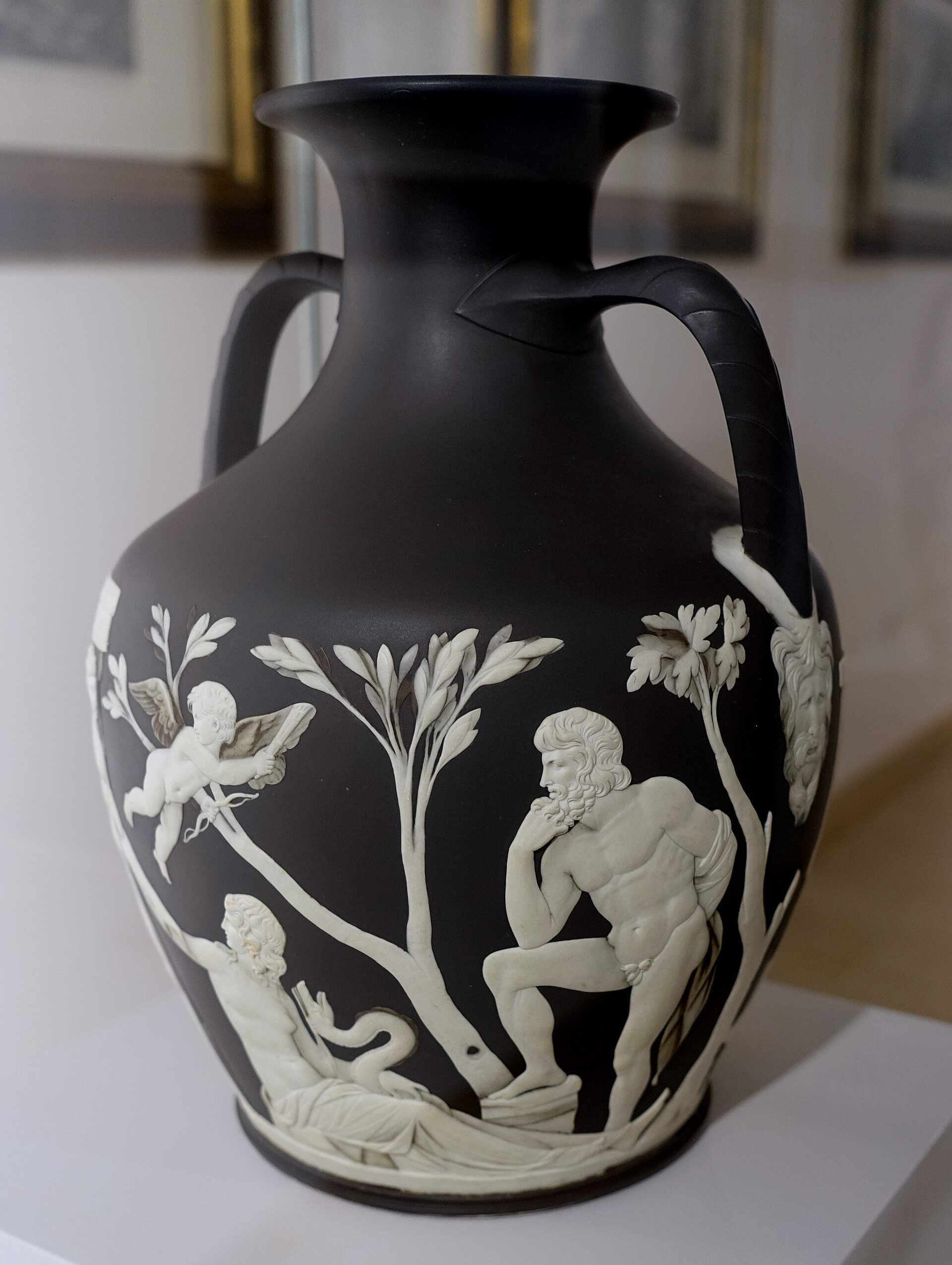
Wedgwood did not copy the vase in glass. He copied it in jasperware, his own dense unglazed stoneware, in a blue-black body with applied white reliefs. The technical problems were severe: cracking, blistering, and sprigged reliefs lifting off in the kiln. Accounts of how long it took differ, giving three years, four years, or nearly five years of experiment; the range is itself a fact worth recording. Erasmus Darwin received what Wedgwood considered the first perfect copy in October 1789.
The first edition was shown privately between April and May 1790, and demand was such that Wedgwood limited it by printing only 1,900 admission tickets. It then went into his public London showrooms. Between October 1789 and January 1795 he sold roughly thirty-one copies, at prices running from 50 guineas down to 30. First-edition copies are now in the Victoria and Albert Museum, the Fitzwilliam, the British Museum's Department of Britain, Europe and Prehistory, the Indianapolis Museum of Art and elsewhere. Wedgwood's own verdict on the project was blunt and has stuck to his reputation ever since.
In glass, the copy came a century later. Philip Pargeter of the Red House Glassworks at Wordsley produced a blue and white blank and commissioned the carver John Northwood, who worked on it for more than three years with steel tools of his own design and finished in 1876, against a standing offer of 1,000 pounds from Benjamin Richardson to any glassmaker who could reproduce the Roman original. That copy is now at the Corning Museum of Glass. Sources differ over exactly which man did which part of the work, and both names belong on it. Northwood's success launched the English cameo glass revival.
The consequence for anyone cataloguing this object is practical and severe. Wedgwood copies, later Wedgwood editions, Victorian glass replicas and modern reproductions exist in the hundreds, they are photographed constantly, they are in dozens of museums, and they are frequently captioned simply Portland Vase. A picture of a black or blue jasperware vase with white figures is not this object. This record carries one such copy deliberately, labelled as what it is.
Chapter 77 February 1845, and the five pound ceiling
The fourth Duke deposited the vase at the British Museum in 1810, on loan and not as a gift; secondary accounts say the immediate cause was a guest breaking the base.
The fourth Duke deposited the vase at the British Museum in 1810, on loan and not as a gift; secondary accounts say the immediate cause was a guest breaking the base. It sat in a case in Bloomsbury for thirty-five years.
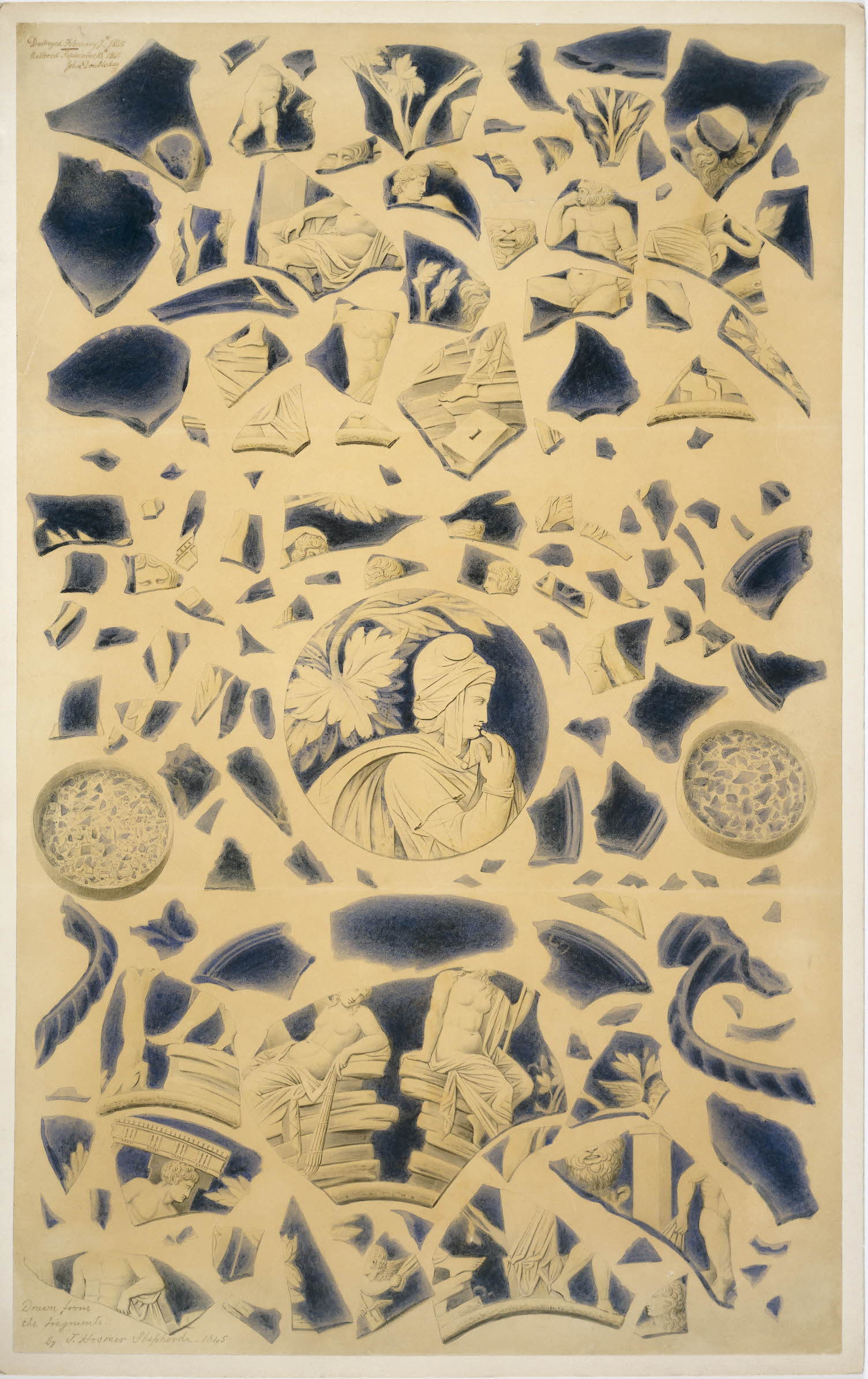
On the afternoon of 7 February 1845 a young man who gave his name as William Lloyd waited for the attendant to move away, picked up a piece of basalt sculpture from Persepolis, and threw it through the case. The vase came apart. Contemporary and later accounts give the number of pieces as well over eighty, as 189, and as about two hundred; the figure most often repeated is 189, and this record does not pretend the count is settled.
Lloyd was not his name. He was a Dubliner named Mulcahy, reported as a former Trinity College student who had left Ireland after family trouble and had been drinking for about a week. He was charged with wilful damage. His counsel then found the hole: the statute under which he was charged reached objects valued at up to five pounds and no further, and there was no provision covering the destruction of an object of the vase's kind. He was therefore convicted of breaking the display case, not the vase inside it, and fined three pounds with two months in prison in default.
He could not pay, and went to prison. An anonymous benefactor settled the fine and he was released. The Duke of Portland declined to pursue him in the civil courts, which spared his family. A 1954 account has him afterwards working as a scenic painter. Beyond that almost nothing is known of him. The most famous piece of Roman glass in the world was destroyed, and the maximum legal consequence available to the state was three pounds for a pane of glass.
Chapter 8Three restorations, and what each one left out
The first was immediate. John Doubleday reassembled the vase over the spring and summer of 1845 and finished on 10 September, and he signed the work by fitting a small disc under the foot inscribed...
The first was immediate. John Doubleday reassembled the vase over the spring and summer of 1845 and finished on 10 September, and he signed the work by fitting a small disc under the foot inscribed with the date of the breaking, the date of the restoration and his name. Thirty-seven small fragments would not go back. They were set aside, and a box maker named Gabb was commissioned to make a case with thirty-seven compartments, one to a fragment.
The box was never collected. The museum man who ordered it died; Gabb died; Gabb's executrix eventually asked a Mr Croker of Putney to find out what the pieces were. In 1948 Croker brought the box to Bernard Ashmole, Keeper of Greek and Roman Antiquities, who recognised them. The Portland Vase had spent a century missing thirty-seven of its own fragments because a joiner's bill went unpaid.
The second restoration followed straight on. Doubleday's adhesive had aged and discoloured, and the vase was taken apart in mid-November 1948 and rebuilt by the conservator J. W. R. Axtell using animal glue and a wax filler, finishing on 2 February 1949. Of the thirty-seven recovered fragments Axtell managed to place three. Thirty-four stayed in the box.
The third began on 1 June 1988. Axtell's adhesive had yellowed in turn and the vase had become too fragile to travel. Nigel Williams and Sandra Smith dismantled it completely, working with roughly 230 fragments, tested a large number of epoxy resins and settled on Hxtal NYL-1, chosen for its resistance to yellowing under prolonged light. The work was overseen by David Akehurst and filmed. All but a few small splinters were integrated, and the remaining gaps were filled with tinted blue or white resin. The vase returned to display on 1 October 1989. The reconstruction was designed to hold for at least a century.
Three restorations, three adhesives, three sets of leftovers. The object now on display is a Roman vessel held together by twentieth-century epoxy, standing on a Roman disc that does not belong to it, signed underneath by a Victorian restorer.
Chapter 9A loan for one hundred and thirty-five years
The vase was in the British Museum from 1810, but it did not belong to it.
The vase was in the British Museum from 1810, but it did not belong to it. It was the property of the Dukes of Portland, on deposit, and the museum's position was that of a custodian who could be given notice.
Notice came. Between 1929 and 1932 the sixth Duke, William Cavendish-Bentinck, withdrew it and offered it at Christie's in London. It failed to reach its reserve and went back to Bloomsbury. Neither the reserve figure nor the highest bid appears in the sources consulted for this record, and that is a real gap: it is the only occasion on which the open market was asked to price this object, and the number is not in general circulation.
In 1945 the British Museum bought it outright from the seventh Duke, with the aid of a bequest from James Rose Vallentin, and registered it as 1945,0927.1. The purchase price is likewise not published in the sources consulted here.
The sequence is worth stating plainly, because it is the shape of the whole object's modern history. The vase was smashed in 1845 while the museum did not own it. It was restored twice while the museum did not own it. It was nearly sold out from under the museum in 1929. The institution that is now inseparable from it in the public mind held it for one hundred and thirty-five years on terms it did not control.
The artist
Unrecorded Roman cameo-glass workshop, probably at Rome
There is no artist to write about, and pretending otherwise is the first way to get this object wrong. The Portland Vase is unsigned, undocumented and unattributed. What can be written about instead is the material and the craft, because Roman cameo glass is a narrow, short-lived and vanishingly rare category: perhaps fifteen more or less complete vessels and plaques survive worldwide, alongside roughly two hundred fragments, from a production window of about eighty years. That is the entire evidence base. Every statement about how this object was made is an inference drawn from fewer than twenty surviving siblings and one modern reconstruction programme.
Related works
| Work | Relation | Where it is |
|---|---|---|
| The Portland Vase disc Unrecorded Roman cameo-glass workshop | Fitted to this object as a base; not part of it Blue and white cameo glass roundel showing a head in a Phrygian cap, Paris or Priam. Cut down from a larger composition and added as a base to the truncated vase, perhaps in antiquity. Differs from the vase in colour, composition and style. Displayed separately since 1845. | British Museum, London |
| The Blue Vase (amphoriskos with cupids harvesting grapes) Unrecorded Roman cameo-glass workshop | Closest surviving comparandum in material and scheme Found at Pompeii, so buried no later than AD 79. Blue glass with opaque white overlay, the standard early Roman scheme. Two cameo panels and a dipper from Pompeii are in the same museum. | Museo Archeologico Nazionale, Naples |
| The Auldjo Jug Unrecorded Roman cameo-glass workshop | Named comparandum in the same material From Pompeii. One of the very small number of named early Roman cameo glass vessels; in the same collection as the Portland Vase. | British Museum, London |
| Portland Vase, jasperware copy Josiah Wedgwood and Sons | Reproduction in a different material; NOT this object About 1790, jasperware with applied white relief, 26.4 x 17.8 cm, gift of Mrs L. E. Holden. Among the earliest editions. Copies of this type are the single largest source of misidentified images of the Portland Vase. | Cleveland Museum of Art, accession 1918.823 |
| Portland Vase, first-edition subscription copy Josiah Wedgwood and Sons | Reproduction in a different material; NOT this object Dated 1793, black jasper with white relief, recorded as the subscription copy owned by the antiquarian Thomas Hope. | Wedgwood Museum, Barlaston, Stoke-on-Trent |
| Replica of the Portland Vase in cameo glass Philip Pargeter (blank) and John Northwood (carving) | First successful reproduction in glass; NOT this object Completed 1876 after more than three years of carving, against a standing offer of 1,000 pounds from Benjamin Richardson of the Red House Glassworks, Wordsley. Sources differ on the exact division of labour between Pargeter and Northwood. | Corning Museum of Glass, New York |
Open questions
- When was it made? The British Museum gives about AD 5 to 25, but low dates in the range of about 30 to 20 BC retain scholarly support and no independent dating evidence exists for the vessel itself.
- What does the frieze show? Readings divide between Greek myth (Peleus and Thetis, Dionysos and Ariadne) and Roman dynastic politics (Augustus, Antony, Cleopatra, Octavia), and there is no agreement on whether the two sides are one story or two. Filippo Coarelli's 2025 reading of Peleus and Thetis with the afterlife of Achilles is the newest, not the last.
- Where was it found? The Monte del Grano account of 1582 was rejected by Henry Stuart Jones in 1909 and reinstated by Coarelli in 2025. The two positions are both live in the current literature.
- Was it blown and cut, or moulded? The dip-overlay account is standard and supported by Gudenrath and Whitehouse's recreation; Lierke's moulding theory and Whiteley's 2017 CT evidence run against it, but Whiteley scanned a different fragment, not the vase.
- When did the pointed base come off, and when was the disc fitted? Both are undated. The disc may have been added in antiquity or long after; the sources give no decisive evidence.
- How many fragments were there in 1845? Accounts give well over eighty, 189, and about two hundred. The figure has never been reconciled in the sources consulted.
- What was the reserve, and the highest bid, at the Christie's offering of 1929 to 1932? This is the only time the open market was asked to price the vase and the figures are not in the sources consulted.
- What did the British Museum pay the 7th Duke of Portland in 1945? The purchase price is not published in the sources consulted.
- What happened to the vase between the reported discovery in 1582 and its appearance in Cardinal Del Monte's collection by about 1601? No owner is recorded for that interval.
Questions about this object
What is The Portland Vase?
The Portland Vase is a glass, dated c. AD 5-25, disputed. Low dates in the range c. 30-20 BC retain scholarly support, and the vase is often placed generally in the reign of Augustus, 27 BC to AD 14.. Medium: Cameo glass: cobalt-blue glass with an opaque white glass overlay, the white cut back in relief.
Who made The Portland Vase, and is the attribution settled?
The attribution to Unrecorded Roman glassworker and gem-cutter is recorded here as unknown. No maker is named, signed or documented. The vase is anonymous and has always been anonymous. The frequently repeated suggestion that the cutting is by the gem engraver Dioskourides, who worked for Augustus, is a stylistic proposal and rests on no inscription, signature or ancient text naming him in connection with this object. Two different trades were involved and probably two different hands: a glassblower who made the blue and white blank, and a gem-cutter who carved the relief. Neither is identifiable.
Where is The Portland Vase now?
British Museum, London. Inventory number 1945,0927.1 (also cited as GR 1945.9-27.1 and as Gems 4036).
What has The Portland Vase sold for?
Hammer 980 guineas (1,029 pounds); with premium, None. A buyer's premium was not a feature of English auction practice in 1786; the hammer price is the whole price. Mr Skinner and Co, 1786-06-07.
What is still unknown about The Portland Vase?
When was it made? The British Museum gives about AD 5 to 25, but low dates in the range of about 30 to 20 BC retain scholarly support and no independent dating evidence exists for the vessel itself.
Sources
- 1British Museum object record for the Portland Vase, registration 1945,0927.1, giving dimensions, technique, description and provenance summary. Consulted through the museum's Google Arts and Culture partner page; britishmuseum.org/collection/object/G_1945-0927-1 returned HTTP 403 to automated retrieval on 2 August 2026 and should be checked by hand. artsandculture.google.com/asset/...
- 2Milo Keynes, 'The Portland Vase: Sir William Hamilton, Josiah Wedgwood and the Darwins', Notes and Records of the Royal Society of London 52, no. 2 (July 1998), 237-259. The scholarly source for the Del Monte and Barberini ownership, the Byres and Hamilton transactions, the 1786 sale and the Wedgwood loan. darwin-online.org.uk/converted/...
- 3Filippo Coarelli, 'The Mausoleum of Alexander Severus and the Portland Vase', Journal of Roman Archaeology 38, no. 2 (December 2025), 409-434, doi 10.1017/S104775942510055X. Abstract and full citation consulted; the full text was not obtained. cambridge.org/core/...
- 4'Portland stoned: An Irishman's Diary about the Dubliner who broke one of the world's most famous vases', The Irish Times. The fullest account of Mulcahy, the alias, the charge, the five pound ceiling and the anonymous benefactor. irishtimes.com/opinion/...
- 5'A restoration 144 years in the making: how the Portland Vase was restored to its Roman glory', Sylcreate. A trade account by an adhesives manufacturer, used only for the conservation materials and chronology. Flagged for replacement with Nigel Williams, The Breaking and Remaking of the Portland Vase (British Museum Press, 1989). sylcreate.com/a-restoration-144-years-in-the-making-how-t...
- 6Victoria and Albert Museum, 'Josiah Wedgwood's Portland Vase'. Holding institution account of the jasperware copies, the manufacturing process and the V&A first edition, museum number WE.8000-2014. vam.ac.uk/articles/...
- 7Wikipedia, 'Portland Vase'. Tertiary. Used as the consolidating source for the frieze interpretations, the 1948-49 restoration detail, the box of thirty-seven fragments, the base disc, the Wedgwood exhibition ticketing and the 1929-32 Christie's offering. Flagged for replacement with Journal of Glass Studies 32 (1990), the Corning volume devoted to the vase, and with Williams 1989. en.wikipedia.org/wiki/...
- 8Wikipedia, 'Cameo glass'. Tertiary. Used for the size of the surviving Roman corpus, the production windows, the casing and flashing methods and the named Pompeian comparanda. Flagged for replacement with a specialist glass catalogue. en.wikipedia.org/wiki/...
- 9Mark Cartwright, 'The Portland Vase', World History Encyclopedia. Tertiary. Used for the figure-by-figure description, the lost pointed base and the unevenly cut mouth. worldhistory.org/article/...
- 10'New challenge to centuries-old theories on Roman glass', ANU College of Arts and Social Sciences, reporting Associate Professor Richard Whiteley's CT scanning of a Roman cameo glass fragment and his pate de verre hypothesis, presented at the British Museum in October 2017. cass.anu.edu.au/news/...
- 11Encyclopaedia Britannica, 'John Northwood'. Tertiary. Used for the 1876 glass copy, the Pargeter commission and Benjamin Richardson's 1,000 pound offer. britannica.com/biography/...
- 12Cleveland Museum of Art, Portland Vase, Josiah Wedgwood and Sons, about 1790, jasperware with applied decoration, 26.4 x 17.8 cm, accession 1918.823, gift of Mrs L. E. Holden. clevelandart.org/art/...
- 13Wikimedia Commons file record, 'Portland Vase - 1845 basal disc.jpg', reproducing the British Museum image of the disc Doubleday fitted in 1845 and transcribing its inscription. The record also notes the museum had catalogued the image under the Auldjo Jug. commons.wikimedia.org/wiki/...
- 14Wikimedia Commons file record for the Portland Vase disc photographed by Carole Raddato, carrying the British Museum gallery text explaining why the disc does not belong with the vase. commons.wikimedia.org/wiki/...
- 15Sir John Soane's Museum, catalogue record for 'A catalogue of the Portland Museum, lately the property of the Duchess Dowager of Portland, deceased: which will be sold by auction, by Mr. Skinner and Co. on Monday the 24th of April, 1786, and the thirty-seven following days ... at her dwelling-house, in Privy-Garden, Whitehall; by order of the acting executrix'. collections.soane.org/b7816

.jpg)
Last verified 29 August 2026 · Published 2 August 2026
Change log
2 August 2026 - Record created at the house standard: researched narrative, technical evidence, maker dossier, graded provenance chain, prices with hammer and premium separated, related works, open questions and sources.