The Astronomer
Johannes Vermeer · 1668
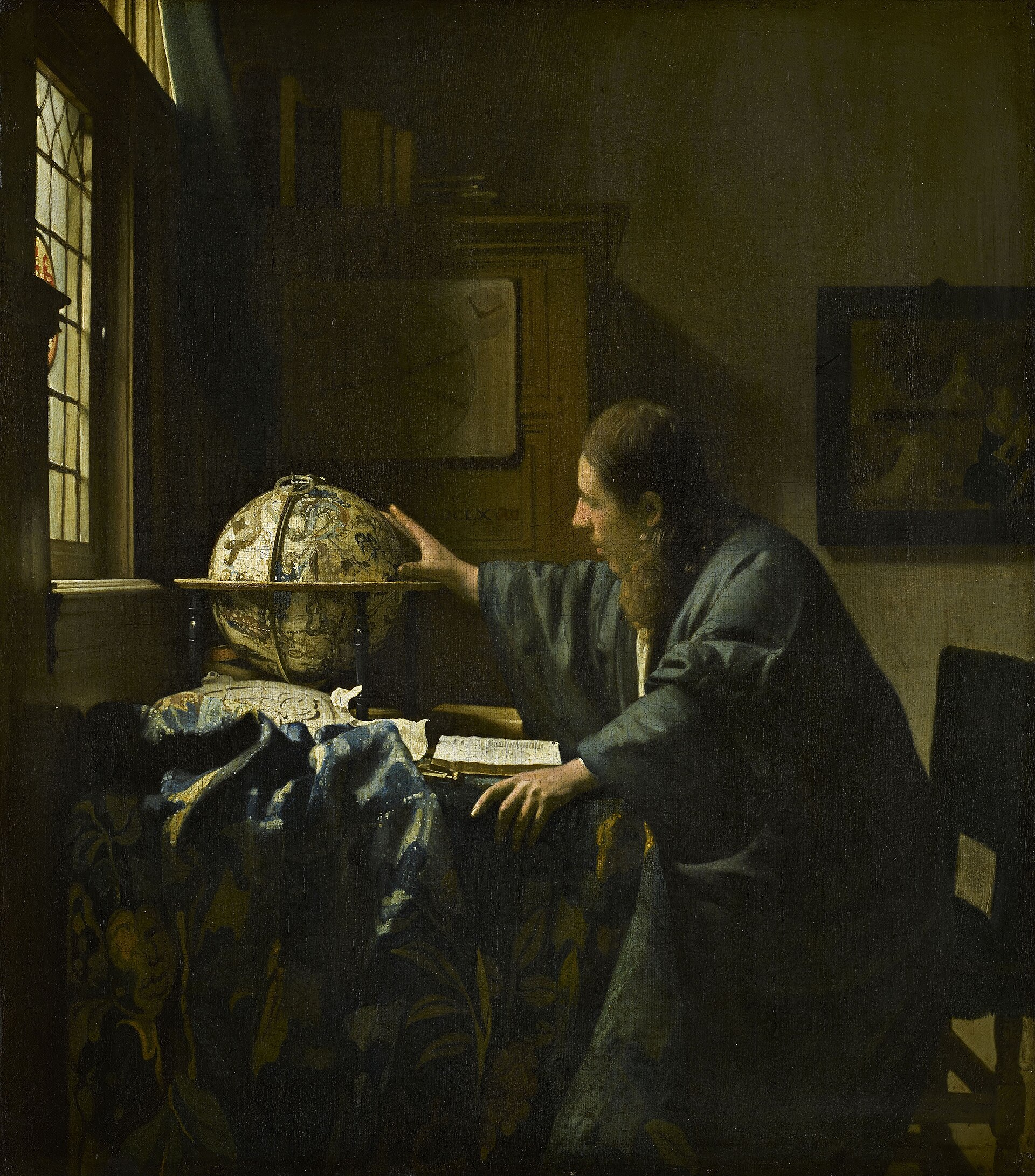
The record subject. Oil on canvas, 51 x 45 cm, signed and dated IVMeer 1668. Musee du Louvre, Paris, RF 1983 28, room 837. Seized in Paris in 1940 for the Linz museum, recovered in 1945, restituted in 1946.
| Artist | Johannes Vermeer |
|---|---|
| Date | 1668 |
| Medium | Oil on canvas |
| Dimensions | 51 x 45 cm. With frame, 91.7 x 84.8 x 6.7 cm. |
| Where it is now | Musee du Louvre, Paris, Departement des Peintures. Owned by the French State. On display in the Richelieu wing, level 2, room 837.last confirmed 4 August 2026 |
| Inventory number | RF 1983 28 |
| Attribution | AcceptedSigned and dated on the cupboard to the right of the globe, IVMeer 1668, the date in Roman numerals with the first three letters interlaced. Full note |
| Object type | Painting |
| Period | Dutch, seventeenth century |
| Cases | Has a provenance gap · Seized, looted or confiscated · Restituted or repatriated |
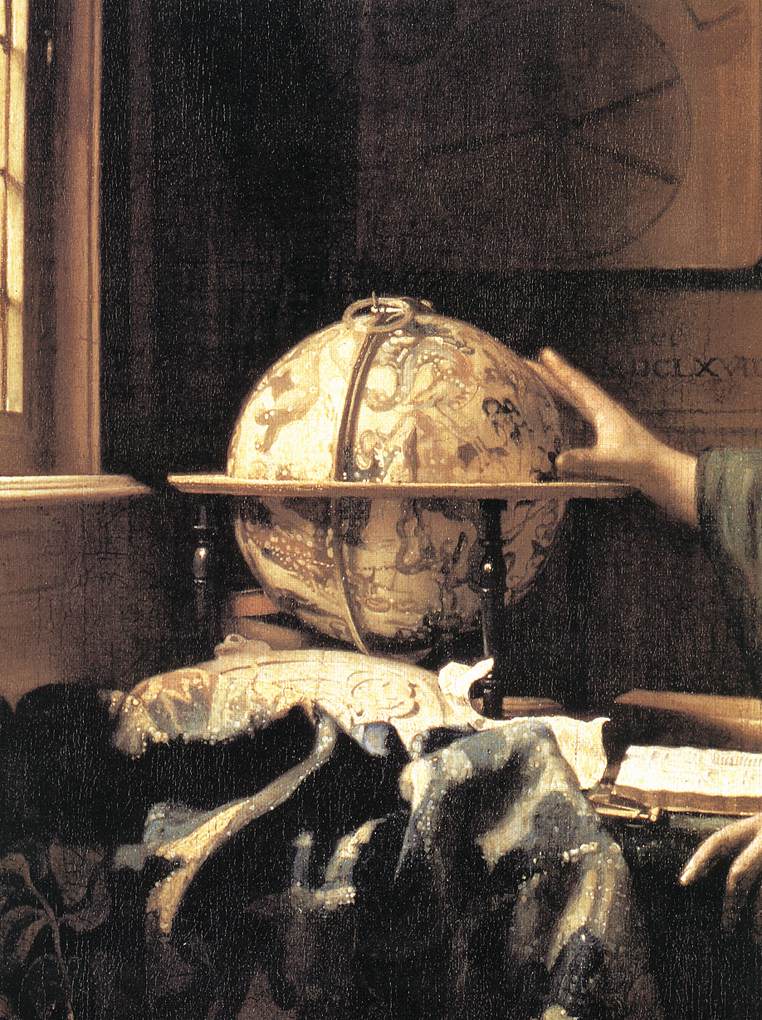
| Inscriptions | Signed and dated towards the centre, to the right of the globe: IVMeer 1668. The date is in Roman numerals; the first three letters of the signature are interlaced; both are slightly retouched. |
| Owners on record | 19 links16 documented, 2 disputed, 1 unknown |
| Sources | 4 cited |
About this record Last verified 6 August 2026 · 4 sources cited · Change log
On this page 11 sections
ContentsClose
A small canvas of 1668 showing a man in a gown turning a celestial globe, painted in Delft, sold and resold through Amsterdam salerooms for a century under four different titles, bought for a Paris collector in 1866 by the critic who invented Vermeer's modern reputation, and acquired by Baron Alphonse de Rothschild before 1888. In 1940 the German authorities seized it from the Rothschild family in Paris for the museum Hitler planned at Linz. A small swastika was stamped on the back. The Allies recovered it in 1945 and it was restituted to Baron Edouard de Rothschild in 1946.
It entered the Louvre in 1983, and not by purchase. The French state took it from Guy de Rothschild in settlement of inheritance duties under the dation en paiement, which is why no price for it has ever been published. This is the record in the corpus where the machinery worked: a documented seizure, a documented recovery, a documented return to the family within a year of the war ending, and a transfer to the state four decades later on the family's own terms.
Provenance
Each link is graded. Documented: a cited source supports it. Disputed: the identification is argued but not established. Unknown: no owner for that span, and the gap is not smoothed into a narrative. The grades in the glossary.
- 1668 -Johannes Vermeer, Delftdocumented
Signed and dated 1668. Painted with, or immediately before, The Geographer of 1669; the two canvases were cut from the same bolt of cloth.12
- - 1713Unknown; possibly the cabinet of Adriaen Paets, Rotterdamunknown
No owner is documented for the forty-five years between the painting's date and its first recorded sale. The 1713 Rotterdam sale may have formed part of the cabinet of Adriaen Paets, 1657 to 1712, the patron of Adriaen van der Werff, most of which was sold the previous day, but the catalogue entry is too laconic to establish it.
- 1713 - 1720H. Sorgh, art dealer, Amsterdamdocumented
Bought at Rotterdam on 27 April 1713 as lot 10, a learned mathematician, with the companion picture as lot 11. Sorgh was a grandson of the painter of that name. His estate sale followed on 28 March 1720, lots 3 and 4.1
- 1720 - 1729G. Looten, Amsterdamdocumented
His estate sale, Amsterdam, 31 March 1729, lot 6, catalogued simply as two Astrologues; the Louvre records that the two canvases cannot be told apart in that entry.1
- 1729 - 1778Jacob Crammer Simonsz., Amsterdamdocumented
Estate sale, Amsterdam, 25 November 1778, lot 18, as a philosopher, with a description matching this canvas; the companion was lot 19.1
- 1778 - 1784J. E. Fizeaux, Amsterdamdocumented
In his possession when the picture was engraved in 1784 at the request of the Paris dealer J.-B. P. Lebrun, who published the plate only in 1792. The engraving omits the signature and the date.1
- 1784 - 1785A. J. Paillet, Paris, with P. Fouquet the younger, Amsterdamdocumented
Entrusted or sold by Fizeaux's widow to Paillet, a Paris dealer and Lebrun's rival, in partnership with Fouquet. Paillet offered the picture to Louis XVI in 1785; nothing came of the purchase and he returned it to Fouquet, who had advanced the outlay.1
- - 1797Jan Danser Nijman, Amsterdamdocumented
The drawn copy made by Delfos in 1794, now in the Rijksmuseum, bearing the date 1673, was probably made while the picture was with him. Estate sale, Amsterdam, 16 August 1797, lot 167, with the companion as lot 168. This is the last time the two are sold together.1
- 1797 - 1800J. Gildemeesterdocumented
Estate sale, Amsterdam, 11 June 1800, lot 139, a philosopher in solitude, now separated from its companion. Bought by Labouchere, probably a dealer.1
- 1804 - 1857English ownership: possibly a Bryan sale, then J. Gibbons and W. Gibbonsdisputed
A picture that may be this one appears at the Bryan sale, London, 9 May 1804, lot 45a, as an Astronome by Van der Neer, recorded only in a second edition of the catalogue; the Louvre marks the link with a query. J. Gibbons, 1777 to 1851, offered it probably at Bristol on 7 October 1820, lot 31; it was unsold or bought in, since he lent it to an exhibition at Birmingham in 1828 as an Astrologue. The estate sale of W. Gibbons, probably a younger brother, London, 18 June 1857, lot 52, as a philosopher.1
- 1857 - 1866Tatedisputed
A collector named Tate, with no first name recorded. The Louvre suggests Thomas Moss Tate of Liverpool, two of whose estate sales are known in 1869, rather than Henry Tate, founder of the Tate Gallery. Sold at Christie's, London, 1863, lot 73; the catalogue has not been found but the sale is cited in 1866.1
- 1866 - 1881Leopold Double, Parisdocumented
Bought for Double by Theophile Thore, writing as William Burger, at the end of 1866 or in early January 1867, the same season in which Thore published the catalogue raisonne that recovered Vermeer for the modern world. Double's estate sale, Paris, 30 May 1881, lot 17, as the Astronome.1
- 1881 - 1905Baron Alphonse de Rothschild, Parisdocumented
Bought from the Paris dealer Leon Gauchez, who had acquired it at the Double sale. Recorded in Alphonse de Rothschild's possession by 1888.1
- 1905 - 1940Baron Edouard de Rothschild, Parisdocumented
Edouard Alphonse James de Rothschild, 1868 to 1949, son of Alphonse.1
- 1940 - 1945German authorities, for the projected Fuehrermuseum at Linzdocumented
Seized in Paris in 1940 for the museum Hitler intended at Linz, as the Louvre's own record states. The Rothschild collections were among the first taken by the Einsatzstab Reichsleiter Rosenberg, which processed looted French collections through the Jeu de Paume from 1940 to 1944. A small swastika was stamped in black ink on the reverse of the canvas.12
- 1945 - 1946Allied recoverydocumented
Recovered by the Allies in 1945.1
- 1946 - 1949Baron Edouard de Rothschild, Parisdocumented
Restituted to Baron Edouard de Rothschild in 1946, one year after recovery and to the man it had been taken from rather than to his heirs. He died in 1949.1
- 1949 - 1983Guy de Rothschild, Parisdocumented
Guy de Rothschild, 1909 to 2007, son of Edouard.1
- 1983 - presentThe French State, held by the Musee du Louvredocumented
Acquired from Guy de Rothschild by dation en paiement of transfer duties in 1982 to 1983, that is, in settlement of inheritance liability rather than by purchase. Inventory RF 1983 28. No price exists because no sale took place, and the valuation agreed for the tax has not been published in the sources consulted.1
Prices realised
This painting has not been offered at auction since 1881 and cannot be: it is French state property. It has appeared at public sale at least nine times between 1713 and 1881, at Rotterdam in 1713 and at Amsterdam in 1720, 1729, 1778, 1797 and 1800, possibly at London in 1804, at Bristol in 1820, at London in 1857 and 1863 and at Paris in 1881. NOT ONE PRICE FOR ANY OF THOSE SALES APPEARS IN THE HOLDING MUSEUM'S OWN PROVENANCE, and none is asserted here. The 1983 transfer to the Louvre was a dation en paiement of inheritance duties and produced no price at all. Any figure quoted anywhere as the value of this picture is an estimate by a third party and not a transaction.
Technical evidence
| Attribution note | Signed and dated on the cupboard to the right of the globe, IVMeer 1668, the date in Roman numerals with the first three letters interlaced. The Louvre records that both signature and date are slightly retouched, and that the date has sometimes been read as 1673, on the evidence of a drawn copy made by Delfos in 1794, but wrongly. The picture is in every accepted list of the roughly thirty-four paintings given to Vermeer. |
|---|---|
| Support | Canvas. Analysis published in 2017 established that this canvas and that of The Geographer in Frankfurt came from the same bolt of cloth.12 |
| Medium | Oil.1 |
| Dimensions | Height 0.51 m, width 0.45 m. The Louvre notes that the picture has not been cut down at the edges, as was at one point believed.1 |
| Signature | Towards the centre, to the right of the globe: IVMeer 1668, the date in Roman numerals, the first three letters interlaced, both signature and date slightly retouched. The date has sometimes been read as 1673, following a drawn copy made by Delfos in 1794, but the Louvre records that reading as wrong.1 |
| Frame | A Dutch seventeenth-century frame, possibly originally a mirror frame, given specifically for this painting by the De Boer gallery of Amsterdam in 1983. With the frame the object measures 91.7 by 84.8 cm and is 6.7 cm deep.1 |
| Instruments depicted | A celestial globe by Jodocus Hondius of 1600; Adriaan Metius's manual of astronomy of 1621, open at the chapter on the stars and showing an engraving of the wheel astrolabe of Metius's own invention; a pair of compasses; and a sixteenth-century astrolabe.1 |
| Picture within the picture | A Moses saved from the waters on the rear wall, given by the Louvre to Peter Lely in his Dutch period before 1643, and possibly from Vermeer's own collection.1 |
| Wartime mark | A small swastika stamped in black ink on the reverse of the canvas by the German authorities after the 1940 seizure. Reported in the general literature; not confirmed against a Louvre or archival record for this entry.2 |
| Inventory and ownership | RF 1983 28, Departement des Peintures. Owned by the French State, held by the Musee du Louvre.1 |
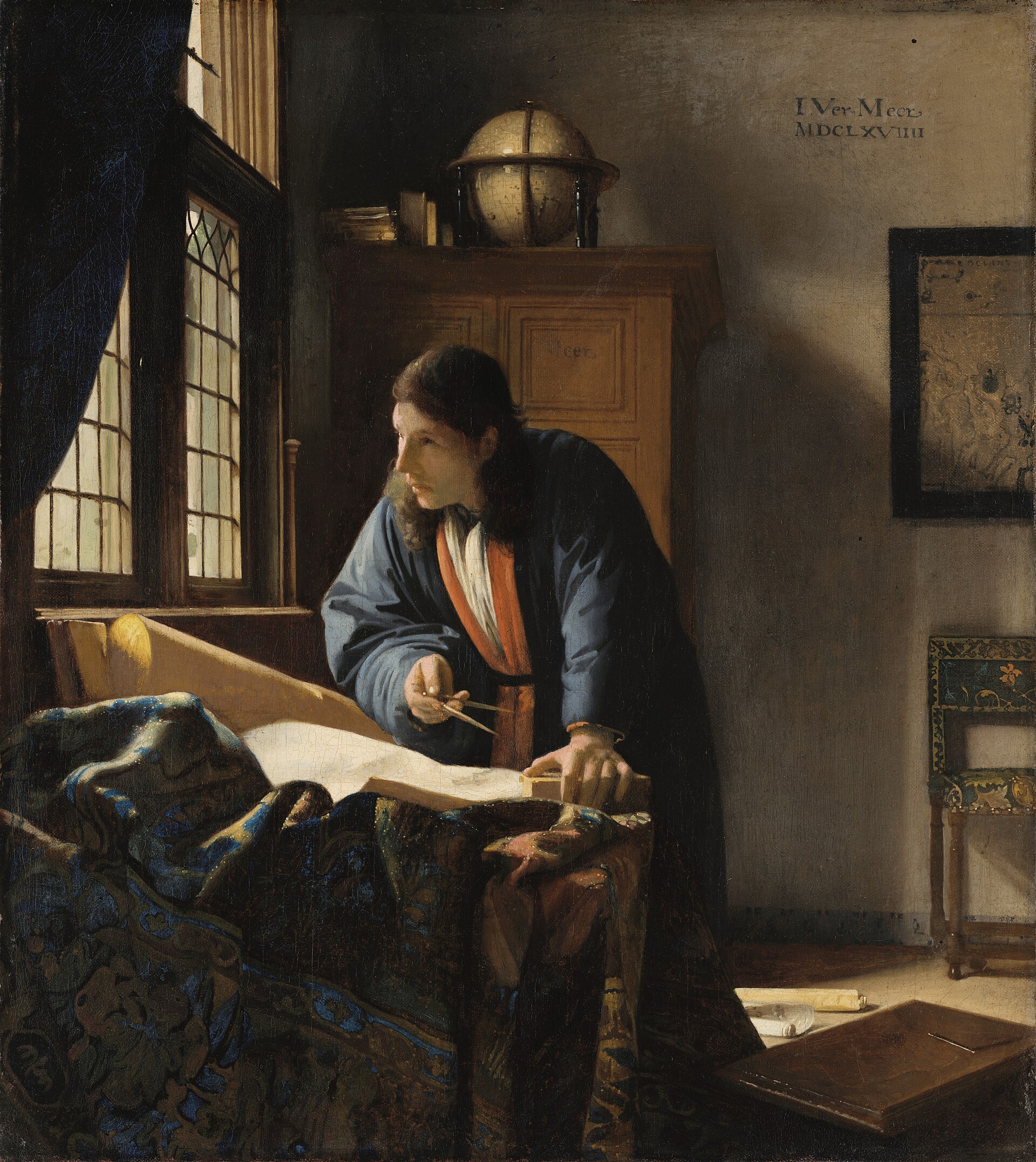
| The companion, for comparison | The Geographer, Staedel Museum inventory 1149, is 51.6 by 45.4 cm against this picture's 51 by 45, and is signed on the wall at upper right, I.Ver-Meer MDCLXVIIII, against this one's signature on the cupboard beside the globe. Both are dated in Roman numerals. The two canvases came from the same bolt of cloth.124 |
Images
The record in full
Chapter 1The one that came back
Most Nazi-era provenance records in this archive are about failure: gaps nobody can close, claims that ran for twenty years, panels that refused, objects that stayed where they were while money moved...
Most Nazi-era provenance records in this archive are about failure: gaps nobody can close, claims that ran for twenty years, panels that refused, objects that stayed where they were while money moved instead. This one is the control case.
The painting was seized from a named Jewish family in Paris in 1940 by a named German organisation for a named purpose, was found by the Allies in 1945, and was given back to its owner in 1946. There was no litigation, no advisory committee and no settlement. The chain runs unbroken through the war because the object was recovered before anyone had time to sell it, and because the family that owned it was still there to receive it.
What happened next is the part worth the reader's attention. Thirty-seven years later the same picture became French state property, and it did so through a tax mechanism rather than a sale. The Louvre did not buy the most famous Vermeer in France. It accepted it in payment of a death duty.
Chapter 2What it is
Oil on canvas, 51 by 45 centimetres, dated 1668.
Oil on canvas, 51 by 45 centimetres, dated 1668. A man in a long gown leans forward at a table covered with a rucked carpet and turns a celestial globe with his fingertips. Light comes through a leaded window at the left.
The instruments are identifiable, and the Louvre identifies them. The globe is Jodocus Hondius's celestial globe of 1600. The book open on the table is Adriaan Metius's manual of astronomy of 1621, open at the chapter on the stars, at a page carrying an engraving of the wheel astrolabe Metius invented. There is a pair of compasses and a sixteenth-century astrolabe.
On the wall behind hangs another picture, a Moses saved from the waters. The Louvre gives it to Peter Lely, from his Dutch period before 1643, and raises the possibility that it was in Vermeer's own collection. Vermeer traded pictures as well as painting them; a canvas he owned appearing on the wall of a canvas he painted is the kind of thing that is provable in a probate inventory and almost nowhere else.
The frame is not original and is not modern either. It is a Dutch seventeenth-century frame, possibly a mirror frame, given specifically for this painting by the De Boer gallery of Amsterdam in 1983, the year the picture entered the Louvre.
Chapter 3What the man is doing, and what the picture on the wall is for
The subject is the scholar at work, a Dutch pictorial tradition running through Rembrandt and Gerrit Dou, and adjacent to the older image of Saint Jerome in his study and of hermits at prayer.
The subject is the scholar at work, a Dutch pictorial tradition running through Rembrandt and Gerrit Dou, and adjacent to the older image of Saint Jerome in his study and of hermits at prayer. A seventeenth-century viewer would have read the room as a version of the study, and the man as a version of the contemplative.
The Moses on the wall is the instruction for how to read him. The Louvre's own catalogue puts it as an allusion to divine Providence, set as a counterpoint to the astronomer's activity, and then declines to say whether that activity is meant as vain or as wise. That refusal is correct and it is worth copying. The picture holds a man measuring the heavens against a scene of a child saved by God's hand, and it does not tell you which way to take it.
There is a further question the identification of the instruments raises and does not answer. Metius's manual is open at the stars. The globe is celestial, not terrestrial. Astronomy and astrology were not cleanly separated in 1668, and the picture has been catalogued as L'Astrologue as often as L'Astronome, including by the Louvre, which lists both titles. What the man is doing depends on which word you use, and the painting supplies no evidence either way.
Chapter 4The sitter, and why the usual answer is not one
The figure is often said to be Antoni van Leeuwenhoek, the Delft draper who built microscopes, who was born in the same year as Vermeer and who was appointed to administer his estate.
The figure is often said to be Antoni van Leeuwenhoek, the Delft draper who built microscopes, who was born in the same year as Vermeer and who was appointed to administer his estate. The Louvre states the identification and then states its status: sometimes identified, without proof, with the scientist Antoni van Leeuwenhoek, who in 1668 to 1669 was still too little known.
That second clause is the useful one. The argument for Leeuwenhoek runs on biography rather than likeness, and it needs him to have been a plausible subject for a portrait in 1668. He was not yet. His first communications to the Royal Society came in 1673.
The man in this picture also appears in The Geographer at Frankfurt. Whoever he was, Vermeer painted him twice.
Chapter 5The Geographer, and what the two pictures are to each other
The Geographer, in the Staedel Museum in Frankfurt since 1885 as inventory 1149, measures 51.6 by 45.4 centimetres against this picture's 51 by 45, and is signed and dated on the wall at upper right...
The Geographer, in the Staedel Museum in Frankfurt since 1885 as inventory 1149, measures 51.6 by 45.4 centimetres against this picture's 51 by 45, and is signed and dated on the wall at upper right, I.Ver-Meer MDCLXVIIII, the date retouched but probably right. The two canvases show the same room with the furniture slightly moved and, on the usual reading, the same man.
They travelled together for most of their recorded history. The Louvre's provenance shows them sold as a pair or as adjacent lots at Rotterdam in 1713, at Amsterdam in 1720, 1729, 1778 and 1797, and separated only at the Gildemeester sale of 1800, where this one appears alone as A philosopher in solitude. They were not shown together again until 1997, when the Louvre and the Staedel reunited them, first in Paris in January and then in Frankfurt in May, a hundred and ninety-seven years after they were parted.
Technical work has since tied them harder together: analysis of the canvas established that both were cut from the same bolt of cloth.
The Louvre is careful about what that makes them, and this record follows it. They are not exactly a pendant pair. They are a very close variation on one iconographic theme, and the antithetical reading often imposed on them, earth against sky, action against thought, has probably been overdone, not least because it does not show up in the way the two pictures are actually composed.
Chapter 6A century of Amsterdam salerooms, and four titles
The recorded chain begins on 27 April 1713 at Rotterdam, where the picture was lot 10, catalogued as a learned mathematician, with its companion as lot 11.
The recorded chain begins on 27 April 1713 at Rotterdam, where the picture was lot 10, catalogued as a learned mathematician, with its companion as lot 11. The sale may have been part of the cabinet of Adriaen Paets, the patron of Adriaen van der Werff, most of which had gone under the hammer the day before.
It was bought by H. Sorgh, an Amsterdam dealer and grandson of the painter of that name. His estate sale in 1720 offered it as lot 3 with the companion as lot 4, and from that point the two pictures become genuinely hard to tell apart in catalogues: at the Looten sale of 1729 they appear simply as two Astrologues, and the Louvre records that distinguishing them is impossible. At the Crammer Simonsz sale of 1778 the description of lot 18 matches this canvas.
Then a title migration, which is the mechanism by which pictures get lost. Savant mathematicien in 1713. Astrologist in 1720. Astrologue in 1729. Un philosophe in 1778 and 1797. Un philosophe en solitude in 1800. Astronome by 1881. At a London sale in 1804 a picture that may be this one is catalogued as an Astronome by Van der Neer, and the entry survives only in a second edition of the catalogue.
A researcher tracing this object through the eighteenth century is not tracing a title. There is no stable title to trace.
Chapter 7The picture Louis XVI did not buy
In 1784 the canvas was with J. E. Fizeaux in Amsterdam when it was engraved at the request of the Paris dealer Jean-Baptiste Pierre Lebrun, who did not publish the plate until 1792.
In 1784 the canvas was with J. E. Fizeaux in Amsterdam when it was engraved at the request of the Paris dealer Jean-Baptiste Pierre Lebrun, who did not publish the plate until 1792. The engraving omits the signature and the date.
Fizeaux's widow then put the picture, with its companion, into the hands of A. J. Paillet, a Paris dealer and Lebrun's rival, working in partnership with P. Fouquet the younger in Amsterdam. In 1785 Paillet offered it to Louis XVI. The purchase came to nothing and Paillet returned the pictures to Fouquet, who had advanced the money.
Paillet left a judgment on the pair which is the only period opinion of their relative quality on the record: the astronomer, he wrote, is as well painted, but the other does it much harm. Two hundred years later the state he tried to sell it to acquired it for nothing, in settlement of a tax.
Chapter 8Thore-Burger buys it, and Vermeer is invented
The picture passes through English hands for four decades in the nineteenth century: a Gibbons sale, probably at Bristol, in 1820, where it went unsold or was bought in, since Gibbons lent it to an...
The picture passes through English hands for four decades in the nineteenth century: a Gibbons sale, probably at Bristol, in 1820, where it went unsold or was bought in, since Gibbons lent it to an exhibition at Birmingham in 1828 as an Astrologue; a second Gibbons estate sale in London in 1857, as a Philosophe; a collector named Tate, whom the Louvre thinks was more likely Thomas Moss Tate of Liverpool than Henry Tate of the Tate Gallery; and a Christie's sale in 1863 whose catalogue has not been found.
At the end of 1866 or in the first days of January 1867 it was bought for the Paris collector Leopold Double by Theophile Thore, who wrote as William Burger.
That is not an incidental name. Thore-Burger published the catalogue raisonne of 1866 that recovered Vermeer for the nineteenth century and made him an international figure, having initially given him more than seventy works. The man who assembled the modern idea of Vermeer bought this canvas in the same season that he published the book. There is no cleaner example anywhere of a critic making a market and then buying into it.
Double's estate sale of 30 May 1881 offered it as lot 17, as the Astronome. The Paris dealer Leon Gauchez bought it, and sold it to Baron Alphonse de Rothschild, in whose possession it is recorded by 1888.
Chapter 91940: seized for Linz
Alphonse de Rothschild died in 1905 and the picture went to his son Edouard, born 1868.
Alphonse de Rothschild died in 1905 and the picture went to his son Edouard, born 1868. In 1940 it was seized by the German authorities in Paris. The Louvre's own record states the destination in as many words: for the Hitler museum at Linz.
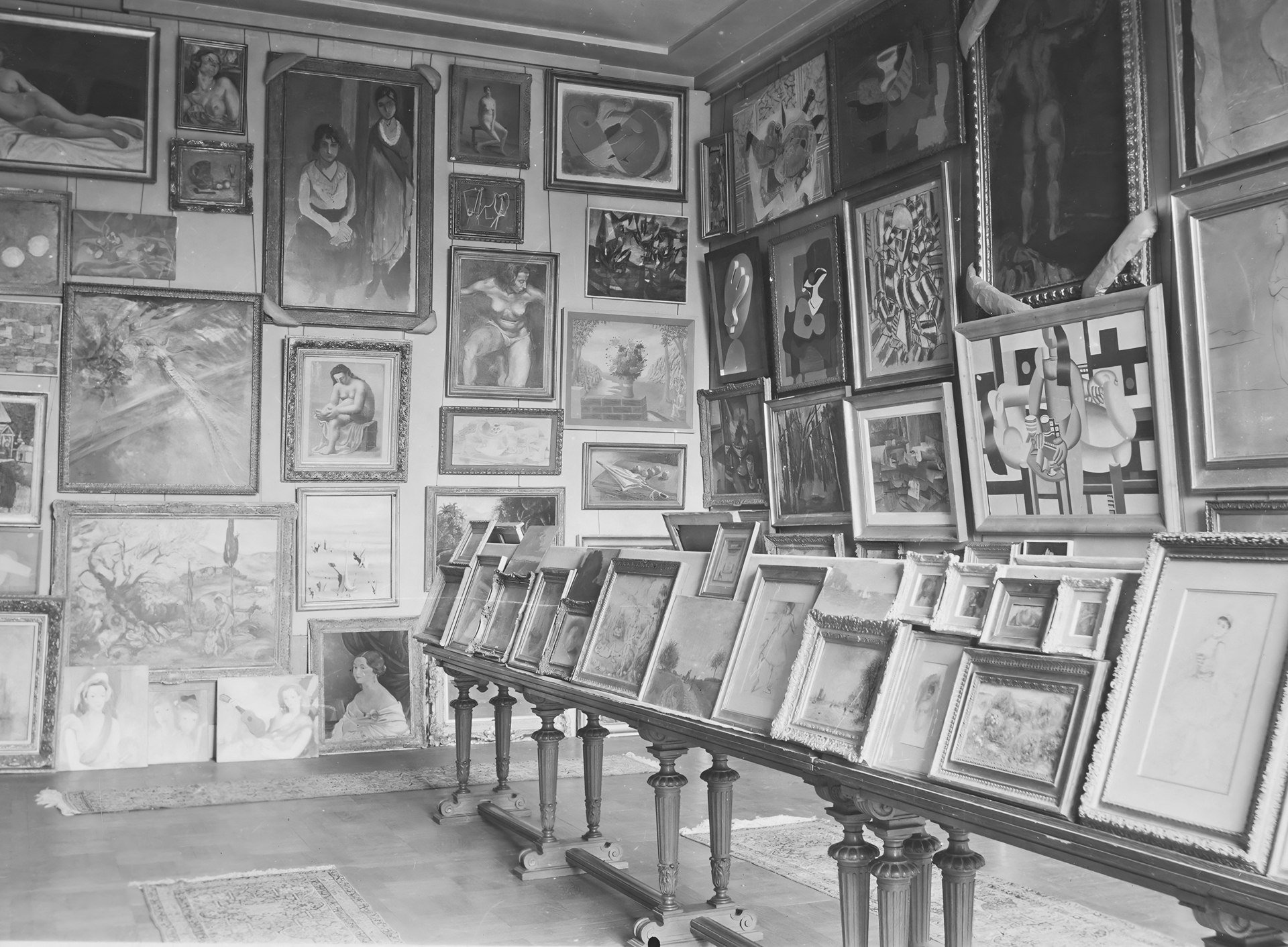
That is the Fuehrermuseum, the collection Hitler intended for his home town, for which the Einsatzstab Reichsleiter Rosenberg stripped French Jewish collections through the Jeu de Paume from 1940. The Rothschild collections were among the first and largest taken. A small swastika was stamped in black ink on the back of this canvas.
The mark matters out of proportion to its size, and it is the reason this object belongs in a provenance archive rather than only in a Vermeer catalogue. A provenance gap is an absence and has to be argued about. A stamp is a presence. It is the seizure written on the object in the seizing authority's own hand, and it converts the 1940 to 1945 link from a claim into a physical fact.
Chapter 101945 and 1946: recovered and returned
The Allies recovered the painting in 1945 and it was restituted to Baron Edouard de Rothschild in 1946.Two things about that sentence are worth stating plainly, because the rest of this archive's...
The Allies recovered the painting in 1945 and it was restituted to Baron Edouard de Rothschild in 1946.
Two things about that sentence are worth stating plainly, because the rest of this archive's Nazi-era records make them look remarkable. First, it took one year. Second, the object went back to the person it was taken from, not to his heirs, not to a compensation fund, and not to a settlement in which somebody kept it and paid for the privilege.
The reasons are unglamorous. The picture was taken late, kept intact for a museum that was never built rather than sold on the market, found by the Allied recovery effort with its records legible, and claimed by a family that had survived, had the means to pursue it and could prove ownership from a published nineteenth-century catalogue. Change any one of those and this record would read like the others in this archive.
Edouard de Rothschild died in 1949. The picture passed to his son Guy.
Chapter 111983: a dation, not a purchase
The Louvre acquired the painting from Guy de Rothschild in 1982 to 1983 by dation en paiement of transfer duties.
The Louvre acquired the painting from Guy de Rothschild in 1982 to 1983 by dation en paiement of transfer duties. It carries the inventory number RF 1983 28 and it is owned by the State.
A dation is not a sale and should never be reported as one. Under the French mechanism, an heir liable to death duties may discharge the liability by handing over a work of art of agreed value instead of money. The state receives the object; the family receives a credit against a tax bill. No cash changes hands and no market price is established.
So there is no acquisition price for this painting and there never was one. The Louvre publishes none, and any figure quoted for it would be either the agreed valuation for the tax, which has not been published in the sources consulted, or an invention. This is the point the archive makes repeatedly about museum acquisitions and it is at its sharpest here: the most important Vermeer in France entered the national collection at a price of zero and a cost of whatever the Treasury forwent.
It is also the reason the object is where it is. A family holding a picture of this stature and facing a death duty has two options, and one of them is a sale abroad. The dation is the instrument that keeps such objects in the country, and it does so by making the tax bill the lever rather than an export ban.
Chapter 12What is happening to it now
It hangs in the Richelieu wing of the Louvre, level 2, room 837, in a room built around Jacob van Ruisdael.It travels.
It hangs in the Richelieu wing of the Louvre, level 2, room 837, in a room built around Jacob van Ruisdael.
It travels. It was in the Louvre's Vermeer and the Masters of Genre Painting in 2017, which went on to Dublin and to the National Gallery of Art in Washington. It was at the Louvre Abu Dhabi through 2021 to 2023. Most recently it was lent to Lire le ciel at the Mucem in Marseille, from 9 July 2025 to 5 January 2026, hung as an object about reading the sky rather than as a Dutch genre picture.
The Louvre's own record was last updated on 2 December 2025 and carries a warning on its face that its contents do not necessarily take account of the latest data. That warning is on every entry in that database, and it is a more honest statement than most museum labels manage.
The artist
Johannes Vermeer
Vermeer painted perhaps fifty pictures in twenty years and about thirty-four are universally accepted. He never left Delft in any documented way, he sold slowly, he dealt in other men's paintings to make up the income, and he died in debt at forty-three. For roughly a century and a half after that he was effectively invisible: his works circulated under other names or under no name at all, which is exactly what the eighteenth-century catalogue history of this picture shows. The Vermeer the world now has was assembled in the 1860s by a French critic, and this canvas passed through that critic's hands.
Exhibited
- 1828Exhibition (lent by J. Gibbons, as an Astrologue)Birmingham
- 1985-1986Anciens et nouveaux: works acquired by the State or with its participation, 1981-1985Galeries nationales du Grand Palais, Paris
- 1997Vermeer's Astronomer and Geographer, reunited after two centuriesMusee du Louvre, Paris, and Staedel Museum, Frankfurt
- 2014-2015Rembrandt and the Dutch Golden AgeSzepmuveszeti Muzeum, Budapest
- 2015Genre painting: scenes of daily lifeNational Art Center, Tokyo, and Kyoto Municipal Museum of Art
- 2015-2016Class Distinctions: Dutch Painting in the Age of Rembrandt and VermeerMuseum of Fine Arts, Boston
- 2017Vermeer and the Masters of Genre PaintingMusee du Louvre, Paris; National Gallery of Ireland, Dublin; National Gallery of Art, Washington
- 2021-2023Louvre Abu Dhabi, fifth hangLouvre Abu Dhabi
- 2025-2026Lire le ciel: reading the sky under the stars in the MediterraneanMucem, Marseille
Related works
| Work | Relation | Where it is |
|---|---|---|
| The Geographer Johannes Vermeer | The companion. Same room, same model, same bolt of canvas Oil on canvas, 51.6 x 45.4 cm, signed and dated on the wall upper right I.Ver-Meer MDCLXVIIII. Acquired by the Staedel in 1885. Sold with the Astronomer at every recorded auction from 1713 to 1797, separated in 1800, reunited with it for the first time in 1997. The Staedel names it the counterpart of the Louvre picture. | Staedel Museum, Frankfurt am Main, inventory 1149 |
| Moses saved from the waters Peter Lely, Dutch period, before 1643 | The picture hanging on the wall inside this painting The Louvre raises the possibility that the canvas was in Vermeer's own collection. It is the interpretative key to the figure, set as a counterpoint of divine Providence against the astronomer's activity. | Unlocated as an object; known here only as a painted quotation |
| Portrait of Wally Neuzil Egon Schiele | Contrast: a seizure that took seventy years and nineteen million dollars to resolve, and did not end in a return The difference between the two files is not the strength of the evidence. It is that this picture was recovered intact in 1945 and its owner was alive to claim it. | Leopold Museum, Vienna |
| Adam and Eve Lucas Cranach the Elder | Contrast: also taken for the Linz project, also recovered by the Allies, and never returned to the family The Cranachs went from Allied recovery into the Dutch state's own restitution machinery and out the other side to a third party. This one went straight back to its owner. | Norton Simon Museum, Pasadena |
Open questions
- Is the swastika stamp on the reverse still present, and has it ever been published in a technical report or photographed? The mark is repeated throughout the general literature; no primary record of it was reached for this entry.
- What ERR inventory code was assigned to the painting in 1940, and does the Jeu de Paume card for it survive? The ERR databases were not reachable for this entry.
- At what value was the picture accepted in settlement of the transfer duties in 1982-1983? The Louvre publishes the mechanism and not the figure, and no published valuation was found.
- Which sale is the 1804 Bryan lot in London, catalogued as an Astronome by Van der Neer and recorded only in a second edition of the catalogue? The Louvre marks the link with a query.
- Which Tate owned it before the 1863 Christie's sale? The Louvre leans to Thomas Moss Tate of Liverpool over Henry Tate, and the 1863 catalogue has not been found.
- Who is the sitter? The Leeuwenhoek identification is stated without proof by the holding museum itself, and rests on a man who was not yet publicly known when the picture was painted.
Questions about this object
What is The Astronomer?
The Astronomer is a painting, dated 1668. Medium: Oil on canvas.
Who made The Astronomer, and is the attribution settled?
The attribution to Johannes Vermeer is recorded here as accepted. Signed and dated on the cupboard to the right of the globe, IVMeer 1668, the date in Roman numerals with the first three letters interlaced. The Louvre records that both signature and date are slightly retouched, and that the date has sometimes been read as 1673, on the evidence of a drawn copy made by Delfos in 1794, but wrongly. The picture is in every accepted list of the roughly thirty-four paintings given to Vermeer.
Where is The Astronomer now?
Musee du Louvre, Paris, Departement des Peintures. Owned by the French State. On display in the Richelieu wing, level 2, room 837. Inventory number RF 1983 28. Last confirmed 4 August 2026. Acquired from Guy de Rothschild by dation en paiement of transfer duties, 1982-1983. Restituted to Baron Edouard de Rothschild in 1946 after recovery by the Allies in 1945.
What is still unknown about The Astronomer?
Is the swastika stamp on the reverse still present, and has it ever been published in a technical report or photographed? The mark is repeated throughout the general literature; no primary record of it was reached for this entry.
Sources
- 1Musee du Louvre, collections database, entry for L'Astronome, RF 1983 28, Departement des Peintures, permalink ark:/53355/cl010064324, last updated 2 December 2025. The museum's own record: signature and its retouching, dimensions with and without frame, the 1983 De Boer frame, the identification of the Hondius globe and the Metius manual, the Lely Moses on the rear wall, the Leeuwenhoek identification and its lack of proof, the complete provenance from the Rotterdam sale of 27 April 1713 to the dation of 1982-1983, the mode of acquisition, the exhibition history and the bibliography. PRIMARY. collections.louvre.fr/en/...
- 2Wikipedia, 'The Astronomer (Vermeer)', TERTIARY, used only for the swastika stamped in black ink on the reverse after the 1940 seizure and for the 2017 canvas analysis showing that this picture and The Geographer came from the same bolt. Flagged for replacement with the Louvre's 2017 exhibition catalogue and an archival record of the mark. en.wikipedia.org/wiki/...
- 3Wikipedia, 'Johannes Vermeer', TERTIARY, used only for the artist dossier: the baptism and death dates, the father's trades, the 1653 marriage and conversion, Maria Thins and Leonaert Bramer, the Guild of Saint Luke and the four terms as headman, the fifteen children, the size of the accepted corpus, the rampjaar and the widow's account of his death, and Thore-Burger's 1866 catalogue. Flagged for replacement with John Michael Montias, Vermeer and His Milieu. en.wikipedia.org/wiki/...
- 4Staedel Museum, Frankfurt am Main, online collection entry for The Geographer: 1669, oil on canvas, 51.6 x 45.4 cm, inventory 1149, signed and dated upper right on the wall I.Ver-Meer MDCLXVIIII, acquired in 1885, and identified by the museum as the counterpart to the Louvre's Astronomer. PRIMARY for the companion picture. sammlung.staedelmuseum.de/en/...
Last verified 6 August 2026 · Published 6 August 2026
Change log
6 August 2026 - Record created at the house standard: researched narrative, technical evidence, maker dossier, graded provenance chain, prices with hammer and premium separated, related works, open questions and sources.