The Crucifixion; The Last Judgment
Jan van Eyck · ca. 1436-38
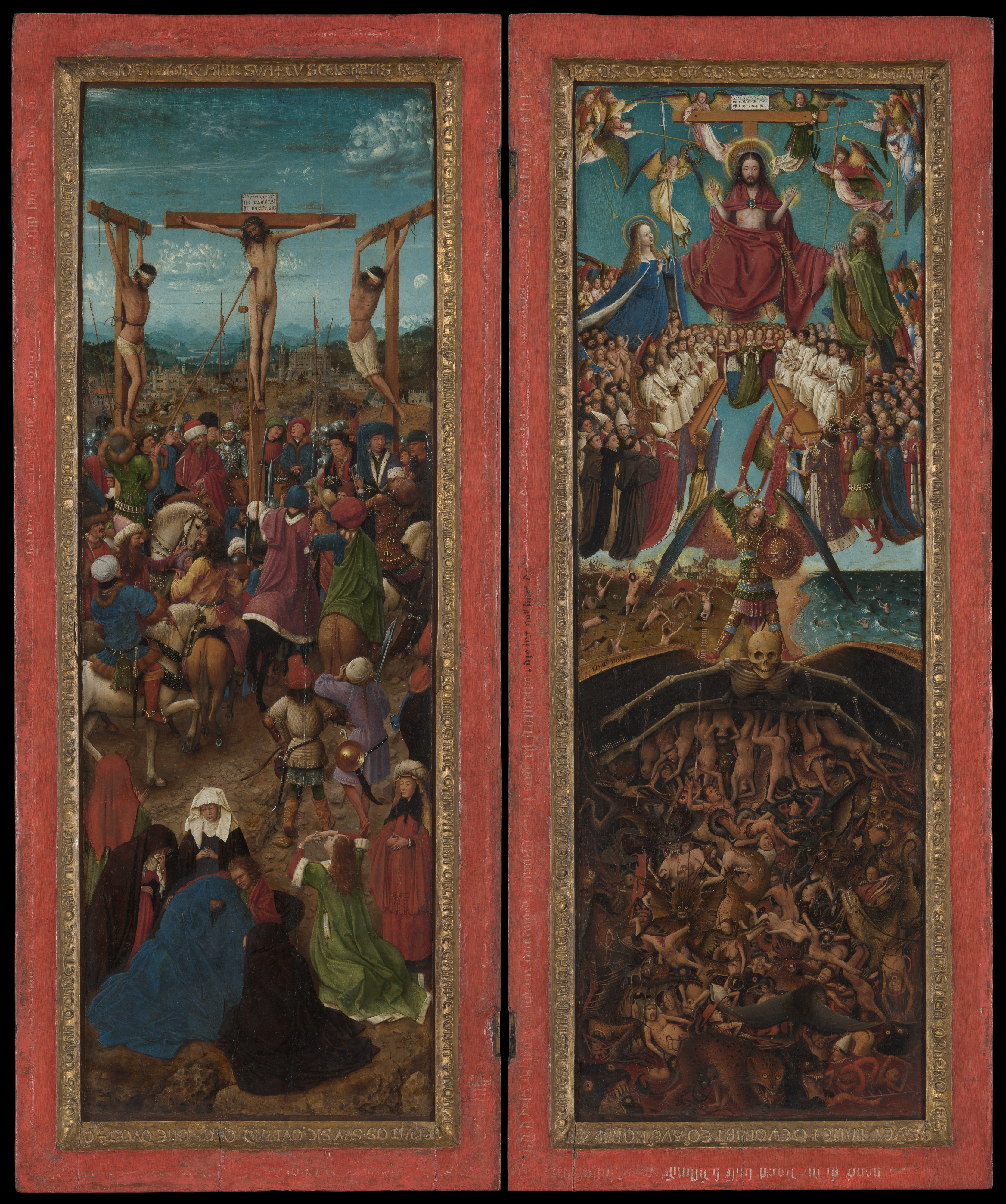
The record subject. Two panels, each 56.5 x 19.7 cm, oil on canvas transferred from wood, about 1436-38. The Metropolitan Museum of Art, 33.92ab, published by the museum as open access.
| Artist | Jan van Eyck |
|---|---|
| Date | ca. 1436-38 |
| Medium | Oil on canvas, transferred from wood |
| Dimensions | Each 56.5 x 19.7 cm (22 1/4 x 7 2/3 in.) |
| Where it is now | The Metropolitan Museum of Art, New Yorklast confirmed 4 August 2026 |
| Inventory number | 33.92ab |
| Attribution | AcceptedGiven by the Metropolitan Museum to Jan van Eyck, and the subject of one of the longest attribution arguments in the literature. Full note |
| Object type | Painting |
| Period | Netherlandish, fifteenth century |
| Cases | Has a provenance gap |
| Inscriptions | Latin biblical texts in gilded pastiglia on the cavettos of the original frames: Isaiah 53:6-9 and 12 around the Crucifixion; Revelation 21:3-4 and 20:13 around the Last Judgment, beginning at the centre left with Ecce Tabernaculum Dei cum Hominibus; Deuteronomy 32:23-24 below, for hell. A now fragmentary Middle Dutch translation in white paint on a red ground runs on the flat outer borders, identified as Middle Dutch by the palaeographer Marc Smith and uncovered beneath modern gilding. |
| Owners on record | 6 links5 documented, 1 unknown |
| Sources | 4 cited |
About this record Last verified 9 September 2026 · 4 sources cited · Change log
On this page 10 sections
ContentsClose
Two panels, each about the size of a forearm, holding between them a Crucifixion crowded with figures under a city and a Last Judgment split into heaven above and a hell held open by Death. They were bought in Spain in the 1840s by a Russian ambassador, transferred from wood to canvas in 1867, bequeathed to the Imperial Hermitage, and sold out of the Soviet Union in 1933 for foreign currency to pay for the first Five Year Plan. The Metropolitan Museum bought them through Knoedler; the sale was secret until The New York Times reported it on 4 November 1933.
For a hundred and thirty years they were argued back and forth between Jan van Eyck, his brother Hubert, his sister Margaret, Petrus Christus, a pupil and the school. The Met's recent research reads them as the doors of a shrine made to hold a purportedly desecrated host in Brussels, and argues that the format objections dissolve once the function is understood. The frames, cut away in 1867 and kept, turned out to carry a vernacular Dutch text under modern gilding, and are the strongest evidence in the case.
Provenance
Each link is graded. Documented: a cited source supports it. Disputed: the identification is argued but not established. Unknown: no owner for that span, and the gap is not smoothed into a narrative. The grades in the glossary.
- ca. 1436-38 - before 1841Unrecorded; a religious house in Spainunknown
Four hundred years with no named owner. Passavant wrote in the Kunstblatt of 12 January 1841 that the panels were the wings of a triptych acquired at an auction at a monastery. The Met's own provenance records only that Tatishchev bought them from a convent near Madrid, with a question mark against the alternative that it was near Burgos. Which house, when it was suppressed and what stood between the two wings are all unknown. If the Met's 2022 argument is right and the shrine was made for the church of Saints Michael and Gudula in Brussels, then how the doors reached Spain is a further unanswered question.1
- by 1841 - 1845Dmitry Pavlovich Tatishchev, Vienna and St Petersburgdocumented
Russian ambassador to Spain, who bought the panels there as by Jan van Eyck. His attribution, made by a diplomat buying out of a suppressed religious house, is the one the museum has come back to after a century and a half of learned dissent. He bequeathed them to the Imperial Hermitage.1
- 1845 - 1917The Imperial Hermitage, St Petersburg, under Nicholas I and his successorsdocumented
Catalogued as no. 444. The panels were transferred from wood to canvas in 1867 while in the Hermitage, and the original integral frames were cut away and kept. Waagen's Hermitage catalogue of 1870 lists them at no. 444 and reassigns them from van Eyck to Petrus Christus.1
- 1917 - 1933Hermitage Museum, Leningraddocumented
The imperial collection became a state museum after the revolution. In February 1928 the Hermitage and the Russian Museum were ordered to list works worth at least two million roubles for export, to raise foreign currency for the first Five Year Plan.13
- 1933 - 1933Knoedler, New Yorkdocumented
Knoedler was the firm most used by Andrew Mellon and, with Colnaghi of London and the dealer Matthiesen, formed the consortium that handled the Soviet sales. About 250 paintings left the Hermitage in these years, and Jan van Eyck is named among the artists.13
- 1933 - presentThe Metropolitan Museum of Art, New Yorkdocumented
Fletcher Fund, accession 33.92ab. The purchase was secret until The New York Times reported on 4 November 1933 that several Hermitage paintings had been bought by the Metropolitan Museum. The museum records that this work may not be lent.123
Prices realised
These panels have never been offered at public auction. Every transfer in the recorded chain was a purchase from a religious house, a bequest, a nationalisation or a government sale conducted through dealers. No hammer price exists for them and no price for the 1933 purchase is published in the sources consulted. For scale on the wider transaction: Andrew Mellon had acquired twenty-one Hermitage paintings for a total of USD 6,654,000 by the end of 1931, a figure that belongs to his purchases and not to this one.
Technical evidence
| Attribution note | Given by the Metropolitan Museum to Jan van Eyck, and the subject of one of the longest attribution arguments in the literature. Dmitry Tatishchev bought the panels in Spain as van Eyck. Gustav Waagen reassigned them to Petrus Christus in 1870 on the strength of the signed Berlin Last Judgment; Crowe and Cavalcaselle followed in 1872; Schnaase made them a pupil's in 1879; Justi restored them to Jan in 1887; Kaemmerer in 1898 proposed early Jan or his sister Margaret; Tschudi agreed with Jan the same year; Voll rejected both Christus and Jan in 1900 and proposed the school; Seeck gave them to Hubert van Eyck in 1901. The standing objections were the tall narrow format, the small figures, the extensive narrative and the unusual raised texts on the frames. The Met's 2022 research argues that all of them follow from the function, painted doors of a reliquary shrine, and dismisses them on that basis. Some authorities still read the pictures as Jan with workshop assistance. |
|---|---|
| Support | Originally oil on oak, each panel cut from a single plank with a fully integral frame. Transferred from panel to canvas in 1867, before entering the Met, with the paint and original ground adhered to a coarse canvas using a probable zinc-containing adhesive and mounted on five-member stretchers.1 |
| The frames | The original integral frames were cut away during the 1867 transfer and preserved. Dendrochronology gives a felling date for the frame oak of about 1410 to 1440, from the same part of the eastern Baltic as the wood of the Virgin at the Fountain at the Clark Art Institute.1 |
| Hardware evidence | Hinge recesses on the inner sides of the frames; three square latch holes on the outer sides in the positions they would occupy if the two were closed face to face as a diptych; and, in the x-radiographs, nails from fittings that latched the frames closed side by side as the wings of a triptych. Both arrangements existed at different times.1 |
| Ground | The original ground preparation is mainly calcium carbonate in its calcite form, that is chalk.1 |
| The frame inscriptions | Latin in gilded pastiglia on the cavettos; a fragmentary Middle Dutch translation in white and black on a solid red ground on the flat outer borders, found beneath modern gilding and identified by the palaeographer Marc Smith. The Latin around the Last Judgment begins at the centre left, not the upper left, with Ecce Tabernaculum Dei cum Hominibus.1 |
| Geology in the underdrawing | The rocks at the base of the Crucifixion have been identified as recognisable specimens resembling columnar basalt, pillow lava and certain sedimentary rocks, with observations by Federico Caro and Elena Basso, and the underdrawing shows they were laid in at the preliminary design stage.1 |
| Dimensions | Each 56.5 x 19.7 cm (22 1/4 x 7 2/3 in.).12 |
| Open access | The Metropolitan Museum publishes the primary photograph of this object as open access under CC0, verified against the museum's own isPublicDomain flag at fetch time, with sixteen additional images.2 |
Images
The record in full
Chapter 1What they are
Two paintings, each 56.5 by 19.7 centimetres, now oil on canvas but originally oil on oak.
Two paintings, each 56.5 by 19.7 centimetres, now oil on canvas but originally oil on oak. The proportion is the first thing to notice: they are more than twice as tall as they are wide, which is not a shape Jan van Eyck used anywhere else that survives.
The Crucifixion shows the moment after death, when the soldier traditionally called Longinus is helped to push a lance into Christ's side to establish that he has died. Below the cross the crowd divides: on the right a group meditates or stares, on the left another jeers. Below them the Virgin hides her face and is held up by John, surrounded by the other Marys, with the Magdalen in a fur-trimmed green gown raising her joined hands. In the lower right corner a woman in red with a black shawl and a turban watches without emotion; who she is has never been settled. Behind everything is a city meant for Jerusalem and a mountain range, and at the right edge a waning gibbous moon hangs in a midday sky, hours before the third hour after noon at which the Gospel of Mark places the death.
The Last Judgment divides horizontally rather than in the usual way. Christ reigns above with the wounds showing, flanked by the Virgin and John the Baptist, with angels holding the instruments of the Passion. Below, Saint Michael stands on the wings and skeletal arms of Death, which spread open over a hell of bodies being torn apart. Between the two, the dead climb out of their graves and out of the sea.
Chapter 2The apostles are Carthusians, and the Virgin is a Virgin of Mercy
Two details in the Last Judgment are not standard and both point in the same direction.
Two details in the Last Judgment are not standard and both point in the same direction. The twelve apostles seated in glory are dressed in the white habits of the Carthusian order. And the Virgin is shown as the Virgin of Mercy, spreading her cloak wide to shelter the naked souls begging her to intercede, which is a specifically Carthusian devotion.
An iconographic anomaly of that kind is not decorative. It records who the picture was for, or who was involved in specifying it, and it is one of the threads that leads the Met's researchers to the Carthusians of Brabant and to a shrine rather than to a private diptych.
The hell below is built from Deuteronomy 32:23-24, and the frame says so. This is a picture in which the text and the image were designed together, which is why what happened to the frames matters more here than on almost any other panel of the century.
Chapter 3The frames were cut off in 1867 and kept, and they are the evidence
In 1867, while the panels were in the Hermitage, they were transferred from wood to canvas: the paint and its original ground were lifted off the oak and stuck down on a coarse canvas with what was...
In 1867, while the panels were in the Hermitage, they were transferred from wood to canvas: the paint and its original ground were lifted off the oak and stuck down on a coarse canvas with what was probably a zinc-containing adhesive, then stretched on five-member stretchers. The original integral frames were cut away in the process and preserved.
That preservation turned out to be the single luckiest accident in the object's history. Dendrochronology on the frames gives a felling date for the oak of about 1410 to 1440, and shows the wood came from the same part of the eastern Baltic as the panel of the Virgin at the Fountain now at the Clark Art Institute, a workshop version of a van Eyck of 1439.
The frames also carry the hardware history. Along their inner sides are recesses for hinges. Along the outer sides, in the position they would occupy if the two were closed face to face as a diptych, are three square holes from a latch. And the x-radiographs show nails from a second set of fittings that would have latched the frames closed side by side, as the wings of a triptych. So both arrangements are physically attested, at different times, which is why the literature has been able to argue about the format for a hundred and eighty years without either side being wrong.
Finally, under modern gilding on the flat outer borders, the recent examination found the remains of an inscription originally painted in white and black on a solid red ground. The palaeographer Marc Smith identified it as Middle Dutch, corresponding to the Latin texts in raised pastiglia on the cavettos.
Chapter 4Why a vernacular text changes the argument
A Latin inscription on a fifteenth-century frame is unremarkable.
A Latin inscription on a fifteenth-century frame is unremarkable. A Middle Dutch translation of the same passages, painted where a person standing close could read them, is not. It implies an audience of lay people rather than clergy, and it implies that they were expected to stand near enough to read.
The Met's research team, led by the curator Maryan Ainsworth with the conservator Sophie Scully and the conservation scientist Silvia Centeno, builds a specific proposal on that. The Latin text running clockwise around the Last Judgment begins, unusually, at the centre left rather than the upper left, and it begins with the words Ecce Tabernaculum Dei cum Hominibus, behold the tabernacle of God is with men. That phrase is found on the doors of tabernacles that held the consecrated host. If a monstrance holding host relics stood inside, the words would have sat at the level of the wafers.
The reading is not new in outline. Heinz Peters suggested in 1968 that the panels were doors to a tabernacle for the display of the host, and Lotte Brand Philip developed the idea in 1971 and attached it to a specific relic. What is new is the physical evidence for the reading and the redirection of the argument to a different city.
Chapter 5Dijon, and why the Met rejects it
Brand Philip's candidate was the Miraculous Bleeding Host at Dijon.
Brand Philip's candidate was the Miraculous Bleeding Host at Dijon. The history is documented and it is worth stating plainly because it explains what these panels may have been made to stand in front of.
Pope Eugenius IV granted Philip the Good a relic in 1433, in acknowledgment of the duke's support for the papacy against the Council of Basel. The papal bull describes a host bearing the image of the Saviour enthroned, pierced in many places by some madman with the ferocity of a sword's blows, and stained with blood, kept in the papal sacristy. It was moved to Dijon in 1433 and placed in the Sainte Chapelle beside the ducal palace. Rene of Anjou, held prisoner at Dijon between 1435 and 1437, became devoted to it, endowed a perpetual mass and commissioned the two earliest images of it for his books of hours. In 1454 Isabella of Portugal, Philip's third wife, gave the relic a gold monstrance.
The Met's team rejects Dijon on two grounds. The court there spoke French, not the Middle Dutch of the frames. And the monstrance stands free on an altar in every surviving illumination, not inside a shrine with closing doors. Neither objection is stylistic; both are the kind of check that ordinary scholarship often skips.
Chapter 6Brussels, and the accusation of 1370
The alternative is Brussels, where Dutch was spoken, and the collegiate church of Saints Michael and Gudula, where a Miraculous Bleeding Host had been venerated since 1370.The origin of that cult was...
The alternative is Brussels, where Dutch was spoken, and the collegiate church of Saints Michael and Gudula, where a Miraculous Bleeding Host had been venerated since 1370.
The origin of that cult was an accusation of host desecration against the Jews of Brabant. The documented events are these. Jonathan of Edingen, the leading Jewish financier and community leader of Brabant, was accused of persuading a convert to steal consecrated hosts from a chapel at Molenbeek. On Ascension Day, 31 May, the Jews were paraded through Brussels to the Grand Place and on to Saint Katherine's chapel at the Flanders Gate, where they were executed, and the Receiver General of Brabant took control of their property. The accounts of the desecration were repeated and elaborated for decades afterwards.
What followed in the 1430s was an official revival of the cult. Cardinal Albergati, himself a Carthusian, issued an indulgence in October 1435 from the Council of Arras, with the participation of the Carthusians of Edingen and Antwerp, for a site of veneration at a former house synagogue where the desecration was said to have occurred. A chapel for the host was built on the north side of the ambulatory of Saints Michael and Gudula in 1436-38, and a papal bull of 19 March 1436 granted a hundred days of indulgence to visitors, with further indulgences for a Thursday mass before the relic and for visits on particular Sundays. Philip the Good gave the chapel a window in 1438.
The Met's date for the panels is about 1436 to 1438. That is the same three years. The argument is that they were the doors of the shrine in that chapel, made for lay visitors coming to earn indulgences, which is why the biblical texts were given in a language those visitors could read.
Chapter 7What is painted, and what it says about who painted it
The Crucifixion contains figures whose Jewish identity is signalled through caricature: hooked noses, open grimacing mouths, bared teeth.
The Crucifixion contains figures whose Jewish identity is signalled through caricature: hooked noses, open grimacing mouths, bared teeth. The Met's own catalogue entry describes them in those terms and links them to the adjacent frame text from Isaiah concerning the ungodly.
This is not a modern reading imposed on the picture and it is not incidental. If the panels were made for a shrine whose entire cult rested on an accusation of desecration against a Jewish community that had been executed for it, then the caricature in the Crucifixion and the story behind the relic are the same programme. Recording that is not an interpretation of the artist's private beliefs, for which there is no evidence; it is a description of what the object was for and what is on its surface.
The honest formulation is the narrow one. A cult founded on an antisemitic accusation was revived by church and ducal authority in Brussels in the 1430s; a shrine was built for it; and the painting proposed as its doors depicts Jews in the manner that cult required.
Chapter 8A hundred and thirty years of reattribution
Tatishchev bought the panels in Spain as Jan van Eyck.
Tatishchev bought the panels in Spain as Jan van Eyck. Nobody kept that name on them for long.
Passavant, in 1841, took them for the wings of a triptych and, with others, saw portraits of the van Eyck brothers and their sister Margaret in them. Waagen, cataloguing the Hermitage in 1870, moved them to Petrus Christus at an early period, arguing from the signed and dated Last Judgment by Christus in Berlin. Crowe and Cavalcaselle followed in 1872. Schnaase made them the work of an immediate pupil of Jan in 1879. Clement de Ris questioned the Christus attribution in the same year. Justi restored them to Jan in 1887. Kaemmerer in 1898 suggested early Jan or even his sister Margaret, and recorded the transfer to canvas. Tschudi, in the same year, compared them to the Berlin Crucifixion and gave them to Jan. Voll in 1900 agreed they were not Christus, rejected Jan, and proposed the school. Seeck in 1901 gave them, with the Ghent Altarpiece, to Hubert van Eyck. Chatelet accepted Jan in 1980 and dated them 1422-24.
The sequence is the attribution history, and it is worth reading as a whole rather than as a series of opinions. Every name in the fifteenth-century Netherlandish canon was tried on these two small pictures, including a woman who may never have painted at all, and the position the museum holds today is the one a Russian diplomat held in the 1840s.
Chapter 9Why the objections were made, and why the Met dismisses them
The case against Jan van Eyck was never about quality.
The case against Jan van Eyck was never about quality. It was about anomaly, and the anomalies were real: these are the only paintings in his corpus with narrative themes treated so extensively; the tall narrow format is unique in his surviving work; the figures are unusually small; pastiglia texts on the inner cavettos of the frames appear nowhere else in his work; and the Last Judgment text begins at the centre of the frame rather than the upper left, which was his habit.
The Met's answer is that every one of those follows from the commission. Doors for a reliquary shrine need a shape no altarpiece needs. That is also why, uniquely in his work, each painting was cut from a single plank with a fully integral frame, which is how wooden reliquary shrines are ordinarily made. The vertical pitch of the perspective towards a high horizon is what lets the Crucifixion hold that many people in that width. The Last Judgment is divided into equal halves for heaven and hell, following Augustine, rather than into saved on the right and damned on the left, because the shape demanded it.
The positive stylistic case rests on the panels of the Knights of Christ and the Holy Hermits from the Ghent Altarpiece of 1432, which solve the same problem of packing figures into a tall narrow rectangle. In those, in the two versions of Saint Francis Receiving the Stigmata in Turin and Philadelphia, and in this Crucifixion, the base of the composition is anchored on carefully studied rock. The rocks in the Crucifixion have been identified as recognisable geological specimens resembling columnar basalt, pillow lava and certain sedimentary formations, and the underdrawing shows van Eyck put them in at the design stage. A painter who drew identifiable volcanic rock before he drew the crowd is a specific painter, not a school.
The Met is careful about how far this goes: the panels are most often attributed to Jan van Eyck, or to van Eyck with workshop assistance, and the museum's entry says so.
Chapter 10How they left Russia
In the late 1920s the Soviet government needed hard currency for the industrialisation ordered under the first Five Year Plan.
In the late 1920s the Soviet government needed hard currency for the industrialisation ordered under the first Five Year Plan. In February 1928 the Hermitage and the Russian Museum were instructed to list works worth at least two million roubles for export. About 250 paintings were sold out of the Hermitage over the following years, by artists including Jan van Eyck, Titian, Rembrandt, Rubens and Raphael.
The selling was done quietly through dealers. Calouste Gulbenkian was the first foreign buyer, from early 1930. The dealer Matthiesen formed a consortium with Colnaghi of London and Knoedler of New York, the firm most used by Andrew Mellon, who had acquired twenty-one Hermitage paintings for a total of 6,654,000 dollars by the end of 1931. The Met bought these two panels through Knoedler in 1933.
The transaction stayed secret until The New York Times reported on 4 November 1933 that several Hermitage paintings had been bought by the Metropolitan Museum. That is unusual and worth stating for what it is: a national museum acquiring, through an intermediary and without announcement, objects a foreign government was selling to finance a five-year plan. The price the Met paid is not published in the sources consulted.
Chapter 11The version problem, which is severe
Very few objects in this archive present a worse identification hazard.
Very few objects in this archive present a worse identification hazard. There are four traps.
The first is Petrus Christus's signed and dated Last Judgment in Berlin, the picture Waagen used to take these panels away from van Eyck in 1870. It is a different object by a different painter and it is routinely reproduced beside these.
The second is Jan van Eyck's Crucifixion in Berlin, which Tschudi used in 1898 to give them back.
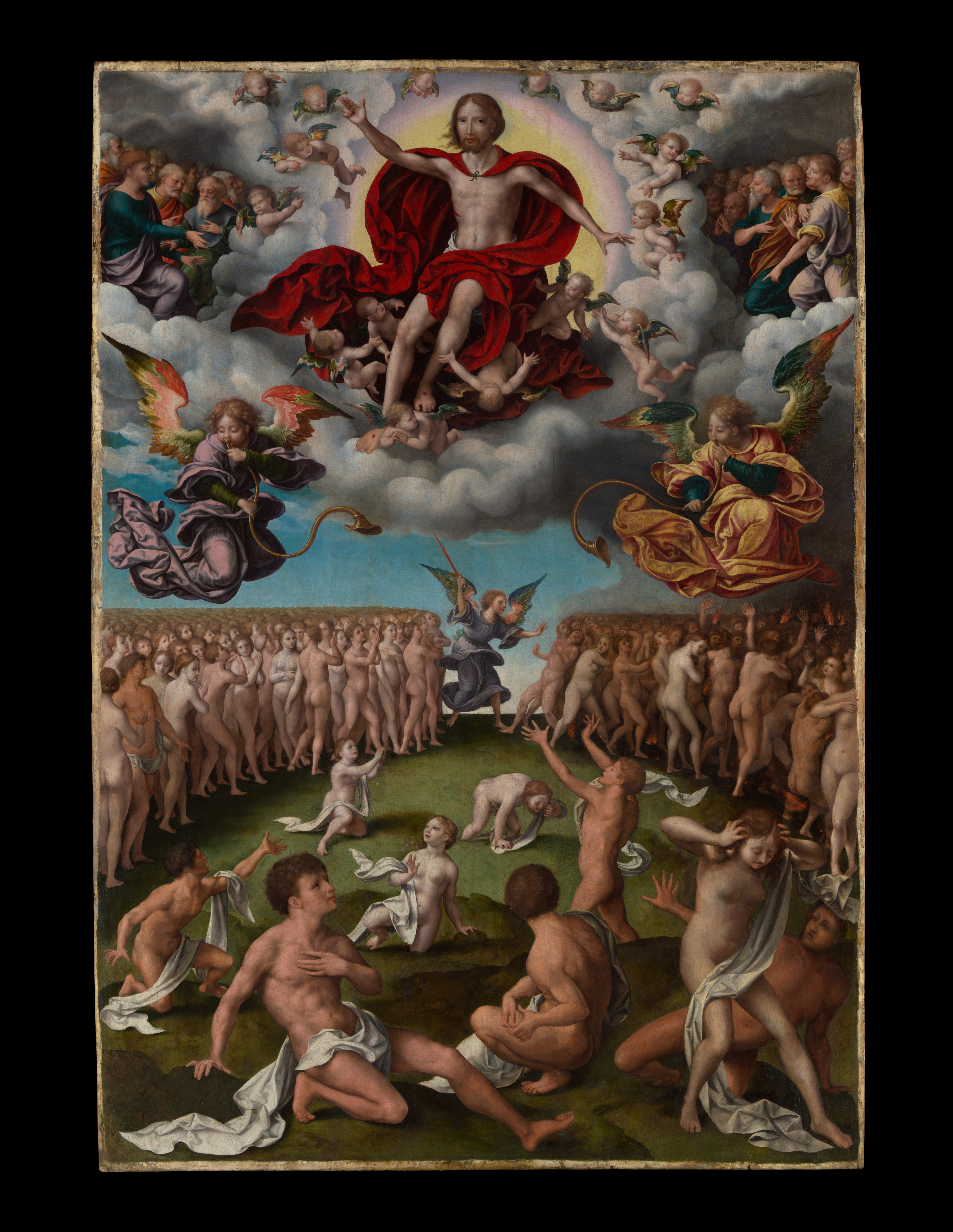
The third is the sheer number of small Netherlandish Crucifixions and Last Judgments in circulation, including two by Joos van Cleve in this same museum. A tall narrow fifteenth or sixteenth-century Netherlandish Last Judgment is not, on sight, this Last Judgment.
The fourth is the format itself. These panels have been published as a diptych, as the wings of a triptych with a painted centre, as the wings of a triptych with a sculpted centre, and as the doors of a tabernacle or reliquary shrine. Reconstructions of all four exist as diagrams. A diagram is not a photograph of the object, and this record carries none.
The artist
Jan van Eyck
Van Eyck is the earliest Netherlandish painter whose name, dates and employment are securely documented, and the corpus attached to that name is still argued over object by object. These two panels are the sharpest illustration of the problem: every anomaly that has been used to remove them from him is real, and the museum's current position is that every one of them is explained by what the object was made to do rather than by who made it. That is a different kind of argument from connoisseurship, and it is only available because the frames survived being sawn off in 1867.
Related works
| Work | Relation | Where it is |
|---|---|---|
| The Last Judgment Petrus Christus | The signed picture used to take these panels away from van Eyck Waagen argued from it in 1870 that the Hermitage wings were early Christus. Crowe and Cavalcaselle followed in 1872 and the attribution held in parts of the literature for decades. | Gemaeldegalerie, Berlin |
| The Crucifixion Jan van Eyck | The comparison used to give the panels back to Jan Tschudi compared the two in 1898 and ascribed the Hermitage panels to Jan van Eyck. | Gemaeldegalerie, Berlin |
| The Ghent Altarpiece, Knights of Christ and Holy Hermits panels Hubert and Jan van Eyck | The stylistic anchor for the present attribution Dated 1432 and much larger, but solving the same problem of packing figures into a tall narrow rectangle, and anchored on the same carefully studied rock formations. | Saint Bavo's Cathedral, Ghent |
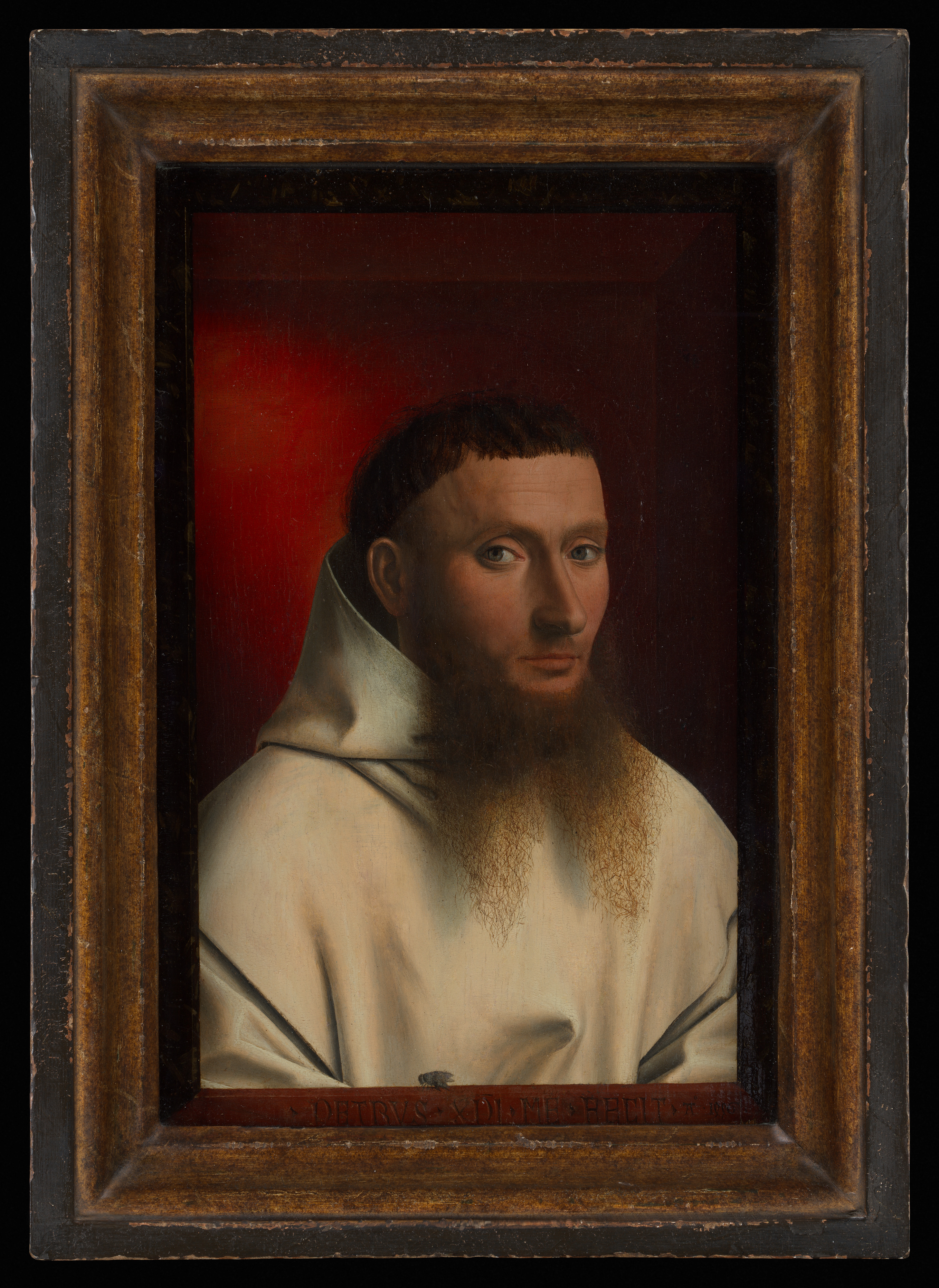
| Portrait of a Carthusian Petrus Christus | By the rival attribution, in the same museum, and a Carthusian Dated 1446. The apostles in the Met's Last Judgment wear Carthusian habits, and the Carthusians of Edingen and Antwerp took part in establishing the Brussels host cult in 1435. | The Metropolitan Museum of Art, New York, 49.7.19 |
| The Last Judgment Joos van Cleve | A later Netherlandish treatment in the same museum, and a standing identification hazard About 1525-30. A Netherlandish Last Judgment of roughly this shape is not, on sight, the van Eyck. | The Metropolitan Museum of Art, New York, 40.174.1 |
| The Virgin at the Fountain Follower of Jan van Eyck | Linked to these panels by the timber supply, not by style Dendrochronology places its oak in the same part of the eastern Baltic as the frames of the Met panels. The original of 1439 is in Antwerp. | Clark Art Institute, Williamstown |
Open questions
- Which Spanish religious house did Tatishchev buy the panels from? The Met's provenance offers a convent near Madrid, with Burgos as an alternative carried with a question mark.
- How did the panels reach Spain? If they were made for a shrine in Brussels in the 1430s, the route to a Spanish convent is entirely unrecorded.
- What stood between them? Diptych, triptych with a painted centre, triptych with a sculpted centre and doors of a reliquary shrine have all been argued, and the frames carry physical evidence of at least two of those arrangements at different periods.
- Who is the woman in red with the black shawl in the lower right of the Crucifixion? Panofsky proposed the Erythrean Sibyl; a participatory portrait of Isabella of Portugal has also been suggested; the Met leaves it open.
- Are the panels autograph throughout, or by van Eyck with workshop assistance? The Met notes both positions in the current literature.
- What did the Metropolitan Museum pay Knoedler in 1933? No figure for this purchase appears in the sources consulted.
- Why was the blue moon in the Crucifixion painted as a waning gibbous at midday, hours before the death the Gospel of Mark places at the third hour after noon?
Questions about this object
What is The Crucifixion; The Last Judgment?
The Crucifixion; The Last Judgment is a painting, dated ca. 1436-38. Medium: Oil on canvas, transferred from wood.
Who made The Crucifixion; The Last Judgment, and is the attribution settled?
The attribution to Jan van Eyck is recorded here as accepted. Given by the Metropolitan Museum to Jan van Eyck, and the subject of one of the longest attribution arguments in the literature. Dmitry Tatishchev bought the panels in Spain as van Eyck. Gustav Waagen reassigned them to Petrus Christus in 1870 on the strength of the signed Berlin Last Judgment; Crowe and Cavalcaselle followed in 1872; Schnaase made them a pupil's in 1879; Justi restored them to Jan in 1887; Kaemmerer in 1898 proposed early Jan or his sister Margaret; Tschudi agreed with Jan the same year; Voll rejected both Christus and Jan in 1900 and proposed the school; Seeck gave them to Hubert van Eyck in 1901. The standing objections were the tall narrow format, the small figures, the extensive narrative and the unusual raised texts on the frames. The Met's 2022 research argues that all of them follow from the function, painted doors of a reliquary shrine, and dismisses them on that basis. Some authorities still read the pictures as Jan with workshop assistance.
Where is The Crucifixion; The Last Judgment now?
The Metropolitan Museum of Art, New York. Inventory number 33.92ab. Last confirmed 4 August 2026. Fletcher Fund, 1933; bought through Knoedler out of the Soviet sale of Hermitage paintings. The museum records that this work may not be lent.
What is still unknown about The Crucifixion; The Last Judgment?
Which Spanish religious house did Tatishchev buy the panels from? The Met's provenance offers a convent near Madrid, with Burgos as an alternative carried with a question mark.
Sources
- 1The Metropolitan Museum of Art, object record 436282, Jan van Eyck, The Crucifixion; The Last Judgment, accession 33.92ab. Consulted for the tombstone, the catalogue entry, the technical notes, the frames section, the signatures and inscriptions, the full provenance, the exhibition history and the bibliography, which supplies Passavant 1841, Waagen 1870, Crowe and Cavalcaselle 1872, Schnaase 1879, Clement de Ris 1879, Justi 1887, Kaemmerer 1898, Tschudi 1898, Voll 1900, Seeck 1901, Peters 1968, Brand Philip 1971, Chatelet 1980, Belting and Eichberger 1983, Kemperdick and Lammertse 2012, Ainsworth 2017 and 2022, Scully and Centeno 2022 and Smith 2022. metmuseum.org/art/...
- 2The Metropolitan Museum of Art Open Access API, object 436282. Consulted for isPublicDomain, primaryImage, the count of additional images, medium, dimensions, artist dates, accession number and credit line. collectionapi.metmuseum.org/public/...
- 3Wikipedia, 'Soviet sale of Hermitage paintings'. Tertiary. Used for the February 1928 export order, the first Five Year Plan as the motive, the figure of about 250 paintings sold with Jan van Eyck among the artists named, Gulbenkian as the first foreign buyer from early 1930, the Matthiesen consortium with Colnaghi and Knoedler, Mellon's twenty-one pictures for USD 6,654,000 by the end of 1931 and the New York Times report of 4 November 1933 revealing the Metropolitan Museum's purchases. Replace with Robert Williams's Russian Art and American Money and with the Knoedler archive at the Getty Research Institute. en.wikipedia.org/wiki/...
- 4The Metropolitan Museum of Art Open Access API, object 435896, Petrus Christus, Portrait of a Carthusian, and object 436794, Joos van Cleve, The Last Judgment. Consulted to verify open-access status and the tombstones of the two comparison plates. collectionapi.metmuseum.org/public/...
Last verified 9 September 2026 · Published 4 August 2026
Change log
4 August 2026 - Record created at the house standard: researched narrative, technical evidence, maker dossier, graded provenance chain, prices with hammer and premium separated, related works, open questions and sources.
9 September 2026 - Re-verified 2026-09-09: Met object page (metmuseum.org/art/collection/search/436282) re-read directly, accession 33.92ab, on view Met Fifth Avenue Gallery 605, attribution to Jan van Eyck unchanged, no reassignment. The Ainsworth Brussels-shrine/host-desecration-cult reading already carried in this record narrative matches the Met own current framing (audio guide narration, checked live) with no material addition. WebSearch found no litigation, sale, export or attribution news since 2026-08-04. No change; null result recorded per house rule.