Vase with Viscaria
Vincent van Gogh · Paris, summer 1886
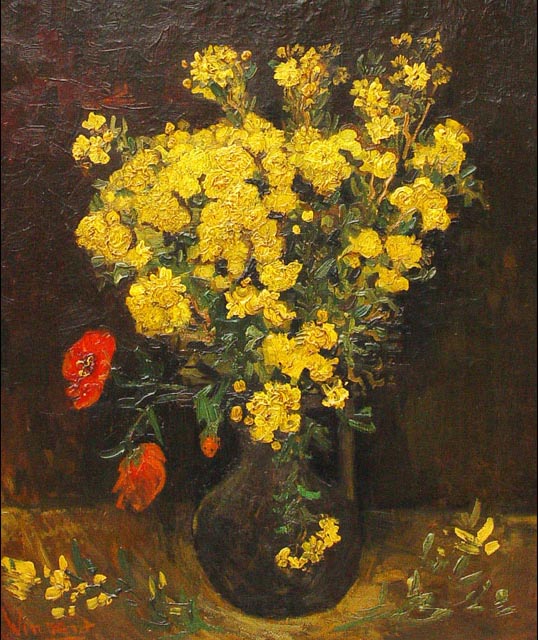
The record subject, F 324a, JH 1137, oil on canvas, 65 x 54 cm. This is a plate reproduced from a printed art book, and it is one of the better images of the painting that exists. Every reproduction of this picture predates 21 August 2010, and none of them is good. A signature is visible at the lower left.
| Artist | Vincent van Gogh |
|---|---|
| Date | Paris, summer 1886 |
| Medium | Oil on canvas |
| Dimensions | 65 x 54 cm |
| Where it is now | Unlocated. Stolen from the Mohamed Mahmoud Khalil Museum, Giza, Cairo, on 21 August 2010, and not recovered. It was stolen from the same collection once before and came back.last confirmed 4 August 2026 |
| Inventory number | Not published in the sources consulted |
| Attribution | AcceptedCatalogued as autograph, F 324a and JH 1137, and accepted by Louis van Tilborgh of the Van Gogh Museum, the senior authority on the corpus. Full note |
| Object type | Painting |
| Period | Dutch, nineteenth century |
| Cases | Has a provenance gap · Restituted or repatriated |
| Inscriptions | A signature is visible at the lower left in the printed reproductions consulted. It is not transcribed in the catalogue sources available here. |
| Owners on record | 7 links5 documented, 1 disputed, 1 unknown |
| Sources | 10 cited |
About this record Last verified 31 August 2026 · 10 sources cited · Change log
On this page 10 sections
ContentsClose
A flower piece painted in Paris in the summer of 1886, 65 by 54 centimetres, catalogued F 324a and JH 1137. It was bought in Paris by Mohamed Mahmoud Khalil, an Egyptian politician who was twice prime minister, and it may be the first van Gogh acquired by a collector outside Europe and North America. It went to the Egyptian state with the rest of his collection and the villa in Giza opened as a museum on 23 July 1962.
It has been stolen from that collection twice. The first time it came back, from Kuwait, in circumstances that have never been explained, and with a rumour attached that has never been settled. The second time, on 21 August 2010, a thief cut it out of its frame during opening hours and walked out. Egypt's prosecutor general found that not one alarm in the museum was working and that seven of the forty-three cameras were. The culture minister announced a recovery at Cairo airport the same day and withdrew the claim the next.
Everyone calls it Poppy Flowers. The standard catalogue calls it Vase with Viscaria, because most of the flowers in it are not poppies. That is not pedantry: a picture with three names and one photograph is exactly how a stolen object disappears twice.
Provenance
Each link is graded. Documented: a cited source supports it. Disputed: the identification is argued but not established. Unknown: no owner for that span, and the gap is not smoothed into a narrative. The grades in the glossary.
- 1886 - c. 1920sUnrecordedunknown
Nothing is recorded of the picture's ownership between its painting in Paris in the summer of 1886 and its purchase by Khalil, which the sources place in Paris and possibly as early as the 1920s. Van Gogh sold almost nothing in his lifetime, so the canvas will have passed through the family and the early dealer trade, but no specific owner is documented in the sources consulted.
- c. 1920s - 1953Mohamed Mahmoud Khalil, Cairo and Parisdocumented
Bought in Paris by Khalil, twice prime minister of Egypt, born 1877, died 1953, who had bought his palace at Giza in 1918 and was a regular visitor to the Paris dealers. It may be the first van Gogh bought by a collector outside Europe and North America. Neither the date, the dealer nor the price is recorded in the sources consulted.36
- 1953 - 1962Emiline Hector Lock, then the Egyptian statedocumented
Khalil died in 1953 and his wife in 1960. The collection and the palace passed to the state, and the museum opened on 23 July 1962, dedicated to them both.6
- 1962 - 1978Mohamed Mahmoud Khalil Museumdocumented
In the collection. From 1971 the palace itself was taken over for President Sadat's executive offices and did not return to museum use until 1993, reopening to the public in 1995. Where the collection was kept during those twenty-two years is not stated in the sources consulted, which matters because the first theft falls inside the period.6
- 1978 - c. 1980Unknown; the painting was in criminal handsdisputed
Stolen from the collection and recovered about two years later in Kuwait, in circumstances the sources agree were never fully explained. Egypt's interior minister said three Egyptians had been arrested and had led police to the hiding place. The date is contested: The Art Newspaper and a contemporaneous account give 1978 with a two-year gap; Wikipedia gives 4 June 1977 with a recovery a decade later. It was suggested at the time that the picture had been copied while missing and that a copy had been returned. Nothing in the sources tests the claim.234
- c. 1980 - 2010Mohamed Mahmoud Khalil Museumdocumented
Back on the wall. No published technical examination of the returned canvas has been found, which is why the substitution rumour is still open and why the attribution question raised by Ronald Pickvance was never settled.3
- 2010 - presentUnknown. Title remains with the Egyptian statedocumented
Cut from its frame with a box cutter during opening hours on Saturday 21 August 2010 and removed from the museum. Not one alarm in the building was working and seven of forty-three cameras were, on the prosecutor general's finding. The culture minister announced a recovery at Cairo airport and retracted it the next day. Eleven ministry employees were convicted of negligence in October 2010. The painting was still missing when the museum reopened in 2021 and is missing now.2345
Prices realised
This painting has never been sold at auction. It was bought privately in Paris at an unrecorded price and has been state property in Egypt since the 1950s. There is no hammer price, no premium, no auction estimate, no published insurance valuation and no probate figure in its history. The 55 million dollar and 50 million dollar figures that appear in every report of the 2010 theft are press estimates that entered circulation within two days of it and have been repeated since; nothing was appraised. The one real number attached to the case is a reward: 175,000 dollars, or one million Egyptian pounds, offered by Naguib Sawiris for information leading to the painting's return. It has not been claimed, and a reward is not a valuation.
Technical evidence
| Attribution note | Catalogued as autograph, F 324a and JH 1137, and accepted by Louis van Tilborgh of the Van Gogh Museum, the senior authority on the corpus. The late Ronald Pickvance questioned it. That doubt cannot now be resolved: the painting has been missing since 21 August 2010 and no technical examination of it is possible. It is a permanent floater, in van Tilborgh's term for a picture whose attribution is neither confirmed nor withdrawn. A separate and older shadow hangs over the object itself. When it was recovered in Kuwait after the first theft, it was suggested at the time that it had been copied while it was gone and that what came back might be one of the copies. Nothing in the sources consulted either establishes or disposes of that suggestion. |
|---|---|
| Support | Canvas. Cut from its frame with a box cutter during the theft of 21 August 2010; the damage that implies to the tacking edges is not on record because the object has not been seen since.4 |
| Medium | Oil on canvas.1 |
| Dimensions | 65 x 54 cm. Note that some 2010 wire reports gave 30 x 30 cm, which is wrong by a factor of four in area and appears to derive from a single early agency error.14 |
| Catalogue numbers | F 324a in Jacob-Baart de la Faille's catalogue raisonne, JH 1137 in Jan Hulsker's. The F number is the identifier to search on, because the title is unstable.110 |
| Date and place | Paris, summer 1886, per the standard catalogue and the specialist literature. 1887 is widely printed and is not what the catalogue says.13 |
| Subject | Predominantly viscaria, also called lychnis or catchfly, with poppies as a minor element at the lower left. The popular title reverses the proportion.110 |
| Technical examination | None published. No X-radiograph, infrared reflectogram or pigment analysis of this picture appears in the sources consulted, and none can now be made. The attribution doubt recorded by Ronald Pickvance therefore has no route to resolution.3 |
| Reproduction quality | Poor. The available free reproductions are small book and press plates, mostly under 700 pixels on the long side, differing in colour, all pre-2010. The largest available image is a 2013 photograph of a digital colour reconstruction shown at a reproduction exhibition in Budapest, not a photograph of the painting.10 |
| Frame | Left behind on the wall in 2010, cut open. The frame history before that is not recorded in the sources consulted.4 |
Images
The record in full
Chapter 1What it is, and what it is not called
Oil on canvas, 65 by 54 centimetres. A dark ground, a plain earthenware vase on a table, and a mass of small yellow flowers with two or three red ones low on the left.
Oil on canvas, 65 by 54 centimetres. A dark ground, a plain earthenware vase on a table, and a mass of small yellow flowers with two or three red ones low on the left. A few sprigs lie on the table on either side.
The world knows it as Poppy Flowers. The standard catalogue of the paintings knows it as Vase with Viscaria, and lists it under F 324a and JH 1137. In German it is Vase mit Pechnelken. Viscaria, pechnelke and lychnis all name the catchfly, a small campion, and that is what the yellow mass is. The red flowers low on the left are poppies. So a picture in which poppies are a minority element has been renamed after them by press coverage of its own theft.
Migrating titles are a direct cause of version confusion, and this object demonstrates the mechanism at full length. The archive files it under the catalogue title and lists the others, because a reader searching for Poppy Flowers and a reader searching for Vase with Viscaria are looking for the same missing canvas and do not know it.
The date has moved as well. Much of the press, and older reference material, gives 1887. The catalogue and the specialist literature give the summer of 1886, a few months after van Gogh arrived in Paris. This record follows the catalogue.
Chapter 2Why he was painting flowers at all
Van Gogh reached Paris in March 1886 and moved in with his brother Theo; from June they were at 54 rue Lepic in Montmartre.
Van Gogh reached Paris in March 1886 and moved in with his brother Theo; from June they were at 54 rue Lepic in Montmartre. He had come from Antwerp and from the brown palette of the Dutch years, and in Paris he found Impressionism, Japanese prints and colour theory in the same eighteen months. He made more than two hundred paintings there before he left for Arles in February 1888.
The flower pieces were not decoration and they were not commissions. They were exercises, and he said so in a letter to the English painter Horace Livens, written in Paris in 1886: he had lacked the money to pay models, so instead he had made a series of colour studies of flowers, red poppies, blue cornflowers and forget-me-nots, white and pink roses, yellow chrysanthemums, looking for oppositions of blue with orange, red with green, yellow with violet, and for the broken and neutral tones that would harmonise brutal extremes.
That letter is the best available account of what this picture is for. It is a yellow mass set against a dark ground with red at its edge, made by a man teaching himself what colours do next to each other because he could not afford a sitter.
Chapter 3How it got to Cairo
Mohamed Mahmoud Khalil, born in 1877, was an Egyptian politician who served as prime minister twice, from 1928 to 1929 and from 1937 to 1939.
Mohamed Mahmoud Khalil, born in 1877, was an Egyptian politician who served as prime minister twice, from 1928 to 1929 and from 1937 to 1939. He bought a palace on the bank of the Nile at Giza in 1918, and he and his wife Emiline Hector Lock assembled a collection of French nineteenth-century art in it: Monet, Renoir, Gauguin, Rodin, Ingres, and this van Gogh.
He bought the picture in Paris, which he visited regularly and where he dealt with the Impressionist trade, possibly as early as the 1920s. The exact date, the dealer and the price are not recorded in the sources consulted. What can be said, and is worth saying, is that this may be the first van Gogh bought by a collector outside Europe and North America. The market for van Gogh in the 1920s was almost entirely European and American; an Egyptian buyer in Paris in that decade was ahead of a curve that took another sixty years to bend.
Khalil died in 1953 and his wife in 1960. The collection passed to the Egyptian state and the palace opened as the Mohamed Mahmoud Khalil Museum on 23 July 1962, dedicated to them both.
Chapter 4The first theft, and the rumour it left behind
The museum did not stay a museum. From 1971 President Anwar Sadat used the palace for executive offices, and it was not returned to museum use until 1993, reopening to the public in 1995.
The museum did not stay a museum. From 1971 President Anwar Sadat used the palace for executive offices, and it was not returned to museum use until 1993, reopening to the public in 1995. So for twenty-two years the Khalil collection was not in the Khalil house, and the first theft of this picture falls inside that period.
The date of that theft is not settled in the sources. Martin Bailey, writing in The Art Newspaper in 2021, gives 1978 and says the picture was recovered two years later after surfacing in Kuwait. A contemporaneous account gives 1978 and the same two-year gap, adding that Egypt's interior minister said three Egyptians had been arrested and had told the police where the canvas was hidden. Wikipedia gives 4 June 1977 and a recovery a decade later. This record does not average them. Two independent accounts say 1978 and two years; one tertiary source says 1977 and ten. The disagreement is recorded as a disagreement.
What every account agrees on is that the circumstances of the recovery were never fully explained. And there was a rumour, current at the time, that the painting had been copied during the two years it was gone, and that what the museum received back was one of those copies rather than the original van Gogh.
That rumour has never been tested, and it cannot be tested now. Any examination that could have settled it would have had to happen between the recovery and 21 August 2010, and there is no published record that one did. A picture that a specialist already doubted, that had been out of institutional hands for two years, and that then vanished again before anybody looked at it properly, is about as compromised an evidentiary position as an object can be in.
Chapter 521 August 2010
On a Saturday, during opening hours, in a museum on a main road in Giza, somebody cut the canvas out of its frame with a box cutter and left with it.
On a Saturday, during opening hours, in a museum on a main road in Giza, somebody cut the canvas out of its frame with a box cutter and left with it. Reports of the time describe a couch being dragged under the picture to stand on.
Egypt's prosecutor general, Abdel-Meguid Mahmoud, established the security position and it is worth reading slowly. Not one alarm in the entire museum was functional. Of forty-three surveillance cameras, seven were working. There were not enough guards to make a proper round at closing time. A security official said the cameras had not worked for a long time and neither had the alarm system.
The prosecutor had already warned the institution. In 2009 nine paintings had been stolen from another Cairo museum with comparably poor security and were found dumped ten days later. Nothing was done. After the van Gogh went, Mahmoud barred fifteen Egyptian officials from leaving the country, among them the director of the Khalil museum and the head of the fine arts department at the Ministry of Culture.
Then came the part that turned a theft into a scandal. The minister of culture, Farouk Hosni, announced that suspects had been detained at Cairo airport and the painting recovered. Within a day he retracted it, saying he had been given false information. The retraction is the moment the case went from a security failure to an institutional one, because it established that the ministry was announcing outcomes it had not verified.
Chapter 6The trial
In October 2010 an Egyptian court convicted eleven employees of the Ministry of Culture of negligence and professional misconduct, among them the deputy minister of culture, Mohsen Shaalan.
In October 2010 an Egyptian court convicted eleven employees of the Ministry of Culture of negligence and professional misconduct, among them the deputy minister of culture, Mohsen Shaalan. They were sentenced to three years and released on bail of around 1,750 dollars. Shaalan subsequently served a term of a year, ending in 2013.
Very few art thefts anywhere produce criminal convictions of the custodians rather than the thieves. This one did, and that is the reason it belongs in a provenance archive rather than only in a crime file. The finding of the Egyptian court was not that a clever criminal beat a good system; it was that there was no system, and that the people paid to run one were culpable for its absence.
Nobody has been convicted of taking the painting. The Egyptian businessman Naguib Sawiris offered a reward, reported at 175,000 dollars or one million Egyptian pounds, for information leading to its return. It has not been claimed.
Chapter 7Fifty-five million dollars is not a valuation
Every report of this theft carries a figure.
Every report of this theft carries a figure. It is usually 55 million dollars and sometimes 50 million. Neither is a price, an appraisal or an insurance valuation. They are press estimates that entered circulation in the first forty-eight hours after the theft and have been repeated ever since.
This picture has never been at auction. It was bought privately in Paris by a private collector at an unrecorded price, probably in the 1920s, and it has been state property in Egypt since the 1950s. There is no hammer price, no premium, no estimate and no published probate or insurance figure anywhere in its history. The only honest statement about its market value is that no market has ever tested it.
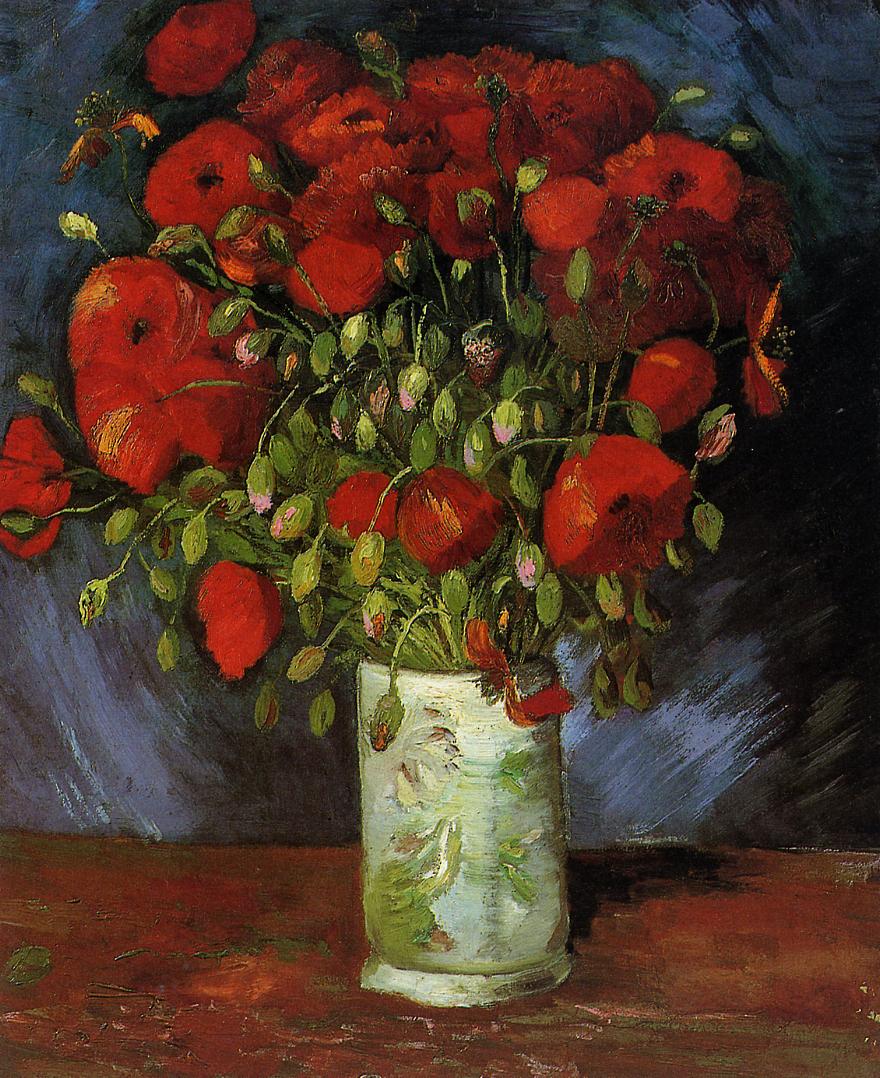
What can be said instead is what a comparable object does when it is present and can be examined. The Wadsworth Atheneum in Hartford owns a van Gogh flower piece of the same Paris summer, Vase with Poppies, F 279, 56 by 46.5 centimetres, bequeathed in 1957. Its attribution was questioned by Bogomila Welsh-Ovcharov in 1976 and again by Walter Feilchenfeldt around 1990, and the museum put it into storage. In 2019, with new imaging equipment, the conservation laboratory found an earlier painting beneath the surface, apparently a self-portrait, of which the outline of an ear was legible. The picture went to the Van Gogh Museum in Amsterdam, was confirmed as autograph, and went back on display in April 2019.
That is what a doubted van Gogh in a museum gets: thirty years in storage and then an answer. The Cairo picture will not get one.
Chapter 8Why the attribution matters more than usual here
Van Gogh has a forgery problem older than most collectors realise, and it is baked into the catalogue that gives this painting its number.
Van Gogh has a forgery problem older than most collectors realise, and it is baked into the catalogue that gives this painting its number. In 1928 the Berlin dealer Otto Wacker was found to be selling van Goghs that his brother Leonhard, a painter and restorer, had almost certainly made. The story attached to them was a Russian owner who had moved them out through Switzerland, which conveniently explained why none of them had papers. Grete Ring and Walter Feilchenfeldt spotted the fakes in January 1928 when the last of the pictures were delivered for an exhibition.
Jacob-Baart de la Faille published his catalogue raisonne of van Gogh the same year. It is the source of the F numbers still used, including the F 324a on this record. In November 1928 he had to publish a supplement identifying the suspect pictures as forgeries. The National Gallery in Berlin found a resin in them used to speed drying that appeared in no genuine van Gogh, and the canvases were not French. Wacker was tried in 1932, convicted, and given nineteen months and a fine of thirty thousand Reichsmarks.
The point for this record is not the scandal. It is that van Gogh attribution has always been done with laboratories as well as eyes, that de la Faille himself had to correct his catalogue within a year of publishing it, and that the corpus has been argued over continuously ever since. Louis van Tilborgh accepts this picture. Ronald Pickvance did not. In any other case that would be a file waiting for an infrared reflectogram. Here the file is shut, because there is nothing to put under the lamp.
Chapter 9No photograph of this painting is any good
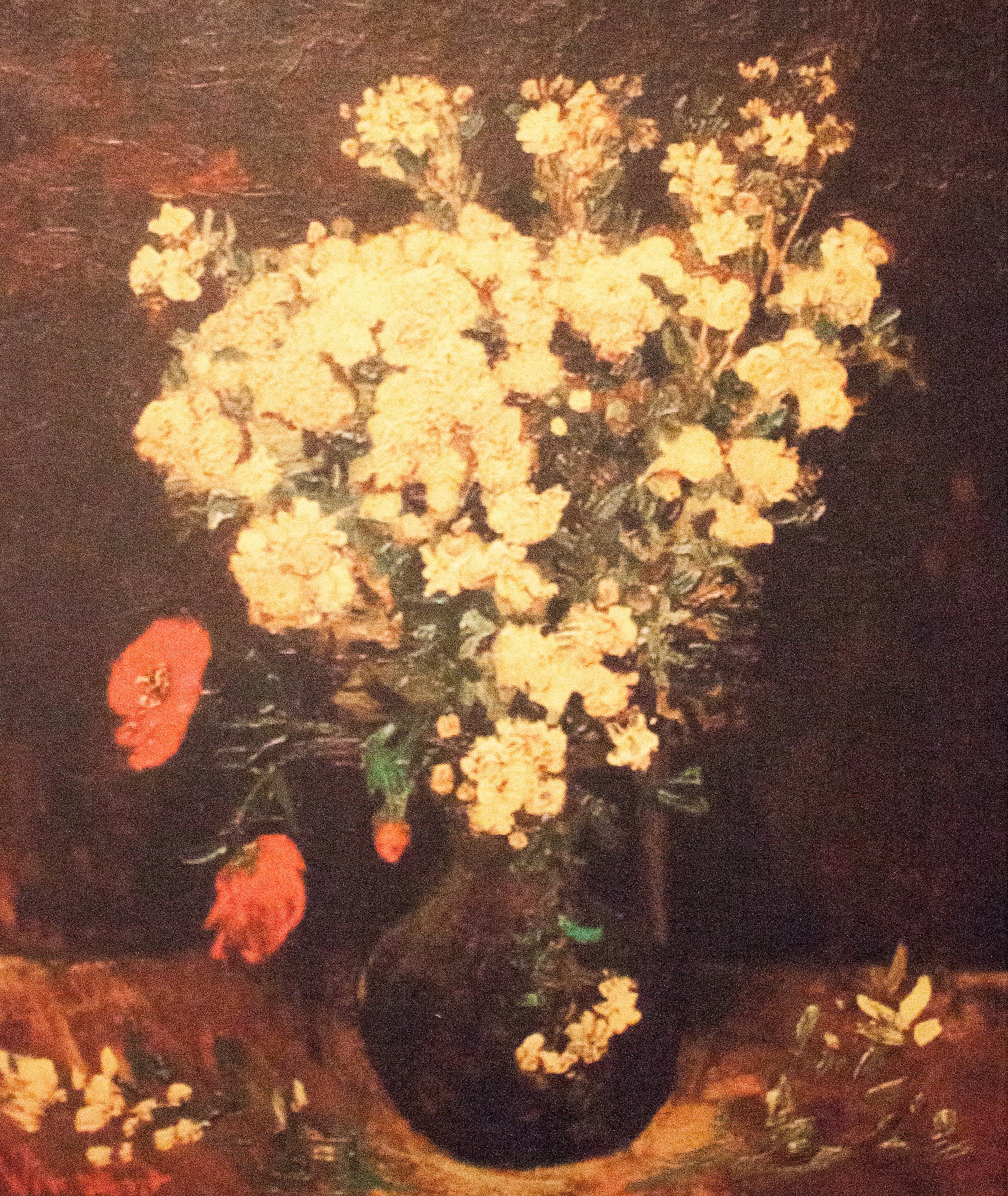
This is the plainest way to say it: there is no high-quality reproduction of this object in existence that this record could find under any licence.What survives is a handful of small plates from...
This is the plainest way to say it: there is no high-quality reproduction of this object in existence that this record could find under any licence.
What survives is a handful of small plates from printed books and press files, most of them well under a thousand pixels on the long side, all made before August 2010 and most of them a good deal earlier. The colour differs between them. In 2013 a touring exhibition of reproductions in Budapest showed a digital reconstruction of the picture's original colours; a photograph of that panel is on this page, and it is the largest image available, and it is a photograph of a modern reconstruction rather than of the painting.
The consequence is that nobody can now compare a candidate canvas against a good reference image. If the picture surfaced tomorrow, the identification would rest on small, colour-unreliable plates and on whatever the Khalil museum holds in its own files. That is a bad position for an object with a live authenticity question and a twenty-year-old rumour about a substituted copy attached to it.
Compare the Gardner Vermeer, missing since 1990, which is reproduced in high resolution from pre-theft photography and is instantly recognisable. Illustration quality is not a cosmetic matter for a stolen object. It is the recovery evidence.
Chapter 10Where it stands in 2026
The museum was closed after the theft and reopened in 2021.
The museum was closed after the theft and reopened in 2021. The van Gogh was not in it. There has been no trace of the picture since it went out of the door in August 2010, and the specialist view is that the chances of recovery after this long are slim.
The convictions stand against the officials. Nobody has been convicted of the theft. The Sawiris reward has not been claimed. The picture is the only van Gogh the museum had, and it may have been the first van Gogh bought by anyone outside Europe and North America.
Two thefts, one recovery, one rumour of substitution, one unresolved attribution and no usable photograph. The second theft of this object was not a break-in. It was the consequence of a decision, taken over years, not to fix the alarms.
The artist
Vincent Willem van Gogh
Van Gogh painted for about a decade and left roughly 2,100 works, of which about 860 are oil paintings and most of those come from his last two years. He sold almost nothing while alive. The corpus as we have it was assembled after his death, catalogued in 1928 by a scholar who had to correct his own catalogue within the year because a Berlin dealer had put more than thirty forgeries into circulation, and it has been contested ever since. Any record of a van Gogh has to say which catalogue number it means, and this one has to say why that number can no longer be checked against the object.
Related works
| Work | Relation | Where it is |
|---|---|---|
| Vase with Poppies (F 279, JH 1104) Vincent van Gogh | Painted the same summer; the picture most often confused with this one 56 x 46.5 cm. Bequeathed by the writer Anne Parrish Titzell in 1957. Doubted by Bogomila Welsh-Ovcharov in 1976 and by Walter Feilchenfeldt around 1990, put in storage, and confirmed as autograph by the Van Gogh Museum in 2019 after imaging revealed an earlier self-portrait beneath the surface. | Wadsworth Atheneum Museum of Art, Hartford, Connecticut |
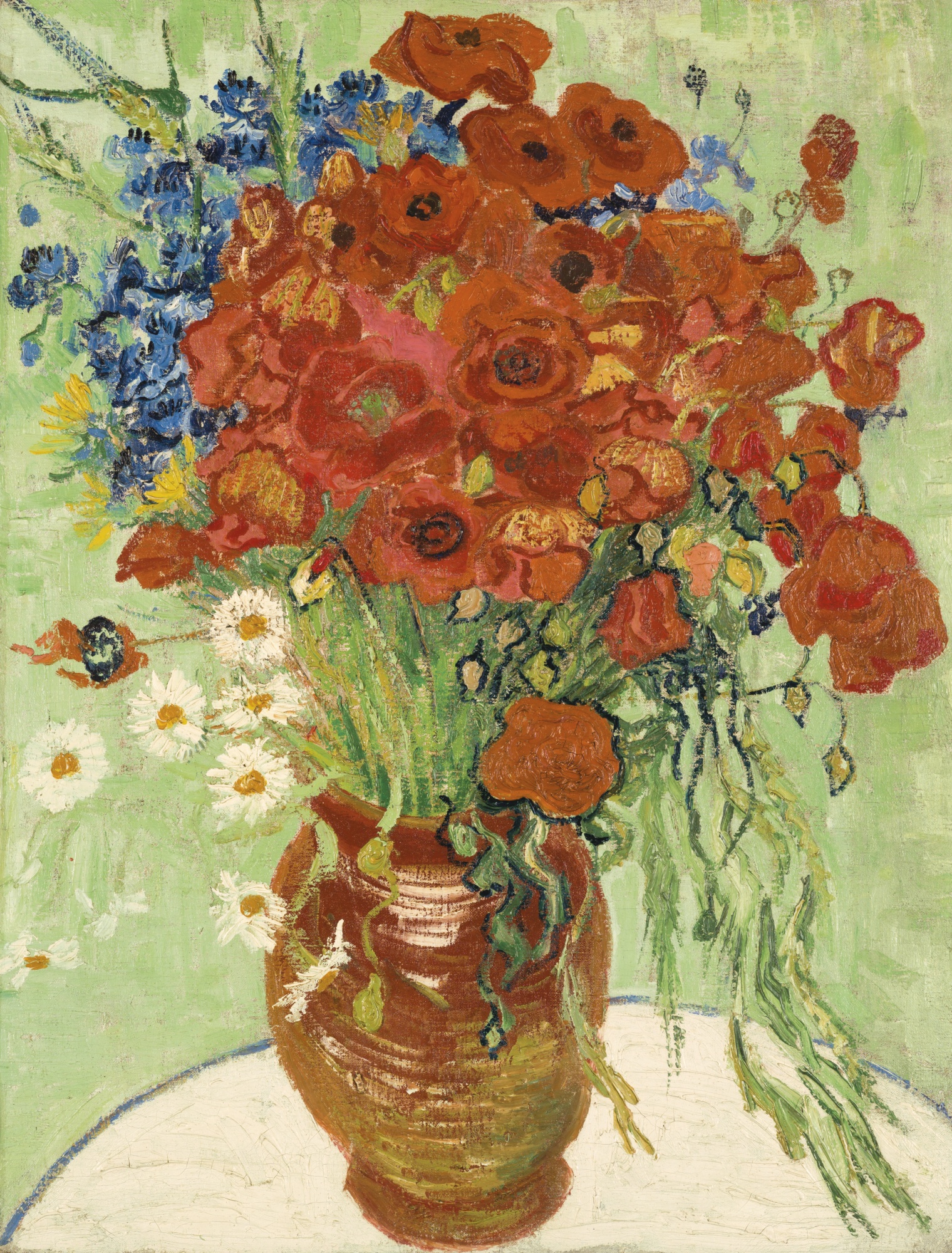
| Vase with Cornflowers and Poppies (F 280) Vincent van Gogh | A third poppy still life, and a case study in migrating titles Auvers, June 1890, 66 x 51 cm. Published as Blumenstrauss in 1918, catalogued by de la Faille in 1928 with the period given incorrectly as Paris, illustrated as Poppies in 1938, retitled Still Life: Vase with Daisies and Poppies in 1970 and Fleurs de Champs in 1982. Five titles for one canvas. | Private collection |
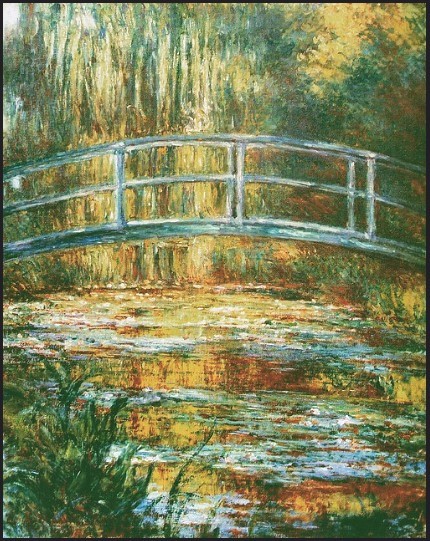
| The Bridge over the Water-Lily Pond (W 1520) Claude Monet | In the same collection, in the same building, behind the same alarms 1899. The Khalil holds a serious group of French nineteenth-century pictures. In August 2010 none of the alarms protecting them worked. | Mohamed Mahmoud Khalil Museum, Cairo |
| The nine paintings taken from a Cairo museum in 2009 Various | The warning the ministry did not act on Stolen the year before this theft from a Cairo museum with comparably poor security and found dumped ten days later. The prosecutor general had told the Khalil to improve its security after that case. Sources differ on which museum lost them. | Recovered |
| The Concert Johannes Vermeer | The comparison case for stolen-object documentation Missing twenty years longer and reproduced far better. A stolen picture's surviving photography is its recovery evidence, and the two objects are at opposite ends of that scale. | Unlocated since 1990 |
Open questions
- When was the first theft, and how long was the painting gone? Two independent accounts give 1978 and a recovery two years later in Kuwait. A tertiary source gives 4 June 1977 and a recovery a decade later. The discrepancy is unresolved.
- Is the canvas that came back from Kuwait the canvas that was taken? It was suggested at the time that copies had been made while it was missing. No published examination has tested it, and none can now be made.
- Is the attribution sound? Louis van Tilborgh accepts it; Ronald Pickvance questioned it. There is no technical evidence either way and there cannot be while the object is missing.
- Where was the picture between 1971 and 1993, when the Khalil palace was in use as presidential executive offices and was not a museum? The first theft falls inside that period and the sources consulted do not say where the collection was housed.
- When, from whom and for how much did Mohamed Mahmoud Khalil buy it? The accounts say Paris and possibly the 1920s, with no dealer and no price.
- Does the museum hold high-resolution photography or a conservation file for the picture? Nothing of that quality is in public circulation, and the best free image available is a photograph of a modern reproduction.
- Two reproductions circulate on Wikimedia Commons under this painting's title and its catalogue number, and they differ visibly in handling; one derives from a website that sells hand-painted reproductions. Which of the images in circulation actually descend from photographs of the object?
- Was the picture insured, and by whom? No insurance position for the Khalil collection appears in the sources consulted.
Questions about this object
What is Vase with Viscaria?
Vase with Viscaria is a painting, dated paris, summer 1886. Medium: Oil on canvas.
Who made Vase with Viscaria, and is the attribution settled?
The attribution to Vincent van Gogh is recorded here as accepted. Catalogued as autograph, F 324a and JH 1137, and accepted by Louis van Tilborgh of the Van Gogh Museum, the senior authority on the corpus. The late Ronald Pickvance questioned it. That doubt cannot now be resolved: the painting has been missing since 21 August 2010 and no technical examination of it is possible. It is a permanent floater, in van Tilborgh's term for a picture whose attribution is neither confirmed nor withdrawn. A separate and older shadow hangs over the object itself. When it was recovered in Kuwait after the first theft, it was suggested at the time that it had been copied while it was gone and that what came back might be one of the copies. Nothing in the sources consulted either establishes or disposes of that suggestion.
Where is Vase with Viscaria now?
Unlocated. Stolen from the Mohamed Mahmoud Khalil Museum, Giza, Cairo, on 21 August 2010, and not recovered. It was stolen from the same collection once before and came back. Inventory number Not published in the sources consulted. Last confirmed 4 August 2026. Cut from its frame during opening hours on 21 August 2010; excluded from the museum's 2021 reopening because it is still missing.
What is still unknown about Vase with Viscaria?
When was the first theft, and how long was the painting gone? Two independent accounts give 1978 and a recovery two years later in Kuwait. A tertiary source gives 4 June 1977 and a recovery a decade later. The discrepancy is unresolved.
Sources
- 1Van Gogh Gallery, catalogue entry for F 324a, 'Vase with Viscaria'. Used for the catalogue title, the F and JH numbers, the dating to Paris in the summer of 1886, the medium, the dimensions of 65 x 54 cm and the current status as stolen in August 2010. vggallery.com/painting/...
- 2Wikipedia, 'Poppy Flowers'. Used for the F 324a and JH 1137 numbers, the alternative 1977 theft date and ten-year recovery, the October 2010 conviction of eleven culture ministry employees including deputy minister Mohsen Shaalan, the three-year sentences and bail of about USD 1,750, Shaalan's later one-year term ending in 2013, the Naguib Sawiris reward of USD 175,000 or EGP 1 million, and the USD 55 million press figure. Tertiary; flagged for replacement with the Egyptian court record and the museum's own file. en.wikipedia.org/wiki/...
- 3The Art Newspaper, Martin Bailey, 'How a Van Gogh painting was stolen from a Cairo museum - not once, but twice', 21 May 2021. Used for the dating to the summer of 1886, the title Vase with Flowers, Khalil's purchase in Paris possibly as early as the 1920s and his habit of frequenting the Impressionist dealers, the first theft in 1978 with recovery two years later after the picture surfaced in Kuwait, the box-cutter theft during opening hours in 2010, the prosecutor general's description of the security as feeble and superficial, the exclusion of the painting from the 2021 reopening, and the acceptance of the work by Louis van Tilborgh against the doubt of the late Ronald Pickvance. theartnewspaper.com/2021/...
- 4The History Blog, 'Van Gogh Poppy Flowers stolen from Egypt museum', 22 August 2010, a contemporaneous account written the day after the theft. Used for the box cutters, Farouk Hosni's announcement of a recovery at the airport and his retraction the following day, the USD 50 million figure, the first theft given as 1978 with recovery two years later in Kuwait, the rumour that the picture was copied while missing and that a copy was returned, prosecutor general Abdel-Meguid Mahmoud's findings that no alarm in the museum worked and that seven of forty-three cameras did, the insufficient guard rounds, the nine paintings stolen from another Cairo museum in 2009 and recovered ten days later, and the barring of fifteen officials from leaving the country. It also carries the erroneous 30 x 30 cm dimension that circulated in the first agency reports. thehistoryblog.com/archives/...
- 5Al Jazeera, 'Egypt blames security for art theft', 23 August 2010. Used for Farouk Hosni's claim that two Italians had been arrested at Cairo airport with the painting and his subsequent retraction, and for the security official's statement that the cameras had not worked for a long time and neither had the alarm system. aljazeera.com/news/...
- 6Wikipedia, 'Mohamed Mahmoud Khalil Museum'. Used for Khalil's dates of 1877 to 1953, his two terms as prime minister, the purchase of the palace in 1918, the collection assembled with his wife Emiline Lock, the museum's opening on 23 July 1962, the use of the palace for President Sadat's executive offices from 1971 until 1993 and the reopening in 1995. Tertiary; flagged for replacement with the museum's own history. en.wikipedia.org/wiki/...
- 7Smithsonian Magazine, Brigit Katz, 'After 30 Years of Doubt, a Painting of Poppies Is Authenticated as a van Gogh', 26 March 2019. Used for the Wadsworth Atheneum's Vase with Poppies: the 1957 Titzell bequest, Bogomila Welsh-Ovcharov's 1976 doubt, Walter Feilchenfeldt's visit around 1990, the move into storage, the 2019 digital X-ray and infrared reflectography revealing an earlier self-portrait, the confirmation by the Van Gogh Museum and the return to display in April 2019; for Louis van Tilborgh's term 'floaters'; and for the 1886 letter to Horace Livens quoted in the dossier. smithsonianmag.com/smart-news/...
- 8Wikipedia, 'Otto Wacker'. Used for the 1928 forgery affair: Leonhard Wacker as the likely painter, the invented Russian provenance, the discovery by Grete Ring and Walter Feilchenfeldt in January 1928, de la Faille's supplement of November 1928 identifying the pictures as forgeries, the Berlin National Gallery's finding of a drying resin absent from genuine van Goghs and of non-French canvases, and the 1932 trial, conviction, nineteen-month sentence and 30,000 Reichsmark fine. Tertiary; flagged for replacement with the trial record and de la Faille's Les Faux van Gogh. en.wikipedia.org/wiki/...
- 9Wikipedia, 'Vincent van Gogh'. Used for the birth and death dates and places, the Paris years from March 1886 to February 1888 and the move to 54 rue Lepic in June 1886, the more than two hundred Paris paintings, the absence of correspondence from that period, the scale of the oeuvre at about 2,100 works and about 860 oil paintings, and Johanna van Gogh-Bonger's publication of the letters in 1906, 1913 and 1914. Tertiary; flagged for replacement with the Van Gogh Museum's catalogue and the letters edition. en.wikipedia.org/wiki/...
- 10Wikimedia Commons file records for this painting and its comparanda, read as wikitext rather than as API summaries: the F 324a and JH 1137 references and the 65 x 54 cm dimensions on the Cairo picture; the German title Vase mit Pechnelken and the English Vase with Viscaria, Vase with Lychnis and Poppy Flowers; the note that the largest available image is a digital colour reconstruction photographed at the Van Gogh, My Dream exhibition in Budapest in 2013; and the de la Faille bibliography for F 280 recording five successive titles between 1918 and 1982. commons.wikimedia.org/wiki/...
Last verified 31 August 2026 · Published 4 August 2026
Change log
4 August 2026 - Record created at the house standard: researched narrative, technical evidence, maker dossier, graded provenance chain, prices with hammer and premium separated, related works, open questions and sources.
31 August 2026 - Re-verified: still unrecovered (checked against The Art Newspaper's updated stolen-Van-Goghs tally and Argus Cultural Property Consultants' 20 Jan 2026 'Still Missing' piece). No litigation, export-licence action, or museum statement since 2021. No reward claim. All 10 cited sources still resolve (HTTP 200). No change to attribution, date, or the theft/recovery narrative; the 1977-vs-1978 first-theft-date discrepancy already flagged remains unresolved in every source checked. No content changes made.