View from the Window at Le Gras
Joseph Nicephore Niepce · 1826 or 1827. The exact year is disputed and unresolved even at the holding institution: Helmut Gernsheim originally dated the plate to 1826, but accepted 1827 in the third edition of his own history after Harmant and Marillier argued for it in 1967. The Harry Ransom Center's own published materials use both years, sometimes on the same page.
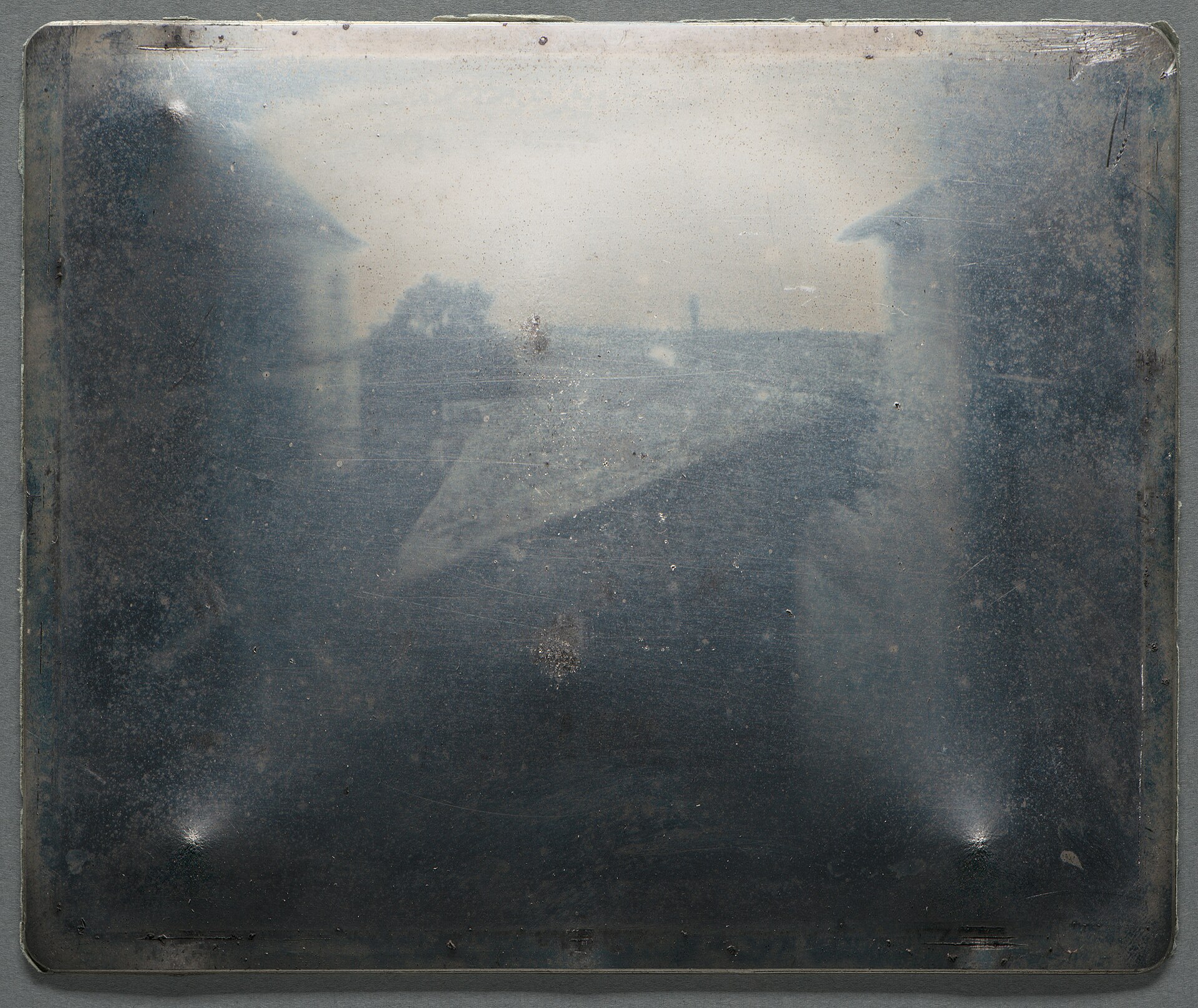
The Harry Ransom Center's own 2020 high-resolution photograph of the actual plate, made under raking light with colour-calibration charts in frame, because the mirror-like pewter surface is otherwise nearly impossible to read in a flat reproduction. This is the plate itself, not a retouched copy.
| Artist | Joseph Nicephore Niepce |
|---|---|
| Date | 1826 or 1827. The exact year is disputed and unresolved even at the holding institution: Helmut Gernsheim originally dated the plate to 1826, but accepted 1827 in the third edition of his own history after Harmant and Marillier argued for it in 1967. The Harry Ransom Center's own published materials use both years, sometimes on the same page. |
| Medium | Heliograph: bitumen of Judea, hardened by light and rinsed clear with a mixture of oil of lavender and white petroleum, on a polished pewter plate (tin alloyed with lead, with trace iron, copper and nickel) |
| Dimensions | 16.7 x 20.3 x 0.15 cm (Harry Ransom Center's current published figure); given elsewhere, including by Wikipedia, as 16.2 x 20.2 cm |
| Where it is now | Harry Ransom Center, University of Texas at Austin, Texas, USAlast confirmed |
| Inventory number | Not published in the sources consulted for this record |
| Attribution | AcceptedUniversally attributed to Niepce. Full note |
| Object type | Photograph |
| Period | French, early nineteenth century |
| Cases | Has a provenance gap · Rediscovered |
| Inscriptions | The plate itself carries no signature or inscription. The paper backing of its frame is inscribed in Francis Bauer's own hand, recording Niepce's name and an account of how the image was made; this note is a large part of why the plate can be securely identified today. |
| Owners on record | 11 links10 documented, 1 unknown |
| Sources | 15 cited |
About this record Last verified · 15 sources cited · Change log
On this page 9 sections
ContentsClose
A view of rooftops, a pigeon loft and a tree at Niepce's family estate near Chalon-sur-Saone, fixed onto a polished pewter plate by his heliography process in 1826 or 1827, and generally described as the earliest surviving photograph made with a camera. Niepce left it with the English botanist Francis Bauer in 1827 after the Royal Society declined to consider his process; the plate then passed through Bauer's estate, a documented sale in 1884 to Henry Baden Pritchard, an unreturned loan to an 1898 exhibition, and forty years of storage in a London warehouse trunk, before the photo-historian Helmut Gernsheim tracked it down and authenticated it on 14 February 1952.
The plate has been at the Harry Ransom Center, University of Texas at Austin, since the Gernsheims sold their photographic history collection there in 1963. It is a mirror-like surface that must be tilted to a precise angle to be read at all, which means almost every reproduction anyone has ever seen of 'the first photograph' is actually a photograph of Gernsheim's own 1952 hand-retouched copy print, not of the object itself. A forty-four-year gap between Bauer's death in 1840 and Pritchard's 1884 purchase remains completely undocumented, and the exact year of exposure, 1826 or 1827, is still argued rather than settled even by the holding institution's own publications.
Provenance
Each link is graded. Documented: a cited source supports it. Disputed: the identification is argued but not established. Unknown: no owner for that span, and the gap is not smoothed into a narrative. The grades in the glossary.
- 1826 or 1827 - 1826 or 1827Nicephore Niepcedocumented
Made at Niepce's family estate, Le Gras, near Chalon-sur-Saone, using his heliography process. The exact year is disputed; see open questions.16913
- 1827 - 1827Francis Bauerdocumented
Niepce travelled to England in September 1827 to visit his ailing brother Claude, was introduced to Bauer, attempted and failed to place his process before the Royal Society for refusing to disclose his method fully, and left the memoir, this camera plate and a separate contact-printed heliograph in Bauer's keeping before returning to France.8914
- 1827 - 1840Francis Bauer, Kewdocumented
Bauer inscribed the frame's paper backing with Niepce's name and an account of the process, and exhibited the plate and memoir before the Royal Society on 9 March 1839 to assert Niepce's priority after Daguerre's and Talbot's rival announcements.689
- 1840 - 1884Unknownunknown
Bauer died on 11 December 1840. No owner, location or event is documented for the plate for the following 44 years. This is a genuine, unclosed gap in every source consulted for this record.910
- 1884 - 1898Henry Baden Pritchard, then his widow Mary Pritcharddocumented
Pritchard, editor of Photographic News, bought the memoir, camera plate and contact print together in 1884. He died shortly afterward and the material passed to his widow, Mary Pritchard. From whom Pritchard bought the material is not documented.910
- 1898 - 1898Royal Photographic Society International Exhibition, Crystal Palacedocumented
The material was shown at this exhibition and, so far as the sources consulted record, was not returned to the Pritchard family afterward, which is the specific reason it then disappears from the public record for over five decades.910
- 1898 - 1917Mary Pritcharddocumented
The material remained with the Pritchard family after the 1898 exhibition, though the exact circumstances of its return to family hands after not being returned by the exhibition organisers are not detailed in the sources consulted.9
- 1917 - 1951Pritchard family, in storagedocumented
On Mary Pritchard's death in 1917, family belongings including the Niepce material were packed into a trunk and placed in a London warehouse. Around 1950 Gernsheim traced Mary's son, who confirmed the family's earlier loss and distress over the material but said it was no longer in the family's possession. The son died in 1951.910
- 1951 - 1952-02-14Widow of Mary Pritchard's sondocumented
After her husband's death in 1951, the son's widow found a 1917 storage receipt among his papers, located and opened the trunk it referred to, found the material still inside, and contacted the Gernsheims.910
- 1952-02-14 - 1963Helmut and Alison Gernsheimdocumented
Gernsheim received the plate on 14 February 1952, authenticated it by tilting it to the light and matching Bauer's manuscript note against the documented 1827 visit, commissioned a reproduction from Kodak's London research laboratory, and personally retouched the copy print he then released for publication.29
- 1963 - presentHarry Ransom Center, University of Texas at Austindocumented
The Gernsheims' entire photographic history collection was acquired by the University of Texas at Austin in 1963. Ransom Center publications differ on whether the heliograph itself was included in that purchase or separately donated by Gernsheim afterward; this record has not been able to resolve which.124
Technical evidence
| Attribution note | Universally attributed to Niepce. The evidence is Francis Bauer's contemporary manuscript note on the frame backing recording Niepce's name and an account of the process; Niepce's own later written description of heliography in his Notice sur l'Heliographie (1829), which matches the plate's physical evidence; and unbroken, documented custody from Bauer's household in 1827 to the present with no competing claim ever proposed. |
|---|---|
| Support | Polished pewter plate: an alloy of tin with lead, with trace amounts of iron, copper and nickel, confirmed by X-ray fluorescence spectroscopy carried out by the Getty Conservation Institute in 2002-2003.3 |
| Light-sensitive layer | Bitumen of Judea dissolved in oil of lavender, applied as a thin coating and confirmed present by reflectance Fourier-transform infrared spectroscopy in the same 2002-2003 study.3 |
| Dimensions | 16.7 x 20.3 x 0.15 cm, per the Harry Ransom Center's current published catalogue figure. Given elsewhere, including Wikipedia, as 16.2 x 20.2 cm; the two figures have not been reconciled in the sources consulted.16 |
| Process | Heliography: the coated plate was exposed in a camera obscura, then washed with a mixture of oil of lavender and white petroleum, which dissolved the unhardened bitumen in shadow areas and left the light-hardened bitumen standing in highlight areas.14 |
| Exposure duration | Traditionally given as roughly eight hours, on the reasoning that sunlight appears to strike both sides of the courtyard in the image. A modern researcher who recreated Niepce's materials and process concluded the exposure must have run for several days instead, given bitumen of Judea's actual light sensitivity. Unresolved.6 |
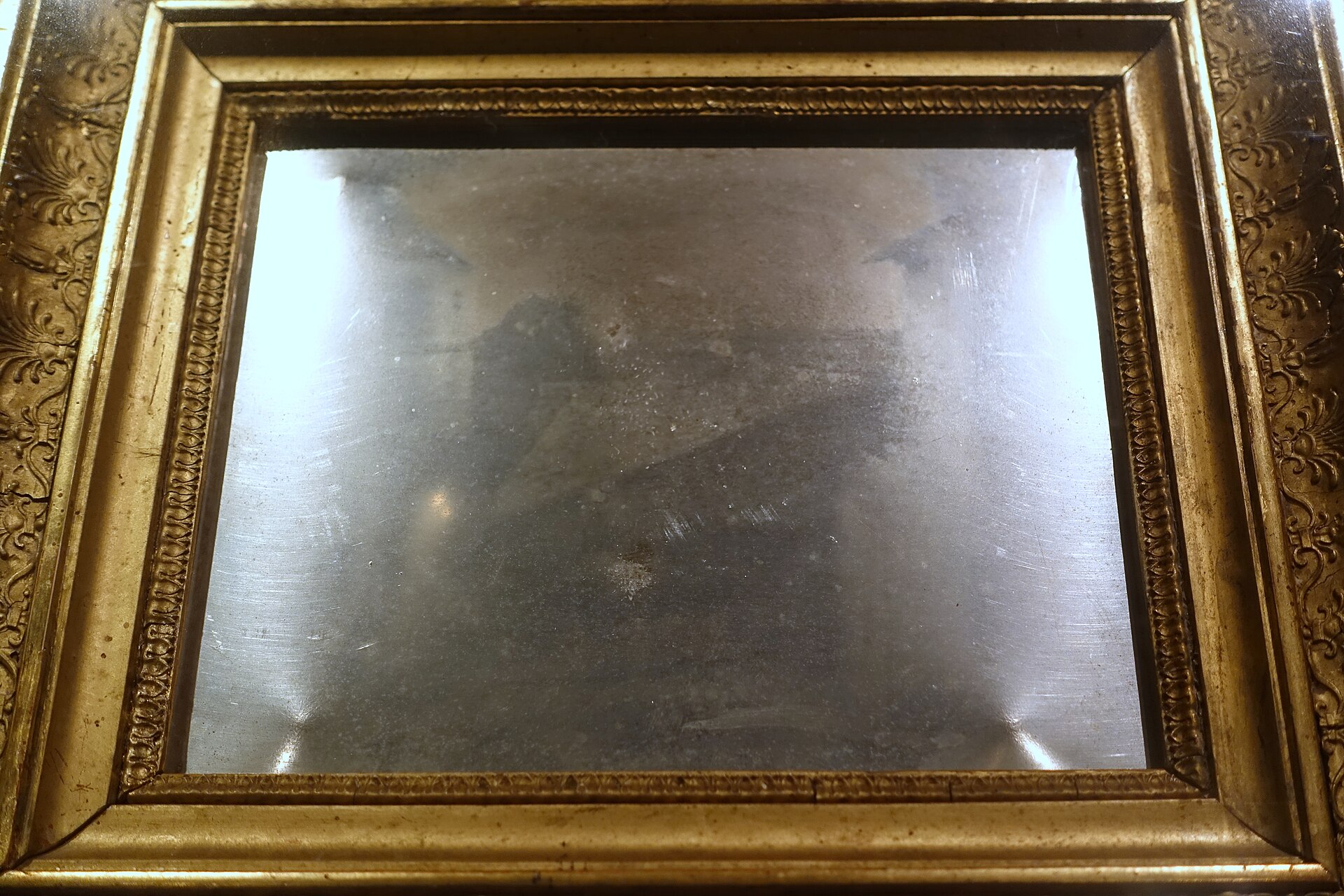
| Frame and inscription | Housed in a gilt wood frame that dates stylistically to the period of the plate's making. The paper backing carries a manuscript note in Francis Bauer's own hand recording Niepce's name and an account of the process.13 |
| Surface condition | Small mechanical bumps near three corners of the plate scatter the raking light needed to read the image, complicating both direct viewing and photography. A 2007 ion beam analysis by Louvre scientists additionally identified ongoing chemical corrosion at the interface between the bitumen layer and the metal support.6 |
| Display case | The plate's original protective case was found in 2002 to have a failed seal, admitting ordinary room air rather than maintaining a stable sealed environment. The Getty Conservation Institute designed and built a new, continuously monitored, oxygen-free case, installed by spring 2003.3 |
Images
The record in full
Chapter 1A view almost nobody can actually see
The single strangest fact about the most famous object in the history of photography is that almost nobody who has seen a reproduction of it has seen it.
The single strangest fact about the most famous object in the history of photography is that almost nobody who has seen a reproduction of it has seen it. What sits in a monitored, oxygen-free case in the lobby of the Harry Ransom Center in Austin, Texas is a small plate of pewter, roughly 16.7 by 20.3 centimetres, its surface polished to something close to a mirror. Tilt it the wrong way under ordinary light and it shows you nothing but a blank, faintly grey sheen and your own reflection. The image, a view of rooftops, a pigeon loft, a barn roof and a tree at Niepce's family estate near Chalon-sur-Saone, only resolves when the plate is held at a specific raking angle to a light source, the way a daguerreotype must be tilted to be read at all.
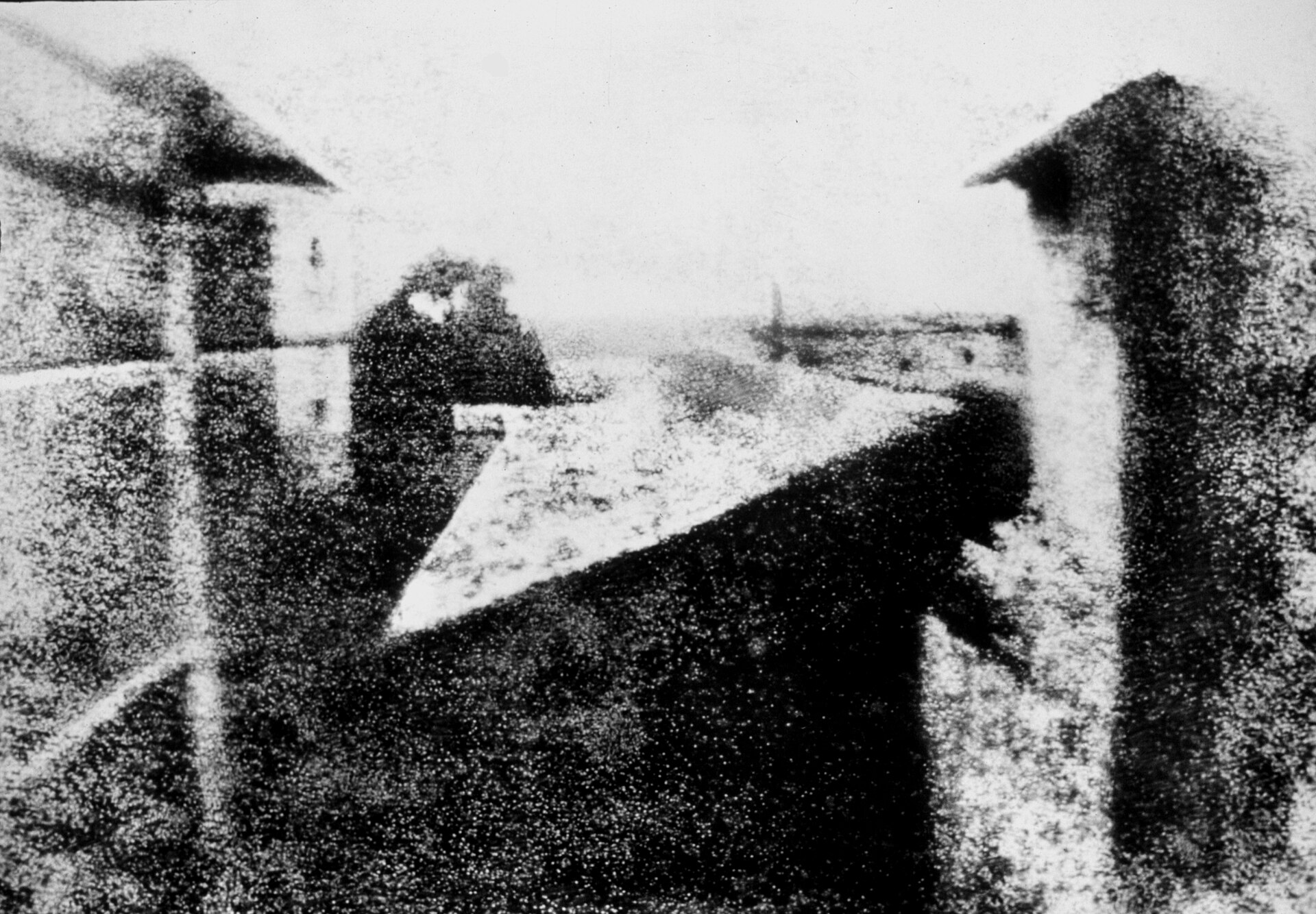
That physical fact is the reason this record exists in the form it does. Every popular reproduction anyone has ever seen of the world's first surviving camera photograph is, without exception, a photograph of something else: a hand-retouched print made in 1952, a later official restoration of that print, or a modern high-resolution photograph taken under raking light with colour-calibration charts in frame specifically so that a flat image file can show what a human eye can only see by tilting the object itself. None of these secondary images are wrong to look at. But they are not the object, and treating them as interchangeable with it is exactly the kind of confusion this publication exists to prevent.
Chapter 2What Niepce actually did
Niepce called his process heliographie, sun-writing.
Niepce called his process heliographie, sun-writing. In his own later written description of it, dated November 1829, he defined the discovery plainly: the discovery I have made, which I call heliography, consists of reproducing spontaneously, by the action of light, with gradations of tone from black to white, the images received in the camera obscura. That sentence, not a modern paraphrase of it, is the clearest surviving statement of what he believed he had achieved, and it is worth reading literally: he is describing a chemical process, not an artistic one, and he frames it that way throughout.
The practical method, reconstructed from his surviving notes and from later technical study of the plate itself, ran as follows. He dissolved bitumen of Judea, a natural asphalt, in oil of lavender, and coated a polished pewter plate with the thin resulting varnish. He set the coated plate inside a camera obscura positioned at an upper window of his house at Le Gras, looking out over the courtyard, the pigeon loft and the barn. Sunlight striking the bitumen through the lens hardened it and made it progressively less soluble; where light fell, the coating stayed fixed, and where it did not, the coating remained soft. After exposure, he washed the plate with a mixture of oil of lavender and white petroleum, which dissolved away the unhardened bitumen in the shadow areas and left the hardened bitumen standing in the light areas, creating a direct positive image in variations of surface texture and reflectivity rather than in pigment.
Traditional accounts, following Gernsheim, give the exposure as roughly eight hours, reasoning from the fact that sunlight appears to strike buildings on both sides of the courtyard in the finished image, which would require the sun to move across a large arc during a single day's exposure. A later researcher who studied Niepce's working notes and physically recreated his materials and process concluded instead that the exposure must have run for several days, since bitumen of Judea's known sensitivity is far too low to produce a legible image from eight hours of exposure alone. Both figures are argued from evidence rather than asserted; neither is settled.
Chapter 3England, Francis Bauer, and a paper the Royal Society would not accept
In September 1827 Niepce travelled to England to visit his older brother Claude, who was living in poor health near London and had squandered a large part of the family's money in unsuccessful...
In September 1827 Niepce travelled to England to visit his older brother Claude, who was living in poor health near London and had squandered a large part of the family's money in unsuccessful business ventures there. While in England, Niepce was introduced to Francis Bauer, an Austrian-born botanical artist who had settled at Kew in 1790 and built, over four decades, one of the most respected reputations in English botanical illustration. Bauer immediately grasped the importance of what Niepce was showing him and urged him to bring his discovery before the Royal Society.
Niepce did so, but the presentation failed on a point of procedure rather than substance. The Society's rules required a full disclosure of method for any process submitted for consideration, and Niepce, protective of an invention he had spent more than a decade developing at his own expense, refused to describe his materials or steps in the detail the rules demanded. The paper was declined. Before returning to France, Niepce left his memoir, a contact-printed heliograph made from an engraving, and this camera-made view of Le Gras in Bauer's keeping. Bauer, methodical by training and temperament, wrote out a record of Niepce's name and an account of the process on the paper backing of the frame that held the camera plate. That single act of careful bookkeeping is the reason the object can be identified today with confidence rather than argued about from style alone, the way so much early photographic material cannot be.
Chapter 4Held by Bauer, exhibited once, then a documented void
Bauer kept the plate at Kew for the rest of his life.
Bauer kept the plate at Kew for the rest of his life. After Louis Daguerre's and William Henry Fox Talbot's rival photographic processes were both announced in London and Paris in January 1839, Bauer put Niepce's memoir and heliographs before the Royal Society again, this time as an exhibit rather than a submission, on 9 March 1839, arguing for Niepce's priority against the sudden fame of two other men's announcements. Niepce himself had died six years earlier, in 1833, and could not make the case himself.
Bauer died on 11 December 1840, at eighty-two, and is buried at St Anne's Church, Kew. What happened to the plate for the next forty-four years is not recorded in any source consulted for this record. It resurfaces in the documentary record only in 1884, when the memoir, the camera plate and the contact-printed heliograph were bought together by Henry Baden Pritchard, editor of the trade journal Photographic News and author of The Photographic Studios of Europe (1882). No source found for this record states from whom Pritchard bought the items, or where they had been kept in the intervening decades. That is a genuine, unclosed gap, not a smoothed-over one, and it is recorded as such rather than bridged with a guess.
Pritchard died shortly after acquiring the material, and it passed to his widow, Mary Pritchard. The plate, memoir and contact print were shown publicly at the Royal Photographic Society's International Exhibition at the Crystal Palace in 1898, and were not returned to the family afterward. That non-return, and not a theft or a further sale, is the specific reason the objects then fall out of the record for more than fifty years.
Chapter 5A trunk in a London warehouse
When Mary Pritchard died in 1917, family belongings, including whatever had by then been recovered or retained of the Niepce material, were packed into a trunk and placed in storage in a London...
When Mary Pritchard died in 1917, family belongings, including whatever had by then been recovered or retained of the Niepce material, were packed into a trunk and placed in storage in a London warehouse, where they were, in the plainest sense, forgotten.
Helmut Gernsheim began actively searching for the plate around 1950, working from Bauer's documented custody and the 1898 exhibition record as his only firm leads. He placed an appeal in The Observer newspaper describing what he was looking for. It produced a response from Mary Pritchard's son, who remembered his mother's lasting distress at the loss of the items but told Gernsheim the family no longer had them. That son died in 1951. His widow subsequently found a storage receipt dated 1917 among his papers, opened the trunk it referred to, and found the plate still inside. She wrote to the Gernsheims. On 14 February 1952, at her home, the framed plate was placed in Helmut Gernsheim's hands.
Chapter 6Authenticating a mirror
Gernsheim did not, by his own later account, expect what he was handed to be reflective.
Gernsheim did not, by his own later account, expect what he was handed to be reflective. The surface showed him nothing at first look but a faint grey sheen and his own face. He took the plate to a window and held it at an angle to the light exactly as one tilts a daguerreotype to read it, then increased the angle further until the latent image of the courtyard at Le Gras resolved into view. Bauer's manuscript note on the backing paper, still attached, matched what he already knew from published accounts of Niepce's 1827 visit and gave him a documentary basis, alongside the physical behaviour of the plate itself, for identifying it as genuine. He commissioned a reproduction from Kodak's research laboratory in London and sent press releases to Life and other magazines announcing the rediscovery of the world's first photograph. The story ran, in France, in Paris Match on 10 May 1952.
What almost nobody who read those stories saw was the plate. What they saw was Kodak's copy print, and Gernsheim did not leave that print alone. He hand-retouched it himself, manually reinforcing the barely legible tonal transitions so that a mass-market reproduction could actually be read as a picture of a courtyard rather than as a grey rectangle, and for roughly a quarter of a century, into the late 1970s, he permitted publication of only this retouched version. The unretouched copy, closer to what the plate itself will show a viewer who tilts it correctly, was not the public face of the object for most of its modern fame. The famous first photograph the twentieth century thought it knew was, quite literally, partly Gernsheim's own handiwork.
Chapter 7Sold to Texas, twice over in the telling
Helmut and Alison Gernsheim spent the 1950s and early 1960s building a photographic history collection that eventually ran to more than 33,000 prints, roughly 4,000 books, and a large body of...
Helmut and Alison Gernsheim spent the 1950s and early 1960s building a photographic history collection that eventually ran to more than 33,000 prints, roughly 4,000 books, and a large body of research notes and correspondence, including original letters from Daguerre and Talbot. In 1963 Harry Ransom, on behalf of the University of Texas at Austin, purchased the entire collection, which became the founding core of what is now the Harry Ransom Center's photography department. Sources describing the heliograph's own path into that collection are not consistent with each other: one Ransom Center account states plainly that the heliograph was purchased in 1963 as part of the collection; another, published by the same institution, states that Gernsheim donated the heliograph separately once the main sale of the collection had gone through. Both statements exist in the institution's own published record, and this record does not resolve the discrepancy, because no source consulted settles it.
Whichever mechanism applies to the heliograph specifically, the plate has been in Austin since 1963 and has left Texas only twice since: for scientific study, and for a single loan exhibition. It travelled to the Reiss-Engelhorn Museums in Mannheim, Germany, from September 2012 to January 2013, for The Birth of Photography: Highlights of the Helmut Gernsheim Collection, an exhibition built specifically to reunite, for the first time in fifty years, the historical Gernsheim material in Texas with the Gernsheims' later twentieth-century photography collection, by then held in Mannheim itself.
Chapter 8What science has actually found inside it
The plate travelled once more within the United States, in 2002, when the Ransom Center sent it to the Getty Conservation Institute in Los Angeles for the first scientific study ever conducted of its...
The plate travelled once more within the United States, in 2002, when the Ransom Center sent it to the Getty Conservation Institute in Los Angeles for the first scientific study ever conducted of its material composition and condition. Getty scientists used X-ray fluorescence spectroscopy and reflectance Fourier-transform infrared spectroscopy, among other non-invasive techniques, and before even opening the plate's protective case, sampled the air trapped inside it to check whether the case's seal was still functioning. It was not: the atmosphere inside was found to be essentially the same as the surrounding room, meaning the case had not been providing the stable, sealed environment it was assumed to provide.
The analysis confirmed that the plate is pewter, an alloy of tin with lead and trace amounts of iron, copper and nickel, not pure tin or any other single metal, and confirmed the presence of bitumen consistent with Niepce's own described method. Microscopic and reflectance examination of the surface also showed physical damage: small bumps near three of the plate's corners, which interfere with viewing and photographing the image by scattering the raking light needed to read it. The Getty Conservation Institute then designed and built a new, continuously monitored, oxygen-free display case to replace the failing original, and the plate went back on view at the Ransom Center in spring 2003, alongside a new official photograph of the object made, for the first time, without manual retouching.
A separate study published in 2007 by scientists at the Louvre used ion beam analysis to examine the plate further and reported evidence of ongoing corrosion at the interface between the bitumen layer and the metal beneath it, a slow chemical process distinct from, and in addition to, the mechanical dents already logged by the Getty team. In 2019 and 2020, during a reinstallation of the Ransom Center's permanent exhibition, curatorial and conservation staff photographed the heliograph again at high resolution, this time with colour-calibration charts included in the frame, producing the most recent reference images of the plate the institution has made public.
Chapter 9A scientist, not a mystic
Niepce was born Joseph Niepce on 7 March 1765 in Chalon-sur-Saone, the son of a well-off royal counsellor.
Niepce was born Joseph Niepce on 7 March 1765 in Chalon-sur-Saone, the son of a well-off royal counsellor. He adopted the name Nicephore, after the ninth-century Patriarch of Constantinople, while a student at the Oratorian college in Angers, where his own recorded interests were physics and chemistry rather than theology; he went on to teach at the college for a time. Later he served as a staff officer under Napoleon in Italy and Sardinia, resigned for reasons of health, married Agnes Romero, administered the district of Nice for the post-revolutionary French state, and then resigned that post too, in 1795, to return to his family's estate at Chalon and pursue scientific experiment full time alongside his brother Claude, funding the work as an independently wealthy gentleman-farmer growing sugar beet.
Nothing in the sources consulted for this record connects Niepce's pursuit of heliography to any religious order, secret society or esoteric programme. His own written definition of the discovery, quoted above, describes light acting chemically on matter; his working notebooks, so far as they are described in the literature, concern lens apertures, exposure times, varnish recipes and metal supports, the ordinary vocabulary of an early nineteenth-century experimental chemist working in the same tradition as Humphry Davy's and Thomas Wedgwood's earlier, unsuccessful attempts to fix a camera image with silver salts. Where this record's house practice requires researching a maker's documented beliefs, the honest finding here is an absence: a wealthy provincial experimentalist, trained in an Oratorian college's science curriculum, working alone and largely self-funded, framing his own achievement in the plain language of applied chemistry. That absence of a hidden programme is itself the finding, and it is a more useful one than a manufactured mystery would be.
Chapter 10Niepce and Daguerre: the partnership that outlived him unevenly
In December 1829 Niepce entered into a formal partnership with Louis Daguerre, a Parisian painter and diorama designer who had been separately pursuing his own means of fixing a camera image.
In December 1829 Niepce entered into a formal partnership with Louis Daguerre, a Parisian painter and diorama designer who had been separately pursuing his own means of fixing a camera image. The two men worked to improve heliography together, and by 1832 had developed a related process, the physautotype, using a distillate of lavender oil as the light-sensitive agent, which needed a shorter exposure than bitumen alone. Niepce died of a stroke on 5 July 1833, financially exhausted; the municipality of Saint-Loup-de-Varennes paid for his grave in the local cemetery.
Daguerre continued alone after Niepce's death and within six years had developed the daguerreotype proper, using mercury vapour to develop a latent image on a silver-coated copper plate sensitized with iodine, a process that reduced exposure times from hours to minutes and was announced to enormous public acclaim in January 1839. The French state rewarded Daguerre with a lifetime pension of 6,000 francs a year; Niepce's estate, represented by his son Isidore, who had continued the partnership after his father's death, received 4,000 francs a year under the same arrangement, a division Isidore contested at the time as inadequate given what he considered his father's greater claim to priority. Bauer's 1839 exhibition of the Le Gras plate at the Royal Society was a direct response to this asymmetry, mounted specifically to put physical evidence of Niepce's earlier achievement in front of the scientific public at the exact moment Daguerre's name was becoming a household word across Europe. It did not change the popular verdict. Daguerre's name became attached to the birth of photography in the public imagination for more than a century; Niepce's has generally needed a specialist, or an object like this one, to be remembered at all.
Chapter 11The one to keep separate: Le Cardinal d'Amboise
Niepce made more than one surviving heliograph, and the difference between them matters.
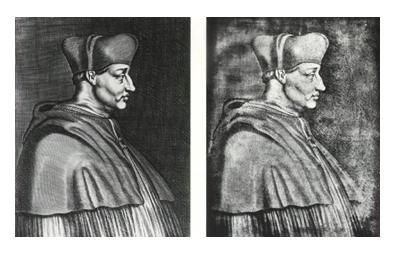
Niepce made more than one surviving heliograph, and the difference between them matters. Le Cardinal d'Amboise is a portrait, taken not with a camera but by direct contact printing from an engraving by Isaac Briot that Niepce's cousin, Dubard de Curley, had sent him; Niepce exposed it in around three hours in late 1826, and in February 1827 etched the exposed pewter plate to create an actual printing plate, from which he pulled at least two paper prints. Several impressions of this separate heliograph survive today, at institutions that include the Victoria and Albert Museum, and individual pewter plates and prints have appeared at auction. It is Niepce's best-known heliograph after the Le Gras view precisely because it exists in multiple surviving copies, unlike the single, unrepeatable camera exposure this record describes.
The two objects are frequently confused in casual writing because both are early Niepce heliographs on pewter, both date from the same eighteen-month window, and both passed through Bauer's hands to England in 1827. They are not the same kind of object. Le Cardinal d'Amboise is a contact print of an existing image, reproducible from its etched plate; the Le Gras view is a unique camera exposure of a real scene, with no negative and no means of making a second original. Any image purporting to show Le Cardinal d'Amboise in this record's gallery is marked accordingly, and should never be read as an alternate view of the object described here.
Chapter 12What is not documented
Several questions a careful reader would expect this record to answer cannot currently be answered from the sources consulted, and are recorded here as findings rather than left implicit.
Several questions a careful reader would expect this record to answer cannot currently be answered from the sources consulted, and are recorded here as findings rather than left implicit. The exact year of exposure, 1826 or 1827, has shifted under expert opinion at least once and is not treated as fully closed even by the Ransom Center's own publications. The forty-four years between Bauer's death in 1840 and Pritchard's purchase in 1884 have no documented owner, dealer or event attached to them at all. It is not recorded from whom Pritchard bought the material in 1884, whether at auction, through a dealer, or privately from someone connected to Bauer's estate. The true duration of the original exposure, eight hours or several days, remains argued rather than settled. And the exact commercial mechanism by which the University of Texas came to hold the heliograph specifically, purchase or separate donation, is stated two different ways in the Ransom Center's own public materials, and this record has not been able to determine which, if either, is the fuller account.
Chapter 13What is happening to it now
The plate remains on permanent view in the main lobby of the Harry Ransom Center in Austin, inside the oxygen-free, continuously monitored case built by the Getty Conservation Institute after the...
The plate remains on permanent view in the main lobby of the Harry Ransom Center in Austin, inside the oxygen-free, continuously monitored case built by the Getty Conservation Institute after the 2002-2003 study, itself installed after the original enclosure's seal was found to have failed. It rarely travels; the 2012-2013 Mannheim loan remains, so far as the sources consulted for this record show, the only occasion since 1963 that it has left Texas. The most recent published photography of the object dates to the 2019-2020 reinstallation of the Ransom Center's permanent galleries, when conservation staff made new high-resolution reference images, with colour charts included in frame, of a kind the object had not previously received. No further scientific study, conservation campaign or travelling exhibition involving the plate is announced in the sources consulted as of the date of this record.
The artist
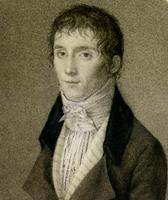
Joseph Nicephore Niepce
Niepce was not an artist in any sense he would have recognised. He was a provincial gentleman-scientist, self-funded, working largely alone, who spent more than a decade on a chemistry problem, how to fix a camera image permanently, before he succeeded. He wrote about his own discovery in the plain, unmystical language of a physical chemist, and there is no documented evidence connecting him to any religious order, society or esoteric current beyond the ordinary Catholic and classical schooling of his class and period. That absence is treated in this record as a finding, not a gap.
Related works
| Work | Relation | Where it is |
|---|---|---|
| Le Cardinal d'Amboise Nicephore Niepce | Niepce's other surviving heliograph on pewter, made by contact-printing an engraving rather than by camera, in late 1826; the object most often confused with this one Not a camera photograph. Reproducible from an etched plate, unlike the unique Le Gras exposure. See the gallery caption for this record's explicit version-safety note. | Multiple surviving impressions, including the Victoria and Albert Museum, London |
| Paysage a Gras (test heliograph on zinc) Nicephore Niepce | An earlier successful heliograph, from around 1823, described in Niepce's own account as his first achieved permanent image Illustrates that the Le Gras plate now at the Harry Ransom Center is not Niepce's very first success, only the earliest one that has survived. | Lost; not known to survive |
| Boulevard du Temple Louis Daguerre | The next major surviving milestone in the same story, made 1838, generally credited as the earliest surviving photograph to show a living person Covered as its own record in this archive. Not to be confused with or substituted for the Niepce plate; the two objects are eleven or twelve years apart and made by different processes. | Bayerisches Nationalmuseum, Munich |
| Latticed Window at Lacock Abbey William Henry Fox Talbot | The earliest surviving photographic negative, made 1835, using Talbot's separately developed calotype process A useful comparandum for what 'earliest surviving photograph' claims mean in practice: Niepce's plate is a unique positive with no negative; Talbot's process, unlike Niepce's or Daguerre's, was reproducible from the start. | Science Museum Group / National Science and Media Museum, Bradford |
Open questions
- Is the plate's exposure correctly dated to 1826 or to 1827? Expert opinion has moved at least once and the Ransom Center's own published materials still use both years.
- What happened to the plate, memoir and contact print between Francis Bauer's death in 1840 and Henry Baden Pritchard's purchase of them in 1884? No owner, dealer or event is documented for this 44-year span.
- From whom did Pritchard buy the material in 1884? No source consulted names a seller or describes the transaction.
- Did the original camera exposure run for roughly eight hours, as traditionally stated, or for several days, as a modern experimental reconstruction argues?
- Did the University of Texas purchase the heliograph as part of the 1963 Gernsheim Collection sale, or was it separately donated by Helmut Gernsheim afterward? The Ransom Center's own publications state both.
- Does any part of the paper Niepce and Bauer attempted to place before the Royal Society in 1827 survive intact, and if so, where is it held today?
Questions about this object
What is View from the Window at Le Gras?
View from the Window at Le Gras is a photograph, dated 1826 or 1827. The exact year is disputed and unresolved even at the holding institution: Helmut Gernsheim originally dated the plate to 1826, but accepted 1827 in the third edition of his own history after Harmant and Marillier argued for it in 1967. The Harry Ransom Center's own published materials use both years, sometimes on the same page.. Medium: Heliograph: bitumen of Judea, hardened by light and rinsed clear with a mixture of oil of lavender and white petroleum, on a polished pewter plate (tin alloyed with lead, with trace iron, copper and nickel).
Who made View from the Window at Le Gras, and is the attribution settled?
The attribution to Joseph Nicephore Niepce is recorded here as accepted. Universally attributed to Niepce. The evidence is Francis Bauer's contemporary manuscript note on the frame backing recording Niepce's name and an account of the process; Niepce's own later written description of heliography in his Notice sur l'Heliographie (1829), which matches the plate's physical evidence; and unbroken, documented custody from Bauer's household in 1827 to the present with no competing claim ever proposed.
Where is View from the Window at Le Gras now?
Harry Ransom Center, University of Texas at Austin, Texas, USA. Inventory number Not published in the sources consulted for this record. Last confirmed 13 August 2026. Acquired 1963 with the Gernsheim Collection. Institutional accounts differ on whether the plate itself was purchased as part of the collection or separately donated by Helmut Gernsheim once the collection sale was complete; both statements appear in Ransom Center publications.
What is still unknown about View from the Window at Le Gras?
Is the plate's exposure correctly dated to 1826 or to 1827? Expert opinion has moved at least once and the Ransom Center's own published materials still use both years.
Sources
- 1Harry Ransom Center, University of Texas at Austin, 'The Niepce Heliograph' (object catalogue page) hrc.utexas.edu/niepce-heliograph
- 2Barbara Appelbaum Brown, 'The First Photograph', WAAC Newsletter Vol. 24 No. 3 (September 2002), reprinted in Abbey Newsletter Vol. 26 No. 3 (November 2002) cool.culturalheritage.org/byorg/...
- 3'GCI/HRC Research World's First Photograph', Abbey Newsletter Vol. 26 No. 3 (November 2002), reporting the Getty Conservation Institute's 2002-2003 material analysis and new display case cool.culturalheritage.org/byorg/...
- 4Ransom Center Magazine, 'Introducing the Niepce Heliograph' (20 August 2019) sites.utexas.edu/ransomcentermagazine/...
- 5Harry Ransom Center press release, 'First Photograph to Travel to Europe for First Time in 50 Years' (26 June 2012) hrc.utexas.edu/press/...
- 6Wikipedia, 'View from the Window at Le Gras'. en.wikipedia.org/wiki/...
- 7Wikipedia, 'Helmut Gernsheim'. en.wikipedia.org/wiki/...
- 8Wikipedia, 'Nicephore Niepce'. en.wikipedia.org/wiki/...
- 9Art History Unstuffed, 'The Invention of Photography: Niepce, Part Two', for the detailed Pritchard family chain of ownership and Gernsheim's own account of authenticating the plate by tilting it to the light arthistoryunstuffed.com/the-invention-of-photography-niep...
- 10Science News, 'Photography at a Crossroads', independently corroborating the Pritchard family chain of ownership and the 1952 rediscovery circumstances sciencenews.org/article/...
- 11Musee Nicephore Niepce / Archives Niepce, quoting Niepce's own 'Notice sur l'Heliographie' (November 1829) for his own definition of the process archivesniepce.com/index.php/...
- 12Sotheby's, 'Joseph Nicephore Niepce, 1765-1833', lot essay for a Niepce heliograph sale, for context on the Cardinal d'Amboise group of works sothebys.com/en/...
- 13Harmant, Pierre G. and Marillier, Paul, 'Some Thoughts on the World's First Photograph', The Photographic Journal, Vol. 107 No. 4 (April 1967), pp. 130-140. Cited via secondary bibliographies; the original journal article was not directly consulted for this record and should be checked against the primary text. en.wikipedia.org/wiki/...
- 14Wikipedia, 'Francis Bauer'. en.wikipedia.org/wiki/...
- 15Victoria and Albert Museum, Collections, 'Le Cardinal d'Amboise, photograph, Niepce, Joseph Nicephore', for the separate Cardinal d'Amboise heliograph object record collections.vam.ac.uk/item/...
Last verified · Published
Change log
13 August 2026 - Record created at the house standard: researched narrative, technical evidence, maker dossier, graded provenance chain, prices with hammer and premium separated, related works, open questions and sources.