La Princesse du pays de la porcelaine
James Abbott McNeill Whistler · 1863-1865, signed and dated 1864
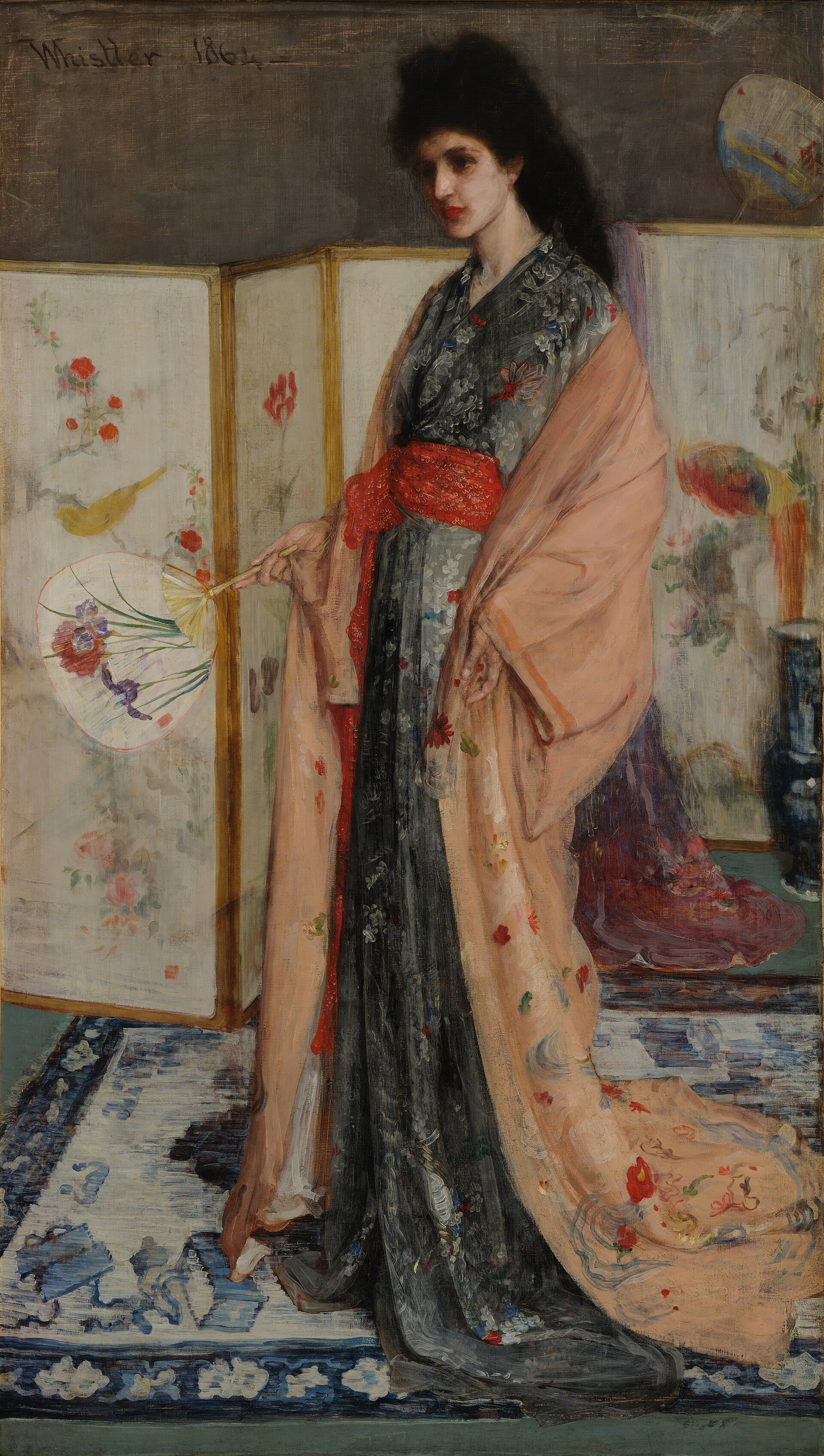
The record subject. Oil on canvas, 1863-1865, signed 'Whistler 1864'. Freer Gallery of Art, accession F1903.91a-b.
| Artist | James Abbott McNeill Whistler |
|---|---|
| Date | 1863-1865, signed and dated 1864 |
| Medium | Oil on canvas |
| Dimensions | 201.5 x 116.1 cm (79 5/16 x 45 11/16 in), as published by the holding institution, the Freer Gallery of Art. The University of Glasgow catalogue raisonne (YMSM 050) gives 199.9 x 116.0 cm (78 3/4 x 45 3/4 in). The discrepancy is not resolved in the sources consulted; it is small enough to be a difference between measuring with and without the frame rebate, but that is this record's inference, not a documented explanation. |
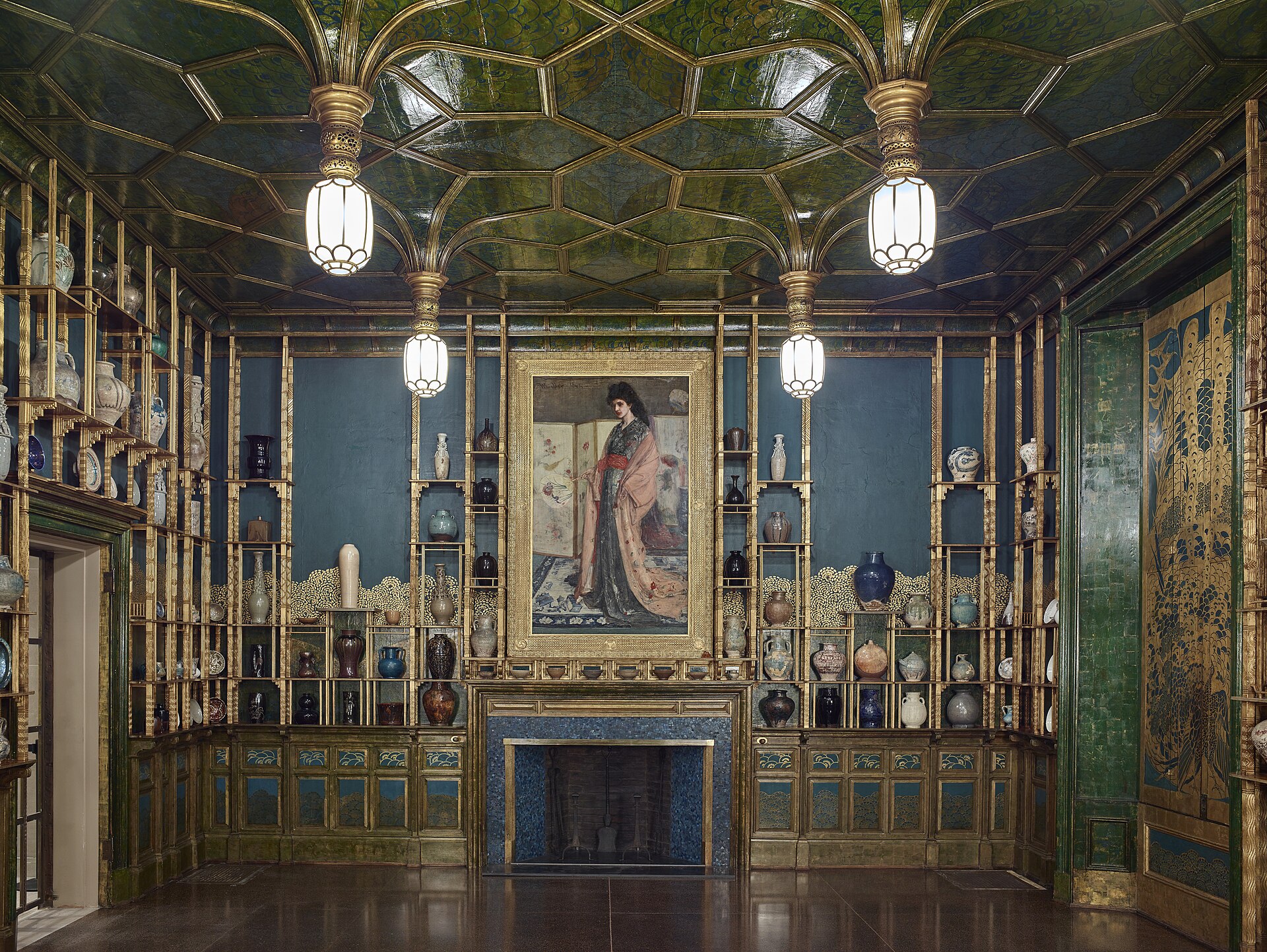
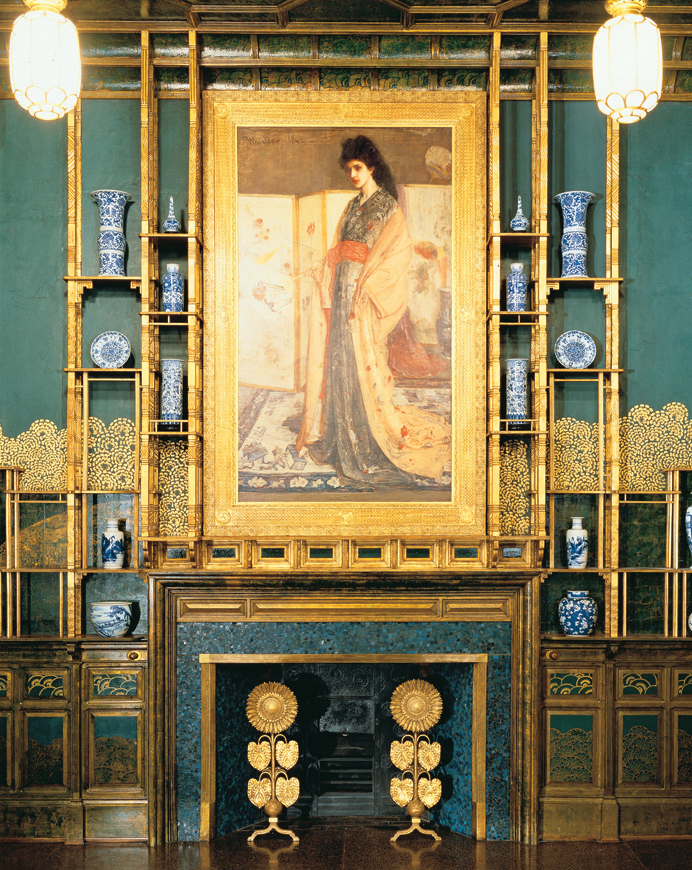
| Where it is now | Freer Gallery of Art, Smithsonian Institution, Washington DC. Displayed above the fireplace in the Peacock Room, Gallery 12 (West Building), in a rehang titled 'The Peacock Room in Blue and White'.last confirmed |
| Inventory number | F1903.91a-b |
| Attribution | AcceptedSigned and dated 'Whistler 1864' on the canvas. Full note |
| Object type | Painting |
| Period | British Aesthetic Movement; American expatriate painting, nineteenth century |
| Inscriptions | Signed and dated 'Whistler 1864', at the upper left corner, per the Freer Gallery's own object record. Corrected 2026-09-27: this record previously gave the position as the lower area of the canvas and attributed that to the catalogue raisonne, which in fact records the signature without giving any position at all. The upper placement is what makes sense of this record's own account of the collector who wanted the signature changed. |
| Owners on record | 9 links8 documented, 1 disputed |
| Sources | 17 cited |
About this record Last verified · 17 sources cited · Change log
On this page 10 sections
ContentsClose
Whistler painted this life-sized figure of a woman in a kimono, using the Anglo-Greek beauty Christine Spartali as his model, between 1863 and 1865, and could not sell it: Spartali's own father declined to buy his daughter's portrait, and the picture remained with the artist through a hostile reception at the 1865 Paris Salon. Frederick Leyland, the Liverpool shipping magnate, bought it by 1872 and hung it above his dining-room fireplace among his collection of Chinese porcelain - and then, when the architect designing the room around it fell ill, handed the project to Whistler, who painted over the leather walls, gilded the shelving, added gold peacocks, and billed Leyland 2,000 guineas for work he had never fully authorised. Leyland paid half, in pounds rather than the guineas convention demanded, and the two men never spoke again; Whistler answered inside the room itself, with a mural of two fighting peacocks he titled Art and Money.
The painting and the room it now shares reached the Smithsonian by two completely separate routes. The picture was sold from Leyland's 1892 estate sale through two Glasgow dealers before Charles Lang Freer bought it in August 1903. The room itself, sold from the same house by a later, unrelated owner who disliked it, was dismantled into twenty-seven crates and shipped to Freer's house in Detroit in 1904 - eleven months after Freer had already bought the painting in a separate transaction. Both came to the Smithsonian by Freer's 1906 gift and have hung together since the Freer Gallery opened in 1923.
One precision matters more than any other here: the blue-and-white porcelain now filling the room's shelves is not Leyland's. His collection was dispersed at auction in 1892; what visitors see today is drawn from Freer's own holdings, supplemented since 2019 with newly commissioned pieces because even Freer's collection could not fill the room the way Leyland's had. A separate, modern artwork, Darren Waterston's 2015 installation Filthy Lucre, reimagines the room in a state of decorative collapse and must never be mistaken for the historic room or for this painting.
Provenance
Each link is graded. Documented: a cited source supports it. Disputed: the identification is argued but not established. Unknown: no owner for that span, and the gap is not smoothed into a narrative. The grades in the glossary.
- 1863 - 1865The artist, James McNeill Whistlerdocumented
Painted in Whistler's studio, using Christine Spartali as the primary model, over the winter of 1863-64 and into 1865; signed and dated 'Whistler 1864'.17
- 1865 - 1865The artist, James McNeill Whistlerdocumented
Exhibited at the Paris Salon of 1865 as La Princesse du Pays de la Porcelaine, retained in the artist's ownership.16
- 1865 - 1872Unclear; possibly Gambart's French Gallery, Dante Gabriel Rossetti, and a collector reported as Frederick Huthdisputed
Secondary sources describe a 1866 display at Gambart's French Gallery in London, a brief period with Rossetti, and a possible sale to Frederick Huth, with the picture back in Whistler's hands by 1867. The catalogue raisonne consulted for this record does not describe this period and moves directly from the 1865 Salon to the 1872 Leyland purchase. Flagged for verification against the catalogue raisonne's full provenance notes.2
- 1872 - 1892Frederick Richards Leylanddocumented
Purchased by Leyland; on display at his London house, 49 Prince's Gate, by November 1872. Hung above the fireplace of the dining room subsequently rebuilt around it as the Peacock Room, 1876-77. No purchase price is given in the sources consulted. Some popular accounts give 1876 as the acquisition date, which this record treats as a conflation with the room's decoration date.13
- 1892-05-28 - 1892-05-28Alexander Reid (dealer, Glasgow), buying at auctiondocumented
Sold at Christie's, London, 28 May 1892, lot 39, following Leyland's death, and bought there by the Glasgow dealer Alexander Reid for 420 guineas - reported by the Pennells as four times what Whistler had originally received for the picture.1
- 1892 - 1895Sir William Burrell, Glasgowdocumented
Sold by Reid to the Glasgow shipping magnate and collector William Burrell in 1894 or 1895.1
- 1903-08-20 - 1903-08-20Charles Lang Freerdocumented
Sold by Burrell to Charles Lang Freer on 20 August 1903, for 3,750 pounds sterling, reported at the time as 18,240 US dollars - a few weeks after Whistler's death on 17 July 1903. This transaction is entirely separate from, and eleven months earlier than, Freer's 1904 purchase of the Peacock Room itself.111
- 1906 - 1920Charles Lang Freer, then his bequestdocumented
Freer signed the deed of gift transferring his collection, including this painting, to the Smithsonian Institution in 1906. Freer died in 1919; the bequest was formally received by the Smithsonian in 1920 on completion of the Freer Gallery of Art.11
- 1923 - presentFreer Gallery of Art, Smithsonian Institutiondocumented
The Freer Gallery opened to the public in 1923; the painting has hung above the fireplace of the reconstructed Peacock Room there ever since. Freer's bequest terms prohibit the painting from being lent outside the Gallery.113
Prices realised
| Date | Sale | Estimate | Result | Note |
|---|---|---|---|---|
| 28 May 1892 | Christie's | Not given in the sources consulted. | Hammer 420 guineas With premium Not separately documented in the sources consulted; nineteenth-century Christie's sales of this kind are not generally recorded with a distinct buyer's premium in the literature reviewed, and this record does not assume one existed. GBP (guineas) | Lot 39 of the estate sale following Frederick Leyland's death, bought by the Glasgow dealer Alexander Reid. Reported by the Pennells as four times the sum Whistler had originally been paid for the picture. Corrected 2026-09-27: that sum IS given, at Pennell 1908 volume 1 page 124, where Whistler agreed to take a hundred pounds through Rossetti; Whistler himself, drafting a letter in 1892, said a hundred pounds and then added that he believed it was fifty and could not remember. 420 guineas is 441 pounds, nearer four times a hundred than four times fifty. The Pennells' own report of the multiple is at volume 2 page 127, not volume 1. |
Hammer is the price at which the bidding stopped; with premium adds the fee the house charges the buyer on top. Hammer price and buyer's premium in the glossary.
Technical evidence
| Attribution note | Signed and dated 'Whistler 1864' on the canvas. The attribution has never been disputed and the picture is catalogued as YMSM 050 in the standard catalogue raisonne of Whistler's paintings compiled by Margaret F. MacDonald, Joy Newton and Robin Spencer for the University of Glasgow. |
|---|---|
| Support and medium | Oil on canvas.1 |
| Dimensions | 201.5 x 116.1 cm (79 5/16 x 45 11/16 in) per the Freer Gallery of Art; 199.9 x 116.0 cm (78 3/4 x 45 3/4 in) per the University of Glasgow catalogue raisonne (YMSM 050). The two published figures differ by roughly 1.5 cm and are not reconciled in the sources consulted.111 |
| Signature | Signed and dated 'Whistler 1864'. The picture is generally dated to a working period of 1863-1865, with the year on the signature falling within that span rather than marking completion.1 |
| Accession number | F1903.91a-b, Freer Gallery of Art, Smithsonian Institution. The number derives from Freer's August 1903 purchase and is a separate accession from the Peacock Room itself, F1904.61, purchased eleven months later.11 |
| Frame | The painting is shown in a frame integral to its display; scholarship on the object (cited by Tsui) has argued that the frame materially affects the picture's presence, describing the unframed image as reading like a cropped photograph and the framed object as an aesthetic object able to hold its own against the Peacock Room's decoration.6 |
| Current display context | Displayed above the fireplace wall of the Peacock Room, Gallery 12, West Building of the Freer Gallery of Art, within the 2019-2022 rehang 'The Peacock Room in Blue and White' and its successor installation.1115 |
| Model | Christine (Christina) Spartali, born c. 1845, died 1884; daughter of Michael Spartali, a London merchant who became Greek consul-general only in 1867, after this picture was painted, and sister of the painter Marie Spartali Stillman. Sat for the picture roughly twice weekly over the winter of 1863-64.7 |
Images
The record in full
Chapter 1A single figure the size of a real woman, built from porcelain colours
The picture is large for a single standing figure: 201.5 by 116.1 centimetres by the Freer Gallery's own measurement, oil on canvas, close to life size.
The picture is large for a single standing figure: 201.5 by 116.1 centimetres by the Freer Gallery's own measurement, oil on canvas, close to life size. A young woman in a kimono worn loose over a Western chemise stands with her head inclined and her torso leaning back from the waist, an S-curve pose borrowed from the figures painted on Chinese export porcelain and from Japanese woodblock prints rather than from any Western portrait convention. She is surrounded by a folding screen, fans, a length of patterned carpet, and blue-and-white porcelain, all rendered in a palette Whistler pulled from famille rose ware: peachy pink, silvery grey and white, with almost none of the deep shadow a conventional 1860s portrait would use.
Whistler's own language for the picture, used in its early exhibition titles, was musical and coloristic rather than narrative: Variations in Flesh Colour and Blue, later Rose and Silver. The subject is not offered as an event or a story. It is offered as an arrangement of colour that happens to take the form of a woman in a kimono, which is exactly the argument Whistler was making about painting in general in these years.
Chapter 2The sitter: Christine Spartali
The model was Christine (also given as Christina) Spartali, born around 1845, daughter of Michael Spartali, a wealthy Anglo-Greek merchant who later served as Greek consul-general in London.
The model was Christine (also given as Christina) Spartali, born around 1845, daughter of Michael Spartali, a wealthy Anglo-Greek merchant who later served as Greek consul-general in London. He was a merchant and not yet consul-general when she sat: the consulship dates from 1867, after the picture was finished. Her sister was Marie Spartali Stillman, later a painter closely associated with the Pre-Raphaelite circle; Christine herself is described by Tsui as noted for her beauty in Pre-Raphaelite circles, and the Pennells say Whistler, no less than Rossetti, was struck by the beauty of both sisters and asked the younger to sit. Corrected 2026-09-27: this record previously said she was one of the beauties artists of the day competed to paint, which no source supports as phrased, and the exclamation usually quoted in this connection is Swinburne's and is about her elder sister Marie.
She sat for Whistler roughly twice a week over the winter of 1863-64. According to the account her sister Marie later gave to Whistler's biographers Elizabeth and Joseph Pennell, the sittings were long and difficult: Whistler repeatedly scraped out sections of the picture and made her return again and again, struggling above all with the head. When Christine fell ill during the process, another model stood in for the costume while Whistler worked from a pencil study of her face made during her recovery.
Christine urged her father to buy the finished picture. Michael Spartali declined, objecting that he did not want it as a portrait of his daughter, and a further prospective buyer is also reported to have backed away, reportedly put off by the size and prominence of Whistler's signature at the top of the canvas, a detail sometimes connected to his later move toward the small, discreet butterfly monogram. Christine went on to marry and become the Countess Edouard Cahen d'Anvers; she died in 1884.
Chapter 3The 1865 Salon, and a decade of retitling
Whistler exhibited the picture at the Paris Salon of 1865 as La Princesse du Pays de la Porcelaine, two years after the succes de scandale of The White Girl at the 1863 Salon des Refuses.
Whistler exhibited the picture at the Paris Salon of 1865 as La Princesse du Pays de la Porcelaine, two years after the succes de scandale of The White Girl at the 1863 Salon des Refuses. Reception was mixed and often unkind. Paul Mantz dismissed it as a costume study rather than the representation of a living figure; Ernest Chesneau complained that Whistler had failed to bring the princess to life, writing that 'the land of porcelain is not the land of the Shades'; Paul de Saint-Victor was harsher still, calling the figure 'a bamboo stalk in costume' with 'nobody under this long robe.' A minority read the picture differently: Louis Gallet found it stopped him in his tracks 'in the manner of the antique sphinx,' and Theophile Gautier fils wrote of a gaze that seemed to pierce the viewer's soul from the antipodes.
Over the following four decades the picture was re-exhibited and renamed almost every time it appeared: The Princess, Variations in Flesh Colour and Blue at the 1872 London International Exhibition; Arrangement in flesh colour and gray at Brighton in 1875; Harmony in Flesh Colour and Grey at the Society of Portrait Painters in 1892; Rose and Silver: La Princesse du Pays de la Porcelaine from 1898 onward. The retitling is not incidental. Each new title is Whistler restating, in the language of colour and music rather than subject, what he wanted the painting to be understood as. A cataloguer or dealer who reads only one of these titles and assumes it is the only one the work has carried will misidentify the exhibition record.
Chapter 4Not a commission: how the picture reached Frederick Leyland
The painting was not made to order. It was painted on Whistler's own initiative, rejected by the sitter's father, and remained the artist's property through the 1865 Salon.
The painting was not made to order. It was painted on Whistler's own initiative, rejected by the sitter's father, and remained the artist's property through the 1865 Salon. What happened to it between 1865 and its documented purchase is only partly established: some accounts describe a period at Gambart's French Gallery in London in 1866 and a brief passage through the hands of Dante Gabriel Rossetti and possibly a collector named Frederick Huth before the picture returned to Whistler around 1867. That intermediate stage rests on secondary sources consulted for this record and is graded accordingly below; the catalogue raisonne entry consulted moves directly from the 1865 Salon to Leyland's purchase without describing it.
The documented purchaser is Frederick Richards Leyland, the Liverpool shipping magnate who built his fortune running the Leyland Line and who was, through the 1860s and 1870s, one of Whistler's most important patrons. The catalogue raisonne records the picture as purchased by Leyland and on display at his London house, 49 Prince's Gate, by November 1872. Popular accounts sometimes give 1876 as the acquisition date; that figure appears to conflate the purchase of the painting with the much better known 1876-77 decoration of the room built around it, and this record follows the more precise catalogue date.
Chapter 5Jeckyll's porcelain room, and the illness that handed it to Whistler
Leyland already owned an important collection of Chinese blue-and-white porcelain, mostly of the Kangxi period, and wanted a dining room built to display it around the newly acquired Princesse, which...
Leyland already owned an important collection of Chinese blue-and-white porcelain, mostly of the Kangxi period, and wanted a dining room built to display it around the newly acquired Princesse, which he hung above the fireplace. He engaged the architect Thomas Jeckyll, working under Richard Norman Shaw, to design the room at 49 Prince's Gate as a Porzellanzimmer: an intricate lattice of engraved spindled walnut shelving built to hold the porcelain, with the walls hung in antique gilded leather that Leyland had bought for 1,000 pounds sterling. That leather is repeatedly described in modern sources as early sixteenth-century Cuir de Cordoue, said to have entered England as part of the dowry brought by Catherine of Aragon; every source consulted for this record repeats the claim as settled fact, and none of them cites a chain-of-custody document establishing it, which is worth stating plainly rather than passing the claim on as more certain than it is.
Jeckyll fell seriously ill during the work - accounts describe a breakdown - and Whistler, a friend of Leyland's already established in the house because of the Princesse, stepped in to finish the room. Leyland authorised what he understood to be minor retouching, in particular altering the colour of pomegranate and rose motifs on the leather to bring them into harmony with the painting. Whistler kept going. While Leyland was out of London he covered the leather with a ground of Prussian blue, gilded the ornamental woodwork and the shelving, and painted the ceiling and shutters with a sweeping pattern of gold peacock feathers on blue, transforming Jeckyll's porcelain cabinet into what Whistler titled Harmony in Blue and Gold: The Peacock Room.
Chapter 6Two thousand guineas, and a cheque written in the wrong currency
When Leyland returned and saw the scale of what had been done without his authorisation, he was presented with a bill: Whistler asked 2,000 guineas for the additional work.
When Leyland returned and saw the scale of what had been done without his authorisation, he was presented with a bill: Whistler asked 2,000 guineas for the additional work. Leyland refused it outright, writing to Whistler that he did not think Whistler should have involved him in such large expenditure without telling him beforehand. He eventually agreed to pay half the sum Whistler had asked.
He then compounded the insult in the method of payment. Nineteenth-century convention paid tradesmen and manufactured goods in pounds and paid professionals - physicians, barristers, and by extension artists working at that social register - in guineas, a nominal unit worth one pound and one shilling. Leyland wrote his cheque in pounds. The difference was small in absolute terms and calculated in intent: it told Whistler, in the one language Leyland was certain he would understand, that he was being treated as a tradesman rather than as the gentleman-artist he insisted he was. The two men never spoke again.
Chapter 7Art and Money, or the Story of the Room
Whistler did not let the insult stand unanswered.
Whistler did not let the insult stand unanswered. On the south wall of the room, opposite the Princesse, he had already painted a mural of two peacocks facing off in a stylised, heraldic confrontation. After the break with Leyland he reworked it and gave it a title that removed any doubt about its subject: Art and Money; or, the Story of the Room. One peacock, its breast feathers rendered in gold and silver coin shapes, represents the artist; the other, its feet scattered with silver shillings picked out in platinum leaf, represents Leyland, shortchanged - in Whistler's telling - out of the guineas he was owed. Whistler's own gloss on the mural, given in later accounts, cast himself as the poor but honest artist and Leyland as the rich, mean patron.
The feud outlived the room. In 1877 Whistler sued the critic John Ruskin for libel over a review of his Nocturne in Black and Gold, won only a farthing in nominal damages, and was bankrupted by the costs in May 1879 - with Leyland, to whom Whistler still owed money, sitting as his principal creditor. Whistler's response was a second, separate satirical picture, The Gold Scab: Eruption in Frilthy Lucre (The Creditor) (1879), showing Leyland as a grotesque peacock-man perched on Whistler's own former house at 2 Lindsey Row playing the piano, a jab at Leyland's amateur musicianship and his famously frilled dress shirts. The Gold Scab is a wholly separate easel painting, now in the Fine Arts Museums of San Francisco (Legion of Honor, accession 1977.11); it has never hung in the Peacock Room and this record treats it strictly as a related but distinct object.
Chapter 8Leyland's estate, and a different sale: the room leaves for Detroit
Frederick Leyland died in 1892. The contents of 49 Prince's Gate were dispersed at Christie's, but the dining room itself, as a fixed architectural decoration, stayed in the house, and the house was...
Frederick Leyland died in 1892. The contents of 49 Prince's Gate were dispersed at Christie's, but the dining room itself, as a fixed architectural decoration, stayed in the house, and the house was sold in 1894 to Blanche Watney, who disliked the room and, on learning that a decorated interior could in principle be dismantled and reassembled elsewhere, decided to sell it rather than live with it.
The sale took place in 1904, arranged through the London dealers Brown and Phillips of the Leicester Galleries acting for Mrs Watney and, because the physical work of dismantling and shipping was beyond their own resources, brought in as a partner the larger Bond Street firm of Obach and Company. Obach's managing partner, Gustave Mayer, first offered the room to the American collector Charles Lang Freer on 26 January 1904; that approach lapsed when Mrs Watney withdrew the offer, then resumed weeks later, and on 17 February 1904 Mayer made Freer a firm offer of 8,500 guineas inclusive of the cost of dismantling and packing for shipment to the United States. Freer, who had spent years buying Whistler's work and later described the purchase as a matter of what he called pleasant duty to the artist, accepted. The room was taken apart, packed into twenty-seven crates, shipped across the Atlantic, and reassembled in a specially built annex on Freer's house at 33 Ferry Avenue in Detroit.
Chapter 9The painting's own, separate route to the same house
It is easy to assume the painting travelled to Detroit as part of the room's 1904 purchase.
It is easy to assume the painting travelled to Detroit as part of the room's 1904 purchase. It did not. The Princesse had already left Leyland's collection twelve years earlier, at the same 1892 Christie's sale that dispersed the contents of 49 Prince's Gate, sold on 28 May 1892 as lot 39 and bought there by the Glasgow dealer Alexander Reid for 420 guineas - by the account later given by the Pennells, four times what Whistler himself had originally been paid for it. Reid sold the picture on, in 1894 or 1895, to the Glasgow collector Sir William Burrell. Burrell in turn sold it to Charles Lang Freer in August 1903, for 3,750 pounds sterling (reported at the time as 18,240 US dollars), a matter of weeks after Whistler's death on 17 July 1903.
Freer, in other words, assembled the room and its painting from two entirely separate transactions eleven months apart, from two different sellers, through two different sets of dealers, and did not reunite them under one roof until the room was rebuilt in Detroit later in 1904. The accession number the Smithsonian now uses for the painting, F1903.91a-b, dates from the 1903 purchase and predates the room's own accession number, F1904.61, by a year - a small but telling piece of documentary evidence that the two objects have always been catalogued, correctly, as separate acquisitions.
Chapter 10From Detroit to the Smithsonian
Freer signed the deed of gift transferring his collection, including the room and the painting, to the Smithsonian Institution in 1906, thirteen years before his death in 1919.
Freer signed the deed of gift transferring his collection, including the room and the painting, to the Smithsonian Institution in 1906, thirteen years before his death in 1919. The bequest was formally received by the Smithsonian in 1920 on completion of the purpose-built Freer Gallery of Art on the National Mall, which opened to the public in 1923. The Peacock Room was reinstalled there and the Princesse rehung above its fireplace, where both remain. One of the Freer's stated conditions for accepting the gift was that Freer's own works, including this painting, could never be lent outside the Gallery - a restriction still in force, which is why loan requests for the Princesse are declined as a matter of policy rather than case by case.
Chapter 11The porcelain on the shelves is not Leyland's
This is the point at which a careless account of the room goes wrong.
This is the point at which a careless account of the room goes wrong. Leyland's own collection of blue-and-white Kangxi-period porcelain, the collection Jeckyll's shelving was built to hold and the collection the room's whole design responds to, was dispersed at the 1892 Christie's estate sale along with the rest of his contents. It did not travel with the room to Detroit. When Freer rebuilt the Peacock Room in his own house he filled the shelves with pieces drawn from his own holdings - roughly 254 pots selected from a personal collection of about 950, sourced not only from China but from Syria, Iran, Japan and Korea, arranged as what Freer himself treated as an ongoing exercise in chromatic display rather than as a recreation of Leyland's original scheme.
Even that substitute collection proved too small to fill the shelves the way Leyland had. In 2019 the Freer opened a rehang, 'The Peacock Room in Blue and White', that ran until 2022: on the fireplace and shutter walls, ceramics from the Freer's own permanent collection resembling Leyland's Kangxi taste; on the peacock-mural and door walls, roughly 170 pieces combining historic Freer holdings with newly commissioned blue-and-white porcelain made specifically to complete the display. Visitors standing in the room today are looking at a curated approximation of Leyland's porcelain, built from Freer's collection and modern commissions, not at a single surviving object that belonged to Leyland himself.
Chapter 12Recent conservation and digitisation
The room has been treated as a live object of study, not a fixed relic.
The room has been treated as a live object of study, not a fixed relic. A scientific and conservation campaign in the early 1990s, involving a team of roughly ten conservators and scientists over about four years, examined the painted and gilded surfaces in depth and recovered detail that decades of use, pollution and light exposure had obscured. A further project, the largest undertaken in three decades, ran through 2022 under exhibitions conservator Jenifer Bosworth and objects conservator Ellen Chase, working under curator of American art Diana Greenwold: it cleaned the painted and gilded surfaces throughout the room, stabilised the metal floor vents, and reinforced the hand-painted peacock shutters, revealing decoration on the shutters and grates that the 1990s campaign had not addressed. The room reopened on 3 September 2022 together with the current ceramic installation, presented as approximating how the room looked in Freer's own Detroit house around 1908.
Separately, the Freer and Sackler Galleries partnered with Wayne State University's library system on a digital humanities project, 'The Story of the Beautiful', which makes a navigable 360-degree virtual reconstruction of the room and high-resolution photography of individual objects within it available online, alongside the surviving correspondence and invoices documenting its creation and sale.
Chapter 13Filthy Lucre: a different, modern work, not to be confused with this one
In 2015 the Smithsonian's Arthur M. Sackler Gallery presented 'Peacock Room REMIX: Darren Waterston's Filthy Lucre', an installation by the contemporary painter Darren Waterston built in oil, acrylic...
In 2015 the Smithsonian's Arthur M. Sackler Gallery presented 'Peacock Room REMIX: Darren Waterston's Filthy Lucre', an installation by the contemporary painter Darren Waterston built in oil, acrylic and gold leaf on wood, aluminium, fibreglass and ceramic, roughly 146 by 366 by 238 inches, with an accompanying soundscape. It reimagines the Peacock Room as a room in collapse: gold pooling and dripping from every surface, shelves splintered and buckling under the weight of shattered porcelain, an interior consuming itself. It is a distinct, modern artwork with its own accession and exhibition history, made 138 years after Whistler's room and shown a short distance away from it. It is not a restoration, a reconstruction, or a documentary record of the historic Peacock Room, and no image of it should be read as depicting the object described in this record.
Chapter 14What the painting is doing there: Japonisme without Japan
The picture sits inside a documented intellectual current rather than a private symbolism.
The picture sits inside a documented intellectual current rather than a private symbolism. Through the early 1860s Whistler and his circle in Paris and London were absorbing Chinese and Japanese decorative objects, prints and dress with genuine enthusiasm and very little discrimination between the two cultures; his friend Henri Fantin-Latour wrote to him in 1864 imagining the two of them transported 'to Nagasaki or in the Summer Palace, China, Japan, it is splendid,' treating both as interchangeable signs of an aesthetic elsewhere rather than as distinct places. The art historian Aileen Tsui has argued, in the fullest scholarly treatment of this painting, that the Princesse belongs to that fantasy rather than to any informed engagement with Japan: Christine Spartali, of Anglo-Greek descent, is dressed and posed as an idea of the East built largely from the porcelain and prints already circulating as fashionable commodities in London and Paris, at a moment when, as Tsui notes, even self-styled experts in the field frequently could not distinguish Chinese from Japanese work. That is an argued scholarly reading, credited here to Tsui, not a claim about what Whistler consciously intended.
What is documented, in Whistler's own hand, is the formal principle behind it. In an 1868 letter he set out the idea that would govern the Princesse, the Peacock Room, and most of his mature work: 'with the canvas as given, the colours should be so to speak embroidered on it...the whole forming in this way an harmonious pattern - Look how the Japanese understand this!' The remark is not about subject matter. It states, in Whistler's own words, that a picture's job is to be a pattern of colour first and a picture of something second - which is exactly the argument critics such as Chesneau and Saint-Victor were objecting to when they complained the Princesse had no life in her, and exactly the argument the room around her was built to make at full scale, in gold and blue, on someone else's dining-room walls.
The artist
James Abbott McNeill Whistler
Whistler was an American-born painter who spent almost his entire working life in Paris and London and built his reputation, deliberately, on the claim that a picture owes the viewer nothing but colour, arrangement and pattern. The Peacock Room and the painting inside it are the clearest possible demonstration of that claim taken to an extreme: an entire room, and the friendship of the man who paid for it, sacrificed to the argument that the painter's eye, not the patron's wishes, decides what a room looks like.
Related works
| Work | Relation | Where it is |
|---|---|---|
| Harmony in Blue and Gold: The Peacock Room James McNeill Whistler | The decorated room in which this painting has hung, in two different houses, since 1876-77 A separate accession from the painting, purchased by Freer eleven months after the painting in a different transaction from different sellers. Never separate the two objects' provenance chains. | Freer Gallery of Art, Smithsonian Institution, Washington DC (accession F1904.61) |
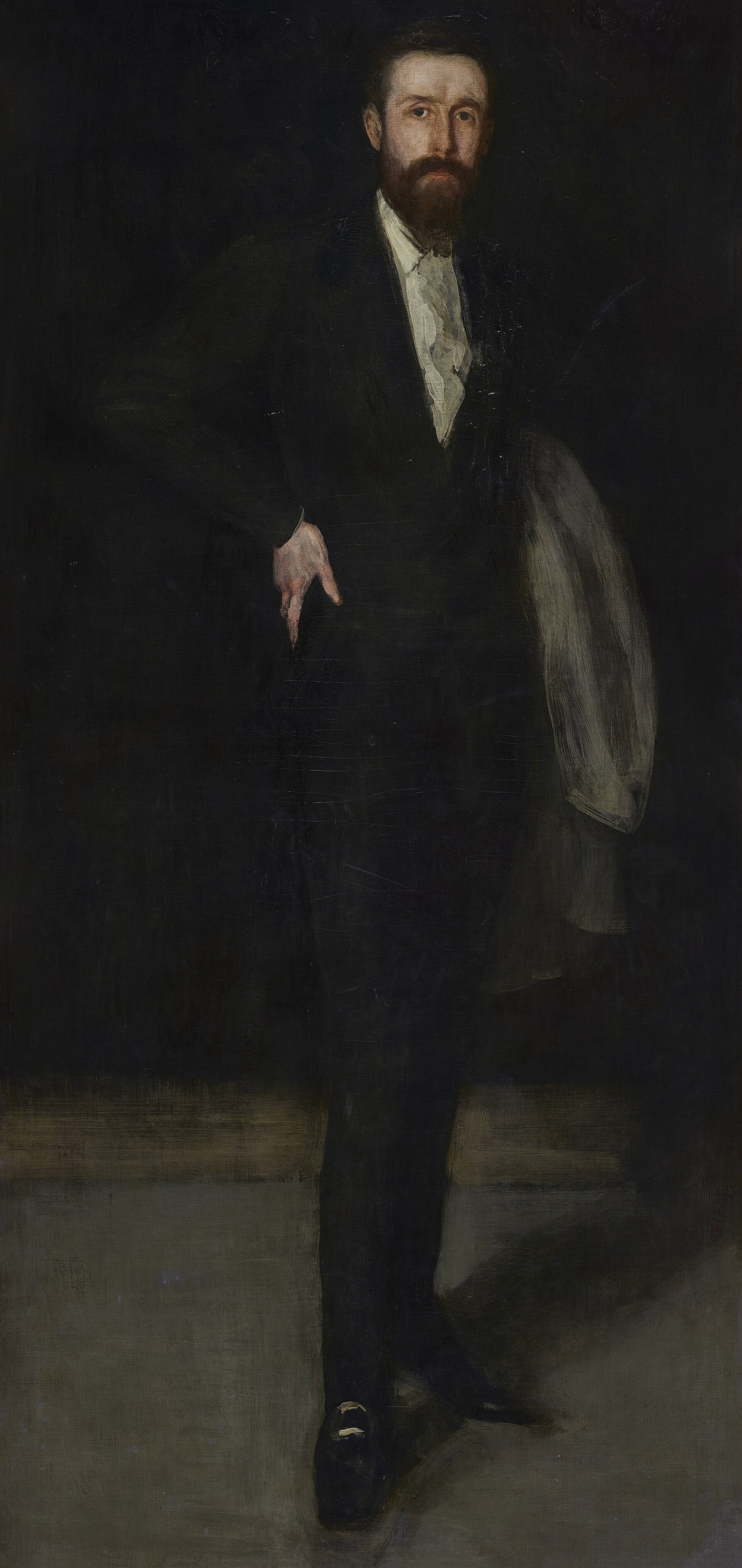
| Arrangement in Black: Portrait of F. R. Leyland James McNeill Whistler | Whistler's formal portrait of the patron at the centre of the Peacock Room dispute, painted before the quarrel Shows the relationship before it broke down; contrast with the two later satirical pictures below. | Freer Gallery of Art, Smithsonian Institution (accession F1905.100a-b) |
| The Gold Scab: Eruption in Frilthy Lucre (The Creditor) James McNeill Whistler | A separate satirical easel painting of Leyland, made in 1879 after Whistler's bankruptcy, distinct from the Art and Money mural inside the Peacock Room Never hung in the Peacock Room and should not be confused with the fighting-peacocks mural on the room's south wall. | Fine Arts Museums of San Francisco, Legion of Honor (accession 1977.11) |
| Filthy Lucre Darren Waterston | A 2015 contemporary reinterpretation of the Peacock Room as a room in decorative collapse A different, modern artwork. Its decayed imagery must never be presented as, or confused with, the historic 1876-77 Peacock Room or this painting. | Created for the Smithsonian's Arthur M. Sackler Gallery; a modern, separately accessioned installation |
Open questions
- What exactly happened to the painting between the 1865 Paris Salon and its documented purchase by Leyland by November 1872. Some accounts describe a passage through Gambart's French Gallery, Dante Gabriel Rossetti, and a possible sale to a collector named Frederick Huth around 1866-67; this record could not verify that chain against a primary source and grades it disputed.
- The Catherine of Aragon dowry attribution given for the room's original sixteenth-century leather wall covering is repeated across secondary sources without a cited chain-of-custody document; no source consulted for this record traces the claim to a primary record.
- How much, if any, of Leyland's original Kangxi-period porcelain survives today, and where. It was dispersed at the 1892 Christie's estate sale and none of it is documented as having reached Freer or the Smithsonian.
- Whether Whistler's uninvited alterations to the room, made while Leyland was away and beyond the retouching he had authorised, amounted to a breach of the working understanding between them, or were simply an artistic and social overreach with no contractual dimension. No litigation over the room is recorded in the sources consulted.
- The precise sequence in which the Art and Money mural was painted or reworked relative to the final breach with Leyland is described inconsistently across secondary sources, some placing the addition of the two fighting peacocks after Whistler had effectively been dismissed from the house.
- Whether the intermediate 1865-1872 ownership history of the painting, if the Rossetti/Huth episode is accurate, was known to Leyland at the time of his purchase, and whether it affected the price he paid; no purchase price for the 1872 sale is given in any source consulted.
Questions about this object
What is La Princesse du pays de la porcelaine?
La Princesse du pays de la porcelaine is a painting, dated 1863-1865, signed and dated 1864. Medium: Oil on canvas.
Who made La Princesse du pays de la porcelaine, and is the attribution settled?
The attribution to James Abbott McNeill Whistler is recorded here as accepted. Signed and dated 'Whistler 1864' on the canvas. The attribution has never been disputed and the picture is catalogued as YMSM 050 in the standard catalogue raisonne of Whistler's paintings compiled by Margaret F. MacDonald, Joy Newton and Robin Spencer for the University of Glasgow.
Where is La Princesse du pays de la porcelaine now?
Freer Gallery of Art, Smithsonian Institution, Washington DC. Displayed above the fireplace in the Peacock Room, Gallery 12 (West Building), in a rehang titled 'The Peacock Room in Blue and White'. Inventory number F1903.91a-b. Last confirmed 24 August 2026. Bequest of Charles Lang Freer. Freer signed the deed of gift to the Smithsonian in 1906; the collection was received in 1920 on completion of the Freer Gallery, which opened to the public in 1923. The terms of Freer's bequest prohibit the painting from being lent outside the Gallery.
What has La Princesse du pays de la porcelaine sold for?
Hammer 420 guineas; with premium, Not separately documented in the sources consulted; nineteenth-century Christie's sales of this kind are not generally recorded with a distinct buyer's premium in the literature reviewed, and this record does not assume one existed. Christie's, 1892-05-28.
What is still unknown about La Princesse du pays de la porcelaine?
What exactly happened to the painting between the 1865 Paris Salon and its documented purchase by Leyland by November 1872. Some accounts describe a passage through Gambart's French Gallery, Dante Gabriel Rossetti, and a possible sale to a collector named Frederick Huth around 1866-67; this record could not verify that chain against a primary source and grades it disputed.
Sources
- 1University of Glasgow, 'The Paintings of James McNeill Whistler', catalogue raisonne entry YMSM 050, La Princesse du pays de la porcelaine. whistlerpaintings.gla.ac.uk/catalogue/...
- 2Wikipedia, 'The Princess from the Land of Porcelain'. en.wikipedia.org/wiki/...
- 3Wikipedia, 'Peacock Room'. en.wikipedia.org/wiki/...
- 4Smithsonian Magazine, 'The Story Behind the Peacock Room's Princess'. smithsonianmag.com/arts-culture/...
- 5Wayne State University / Freer Gallery of Art, 'The Peacock Room: In Detroit'. peacockroom.wayne.edu/history-detroit
- 6Aileen Tsui, 'Whistler's La Princesse du pays de la porcelaine: Painting Re-Oriented', Nineteenth-Century Art Worldwide 9, no. 2 (Autumn 2010). 19thc-artworldwide.org/autumn10/...
- 7University of Glasgow, Whistler correspondence project, biography of Christine Spartali. whistlerpaintings.gla.ac.uk/catalogue/...
- 8Artnet News, 'James McNeill Whistler's 'The Peacock Room' Is a Glittering Masterpiece With a Dark History'. news.artnet.com/art-world/...
- 9Wikipedia, 'Cuir de Cordoue'. en.wikipedia.org/wiki/...
- 10The Art Newspaper, 'Whistler's famed Peacock Room, vibrant and revamped, reopens following major conservation project', 2 September 2022. theartnewspaper.com/2022/...
- 11Smithsonian's National Museum of Asian Art, object record for The Princess from the Land of Porcelain, accession F1903.91a-b. asia.si.edu/object/...
- 12Smithsonian Institution Newsdesk, 'Smithsonian's Sackler Gallery Welcomes Peacock Room REMIX: Darren Waterston's Filthy Lucre'. si.edu/newsdesk/...
- 13Fine Arts Museums of San Francisco, object record for The Gold Scab: Eruption in Frilthy Lucre (The Creditor). famsf.org/artworks/...
- 14University of Glasgow, catalogue raisonne entry YMSM 208, The Gold Scab. whistlerpaintings.gla.ac.uk/catalogue/...
- 15National Museum of Asian Art, exhibition record, 'The Peacock Room in Blue and White'. asia.si.edu/exhibition/...
- 16Wikipedia, 'James McNeill Whistler'. MacDonald or Anderson and Koval). en.wikipedia.org/wiki/...
- 17Wikimedia Commons, file and licence record for the lead image, verified directly against the API. commons.wikimedia.org/wiki/...

Last verified · Published
Change log
24 August 2026 - Record created at the house standard: researched narrative, technical evidence, maker dossier, graded provenance chain, prices with hammer and premium separated, related works, open questions and sources.
27 September 2026 - Four corrections by the women desk, made while writing the-picture-her-father-refused. (1) SIGNATURE POSITION: the record gave it as the lower area of the canvas and credited the catalogue raisonne; the Freer's own record puts it at the upper left corner and the catalogue gives no position, so the record contradicted its own narrative about the collector who objected to the signature at the top. (2) THE PRICE the 1892 multiple is measured against is not missing: Pennell volume 1 page 124 gives a hundred pounds. (3) An unsupported claim that Christine Spartali was one of the beauties artists of the day competed to paint has been replaced with what the sources say; the exclamation usually attached to a Spartali sister is Swinburne's and concerns Marie. (4) Michael Spartali was a merchant when his daughter sat and became Greek consul-general in 1867, after the picture was finished; both places that implied otherwise are fixed.