Portrait of a Girl
Rembrandt van Rijn · 17th century
Last verified 12 September 2026 · 18 sources cited · Change log
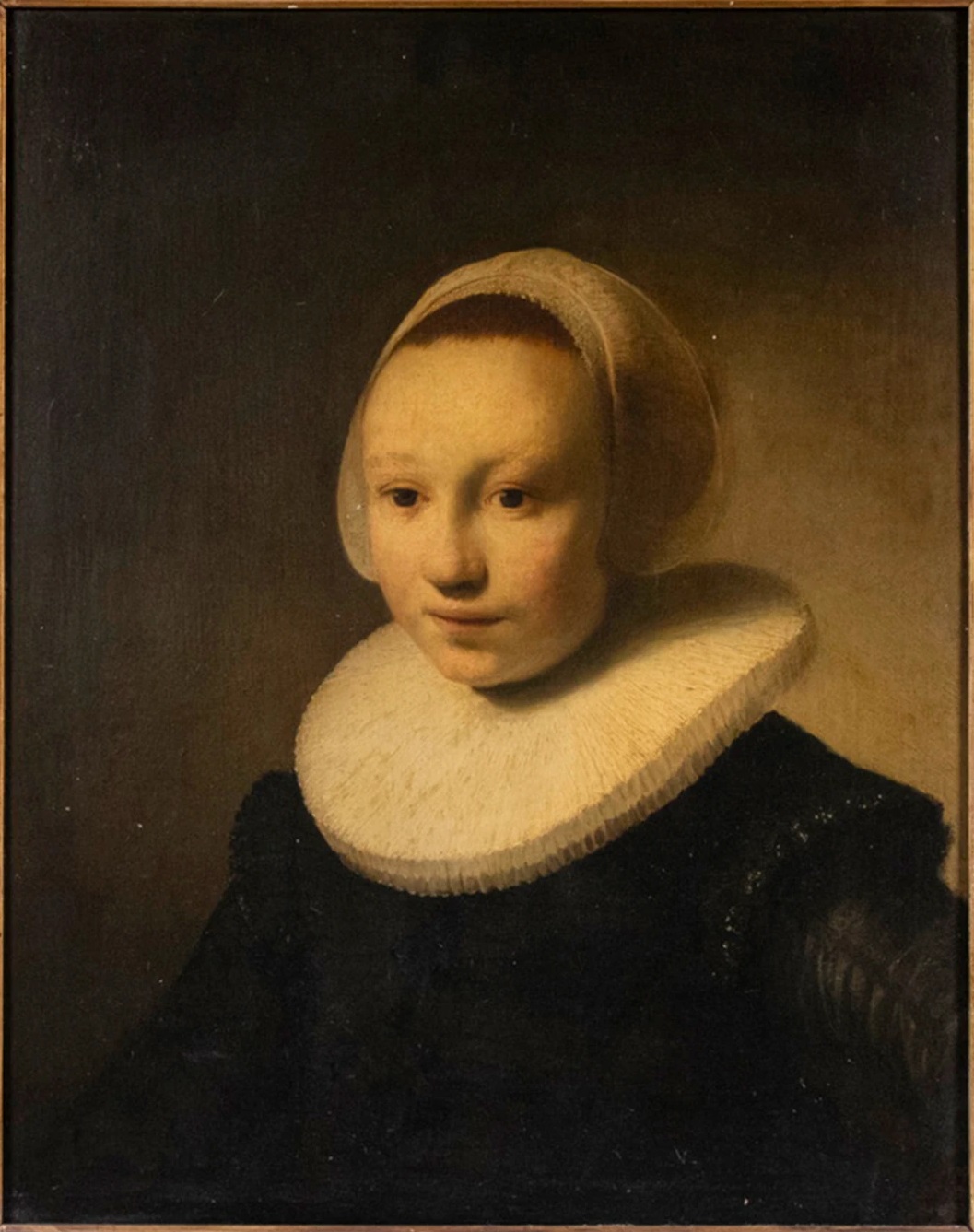
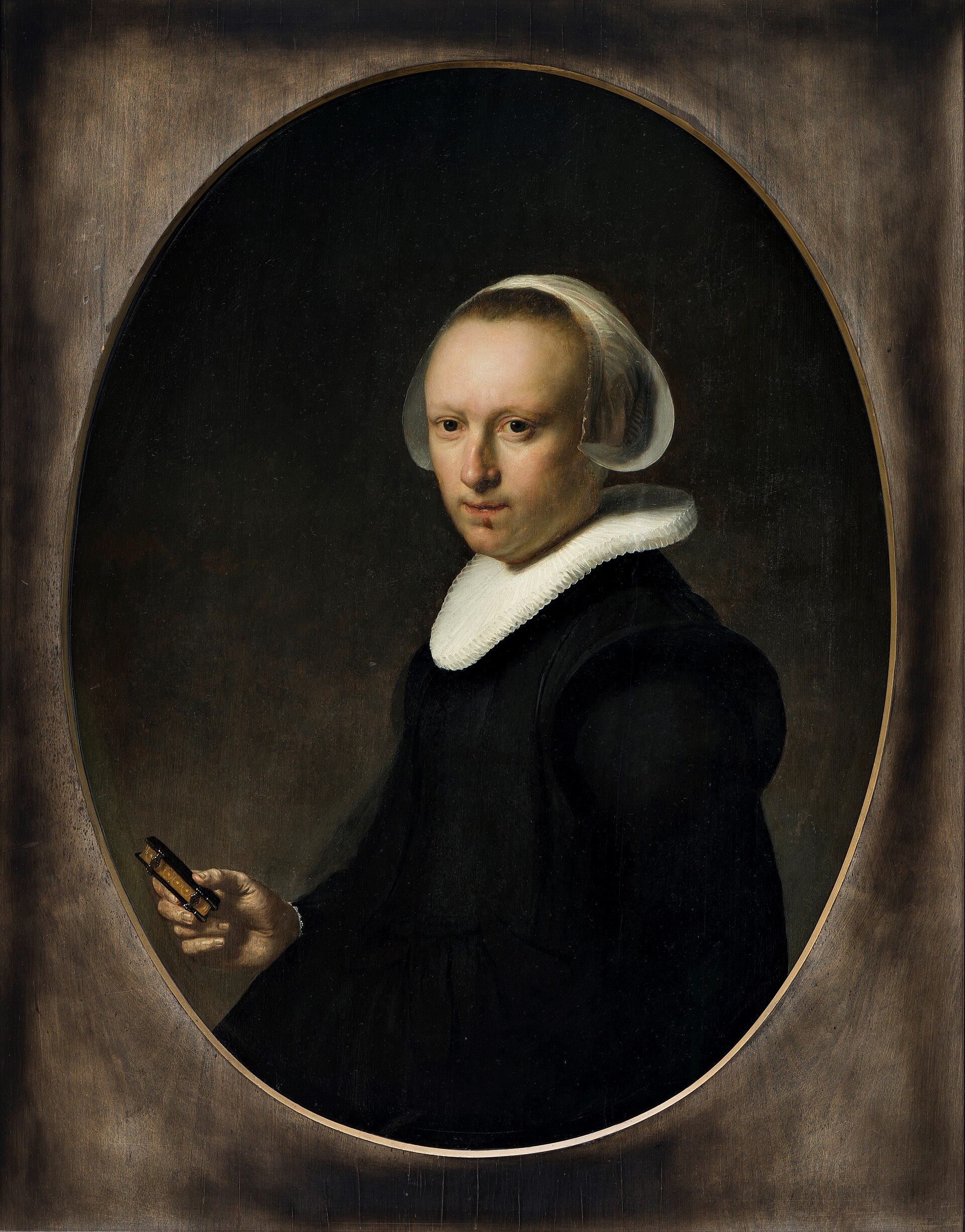
The record subject, photographed at the time of the 2024 sale. Oil on cradled oak panel, about 56.4 by 44.5 cm, catalogued by the auction house as after Rembrandt and sold on 24 August 2024 for USD 1,175,000 at the hammer against an estimate of USD 10,000 to 15,000. The attribution is open.
| Artist | Rembrandt van Rijn |
|---|---|
| Date | 17th century |
| Medium | Oil on oak panel |
| Where it is now | Private collection, Europelast confirmed 2 August 2026 |
| Attribution | disputedSold unsigned and uncatalogued. Full note |
| Object type | Painting |
| Period | Dutch Golden Age, 1600-1700 |
| Cases | Disputed attribution · Has a provenance gap · Rediscovered |
| Culture | Dutch |
| Genre | portrait |
- Where it is now
- Private collection, Europelast confirmed 2 August 2026
- Attribution
- disputed
- Provenance
- 9 links4 documented, 3 disputed, 2 unknown
- At auction
- Hammer USD 1,175,000, 24 August 2024
- Sources
- 18 cited
- Last verified
- 12 September 2026Change log
On this page 11 sections
An oil portrait of a young woman on a cradled oak panel, found by an appraiser among stacks of pictures in the attic of a Camden, Maine estate, catalogued as after Rembrandt against an estimate of ten to fifteen thousand dollars, and sold on 24 August 2024 for a hammer of 1,175,000 US dollars. The press treated it as an attic lottery ticket. It is something considerably more interesting: a picture with a documented nineteenth-century history that nobody reported.
It was published as a Rembrandt by Wilhelm von Bode, reproduced as a Rembrandt in the Klassiker der Kunst survey of 1908, catalogued as a Rembrandt by Hofstede de Groot in 1914, and hung as a Rembrandt in the Mauritshuis from 1893, on loan from Abraham Bredius, that museum's former director and the foremost Rembrandt authority of his generation, who owned it. The Mauritshuis catalogue of 1910 records it as signed with the monogram RHL. The 2024 lot record describes it as unsigned. No published argument for the demotion has been found, and nobody has examined the corner where the monogram was recorded.
The attribution remains open and this record leaves it open. Gary Schwartz rates the chance of autograph authorship as extremely large and proposes testing it against an accepted Rembrandt in Vienna; Volker Manuth leans against; Betsy Wieseman explains why the question is structurally hard, since Amsterdam painters of the 1630s were working to erase the very traits attribution depends on. All of them say the same thing about method: examine the object first. No authentication body has ruled, and none of the routine technical work has been reported. No ruling has been published as of 2 August 2026.
Provenance
Each link is graded. Documented: a cited source supports it. Disputed: the identification is argued but not established. Unknown: no owner for that span, and the gap is not smoothed into a narrative. The grades in the glossary.
- c. 1630-1632 -Painted, maker disputeddisputed
Dated about 1630-31 by Hofstede de Groot, about 1630 by the Mauritshuis, about 1631 in the 1908 plate caption and circa 1632 in modern structured records. The costume places it in Amsterdam portraiture of the early 1630s. Whether the hand is Rembrandt's, a pupil's or a follower's is the open question of this record.5678
- - 1893Unknownunknown
No owner is recorded for the first two and a half centuries of the panel's existence. The earliest documented location is a London dealer's stock in 1893.6
- 1893 - 1893M. H. Colnaghi, Londondocumented
Recorded by Hofstede de Groot as in the possession of Martin Henry Colnaghi in 1893, when London dealers regarded it as an Aelbert Cuyp. The faded pen note on the Philadelphia Museum of Art label recording a former Cuyp attribution independently corroborates this.68
- 1893 - at least 1914Dr Abraham Bredius, The Haguedocumented
In the collection of Abraham Bredius (1855-1946), director of the Mauritshuis from 1889 to 1909 and the leading Rembrandt authority of his generation. Lent by him to the Royal Picture Gallery, The Hague, from 1893, where it is entry 577 in the 1910 abridged catalogue, on oak, 0.564 by 0.445 m, signed RHL, painted about 1630. Still recorded as on loan there by Hofstede de Groot in 1914. The date it left the museum and the collection is not documented in the sources consulted.56
- c. 1920s - 1930Edward Bok and Mary Louise Curtis Bok, Philadelphiadisputed
Press accounts of the 2024 sale state the picture had been in private family ownership since the 1920s. It is plausible that it was acquired by Edward Bok (died 1930), the Dutch-born editor of the Ladies' Home Journal, who is known to have owned a Frans Hals, and the transfer from a Dutch collection to a Dutch-born American collector is a natural route. No document evidencing the purchase has been published, and the entire link from Bredius to the Boks rests on inference.811
- 1930 - January 1970Mary Louise Curtis Bok Zimbalist, Philadelphiadisputed
Sole heir to the Curtis Publishing fortune, widowed in 1930, remarried to Efrem Zimbalist in 1943, died 4 January 1970. That the painting was hers and passed to her son is stated in the tertiary record and is consistent with the 1970 loan slip, but no probate or inventory record has been examined.814
- 1970 - December 1970Cary W. Bok, Camden, Mainedocumented
The typed Philadelphia Museum of Art label on the reverse of the frame names Cary W. Bok of Camden, Maine as lender, gives the artist as Rembrandt and the title as Portrait of Girl, in connection with an exhibition in 1970. Cary William Bok died on 29 December 1970, within a year of his mother. The museum has stated it cannot identify which exhibition the slip relates to, and that a loan slip does not authenticate a work.13811
- 1971 - 2024Bok family estate, Camden, Maineunknown
Fifty-four years with no record. The panel was found by the appraiser Kaja Veilleux among stacks of pictures in the attic of a Camden estate during a house call, and consigned as from a Camden, Maine estate. Which family members held it in the interval, and whether it was ever examined or shown, is not documented.1910
- 2024 - presentPrivate collector, Europedocumented
Bought at Thomaston Place Auction Galleries on 24 August 2024, lot 2363. The auction house describes the buyer as a private European collector; parts of the trade press describe an anonymous private collector in the United Kingdom. The buyer has not been named and no examination of the panel has been reported since.121011
Prices realised
| Date | Sale | Estimate | Result | Note |
|---|---|---|---|---|
| 24 August 2024 | Thomaston Place Auction Galleries, Thomaston, Maine | USD 10,000 - 15,000 | Hammer USD 1,175,000 With premium USD 1,410,000 at a 20 per cent premium, or USD 1,468,750 at 25 per cent; the house has not stated which applied USD | Lot 2363, Summer Grandeur 2024, Day 2, catalogued as AFTER REMBRANDT HARMENSZOON VAN RIJN (NETH, 1606-1669). Bidding opened at USD 5,000 and ran past sixty bids with 123 bidders. The auction house lot record states a sold price of USD 1,175,000, which is the hammer; the conditions of sale specify a buyer's premium of up to 25 per cent. The three figures in circulation reconcile exactly to that one hammer: 1.2 m is the rounded hammer, 1.41 m is the hammer plus 20 per cent and is the figure in the house's own press release, and 1.47 m (reported as 1.5 m) is the hammer plus 25 per cent and is the figure carried into reference works. The result was a record for the auction house. The three-day sale grossed about USD 3.5 m in total. No source consulted reports the price in any currency other than US dollars. |
Hammer is the price at which the bidding stopped; with premium adds the fee the house charges the buyer on top. Hammer price and buyer's premium in the glossary.
Technical evidence
| Attribution note | Sold unsigned and uncatalogued. Reported variously as by Rembrandt, as after Rembrandt, and as circle of Rembrandt. No authentication body has ruled publicly. The attribution is open. |
|---|---|
| Support | Oak panel, cradled. Cradling is a later structural intervention, which means the reverse of the panel has been planed and battened and is no longer in its original state.1 |
| Medium | Oil on panel. Described as oil on cradled oak panel in the 2024 lot record and as Auf Holz, on wood, in the 1908 catalogue.17 |
| Panel dimensions | 56.4 x 44.5 cm. The Mauritshuis catalogue of 1910 gives 0.564 by 0.445 m; Hofstede de Groot in 1914 gives 22 1/2 by 17 1/2 inches, which is 57.2 by 44.5 cm. The 1908 Klassiker der Kunst plate prints the width as 0.415 m, and that figure has propagated into modern databases. It is not compatible with the recorded sight size and should be treated as a misprint.567 |
| Sight and frame size, 2024 | Sight size 20 1/2 x 16 1/2 inches (52.1 x 41.9 cm); overall framed size 28 1/2 x 24 1/2 inches (72.4 x 62.2 cm). A sight width of 41.9 cm cannot be taken from a panel 41.5 cm wide, but sits comfortably within one of 44.5 cm. The 2024 object is dimensionally consistent with the panel catalogued in 1910 and 1914.156 |
| Signature | Disputed. The 2024 lot record states unsigned. The Mauritshuis catalogue of 1910 records the picture as Signed: RHL, the Leiden monogram Rembrandt used around 1630. Hofstede de Groot in 1914 describes a monogram at the upper right, read as an R with the lower bar of the L erased. Whether the mark was lost, misread by two authorities, or simply not looked for in 2024 has not been established.156 |
| Frame | Hand carved Dutch gold frame. The Philadelphia Museum of Art loan label is on the reverse of the frame, not of the panel, which means it travels with the frame and is weaker evidence of the panel's history than a label on the panel itself would be.1810 |
| Condition | Described by the auction house as remarkable for its age, with an untouched surface. No conservator's report or condition survey has been published, and the phrase is a saleroom characterisation rather than a technical finding.10 |
| Technical examination | None reported. No dendrochronology, X-radiography, infrared reflectography, pigment analysis or paint sampling has been publicly reported for this panel, before or since the 2024 sale.3411 |
| Historical catalogue numbers | Bode 52 (Bode and Hofstede de Groot, Rembrandt, 1897-1905, cited by Hofstede de Groot as B.-HdG. 52); Klassiker der Kunst plate, 1908; Royal Picture Gallery (Mauritshuis) 577, 1910 catalogue; Hofstede de Groot 853, 1914.567 |
| Dating | About 1630 to 1631 per Hofstede de Groot; about 1630 per the Mauritshuis catalogue; about 1631 per the 1908 plate caption; circa 1632 in modern structured records. The costume, a millstone collar with a diadem cap, is consistent with Amsterdam portraiture of the early 1630s.5678 |
| Sitter | Unidentified. Hofstede de Groot judged her to be about seventeen, with brown eyes and a fresh complexion, and considered her to be the same sitter as in his number 847, then in the Simon collection in Berlin. That picture is now catalogued as circle of Rembrandt.6815 |
Images
The record in full
What it is
A small oil portrait of a young woman on a cradled oak panel, seen half length without hands, turned slightly to the left with her face to the front. She wears a close-fitting black dress, a broad white millstone collar and a white diadem cap over smooth light brown hair, against a plain light grey ground, with the light falling full from the left.
The auction catalogue that offered it in 2024 described it in one line: Portrait of a Girl, oil on cradled oak panel, unsigned, label verso from the Philadelphia Museum of Art, lent for a 1970 exhibition, in a hand carved Dutch gold frame, from a Camden, Maine estate. It gave a sight size of 20 1/2 by 16 1/2 inches inside a frame measuring 28 1/2 by 24 1/2 inches overall. It gave no artist beyond the phrase at the head of the lot, which was after Rembrandt Harmenszoon van Rijn, and it carried an estimate of ten to fifteen thousand dollars.
That one line is the whole of what the market was told. It omits everything set out below.
The attribution is not new, and it is not a press invention
The story reported in September 2024 was that a picture nobody had ever heard of had turned up in an attic and might be a Rembrandt. That is not what happened. This panel was published as a Rembrandt, repeatedly, by the leading authorities of the day, for at least the first quarter of the twentieth century.
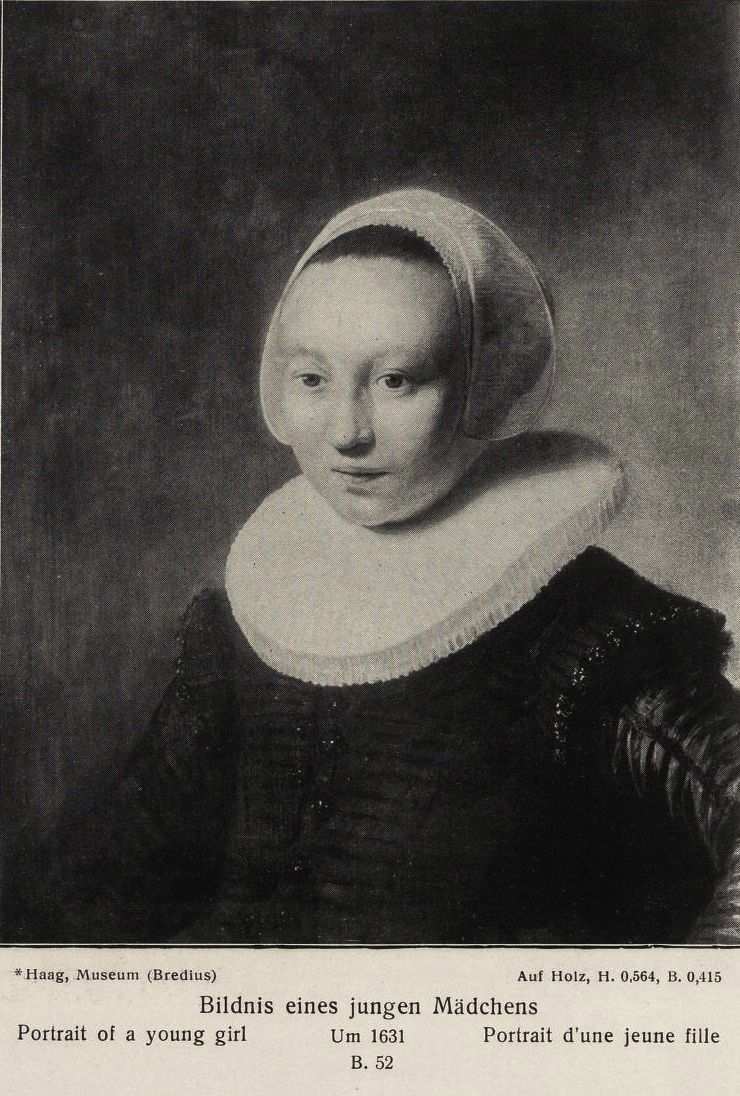
It appears in Wilhelm von Bode's eight-volume Rembrandt of 1897 to 1905 as number 52. It was reproduced as a full-page plate in Rembrandt: des Meisters Gemaelde in 643 Abbildungen, the Klassiker der Kunst survey published in Stuttgart in 1908 under Adolf Rosenberg and Wilhelm Reinhold Valentiner, captioned Bildnis eines jungen Maedchens, dated about 1631, and located at The Hague. It is catalogued as number 577 in the Royal Picture Gallery's own abridged catalogue of 1910. And it is number 853 in Cornelis Hofstede de Groot's Rembrandt volume of 1914, the standard critical catalogue of its generation, where it is dated about 1630 to 1631.
Four separate publications, none of them hedged. In each of them the picture is simply a Rembrandt. The 2024 catalogue heading of after Rembrandt is therefore not the survival of a cautious old opinion. It is a demotion, and no published argument for that demotion has been produced.
Bredius owned it
This is the fact that changes the weight of the case, and it is absent from every press account of the sale.
The 1910 catalogue of the Royal Picture Gallery at The Hague, the Mauritshuis, lists entry 577 as Portrait of a young girl, on oak, 0.564 by 0.445 metres, and records it as lent by Dr A. Bredius in 1893. Abraham Bredius, who lived from 1855 to 1946, was the director of that museum from 1889 to 1909 and the most consequential Rembrandt authority of his era; the catalogue he published in 1935 is still cited as a standard reference by its author's bare surname.
So the man who ran the Mauritshuis, and who spent his life deciding what was and was not a Rembrandt, bought this panel, kept it in his own collection, and hung it in his own national gallery for at least seventeen years under Rembrandt's name. Hofstede de Groot, who disagreed with Bredius about a great many attributions, agreed about this one. Bode had already accepted it.
That does not make the picture a Rembrandt. Bredius was famously wrong about at least one very large thing, and the standards of 1893 were not the standards of today. But it does mean the burden of argument sits differently than the press coverage implied. The question is not whether anyone has ever thought this was a Rembrandt. It is why the people who thought so were wrong.
The signature that is no longer there
The 2024 lot description says unsigned. The historical record says otherwise, twice.
The Mauritshuis catalogue of 1910 records entry 577 as Signed: RHL. That monogram, standing for Rembrandt Harmenszoon of Leiden, is the form the artist used in the years around 1630, which is precisely the period to which every early cataloguer assigned this panel. Hofstede de Groot in 1914 describes a monogram at the upper right, reading it as an R with the lower bar of the L worn away.
Either the mark was there and is now gone, lost to cleaning, abrasion or overpaint at some point in the intervening century; or it was never there and two independent authorities recorded what they expected to see; or it is still there and was not looked for in 2024. Each possibility is testable, and none of them has been tested in public.
This is the single sharpest unresolved question about the object, and it is the one no coverage of the sale raised.
The measurements corroborate the identification
A reader is entitled to ask whether the panel sold in Maine is really the panel Bredius lent to The Hague, or merely a similar picture. The measurements answer it.
Hofstede de Groot gives the oak panel as 22 1/2 by 17 1/2 inches, which is 57.2 by 44.5 centimetres. The Mauritshuis gives 56.4 by 44.5 centimetres. The two agree. The Klassiker der Kunst plate of 1908 prints the height identically at 0.564 but gives the width as 0.415, and it is that figure, 56.4 by 41.5 centimetres, which has been carried into modern structured databases.
The 1908 width is impossible. The 2024 lot record gives a sight size of 20 1/2 by 16 1/2 inches, or 52.1 by 41.9 centimetres, being the area of panel visible inside the frame rebate. A sight width of 41.9 centimetres cannot be cut from a panel 41.5 centimetres wide. It can be cut comfortably from a panel 44.5 centimetres wide, leaving about 1.3 centimetres covered on each side, with about 2.2 centimetres covered top and bottom. The 2024 object is dimensionally consistent with the panel catalogued in 1910 and 1914, and the widely repeated 41.5 centimetre width is a printing error of 1908 that should be retired.
Confirmation also comes from the plate itself. The 1908 reproduction and the 2024 photograph show the same picture: the same tilt of the head, the same asymmetry in the collar, the same fall of light, the same dark braided sleeve entering at the lower right.
How a Philadelphia picture reached a Camden attic
The label on the reverse of the frame is a Philadelphia Museum of Art slip, typed, naming the lender as Cary W. Bok of Camden, Maine, giving the artist as Rembrandt and the title as Portrait of Girl, in connection with an exhibition in 1970. Scrawled on it in faded pen is a note that the picture had formerly been attributed to Aelbert Cuyp, which matches Hofstede de Groot's record that London dealers took it for a Cuyp when it was with M. H. Colnaghi in 1893.
Cary William Bok, who died on 29 December 1970, was the son of Edward Bok, the Dutch-born editor of the Ladies' Home Journal, and of Mary Louise Curtis, sole heir to the Curtis Publishing fortune, who died on 4 January 1970. The family's connection to Camden was long established; Mary Louise Curtis Bok had given the town the land for its public library in 1916.
Three things therefore happened to this picture in a single year. Its owner of four decades died in January. It passed to her son. It went to Philadelphia on a museum loan slip bearing his name. And by the end of December the son was dead too. After that the record stops for fifty-four years, until an auctioneer walked into the attic.
How the panel travelled from Bredius in The Hague to the Boks in Philadelphia is not documented anywhere consulted. Press accounts state the family had owned it since the 1920s, which is chronologically plausible given Edward Bok's Dutch birth, his known ownership of a Frans Hals, and his death in 1930, but no bill of sale, dealer record or shipping document has been published.
What each position rests on
Four distinct positions were stated publicly in the fortnight after the sale, and it is worth separating what each one actually rests on.
The auction house. Thomaston Place catalogued the lot as after Rembrandt and has never claimed to have authenticated it. Kaja Veilleux, its founder and the appraiser who found the panel on a house call to the Camden estate, has described the discovery but has published no attribution argument. A year later, in August 2025, the firm's own publicity referred to the picture only as having been linked to Rembrandt. This position rests on the object's appearance and on the verso label.
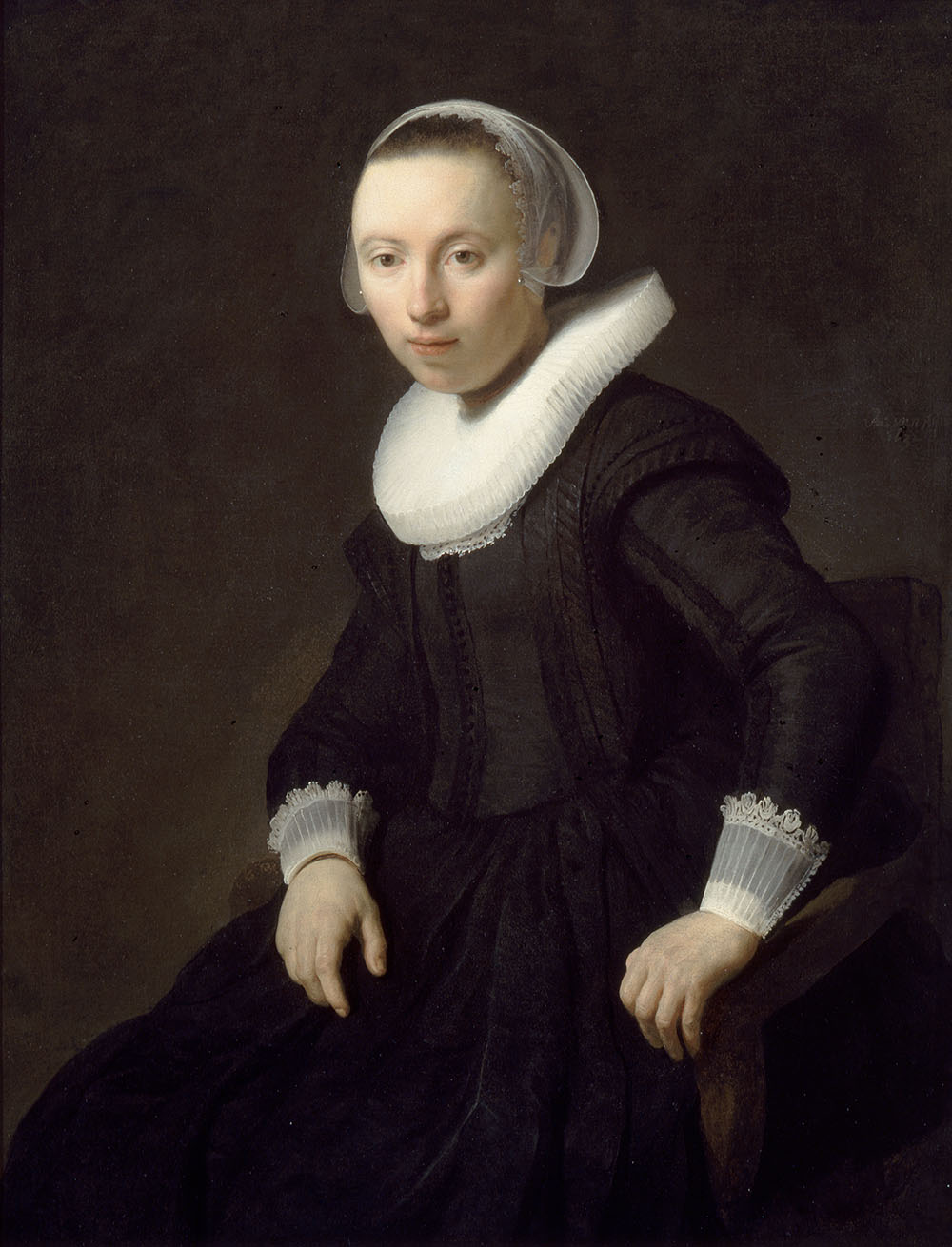
Gary Schwartz, for. Schwartz, a Rembrandt scholar of long standing, put the chance that Rembrandt painted it as extremely large. His argument is comparative: he points to a portrait of a woman of 1632 in the Academy of Fine Arts in Vienna, accepted as Rembrandt, and says of the resemblance that he is amazed that people accept one and simply dismiss the other. He proposed the obvious remedy, which is to take this panel to Vienna and stand it beside the other. He also said plainly that nobody should give a definitive opinion without studying the object.
Volker Manuth, against. Manuth, of Radboud University and author of the 2019 Taschen Rembrandt, said by email that he had more doubts about the attribution than not. He attached the same condition: no attribution without thorough investigation of the original.
Betsy Wieseman, on why the question is hard. Wieseman, who heads Northern European paintings at the National Gallery of Art in Washington, made the structural point rather than a verdict. In the 1630s a great many painters in Amsterdam were deliberately trying to look like Rembrandt and to suppress their own habits of hand. The features by which a modern eye separates artists are exactly the features those painters were working to erase.
The Philadelphia Museum of Art. The museum could not confirm which exhibition, if any, the panel was lent for, and said that a loan slip does not verify a work. That is correct and it is important: a registrar's label records what a lender called a picture, not what a curator concluded about it. The 1970 label is evidence of the family's belief and of the object's location. It is not evidence of authorship.
Two further figures are quoted in the coverage giving values conditional on authentication, of about five million dollars and about fifteen million dollars. Those are commercial estimates of an outcome, not opinions on authorship, and should not be read as either.
The price, in three figures
Reports gave the result as 1.2 million dollars, as 1.4 million and as 1.5 million. All three are traceable to one hammer.
The auction house's own lot record shows the panel sold on 24 August 2024, as lot 2363 in the second day of the Summer Grandeur 2024 sale, for 1,175,000 dollars against an estimate of 10,000 to 15,000. Bidding opened at 5,000, ran past sixty bids and drew 123 bidders. The conditions of sale provide for a buyer's premium of up to 25 per cent, which is the standard tiered arrangement where a lower rate applies in the room and a higher rate to online platform bidding.
Apply 20 per cent to 1,175,000 and the total is 1,410,000, which is the figure in the auction house's own press release and the source of every 1.4 million headline. Apply 25 per cent and the total is 1,468,750, which is the figure that reached the encyclopaedias and produced the 1.5 million headlines. The 1.2 million reports are the bare hammer, rounded.
The hammer is 1,175,000 US dollars. The premium-inclusive total is either 1,410,000 or 1,468,750 depending on how the winning bid was placed, and the house has not stated which. No source consulted reports the sum in any other currency; every conversion in circulation is derived and depends on the date applied. The buyer is described by the auction house as a private European collector and in parts of the trade press as an anonymous private collector in the United Kingdom; the two are not inconsistent but neither is confirmed.
What would settle it, and what has not happened
No authentication body has ruled on this panel, and no ruling has been published as of 2 August 2026. That is the finding, and it should be stated as flatly as that.
There is no body left that could issue one with the old authority. The Rembrandt Research Project, whose word decided these questions for four decades, wound up at the end of 2011 and formally closed in 2014 with roughly a quarter of the material still unexamined. Its archive went to the Netherlands Institute for Art History as the Rembrandt Database. Attribution now proceeds by individual scholarship and by the technical departments of museums and auction houses, which is why the two named scholars who spoke in 2024 both refused to commit without examining the object.
What would settle it is not connoisseurship but a programme of work, and it is the same programme that re-attributed The Adoration of the Kings between 2021 and 2023: dendrochronology of the oak to date the felling and, in the best case, tie the board to others Rembrandt used; X-radiography and infrared reflectography to expose the underdrawing and any changes of mind; paint sampling and pigment analysis; and a direct examination of the upper right corner to determine whether the monogram recorded in 1910 is present, lost or was never there. Every one of these is routine. None of them has been reported.
The panel is in private hands in Europe. Its owner has no obligation to commission any of it, and every incentive to choose the moment. Until then this record holds the attribution open, because the evidence is genuinely open, and because a picture that four authorities called a Rembrandt and one auction house called a copy is worth more to a reader as an unresolved question stated accurately than as a verdict nobody has earned.
The artist
Rembrandt Harmenszoon van Rijn
Rembrandt is the most securely documented major painter of the seventeenth century and simultaneously the one whose body of work is least settled. Both things are true for the same reason: he ran a large teaching workshop for decades, his manner was the most imitated in the Dutch Republic, and his pupils were trained specifically to paint like him. The result is that the question is this a Rembrandt has been answered differently, by serious people, in every generation since the 1890s, and the number of paintings the discipline is prepared to call his has moved by hundreds within living memory. A record about a disputed Rembrandt is therefore not a record about one uncertain picture. It is a record about a corpus that has never stopped moving.
Exhibited
- 1970Exhibition not named in reportingPhiladelphia Museum of Art
Related works
| Work | Relation | Where it is |
|---|---|---|
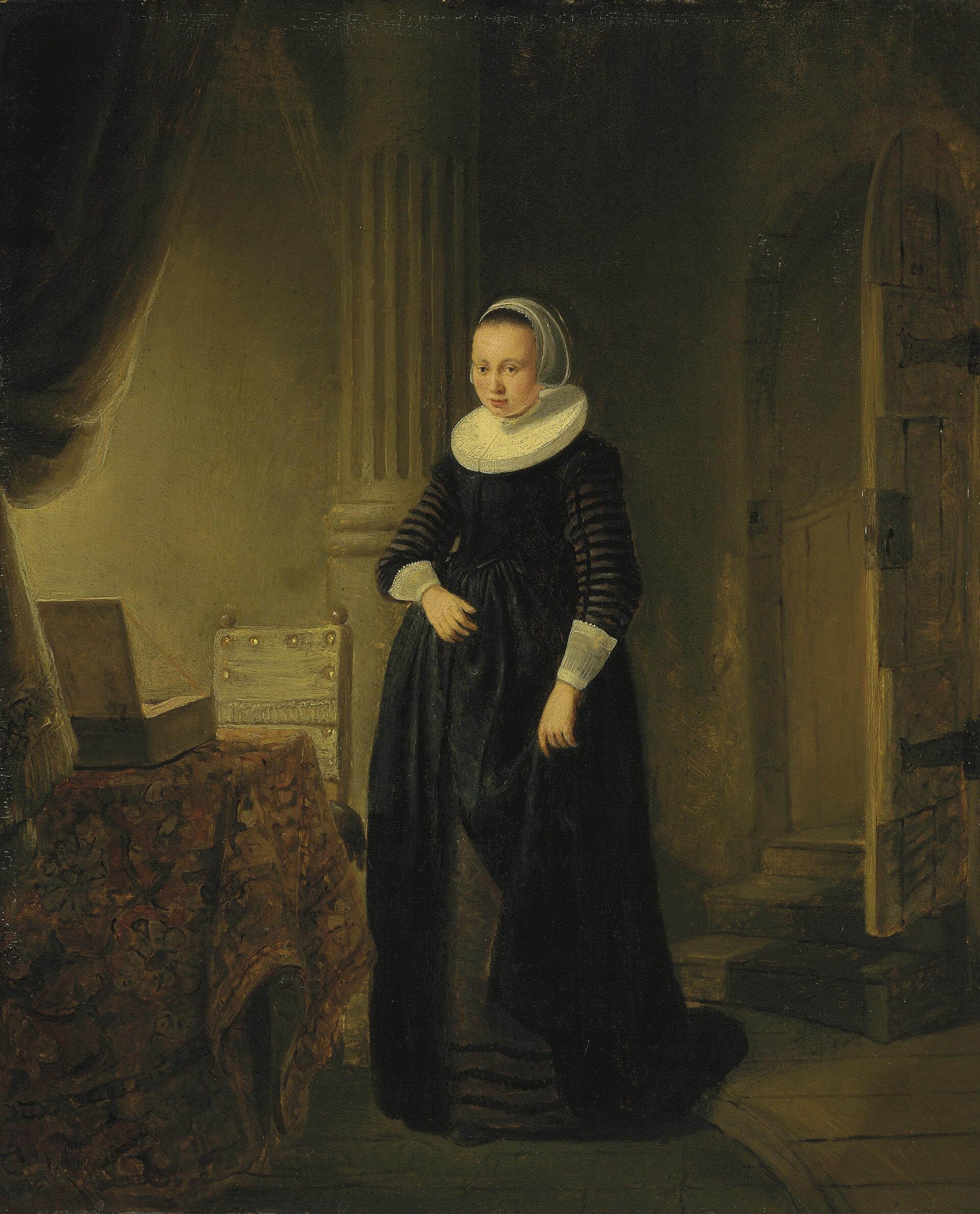
| A Young Woman in an Interior (Hofstede de Groot 847) Circle of Rembrandt | Held by Hofstede de Groot in 1914 to show the same sitter as this panel Hofstede de Groot catalogued it as Rembrandt and used it to identify the sitter here. It is now catalogued as circle of Rembrandt. The comparison that once supported this panel has itself been demoted, which is a fair illustration of how little the 1914 consensus survives. | Private collection; sold Christie's, New York, 6 June 2012, lot 73 |
| Portrait of a Woman, 1632 (Hofstede de Groot 884) Rembrandt | The accepted picture Gary Schwartz compares with this panel Oil on canvas, 92 x 71 cm, so much larger and on a different support. Schwartz's comparison is to the sitter's features and handling, not to format. He proposed placing the two side by side in Vienna as the test. | Gemaeldegalerie der Akademie der bildenden Kuenste, Vienna, inv. GG-611 |
| The Adoration of the Kings Rembrandt | The economics of the phrase circle of Rembrandt, demonstrated Circle of Rembrandt at Christie's Amsterdam in 2021 at an estimate of about 10,000 to 15,000 euros; Rembrandt at Sotheby's London in December 2023 at 10 to 15 million pounds after X-ray, infrared and material analysis; sold for about 13.7 million dollars. | Private collection |
| Portrait of a Young Gentleman Rembrandt | A circle-of attribution reversed by argument rather than by a ruling Bought as circle of Rembrandt at Christie's in December 2016 for 137,000 pounds by the dealer Jan Six, and supported as autograph by Ernst van de Wetering. | Amsterdam, private collection |
| Three paintings reclassified as copies, 2025 After Rembrandt | Demotion by the institution that once exhibited this panel as a Rembrandt Announced in 2025. Relevant here because the Mauritshuis showed this panel under Rembrandt's name from 1893 on loan from its own former director. | Mauritshuis, The Hague |
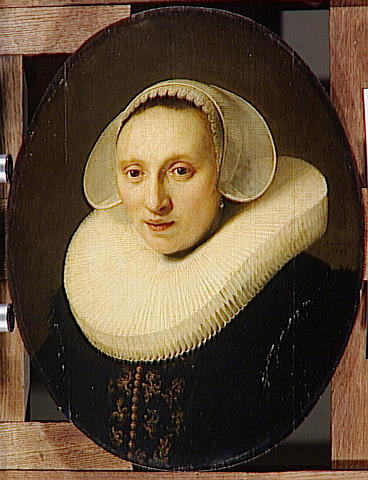
| Portrait of Cornelia Pronck (Hofstede de Groot 669) Rembrandt | Comparison for the costume type 1633. One of the group of accepted Rembrandt portraits of women in millstone collars and diadem caps from the early 1630s against which this panel has to be judged. | Musee du Louvre, Paris |
Open questions
- Is the RHL monogram recorded by the Mauritshuis in 1910, and described by Hofstede de Groot in 1914 as a partly erased monogram at the upper right, still present on the panel? The 2024 lot record says unsigned. No one has published an examination of that corner.
- How did the panel pass from Abraham Bredius in The Hague to the Bok family in Philadelphia, and when? Press accounts say the family owned it from the 1920s, but no bill of sale, dealer record or shipping document has been published, and the loan to the Mauritshuis is documented only up to 1914.
- Which Philadelphia Museum of Art exhibition, if any, did the 1970 loan slip relate to? The museum has said it could not identify the show. Its 1970 loan and exhibition registers would settle whether the picture ever hung there, and under what attribution a curator accepted it.
- Why was the picture demoted from Rembrandt to after Rembrandt? Bode, the 1908 Klassiker der Kunst survey, the Mauritshuis and Hofstede de Groot all published it as autograph. No published argument for the change of status has been located, and it may simply reflect twentieth-century caution rather than any specific finding.
- Is it in Bredius 1935? Bredius owned the panel and published his own Rembrandt catalogue in 1935. Whether he still accepted it by then, and under what number, has not been checked against that volume and would be a direct test of the strongest historical opinion in its favour.
- What does the oak say? Dendrochronology would date the felling of the board and could tie it to panels used in Rembrandt's workshop. It is routine, it is non-destructive, and no result has been reported.
- Who owns it? The auction house describes a private European collector; parts of the trade press describe an anonymous private collector in the United Kingdom. Neither has been confirmed, and no examination can be commissioned without the owner.
Questions about this object
What is Portrait of a Girl?
Portrait of a Girl is a painting, dated 17th century. Medium: Oil on oak panel.
Who made Portrait of a Girl, and is the attribution settled?
The attribution to Rembrandt van Rijn is recorded here as disputed. Sold unsigned and uncatalogued. Reported variously as by Rembrandt, as after Rembrandt, and as circle of Rembrandt. No authentication body has ruled publicly. The attribution is open.
Where is Portrait of a Girl now?
Private collection, Europe. Last confirmed 2 August 2026. Bought at the 2024 Thomaston Place sale by a European collector.
What has Portrait of a Girl sold for?
Hammer USD 1,175,000; with premium, USD 1,410,000 at a 20 per cent premium, or USD 1,468,750 at 25 per cent; the house has not stated which applied. Thomaston Place Auction Galleries, Thomaston, Maine, 2024-08-24.
What is still unknown about Portrait of a Girl?
Is the RHL monogram recorded by the Mauritshuis in 1910, and described by Hofstede de Groot in 1914 as a partly erased monogram at the upper right, still present on the panel? The 2024 lot record says unsigned. No one has published an examination of that corner.
Sources
- 1Thomaston Place Auction Galleries, lot record for lot 2363, AFTER REMBRANDT HARMENSZOON VAN RIJN (NETH, 1606-1669), Summer Grandeur 2024 Day 2, 24 August 2024. Primary. Gives the catalogue description verbatim, the estimate of USD 10,000-15,000, a sold price of USD 1,175,000 and a buyer's premium of up to 25 per cent. The live site returns 403; consulted via the Internet Archive capture of 9 September 2024. live.thomastonauction.com/auction-lot/...
- 2Antiques and The Arts Weekly, 'Portrait Of A Girl, After Rembrandt, Soars To $1.4 Million At Thomaston Place', 26 August 2024. Trade report; source for the opening bid of USD 5,000, the sixty-plus bids, the 123 bidders and the USD 3.5 m sale total. antiquesandthearts.com/portrait-of-a-girl-after-rembrandt...
- 3Oscar Holland, 'A portrait found in a Maine attic unexpectedly sold for $1.4M. Could it be a long-lost Rembrandt?', CNN, 8 September 2024. Source for Gary Schwartz, Volker Manuth, the Philadelphia Museum of Art response and the conditional valuations. cnn.com returned HTTP 451 to this researcher; consulted in the ABC17/CNN syndication at the URL given. abc17news.com/entertainment/...
- 4Portland Press Herald, 'A Thomaston auction house believes it just sold a Rembrandt. Others aren't so sure.', 8 September 2024. Source for Betsy Wieseman of the National Gallery of Art and for Volker Manuth's emailed doubt. NOTE: the site returned HTTP 403 and this source was consulted only through search-result extracts, not a direct read. Verify before publication. pressherald.com/2024/...
- 5Royal Picture Gallery (Mauritshuis), The Hague, 'Abridged catalogue of the pictures and sculpture in the Royal Picture Gallery (Mauritshuis) the Hague', 1910, page 71, entry 577: 'Portrait of a young girl. On oak, 0.564 by 0.445. Signed: RHL. Painted about 1630. Lent by Dr. A. Bredius, 1893.' PRIMARY. Full text read directly. archive.org/details/...
- 6Cornelis Hofstede de Groot, 'Beschreibendes und kritisches Verzeichnis...', Volume 6, Rembrandt, 1914, page 390, number 853, 'A Young Girl' (B.-HdG. 52). Gives the description, the dating of about 1630-31, the oak panel at 22 1/2 by 17 1/2 inches, the monogram, the Colnaghi and Cuyp episode of 1893, and the Bredius loan to the Royal Gallery. NOTE: quoted from the transcription in source 8; the DjVu page image was not read directly. Check against the page before publication. commons.wikimedia.org/w/...
- 7Adolf Rosenberg and Wilhelm Reinhold Valentiner (eds), 'Rembrandt: des Meisters Gemaelde in 643 Abbildungen', Klassiker der Kunst, Deutsche Verlags-Anstalt, Stuttgart, 1908. PRIMARY. The plate of this panel and its printed caption were read directly from the Getty Research Institute scan. archive.org/details/...
- 8Wikipedia, 'Portrait of a Girl (after Rembrandt)'. TERTIARY. Consolidates the Bredius and Mauritshuis provenance, the Hofstede de Groot transcription, the Bok family descent and the label details. Flagged for replacement by the underlying primary sources 5, 6 and 7 and by the Philadelphia Museum of Art registers. en.wikipedia.org/wiki/...
- 9Boston.com, 'Rembrandt painting discovered in Maine attic sells for almost $1.2 million', 3 September 2024. Independently reports the sale price as USD 1,175,000, corroborating the hammer, and carries Kaja Veilleux on the house call and the attic discovery. boston.com/news/...
- 10Thomaston Place Auction Galleries press release, 'New England Art Discovery: Rare 17th Century Portrait Fetches $1.4 Million', PR Newswire, September 2024. The auction house's own account: the cradled oak panel, the hand-carved gold Dutch frame, the untouched surface, the verso label, the USD 1,410,000 figure and the private European collector. prnewswire.com/news-releases/...
- 11Thomaston Place Auction Galleries press release, 'From Attic to Auction Block: Can Maine Repeat Its Rembrandt Discovery?', PR Newswire, 20 August 2025. A year after the sale the firm still refers to the picture only as having been linked to Rembrandt, and reports no authentication, examination or resale. Evidence for the negative finding. prnewswire.com/news-releases/...
- 12Wikipedia, 'Rembrandt Research Project'. TERTIARY. Source for the 1968 founding, the team, the six Corpus volumes and their dates, the halving of accepted self-portraits, the 2011 wind-up and 2014 closure, the quarter left unexamined and the transfer of the archive to the Rembrandt Database. Flagged for replacement with Corpus volume VI, 2014. en.wikipedia.org/wiki/...
- 13CODART, 'A Corpus of Rembrandt Paintings Volume VI: Rembrandt's Paintings Revisited, A Complete Survey presented'. Source for van de Wetering's count of about 340 autograph works, Tuempel's 280 of 1986, and van de Wetering's restoration of about sixty pictures rejected by his predecessors. codart.nl/research-study/...
- 14Wikipedia, 'Mary Louise Curtis'. TERTIARY. Source for her dates (6 August 1876 to 4 January 1970), the Curtis Publishing inheritance, the marriage to Edward Bok in 1896 and his death in 1930, the Zimbalist marriage of 1943, the sons including Cary William Bok, and the family's Camden, Maine connection including the 1916 library land gift. Flagged for replacement with the Curtis Institute archives. en.wikipedia.org/wiki/...
- 15Wikimedia Commons file record for 'Circle of Rembrandt - A Young Woman in an Interior', giving the current attribution and the Christie's New York sale of 6 June 2012, lot 73. commons.wikimedia.org/wiki/...
- 16Smithsonian Magazine and ARTnews coverage of 'The Adoration of the Kings', 2023: circle of Rembrandt at Christie's Amsterdam in 2021 at an estimate of about EUR 10,000-15,000, re-attributed after X-ray, infrared and material analysis, offered at Sotheby's London on 6 December 2023 at GBP 10-15 m and sold for about USD 13.7 m. artnews.com/art-news/...
- 17Wikipedia, 'Portrait of a Young Gentleman'. TERTIARY. Source for the Christie's sale of 9 December 2016 as circle of Rembrandt at GBP 137,000, the purchase by Jan Six and the re-attribution argument of Ernst van de Wetering. en.wikipedia.org/wiki/...
- 18ARTnews, 'Mauritshuis Says Three Paintings From Collection Are Rembrandt Copies', 2025. NOTE: headline confirmed but the article body could not be retrieved; the three works and the technical basis are unverified here. Verify before publication. artnews.com/art-news/...

Last verified 12 September 2026 · Published 2 August 2026
Change log
2 August 2026 - Record deepened to the house standard: narrative sections, technical evidence, artist dossier, related works and open questions added; provenance chain and auction results replaced with the researched versions; sources rebuilt.
4 August 2026 - Re-verified. No change to location, attribution, claims or market: still an unnamed private collection in Europe, still no published ruling in either direction, no new technical study of this panel, no litigation, and the August 2024 Thomaston sale still the only auction record. All eighteen sources resolve and none has rotted; three return 403 or 402 to automated retrieval and serve in full to a browser. Three source caveats that recorded retrieval failures rather than doubts have been lifted after reading each in full. One error corrected: source 4 was credited for Volker Manuth's doubt, which does not appear in it; that testimony is in source 3 and source 4 now carries only Betsy Wieseman. The three Mauritshuis works reclassified in April 2025 are now named rather than counted. A caution has been added to the auction row: the live lot page has since gained a premium-inclusive boilerplate line that appears to contradict the hammer figure and does not, and it should not be read as one.
2 August 2026 - Record created from press sources. Attribution recorded as open. Conflicting price reports recorded as hammer against premium rather than reconciled to one figure.
6 August 2026 - Re-verified. No change to current location, attribution, provenance, or market history. Still an unnamed private collection in Europe as of the 2024 Thomaston Place sale; no new sale, exhibition, or transfer found. No authentication body has issued a ruling on this panel and no new scholarship, Rembrandt Research Project or comparable committee statement was found. No litigation, export licence action, or restitution claim located. All eighteen listed sources were re-checked or re-confirmed: sources 1 and 4 (the Thomaston Place lot page and the Portland Press Herald) again returned HTTP 403 to automated retrieval, consistent with bot-blocking rather than link rot, as previously noted; the ArtNews Mauritshuis piece (source 18) returned HTTP 402 on this pass. No source has gone genuinely dead. Nothing in this record required correction.
4 August 2026 - Re-verification pass: all source URLs re-probed and resolved 200, no factual changes found to location, attribution or litigation status. Backlog re-verification result from 2026-08-04 merged into last_verified (was previously completed but not yet applied).
13 August 2026 - Data-integrity fix, not a new re-verification: last_verified was stuck at 2026-08-04 despite a completed 2026-08-06 re-verification already recorded in this record's own changelog ("No change to current location, attribution, provenance, or market history"). This is the second time this exact drift has hit this record - the 2026-08-04 entry itself already describes correcting the same gap once. Bumped last_verified to match the latest genuine re-verification date already on file. Found while auditing the corpus for this bug during the 2026-08-13 record-desk run (see also antikythera-mechanism, same issue, same day).
12 September 2026 - Re-verification pass: searched for any authentication ruling, sale, or relocation since the 2024 Thomaston Place sale and this record's 2026-08-06 last check. Found none - every source located (Artnet, ARTnews, CNN, Smithsonian Magazine, Bangor Daily News, NBC News) remains dated to August-September 2024 and none reports a subsequent expert ruling for or against the Rembrandt attribution, nor any change from the private European collection reported at the time of sale. Attribution remains disputed/open; no change made to the record.