Composite Names Three Different Objects, and Only One of Them Is a Fake
Fifty-seven records here use composite, pastiche or assembled, and the words are doing three incompatible jobs. One describes manufacture, one describes centuries of honest accretion and one is an allegation about intent.
Records in this piece: Epee du sacre des rois de France, The Ardagh Chalice, Tiara of Saitapharnes, Cup, known as the Rospigliosi Cup, Bronze statuette of a horse, Armor Garniture of George Clifford, Third Earl of Cumberland, Armor Garniture, Probably of King Henry VIII of England
On this page 11 sections
ContentsClose
In short
- Fifty-seven of the 297 published records in this archive use the word composite, pastiche, assembled or not original to, and the word is doing three incompatible jobs. Reading them as one class turns ordinary manufacture into a doubt and an allegation into a description.
- The Ardagh Chalice is assembled from 354 separate pieces and nothing about it is in question. Composite there is a fact about how eighth-century Irish metalwork was built, and the underside of the foot, which no congregation would ever see, is finished to the same standard as the front.
- The Louvre dates the four principal parts of the French coronation sword to four different periods across roughly a millennium, and publishes that itself. The object is entirely genuine; what fails is the tradition that calls it Charlemagne's.
- Museum armour is assembled, and the museum is usually the assembler. The Metropolitan's Clifford garniture of 1586 as now displayed was put together by the Museum from two separate acquisitions, made four years apart out of two different funds, and its left gauntlet is not original to the commission.
- The strongest word in the vocabulary carries an allegation about intent, and the Metropolitan published it against one of its own objects in February 1968 under the title The Forgery of Our Greek Bronze Horse. The horse is now catalogued as Greek of the late second to first century BCE, and the object it was bought as in 1923 has gone instead.
One word is carrying three claims that do not follow from each other
Composite, in a catalogue entry, can mean that an object was built out of many parts, that it acquired its parts at different dates, or that somebody put old parts together to sell a thing that never existed. Those are three separate findings and only the third is a reason to doubt anybody.
The vocabulary is slippery in a specific direction. A reader who meets composite in the entry for a reliquary and remembers having met it in the entry for a discredited antiquity will import the suspicion, and the entry gives no signal to stop that. The house habit of separating words that get conflated applies here as much as it does to the five things the word signed can mean.
Fifty-seven records here carry one of these words. Sorting them gives three groups of very different sizes and very different consequences, and the test that separates them is not technical. It is a question about when the parts came together and whether anybody was meant to be deceived.
Assembled can be a fact about manufacture and nothing else
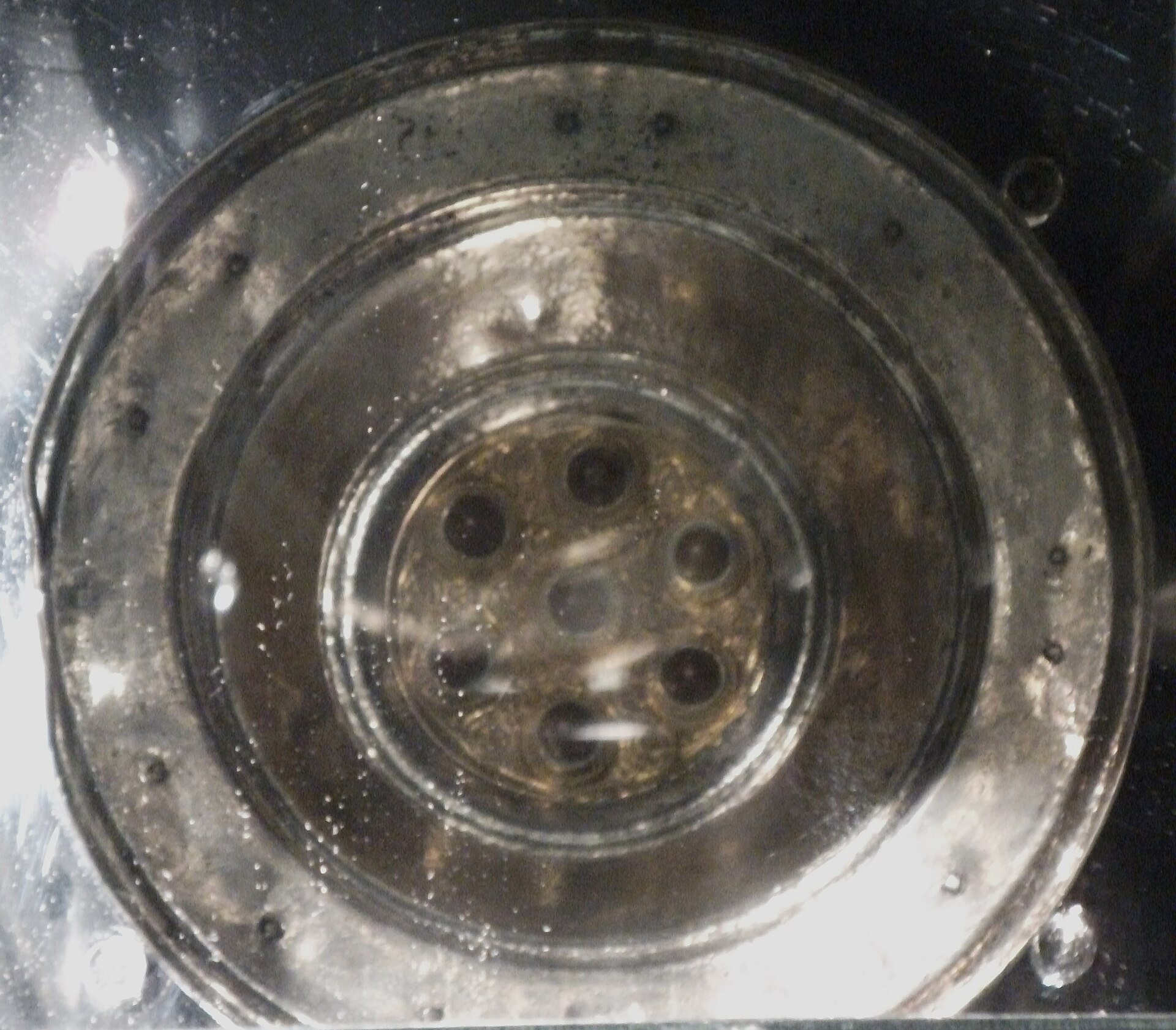
The Ardagh Chalice is a two-handled beaten and spun silver vessel assembled from 354 separate pieces, made in Ireland in the eighth century and commonly dated to about 750. Every one of those parts was made for this object, in one campaign, by people working to a single design. Composite here is a statement about ambition.
The detail that settles it is on the underside. The decorated foot carries a polished rock crystal at its centre, and the surface a congregation kneeling in front of the altar would never see is finished to full standard. Nobody assembling parts to deceive a buyer finishes the bottom.
This is the largest of the three groups and the least interesting to a sceptic, which is exactly why it should not share a word with the other two. An eighth-century chalice of 354 parts, a Renaissance nef and a sixteenth-century automaton are all composite in this sense, and in none of them does the word bear on authenticity at all.
The Louvre dates one sword to four different periods, and says so itself
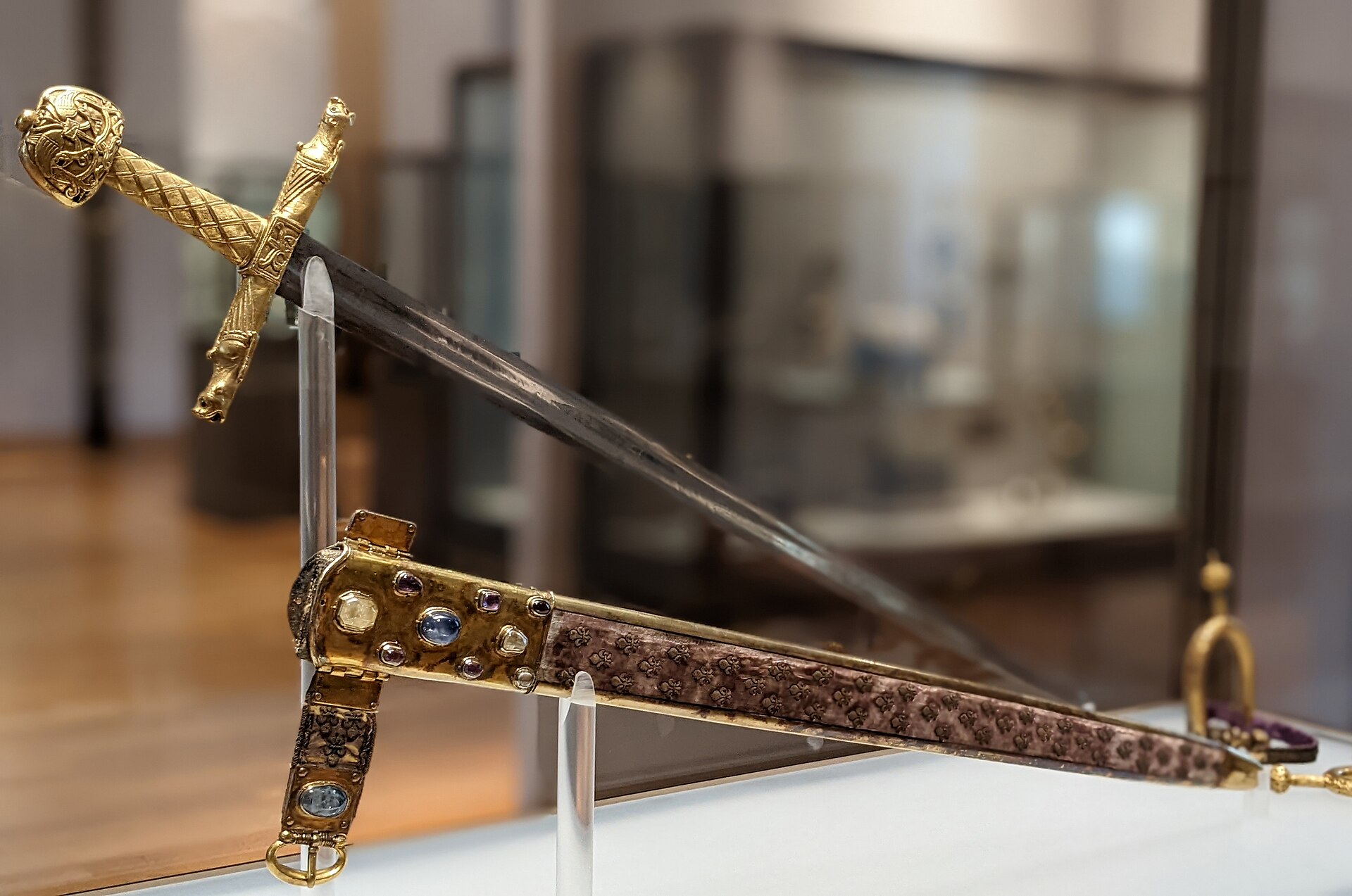
The second group is objects that grew. The Epee du sacre des rois de France, MS 84, has been used at French coronations since at least 1271 and is traditionally identified as the sword of Charlemagne, who died in 814. The Louvre's own collections database dates its pommel to 900-1100, its quillons to 1100-1200, its grip to 1200-1400 and its blade to 1700-1900, and states that the sword is composed of very diverse elements, much modified, particularly as to the blade.
Not one of those four ranges includes Charlemagne's lifetime. The object is nonetheless completely authentic: it is a real coronation sword with a continuous documented function, and the scabbard carries velvet remade in 1804 and again in 1825 because it was still being used. What the component dates destroy is a claim about physical continuity with one man, and the Louvre publishes the evidence against that claim in its own record.
This is the case that shows why a composite needs its dating rule stated. If the object is dated by its latest part it is an eighteenth or nineteenth-century sword. If by its earliest, it is tenth-century. Neither number describes the thing, and the honest entry gives all four and names which part each belongs to.
Museum armour is assembled, and the museum did the assembling
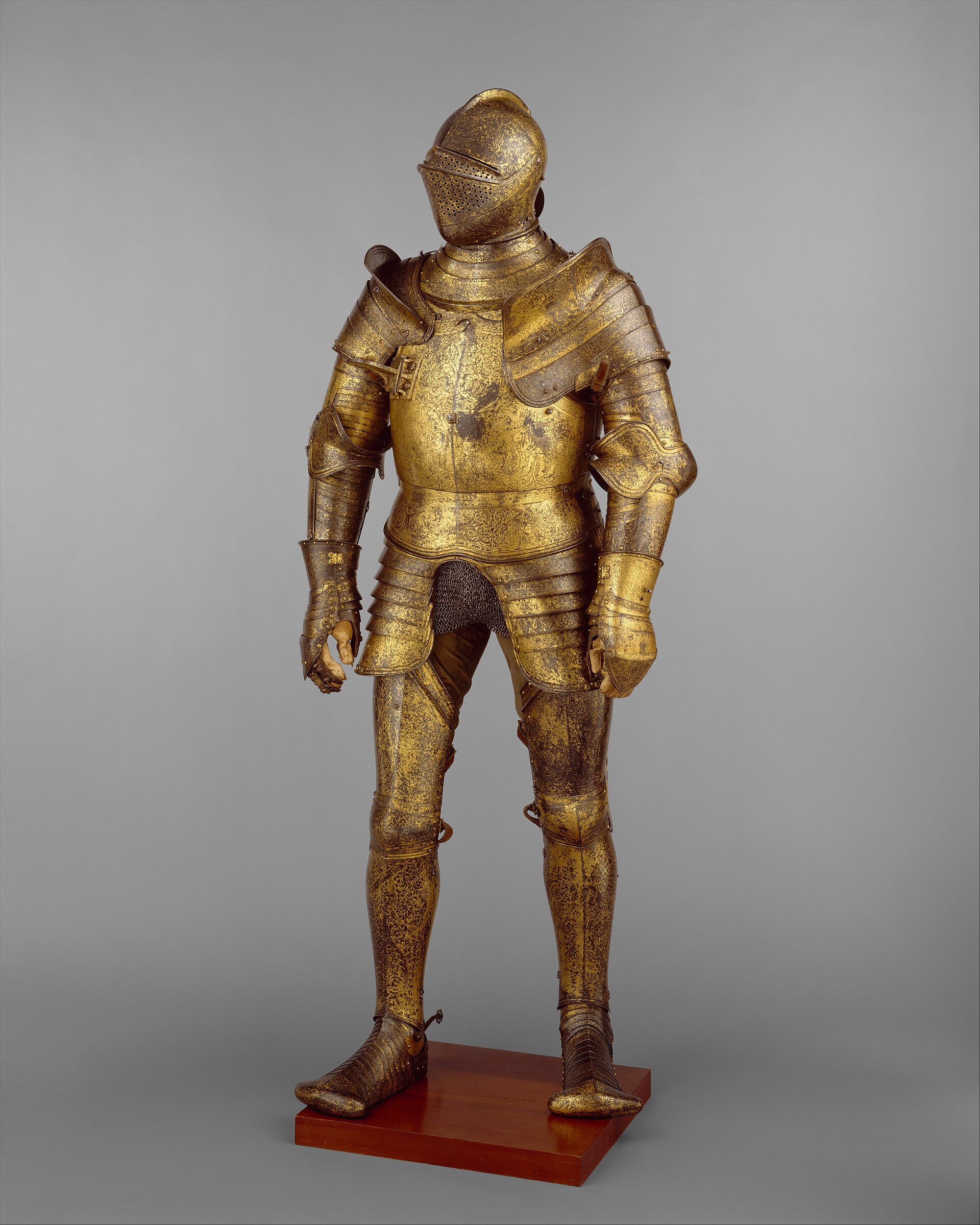
Armour is the field where the second group is standard practice rather than an exception, and where the assembler is often the institution. The Metropolitan's garniture of George Clifford, third Earl of Cumberland, is dated 1586 and made under Jacob Halder's direction at the royal Almain Armoury at Greenwich, on evidence as good as this field offers: Halder annotated two of his own designs in the workshop's record book with the words that they were made by him, and the corresponding design for this exact garniture survives.
The object on display is still not what left Greenwich. The garniture as now shown was assembled by the Museum from two separate acquisitions, made across two different funds four years apart, rather than received complete in one transaction, and its left gauntlet is not original to the 1586 commission. The Museum's own photographs of the armour of Henry VIII, dated 1527 in three places and accepted as the earliest dated product of the same workshop, likewise carry an associated piece that is not from that harness.
A visitor sees one suit of armour. The record describes a display, and the difference between those two things is a hundred per cent of the question a specialist would ask.
Pastiche adds an inference about who intended what
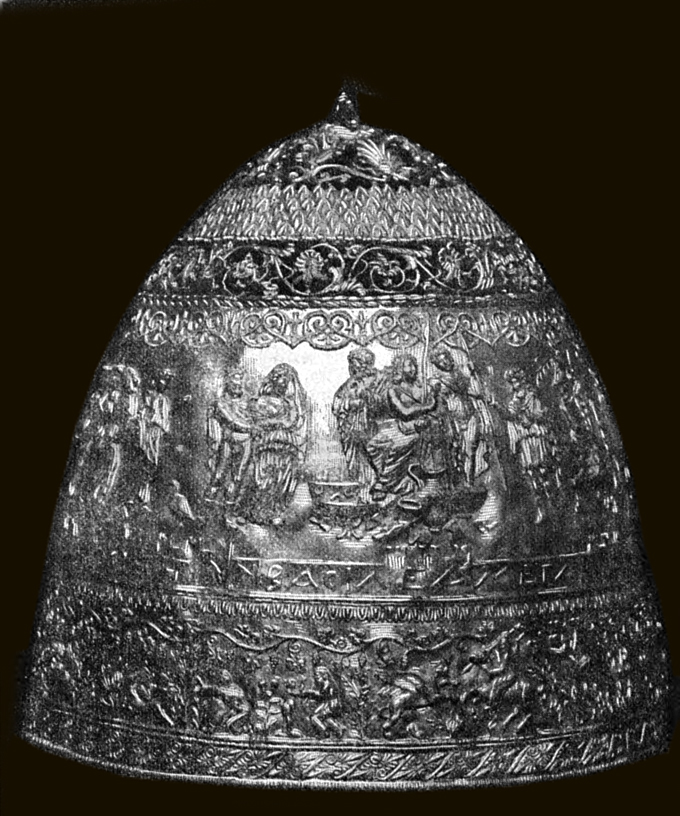
The third group is where the word stops describing and starts alleging. The Tiara of Saitaphernes was sold to the Louvre in 1896 as a Greek gold tiara presented by the city of Olbia to a Scythian king of the third or second century BCE. It was made in Odessa in 1894 or 1895 by the goldsmith Israel Rouchomovsky, who came forward in Paris in 1903 and proved his authorship by reproducing a section of the work in front of a commission.
What he had produced is described in this archive as a competent and learned pastiche, assembled from the visual vocabulary of Black Sea Greek gold that was being excavated and published in his own lifetime, in a city where that material was arriving. The subject matter was assembled from published excavation reports supplied to him by the dealers who commissioned the piece. It is seventeen centimetres high and eighteen across, worked by hammering, repousse and chasing and put together by soldering, and the Louvre's catalogue now gives Rouchomovsky as its author.
Note where the deception sits. Rouchomovsky made an object and did not sell it as ancient; the dealers who briefed him did that. Pastiche is accurate about the object and silent about which person intended the fraud, which is the one thing a reader most wants to know.
The Rospigliosi Cup shows what a museum does when it stops guessing
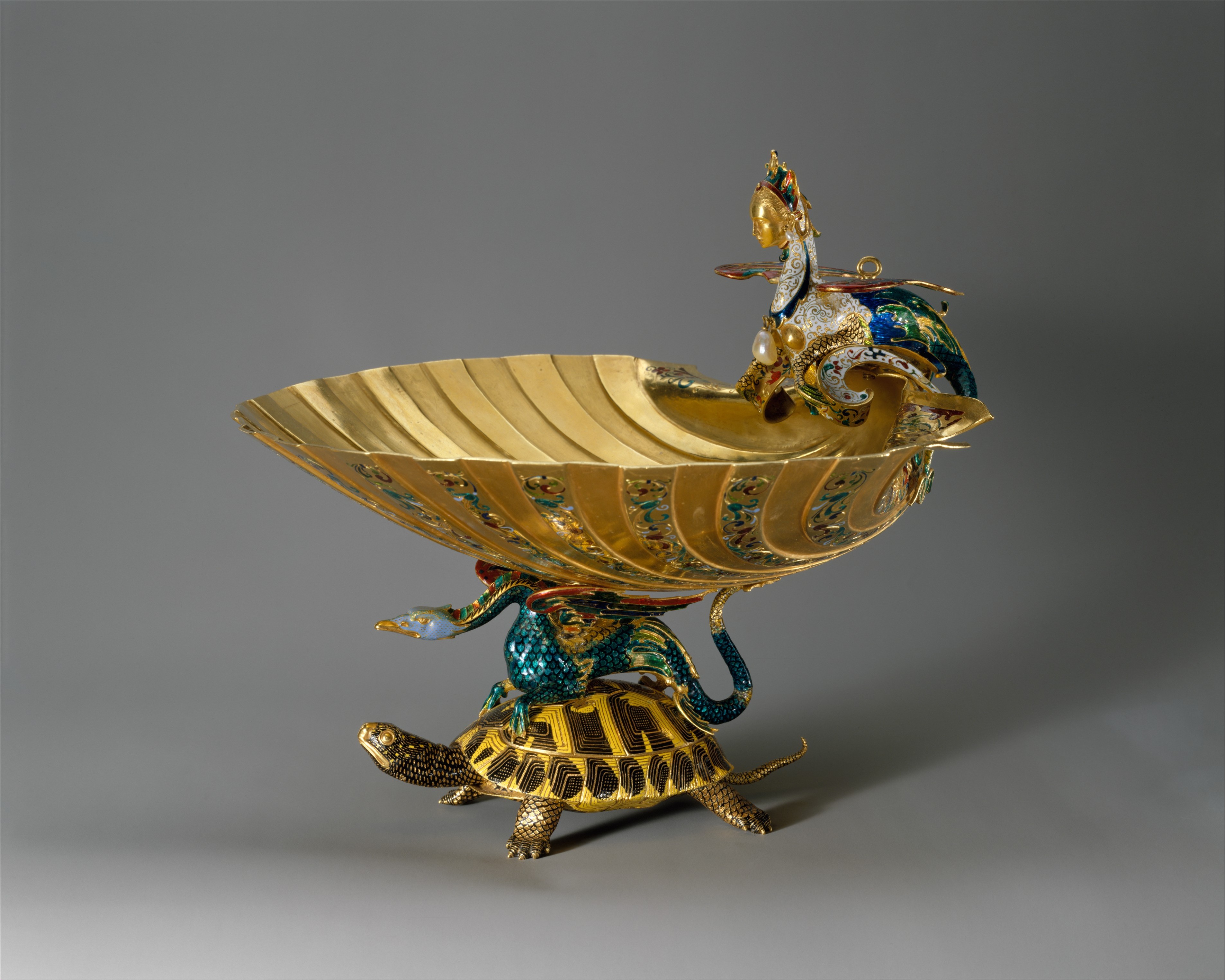
Four positions in a hundred and thirteen years is the record of this object. The cup was catalogued as Benvenuto Cellini until 1969, reattributed by Yvonne Hackenbroch to Jacopo Bilivert in that year, reassigned by the same scholar to the Aachen goldsmith Reinhold Vasters in her Metropolitan Museum Journal monograph of 1984-85, and is now carried by the Museum with no maker at all.
The Museum's current record is worth reading as a piece of writing. The title is Cup. The date is probably about 1840 to 1850, or somewhat earlier. The medium is gold, partly enamelled, with pearls, the object is 19.7 by 21.6 by 22.9 cm, the accession number is 14.40.667 and the credit line is the Bequest of Benjamin Altman, 1913.
That entry contains no allegation against anybody, names no forger and asserts nothing it cannot support. It also tells a reader everything material: the object is a nineteenth-century thing that was bought and bequeathed as a sixteenth-century one. Withdrawing a maker is a finding, and it is a stronger one than the three confident attributions that preceded it.
The strongest word was published by a museum against its own object, and it was wrong
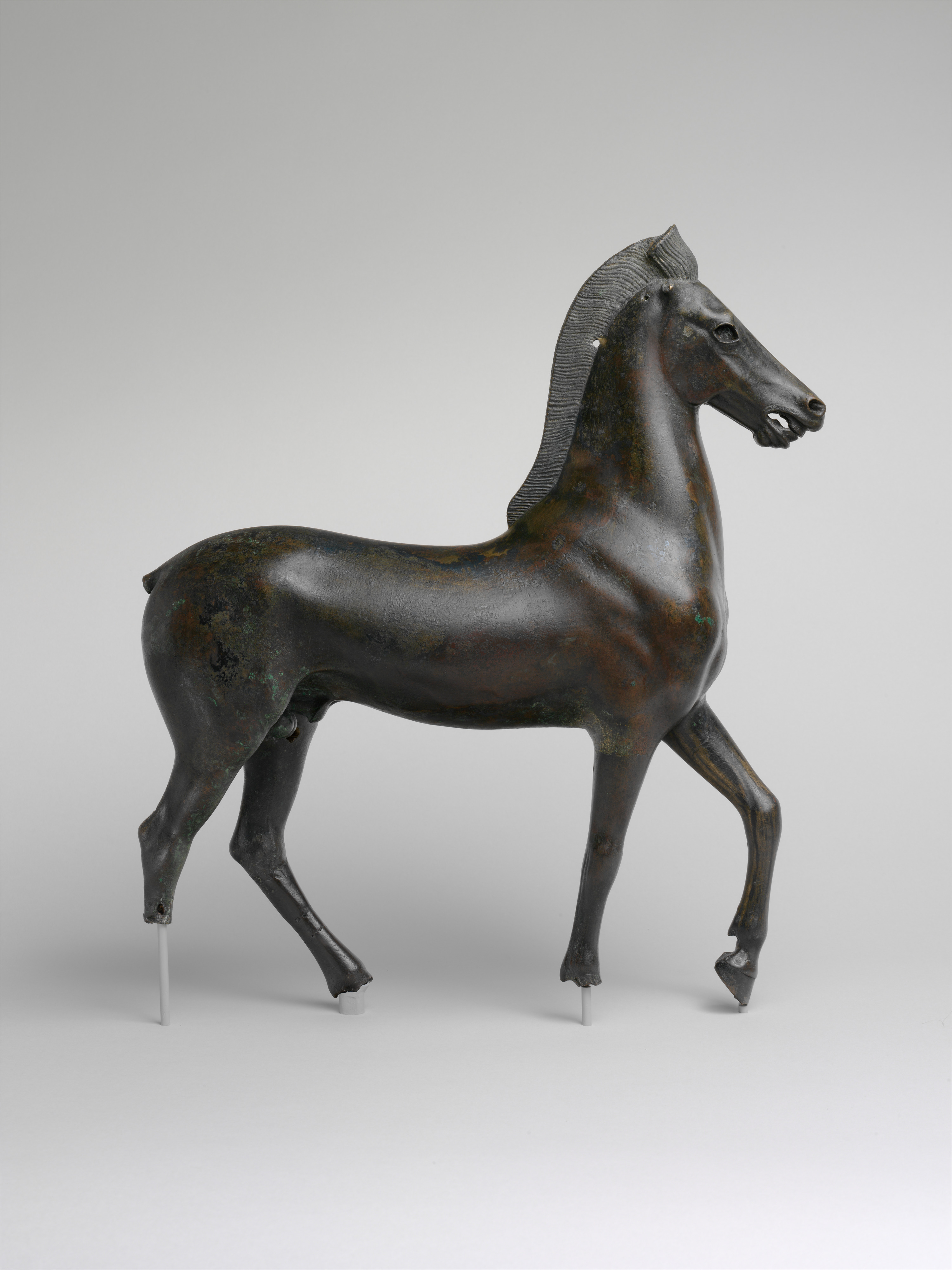
In February 1968 the Metropolitan Museum of Art Bulletin carried an article by the Museum's Vice-Director, Joseph V. Noble, titled The Forgery of Our Greek Bronze Horse. The object had been bought in 1923 and shown for more than forty years as Early Classical, of about 480 to 470 BCE. It was condemned in December 1967.
A technical re-examination lasting thirteen years reversed that. The bronze alloy, the corrosion products, the ceramic core with its iron armature and chaplets and the repair patches are all consistent with casting in antiquity, and thermoluminescence dating of the core returned 2250 plus or minus 210 years. The Museum now catalogues the statuette as Greek, late second to first century BCE, bronze, 40.2 cm high, accession 23.69, Fletcher Fund, 1923.
Two things follow. The first is that the allegation was withdrawn. The second is less often noticed: the object is genuine and the date it was bought as is gone, because the work that rescued it also moved it about four hundred years later than anyone had claimed. A composite argument was made, refuted, and in refuting it the museum lost the thing it had actually been proud of.
Three meanings, and the question that separates them
The three groups can be told apart by asking when the parts came together and whether the join was meant to mislead. Nothing technical is required to ask it, and the answer changes what the entry is reporting.
| Sense | When the parts met | Bears on authenticity | Example in this archive |
|---|---|---|---|
| Composite by manufacture | In one campaign, by the maker | No | Ardagh Chalice, 354 pieces, about 750 |
| Composite by accretion | Over centuries, in use | No, but the date needs stating by part | Coronation sword MS 84, parts of 900-1100 to 1700-1900 |
| Composite by curatorial display | In the museum, from separate acquisitions | No, and it should be disclosed | Clifford garniture, 1586, two acquisitions four years apart |
| Pastiche | Recently, to make a marketable object | Yes, and it implies intent | Tiara of Saitaphernes, Odessa, 1894 to 1895 |
| Forgery | Recently, with intent alleged outright | Yes, and it is an allegation | Bronze horse 23.69, alleged 1967, withdrawn |
Four of these five are ordinary facts about objects. The fifth is a charge, and the bronze horse is the standing proof that a museum can bring it against its own holding and lose.
How to read a composite entry
Ask which part the date belongs to. An object described as composite and given one date is under-catalogued, and the Louvre's four ranges for one sword are the standard to hold other records against. Where a single date appears, assume it is the latest part until the entry says otherwise.
Ask who did the assembling and when, and treat the museum as a candidate. A display assembled from two acquisitions is not a fault, and a record that does not disclose it is.
Then read the word itself as evidence about the cataloguer. Composite describes, pastiche infers an intention and forgery alleges one, and a catalogue that reaches for the strongest available word is telling you about the confidence in the building as much as about the object. In February 1968 that confidence was total, published and wrong.
Land the point
An eighth-century chalice of 354 parts, a coronation sword built up across a millennium, a display armour put together by its own museum, a learned fake made in Odessa and an ancient bronze once denounced by the institution that owns it are all called composite somewhere in the literature. Four of them are exactly what they claim to be.
The remedy is not a new word. It is to say when the parts came together, on whose authority, and whether anybody was meant to be misled, in the entry, every time. A catalogue that does that can use composite freely, because the sentence beside it will carry the meaning the word cannot.
Why this archive is free to read
We do this for everyone who loves art. The people who have studied it for years, and the people who just stopped to look. Iconotheca exists so that what we learn belongs to all of them.
Nobody pays us for this. No ads, no sponsors, no commercial interest. These works belong to all of us, and we would rather share them with as many people as we can than keep them to ourselves.
If it gave you something today, tell us to keep going. Follow us, leave a like, or write a positive comment. We read every one, and they are what keeps us going.
Questions
Usually not. In this archive the word most often records how an object was manufactured, as with the Ardagh Chalice's 354 separate pieces, or how it acquired parts over centuries of use, as with the French coronation sword. Only pastiche and forgery carry an implication that somebody meant to mislead.
By part rather than as a whole. The Louvre's collections database gives the pommel as 900-1100, the quillons as 1100-1200, the grip as 1200-1400 and the blade as 1700-1900, and describes the sword as composed of very diverse elements. None of those ranges includes the lifetime of Charlemagne, who died in 814.
Because the suit on display is frequently put together from pieces acquired separately. The Metropolitan's Clifford garniture of 1586 as now shown was assembled by the Museum from two acquisitions made four years apart from two different funds, and its left gauntlet is not original to the 1586 commission.
A pastiche describes an object made up from the vocabulary of a period; a forgery alleges that somebody intended to deceive. The distinction matters because the person who makes the object and the person who sells it as ancient are not always the same, as with the Tiara of Saitaphernes, whose maker came forward and proved his own authorship in 1903.
Yes. The Metropolitan Museum of Art Bulletin published The Forgery of Our Greek Bronze Horse in February 1968 about its own accession 23.69, and a thirteen-year technical re-examination restored the statuette to antiquity, with thermoluminescence dating of the core returning 2250 plus or minus 210 years. It is now catalogued as Greek of the late second to first century BCE.
Sources
- 1Musee du Louvre, collections database, 'Epee du sacre des rois de France', MS 84. Read 25 September 2026. Source for the component datings of pommel 900-1100, quillons 1100-1200, grip 1200-1400 and blade 1700-1900, for the dimensions of 100.5 by 22.6 cm, and for the Louvre's own statement that the sword is composed of very diverse elements, much modified, particularly as to the blade. collections.louvre.fr/en/...
- 2Metropolitan Museum of Art Collection API, object 192708, the Rospigliosi Cup. Read 25 September 2026. Source for the Museum's current catalogue line: title 'Cup', date 'probably ca. 1840-50, or somewhat earlier', medium gold partly enamelled with pearls, dimensions 19.7 by 21.6 by 22.9 cm, accession 14.40.667 and the credit line Bequest of Benjamin Altman, 1913, with no maker named. collectionapi.metmuseum.org/public/...
- 3Metropolitan Museum of Art Collection API, object 251268, Bronze statuette of a horse. Read 25 September 2026. Source for the Museum's current dating of the object as Greek, late 2nd to 1st century BCE, with machine-readable begin and end dates of -115 and -1, the height of 40.2 cm, accession 23.69 and the Fletcher Fund credit line of 1923, against which the 1923 to 1960s catalogue date of about 480 to 470 BCE can be compared. collectionapi.metmuseum.org/public/...
- 4Joseph V. Noble, 'The Forgery of Our Greek Bronze Horse', in 'Art Forgery', The Metropolitan Museum of Art Bulletin, new series vol. 26 no. 6, February 1968, article at p. 253. The Museum's own scanned issue was downloaded and read on 25 September 2026. Source for the title verbatim from the issue's contents page, and for the issue's note that the first four articles are adapted from a series of seminars presented by the Museum in November and December 1967, which is the period in which the bronze was condemned. resources.metmuseum.org/resources/...
More in Attribution and Authenticity
The partThe Frame Has Its Own Provenance
Ten records carry evidence on a frame. Van Eyck's integral frames date the panels to 1410-1440; a 1970 loan label on a frame in Maine proves nothing...
The Object With No Maker
Eighty-nine of the 266 objects published here name nobody as their maker. The rate runs from 71 per cent in glass and goldsmiths' work to 3 per cent...
An inscription is read on a date, not seen
Six objects in this archive carry writing that settled what they are. In every case the reading is an event with a date and a reader, and in four of...