A Hallmark Can Be Genuine, Legal and About a Different Object
The V and A catalogues a Paul de Lamerie ewer of 1736 as a duty dodger, hallmarked 1944. Its marks were genuine, struck by the state, and cut out of something else. No test of the metal can find that.
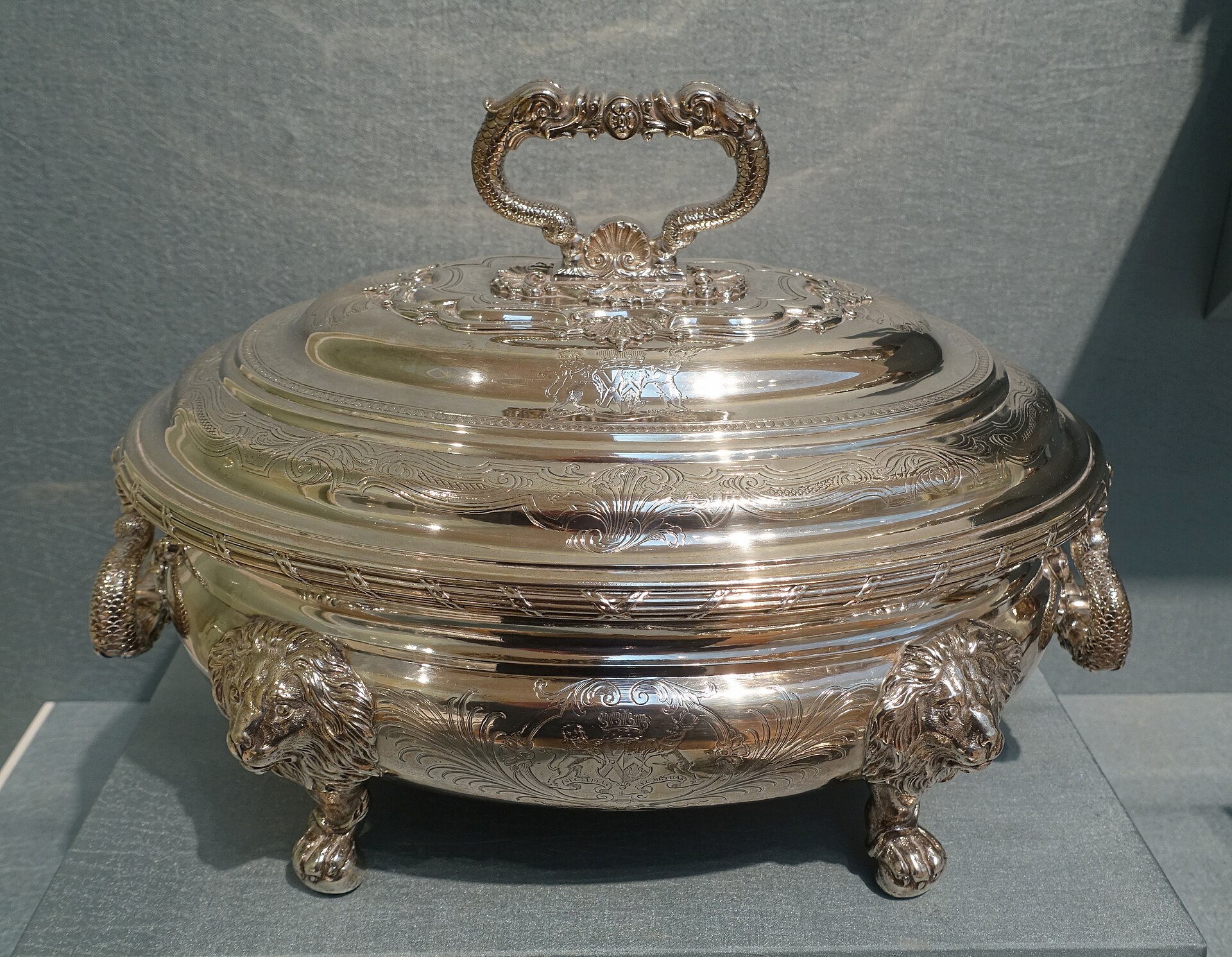
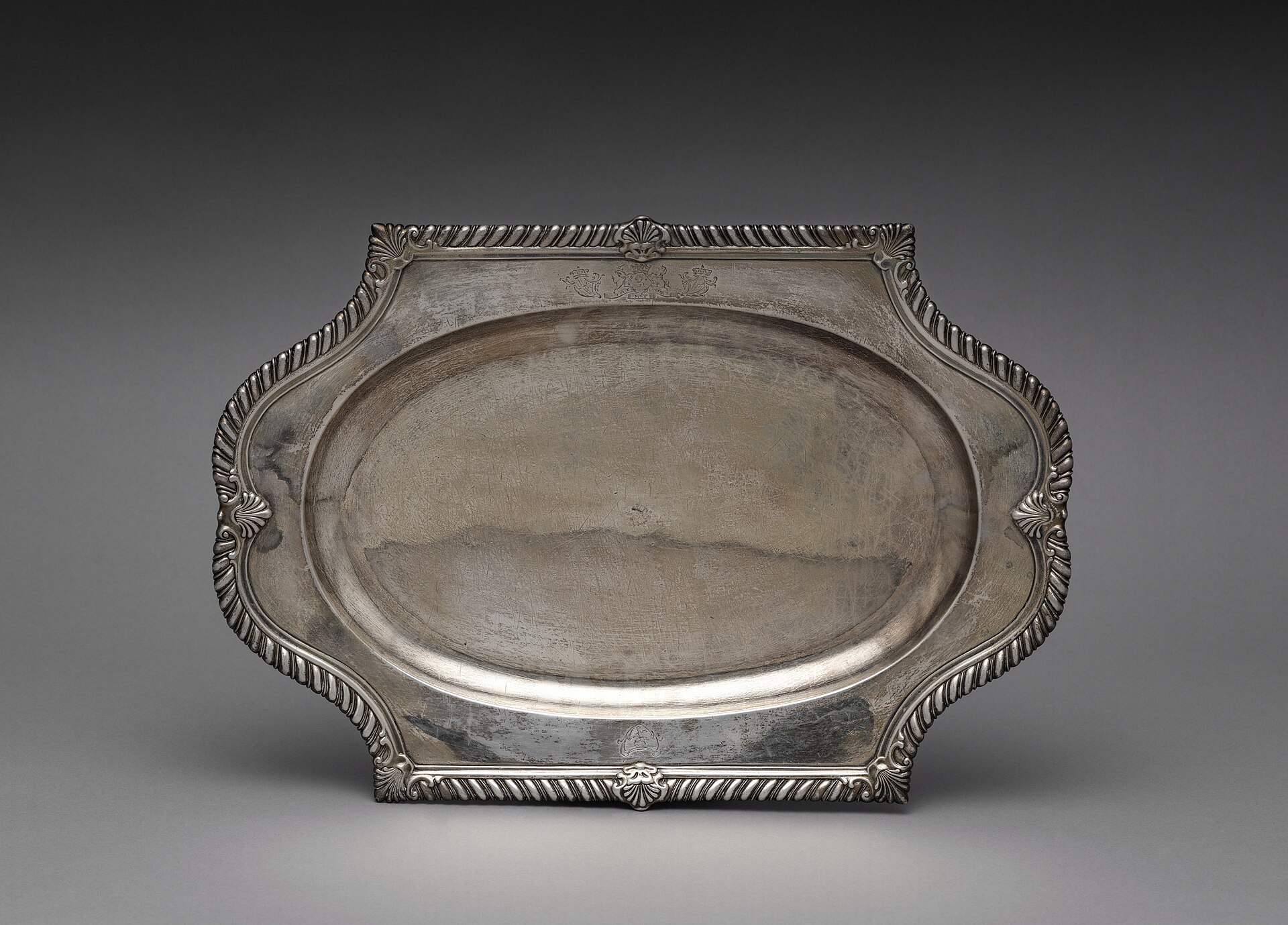
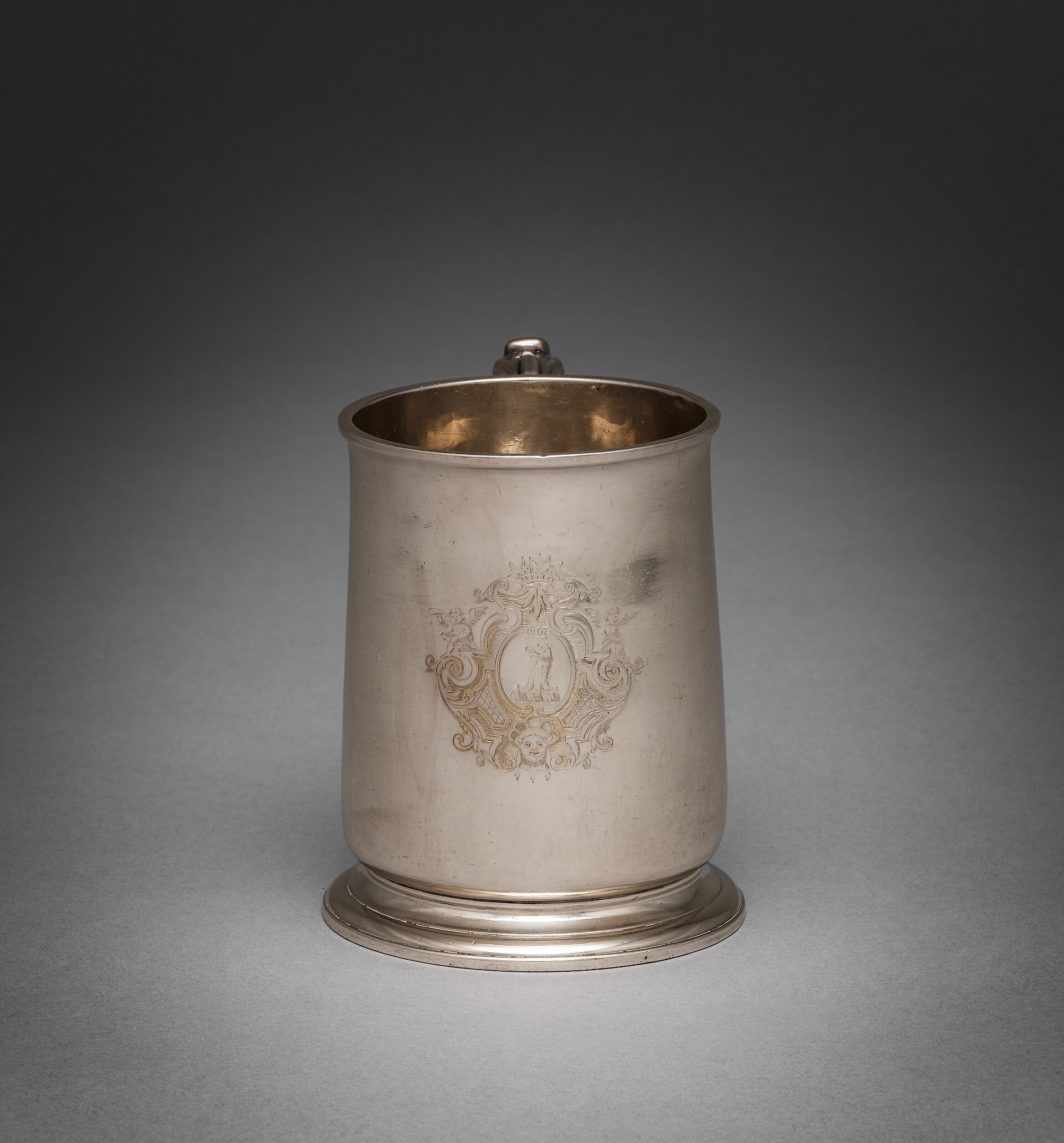
Records in this piece: The Hardwicke Soup Tureen and Cover, Tea Caddy, Tray, Cann
On this page 12 sections
ContentsClose
In short
- The Victoria and Albert Museum gives one of its Paul de Lamerie ewers two dates in the same field: made 1736, hallmarked 1944-1945. The second date is there because the first set of marks had been cut out of a smaller object and soldered into this one.
- A transposed mark defeats every test of the material. The silver is the right silver, the punch is the right punch and the date letter is the right date letter, because all of them are genuine. What is false is the relationship between the marks and the object under them.
- The Goldsmiths' Company Assay Office's own guidance to the trade names the forms most often found carrying transposed marks: cups, tea and coffee wares, casters, bowls, mugs and tankards. Four of the five Lamerie objects in this archive are in that list.
- A London hallmark of the 1730s is four punches doing four different legal jobs, and only one of them says anything about a person. The other three certify an alloy, a place of assay and a year.
- Two centuries later the fraud runs the other way. In April 2024 the Goldsmiths' Company held a seminar at Goldsmiths' Hall on the recent increase in attempts to forge the maker's mark of Paul de Lamerie, with a session devoted to exactly that.
- The body that rules on these cases decides whether marks are lawful, not who made the object. A clearance is not a certificate of authorship, and it has never claimed to be.
A hallmark is a statement about a transaction, not about an object
A British hallmark records that somebody brought a piece of metal to an assay office, that the office tested the alloy and that a duty, where one was charged, was paid. That is the whole of what it certifies. It is easy to read it as a signature, because it carries initials and because the initials are frequently the only words on the object, but the initials belong to whoever answered for the assay and not necessarily to whoever raised, cast or chased the piece.
This matters more than the usual caution about signatures, because a hallmark is not a private claim. It is a state act, punched into the metal by an official body under statute, and it is the most authoritative document most pieces of English silver will ever carry. Which is why the interesting failure is not a forged mark. It is a real one, in the wrong place.
The V and A publishes one of its own Lamerie ewers as a duty dodger
The Victoria and Albert Museum holds a silver gilt helmet-shaped ewer, museum number M.16-1954, and its catalogue gives the date as made 1736, hallmarked 1944-1945. It is 15.75 inches high, 13 inches wide and weighs 3.66 kg. It carries the cast coat of arms of Philip Yorke, Baron Hardwicke, later Lord Chancellor, impaling those of his wife Margaret Cocks, so the patron is named, documented and beyond dispute.
The museum's own description calls it a duty dodger and explains the mechanism in its own words: English silver was taxed by weight after 1720, and to avoid paying tax on larger, heavier objects, which were weighed when the piece was being marked by the assay office, marks were sometimes cut out from smaller, lighter pieces and added to avoid them going through the assay office. On this ewer that is what happened. The museum then records the sequel: in 1944, after complaint, the transposed marks were removed and the ewer was re-marked by the Goldsmiths' Company.
Two things about that are worth sitting with. The first is that the fraud was still actionable two hundred and eight years after the object was made, because the offence attaches to the marks and not to a person who could die out of reach of it. The second is that the museum publishes both facts side by side, the original crime and its correction, rather than quietly showing a 1736 ewer with 1944 marks and letting a visitor assume.
Sixpence an ounce, and a fraud the tax paid for
The duty that produced the fraud was introduced by an Act for laying a duty on wrought plate at sixpence per troy ounce, in force from 1 June 1720. Because the charge was by weight and was assessed when the piece was presented, the saving from moving a small object's marks into a large one scaled with the difference in weight, and on a heavy ewer or a tureen it was worth real money. The trade literature records the penalty as a fine of five hundred pounds or, later, transportation, which tells you what the authorities thought of it.
The Goldsmiths' Company's answer came in the Plate Offences Act of 1739, which required goldsmiths to destroy their existing marks and register new ones, and which introduced punch designs with indented outlines used from 18 July 1739 until the end of the 1755 marking year on 27 May 1756. That last detail is a gift to anybody checking a piece today, because a mark whose outline does not belong to the cycle its date letter claims is caught on style alone. The Hardwicke ewer of 1736 sits just before that reform, in the years when the fraud was easiest.
Four punches, four different claims, and only one of them names anybody
A London hallmark of this period is built from four separate punches, and reading them as a single block is where most misunderstanding starts. Each certifies something different, and a transposition moves all four at once while falsifying none of them individually.
| Punch | What it certifies | What a transposition does to it |
|---|---|---|
| Lion passant | The alloy meets the sterling standard | Nothing. The claim stays true of the metal under it only if the metal is the same, which it is not |
| Leopard's head crowned | The piece was assayed at Goldsmiths' Hall in London | Transfers a true statement about one object onto another that was never assayed |
| Date letter | The assay year, running from late May to late May | Dates the object it came off, not the object it is now in |
| Sponsor's mark | Who submitted the piece and answered for its standard | Names a real person who really did submit something, just not this |
Paul de Lamerie registered the sterling-standard mark PL at Goldsmiths' Hall on 27 March 1732, having used a two-letter LA mark on Britannia-standard silver before that. So a PL punch also carries a date floor. It cannot honestly appear on anything assayed before March 1732, and that is one more consistency check available to a cataloguer who has the object in hand.
Tea and coffee wares are named in the trade's own list of vulnerable forms
The Goldsmiths' Company Assay Office's guidance to the trade names the object forms most often found carrying transposed marks, and it is specific rather than general: cups, tea and coffee wares, casters, bowls, mugs and tankards. Tea and coffee wares are not folded into a vague category of hollowware. They are called out.
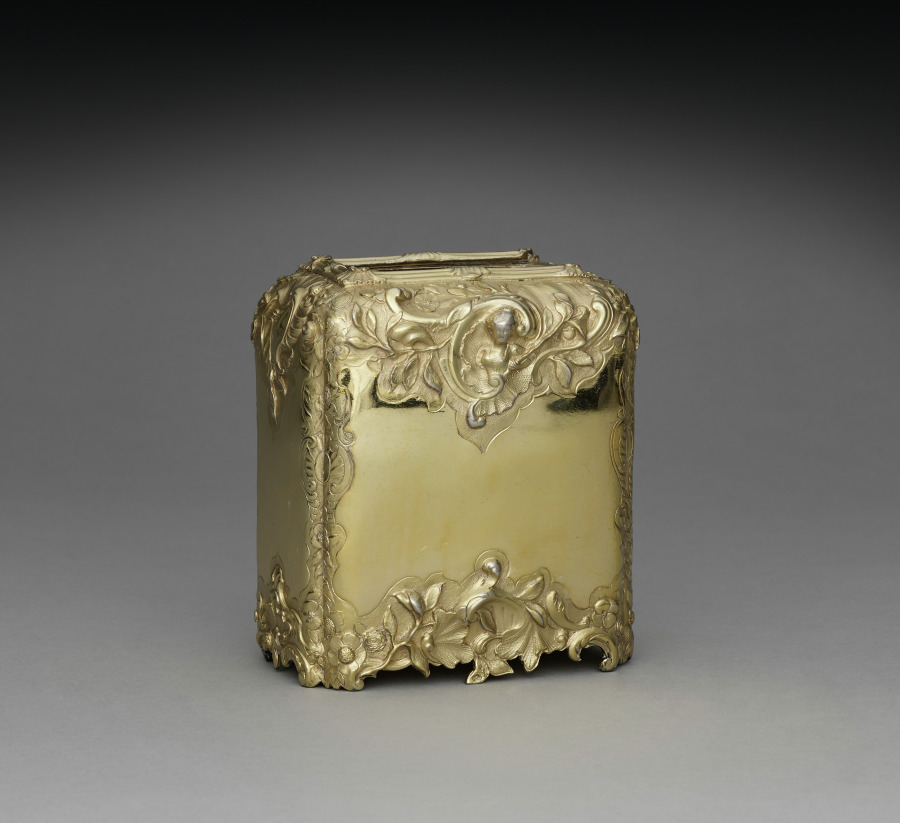
The Cleveland Museum of Art holds a Lamerie tea caddy, silver gilt, dated by assay year to 1741-42, accession 1943.179, with the canister body accessioned separately as 1943.179.a and the lid as 1943.179.b. It is on view in gallery 203A. The museum publishes the two-year assay span, which means somebody read a date letter, and it does not publish which punches were read or where on the object they sit. It also lists no inscriptions at all: no arms, no crest, no motto, no initials, on either the body or the lid.
We are not suggesting anything about this caddy, and it would be irresponsible to. What we can say is narrower and more useful: it is a small silver gilt object of exactly the form the trade's own literature flags as worth checking, and no conservation report, technical imaging or Hallmark Authentication Committee examination of it turned up in anything we could find. That is an absence in the public record, and an absence is worth naming precisely because it is so easy to read as a clean bill of health.
A body and a lid engraved with the same arms are checking each other
The strongest routine check that a cover belongs to its body is engraved, not punched. When a piece was made as a commission, the armorial was frequently applied to both elements, which means that centuries later a mismatch between the arms on a lid and the arms on the body is one of the first things a cataloguer looks for. The Hardwicke tureen carries identical armorial devices below barons' coronets on both the body and the cover, per the Portland Art Museum's own description, and that redundancy is worth more than it looks.
The Cleveland caddy has the opposite problem, and it is instructive to see the two failures next to each other. Its lid and body are accessioned separately and neither carries a mark of ownership, so nothing engraved connects them. Meanwhile the V and A holds a second Lamerie caddy, M.314-1962, which carries no hallmark at all and is attributed on style, dated only to about 1730, a full decade's latitude, while carrying the arms of Antonio Lopez Suasso impaling Da Costa. Between those two objects the workshop's output splits into two halves of one evidentiary package, and neither half is the whole thing.
| Object | Hallmark | Dating latitude | Engraved owner |
|---|---|---|---|
| Cleveland 1943.179 | Read, span published | Two years, 1741-42 | None recorded |
| V and A M.314-1962 | None at all | About a decade, around 1730 | Lopez Suasso impaling Da Costa |
The fraud running now is the opposite of the one that made the ewer
The duty dodger was a tax fraud and not an attempt to deceive a buyer about authorship, which is why the ewer's patron and its shop are both perfectly well established. The current problem is the other way round. On 12 April 2024 the Goldsmiths' Company held a half-day seminar at Goldsmiths' Hall titled Marks of deception: tackling fakes and forgeries in antique British silver, and its own published announcement gives the reason: the recent increase in attempts to forge the maker's mark of Paul de Lamerie.
The programme is worth listing because it shows where the Company thinks the defences are. Timothy Schroder spoke on the role of the Goldsmiths' Hallmark Authentication Committee, Alastair Dickenson on fakes in British silver from about 1700 to today, Will Evans on scientific testing and antique silver, Eleni Bide on researching silver and hallmarks in the Company's library and archive, and Peter Cameron on the fake marks of Paul de Lamerie specifically. The Company names the increase. It does not publish a count of pieces detected, and we could not find one anywhere.
There is a hard commercial edge to this. The Los Angeles County Museum of Art's own published history of the Gilbert Collection records that Arthur Gilbert, who began buying de Lamerie and Paul Storr in the mid-1960s, was quick to realise the potential for errors in judgment after a purported de Lamerie acquisition turned out to be a fake. A wealthy and increasingly expert collector bought a forgery, and it is on the institutional record of a collection that now anchors a national museum's silver galleries.
The committee rules on marks, and it does not rule on hands
The Goldsmiths' Hallmark Authentication Committee, formerly the Antique Plate Committee, has operated since 1939, and the Company describes its job precisely: it advises the London Assay Office on the authenticity of an article's provenance based on the hallmark, professional analysis of the object and a scientific analysis of its metals. Where it finds marks forged, counterfeit or transposed, they are cancelled.
That is a narrower remit than it is often taken to be, and the narrowness is the point. A clearance means the marks are lawful. It is not a finding that a particular person made the object, and the Company does not claim otherwise. So a buyer who reads a committee clearance as an attribution has confused two questions that the system deliberately keeps apart, and has bought reassurance about a punch while believing they bought reassurance about a hand.
Nor can anybody tidy a bad mark up privately. Section 5 of the Hallmarking Act 1973 makes it an offence to remove, alter or deface any mark struck on an article except in accordance with the written consent of an assay office. That is the machinery under which the V and A's ewer was put right in 1944, and it is why the correction is dated, attributed and on the record instead of invisible.
What this means for the four Lamerie objects in this archive
None of the four Lamerie objects catalogued here is recorded anywhere as carrying a transposed mark, and this article does not suggest that any of them does. What we can set out is what each one's evidence actually consists of, and how much of it rests on the punches alone.
| Object | Holder and number | Assay year published | Engraved evidence of a first owner |
|---|---|---|---|
| Soup tureen and cover | Portland Art Museum, 69.45a-c | 1737-38 | Arms under barons' coronets on body and cover |
| Tea caddy | Cleveland Museum of Art, 1943.179 | 1741-42 | None recorded |
| Tray | Cleveland Museum of Art, 1941.601 | Published by the museum | Not established here |
| Cann | Cleveland Museum of Art, 1986.206 | Published by the museum | Not established here |
We have not examined any of them in person, and we have not read a single punch off a photograph, which we mention because a punch-by-punch reading is exactly the kind of claim that is tempting to fake and impossible to check afterwards. The Company's own detection questions are physical ones: whether the punches sit where this form of object was normally marked, whether there is excess solder around them suggesting a let-in patch, and whether the impression shows correctly on the reverse of the metal. Those are answered with the object on a bench, not with a catalogue and a photograph.
How to read a hallmark without over-reading it
Treat the hallmark as evidence about an event, and ask separately what the event has to do with the object in front of you. The mark tells you that something of this standard was assayed in this city in this year and that this sponsor stood behind it. Whether that something is this thing is a different question, and the answer to it is physical: the position of the punches on the form, the presence or absence of solder around them, the reading on the reverse.
Then look for the second, independent line of evidence, because a single documentary source is a single point of failure whatever authority struck it. An engraved armorial on two separate elements, a weight recorded in a bill, a name in an inventory, a punch outline that belongs to the right cycle: any of these can agree or disagree with the marks, and the disagreement is the finding. Where a museum publishes an assay year but not the punches, as most do, the honest position is that the date has been read by somebody competent and that you have not read it.
The genuine document is the one worth checking hardest
The strongest document on an object can be perfectly genuine and about something else. That is not a flaw in hallmarking, which was designed to certify a transaction and does so well. It is a flaw in how the mark gets read, and the reading is where the money is lost.
Why this archive is free to read
We do this for everyone who loves art. The people who have studied it for years, and the people who just stopped to look. Iconotheca exists so that what we learn belongs to all of them.
Nobody pays us for this. No ads, no sponsors, no commercial interest. These works belong to all of us, and we would rather share them with as many people as we can than keep them to ourselves.
If it gave you something today, tell us to keep going. Follow us, leave a like, or write a positive comment. We read every one, and they are what keeps us going.
Questions
It is a piece on which hallmarks were cut out of a smaller, already assayed object and soldered in, so that the larger piece appeared to have been tested and to have paid the duty when it had not. The duty was sixpence per troy ounce from 1 June 1720 and was assessed by weight, so the saving grew with the size of the object.
Not on its own, because both the object and the transposed marks are usually genuine silver of the period. Detection is physical and contextual: whether the punches sit where that form of object was normally marked, whether there is excess solder around them suggesting a let in patch, whether the impression reads correctly on the reverse, and whether the punch outlines belong to the cycle the date letter claims.
No. The committee advises the London Assay Office on whether an article's marks are lawful, using the hallmark, examination of the object and scientific analysis of its metals, and it cancels marks it finds forged, counterfeit or transposed. It does not certify authorship, and it has never claimed to.
Because it adds the most value of any English silver mark, and the Goldsmiths' Company said publicly in April 2024 that attempts to forge it had recently increased. The Company held a seminar at Goldsmiths' Hall on 12 April 2024 with a session devoted specifically to fake marks of Paul de Lamerie.
Only with the written consent of an assay office. Section 5 of the Hallmarking Act 1973 makes it an offence for any person to remove, alter or deface any mark struck on an article otherwise, which is why corrections such as the 1944 re-marking of the Victoria and Albert Museum's Lamerie ewer are documented events rather than private repairs.
Sources
- 1Victoria and Albert Museum, online collections catalogue, entry for Ewer, Paul de Lamerie, museum number M.16-1954. Read 26 September 2026. Primary source for the date field reading made 1736 and hallmarked 1944-1945, for the silver gilt medium, the height of 15.75 inches, the width of 13 inches and the weight of 3.66 kg, for the cast coat of arms of Philip Yorke, Baron Hardwicke impaling Margaret Cocks, for the museum's own description of the object as a duty dodger and its explanation of the mechanism, and for the statement that in 1944 the transposed marks were removed and the ewer was re-marked by the Goldsmiths' Company after complaint. collections.vam.ac.uk/item/...
- 2The Goldsmiths' Company, company news, Marks of deception: tackling fakes and forgeries in antique British silver, seminar held at Goldsmiths' Hall on Friday 12 April 2024, 10:00 to 16:30. Read 26 September 2026. Primary source for the Company's own statement about the recent increase in attempts to forge the maker's mark of Paul de Lamerie (1688-1751), for the programme and speakers including Peter Cameron on the fake marks of Paul de Lamerie, and for the Company's description of what the Goldsmiths' Hallmark Authentication Committee does. thegoldsmiths.co.uk/company-news/...
- 3Hallmarking Act 1973, section 5, Alterations to hallmarked articles, on legislation.gov.uk. Read 26 September 2026. Primary source for section 5(2), that it is an offence for any person to remove, alter or deface any mark struck on an article except in accordance with the written consent of an assay office. legislation.gov.uk/ukpga/...
- 4Association of Small Collectors of Antique Silver (ASCAS), The background to duty dodgers. Read 26 September 2026. Secondary source, used for the statutory title An Act for laying a duty on wrought plate, the rate of sixpence per troy ounce in force from 1 June 1720, the penalty of a five hundred pound fine or later transportation, the Plate Offences Act of 1739 and the introduction of punch designs with indented outlines used from 18 July 1739 to the end of the 1755 marking year on 27 May 1756. ascasonline.org/articoloDICEM121.html
- 5Cleveland Museum of Art, online collection entry for Tea Caddy, Paul Jacques de Lamerie, accession 1943.179. Read 26 September 2026. Primary source for the date of 1741-42, the silver gilt medium, the overall dimensions of 13.4 by 9.6 by 5.8 cm, the credit line The Thomas S. Grasselli Memorial Collection, the location in gallery 203A British Painting and Decorative Arts, and the museum's Open Access release of the images. The museum publishes no punch by punch reading and no hallmark detail on this page. clevelandart.org/art/...
More in Attribution and Authenticity
The partComposite Names Three Different Objects, and Only One of Them Is a Fake
Fifty-seven records here use composite, pastiche or assembled, and the words are doing three incompatible jobs.
The Frame Has Its Own Provenance
Ten records carry evidence on a frame. Van Eyck's integral frames date the panels to 1410-1440; a 1970 loan label on a frame in Maine proves nothing...
The Object With No Maker
Eighty-nine of the 266 objects published here name nobody as their maker. The rate runs from 71 per cent in glass and goldsmiths' work to 3 per cent...