Salvator Mundi
Leonardo da Vinci · c. 1500
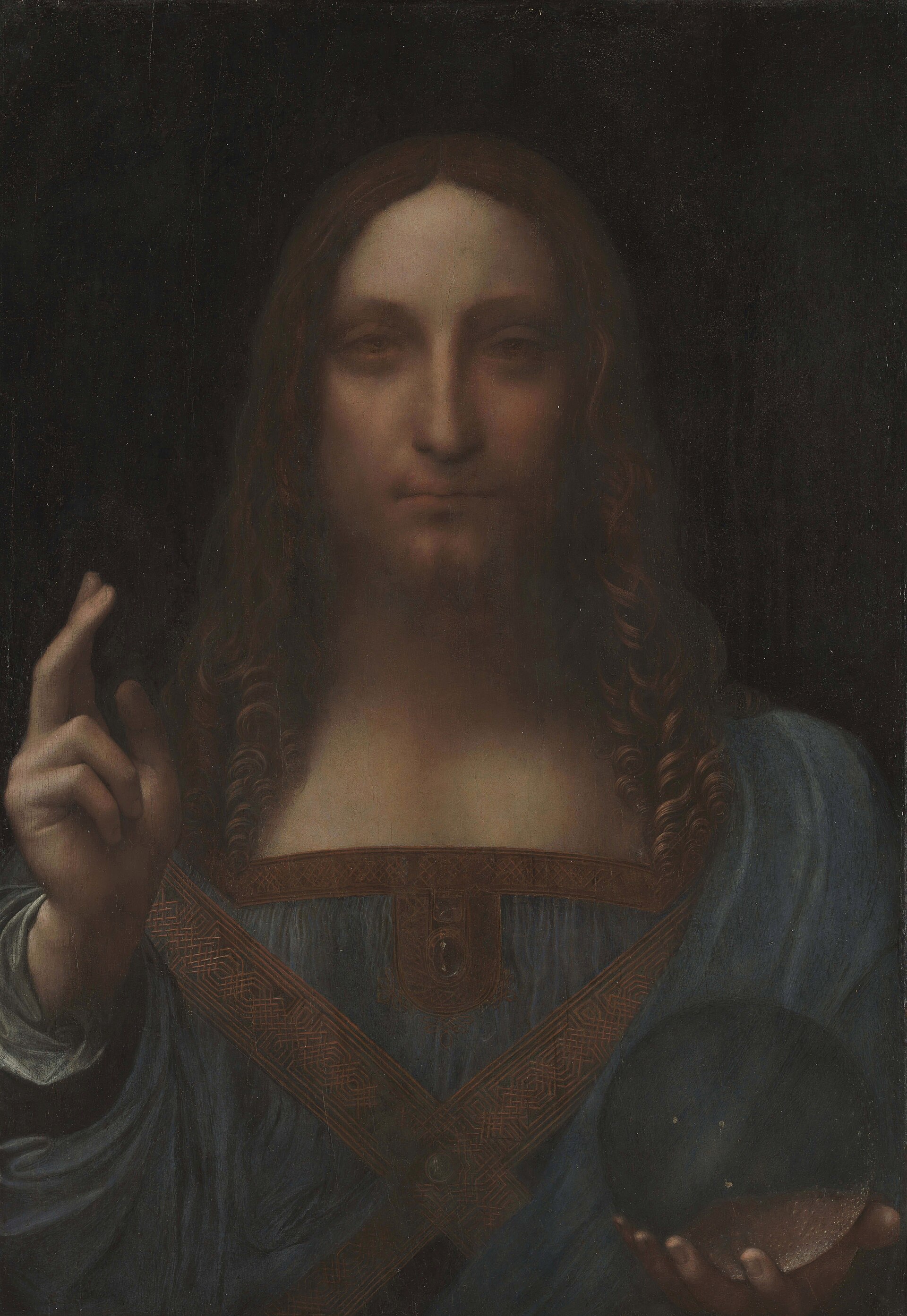
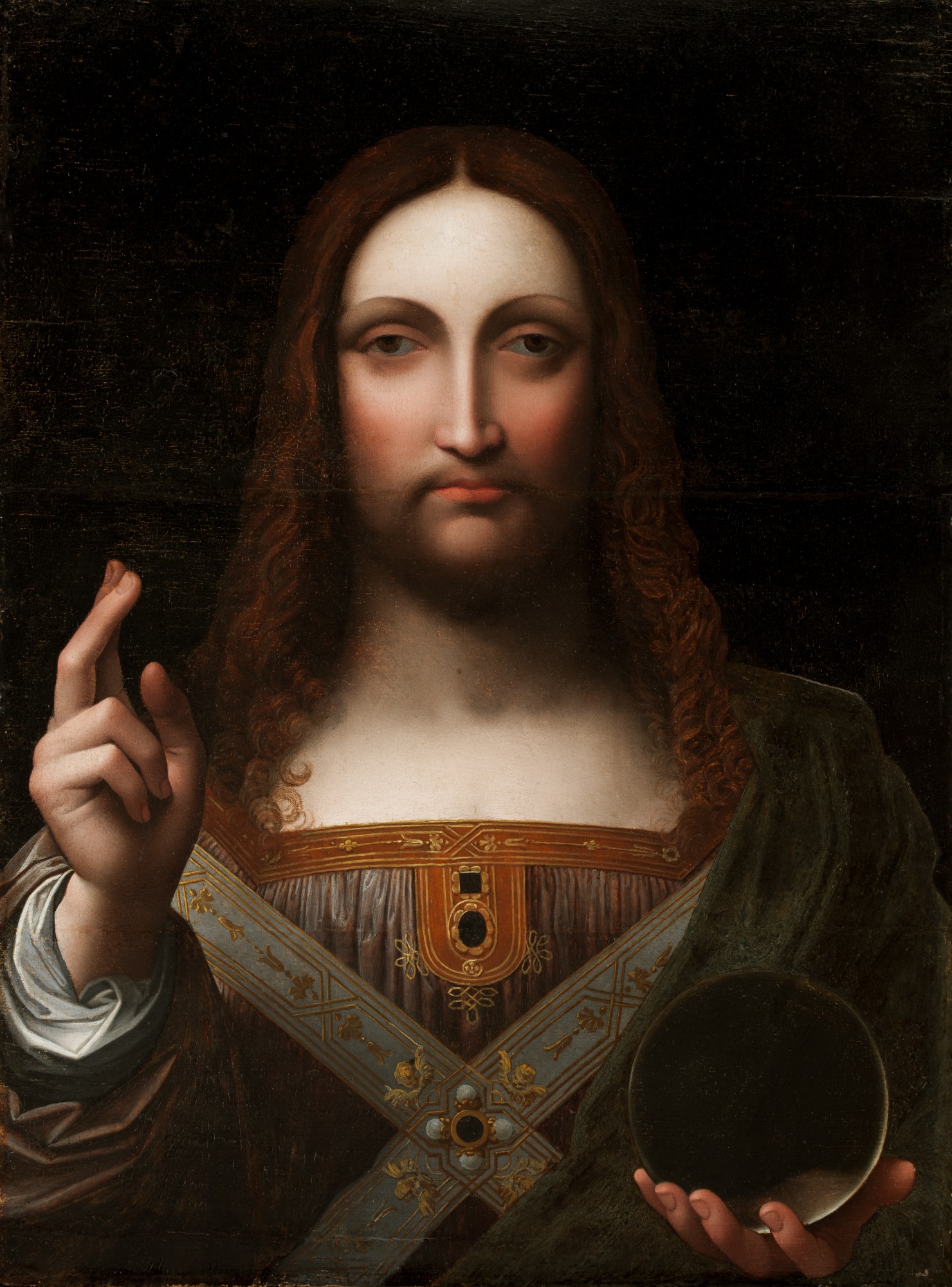
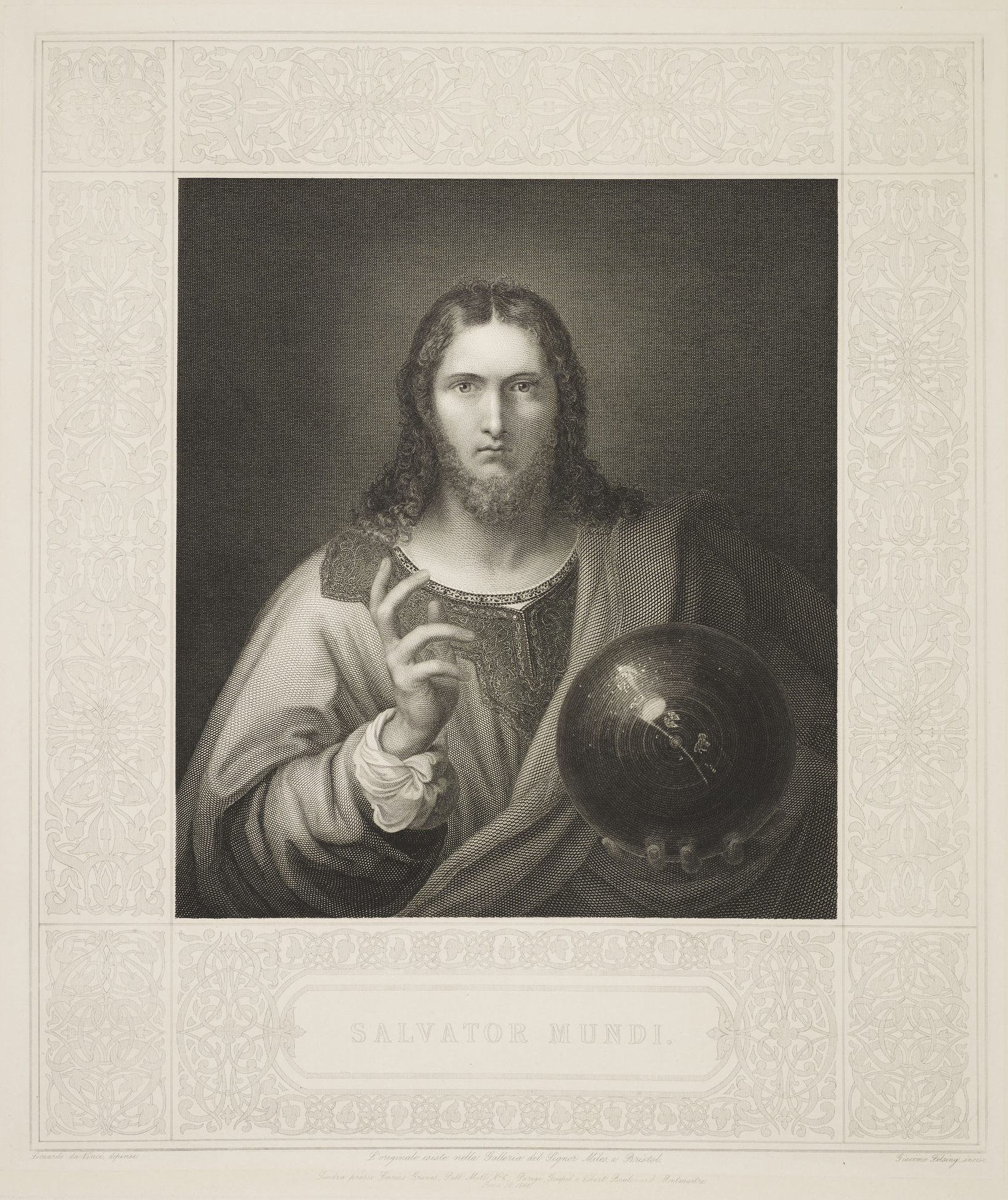
The picture as it has looked since Dianne Dwyer Modestini finished work on it, and the image reproduced worldwide in November 2017. Released by the Department of Culture and Tourism of Abu Dhabi in September 2018, the last authorised photograph of the panel. This is the restored state, not the state in which it was bought.
| Artist | Leonardo da Vinci |
|---|---|
| Date | c. 1500 |
| Medium | Oil on walnut panel |
| Dimensions | Painted image 64.5 x 44.7 cm. Panel 65.5 x 45.6 cm at the top and 65.5 x 45.1 cm at the bottom. Christie's published 45.4 x 65.6 cm. |
| Where it is now | Unlocated. No public record places the panel anywhere since the sale of 15 November 2017.last confirmed 30 August 2026 |
| Attribution | DisputedSold by Christie's in 2017 as an autograph Leonardo. Full note |
| Object type | Painting |
| Period | Italian, High Renaissance |
| Cases | Disputed attribution · Rediscovered |
| Inscriptions | None on the painted surface. The early nineteenth-century cradle on the reverse carries the letters CC and the number 106, painted in white; the same number appears on the lower left of the nineteenth-century frame in which the panel was sold in 2005. |
| Owners on record | 8 links5 documented, 3 disputed |
| Sources | 12 cited |
About this record Last verified 30 August 2026 · 12 sources cited · Change log
On this page 10 sections
ContentsClose
A walnut panel bought at an estate sale in New Orleans in April 2005 for a sum recorded on the auction house's own prices-realised sheet as 1,175 dollars, restored over roughly twelve years by Dianne Dwyer Modestini, exhibited at the National Gallery in London in 2011 as Leonardo, sold privately in 2013 twice in two days at 80 and then 127.5 million dollars, and sold at Christie's New York on 15 November 2017 at a hammer of 400 million dollars, 450,312,500 dollars with fees. It has not been publicly seen since.
The crux of the record is not the price. It is a 46-page book. In December 2019 the Louvre printed Leonard de Vinci. Le Salvator Mundi, by its own curator and its own laboratory scientists, concluding that the picture is by Leonardo. The book went briefly on sale in the museum bookshop, was withdrawn, and the museum later told a reporter that it did not exist. A national museum's attribution was therefore published and unpublished within weeks, and the painting it described was never hung.
Two further things must be held in mind on every page about this object. There are more than thirty extant paintings of the composition and at least three of them circulate under captions that would fit this one. And the picture the world knows is a restored state: photographs of the same panel before cleaning show something markedly different, and this record labels which state every plate shows.
Provenance
Each link is graded. Documented: a cited source supports it. Disputed: the identification is argued but not established. Unknown: no owner for that span, and the gap is not smoothed into a narrative. The grades in the glossary.
- c. 1500 -Painted in Milan or France; patron unrecordeddisputed
No painting of this subject by Leonardo is documented in his lifetime. Ludwig Heydenreich argued in 1964 for a lost prototype; Maria Teresa Fiorio argued in 2005 that Leonardo never executed one and that the copies descend from drawings and cartoons. Two drawings for the subject survive in the Royal Collection at Windsor.1
- 1649 - 1763English royal collection, and the Buckingham House saledisputed
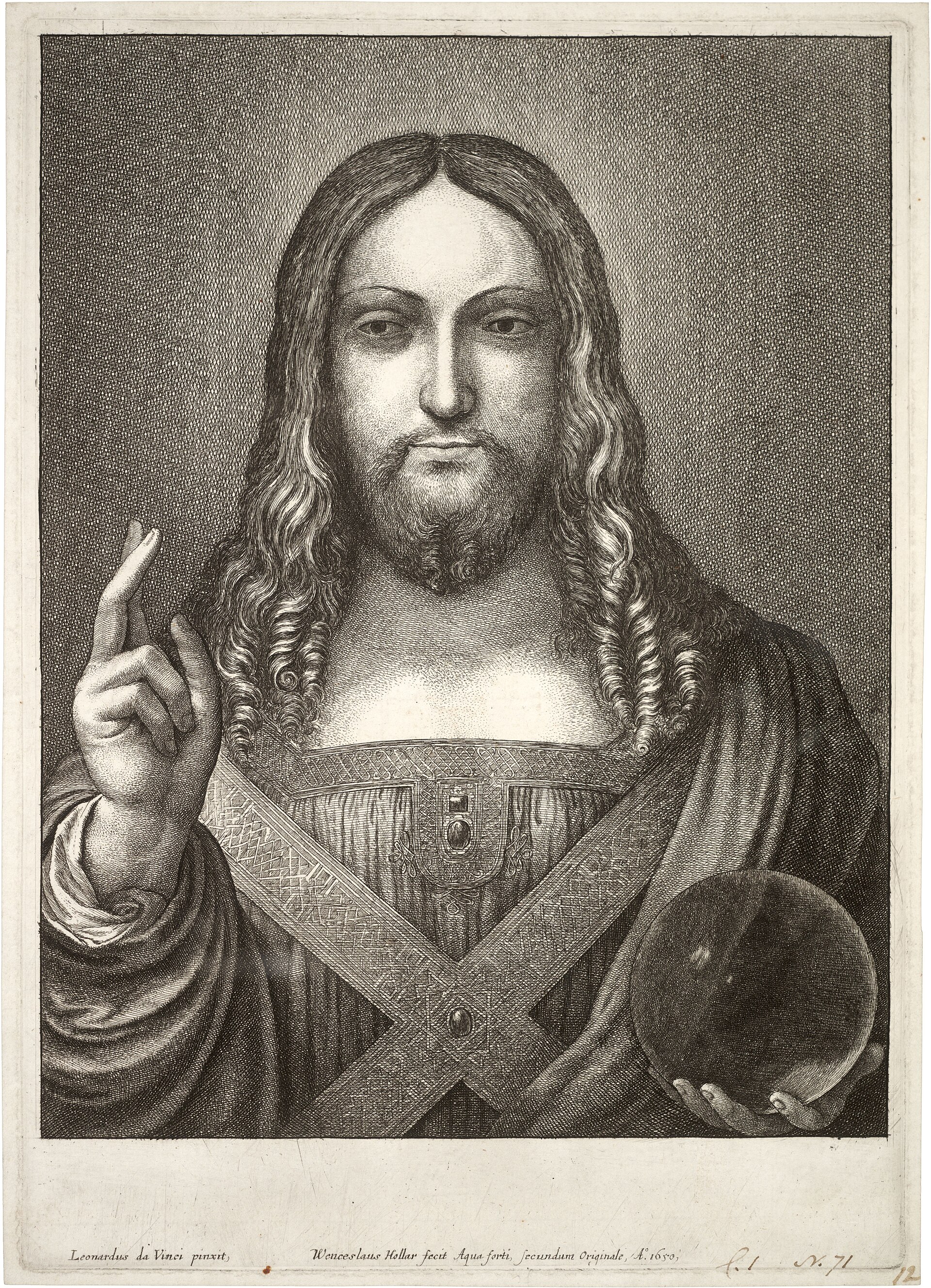
The provenance advanced in 2017 runs a Leonardo Salvator Mundi through the possessions of Charles I, the Commonwealth valuation of thirty pounds, the Restoration inventories, and the sale of the Buckingham House pictures by Sir Charles Herbert Sheffield in 1763. Hollar's etching of 1650 is the anchor. Every link is an identification of this panel with a documentary entry, not a receipt naming it.7
- 1900 - 1958Sir Francis Cook, 1st Baronet, and his descendants, Doughty House, Richmonddocumented
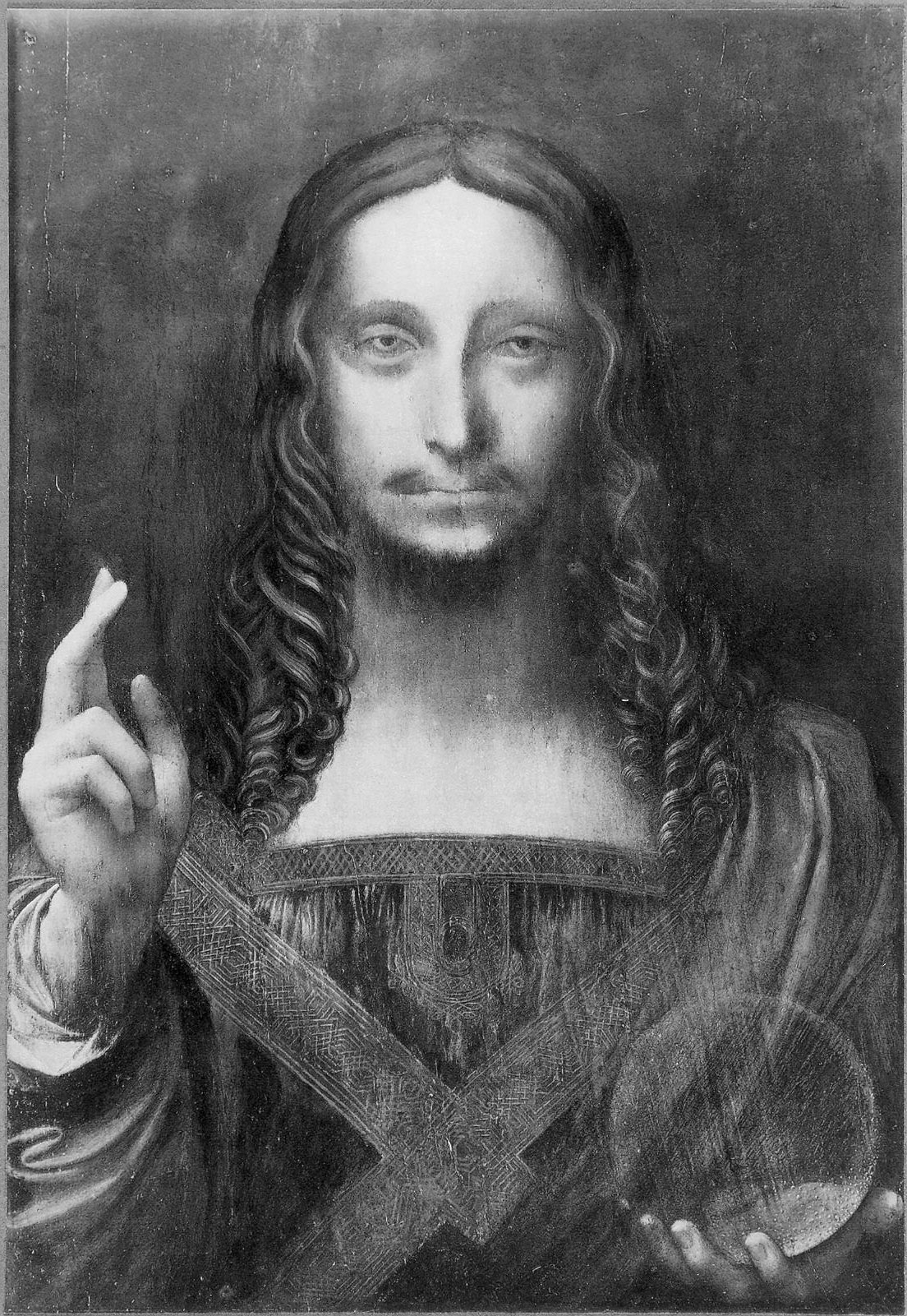
Bought from Sir Charles Robinson in 1900 for 120 pounds as a Luini. The 1913 catalogue of the Italian paintings in the Cook Collection by Tancred Borenius and Herbert Cook lists it as number 106, describes it as suffering from both over-cleaning and repainting, and calls it a free copy after the Salvator Mundi by Boltraffio then with G. B. Vittadini at Arcore. Herbert Cook added that he preferred to call it a parallel work by some contemporary painter of Leonardo's school. No earlier provenance is recorded in that catalogue. Hung in the Long Gallery at Doughty House despite its condition.1
- 1958 - 2004Warren and Minnie Kuntz, New Orleans, then Basil Clovis Hendry Sr, Baton Rougedocumented
Sold at Sotheby's on 25 June 1958 in a sale of 136 Cook paintings, for 45 pounds, about 120 dollars, as Boltraffio. Kenneth Clark, Ellis Waterhouse and the dealer Gianni Salocchi attended. The post-sale list recorded the buyer only as Kuntz; the identification of Warren and Minnie Kuntz was made by Wall Street Journal reporters in September 2018. Mrs Kuntz bequeathed her estate to her nephew Basil Clovis Hendry, who hung the picture in his stairwell in Baton Rouge. He died in 2004. During this period the Cook restoration was removed, the losses clumsily touched up and a new varnish applied.1
- 2005 - 2013Alexander Parish and Robert Simon, joined by Warren Adelsondocumented
Bought as lot 664 at the St Charles Gallery, New Orleans, sale of 9 and 10 April 2005, catalogued as After Leonardo da Vinci. Restored by Dianne Dwyer Modestini from 2005. Shown to Nicholas Penny and then to five scholars at the National Gallery, London. Exhibited as Leonardo in Leonardo da Vinci: Painter at the Court of Milan, National Gallery, London, November 2011 to February 2012. Offered unsuccessfully to the Dallas Museum of Art after the exhibition.16
- 2013 - 2013Yves Bouvierdocumented
Sotheby's Private Sales approached the owners in April 2013 on behalf of a client. Bouvier bought at 80 million dollars and sold the following day. Sotheby's fee has been reported at 3 million dollars. No buyer's premium applies to a private treaty sale, which is why the figure is directly comparable to the 127.5 million and not to the 450.3 million.17
- 2013 - 2017Dmitry Rybolovlevdocumented
Bought from Bouvier at 127.5 million dollars, one day after Bouvier paid 80 million, in the belief that Bouvier was acting as his agent on a two per cent commission. Rybolovlev's identity as owner became public through a New Yorker report in early 2016. He sued Bouvier for fraud in several jurisdictions and decided to sell the collection.1
- 2017 - presentContested. Prince Badr bin Abdullah al-Saud named as buyer; the Department of Culture and Tourism of Abu Dhabi and Crown Prince Mohammed bin Salman both named as principaldisputed
Christie's New York, 15 November 2017, hammer 400 million dollars, 450,312,500 dollars with premium. The Louvre Abu Dhabi announced a display in December 2017 and postponed it indefinitely in September 2018. The panel was in Paris in 2018 for examination by the C2RMF, was absent from the Louvre's 2019 retrospective, and has not been publicly exhibited since. Reporting has placed it on the yacht Serene, in Saudi storage, and reserved for a future museum at Al-Ula; none of these has a public documentary basis.4578
Prices realised
| Date | Sale | Estimate | Result | Note |
|---|---|---|---|---|
| 25 June 1958 | Sotheby's Cook Collection, 136 paintings | Hammer GBP 45 With premium No buyer's premium was charged by London houses in 1958 GBP | About 120 dollars at the time. Catalogued as Boltraffio. The buyer was recorded only as Kuntz. Kenneth Clark, Ellis Waterhouse and Gianni Salocchi were present. | |
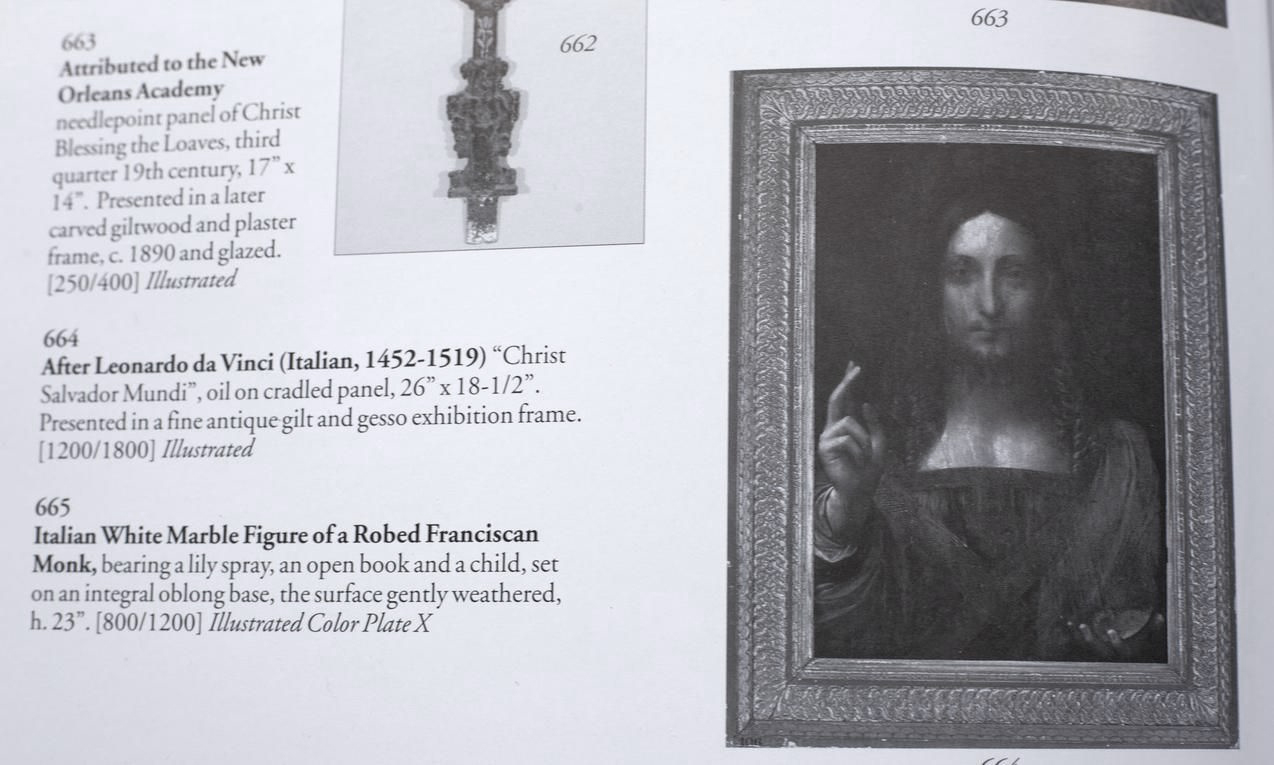
| 9 April 2005 | St Charles Gallery, New Orleans Sale of 9 and 10 April 2005, lot 664 | USD 1,200 - 1,800 | Hammer USD 1,000 as described by the buyer With premium USD 1,175 aggregate on the house prices-realised sheet USD | Catalogued as After Leonardo da Vinci, Christ Salvador Mundi, oil on cradled panel, 26 x 18 1/2 inches. The estate appraisal a year earlier had been 750 dollars as Continental School, 19th century, poor condition. A buyer's premium of 17.5 per cent on a 1,000 dollar hammer produces the 1,175 aggregate exactly; that schedule is DERIVED from the two published figures and has not been checked against a printed St Charles Gallery schedule. Wikimedia Commons states on its copy of the catalogue page that the lot sold for just under 10,000 dollars, which no source supports. |
| 2013-04 | Sotheby's Private Sales Private treaty | With premium USD 80,000,000 net to the sellers USD | A private treaty sale carries no buyer's premium, so there is no hammer and premium to separate. Sotheby's fee reported at 3 million dollars. Bouvier resold the following day at 127.5 million. | |
| 15 November 2017 | Christie's Post-War and Contemporary Art Evening Sale, New York, lot 9B | In the region of USD 100,000,000 | Hammer USD 400,000,000 With premium USD 450,312,500 total, of which the fee is USD 50,312,500 USD | Bidding ran more than eighteen minutes between telephone clients and closed on a jump bid of 400 million. The fee is 12.578 per cent of hammer, which is a blended rate, not a schedule. It reconciles exactly against 25 per cent on the first 250,000 dollars, 20 per cent from 250,000 to 4,000,000, and 12.5 per cent above 4,000,000: 62,500 plus 750,000 plus 49,500,000 equals 50,312,500. That schedule is DERIVED from the arithmetic and has not been checked against a printed Christie's chart for November 2017. The lot was placed in a contemporary sale rather than an Old Master sale, a decision made by Loic Gouzer. |
Hammer is the price at which the bidding stopped; with premium adds the fee the house charges the buyer on top. Hammer price and buyer's premium in the glossary.
Technical evidence
| Attribution note | Sold by Christie's in 2017 as an autograph Leonardo. The Louvre's own printed study of 2019 concluded the same, in the words of its then president Jean-Luc Martinez, that the results allow the attribution to Leonardo to be confirmed, and in the words of its curator Vincent Delieuvin that the evidence invites one to privilege the idea of a work that is entirely autograph. That book was withdrawn from sale and the museum afterwards told The Art Newspaper that no such publication exists. Carmen Bambach gives the picture to Boltraffio with passages by Leonardo; Matthew Landrus gives it to Bernardino Luini with a Leonardo contribution of between five and twenty per cent; Frank Zollner reads the sfumato as closer to a talented pupil of the 1520s; Charles Hope and Jacques Franck reject the attribution outright. No claim on either side can be tested against the object, because the object has not been publicly seen since 15 November 2017. |
|---|---|
| Support | Walnut, a single plank. A check runs the entire length of the panel and transects the head. Cradled in the early nineteenth century; the cradle carries the letters CC and the number 106 in white paint. Walnut is consistent with Leonardo's practice in Lombardy, a point made in the Louvre's 2019 study.14 |
| Dimensions | Painted image 64.5 x 44.7 cm. Panel 65.5 x 45.6 cm at the top, 65.5 x 45.1 cm at the bottom. The panel tapers; Christie's published figure of 45.4 x 65.6 cm records a single width.1 |
| Ground and paint structure | Lead white preparation, with the image built in exceptionally thin layers and heavy use of black in the mixtures. Modestini notes that this combination makes composition changes largely invisible to X-radiography and infrared, and that macro XRF scanning would be required to resolve them.3 |
| Background | Originally deep black, with vestiges of a later bright green layer that had itself been removed. The original black largely perished when the panel was scraped down, probably in the early nineteenth century; the gouges were filled with gesso and the whole area repainted brown. The brown was removed in 2011 and the losses retouched to match the surviving original black.1 |
| Pentimenti | The thumb of the blessing hand was moved, and the earlier fully modelled position was exposed by the historic scraping. The hand as a whole was shifted lower and towards the edge of the panel. The outer contour of the third finger was incised into dry paint. The stole was repositioned late, its first placement slightly higher and at a different angle.3 |
| Restorer's interventions on record | Recent varnish and repaint removed in 2005 in a matter of hours; structural panel work by a specialist; brown background repaint removed 2011; the exposed thumb pentimento suppressed in consultation with Robert Simon and Luke Syson; missing glazes added to the abraded orb; losses in the embroidery of the stole retouched; shoulder folds reworked and a retouch above the lip corrected before the 2017 sale; final varnish applied 2017.1 |
| Technical imaging | Vidicon infrared scanning (sensitivity to about 1100 nm) during the early restoration, superseded by three InGaAs scans (to about 1700 nm) made at the Metropolitan Museum of Art of the head, the blessing hand, and the mantle, stole and orb. Further examination by the C2RMF in Paris in 2018, including X-radiography.14 |
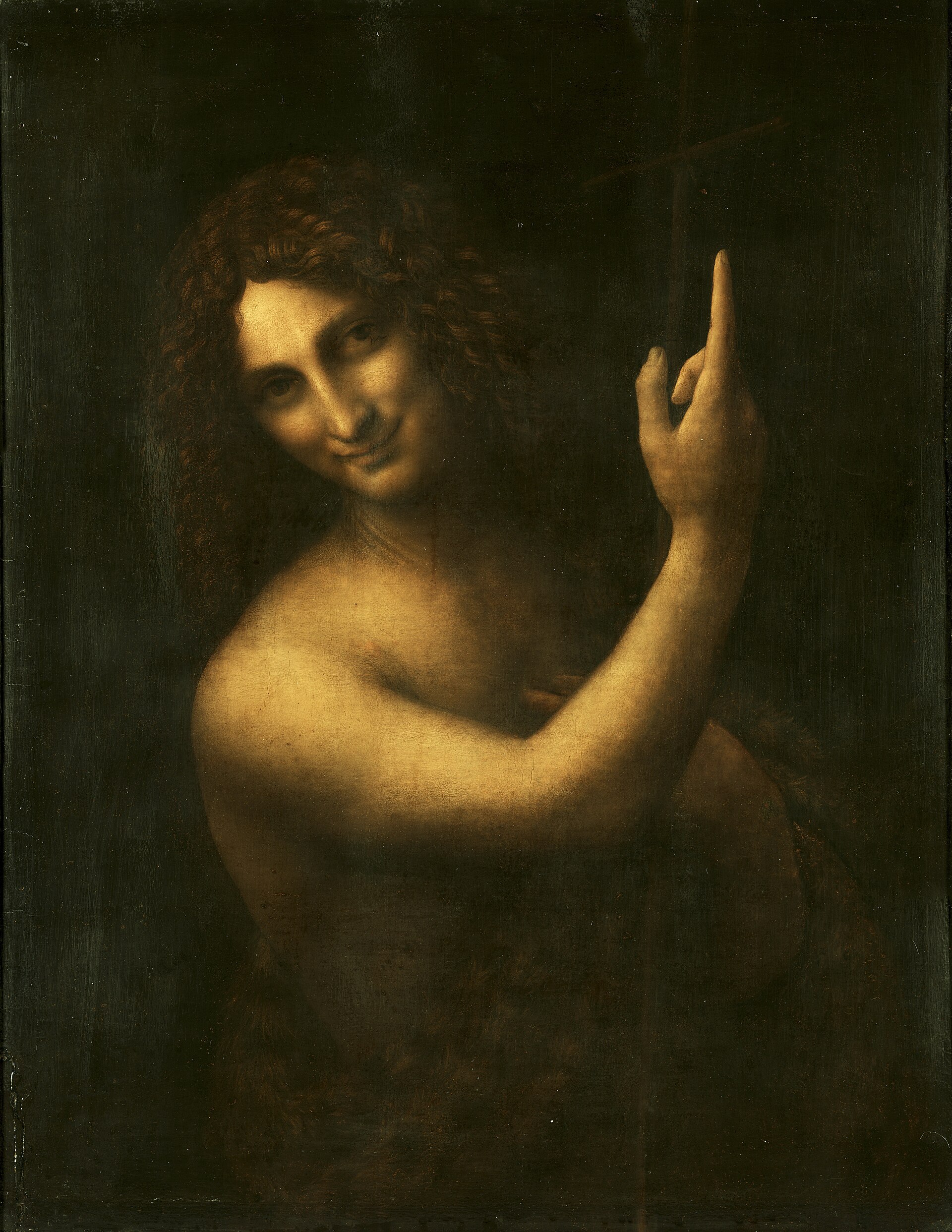
| Louvre laboratory findings, 2019 | Walnut support; an almost imperceptible underdrawing described as very close to that of the Mona Lisa and the Saint John the Baptist; transparent glazes producing sfumato consistent with Leonardo's mature period between 1500 and 1510; the blessing hand introduced late into the composition.45 |
| Frame | Sold in 2005 in a nineteenth-century gilt and gesso frame carrying the inventory number 106 at the lower left, the same number as on the cradle. The current frame is not on public record.1 |
Images
The record in full
Chapter 1The object, and which state of it you are looking at
A single plank of walnut, painted in oil, showing Christ half-length and frontal, the right hand raised in blessing with two fingers extended, the left holding a transparent sphere of rock crystal.
A single plank of walnut, painted in oil, showing Christ half-length and frontal, the right hand raised in blessing with two fingers extended, the left holding a transparent sphere of rock crystal. The painted image measures 64.5 by 44.7 centimetres. The panel itself is 65.5 by 45.6 centimetres at the top and 65.5 by 45.1 at the bottom, a taper that Christie's published figure of 45.4 by 65.6 does not record. A check runs the entire length of the panel and passes through the head.
The reverse carries an early nineteenth-century cradle, and on that cradle, in white paint, the letters CC and the number 106. Those two marks are the reason the picture has any pre-1958 provenance at all. Robert Simon matched them to the Cook Collection inventory after the panel reached New York in 2005.
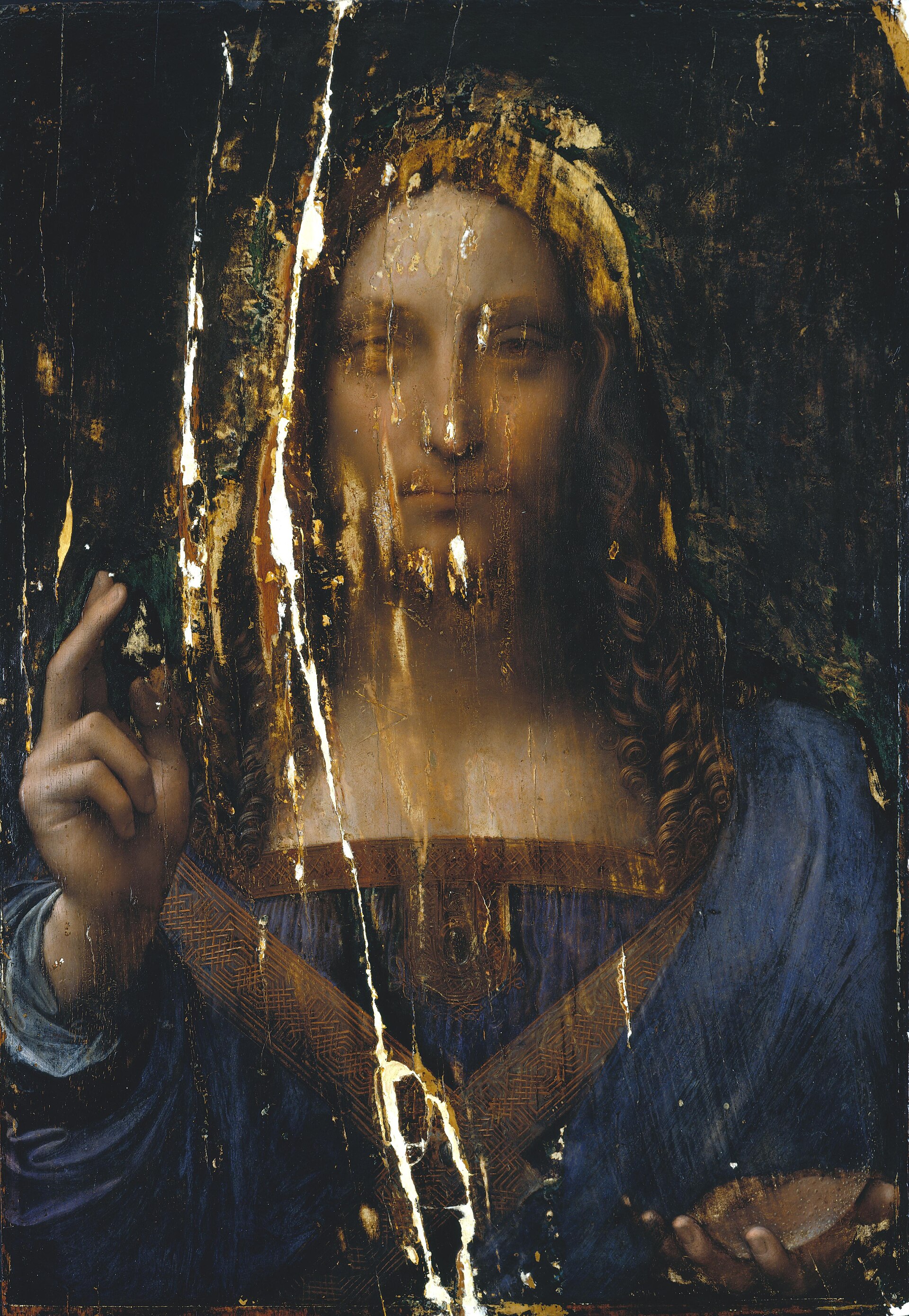
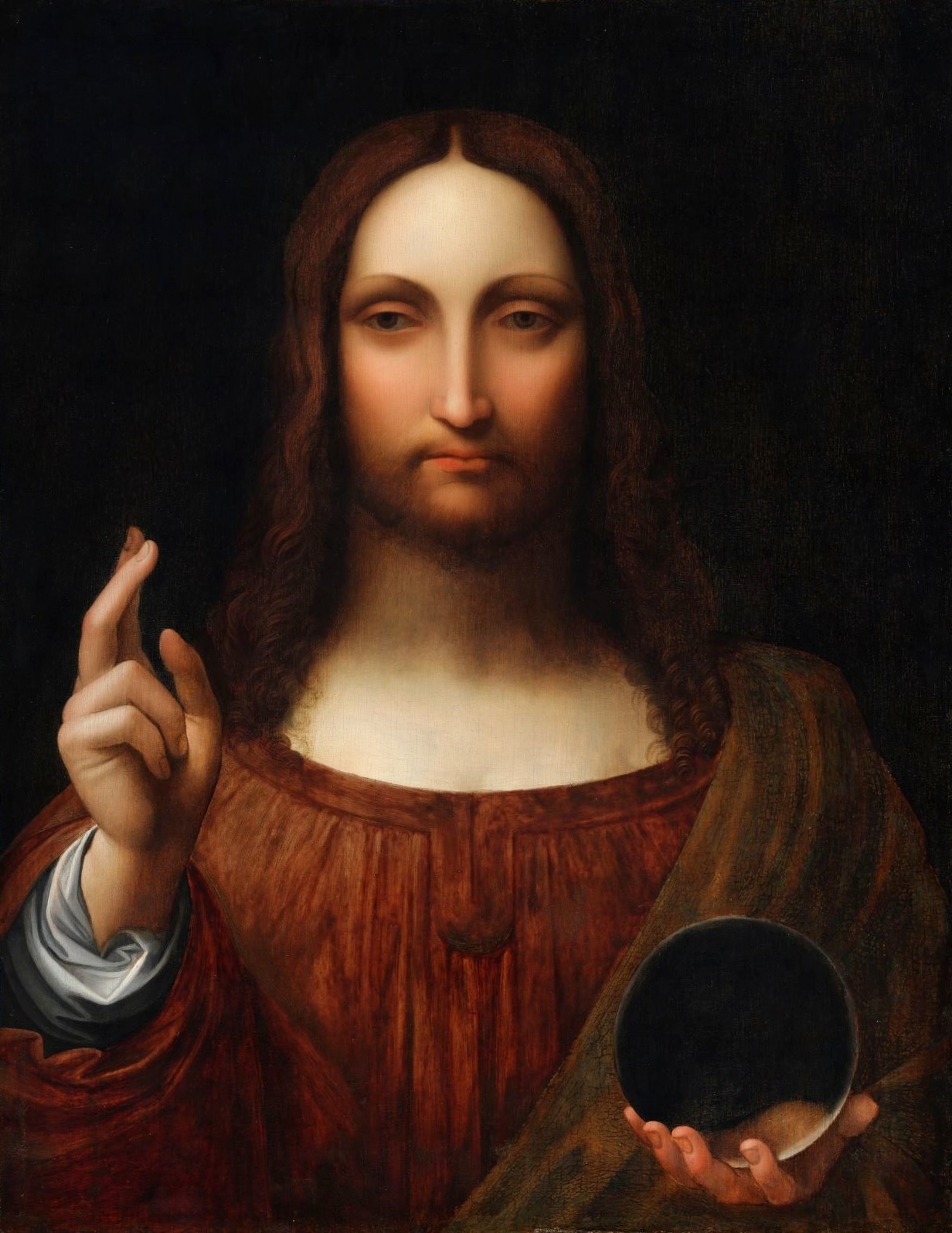
The single most important fact about every reproduction of this painting is that there are at least three different states of it in circulation and they do not look alike. There is the picture as it was photographed in the Cook Collection and again in the 2005 auction catalogue, with a grotesquely repainted face that Martin Kemp described as resembling a drug-crazed hippy. There is the cleaned state, photographed in 2006 and 2007, stripped back to what survived. And there is the restored state, the image that was reproduced worldwide in November 2017 and that almost every reader has in mind when the title is used. All three are the same object. A record that does not say which one a plate shows is not describing the object at all.
Chapter 2The 2005 lot, and four figures that are not the same figure
Warren and Minnie Kuntz of New Orleans bought the picture at the Cook sale in 1958.
Warren and Minnie Kuntz of New Orleans bought the picture at the Cook sale in 1958. It passed to Mrs Kuntz's nephew, Basil Clovis Hendry Sr, who hung it in the stairwell of his house in Baton Rouge. He died in 2004. The preliminary appraisal of his estate described it as Continental School (19th century), Portrait of the Head of Christ, oil on panel, framed, poor condition, and assigned it a value of 750 dollars. On the appraiser's list, as reproduced by the Wall Street Journal, there is a red check beside the entry and a pencilled question mark.
Part of the estate went to Christie's in New York. This went to the St Charles Gallery, a small house in New Orleans, for its sale of 9 and 10 April 2005, as lot 664: After Leonardo da Vinci (Italian, 1452-1519), Christ Salvador Mundi, oil on cradled panel, 26 by 18 1/2 inches, presented in a fine antique gilt and gesso exhibition frame, estimate 1200 to 1800, illustrated. The misspelling of Salvator is the catalogue's own.
Four numbers attach to that sale and they are routinely used interchangeably. The estate appraisal was 750 dollars. The printed estimate was 1,200 to 1,800 dollars. The winning bid, as the buyer Alexander Parish has described it, was 1,000 dollars. The house's own prices-realised sheet gives an aggregate against lot 664 of 1,175 dollars. Only the last two are prices, and they are prices of different kinds: 1,000 dollars plus a buyer's premium of 17.5 per cent is 1,175 dollars exactly. That reconciliation is DERIVED here from the two published figures; the St Charles Gallery premium schedule for April 2005 has not been checked against a printed one, and the sheet gives an aggregate rather than a hammer and a premium separately. Note also that Wikimedia Commons, on its own copy of the catalogue page, states that the painting sold for just under 10,000 dollars. It did not.
Chapter 3What the restorer has published about the extent of the restoration
Dianne Dwyer Modestini has written her own account and it is more candid than the press coverage that quotes her.
Dianne Dwyer Modestini has written her own account and it is more candid than the press coverage that quotes her. Robert Simon brought the panel to her apartment in 2005. Her husband, the restorer and connoisseur Mario Modestini, was ninety-eight and dying. She removed the recent varnish and repaints in a matter of hours while Simon watched, and was not immediately impressed. Later that afternoon she carried the panel to her husband. He held it, looked at it in silence for a long time, and said that it was by a very great artist whose name he did not know, a generation after Leonardo, and slightly larger than life. Mario Modestini died on 28 January 2006.
The panel went to a specialist for structural work before painting could begin. The background had been repainted a muddy brown in the nineteenth century. Beneath that lay passages of deep black and vestiges of a bright green, and beneath those the evidence that the original black had for the most part perished when the panel was, in her word, brutally scraped, probably in the early nineteenth century. The gouges had been filled with gesso and painted over. In 2011, after comparing the blacks in the freshly cleaned London Virgin of the Rocks, she obtained Simon's permission to remove the brown and retouched the losses to match what remained of the original black.
She also records three specific interventions that a buyer's diligence file would want in writing. She suppressed the pentimento of the blessing thumb, which the scraping of the background had exposed, in consultation with Simon and with Luke Syson, the curator of the London exhibition. She added missing glazes to the abraded orb. She retouched losses in the embroidery of the stole. Before the 2017 sale she unframed the picture again, reworked the folds of the shoulder because the black underpaint had asserted itself, corrected a retouch above the lip with which she had never been satisfied, and applied the final varnish.
The head is the damaged part. When she showed the cleaned-state photograph at the National Gallery technical symposium in January 2012, she records that the condition of the head created a certain amount of consternation. The collected papers were published in 2014, which means the cleaned-state image has been available to anyone who cared to consult that volume since three years before the sale.
Chapter 4The pentimenti, which are the technical case
A pentimento is a change of mind made during painting and covered over.
A pentimento is a change of mind made during painting and covered over. In a composition surviving in many versions, pentimenti matter because a copyist has no reason to make them: they are the argument that a given panel is the prime version rather than a repetition.
Modestini records several. The thumb of the blessing hand was moved, and the earlier, fully modelled position was exposed by the historic scraping of the background. The whole hand was shifted slightly lower and towards the edge of the panel; part of the first position of the palm survives in the crevice between thumb and forefinger. The new outer contour of the third finger was incised into already dry paint, and black lines, some laid in with a liquid medium and some in a dry one such as black chalk, run along the inner contours of the third and fourth fingers. The stole was repositioned late, slightly higher in its first state and at a marginally different angle, with pleats of blue drapery from the earlier design visible under the embroidered threads.
She is equally careful about what the evidence does not establish. The upper part of the blessing hand, above the shoulder line, sits over a thin initial black wash, whereas below the shoulder the area is held in reserve. That is consistent with an early idea in which the hand sat lower, as it does in Marco d'Oggiono's version in the Galleria Borghese and Giampietrino's in the Pushkin Museum. But she notes that Leonardo's heavy use of black in his mixtures, the lead white preparation and the extreme thinness of his paint layers make such a change effectively invisible to X-ray and infrared, and that macro XRF scanning could settle it. Macro XRF scanning requires access to the painting.
Chapter 5Who signed off, and who changed their mind
The attribution was built in stages and the record of who agreed to what, and when, is unusually well documented because the restorer wrote it down.Carmen Bambach of the Metropolitan Museum saw the...
The attribution was built in stages and the record of who agreed to what, and when, is unusually well documented because the restorer wrote it down.
Carmen Bambach of the Metropolitan Museum saw the picture once in Modestini's studio at the Conservation Center. Asked what she thought it was, and told that Simon and Modestini believed it to be Leonardo, she replied that it was not by Boltraffio. She has since attributed it to Boltraffio with retouches by Leonardo. Modestini's published response is direct: Bambach has said she followed the restoration, and that studio visit was the only time she saw the painting.
Nicholas Penny, shortly before becoming director of the National Gallery, agreed with Simon that it could be Leonardo. Three infrared scans were made at the Metropolitan Museum with an InGaAs scanner, of the head, the blessing hand, and the mantle, stole and orb. Penny then invited five scholars to see it in the National Gallery conservation studio: Bambach; David Alan Brown of the National Gallery of Art in Washington; Maria Teresa Fiorio of the Universita Statale in Milan; Martin Kemp of Oxford; and Pietro Marani of the Politecnico in Milan. No formal statement was issued. Kemp and Brown accepted it. Marani endorsed it, later asked to borrow it for an exhibition, and has since expressed reservations. Fiorio was struck by the well-preserved passages but held that the ruinous state of the head made a firm conclusion impossible. Bambach appeared to accept it and later recanted.
Luke Syson, then curator of Italian paintings at the National Gallery, included it in Leonardo da Vinci: Painter at the Court of Milan, which opened in November 2011. That decision is the hinge of the whole affair, and Modestini notes what it cost the museum in principle: museums as a rule decline to exhibit paintings that are on the market.
Against the attribution: Charles Hope has dismissed it, describing the picture as a ruin with the face much restored to make it reminiscent of the Mona Lisa. Frank Zollner has emphasised the extent of restoration and read the sfumato as closer to the manner of a talented pupil working in the 1520s. Matthew Landrus gives it to Bernardino Luini with a Leonardo contribution of between five and twenty per cent. Jacques Franck has called it a good studio work with a little Leonardo at best, and later gave it jointly to Salai and Boltraffio. Michael Daley of ArtWatch UK notes that there is no documentary record within the Leonardo literature of the artist having been involved in such a project at all.
This record does not adjudicate. It notes only that every position on the list was formed either before the final varnish went on or without access to the object, and that no one has had access since 2017.
Chapter 6The book the Louvre printed and then did not have
In 2018 the painting was shipped to Paris and examined by the Centre de recherche et de restauration des musees de France.
In 2018 the painting was shipped to Paris and examined by the Centre de recherche et de restauration des musees de France. In December 2019, two months after the Louvre's Leonardo retrospective opened without it, the museum published a 46-page cardboard-covered booklet, Leonard de Vinci. Le Salvator Mundi, printed in Turin, priced at eight euros, written by the Louvre's curator of Italian painting Vincent Delieuvin with Myriam Eveno and Elisabeth Ravaud of the C2RMF laboratory.
Its preface, by the Louvre's president Jean-Luc Martinez, states that the results of the historical and scientific study allow the attribution of the work to Leonardo da Vinci to be confirmed. The laboratory text states that the examination of the Salvator Mundi seems to the authors to demonstrate that the painting was indeed executed by Leonardo. Delieuvin concludes that the evidence invites one to privilege the idea of a work that is entirely autograph. The findings recorded include a walnut support consistent with Leonardo's Lombard practice, an almost imperceptible underdrawing very close to that of the Mona Lisa and the Saint John the Baptist, glazing consistent with the mature period between 1500 and 1510, and the late introduction of the blessing hand into the composition.
The book was on sale in the Louvre bookshop in December 2019, buried in a pile of exhibition catalogues, and was withdrawn. Dianne Modestini found a copy by chance and scanned it. When The Art Newspaper asked the museum about it, a spokesperson said that no such publication exists, while acknowledging that the book was a project in case the Louvre got the chance to present the painting.
That sequence is the reason this object earns a record rather than a news story. An auction house attribution is a commercial opinion and everyone treats it as one. A national museum's attribution, written by its own curator and its own laboratory, printed, priced and put on a shelf, is a different kind of document. This one existed for a few weeks in a bookshop and then, officially, had never existed. The painting it authenticated has not been hung since.
Chapter 7Three incompatible accounts of an empty wall
The Louvre's Leonard de Vinci exhibition ran from 24 October 2019 to 24 February 2020 and did not include the Salvator Mundi.
The Louvre's Leonard de Vinci exhibition ran from 24 October 2019 to 24 February 2020 and did not include the Salvator Mundi. Three explanations are in public circulation and they cannot all be true.
The first is the museum's own book, which says the picture is entirely by Leonardo. On that account there was no attribution obstacle at all.
The second is Antoine Vitkine's documentary The Savior for Sale, broadcast in April 2021, which reports through anonymous French officials that the C2RMF examination concluded Leonardo had only contributed to the picture and that its authenticity could not be confirmed; that the owner was told; that Crown Prince Mohammed bin Salman then demanded it hang beside the Mona Lisa and be presented as one hundred per cent Leonardo with no qualifying text; and that President Macron refused in September 2019 on the ground that agreeing would amount to laundering a work at 450 million dollars. The film places the episode inside the French-Saudi negotiations over the Al-Ula cultural agreement.
The third, reported separately, is that the sticking point was placement rather than attribution: that the Saudi side required the picture to hang next to the Mona Lisa and that this was impossible for reasons of crowd management and security.
Iconotheca does not choose between them. What is documented is that the loan did not happen, that the museum printed a book saying the picture is autograph, and that the museum subsequently denied the book's existence. Any of the three accounts leaves that pair of facts standing.
Chapter 9Thirty versions, and why a caption is not evidence
More than thirty extant paintings derive from this composition or from the related Christ the Redeemer.
More than thirty extant paintings derive from this composition or from the related Christ the Redeemer. Only three reproduce the details visible in Wenceslaus Hollar's etching of 1650: this panel, the version formerly with the Marquis de Ganay, and the version in San Domenico Maggiore in Naples. Both of those repeat the elaborate knotwork of the stole and give the orb as translucent, and both differ from this panel in other respects.
Two of the best-known versions have had their traditional attributions destroyed by the wood rather than by the eye. The panel at the Wilanow Palace Museum in Warsaw, accession Wil.1016, is catalogued as Cesare da Sesto and dated 1516 to 1517; dendrochronology carried out in 2005 dated the felling of its oak to about 1586 in the Seine basin, and Cesare da Sesto died in 1523. The panel at the Detroit Institute of Arts is on three horizontally joined boards of Baltic oak felled after 1569, and Giampietrino, to whom it has been given, died in 1549. Neither attribution can stand, and neither has anything to do with connoisseurship.
The practical consequence for anyone assembling a file on this object is severe. Wikimedia Commons hosts a photograph of a version whose file page simultaneously names the Museo Diocesano in Naples as its location, describes it as formerly in the Marquis de Ganay collection, and cross-references a separate Ganay file. Those are two different paintings in two different countries, and the Naples picture is in the treasury of the Basilica of San Domenico Maggiore rather than the Museo Diocesano. Iconotheca has not published that plate, because publishing it would require asserting which of the two pictures it shows. That is the version-safety problem in its ordinary form: not a forger, not a fraud, just a caption written quickly by someone who had two entries open.
Chapter 10The money in period terms, and who the finders were
The 2005 purchase is often reported as though a masterpiece cost the price of a meal.
The 2005 purchase is often reported as though a masterpiece cost the price of a meal. It did not quite. One thousand dollars in New Orleans in April 2005 was a fortnight's wage for a median American worker, and the buyers were not passers-by. Alexander Parish is a professional sleeper hunter who buys on his own eye at regional sales; Robert Simon is a dealer and an art historian of Italian Renaissance painting with a doctorate. They then spent years and their own money on structural work, on restoration, on infrared scanning at two museums and on the scholarly campaign that produced the 2011 exhibition. Warren Adelson, a dealer in American pictures, joined the partnership and took charge of selling it.
The selling campaign failed before it succeeded. The picture was offered to the Dallas Museum of Art after the London exhibition. Modestini went to Dallas to unframe it and spoke to trustees alongside Luke Syson; her impression was that the money was there and the appetite was not, and that Ross Perot expressed active distaste for the picture. Negotiations are said to have run nine months and produced nothing. By 2013 the painting had, in her account, been shopped around to the point of being burned, market slang for unsaleable, and what remained was a buyer from the world of freeports and shell companies. She calls that the great tragedy in the saga of the painting.
The 1958 sale is the other number worth holding. On 25 June 1958, 136 paintings from the Cook Collection were sold at Sotheby's. This one made 45 pounds, about 120 dollars. Kenneth Clark, Ellis Waterhouse and the Florentine dealer Gianni Salocchi were in the room. The post-sale list recorded the buyer as Kuntz and nobody asked who that was for sixty years.
Chapter 11What the chain does not contain
The provenance offered in 2017 ran back to the English royal collection: a Salvator Mundi by Leonardo recorded in the possessions of Charles I, valued at thirty pounds in the Commonwealth inventory...
The provenance offered in 2017 ran back to the English royal collection: a Salvator Mundi by Leonardo recorded in the possessions of Charles I, valued at thirty pounds in the Commonwealth inventory, etched by Hollar in 1650 with an inscription naming Leonardo as its author, and traceable thereafter through the Restoration and the Buckingham House sale of 1763.
Set against that, Modestini's account of the 1913 Cook catalogue is flat: the picture had been bought from Sir Charles Robinson in 1900 for 120 pounds as a Luini, and there was no earlier provenance. Borenius and Cook described it as a free copy after the Salvator Mundi by Boltraffio then with Signor G. B. Vittadini at Arcore, and Herbert Cook added that he preferred to call it a parallel work by some contemporary painter of Leonardo's school.
The two accounts are not in direct contradiction, because a chain can be reconstructed after 1913. They are, however, evidence of different weight. Everything before 1900 rests on identifying this panel with a picture in a documentary record, and identification of that kind is an argument, not a receipt. This record grades the pre-1900 links disputed and says why, rather than printing a smooth line from Charles I to Christie's.
Chapter 12Where the painting is
In December 2017 the Department of Culture and Tourism of Abu Dhabi announced that the picture would go to the Louvre Abu Dhabi, and released a photograph of it.
In December 2017 the Department of Culture and Tourism of Abu Dhabi announced that the picture would go to the Louvre Abu Dhabi, and released a photograph of it. In September 2018 the display was postponed indefinitely, with no reason given. In 2018 the panel was in Paris for examination. In 2019 it was not in the Louvre's exhibition. Since then it has been reported hanging on the yacht Serene, then removed to Saudi storage while the vessel was refitted, and latterly held against the opening of a museum at Al-Ula.
None of that is documented in the sense this archive uses the word. There is no accession number, no loan agreement, no exhibition label, no conservation report and no insurance schedule in the public domain. The buyer named in the room was Prince Badr bin Abdullah al-Saud; the Saudi embassy said he was acting as an agent for the Abu Dhabi department; other reporting names Crown Prince Mohammed bin Salman as the owner. Iconotheca records the location as unlocated, which is the honest term for an object whose ownership is asserted by three parties and confirmed by none.
The last authorised photograph of the picture was posted to a government social media account in September 2018. The most expensive object ever sold at auction has been out of sight for longer than the twelve years it spent being restored.
The artist
Leonardo di ser Piero da Vinci
The problem with attributing anything to Leonardo is arithmetic before it is connoisseurship. The accepted corpus of paintings runs to sixteen or seventeen works at the outside. Adding one increases the total by roughly six per cent, which is why every candidate is fought over, and why the fight is conducted through pupils and followers whose own corpora are equally unstable. This dossier covers what is documented about Leonardo as it bears on this panel, not the biography, which is everywhere.
Related works
| Work | Relation | Where it is |
|---|---|---|
| Salvator Mundi Catalogued as Cesare da Sesto, after Leonardo | Version of the same composition; attribution disproved by dendrochronology Catalogued 1516-1517. The oak was felled in the Seine basin around 1586, sixty years after Cesare da Sesto died. Acquired by Stanislaw Kostka Potocki between 1790 and 1792. | Wilanow Palace Museum, Warsaw, Wil.1016 |
| Salvator Mundi Catalogued as Giampietrino, after Leonardo | Version of the same composition; attribution disproved by dendrochronology Three horizontally joined boards of Baltic oak felled after 1569. Giampietrino died in 1549. | Detroit Institute of Arts |
| Salvator Mundi (the Ganay version) School of Leonardo | One of only three versions reproducing the details of the Hollar etching Single plank, 64 x 47 cm, said to be walnut on information supplied by Madeleine Hours of the Louvre in 1976. Attributed to Leonardo by Joanne Snow-Smith in 1978. Acquired by the Comtesse de Behague from the Baron de Lareinty in 1902; before that reportedly in a convent in Nantes. Cleaned in 1976 by Sylvaine Brans, whose report records an originally blue background, a lost gold halo and a cross once painted over the orb. Sold at Sotheby's in 1999 for an undisclosed, reportedly modest sum to its current owner, who consigned it to Agnews of London for TEFAF Maastricht 2026 (opened March 2026); the gallery attached no asking price, citing a lack of comparable sales. Shown there dated circa 1505-1515, described as by a Leonardo workshop hand painted under his possible supervision - the same guarded formulation the Louvre used in 2019-2020 - alongside infrared imaging of the underdrawing and the related Windsor red-chalk drapery studies. This is a different painting from the Cook picture this record is about. | Private collection (offered by Agnews of London at TEFAF Maastricht 2026, unpriced) |
| Salvator Mundi Follower of Leonardo | One of only three versions reproducing the details of the Hollar etching Single walnut plank, 66.5 x 46.5 cm, with a check running the length of the panel through the head, as on the Cook picture. Recorded in the Muscettola chapel in 1666. Technical study by Emmebi Diagnostica Artistica, Rome, May 2019, found spolvero from several cartoons. | Treasury of the Basilica of San Domenico Maggiore, Naples |
| Salvator Mundi Marco d'Oggiono | Variant with the blessing hand in the lower position Shows a young, beardless Christ. Cited by Modestini in the argument over whether the blessing hand was first conceived below the shoulder. | Galleria Borghese, Rome |
| Salvator Mundi Giampietrino | Variant with the blessing hand open and facing the viewer Young, beardless Christ, 50 x 39 cm. | Pushkin Museum, Moscow |
| Jesus, after Leonardo Wenceslaus Hollar | Etching of 1650 after the composition, inscribed as after Leonardo Plate P217, 26 x 18 cm. Probably made in Antwerp. The primary evidence that a Leonardo composition of this subject existed and was known in the seventeenth century. | Impressions in the Thomas Fisher Rare Book Library, University of Toronto, and elsewhere |
| Saint John the Baptist Leonardo da Vinci | Comparison work cited by the restorer and by the Louvre laboratory The curls on the proper left of the Salvator Mundi are compared to it directly; the C2RMF found the underdrawing very close to it and to the Mona Lisa. | Musee du Louvre, Paris |
Open questions
- Where is the painting? No accession number, loan agreement, exhibition label or conservation report has been published since 15 November 2017.
- Who owns it? Prince Badr bin Abdullah al-Saud was named as the buyer, the Saudi embassy said he acted as agent for the Department of Culture and Tourism of Abu Dhabi, and other reporting names Crown Prince Mohammed bin Salman. No party has produced a document.
- What did the C2RMF examination of 2018 actually conclude? The Louvre's printed book says entirely autograph; Antoine Vitkine's film reports anonymous officials saying Leonardo only contributed. The underlying report has not been published.
- How many copies of Leonard de Vinci. Le Salvator Mundi were printed, and where are they? The print run has not been stated and the museum has denied the book exists.
- Does the pre-1900 provenance belong to this panel? The 1913 Cook catalogue records no provenance before the 1900 purchase from Sir Charles Robinson. Every link back to Charles I is an identification argument.
- Was the blessing hand first placed below the shoulder? The layer structure is suggestive but Modestini states the question cannot be settled without macro XRF scanning, which requires access to the object.
- Which picture does the Commons file captioned as the Naples version actually show? The same file page names the Museo Diocesano in Naples and the Marquis de Ganay collection, which are two different paintings.
- What was the St Charles Gallery buyer's premium schedule in April 2005? The 1,175 dollar aggregate reconciles to a 1,000 dollar bid at 17.5 per cent, but no printed schedule has been located.
Questions about this object
What is Salvator Mundi?
Salvator Mundi is a painting, dated c. 1500. Medium: Oil on walnut panel.
Who made Salvator Mundi, and is the attribution settled?
The attribution to Leonardo da Vinci is recorded here as disputed. Sold by Christie's in 2017 as an autograph Leonardo. The Louvre's own printed study of 2019 concluded the same, in the words of its then president Jean-Luc Martinez, that the results allow the attribution to Leonardo to be confirmed, and in the words of its curator Vincent Delieuvin that the evidence invites one to privilege the idea of a work that is entirely autograph. That book was withdrawn from sale and the museum afterwards told The Art Newspaper that no such publication exists. Carmen Bambach gives the picture to Boltraffio with passages by Leonardo; Matthew Landrus gives it to Bernardino Luini with a Leonardo contribution of between five and twenty per cent; Frank Zollner reads the sfumato as closer to a talented pupil of the 1520s; Charles Hope and Jacques Franck reject the attribution outright. No claim on either side can be tested against the object, because the object has not been publicly seen since 15 November 2017.
Where is Salvator Mundi now?
Unlocated. No public record places the panel anywhere since the sale of 15 November 2017. Last confirmed 30 August 2026. No exhibition, loan or accession record has been published since the Christie's sale. Reporting has variously placed it on the yacht Serene, in Saudi storage, and awaiting a museum at Al-Ula; none of these has a public documentary basis. In August 2024 Bernard Haykel, a Princeton professor described as a friend of Crown Prince Mohammed bin Salman, told the BBC the painting is in storage in Geneva and that the Crown Prince intends to display it eventually in a museum in Riyadh - an account from a named source, not a documentary record, and the most specific location claim published to date.
What has Salvator Mundi sold for?
Hammer GBP 45; with premium, No buyer's premium was charged by London houses in 1958. Sotheby's, 1958-06-25.
What is still unknown about Salvator Mundi?
Where is the painting? No accession number, loan agreement, exhibition label or conservation report has been published since 15 November 2017.
Sources
- 1Dianne Dwyer Modestini, 'History of the Salvator Mundi', Salvator Mundi Revisited. The restorer's own account of the 2005 purchase, the Cook and Kuntz provenance, the restoration, the 2008 National Gallery viewing, the Dallas offer and the 2013 sales. salvatormundirevisited.com/History-of-the-Salvator-Mundi
- 2Dianne Dwyer Modestini, 'Copies', Salvator Mundi Revisited. The census of over thirty versions, the three that follow the Hollar details, and the dendrochronology of the Warsaw and Detroit panels. salvatormundirevisited.com/Copies
- 3Dianne Dwyer Modestini, 'Pentimenti', Salvator Mundi Revisited. The thumb, the shifted hand, the incised finger contour, the repositioned stole, and the limits of X-ray and infrared on this paint structure. salvatormundirevisited.com/Pentimenti
- 4The Art Newspaper, 'What the Louvre's scientific examinations of the Salvator Mundi really revealed, according to the museum's own book', 13 April 2021. Gives the title, authors, publisher and contents of the withdrawn book, the Martinez preface and the Delieuvin conclusion. theartnewspaper.com/2021/...
- 5The Art Newspaper, 'Revealed: the first photograph of the Louvre's Leonardo book that was spiked over Salvator Mundi fiasco', 16 November 2022. Gives the 46-page format, the eight euro price, the Turin printing, the Louvre bookshop appearance, Modestini's chance discovery, and the museum's statement that no such publication exists. theartnewspaper.com/2022/...
- 6St Charles Gallery, New Orleans, Prices Realized sheet for the April 2005 sale, archived copy, listing lot 664 at an aggregate of 1,175. web.archive.org/web/...
- 7Wikipedia, 'Salvator Mundi (Leonardo)', consolidating the pre-1900 provenance claim, the census of versions and the published positions of Bambach, Zollner, Landrus, Franck, Hope and Daley. TERTIARY: flagged for replacement with the Christie's 2017 catalogue entry, Bambach's Leonardo Rediscovered (2019) and Zollner's catalogue raisonne. en.wikipedia.org/wiki/...
- 8The Art Newspaper, 'The real reason why the Salvator Mundi didn't make it into the Louvre's Leonardo show', 7 April 2021, reporting the claims made in Antoine Vitkine's documentary The Savior for Sale, including the anonymous officials, the demanded label, and the September 2019 decision. theartnewspaper.com/2021/...
- 9Scott Reyburn, 'Five years since the $450m Salvator Mundi sale: a first-hand account of the nonsensical auction', The Art Newspaper, 15 November 2022. Gives the eighteen-minute bidding, the jump bid and the 100 million dollar estimate. theartnewspaper.com/2022/...
- 10Iconotheca, 'What a Sleeper Is, and Why They Still Happen', the market article this record extends, giving the 2005 lot wording and the 750 dollar estate appraisal alongside the Turner, Gentileschi, Cimabue and Frans Post cases. iconotheca.com/market/...
- 11The Art Newspaper, 'Where is Salvator Mundi? In storage in Geneva - apparently', 19 August 2024. Reports Bernard Haykel, a Princeton professor described as a friend of Crown Prince Mohammed bin Salman, telling the BBC the painting is in storage in Geneva and that MbS intends to display it eventually in a future Riyadh museum. The claim is Haykel's own account via the BBC, not a documentary record; no accession, loan or storage document has been published. theartnewspaper.com/2024/...
- 12USA Art News, 'TEFAF Maastricht: A Superior Salvator Mundi, and 5 Other Masterpieces', 12 March 2026. Reports Agnews of London offering the de Ganay Salvator Mundi, unpriced, at TEFAF Maastricht 2026, and gives its 1999 Sotheby's sale to its current owner - a provenance link not in the Ganay version's prior record. usaartnews.com/news/...
Last verified 30 August 2026 · Published 4 August 2026
Change log
4 August 2026 - Record created at the house standard: researched narrative, technical evidence, maker dossier, graded provenance chain, prices with hammer and premium separated, related works, open questions and sources.
30 August 2026 - Re-verification pass. Added the most specific location claim published to date for the Cook picture (Bernard Haykel's August 2024 account to the BBC of Geneva storage and an eventual Riyadh museum, correctly attributed as a named source's account, not a document). Updated the Ganay-version related work with its March 2026 public appearance at TEFAF Maastricht via Agnews of London (unpriced) and its 1999 Sotheby's sale, a provenance link not previously recorded. No change to the Cook picture's own location, ownership or attribution status - it remains unlocated and undocumented since the 2017 sale.