The Concert
Johannes Vermeer · c. 1663-1666
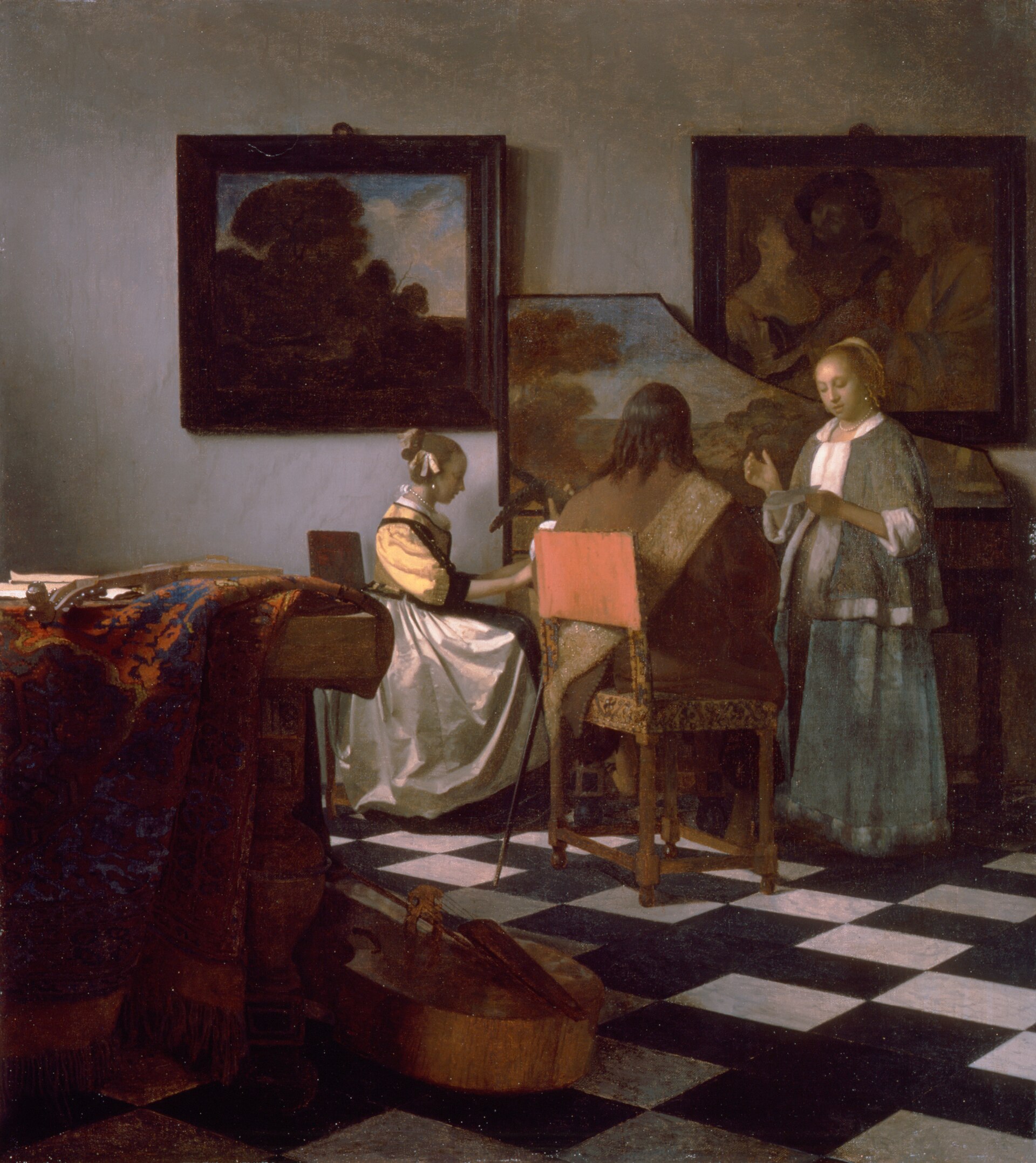
The record subject. Oil on canvas, 72.5 x 64.7 cm, unsigned. This reproduction, like every other in existence, was made before 18 March 1990. No photograph of the painting has been taken since.
| Artist | Johannes Vermeer |
|---|---|
| Date | c. 1663-1666 |
| Medium | Oil on canvas |
| Dimensions | 72.5 x 64.7 cm (28 1/2 x 25 1/2 in.) |
| Where it is now | Unlocated. Stolen from the Isabella Stewart Gardner Museum, Boston, on 18 March 1990 and not recovered. Legal title remains with the museum.last confirmed 31 August 2026 |
| Inventory number | P21W27 |
| Attribution | AcceptedUniversally accepted as autograph and included in every modern catalogue of the artist, although the picture carries no signature and no date. Full note |
| Object type | Painting |
| Period | Dutch, seventeenth century |
| Cases | Has a provenance gap |
| Inscriptions | None. The picture is unsigned and undated. |
| Owners on record | 13 links9 documented, 3 disputed, 1 unknown |
| Sources | 12 cited |
About this record Last verified 31 August 2026 · 12 sources cited · Change log
On this page 10 sections
ContentsClose
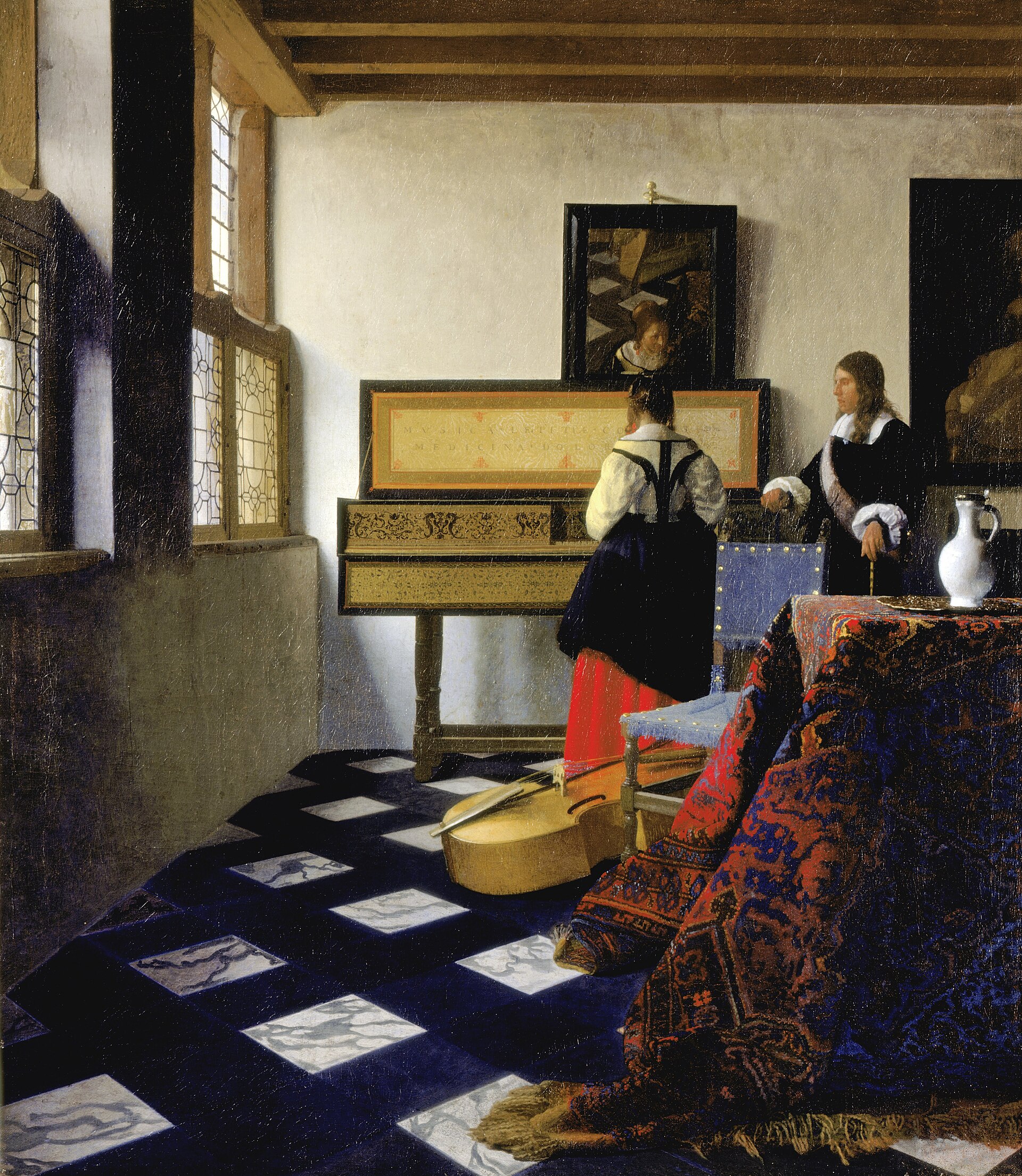
An unsigned Vermeer of the mid 1660s, 72.5 by 64.7 centimetres, showing three people making music in a room hung with two other pictures. It is the most valuable unrecovered stolen object in the world, taken from the Isabella Stewart Gardner Museum in Boston on 18 March 1990 by two men in police uniform who were inside the building for eighty-one minutes and left with thirteen works.
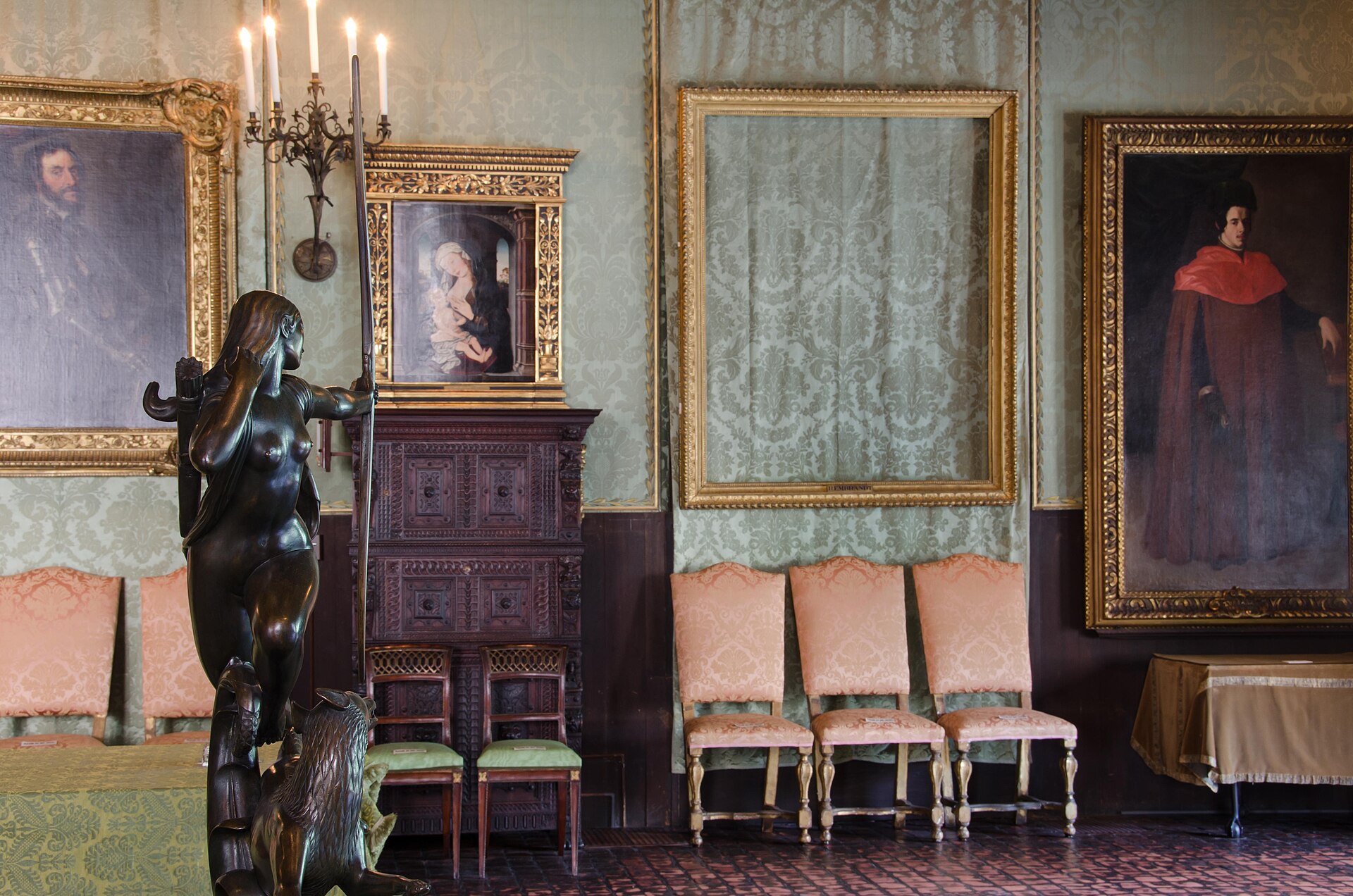
Its frame is still on the wall of the Dutch Room, empty. That is not a memorial gesture. Isabella Stewart Gardner's will forbids the trustees to change the arrangement of the museum she left, so the frame stays where it was because moving it would be a breach of trust. The museum carried no theft insurance, which means there was no settlement, no subrogation and no insurer with a claim on the picture. Title never moved.
In March 2013 the FBI announced that it had identified the thieves and would not name them. The statute of limitations on the theft itself expired in the mid 1990s, so the men who took it cannot now be prosecuted for taking it. Whoever holds it can still be charged with possessing it. Every reproduction on this page, and every reproduction anywhere, predates 1990.
Provenance
Each link is graded. Documented: a cited source supports it. Disputed: the identification is argued but not established. Unknown: no owner for that span, and the gap is not smoothed into a narrative. The grades in the glossary.
- c. 1663 - 1674Pieter Claesz van Ruijven, Delft, and Maria de Knuijtdisputed
Van Ruijven, who died in 1674, bought a large part of Vermeer's output, and the 2023 Rijksmuseum exhibition argued that his wife Maria de Knuijt was the active party. The attachment of this specific picture to them rests on the fact that it can be traced back to the Dissius sale, not on a named document. The catalogue literature marks the link with a query and so does this record.18
- 1674 - 1695Maria de Knuijt, then Magdalena van Ruijven, then Jacob Abrahamsz Dissius, Delftdisputed
By descent within one Delft family: van Ruijven's widow, who died in 1681; their daughter Magdalena, who died in 1682; and her widower Jacob Dissius, who died in 1695 with twenty-one Vermeers in his estate inventory. The chain is secure for the group. Its application to this individual canvas is inferred from the 1696 sale.18
- 1696 -Sold at the Dissius sale, Amsterdam, 16 May 1696disputed
Probably lot 9. Twenty-one Vermeers were sold together for about 1,500 guilders, roughly seventy guilders each. No buyer is recorded for this lot in the sources consulted, and the lot identification is given as probable rather than certain.1
- 1696 - 1780Unrecordedunknown
Eighty-four years with no documented owner. The picture reappears in an Amsterdam saleroom in 1780 with no stated history.
- 1780 - 1804Diederik van Leyden, bought through the dealer A. Delfosdocumented
Johannes Lodewijk Strantwijk sale, Amsterdam, 10 May 1780, lot 150. Delfos bought for the client the catalogue calls the Heer van Vlaardingen, identified as van Leyden. This is the earliest link in the chain with a named agent and a named principal.1
- 1804 - 1835Paillet, Paris, then unrecordeddocumented
Diederik van Leyden sale, Paris, conducted by Paillet, 5 November 1804, lot 62, bought by Paillet himself. Where it sat for the next three decades is not recorded.1
- 1835 - 1860Unrecordeddocumented
Anonymous sale, Foster, London, 26 February 1835, lot 127. Neither the consignor nor the buyer is named in the catalogue literature. The picture is now in England and nobody knows it is a Vermeer.1
- 1860 - 1869Toothedocumented
Admiral Lysaght and others sale, Christie's, London, 2 April 1860, lot 49, to a buyer recorded only as Toothe. The picture crosses to Paris at some point before the Demidoff sale of 1869.1
- 1869 - 1869Etienne Joseph Theophile Thore, called Thore-Burger, Parisdocumented
Demidoff sale, Paris, 1 April 1869, lot 14, evidently to Thore-Burger, the critic whose 1866 catalogue in the Gazette des Beaux-Arts had created the modern idea of Vermeer. He died the following month. He owned the picture for about four weeks.18
- 1869 - 1892Apolline Lacroix and her family, Parisdocumented
Thore-Burger left about a hundred and twenty pictures to the family friend Apolline Lacroix, who died in 1896. Her family chose the works for the 1892 auction. The picture spent twenty-three years in private hands in Paris as part of a critic's estate.69
- 1892 - 1924Isabella Stewart Gardner, Boston, bought through Fernand Robertdocumented
Thore-Burger sale, Hotel Drouot, Paris, 5 December 1892, lot 31. Gardner signalled her bids to her Paris agent Fernand Robert with a handkerchief. The underbidders were agents of the Louvre and of the National Gallery, London, who realised they were competing with each other and withdrew. 29,000 francs at the hammer; 31,175 francs is also published and is the hammer plus the 7.5 per cent Drouot charge.136
- 1903 - 1990Isabella Stewart Gardner Museum, Bostondocumented
Fenway Court opened to the public on 1 January 1903 and the picture hung in the Dutch Room on the second floor as P21W27. Lent once, to One Hundred Masterpieces at Copley Hall, Boston, 5 to 28 March 1897, as number 98, under the title The Musicians and in the name of Mrs John L. Gardner. Gardner died in 1924 leaving a will that forbids any rearrangement.179
- 1990 - presentUnknown. Legal title remains with the Isabella Stewart Gardner Museumdocumented
Stolen 18 March 1990 between about 00:30 and 02:45 by two men in Boston police uniform, with twelve other objects. No insurer acquired an interest because the museum carried no theft cover, so title never moved. The FBI said in 2013 that the works were taken to Connecticut and to the Philadelphia area and that some were offered for sale in Philadelphia around 2002 or 2003. Nothing has been recovered.245
Prices realised
The Concert passed through at least six auctions between 1696 and 1892. A price is recorded in the sources consulted for only the last of them. The 1696 Dissius sale is documented as a group result, about 1,500 guilders for twenty-one Vermeers, with no figure for the individual lot. No price at all is recorded for 1780, 1804, 1835, 1860 or 1869. The figures in circulation today, from 250 million dollars for this picture to 600 million for the thirteen stolen objects together, are press and law-enforcement estimates of a hypothetical value; nothing has been appraised, and the museum carried no theft insurance, so no insurance valuation exists either.
| Date | Sale | Estimate | Result | Note |
|---|---|---|---|---|
| 5 December 1892 | Hotel Drouot, Paris Thore-Burger collection, lot 31 | Not published in the sources consulted | Hammer FRF 29,000 With premium FRF 31,175 reported, which is the hammer plus 7.5 per cent FRF | Bought by the agent Fernand Robert for Isabella Stewart Gardner, who signalled from the room with a handkerchief. Underbid by agents for the Louvre and the National Gallery, London, who withdrew on realising they were bidding against each other. The Gardner Museum's records give 29,000 francs; 31,175 francs appears elsewhere and is exactly 7.5 per cent higher, the Drouot buyer's charge of the period, so this record reads the first as the hammer and the second as the total and marks the reading as an inference. Dollar equivalents of 5,000 and 6,000 both circulate; both are later conversions by writers rather than figures from the sale. |
Hammer is the price at which the bidding stopped; with premium adds the fee the house charges the buyer on top. Hammer price and buyer's premium in the glossary.
Technical evidence
| Attribution note | Universally accepted as autograph and included in every modern catalogue of the artist, although the picture carries no signature and no date. The attribution rests on connoisseurship rather than on any document naming Vermeer as its author, and it has never been seriously challenged. Note the position this creates: a painting accepted without dispute cannot now be re-examined, because the object has been out of reach of every laboratory since 18 March 1990. |
|---|---|
| Support | Canvas. No modern technical report is available; the picture has not been examined since March 1990.1 |
| Medium | Oil on canvas.1 |
| Dimensions | 72.5 x 64.7 cm (28 1/2 x 25 1/2 in.).13 |
| Signature | None. The picture is unsigned. Vermeer dated only three of his surviving paintings and this is not among them.18 |
| Inventory number | P21W27, Isabella Stewart Gardner Museum, Boston. The number encodes the hanging position in the Dutch Room, which is why it has not been reassigned.1 |
| Dating | No consensus inside a narrow band. Blankert 1664; Wheelock c. 1665-1666; Liedtke c. 1663-1666; Franits c. 1664-1665; Roelofs and Weber c. 1662-1664.1 |
| Pictures within the picture | Dirck van Baburen, The Procuress, 1622, on the rear wall at the right; the original, or a version of it, belonged to Maria Thins, the painter's mother-in-law. An Arcadian landscape in the manner of Jacob van Ruisdael hangs above the harpsichordist, and a third landscape is painted inside the harpsichord lid.18 |
| Instruments depicted | A harpsichord, almost certainly a Ruckers instrument from Antwerp and the only harpsichord in Vermeer's work; a cittern on the foreground table; a viola da gamba on the floor, unplayed, as in every other Vermeer that includes one.1 |
| Floor | Black and white marble in a broken checkerboard, a white tile periodically replaced by a black one so that groups of five black tiles form crosses. Steadman observes that the marble tiles are exactly twice the size of the ceramic tiles in Vermeer's earlier interiors.1 |
| Technical imaging | None accessible. No X-radiograph, infrared reflectogram, pigment analysis or IIIF manifest made with current equipment exists, and none can be made while the object is missing. All physical study of this painting predates 1990.23 |
| Condition | Unknown since March 1990. The picture was taken out of its frame during the theft. Two other canvases removed the same night were cut from their stretchers.2 |
| Frame | The frame remained in the museum and hangs empty in the Dutch Room. It cannot be removed without breaching the terms of the founder's will.27 |
Images
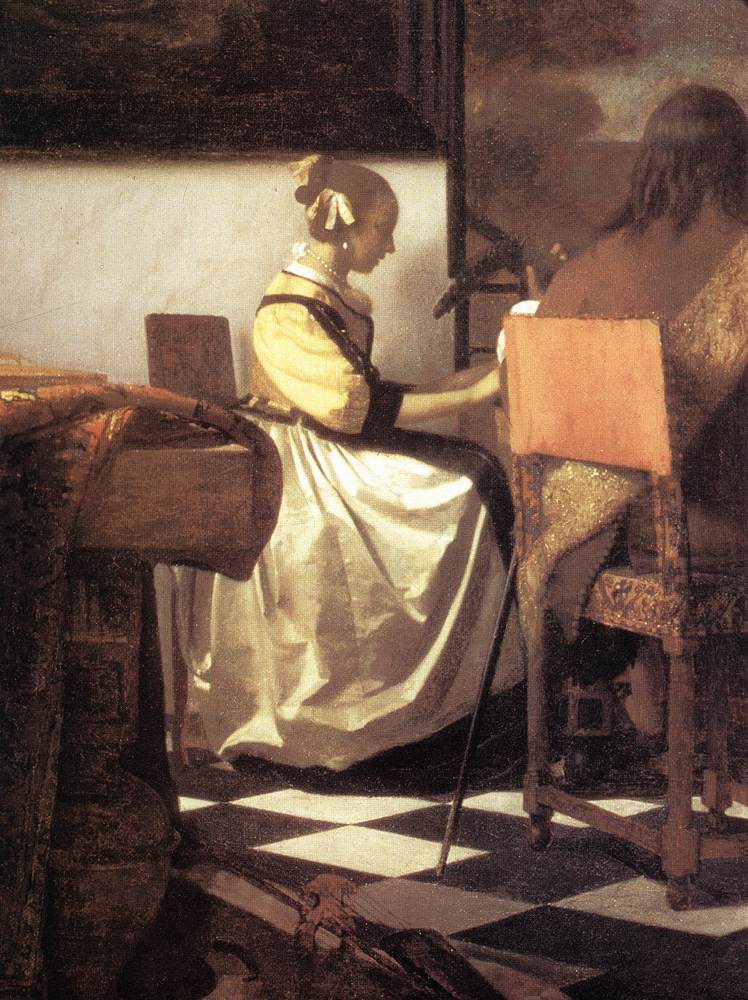
The record in full
Chapter 1The most valuable stolen object in the world is a picture of three people making music
Oil on canvas, 72.5 by 64.7 centimetres, unsigned and undated.
Oil on canvas, 72.5 by 64.7 centimetres, unsigned and undated. A woman sits in profile at a harpsichord, its lid painted inside with a landscape. A man with his back to us sits between her and a second woman who stands singing, holding a sheet of music. On the carpeted table in the foreground lies a cittern, and on the tiled floor at the front of the room a viola da gamba rests untouched.
Scholars date it across a narrow band and cannot agree inside it. Albert Blankert gave 1664, Arthur Wheelock about 1665 to 1666, Walter Liedtke about 1663 to 1666, Wayne Franits about 1664 to 1665, and the curators of the 2023 Amsterdam exhibition about 1662 to 1664. There is nothing on the canvas to settle it. Vermeer dated only three pictures in his life and this is not one of them.
The room is a Vermeer room: a marble floor in black and white, a wall broken by pictures, light entering from the left. Willemijn Fock has shown that marble floors of this kind were rare in seventeenth-century Dutch houses and largely confined to the entrance halls of the very rich, so the floor is at least partly a construction. Philip Steadman noticed that the black and white marble tiles Vermeer painted are exactly twice the size of the ceramic tiles in his earlier interiors, which suggests he was working from a grid he already knew and enlarging it. In the Concert the checkerboard is broken: a white tile is periodically replaced by a black one so that groups of five black tiles form crosses.
Chapter 2The picture inside the picture is a brothel scene, and it belonged to his mother-in-law
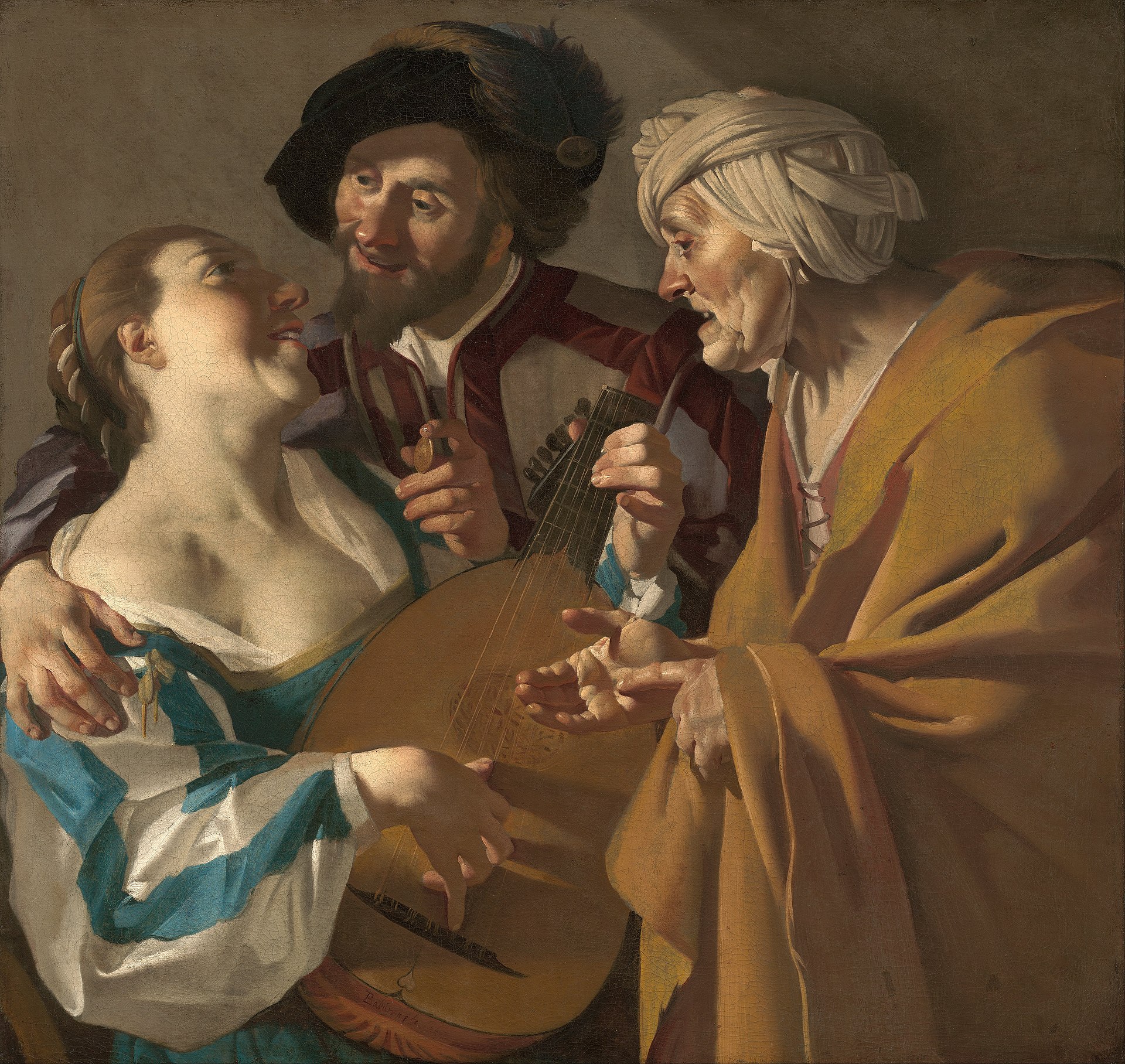
On the back wall, to the right, hangs Dirck van Baburen's The Procuress of 1622.
On the back wall, to the right, hangs Dirck van Baburen's The Procuress of 1622. It shows a young woman playing a lute, a bearded client, and an old woman with her open palm out for payment. It is not an invention. The picture, or a version of it, belonged to Maria Thins, Vermeer's mother-in-law, in whose house on the Oude Langendijk he lived and worked; she came from Gouda, had patrician connections and collected the Utrecht painters who had gone to Rome and come back with Caravaggio's lighting.
Vermeer used the Baburen twice. Putting a paid transaction on the wall behind an unpaid one has consequences for how the room below is read. Nineteenth-century critics took the hint literally and proposed that the Concert shows a high-class brothel: the standing singer as the procuress, the seated man as the client, the harpsichordist as the girl. Modern readings are cooler. They take the Baburen as a caution set against a scene of order, a warning about where music and company can lead rather than a statement of where they have led.
Above the harpsichordist hangs a second picture, a rugged Arcadian landscape in the manner of Jacob van Ruisdael. Elise Goodman reads it as belonging to the woman beneath it, on the seventeenth-century convention that made a beautiful woman the masterpiece of nature. Arthur Wheelock reads it against her, pointing to the dead tree trunk that Ruisdael used to mean decay. Both readings are arguments by named scholars about what a viewer would have seen. Neither is a statement about what Vermeer meant, and nothing survives in which he says.
The instruments are chosen, not accumulated. This is the only harpsichord in Vermeer's work; every other keyboard he painted is a virginal. It is almost certainly a Ruckers instrument from Antwerp, the make that stood in the parlours of the rich, and it was more probably borrowed for the picture than owned. The viola da gamba is the recurring silence in his musical pictures. It appears in the Music Lesson, the Woman with a Lute, the Lady Seated at a Virginal and here, and in none of them is anybody playing it. It lies on the floor waiting for a player who is not in the room.
Chapter 3A chain that runs through six salerooms
The picture was very probably one of the twenty-one Vermeers that came to auction in Amsterdam on 16 May 1696 from the estate of Jacob Abrahamsz Dissius, who had married into the family of Pieter van...
The picture was very probably one of the twenty-one Vermeers that came to auction in Amsterdam on 16 May 1696 from the estate of Jacob Abrahamsz Dissius, who had married into the family of Pieter van Ruijven, the Delft patron who bought a large share of Vermeer's output. The twenty-one made about 1,500 guilders between them, roughly seventy guilders each. That is the whole of the artist's market at the moment his name meant nothing.
Then it moves. Amsterdam again in 1780, in the Strantwijk sale, lot 150, bought by A. Delfos for the man the catalogue calls the Heer van Vlaardingen, who was Diederik van Leyden. Paris in 1804, in van Leyden's own sale run by Paillet, lot 62, bought in by Paillet. London in 1835 at Foster's, lot 127, in an anonymous sale. London again on 2 April 1860 at Christie's, in the Admiral Lysaght sale, lot 49, to a buyer recorded only as Toothe. Paris on 1 April 1869, in the Demidoff sale, lot 14.
Six salerooms in a hundred and seventy-three years, and in the sources consulted here not one of those sales has a recorded price. That is not unusual for the period and it is worth stating plainly rather than filling in. What the sequence does show is a picture circulating steadily among dealers and collectors as a good Dutch interior by nobody in particular, at prices nobody thought worth writing down.
Chapter 4The man who invented Vermeer bought it a month before he died
The buyer at the Demidoff sale of 1 April 1869 was, on the evidence of the catalogue annotations, Etienne Joseph Theophile Thore, who wrote as Bruger and is known as Thore-Burger.
The buyer at the Demidoff sale of 1 April 1869 was, on the evidence of the catalogue annotations, Etienne Joseph Theophile Thore, who wrote as Bruger and is known as Thore-Burger. He was a republican journalist who had been exiled after 1849, and he had spent the 1860s assembling out of scattered museum labels and saleroom notices the artist that art history now calls Vermeer. His catalogue raisonne appeared in the Gazette des Beaux-Arts in 1866 and attributed something over seventy pictures to a painter who had been effectively invisible for a century and a half.
He was wrong about most of them. Of the seventy-odd he gathered, about thirty-four are accepted today. That is the standard fate of a first catalogue and it does not diminish the achievement: before Thore-Burger there was no Vermeer to be wrong about.
He owned the Concert for at most a month. Thore-Burger died in April 1869, weeks after the Demidoff sale. About a hundred and twenty pictures went to Apolline Lacroix, a family friend, and her family kept them together until December 1892, when a selection was put up at the Hotel Drouot in Paris. So the picture that would become the most valuable stolen object in the world spent twenty-three years in a private house in France as part of the estate of the critic who had rescued its author from oblivion, and then was sold off.
Chapter 5The handkerchief, and the two national museums that stopped bidding
The Thore-Burger sale was held at the Hotel Drouot on 5 December 1892.
The Thore-Burger sale was held at the Hotel Drouot on 5 December 1892. The Concert was lot 31. Isabella Stewart Gardner, a Boston collector then in her early fifties, was in the room but did not bid. Convention did not have women bidding in Paris salerooms, and in any case a known American buyer in the room raises the price. She signalled with her handkerchief to Fernand Robert, her regular agent in Paris, and Robert bid.
The underbidders were the Louvre and the National Gallery in London. Both had sent representatives. The accounts agree that the two agents worked out that they were bidding against each other rather than against a private buyer, and withdrew. Robert took the lot.
Two figures circulate for what she paid, and they are not in conflict. The Gardner Museum's own records give 29,000 francs; other accounts give 31,175 francs. The second is the first plus exactly 7.5 per cent, which is the buyer's charge levied at the Hotel Drouot in that period, so the likeliest reading is that 29,000 francs is the price at which the lot was knocked down and 31,175 francs is what Robert actually paid out. This record treats 29,000 as the hammer and 31,175 as the total, and flags the reading as an inference from the arithmetic rather than a fact read off the sale record. Dollar equivalents of 5,000 and 6,000 both appear in the literature. They are later conversions by writers, not the price of anything.
An underbidder establishes the depth of a price, and here the underbidders were two national collections. In 1892 the Louvre and the National Gallery both thought this picture worth competing for, and both were willing to be outbid at a level a private American buyer could reach. That is the market position of a Vermeer four decades before Vermeer became unbuyable.
Chapter 6Eighty-one minutes
Fenway Court opened on 1 January 1903 and the Concert hung in the Dutch Room on the second floor, catalogued P21W27.
Fenway Court opened on 1 January 1903 and the Concert hung in the Dutch Room on the second floor, catalogued P21W27. It stayed there for eighty-seven years.
Shortly after midnight on 18 March 1990, in the hours after St Patrick's Day, two men in Boston police uniform presented themselves at the museum's side entrance on Palace Road and said they were responding to a disturbance. Rick Abath, a twenty-three-year-old night watchman, let them in. They told him to step away from the desk, which took him away from the only alarm button in the building. He and a second guard, Randy Hestand, aged twenty-five and rarely on nights, were handcuffed, wrapped in duct tape and left in the basement.
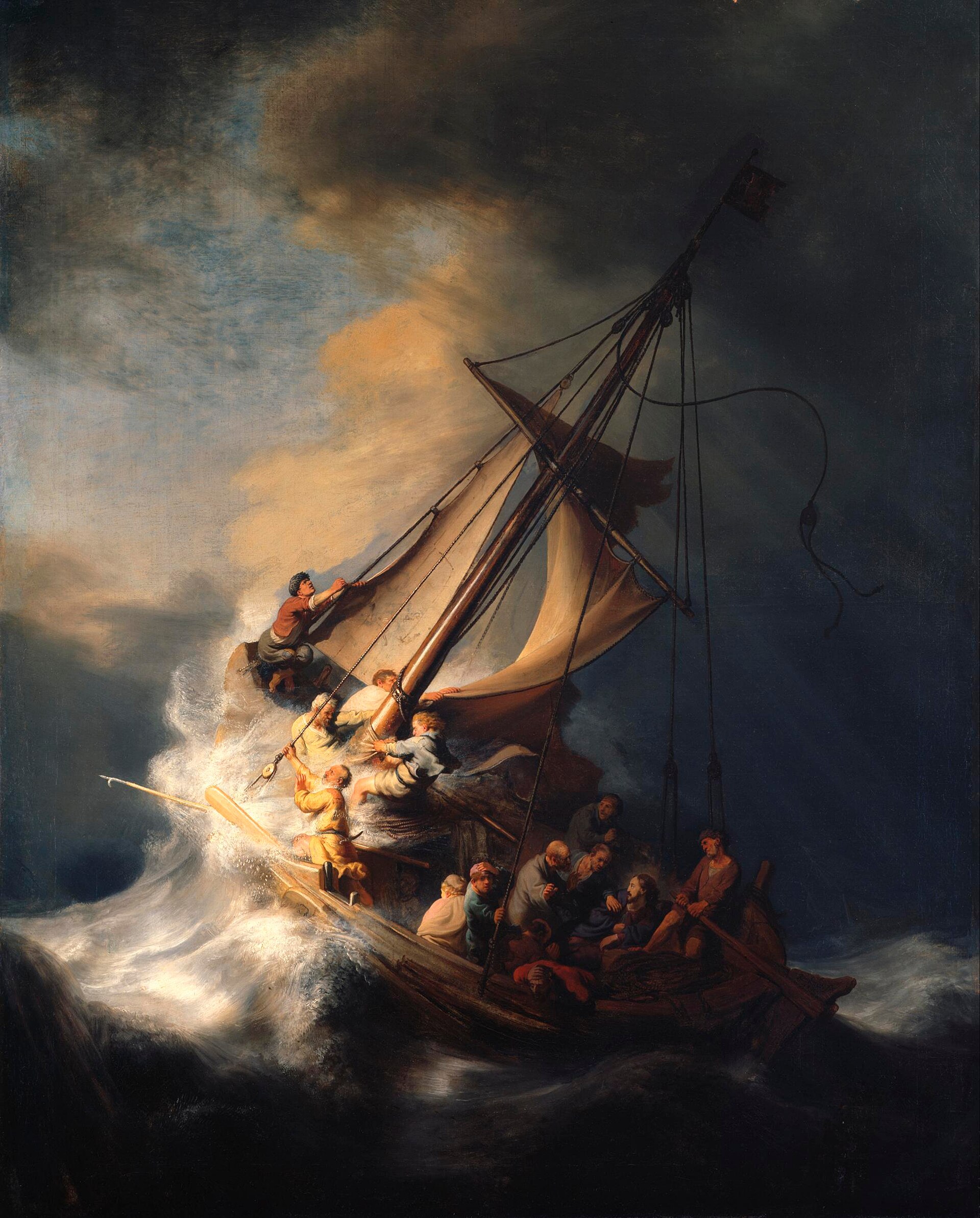
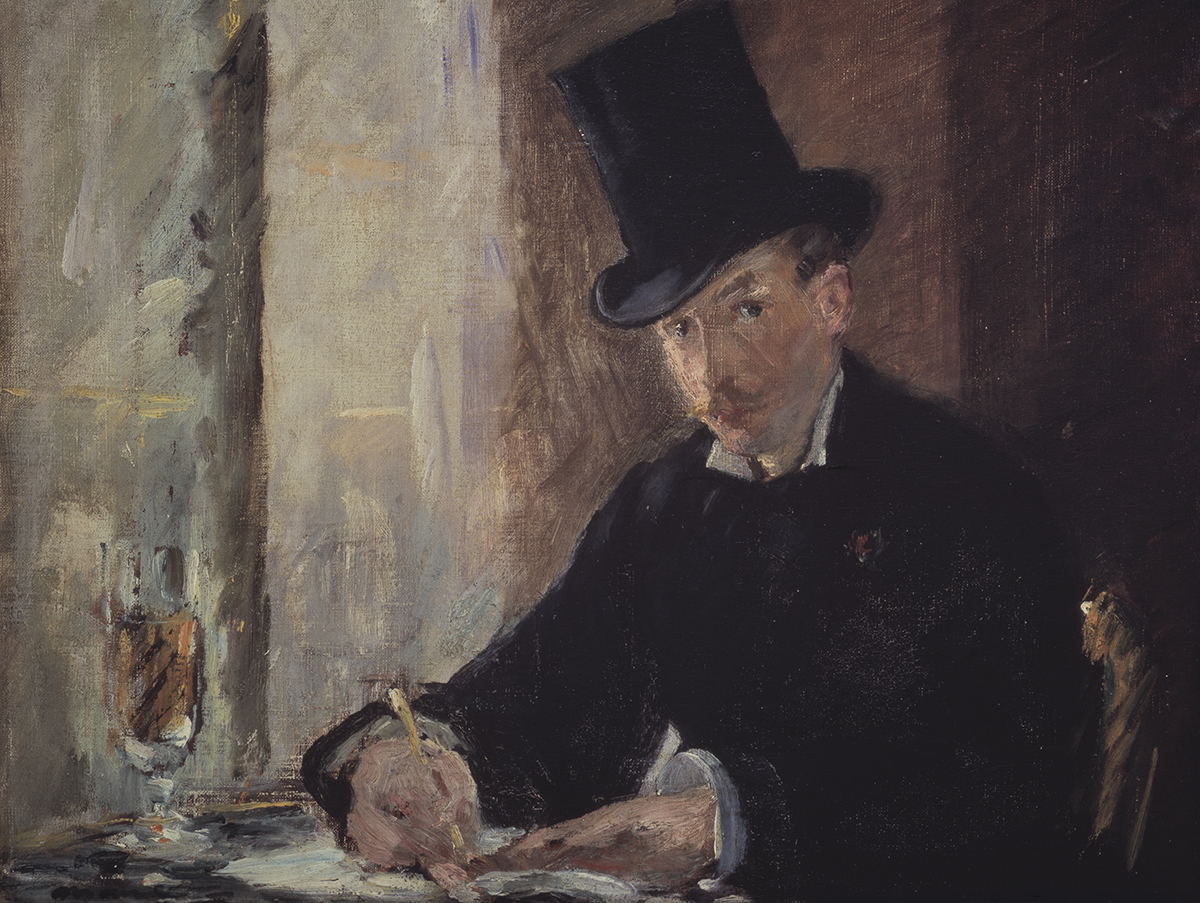
The thieves were in the building for eighty-one minutes. They took thirteen objects: this picture, Rembrandt's The Storm on the Sea of Galilee and A Lady and Gentleman in Black, a Rembrandt self-portrait etching, Govaert Flinck's Landscape with an Obelisk, Manet's Chez Tortoni, five works on paper by Degas, a bronze gu beaker of the Shang dynasty and a French imperial eagle finial. The two large Rembrandts were cut out of their frames. Nothing has ever been recovered.
One detail from that night has never been explained. The museum's motion detectors recorded no one in the Blue Room, where the Manet was taken from a frame beside the security desk; the only movement the system logged in that room all night was Abath on his rounds before the thieves arrived. Abath maintained to the end of his life that he had done nothing wrong, and he was never charged. He died at his home in Brattleboro, Vermont, in February 2024, aged fifty-seven.
Chapter 7What the FBI said in 2013, and what it did not say
On 18 March 2013, the twenty-third anniversary of the theft, the FBI held a press conference in Boston.
On 18 March 2013, the twenty-third anniversary of the theft, the FBI held a press conference in Boston. Richard DesLauriers, the Special Agent in Charge, was joined by the United States Attorney Carmen Ortiz, the case agent Geoff Kelly and the museum's security director Anthony Amore.
The Bureau said it had identified the men who entered the museum, and that it had done so on the basis of evidence rather than inference. It said the thieves were associated with a criminal organisation based in the mid-Atlantic states and New England. It said that in the years after the theft the works were moved to Connecticut and to the Philadelphia area, and that around a decade earlier some of them had been offered for sale in Philadelphia.
Then it stopped. The FBI declined to name the men, declined to name the organisation, and said the investigation was active. And it said, in the same breath as the announcement that the thieves were known, that it did not know where the pictures were. The trail it had reconstructed ran out at the attempted Philadelphia sale.
The announcement is therefore two things at once, and the coverage generally reported only the first. It is a claim to have solved the identity question. It is also, read carefully, an admission that solving the identity question did not recover a single object, and that the Bureau had no current location for anything. Thirteen years on from that press conference, in 2026, that remains the position.
Chapter 8Why nobody can be prosecuted for taking it
The federal statute of limitations on the theft ran out in the mid 1990s.
The federal statute of limitations on the theft ran out in the mid 1990s. Carmen Ortiz put the period at six years from the crime; the museum's own chronology and most reporting date the expiry to 1995. Either way, by the time the FBI announced in 2013 that it knew who had done it, the men who did it could not be charged with doing it.
That is not the end of the criminal exposure, and the distinction matters to anyone holding one of these objects. Possession of stolen property and concealment are continuing offences, and the clock on them runs from the possession, not from 1990. Ortiz was explicit that charges remained available against anyone currently holding the works or anyone who had misled investigators. She was equally explicit that she would not offer blanket immunity in advance, but that immunity was a strong possibility for someone who came forward and produced the objects.
The practical shape of the case is therefore unusual. The prosecution of the theft is dead. The prosecution of the custody is alive, and is the only lever the government has. Everything the FBI has said publicly since 2013 has been addressed not to the thieves but to whoever is sitting on the pictures now, or to whoever knows who is.
Chapter 9The reward is a reward. It is not a valuation
Three different kinds of number attach to this picture and they are routinely printed as if they were one.The first is the reward.
Three different kinds of number attach to this picture and they are routinely printed as if they were one.
The first is the reward. The museum's trustees offered one million dollars within three days of the theft, raised it to five million in 1997, doubled it to ten million in May 2017 with a year-end expiry, and in January 2018 extended it indefinitely. It is payable for information leading to the recovery of all thirteen works in good condition. It is the largest reward ever offered by a private institution, and it is a bounty on an outcome, not an opinion about what anything is worth.
The second is the aggregate estimate for the thirteen objects, which is a press and law-enforcement figure and has drifted upward with retelling: about 200 million dollars in the FBI's early statements, 500 million by the 2000s, and 600 million in the mouths of some dealers by the end of that decade. Nothing was appraised to produce these.
The third is the figure attached to this picture alone, commonly given as 250 million dollars and traceable to the accounts by Ulrich Boser in 2009 and Stephen Kurkjian in 2015. It is an author's estimate of what a Vermeer would fetch if a Vermeer could be sold, in a market where no Vermeer has come up at auction in living memory. It is not a hammer price, not a premium, not an insurance valuation and not a probate figure.
The insurance point is the one that most reporting misses. The Gardner did not carry theft cover. The museum has said its works were insured for damage, restoration and conservation but not against theft, on the reasoning that premiums for a collection of this value would have been prohibitive and that no payout could have replaced what was lost, since the will forbids buying anything. So there was no settlement in 1990, no insurer stepped into the museum's shoes, and no subrogated claim exists. Legal title to the Concert has never left the Isabella Stewart Gardner Museum, which is why the museum, and not a syndicate, is the party offering the reward.
Chapter 10The empty frame is a legal object
Visitors are told that the Gardner leaves the frames empty as a gesture of hope, or of mourning, or as a standing provocation to whoever has the pictures.
Visitors are told that the Gardner leaves the frames empty as a gesture of hope, or of mourning, or as a standing provocation to whoever has the pictures. Those readings are all available. None of them is the reason.
Isabella Stewart Gardner died in 1924 and her will requires that the collection be kept for the education and enjoyment of the public forever, arranged as she left it. Nothing may be moved. Nothing may be sold. Nothing may be added. The trustees do not have the discretion to rehang the Dutch Room around a gap, because rehanging the Dutch Room is precisely what they are forbidden to do. The empty frames are what compliance looks like.
How hard that constraint bites can be measured by what it took to build an extension. When the museum wanted to add its new wing it had to go to court in 2008 for permission, and its own leadership acknowledged afterwards that the addition was technically a breach of the will and was made because there was no alternative. A museum that needs a judge's leave to put up a building is not a museum that can quietly take a frame off a wall.
So the frame in the Dutch Room is not a curatorial decision that could be revisited. It is the operation of a testamentary instrument written in 1924 on an object stolen in 1990, and it will hold whether or not the picture ever comes back.
Chapter 11There is no photograph of this painting as it is now
Every reproduction of the Concert in existence was made before 18 March 1990.
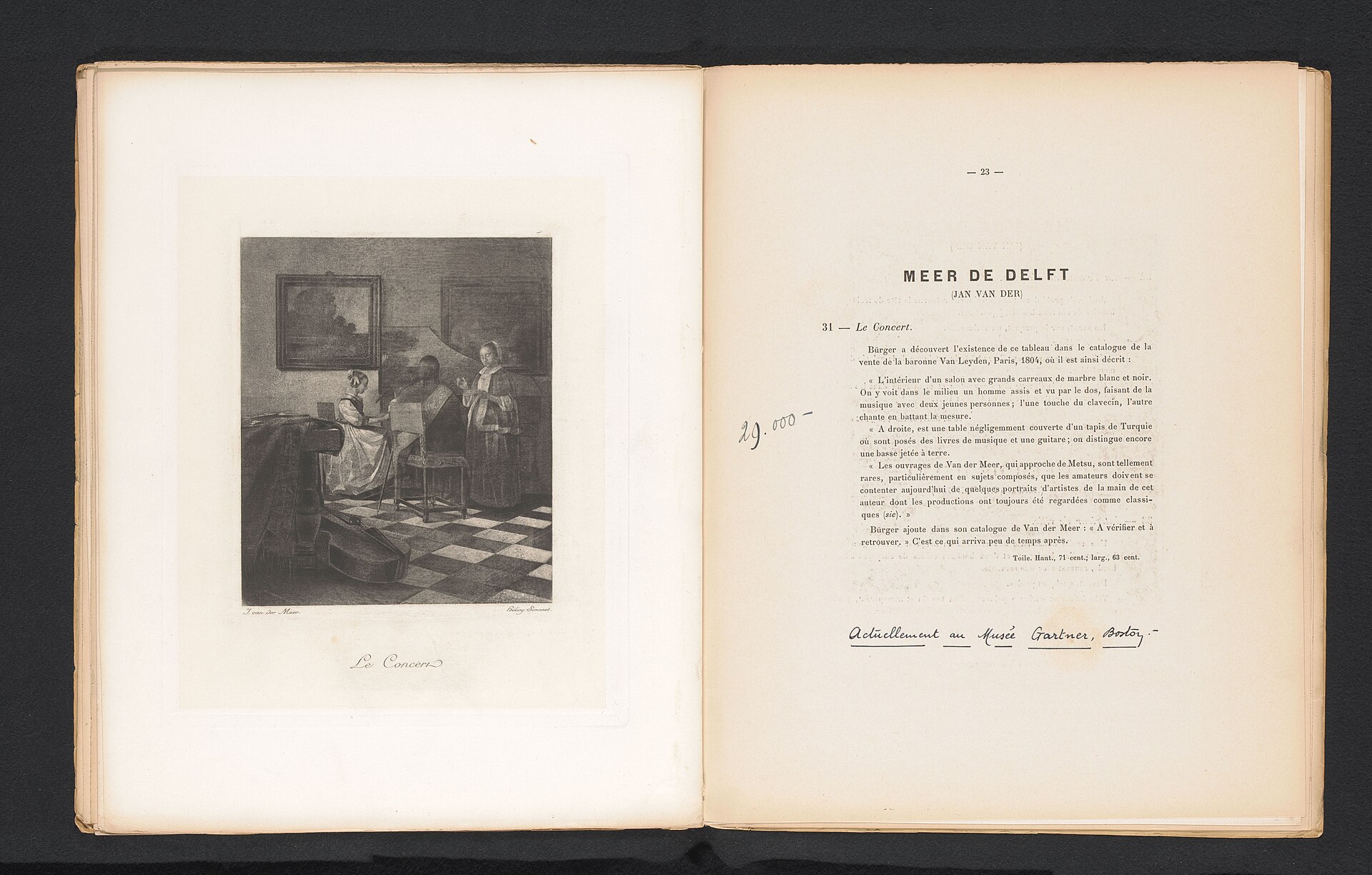
Every reproduction of the Concert in existence was made before 18 March 1990. That includes every plate on this page. It is a limitation that has to be stated on any record of a missing object, and it has consequences that go beyond illustration.
The picture has not been examined since 1990. There is no infrared reflectogram made with modern equipment, no X-radiograph a student can consult, no pigment analysis from the current generation of instruments, no IIIF manifest, no technical bulletin. The entire physical study of this painting was completed under twentieth-century conditions and cannot be extended. Where a comparable Vermeer in a museum gains a new layer of evidence every decade, this one is frozen at the state of knowledge of a generation ago.
The condition question is worse. Whatever the painting looked like in March 1990, that is not what it looks like now. It has spent thirty-six years somewhere unknown, out of climate control, in the hands of people with an interest in concealment rather than conservation. The two Rembrandts were cut from their stretchers, which tells us something about the handling. The Concert was removed from its frame. Any recovery would be followed immediately by a conservation report, and nobody can say now what that report would contain.
The oldest reproduction reproduced here is a heliogravure of about 1887 to 1892, made in Paris by the plate-maker Simonet after the painting while it still hung in the Lacroix house, and printed as a book plate. It is now in the Rijksmuseum. It was made to sell the idea of Vermeer to a European readership, in the years immediately before the picture crossed the Atlantic. It is also, at 136 by 116 millimetres, an object in its own right with its own inventory number, and it will outlast the argument about where the painting is.
Chapter 12The painter as an authenticator
One episode in Vermeer's life belongs in a provenance archive more than in a monograph.
One episode in Vermeer's life belongs in a provenance archive more than in a monograph. In the early 1670s the Amsterdam dealer Gerrit van Uylenburgh sold a group of Italian paintings to Frederick William, the Elector of Brandenburg, who was then told by his adviser Hendrick Fromantiou that they were copies and sent twelve of them back. Uylenburgh assembled a panel of thirty-five painters to give a counter-opinion. Vermeer was one of them, and he travelled to The Hague to pronounce on whether the pictures were what they were said to be.
He was, in other words, hired as an expert in version confusion: the question of whether a canvas is the original or a copy after it, argued in front of a client who had paid for one and suspected he had the other. Three centuries later the same question is the reason this publication exists. It is also, in a colder sense, the reason the Concert is unsellable. A stolen Vermeer cannot be authenticated in public, cannot be exhibited, cannot be catalogued and cannot be insured, which is why the FBI's working theory has always been that these objects have been used as collateral and currency inside criminal networks rather than sold to a collector.
Chapter 13Where the case stands in 2026
The ten million dollar reward remains open with no expiry.
The ten million dollar reward remains open with no expiry. The FBI investigation remains open, and the Bureau has not added materially to what it said in 2013. Rick Abath, the guard who opened the door, died in 2024 without changing his account. Most of the men whose names have circulated as suspects, among them Bobby Donati, who was murdered in 1991, and George Reissfelder, who died the same year, are dead. Robert Gentile, the Connecticut figure the Bureau pressed hardest in the 2010s, denied knowing anything to the end.
Nothing about the legal position has changed. Title is the museum's. The theft cannot be prosecuted. Possession can. The frame is on the wall because a will says so.
A reader who wants to know what this object is worth should note that the only number anyone has ever actually paid for it is 29,000 francs, at the Hotel Drouot, on 5 December 1892.
A further account entered the record in 2026: retired FBI agent Geoffrey Kelly, who worked the case for 22 years, published a first-person book, Thirteen Perfect Fugitives, naming a Dorchester-based organised-crime crew as the thieves. The figures he names in that connection — Bobby Donati, George Reissfelder and Carmello Merlino, whose Dorchester auto shop the FBI had already tied to the case in earlier reporting — are all dead; Merlino died in prison in 2005. Kelly's account adds detail and a personal narrative to a theory the Bureau had already outlined by 2013; it does not add a location for any of the thirteen objects, and he says so himself: 'I have no doubt they still exist,' but he does not say where.
The artist
Johannes Vermeer, also Jan Vermeer van Delft
Vermeer left about thirty-four accepted paintings, no drawings, no pupils and almost no words. He was a respected local figure in Delft who was elected head of his guild four times, and he was forgotten for a century and a half after his death. The artist as we have him was assembled in the 1860s by a French republican critic working from museum labels and saleroom catalogues, and the shape of the corpus has been argued about ever since. Everything on this page rests on that reconstruction, including the attribution of the missing picture it describes.
Related works
| Work | Relation | Where it is |
|---|---|---|
| A Lady at the Virginals with a Gentleman (The Music Lesson) Johannes Vermeer | The picture most often confused with this one in reproduction Also a keyboard, also a standing man, also a marble floor and a viola da gamba on the ground. It is a different painting, it is in London, and it has never been stolen. | Royal Collection, RCIN 405346 |
| The Procuress Dirck van Baburen | The painting depicted on the rear wall inside this picture 1622. Owned by Maria Thins, Vermeer's mother-in-law. Vermeer put it into two of his interiors. | Museum of Fine Arts, Boston |
| The Storm on the Sea of Galilee Rembrandt van Rijn | Taken in the same theft, from the same room Rembrandt's only seascape, cut from its frame. Its empty frame is the one usually photographed in the Dutch Room. | Unlocated since 18 March 1990 |
| Landscape with an Obelisk Govaert Flinck | Taken in the same theft Long catalogued as a Rembrandt and reattributed to Flinck in 1924, the year Gardner died. A reminder that attribution moves even inside a museum that may not. | Unlocated since 18 March 1990 |
| Chez Tortoni Edouard Manet | Taken in the same theft, from a different floor Removed from the Blue Room, feet from the security desk, in a room where the motion detectors logged nobody that night. | Unlocated since 18 March 1990 |
| The Dissius sale, Amsterdam, 16 May 1696 Johannes Vermeer | The single event through which most Vermeer provenance runs Twenty-one Vermeers in one auction, about 1,500 guilders the lot. This picture is probably number 9. | Dispersed |
Open questions
- Where is the painting? The FBI said in 2013 that it had identified the thieves and did not know the location of any of the thirteen objects. Nothing published since has changed that.
- What condition is it in? It has been out of museum care since March 1990 and out of its frame since the night of the theft. No conservator has seen it in thirty-six years.
- Is 29,000 francs the hammer and 31,175 francs the total? The two published figures differ by exactly 7.5 per cent, the Hotel Drouot buyer's charge of the period, but this record has not seen the sale's proces-verbal and treats the split as an inference.
- What did the six recorded auctions between 1696 and 1892 make? No price for this picture is recorded in the sources consulted for the 1696, 1780, 1804, 1835, 1860 or 1869 sales.
- What is the exact residuary clause of Isabella Stewart Gardner's 1924 will? The requirement that nothing be moved, sold or added is well attested. The widely repeated further term, that a breach sends the whole collection to be sold for the benefit of Harvard, has not been verified here against the probated instrument.
- Why did the Blue Room motion detectors register nobody on the night the Manet was taken from it, when they registered the guard's own rounds earlier the same night?
- Was the Concert lot 9 in the Dissius sale of 1696? The identification is given as probable, not certain, in the catalogue literature.
- Would a recovery be followed by a reattribution debate? The picture is unsigned, was last examined with pre-1990 equipment, and has been absent through the entire period in which technical analysis of Vermeer was transformed.
Questions about this object
What is The Concert?
The Concert is a painting, dated c. 1663-1666. Medium: Oil on canvas.
Who made The Concert, and is the attribution settled?
The attribution to Johannes Vermeer is recorded here as accepted. Universally accepted as autograph and included in every modern catalogue of the artist, although the picture carries no signature and no date. The attribution rests on connoisseurship rather than on any document naming Vermeer as its author, and it has never been seriously challenged. Note the position this creates: a painting accepted without dispute cannot now be re-examined, because the object has been out of reach of every laboratory since 18 March 1990.
Where is The Concert now?
Unlocated. Stolen from the Isabella Stewart Gardner Museum, Boston, on 18 March 1990 and not recovered. Legal title remains with the museum. Inventory number P21W27. Last confirmed 31 August 2026. Theft reported 18 March 1990; the FBI investigation remains open and the museum's USD 10 million reward stands.
What is still unknown about The Concert?
Where is the painting? The FBI said in 2013 that it had identified the thieves and did not know the location of any of the thirteen objects. Nothing published since has changed that.
Sources
- 1Essential Vermeer 5.0, 'The Concert by Johannes Vermeer', interactive catalogue entry. Used for the full provenance chain from van Ruijven to the Gardner, the 1696 Dissius and 1892 Drouot lot numbers, the absence of a signature, the range of scholarly dates, the 1897 Copley Hall loan, the inventory number P21W27, and the identification of the Baburen, the Ruisdael-like landscape and the instruments. A specialist secondary source; the primary catalogue entries by Liedtke and Wheelock should replace it. essentialvermeer.com/catalogue/...
- 2Wikipedia, 'Isabella Stewart Gardner Museum theft'. Used for the timings, the guards, the list of thirteen objects, the reward chronology, the statute of limitations, the value estimates and the named suspects. Tertiary; flagged for replacement with the museum's own chronology and the FBI case file. en.wikipedia.org/wiki/...
- 3Wikipedia, 'The Concert (Vermeer)'. Used for the dimensions, the 250 million dollar figure and its attribution to Boser 2009 and Kurkjian 2015, and the 1892 purchase. Tertiary; flagged for replacement with the Gardner Museum catalogue. en.wikipedia.org/wiki/...
- 4WBUR, 'FBI Says It Has Identified Thieves In Gardner Art Heist', 18 March 2013. Used for who spoke at the press conference, what the Bureau claimed and refused to say, the Connecticut and Philadelphia movement, the attempted Philadelphia sale, the expired statute of limitations and the immunity position. wbur.org/news/...
- 5WBUR, 'Night watchman during notorious 1990 Gardner heist has died', 27 February 2024. Used for Rick Abath's death at fifty-seven in Brattleboro, Vermont, his account, the fact that he was never charged, and the Blue Room motion-detector anomaly. wbur.org/news/...
- 6Journal of Art in Society, 'Vermeer's Concert, the Gardner Collection and the Art Heist of the Century'. Used for the 1892 Drouot sale as a sale of the Thore-Burger estate, the handkerchief signal to a male agent, the Louvre and National Gallery as underbidders, the Lacroix bequest of about 120 works, and the hanging in the Dutch Room from 1903. artinsociety.com/vermeerrsquos-concert-the-gardner-collec...
- 7Tufts University Museum Studies Blog, 'The Contested Legal Legacy of the Isabella Stewart Gardner Museum', 4 March 2022. Used for the terms of the will, that nothing was to be moved, sold or added, and for the 2008 court application and the museum's acknowledgement that the New Wing was technically a breach. sites.tufts.edu/museumstudents/...
- 8Wikipedia, 'Johannes Vermeer'. Used for the artist dossier: baptism and burial, guild admission and headmanships, the 1653 marriage and conversion, Maria Thins and the Baburen, van Ruijven and de Knuijt, the Dissius inventory of twenty-one pictures, the absence of drawings and pupils, the Uylenburgh authentication panel, the widow's statement to creditors, van Leeuwenhoek as trustee, and the 1866 Gazette des Beaux-Arts catalogue. Tertiary; flagged for replacement with Montias, Vermeer and His Milieu. en.wikipedia.org/wiki/...
- 9Wikipedia, 'Isabella Stewart Gardner Museum'. Used for the 1 January 1903 opening of Fenway Court, Gardner's dates, the one million dollar endowment and the empty frames in the Dutch Room. Tertiary; flagged for replacement with the museum's published history. en.wikipedia.org/wiki/...
- 10The Harvard Crimson, 'How the Isabella Stewart Gardner Museum Challenges Modern Curation', 13 January 2026. Used for the restriction on display, acquisition and sale continuing after 1924. thecrimson.com/article/...
- 11Wikimedia Commons file page and Rijksmuseum object record RP-F-2001-7-1696-4, for the heliogravure after The Concert: dating c. 1887 to in or before 1892, plate-maker Simonet, sheet 136 x 116 mm, acquired by the Rijksmuseum in 2001, released CC0. commons.wikimedia.org/wiki/...
- 12Wikimedia Commons file page for the FBI photograph of the Dutch Room, released under PD-USGov-FBI, described by the Bureau as showing the empty frame where The Storm on the Sea of Galilee was displayed. commons.wikimedia.org/wiki/...
,_RP-F-2001-7-1696-4.jpg)

Last verified 31 August 2026 · Published 4 August 2026
Change log
4 August 2026 - Record created at the house standard: researched narrative, technical evidence, maker dossier, graded provenance chain, prices with hammer and premium separated, related works, open questions and sources.
31 August 2026 - Re-verified. No change to location, attribution or legal status: the painting remains unlocated and the FBI investigation remains formally open. Added a 2026 development to the 'Where the case stands' section: retired FBI agent Geoffrey Kelly's book Thirteen Perfect Fugitives names a Dorchester crew, consistent with figures already in this record (Donati, Reissfelder) plus Carmello Merlino (d. 2005 in prison) - no new named suspects who are living, and no new information on the picture's whereabouts. Checked all source URLs; no rot found.