The Department That Decides What the Object Is
Three glazed ceramics in this archive sit in three different Metropolitan Museum departments. The Met sorts by culture, by medium, by period and by address at the same time, and the object never moves again.
Records in this piece: Dish, Platter, Bowl with two boys and lotuses, Astrolabe of 'Umar ibn Yusuf ibn 'Umar ibn 'Ali ibn Rasul al-Muzaffari, Liber Chronicarum, the Khuner copy, Folio from the "Blue Qur'an", Jug Signed by Ennion, Mosque Lamp Bearing the Name of the Mamluk Sultan al-Malik al-Nasir, Desk Chair, Desk and Bookcase, Julius Caesar (from the Heroes Tapestries), Crown of the Virgin of the Immaculate Conception, known as the Crown of the Andes
On this page 9 sections
ContentsClose
In short
- Three glazed ceramic vessels in this archive are held by the Metropolitan Museum in three different departments: Islamic Art, Asian Art, and European Sculpture and Decorative Arts. The museum's own classification field calls all three of them ceramics.
- The Met's departments do not run on one principle. They run on four at once: culture, medium, period, and position in the building. An astrolabe is filed under Islamic Art and a printed book under Drawings and Prints.
- Two of the departments in this archive are places rather than subjects. The Cloisters is a building in northern Manhattan, and The American Wing holds a crown made in colonial Colombia.
- The department is chosen once, at accession, and it decides which specialists write the entry, which galleries can show the object and which literature it joins. It is the least examined line on a museum record.
A department is a claim about what the object mainly is
A curatorial department is an argument, not a shelf. Every object a museum accessions is assigned to one, and that assignment decides which specialists catalogue it, which galleries are able to show it, which conservators treat it, and which body of literature it joins. The Metropolitan Museum of Art publishes the department on every object record it releases, so the assignment is visible on any object anyone can look up.
This archive holds sixty Metropolitan objects across eighteen material classes, which is enough to see how the sorting works. What it shows is that there is no single sorting rule. The Met's departments run on at least four incompatible principles at the same time. Some are cultures: Islamic Art, Asian Art, Greek and Roman Art, Egyptian Art. Some are media: Drawings and Prints, Photographs, Arms and Armor, Musical Instruments. One is a period, Modern and Contemporary Art. And two are addresses, The American Wing and The Cloisters.
An object goes wherever the strongest of those four claims put it on the day it was accessioned. It very rarely moves again. That makes the department line a dated scholarly judgement wearing the clothes of an administrative fact, and almost nobody reads it as one.
Three ceramics in this archive sit in three different departments
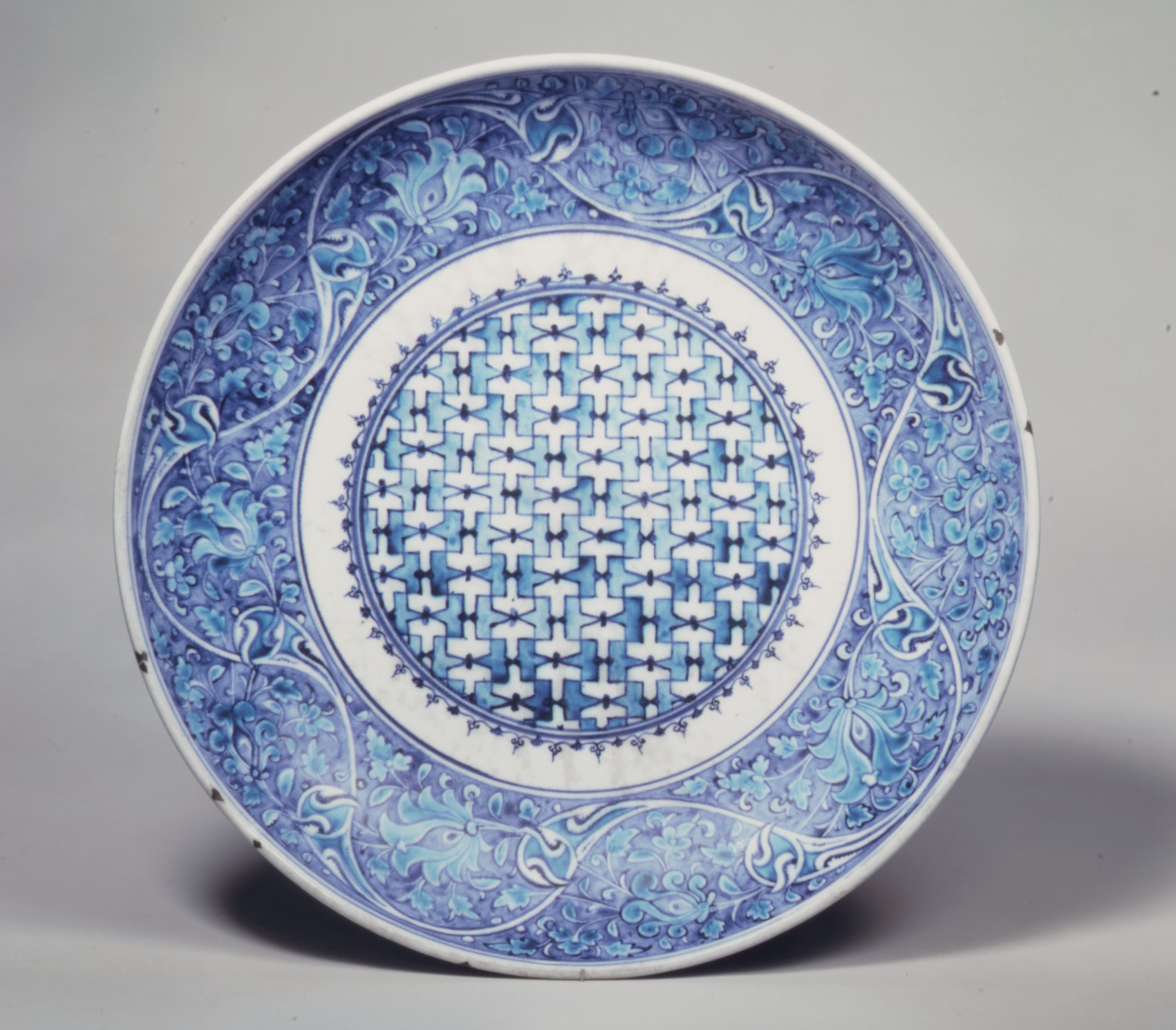
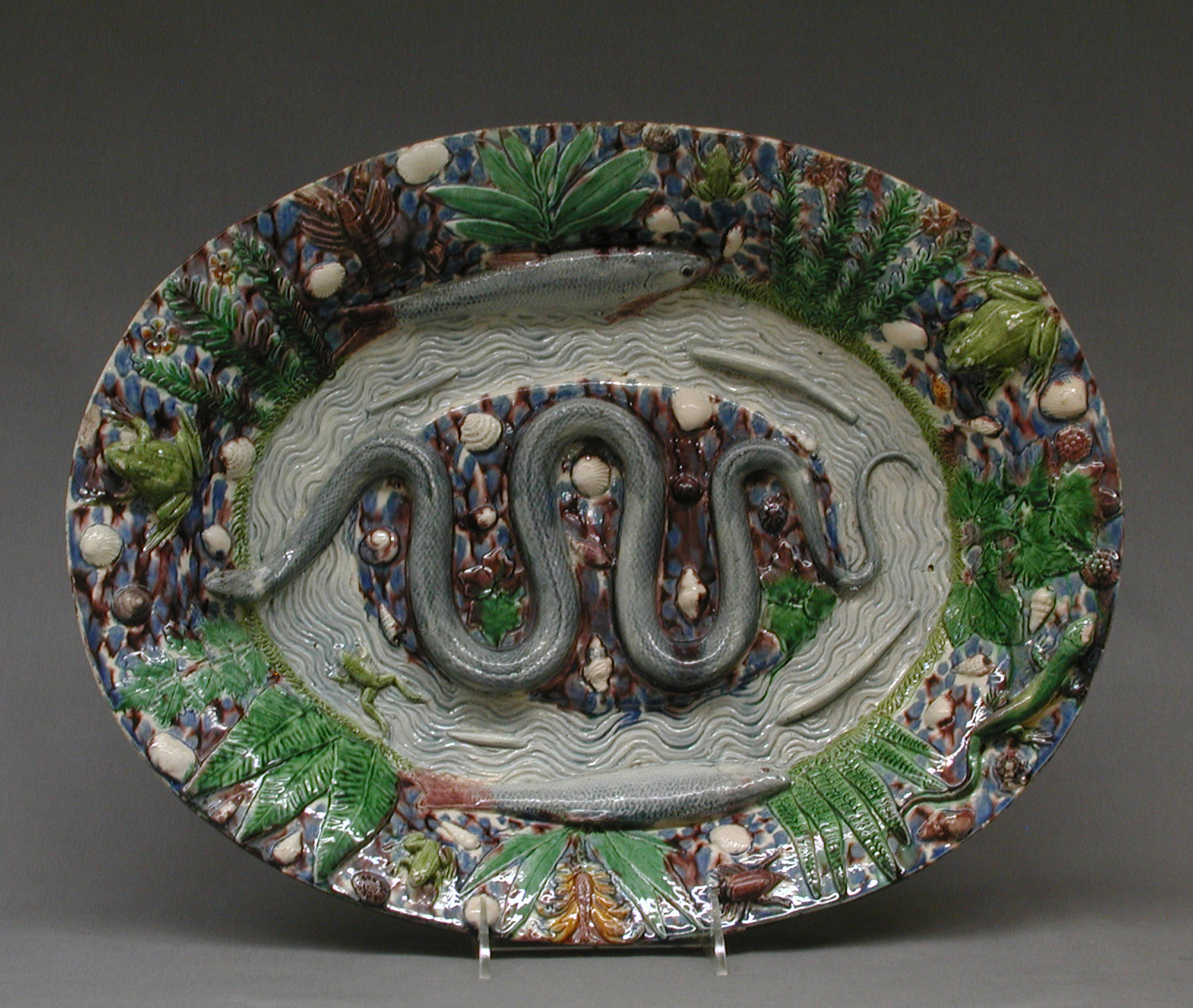
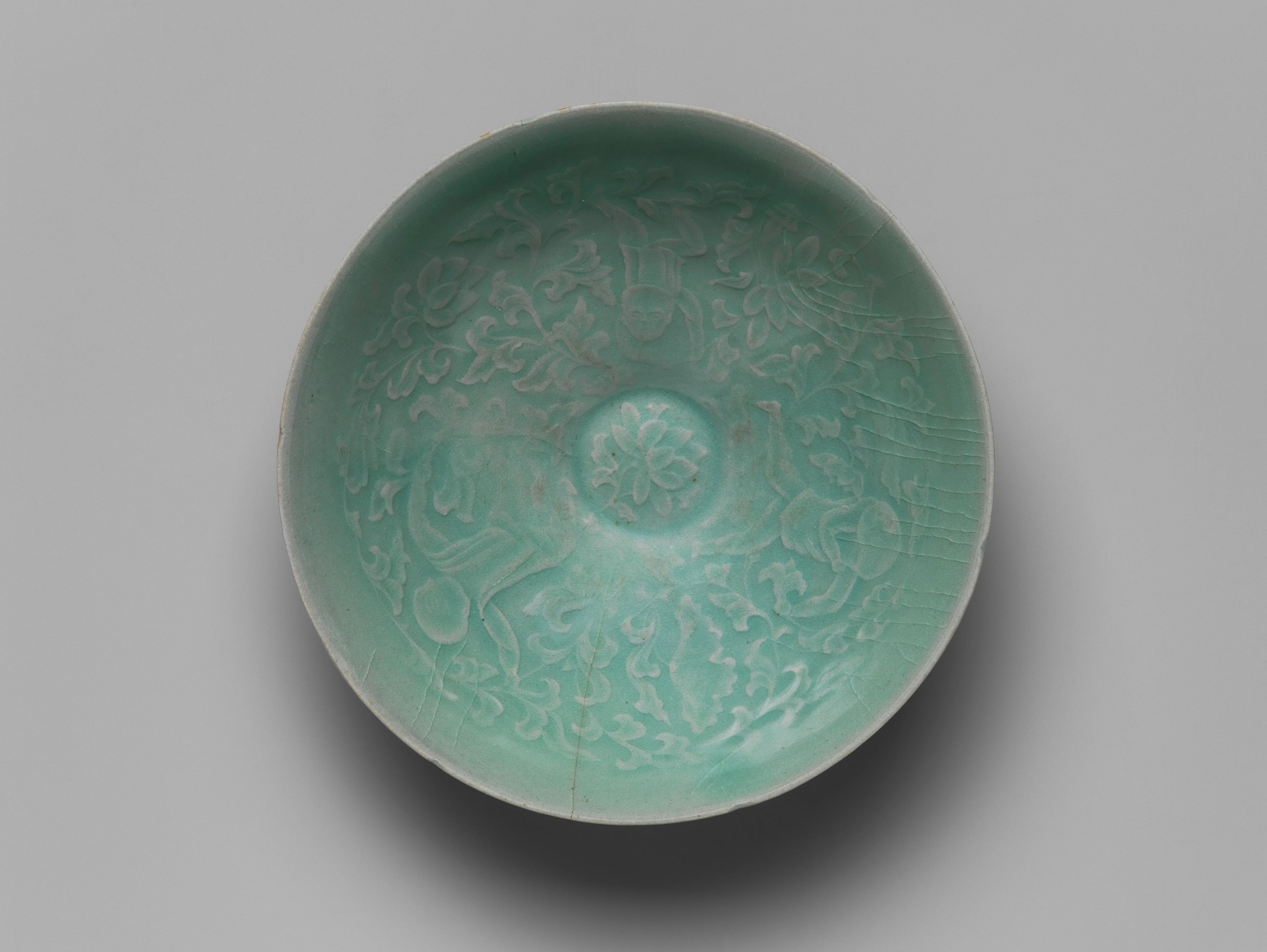
Three glazed ceramic vessels in this archive are held by the Metropolitan Museum of Art in three different curatorial departments. All three are fired clay with a decorated glaze, all three are dishes or bowls meant to hold something, and the museum's own classification field describes each of them as ceramics. The department each one landed in was decided by where it was made, not by what it is.
| Object | Accession | Museum classification | Department |
|---|---|---|---|
| Dish, Iznik, mid-16th century | 14.40.727 | Ceramics | Islamic Art |
| Platter, manner of Bernard Palissy, later 19th century | 53.225.64 | Ceramics-Pottery | European Sculpture and Decorative Arts |
| Bowl with two boys and lotuses, Goryeo, early 12th century | 11.8.6 | Ceramics | Asian Art |
Read down the classification column and the three objects are the same kind of thing. Read down the department column and they belong to three separate scholarly communities, three separate acquisition budgets and three separate parts of the building. The Iznik dish hangs in Gallery 460 and the Goryeo bowl in Gallery 233. The Palissy-manner platter is not on view at all.
Where a vessel was made outranks what it is made of
Two Roman-era and medieval glass vessels in this archive are held by two different Metropolitan departments, and the split follows culture rather than material. The Ennion jug, accession 17.194.226, is in Greek and Roman Art and stands in Gallery 166. The enamelled and gilded mosque lamp made for the Mamluk sultan al-Nasir, accession 17.190.987, is in Islamic Art. Both are glass, both were blown, and the museum's classification field records the word glass against each of them.
The same rule sorts the ceramics above, and it is a defensible rule. A scholar of Iznik pottery and a scholar of Saint-Porchaire and Palissy ware share very little beyond a kiln. Grouping objects by the culture that produced them puts each one next to the material that explains it, and it is why the Goryeo bowl sits with Korean celadon rather than with every other green glazed bowl in the building.
What the rule costs is the comparison across cultures. A historian of glaze chemistry who wants to look at cobalt blue on a fritware body and cobalt blue on a soft-paste body is asking two departments for two appointments. The archive can put those objects on one page. The museum, by its own structure, cannot put them in one room.
An astrolabe is filed as Islamic art rather than as a scientific instrument
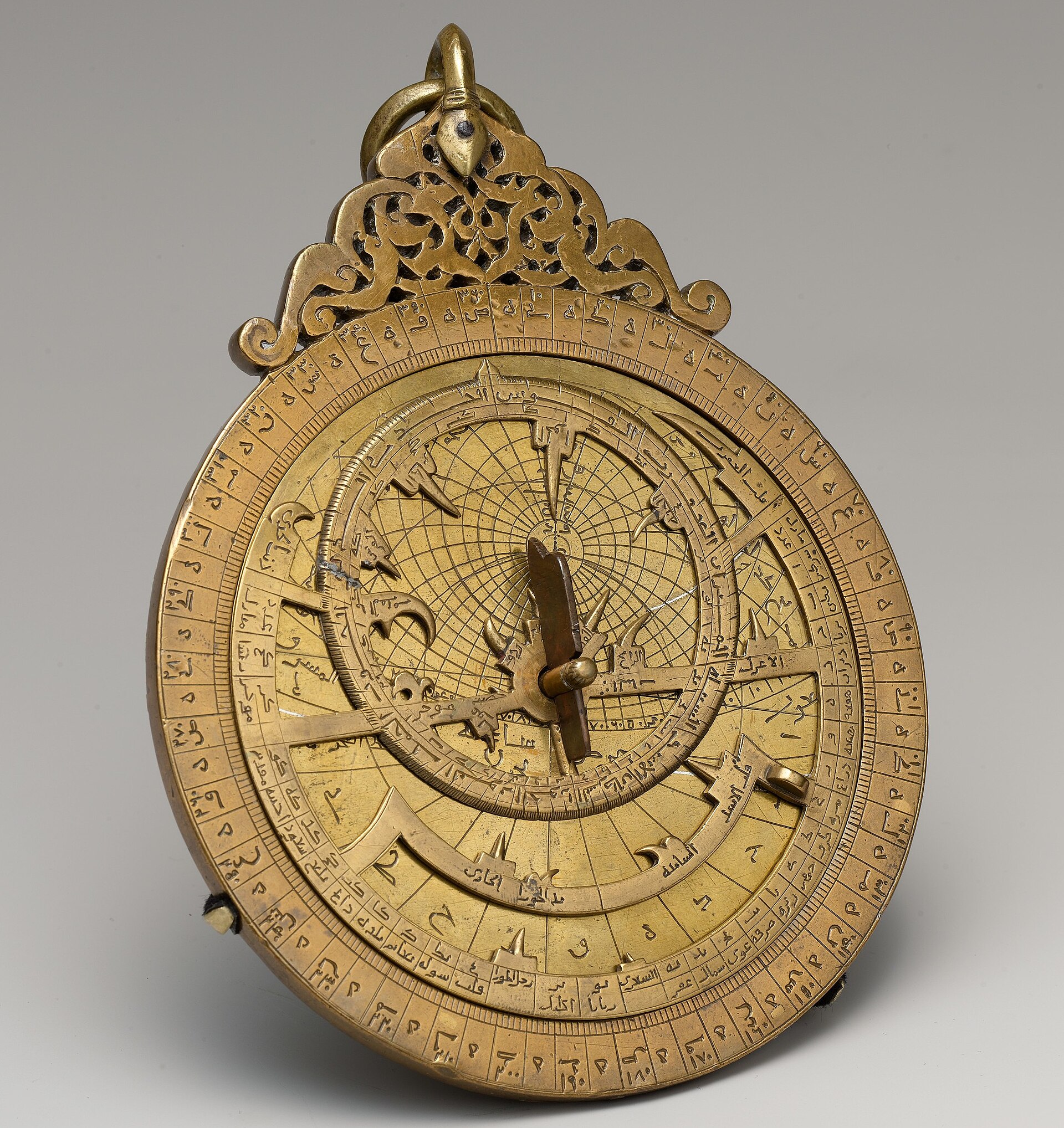
The astrolabe of Umar ibn Yusuf ibn Umar al-Muzaffari, dated 690 AH and 1291 CE, is held by the Metropolitan's Department of Islamic Art under accession 91.1.535a-h. The museum's classification field for it reads Metal. It is a computing instrument, made to solve problems of time and position, and it is filed neither as an instrument nor as a clock but as metalwork produced in a particular culture.
That is not an error, and it puts the object beside the inlaid brass this archive also holds from the same tradition. It does mean that a reader who goes looking for the Met's holdings of early astronomical instruments will not find this one by searching for instruments. This archive classes it as Clocks and instruments, and the two descriptions are both true at once. The difference is that a museum has to pick one and live inside the consequence, while a record can carry both.
The Blue Qur'an folio, accession 2004.88, shows the same rule again from the other direction. The Met's classification field for it is Codices, and its department is Islamic Art.
A printed book is held by the department of drawings and prints
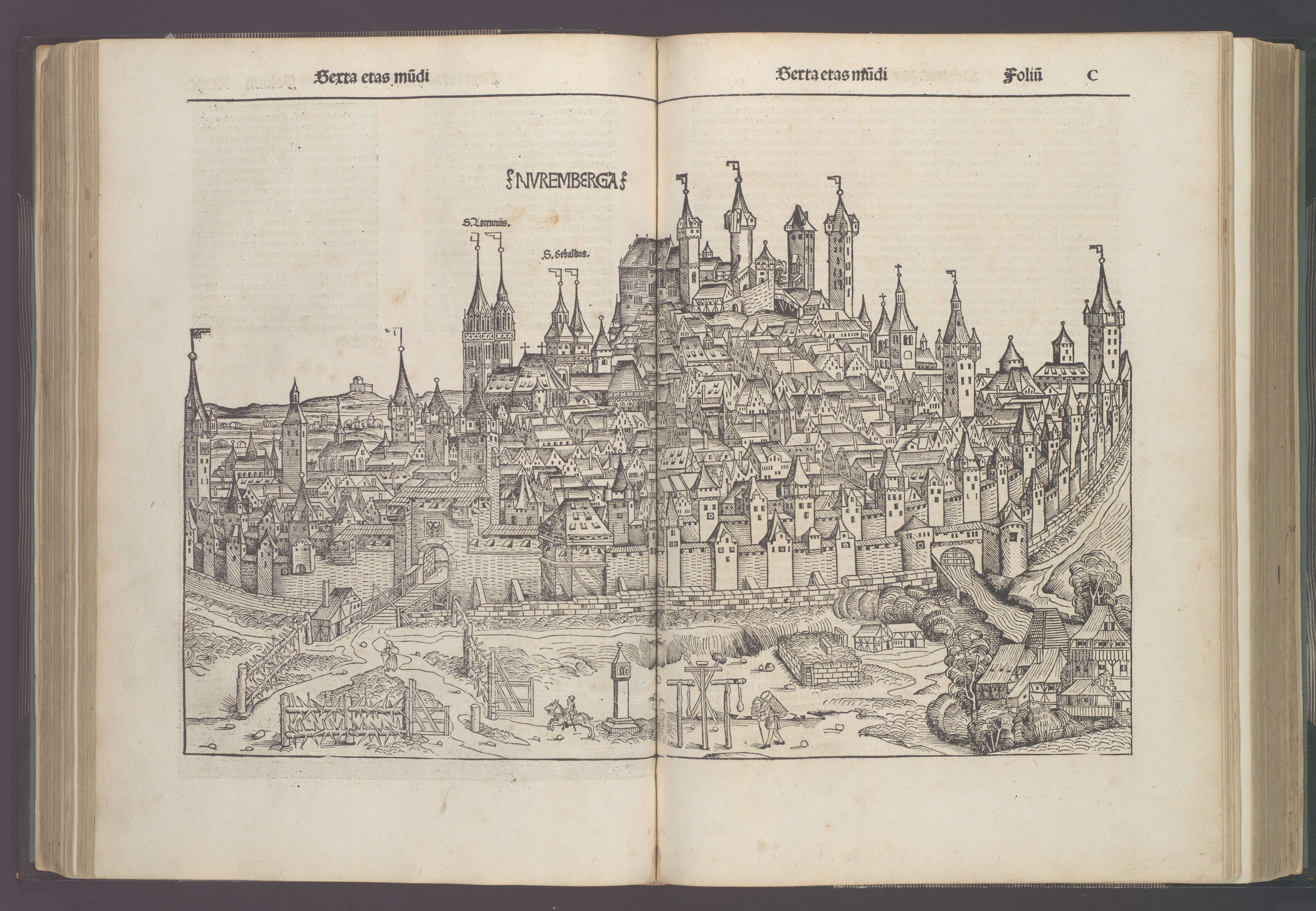
The Metropolitan's copy of the Nuremberg Chronicle, printed on 12 July 1493, is held by the Department of Drawings and Prints under accession 1981.1178.29. The museum's own object record gives its object name as Book and its classification as Books. It is not in a library and it is not in a department of manuscripts and printed matter, because the Met has no such department.
The reason is that the Chronicle's claim on the museum is its woodcuts. It carries more than eighteen hundred impressions from a workshop that included the young Durer's master, and a museum of art collects it as a body of prints that happens to be bound. A research library collecting the same edition would file it by imprint and treat the woodcuts as illustration. Two institutions, one book, two opposite readings of what the object primarily is.
Set that beside the Blue Qur'an folio in the paragraph above and the pattern is plain. Both are text on a page. One went to the department that owns the technique, the other to the department that owns the culture.
Two of the departments in this archive are addresses
The Cloisters and The American Wing are curatorial departments named after parts of the museum rather than after subjects. The Nine Heroes tapestry showing Julius Caesar, accession 47.101.3, is recorded by the Met under the department The Cloisters, which is a building assembled from French monastic fragments four miles north of the main museum. The Goddard and Townsend desk and bookcase, accession 15.21.2, is in The American Wing and stands in Gallery 753.
The Crown of the Andes shows how far an address can stretch. It was made in Popayan, in what is now Colombia, from gold and Colombian emeralds, for a figure of the Virgin of the Immaculate Conception. The Metropolitan acquired it in 2015 under accession 2015.437, and its department is The American Wing. American here means a hemisphere, not a country, and a reader who takes the department as a shorthand for the United States will misread the object entirely.
A department named for a room is a department that will one day disagree with its own name. That is not hypothetical: this archive holds Met objects whose galleries have been renumbered and whose wings have been renamed while the accession numbers stayed put.
What the department decides after it is decided
The department chooses the people who will speak for the object for as long as the museum holds it. It supplies the curator who writes the catalogue entry and the label, the specialists a journalist or a court is referred to, the conservators with the relevant training, and the exhibition programme the object can be lent into. It also sets the comparanda: an object is studied next to whatever else its department owns.
That is why a departmental placement is worth reading as evidence. It records what the museum thought the object mainly was at the moment it arrived, which is often a moment when much less was known. A nineteenth-century imitation catalogued into a department of European decorative arts is being read as a European decorative object first and as an imitation second, and the order of those two readings shapes every later argument about it.
None of this makes any one placement wrong. It makes the placement a claim with a date on it, exactly like an attribution or a location line, and a claim with a date on it can be checked against what is known now.
How to read a department line
Treat the department as an assertion about the object's primary identity, and ask which of the four principles produced it. If the answer is culture, the object has been placed by where it was made and you should expect its comparanda to be regional. If the answer is medium, expect them to be technical. If the answer is a period or a wing, expect the grouping to be institutional history rather than scholarship, and check when that history was written.
Then check the classification field against the department, because the Met publishes both and they do not always agree in spirit. Ceramics in Islamic Art, Metal for an astronomical instrument, Books in Drawings and Prints and Codices in Islamic Art are all cases where the two fields are describing different things about one object. Where they diverge, the classification usually tells you what the object is and the department tells you what the museum decided it was for.
And cite both. A citation that gives an accession number and a department records the museum's own reading at the date you consulted it, which is the part most likely to have changed by the time somebody checks your work.
Why this archive is free to read
We do this for everyone who loves art. The people who have studied it for years, and the people who just stopped to look. Iconotheca exists so that what we learn belongs to all of them.
Nobody pays us for this. No ads, no sponsors, no commercial interest. These works belong to all of us, and we would rather share them with as many people as we can than keep them to ourselves.
If it gave you something today, tell us to keep going. Follow us, leave a like, or write a positive comment. We read every one, and they are what keeps us going.
Questions
It is the unit that owns an object inside the institution: the curators who catalogue and interpret it, the budget it is acquired against, and the galleries it can be shown in. At the Metropolitan Museum of Art the department is published on every object record, alongside the accession number and the credit line.
Because most large museums sort by more than one principle at once. The Metropolitan uses culture, medium, period and position in the building, so three glazed ceramics in this archive sit in Islamic Art, Asian Art, and European Sculpture and Decorative Arts, while its own classification field records all three as ceramics.
It can, but it is uncommon. The department is normally settled at accession and stays there, which is why it preserves the museum's reading of the object at the date it arrived rather than its current one.
Because its claim on an art museum is its images. The museum's copy of the Nuremberg Chronicle, accession 1981.1178.29, is recorded with the object name Book and the classification Books, and is held by Drawings and Prints, which collects it for its woodcuts rather than as an edition.
A hemisphere rather than a country. Its holdings in this archive include the Crown of the Andes, accession 2015.437, made in Popayan in present-day Colombia, alongside Newport and New York furniture.
Sources
- 1Metropolitan Museum of Art, Open Access Collection API, object 446648, dish, accession 14.40.727. Department: Islamic Art; classification: Ceramics; Gallery 460. Read as raw JSON, 5 September 2026. collectionapi.metmuseum.org/public/...
- 2Metropolitan Museum of Art, Open Access Collection API, object 201645, platter in the manner of Bernard Palissy, accession 53.225.64. Department: European Sculpture and Decorative Arts; classification: Ceramics-Pottery. collectionapi.metmuseum.org/public/...
- 3Metropolitan Museum of Art, Open Access Collection API, object 50352, bowl with two boys and lotuses, accession 11.8.6. Department: Asian Art; classification: Ceramics; Gallery 233. collectionapi.metmuseum.org/public/...
- 4Metropolitan Museum of Art, Open Access Collection API, object 444408, astrolabe of Umar ibn Yusuf ibn Umar al-Muzaffari, accession 91.1.535a-h. Department: Islamic Art; classification: Metal. collectionapi.metmuseum.org/public/...
- 5Metropolitan Museum of Art, Open Access Collection API, object 356792, Liber Chronicarum, accession 1981.1178.29. Department: Drawings and Prints; object name: Book; classification: Books. collectionapi.metmuseum.org/public/...
- 6Metropolitan Museum of Art, Open Access Collection API, object 454662, folio from the Blue Qur'an, accession 2004.88. Department: Islamic Art; classification: Codices. collectionapi.metmuseum.org/public/...
- 7Metropolitan Museum of Art, Open Access Collection API, object 249470, Ennion jug, accession 17.194.226. Department: Greek and Roman Art; classification: Glass; Gallery 166. collectionapi.metmuseum.org/public/...
- 8Metropolitan Museum of Art, Open Access Collection API, object 447002, mosque lamp bearing the name of the Mamluk sultan al-Nasir, accession 17.190.987. Department: Islamic Art; classification: Glass. collectionapi.metmuseum.org/public/...
- 9Metropolitan Museum of Art, Open Access Collection API, object 3141, desk and bookcase, accession 15.21.2. Department: The American Wing; Gallery 753. collectionapi.metmuseum.org/public/...
- 10Metropolitan Museum of Art, Open Access Collection API, object 480706, Carlo Bugatti desk chair, accession 1970.181.2. Department: Modern and Contemporary Art; classification: Furniture. collectionapi.metmuseum.org/public/...
- 11Metropolitan Museum of Art, Open Access Collection API, object 468233, Julius Caesar from the Nine Heroes tapestries, accession 47.101.3. Department: The Cloisters; classification: Textiles-Tapestries. collectionapi.metmuseum.org/public/...
- 12Metropolitan Museum of Art, Open Access Collection API, object 21698, Crown of the Virgin of the Immaculate Conception, known as the Crown of the Andes, accession 2015.437. Department: The American Wing. collectionapi.metmuseum.org/public/...
- 13Metropolitan Museum of Art, Collection Areas, the museum's own published list of its curatorial departments. Retrieved 5 September 2026. metmuseum.org/about-the-met/...
- 14Metropolitan Museum of Art, object page for the Iznik dish, accession 14.40.727, giving the department and gallery as displayed to the public. metmuseum.org/art/...
More in Museums and Exhibitions
The partThe complete object is a temporary arrangement
For a dispersed set, being complete is an event with a date and a duration. Twelve Renaissance tazze were whole and correct for two days in 2014, and...
When the Holder Is Not a Museum, the Accession Number Is Replaced by Law
Fourteen records here are held by a cathedral, a diocese, a cathedral works, a charitable trust or a monuments agency.
A Closing Date That Moves Both Ways, and Who Actually Moved It
Of 937 exhibitions tracked here, only 7 ever had a date move, and three of those flipped between the same two dates again and again.