Jug Signed by Ennion
Ennion · 1st half of the 1st century CE (c. AD 1-50)
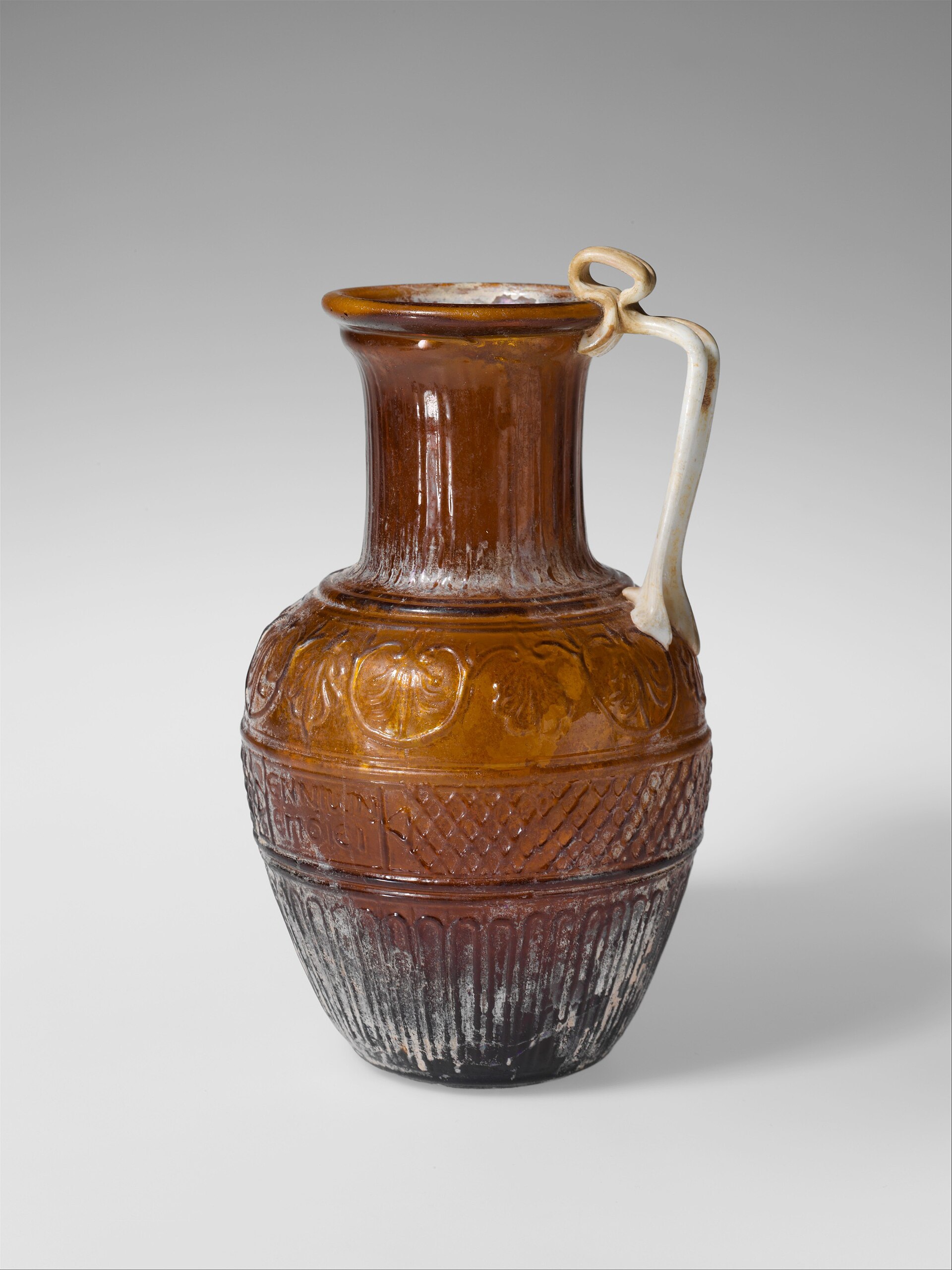
The jug described in this record, accession 17.194.226. Blown in a four-part mold; the handle, in opaque white glass, is unique among the twenty-six signed Ennion vessels in the standard modern catalogue.
| Artist | Ennion |
|---|---|
| Date | 1st half of the 1st century CE (c. AD 1-50) |
| Medium | Glass, blown in a four-part mold; handle applied in opaque white glass |
| Dimensions | 18.4 x 10.6 cm (7 1/4 x 4 3/16 in.); diameter at rim 7 cm (2 3/4 in.) |
| Where it is now | The Metropolitan Museum of Art, New York, Gallery 166 (Greek and Roman galleries)last confirmed |
| Inventory number | 17.194.226 |
| Attribution | AcceptedThe attribution of this jug to Ennion is not in question: his name is cast in relief into the glass itself, as part of the mold, in the same way on every vessel blown from that mold. Full note |
| Object type | Glass |
| Period | Roman, Early Imperial, Julio-Claudian |
| Cases | Has a provenance gap |
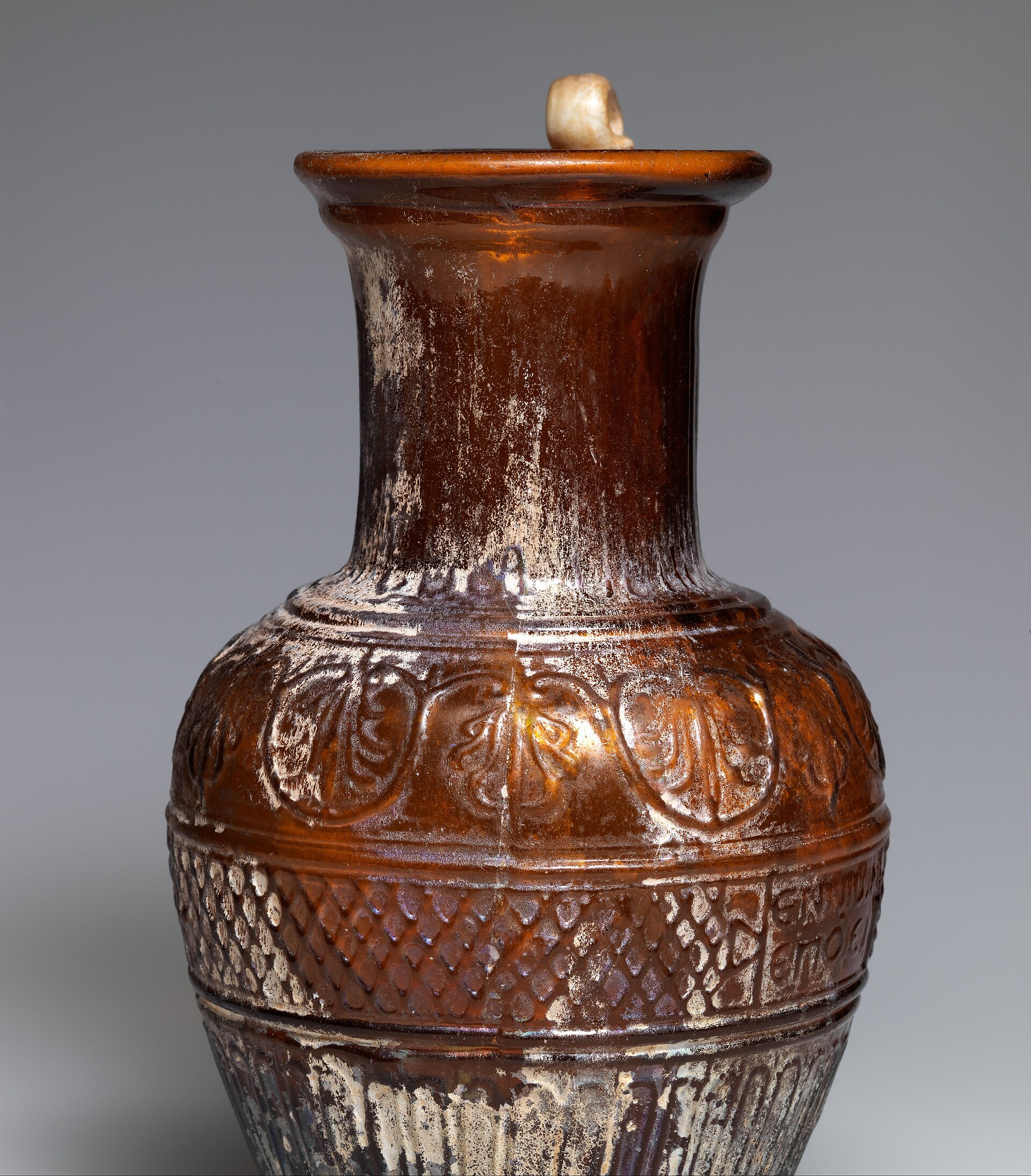
| Inscriptions | ENNIWN EPOIEI (Latin-letter transliteration of the Greek original: "Ennion made [it]"), in two lines within a tabula ansata cast in relief on the body, as part of the mold design |
| Owners on record | 6 links5 documented, 1 unknown |
| Sources | 7 cited |
About this record Last verified · 7 sources cited · Change log
On this page 9 sections
ContentsClose
A small amber-brown glass jug blown into a mold that carried, as part of its own design, the name of the man who made it: ENNIWN EPOIEI, "Ennion made [it]," in Greek. Ennion worked in the middle decades of the first century AD, probably at Sidon on the Phoenician coast, at the exact moment mold-blowing was invented, and his signed vessels are the earliest branded manufactured objects to survive from antiquity in any quantity. This jug is one of only twenty-six relatively complete signed Ennion vessels known, and the only one on which the handle is made in a contrasting opaque white glass.
It passed through the nineteenth-century Paris collection of Julien Greau, was bought with that collection by J. Pierpont Morgan in 1913, and came to the Metropolitan Museum as Morgan's gift in 1917, where it has been on view for more than a century. Whether "Ennion" names one man working within his own lifetime or a workshop brand that outlived him is still argued by specialists; the archaeological evidence, including a fire-destroyed house in Jerusalem's Jewish Quarter that preserves a jug from the same mold family, points to a short, sharply bounded period of production and gives no support for the brand continuing for decades after any individual master's death.
Provenance
Each link is graded. Documented: a cited source supports it. Disputed: the identification is argued but not established. Unknown: no owner for that span, and the gap is not smoothed into a narrative. The grades in the glossary.
- c. AD 1-50 -Ennion's workshopdocumented
The maker's mark, ENNIWN EPOIEI, is cast in relief into the vessel as part of the mold design, identically on every vessel blown from that mold. The workshop is generally placed at Sidon, in Roman Syria, though the location is argued rather than documented; see the attribution note and narrative above.1
- - by 1895Unknown; a single undocumented claim of acquisition in Constantinopleunknown
No archaeological find-spot and no owner is documented between manufacture and the jug's appearance in a Paris collection by 1895. Wilhelm Froehner's 1903 catalogue records only a bare assertion that it had been acquired in Constantinople (ancient Byzantium, modern Istanbul), with no further detail.1
- by 1895 - 1913Julien Greau, Parisdocumented
In the glass collection of the Paris collector Julien Greau, catalogued in full, with an illustration of this jug, by Wilhelm Froehner in 1903.1
- 1913 - 1913J. Pierpont Morgan, New York and Londondocumented
Morgan bought the Greau glass collection in its entirety in 1913. No price for the collection, or for this jug individually, appears in the sources consulted. Morgan died later the same year.1
- 1913 - 1917J. Pierpont Morgan Jr.documented
Inherited on his father's death in 1913.1
- 1917 - presentThe Metropolitan Museum of Art, New Yorkdocumented
Given to the Museum in 1917 by J. Pierpont Morgan Jr., accession number 17.194.226. On permanent public display in Gallery 166 as of 2026.123
Technical evidence
| Attribution note | The attribution of this jug to Ennion is not in question: his name is cast in relief into the glass itself, as part of the mold, in the same way on every vessel blown from that mold. What is genuinely disputed among specialists is what the name identifies. Most working scholars (Donald Harden, Christopher Lightfoot, Yael Israeli) treat Ennion as a single historical master who owned and worked in a glass workshop, almost certainly at Sidon. The evidence for how long that workshop operated, whether it later moved to northern Italy, and whether the name continued to be used on molds after the death of the man who first cut them, is archaeological and inferential, not documentary, and is argued rather than settled. |
|---|---|
| Material | Translucent deep amber-brown glass, with the handle made separately in opaque white glass. The only signed Ennion vessel known to combine these two colors.1 |
| Dimensions | Height 18.4 cm (7 1/4 in.); diameter at rim 7 cm (2 3/4 in.); maximum diameter 10.6 cm (4 3/16 in.).13 |
| Technique | Blown in a four-part mold: three vertical sections for the neck and upper body, and a separate bowl-shaped mold for the lower body and base. The handle was applied by hand after the vessel left the mold. No pontil marks survive; the tool used to hold the vessel during finishing is not known.1 |
| Inscription | ENNIWN EPOIEI, in two lines within a tabula ansata, cast in relief as part of the mold. One of at least six inscription variants documented across the twenty-six-piece signed corpus; this jug carries the imperfect-tense form ("was making" or "made"), shared with six other signed jugs, as against the aorist form used on most of the signed cups.1 |
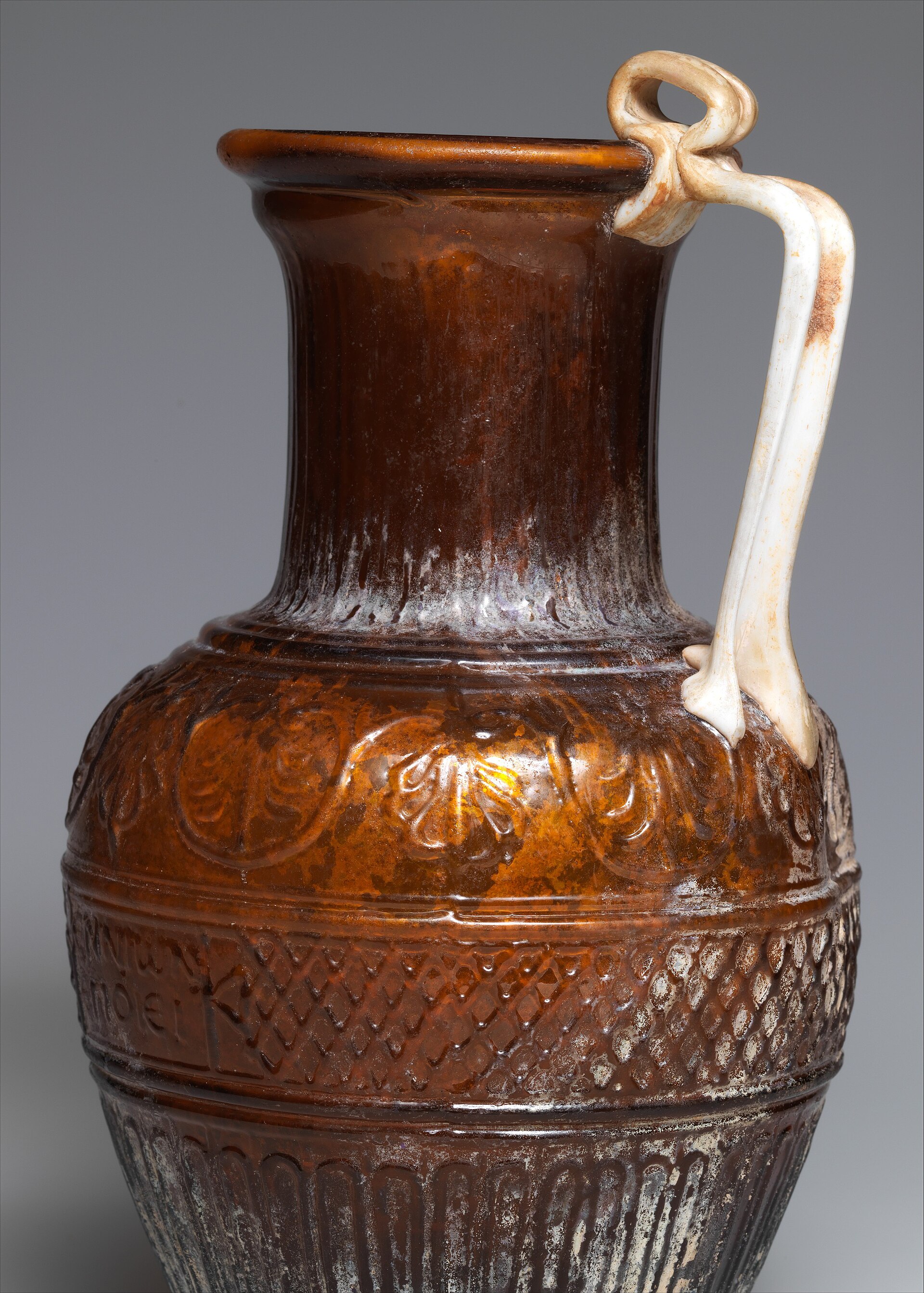
| Decoration | Four horizontal registers divided by raised ridges: vertical fluting on the neck; a continuous frieze of alternating downturned palmettes on the shoulder and upper body; a net pattern of interlocking lozenges around the middle of the body, interrupted by the inscribed tabula ansata; further vertical fluting on the lower body. A small deep kick with a central knob on the underside of the base.1 |
| Condition | Intact. Slight dulling and pitting, a shallow indent in the body near the handle, and patches of creamy weathering and iridescence. No restoration to the body or handle.1 |
| Chemical composition | Not analyzed. The Metropolitan's 2014-15 scientific research programme, using SEM-EDS/WDS, tested two of the Museum's three signed Ennion vessels; this jug, being intact, was excluded because sampling requires an existing broken edge.1 |
| Mold classification | Harden's type A.4.i: a four-register jug design without a pedestal foot, one of two mold families used for Ennion's signed closed vessels. The related type A.4.ii, used for the footed jugs including the example in the Corning Museum of Glass, shares the same register scheme but adds a separately molded foot.1 |
| Current display | On permanent public view, Metropolitan Museum of Art, Gallery 166, Greek and Roman galleries.23 |
Images
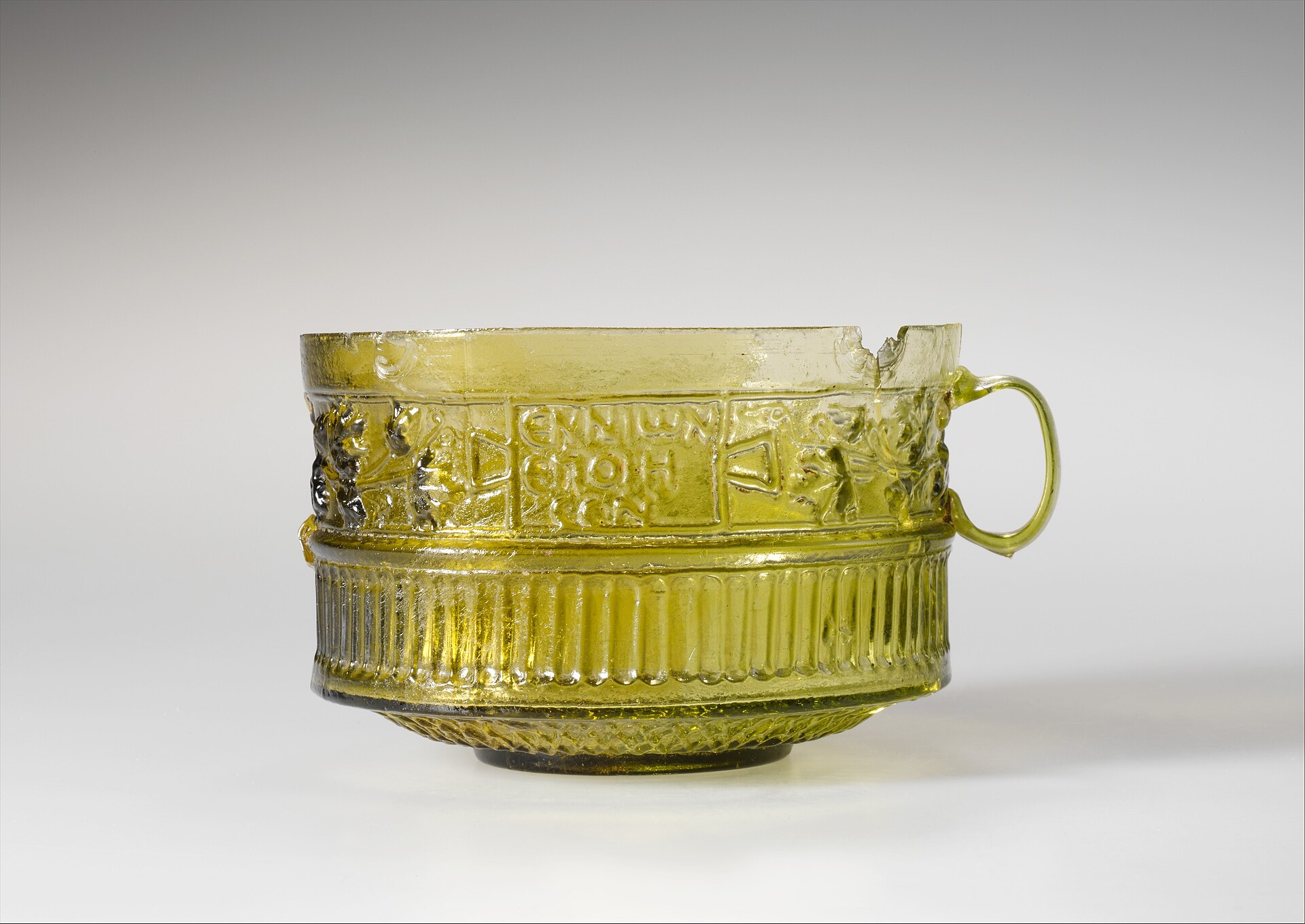
The record in full
Chapter 1What it is
A one-handled jug of translucent deep amber-brown glass, 18.4 centimeters tall, with an outsplayed rim, a cylindrical neck, a piriform body, and a flat bottom.
A one-handled jug of translucent deep amber-brown glass, 18.4 centimeters tall, with an outsplayed rim, a cylindrical neck, a piriform body, and a flat bottom. The neck carries vertical fluting; the shoulder and upper body carry a continuous floral frieze of alternating palmettes; the middle of the body is filled with a net pattern of interlocking lozenges, broken on one side by a rectangular tabula ansata containing the two-line inscription; the lower body returns to vertical fluting. Every element of that decoration, including the inscription, was built into the mold and appears identically on every vessel blown from it.
The handle is the detail that sets this jug apart from every other signed Ennion vessel known. It was applied by hand after the body came out of the mold, using two ribs of glass drawn up from the shoulder and folded over the rim, and it is made in opaque white glass against the translucent amber-brown body. Opaque white shows up elsewhere on early Roman glass, as a casing layer on cameo vessels and as trailed decoration on free-blown perfume bottles, but among the vessels that carry Ennion's signature this is the only one on which it was used for a handle.
Chapter 2How a jug like this was made
Mold-blowing was new when this jug was made.
Mold-blowing was new when this jug was made. A bubble of hot glass on the end of a blowpipe was inflated inside a container that had been shaped and carved, usually in fired clay, with the vessel's design cut in reverse on its inner walls; as the glass pushed outward it took on the shape and the pattern, including any inscription, in a single motion. The technique had only become possible once glassblowing itself was invented in the first century BC, and mold-blowing followed within a few decades.
Ennion's jugs were built in a four-part mold: three vertical sections wrapped around the neck and upper body, and a separate bowl-shaped section for the lower body and base. The two halves were removed and the glass, still hot, was given its foot and handle by hand before it went into the annealing oven. No pontil marks survive on the base of any signed Ennion jug, which means the vessel was transferred from the blowpipe by some kind of clamp rather than a solid punty rod; no such tool has survived, and how the transfer was actually done is not known. What is documented is the quality of the result: Ennion's mold-cutting concealed its own seams inside the vertical flutes and palmette borders so effectively that later mold-makers copied the trick.
Chapter 3Who Ennion was
Almost nothing is known about Ennion the person.
Almost nothing is known about Ennion the person. His name is not Greek and not Roman; it is thought to render a Semitic original, and the only other ancient attestation of it belongs to a builder recorded at Damascus in the third century AD. He is traditionally placed at Sidon, on the Phoenician coast in the Roman province of Syria, a city Pliny the Elder singled out twice in his Natural History as a historic center of glass production, writing of "Sidon, the producer of glass" and "Sidon, once famed for its glass workshops." Unlike his named contemporaries Aristeas, Jason, Meges, and Neikais, all of whom bear Greek names, Ennion did not adopt Roman-style nomenclature and shows no sign of coming from a Hellenized family; he was, in Christopher Lightfoot's phrase, a provincial with no great pretensions who was nonetheless successful enough to have his molds cut with his name in the language of eastern Mediterranean trade.
No document fixes his birth or death. Lightfoot's inference, offered explicitly as inference and not as record, is that Ennion was born sometime under Augustus, between 27 BC and AD 14, and that ordinary Roman-era life expectancy makes it unlikely he lived much past fifty.
Chapter 4One master, or a name that outlived him
This is the real scholarly question behind the signature, and it has not been settled.
This is the real scholarly question behind the signature, and it has not been settled. The inscription itself only says that Ennion made the piece; it does not say whether "Ennion" refers to the person who cut the mold, the owner of the workshop who employed a mold-cutter, or simply the glassblower who used it, and Lightfoot treats the distinction as largely academic given how small ancient glass workshops are known to have been, compared with a large operation such as the Arretine pottery works at Arezzo, where a factory owner's stamp and an individual worker's stamp could appear separately on the same vessel. His conclusion, stated plainly rather than left open, is that Ennion was very probably both the owner of the workshop and its leading craftsman, because it is improbable that anyone but a proficient glassblower would have been entrusted with cutting molds for a technique that was still experimental at the time.
What the object record does not support is a long afterlife for the brand once the man was gone. No securely dated find of a signed Ennion vessel, or of glass signed by any of his four named contemporaries, has been identified in a second-century context anywhere in the empire. The latest firm archaeological date for the type is AD 70, the year a large house in Jerusalem containing a jug from the same mold family as this one burned during the Roman siege of the city. Production, on the evidence available, was compressed into a few decades in the second quarter of the first century AD, not stretched across generations of successors trading on an inherited name. That evidence argues against a workshop brand that ran on for decades after Ennion's death, though it cannot rule out molds being copied or reused by others within his own working lifetime or shortly after it.
Chapter 5Sidon, or Sidon and Aquileia
Where the workshop physically stood is argued on the strength of find-spots, and the two halves of the evidence point in different directions.
Where the workshop physically stood is argued on the strength of find-spots, and the two halves of the evidence point in different directions. Donald Harden's original 1935 study proposed that Ennion made his jugs in Sidon, because most of the recorded jug find-spots cluster in the eastern Mediterranean, and that he later opened, or his products reached, a second workshop near Aquileia in northern Italy to account for the striking concentration of signed cups found in graves there. Lightfoot's 2014 study reports that later scholarship has questioned this two-workshop model and raised the possibility that all of Ennion's vessels, jugs included, were made in a single eastern workshop and simply traded west, since no kiln site associated with glassworking, let alone one linked specifically to Ennion, has ever been excavated at either Sidon or Aquileia.
Lightfoot offers one argument of his own in favor of a single eastern workshop that never relocated: every inscription on every signed Ennion vessel, wherever it was found, is in Greek, never Latin, even though a majority of the well-preserved cups were recovered from graves in northern Italy, a Latin-speaking region where a maker who had actually moved his business would have had an obvious commercial reason to cut new molds in Latin. That he never did so, in Lightfoot's reading, is a stronger argument for a workshop that stayed in the Greek-speaking East and let merchants carry its goods west than any pattern in the find-spots themselves can offer on their own.
Chapter 6The inscription, and what this jug does not say
Six variant forms of Ennion's own signature are known across the corpus, differing in wording, spelling, and layout; this jug carries what specialists label type A, the form used on this and six...
Six variant forms of Ennion's own signature are known across the corpus, differing in wording, spelling, and layout; this jug carries what specialists label type A, the form used on this and six other signed jugs and several cups: ENNIWN EPOIEI, using the imperfect tense of the Greek verb "to make." Most of the other variants use the aorist tense instead, EPOIHSEN, and Lightfoot states directly that why the tense changes between molds, and what if anything that change was meant to signify, is not understood.
A second inscription, found only on some of Ennion's cups, invokes the buyer rather than the maker, in a Greek phrase that has been read two contradictory ways by different translators: as an active wish, "may he remember," or as a passive one, "may he be remembered." Donald Harden argued for the passive sense and linked it to a Semitic blessing formula. This jug, and every closed vessel of its type, does not carry that inscription at all. Its only inscribed content is the two-word maker's mark, framed in a tabula ansata, a rectangular tablet-with-handles device the Romans used elsewhere for votive plaques, military standards, and honorific inscriptions. Lightfoot argues, as a specific and citable claim rather than a settled fact, that the choice of that particular frame for a maker's trademark was itself a deliberate gesture toward Roman commercial and political authority, mirroring in glass what Arretine pottery stamps were already doing in clay. The jug carries no mythological, votive, or funerary imagery of its own; its decorative programme is Ennion's trademark and nothing else, and that plainness is itself the finding, not an oversight.
Chapter 7Dating the corpus
No signed Ennion vessel carries a date. What dates the type is the archaeological context in which examples have been found: fragments from a securely Tiberian-to-Claudian layer at Kempten in Raetia...
No signed Ennion vessel carries a date. What dates the type is the archaeological context in which examples have been found: fragments from a securely Tiberian-to-Claudian layer at Kempten in Raetia, fragments tied to a coin of Caligula at Corinth, a cup found with a coin of Claudius dated AD 46 at Caresana in Italy, and fragments from military sites in Roman Dalmatia dated to the reign of Claudius. Marianne Stern's independent argument, from mold sequences and literary evidence, that mold-blowing itself began around AD 13 sets the earliest plausible boundary for the whole technique, Ennion included.
The clearest single data point is the jug recovered from the ruins of a mansion in Jerusalem's Jewish Quarter, made in the same mold family as this piece and as the Corning and Tel Aviv jugs, which was broken and distorted by the fire that destroyed the building when Rome captured the city's Upper City in AD 70. Because no signed Ennion vessel, and no vessel by any of his four named contemporaries, has been dated to a context later than that, the working span usually given for the type is roughly AD 30 to 70: a single, short-lived phenomenon rather than an industry that renewed itself across decades.
Chapter 8Where Ennion's glass has turned up
The twenty-six relatively complete signed vessels catalogued by Lightfoot in 2014, together with the fragments recorded separately, have been found from Spain to the Crimea: a beaker at Cadiz, an...
The twenty-six relatively complete signed vessels catalogued by Lightfoot in 2014, together with the fragments recorded separately, have been found from Spain to the Crimea: a beaker at Cadiz, an amphora from a tomb at Panticapaeum in the Crimea excavated in 1852, cup fragments from Athens, Corinth, and sites across Roman Dalmatia associated with army veterans, a hexagonal flask said to be from Cyprus, jugs and jug fragments from Jerusalem, and a heavy concentration of cups from graves in northern Italy around Aquileia and Adria. No piece of Ennion's glass has ever been recorded at Rome itself, or at Pompeii or the other sites buried by Vesuvius in AD 79, a gap Lightfoot calls surprising given how obvious a market either city would seem to offer.
This specific jug has no excavated find-spot at all. Its documented history begins only when it surfaces in a nineteenth-century Paris collection with an undocumented claim that it had been acquired in Constantinople; unlike the Jerusalem jug or the Italian tomb finds, it carries no archaeological context of its own to help fix where it was used or how it was lost.
Chapter 9From Constantinople, if the claim holds, to Fifth Avenue
The earliest reference to this jug is a bare assertion, recorded by the dealer and cataloguer Wilhelm Froehner in 1903, that it had been acquired in Constantinople; nothing beyond that claim...
The earliest reference to this jug is a bare assertion, recorded by the dealer and cataloguer Wilhelm Froehner in 1903, that it had been acquired in Constantinople; nothing beyond that claim documents its whereabouts before then. By 1895 it belonged to Julien Greau, a Paris collector whose glass Froehner catalogued in full in 1903, illustrating this jug with a hand-colored engraving. In 1913 J. Pierpont Morgan bought Greau's glass collection in its entirety; Morgan died the same year and the jug passed to his son, J. Pierpont Morgan Jr., who gave it to the Metropolitan Museum in 1917 along with the rest of his father's Greau glass. It has been at the Museum ever since and is currently on view in Gallery 166.
No purchase price for the jug individually, or for the Greau collection as a whole, appears in the sources consulted for this record. What the documented chain does establish is a continuous, gap-free ownership history running back more than a century, to a moment before Ennion was widely known outside a small circle of specialist collectors: Froehner's 1903 catalogue entry is one of the earliest substantial discussions of any Ennion vessel in print, predating by more than a decade the first English-language survey of Ennion's work, published by Donald Harden in 1935, on which nearly all subsequent scholarship, including Lightfoot's, is built.
Chapter 10The catalogue history
Few ancient objects this size carry as continuous a published record.
Few ancient objects this size carry as continuous a published record. Froehner's 1903 catalogue of the Greau collection describes and illustrates it; Luigi Conton in 1906 and Anton Kisa, in his 1908 three-volume Das Glas im Altertume, the first attempt at a comprehensive study of ancient glass, both discuss it; Gisela Richter, the Metropolitan's own curator of classical art, publishes it in 1911 and again in 1938; Michael Rostovtzeff includes it in 1914; Gustavus Eisen catalogues it in 1927; Donald Harden's foundational 1935 survey of Ennion's work assigns it catalogue number A.4.i.a; and it recurs in exhibition and survey literature through the twentieth century and into Lightfoot's own 2014 catalogue, where Lightfoot cites his own earlier discussion of the piece from a 2001 essay. At no point across that century of publication has its attribution to Ennion, or its identification as the type A.4.i mold variant, been seriously disputed; what has accumulated instead is more precise technical description with each successive study, from Froehner's engraving to Lightfoot's 2014 mold-seam photography.
Chapter 11Ennion's rivals, his successors, and a correction
Ennion is one of only five named makers whose signatures survive on ancient mold-blown tableware.
Ennion is one of only five named makers whose signatures survive on ancient mold-blown tableware. His closest rival was Aristeas, known from just two complete vessels plus fragments excavated at Roman military sites in Dalmatia, whose forms and inscriptions are similar enough to Ennion's that Lightfoot suggests the two may have worked in proximity to one another; Aristeas signed some of his pieces with the added epithet "the Cypriot." Jason and Meges are known from a small number of signed beakers found from Beit Shean to Cyprus. A larger, cruder body of unsigned mold-blown glass, made throughout the second half of the first century AD in imitation of Ennion's patterns but never approaching his technical standard, followed once the fashion he had set became general.
One correction is worth making explicitly, because loose references to "Ennion pieces" at various American museums circulate online without checking the primary catalogue. The Toledo Museum of Art does hold a signed piece of first-century mold-blown glass, a beaker recorded as found near Beroea (modern Aleppo) in Syria, but its signature reads NEIKAIC EPOHSEN: it is signed by Neikais, not by Ennion, and Lightfoot's catalogue explicitly notes that Neikais's workshop was a distinct, and by his assessment inferior, operation working at the same period as Ennion's or slightly later. Toledo's example is a genuine and well-documented piece of the same broader phenomenon of signed Roman mold-blown glass that Ennion pioneered; it is not a signed Ennion vessel, and should not be catalogued as one.
Chapter 12Forgery, and what has never been tested
Ennion's reputation attracted imitators even in antiquity, in the form of unsigned wares copying his patterns, and in the modern era it has attracted outright forgeries, some reportedly cast from...
Ennion's reputation attracted imitators even in antiquity, in the form of unsigned wares copying his patterns, and in the modern era it has attracted outright forgeries, some reportedly cast from molds taken as impressions of genuine ancient pieces. Style and technical execution remain the primary tools for separating the two, because as of the Museum's 2014 research programme, only four pieces of glass either signed by or attributed to Ennion had ever been subjected to full compositional analysis anywhere, and no comprehensive study of the chemical composition of the signed corpus as a whole has been undertaken.
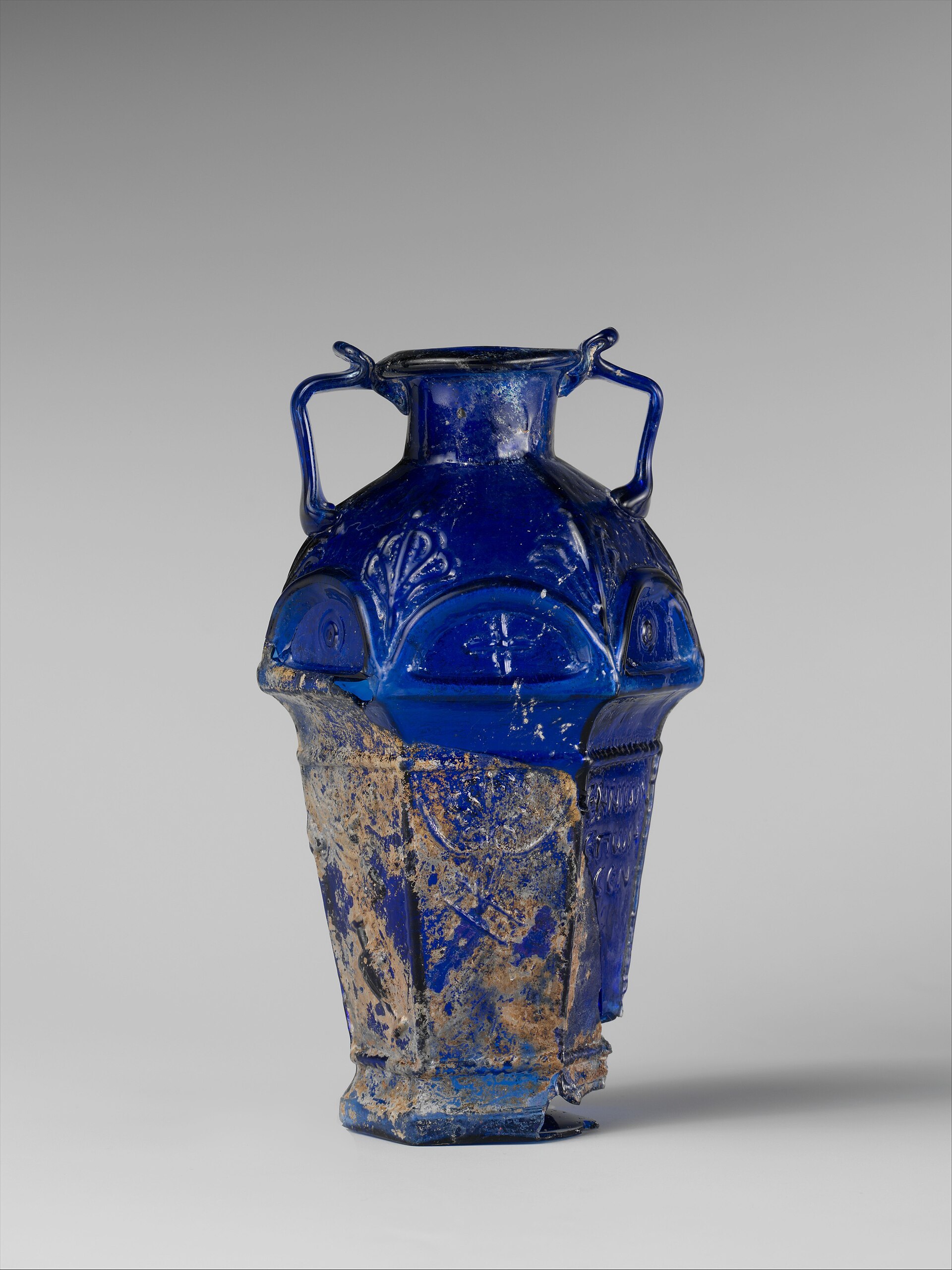
The Metropolitan's own 2014 scientific study, carried out by research scientist Mark Wypyski using scanning electron microscopy with energy- and wavelength-dispersive X-ray spectrometry, analyzed two of the Museum's three signed Ennion vessels, the hexagonal flask (accession 81.10.224) and the two-handled cup (accession 17.194.225), and found both to be a low-magnesia, low-potash soda-lime-silica glass typical of the Mediterranean world in this period, colored respectively with cobalt and by trace iron oxide. This jug, accession 17.194.226, was excluded from that study for the simplest of reasons: it is intact, and the analysis required a sample taken from an existing broken edge. It has never been chemically tested.
Chapter 13On view now
The jug is on permanent public display at the Metropolitan Museum of Art, in Gallery 166 among the Museum's Greek and Roman holdings, alongside the Museum's other two signed Ennion vessels.
The jug is on permanent public display at the Metropolitan Museum of Art, in Gallery 166 among the Museum's Greek and Roman holdings, alongside the Museum's other two signed Ennion vessels. It last appeared as a lead object in the Museum's own major monographic treatment of the maker, the exhibition and accompanying catalogue Ennion: Master of Roman Glass, shown at the Metropolitan from December 2014 to April 2015 before traveling to the Corning Museum of Glass, the first exhibition anywhere devoted solely to Ennion's work.
The artist
Ennion
Ennion is known only from the two words cast into his own glass. No ancient text mentions him by name, no portrait or inscription outside his own products records him, and no document fixes when he was born or died. Everything said about him, including his likely home city and his probable dates, is reconstructed from where his signed vessels have been found and what their molds can be made to reveal about workshop practice. That reconstruction is unusually well evidenced for an ancient craftsman precisely because he chose, uniquely for his time, to put his name on every object he made.
Related works
| Work | Relation | Where it is |
|---|---|---|
| One-handled jug signed by Ennion Ennion | Same broad four-register mold family (Harden's type A.4) as this jug, but the footed variant, type A.4.ii. The closest formal parallel to this piece. From the Ray Winfield Smith collection; on loan to the Metropolitan Museum of Art from 1936 to 1957 before Corning acquired it in 1959. No verified public-domain photograph of this specific object was located on Wikimedia Commons for this record; see notes_for_editor. | Corning Museum of Glass, Corning, New York (accession 59.1.76) |
| Jug signed by Ennion, from the Jewish Quarter, Jerusalem Ennion | Made in the same footed-jug mold group as the Corning and Tel Aviv jugs; found broken in the ruins of a mansion burned during the Roman capture of Jerusalem in AD 70, the single clearest dated archaeological context for this vessel type. | Israel Antiquities Authority, on exhibition at the Israel Museum, Jerusalem (1982-1105) |
| Jug signed by Ennion Ennion | Cobalt blue; the only signed Ennion jug known to survive with its original pedestal foot intact. Said to come from Jerusalem. | Eretz Israel Museum, Tel Aviv (MHG1200.58) |
| Cup signed by Ennion Ennion | Purchased from the excavator and dealer Luigi Palma di Cesnola in 1876, said to be from Tremithus, Cyprus. One of the earliest signed Ennion vessels to enter a public museum collection. | British Museum, London (GR 1876.11-14.4) |
| Hexagonal flask and two-handled cup signed by Ennion Ennion | The Metropolitan Museum's other two signed Ennion vessels, forming a group of three with this jug. Both were sampled in the Museum's 2014 chemical analysis; this jug was not, because it is intact. | Metropolitan Museum of Art, New York (accessions 81.10.224 and 17.194.225) |
| Bowl signed by Aristeas Aristeas, called 'the Cypriot' | Ennion's closest documented rival among the five named makers of signed mold-blown glass; forms and inscriptions similar enough that the two may have worked in proximity to one another. | Various collections; two complete vessels survive, plus fragments from Roman Dalmatia |
| Beaker signed by Neikais Neikais | Included here specifically to correct a recurring conflation: this is the signed antique mold-blown glass held by the Toledo Museum of Art, and it is signed by Neikais, not by Ennion. Lightfoot's catalogue describes Neikais's workshop as distinct from, and technically inferior to, Ennion's, operating in the same period or slightly later. | Toledo Museum of Art (inventory 1930.5), said to be from Beroea (modern Aleppo), Syria |
Open questions
- Where was this jug before it appears in the Julien Greau collection by 1895? The only claim on record, that it was acquired in Constantinople, rests on a single line in Wilhelm Froehner's 1903 catalogue and is not independently documented.
- Was Ennion's workshop ever active outside Sidon? The case for a second workshop near Aquileia rests entirely on the western distribution of surviving cups, and no kiln site linked to glassworking, let alone specifically to Ennion, has been excavated at either location.
- Did molds bearing Ennion's name continue to be used after the death of the individual who first cut them? No securely dated find later than AD 70 has been identified for the signed corpus, but the corpus has never been systematically tested to establish whether all inscribed pieces share a single glass recipe consistent with one workshop and one period.
- Why does the maker's inscription shift between the imperfect tense used on this jug and the aorist tense used on most signed cups? Lightfoot states directly that the reason is not understood.
- What does the companion inscription found on some Ennion cups, invoking the buyer, actually mean? It has been read both as an active wish and as a passive one by different translators, and in any case this jug does not carry that inscription; it carries only the maker's mark.
- What price, if any, did J. Pierpont Morgan pay for Julien Greau's glass collection in 1913, and what portion of it might reasonably be attributed to this jug? No figure appears in the sources consulted for this record.
- Has this specific jug ever been chemically analyzed? The Metropolitan's 2014-15 scientific study tested two of its three signed Ennion vessels; this one, being intact, was not sampled, and no comprehensive compositional study of the wider signed Ennion corpus has been undertaken anywhere.
Questions about this object
What is Jug Signed by Ennion?
Jug Signed by Ennion is a glass, dated 1st half of the 1st century CE (c. AD 1-50). Medium: Glass, blown in a four-part mold; handle applied in opaque white glass.
Who made Jug Signed by Ennion, and is the attribution settled?
The attribution to Ennion is recorded here as accepted. The attribution of this jug to Ennion is not in question: his name is cast in relief into the glass itself, as part of the mold, in the same way on every vessel blown from that mold. What is genuinely disputed among specialists is what the name identifies. Most working scholars (Donald Harden, Christopher Lightfoot, Yael Israeli) treat Ennion as a single historical master who owned and worked in a glass workshop, almost certainly at Sidon. The evidence for how long that workshop operated, whether it later moved to northern Italy, and whether the name continued to be used on molds after the death of the man who first cut them, is archaeological and inferential, not documentary, and is argued rather than settled.
Where is Jug Signed by Ennion now?
The Metropolitan Museum of Art, New York, Gallery 166 (Greek and Roman galleries). Inventory number 17.194.226. Last confirmed 13 August 2026. Gift of J. Pierpont Morgan, 1917; on permanent public display.
What is still unknown about Jug Signed by Ennion?
Where was this jug before it appears in the Julien Greau collection by 1895? The only claim on record, that it was acquired in Constantinople, rests on a single line in Wilhelm Froehner's 1903 catalogue and is not independently documented.
Sources
- 1Christopher S. Lightfoot, with contributions by Zrinka Buljevic, Yael Israeli, Karol B. Wight, and Mark T. Wypyski, Ennion: Master of Roman Glass (New York: The Metropolitan Museum of Art, 2014; distributed by Yale University Press). Catalogue of the exhibition held at the Metropolitan Museum of Art, December 9, 2014 - April 13, 2015. Cited throughout for the catalogue entry, provenance, technical description, and condition report of cat. no. 1 (this jug), the essays by Lightfoot ('Ennion and the History of Ancient Glass'), Wight ('The Mold-Blowing Process'), Israeli ('The Ennion Jug from Jerusalem'), and Buljevic ('Ennion and Aristeas Glassware Found in the Roman Province of Dalmatia'), the appendix by Wypyski ('Scientific Analysis of Two Vessels Signed by Ennion'), the List of Find-Spots, and the Concordance. resources.metmuseum.org/resources/...
- 2The Metropolitan Museum of Art, Collection Online, 'Glass jug' (Ennion jug), accession 17.194.226. metmuseum.org/art/...
- 3The Metropolitan Museum of Art, Collection API, object record 249470 (accession, dimensions, gallery location, image files). collectionapi.metmuseum.org/public/...
- 4The Metropolitan Museum of Art, Collection Online, 'Glass cup' (Ennion cup), accession 17.194.225. metmuseum.org/art/...
- 5The Metropolitan Museum of Art, Collection Online, 'Glass hexagonal amphoriskos' (Ennion flask), accession 81.10.224. metmuseum.org/art/...
- 6Wikimedia Commons, file and license metadata () for the Metropolitan Museum's donated CC0 photography of accessions 17.194.226, 17.194.225, and 81.10.224, consulted to verify public-domain status before use. commons.wikimedia.org/wiki/...
- 7Wikipedia, 'Ennion'. Israeli's other publications) if this record is expanded further. en.wikipedia.org/wiki/...
Last verified · Published
Change log
13 August 2026 - Record created at the house standard: researched narrative, technical evidence, maker dossier, graded provenance chain, prices with hammer and premium separated, related works, open questions and sources.