Folio from the "Blue Qur'an"
Unknown workshop, probably North Africa (attribution disputed) · second half 9th century - mid 10th century CE (Metropolitan Museum dating; c. 850-950); disputed, see narrative
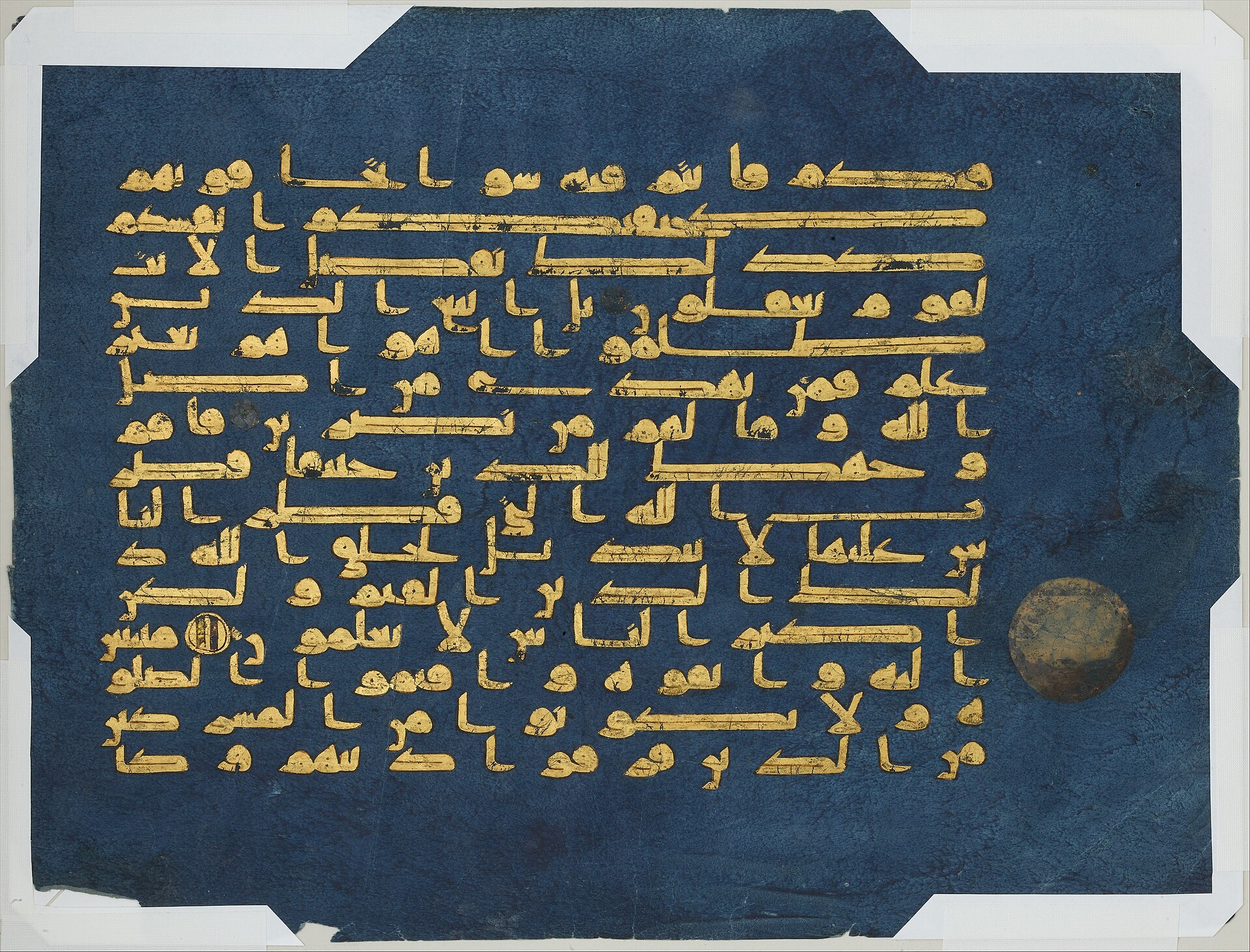
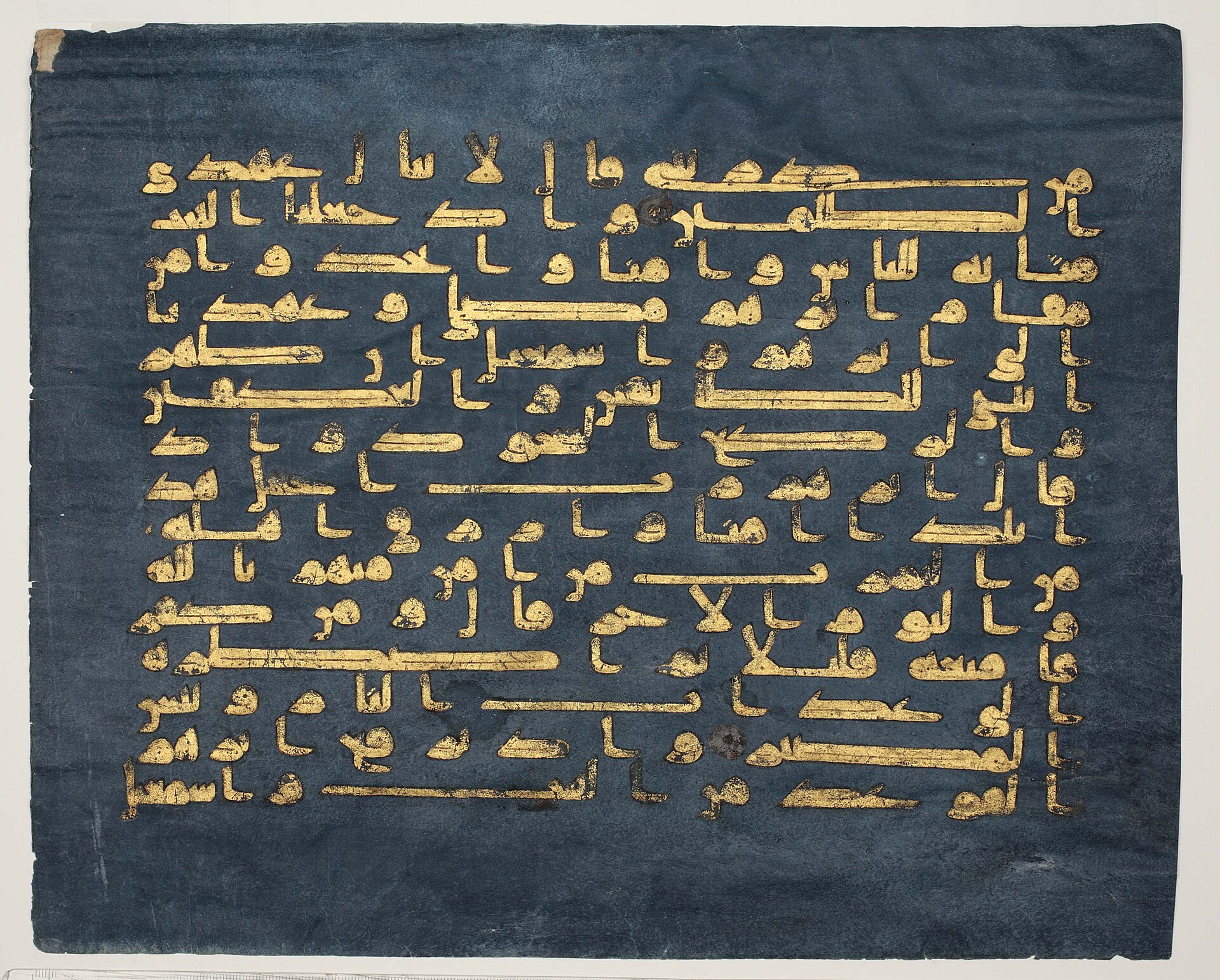
The record subject, photographed by the Metropolitan Museum of Art and released under its Open Access policy. Gold and silver on indigo-dyed parchment, 30.4 x 40.2 cm, second half 9th - mid 10th century.
| Artist | Unknown workshop, probably North Africa (attribution disputed) |
|---|---|
| Date | second half 9th century - mid 10th century CE (Metropolitan Museum dating; c. 850-950); disputed, see narrative |
| Medium | Gold and silver on indigo-dyed parchment |
| Dimensions | 30.4 x 40.2 cm (11 15/16 x 15 13/16 in.) |
| Where it is now | Metropolitan Museum of Art, New York, Department of Islamic Artlast confirmed |
| Inventory number | 2004.88 (object ID 454662) |
| Attribution | DisputedNo scribe, illuminator or patron is named on any known leaf of the Blue Qur'an, and no colophon survives. Full note |
| Object type | Manuscript |
| Period | Early Islamic North Africa (disputed attribution; see narrative) |
| Cases | Disputed attribution · Has a provenance gap |
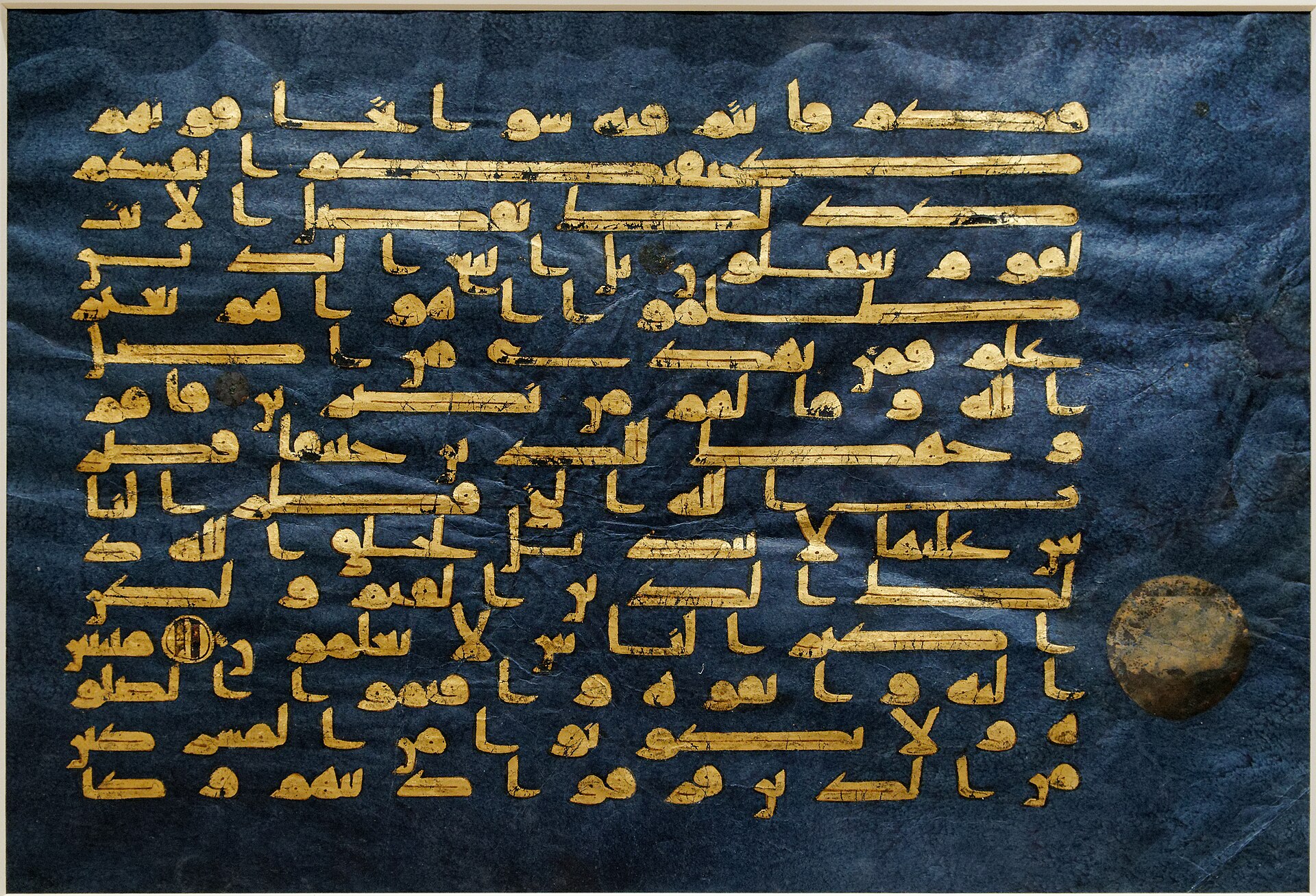
| Inscriptions | Qur'an, Sura 30 (al-Rum), verses 28-32, in gold Kufic script without diacritical marks; verse and group divisions marked with silver rosettes/medallions. |
| Owners on record | 5 links2 documented, 2 disputed, 1 unknown |
| Sources | 18 cited |
About this record Last verified · 18 sources cited · Change log
On this page 9 sections
ContentsClose
A single leaf, gold and silver Kufic script on indigo-dyed parchment, cut at an undocumented point from a once-bound multi-volume Qur'an now known only as the Blue Qur'an. The Metropolitan Museum's own catalogue hedges the leaf's origin as "possibly Qairawan, Tunisia", and that hedge is the honest state of the field: at least six named scholars have argued for six different combinations of date and place, from early ninth-century Baghdad to tenth-century Umayyad Spain, and none has settled the question.
What is documented is narrower and, in its way, more striking. The original manuscript, reconstructed as seven volumes of roughly 600 folios, required the parchment of at least 150 sheep and the work of several identifiable scribal hands, luxury production on a scale that every competing theory agrees points to a ruling court as patron. Most of it stayed in the library of the Great Mosque of Qairawan, recorded there in a 1294 inventory, until Tunisia's 1967 nationalisation of religious endowments sent the bulk of the surviving leaves to what is now the Raqqada National Museum of Islamic Art, still the largest single holding. This leaf was not among them: it surfaces in the documentary record only in London, with the dealer Sam Fogg, by 2002, more than eleven centuries after its probable making, and was purchased by the Metropolitan Museum in 2004. Everything in between is unknown, and this record says so.
Other leaves from the same manuscript have gone to auction repeatedly since 2010, for hundreds of thousands of pounds apiece, completing, sale by sale, a dispersal that began somewhere in the manuscript's own past, itself only partly recovered.
Provenance
Each link is graded. Documented: a cited source supports it. Disputed: the identification is argued but not established. Unknown: no owner for that span, and the gap is not smoothed into a narrative. The grades in the glossary.
- second half 9th century - mid 10th century (disputed range)Unknown patron and workshopdisputed
The Metropolitan Museum dates the leaf to the second half of the 9th to mid 10th century and gives its findspot as "possibly Qairawan, Tunisia". At least five other named scholarly positions place production anywhere from early Abbasid Baghdad or Fustat to Umayyad Cordoba to Aghlabid or Kalbid Sicily. No single position commands scholarly consensus. See narrative for the individual positions and who holds them.145678
- possibly from origin - by 1294 CE (693 AH)Great Mosque of Qairawan library (if the traditional attribution is correct)disputed
A 1294 CE inventory of the Great Mosque of Qairawan's library, published by Ibrahim Chabbouh in 1956, records a Qur'an written in gold on blue parchment. This is the strongest documentary link between the manuscript and Qairawan and the principal evidence behind Jonathan Bloom's attribution, but the identification of the inventory entry with this specific manuscript is an inference, not a stated identification in the source itself.46
- 1294 - 2002 (for this specific leaf)Unknownunknown
No owner, custodian, sale or publication record for this individual leaf has been identified between the 1294 inventory (itself of uncertain identification with this manuscript) and the point at which the London dealer Sam Fogg is documented holding it, by 2002. The broader manuscript's Tunisian custodial history in this period, continued library holding, 1967 nationalisation of habus endowments, 1983 transfer to Raqqada, is documented for the state collection as a whole but is not evidence for this specific leaf, which by 2002 was already in London and had therefore left Tunisia by some undocumented route and date, possibly as part of the wave of leaves that began leaving with F.R. Martin's pre-1912 Istanbul purchase, possibly later. This gap is recorded as a gap.14
- by 2002 - 2004Sam Fogg, London (dealer)documented
The Metropolitan Museum's own provenance note identifies Sam Fogg, the London dealer in medieval and Islamic art, as holding the leaf by 2002-2004, prior to its sale to the Museum.1
- 2004 - presentMetropolitan Museum of Art, New Yorkdocumented
Purchased by the Metropolitan Museum in 2004 using the Lila Acheson Wallace Gift, an acquisitions endowment named for the Reader's Digest co-founder and Museum benefactor. The purchase price has not been published in any source consulted for this record.1
Technical evidence
| Attribution note | No scribe, illuminator or patron is named on any known leaf of the Blue Qur'an, and no colophon survives. The traditional attribution places production at Qairawan (Kairouan), Tunisia, probably under Aghlabid or early Fatimid patronage in the 9th-10th century, resting chiefly on a 1294 inventory of the Great Mosque of Qairawan's library that records a Qur'an in gold on blue parchment. Named scholars have proposed at least five competing places and periods of production, from Abbasid Baghdad or Mashhad in the early 9th century to Umayyad Cordoba, and the dispute is unresolved. This record treats every specific claim of place and date as an attribution, not a fact. |
|---|---|
| Support | Parchment, dyed indigo blue before writing.14 |
| Dimensions | H. 30.4 cm (11 15/16 in.); W. 40.2 cm (15 13/16 in.).1 |
| Script | Kufic, angular and unpointed (no diacritical marks or vowel signs), laid out in a horizontal, oblong page format typical of the grandest early Qur'ans.1418 |
| Media | Lettering in gold leaf, outlined in a dark ink; verse and section divisions marked in silver (rosettes and medallions). The adhesive used to fix the gold is not established with certainty in the sources reviewed.14 |
| Textual content of this leaf | Qur'an, Sura 30 (al-Rum), verses 28-32, per the Wikimedia Commons cataloguing of the Metropolitan's own photograph of this leaf.3 |
| Classification | Codices (Metropolitan Museum of Art classification); the leaf was originally bound as part of a multi-volume manuscript, not created as a single sheet.1 |
| Scribal hands (manuscript-wide, not leaf-specific) | Alain George's 2009 codicological study identifies several distinct scribal hands across the surviving corpus (labelled by group, e.g. B.I, B.II, C.I, C.II, C.III, D.IV), indicating production by a workshop of several copyists rather than a single calligrapher. No source consulted identifies which hand produced this specific leaf.5 |
| Material scale of the original manuscript | The full manuscript, reconstructed by Jonathan Bloom as seven volumes of roughly 600 folios in total, is estimated to have required the parchment of at least 150 sheep.46 |
Images
The record in full
Chapter 1A single leaf from a manuscript that no longer exists as a book
This is one page, gold and silver script on indigo-dyed parchment, 30.4 by 40.2 centimetres, holding fifteen or so lines of Qur'anic text in an angular, unpointed Kufic hand: Sura 30, al-Rum, verses...
This is one page, gold and silver script on indigo-dyed parchment, 30.4 by 40.2 centimetres, holding fifteen or so lines of Qur'anic text in an angular, unpointed Kufic hand: Sura 30, al-Rum, verses 28 to 32. The Metropolitan Museum classifies it as a codex leaf, which is precise and also slightly misleading, because there is no longer a codex. The leaf was cut, at some undocumented point, from a bound multi-volume Qur'an now known only by the informal name given to it by scholars and dealers: the Blue Qur'an.
Nothing about this leaf is ordinary. Indigo-dyed parchment for a religious text was an extravagant and rare choice in any medieval tradition; gold leaf lettering compounded the cost; and the sheer size of the undertaking, discussed below, points to patronage on a scale few institutions of the ninth or tenth century could sustain. The Metropolitan Museum's own catalogue entry hedges its findspot with the word "probably": probably Qairawan, Tunisia. That single word carries the weight of more than a century of unresolved argument among specialists in early Islamic manuscripts, summarised later in this record.
Chapter 2The manuscript this leaf belonged to
The Blue Qur'an was, before its dispersal, one continuous work: a horizontal-format, oblong Qur'an written across what Jonathan Bloom has reconstructed, using the abjad letter-numeral sequence that...
The Blue Qur'an was, before its dispersal, one continuous work: a horizontal-format, oblong Qur'an written across what Jonathan Bloom has reconstructed, using the abjad letter-numeral sequence that marks section divisions within the surviving leaves, as seven original volumes. Estimates of the original leaf count run to roughly 600 folios for the complete text. Producing parchment at this scale and this size is estimated to have required the skins of at least 150 sheep, before a single letter was written or a page dyed.
Today only a fraction is known to survive: on the order of 100 leaves and bifolia, dispersed across public and private collections on several continents. The largest single group, and the group with the clearest institutional descent from the original library, is held by the Raqqada National Museum of Islamic Art near Kairouan, Tunisia, with some 67 folios. Other leaves are held by the Chester Beatty Library in Dublin, the Museum of Fine Arts in Boston, the Aga Khan Museum in Toronto, the Nasser D. Khalili Collection of Islamic Art in London, the Los Angeles County Museum of Art, the Seattle Art Museum, the David Collection in Copenhagen, the Zayed National Museum in Abu Dhabi, Qatar's national collections, and a number of private hands, in addition to this leaf at the Metropolitan Museum. No single institution holds anything close to a complete volume; what survives is a scattered census of individual pages, most first identified and published only after they had already left North Africa.
Chapter 3How the page was made
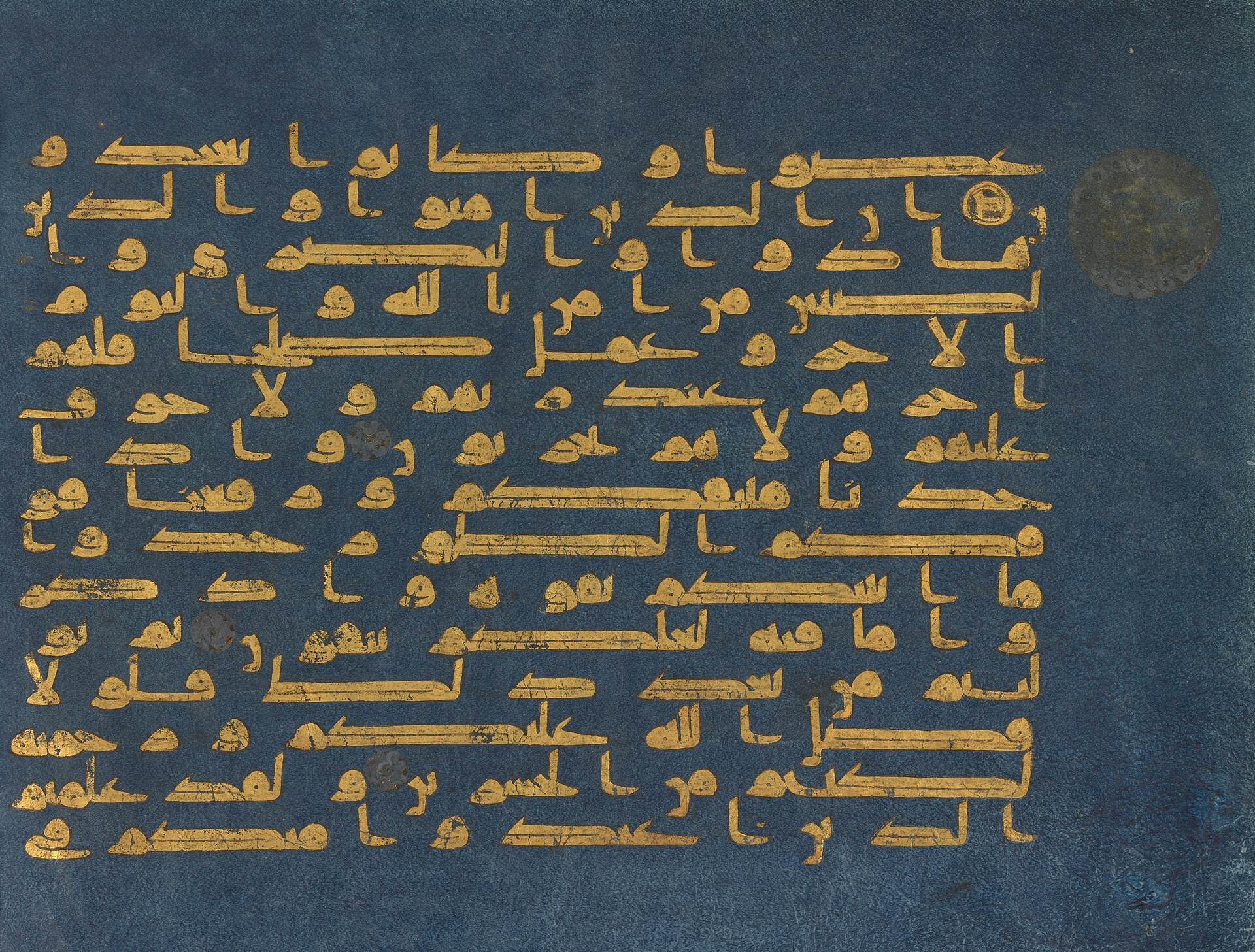
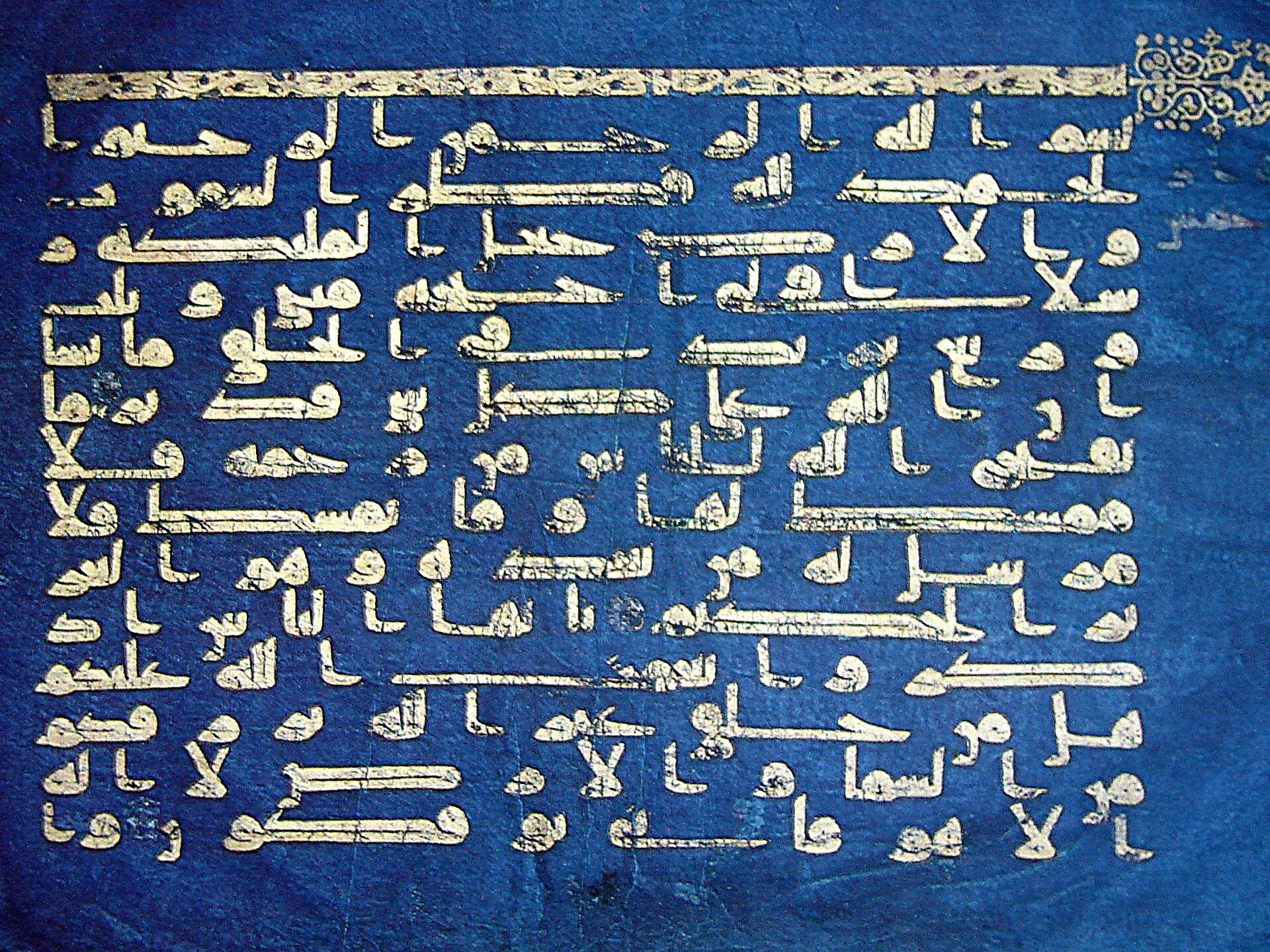
The script is Kufic: angular, without the diacritical dots (i'jam) or vowel signs that would later become standard, laid out with the horizontal emphasis typical of the grandest early Qur'ans.
The script is Kufic: angular, without the diacritical dots (i'jam) or vowel signs that would later become standard, laid out with the horizontal emphasis typical of the grandest early Qur'ans. The letters were built in gold leaf, outlined in a dark ink usually identified in technical literature on comparable manuscripts as iron-tannate based, though the adhesive used to fix the gold to the parchment surface is not established with certainty in the sources reviewed for this leaf and has been proposed variously as gum, egg white, or an animal-glue byproduct of parchment preparation. Verse endings and larger textual divisions were marked in silver: small rosettes or medallions, sometimes a roundel enclosing a letter used as a numeral, conventions that recur with local variation across the surviving corpus.
The scale of the project argues strongly against a single calligrapher. Alain George's 2009 codicological study in the Journal of Qur'anic Studies identifies several distinct scribal hands across the surviving leaves, labelled by group and sub-group (his notation includes hands such as B.I, B.II, C.I, C.II, C.III and D.IV), evidence of a workshop of several copyists working to a shared design rather than one master's unbroken hand. No source consulted for this record identifies which hand, if any, produced the Metropolitan's leaf specifically; the point stands for the manuscript as a whole and is recorded here as evidence of an organised scriptorium, not as a claim about this folio's individual scribe.
Chapter 4A concealed error, found by imaging: what recent research shows about production practice
In November 2024, researchers at the Zayed National Museum in Abu Dhabi, using multispectral imaging on a Blue Qur'an leaf in that museum's own collection, reported finding Qur'anic text from Sura...
In November 2024, researchers at the Zayed National Museum in Abu Dhabi, using multispectral imaging on a Blue Qur'an leaf in that museum's own collection, reported finding Qur'anic text from Sura al-Nisa' hidden beneath a later layer of gold leaf. The imaging team, credited as curators Nurul Iman Bint Rusli and Mai Al Mansouri, concluded the gold overlay concealed a scribal error, possibly a duplicated passage, rather than serving a purely decorative purpose: instead of discarding an already-dyed, already-gilded sheet of expensive indigo parchment, the workshop appears to have masked the mistake and continued.
This finding concerns a different leaf, held by a different institution, and is reported here for what it establishes about the manuscript's production generally: real, costly, imperfect labour rather than an infallible court commission executed without error. No equivalent imaging study of the Metropolitan's leaf, 2004.88, has been identified in the sources reviewed for this record, and no claim is made here that this leaf carries a similar concealed correction.
Chapter 5Why blue and gold: the Byzantine comparison
Dyeing parchment for a luxury book, and writing on it in metal, was not an Islamic invention.
Dyeing parchment for a luxury book, and writing on it in metal, was not an Islamic invention. Byzantine scriptoria had for centuries produced imperial-grade manuscripts on parchment stained purple, most famously the Codex Argenteus, a Gothic-language Gospel book in gold and silver ink on purple vellum probably commissioned for the Ostrogothic king Theoderic the Great in the early sixth century, and the Vienna Genesis, a Greek Genesis text in silver on purple parchment associated with the Justinianic court. In Byzantium the colour purple, from the murex dye, was itself restricted to imperial use; a purple manuscript was a political object as much as a devotional one.
Several scholars, prominently Jonathan Bloom, have argued that the Blue Qur'an's colour scheme should be read against this Byzantine tradition: a deliberate emulation, and implicit rivalry, aimed at a comparable register of imperial luxury book production, made plausible in Bloom's Fatimid attribution by the Fatimid state's documented diplomatic contact with Byzantium. This is an argued position, resting on comparative material culture and historical plausibility rather than on any surviving text that states the patron's intention. No source consulted claims that a specific Islamic patron cited Byzantine manuscripts as a model in writing; the connection is scholarly inference from the objects themselves, and it should be read as inference.
A second, narrower argued reading comes from the art historian Yasser Tabbaa, who has proposed that the visual instability of gold script on a dark blue ground, letters that can seem to dissolve into or emerge from their background depending on light and distance, expresses something of the Mu'tazili theological position that the Qur'an, as God's speech, was created rather than eternally co-existent with God. This is a single scholar's interpretive proposal, not a documented statement of patron intent, and it is recorded here at that grade: an argued reading of visual effect, offered by one named specialist, not a consensus finding.
Chapter 6Where and when: the unresolved dispute
No question about the Blue Qur'an is more contested than where and when it was made, and the honest record is that the field has not settled it.
No question about the Blue Qur'an is more contested than where and when it was made, and the honest record is that the field has not settled it. At least six distinct scholarly positions have been published, spanning more than two centuries and half the medieval Mediterranean and Near East.
The earliest modern theory belongs to Fredrik Robert Martin, a Swedish diplomat and orientalist who purchased a handful of leaves in Istanbul before 1912 and publicised them through a catalogue issued by the London bookseller Bernard Quaritch, the event that first brought the Blue Qur'an to Western scholarly attention. Martin proposed that the manuscript had been commissioned by the Abbasid caliph al-Ma'mun for the tomb of his father, Harun al-Rashid, associating the dark blue ground with mourning. This theory is now largely rejected by specialists, but it set the terms of debate for a century afterward and explains why the manuscript still carries an association with Abbasid Iraq in some popular accounts.
Jonathan Bloom directly tested and rejected Martin's Abbasid attribution in an early study whose title poses it as a question, "al-Ma'mun's Blue Koran?", and later argued in "The Blue Koran Revisited" (Journal of Islamic Manuscripts, 2015) for a North African origin, most likely Qairawan under Aghlabid or early Fatimid patronage, placing production in the mid-tenth century. Bloom's case rests on two pillars: a 1294 CE inventory of the library of the Great Mosque of Qairawan, published by Ibrahim Chabbouh in 1956, which records a Qur'an written in gold on blue parchment; and his own reconstruction of the manuscript's original seven-volume structure from the abjad numeral sequence visible on surviving leaves.
Francois Deroche and, independently, Alain George have argued for a considerably earlier date, the late eighth or early ninth century, within the early Abbasid period, and for production possibly at Fustat or Baghdad rather than in North Africa at all, based on comparison with the horizontal format and letterforms of other early Abbasid-period Qur'ans. Arianna D'Ottone Rambach has proposed a third geography entirely: Umayyad Spain, pointing to close similarities in parchment colour and page ruling between Blue Qur'an leaves and the Cava Bible, a ninth-century Latin illuminated Bible produced in the kingdom of Asturias/Christian Iberia, and suggesting the manuscript may have been executed by Christian scribes, whose tradition of dyed-parchment sacred books was older and more established than any Muslim equivalent, working for a Muslim patron. Tim Stanley has separately argued for an Andalusian origin, and M. Fraser has proposed Sicily under Aghlabid or Kalbid rule.
These are not shades of the same answer. They disagree by more than a century on date and by the width of the medieval Islamic world on place, from Baghdad or Mashhad in the east to Cordoba in the west, with Qairawan and Palermo argued as intermediate positions. What every position shares is agreement that the patron, whoever it was, commanded resources on a scale associated with a ruling court: none of the competing theories proposes a private or mercantile commission.
Chapter 7The Qairawan library and its 1294 inventory
The single strongest documentary thread tying the manuscript to Qairawan is administrative rather than art-historical.
The single strongest documentary thread tying the manuscript to Qairawan is administrative rather than art-historical. In 1294 CE (693 AH), an inventory was made of the library of the Great Mosque of Qairawan; the Tunisian scholar Ibrahim Chabbouh published this inventory in 1956, and it records among the library's holdings a Qur'an written in gold on blue parchment. Bloom and other scholars who favour a Qairawan attribution treat this entry as the anchor of their case: a specific, dated, documentary reference to an object matching the Blue Qur'an's description, sitting in the library from which the largest surviving group of leaves demonstrably descends.
The identification is an argued inference, not a certainty stated in the source itself. The 1294 inventory does not name the manuscript as "the Blue Qur'an", carries no accession-style identifier linking it unambiguously to the specific leaves now dispersed across museums, and could in principle describe a different, similarly luxurious blue-and-gold Qur'an that has not survived at all. This record treats the identification as the best-supported documentary link available, while noting, as the discipline requires, that a plausible match is not the same thing as a proven one.
Chapter 8From mosque library to the market: how the manuscript came apart
Two separate histories run alongside each other after the manuscript is documented at Qairawan.
Two separate histories run alongside each other after the manuscript is documented at Qairawan. One is the history of the leaves that left; the other is the history of the leaves, the majority, that stayed, at least until the twentieth century brought its own upheavals.
Martin's pre-1912 Istanbul purchase is the earliest documented instance of Blue Qur'an leaves entering Western hands and Western scholarly literature; how those particular leaves travelled from North Africa (if that is indeed their origin) to the Ottoman capital is not established in the sources reviewed here. His Quaritch catalogue gave the manuscript international visibility and, by extension, a market value it had not previously carried in the West; further leaves reached private collectors and, eventually, museums across the following decades, including the Museum of Fine Arts, Boston, which acquired its leaf in 1931 at the International Exhibition of Persian Art at Burlington House, London, for the sum of 85 US dollars, a figure worth holding onto as a benchmark for how the market valued this material before its full art-historical importance was established.
The bulk of the manuscript, meanwhile, remained under the religious-endowment (habus, or waqf) administration of the Great Mosque of Qairawan into the twentieth century. Tunisia abolished the habus system in 1967, nationalising the properties it had held, including manuscripts, which passed to the National Library in Tunis. In 1983 the Qairawan-associated material was transferred again, to the newly established Centre of Islamic Art and Civilisation at Raqqada, which opened to the public as a museum in 1986 and remains today the single largest custodian of Blue Qur'an leaves, with roughly 67 folios on record. This administrative chain, nationalisation, transfer, museum foundation, is documented for the Tunisian state collection as a whole; it is not evidence for the individual custodial history of any specific leaf now outside Tunisia, including the Metropolitan's.
Chapter 9How this leaf reached the Metropolitan Museum
For this specific folio, 2004.88, the documented record begins and ends abruptly.
For this specific folio, 2004.88, the documented record begins and ends abruptly. The Metropolitan Museum's own catalogue entry gives the leaf's probable origin as the Great Mosque of Qairawan, Tunisia, "from about 900", using the hedge "probably" that the Museum's cataloguers apply throughout to the Blue Qur'an's early history. The next documented fact is that the London dealer Sam Fogg held the leaf by some point between 2002 and 2004. Between roughly 900 CE and 2002 CE, more than a millennium, no owner, custodian, sale, exhibition or publication is documented for this individual leaf in the sources consulted for this record. It may have left Tunisia with the earliest wave of dispersed leaves around Martin's time, or considerably later; it may have passed through intermediate private or institutional hands never publicly recorded. None of that can be stated as fact, only as an open gap.
The Metropolitan Museum purchased the leaf in 2004 using funds from the Lila Acheson Wallace Gift, an acquisitions endowment named for the co-founder of Reader's Digest and a major benefactor of the Museum across several curatorial departments. The purchase price has not been published in any source consulted for this record, consistent with the Museum's general practice of not disclosing individual purchase prices. The transaction was a private sale through an established dealer, not an auction; no export licence application or cultural-property dispute in connection with this specific leaf has been identified in the sources reviewed.
Chapter 10The market for single leaves
The Metropolitan's leaf was never auctioned, but other leaves from the same dispersed manuscript have been, repeatedly, since the later twentieth century, and the pattern is itself part of this...
The Metropolitan's leaf was never auctioned, but other leaves from the same dispersed manuscript have been, repeatedly, since the later twentieth century, and the pattern is itself part of this object's context. Sotheby's London sold a Blue Qur'an leaf on 4 October 2010 (lot 7) for a reported GBP 529,250. Sotheby's London offered another leaf on 22 April 2015 as lot 62 of its Arts of the Islamic World sale, estimated at GBP 300,000 to 400,000, described in the saleroom's own catalogue essay as representing a manuscript whose patron "must have been a ruler of enormous wealth and ambition"; press reporting of the result gives a price of GBP 365,000 (reported elsewhere as 547,565 US dollars at the prevailing exchange rate), though the sources reviewed do not clearly distinguish whether this figure is the hammer price or the total including buyer's premium, a distinction this record cannot resolve from the material available and flags rather than guesses at. A further leaf was reported sold at Christie's in 2018 for GBP 512,750, again above estimate.
Each of these sales completes, leaf by leaf, a process of fragmentation that began when the codex first came apart, whenever and however that happened. A manuscript that was, within human memory of its makers, a small number of large bound volumes has become, in the twenty-first-century market, a recurring category of single-leaf lots, each individually authenticated, individually priced, and individually catalogued, sold to institutions and private collectors who are necessarily acquiring a fragment rather than the work. This record does not take a position on whether that market is a legitimate mechanism for placing rare material into public and accessible private collections or a continuation, by commercial means, of an original dispersal that scholars would otherwise regret; both views are held in the field, and neither is sourced to a specific citation in the material gathered for this record.
Chapter 11Condition across the corpus, and what is not established for this leaf
Silver tarnishes; it is a basic and well-understood chemical property of the metal, and it is repeatedly reported across the Blue Qur'an corpus that the silver verse-markers and medallions on...
Silver tarnishes; it is a basic and well-understood chemical property of the metal, and it is repeatedly reported across the Blue Qur'an corpus that the silver verse-markers and medallions on surviving leaves have oxidised to black or near-black over the eleven or twelve centuries since they were applied, a condition documented, for instance, in the Museum of Fine Arts, Boston's cataloguing of its own leaf. Some accounts of the wider corpus also describe letters or sections that appear to have been deliberately scraped or removed from certain leaves, in a manner going beyond ordinary scribal correction, though the specific leaves and the scholarly source for this observation are not established with precision in the tertiary material reviewed for this record and the claim is flagged here for verification against a primary conservation report rather than presented as settled.
What this record cannot state is whether the Metropolitan's own leaf shows the same silver tarnishing, the same erasures, or neither. No condition report or conservation note specific to 2004.88 was identified in the sources consulted. Given how consistently tarnishing is reported elsewhere in the corpus, it would not be surprising if this leaf's silver markers show comparable oxidation, but an expectation is not a finding, and this record does not convert one into the other.
Chapter 12What remains unresolved
Put plainly: this is a page whose text, materials and general historical setting are well understood, and whose specific date, specific place of production, specific patron, and specific journey from...
Put plainly: this is a page whose text, materials and general historical setting are well understood, and whose specific date, specific place of production, specific patron, and specific journey from a mosque library in Tunisia to a Manhattan museum are not. The dating and attribution dispute is not a matter of popular simplification obscuring a settled scholarly answer; it is a live, published, named disagreement among specialists that has run for more than a century and shows no sign of resolving from the evidence currently available. The open questions that follow are not gaps in this record's research; they are gaps in the field's knowledge, recorded as such.
The artist
Unknown workshop, place and patron disputed
No scribe, illuminator, workshop head or patron is named on this leaf or on any other known leaf of the Blue Qur'an. There is no colophon, no signature, and no contemporary document that identifies who made it or for whom. Everything said about the makers is reconstructed from the physical evidence of the surviving leaves themselves, from one much later library inventory, and from comparison with other luxury manuscripts of the period. This dossier covers what that evidence does and does not support, rather than describing an individual hand, because no individual hand can currently be named.
Related works
| Work | Relation | Where it is |
|---|---|---|
| Folio from the Blue Qur'an (CBL Is 1405A, f. 1b) Same manuscript, unknown workshop | A separate leaf from the same dispersed codex, containing Surat al-Baqara, verse 62 One of the leaves that left the Qairawan corpus and entered a Western institutional collection; image in the public domain via Wikimedia Commons. | Chester Beatty Library, Dublin |
| Two folios (bifolium), Blue Qur'an, AKM477 Same manuscript, unknown workshop | A bifolium from what Jonathan Bloom's reconstruction identifies as the fourth of the manuscript's seven original volumes, containing Suras 25 and 26 Directly supports the seven-volume reconstruction of the original codex used elsewhere in this record. | Aga Khan Museum, Toronto |
| Page from the "Blue Qur'an", Sura 3 (al-Imran), verses 47-55 Same manuscript, unknown workshop | A separate leaf from the same dispersed codex Acquired in 1931 at the International Exhibition of Persian Art, Burlington House, London, for 85 US dollars, a documented benchmark for the material's market value before its full importance was recognised; accessioned by the museum in December 1933. | Museum of Fine Arts, Boston (accession 33.686) |
| Two folios from the Blue Qur'an, KFQ 53 Same manuscript, unknown workshop | Separate leaves containing Surat al-Baqara verses 120-127 and Surat Al 'Imran verses 55-64 Image published by the Khalili Collections under CC BY-SA 3.0 IGO. | Nasser D. Khalili Collection of Islamic Art, London |
| Blue Qur'an folio, accession Rutbi 196, and the Raqqada holding generally Same manuscript, unknown workshop | One of roughly 67 folios forming the largest single surviving group, with the clearest institutional descent from the Great Mosque of Qairawan's library Reached the museum via the 1967 nationalisation of Tunisia's habus religious endowments, transfer to the National Library in Tunis, and a further transfer to Raqqada in 1983; the museum opened in 1986. | Raqqada National Museum of Islamic Art, near Kairouan, Tunisia |
| Blue Qur'an leaf examined by multispectral imaging, 2024 Same manuscript, unknown workshop | A separate leaf on which researchers found Qur'anic text from Sura al-Nisa' concealed beneath a later layer of gold leaf, evidence of a corrected scribal error Reported November 2024; the specific leaf's own accession number was not identified in the sources consulted for this record. | Zayed National Museum, Abu Dhabi |
Open questions
- Which of the at least six published scholarly positions on date and place of production, Abbasid Baghdad/Mashhad, Fatimid or Aghlabid Qairawan, early Abbasid Fustat or Baghdad, Umayyad Cordoba, generic Andalusia, or Aghlabid/Kalbid Sicily, is correct, if any single one is? The field has not converged after more than a century of argument.
- What happened to this specific leaf between its probable origin ("from about 900", per the Metropolitan Museum's own catalogue hedge) and the point at which the London dealer Sam Fogg is first documented holding it, by 2002? More than eleven centuries are undocumented for this individual object.
- Is Jonathan Bloom's reconstruction of the original manuscript as seven volumes, based on abjad numeral sequencing, correct for every surviving leaf, or only for the subset on which it has been directly tested?
- Do the silver verse-markers on this specific leaf show the same tarnishing to black documented for other Blue Qur'an leaves elsewhere in the corpus? No condition report specific to 2004.88 was identified.
- Which scribal hand, in Alain George's classification of several distinct hands across the corpus, if any, produced this leaf? The question has apparently not been asked in print for this specific folio.
- How many leaves of the original manuscript survive in total, across public and private hands? Published estimates cluster around 100 but are explicitly approximate, and private holdings are by nature incompletely surveyed.
- Will the price the Metropolitan Museum paid in 2004 ever be published? Museum purchase prices are frequently withheld, and none of the sources consulted for this record discloses it.
- Is the object described in the 1294 CE Qairawan library inventory (published by Chabbouh, 1956) definitely this same manuscript, or could it describe a different, now-lost blue-and-gold Qur'an of similar description? The identification is treated as the best-supported link in the scholarship, not a certainty.
Questions about this object
What is Folio from the "Blue Qur'an"?
Folio from the "Blue Qur'an" is a manuscript, dated second half 9th century - mid 10th century CE (Metropolitan Museum dating; c. 850-950); disputed, see narrative. Medium: Gold and silver on indigo-dyed parchment.
Who made Folio from the "Blue Qur'an", and is the attribution settled?
The attribution to Unknown workshop, probably North Africa (attribution disputed) is recorded here as disputed. No scribe, illuminator or patron is named on any known leaf of the Blue Qur'an, and no colophon survives. The traditional attribution places production at Qairawan (Kairouan), Tunisia, probably under Aghlabid or early Fatimid patronage in the 9th-10th century, resting chiefly on a 1294 inventory of the Great Mosque of Qairawan's library that records a Qur'an in gold on blue parchment. Named scholars have proposed at least five competing places and periods of production, from Abbasid Baghdad or Mashhad in the early 9th century to Umayyad Cordoba, and the dispute is unresolved. This record treats every specific claim of place and date as an attribution, not a fact.
Where is Folio from the "Blue Qur'an" now?
Metropolitan Museum of Art, New York, Department of Islamic Art. Inventory number 2004.88 (object ID 454662). Last confirmed 19 August 2026. Purchase, Lila Acheson Wallace Gift, 2004, from the dealer Sam Fogg, London, who held the leaf by 2002-2004.
What is still unknown about Folio from the "Blue Qur'an"?
Which of the at least six published scholarly positions on date and place of production, Abbasid Baghdad/Mashhad, Fatimid or Aghlabid Qairawan, early Abbasid Fustat or Baghdad, Umayyad Cordoba, generic Andalusia, or Aghlabid/Kalbid Sicily, is correct, if any single one is? The field has not converged after more than a century of argument.
Sources
- 1Metropolitan Museum of Art, "Folio from the 'Blue Qur'an'", accession 2004.88, object ID 454662, collection catalogue entry (medium, dimensions, date, findspot hedge, credit line, and provenance note naming Sam Fogg, London). metmuseum.org/art/...
- 2Wikimedia Commons, File:Folio from the "Blue Qur'an" MET DP167100.jpg. Metropolitan Museum Open Access image, CC0 1.0 Universal Public Domain Dedication. commons.wikimedia.org/wiki/...
- 3Wikimedia Commons, File:Folio Blue Quran Met 2004.88.jpg. Photograph by Marie-Lan Nguyen, self-photographed at the Metropolitan Museum, November 2011, CC BY 2.5, with file description confirming Sura 30, verses 28-32. commons.wikimedia.org/wiki/...
- 4Wikipedia, "Blue Quran". en.wikipedia.org/wiki/...
- 5Alain George, "Calligraphy, Colour and Light in the Blue Qur'an", Journal of Qur'anic Studies 11.1 (2009), pp. 75-125 (codicological analysis identifying multiple scribal hands; early Abbasid dating argument). euppublishing.com/doi/...
- 6Jonathan M. Bloom, "The Blue Koran Revisited", Journal of Islamic Manuscripts 6.2-3 (2015), pp. 196-218 (Qairawan/Fatimid attribution, seven-volume reconstruction via abjad numbering, 1294 Qairawan library inventory). Cited via listing. semanticscholar.org/paper/...
- 7Jonathan M. Bloom, "al-Ma'mun's Blue Koran?", in Early Islamic Art and Architecture (Ashgate/Routledge reprint series). Cited via publisher listing; original argument testing and rejecting the Abbasid al-Ma'mun attribution proposed by F.R. Martin. taylorfrancis.com/chapters/...
- 8Sotheby's, "A large Qur'an leaf in gold Kufic script on blue vellum", Arts of the Islamic World sale, London, 22 April 2015, lot 62 (catalogue essay summarising competing scholarly attributions: Bloom/Qairawan, T. Stanley/Andalusia, M. Fraser/Sicily, Alain George/early Abbasid; estimate GBP 300,000-400,000; condition note). sothebys.com/en/...
- 9Paul Fraser Collectibles, "Blue Qur'an single leaf realises $547,500 in London sale" (reporting the 22 April 2015 Sotheby's result at GBP 365,000 / $547,565; hammer vs. premium not distinguished in the article). paulfrasercollectibles.com/blogs/...
- 10Aga Khan Museum, "Two folios, from a manuscript known as the 'Blue Qur'an'", AKM477, collection catalogue entry (bifolium, fourth of seven reconstructed volumes, c. 950, pre-970 dating rationale). collections.agakhanmuseum.org/collection/...
- 11Museum of Fine Arts, Boston, "Page from the 'Blue Qur'an'", accession 33.686, collection catalogue entry (Sura 3:47-55; 1931 Burlington House acquisition for $85; accessioned 1933; tarnished silver medallion noted). collections.mfa.org/objects/...
- 12Khalili Collections, "Two Folios from the 'Blue Qur'an'", KFQ 53, collection page. khalilicollections.org/collections/...
- 13Wikimedia Commons, File:Folio from the Blue Qur'an (CBL Is 1405A, f. 1b).jpg. Chester Beatty Library, Dublin; public domain (faithful reproduction of a public-domain two-dimensional work). commons.wikimedia.org/wiki/...
- 14Wikimedia Commons, File:Der blaue Koran,Kairouan.JPG. Raqqada National Museum of Islamic Art, accession Rutbi 196, photographed 2006; public domain/CC0. commons.wikimedia.org/wiki/...
- 15Wikimedia Commons, File:Khalili Collection Islamic Art kfq_0053.1b.jpg. CC BY-SA 3.0 IGO. commons.wikimedia.org/wiki/...
- 16Patrimoine de Tunisie, "The Raqqada National Museum of Islamic Art", overview page (manuscript room; 1967 habus abolition and nationalisation; 1983 transfer to Raqqada; museum opened 1986). patrimoinedetunisie.com.tn/en/...
- 17Interesting Engineering, "1,000-year-old secret of rare Blue Quran's gold leaf finally revealed", 21 November 2024 (Zayed National Museum, Abu Dhabi, multispectral imaging finding concealed text from Sura al-Nisa' beneath gold leaf on a separate Blue Qur'an leaf; curators Nurul Iman Bint Rusli and Mai Al Mansouri). interestingengineering.com/culture/...
- 18Islamic Awareness, "The Famous 'Blue' Qur'an" (codicological detail on verse-marker conventions, gold roundel and silver medallion system; A. Welch citation; F.R. Martin/Bernard Quaritch publication history). islamic-awareness.org/quran/...


.jpg)


Last verified · Published
Change log
19 August 2026 - Record created at the house standard: researched narrative, technical evidence, maker dossier, graded provenance chain, prices with hammer and premium separated, related works, open questions and sources.