Astrolabe of 'Umar ibn Yusuf ibn 'Umar ibn 'Ali ibn Rasul al-Muzaffari
'Umar ibn Yusuf ibn 'Umar ibn 'Ali ibn Rasul al-Muzaffari, later Sultan al-Malik al-Ashraf 'Umar II · 690 AH / 1291 CE
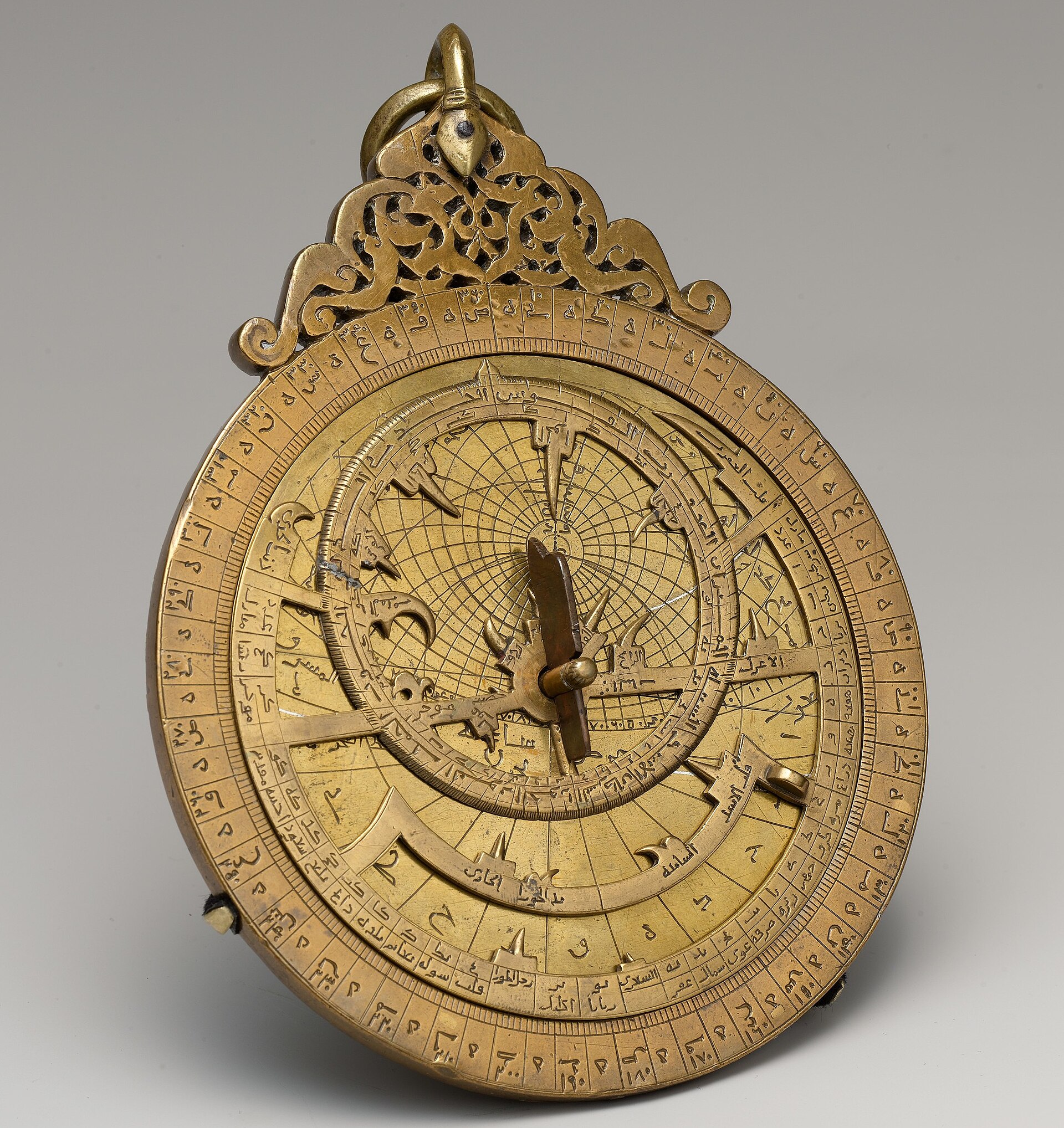
The astrolabe of 'Umar ibn Yusuf ibn 'Umar ibn 'Ali ibn Rasul al-Muzaffari, dated 690 AH/1291 CE, Metropolitan Museum of Art.
| Artist | 'Umar ibn Yusuf ibn 'Umar ibn 'Ali ibn Rasul al-Muzaffari, later Sultan al-Malik al-Ashraf 'Umar II |
|---|---|
| Date | 690 AH / 1291 CE |
| Medium | Brass, cast and hammered, pierced, chased, and inlaid with silver |
| Dimensions | Case: diameter 15.6 cm, width 19.4 cm, depth 0.6 cm. Net (rete): diameter 12.7 cm. Four plates: diameter 12.7 cm each. Bar with attached nail: length 12.7 cm. Pin: length 4.4 cm, width 1.3 cm. |
| Where it is now | Metropolitan Museum of Art, New York, Department of Islamic Artlast confirmed |
| Inventory number | 91.1.535a-h |
| Attribution | AcceptedThe astrolabe is signed by its maker in its own inscription and dated 690 AH / 1291 CE. Full note |
| Object type | Clocks and instruments |
| Period | Rasulid Yemen, late 13th century |
| Cases | Has a provenance gap |
| Inscriptions | Signed by the maker and dated 690 AH / 1291 CE. The instrument is catalogued as an assembled set of eight parts (case, bar and nail, net, four plates, and pin), accessioned together as 91.1.535a-h. |
| Owners on record | 4 links3 documented, 1 unknown |
| Sources | 11 cited |
About this record Last verified · 11 sources cited · Change log
On this page 8 sections
ContentsClose
A brass astrolabe signed and dated 690 AH / 1291 CE by its maker, a Rasulid prince of Yemen who three or four years later briefly ruled the kingdom as Sultan al-Ashraf 'Umar II. It is one of the small number of medieval Islamic scientific instruments whose maker also left behind his own written manual on how to build it, complete with notes from two teachers certifying his skill. The astrolabe's rete carries an unusual scale for the lunar mansions, and its plates are engraved for the latitudes of Yemen and the Hejaz using the tables set out in that same manual rather than by direct geometrical construction.
Nothing is recorded of the object between its making in 1291 and its appearance, roughly six centuries later, in the New York collection of the Tiffany silversmith and pioneer collector of Islamic art Edward C. Moore, who bequeathed it to the Metropolitan Museum in 1891. It has been in the Museum's Department of Islamic Art ever since.
Provenance
Each link is graded. Documented: a cited source supports it. Disputed: the identification is argued but not established. Unknown: no owner for that span, and the gap is not smoothed into a narrative. The grades in the glossary.
- 690 AH / 1291 CE -'Umar ibn Yusuf ibn 'Umar ibn 'Ali ibn Rasul al-Muzaffaridocumented
Signed and dated by the maker in the instrument's own inscription. Made several years before he became sultan.13
- 1291 - before 1891Unknownunknown
No owner, transaction, gift or seizure is named in any source consulted for this record across a span of roughly six centuries. This is recorded as a gap, not bridged by inference.136
- before 1891 - 1891Edward C. Moore, New Yorkdocumented
Moore, a Tiffany and Co. silversmith and one of the earliest serious American collectors of Islamic art, owned the astrolabe by the time of his death in 1891; how and when he acquired it is not documented in the sources consulted.19
- 1891 - presentMetropolitan Museum of Art, New Yorkdocumented
Accessioned as 91.1.535a-h under the Edward C. Moore Collection, Bequest of Edward C. Moore, 1891, part of a gift of roughly four hundred Islamic-world objects, the Museum's first major group of Islamic art.19
Technical evidence
| Attribution note | The astrolabe is signed by its maker in its own inscription and dated 690 AH / 1291 CE. The identification of the signatory with the Rasulid prince who briefly ruled Yemen as al-Malik al-Ashraf 'Umar II is not a connoisseurship attribution but a documentary one: the same name, filiation and craft are independently confirmed by his own surviving treatise on astrolabe construction, by the certifying notes his teachers appended to it, and by a modern academic study devoted specifically to this instrument (David A. King, 1985). There is no competing candidate of the same name and period; the identification is treated here as settled. |
|---|---|
| Material and technique | Brass; cast and hammered, then pierced, chased, and inlaid with silver for lettering and scale divisions.1 |
| Assembled parts | Case (a), bar with attached nail (b), net/rete (c), four plates (d-g), and pin (h), accessioned together as a single set, 91.1.535a-h.1 |
| Dimensions | Case: diameter 15.6 cm, width 19.4 cm, depth 0.6 cm. Net: diameter 12.7 cm. Plates: diameter 12.7 cm each. Bar: length 12.7 cm. Pin: length 4.4 cm, width 1.3 cm.1 |
| Signature and date | Signed by the maker, 'Umar ibn Yusuf ibn 'Umar ibn 'Ali ibn Rasul al-Muzaffari, and dated 690 AH / 1291 CE.13 |
| Rete | Fitted with star pointers and, unusually for the period, a graduated scale for the twenty-eight lunar mansions (manazil al-qamar).3 |
| Back of the case | Engraved with astrological information in planetary symbols of Greek derivation. Its design is described in the academic literature as virtually identical to the illustration of an astrolabe's back in the maker's own treatise on instrument construction.3 |
| Plates | Engraved for latitudes covering Yemen and the Hejaz, calculated from tables the maker sets out in his own treatise rather than by direct geometrical construction.3 |
| Known inconsistency | The star pointers fitted to the rete do not match the star positions tabulated in the maker's own treatise, an unresolved discrepancy noted in the academic literature on this instrument.3 |
The record in full
Chapter 1What it is
An astrolabe is a hand-held computing instrument, a brass disc-based model of the sky that lets its user solve a fixed set of astronomical problems by turning one part against another rather than by...
An astrolabe is a hand-held computing instrument, a brass disc-based model of the sky that lets its user solve a fixed set of astronomical problems by turning one part against another rather than by calculation. This example survives as a complete assembled set: a case 15.6 cm across, a pierced rotating net (the rete, carrying pointers to fixed stars and set within the rim of the case), four interchangeable plates engraved for different latitudes, a sighting bar (the alidade) with its retaining pin, and the central pin and wedge that hold the stack together so the whole instrument can be turned in the hand.
It is a brass object, cast and hammered into shape, then pierced, chased and inlaid with silver for its lettering and scale markings. That combination of casting, piercework and silver inlay is standard for the finer astronomical instruments of the medieval Islamic world, and distinguishes an object made for genuine use and display from a cruder working tool.
Chapter 2How the plates and rete were built
The four plates are engraved for latitudes covering Yemen and the Hejaz, the two regions the maker's own household and travels connected: Yemen where he ruled, and the Hejaz, home to Mecca and...
The four plates are engraved for latitudes covering Yemen and the Hejaz, the two regions the maker's own household and travels connected: Yemen where he ruled, and the Hejaz, home to Mecca and Medina, orientation toward which is one of an astrolabe's standard uses. According to the modern academic study of this specific instrument, the plates were not laid out by the direct geometrical projection more usually described in Arabic treatises on astrolabe-making, but were calculated from tables the maker set out in his own separate manual on the subject. That manual gives tables for constructing the altitude circles and azimuth circles for particular Yemeni and Hejazi latitudes, tables of shadow-lengths, and the solar altitude at the start of the afternoon prayer.
The rete carries an additional feature that is not typical of astrolabes from this period: a graduated scale for the twenty-eight lunar mansions (manazil al-qamar), the stations the Moon appears to pass through each month, used across the medieval Islamic world for timekeeping, weather lore and agricultural reckoning quite apart from formal astronomy. The back of the case, in turn, is engraved with astrological information rendered in planetary symbols that had reached Islamic astronomy from Greek sources. The academic literature on this piece describes this back as 'virtually identical' to the illustration of an astrolabe's back given in the maker's own treatise, which is the clearest single piece of evidence tying the surviving object to the surviving text.
That match is not total. The star pointers actually fitted to this rete do not correspond to the star positions the same treatise tabulates. Nobody has resolved why; it stands as an open inconsistency in an otherwise unusually well-documented pairing of instrument and manual.
Chapter 3The prince who signed his own instrument
The maker gives his own name and lineage in the signature: 'Umar ibn Yusuf ibn 'Umar ibn 'Ali ibn Rasul al-Muzaffari.
The maker gives his own name and lineage in the signature: 'Umar ibn Yusuf ibn 'Umar ibn 'Ali ibn Rasul al-Muzaffari. He was born around 1242, a son of al-Muzaffar Yusuf I, the second sultan of the Rasulid dynasty that had ruled Yemen since 1229 and whose own reign, from 1249, ran for close to half a century. Little is recorded of 'Umar's early life. In 1266 or 1267 he commanded a military expedition for his father to the northern town of Hajja, and he later served as governor of al-Mahjam, on the Wadi Surdud in coastal Yemen. His father made him coregent in 1295; four months later, on al-Muzaffar's death, he succeeded to the throne as al-Malik al-Ashraf, Sultan al-Ashraf 'Umar II, the third Rasulid sultan.
His reign lasted about twenty-one months. He died on 22 November 1296 and was buried in the Ashrafiyya school he had founded at Ta'izz. He left six sons and two daughters, the daughters married to sons of his own successor, his younger brother al-Mu'ayyad Da'ud. This astrolabe was made in 1291, several years before any of that: it is the work of a prince, not yet of a sultan.
Chapter 4A reign of twenty-one months, and a longer scientific record
Set against his father's long and, by the standard accounts, prosperous rule, al-Ashraf's own brief reign is described in the modern scholarly literature as of no major political significance.
Set against his father's long and, by the standard accounts, prosperous rule, al-Ashraf's own brief reign is described in the modern scholarly literature as of no major political significance. The same scholarship is explicit that this is not the measure by which he is remembered: his importance rests on his scientific output, which was set down independently of, and mostly before, his short time on the throne.
He is credited with some thirteen treatises across medicine, genealogy, agriculture, veterinary medicine, astronomy and astrology, and with building astronomical instruments himself, astrolabes among them. One modern assessment of him, from a scholar who has studied his astronomical writing directly, puts it plainly: he 'was not a great genius but a teachable pupil and a versatile scholar.' That is a considered, unflattering judgment from someone who read the material, not a dynastic compliment, and this record treats it as the more reliable of the two available pictures of the man.
Chapter 5The treatise, and the teachers who certified him
Separately from this astrolabe, 'Umar left a manual on how to build one: a work usually cited as Mu'in (or Minhaj) al-tullab fi al-'amal bi'l-asturlab, on the construction of the astrolabe and other...
Separately from this astrolabe, 'Umar left a manual on how to build one: a work usually cited as Mu'in (or Minhaj) al-tullab fi al-'amal bi'l-asturlab, on the construction of the astrolabe and other instruments, surviving in two manuscripts, one in Cairo (commonly cited as held in Dar al-Kutub, the Egyptian National Library) and one in Tehran. In it he explains the construction of the astrolabe with diagrams of its parts, gives the tables for Yemeni and Hejazi latitudes described above, and goes on to cover the horizontal sundial, the water clock, and the magnetic compass, in the course of which he wrote what is described as the first description in a medieval astronomical treatise of the magnetic compass, and the first use of it there as a qibla-indicator: a floating compass bowl with an inserted needle, used to find the sacred direction toward Mecca under conditions, such as bad weather, where the sky itself could not be used.
At the end of the treatise, two of his own teachers added notes. They record that they had inspected some four to six astrolabes made by 'Umar himself, found them accurate and skillfully made, and formally certified his competence, giving him leave to make astrolabes as he saw fit; they also mention two water clocks of his. Whether this particular Metropolitan Museum astrolabe is among the instruments the teachers actually inspected is not stated anywhere in the sources consulted for this record, and should not be assumed; the certification is general to his craft, not a description of this specific object. What is specific to this object is the match, described above, between its back and the treatise's own diagram of an astrolabe back. It is rare, in the surviving literature of the medieval Islamic world, to be able to hold in hand both an instrument and the manual its own maker wrote for building it; that pairing, not a claim that the treatise names this exact piece, is the documentary strength this record can support.
Chapter 6What it was for
An astrolabe of this kind served both an astronomical and a devotional function, and the two were not separate in practice.
An astrolabe of this kind served both an astronomical and a devotional function, and the two were not separate in practice. Its plates and rete let a user find the time of day or night from the altitude of the Sun or a known star, and from that derive the times of the five daily prayers, a routine and expected use of the instrument across the medieval Islamic world. Its maker's own separate work on the magnetic compass, described above, addressed the same religious requirement from another angle: establishing the qibla when neither sun nor stars were available to sight by. The astrological information engraved on the back, using planetary symbols carried into Islamic astronomy from Greek sources, points to the instrument's second, non-devotional use, in judicial and natal astrology, a discipline 'Umar treated systematically and at length in his own separate fifty-chapter compendium (see Related works). Nothing in the sources consulted suggests any further private or esoteric use beyond these ordinary, well-documented functions of timekeeping, prayer and astrology as they were practiced at a Rasulid court; this record does not manufacture one.
Chapter 7A dynasty that kept producing scholar-princes
'Umar was not an isolated case inside his own family.
'Umar was not an isolated case inside his own family. The Rasulid sultans of Yemen, who ruled from 1229 to 1454, are recorded across multiple generations as patrons and, more unusually, practitioners of astronomy, medicine, botany, agriculture and veterinary science, and Rasulid-founded schools in Ta'izz and elsewhere taught these subjects alongside jurisprudence and mathematics. Nearly a century after 'Umar, the Rasulid sultan al-Afdal al-Abbas (r. 1363-1377) compiled a six-language comparative dictionary, now known as the Rasulid Hexaglot, and his successor al-Ashraf Isma'il I continued the same pattern of scholarly patronage into the last decades of the fourteenth century. Read against that longer record, 'Umar's astrolabe and its accompanying manual are not a freak survival but one dated, signed data point inside a documented, multi-generational royal habit of doing science rather than merely funding it.
Chapter 8Six centuries of silence, then a Tiffany silversmith's cabinet
Between the astrolabe's completion in 1291 and its next documented appearance, nothing is recorded in the sources consulted for this record.
Between the astrolabe's completion in 1291 and its next documented appearance, nothing is recorded in the sources consulted for this record. No owner, sale, gift or seizure across roughly six centuries is named anywhere found in the course of this research. That gap is recorded here as a gap.
The instrument surfaces in the historical record again in the collection of Edward C. Moore (1827-1891), the New York silversmith who from the 1860s and 1870s became one of the earliest serious American collectors of Islamic art, assembling it in large part as a working reference library of design and technique for his own studio, which Tiffany and Co. had acquired in 1868 and which he went on to direct as chief designer. On his death in 1891 Moore bequeathed roughly four hundred objects from the Islamic world to the Metropolitan Museum, the Museum's first major group of Islamic material and, at the time, its largest and most comprehensive. This astrolabe was accessioned from that bequest as 91.1.535a-h, alongside other Rasulid metalwork from the same gift, including a brass brazier bearing the name of 'Umar's own father, al-Muzaffar Yusuf I (Metropolitan Museum, accession 91.1.540). Exactly how, when, or from whom Moore acquired the astrolabe is not stated in the sources consulted for this record.
Chapter 9What is still unresolved
The largest gap is the plainest one: where the astrolabe was, and in whose hands, for roughly six hundred years between its making and its documented presence in Edward Moore's New York collection...
The largest gap is the plainest one: where the astrolabe was, and in whose hands, for roughly six hundred years between its making and its documented presence in Edward Moore's New York collection before 1891. Nothing in the sources consulted narrows that gap. A smaller, more technical puzzle sits inside the object itself: the mismatch between the star positions engraved on the rete and those tabulated in the maker's own treatise, on an instrument whose back otherwise matches that same treatise closely enough to be called virtually identical to it. Neither question has an answer in the literature this record was built from, and both are recorded as open rather than guessed at.
The artist
'Umar ibn Yusuf ibn 'Umar ibn 'Ali ibn Rasul al-Muzaffari, later al-Malik al-Ashraf (Mumahhid al-Din), Sultan al-Ashraf 'Umar II of the Rasulid dynasty
Unlike almost every maker's name attached to an object in this collection, this one is not a matter of connoisseurship. 'Umar signed his own work, and independent written sources, his own surviving treatise among them, corroborate exactly who he was: a working prince and, later and briefly, a sultan, who built astrolabes with his own hands and wrote down how he did it.
Related works
| Work | Relation | Where it is |
|---|---|---|
| Brazier of al-Malik al-Muzaffar Shams al-Din Yusuf ibn 'Umar Unattributed Rasulid workshop, made for 'Umar's father, al-Muzaffar Yusuf I | Inscribed metalwork of a family member, from the same Edward C. Moore bequest of 1891 Brass, cast, chased and inlaid with silver and a black compound, second half of the 13th century. Entered the Museum in the same 1891 bequest as this astrolabe. | Metropolitan Museum of Art, New York (accession 91.1.540) |
| Mu'in (or Minhaj) al-tullab fi al-'amal bi'l-asturlab 'Umar ibn Yusuf al-Muzaffari | The maker's own manual on building the astrolabe and other instruments, the direct textual companion to this object Contains the tables from which this astrolabe's plates were calculated, and an illustration of an astrolabe back described as virtually identical to the back of this instrument. The manuscripts have not been independently examined for this record. | Manuscripts in Cairo (commonly cited as Dar al-Kutub) and Tehran |
| Kitab al-Tabsira fi 'ilm al-nujum 'Umar ibn Yusuf al-Muzaffari | The maker's own fifty-chapter compendium on astronomy, astrology, timekeeping and agriculture Includes what is described as the earliest known Yemeni prose almanac, compiled around 1271, twenty years before this astrolabe was made. | Manuscript in Oxford |
| The Rasulid Hexaglot Compiled under Sultan al-Afdal al-Abbas | A later Rasulid royal scholarly work, evidence of the same dynasty's continuing pattern of prince-scholars A six-language comparative dictionary compiled roughly seventy years after this astrolabe was made, under a different Rasulid sultan; included here as dynastic context, not as a work by this maker. | British Library, London |
Open questions
- Where was the astrolabe, and in whose hands, between its completion in 1291 and its documented presence in Edward C. Moore's New York collection before his death in 1891? No owner across that roughly six-century span is named in the sources consulted.
- How and when did Edward C. Moore acquire the astrolabe? No dealer, sale, or intermediary owner is identified in the sources consulted.
- Which specific towns' latitudes are engraved on the four surviving plates? The academic literature describes them only as covering Yemen and the Hejaz generally, without itemizing the plates by named locality.
- Why do the star pointers fitted to the rete not match the star positions tabulated in the maker's own treatise, given that the instrument's back and the treatise's diagram of a back are otherwise closely matched?
- Is this specific astrolabe one of the four to six instruments that the maker's two teachers examined and certified, or a work outside that certification? The certifying notes do not identify the instruments they cover by any description that can be matched to this one.
- What did the Metropolitan Museum's internal appraisal of the 1891 Moore bequest, if one survives, record for this object? Not published in the sources consulted.
Questions about this object
What is Astrolabe of 'Umar ibn Yusuf ibn 'Umar ibn 'Ali ibn Rasul al-Muzaffari?
Astrolabe of 'Umar ibn Yusuf ibn 'Umar ibn 'Ali ibn Rasul al-Muzaffari is a clocks and instruments, dated 690 AH / 1291 CE. Medium: Brass, cast and hammered, pierced, chased, and inlaid with silver.
Who made Astrolabe of 'Umar ibn Yusuf ibn 'Umar ibn 'Ali ibn Rasul al-Muzaffari, and is the attribution settled?
The attribution to 'Umar ibn Yusuf ibn 'Umar ibn 'Ali ibn Rasul al-Muzaffari, later Sultan al-Malik al-Ashraf 'Umar II is recorded here as accepted. The astrolabe is signed by its maker in its own inscription and dated 690 AH / 1291 CE. The identification of the signatory with the Rasulid prince who briefly ruled Yemen as al-Malik al-Ashraf 'Umar II is not a connoisseurship attribution but a documentary one: the same name, filiation and craft are independently confirmed by his own surviving treatise on astrolabe construction, by the certifying notes his teachers appended to it, and by a modern academic study devoted specifically to this instrument (David A. King, 1985). There is no competing candidate of the same name and period; the identification is treated here as settled.
Where is Astrolabe of 'Umar ibn Yusuf ibn 'Umar ibn 'Ali ibn Rasul al-Muzaffari now?
Metropolitan Museum of Art, New York, Department of Islamic Art. Inventory number 91.1.535a-h. Last confirmed 27 August 2026. Confirmed directly from the Metropolitan Museum of Art's own Collection API record for object ID 444408 (isPublicDomain: true, accessionNumber 91.1.535a-h, credit line: Edward C. Moore Collection, Bequest of Edward C. Moore, 1891).
What is still unknown about Astrolabe of 'Umar ibn Yusuf ibn 'Umar ibn 'Ali ibn Rasul al-Muzaffari?
Where was the astrolabe, and in whose hands, between its completion in 1291 and its documented presence in Edward C. Moore's New York collection before his death in 1891? No owner across that roughly six-century span is named in the sources consulted.
Sources
- 1Metropolitan Museum of Art, Collection API, object record for ID 444408 (accession 91.1.535a-h), confirmed directly. collectionapi.metmuseum.org/public/...
- 2Metropolitan Museum of Art, object page for this astrolabe. metmuseum.org/art/...
- 3Petra G. Schmidl, 'Ashraf: al-Malik al-Ashraf (Mumahhid al-Din) 'Umar ibn Yusuf ibn 'Umar ibn 'Ali ibn Rasul,' in Thomas Hockey et al. (eds.), The Biographical Encyclopedia of Astronomers (Springer, 2007), pp. 66-67, as hosted by the Islamic Scientific Manuscripts Initiative (ISMI), Max Planck Institute for the History of Science. This entry cites and draws on David A. King, 'The Medieval Yemeni Astrolabe in the Metropolitan Museum of Art in New York City,' Zeitschrift fur die Geschichte der Arabisch-Islamischen Wissenschaften 2 (1985), pp. 99-122, which this desk has not independently examined and which is flagged for direct consultation. ismi.mpiwg-berlin.mpg.de/biography/...
- 4Wikimedia Commons, licensing metadata (LicenseShortName: CC0) for the lead image file, verified via the Commons API. commons.wikimedia.org/wiki/...
- 5Wikimedia Commons, licensing metadata (LicenseShortName: CC0) for the companion documentation photographs of the same accession, verified via the Commons API. commons.wikimedia.org/w/...
- 6Wikipedia, 'Al-Ashraf Umar II.' source, used only for cross-checking reign dates and family relations already given by Schmidl; with direct consultation of King (1985) and Varisco. en.wikipedia.org/wiki/...
- 7Wikipedia, 'Al-Muzaffar Yusuf I.' source, used only for the father's reign dates and succession; . en.wikipedia.org/wiki/...
- 8Discover Islamic Art (Museum With No Frontiers), database entry on this astrolabe. islamicart.museumwnf.org/database_item.php
- 9Metropolitan Museum of Art, exhibition and curatorial material on Edward C. Moore's collection of Islamic art and its 1891 bequest to the Museum. metmuseum.org/exhibitions/...
- 10Metropolitan Museum of Art, Collection API, object record for ID 444540 (Brazier of al-Malik al-Muzaffar Shams al-Din Yusuf ibn 'Umar, accession 91.1.540), confirmed directly. collectionapi.metmuseum.org/public/...
- 11Wikipedia, 'Al-Afdal al-Abbas.' source, used only for general context on continuing Rasulid royal scholarly patronage after this maker's death; . en.wikipedia.org/wiki/...

Last verified · Published
Change log
27 August 2026 - Record created at the house standard: researched narrative, technical evidence, maker dossier, graded provenance chain, prices with hammer and premium separated, related works, open questions and sources.