Crown of the Virgin of the Immaculate Conception, known as the Crown of the Andes
Unidentified goldsmiths, Popayan and viceroyalty of New Granada · 16th century (cross); c. 1660 (diadem); c. 1770 (arches)
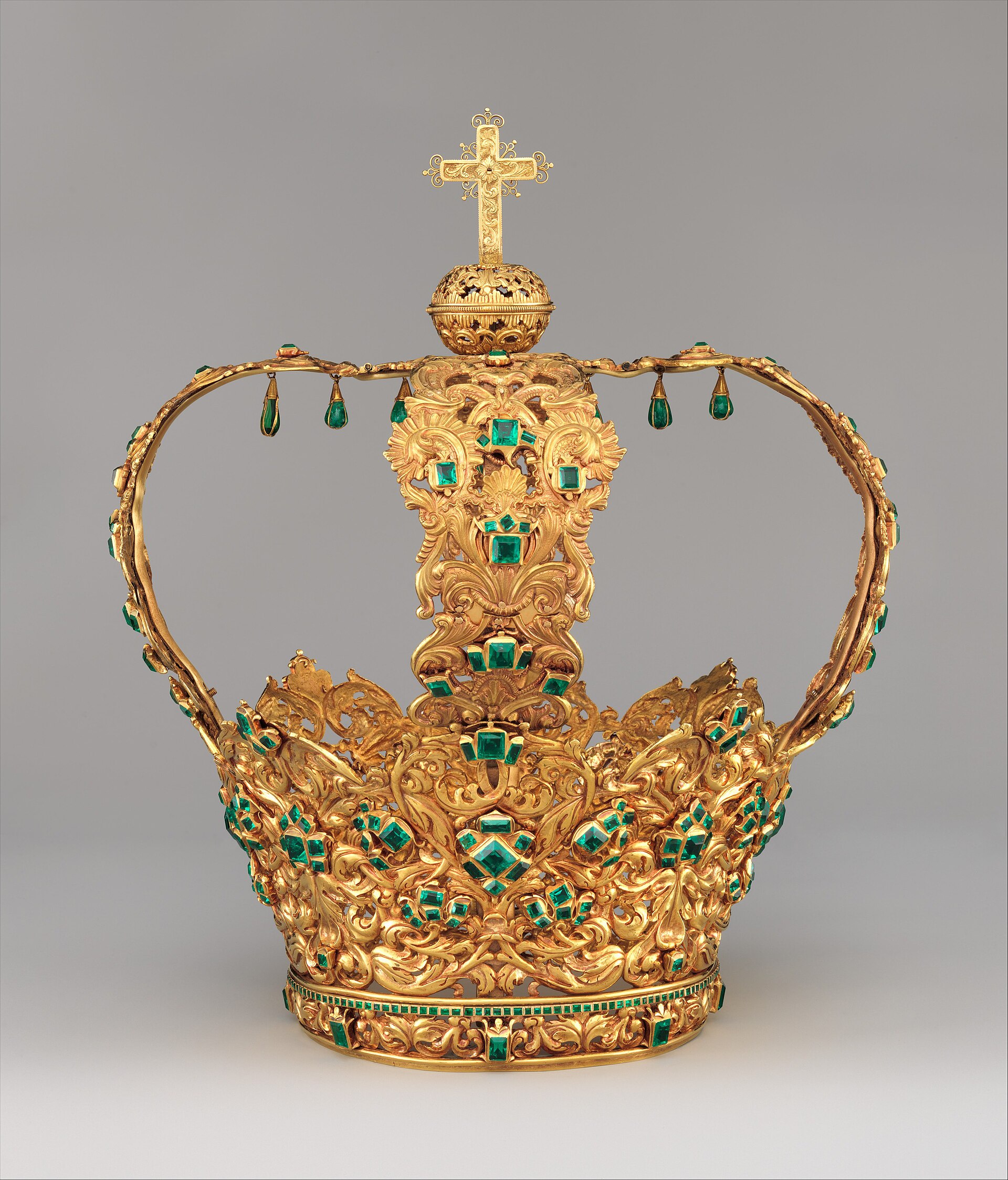
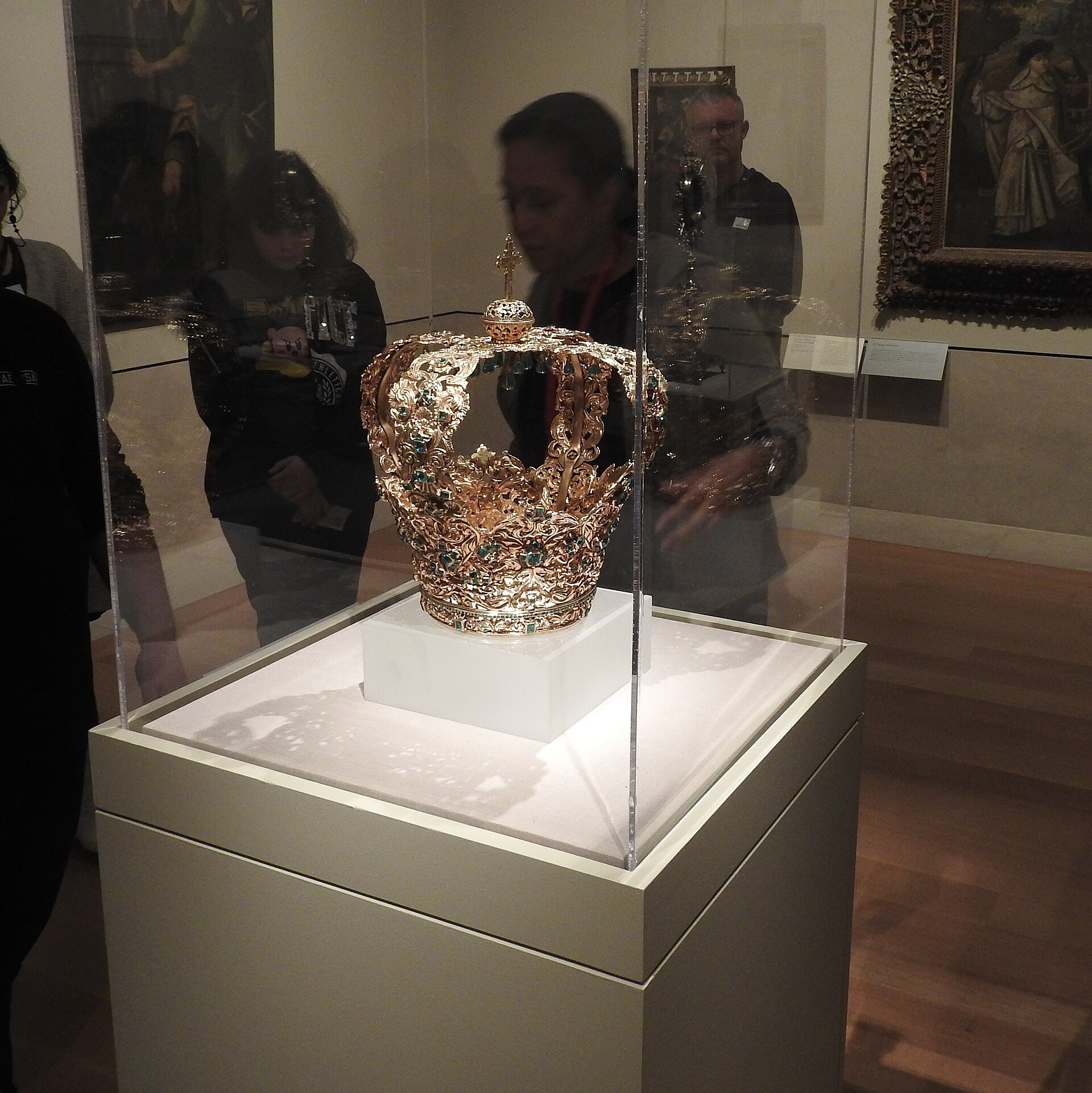
The crown, frontal view. Gold, repousse and chased, set with approximately 450 emeralds. Metropolitan Museum of Art, accession 2015.437.
| Artist | Unidentified goldsmiths, Popayan and viceroyalty of New Granada |
|---|---|
| Date | 16th century (cross); c. 1660 (diadem); c. 1770 (arches) |
| Medium | Gold, repousse and chased, set with emeralds |
| Dimensions | 34.3 cm (13 1/2 in) high; 33.4 cm (13 1/4 in) body diameter; weight approximately 2.17-2.4 kg |
| Where it is now | Metropolitan Museum of Art, New Yorklast confirmed |
| Inventory number | 2015.437 |
| Attribution | DisputedNo maker's mark or contract survives and no individual goldsmith is named in any source consulted. Full note |
| Object type | Goldsmith's work |
| Period | Colonial Spanish South America, viceroyalty of New Granada |
| Cases | Disputed attribution |
| Inscriptions | None recorded in any source consulted |
| Owners on record | 7 links4 documented, 3 disputed |
| Sources | 13 cited |
About this record Last verified · 13 sources cited · Change log
On this page 10 sections
ContentsClose
A closed, arched crown of gold set with roughly 450 Colombian emeralds, made in Popayan not as a single commission but in at least two and probably three separate campaigns of work between the 16th and 18th centuries, to be placed on a statue of the Virgin of the Immaculate Conception carried in that city's Holy Week processions for close to three hundred years.
In 1936, after a 1914 papal permission to sell that was controversial with part of the Popayan congregation, the crown left Colombia for a Chicago-led American syndicate that intended to break it up and sell the stones individually. It did not break up. It passed through a 1963 Sotheby's sale, a failed 1995 Christie's sale, and the private hands of the jeweler Oscar Heyman and his daughter Alice Heyman before the Metropolitan Museum acquired it in December 2015.
The gold is Colombian river gold worked under Spanish colonial rule; the emeralds are substantially from the Muzo deposit, whose 16th and 17th century extraction under forced indigenous and enslaved labour is documented by the historian Kris Lane and, earlier, by the mining engineer H. A. Schumacher's 1875 study of the original Spanish sources -- for the deposit generally, not for these specific stones, which no source consulted traces to a named group of labourers. A Colombian cultural-heritage body has publicly argued the crown belongs in Popayan, where it was made and used, not in New York; the Met's own published materials describe the 2015 acquisition as legal but do not engage the argument.
Provenance
Each link is graded. Documented: a cited source supports it. Disputed: the identification is argued but not established. Unknown: no owner for that span, and the gap is not smoothed into a narrative. The grades in the glossary.
- 16th century - c. 1660Confraternity of the Immaculate Conception (La Cofradia de la Inmaculada Concepcion), Popayan Cathedraldisputed
The Met's own catalogue dates the diadem to circa 1660; a technical examination by the jewellery historian Christopher Hartop in 1995 additionally dated a separate cross element to the 16th century, describing the object as a composite of parts rather than a single commission. The popular legend of a single 1590s commission made in thanksgiving for deliverance from smallpox is not supported by either the Met's dating or Hartop's reading and is recorded here as legend, not fact.16
- c. 1770 - 1914Confraternity of the Immaculate Conception, Popayan Cathedraldocumented
Arches added circa 1770 per the Met's catalogue dating. The completed crown was then used continuously in Popayan's Holy Week celebrations for approximately three centuries until the sale process began.136
- 1914 - 1936Confraternity of the Immaculate Conception, seeking a buyerdocumented
Pope Pius X granted permission to sell the crown in 1914 to fund charitable works reported as a hospital, orphanage and home for the elderly; the decision was reported as controversial within parts of the Popayan church community. No buyer was secured until 1936.467
- 1936 - 1963American investment syndicate led by Warren J. Piper, Chicagodocumented
Piper's syndicate purchased the crown for a reported 125,000 US dollars, reportedly intending to melt it down and sell the emeralds individually; this did not happen. The crown was instead exhibited at Detroit (1937), the New York World's Fair (1939), and the Royal Ontario Museum (1959).467
- 1963 - 1995Anonymous buyer, via the Asscher Diamond Company, Amsterdamdisputed
Sold at Sotheby's London in 1963 to the Asscher Diamond Company acting for an undisclosed buyer, reportedly for 55,000 pounds. The identity of the underlying purchaser is not documented in any source consulted; graded disputed/unknown rather than documented for that reason, though the auction house, intermediary and reported price are documented.458
- 1995 - 2015Oscar Heyman, then his daughter Alice Heymandisputed
Consigned to Christie's, New York, in 1995 with a reported reserve of approximately 3 million US dollars; did not sell. Christopher Hartop examined the crown during this consignment and proposed his three-campaign dating. The jeweler Oscar Heyman subsequently acquired the crown and gave it to his daughter Alice Heyman; neither the date nor terms of either transfer are published in any source consulted. Lent to the Indianapolis Museum of Art for the exhibition Sacred Spain, October 2009-January 2010.567
- 2015 - presentMetropolitan Museum of Art, New Yorkdocumented
Acquired December 2015, accession number 2015.437, credit line Purchase, Lila Acheson Wallace Gift, Acquisitions Fund and Mary Trumbull Adams Fund. Price not published by the Met in any source consulted; a 2.5 million US dollar figure attributed to Bloomberg News reporting circulates but is unconfirmed against a primary Met document.1237
Prices realised
| Date | Sale | Estimate | Result | Note |
|---|---|---|---|---|
| 1963 | Sotheby's | not stated in sources consulted | Hammer GBP 55,000 (reported; hammer vs. total not separated in any source consulted) With premium not specified in sources consulted GBP | Sold to the Asscher Diamond Company acting for an anonymous buyer. Whether the reported 55,000 pounds is hammer price or a total including any premium is not distinguished in the sources consulted. |
| 19 September 1995 | Christie's | Reserve reported at approximately USD 3,000,000 | Hammer Did not sell With premium n/a USD | Consigned for sale in New York; failed to meet reserve and was withdrawn. Christopher Hartop's technical examination of the crown took place in connection with this consignment. Contemporary Spanish-language coverage (El Pais, 19 September 1995) separately reported the sale process and the crown's physical statistics. |
Hammer is the price at which the bidding stopped; with premium adds the fee the house charges the buyer on top. Hammer price and buyer's premium in the glossary.
Technical evidence
| Attribution note | No maker's mark or contract survives and no individual goldsmith is named in any source consulted. The Metropolitan Museum's own dating, corroborated by the jewellery historian Christopher Hartop's 1995 technical examination, separates the object into at least two, and on Hartop's reading three, campaigns of work rather than a single commission: a cross at the top he places in the 16th century, a diadem completed in the mid-17th century, and arches added around 1770. This record follows that multi-campaign reading rather than the single-date legend still repeated in popular accounts. |
|---|---|
| Support/structure | Closed crown form: jewelled diadem/headband, surmounted by intersecting arches meeting at a central orb, topped by a cross. Constructed as at least two, and on Christopher Hartop's technical reading three, physically distinct campaigns of goldwork joined together rather than made as a single unit.146 |
| Metal | Gold, 18 to 22 carat, worked by repousse (hammered relief from the reverse) and chasing (surface detail worked from the front).13 |
| Gemstones | Approximately 450 emeralds (443 by the Met's own count, 442 or 450 in other sources), largely uncut or minimally faceted colonial-period stones, substantially Colombian and reported in multiple sources as from the Muzo deposit specifically. Total weight reported at approximately 846.15 carats. Largest stone approximately 24 carats, called the Atahualpa Emerald.1238 |
| Dimensions and weight | Approximately 34.3 cm (13 1/2 in) high; body diameter approximately 33.4 cm (13 1/4 in); weight reported variously as 2.17 kg and 2.4 kg (approximately 4.8 to 5.3 lb) across sources, a discrepancy not resolved in any single source consulted.134 |
| Dating by component | Met catalogue: diadem circa 1660, arches circa 1770. Christopher Hartop's 1995 technical examination (reported in contemporary press, not accessed as a primary published report): cross circa 16th century, lower body complete by the 17th century, arches 18th century.16 |
| Condition and later conservation | No condition report or post-2015 conservation findings beyond the dating above were directly retrievable; the Met's own published conservation essay on the object could not be fetched during this research (persistent server rate-limiting) and should be consulted directly for any technical claim beyond dating.1 |
Images
The record in full
Chapter 1What it is
The Crown of the Andes is a closed votive crown of gold, repousse and chased, in the form long used across Catholic Europe and its colonies for the ceremonial crowning of a statue of the Virgin: a...
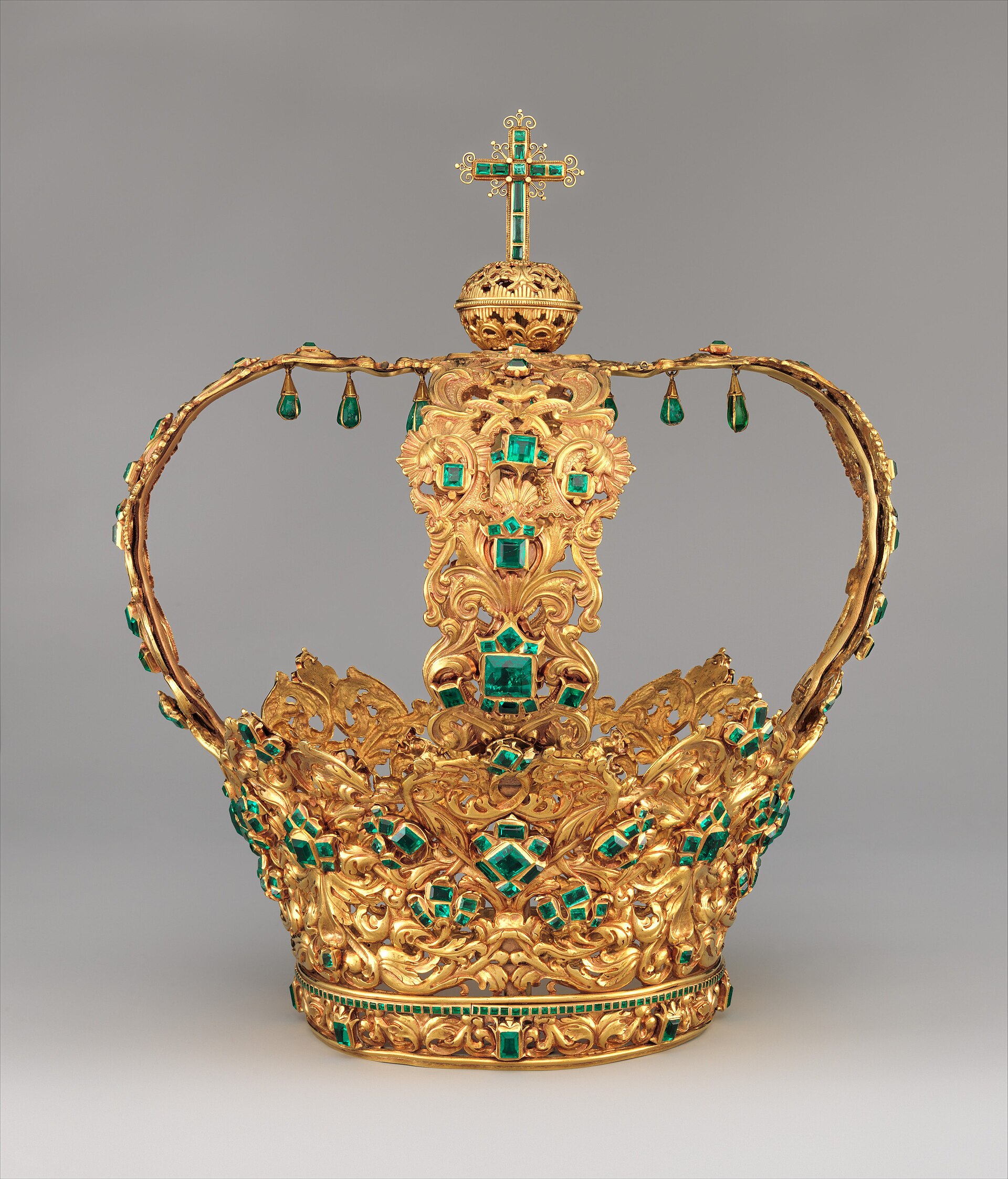
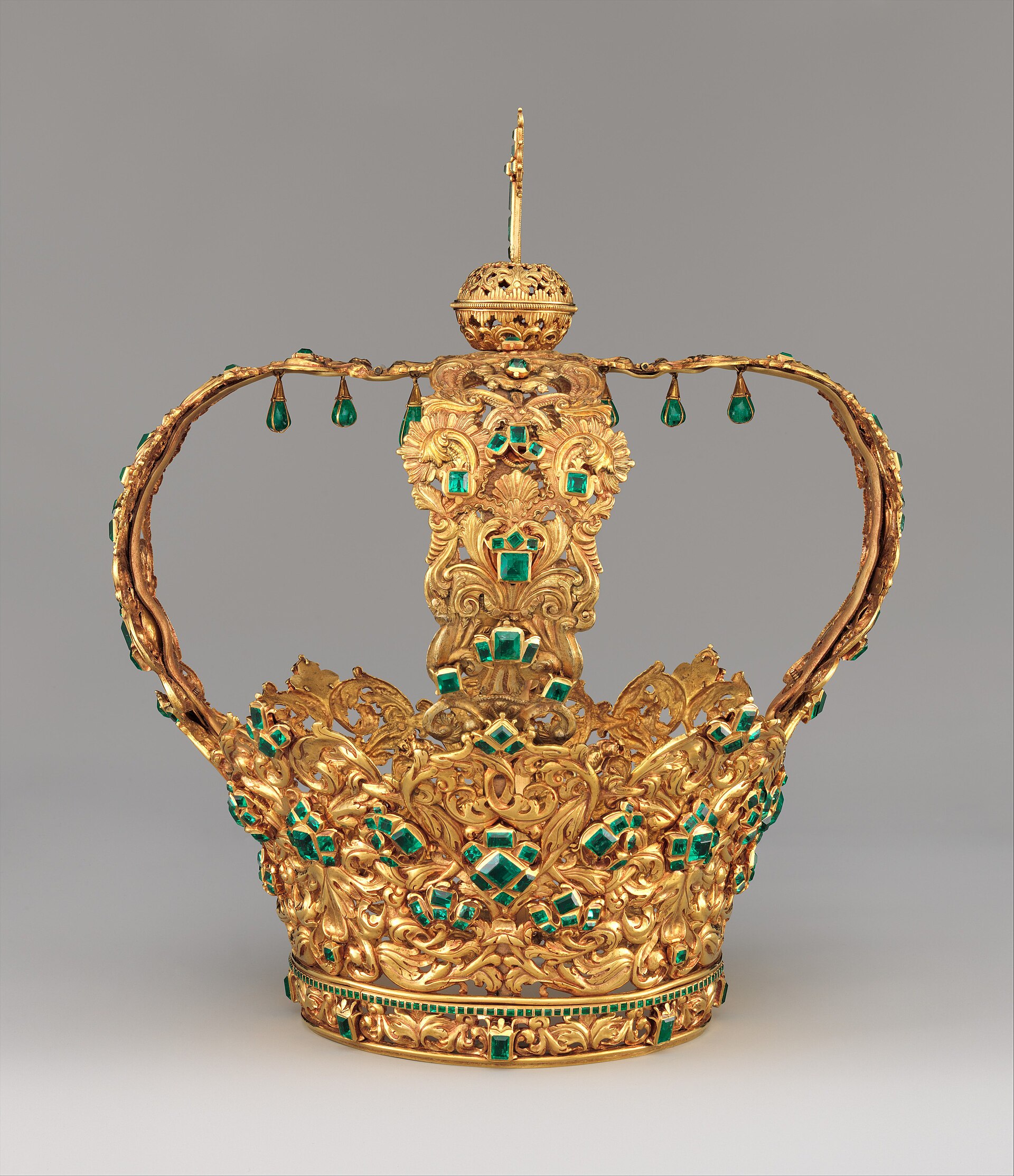
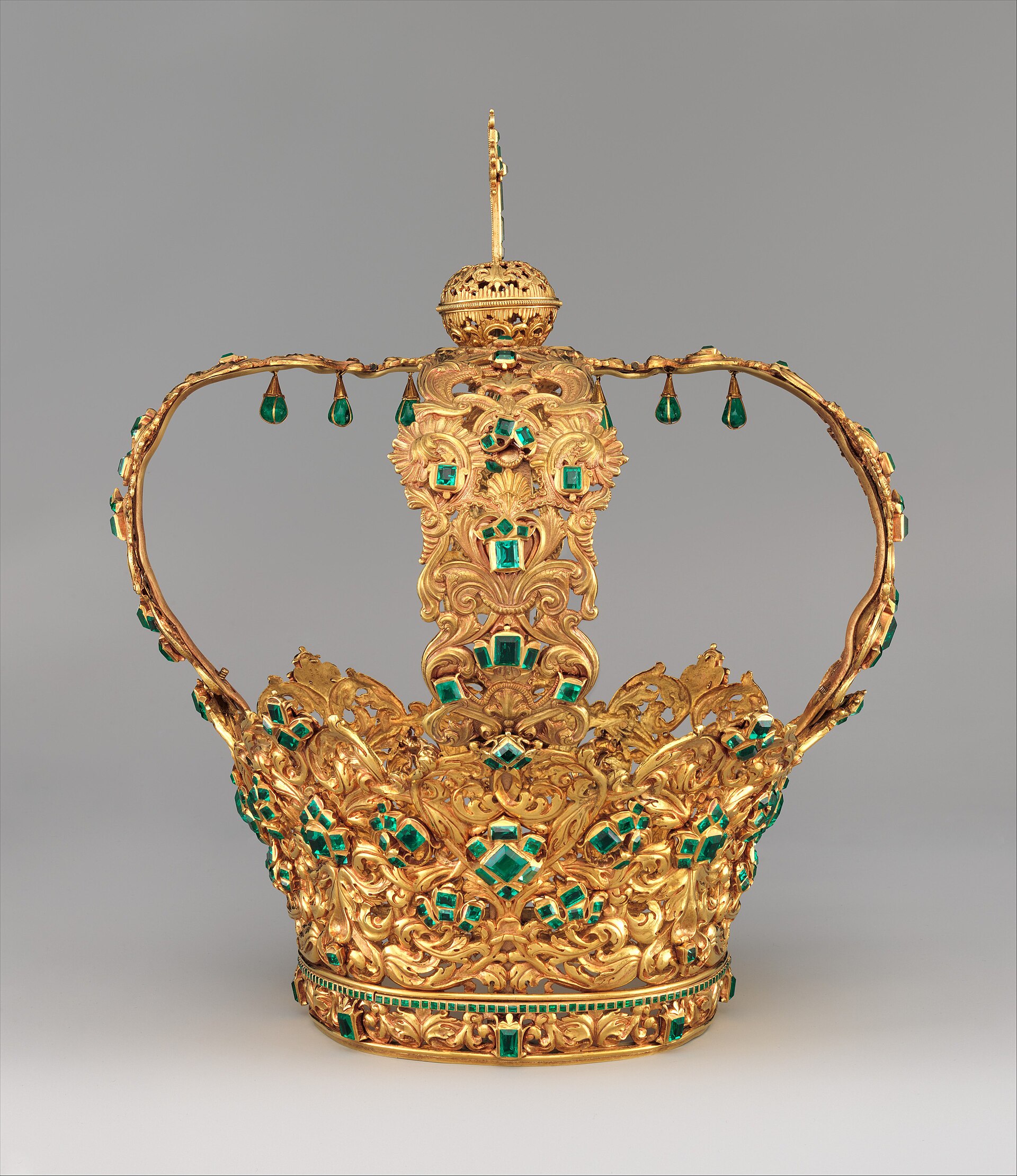
The Crown of the Andes is a closed votive crown of gold, repousse and chased, in the form long used across Catholic Europe and its colonies for the ceremonial crowning of a statue of the Virgin: a jewelled diadem or headband, surmounted by arches that meet at a central orb, itself topped by a cross. It stands about 34 centimetres high with a body diameter of roughly 33 centimetres and weighs a little over two kilograms. It carries approximately 450 emeralds, the great majority uncut or minimally cut in the period manner, the largest a rectangular stone of about 15.8 by 16.1 millimetres known as the Atahualpa Emerald.
It was made not to be worn by a living person but to sit on the head of a large statue of the Virgin of the Immaculate Conception kept in the cathedral of Popayan, in what is now southwestern Colombia, and brought out for the city's Holy Week observances. That devotional function, not portability or personal ornament, governs its scale: it is built to be seen from below and at a distance, on a statue considerably larger than life size.
Chapter 2A votive crown for a specific Marian title
The crown was made for a statue honoured under one specific title, the Immaculate Conception, and that title carries its own standard iconography, formalised for Spanish and colonial art in the...
The crown was made for a statue honoured under one specific title, the Immaculate Conception, and that title carries its own standard iconography, formalised for Spanish and colonial art in the mid-17th century by the painter and theorist Francisco Pacheco: Mary as a young woman standing on a crescent moon, ringed by twelve stars, with the sun behind her and a serpent underfoot, an image built from the vision of the "woman clothed with the sun" in Revelation 12 read alongside the Tota Pulchra liturgical antiphon celebrating her as free of any stain. A crown placed on such a statue is not incidental decoration; it is the physical answer to the biblical "crown of twelve stars," rendered in gold and colonial emerald rather than left as vision, and it marks the statue as an image due royal honour as Queen of Heaven, a status Catholic devotional practice across the Spanish empire routinely gave its most venerated Marian images with an actual, physical crown.
This record treats the Pacheco iconographic type and its Revelation source as documented art-historical fact, established by period doctrine and widely attested devotional practice, not as this record's own reading. No source consulted describes the specific decorative programme of the Popayan crown's chasing in enough technical detail to say whether its ornament depicts the twelve stars, the serpent or other attributes of the type directly; that absence is recorded here as a gap rather than filled by inference.
Chapter 3How the dating actually breaks down
Popular accounts, repeated in tourist literature and some press coverage, hold that the crown was made in a single campaign in the 1590s, in thanksgiving for Popayan's deliverance from a smallpox...
Popular accounts, repeated in tourist literature and some press coverage, hold that the crown was made in a single campaign in the 1590s, in thanksgiving for Popayan's deliverance from a smallpox epidemic, using emeralds already associated with the captured Inca emperor Atahualpa. The Metropolitan Museum's own catalogue entry does not date the object this way. It gives the diadem a date of about 1660 and the arches a date of about 1770, already a two-campaign structure spanning more than a century.
The jewellery historian Christopher Hartop went further. Examining the crown in 1995 during a proposed sale at Christie's in New York, he concluded it was a composite object assembled from parts of differing date: a small cross at the top he placed in the 16th century, a lower body he judged complete by the 17th century, and intersecting arches he dated to the 18th century, on stylistic and constructional grounds reported in contemporary press coverage of his examination. Later summaries of the object's technical history go further still, describing it as assembled in the 19th century from elements of at least three earlier objects, with the cross originally a separate pectoral cross of slightly earlier date than the diadem it was later joined to.
The evidentiary basis for this record's dating is therefore layered: the Met's own two-date catalogue entry is the institutional record and is treated as documented; Hartop's three-part reading is an expert technical opinion, reported via contemporary press coverage of his 1995 examination, and is treated as argued rather than settled fact, since this record could not obtain his original report or a peer-reviewed publication of it; and the smallpox-thanksgiving origin story, still the version most often repeated for visitors, is treated as legend, unsupported by either the Met's catalogue dating or Hartop's technical reading. No single-commission account of the crown's origin survives scrutiny against the object's own material evidence as reported by the parties who have actually examined it.
Chapter 4The gold: Colombian river workings under colonial rule
The crown is worked in 18 to 22 carat gold.
The crown is worked in 18 to 22 carat gold. No source consulted publishes an assay, mine attribution or metallurgical sourcing study identifying the specific origin of the gold used in the Popayan crown by name. What is documented, independently of this object, is the regional context: the Popayan region and the wider viceroyalty of New Granada were major sources of alluvial and reef gold worked by the Spanish colonial administration from the 16th century onward, using indigenous and later enslaved African labour, and colonial goldsmith production in cities including Popayan and Bogota depended on that supply. This record states the gold as regionally Colombian on that general historical basis and does not claim a specific mine or river has been identified for this object; that identification, if it exists, was not located.
Chapter 5The emeralds: Muzo and the mines the Spanish forced open
The crown's roughly 450 emeralds are described across the sources consulted, with varying precision, as Colombian in origin and, where a specific deposit is named, as substantially from Muzo, in...
The crown's roughly 450 emeralds are described across the sources consulted, with varying precision, as Colombian in origin and, where a specific deposit is named, as substantially from Muzo, in present-day Boyaca department. Muzo was worked by pre-Hispanic peoples before the conquest and was seized and reorganised as a Spanish colonial mining operation from the 1560s. The historian Kris Lane's Colour of Paradise: The Emerald in the Age of Gunpowder Empires (Yale University Press, 2010) traces the emerald trade from these Andean deposits into global circulation and documents forced and enslaved labour, indigenous and African, as integral to their exploitation under the colonial mining regime; a review of the book in the University of Texas history department's Not Even Past summarises Lane's account of the original workforce as drawn from both conquered indigenous communities and enslaved Africans. Earlier still, the mining engineer H. A. Schumacher's 1875 historical study, drawing on original Spanish colonial documentation including the chronicles of Fray Pedro Simon and Lucas Fernandez de Piedrahita, is cited by later mineralogical literature (summarised in Pala International's account of the Muzo deposits) as recording that excessive forced labour imposed on neighbouring indigenous groups caused heavy mortality and depopulation in the region, alongside the Spanish Crown's standing claim to a fixed royal fifth of mined output.
No source consulted connects a specific, named group of enslaved or forced labourers to the specific stones now set in this crown; the labour history above is documented for the Muzo deposit and the colonial mining system generally, not traced stone by stone to this object. That distinction is preserved deliberately rather than blurred into a single sentence implying direct, individual-level documentation that does not exist.
Chapter 6The Atahualpa Emerald: a legend, not a verified provenance
The largest stone in the crown, a 24-carat rectangular emerald measuring about 15.8 by 16.1 millimetres, is popularly called the Atahualpa Emerald on the strength of a story that it was taken from...
The largest stone in the crown, a 24-carat rectangular emerald measuring about 15.8 by 16.1 millimetres, is popularly called the Atahualpa Emerald on the strength of a story that it was taken from the last independent Inca emperor, Atahualpa, when Francisco Pizarro's forces captured and later executed him in 1532-1533. Multiple sources consulted, including a 2025 jewellery-trade retrospective on the crown, explicitly flag this as legend rather than documented fact: no chain of custody, contemporary document or gemological test connects this specific stone to Atahualpa's person or treasury. This record repeats the name because it is how the stone is universally known and catalogued, not as an endorsement of the underlying story.
Chapter 7Three centuries in Popayan
Once assembled in its present form, the crown was used for a documented span of roughly three centuries in the religious life of Popayan, kept by the Confraternity of the Immaculate Conception (La...
Once assembled in its present form, the crown was used for a documented span of roughly three centuries in the religious life of Popayan, kept by the Confraternity of the Immaculate Conception (La Cofradia de la Inmaculada Concepcion) and brought out to crown the cathedral's statue of the Virgin during Holy Week. This continuous devotional use, rather than storage in a treasury, is the basis on which later commentators in Colombia have argued the object's cultural significance is bound to that specific place and practice, not merely to its materials.
Chapter 8The 1914 sale permission and the 1936 sale
In the early 20th century the Confraternity sought Vatican permission to sell the crown, intending to use the proceeds for charitable purposes reported as a hospital, an orphanage and a home for the...
In the early 20th century the Confraternity sought Vatican permission to sell the crown, intending to use the proceeds for charitable purposes reported as a hospital, an orphanage and a home for the elderly. Pope Pius X granted that permission in 1914. The decision was not welcomed by the entire Popayan church community; more than one source consulted describes it as controversial within the congregation at the time, though none names individual objectors or preserves a documented formal protest.
No buyer was found for over two decades. In 1936 an American investment syndicate, organised by the Chicago wholesale jeweler and diamond dealer Warren J. Piper, purchased the crown from the Confraternity for a reported 125,000 US dollars. Piper's reportedly stated intention was to break the crown up and sell its emeralds, including the Atahualpa stone, individually. That did not happen; the crown survived intact.
Chapter 9Exhibition years and the postponed dispersal
Instead of being broken up, the crown was exhibited sporadically over the following decades: at Detroit in 1937, where General Motors displayed it at a Chevrolet model unveiling and it reportedly...
Instead of being broken up, the crown was exhibited sporadically over the following decades: at Detroit in 1937, where General Motors displayed it at a Chevrolet model unveiling and it reportedly drew 225,000 viewers, at the 1939 New York World's Fair, and at the Royal Ontario Museum in 1959. Tsar Nicholas II of Russia is reported to have expressed interest in acquiring it for the Hermitage before the Bolshevik Revolution ended that possibility; this record could not verify this claim beyond its repetition in secondary coverage and flags it as unverified.
Chapter 101963: sold again, buyer undisclosed
In 1963 the crown was sold at auction at Sotheby's in London to the Amsterdam-based Asscher Diamond Company, acting on behalf of an anonymous buyer, for a reported 55,000 pounds.
In 1963 the crown was sold at auction at Sotheby's in London to the Amsterdam-based Asscher Diamond Company, acting on behalf of an anonymous buyer, for a reported 55,000 pounds. The identity of the ultimate 1963 purchaser is not disclosed in any source consulted; this record grades that link in the chain as documented only as to the auction house, the intermediary firm and the price, and as unknown as to the underlying owner.
Chapter 111995: offered again, withdrawn
The crown was consigned for sale at Christie's in New York in 1995, with a reserve reported at around three million US dollars, and did not sell.
The crown was consigned for sale at Christie's in New York in 1995, with a reserve reported at around three million US dollars, and did not sell. It was during this consignment that Christopher Hartop carried out the technical examination described above. Contemporary Spanish-language press coverage of the proposed sale (El Pais, 19 September 1995) independently records the crown's dimensions, weight, gold fineness and emerald count in terms consistent with the Met's later catalogue figures. Sometime after the failed 1995 sale, the jeweler Oscar Heyman acquired the crown; he later gave it to his daughter, Alice Heyman, a women's-banking activist and a founding member of the Women's Bank of New York City. Neither the terms nor the date of Heyman's acquisition, nor of the transfer to his daughter, are published in any source consulted.
Chapter 122009-2010: a last loan before New York
Between October 2009 and January 2010, while still in the Heyman family's ownership, the crown was lent to the exhibition Sacred Spain: Art and Belief in the Spanish World at the Indianapolis Museum...
Between October 2009 and January 2010, while still in the Heyman family's ownership, the crown was lent to the exhibition Sacred Spain: Art and Belief in the Spanish World at the Indianapolis Museum of Art, one of its rare public appearances in the decades after 1995.
Chapter 132015: acquisition by the Metropolitan Museum
The Metropolitan Museum announced its acquisition of the crown on 2 December 2015, under the accession number 2015.437, with the credit line Purchase, Lila Acheson Wallace Gift, Acquisitions Fund and...
The Metropolitan Museum announced its acquisition of the crown on 2 December 2015, under the accession number 2015.437, with the credit line Purchase, Lila Acheson Wallace Gift, Acquisitions Fund and Mary Trumbull Adams Fund. The museum's then director, Thomas P. Campbell, described the crown as a vivid expression of the cultural values and aspirations of the community that made and used it, and the acquisition was framed publicly as part of a renewed institutional interest in the art of colonial Latin America. The Met's own public materials have not disclosed the price paid; a figure of 2.5 million US dollars, attributed to Bloomberg News reporting at the time, circulates in later commentary but was not independently confirmed in any primary Met document this record could access. That reported figure is well below the roughly three-million-dollar reserve the crown failed to meet at Christie's twenty years earlier, a gap one Colombian outlet has pointedly highlighted without offering a documented explanation for it.
Chapter 14What has and has not been examined since 2015
This record could not directly retrieve the Metropolitan Museum's own conservation account of its post-acquisition technical study of the crown; repeated attempts to fetch the museum's published...
This record could not directly retrieve the Metropolitan Museum's own conservation account of its post-acquisition technical study of the crown; repeated attempts to fetch the museum's published conservation essay on the object returned rate-limit errors rather than content, and that essay should be consulted directly by anyone using this record for close technical claims. What is corroborated independently, across the museum's public catalogue entry, its acquisition announcement and third-party press, is the two-campaign dating (diadem c. 1660, arches c. 1770), the materials, and the physical dimensions; this record treats those as documented and flags the museum's specific post-acquisition conservation findings, beyond that dating, as not directly verified here.
Chapter 15The unresolved question of return
In October 2006, writing for the Bogota cultural affairs bulletin CiudadViva under the auspices of the Instituto Distrital de Cultura y Turismo, German Izquierdo Manrique argued in print that the...
In October 2006, writing for the Bogota cultural affairs bulletin CiudadViva under the auspices of the Instituto Distrital de Cultura y Turismo, German Izquierdo Manrique argued in print that the crown, as the most beautiful of Colombia's religious crowns, belonged in Colombia rather than in the United States, on the basis that it was made in Popayan from local gold and emeralds and used there continuously in religious worship for three centuries. That piece predates the Met's 2015 purchase by nine years and was directed at the crown's American private ownership generally, not at the Met specifically. The Met's own published materials describe the 2015 acquisition as legally conducted and do not, in the sources this record could access, engage directly with the Colombian cultural-patrimony argument. A Bogota English-language outlet, City Paper Bogota, has separately reported that the Colombian government has treated the crown's repatriation as a cultural-patrimony priority, without this record being able to confirm a specific, dated formal government claim, demand or legal action addressed to the Met. This record therefore states the repatriation position as a documented published argument from a named Colombian cultural-affairs source, not as an active legal dispute, since no litigation, formal restitution claim or export-law mechanism triggered by the sale was located in any source consulted.
Chapter 16What stayed: a comparison the crown's own history invites
Not every comparable object left Colombia.
Not every comparable object left Colombia. La Lechuga, a monstrance of similar colonial Colombian goldsmith's work made between 1700 and 1707 by the goldsmith Jose de Galaz for the Jesuit church of San Ignacio in Bogota, is set with 1,485 Colombian emeralds from Muzo alongside gems drawn from across the colonial trade network, and was hidden, according to its own history, after the Jesuit expulsion of 1767, before the Bank of the Republic of Colombia purchased it in 1985 for 3.5 million US dollars and placed it on permanent public display at the Miguel Urrutia Art Museum in Bogota. It is the clearest surviving comparandum in Colombian public hands for the kind of object the Crown of the Andes is, and its presence in Bogota rather than in a foreign museum is not an accident of survival but the result of a different, later 20th-century decision by a Colombian institution to buy it back and keep it. That contrast is left for the reader to weigh rather than argued to a conclusion here.
The artist
Unidentified goldsmiths of colonial Popayan and the viceroyalty of New Granada
No goldsmith's name is attached to any part of the Crown of the Andes in any source consulted. That is normal for the trade and period: colonial Spanish American goldsmithing was organised through guild workshops in cities including Bogota, Popayan and Cartagena, working largely to ecclesiastical and confraternity commission, and individual makers' names survive far more often for contracts and account books than for the objects themselves unless a maker's mark or a documented commission happens to be preserved. The one securely named goldsmith working in a directly comparable idiom, Jose de Galaz, is known only because the monstrance he made, La Lechuga, stayed in Colombian hands with its documentation intact; the Crown of the Andes did not, and its maker or makers were not preserved along with it.
Related works
| Work | Relation | Where it is |
|---|---|---|
| La Lechuga Jose de Galaz | Directly comparable colonial Colombian goldsmith's work set with Muzo emeralds, made 1700-1707 Hidden after the 1767 Jesuit expulsion; purchased back by the Bank of the Republic in 1985 for 3.5 million US dollars and kept in Colombia. The clearest surviving contrast case for what happened to the Crown of the Andes instead. | Museo Miguel Urrutia (Banco de la Republica), Bogota, Colombia |
| Statue of the Virgin of the Immaculate Conception, Popayan Cathedral Unidentified | The statue the crown was made to adorn This record could not confirm whether the Popayan statue now wears a replacement or replica crown for continued Holy Week use, or goes uncrowned. No source consulted addresses this directly; it is recorded here as unresolved rather than assumed. | Cathedral Basilica of Our Lady of the Assumption, Popayan, Colombia (statue's current crowned status not verified) |
| "Inmaculada concepcion de Popayan" (photograph of a devotional sculpture) Attributed in its Wikimedia Commons record to the Quiteno-school sculptor Bernardo de Legarda | Appears in the same Wikimedia Commons category as the crown but is a photograph of a different devotional sculpture, not the crown and not confirmed to be the same statue the crown was made for VERSION CAUTION: this image is excluded from the gallery below because this record could not confirm it depicts the actual Popayan statue associated with the Crown of the Andes, as against a different Marian image from the separate Quiteno sculptural tradition of colonial Ecuador. It is listed here only to flag the risk for any future editor tempted to pull it from the same Commons category. | Unclear from the source consulted |
Open questions
- What did the Met pay in 2015? The museum's own materials do not publish a figure; a 2.5 million US dollar figure attributed to Bloomberg News reporting circulates in later commentary but was not confirmed against a primary Met document in this research.
- Who was the anonymous buyer behind the Asscher Diamond Company's purchase at the 1963 Sotheby's sale? Not disclosed in any source consulted.
- Exactly when, and on what terms, did the crown pass from Christie's failed 1995 consignment into Oscar Heyman's ownership, and then to Alice Heyman? No date or terms are published in any source consulted.
- Does the statue in Popayan Cathedral that the crown was originally made for still exist, and if so, does it now wear a replacement or replica crown for continued devotional use? Not addressed in any source consulted.
- Has the Metropolitan Museum published its own post-acquisition technical and conservation study of the crown, and does it confirm, extend or revise Christopher Hartop's three-campaign dating? The museum's conservation essay on the object could not be fetched during this research; it should be checked directly.
- Has the Colombian government or any Colombian institution made a formal, dated repatriation demand, legal claim or export-law argument specifically addressed to the Metropolitan Museum since the 2015 acquisition, as distinct from the general cultural-patrimony argument published in 2006? No such formal action was located in any source consulted.
- Can any specific stone in the crown be traced to a documented individual labourer, mine record or shipment, as against the general documented history of forced and enslaved labour at Muzo? No source consulted makes that stone-level connection.
Questions about this object
What is Crown of the Virgin of the Immaculate Conception, known as the Crown of the Andes?
Crown of the Virgin of the Immaculate Conception, known as the Crown of the Andes is a goldsmith's work, dated 16th century (cross); c. 1660 (diadem); c. 1770 (arches). Medium: Gold, repousse and chased, set with emeralds.
Who made Crown of the Virgin of the Immaculate Conception, known as the Crown of the Andes, and is the attribution settled?
The attribution to Unidentified goldsmiths, Popayan and viceroyalty of New Granada is recorded here as disputed. No maker's mark or contract survives and no individual goldsmith is named in any source consulted. The Metropolitan Museum's own dating, corroborated by the jewellery historian Christopher Hartop's 1995 technical examination, separates the object into at least two, and on Hartop's reading three, campaigns of work rather than a single commission: a cross at the top he places in the 16th century, a diadem completed in the mid-17th century, and arches added around 1770. This record follows that multi-campaign reading rather than the single-date legend still repeated in popular accounts.
Where is Crown of the Virgin of the Immaculate Conception, known as the Crown of the Andes now?
Metropolitan Museum of Art, New York. Inventory number 2015.437. Last confirmed 15 August 2026. Purchase, Lila Acheson Wallace Gift, Acquisitions Fund and Mary Trumbull Adams Fund, 2015. On display; a 2020 gallery photograph places it in Gallery 757, while 2015 acquisition coverage cited Gallery 357. This record could not confirm the current gallery number directly against the Met's own object page, which returned repeated rate-limit errors during research; the accession number and core catalogue data are corroborated across multiple independent sources including a Wikimedia Commons file description page carrying the Met's own credit-line metadata.
What has Crown of the Virgin of the Immaculate Conception, known as the Crown of the Andes sold for?
Hammer GBP 55,000 (reported; hammer vs. total not separated in any source consulted); with premium, not specified in sources consulted. Sotheby's, 1963.
What is still unknown about Crown of the Virgin of the Immaculate Conception, known as the Crown of the Andes?
What did the Met pay in 2015? The museum's own materials do not publish a figure; a 2.5 million US dollar figure attributed to Bloomberg News reporting circulates in later commentary but was not confirmed against a primary Met document in this research.
Sources
- 1Metropolitan Museum of Art, collection catalogue entry, 'Crown of the Virgin of the Immaculate Conception, known as the Crown of the Andes,' accession 2015.437. metmuseum.org/art/...
- 2Wikimedia Commons, file description page for 'Crown of the Virgin of the Immaculate Conception, known as the Crown of the Andes MET DP365522.jpg,' carrying Met credit line, accession number, materials and CC0 licence metadata. commons.wikimedia.org/wiki/...
- 3Antiques and The Arts Weekly, 'Metropolitan Museum Acquires Lavish Crown Of The Andes.' antiquesandthearts.com/metropolitan-museum-acquireslavish...
- 4New York Latin Culture Magazine, 'The Crown of the Andes is at the Metropolitan Museum of Art.' newyorklatinculture.com/crown-of-the-andes
- 5TheArtWolf, 'The Crown of the Andes acquired by the Metropolitan Museum.' theartwolf.com/news/...
- 6Wikipedia, 'Crown of the Andes,' consolidating Christopher Hartop's 1995 dating analysis (via The Independent on Sunday, 18 June 1995, not independently fetched), the Warren Piper 1936 sale, the 1963 Sotheby's sale, and the Instituto Distrital de Cultura y Turismo repatriation citation. en.wikipedia.org/wiki/...
- 7The City Paper Bogota, 'Crown of the Andes sold on the cheap?' thecitypaperbogota.com/living/...
- 8Scottsdale Mint, '$2.9M Golden Andes Crown's 400-Year Secret: The Emperor's Stolen Emerald.' scottsdalemint.com/articles/...
- 9Wikipedia, 'La Lechuga,' for the comparandum monstrance by Jose de Galaz, its Muzo emerald content, and its 1985 purchase by the Bank of the Republic of Colombia. en.wikipedia.org/wiki/...
- 10Kris Lane, Colour of Paradise: The Emerald in the Age of Gunpowder Empires (New Haven: Yale University Press, 2010), reviewed by Maria Jose Afanador-Llach, Not Even Past (University of Texas at Austin, Department of History), for the documented history of forced indigenous and enslaved labour at the Muzo emerald deposit. notevenpast.org/colour-of-paradise-the-emerald-in-the-age...
- 11Pala International, 'The Emerald Deposits of Muzo, Colombia,' summarising H. A. Schumacher's 1875 historical study of Spanish colonial sources (including the chronicles of Fray Pedro Simon and Lucas Fernandez de Piedrahita) on forced labour and depopulation at Muzo under colonial mining administration. palagems.com/emerald-colombia
- 12Wikipedia, 'Immaculate Conception,' for the standard Marian iconography (twelve stars, crescent moon, serpent, Woman of the Apocalypse of Revelation 12) formalised by Francisco Pacheco in 1649 under Counter-Reformation doctrine. en.wikipedia.org/wiki/...
- 13Humanities LibreTexts, mirror of Smarthistory, 'Crown of the Virgin of the Immaculate Conception,' for corroboration of the Met's two-campaign dating and the repatriation debate framing. human.libretexts.org/Bookshelves/...

Last verified · Published
Change log
15 August 2026 - Record created at the house standard: researched narrative, technical evidence, maker dossier, graded provenance chain, prices with hammer and premium separated, related works, open questions and sources.