Julius Caesar (from the Heroes Tapestries)
Unknown South Netherlandish (or French) tapestry workshop · ca. 1400-1410
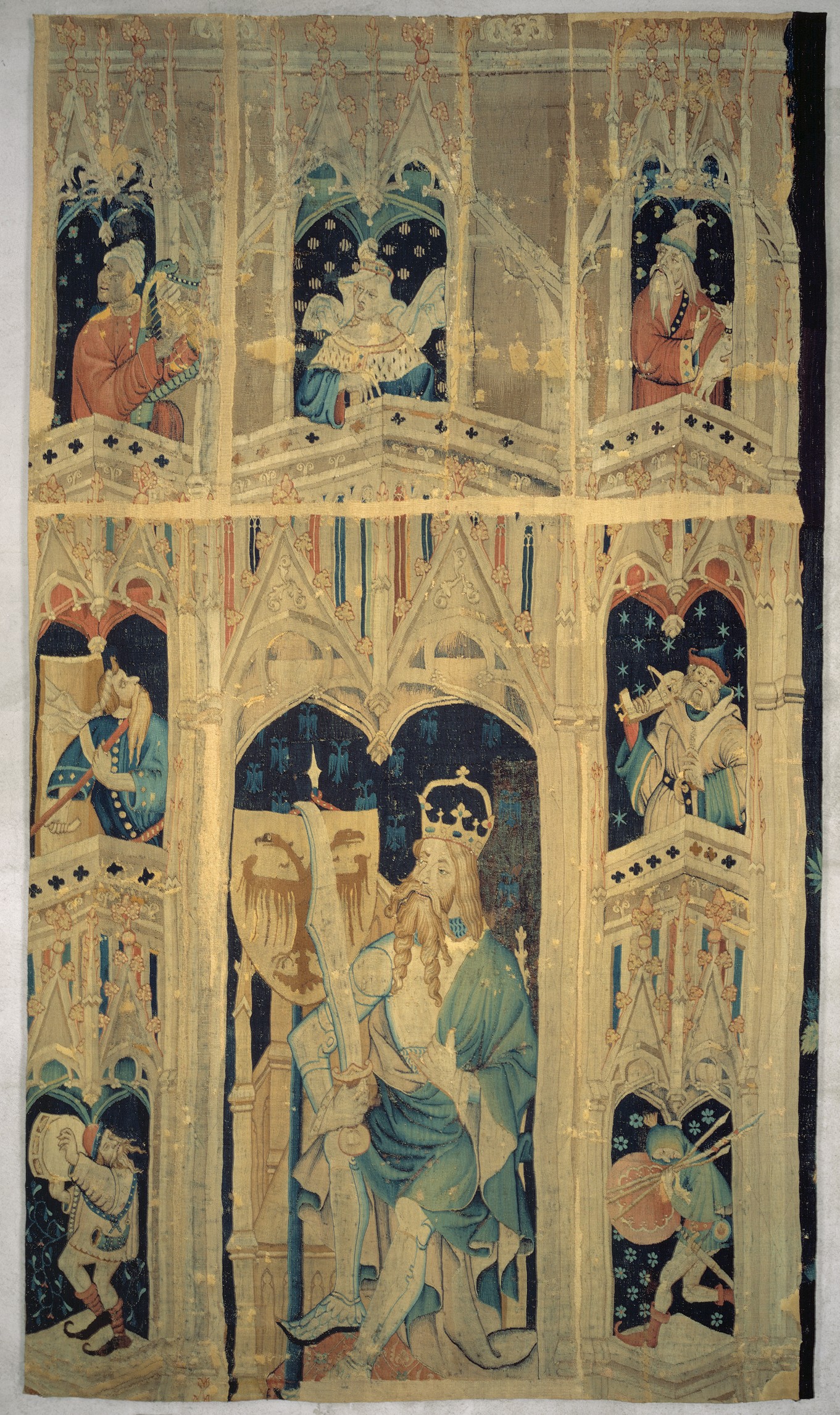
The panel described in this record. Wool warp and wefts, South Netherlandish or French, ca. 1400-1410, 165 1/2 x 93 11/16 in. Gift of John D. Rockefeller Jr., 1947, accession 47.101.3. Confirmed against the object's own live Museum page and caption; the Museum's Open Access API separately misattaches a King Arthur filename to this object's primaryImage field, which this record does not use.
| Artist | Unknown South Netherlandish (or French) tapestry workshop |
|---|---|
| Date | ca. 1400-1410 |
| Medium | Wool warp, wool wefts (tapestry weave) |
| Dimensions | 165 1/2 x 93 11/16 in. (420.4 x 238 cm) |
| Where it is now | The Metropolitan Museum of Art, The Cloisters, New York, Department of Medieval Art and The Cloisters. Normally on view in Gallery 18; as of this record's research the panel is off view, undergoing an intensive conservation treatment in the Museum's Department of Textile Conservation.last confirmed |
| Inventory number | Accession number 47.101.3 (object ID 468233) |
| Attribution | DisputedThe Metropolitan Museum's own current cataloguing gives the culture as South Netherlandish. Full note |
| Object type | Textile |
| Period | South Netherlandish or French, early fifteenth century (Late Gothic) |
| Cases | Disputed attribution · Has a provenance gap |
| Inscriptions | None recorded on this panel in the sources consulted. The heraldic banners that anchor the Jean de Berry patronage hypothesis appear on the related Jewish Heroes hanging (Joshua and David, accession 32.130.3b; 47.101.1; 47.152), not on the Julius Caesar panel itself. |
| Owners on record | 5 links3 documented, 2 unknown |
| Sources | 10 cited |
About this record Last verified · 10 sources cited · Change log
On this page 9 sections
ContentsClose
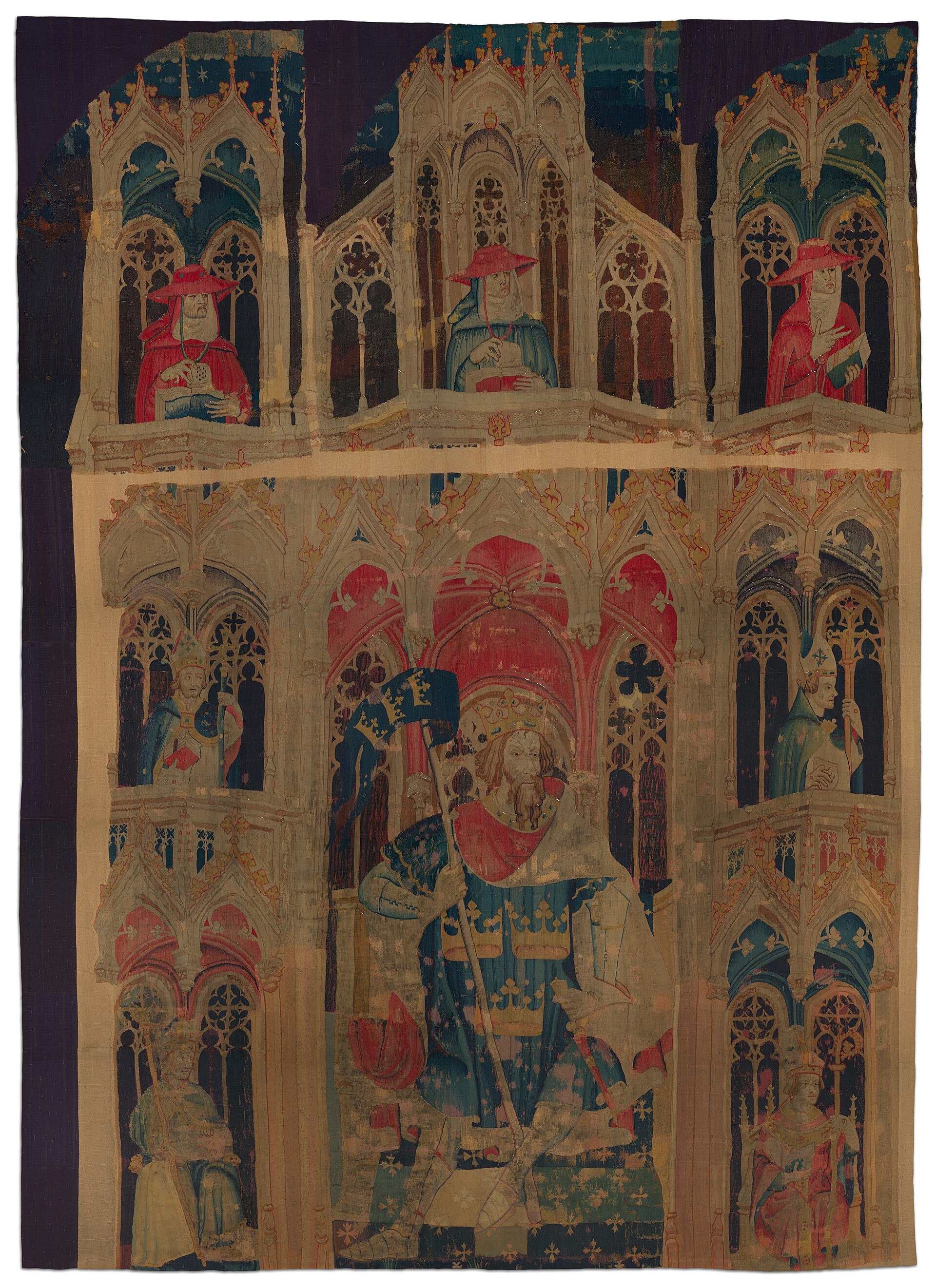
A wool tapestry of about 1400-1410 showing Julius Caesar enthroned under a Gothic architectural canopy, crowned, armed with a falchion, and flanked by musicians and soldiers whose shields carry the double-headed eagle of the Roman empire. It is one of only five surviving figures from a set of Nine Heroes tapestries commissioned for an unidentified patron around 1400, a set scholars have proposed, without proof, belonged to Jean, duke of Berry.
The panel's own history is a reconstruction as much as its subject's empire was. At some undocumented point the set was cut into pieces; by the early twentieth century the fragments had been resewn as curtains in a French household. The Metropolitan Museum acquired the surviving material in two campaigns fifteen years apart, a 1932 purchase and a 1947 gift, and four tapestry restorers spent nearly 6,700 hours piecing ninety-four fragments back into the hangings now on view. The Julius Caesar panel came entirely from the 1947 gift.
The panel is currently off view again, mid-treatment in the Museum's own Department of Textile Conservation as part of a long-term study begun in 2018. Analysis of its dyes published in 2024 identified a lichen source never before confirmed in a historic textile, the first evidence that lichen dyes prepared by boiling water, rather than fermentation, were in use before the eighteenth century.
Provenance
Each link is graded. Documented: a cited source supports it. Disputed: the identification is argued but not established. Unknown: no owner for that span, and the gap is not smoothed into a narrative. The grades in the glossary.
- ca. 1400-1410 -Unidentified commissioning patron; South Netherlandish or French workshopunknown
Style and weave place manufacture in South Netherlandish or French hands around 1400-1410. The Museum's own 2024 dye-analysis study of this panel states plainly that it remains unclear exactly where, when, or for whom the Heroes tapestries were woven. Scholars have proposed Jean, duke of Berry, as the original patron, resting on the observation that ten of fourteen heraldic banners on the related Joshua and David hanging carry his coat of arms, with the remaining four split between the royal arms of France and those of his brother Philip the Bold, duke of Burgundy. Against that reading, inventories of the duke of Berry's own collection do record Nine Heroes tapestries in his possession, but describe them as woven with gold and silver thread; the Cloisters set is wool only. The Museum treats the identification as suggestive, not proven, and this record follows that grading.134
- - early 20th centuryUnrecordedunknown
No owner or location is documented for roughly five centuries between the panel's presumed weaving in the early fifteenth century and the reappearance of the Heroes tapestry fragments, cut apart and resewn as window curtains, in a French household in the early twentieth century. Which household, and when or why the tapestries were dismembered, is not stated in any source this research could verify.3
- early 20th century - 1947An unnamed French household, then the New York art marketdocumented
Fragments including pieces later identified as the Julius Caesar panel were photographed on 28 August 1947, before restoration, still stitched together as functioning curtains. How the fragments moved from the French household to the market that supplied the Metropolitan is not documented in the sources this record could verify. A possible connection to the New York and Paris dealer Joseph Brummer, whose personal collection the Museum did acquire in 1947, surfaced in secondary search results but could not be traced to a citable primary source; it is not asserted here and is flagged for a researcher with access to the Cloisters Archives or the Brummer Gallery records at Duke University.3
- 1932 - 1932The Metropolitan Museum of Art (Munsey Fund purchase)documented
A first tranche of Heroes tapestry fragments entered the Museum in 1932 through the Munsey Fund, a purchase fund built from Frank Munsey's bequest, not a personal gift. This tranche did not include any part of the Julius Caesar panel. Caesar's own accession number, 47.101.3, is a single 1947 number with no 1932 component, unlike the King Arthur panel (32.130.3a; 47.101.4) and the Joshua and David panel (32.130.3b; 47.101.1; 47.152), both of which combine fragments recovered across both the 1932 and 1947 campaigns. This record notes the distinction because it is the only one of the four surviving named-hero panels, along with the uncertainly identified 47.101.2d, whose accession history is not split across the two campaigns.12379
- 1947 - presentThe Metropolitan Museum of Art, gift of John D. Rockefeller Jr.documented
The Julius Caesar panel entered the Museum's collection in July 1947 as a gift of John D. Rockefeller Jr., accession number 47.101.3. Curators James Rorimer and Margaret B. Freeman reconstructed the fragmentary set on paper from black-and-white photographs; four tapestry restorers, Mathilda Sullivan, Helen O'Brien Burke, Aline von Arx, and Olga Wangen Larsen, then physically pieced the fragments back together, together logging 6,670 hours between July 1947 and the completion of the work on 15 May 1949, four days before the new Heroes Tapestries gallery opened at The Cloisters. The panel has remained in the Museum's collection since, and since 2018 has been the subject of a long-term Museum conservation and technical-study project; treatment and dye analysis of this specific panel began in September 2022.123
Technical evidence
| Attribution note | The Metropolitan Museum's own current cataloguing gives the culture as South Netherlandish. The most recent technical study of this panel, published in 2024 by the Museum's own Department of Scientific Research, states plainly that the tapestry was 'likely woven circa 1400-1410 in France or the Southern Netherlands' and that it remains unclear exactly where, when, or for whom the set was woven. This record could not locate a documented record of an earlier Parisian or French catalogue attribution for this specific Metropolitan set that was later revised to South Netherlandish; the Museum's own object page and its 1953 Rorimer/Freeman monograph both use South Netherlandish, so far as this research could establish. Whether an earlier French attribution existed and was formally revised, or whether South Netherlandish has been the Museum's position throughout, is left as an open question rather than asserted either way. |
|---|---|
| Weave and materials | Tapestry weave, wool warp and wool wefts throughout; no metal thread.12 |
| Dimensions | 165 1/2 x 93 11/16 in. (420.4 x 238 cm), overall.12 |
| Classification | Textiles-Tapestries, per the Museum's own department classification.1 |
| Credit line and accession | Gift of John D. Rockefeller Jr., 1947. Accession number 47.101.3; object ID 468233.12 |
| Palette | Principal figures in bright blue, green, red, and yellow; shading and depth built from darker blue, beige, and brown wefts.4 |
| Dye analysis, brown fibers | Three dark brown wool samples, drawn from thirty-seven taken across the panel, yielded chlorinated lichen xanthone metabolites (including thiophanic acid and arthothelin), identified by LC-qToF-MS and matched against Lecanora sulphurata and other crustose lichen reference material. The specific lichen source used by the medieval dyers remains unidentified.4 |
| Dye method implied | The metabolites identified are boiling-water-method (BWM) lichen colorants rather than the better-documented ammonia-fermentation dyes, the first physical evidence of BWM lichen dye use before the eighteenth century.4 |
| Physical reconstruction | Assembled from fragments recovered as sewn-together window curtains; the individual fragments composing the panel are numbered in the Museum's own conservation photography.34 |
| Display location | Normally Gallery 18 at The Met Cloisters; off view during current conservation treatment.1 |
Images
The record in full
Chapter 1What the panel shows
Julius Caesar sits enthroned at the center of an elaborate Gothic architectural setting built from tracery windows, pointed arches, and small spired canopies, the standard framing device used for...
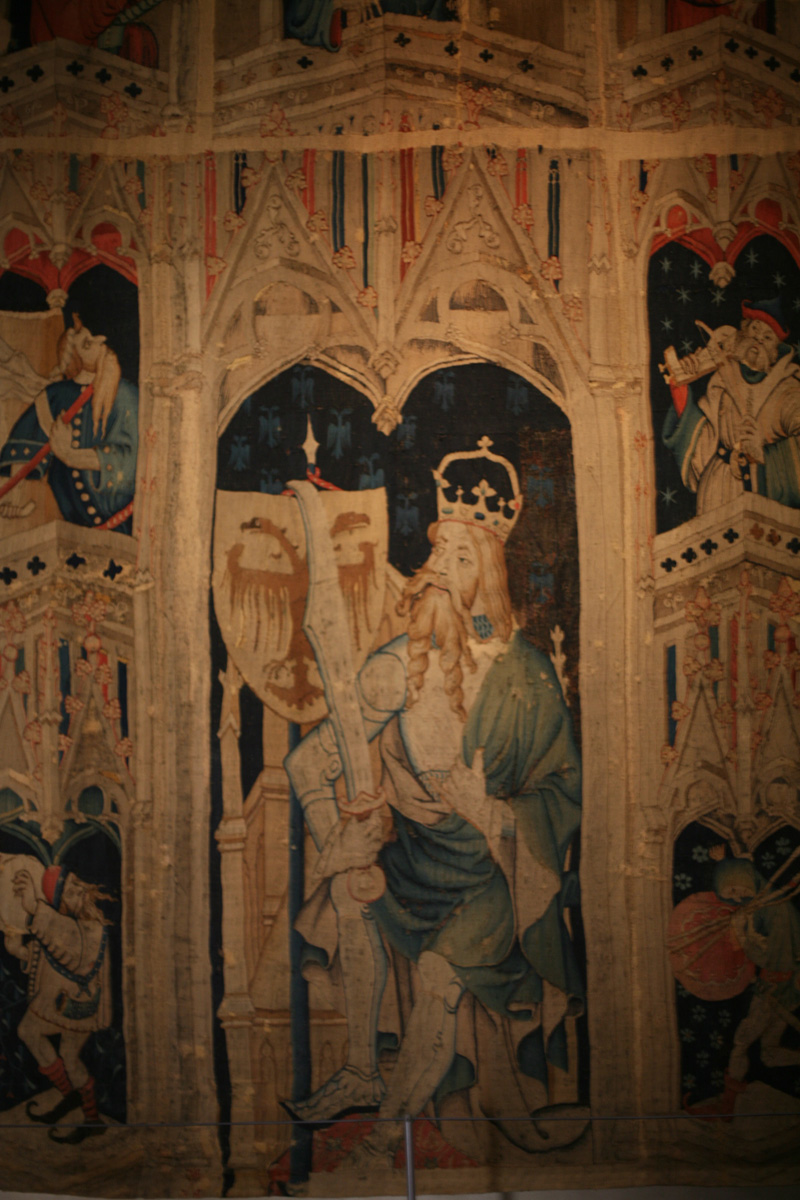
Julius Caesar sits enthroned at the center of an elaborate Gothic architectural setting built from tracery windows, pointed arches, and small spired canopies, the standard framing device used for each of the Nine Heroes. He wears the imperial crown and holds a falchion, a single-edged curved saber associated in medieval art with authority and command. A shield bearing a double-headed eagle, the emblem the period attached to the ancient Roman empire, hangs from a spear at his side. Musicians and foot soldiers surround him, their blue clothing and accessories echoing his own regal coloring, a visual device that ties the attendant figures to the hero they serve.
The whole hanging measures 165 1/2 by 93 11/16 inches, woven entirely in wool, warp and weft alike. It is one of only five figures to survive from what was originally a set of nine, each a large-scale wall hanging meant to be seen from across a hall rather than examined at close range, though the surviving detail rewards close looking: fine outlines and shading were worked in a black compound-like technique typical of the period's best tapestry weaving.
Chapter 2The Nine Heroes and what they were for
The idea of Nine Heroes, or Nine Worthies, drawing three exemplars each from Classical antiquity, the Hebrew Bible, and Christian history, was first put into words in a French poem around 1312 and...
The idea of Nine Heroes, or Nine Worthies, drawing three exemplars each from Classical antiquity, the Hebrew Bible, and Christian history, was first put into words in a French poem around 1312 and became one of the most widely repeated moral schemes in late medieval European art and literature. Hector of Troy, Alexander the Great, and Julius Caesar stood for the Classical era; Joshua, David, and Judas Maccabeus for the Jewish tradition; King Arthur, Charlemagne, and Godfrey of Bouillon for Christian Europe. Together the nine were held up as models of chivalry, meant to give the noble and upper classes of the period both worthy warriors to admire and just leaders to imitate.
Woven at full scale in wool, hangings like this one served a double purpose: they were images to be read and admired, and they were also functional textiles that kept the stone interiors of a great hall or chamber warmer and more festive during the colder months. The choice to depict Caesar in particular, crowned and armed with the double-headed eagle of imperial Rome, placed the weight of ancient legitimate authority behind whatever hall the tapestry originally hung in.
Chapter 3Who commissioned it, and the case that does not quite close
No inscription on the Julius Caesar panel itself names a patron.
No inscription on the Julius Caesar panel itself names a patron. The strongest documented lead comes from a different panel in the same set: the Joshua and David hanging carries fourteen heraldic banners across its upper register, and ten of them display the coat of arms of Jean, duke of Berry, son of King John II of France, with the remaining four split between the royal arms of France and those of his brother, Philip the Bold, duke of Burgundy. On that evidence, scholars have proposed since the tapestries entered the Museum's collection that the whole set was made for the duke of Berry.
The proposal runs into a real obstacle. Surviving inventories of the duke of Berry's own collection do record that he owned tapestries depicting the Nine Heroes, but describe them as woven with gold and silver thread. The Cloisters set is wool throughout, with no metal thread. The Metropolitan's own position, stated on its object pages, is that the resemblance is tantalizing but that there is no conclusive proof regarding the tapestries' original ownership. This record follows that caution: the patron is unknown, not merely undocumented in this record's own sources.
Chapter 4Where it was woven, and by whom
The Metropolitan currently catalogues the tapestry's culture as South Netherlandish.
The Metropolitan currently catalogues the tapestry's culture as South Netherlandish. The Museum's own 2024 technical study of this specific panel, conducted by its Department of Scientific Research, is more guarded, stating that the hanging was 'likely woven circa 1400-1410 in France or the Southern Netherlands' and that it remains unclear exactly where, when, or for whom the Heroes tapestries were made. No weaver's mark, workshop stamp, or signature survives on the panel, and this record found no document that names a specific town, guild, or master weaver.
This research also could not confirm whether South Netherlandish represents a revision of an earlier French or Parisian catalogue attribution for this particular set. Every source consulted, back to the Museum's own 1953 monograph on the tapestries by curators James Rorimer and Margaret B. Freeman, already uses South Netherlandish. If an earlier French attribution existed and was formally revised, it was not found in the sources this record could verify, and the question is left open rather than answered by assumption.
Chapter 5How it was made, and what its dyes reveal
Tapestry of this kind is woven, not embroidered: the design is built directly into the cloth by weft threads of different colors passed back and forth across a fixed set of warp threads, a slow...
Tapestry of this kind is woven, not embroidered: the design is built directly into the cloth by weft threads of different colors passed back and forth across a fixed set of warp threads, a slow, labor-intensive process that for a hanging of this size would have required a substantial workshop and many months of work. The palette on the Julius Caesar panel runs from bright blues, greens, reds, and yellows in the principal figures to darker blues, beiges, and browns used for shading and depth.
In September 2022, as part of a long-term Museum project to study and conserve the whole Heroes series, conservators and scientists took thirty-seven samples of dyed wool from across the Caesar panel and analyzed them by liquid chromatography-mass spectrometry. Three dark brown samples yielded a set of chlorinated compounds, published in 2024, that were traced to a lichen source and definitively identified as lichen xanthones, including thiophanic acid and arthothelin, matched against reference lichen specimens. It was the first time lichen xanthones of this kind had been identified in any historic object, and the first physical evidence that lichen dyes prepared by boiling water, rather than by the better-documented ammonia fermentation method, were in use before the eighteenth century. The exact species of lichen used remains unidentified; none of the known dye sources in the scientific literature produce the specific metabolites found in the tapestry.
Chapter 6From wall hanging to window curtain
At some point in the roughly five centuries between its weaving and its rediscovery, the set was cut apart.
At some point in the roughly five centuries between its weaving and its rediscovery, the set was cut apart. By the early twentieth century, the surviving fragments, including pieces that would later be identified as the Julius Caesar panel, had been resewn together and pressed into service as curtains in a French household. Who owned that household, and when or why the tapestries were dismembered in the first place, is not recorded in any source this research could verify. The fragments were photographed in their curtain form on 28 August 1947, immediately before restoration began, the last documentary trace of the tapestries in their damaged state.
How the fragments moved from that French household onto the market that eventually supplied the Metropolitan is likewise undocumented in the sources consulted for this record. A possible link to the dealer Joseph Brummer, whose own private collection the Museum acquired in 1947, appeared in secondary search results, but no primary document confirming that Brummer handled these specific tapestries could be located, so it is not asserted here.
Chapter 7Two campaigns, fifteen years apart
The Heroes tapestry fragments entered the Metropolitan's collection in two separate acquisitions.
The Heroes tapestry fragments entered the Metropolitan's collection in two separate acquisitions. The first, in 1932, was a purchase made through the Munsey Fund, built from the bequest of newspaper publisher Frank Munsey. The second, in 1947, was a personal gift from John D. Rockefeller Jr., with a further, smaller gift the same year from George A. Douglass covering part of the Jewish Heroes hanging.
Several of the surviving panels carry composite accession numbers that record both campaigns on a single object: King Arthur is catalogued as 32.130.3a; 47.101.4, and Joshua and David as 32.130.3b; 47.101.1; 47.152. The Julius Caesar panel is different. Its accession number, 47.101.3, is a single 1947 number, meaning the fragments that make up this particular hanging arrived entirely in the Rockefeller gift, with no portion recovered in the earlier 1932 purchase. That distinction is itself a small piece of the reconstruction's documentary record: it tells a researcher, without needing to consult the Museum's internal files, which fragments were in hand fifteen years apart.
Chapter 8Rebuilding the heroes
The Museum received the tapestries in ninety-four separate fragments.
The Museum received the tapestries in ninety-four separate fragments. Curators James Rorimer and Margaret B. Freeman worked out how the pieces fit together using black-and-white photographs, effectively solving the jigsaw on paper before a single stitch of physical restoration began. Turning that paper reconstruction into wall-ready tapestries fell to four hired needleworkers: Mathilda Sullivan, a former Museum employee who selected the wool threads for the project; Helen O'Brien Burke, the highest-paid of the four; Aline von Arx, a Swiss immigrant who became a United States citizen one month before starting the work; and Olga Wangen Larsen, a Norwegian immigrant and trained tapestry weaver who later worked on the Museum's Unicorn Tapestries.
Between them the four women logged 6,670 hours cutting apart, reassembling, piercing, and relining the fragments, work that ran from July 1947 to 15 May 1949, finishing just four days before the new Heroes Tapestries gallery opened at The Cloisters. Their contribution went largely unrecorded at the time; an undated photograph of two of them at work appeared unlabeled in the Museum's own Bulletin, and it took a 1955 Saturday Evening Post feature, focused mainly on Rorimer, to name them at all. Without their labor the set would have remained in fragments.
Chapter 9What the reconstruction still leaves uncertain
Only five of the original nine heroes survive in any form: Julius Caesar, King Arthur, Joshua and David together on one hanging, and a fifth figure the Museum itself catalogues with a question mark...
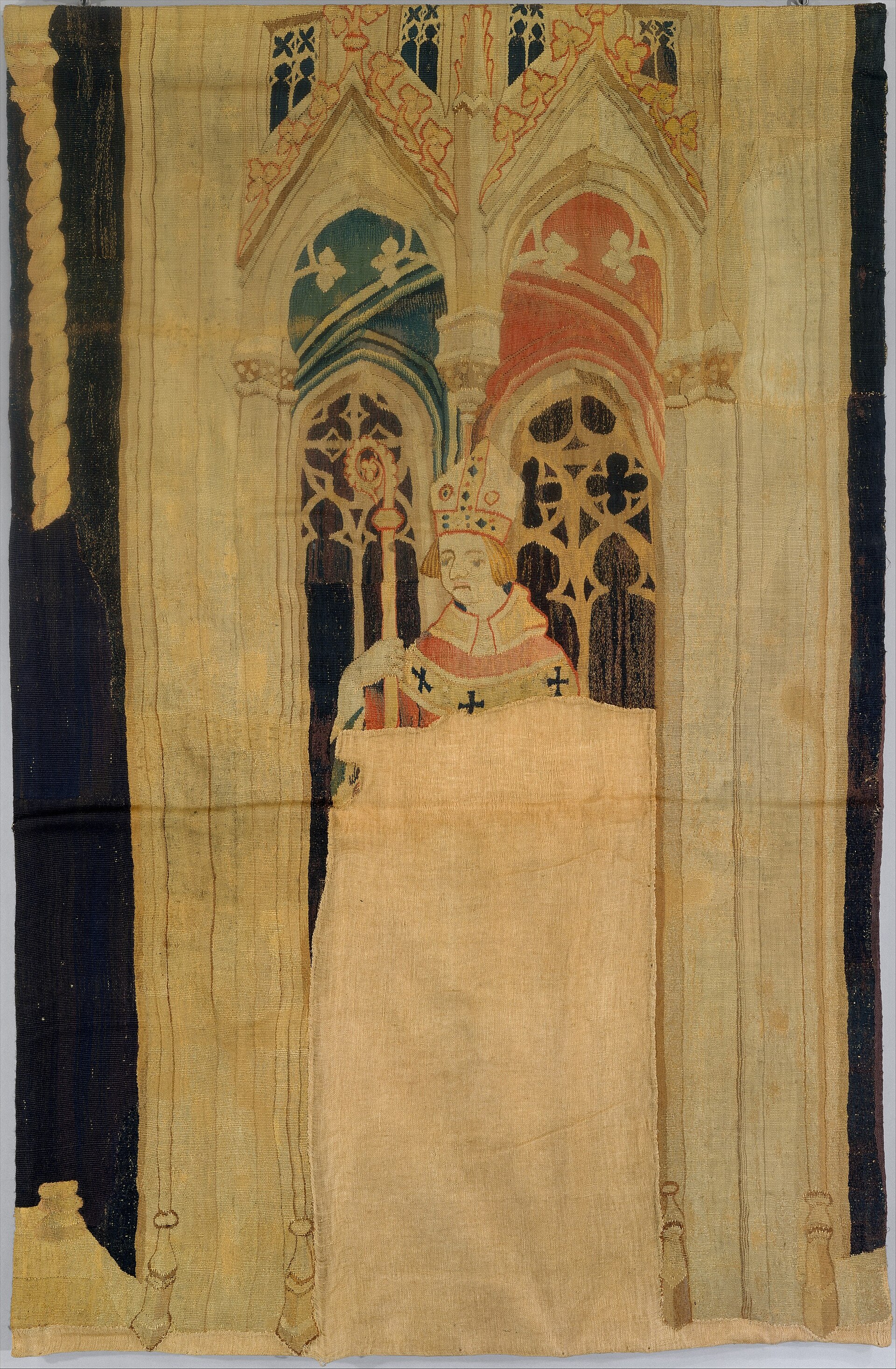
Only five of the original nine heroes survive in any form: Julius Caesar, King Arthur, Joshua and David together on one hanging, and a fifth figure the Museum itself catalogues with a question mark, 'Hector of Troy (?)'. That panel, accession 47.101.2d, would have hung alongside Caesar as the third member of the Classical Heroes group, but the Museum has not settled whether the surviving figure is Hector of Troy or Alexander the Great. Small fragments showing subsidiary figures, including bishops, archbishops, and cardinals who accompanied King Arthur's throne, also survive as separate catalogued pieces.
The other four heroes, whichever of Hector or Alexander is not accounted for by 47.101.2d, Judas Maccabeus, Charlemagne, and Godfrey of Bouillon, are not known to survive in any recognizable form. Whether fragments of them exist unidentified in another collection, or whether they were lost or destroyed before the set reached the Metropolitan, is not established in any source this record could verify.
Chapter 10What is happening to it now
None of the surviving Heroes panels received conservation treatment between their installation in 1949 and 2018, when the Metropolitan began a long-term project to study and conserve the whole group.
None of the surviving Heroes panels received conservation treatment between their installation in 1949 and 2018, when the Metropolitan began a long-term project to study and conserve the whole group. King Arthur was treated first, with cleaning, stabilization, and reweaving of fragile areas completed and the panel reinstalled at The Cloisters by December 2022. Treatment and dye analysis of the Julius Caesar panel began in September 2022 and, as of this record's research, is still underway in the Museum's Department of Textile Conservation; the panel is currently off view. The 2024 dye-analysis paper describing the lichen finding notes that a fuller account of Caesar's own conservation and acquisition history is being prepared as a separate publication, not yet identified in the sources searched for this record.
The artist
Unknown South Netherlandish or French tapestry workshop, active early fifteenth century
No weaver's signature, workshop mark, or maker's name survives on any of the surviving Heroes panels, including this one. What can be established comes from the finished object itself and from a single, still-unresolved technical study: a wool tapestry-weaving operation capable of producing wall hangings on this scale, working in a South Netherlandish or French idiom around 1400-1410, for a patron wealthy enough to commission a set of at least three large hangings but not identified with certainty in any surviving document.
Related works
| Work | Relation | Where it is |
|---|---|---|
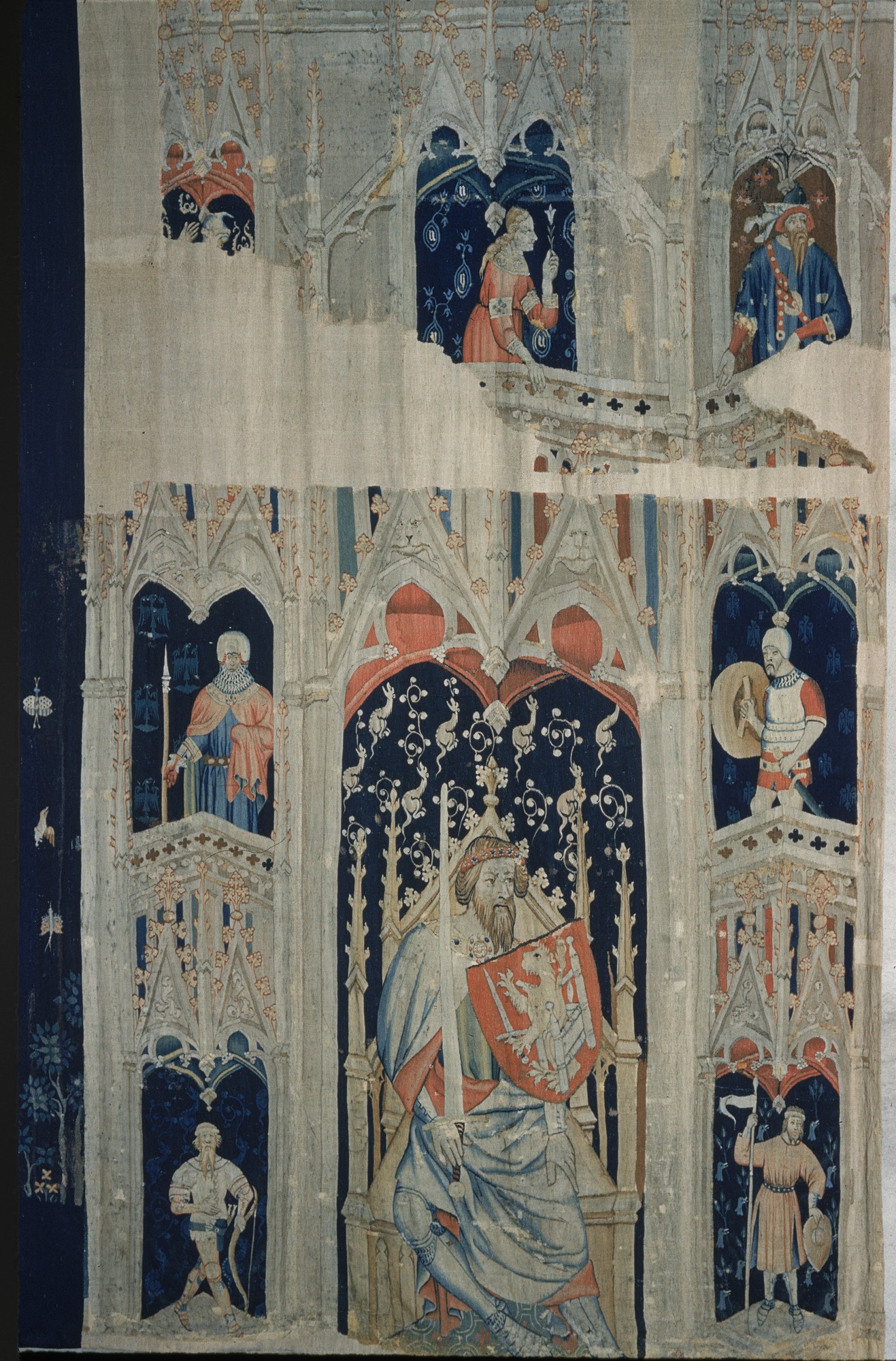
| King Arthur (from the Heroes Tapestries) Same South Netherlandish or French workshop | Surviving panel from the Christian Heroes hanging of the same original set Accession 32.130.3a; 47.101.4, combining fragments from both the 1932 and 1947 acquisition campaigns, unlike the single-campaign Julius Caesar panel. The first of the surviving Heroes to receive modern conservation treatment, completed by December 2022. | The Metropolitan Museum of Art, The Cloisters, New York |
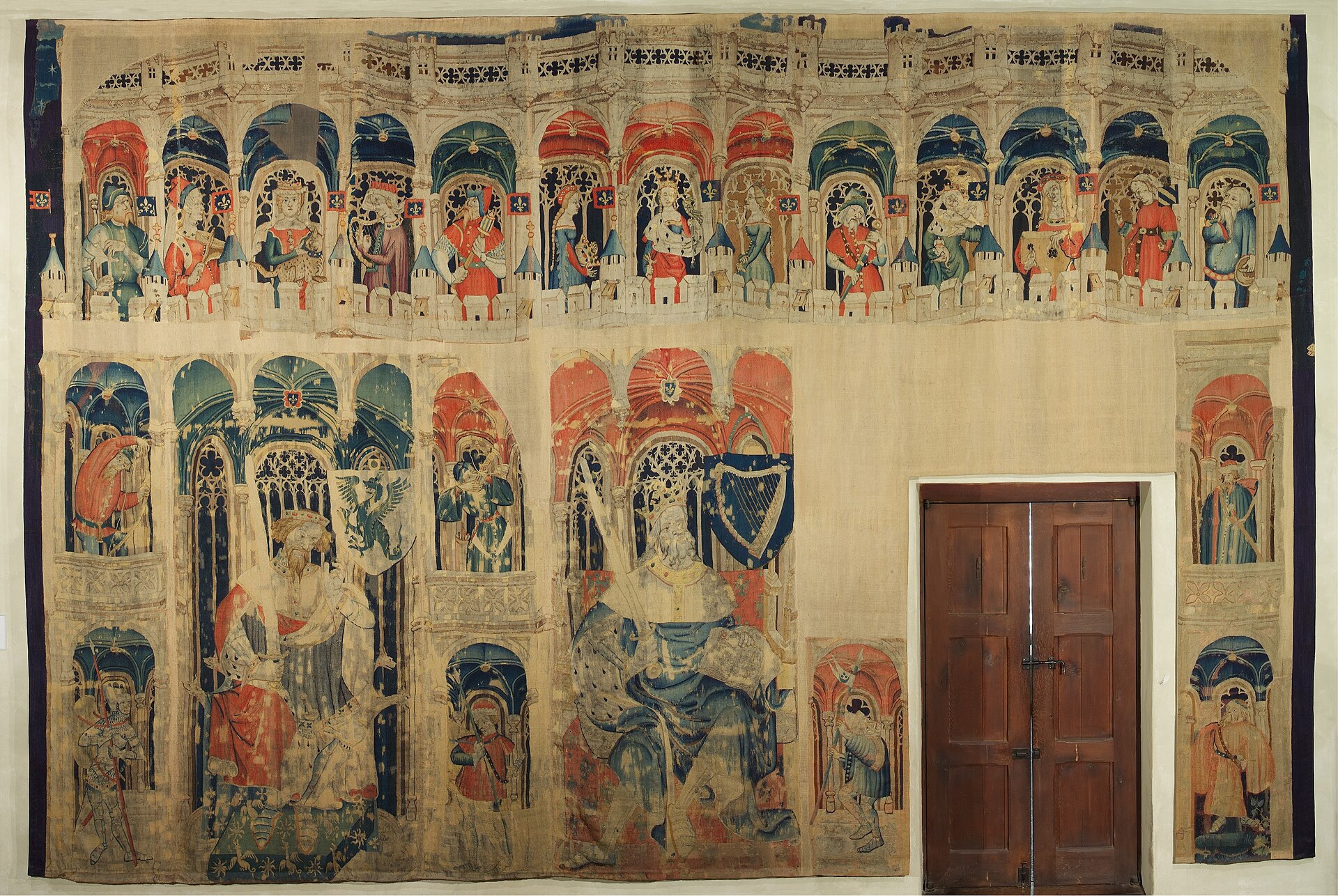
| Joshua and David (from the Heroes Tapestries) Same South Netherlandish or French workshop | Surviving panel from the Jewish Heroes hanging of the same original set Accession 32.130.3b; 47.101.1; 47.152, combining fragments from the 1932 Munsey Fund purchase and two separate 1947 gifts. Carries the heraldic banners that anchor the (unproven) Jean de Berry patronage hypothesis for the whole set. | The Metropolitan Museum of Art, The Cloisters, New York |
| Hector of Troy (?) (from the Heroes Tapestries) Same South Netherlandish or French workshop | The only other surviving panel from the Classical Heroes hanging that originally included Julius Caesar Accession 47.101.2d, from the 1947 gift only. The Museum's own catalogue title carries a question mark: whether the figure depicts Hector of Troy or Alexander the Great has not been settled. | The Metropolitan Museum of Art, The Cloisters, New York |
| The third original Classical Hero (Hector of Troy or Alexander the Great, whichever 47.101.2d is not) Same South Netherlandish or French workshop | Companion figure to Julius Caesar in the original Classical Heroes hanging The Classical Heroes hanging originally paired Caesar with both Hector of Troy and Alexander the Great. Only one companion figure survives, under an uncertain identification, so it is unclear whether a portrait of the third figure survives unrecognized elsewhere or was lost. | Not known to survive |
Open questions
- Who commissioned the Heroes tapestries and for what building. The Jean de Berry hypothesis rests on heraldry on a different panel and is contradicted by the duke's own inventories, which describe his Nine Heroes tapestries as woven with gold and silver thread, unlike this wool-only set.
- Exactly where the tapestries were woven. The Museum's own 2024 technical study of this panel could not decide between France and the Southern Netherlands.
- When, and by whom, the tapestries were originally cut into fragments. The gap between the presumed early-fifteenth-century weaving and the fragments' early-twentieth-century reuse as curtains in a French household is entirely undocumented in the sources this record could verify.
- Whether object 47.101.2d depicts Hector of Troy or Alexander the Great. The Museum's own catalogue title keeps a question mark on the identification.
- What became of the four Heroes that do not survive in any recognized form (Judas Maccabeus, Charlemagne, Godfrey of Bouillon, and whichever of Hector or Alexander is not 47.101.2d).
- How the tapestry fragments moved from the French household that used them as curtains onto the market that supplied the Metropolitan Museum, and whether the dealer Joseph Brummer was involved, as an unconfirmed secondary lead suggested.
- What the promised separate publication on Julius Caesar's own conservation and acquisition history, flagged as forthcoming in the 2024 dye-analysis paper, will add once it appears.
Questions about this object
What is Julius Caesar (from the Heroes Tapestries)?
Julius Caesar (from the Heroes Tapestries) is a textile, dated ca. 1400-1410. Medium: Wool warp, wool wefts (tapestry weave).
Who made Julius Caesar (from the Heroes Tapestries), and is the attribution settled?
The attribution to Unknown South Netherlandish (or French) tapestry workshop is recorded here as disputed. The Metropolitan Museum's own current cataloguing gives the culture as South Netherlandish. The most recent technical study of this panel, published in 2024 by the Museum's own Department of Scientific Research, states plainly that the tapestry was 'likely woven circa 1400-1410 in France or the Southern Netherlands' and that it remains unclear exactly where, when, or for whom the set was woven. This record could not locate a documented record of an earlier Parisian or French catalogue attribution for this specific Metropolitan set that was later revised to South Netherlandish; the Museum's own object page and its 1953 Rorimer/Freeman monograph both use South Netherlandish, so far as this research could establish. Whether an earlier French attribution existed and was formally revised, or whether South Netherlandish has been the Museum's position throughout, is left as an open question rather than asserted either way.
Where is Julius Caesar (from the Heroes Tapestries) now?
The Metropolitan Museum of Art, The Cloisters, New York, Department of Medieval Art and The Cloisters. Normally on view in Gallery 18; as of this record's research the panel is off view, undergoing an intensive conservation treatment in the Museum's Department of Textile Conservation. Inventory number Accession number 47.101.3 (object ID 468233). Last confirmed 1 September 2026. The Museum's own object page and Open Access API record for object 468233, both current as of this record's research.
What is still unknown about Julius Caesar (from the Heroes Tapestries)?
Who commissioned the Heroes tapestries and for what building. The Jean de Berry hypothesis rests on heraldry on a different panel and is contradicted by the duke's own inventories, which describe his Nine Heroes tapestries as woven with gold and silver thread, unlike this wool-only set.
Sources
- 1The Metropolitan Museum of Art, 'Julius Caesar (from the Heroes Tapestries),' Collection object page, object number 47.101.3. metmuseum.org/art/...
- 2The Metropolitan Museum of Art, Open Access API, object record 468233 (Julius Caesar). Note: this API's own primaryImage field for object 468233 returns a filename beginning 'lc-32-130-Arthur', i.e. a King Arthur file misattached to the Caesar record; this record does not use that image and instead uses a Commons-hosted file whose own filename embeds the correct accession number, cross-checked against the Museum's live object page and its own caption. collectionapi.metmuseum.org/public/...
- 3Amelia Roche Hyde, 'The Heroines of Heroes,' The Metropolitan Museum of Art, Perspectives, March 4, 2022. metmuseum.org/perspectives/...
- 4Rachel M. Lackner, Solenn Ferron, Joel Boustie, Francoise Le Devehat, H. Thorsten Lumbsch, and Nobuko Shibayama, 'Unraveling a Historical Mystery: Identification of a Lichen Dye Source in a Fifteenth Century Medieval Tapestry,' Heritage 2024, 7(5), 2370-2384. doi.org/10.3390/...
- 5The Field Museum, 'Identifying a Dye Source in a 15th Century Medieval Tapestry' (blog report on the Lackner et al. study). fieldmuseum.org/blog/...
- 6The History Blog, 'Conserving the Met's King Arthur tapestry,' December 10, 2022. thehistoryblog.com/archives/...
- 7The Metropolitan Museum of Art, Open Access API, object record 467528 (King Arthur, from the Heroes Tapestries). collectionapi.metmuseum.org/public/...
- 8The Metropolitan Museum of Art, Open Access API, object record 468232 (Hector of Troy (?), from the Heroes Tapestries). collectionapi.metmuseum.org/public/...
- 9The Metropolitan Museum of Art, Open Access API, object record 468230 (Joshua and David, from the Heroes Tapestries). collectionapi.metmuseum.org/public/...
- 10Wikimedia Commons, File:Julius Caesar and Attendants (from the Nine Heroes Tapestries) MET h1 47.101.3.jpg, licence and description metadata read via the Commons API. commons.wikimedia.org/wiki/...
_MET_h1_47.101.3.jpg)
Last verified · Published
Change log
1 September 2026 - Record created at the house standard: researched narrative, technical evidence, maker dossier, graded provenance chain, prices with hammer and premium separated, related works, open questions and sources.