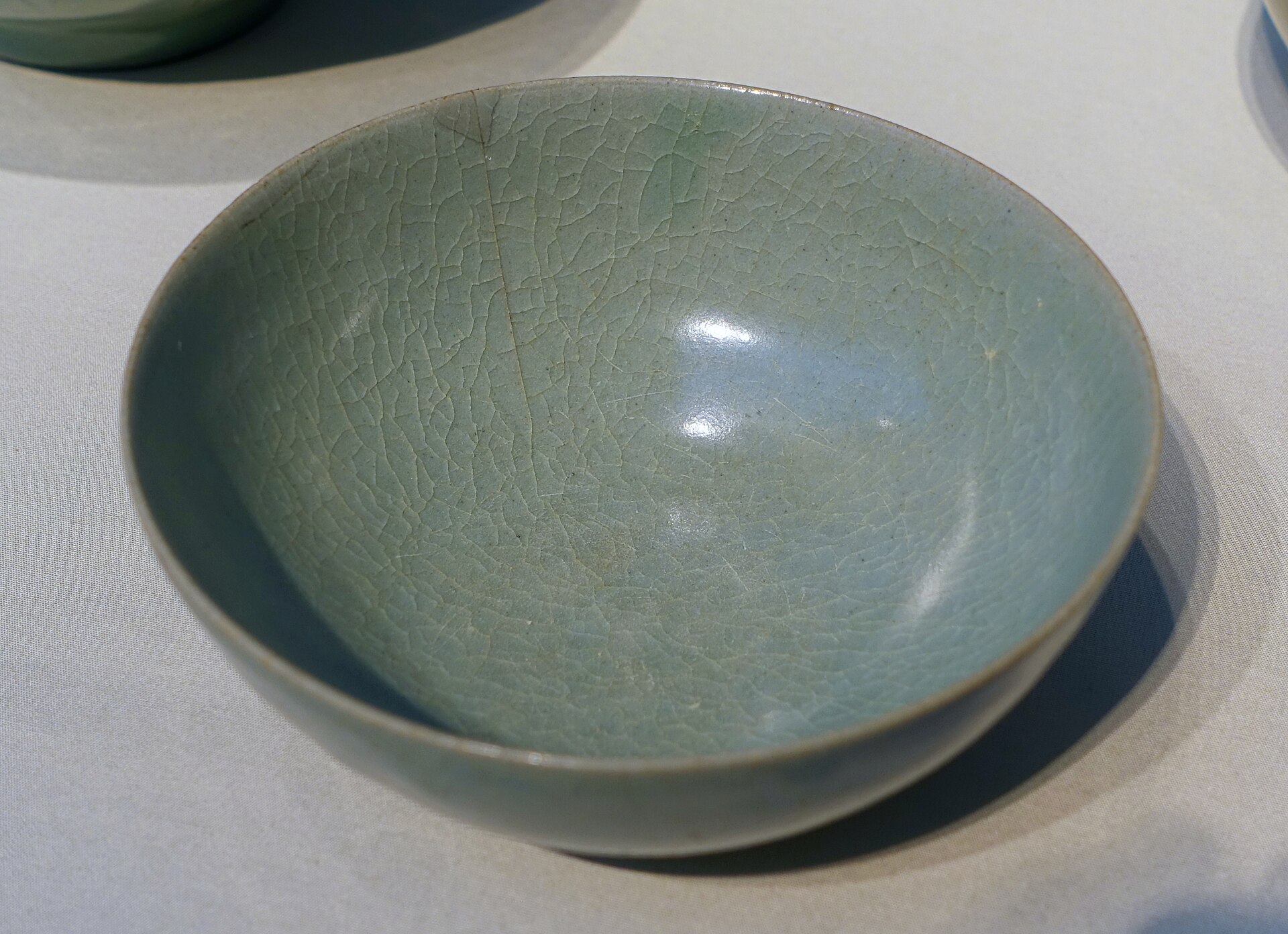
Bowl with two boys and lotuses
Goryeo dynasty celadon kilns (unattributed potter) · Early 12th century, Goryeo dynasty
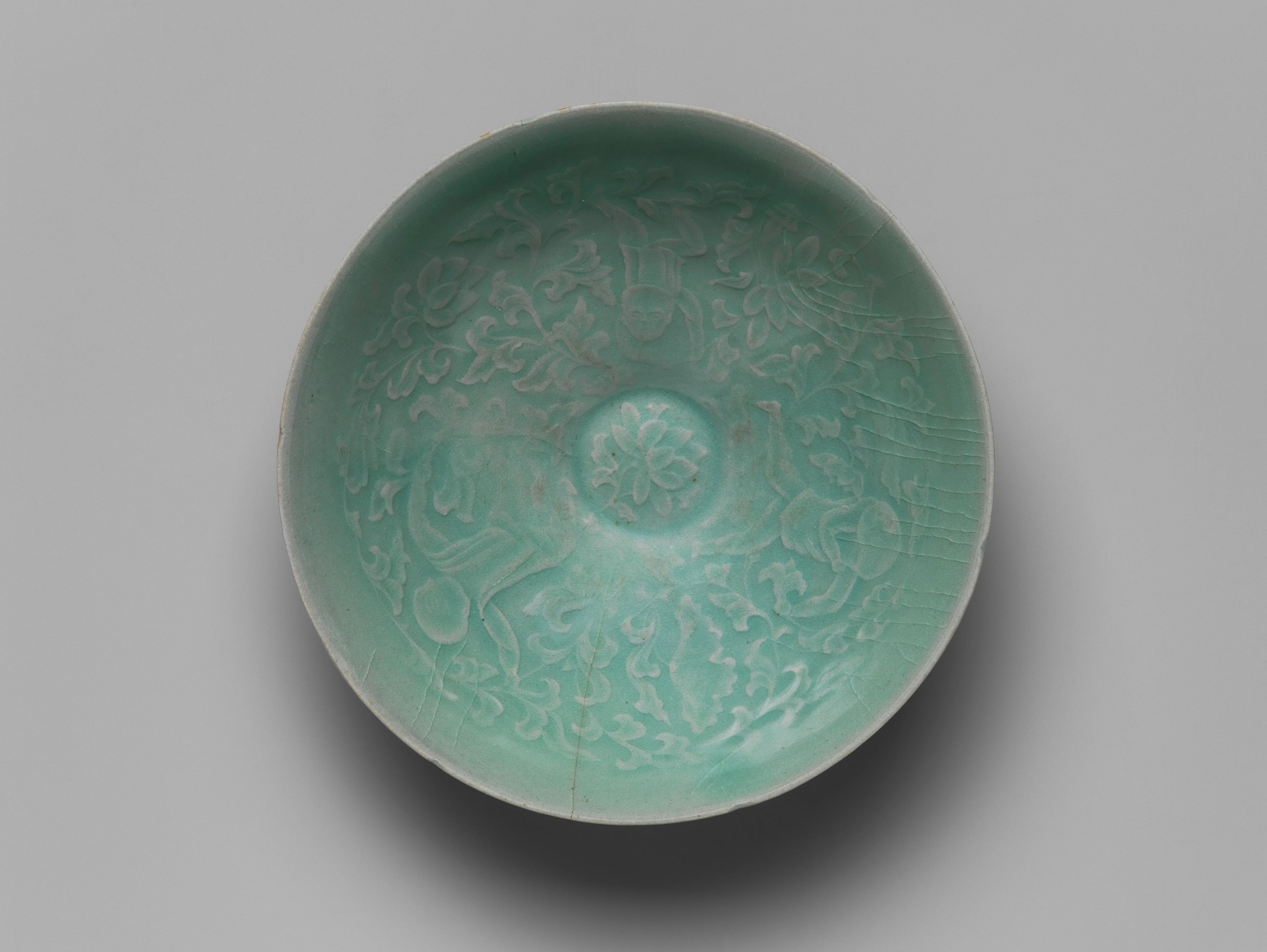
The record subject. Stoneware with mold-impressed design under celadon glaze, early 12th century. Metropolitan Museum of Art, accession 11.8.6, gift of Sadajiro Yamanaka, 1911. Published by the Museum as open access.
| Artist | Goryeo dynasty celadon kilns (unattributed potter) |
|---|---|
| Date | Early 12th century, Goryeo dynasty |
| Medium | Stoneware with mold-impressed design under celadon glaze |
| Dimensions | Height 6.4 cm (2 1/2 in.); diameter 19.4 cm (7 5/8 in.) |
| Where it is now | Metropolitan Museum of Art, New York, Department of Asian Art, on view in Gallery 233last confirmed |
| Inventory number | Accession 11.8.6 (Museum object ID 50352) |
| Attribution | UnknownNo potter, workshop or kiln site is named for this bowl in the Metropolitan Museum's own object record or in any source consulted for this record. Full note |
| Object type | Ceramic |
| Period | Korea, Goryeo dynasty (918-1392) |
| Cases | Has a provenance gap |
| Inscriptions | None recorded. |
| Owners on record | 3 links2 documented, 1 unknown |
| Sources | 15 cited |
About this record Last verified · 15 sources cited · Change log
On this page 9 sections
ContentsClose
A small stoneware bowl decorated with two boys among lotus scrolls under a jade-green celadon glaze, made in Korea in the early twelfth century at the height of the Goryeo dynasty's reputation for the finest green ware then known outside China. It reached the Metropolitan Museum of Art in 1911 as a gift of Sadajiro Yamanaka, head of Yamanaka and Co., then one of the largest dealers moving East Asian art, including Korean material, into American and European collections.
The gift falls squarely inside a well documented and still unresolved history: Goryeo celadon of exactly this kind was being dug up from tombs around the old capital at Kaesong in exactly this decade, largely under Japan's colonial administration of Korea, and Yamanaka's own firm is separately documented as having profited from acquiring antiquities cheaply from Korea and China during this period of upheaval. What is not documented, anywhere in the sources consulted for this record, is that this specific bowl came from a looted tomb or any other named findspot; the Museum's own accession record carries no provenance earlier than the 1911 gift at all.
This record states the general historical pattern plainly, states just as plainly what is and is not known about this one bowl, and keeps the two apart. Where the honest answer is unknown, it is recorded as unknown rather than filled in with an inference the sources do not support.
Provenance
Each link is graded. Documented: a cited source supports it. Disputed: the identification is argued but not established. Unknown: no owner for that span, and the gap is not smoothed into a narrative. The grades in the glossary.
- - 1911Unrecordedunknown
No owner, findspot, or acquisition history is documented for this bowl before 1911. The bowl's date and its donor's documented dealing activity place it within a well studied historical category, colonial-period Goryeo celadon moving through the trade via dealers including Yamanaka and Co., but no source consulted names a findspot, an excavator, or a prior owner for this specific object, and none is invented here. See the narrative sections on the colonial-period trade and on the Ogura Collection for what a documented case in this category looks like by contrast.1579
- 1911 - 1911Sadajiro Yamanaka / Yamanaka and Co.documented
Given to the Metropolitan Museum of Art in 1911 by Sadajiro Yamanaka, head of Yamanaka and Co., per the Museum's own credit line and accession record.123
- 1911 - presentMetropolitan Museum of Art, New Yorkdocumented
In the Museum's Department of Asian Art continuously since the 1911 gift; currently on view in Gallery 233.12
Technical evidence
| Attribution note | No potter, workshop or kiln site is named for this bowl in the Metropolitan Museum's own object record or in any source consulted for this record. Goryeo celadon of this quality is generally associated with the Gangjin and Buan kiln complexes in southwestern Korea, which supplied the court and aristocracy in the eleventh and twelfth centuries, but this is a statement about the ware type in general, not a documented finding about this specific bowl, and it is graded accordingly. |
|---|---|
| Body | Fine gray stoneware, wheel-thrown and trimmed.12 |
| Decoration technique | Mold-impressed design of two boys among lotus scrolls on the interior, distinct from the carved/incised and sanggam-inlaid techniques also used on Goryeo celadon of this period.11011 |
| Glaze | Celadon glaze, reduction fired to the blue-green tone Korean sources of the period called bisaek, jade colour.11013 |
| Dimensions | Height 6.4 cm (2 1/2 in.); diameter 19.4 cm (7 5/8 in.).1 |
| Classification | Ceramics, Department of Asian Art, Metropolitan Museum of Art.12 |
| Dating basis | Museum-assigned range of about 1100 to 1133 (early 12th century). The specific stylistic or archaeological reasoning behind this narrow bracket is not published in the sources consulted for this record and is recorded as an open question.1 |
| Accession and object ID | Accession 11.8.6; Metropolitan Museum object ID 50352.13 |
| Rights status | Published by the Metropolitan Museum as open access and public domain; images donated to Wikimedia Commons under CC0.114 |
Images
The record in full
Chapter 1What it is
A small stoneware bowl, 6.4 centimetres high and 19.4 centimetres across, covered in the blue-green celadon glaze that Korean potters of the Goryeo dynasty perfected in the twelfth century.
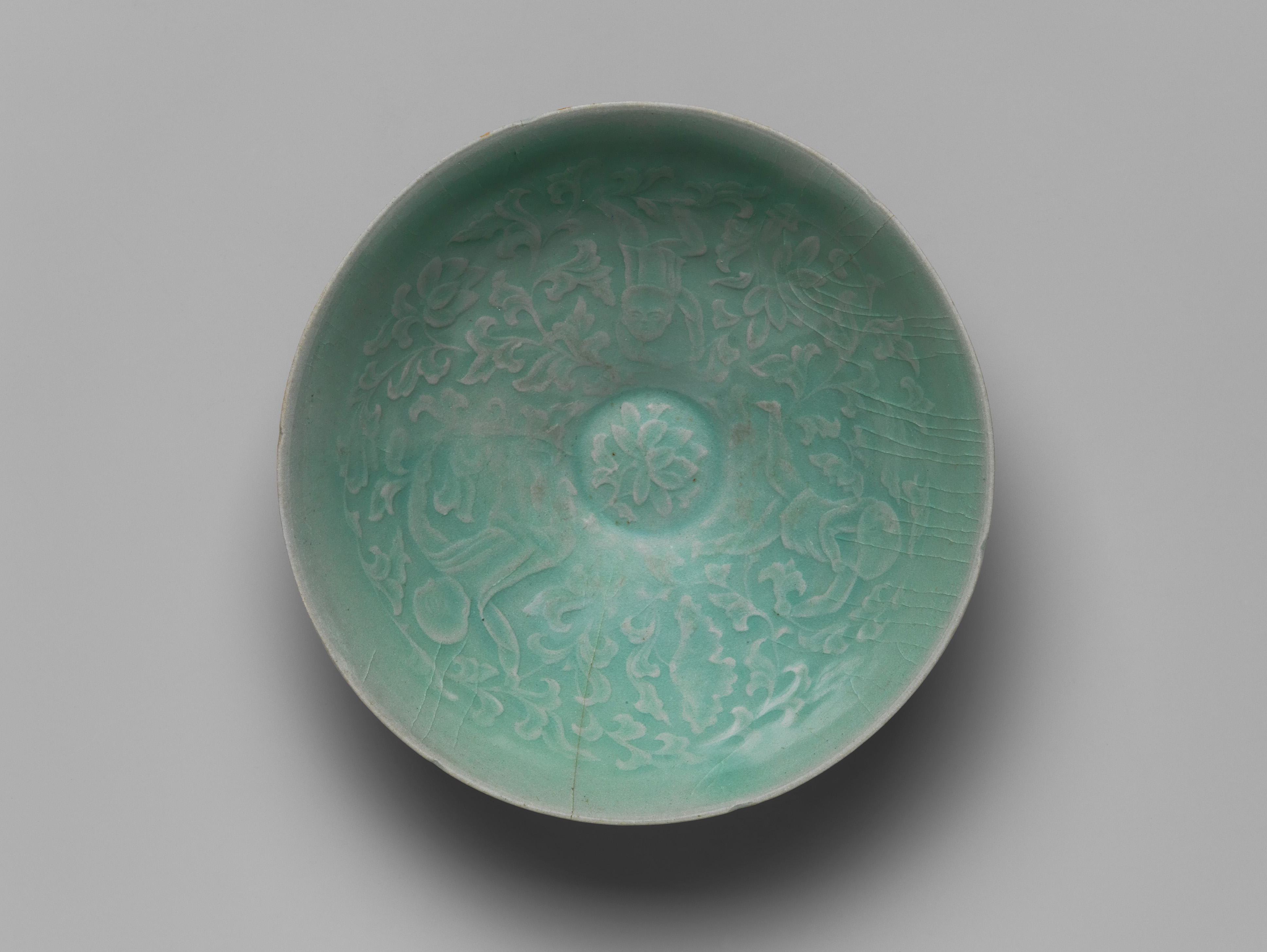
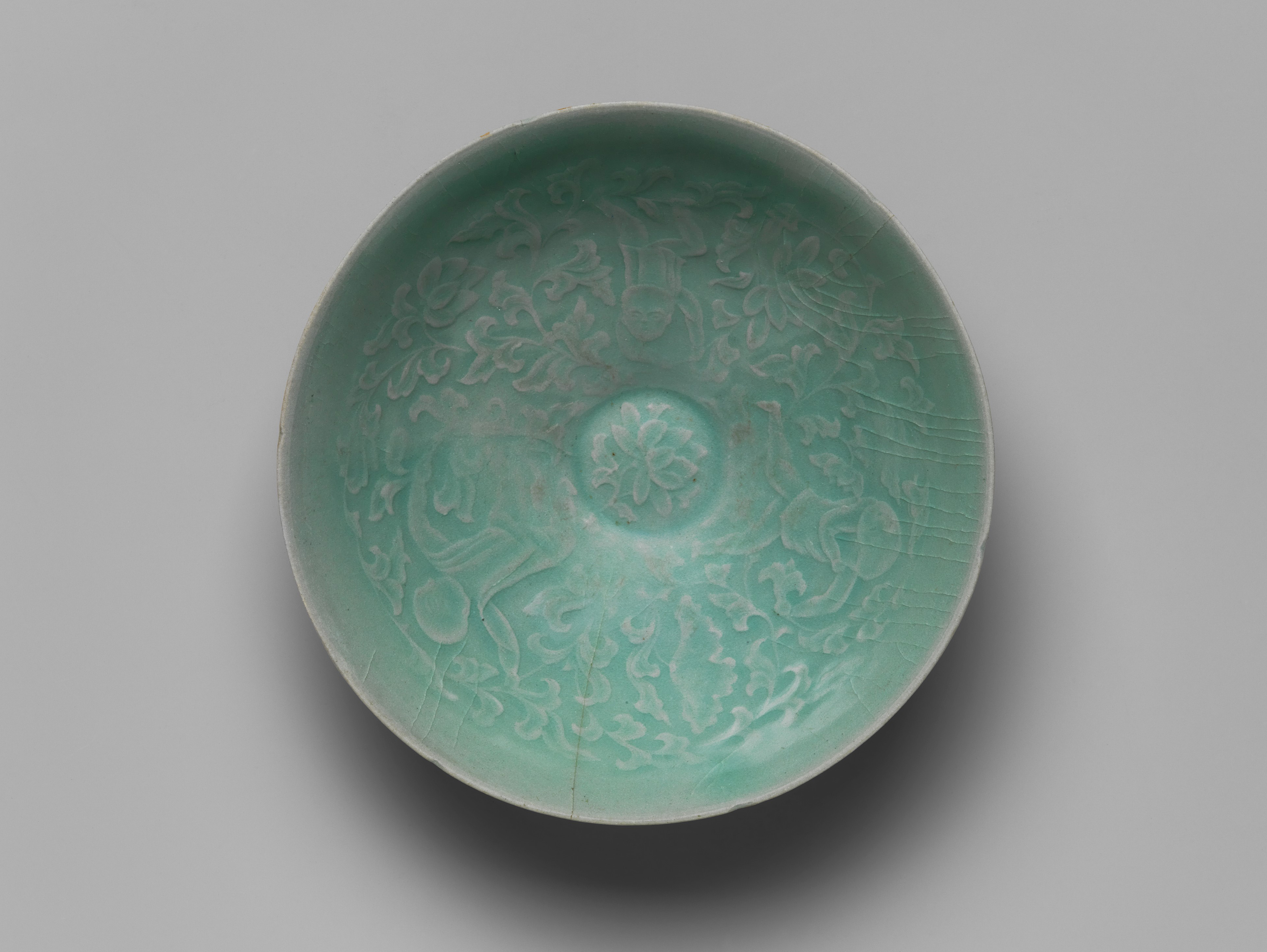
A small stoneware bowl, 6.4 centimetres high and 19.4 centimetres across, covered in the blue-green celadon glaze that Korean potters of the Goryeo dynasty perfected in the twelfth century. The decoration, two boys set among lotus scrolls, was pressed into the clay with a mold before the bowl was glazed and fired, rather than carved, incised or inlaid. It is a domestic-scale object, the kind that would have been used at table rather than displayed as a showpiece, and it survives essentially complete.
The Metropolitan Museum catalogues it simply as a bowl, culture Korea, classification Ceramics, and dates it to the early twelfth century within a bracket of about 1100 to 1133. The Museum's own published record does not explain the specific archaeological or stylistic reasoning behind that narrow date bracket, which is recorded here as an open question rather than filled in with a guess.
Chapter 2How it was made
The body is a fine gray stoneware, thrown and then pressed against or into a mold to raise the boys-and-lotus design on the interior before the bowl was trimmed, glazed and fired in a reducing...
The body is a fine gray stoneware, thrown and then pressed against or into a mold to raise the boys-and-lotus design on the interior before the bowl was trimmed, glazed and fired in a reducing (low-oxygen) kiln atmosphere. Reduction firing is what turns the iron oxide naturally present in Korean glaze recipes blue-green rather than the brown or yellow that an oxidizing fire produces; Goryeo potters controlled this closely enough, by the twelfth century, to produce the specific pale jade-green called bisaek, "jade colour," that gave the ware its reputation.
Mold-impression, the technique used on this bowl, was one of three main ways Goryeo potters decorated celadon in this period, the others being carved or incised line work directly in the clay, and the inlay technique called sanggam, in which a design was cut into the leather-hard body and packed with white and black slip before glazing. Sanggam is the more famous and more labour-intensive Goryeo innovation, and pieces made with it are generally later and more elaborate than this bowl; the two techniques are documented in the same body of scholarship and are not interchangeable, a distinction worth holding onto given how often "Goryeo celadon" is treated in general writing as a single undifferentiated technique.
Chapter 3Two boys among lotuses: the motif
Small figures of boys at play, often shown climbing among grapevines, lotus stems or scrolling foliage, were part of the standard decorative repertoire of Goryeo celadon alongside willows and...
Small figures of boys at play, often shown climbing among grapevines, lotus stems or scrolling foliage, were part of the standard decorative repertoire of Goryeo celadon alongside willows and waterfowl, cranes and clouds, and chrysanthemums and peonies. The convention itself is older and comes from China: children, in Chinese pictorial tradition, generally stand for sons, and a composition crowded with them is a wish for a large and prosperous line of male heirs, a motif that reached a Chinese peak of elaboration in "hundred boys" paintings and that appears on ceramics and textiles across East Asia. That general symbolic reading is documented for the Chinese tradition the motif is drawn from; no source consulted for this record states what the boys-and-lotus motif meant specifically to whoever commissioned or used this particular bowl, and that gap is left as a gap rather than closed with an inference dressed as a fact.
The lotus half of the pairing carries its own separate and well documented meaning in a Buddhist context, standing for purity emerging untouched from muddy water, and Goryeo Korea was a Buddhist state in which lotus imagery pervaded both religious and secular decorative art. A bowl combining both motifs sits inside an ordinary, well attested decorative and devotional vocabulary; there is no need, and no evidence, to read anything more specific or more hidden into it.
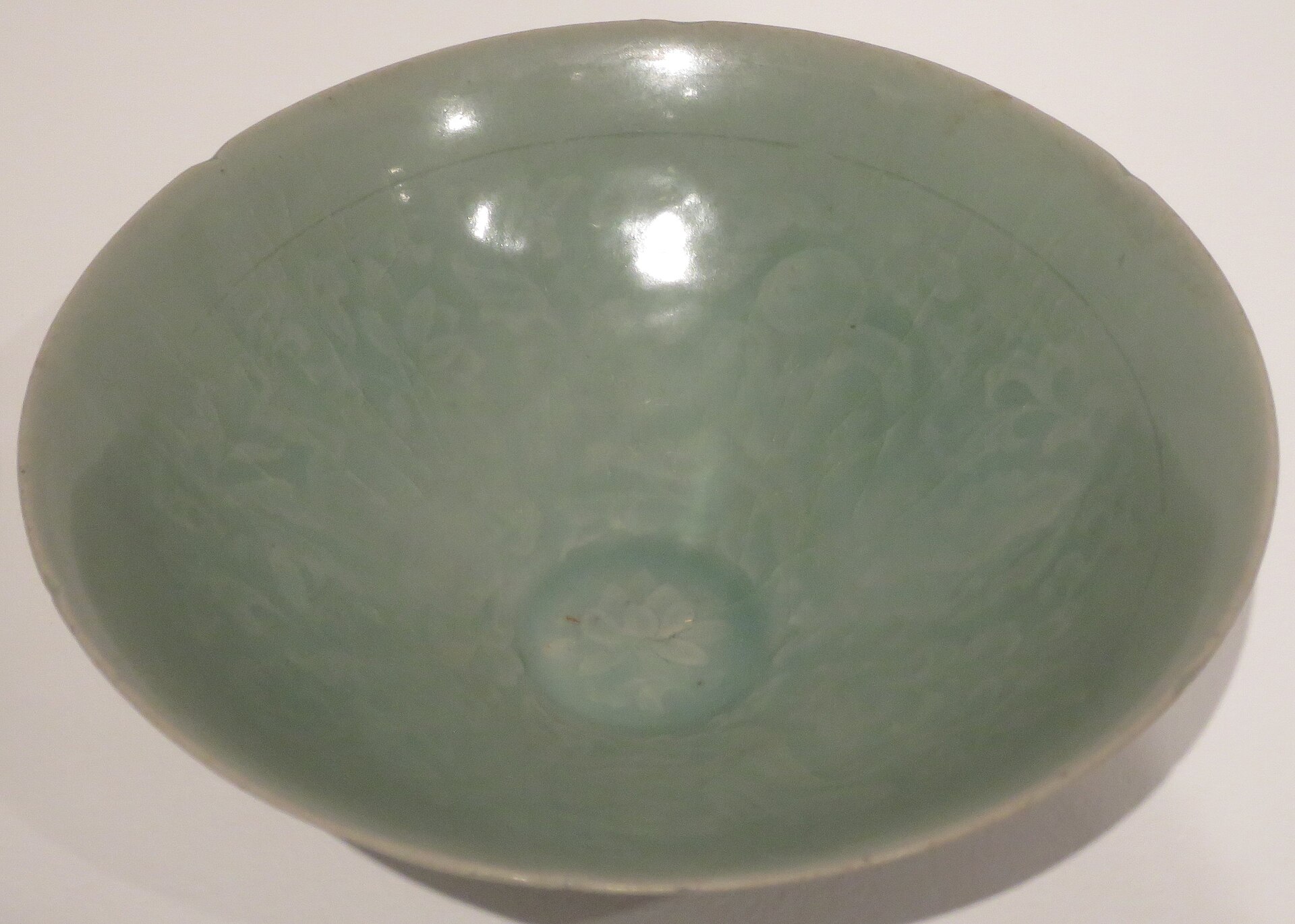
The pairing on this bowl is not unique to it. A celadon bowl at the Honolulu Museum of Art, a different object entirely, carries the same paired subject, boys playing among lotuses, worked in the same general period style; the two bowls confirm that this was a recognised type produced by more than one workshop or in more than one location, not a one-off invention.
Chapter 4What Goryeo celadon meant in its own century
The clearest contemporary account of Goryeo celadon comes from a foreign observer.
The clearest contemporary account of Goryeo celadon comes from a foreign observer. Xu Jing, a Song Chinese envoy who travelled to the Goryeo capital, Gaeseong, in 1123 as part of an official mission, wrote up his visit in an illustrated report presented to the Song emperor the following year. Xu Jing compared Goryeo's green wares to the celadons of China's own Yue and Ru kilns, recorded that Koreans called the colour "kingfisher" or jade, and noted that the most recent production he had seen showed markedly improved skill and colour. A near-contemporary Chinese commentator writing under the pen name Taiping Laoren went further, listing jade-coloured Goryeo celadon among a short roll of luxury goods he judged "first under heaven," incomparable to anything else.
This is a genuinely early and genuinely foreign assessment, not a later or nationalist reconstruction, and it dates from within a generation of when this bowl was made. It establishes that Goryeo celadon's high reputation is not a modern collecting-market invention; educated Chinese visitors were already saying so in the 1120s, while the dynasty's kilns were still working at full capacity.
Chapter 5How Korean celadon reached Western collections
Goryeo celadon had gone out of production by the end of the fourteenth century, after Mongol invasions disrupted the kilns in the thirteenth century and Japanese coastal raiding destroyed much of...
Goryeo celadon had gone out of production by the end of the fourteenth century, after Mongol invasions disrupted the kilns in the thirteenth century and Japanese coastal raiding destroyed much of what was left of the industry in the fourteenth, and it had then been effectively out of circulation and out of memory for five hundred years. It re-entered the world's view only from the 1880s, when pieces began to be dug up, mostly from tombs, around the old Goryeo capital region near Kaesong, an area now in North Korea. Foreign residents in Korea were among the first Western collectors: the American physician and diplomat Horace Newton Allen, resident in Seoul from 1884 to 1905, assembled a personal collection of celadon bought on the open Korean antiques market of the period, and sold it in 1907 to Charles Lang Freer of Detroit, whose own Korean holdings, still at the Smithsonian's Freer Gallery of Art, became one of the earliest serious Korean-ceramics collections in an American museum.
The scholarly literature on this period, notably Charlotte Horlyck's study of collecting practices published in the Bulletin of the School of Oriental and African Studies, traces a rapid market boom for Goryeo celadon among Japanese, American and European buyers from the 1880s through the 1910s, followed by a marked contraction in supply by the 1930s. The market was substantial enough by 1908 and 1912 to support two purpose-built Japanese factories in Korea, one at Nampo run by Tomita Gisaku and one in Seoul run by Umii Benzo, making deliberate reproductions of Goryeo-style celadon for department stores and tourists; demand for the genuine article and demand for a convincing copy of it grew up side by side.
Chapter 6Sadajiro Yamanaka and Yamanaka and Co.
The bowl entered the Metropolitan Museum in 1911 as a gift of Sadajiro Yamanaka, the Osaka-born head of Yamanaka and Co., one of the largest dealers in East Asian art operating in the United States...
The bowl entered the Metropolitan Museum in 1911 as a gift of Sadajiro Yamanaka, the Osaka-born head of Yamanaka and Co., one of the largest dealers in East Asian art operating in the United States and Europe in this period. Born in Sakai near Osaka in 1866 and adopted into the Yamanaka family of established Osaka antiques dealers, he arrived in New York in 1894 and opened a shop in Chelsea; branches followed in Boston in 1899, London in 1900, a Paris agency by 1905, and eventually Chicago, Beijing and Shanghai. By 1917 the New York gallery occupied a five-storey building on Fifth Avenue with ten viewing rooms and a lecture hall.
Charles Lang Freer, one of Yamanaka's most important clients and the man who separately bought Horace Allen's Korean collection, described Yamanaka and Co. in his own correspondence as the "largest company in existence dealing in Japanese Fine Art goods," adding that "nearly all the other dealers in New York buy from them." The firm's clientele also included the Rockefellers, Ernest Fenollosa and Isabella Stewart Gardner, and objects it sold now sit in the British Museum, the Victoria and Albert Museum, the Rijksmuseum and the Seattle Art Museum, among others. Sadajiro Yamanaka remained the dominant figure in the firm until 1931, when he stopped travelling to the United States; he died in Japan in 1936.
Chapter 7The 1911 gift, and what the Museum's own record does and does not say
The Museum's credit line for this bowl reads simply "Gift of Sadajiro Yamanaka, 1911." Nothing else about the transaction, no purchase history, no prior owner, no findspot, is recorded in the...
The Museum's credit line for this bowl reads simply "Gift of Sadajiro Yamanaka, 1911." Nothing else about the transaction, no purchase history, no prior owner, no findspot, is recorded in the Museum's own published object data or its Collection API entry for object 50352, and no other source consulted for this record adds to it. The gift sits within a broader pattern documented for Yamanaka and Co. as a firm: its own historian, Najiba Choudhury, writing in the Journal for Art Market Studies, notes that as Japan's colonial administration reorganised Korea and China in this period, "Yamanaka and Co., Inc. was able to take advantage of the situation and acquire many antiquities inexpensively from China and Korea." That is a documented statement about the firm's general operating conditions across the region in this decade, drawn from a study of the company as a whole; it is not a statement about how this particular bowl came into Yamanaka's hands, and no source available for this record bridges that gap. The pre-1911 history of this object is graded unknown in the provenance table below, and it stays there.
Chapter 8The colonial-period trade in Goryeo tomb celadon, and what is not being claimed about this bowl
The general historical pattern is well documented and worth stating plainly, because this bowl's date, material, and gift year sit inside it.
The general historical pattern is well documented and worth stating plainly, because this bowl's date, material, and gift year sit inside it. From the 1880s, and accelerating sharply after Japan's 1910 annexation of Korea, Goryeo-era celadon that had been buried as grave goods in tombs around the old capital at Kaesong was dug up, in large volume, and moved into a trade supplying Korean, Japanese and Western buyers. Named episodes are on the historical record: Sekino Tadashi's 1904 survey of the former Goryeo capital region drew academic attention to the sites; Japan's first Resident-General in Korea, Ito Hirobumi, personally amassed more than a thousand celadon pieces bought through Seoul antique dealers; the third Governor-General, Terauchi Masatake, assembled a further large personal collection of calligraphy, books and celadon; and in one documented 1916 case, objects removed by grave robbers from a tomb attributed to King Injong of Goryeo were bought by the colonial government-general itself and were recovered by Korea's National Museum only after 1945. Kyoichi Arimitsu, an archaeologist who worked in Korea from 1931 and lived to be one of the few surviving participants in the colonial-era investigations, later acknowledged that looting during the period was, in his own word, "rampant."
Yamanaka and Co., the firm through which this bowl reached the Metropolitan Museum, operated as a major dealer in exactly this material and exactly this period; that much is documented for the firm in general, as set out above. What is not documented, in any source consulted for this record, is that this specific bowl came from a looted tomb, from the Kaesong region, or from any other named findspot at all. The Museum's own accession record carries no findspot. No excavation report, dealer invoice, or export record naming this bowl has surfaced in this research. To assert that this bowl was looted would be to take a fact about the category, colonial-period Goryeo celadon moving through dealers including Yamanaka in this decade, and dress it as a fact about the object, which it is not. The honest and correct position is the one recorded in this bowl's provenance table: everything before 1911 is unknown, not looted, not clean, unknown, and that grade should not be read as a euphemism in either direction.
Chapter 9A documented parallel, kept separate: the Ogura Collection
The clearest illustration of what a documented case in this category actually looks like, and how different it is from an undocumented one, is the Ogura Collection, now held mainly at the Tokyo...
The clearest illustration of what a documented case in this category actually looks like, and how different it is from an undocumented one, is the Ogura Collection, now held mainly at the Tokyo National Museum. Ogura Takenosuke moved to Korea in 1903 to run a Japanese electric power company and, over the following decades, assembled roughly 1,100 objects, including celadon vessels, Buddhist bronzes, and a gold crown removed from a fifth or sixth century Gaya-period grave; Koreans reportedly nicknamed him "the mole" for his pursuit of buried material, and a specialist in the field has been quoted describing him bluntly as "one of the bad guys." Around 125 of these objects are today shown in the Tokyo National Museum's own Asian Gallery, by that museum's own published exhibition listing.
Unlike this bowl, the Ogura Collection's colonial-era formation is itself the direct subject of an unresolved international dispute. Korea sought its return during the negotiations that produced the 1965 Treaty on Basic Relations between the two countries; Japan refused, on the ground that the collection was privately, not publicly, owned, and legal scholarship on the case, including a 2015 student note in the Cardozo Journal of Conflict Resolution, records that Korea has since been unable to establish through documentary proof that the objects were obtained by illegal means, even though their general manner of acquisition is not seriously disputed. The comparison matters here for one reason only: it shows what a documented, named, contested case in this category looks like, so that the absence of any equivalent documentation for this bowl is legible as an absence, not glossed over. The two objects, two collectors, and two institutions are kept entirely separate in this record and should not be read into one another.
Chapter 10What became of Yamanaka and Co.
Sadajiro Yamanaka's firm outlived him by only a few years as an independent Japanese-owned business in the United States.
Sadajiro Yamanaka's firm outlived him by only a few years as an independent Japanese-owned business in the United States. After Japan attacked Pearl Harbor in December 1941, the United States declared war and, under the Trading with the Enemy Act of 1917, the Office of Alien Property Custodian was reactivated within the Office for Emergency Management to seize the assets of enemy nationals. In 1944 it seized and subsequently liquidated Yamanaka and Co.'s New York, Chicago and Boston inventories, a substantial holding of Asian art built up over half a century of trading. The firm reopened in Japan after the war and continued on a reduced scale into the 1950s and 1960s. This episode belongs to the dealer's own institutional history, thirty-three years after this bowl's 1911 gift to the Met; nothing in the sources consulted connects it to this specific object, and it is recorded here for completeness about the donor, not as part of this bowl's own chain of ownership.
Chapter 11The bowl since 1911
Since the 1911 gift, the bowl appears to have remained continuously in the Metropolitan Museum's keeping.
Since the 1911 gift, the bowl appears to have remained continuously in the Metropolitan Museum's keeping. It is currently on view in Gallery 233 in the Department of Asian Art, and the Museum has released at least four of its own photographs of the object, including the interior view showing the boys-and-lotus design used as the lead image on this record, through its Open Access programme. No source consulted for this record documents a separate loan, special exhibition, or discussion of this bowl by name in published Korean-language ceramics scholarship; if such discussion exists, it has not surfaced in this research, and that absence is recorded as an open question rather than assumed to mean the object has gone entirely unstudied.
Chapter 12What is still open
The Korea-Japan conversation about colonial-period cultural property has not closed.
The Korea-Japan conversation about colonial-period cultural property has not closed. The Ogura Collection dispute remains unresolved more than six decades after the 1965 treaty that first raised it, and public advocacy for the return of Korean colonial-era holdings in Japanese museums continues into the present, including petitions addressed directly to the Tokyo National Museum. None of that activity, in any source consulted for this record, names this bowl, this accession, or the Metropolitan Museum's Yamanaka gift of 1911. This record states that plainly rather than implying a live claim where none has been documented, while recording, equally plainly, the unresolved questions that remain about how this particular bowl came to Sadajiro Yamanaka in the first place.
The artist
Unattributed potter, Goryeo dynasty celadon kilns (probable southwestern Korean production, e.g. Gangjin or Buan; not documented for this specific piece)
No maker's name attaches to any Goryeo celadon; the ware was produced anonymously in kilns supplying the court and aristocracy, and attribution in this field means attribution to a kiln site, region or period style rather than to an individual hand. Nothing in the sources consulted for this record identifies the specific kiln that produced this bowl, so the dossier below covers the tradition as a whole rather than a named workshop.
Related works
| Work | Relation | Where it is |
|---|---|---|
| Wine Ewer with Lotuses Goryeo celadon kilns, unattributed | A different Metropolitan Museum object, accession and object ID 50354, from the same general Yamanaka donation years; noted here specifically to prevent confusion with the bowl described in this record. Not the object described in this record. | Metropolitan Museum of Art, New York |
| Goryeo dynasty bowl with children playing among lotuses Goryeo celadon kilns, unattributed | A different bowl carrying the same paired boys-and-lotus motif, confirming the subject was a recognised type rather than unique to this piece. Not the object described in this record. | Honolulu Museum of Art, accession 150 |
| Bowl, Gangjin or Buan kilns Goryeo celadon kilns, unattributed | A contemporaneous celadon bowl, c. 1100-1150, illustrating the kiln tradition and, through its collection history, the Horace Allen and Charles Lang Freer collecting narrative discussed in this record. Not the object described in this record. | Freer Gallery of Art, Smithsonian Institution, Washington DC |
| Ogura Collection Various Korean makers, Goryeo and other periods | A separate, documented and contested colonial-era Korean collection, used in this record only as a comparison for what documented dispute looks like; kept explicitly distinct from this bowl's own, undocumented, pre-1911 history. A different collector, a different set of objects, and a separately contested provenance. | Tokyo National Museum |
Open questions
- How or from whom Sadajiro Yamanaka or Yamanaka and Co. acquired this bowl before donating it to the Metropolitan Museum in 1911 is not documented in any source consulted for this record.
- The bowl's findspot, if any, is not recorded. The Museum's own object record carries no provenance history earlier than the 1911 gift.
- The specific stylistic or archaeological basis for the Museum's own dating of the bowl to about 1100-1133 is not published in the sources consulted.
- Whether this bowl has been discussed by name in Korean-language Goryeo ceramics scholarship could not be established from the sources available for this research.
- Whether the bowl can be attributed to a specific kiln site, such as Gangjin or Buan, on technical grounds (glaze chemistry, body composition) has not been addressed in any published source located for this record.
- Whether any customs, export or shipping record survives for the bowl's 1911 transfer from Yamanaka to the Museum has not been established.
Questions about this object
What is Bowl with two boys and lotuses?
Bowl with two boys and lotuses is a ceramic, dated early 12th century, Goryeo dynasty. Medium: Stoneware with mold-impressed design under celadon glaze.
Who made Bowl with two boys and lotuses, and is the attribution settled?
The attribution to Goryeo dynasty celadon kilns (unattributed potter) is recorded here as unknown. No potter, workshop or kiln site is named for this bowl in the Metropolitan Museum's own object record or in any source consulted for this record. Goryeo celadon of this quality is generally associated with the Gangjin and Buan kiln complexes in southwestern Korea, which supplied the court and aristocracy in the eleventh and twelfth centuries, but this is a statement about the ware type in general, not a documented finding about this specific bowl, and it is graded accordingly.
Where is Bowl with two boys and lotuses now?
Metropolitan Museum of Art, New York, Department of Asian Art, on view in Gallery 233. Inventory number Accession 11.8.6 (Museum object ID 50352). Last confirmed 3 September 2026. Continuous Museum ownership since the 1911 gift, per the Museum's own object record and its Collection API entry for object 50352.
What is still unknown about Bowl with two boys and lotuses?
How or from whom Sadajiro Yamanaka or Yamanaka and Co. acquired this bowl before donating it to the Metropolitan Museum in 1911 is not documented in any source consulted for this record.
Sources
- 1The Metropolitan Museum of Art, Collection API, object record for object ID 50352 (accession 11.8.6, 'Bowl with two boys and lotuses'). collectionapi.metmuseum.org/public/...
- 2The Metropolitan Museum of Art, object page for 'Bowl with two boys and lotuses', accession 11.8.6. metmuseum.org/art/...
- 3Wikidata, item Q116313618, 'Bowl with Two Boys and Lotuses', linking accession 11.8.6 and Museum object ID 50352. wikidata.org/wiki/...
- 4Wikipedia, 'Sadajiro Yamanaka', for biographical dates and firm history. en.wikipedia.org/wiki/...
- 5Najiba H. Choudhury, 'Seizures and Liquidation Sales in the United States during World War II: Tracking the Fate of Japanese Art Dealership, Yamanaka & Company, Inc.', Journal for Art Market Studies 2 (2020). fokum.org/wp-content/...
- 6Smithsonian National Museum of Asian Art, 'Yamanaka & Co.: Early Pioneer of the Global Asian Art Trade' (Hidden Networks research programme). asia-archive.si.edu/research/...
- 7Charlotte Horlyck, 'Desirable commodities: unearthing and collecting Koryo celadon ceramics in the late nineteenth and early twentieth centuries', Bulletin of the School of Oriental and African Studies 76, no. 3 (2013), 467-491. researchgate.net/publication/...
- 8Melissa (YoungJae) Koo, 'Repatriation of Korean Cultural Property Looted by Japan - Can a Sincere Apology Resolve the Centuries-Old Korea/Japan Disputes?', Cardozo Journal of Conflict Resolution 16 (2015), 625. static1.squarespace.com/static/...
- 9Donald MacIntyre, 'A Legacy Lost', TIME, 4 February 2002, on Japanese colonial-period collecting of Korean cultural property, the Ogura Collection, and named colonial officials and collectors. time.com/archive/...
- 10The Metropolitan Museum of Art, 'Goryeo Celadon', Heilbrunn Timeline of Art History essay, for Xu Jing's account, the bisaek glaze and the sanggam technique. metmuseum.org/essays/...
- 11Wikipedia, 'Goryeo ware', for the production timeline, kiln sites and end of the industry. en.wikipedia.org/wiki/...
- 12Wikipedia, 'Korean ceramics', for the 1916 Government-General survey of tombs around Kaesong. en.wikipedia.org/wiki/...
- 13Smarthistory, 'Korean celadons of the Goryeo dynasty', for Xu Jing's and Taiping Laoren's assessments and the sanggam technique. smarthistory.org/korean-celadons-goryeo
- 14Wikimedia Commons, file description pages and extended metadata for File:MET DP342744.jpg, File:MET DP253565.jpg, File:MET DP253893.jpg, File:Goryeo dynasty bowl with children playing among lotuses, HMA 150.JPG, and File:Bowl, Korea, Gangjin or Buan kilns, Goryeo period, 1100-1150 AD, stoneware, celadon, glaze - Freer Gallery of Art - DSC04940.jpg, for licence verification. commons.wikimedia.org/wiki/...
- 15Cultural Property Disputes Resource, Claremont Graduate University, 'Korean Ogura Collection of Military Artifacts and Jewelry', on the 1965 treaty negotiations and the collection's status. research.cgu.edu/cultural-property-disputes-resource/...
Last verified · Published
Change log
3 September 2026 - Record created at the house standard: researched narrative, technical evidence, maker dossier, graded provenance chain, prices with hammer and premium separated, related works, open questions and sources.