Desk Chair
Carlo Bugatti · ca. 1902
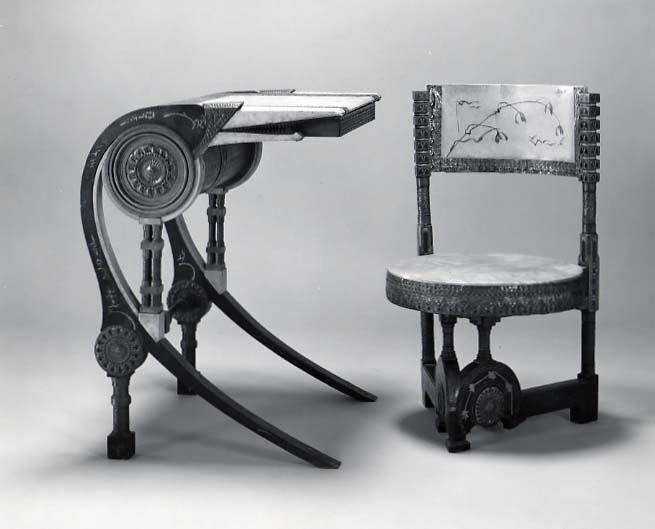
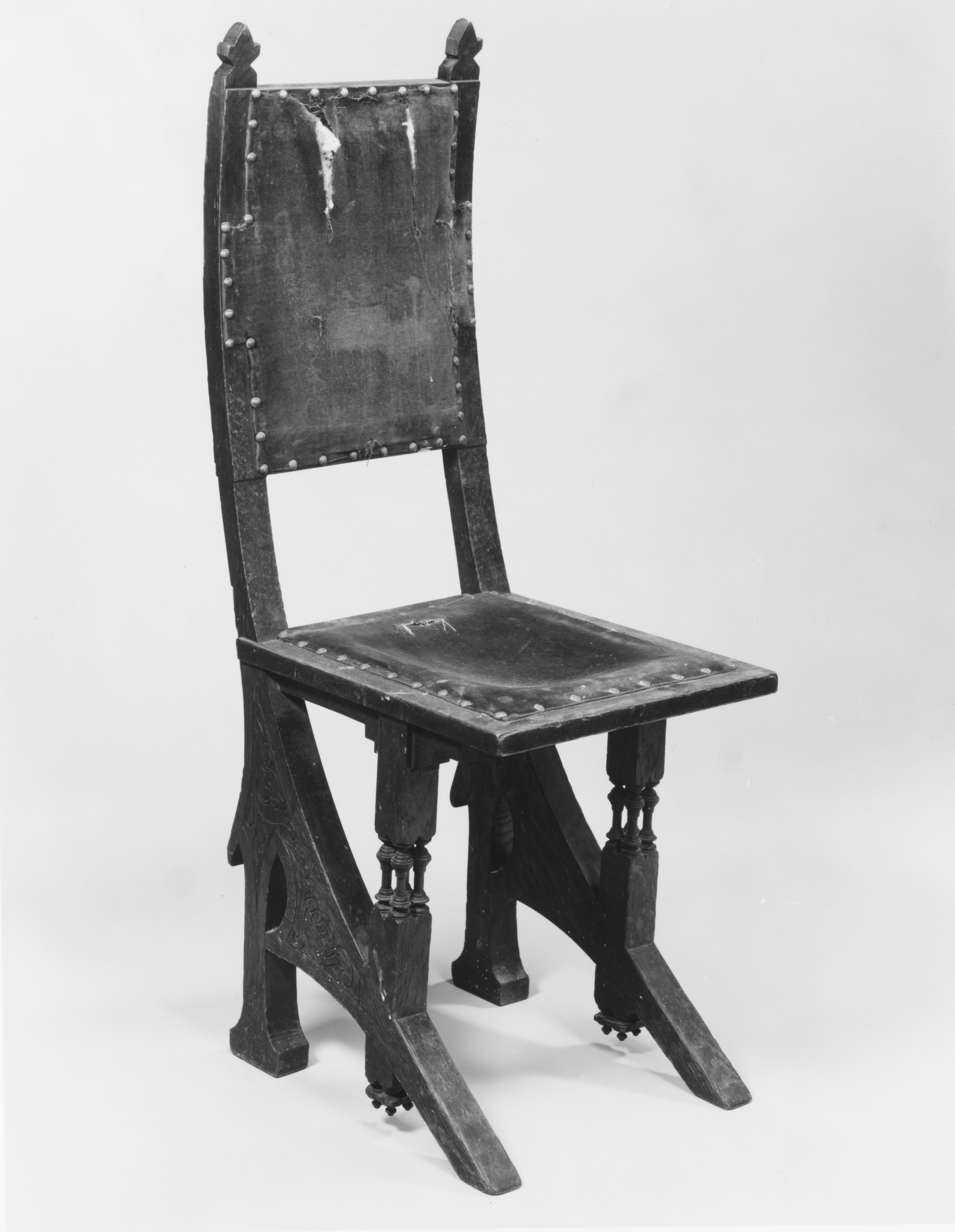
The record subject, right, photographed with its matching desk (accession 1970.181.3), left. Walnut, brass, vellum and pewter, ca. 1902. Donated to Wikimedia Commons by the Metropolitan Museum of Art in 2017 as part of the Museum's Open Access Initiative bulk upload; the Museum's own current object page and API no longer flag this object as public domain, but the CC0 dedication on this file is irrevocable.
| Artist | Carlo Bugatti |
|---|---|
| Date | ca. 1902 |
| Medium | Walnut, brass, vellum, and pewter |
| Dimensions | 76.2 x 44.5 cm (30 x 17 1/2 in); seat diameter 44.5 cm, no separate depth published because the base is circular |
| Where it is now | The Metropolitan Museum of Art, New York, Department of Modern and Contemporary Artlast confirmed 7 August 2026 |
| Inventory number | 1970.181.2 (object ID 480706) |
| Attribution | AcceptedSigned 'Bugatti' in the top proper left corner of the seat back and catalogued without qualification by the Metropolitan Museum of Art as the work of Carlo Bugatti. Full note |
| Object type | Furniture |
| Period | Italian Art Nouveau, early 20th century |
| Cases | Has a provenance gap |
| Inscriptions | Signed 'Bugatti', top proper left corner of the seat back |
| Owners on record | 4 links3 documented, 1 unknown |
| Sources | 18 cited |
About this record Last verified 7 August 2026 · 18 sources cited · Change log
On this page 10 sections
ContentsClose
A walnut desk chair of about 1902, its round seat and back panel sheathed in vellum and bordered with hammered pewter, signed 'Bugatti' on the back and bought by the Metropolitan Museum in 1970 together with a matching desk and settee from a Paris dealer. It belongs to the vocabulary of curved, insect-and-flower-painted vellum furniture that won Carlo Bugatti the top award at the 1902 Turin exhibition, though no source consulted confirms that this particular chair was one of the pieces shown there.
Almost nothing is documented about where the chair spent the seven decades between leaving Bugatti's Milan workshop and surfacing at Galerie du Luxembourg in Paris, the dealer from whom the Museum bought it. The Museum's own current website no longer flags the object, or any of its four sibling Bugatti pieces, as public domain, even though the Museum donated a CC0-licensed photograph of this exact chair to Wikimedia Commons in 2017. That photograph is the one this record uses.
Carlo Bugatti is now most often introduced, in casual writing, as the father of the car maker Ettore Bugatti and the sculptor Rembrandt Bugatti. This record treats that overshadowing as a documented fact about how his reputation is framed today, not as a licence to blur the three men's very different work.
Provenance
Each link is graded. Documented: a cited source supports it. Disputed: the identification is argued but not established. Unknown: no owner for that span, and the gap is not smoothed into a narrative. The grades in the glossary.
- ca. 1902 -Carlo Bugatti workshop, Milan (Via Castelfiardo 6)documented
Dated ca. 1902 and signed 'Bugatti' on the seat back, per the Metropolitan Museum's own catalogue entry.1
- ca. 1902 - by 1970Unknownunknown
No owner, sale, or exhibition is documented for this interval in the sources consulted. Bugatti's Milan workshop closed after 1902 and he left for Paris in 1904; whether the chair left the workshop before or after that closure is not established.1
- unknown - 1970Galerie du Luxembourg, Paris (dealer)documented
The Museum's own catalogue entry names Galerie du Luxembourg, Paris, as the immediate prior owner before the 1970 sale to the Met. How long the gallery had held the piece and where it acquired it are not stated.1
- 1970 - presentThe Metropolitan Museum of Art, New Yorkdocumented
Bought with the Rogers Fund in 1970, together with a matching desk (1970.181.3) and settee (1970.181.1a-d) from the same dealer in the same transaction. The price paid has not been published in the sources consulted.1
Technical evidence
| Attribution note | Signed 'Bugatti' in the top proper left corner of the seat back and catalogued without qualification by the Metropolitan Museum of Art as the work of Carlo Bugatti. No dispute over authorship is recorded in the sources consulted. |
|---|---|
| Support | Walnut, carved and turned.1 |
| Seat | Circular, vellum-covered, 44.5 cm (17 1/2 in) diameter.1 |
| Back panel | Upright vellum panel bordered with inlaid pewter strip, marked with a dark-ink botanical motif, as visible in the Museum's own Open Access photograph.16 |
| Inlay | Brass and pewter, hammered and set into narrow bands along the legs, stretchers and panel edges, the standard technique of Bugatti's vellum-period furniture.178 |
| Understructure | Turned legs joined by a cross-stretcher with turned wood roundels at the crossing point, a construction repeated across other Bugatti chair models of the same years.68 |
| Signature | Inscribed 'Bugatti', top proper left corner of the seat back.1 |
| Dimensions | Height 76.2 cm (30 in); seat diameter 44.5 cm (17 1/2 in). No separate depth is published because the base is circular.1 |
| Medium as catalogued | Walnut, brass, vellum, pewter.1 |
Images
The record in full
Chapter 1What the chair is
A desk chair in walnut, standing 76.2 centimetres high, with a circular seat 44.5 centimetres in diameter stretched with vellum.
A desk chair in walnut, standing 76.2 centimetres high, with a circular seat 44.5 centimetres in diameter stretched with vellum. The back is a single upright panel, also vellum, bordered by a strip of inlaid pewter and marked, in the Museum's own photograph, with a dark ink botanical motif running across its width. The legs are turned and joined by a cross-stretcher carrying turned wood roundels at the point where the stretchers cross, a construction Bugatti repeated across several chair models of the same years.
The chair is signed: 'Bugatti' is inscribed in the top proper left corner of the seat back. It was made, on the Museum's dating, around 1902, in Bugatti's workshop at Via Castelfiardo 6 in Milan.
It did not travel to New York alone. The Metropolitan Museum bought it in 1970 together with a matching desk (accession 1970.181.3) and a settee (accession 1970.181.1a-d), all from the same Paris dealer in the same transaction. The Museum's own Open Access photograph of this chair, in fact, frames it beside the desk, not alone - the two pieces were made, sold, and photographed as a pair.
Chapter 2How it was made
Bugatti's characteristic technique in this period was to carve and turn a wood armature - walnut, in this case - and then sheathe the flat surfaces in vellum, the scraped and stretched calfskin...
Bugatti's characteristic technique in this period was to carve and turn a wood armature - walnut, in this case - and then sheathe the flat surfaces in vellum, the scraped and stretched calfskin parchment normally associated with manuscripts and drumheads rather than furniture. The vellum panels were then decorated, usually in ink, with the stylised floral and insect motifs that recur across his work of these years; the dragonfly in particular became, by the account of the National Gallery of Victoria, a signature motif of his mature style.
Metal was inlaid rather than applied as separate mounts: brass and pewter, hammered and set into the wood in narrow bands along the legs, stretchers and panel edges, a technique that produced the metallic glitter visible in every photograph of his furniture of this period without adding the bulk of cast mounts. This piece's own catalogued medium - walnut, brass, vellum, pewter - is the standard combination for Bugatti's work of exactly this date, distinct from the heavier, more purely inlaid ebonised furniture of his earlier career in the 1880s and early 1890s.
Chapter 3Carlo Bugatti and the break from a borrowed style
Bugatti was born in Milan - the Metropolitan Museum's own artist record gives 1855, while most other sources consulted, including Wikipedia and the auction house Sworder's, give 1856; this record...
Bugatti was born in Milan - the Metropolitan Museum's own artist record gives 1855, while most other sources consulted, including Wikipedia and the auction house Sworder's, give 1856; this record follows the majority reading but notes the discrepancy rather than silently picking one. He trained at the Brera Academy in Milan and then, from 1875, at the Academie des Beaux-Arts in Paris, before establishing his own furniture workshop in Milan in 1880.
His early furniture was heavily ornamented and historicist: ebonised wood inlaid with copper, brass, ivory, mother-of-pearl or hide, hung with fringes and metal discs, drawing on Moorish, Islamic and Japanese sources without disguising the borrowing. By the later 1890s his work had moved toward the curvilinear, vellum-sheathed idiom this chair belongs to, replacing applied ornament with painted decoration and reducing forms to fewer, larger curves.
An anecdote repeated across the secondary literature, though not traced in this pass to a primary transcript, has Queen Elena of Savoy praising his work at the 1902 Turin exhibition as 'Moorish' in style, and Bugatti correcting her: 'You are wrong, Majesty, this style is mine.' Whatever its exact wording, the line is the clearest statement attributed to him of how he wanted his late furniture read - not as an imitation of an existing decorative tradition, but as an idiom of his own invention.
Chapter 4Turin, 1902
The Prima Esposizione Internazionale d'Arte Decorativa Moderna opened at the Parco del Valentino in Turin on 10 May 1902, the only world's fair ever organised around a single decorative style, Art...
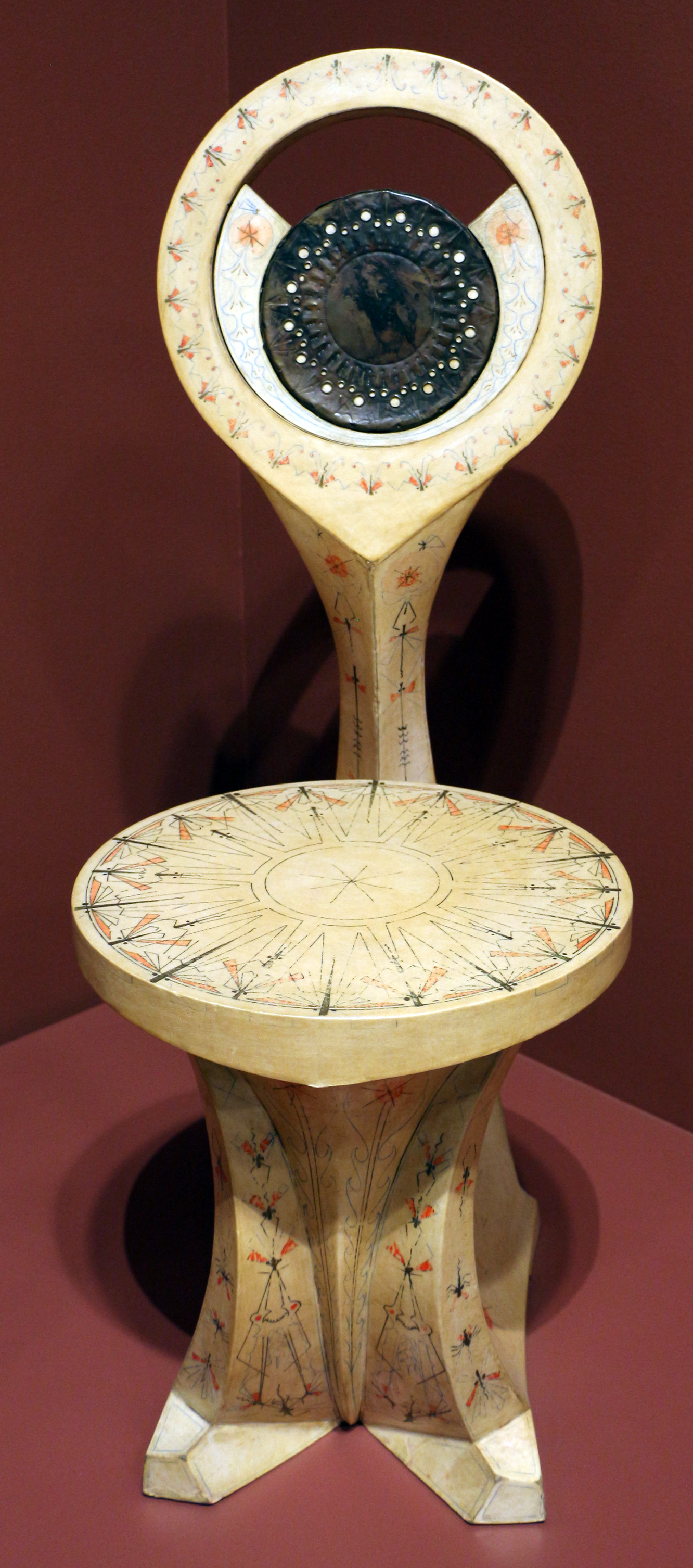
The Prima Esposizione Internazionale d'Arte Decorativa Moderna opened at the Parco del Valentino in Turin on 10 May 1902, the only world's fair ever organised around a single decorative style, Art Nouveau, and drawing participants from nine countries including Victor Horta, Charles Rennie Mackintosh, Peter Behrens and Louis Comfort Tiffany. Bugatti showed four interior schemes there, of which the best documented is the so-called Snail Room (Camera delle Lumache), built around a semicircular banquette shaped like a snail's shell and furnished with four chairs of a fully legless, continuously curved form now generally called the Cobra chair.
The critic Alfredo Melani, writing at the time, described the Cobra chairs' lines as having 'a rotational movement,' a phrase quoted by Sotheby's as evidence of the room's strangeness to contemporary eyes; other secondary accounts describe 'heated debates amongst the public and the jury' before the jury settled on its top award. Sources consulted differ on the exact name of that award: the National Gallery of Victoria and Sworder's both give 'Diploma of Honour,' Sotheby's gives 'Grand Prix d'Honneur,' and both citations attach the same justification, that Bugatti was 'the first in Italy to create, and not just to dream, a modern style of furniture.' This record could not resolve which name is correct from the sources consulted and reports both.
What this record could not verify, despite searching, is a specific contemporary description of Bugatti's Turin pieces as 'bizarre' or 'insect-like' in the period press. The standard contemporary Italian account of the exhibition, Vittorio Pica's 1903 L'Arte decorativa all'esposizione di Torino del 1902, almost certainly contains the fuller critical picture, but its text could not be searched inside an available digitised copy during this research pass. That gap is recorded honestly in open questions rather than papered over with an invented quotation.
Chapter 5Where this chair fits, and where it does not
This is the point at which the record has to be more careful than the secondary market usually is.
This is the point at which the record has to be more careful than the secondary market usually is. The Cobra chairs of the Snail Room have no legs at all: seat, back and support form one continuous moulded curve, a design radical enough that later writers compare it to Marcel Breuer's cantilevered tubular steel chair of 1928. This desk chair is a different design entirely - it stands on four turned legs joined by a cross-stretcher, with a conventional, if elaborately decorated, seat and back. It is not a Cobra chair, and no source consulted describes it as one.
What can be said, and no more, is that this chair shares its date, its materials - walnut, vellum, brass, pewter - and its decorative vocabulary of painted botanical ornament with the pieces Bugatti exhibited at Turin in 1902. Bugatti showed four separate interior schemes that year, of which the Snail Room is the one best documented in the sources consulted; whether this desk-and-chair suite belonged to one of the other three, or was made in the same idiom for sale rather than exhibition, is not established by anything found in this research pass. The relationship is real - same maker, same year, same materials, same visual language - but it is a relationship of idiom, not of documented identity with a specific exhibited object, and this record does not claim otherwise.
Chapter 6From the workshop to a Paris dealer: an undocumented seventy years
Between the chair's manufacture around 1902 and its appearance in the stock of the Paris dealer Galerie du Luxembourg by 1970, no owner, sale, or exhibition is documented in the sources consulted.
Between the chair's manufacture around 1902 and its appearance in the stock of the Paris dealer Galerie du Luxembourg by 1970, no owner, sale, or exhibition is documented in the sources consulted. Bugatti's own workshop closed after 1902 under financial pressure, and he left Milan for Paris in 1904; whether the chair left the workshop before or after that closure, who bought it, and how it eventually reached a Paris gallery nearly seven decades later are all unrecorded. This is not a small gap dressed up as a minor one: it is the entire ownership history of the object for a stretch as long as the time separating the chair's making from the Rogers Fund purchase that brought it to New York.
Chapter 7The Rogers Fund purchase, 1970
The Metropolitan Museum's own catalogue entry records that this chair, the matching desk, and the settee were bought together from Galerie du Luxembourg, Paris, with the acquisition credited to the...
The Metropolitan Museum's own catalogue entry records that this chair, the matching desk, and the settee were bought together from Galerie du Luxembourg, Paris, with the acquisition credited to the Rogers Fund in 1970. The Rogers Fund is one of the Museum's oldest and largest endowed acquisition funds, established under the 1901 bequest of Jacob S. Rogers; it is a general-purpose fund rather than one earmarked for decorative arts, which is itself unremarkable but worth stating because it means the purchase was a curatorial choice within a broad mandate rather than a fund built specifically to acquire Bugatti or Art Nouveau furniture.
How long Galerie du Luxembourg had held the three pieces before 1970, and where the gallery had sourced them, is not stated in the sources consulted. Neither is the price the Museum paid. Three pieces of documented Bugatti furniture entering an American museum together, from a single Paris dealer, in a single year, is itself a data point about how this material moved onto the market in the mid-twentieth century - but it is a data point without the surrounding transaction detail that would let a reader judge whether 1970 was an unusually active year for Bugatti's rediscovery or simply the year one dealer happened to place a group with the Met. For a sense of scale rather than a direct comparison, a single related Bugatti side chair of a later, ca. 1910 model carried an estimate of only USD 4,000 to 6,000 at a Sotheby's design sale in 2020 - a reminder that individual pieces of this furniture, outside a documented museum suite, have not always commanded high prices.
Chapter 8A photograph that outlived its own release
Confirming a usable photograph for this record took more than the usual check of the Museum's public-domain flag.
Confirming a usable photograph for this record took more than the usual check of the Museum's public-domain flag. Queried directly, the Metropolitan Museum's own Open Access API returns isPublicDomain: false for this chair, and returns no image at all - and the same is true, without exception, for the matching desk, the settee, the secretary, and the other Bugatti chair in the Museum's collection. On the live evidence of the Museum's own current data, none of its five Bugatti pieces is currently flagged for open, unrestricted reuse.
And yet a CC0-licensed photograph of this exact chair exists on Wikimedia Commons, uploaded on 12 July 2017, a few months after the Museum's February 2017 Open Access launch, as part of the Museum's own bulk donation to Commons under that initiative. The file's caption gives the accession number, dimensions and credit line that match the Museum's current catalogue entry precisely, and it shows this chair together with its matching desk, exactly as this record's related-works section describes them. Because a CC0 dedication is, by its own terms, irrevocable, the Commons copy remains freely usable regardless of what the Museum's current live page shows.
The most likely explanation is an ordinary one: image rights get re-reviewed, primary-image fields get dropped or repopulated during data migrations, and the 2017 bulk upload to Commons is not necessarily kept in permanent lockstep with the Museum's own live catalogue. But this record does not know that for certain, because the Museum has not published an explanation in the sources consulted, and it is recorded as an open question rather than assumed away.
Chapter 9Overshadowed by the family name
Carlo Bugatti had two sons who became far more famous than he did, in fields that have nothing to do with furniture.
Carlo Bugatti had two sons who became far more famous than he did, in fields that have nothing to do with furniture. Ettore Bugatti founded the Bugatti automobile marque in 1909; Rembrandt Bugatti became a celebrated animalier sculptor before his suicide in 1916, a loss from which Carlo's own later work never fully recovered. Both sons were apprenticed as boys in their father's workshop, painting the vellum panels of his furniture before either found his own field - a detail that makes the family's later divergence sharper, not softer.
In casual writing today, Carlo is very often introduced first as the father of Ettore, the car maker, rather than as an artist in his own right; this record's own research repeatedly turned up his furniture summarised in a single clause before pivoting to his son's marque. That is a real and documented pattern of how his reputation is framed. What this research did not find, despite a targeted search of auction listings filed under 'Ettore Bugatti,' was a single piece of furniture misattributed to the son rather than the father: everything catalogued under Ettore's name on the auction aggregator checked was automotive or personal memorabilia - pens, tools, a work table, mechanical drawings - nothing a cataloguer could plausibly confuse with a chair. The overshadowing, on the evidence gathered here, operates in popular narrative and market framing, not as a documented pattern of objects being physically relabelled from father to son. That distinction matters, and this record states it rather than assuming the more dramatic version.
Chapter 10Signatures, marks, and the reproduction question
Not all of Bugatti's furniture is signed, and the market guidance consulted for this record - a dealer summary of his auction results - states plainly that a certified specialist's appraisal is...
Not all of Bugatti's furniture is signed, and the market guidance consulted for this record - a dealer summary of his auction results - states plainly that a certified specialist's appraisal is essential before an attribution can be relied on for valuation. This particular chair is signed, 'Bugatti,' in the top proper left corner of the seat back, which is one reason its attribution carries no recorded dispute.
General authentication practice for furniture of this kind, as described in sources consulted, rests on maker's marks read against period-consistent wear, construction analysis, and provenance research using magnification, ultraviolet light and X-ray fluorescence to check whether a mark sits convincingly within the surrounding material or was added later. No source consulted for this record documents a specific case of a period or later reproduction of a Bugatti chair being sold, knowingly or otherwise, as an original - which is a negative finding worth stating plainly rather than a gap this record is papering over with generic caution. If such a case exists in the specialist literature, it was not surfaced by the searches run for this record.
Chapter 11What remains unresolved
This chair's authorship is not in question.
This chair's authorship is not in question. Almost everything around it is: seventy years of ownership between the workshop and the Paris trade, the exact relationship between this piece and what Bugatti physically showed at Turin, the price the Museum paid in 1970, and now the puzzle of why the Museum's own current systems no longer show as public domain an image the Museum itself gave away under an irrevocable licence nine years ago. None of these gaps is filled with a guess in this record. They are the honest shape of what a signed, dated, well-photographed object can still not tell a reader about its own life before it reached a museum wall.
The artist
Carlo Bugatti
Carlo Bugatti trained as a painter and architect before making furniture his life's work, and he lived to see both of his sons eclipse him in fame while working in fields he had nothing to do with. What follows treats him as the maker of this chair, not as a footnote to either son.
Literature
- Vittorio Pica, L'Arte decorativa all'esposizione di Torino del 1902 (Bergamo: Istituto Italiano d'Arti Grafiche, 1903) - the standard contemporary Italian critical account of the exhibition at which Bugatti showed. NOT read in full; the Internet Archive copy's full text could not be searched inside during this research pass. This is the first item to obtain for this record, and the most likely place to find a genuine period description of the critical reaction to Bugatti's rooms.
Related works
| Work | Relation | Where it is |
|---|---|---|
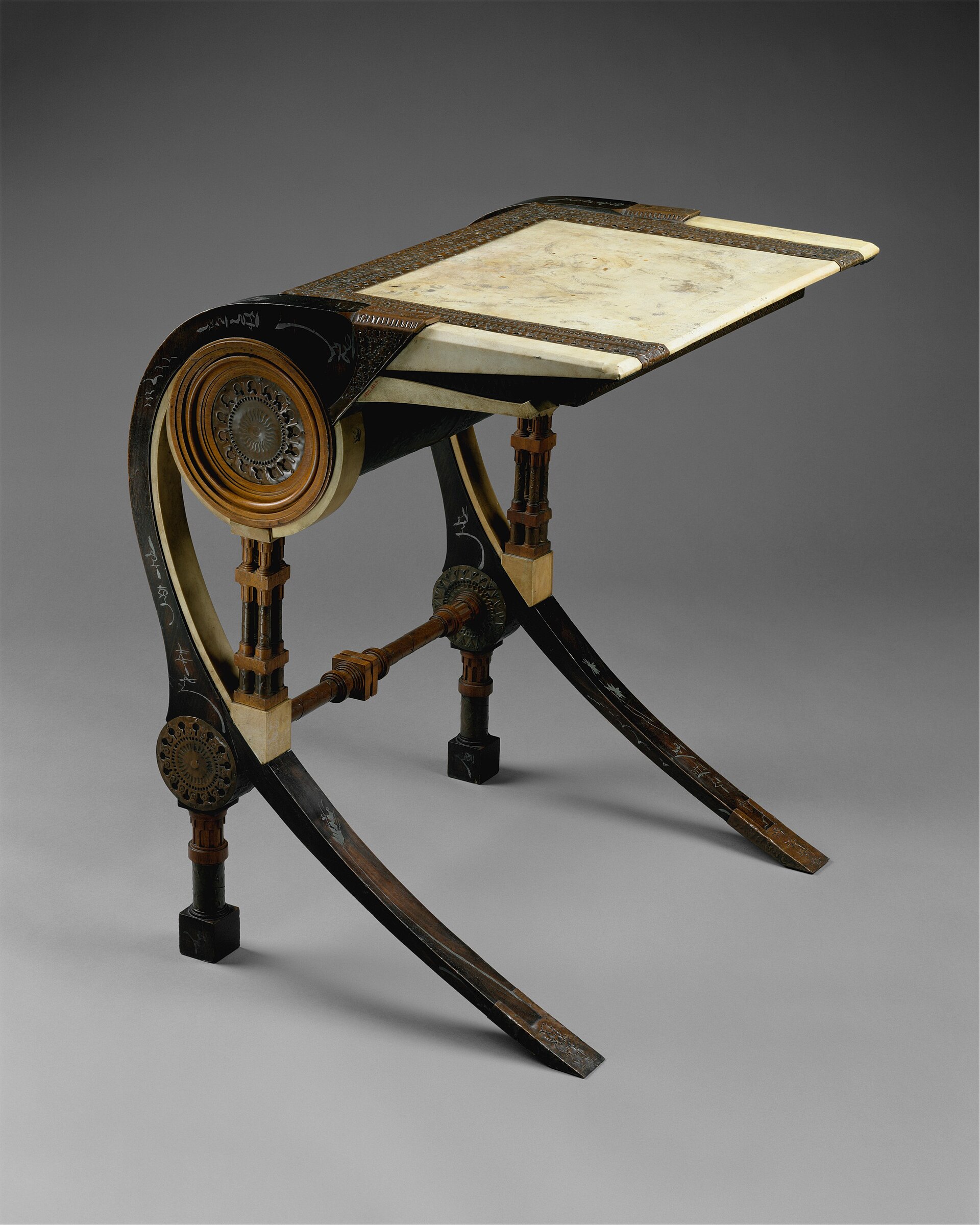
| Desk Carlo Bugatti | Matching desk bought from the same Paris dealer in the same 1970 Rogers Fund purchase; shown together with this chair in the Museum's own CC0 photograph. Also flagged isPublicDomain: false on the Museum's current Open Access API, despite a CC0 image of it existing on Wikimedia Commons from the 2017 donation. | The Metropolitan Museum of Art, New York (accession 1970.181.3) |
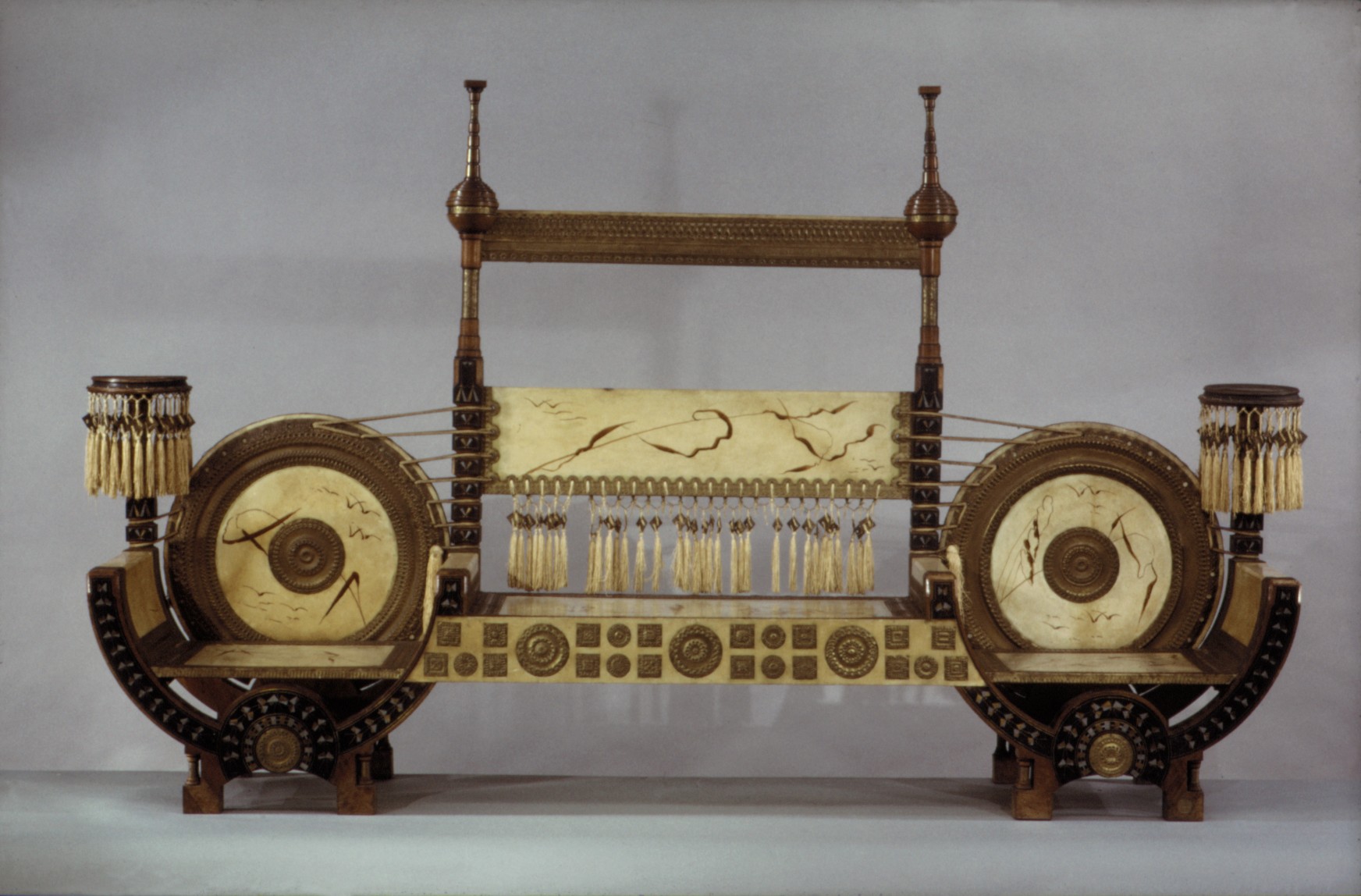
| Settee Carlo Bugatti | Third piece of the same 1970 purchase from Galerie du Luxembourg, Paris. Dated ca. 1900 by the Museum, slightly earlier than the chair and desk. | The Metropolitan Museum of Art, New York (accession 1970.181.1a-d) |
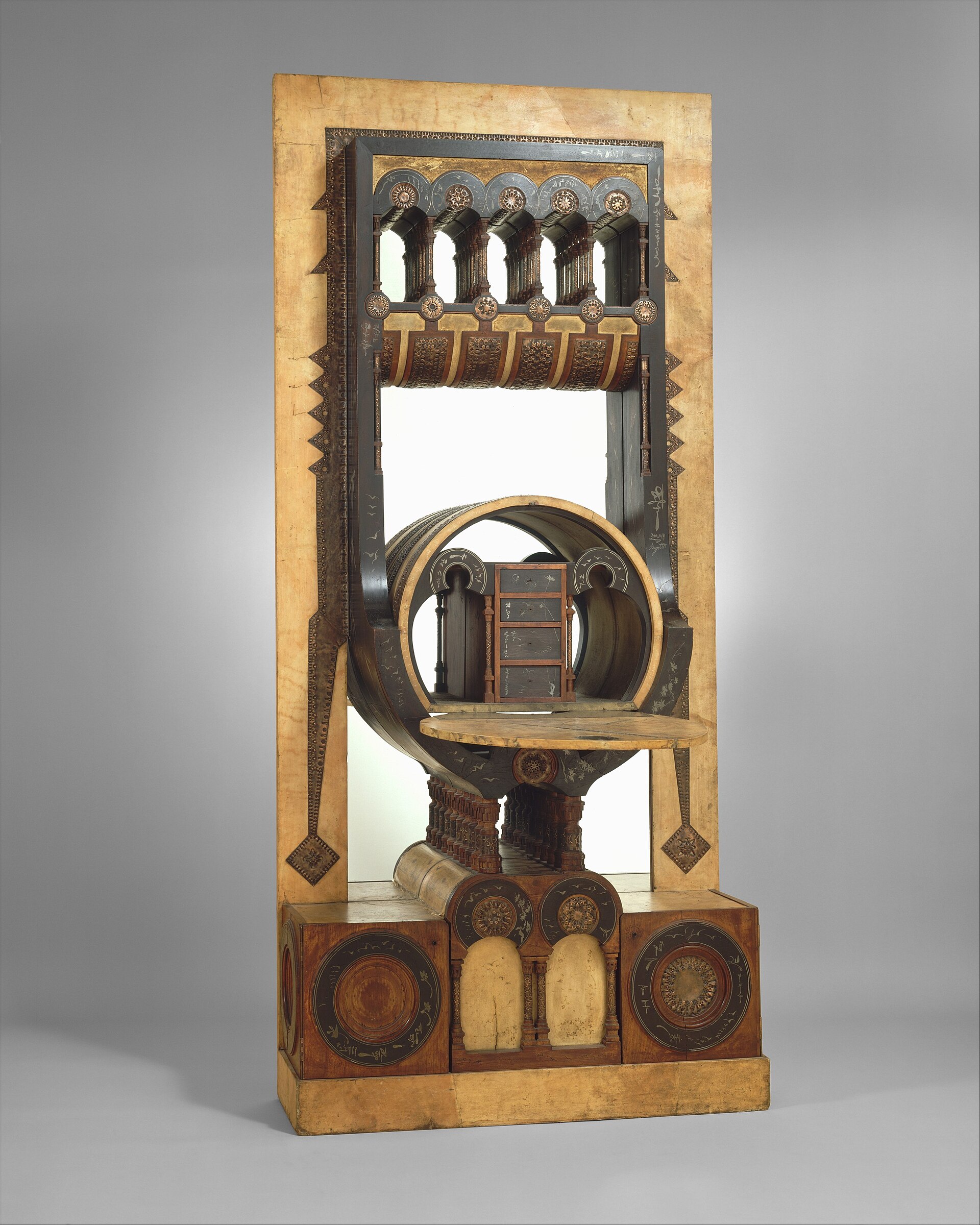
| Secretary Carlo Bugatti | Separate Bugatti acquisition, one year earlier than the Rogers Fund group. Bought in 1969 through the Edward C. Moore Jr. Gift, dated ca. 1895, earlier than this chair's vellum-period idiom. | The Metropolitan Museum of Art, New York (accession 69.69) |
| Chair Carlo Bugatti (attributed, catalogued as 'Maker') | The Museum's fifth Bugatti piece, and an anomaly among them. Made of oak rather than Bugatti's usual walnut, catalogued with 'American' as its culture field and held in The American Wing rather than with the Museum's other Bugatti furniture in Modern and Contemporary Art. The Museum's own data does not explain the classification, and this record does not guess at one. | The Metropolitan Museum of Art, New York (accession 1986.448.1) |
| Cobra chair (Snail Room) Carlo Bugatti | A different design model from this desk chair - fully legless, one continuous curved form - shown in the Snail Room at the 1902 Turin exhibition. Included here specifically to keep the two models distinct rather than to suggest a closer link than is documented. Photographed in the galleries by Wikimedia Commons contributor Sailko in 2016; this is a different physical object from the Met's holdings and is not part of this record's own suite. | Art Institute of Chicago |
Open questions
- Was this specific chair among the pieces Bugatti exhibited at Turin in 1902, or made afterward in the same idiom for sale? No source consulted confirms either answer.
- Who owned the chair between its manufacture around 1902 and its appearance in the stock of Galerie du Luxembourg, Paris, the dealer from whom the Met bought it in 1970? Nothing is documented for that interval.
- How long had Galerie du Luxembourg held the three-piece Bugatti group before 1970, and where had the gallery sourced them?
- What did the Metropolitan Museum pay for the chair, desk and settee together in 1970? The purchase price is not published in the sources consulted.
- Why is the Museum's other Bugatti chair (accession 1986.448.1) catalogued as American in culture and held in The American Wing rather than with this piece and its siblings in Modern and Contemporary Art?
- Why does the Metropolitan Museum's own current Open Access API return isPublicDomain: false and no image for this object and all four other Bugatti pieces, when the Museum itself donated a CC0-licensed photograph of this exact chair to Wikimedia Commons in 2017? Is this a deliberate rights withdrawal or a data-migration gap? The Museum has not published an explanation in the sources consulted.
- Was Carlo Bugatti born in 1855 or 1856? The Metropolitan Museum's own artist record gives 1855; most other sources consulted give 1856.
- What did Italian and international critics actually write about Bugatti's rooms at Turin in 1902? Vittorio Pica's contemporary account almost certainly answers this in detail, but its full text could not be searched during this research pass.
Questions about this object
What is Desk Chair?
Desk Chair is a furniture, dated ca. 1902. Medium: Walnut, brass, vellum, and pewter.
Who made Desk Chair, and is the attribution settled?
The attribution to Carlo Bugatti is recorded here as accepted. Signed 'Bugatti' in the top proper left corner of the seat back and catalogued without qualification by the Metropolitan Museum of Art as the work of Carlo Bugatti. No dispute over authorship is recorded in the sources consulted.
Where is Desk Chair now?
The Metropolitan Museum of Art, New York, Department of Modern and Contemporary Art. Inventory number 1970.181.2 (object ID 480706). Last confirmed 7 August 2026. Rogers Fund purchase, 1970. Gallery number not published in the Museum's own object data as of this record, so on-view status could not be confirmed.
What is still unknown about Desk Chair?
Was this specific chair among the pieces Bugatti exhibited at Turin in 1902, or made afterward in the same idiom for sale? No source consulted confirms either answer.
Sources
- 1The Metropolitan Museum of Art, Open Access Collection API, object record for 'Desk chair' by Carlo Bugatti, accession 1970.181.2 (object ID 480706), queried directly 2026-08-07. The Museum's own rendered object page returned repeated HTTP 429 errors during this research pass; the API record and cached search-index text were used in its place. collectionapi.metmuseum.org/public/...
- 2The Metropolitan Museum of Art, Open Access Collection API, object record for 'Desk' by Carlo Bugatti, accession 1970.181.3 (object ID 480707). collectionapi.metmuseum.org/public/...
- 3The Metropolitan Museum of Art, Open Access Collection API, object record for 'Settee' by Carlo Bugatti, accession 1970.181.1a-d (object ID 480705). collectionapi.metmuseum.org/public/...
- 4The Metropolitan Museum of Art, Open Access Collection API, object record for 'Secretary' by Carlo Bugatti, accession 69.69 (object ID 489826). collectionapi.metmuseum.org/public/...
- 5The Metropolitan Museum of Art, Open Access Collection API, object record for 'Chair' attributed to Carlo Bugatti, accession 1986.448.1 (object ID 1665). collectionapi.metmuseum.org/public/...
- 6Wikimedia Commons, File:Desk chair MET 1970.181.2,3.jpg, donated by the Metropolitan Museum of Art as part of its Open Access Initiative, licensed CC0, extmetadata LicenseShortName verified directly via the Commons API. commons.wikimedia.org/wiki/...
- 7Sotheby's, 'The Cobra Chairs of Carlo Bugatti, Pioneer of 20th Century Design'. sothebys.com/en/...
- 8National Gallery of Victoria, 'Carlo Bugatti's Chair, from the Snail Room'. ngv.vic.gov.au/essay/...
- 9Sworder's, 'The Life and Work of Carlo Bugatti (1856-1940)'. sworder.co.uk/news/...
- 10Wikipedia, 'Carlo Bugatti'. Tertiary source, flagged for replacement with a scholarly monograph (Dan Klein's or Nancy McClelland's writing on Bugatti was sought per the research brief but not located in a form this record could fetch and cite directly in this pass). en.wikipedia.org/wiki/...
- 11Wikipedia, 'Prima Esposizione Internazionale d'Arte Decorativa Moderna'. Tertiary source, flagged for replacement with the exhibition's own catalogue or Vittorio Pica's contemporary review. en.wikipedia.org/wiki/...
- 12Art & Antiques Magazine, 'Carlo Bugatti: Furnishing a Fantasy'. artandantiquesmag.com/carlo-bugatti-designs
- 131stDibs / The Study, 'Carlo Bugatti's 1902 Chair Is a Masterful Cultural Mash-Up'. 1stdibs.com/blogs/...
- 14Aucties.com, 'Value and quotation of Carlo Bugatti's artworks, furniture and objects'. aucties.com/en/...
- 15Invaluable.com, 'Ettore Bugatti Sold at Auction Prices' - checked specifically for furniture misattributed to Ettore Bugatti; none found among the listings reviewed. invaluable.com/artist/...
- 16Sotheby's, lot page, 'Carlo Bugatti, Chair', Design sale, 2020, used for comparable market data (estimate USD 4,000-6,000 for a related ca. 1910 chair). sothebys.com/en/...
- 17Wikimedia Commons, File:Carlo bugatti, cobra chair, milano 1902.jpg, photograph by Sailko at the Art Institute of Chicago, licensed CC BY 3.0. Used only as a version/comparison image, explicitly marked as not this record's object. commons.wikimedia.org/wiki/...
- 18Internet Archive, Vittorio Pica, L'Arte decorativa all'esposizione di Torino del 1902 (Bergamo, 1903). Item record consulted for scope and provenance; full text not searched inside during this research pass. archive.org/details/...


Last verified 7 August 2026 · Published 7 August 2026
Change log
7 August 2026 - Record created at the house standard: researched narrative, technical evidence, maker dossier, graded provenance chain, prices with hammer and premium separated, related works, open questions and sources.