Dish
Ottoman Iznik potters (workshop unidentified) · Mid-16th century (Metropolitan Museum range: 1525-1575)
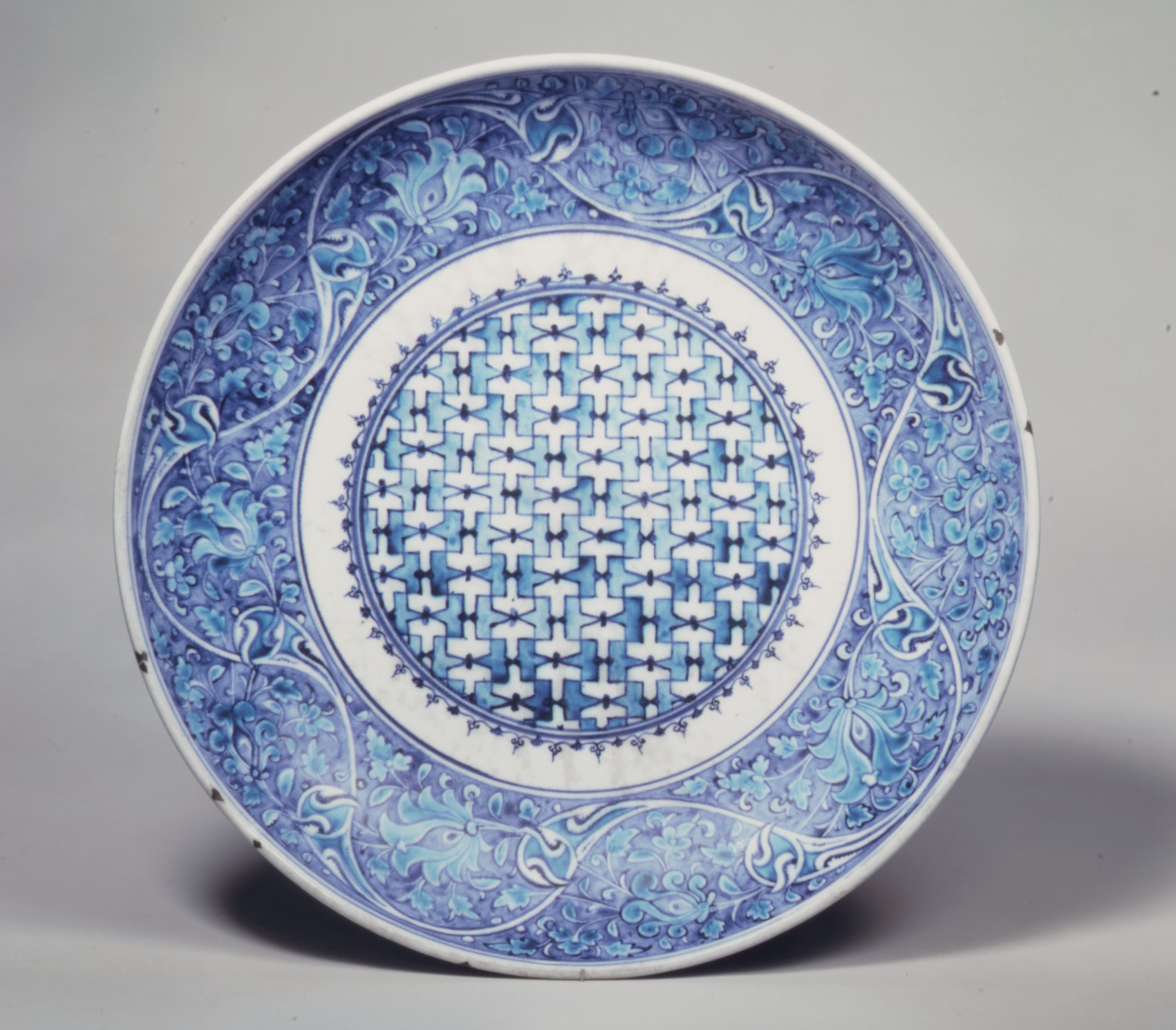
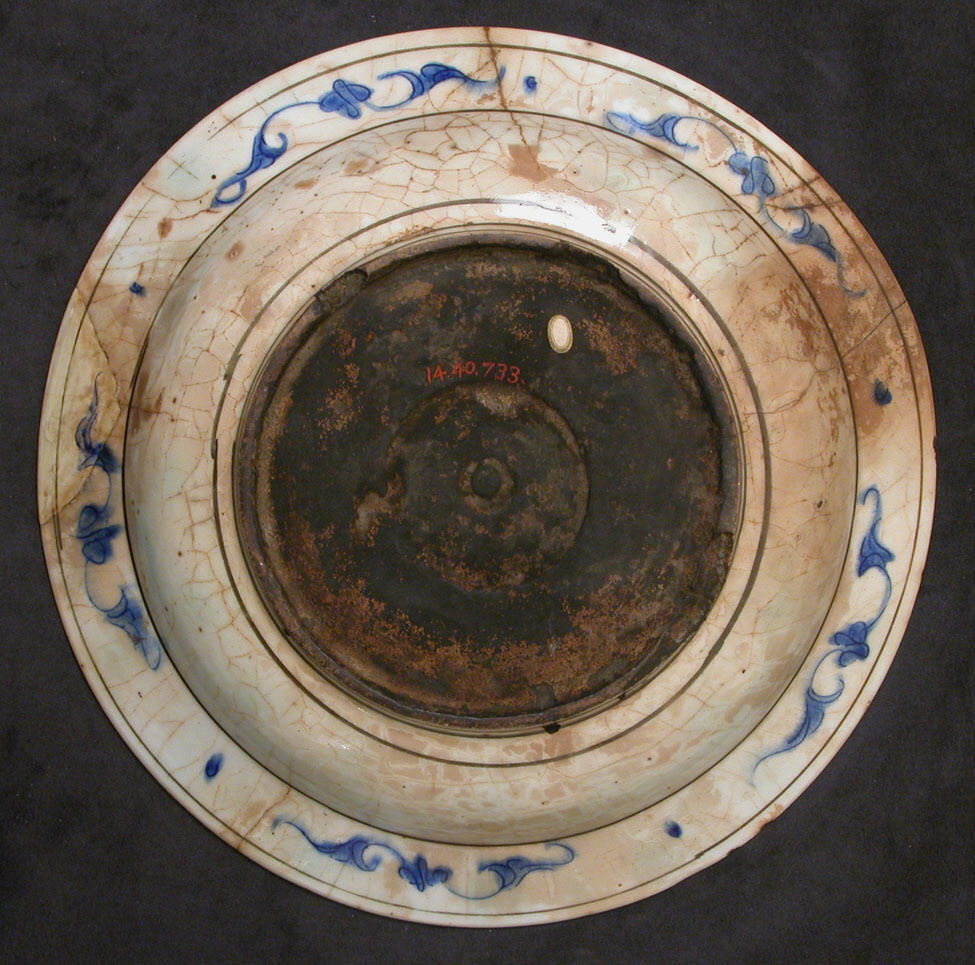
The dish as catalogued by the Metropolitan Museum, accession 14.40.727: stonepaste painted in turquoise and two hues of blue under a transparent glaze, mid-16th century.
| Artist | Ottoman Iznik potters (workshop unidentified) |
|---|---|
| Date | Mid-16th century (Metropolitan Museum range: 1525-1575) |
| Medium | Stonepaste (fritware), painted in turquoise and two hues of cobalt blue under a transparent lead-alkaline-tin glaze |
| Dimensions | H. 7.6 cm (3 in.); Diam. 39.4 cm (15 1/2 in.) |
| Where it is now | Metropolitan Museum of Art, New York, Department of Islamic Art, Gallery 460last confirmed 7 August 2026 |
| Inventory number | Accession number 14.40.727, object ID 446648 |
| Attribution | AcceptedMade in the town of Iznik, in Ottoman Anatolia, and accepted without dispute today as a product of the Iznik kilns. Full note |
| Object type | Ceramic |
| Period | Ottoman Turkish, 16th century |
| Cases | Has a provenance gap |
| Inscriptions | None. No potter's mark, workshop mark, or inscription is recorded on this dish. |
| Owners on record | 5 links4 documented, 1 unknown |
| Sources | 11 cited |
About this record Last verified 7 August 2026 · 11 sources cited · Change log
On this page 9 sections
ContentsClose
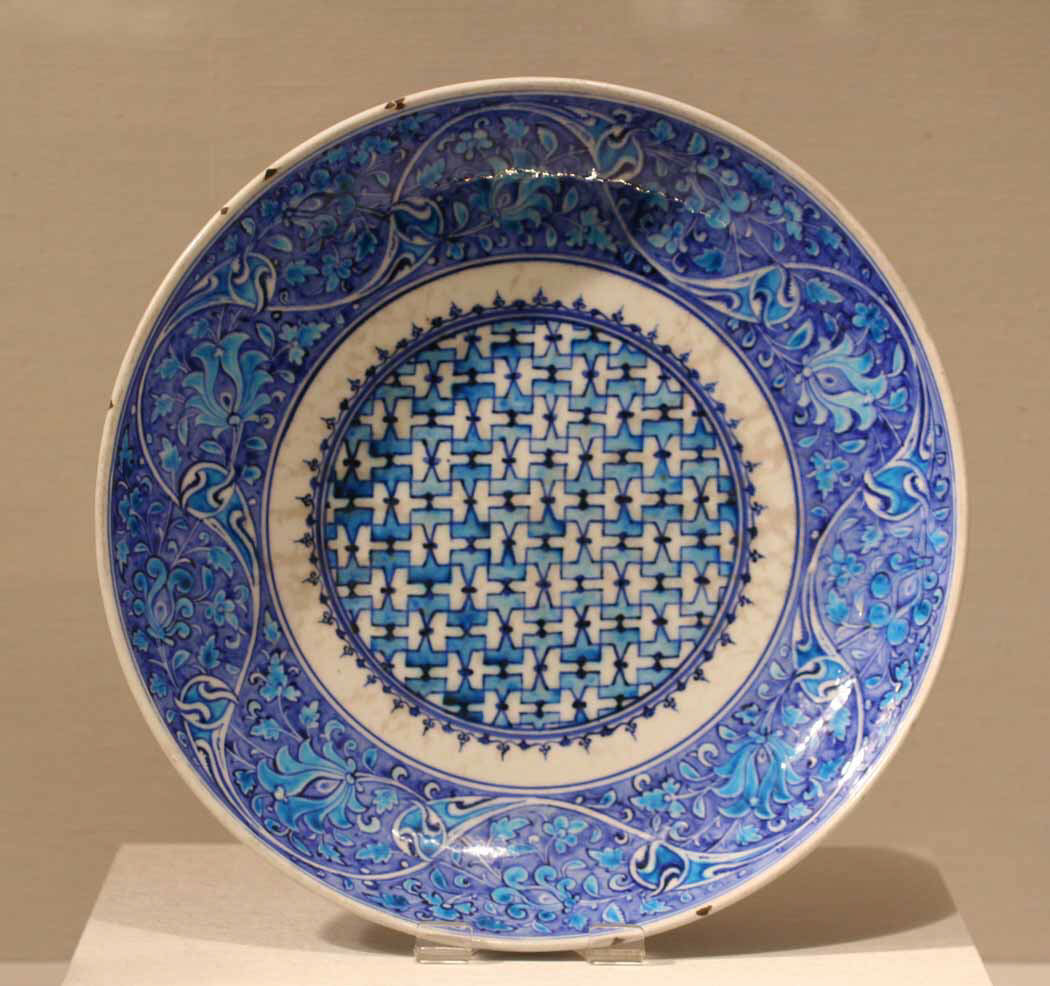
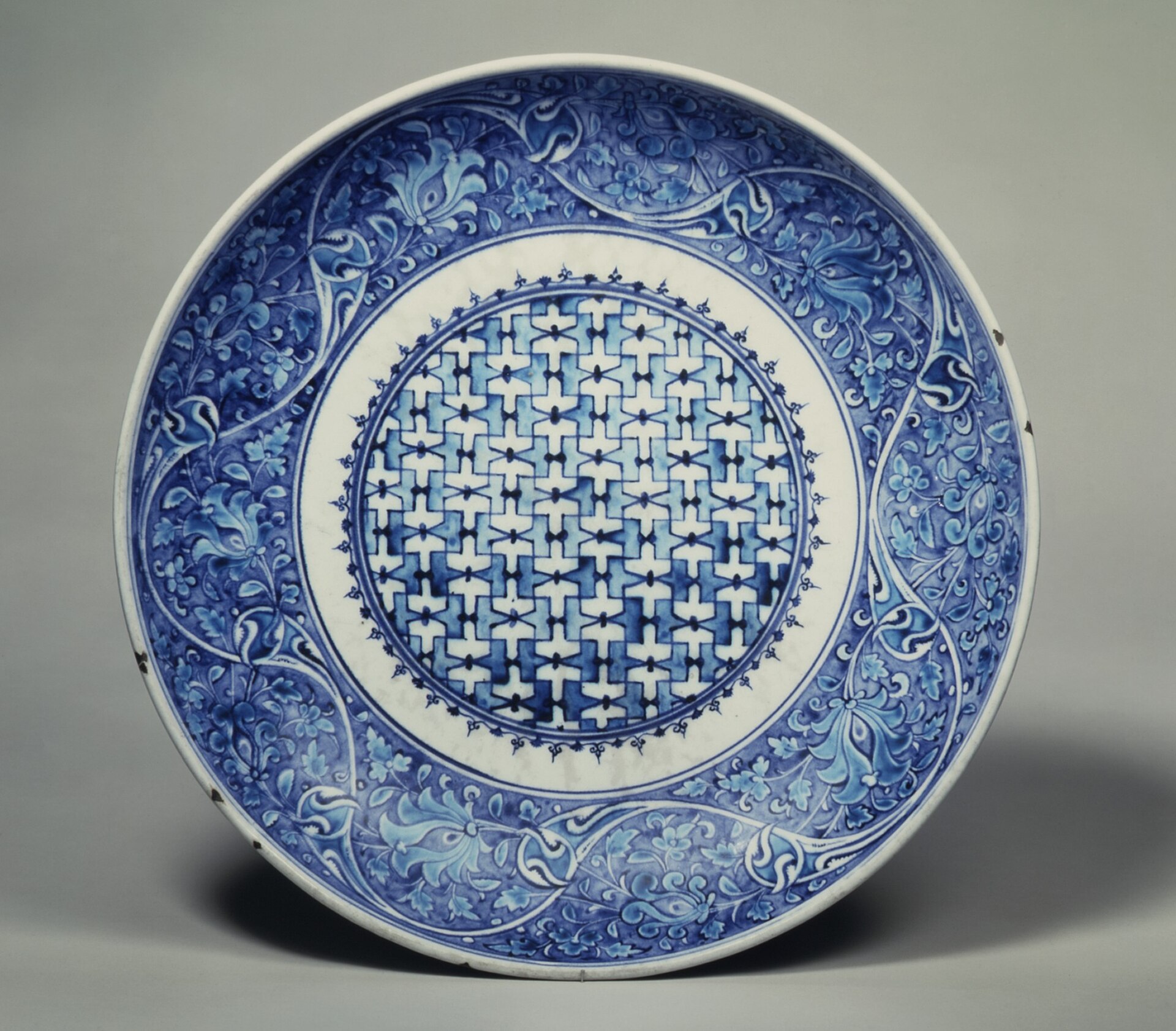
A saucer-shaped dish of Iznik fritware, its rim carrying a floral scroll painted in turquoise and two shades of cobalt blue under a clear lead-tin glaze, made in Ottoman Turkey in the middle decades of the 16th century. It came to the Metropolitan Museum of Art in the 1913 bequest of Benjamin Altman, the New York department-store owner whose Rembrandts and Chinese porcelains are far better known than his Ottoman pottery.
For most of the century before this dish entered a museum, pieces of exactly this kind were sold and catalogued under invented names. European dealers who did not know where Ottoman pottery was actually fired called blue-and-turquoise wares like this one "Damascus ware" after the city where some pieces happened to be bought, not made. The error was not corrected with certainty until archaeologists dug into the kiln waste of Iznik itself, decades after this dish had already settled into a Fifth Avenue collector's cabinet.
This record also asks the question the Iznik market forces on every undocumented piece: was it ever suspected of being one of the close 19th-century reproductions that the Florence workshop of Ulisse Cantagalli and the Paris firm of Edme Samson sold into the same collecting world Altman moved in. No source found in this research raises that suspicion about this dish, and the reasons why are worth setting out plainly rather than leaving as an assumption.
Provenance
Each link is graded. Documented: a cited source supports it. Disputed: the identification is argued but not established. Unknown: no owner for that span, and the gap is not smoothed into a narrative. The grades in the glossary.
- c. 1525-1575 (Museum's dating range) -Iznik potters, Ottoman Turkey (workshop unidentified)documented
Origin at Iznik is not disputed today; the town itself was confirmed as the production centre for this class of ware by kiln excavation (Aslanapa, early 1960s and 1981-1988), following decades in which pieces of this kind were sold under invented regional names such as Damascus ware. The precise decade of manufacture and the specific workshop are not established for this individual object.127
- - by 1913Unknownunknown
No owner, dealer or route of export from Ottoman Turkey is documented for this dish between its manufacture and its presence in Benjamin Altman's New York collection. This is a genuine gap, not a smoothed-over assumption.
- by 1913 - 1913Benjamin Altman, New Yorkdocumented
Held in Altman's collection at his death on 7 October 1913. Much of Altman's oriental porcelain was bought through the dealer Henry J. Duveen, but no source found in this research names Duveen, or any other specific dealer, as the supplier of this particular dish.14
- 1913 - 1914Estate of Benjamin Altmandocumented
Bequeathed to the Metropolitan Museum of Art with the bulk of Altman's collection following his death.14
- 1914 - presentMetropolitan Museum of Art, New Yorkdocumented
Accessioned 1914 as 14.40.727, Department of Islamic Art. On view in Gallery 460.1
Technical evidence
| Attribution note | Made in the town of Iznik, in Ottoman Anatolia, and accepted without dispute today as a product of the Iznik kilns. No individual potter or workshop is named for this dish and none can be; Iznik ware carries no makers' signatures. The town-of-origin question that this record documents in detail was a real and long-running dispute for this entire class of pottery, but it was a dispute about where wares like this one were made, resolved by kiln excavation, not a dispute about this specific object. |
|---|---|
| Body | Fritware (stonepaste): quartz sand bound with finely ground glass frit and a small proportion of clay, with lead oxide added to the frit mixture, roughly following the silica-frit-clay proportions given in Abu'l-Qasim's 1301 Kashan treatise though no Iznik-specific recipe survives in writing.2 |
| Glaze | Transparent lead-alkaline-tin glaze, approximately 25-30% lead oxide, 45-55% silica, 8-14% sodium oxide and 4-7% tin oxide; unusually for a tin glaze, the tin remains in solution rather than precipitating as an opacifier, so the glaze reads as clear rather than milky.27 |
| Pigments | Turquoise (copper oxide) and two hues of cobalt blue only, per the Museum's own medium description; no purple (manganese oxide), green, black or the later bole red are recorded on this piece.12 |
| Dimensions | Height 7.6 cm (3 in.); rim diameter 39.4 cm (15 1/2 in.).1 |
| Dating range as catalogued | Mid-16th century; the Metropolitan's own working range is 1525-1575, a fifty-year bracket.1 |
| Design | A floral scroll around the cavetto, in the loosening, rhythmic Iznik decorative idiom that had developed from earlier Chinese-derived (Hatayi) and Ottoman arabesque (Rumi) motifs by the mid-16th century.12 |
| Department and display | Metropolitan Museum of Art, Department of Islamic Art, Gallery 460.1 |
| Condition | No published condition report was located in this research. |
Images
The record in full
Chapter 1What it is
A saucer-shaped dish, 7.6 centimetres high and 39.4 centimetres across the rim, thrown and built from Iznik fritware - a synthetic ceramic body, not a natural clay, made by mixing quartz sand with a...
A saucer-shaped dish, 7.6 centimetres high and 39.4 centimetres across the rim, thrown and built from Iznik fritware - a synthetic ceramic body, not a natural clay, made by mixing quartz sand with a small amount of ground glass and a little clay. The Metropolitan Museum catalogues its decoration as "painted in turquoise and two hues of blue under transparent glaze," and dates it broadly to the mid-16th century, giving a working range of 1525 to 1575, a fifty-year bracket that is itself a fact about how this object is known, not only about when it was made.
The dish is large enough to have been made for display as much as use. Iznik dishes of this size were commonly pierced through the footring so they could be hung on a wall, and many surviving examples show scratching from genuine use as tableware as well - the two functions were not mutually exclusive in an Ottoman household or a European collector's cabinet alike.
Chapter 2How Iznik potters built a dish
Iznik fritware, sometimes called stonepaste, is not porcelain and was never meant to pass for it up close, but it was engineered to answer Chinese blue-and-white porcelain from a distance.
Iznik fritware, sometimes called stonepaste, is not porcelain and was never meant to pass for it up close, but it was engineered to answer Chinese blue-and-white porcelain from a distance. The body is quartz sand bound with finely ground glass frit and a small proportion of clay; analysis of surviving pieces suggests Iznik potters worked in roughly the same proportions - about ten parts silica to one part frit to one part clay - given in a 1301 treatise on fritware by the Kashan tilemaker Abu'l-Qasim, though no equivalent written recipe survives from Iznik itself. The Iznik version added lead oxide to the frit alongside the quartz and soda used at Kashan, a variation recovered only by analysing the material itself.
The paste lacked the plasticity to be thrown as a single piece on the wheel, so dishes were built by rolling out a sheet of paste over a mould, shaping the underside with a template as the mould turned, and sculpting the foliate rim by hand once the paste had partly dried - a method closer to pressing pastry into a tin than to conventional pottery throwing. The body was then coated in a fine white slip of similar composition, selected to avoid the iron impurities that would discolour the surface, before the design was painted on and the whole piece covered in a lead-alkaline-tin glaze - typically 25 to 30 percent lead oxide, 45 to 55 percent silica, 8 to 14 percent sodium oxide and 4 to 7 percent tin oxide. Unusually, the tin in an Iznik glaze stays in solution rather than precipitating out as the opacifying particles it forms in most tin glazes, which is why the glaze reads as clear rather than milky.
Chapter 3A palette that can be read like a clock
Iznik potters worked in cobalt blue alone for the first decades of fritware production, the ore probably sourced from Qamsar near Kashan in Iran.
Iznik potters worked in cobalt blue alone for the first decades of fritware production, the ore probably sourced from Qamsar near Kashan in Iran. Turquoise, made from copper oxide, was added to the palette from around 1520. Only afterward did the potters add purple from manganese oxide, and green, grey and black; the bright, thickly applied bole red that became the ware's signature colour was not introduced until around 1560, using an iron-rich slip applied under the glaze.
This dish's catalogued medium is turquoise and two hues of blue, and nothing else - no purple, no green, no red. Read against the standard colour-introduction sequence, that palette matches the years after turquoise joined cobalt blue but before purple and green arrived, which would sit toward the earlier part of the Museum's own 1525-1575 bracket rather than the middle or later part of it. This is an inference drawn from the documented medium and the published chronology, not a redating that any scholar has proposed for this specific dish, and it is recorded here as a research lead rather than a finding; see the open questions below.
Chapter 4A label that lied for seventy years
The genuine dispute attached to this dish is not about who made it but about where, and the dispute was manufactured by the market rather than by scholarship.
The genuine dispute attached to this dish is not about who made it but about where, and the dispute was manufactured by the market rather than by scholarship. Until the 1860s, European and American collectors and dealers lumped essentially all Islamic pottery together as "Persian" ware. Between 1865 and 1872 the Musee de Cluny in Paris bought a group of polychrome fritware with a bright sealing-wax red; because the pieces had been obtained on Rhodes, the trade assumed they had been made there and coined the term "Rhodian ware." Separately, pieces sharing this dish's own colour range - blue, turquoise, and eventually sage green and pale purple - were believed to come from Damascus and were sold and catalogued as "Damascus ware." A third group, spiral-patterned sherds turned up during the 1905-1907 construction of a post office in Istanbul's Sirkeci district, became "Golden Horn ware" after the district where they surfaced, not where they were fired.
None of these names described a real production centre. All of them, along with "Miletus ware" - a related but chronologically earlier and technically distinct group of red-clay, white-slipped pottery, named for sherds a German archaeologist found at ancient Miletus in the early 1930s - were eventually traced back to Iznik and, in smaller volume, to Kutahya. Art historians had come to suspect a common origin by the 1930s on stylistic grounds alone, but suspicion is not proof, and the market went on using the old regional names for decades after that suspicion took hold; some of them, "Damascus ware" and "Rhodian ware" among them, are still used by dealers and auction houses today as period style labels even though no scholar now believes they mark a place of manufacture.
Whether the Metropolitan Museum's own early-20th-century cataloguers ever applied one of these regional labels to this specific dish has not been established in this research; the Museum's current online record uses no such term, describing the piece simply by material, technique and findspot. This is recorded as an open question rather than assumed either way.
Chapter 5What the kilns proved
Proof that Iznik itself was the production centre came from the ground, not from the archive, and it came in two separate campaigns decades apart.
Proof that Iznik itself was the production centre came from the ground, not from the archive, and it came in two separate campaigns decades apart. Oktay Aslanapa's excavations at Iznik in the early 1960s recovered kiln wasters - pottery ruined and discarded in firing, which by definition cannot have travelled - confirming that the earlier, chronologically distinct red-bodied "Miletus ware" had in fact been made locally, alongside Kutahya and Akcaalan in smaller volume. A second, more extensive round of excavation at the Iznik tile kilns ran from 1981 to 1988 and is reflected in the scholarly record of that decade; a 2006 Raman-spectroscopy study of Iznik glazes and shards notes bluntly that "the town of production of these potteries was highly disputed in the 80's and many questions still remain," which is as fair a summary as any of how recently the ground, rather than the showroom, settled the question.
Nurhan Atasoy and Julian Raby's 1989 monograph, Iznik: The Pottery of Ottoman Turkey, drew the excavated and museum evidence together into the typology now used as the field's standard reference, building on the sequential chronology the V&A ceramics keeper Arthur Lane had proposed by style alone in 1957 - Abraham of Kutahya ware to about 1525, Damascus and Golden Horn wares from 1525 to 1555, Rhodian ware from about 1555 to the early 18th-century end of production. That framework, refined rather than overturned by the kiln evidence, is the one against which this dish's own fifty-year bracket, and the possibility of narrowing it, has to be judged.
Chapter 6A Chinese pattern in an Ottoman hand
The floral scroll on this dish's cavetto belongs to a design tradition that begins as an act of imitation and ends as something distinct from what it imitated.
The floral scroll on this dish's cavetto belongs to a design tradition that begins as an act of imitation and ends as something distinct from what it imitated. Ottoman potters could not make porcelain and were not trying to; what they wanted from Chinese blue-and-white ware was its prestige, not a copy of its designs. Iznik decoration drew on the same Chinese floral vocabulary - the Hatayi repertoire, paired in the earliest Iznik wares with the Ottoman arabesque patterns called Rumi - but reworked it into denser, more contained, more three-dimensional designs than the Chinese originals, a relationship scholars describe as adaptation rather than imitation. By the middle of the 16th century Iznik had its own settled vocabulary of stylised tulips, carnations, roses and hyacinths, promoted at court by the designer Kara Memi, moving decoration away from strict symmetry toward looser, more rhythmic scrolling compositions of exactly the kind this dish's cavetto shows.
There is no evidence that the choice of a floral rather than figural design on this dish carried a specific doctrinal or theological charge; floral and abstract ornament was simply the ordinary, court-promoted decorative language of Ottoman ceramics, textiles and manuscript illumination alike by this date, produced for household and market use rather than for a religious setting. Reading a hidden programme into an ordinary tableware pattern would overstate what the evidence supports; the absence of such a programme here is itself the honest finding.
Chapter 7No signed hand, and why that is normal
No Iznik vessel from this period carries a potter's signature, and this dish is no exception.
No Iznik vessel from this period carries a potter's signature, and this dish is no exception. Design at Iznik was not purely a potter's invention: the Ottoman court kept its own design workshop, the nakkashane, which supplied patterns used across court-sponsored media - textiles, manuscripts, metalwork and ceramics alike - so that a motif on a dish like this one may reflect a court designer's pattern as much as an individual potter's hand. Archive evidence for the ceramic workshops themselves is thin: a 1526 wage register for the Istanbul court names a tilemaker from Tabriz with ten assistants, and by 1566 the number of court-employed tilemakers had dwindled to three, but no comparable roster survives naming the potters of Iznik town itself.
The practical consequence is that even the region of manufacture within greater Iznik production - let alone an individual workshop - is established for most pieces, including this one, by comparison of style, palette and, where available, findspot, not by a signature or a document. The art historian Julian Raby put the resulting caution plainly: for now, he wrote, "we have no choice but to call all Ottoman glazed pottery of the 16th and 17th centuries by the generic label 'Iznik', and to hope that in time we can learn to recognise the diagnostic features of contemporary 'Kutahya ware.'" That caution applies to this dish as much as to any other unexcavated, unexcavated-comparison piece in a Western museum.
Chapter 8Benjamin Altman, the collector
Benjamin Altman, 1840 to 1913, built the New York department store B.
Benjamin Altman, 1840 to 1913, built the New York department store B. Altman and Company from a Third Avenue dry-goods shop into the Fifth Avenue institution that opened in 1906. He began collecting art with a pair of Chinese vases bought for thirty-five dollars in 1882, and over roughly thirty years assembled fifty paintings - including the Metropolitan's first Vermeer and twenty Rembrandts, several since reattributed - along with 429 Chinese porcelains and hundreds of further objects, a collection valued at fifteen million dollars at his death.
Most of his oriental porcelain, according to the standard account of his life, was bought through his friend, the dealer Henry J. Duveen, with whom Altman kept up an almost weekly habit of visiting on Saturday evenings. Altman had a reputation among dealers for demanding precise histories of the objects he was offered, a habit that frustrated more than one seller hoping for an easy transaction. No source found in this research names Duveen, or any other dealer, as the specific supplier of this dish; the general pattern of Altman's oriental porcelain buying through Duveen is documented, but the piece-specific link is not, and this record does not assert one.
Chapter 9How the dish reached the Museum
Altman died on 7 October 1913, shortly after founding the Altman Foundation, and bequeathed his collection to the Metropolitan Museum of Art.
Altman died on 7 October 1913, shortly after founding the Altman Foundation, and bequeathed his collection to the Metropolitan Museum of Art. This dish entered the Museum's Department of Islamic Art with the rest of the bequest and was formally accessioned in 1914 as 14.40.727, one entry among a large group of Ottoman and Persian carpets, porcelains and pottery that came in with the same gift. It is on view today in Gallery 460.
What is not documented, in any source located for this record, is how the dish left Ottoman Turkey and entered the Western art market in the first place, or through whose hands it passed before it reached Altman's collection. That gap sits in exactly the same place as the undocumented decades in most Iznik provenance chains of this period: pieces of this kind moved into European and American collections through the 19th-century antiques trade in large enough volume that individual points of origin were rarely recorded, and this dish's own path before Altman is one more example rather than an exception.
Chapter 10The reproduction question
Genuine Iznik ware was already collectible, and already being closely imitated, while Altman was assembling his collection.
Genuine Iznik ware was already collectible, and already being closely imitated, while Altman was assembling his collection. In Florence, Ulisse Cantagalli took over his family's pottery works in 1878 and built a business explicitly on high-quality reproductions - Renaissance maiolica above all, but also, by his own firm's account, pieces in the "Islamic and Moresque styles," sold to the same Grand Tour and collector market that prized genuine antique wares and marked with a distinctive singing-cockerel stamp. In Paris, Edme Samson opened a firm in 1845 explicitly to supply reproductions of ceramics already on display in museums and private collections, working across Meissen, Sevres, Chinese famille rose and famille verte porcelain, Hispano-Moresque and Persian-style wares among others; Samson's own blue underglaze mark could be, and in a number of documented cases was, ground or scratched off pieces to pass them as originals, though the firm maintained it never intended to deceive.
No source located in this research suggests that this dish, or its type generally, was ever suspected of being a Cantagalli, Samson or other 19th-century reproduction rather than genuine 16th-century Iznik work. That silence is worth stating plainly rather than treated as an oversight: this is not a piece with a rediscovery story or an attribution reversed after close study, of the kind this record would be flagging if one existed. Three material facts support the plain reading. First, the piece has been in an institutional collection, photographed and catalogued, since 1914, without the kind of undocumented gap in which confusion typically takes root. Second, Altman's own reputation for demanding documented histories, and Duveen's standing as a dealer, both cut against the piece having entered a major collection unexamined. Third, and most fundamentally, the materials are not easily confused under scrutiny: Cantagalli and Samson worked in maiolica, faience and porcelain bodies, chemically and physically distinct from Iznik's quartz-frit stonepaste, and modern non-destructive methods - Raman spectroscopy and X-ray fluorescence of the glaze, thermoluminescence dating of the body - can and do distinguish genuine Ottoman material from later European reproduction today, whatever the painted surface looks like to the eye. No record of such a test having been run on this specific dish was located in this research, and that absence is recorded as an open question rather than resolved by assumption in either direction.
Chapter 11In the galleries, among its own kind
This dish did not arrive at the Metropolitan alone.
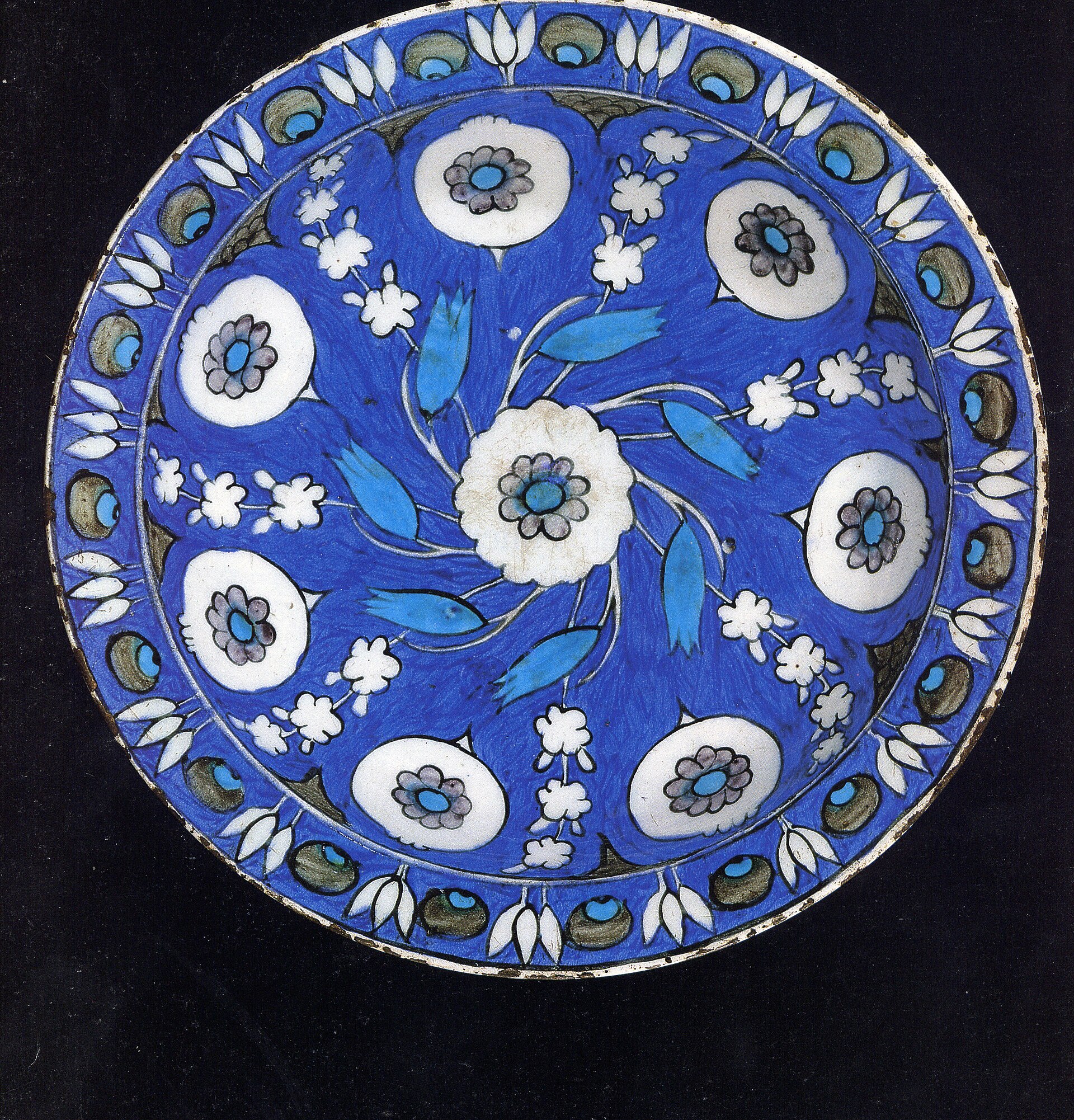
This dish did not arrive at the Metropolitan alone. The Altman bequest included several other Iznik and Ottoman ceramic pieces accessioned in the same 14.40 series, among them a Blue-Ground Dish with Floral Design (14.40.732), dated about 1550 to 1560 and already showing the fuller polychrome palette - green and purple added to the blue and turquoise - that would come to define what the trade once called Damascus ware, and a later Dish Depicting a Woman Bust and Floral Decoration (14.40.733), from the first half of the 17th century, made after Iznik's court patronage had faded and the quality of its output with it. Set beside these companions from the same collector and the same gift, this dish reads as an earlier moment in the same sequence: blue and turquoise only, before the fuller palette, before the decline.
The artist
The Iznik potters (workshop unidentified)
No potter's name attaches to this dish, and none attaches to almost any other surviving piece of 16th-century Iznik ware. The industry that made it is known collectively, through archaeology, court archives and comparative study of thousands of surviving objects, rather than through the biography of any named maker - closer, in that respect, to how a Roman pottery workshop or a medieval scriptorium is studied than to how an individual Renaissance painter is. What follows covers the industry, not a person, because that is what the evidence supports.
Related works
| Work | Relation | Where it is |
|---|---|---|
| Blue-Ground Dish with Floral Design Iznik potters, workshop unidentified | Companion piece from the same 1913 Benjamin Altman bequest, accession 14.40.732; shows the fuller polychrome palette (blue, turquoise, green and purple) that developed after this dish's simpler blue-and-turquoise stage Dated about 1550-1560 by the Museum. | Metropolitan Museum of Art, New York |
| Dish Depicting a Woman Bust and Floral Decoration Iznik potters, workshop unidentified | Companion piece from the same 1913 Benjamin Altman bequest, accession 14.40.733; a later Iznik dish made after the industry's late-16th-century decline in quality Dated to the first half of the 17th century by the Museum. | Metropolitan Museum of Art, New York |
| Bowl with Variation of 'Baba Nakkas' Design Iznik potters, workshop unidentified | Another Metropolitan Iznik vessel, from an earlier design phase; shows the Baba Nakkas court style current about 1500-1525, just before this dish's own turquoise-and-blue period Accession 32.34, Rogers Fund, 1932. | Metropolitan Museum of Art, New York |
| Mosque lamp Iznik potters; decorator named in the inscription as Musli | The best-documented dated Iznik vessel of the period, inscribed with the date AH 956 (AD 1549) and a dedication; used by scholars to anchor the dating of undated pieces such as this dish Found on the Temple Mount, Jerusalem, in the mid-19th century; associated with Suleyman the Magnificent's refurbishment of the Dome of the Rock. | British Museum, London |
| Dish, Golden Horn ware Probably Iznik potters | A dish still catalogued with the qualifier 'probably Iznik', illustrating how the old regional-misnomer caution persists in some museum labelling even after kiln archaeology settled the question for most of the ware group Catalogued to about 1530-1540. | Cincinnati Art Museum |
Open questions
- Which of Iznik's several 16th-century workshops, now archaeologically distinguishable from one another, actually produced this dish? No kiln-waster or petrographic comparison has been published for this specific object.
- Does the dish's documented blue-and-turquoise-only palette, read against the standard colour-introduction chronology, allow its date to be narrowed within the Museum's own 1525-1575 bracket toward the earlier end of that range? No scholar has published such a redating for this piece; this record notes the possibility without asserting the conclusion.
- How and through whose hands did the dish leave Ottoman Turkey and enter the Western art market before it reached Benjamin Altman? No source located in this research documents any owner or dealer before Altman.
- Did Henry J. Duveen personally supply this dish to Altman, as he supplied much of Altman's other oriental porcelain, or did it reach Altman by a different route? No source confirms either possibility.
- Has this dish's body or glaze ever been tested by thermoluminescence, X-ray fluorescence or Raman spectroscopy to confirm 16th-century Ottoman manufacture, or to rule out a later Iznik-style reproduction? No published test result for this specific object was located.
- What label, if any, did the Metropolitan Museum's own early cataloguers apply to this dish before current descriptive practice - was it ever called 'Damascus ware' in-house, as pieces of this general type commonly were in the trade at the time it was acquired?
Questions about this object
What is Dish?
Dish is a ceramic, dated mid-16th century (Metropolitan Museum range: 1525-1575). Medium: Stonepaste (fritware), painted in turquoise and two hues of cobalt blue under a transparent lead-alkaline-tin glaze.
Who made Dish, and is the attribution settled?
The attribution to Ottoman Iznik potters (workshop unidentified) is recorded here as accepted. Made in the town of Iznik, in Ottoman Anatolia, and accepted without dispute today as a product of the Iznik kilns. No individual potter or workshop is named for this dish and none can be; Iznik ware carries no makers' signatures. The town-of-origin question that this record documents in detail was a real and long-running dispute for this entire class of pottery, but it was a dispute about where wares like this one were made, resolved by kiln excavation, not a dispute about this specific object.
Where is Dish now?
Metropolitan Museum of Art, New York, Department of Islamic Art, Gallery 460. Inventory number Accession number 14.40.727, object ID 446648. Last confirmed 7 August 2026. Bequest of Benjamin Altman, 1913; accessioned 1914.
What is still unknown about Dish?
Which of Iznik's several 16th-century workshops, now archaeologically distinguishable from one another, actually produced this dish? No kiln-waster or petrographic comparison has been published for this specific object.
Sources
- 1Metropolitan Museum of Art, Collection database, 'Dish' (object 446648, accession 14.40.727), including the Museum's public Collection API data (medium, dimensions, credit line, dating range, department, gallery, and CC0/Open Access status). The live object page itself was blocked by an automated bot-checkpoint during this research and could not be fetched directly; data cited here is drawn from the Museum's own API endpoint and corroborating indexed copies of the same official text. metmuseum.org/art/...
- 2Wikipedia, 'Iznik pottery', for the fritware and glaze chemistry, the pigment-introduction chronology, the Damascus/Rhodian/Golden Horn/Miletus ware misnomer history, Arthur Lane's 1957 chronology, and Julian Raby's quoted caution on the 'Iznik' umbrella label. Tertiary source; flagged for replacement with Atasoy and Raby, Iznik: The Pottery of Ottoman Turkey (1989), and Lane's original 1957 article. en.wikipedia.org/wiki/...
- 3Wikipedia, 'Miletus ware', for the 1930s Friedrich Sarre excavation at Miletus and the subsequent correction of that misattribution. Tertiary source; flagged for replacement with the excavation literature. en.wikipedia.org/wiki/...
- 4Wikipedia, 'Benjamin Altman', for Altman's biography, his collecting through the dealer Henry J. Duveen, and the 1913 bequest to the Metropolitan Museum. Tertiary source; flagged for replacement with the Metropolitan Museum Journal v.3 (1970) article 'The Benjamin Altman Bequest' by Francis Haskell. en.wikipedia.org/wiki/...
- 5Oktay Aslanapa's early-1960s and 1981-1988 Iznik kiln excavations, as reported in Wikipedia's 'Iznik pottery' and 'Miletus ware' articles. Tertiary source; flagged for replacement with Aslanapa's own excavation publications. en.wikipedia.org/wiki/...
- 6Wikipedia, 'Ulisse Cantagalli', for Cantagalli's Florence workshop, its reproductions in 'Islamic and Moresque styles' from 1878, and its market and reputation among European collectors. Tertiary source; flagged for replacement with Sheila Forbes's published research on Cantagalli. en.wikipedia.org/wiki/...
- 7Philippe Colomban, Veronique Milande and Lionel Le Bihan, 'On Site Raman Analysis of Iznik Pottery Glazes and Pigments', arXiv, 14 December 2006, for the confirmation that Iznik's production town was 'highly disputed in the 80's', the glaze-chemistry classification method, and the Raman/XRF authentication approach. arxiv.org/abs/...
- 8Wikipedia, 'Edme Samson', for the Paris reproduction firm founded 1845, its range of copied wares, and documented cases of its maker's marks being removed to pass reproductions as originals. Tertiary source; flagged for replacement with a specialist study of Samson ceramics. en.wikipedia.org/wiki/...
- 9Metropolitan Museum of Art, Collection database, 'Blue-Ground Dish with Floral Design' (object 446649, accession 14.40.732), Bequest of Benjamin Altman, 1913. metmuseum.org/art/...
- 10Metropolitan Museum of Art, Collection database, 'Dish Depicting a Woman Bust and Floral Decoration' (object 446650, accession 14.40.733), Bequest of Benjamin Altman, 1913. metmuseum.org/art/...
- 11Wikimedia Commons, Category:Bequest of Benjamin Altman, used to identify and licence-verify the Commons image files for this dish and its companion pieces from the same bequest (all confirmed CC0 via extmetadata.LicenseShortName). commons.wikimedia.org/wiki/...
Last verified 7 August 2026 · Published 7 August 2026
Change log
7 August 2026 - Record created at the house standard: researched narrative, technical evidence, maker dossier, graded provenance chain, prices with hammer and premium separated, related works, open questions and sources.