Mosque Lamp Bearing the Name of the Mamluk Sultan al-Malik al-Nasir
Unidentified Mamluk glass workshop, Syria · ca. 1340
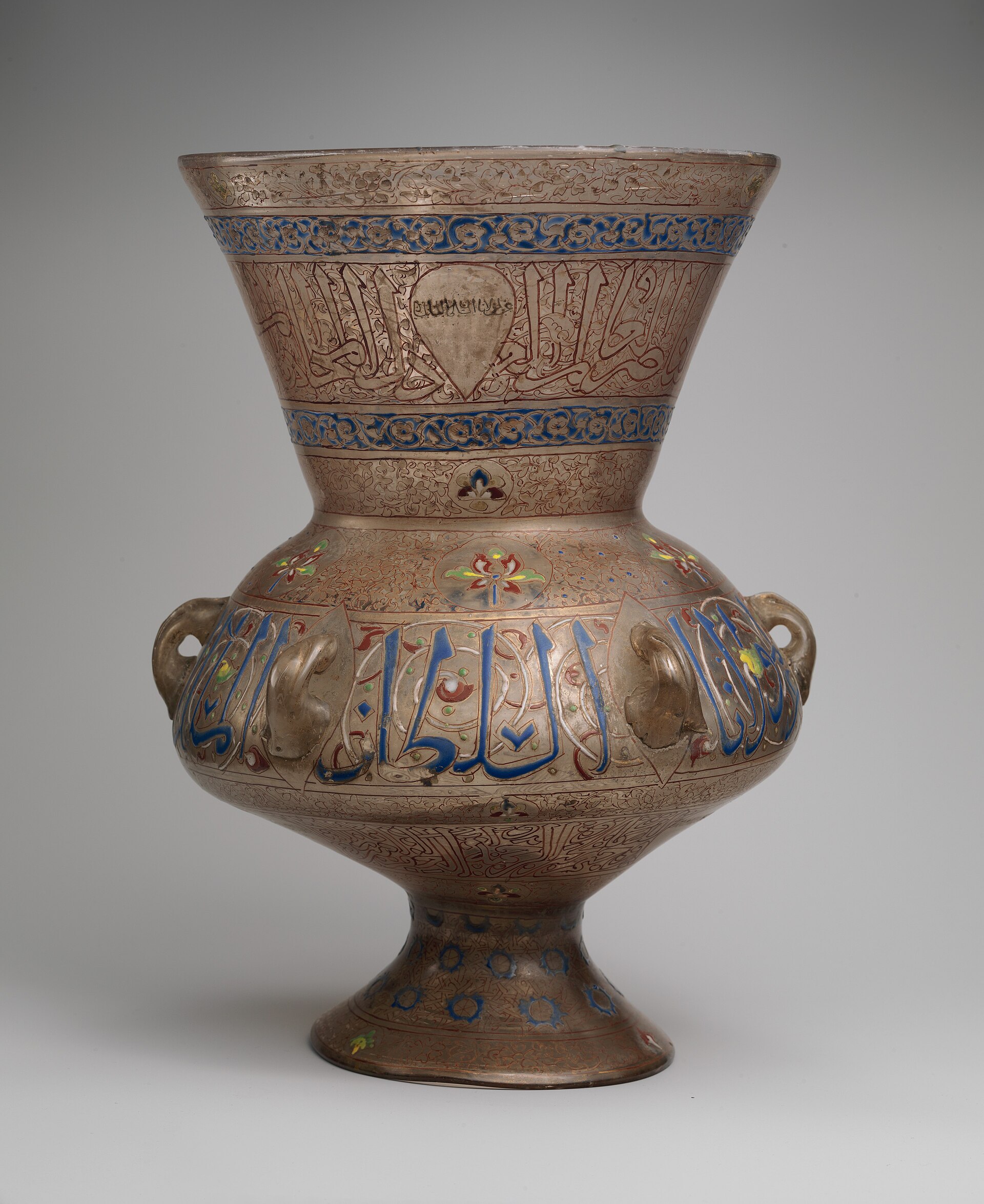
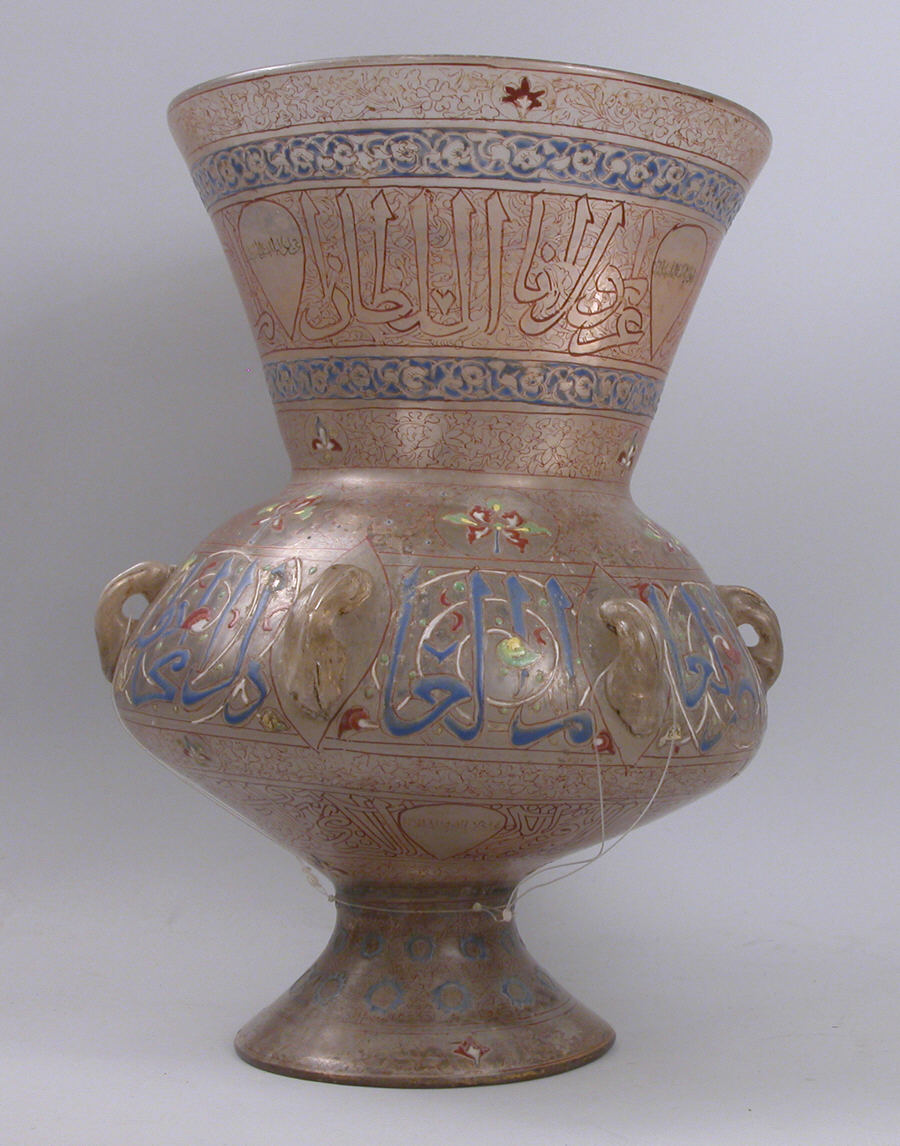
The lamp as photographed for the Metropolitan Museum's Open Access archive: a blown glass vessel with an applied foot and loop handles, enamelled and gilded with the sultan's titulature. This is the Museum's own primary image for accession 17.190.987, released CC0.
| Artist | Unidentified Mamluk glass workshop, Syria |
|---|---|
| Date | ca. 1340 |
| Medium | Glass, colorless with a brown tinge; blown, with an applied blown foot and applied handles; enamelled and gilded |
| Dimensions | Height 33 cm (13 in.); rim diameter 21.9 cm (8 5/8 in.) |
| Where it is now | Metropolitan Museum of Art, New Yorklast confirmed |
| Inventory number | Accession number 17.190.987 (object ID 447002), Department of Islamic Art |
| Attribution | AcceptedNo maker or workshop signs the lamp; enamelled Mamluk glass is essentially never signed. Full note |
| Object type | Glass |
| Period | Mamluk (Bahri period); dated to the third reign of Sultan al-Nasir Muhammad ibn Qalawun, 1310-1341 |
| Cases | Has a provenance gap |
| Inscriptions | Arabic titulature bands on the neck, on three enamelled shields, and on the body, all naming the sultan by his royal style; a separate waqf (pious endowment) inscription on the foot naming the founder as 'the convert Al-Kerimi' at a place given as 'Al-Karafa'. Translated for the Metropolitan Museum by Nicholas Martinovitch. |
| Owners on record | 8 links6 documented, 2 unknown |
| Sources | 8 cited |
About this record Last verified · 8 sources cited · Change log
On this page 10 sections
ContentsClose
An enamelled and gilded Mamluk glass mosque lamp, about 33 centimetres tall, made around 1340 and attributed by the Metropolitan Museum to Syria. Its titulature names the sultan al-Malik al-Nasir, almost certainly al-Nasir Muhammad ibn Qalawun in his long third reign, but its most specific inscription is a separate one on the foot: a waqf endowment naming an otherwise undocumented founder, 'the convert Al-Kerimi,' at a place given as Al-Karafa, almost certainly Cairo's Qarafa cemetery district.
Its documented modern history is short and precise where it exists and honestly blank where it does not. It belonged to the Paris auction expert and collector Charles Mannheim until his death in 1910, was sold at his estate sale that year, and entered the collection of J. Pierpont Morgan; his estate gave it to the Metropolitan Museum in 1917, four years after his own death, as part of a gift of eight Mamluk mosque lamps. How Mannheim acquired it, and what it made at auction in 1910, are not established in any source consulted for this record.
The lamp also sits inside a live scholarly tension rather than a settled fact: the Museum's own Syria attribution runs against its own curators' broader observation that glass of exactly this date is more often Cairo-made. This record states that openly instead of picking a side its sources do not support.
Provenance
Each link is graded. Documented: a cited source supports it. Disputed: the identification is argued but not established. Unknown: no owner for that span, and the gap is not smoothed into a narrative. The grades in the glossary.
- ca. 1340 -The convert known as Al-Kerimi, founder of a waqf at Al-Karafa (probably al-Qarafa, the southern cemetery of Cairo)documented
Established directly by the lamp's own foot inscription, translated for the Metropolitan Museum by Nicholas Martinovitch. The founder's fuller identity, and the specific building he endowed, are not established in the sources consulted.1
- - 1910Charles Mannheim, Parisdocumented
The Metropolitan Museum's own provenance record places the lamp with Mannheim (1833-1910), a leading Paris auction expert and collector, until his death, without stating its earlier history. His own published 1898 collection catalogue covers Renaissance decorative arts, not Islamic material, so it does not document this piece.16
- - 1910Charles Mannheim, Parisunknown
The Metropolitan Museum's own provenance record places the lamp with Mannheim (1833-1910), a leading Paris auction expert and collector, until his death, without stating its earlier history. His own published 1898 collection catalogue covers Renaissance decorative arts, not Islamic material, so it does not document this piece.16
- 1910 - 1910Sale of the Mannheim estatedocumented
Sold at the estate sale of Charles Mannheim, Galerie Georges Petit, Paris, 1910, lot 131, per the Metropolitan Museum's own provenance record. The specific dated sale session and the price realized are not established in the sources consulted.1
- 1910 - 1913J. Pierpont Morgan, New Yorkdocumented
Morgan owned the lamp until his death in 1913. Whether he bought it directly at the 1910 Mannheim sale or acquired it afterward through a dealer is not stated in the sources consulted.13
- 1910 - 1913J. Pierpont Morgan, New Yorkunknown
Morgan owned the lamp until his death in 1913. Whether he bought it directly at the 1910 Mannheim sale or acquired it afterward through a dealer is not stated in the sources consulted.13
- 1913 - 1917Estate of J. Pierpont Morgandocumented
On Morgan's 1913 death the lamp passed into his estate. His son, J. Pierpont Morgan Jr., gave the largest portion of the collection, including eight Mamluk mosque lamps of which this was one, to the Metropolitan Museum in 1917.13
- 1917 - presentMetropolitan Museum of Art, New Yorkdocumented
Accessioned as 17.190.987, Department of Islamic Art, with the credit line 'Gift of J. Pierpont Morgan, 1917' following Museum convention for a gift completed by an estate in the original collector's name. Currently not on view.12
Prices realised
| Date | Sale | Estimate | Result | Note |
|---|---|---|---|---|
| 1910 | Galerie Georges Petit Estate sale of Charles Mannheim, Paris, lot 131 | unknown | Hammer unknown With premium unknown unknown | The Metropolitan Museum's own provenance record cites this lot number and sale house but does not give a hammer price, premium, buyer of record at the time, or which of the Mannheim estate's several 1910 sale sessions included this lot. No sale catalogue was independently consulted for this record; the gap is stated rather than guessed at. |
Hammer is the price at which the bidding stopped; with premium adds the fee the house charges the buyer on top. Hammer price and buyer's premium in the glossary.
Technical evidence
| Attribution note | No maker or workshop signs the lamp; enamelled Mamluk glass is essentially never signed. The patron sultan is identified by the titulature in the lamp's own inscriptions, which the Metropolitan Museum dates to about 1340 and displays as belonging to 'Al-Malik Al-Nasir (1293-1340)' -- a loose span running from his first accession to near the end of his life, rather than a precise regnal date. Independent reign chronologies place his third and final reign at 1310-1341, and he died in June 1341, so the Museum's own dating is consistent with a lamp of his third reign even though its shorthand years do not exactly match his death date. The workshop is attributed geographically to Syria by the Metropolitan Museum's own catalogue. General scholarship on the craft (Carboni and Adamjee, Metropolitan Museum, 2002) notes that by the 1330s and 1340s Cairo, by then the Mamluk capital, had become the more probable center for most enamelled glass production of this kind; this record states that tension rather than resolving it, since no publication consulted argues the point for this specific lamp. |
|---|---|
| Form | Mosque-lamp form: flaring neck, bulbous body, applied blown foot, and applied loop handles for suspension chains.1 |
| Medium | Blown glass, colorless with a brown tinge, decorated with enamel and gold leaf.1 |
| Dimensions | Height 33 cm (13 in.); rim diameter 21.9 cm (8 5/8 in.).1 |
| Decorative technique | Enamel and gilding, both requiring different firing temperatures to fuse permanently onto glass. The Metropolitan Museum's curators conclude that Mamluk glassmakers applied all colors and gilding together and fixed them in a single kiln firing to avoid repeated reheating and warping of the vessel.4 |
| Inscriptions | Arabic titulature of the sultan al-Malik al-Nasir on the neck, on three shields, and on the body; a separate waqf foundation text on the foot naming a patron, 'the convert Al-Kerimi', at 'Al-Karafa'. Translated for the Metropolitan Museum by Nicholas Martinovitch.1 |
| Geographic attribution | Attributed by the Metropolitan Museum to Syria, though the wider scholarly picture for enamelled glass of this date leans toward Cairo as the more probable production center by the 1330s-40s; not independently resolved for this object in the sources consulted.14 |
| Dating | Circa 1340 (the Museum's broader working range for the piece is 1315-1365), placed within the third reign of Sultan al-Nasir Muhammad ibn Qalawun (1310-1341).128 |
| Scientific analysis | The Metropolitan Museum's own References cite a compositional study of the glass and enamel (Wypyski, 2010) discussing this object among others; that publication was not independently consulted for this record and its specific findings for this lamp are not reproduced here.1 |
Images
The record in full
Chapter 1What it is
A blown glass mosque lamp, 33 centimetres high with a rim 21.9 centimetres across, made of colorless glass with a faint brown tinge.
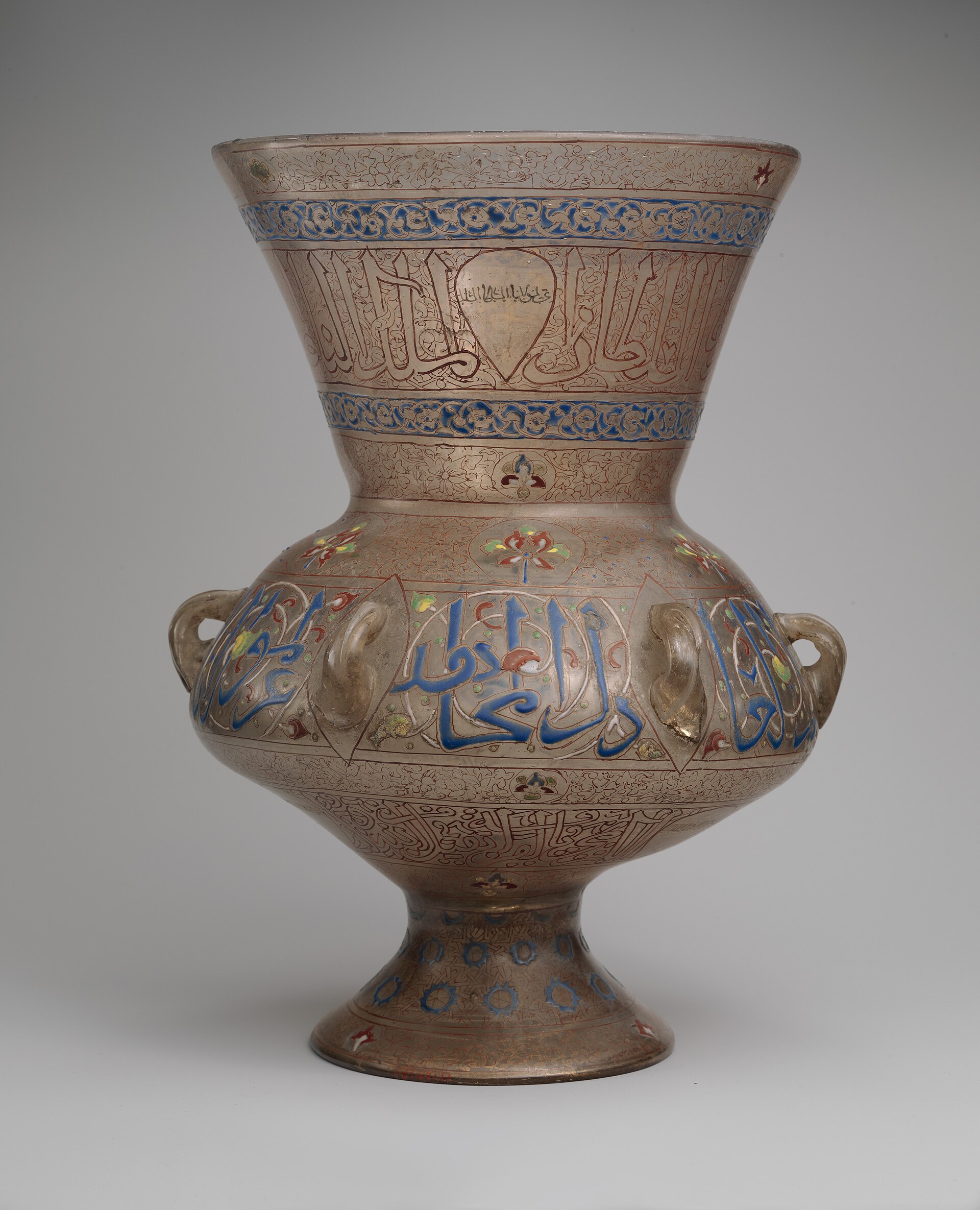
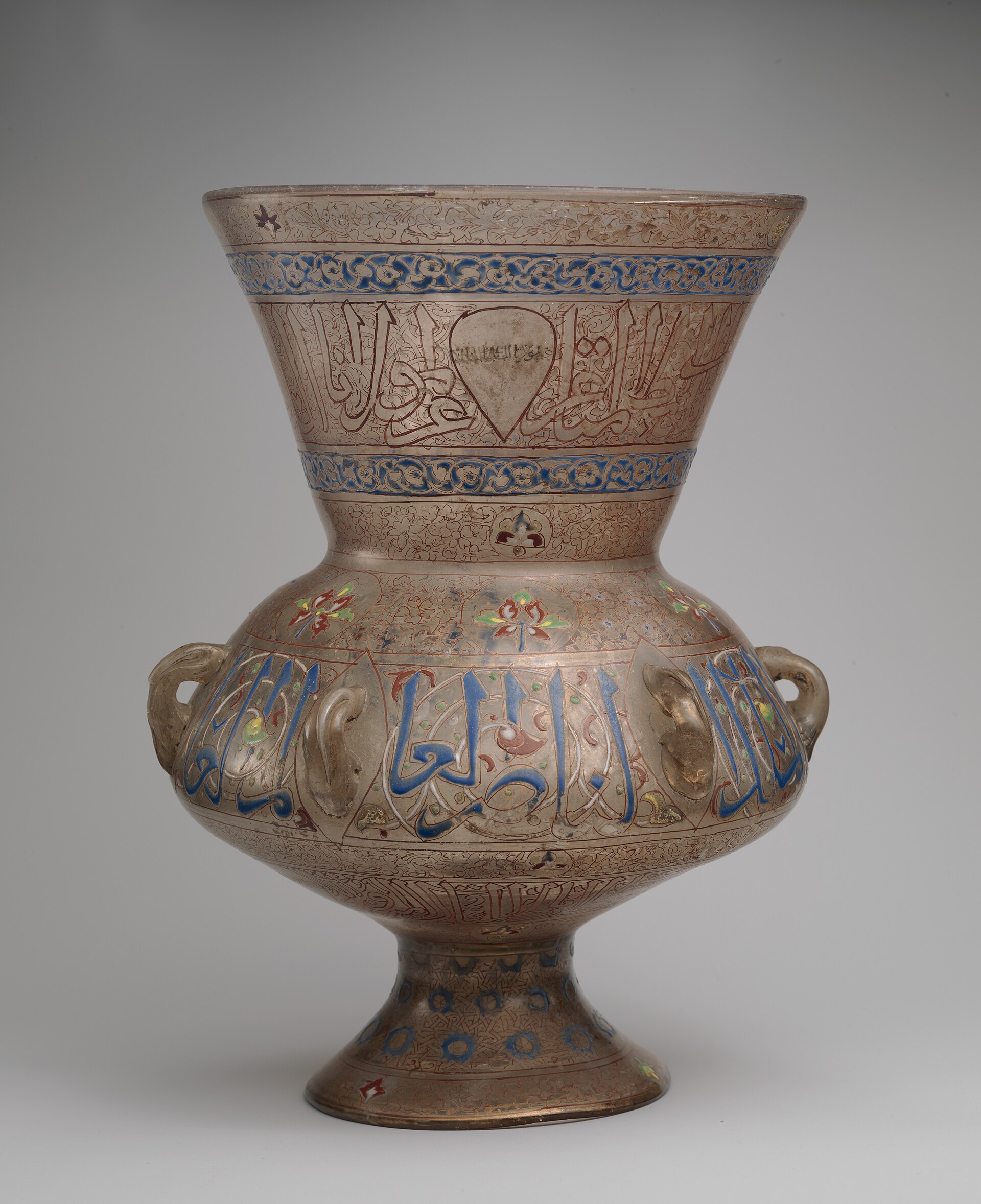
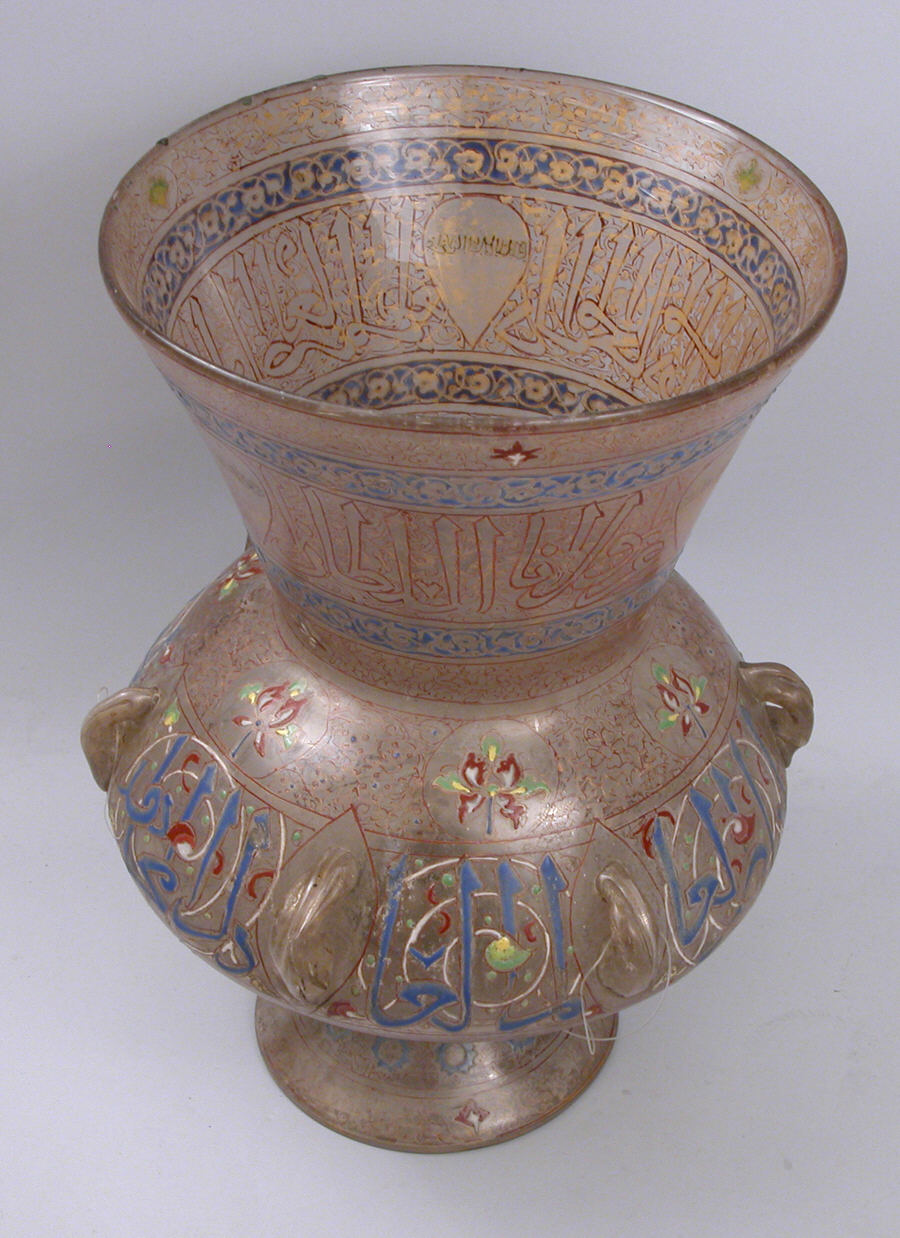
A blown glass mosque lamp, 33 centimetres high with a rim 21.9 centimetres across, made of colorless glass with a faint brown tinge. It has the classic Mamluk lamp form: a wide flaring neck, a bulbous body, an applied blown foot, and applied loop handles from which chains would have suspended it. Its surface carries painted enamel and gold leaf, fired onto the glass in bands of Arabic inscription and ornament.
It was never meant to be looked at from a table. Mosque lamps of this kind hung on chains from the ceilings of mosques, madrasas and mausolea, burning oil through a floating wick, so that from below a viewer saw the enamelled bands glowing against the light of the flame inside. The object in a museum case, lit from without, is being seen the wrong way round from how it was designed to be seen.
Chapter 2How it was made
Enamelling glass is a two-material problem.
Enamelling glass is a two-material problem. Gold and the powdered colored glass used for enamel each need a different firing temperature to fuse permanently onto a blown vessel, and reheating a finished lamp repeatedly risks warping or collapsing it. The Metropolitan Museum's own curators, writing on the wider craft, conclude that Mamluk glassmakers had mastered a way to apply every color and the gilding at once and fix them in a single firing, a technically demanding sequence that left little room for correction.
The technique itself did not originate with the Mamluks. It developed in the Syrian region in the twelfth century and matured through the final decades of Ayyubid rule and the first decades of Mamluk rule in the thirteenth century, before becoming the signature luxury glass product of the Mamluk sultanate in the fourteenth.
Chapter 3What the inscriptions say
The Metropolitan Museum publishes a full translation of the lamp's Arabic inscriptions, credited to Nicholas Martinovitch.
The Metropolitan Museum publishes a full translation of the lamp's Arabic inscriptions, credited to Nicholas Martinovitch. On the neck: 'Glory to our Lord the Sultan, the King (Malik), the Victorious (Al-Nasir), the Wise, the Just, the Warrior for Religion, the Defender of Frontiers, the Protector.' On three enamelled shields around the body: 'Glory to our Lord, the Sultan, the King.' On the body itself: 'Glory to Our Lord, the King, the Wise, the Just, the Defender of Frontiers.'
These are royal titles, not a name in the ordinary sense: 'al-Nasir' here functions as the sultan's honorific laqab, the Victorious, repeated as a kind of refrain around the vessel. Many surviving Mamluk mosque lamps instead or additionally carry a quotation from the Qur'anic Verse of Light (Surat al-Nur, 24:35), which compares God's light to a lamp inside a niche. The Metropolitan Museum's own published transcription of this lamp's inscriptions does not include that verse; its only devotional text is the separate foundation inscription on the foot. A reader should not assume the Light Verse is present here simply because it is common on lamps of this type.
Chapter 4The sultan named on it
The royal titles point to a Mamluk sultan styled al-Malik al-Nasir.
The royal titles point to a Mamluk sultan styled al-Malik al-Nasir. The Museum's own display text glosses this as 'Al-Malik Al-Nasir (1293-1340)', and independently published reign chronologies for al-Nasir Muhammad ibn Qalawun (mentioned here as a general historical check, not as evidence about this specific lamp) record his rule in three separate periods -- December 1293 to December 1294, January 1299 to March 1309, and March 1310 until his death on 7 June 1341. A lamp dated about 1340 falls inside that third and by far longest reign, the period of his greatest architectural and artistic patronage in Cairo.
Nothing in the sources consulted for this record suggests any other Mamluk sultan bearing the laqab al-Nasir -- his son al-Nasir Hasan among them -- fits the Museum's ca. 1340 date better. The identification with Muhammad ibn Qalawun is treated here as accepted on that basis, while noting that the object itself, like most mosque lamps of its kind, names a royal title rather than a personal name.
Chapter 5The founder the object actually names
The sultan's titles are not, in fact, the most specific piece of evidence the lamp carries.
The sultan's titles are not, in fact, the most specific piece of evidence the lamp carries. That is the separate inscription on the foot, in the Museum's translation: 'The wakf [inalienable property] of the blessed and praiseworthy convert Al-Kerimi in Al-Karafa. Allah receive him who established this wakf and conclude his life with goodness and mercy, and forgiveness of his sins. O Lord of two worlds!'
A wakf, or waqf, is a permanent pious endowment under Islamic law: property, income or an object dedicated irrevocably to a religious or charitable purpose, which is precisely why a lamp like this survives with any documentary trace at all -- it was legally inalienable, made for a specific foundation rather than for sale. 'Al-Karafa' is almost certainly al-Qarafa, the historic southern cemetery and shrine district of Cairo, where Mamluk amirs and officials built mausolea, often attached to a madrasa or a khanqah, a Sufi hospice.
Beyond the inscription itself, this record can establish nothing further about Al-Kerimi. No source consulted identifies him with a named historical figure, dates his foundation more precisely than the lamp's own circa-1340 date, or names the specific building in the Qarafa he endowed. That gap is recorded as a gap, not bridged with a guess: sultans commissioned mosque lamps for their own foundations, but this lamp's own words describe someone else's act of piety, someone the surviving record does not otherwise preserve.
Chapter 6Syria or Cairo: an attribution that is not fully settled
The Metropolitan Museum's own catalogue entry attributes the lamp to Syria.
The Metropolitan Museum's own catalogue entry attributes the lamp to Syria. That sits awkwardly against a fact the Museum's own curators state elsewhere: as Cairo became the Mamluk capital over the course of the fourteenth century, most enamelled and gilded glass from that period is attributed to Egyptian rather than Syrian workshops, because the largest glass factories serving the court and the great architectural foundations were almost certainly based there by the 1330s and 1340s.
This record does not resolve that tension. It notes only that the Museum's own geographic attribution for this specific lamp is Syria, that the broader scholarly picture for glass of this date leans toward Cairo, and that no source consulted here argues the point for 17.190.987 in particular. Attributions of this kind rest on comparative style and technique across a large corpus rather than on a maker's mark, and a museum's classification can predate later shifts in scholarly consensus without being revisited object by object.
Chapter 7An industry built on trade wealth, and its end
Mamluk decorative luxury -- enamelled glass among it, alongside inlaid metalwork, woodwork and textiles -- was funded by the empire's control of the east-west trade in silks and spices passing...
Mamluk decorative luxury -- enamelled glass among it, alongside inlaid metalwork, woodwork and textiles -- was funded by the empire's control of the east-west trade in silks and spices passing through Cairo and Alexandria. Enamelled and gilded glass in particular was prized enough to shape taste well outside the Islamic world; the Metropolitan Museum's own curators note its documented influence on the later Venetian glass industry.
The craft did not last. Production declined through the late fourteenth century, and dwindling patronage closed workshops by the early fifteenth; by the century's end most enamelled glassmaking of this kind had shifted to Venice. A popular version of that story blames a single catastrophe, the Central Asian conqueror Timur's sack of Damascus in 1401, said to have ended the city's glass trade at a stroke and carried its craftsmen off to Samarkand. Specialist literature on the craft's final decades treats that as an overstated single-cause account of what was in fact a longer, multi-causal decline in patronage and trade; this record repeats the caution rather than the dramatic version, and notes that this specific lamp, made decades before 1401, has no direct connection to that later event either way.
Chapter 8The mosque lamp as an act of patronage
Under the Bahri Mamluks, endowing a madrasa, a mausoleum or another pious foundation was not only devotional; it was also a legal strategy.
Under the Bahri Mamluks, endowing a madrasa, a mausoleum or another pious foundation was not only devotional; it was also a legal strategy. The Metropolitan Museum's own account of the period notes that such endowments protected a patron's wealth and perpetuated his name against the ordinary risks of inheritance disputes and confiscation that threatened a private fortune under Mamluk succession practice. Sultan Qalawun's own foundation set the pattern that al-Nasir Muhammad, his son, and lesser amirs after them followed at scale through the fourteenth century.
A mosque lamp sits at the small end of that same system. Whether commissioned by a sultan for his own foundation or, as here, by someone considerably less powerful for a foundation of his own, the lamp made the founder's piety and his name physically present in the building for as long as it burned -- which, for an object protected as inalienable waqf property, was meant to be indefinitely. That the sultan's titulature and an otherwise unrecorded convert's endowment appear on the same object is not a contradiction: the royal titles may signal that the lamp was produced under, or dated to, the sultan's reign and workshops operating in his name, while the wakf text names the person who actually paid for it and gave it to a specific place.
Chapter 9From Charles Mannheim's Paris to J. Pierpont Morgan's estate
The Metropolitan Museum's own provenance record for this lamp is short and specific: it belonged to Charles Mannheim, Paris, until his death in 1910, was sold at his estate sale at the Galerie...
The Metropolitan Museum's own provenance record for this lamp is short and specific: it belonged to Charles Mannheim, Paris, until his death in 1910, was sold at his estate sale at the Galerie Georges Petit, Paris, in 1910 as lot 131, and then belonged to J. Pierpont Morgan, New York, until his own death in 1913, passing through his estate before being given to the Museum in 1917.
Mannheim (1833-1910) was one of the most active figures in the nineteenth-century Paris art trade, described by a contemporary as 'the prince of experts' and associated, across his career and that of his father Sigismond before him, with more than two thousand Parisian auction sales, including the dispersal of objects from the Yuanmingyuan, the Chinese imperial summer palace looted in 1860, sold in Paris in 1861. He worked chiefly as an auction expert rather than a retail dealer, based from 1867 at 7 rue Saint-Georges near the Hotel Drouot. He also built a personal collection, catalogued in 1898 by Emile Molinier, then a curator at the Louvre -- but that catalogue covers Renaissance bronzes, sculpture, ivories, Venetian glass and enamels, not Islamic material, so it does not document how or when this lamp entered his hands. Nothing in the sources consulted for this record establishes where Mannheim acquired the lamp, from whom, or when; that link is graded unknown.
Chapter 10The Morgan gift of 1917
J. Pierpont Morgan (1837-1913) spent much of the last two decades of his life assembling an encyclopedic art collection that the Metropolitan Museum's own account estimates absorbed more than...
J. Pierpont Morgan (1837-1913) spent much of the last two decades of his life assembling an encyclopedic art collection that the Metropolitan Museum's own account estimates absorbed more than two-thirds of his fortune. He died in 1913; his son, J. Pierpont Morgan Jr., then gave the largest portion of the collection -- several thousand ancient and medieval objects -- to the Metropolitan Museum, a gift completed in 1917. Among the Islamic material were numerous Ottoman tile panels, carpets, and enamelled glass 'of high quality and in excellent condition,' in the Museum's own words; the gift specifically included eight mosque lamps, of which this is one.
The Museum's credit line reads simply 'Gift of J. Pierpont Morgan, 1917.' That is Metropolitan Museum convention for gifts completed by an estate in a donor's name, but it is worth stating plainly: Morgan died four years before the gift that carries his name was actually made, and the decision to give this object to the Museum, along with the rest of the 1917 gift, was his son's and his estate's to make, not his own final act.
Chapter 11What is documented and what is not
Set out in one place, the documented chain runs: an unidentified founder named only as Al-Kerimi endowed the lamp as waqf property at a foundation in or near Cairo's Qarafa cemetery, in or close to...
Set out in one place, the documented chain runs: an unidentified founder named only as Al-Kerimi endowed the lamp as waqf property at a foundation in or near Cairo's Qarafa cemetery, in or close to 1340; by 1910 it belonged to the Paris expert and collector Charles Mannheim, who owned it until his death that year; it was sold at his estate sale at the Galerie Georges Petit in 1910; it entered the collection of J. Pierpont Morgan, who owned it until his own death in 1913; his estate, acting through his son, gave it to the Metropolitan Museum in 1917, where it has remained.
Undocumented in the sources consulted: how Al-Kerimi is otherwise identified, or which specific building he endowed; where, from whom, and for what price Mannheim acquired the lamp; the price it made at the 1910 Mannheim sale, and whether Morgan bought it there directly or through an intermediary afterward; and any price or valuation attached to the 1917 gift, which as a charitable donation would in any case not reflect an open-market sale price. A record that states these gaps plainly is more useful than one that quietly smooths over them.
The artist
No individual maker or workshop is named; the object is the product of the Mamluk enamelled-glass craft centered in Syria and Egypt.
Enamelled and gilded Mamluk glass is a craft tradition, not a roster of named artists. Vessels of this kind are almost never signed, and workshops are identified, when they can be identified at all, by comparing form, palette, script and inscription formulas across a large surviving corpus -- the method Carl Johan Lamm used to build the field's foundational catalogue in 1929-30, and the same method that underlies the Metropolitan Museum's own attribution of this piece to Syria. The dossier below covers that craft and its documented history, not an individual hand.
Related works
| Work | Relation | Where it is |
|---|---|---|
| Mosque Lamp for the Mausoleum of Amir Aydakin al-'Ala'i al-Bunduqdar Unidentified Mamluk glass workshop, Egypt | Part of the same 1917 gift of eight mosque lamps from the J. Pierpont Morgan estate Dated shortly after 1285, earlier than this lamp; made for a named amir's mausoleum, an example of the documented foundation this lamp's own inscription leaves unnamed. | Metropolitan Museum of Art, accession 17.190.985 |
| Mosque Lamp of Amir Qawsun 'Ali ibn Muhammad al-Barmaki | Part of the same 1917 Morgan gift; made for an amir who served under al-Nasir Muhammad Dated ca. 1329-35, close in date to this lamp and made for a documented officer of the same sultan named on this piece's titulature. | Metropolitan Museum of Art, accession 17.190.991 |
| Mosque Lamp Unidentified Mamluk glass workshop, Syria | Comparable Syrian-attributed mosque lamp of the same general period, from an earlier Museum gift First half of the 14th century; useful comparanda for the Syria attribution given to this lamp. | Metropolitan Museum of Art, accession 91.1.1530, Edward C. Moore bequest, 1891 |
| Mosque Lamp of Amir Sayf al-Din Shaykhu Unidentified Mamluk glass workshop, Syria | Later comparable lamp made for a named amir, from the same earlier Moore bequest Dated ca. 1349-55, roughly a decade after this lamp; shows the type continuing after al-Nasir Muhammad's death. | Metropolitan Museum of Art, accession 91.1.1537 |
| Mosque Lamp Unidentified Mamluk glass workshop, Egypt or Syria | Further comparable lamp of uncertain single attribution, same Moore bequest Cataloged simply to the fourteenth century, illustrating how often geographic attribution for this type of object remains genuinely open, as it does for the present lamp. | Metropolitan Museum of Art, accession 91.1.1539 |
Open questions
- Who was the 'convert Al-Kerimi' named in the foot inscription as the founder of the waqf, and is he identifiable with any other documented Mamluk-period figure? No source consulted identifies him further.
- Which specific mosque, madrasa, mausoleum or khanqah in Cairo's Qarafa cemetery did this lamp originally light? The inscription names the district, not the building.
- Where, from whom, and when did Charles Mannheim acquire the lamp? His documented 1898 collection catalogue does not cover Islamic material, and no source consulted traces the object before his ownership.
- Which specific 1910 Galerie Georges Petit sale session included lot 131? The Mannheim estate was dispersed across more than one 1910 sale (paintings and objets d'art separately), and the sources consulted for this record do not specify which.
- What price did the lamp make at the 1910 Mannheim sale, and did J. Pierpont Morgan buy it there directly or acquire it afterward through a dealer? Neither is established in the sources consulted.
- Why does the Metropolitan Museum attribute this specific lamp to Syria when its own published scholarship on the wider craft places most glass of this exact date (the 1330s-40s) in Cairo workshops? No source consulted argues the point for this object in particular.
Questions about this object
What is Mosque Lamp Bearing the Name of the Mamluk Sultan al-Malik al-Nasir?
Mosque Lamp Bearing the Name of the Mamluk Sultan al-Malik al-Nasir is a glass, dated ca. 1340. Medium: Glass, colorless with a brown tinge; blown, with an applied blown foot and applied handles; enamelled and gilded.
Who made Mosque Lamp Bearing the Name of the Mamluk Sultan al-Malik al-Nasir, and is the attribution settled?
The attribution to Unidentified Mamluk glass workshop, Syria is recorded here as accepted. No maker or workshop signs the lamp; enamelled Mamluk glass is essentially never signed. The patron sultan is identified by the titulature in the lamp's own inscriptions, which the Metropolitan Museum dates to about 1340 and displays as belonging to 'Al-Malik Al-Nasir (1293-1340)' -- a loose span running from his first accession to near the end of his life, rather than a precise regnal date. Independent reign chronologies place his third and final reign at 1310-1341, and he died in June 1341, so the Museum's own dating is consistent with a lamp of his third reign even though its shorthand years do not exactly match his death date. The workshop is attributed geographically to Syria by the Metropolitan Museum's own catalogue. General scholarship on the craft (Carboni and Adamjee, Metropolitan Museum, 2002) notes that by the 1330s and 1340s Cairo, by then the Mamluk capital, had become the more probable center for most enamelled glass production of this kind; this record states that tension rather than resolving it, since no publication consulted argues the point for this specific lamp.
Where is Mosque Lamp Bearing the Name of the Mamluk Sultan al-Malik al-Nasir now?
Metropolitan Museum of Art, New York. Inventory number Accession number 17.190.987 (object ID 447002), Department of Islamic Art. Last confirmed 29 August 2026. The Museum's own object record gives this accession number and department and states the lamp is currently not on view; it has been in the Met's collection continuously since the 1917 gift.
What has Mosque Lamp Bearing the Name of the Mamluk Sultan al-Malik al-Nasir sold for?
Hammer unknown; with premium, unknown. Galerie Georges Petit, 1910.
What is still unknown about Mosque Lamp Bearing the Name of the Mamluk Sultan al-Malik al-Nasir?
Who was the 'convert Al-Kerimi' named in the foot inscription as the founder of the waqf, and is he identifiable with any other documented Mamluk-period figure? No source consulted identifies him further.
Sources
- 1Metropolitan Museum of Art, object record for 'Mosque Lamp Bearing the Name of the Mamluk Sultan al-Malik al-Nasir,' accession 17.190.987, object ID 447002, including its Overview, Signatures/Inscriptions/Markings, Provenance and References tabs. metmuseum.org/art/...
- 2Metropolitan Museum of Art, Open Access Collection API, object record 447002 (public-domain status, primary and additional images). collectionapi.metmuseum.org/public/...
- 3Metropolitan Museum of Art, press release, 'The Making of a Collection: Islamic Art at the Metropolitan,' October 31, 2011, on the Edward C. Moore and J. Pierpont Morgan gifts and the ten major donor-collectors of the Islamic Art department. metmuseum.org/press-releases/...
- 4Carboni, Stefano, and Qamar Adamjee, 'Enameled and Gilded Glass from Islamic Lands,' Heilbrunn Timeline of Art History, Metropolitan Museum of Art, October 2002. metmuseum.org/essays/...
- 5Yalman, Suzan, 'The Art of the Mamluk Period (1250-1517),' Heilbrunn Timeline of Art History, Metropolitan Museum of Art, October 2001. metmuseum.org/essays/...
- 6AGORHA (Institut National d'Histoire de l'Art), biographical notice, 'Mannheim, Charles (29/03/1833 - 01/05/1910), Paris.' agorha.inha.fr/ark:/...
- 7Wikimedia Commons, file records and (license, categories) for the five CC0-licensed photographs of accession 17.190.987, queried via the Commons API. commons.wikimedia.org/w/...
- 8Wikipedia, 'Al-Nasir Muhammad,' consulted only for a general cross-check of reign dates and titulature, not as evidence about this specific object. en.wikipedia.org/wiki/...
Last verified · Published
Change log
29 August 2026 - Record created at the house standard: researched narrative, technical evidence, maker dossier, graded provenance chain, prices with hammer and premium separated, related works, open questions and sources.