Platter
Unidentified maker, in the manner of Bernard Palissy · second half 19th century
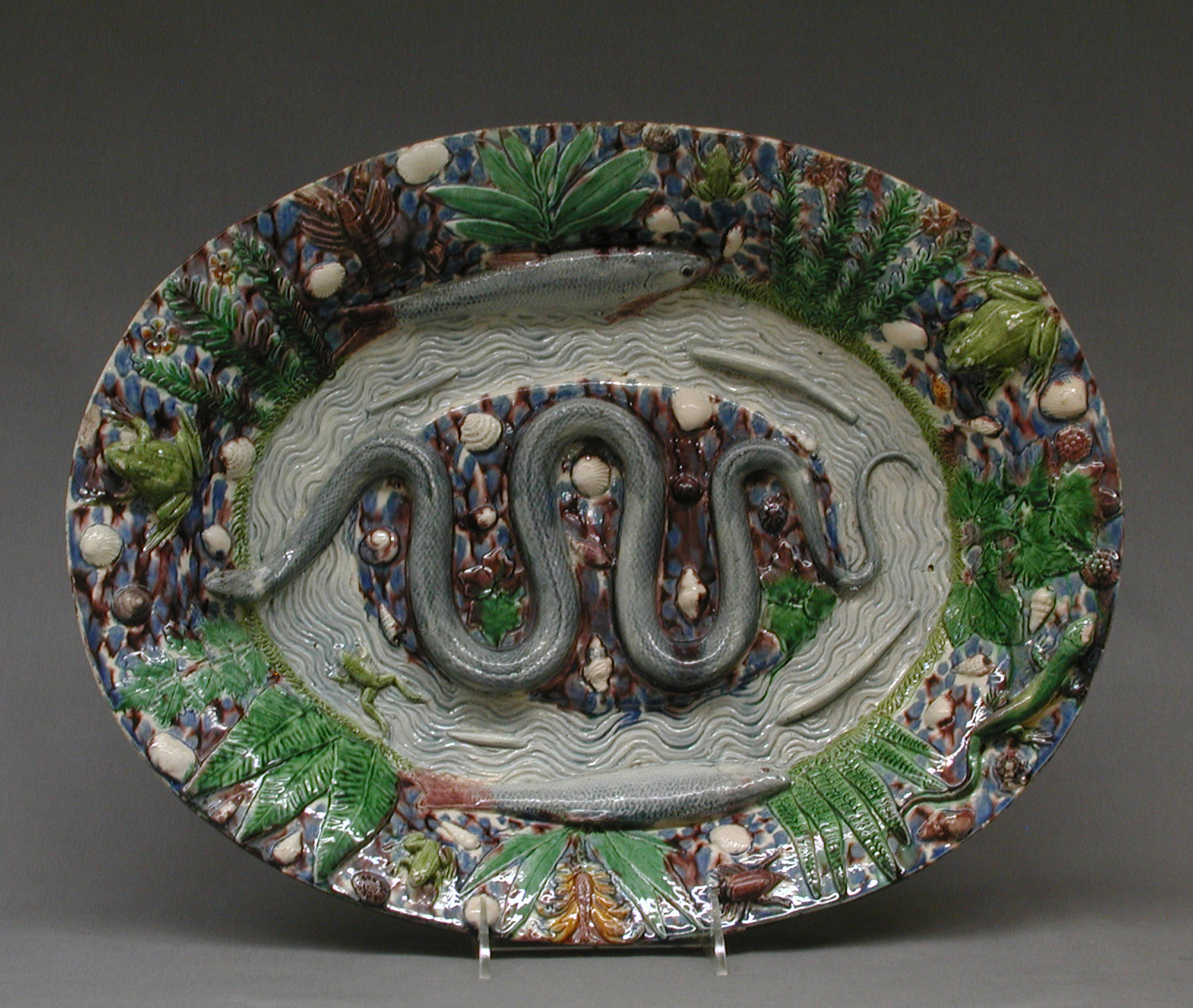
The record subject: an oval earthenware platter modelled with a coiled reptile on a rippled ground, ringed by ferns, shells, frogs and pebbles in the naturalistic life-cast manner associated with Bernard Palissy. The Metropolitan Museum catalogues it in the manner of Palissy rather than as his own work, and the attribution names no individual and no firm.
| Artist | Unidentified maker, in the manner of Bernard Palissy |
|---|---|
| Date | second half 19th century |
| Medium | Lead-glazed earthenware |
| Dimensions | 7.1 x 43.5 x 34.1 cm (2 13/16 x 17 1/8 x 13 7/16 in), overall confirmed |
| Where it is now | Metropolitan Museum of Art, New York, European Sculpture and Decorative Arts department. Not currently on view.last confirmed 28 August 2026 |
| Inventory number | Object number 53.225.64 |
| Attribution | AcceptedThe Metropolitan Museum of Art catalogues this platter as 'Manner of Bernard Palissy,' French, second half of the nineteenth century, and does not attribute it to Palissy himself, to a documented workshop successor, or to any of the named nineteenth-century revivalists (Charles-Jean Avisseau, the Landais family, Georges Pull, Victor Barbizet). Full note |
| Object type | Ceramic |
| Period | French, 19th century (Palissy revival) |
| Cases | Has a provenance gap |
| Inscriptions | Paper sticker on the reverse inscribed '6771', recorded by the Metropolitan Museum as a Berwind collection list number. No maker's mark, monogram, or signature. |
| Owners on record | 3 links1 documented, 2 unknown |
| Sources | 21 cited |
About this record Last verified 28 August 2026 · 21 sources cited · Change log
On this page 9 sections
ContentsClose
An oval earthenware platter modeled with a coiled reptile, a fish, frogs, ferns, shells, and pebbles in the naturalistic, life-cast style associated with the sixteenth-century French potter Bernard Palissy. The Metropolitan Museum of Art, which received the piece as a gift from Julia A. Berwind in 1953, catalogues it not as a work of Palissy's own hand but as 'Manner of Bernard Palissy, second half 19th century' - a product of the industry of French revivalists, chiefly based in Tours and Paris, who spent the second half of the nineteenth century reverse-engineering Palissy's lost glaze technique and selling the results into a market hungry for Renaissance naturalism.
The platter is one of a group of Palissy-style ceramics that entered the Berwind collection at The Elms, the family's Newport summer house, during the same wave of American Gilded Age buying that stocked comparable rooms at other coal and railroad fortunes. A companion platter from the identical 1953 Berwind gift, accession 53.225.52, carries a fully documented provenance back through the Paris dealer-collector Emile Gavet and is dated by the Museum to the last quarter of the sixteenth century - a genuine difference in age between two objects acquired by the same family, in the same style, and given to the same museum in the same year. That contrast, preserved inside one small accession lot, is the clearest illustration available of how thoroughly the modern reattribution of 'Palissy' ceramics has worked through even a single private collection.
No maker's mark identifies who produced this platter, and it has not been subjected to the kind of X-ray fluorescence, electron microscopy, or fragment comparison that curators elsewhere have used to sort genuine sixteenth-century rustic ware from its nineteenth-century imitators. It is presented here as exactly what it is: a well-made, honestly catalogued example of a genre whose very existence depends on the difficulty of telling old from new.
Provenance
Each link is graded. Documented: a cited source supports it. Disputed: the identification is argued but not established. Unknown: no owner for that span, and the gap is not smoothed into a narrative. The grades in the glossary.
- second half 19th century -Unidentified workshop, probably France (Tours or Paris circle of Palissy-style revival production)unknown
Dated by the Metropolitan Museum on stylistic and material grounds to the second half of the 19th century. No maker's mark or workshop stamp survives, and no documentary or scientific evidence assigns the piece to a specific named workshop.13
- unknown - 1953Julia A. Berwind, New York and Newport, Rhode Island (The Elms)unknown
The Metropolitan Museum's published provenance record for this object begins with Julia A. Berwind and does not state how or when she, or her brother Edward Julius Berwind, from whose 1936 estate she inherited the bulk of the family's decorative arts, acquired this specific platter. Contrast the fuller, Gavet-sourced provenance recorded for the companion platter in the same 1953 gift, accession 53.225.52.11314
- 1953 - presentMetropolitan Museum of Art, New Yorkdocumented
Gift of Julia A. Berwind, 1953. Accession number 53.225.64. Not currently on view.13
Prices realised
This platter has never been sold at public auction. It entered the Metropolitan Museum of Art in 1953 as a gift from Julia A. Berwind, with no purchase price disclosed, per the credit line on the museum's own object record. As a piece made in the manner of Bernard Palissy rather than an autograph work by Palissy himself, no price achieved by an authenticated Palissy piece is substituted here.
Technical evidence
| Attribution note | The Metropolitan Museum of Art catalogues this platter as 'Manner of Bernard Palissy,' French, second half of the nineteenth century, and does not attribute it to Palissy himself, to a documented workshop successor, or to any of the named nineteenth-century revivalists (Charles-Jean Avisseau, the Landais family, Georges Pull, Victor Barbizet). No maker's mark, signature, or workshop stamp has been published for this object. The dating to the second half of the nineteenth century, rather than to Palissy's own lifetime or to the generation immediately after his death, is the Museum's own settled curatorial position, current as of this record; it is not presented here as a disputed or contested reading, but the identity of the actual maker is unknown and openly so. |
|---|---|
| Body | Earthenware, lead-glazed, built up in low and high relief over a shallow oval form.13 |
| Glaze | Polychrome lead glaze in the standard rustic-ware palette: greens (copper), blues (cobalt), browns and blacks (manganese), and creamy whites, consistent with both genuine Palissy-workshop and nineteenth-century revival practice; no glaze analysis specific to this object has been published.911 |
| Dimensions | Overall (confirmed): 2 13/16 x 17 1/8 x 13 7/16 in. (7.1 x 43.5 x 34.1 cm).13 |
| Inscriptions and marks | Paper sticker on the reverse inscribed '6771' (recorded by the Metropolitan Museum as a Berwind collection list number). No maker's mark, monogram, or signature is recorded.1 |
| Classification and department | Ceramics-Pottery; European Sculpture and Decorative Arts department, Metropolitan Museum of Art.13 |
| Display status | Not currently on view. No published exhibition history for this accession number, in contrast with its 1953 Berwind companion, accession 53.225.52, which has been lent to at least two exhibitions.12 |
| Dating method | Dated by the Metropolitan Museum to the second half of the nineteenth century on connoisseurial (stylistic and material) grounds. No X-ray fluorescence, electron microscopy, or fragment comparison against the excavated Tuileries workshop material, of the kind applied to comparable holdings at the Museum of Fine Arts, Boston, has been published for this specific object.1812 |
The record in full
Chapter 1What the platter shows
The platter is a shallow oval dish built up in relief around a sunken central field modeled to suggest the floor of a pond: a rippled, grey-green ground on which sits a single long reptile, its body...
The platter is a shallow oval dish built up in relief around a sunken central field modeled to suggest the floor of a pond: a rippled, grey-green ground on which sits a single long reptile, its body thrown into an S-curve so that it nearly fills the width of the well. Photographs of the piece published by the Metropolitan Museum show the animal modeled with the flattened head and continuous sinuous body typical of the genre's snakes and eels; a separate fish lies near the rim of the pond, and small frogs are set at intervals around the transition from the sunken center to the raised border. The border itself carries the second half of the standard repertoire: ferns and other leaf forms in low relief, scattered shells, and a scatter of rounded pebbles, all under the mottled polychrome lead glazes, greens, browns, blues and creamy whites, that are the technical signature of the whole tradition, genuine and revival alike.
This is a description of what the object itself shows, read from the Museum's own photography, rather than a repetition of a published catalogue description specific to this accession number; the Museum's own overview text for this object is a general essay on Palissy and the vogue for his style, and does not describe this platter's individual iconography in the way it describes some other pieces in the same group.
Chapter 2The technique the platter imitates
The method being reproduced here is Bernard Palissy's own, and it did not originate as decoration.
The method being reproduced here is Bernard Palissy's own, and it did not originate as decoration. Palissy, a self-taught potter and natural philosopher working in Saintonge and later in Paris, spent roughly sixteen years from around 1539 trying to replicate a white enameled cup he had seen, reportedly burning his own furniture and floorboards to keep his kiln fires going while his family went without. He never reproduced true porcelain or tin-glazed maiolica, but he developed a lead-glazed earthenware technique of his own: casting actual dead snakes, lizards, frogs, crayfish, insects, shells, and plants in plaster to make molds, then pressing clay into those molds so that the finished creatures carried the true texture of the animals themselves, fixed under colored glazes built from copper for green, cobalt for blue, and manganese for the browns and blacks.
Palissy called the result 'rustic figurines,' rustiques figulines, and it earned him the title inventeur des rustiques figulines du Roi under Catherine de Medici, who commissioned a grotto with his rusticware from him at the Tuileries in Paris in the 1560s. That structure no longer survives, and it is worth stating plainly what this means for attribution generally: it was, for a long period, the only work securely documented as by Palissy's own hand, everything else being connoisseurship built on comparison rather than on a signed or contracted object.
Chapter 3Palissy the man, and why his name still sells a platter
Bernard Palissy was born around 1510, probably near Agen, and died in the Bastille around 1589 or 1590, imprisoned as an old man for his Protestant faith.
Bernard Palissy was born around 1510, probably near Agen, and died in the Bastille around 1589 or 1590, imprisoned as an old man for his Protestant faith. He had been a working potter, glass painter, and land surveyor before his ceramic obsession took hold, and after establishing himself in Paris under royal protection he became as well known for public lectures on natural history, delivered for a fee, as for his pottery. His 1580 book, the Discours admirables, set out theories of the water cycle that anticipated the modern understanding that rainfall alone, not some hidden reservoir of underground water, accounts for springs and rivers; he also argued, against the orthodoxy of his time, that fossils were the genuine remains of once-living creatures rather than products of astrological influence or relics of the biblical flood. He wrote of his own method, 'by experiment I prove in several places that the theory of several philosophers is false, even of the most renowned and the most ancient,' a fair statement of the empirical, hands-in-the-clay approach that also produced the rustic ware.
His faith cost him his freedom and eventually his life. Despite noble protection that had shielded him for decades, the fanaticism of the War of the Three Henrys reached him in old age; imprisoned in the Bastille and reportedly offered his freedom in exchange for recanting, he refused. The diarist Pierre de L'Estoile, a fellow prisoner, recorded that Palissy 'died in the dungeons of the Bastille, a prisoner for his religion, aged 80 years, and killed by misery, need and poor treatment,' his body afterward thrown out with the dogs.
None of this biography is illustrated by the platter described in this record. It matters to the record anyway, because the market this platter belongs to is built entirely on Palissy's name and reputation as a self-made genius-martyr, a story that was already well established by the time the nineteenth-century revival began, and that gave the revival its commercial appeal. Buying a rustic ware platter in the 1870s or 1880s was buying into that story as much as into a piece of pottery.
Chapter 4How 'Palissy' became a nineteenth-century industry
Palissy's original technique was not passed down.
Palissy's original technique was not passed down. It had to be rediscovered, and the man usually credited with doing so is Charles-Jean Avisseau, a faience painter working in Tours, who was introduced to ceramics as a child in his father's pottery around 1804 and spent years experimenting before succeeding, by around 1843, in reproducing Palissy's naturalistic relief technique and its distinctive glazes. Avisseau founded a small family workshop in Tours in partnership with his brother-in-law, a member of the Landais family, and the two households became the center of a new Tours school of Palissy-style ceramics. Avisseau exhibited at the Great Exhibition in London in 1851 and again at the Paris Exposition of 1861, and the style spread from Tours to Paris, where Georges Pull and Victor Barbizet ran competing workshops, and onward to Portugal, where makers including Jose Francisco de Sousa and the Mafra workshop produced their own naturalistic wares.
The timing was not an accident. The mid-nineteenth-century vogue for Palissy's rustic ware rode the same currents that produced Darwin's Origin of Species in 1859 and John Ruskin's writing on naturalism in art: an educated public newly fascinated by close, accurate observation of the natural world, for which Palissy, dead nearly three centuries, was a ready-made hero. Minton's Victorian majolica, shown at the same 1851 Great Exhibition under the label 'Palissy ware,' extended the naturalistic vocabulary into an industrial product sold far more widely than Avisseau's or Pull's individually made pieces ever were.
The consequence for museum collections a century and a half later is direct. A style invented to be reproduced, sold under its inventor's name by makers who were open about what they were doing, was bought in large volume by collectors who were not always told, and did not always ask, whether a given piece was Palissy's own work, a documented follower's, or a nineteenth-century interpretation made to be sold as either.
Chapter 5Into American collections: Gavet, the Berwinds, and The Elms
The platter described in this record was given to the Metropolitan Museum in 1953 by Julia A.
The platter described in this record was given to the Metropolitan Museum in 1953 by Julia A. Berwind, together with a small group of related pieces, as part of the residual disposal of a much larger Renaissance and eighteenth-century collection assembled by her brother, the coal magnate Edward Julius Berwind. Edward Berwind, born in Philadelphia in 1848, built his fortune as co-founder and longtime president of the Berwind-White Coal Mining Company and was, by the time of his death in 1936, reckoned the largest single owner of coal properties in the United States, with a net worth of more than 34 million dollars. In 1898 he and his wife commissioned the Philadelphia architect Horace Trumbauer to build The Elms, their Newport summer house modeled on the eighteenth-century Chateau d'Asnieres outside Paris, with interiors and furnishings supplied by the Paris decorating firm Allard et fils; the house was built specifically to display his collection of eighteenth-century French and Venetian paintings, Oriental jades, and Renaissance ceramics. After his wife's death in 1922 his sister Julia, born in 1865, moved in as his hostess, inherited his 31 million dollar estate on his death in 1936, and continued to summer at The Elms until her own death in 1961, a year before the house was sold to the Preservation Society of Newport County and opened to the public.
The companion platter from the same 1953 gift, accession 53.225.52, carries a Metropolitan Museum provenance record naming the Paris collector and dealer Emile Gavet as an earlier owner. Gavet, an architect and decorator by training who became one of the principal suppliers of Renaissance decorative arts to wealthy American buyers between roughly 1860 and 1890, sold his own great collection at the Galerie Georges Petit in Paris across ten days in the summer of 1897, in a sale of more than eight hundred lots of Renaissance objects, tapestries, and paintings. Gavet's American clients across his career included Henry Walters, Louisine Havemeyer, and Alva Vanderbilt, placing him at the exact center of the same trade in Renaissance-labeled decorative art that filled Gilded Age houses such as The Elms. Whether Edward Berwind bought this platter's companion directly from Gavet, at the 1897 sale, or later through an intermediary dealer is not stated in the Museum's own provenance note, which records only the sequence of owners, not the transaction: 'Emile Gavet, Paris; Edward Julius Berwind (until d. 1936); Julia A. Berwind, by descent (1936-53; to MMA).'
No comparable chain has been published for the platter that is the subject of this record. The Museum's provenance note for accession 53.225.64 states only 'Julia A. Berwind (until 1953; to MMA)' - a single link, with everything before it, including whether it too passed through Gavet's hands or reached the Berwinds by an entirely different route, left unrecorded.
Chapter 6Two platters, one gift: the spectrum inside a single accession lot
The value of setting these two Berwind platters side by side is that it removes any suspicion that the age difference between them is an argument invented for this record.
The value of setting these two Berwind platters side by side is that it removes any suspicion that the age difference between them is an argument invented for this record. Both entered the Metropolitan Museum in the same year, from the same donor, out of the same family collection, in the same general style of oval pond-form platter carrying a coiled reptile, frogs, and shells in relief. The Museum's own current cataloguing treats them completely differently: accession 53.225.52 as 'Follower of Bernard Palissy,' last quarter of the sixteenth century, a work made within a generation of Palissy's own lifetime and workshop practice; accession 53.225.64, the platter described here, as 'Manner of Bernard Palissy,' second half of the nineteenth century, a work made roughly three hundred years later, in the era of Avisseau, Pull, and Barbizet.
A family that displayed both pieces together at The Elms almost certainly had no reason to draw this distinction themselves, and nothing in the sources consulted for this record suggests that the Berwinds ever did. The distinction is the Metropolitan Museum's, arrived at through connoisseurship applied after the gift, and it stands as a working demonstration, inside a single donor's collection, of exactly the sorting exercise that curators elsewhere have had to perform across entire departments of 'Palissy' holdings.
Chapter 7How the sorting is actually done
The modern tools for separating genuine Palissy workshop production from later imitation did not exist when either Berwind platter entered the family collection, and in large part they did not exist...
The modern tools for separating genuine Palissy workshop production from later imitation did not exist when either Berwind platter entered the family collection, and in large part they did not exist when the Museum accepted Julia Berwind's gift in 1953 either. The turning point was archaeological. During renovation work at the Louvre in the 1980s, excavation on the site of the Tuileries uncovered the remains of Palissy's own Paris workshop, along with more than ten thousand plaster mold and terracotta fragments. For the first time, scholars had a securely dated body of material that could be physically and chemically compared against pieces in museum collections that carried an old, undocumented 'Palissy' label. The Louvre has since used augmented reality display specifically to explain this excavation and its rusticware finds to the public, a direct acknowledgment that the workshop site, not connoisseurial eye alone, is now the anchor for the whole attribution question.
The most systematic published application of this kind of physical testing to a museum's own holdings is a 2019 study of eleven Palissy-attributed ceramics at the Museum of Fine Arts, Boston, conducted by Abigail Hykin, Richard Newman, and Thomas Michie and published in the journal Techne. Every piece was examined non-destructively with X-ray fluorescence; four were sampled for scanning electron microscopy with energy-dispersive spectrometry; cross-sections from those four were further analyzed by particle-induced gamma-ray spectroscopy at the Centre de Recherche et de Restauration des Musees de France. The results ran across three centuries: most of the figurative dishes in the group were reassigned to the seventeenth century, one rustic basin was, in the authors' words, 'now recognized as a nineteenth-century work in the manner of Palissy,' and named nineteenth-century makers, Avisseau among them, Georges Pull, Victor Barbizet, and Thomas Victor Sergent, were identified for other pieces in the group by comparison with signed or documented examples of their work. The study's summary conclusion is blunt: 'It is likely that none was made by Palissy, despite the early attributions.'
No comparable published testing programme has been applied to either Berwind platter at the Metropolitan Museum, so far as the sources consulted for this record show. The current attributions of both pieces rest on connoisseurship, the same method that assigned them, almost certainly more optimistically, when they still hung in a Newport summer house.
Chapter 8What survived scrutiny, and what a curator will say about her own collection
The Boston re-evaluation is not an isolated case.
The Boston re-evaluation is not an isolated case. Suzanne Higgott, curator at the Wallace Collection in London, one of the great repositories of French decorative art formed by Sir Richard Wallace in the nineteenth century, has said in print of her own museum's Palissy-labeled dish: 'There are very few pieces that can actually be attributed to him. It's even questionable if our piece can be attributed to him.' That a curator would say this about a piece in her own galleries, rather than only about other institutions' holdings, is a measure of how far the reattribution of this material has gone across the field generally, not only at the Metropolitan Museum or at Boston.
Against that background, what actually gets to keep the name 'Bernard Palissy' without qualification in a museum catalogue is now a short list, tightly restricted to pieces whose paste, glaze chemistry, and modeling can be matched against the excavated Tuileries workshop material, or to the very small number of documented commissions. Everything else carries a qualifier, 'follower of,' 'school of,' 'manner of,' or a named nineteenth-century maker, and the platter in this record sits at the far end of that qualified group: not close enough in date to Palissy's own workshop to be called a follower or a school piece, and not signed or documented closely enough to any individual nineteenth-century maker to be given a name of its own.
Chapter 9The market: why the copies can outprice the originals
One consequence of this sorting is a market that runs, in places, backward from what a reader might expect.
One consequence of this sorting is a market that runs, in places, backward from what a reader might expect. According to the Paris dealer Laurence Vauclair, speaking to Art & Antiques Magazine, 'a regular Palissy plate with a snake might be 5,000 euros, and a 19th-century one might be 3,500 euros,' a modest premium for the older attribution on an ordinary piece. But named nineteenth-century makers, chiefly Avisseau, do not behave like ordinary later copies: Vauclair described Avisseau's work as commanding 10,000 to 30,000 euros, well above the price of an anonymous 'genuine' plate, because a documented, signed or securely attributed Avisseau is itself a finished, desirable object in its own market, not a discounted stand-in for something older. The contemporary artist Christine Viennet, working in a related naturalistic tradition, offered a data point from the other end of the market in the same article, describing a seventeenth-century metal plate with a rustic fish bought for 800 euros, well under either Palissy-era or Avisseau prices, a reminder that rustic naturalism as a genre spans metal as well as ceramic and that price tracks documented authorship far more than it tracks style alone.
This platter has never, so far as the sources consulted for this record show, been sold at public auction. It passed from an unrecorded earlier owner to Julia A. Berwind, and from her by gift directly to the Metropolitan Museum in 1953; it has no hammer price, no premium, and no estimate to report, and none is invented here. Its place in the market described above is therefore representative rather than personal: it belongs to the broad tier of unsigned, unattributed 'manner of' pieces that trade, when they trade at all, well below both a documented sixteenth-century follower's work and a named nineteenth-century maker's.
Chapter 10Condition, marks, and what the object itself withholds
The Metropolitan Museum's own published record of this platter is unusually spare for an accessioned object on view in a major department.
The Metropolitan Museum's own published record of this platter is unusually spare for an accessioned object on view in a major department. Beyond its dimensions, medium and current dating, the Museum records one inscription only: a paper sticker on the reverse bearing the number '6771,' identified by the Museum as a Berwind collection list number, evidently a numbering system Julia Berwind or an earlier household inventory used to track pieces at The Elms, rather than anything original to the platter's manufacture. No maker's mark, monogram, or workshop stamp is recorded. No exhibition history is published for this specific accession number, in contrast to its Berwind companion, 53.225.52, which has been lent to at least two exhibitions including the National Gallery of Art's 2010-2011 Arcimboldo show and a 2012-2013 nature-in-Western-art exhibition that traveled to Tokyo and Beijing. The platter described in this record is not currently on view.
This absence of a mark is itself informative, though not proof of anything on its own: Avisseau's workshop pieces are, where signed or firmly documented, identifiable as his; an unmarked piece dated by style and material to the same general decades is, by definition, one that cannot be pinned to a specific hand, whether because no mark was ever applied, because a mark has worn away, or because the maker chose not to sign work intended to read, at a glance, as considerably older than it was.
Chapter 11What remains unresolved
Several questions about this specific platter have no answer in the sources available for this record, and are recorded honestly as gaps rather than filled with a plausible guess.
Several questions about this specific platter have no answer in the sources available for this record, and are recorded honestly as gaps rather than filled with a plausible guess. Who actually made it, and in which workshop or city, is not known; the generic 'manner of' attribution is, by definition, a statement of what is not known as much as what is. Whether it was ever labeled 'Bernard Palissy' without qualification, in the Berwind household or at the point of accession in 1953, and if so when and on what basis the Museum's own attribution was later revised to 'manner of, nineteenth century,' is not addressed in any source consulted; the Museum's public object page gives only its current, settled position, not the history of how that position was reached. How and when the platter came into the Berwind family's possession before 1953 is likewise unrecorded, in contrast to its companion piece's documented line back through Emile Gavet. And no scientific testing of the kind applied to the Museum of Fine Arts Boston's Palissy holdings, or referenced by the Louvre's own excavated workshop material, has been published for this object, so its attribution rests on the same connoisseurial basis that has proven fallible for so much of this material elsewhere.
The artist
Bernard Palissy, the name under which this style circulates; the maker of this particular platter is not documented
This platter is not by Bernard Palissy, and the Metropolitan Museum does not claim that it is. But it exists only because Palissy's name, technique, and biography created a market and a genre that outlived him by more than three centuries. Understanding the platter means understanding both the original potter and the nineteenth-century industry that reproduced, and sold, his style under his name.
Related works
| Work | Relation | Where it is |
|---|---|---|
| Platter (oval dish with snake, frogs and shells) Follower of Bernard Palissy | Companion piece from the identical 1953 Julia A. Berwind gift; same general form and subject, dated by the Metropolitan Museum to the last quarter of the 16th century with a documented provenance through the Paris collector Emile Gavet This is NOT the piece described in this record. It is a different accession number, currently on view in Gallery 544, and is dated roughly three centuries earlier than the platter that is this record's subject. | Metropolitan Museum of Art, New York, accession 53.225.52 |
| Basin Follower of Bernard Palissy (decoration after pewter originals by Francois Briot) | Comparandum: a differently sourced 'Follower of Palissy' attribution at the same museum, dated late 16th - early 17th century, acquired by purchase (Rogers Fund, 1904) rather than by gift This is NOT the piece described in this record. Shown for contrast: a Palissy-tradition object whose design derives from a documented pewter model rather than from life-casting. | Metropolitan Museum of Art, New York, accession 188904 |
| Large basin with snake, ferns, and bark Charles-Jean Avisseau | Comparandum: a nineteenth-century revival piece confidently and individually attributed by name to the reviver most associated with rediscovering Palissy's technique, rather than left as an anonymous 'manner of' This is NOT the piece described in this record. Shown to illustrate the alternative outcome available to a nineteenth-century Palissy-style piece: a secure attribution to a named maker, which this platter lacks. | Metropolitan Museum of Art, New York, accession 841279, ca. 1850-1855 |
| Oval Dish Commemorating the Ascent of the Young Louis XIII to the Throne of France School of Bernard Palissy | Comparandum: a differently graded attribution ('school of,' one generation removed) at a different institution, dated c. 1610-1615 This is NOT the piece described in this record. Purchased from the London dealer Rainer Zietz Ltd with funds from the J.H. Wade Fund; shown to illustrate a third grade of Palissy-tradition attribution, distinct from both 'follower of' and 'manner of, 19th century.' | Cleveland Museum of Art, accession 1986.51 |
| Eleven Palissy-attributed ceramics re-examined by X-ray fluorescence, SEM-EDS and PIGE Various (Bernard Palissy workshop tradition and 19th-century revivalists) | The published comparandum cohort for this record's central claim: a 2019 scientific re-evaluation that reassigned most of a museum's 'Palissy' holdings to the seventeenth century or to named nineteenth-century makers Not a single object but the closest published market-and-attribution cohort to the platter in this record; see Hykin, Newman and Michie, Techne 47 (2019). | Museum of Fine Arts, Boston |
Open questions
- Who made this platter, and in which workshop or city? The 'manner of' attribution names no individual and no firm.
- Was this platter ever catalogued or displayed as an unqualified 'Bernard Palissy' before 1953, and if so, when and on what evidence did the Metropolitan Museum revise that to 'manner of, second half 19th century'? No accession history addressing this has been located.
- How and when did the platter enter the Berwind family collection? Unlike its 1953 gift-companion, accession 53.225.52, which is documented back through the Paris dealer-collector Emile Gavet, this platter's provenance record begins only with Julia A. Berwind.
- Has this platter ever been scientifically tested, by X-ray fluorescence, electron microscopy, or comparison with the fragments excavated at Palissy's Tuileries workshop site in the 1980s? No such testing has been published for this object.
- Were other Palissy-style pieces from the same 1953 Berwind gift lot re-examined at the time of accession, or since? The Museum's public record for this object gives no indication that the group was treated as a set for attribution purposes.
- Does any nineteenth-century sale, exhibition, or dealer record survive that would place this platter within the documented output of a specific Tours or Paris workshop (Avisseau, Landais, Pull, or Barbizet), rather than leaving it as an anonymous product of the wider revival market?
Questions about this object
What is Platter?
Platter is a ceramic, dated second half 19th century. Medium: Lead-glazed earthenware.
Who made Platter, and is the attribution settled?
The attribution to Unidentified maker, in the manner of Bernard Palissy is recorded here as accepted. The Metropolitan Museum of Art catalogues this platter as 'Manner of Bernard Palissy,' French, second half of the nineteenth century, and does not attribute it to Palissy himself, to a documented workshop successor, or to any of the named nineteenth-century revivalists (Charles-Jean Avisseau, the Landais family, Georges Pull, Victor Barbizet). No maker's mark, signature, or workshop stamp has been published for this object. The dating to the second half of the nineteenth century, rather than to Palissy's own lifetime or to the generation immediately after his death, is the Museum's own settled curatorial position, current as of this record; it is not presented here as a disputed or contested reading, but the identity of the actual maker is unknown and openly so.
Where is Platter now?
Metropolitan Museum of Art, New York, European Sculpture and Decorative Arts department. Not currently on view. Inventory number Object number 53.225.64. Last confirmed 28 August 2026. Gift of Julia A. Berwind, 1953.
What is still unknown about Platter?
Who made this platter, and in which workshop or city? The 'manner of' attribution names no individual and no firm.
Sources
- 1Metropolitan Museum of Art, 'Platter,' Manner of Bernard Palissy, accession 53.225.64, object record including Overview, Signatures/Inscriptions/Markings, and Provenance tabs. metmuseum.org/art/...
- 2Metropolitan Museum of Art, 'Platter,' Follower of Bernard Palissy, accession 53.225.52, object record including Overview, Provenance, and Exhibition History tabs. metmuseum.org/art/...
- 3Metropolitan Museum of Art Collection API, object record 201645 (isPublicDomain, dimensions, credit line, classification). collectionapi.metmuseum.org/public/...
- 4Metropolitan Museum of Art Collection API, object record 201633 (isPublicDomain, primary and additional image references, accession number). collectionapi.metmuseum.org/public/...
- 5Metropolitan Museum of Art, 'Basin,' Follower of Bernard Palissy, decoration after pewter originals by Francois Briot, accession 188904 (Rogers Fund, 1904). metmuseum.org/art/...
- 6Metropolitan Museum of Art, 'Large basin with snake, ferns, and bark,' Charles-Jean Avisseau, accession 841279, ca. 1850-1855. metmuseum.org/art/...
- 7Cleveland Museum of Art, 'Oval Dish Commemorating the Ascent of the Young Louis XIII to the Throne of France,' School of Bernard Palissy, accession 1986.51, and Cleveland Museum of Art Open Access API record for the same accession. clevelandart.org/art/...
- 8Abigail Hykin, Richard Newman and Thomas Michie, 'A Re-evaluation of Palissy Ceramics at the Museum of Fine Arts, Boston,' Techne, no. 47 (2019). journals.openedition.org/techne/...
- 9Wikipedia, 'Palissy ware.' Tertiary source; flagged for replacement with the Techne study (source 8) and a specialist ceramics catalogue where a specific claim needs stronger backing. en.wikipedia.org/wiki/...
- 10Wikipedia, 'Bernard Palissy,' for biography, the Tuileries grotto, the water-cycle and fossil theories, and the L'Estoile account of his death. Tertiary source; flagged for replacement with a scholarly biography and Palissy's own Discours admirables in a modern edition. en.wikipedia.org/wiki/...
- 11Sallie Brady, 'Organic Ceramic,' Art & Antiques Magazine (quoting Suzanne Higgott, curator, the Wallace Collection; the dealer Laurence Vauclair; and the artist Christine Viennet on current market prices). artandantiquesmag.com/organic-ceramic
- 12Musee du Louvre, 'Revealing the Secret of Bernard Palissy's Rusticware with Augmented Reality,' on the 1980s excavation of Palissy's Tuileries workshop site. louvre.fr/en/...
- 13Wikipedia, 'Edward Julius Berwind.' Tertiary source for the Berwind-White Coal Mining Company, net worth, and The Elms; flagged for replacement with primary Newport Mansions / Preservation Society of Newport County archival material. en.wikipedia.org/wiki/...
- 14Wikipedia, 'Julia Berwind.' Tertiary source for biography, inheritance, and life at The Elms; flagged for replacement with primary Newport Mansions / Preservation Society of Newport County archival material. en.wikipedia.org/wiki/...
- 15Galerie Georges Petit, Paris, 'Catalogue des objets d'art et de haute curiosite de la Renaissance, tableaux, tapisseries composant la collection de M. Emile Gavet,' sale of 31 May - 9 June 1897 (Gallica / Bibliotheque nationale de France; corroborating listing via Mullen Books). gallica.bnf.fr/ark:/...
- 16Newport Mansions (Preservation Society of Newport County), 'The Elms' history page, on the Berwind family, Horace Trumbauer's design, and the house's Renaissance ceramics collection. newportmansions.org/mansions-and-gardens/...
- 17Wikimedia Commons, File:Platter MET LC-53 225 64-001.jpg, extmetadata LicenseShortName CC0, Metropolitan Museum of Art open access donation. commons.wikimedia.org/wiki/...
- 18Wikimedia Commons, File:Platter MET LC-53 225 64-002.jpg, extmetadata LicenseShortName CC0, Metropolitan Museum of Art open access donation. commons.wikimedia.org/wiki/...
- 19Wikimedia Commons, File:Basin MET 32277.jpg, extmetadata LicenseShortName CC0, Metropolitan Museum of Art open access donation. commons.wikimedia.org/wiki/...
- 20Wikimedia Commons, File:Clevelandart 1986.51.jpg, extmetadata LicenseShortName CC0, credit clevelandart.org. commons.wikimedia.org/wiki/...
- 21Wikimedia Commons, File:Avisseau-plat creux aux poissons.jpg, extmetadata LicenseShortName CC BY-SA 3.0, photographer Gribeco, Musee des Arts Decoratifs, Paris. commons.wikimedia.org/wiki/...


Last verified 28 August 2026 · Published 6 August 2026
Change log
2 August 2026 - Record deepened to the house standard: narrative sections, technical evidence, artist dossier, related works and open questions added; provenance chain and auction results replaced with the researched versions; sources rebuilt.
6 August 2026 - Record created at the house standard: researched narrative, technical evidence, maker dossier, graded provenance chain, prices with hammer and premium separated, related works, open questions and sources.
28 August 2026 - Re-verified: confirmed still Met accession 53.225.64, 'Manner of Bernard Palissy, second half 19th century', not on view - attribution and location unchanged since last check. Flagged for a future pass, not yet incorporated: Priscilla Bright (Preservation Society of Newport County; MA, Museum and Artifact Studies, Durham University) is reported, in her own professional biography, to have written a 2025 dissertation on a Bernard Palissy earthenware platter with provenance linking Emile Gavet and Edward Berwind - the same Gavet-to-Berwind route already documented in this archive for the gift-companion piece, accession 53.225.52, per this record's own open questions. The thesis itself could not be located or read (not published online), so it is not clear whether it concerns this platter or 53.225.52, and nothing has been changed in the provenance chain on this basis. Worth chasing down for a future re-verification pass - it may directly answer this record's open question about how the platter entered the Berwind collection.