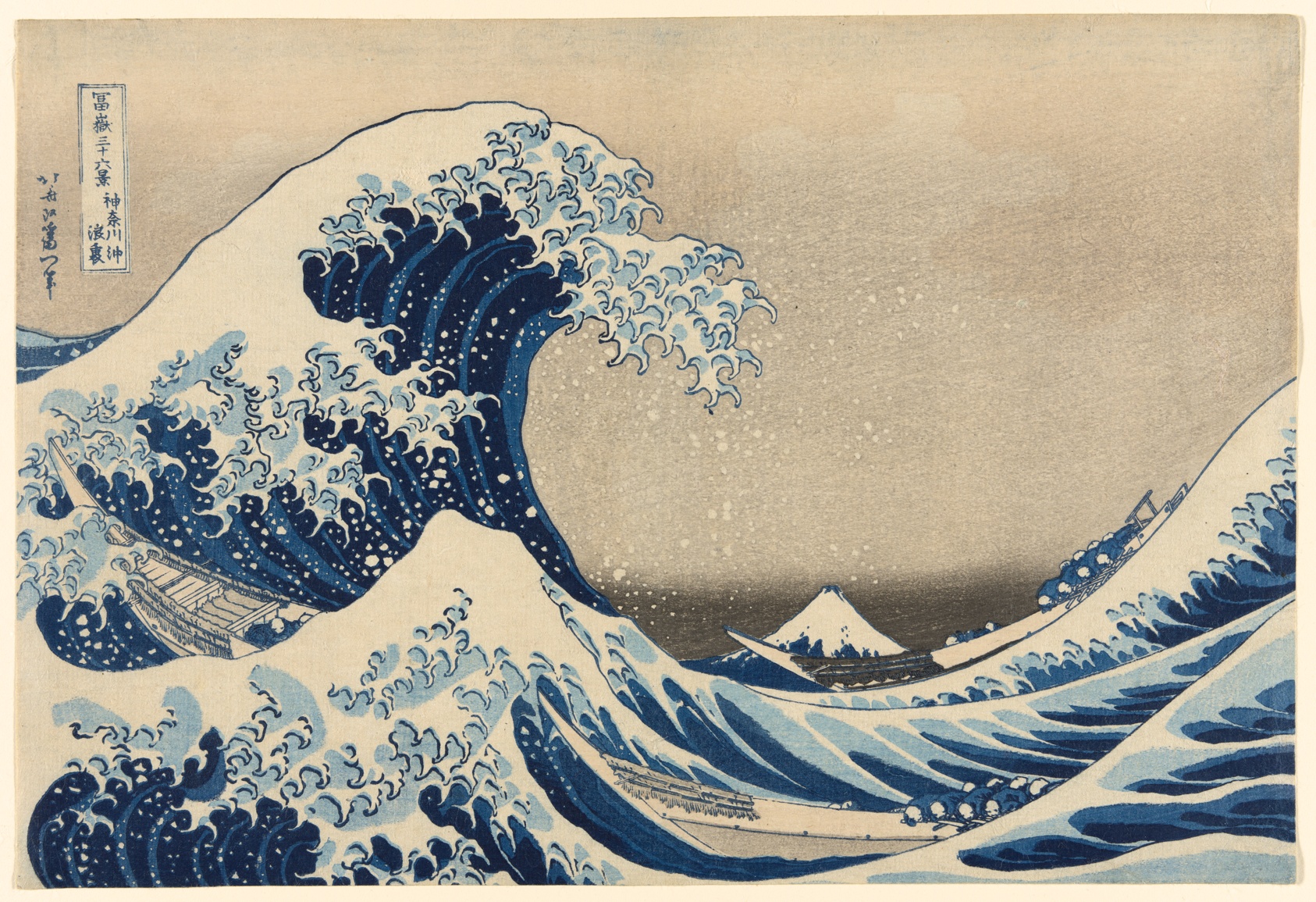
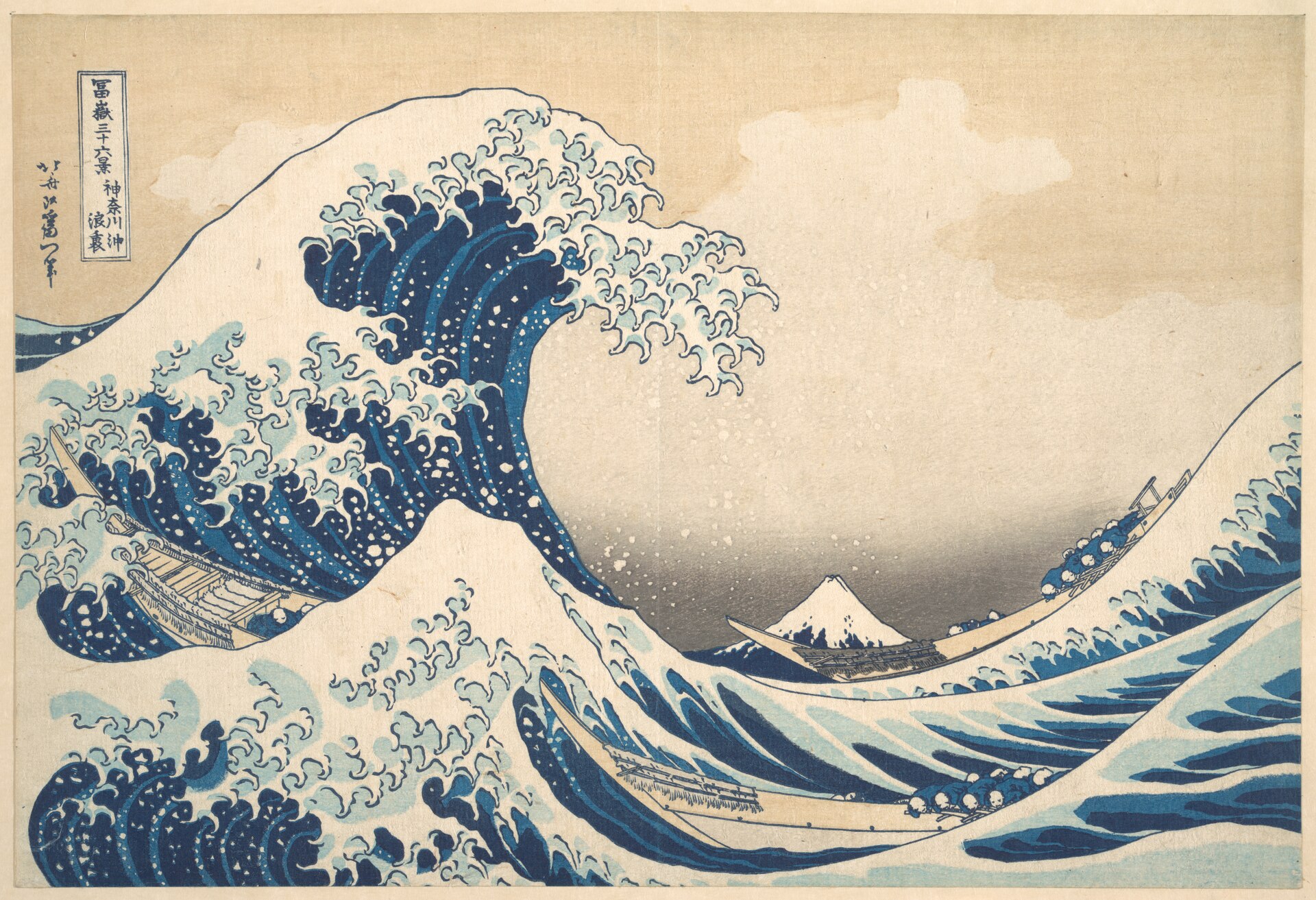
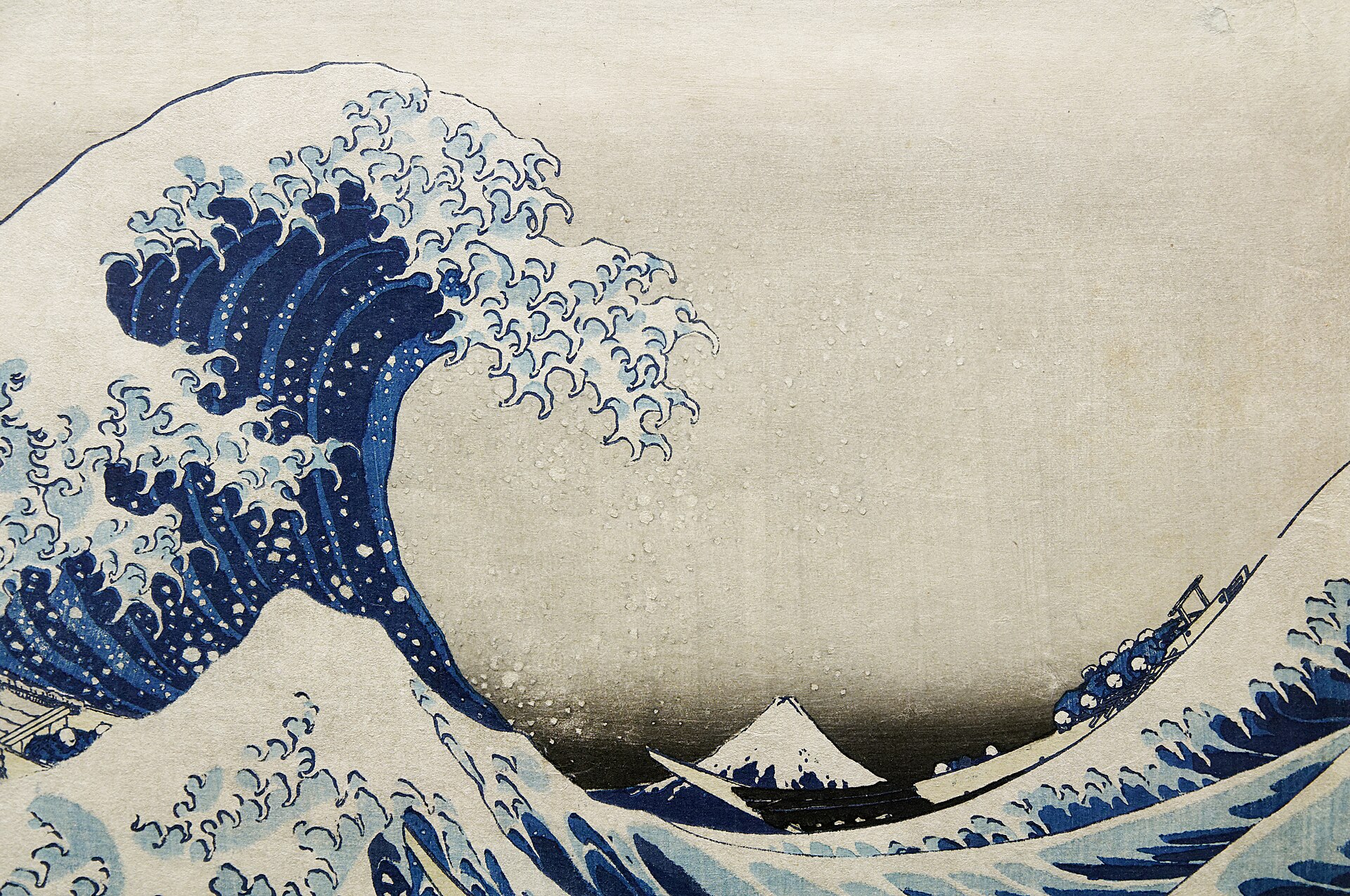
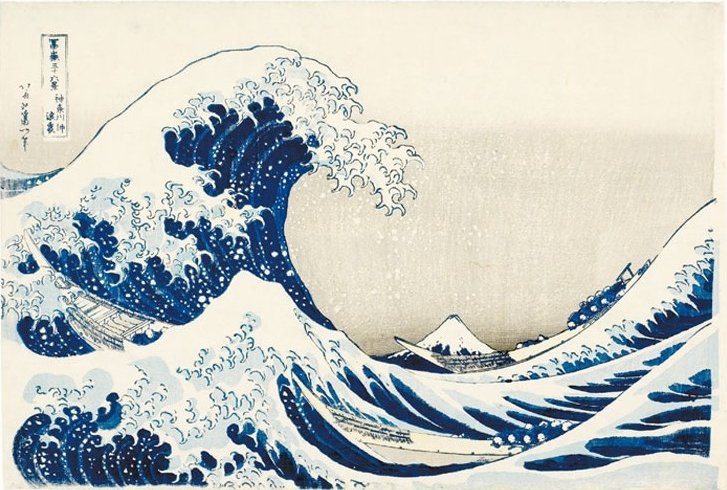
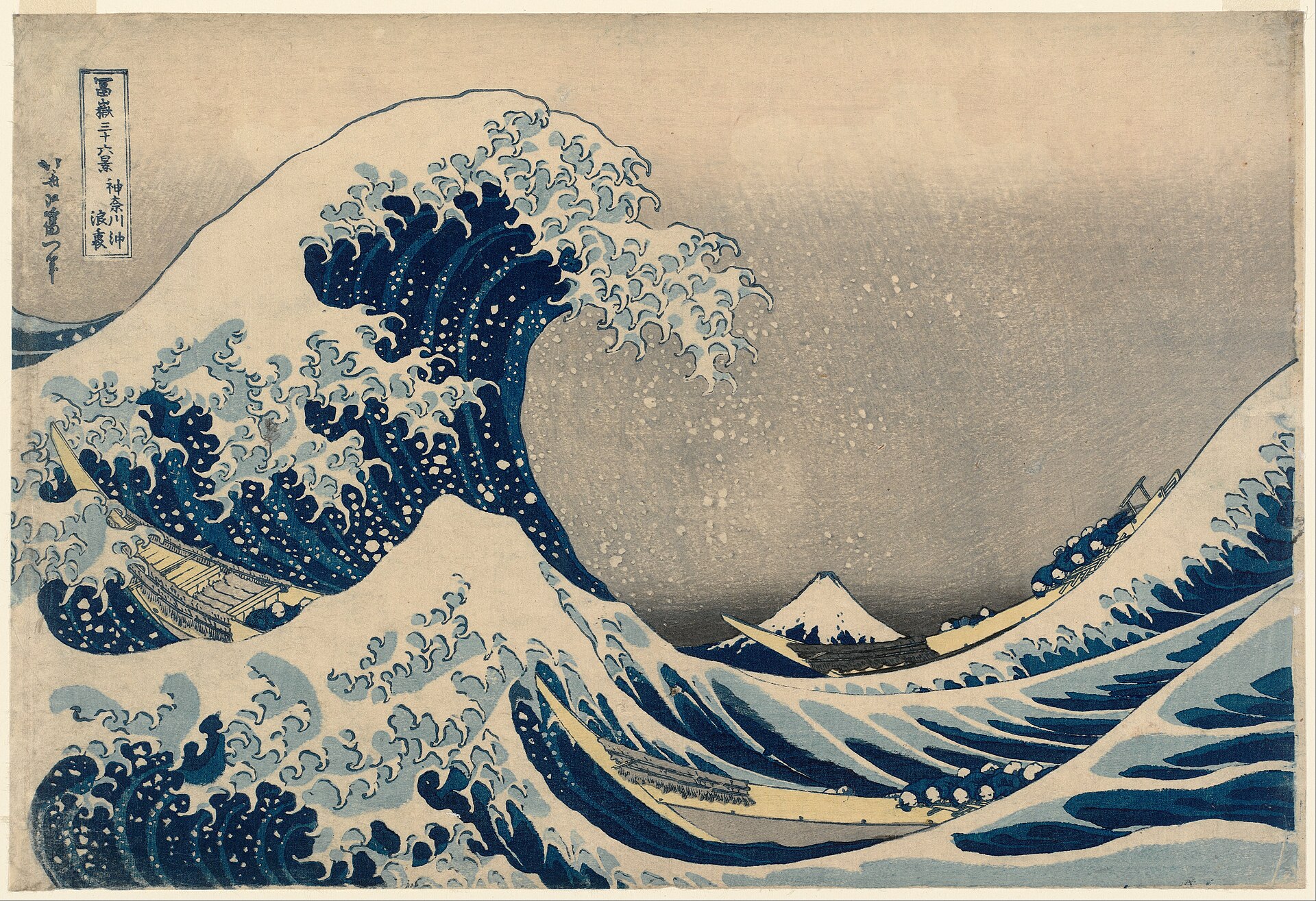
Under the Wave off Kanagawa (Kanagawa oki nami ura), also known as The Great Wave, from the series Thirty-Six Views of Mount Fuji
1830/33 · Colour woodblock print
Art Institute of Chicago
 Japanese · 1760-1849
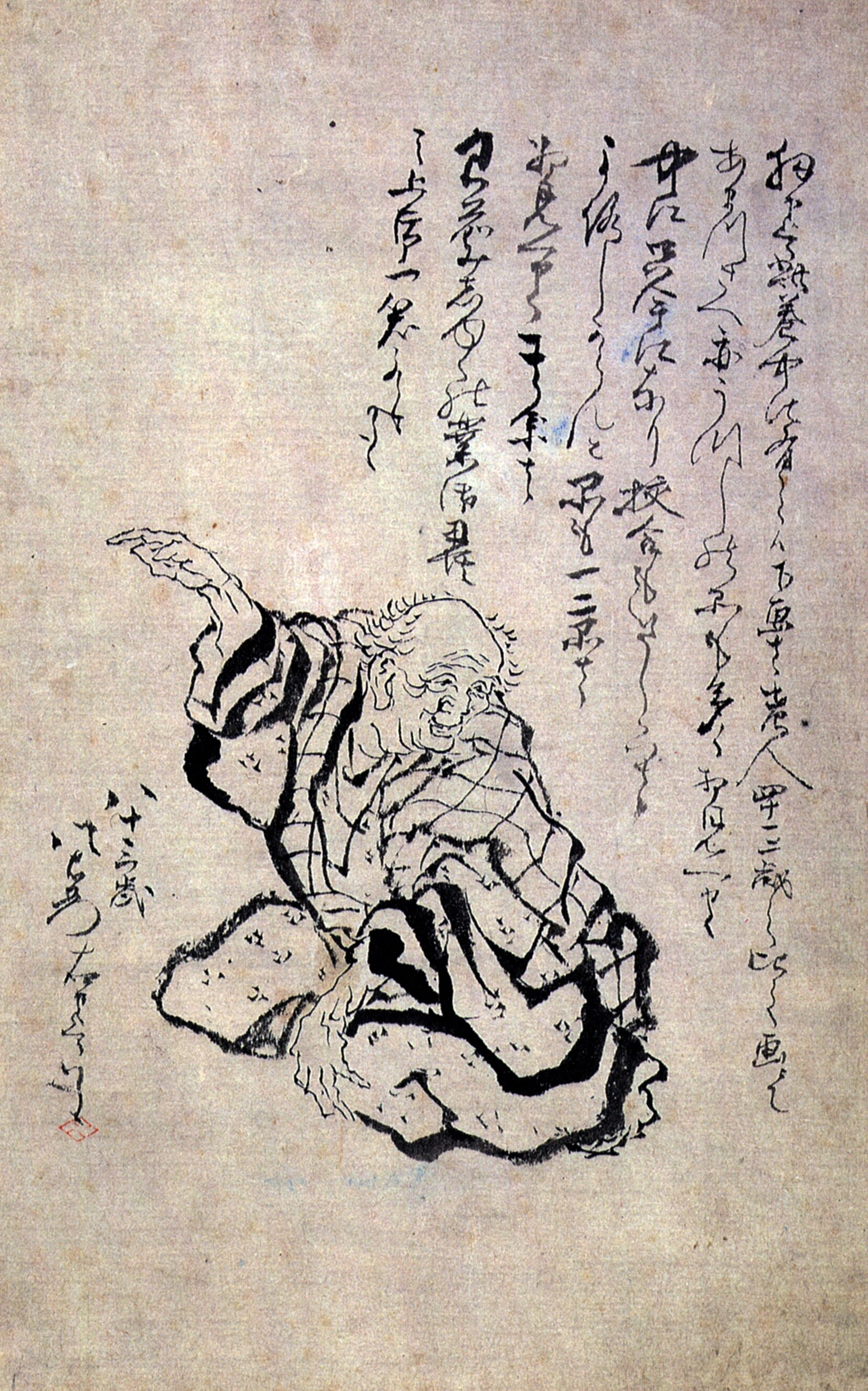
Self-portrait at the age of eighty-three: a brush drawing at the foot of a letter, dated by its own inscription to 1842 and signed off as the eighty-three year old Hachiemon, with the Manji seal. Matthi Forrer, who identifies the recipient as the publisher Kikuya Kosaburo of Edo, places the drawing in the National Museum of Ethnology in Leiden. The letter went with a bundle of sketches Hokusai said he had made at about forty-one or forty-two and called repetitive and immature. The identification of the sitter is secure in the sense that the drawing is inscribed by him as himself; the Commons file record names no holding institution and gives a stock-image site as its source, so the location here rests on Forrer and not on the file. The other and far more widely reproduced likeness, the bent old man with a stick, is a Meiji print of 1900 after a drawing whose attribution is disputed, and it is discussed in the narrative above rather than shown here.
Recorded by Matthi Forrer as the National Museum of Ethnology, Leiden. Wikimedia Commons; licence verified as Public domain from extmetadata.LicenseShortName, Copyrighted flag False| Full name | Born Tokitaro. He signed under more than thirty art names across seventy years, of which Shunro, Sori, Hokusai, Taito... |
|---|---|
| Worked as | Printmaker, Painter, Book illustrator, Designer of surimono |
| Born | 1760, traditionally the 23rd day of the ninth month of... · Katsushika district, on the eastern edge of Edo, now Tokyo |
| Died | 1849, in the fourth month of Kaei 2 · Edo |
| Nationality | Japanese |
| Movement | ukiyo-e, in its late landscape phase |
| In this archive | 2 artworks |
| Sources | 66 cited |
| Last verified | 17 September 2026 |
About this page 2 artworks in the archive · Last verified 17 September 2026 · 66 sources cited
With a woodblock artist the question is never whether the sheet is real. It is which sheet. The Great Wave was printed in the thousands from blocks that broke, wore and were replaced while the run was still going on, and every impression is a different object with a different date, a different condition and a price that can differ from the next one by two orders of magnitude. A collector who asks an auction house whether a Great Wave is genuine has asked the wrong question and will get an answer that is true and useless.
The single most useful document in this field is a census. Capucine Korenberg, a scientist at the British Museum, gathered photographs of 111 surviving original impressions of the design, and by comparing damage to the blocks she reduced Roger Keyes's twenty-one states to eight that occur systematically. Three breaks in the border of the title cartouche, a break near the peak of Mount Fuji and a break in the outline of the wave behind the right-hand boat are the whole of the sequence a specialist can rely on. Everything else Keyes recorded turned out to be inking and pressure rather than damage. Of the 111, seven showed no cartouche damage at all. Sixteen had been retouched. Twenty-six had lost their clouds entirely to light.
The other thing a reader should know before anything else is how easily this design is faked, and how respectable the fakes are. The Library of Congress sheet that has been reproduced in a thousand places, digital identifier jpd.02018, is catalogued by the Library itself as an Adachi modern reprint (Showa), bought in 1938 from the collector H. Irving Olds and classified under woodcut reproductions of 1890 to 1940. The impression Blackburn Museum and Art Gallery held, which Keyes cited as an example of one of his states, is a facsimile. Neither was made to deceive anybody, and both have been treated as originals in print for decades.
And one finding that runs against what the field assumes. Across the last decade, at every auction house reachable for this record, no genuine Edo-period impression of the Great Wave sold below about 160,000 dollars, however badly damaged. Sheets that were trimmed, backed onto paper, faded, wormed, folded, and in one case missing paper from the lower edge and stuck to cardboard made 228,600, 250,000 and 508,000 dollars with premium. The spread between the worst genuine impression and the best is about thirteen to one, not a hundred to one. The real cliff edge is not condition but whether the object is an Edo impression at all: in March 2023 a correctly catalogued framed reproduction made 153 dollars.
1830/33 · Colour woodblock print
Art Institute of Chicago
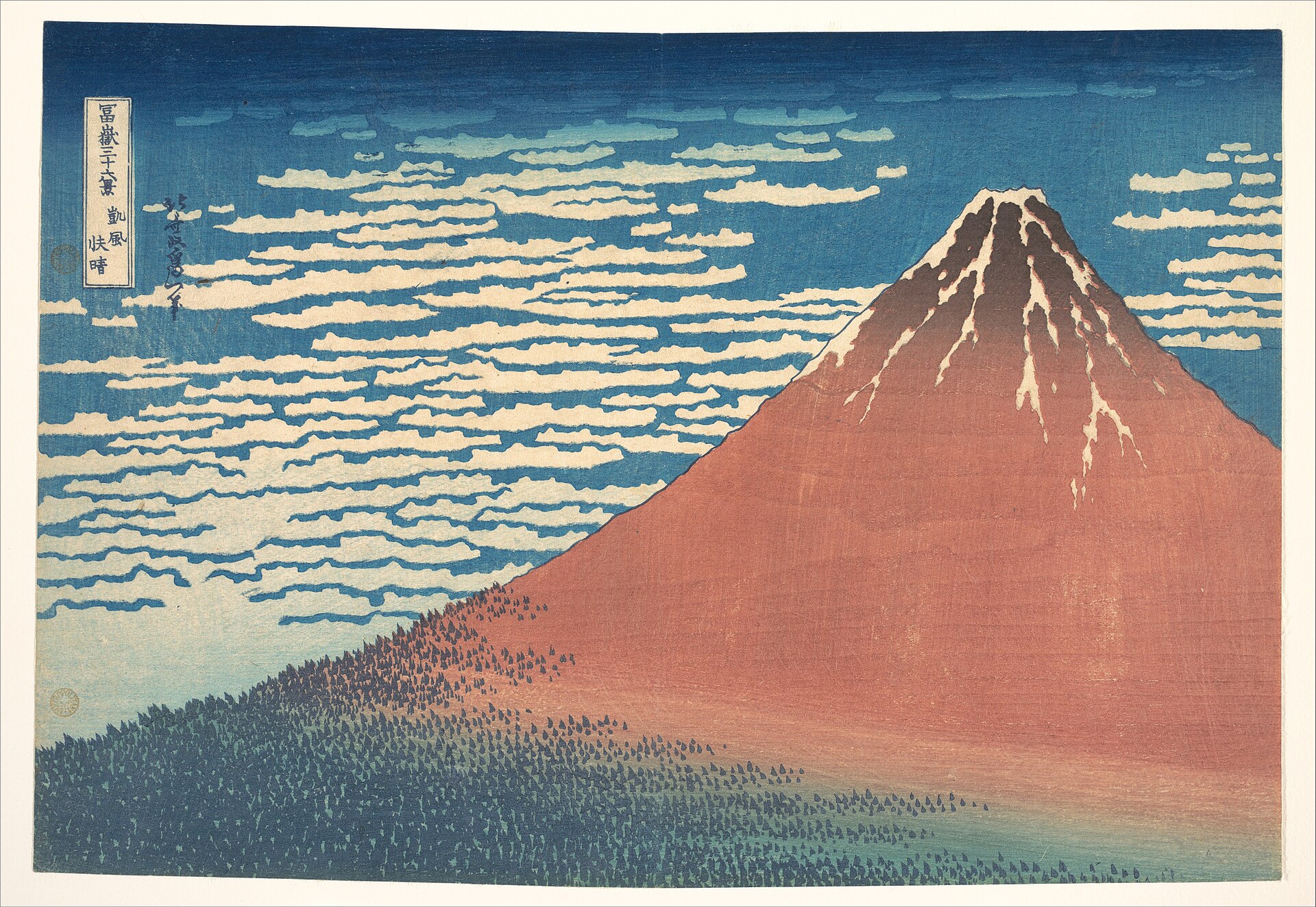
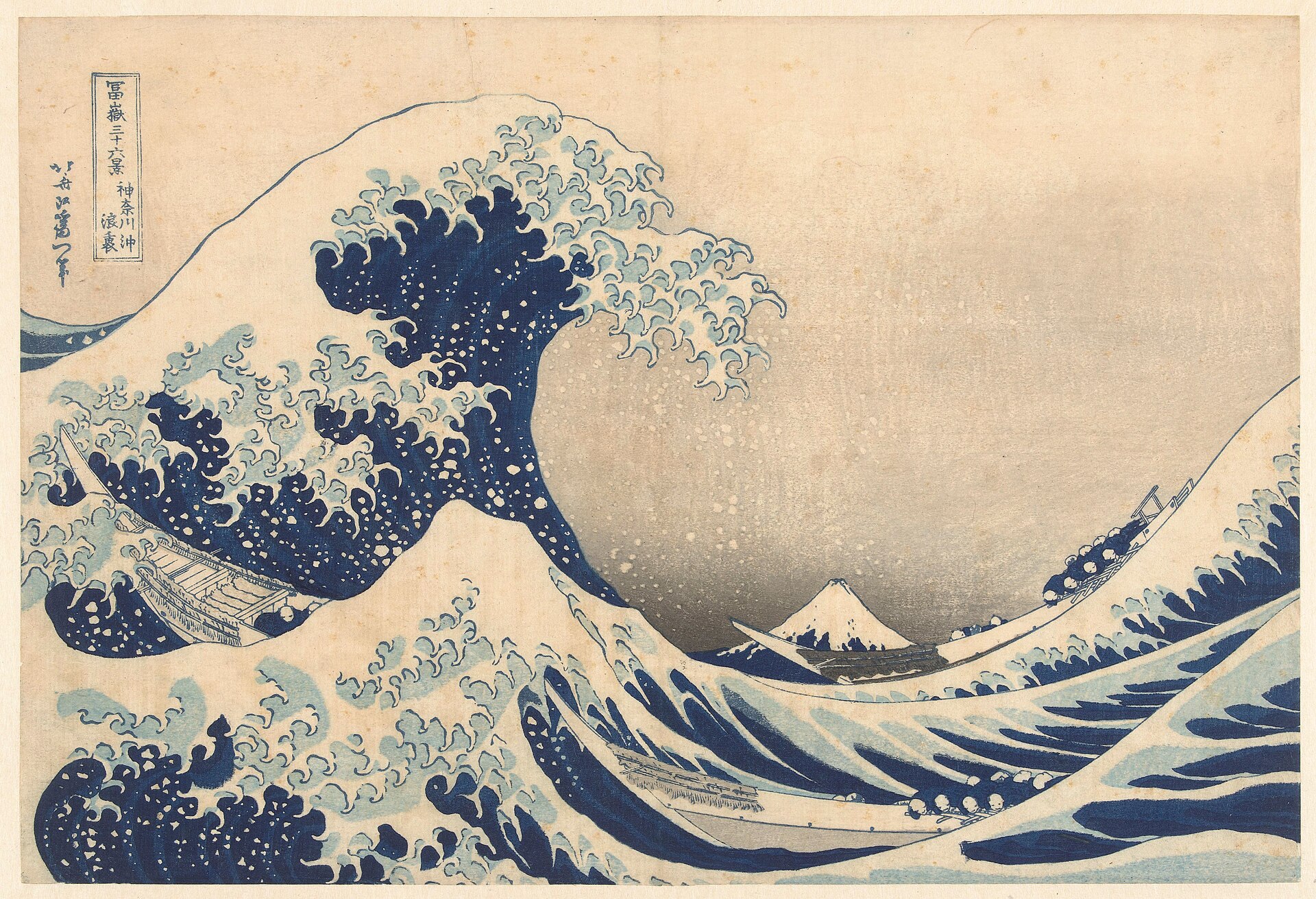
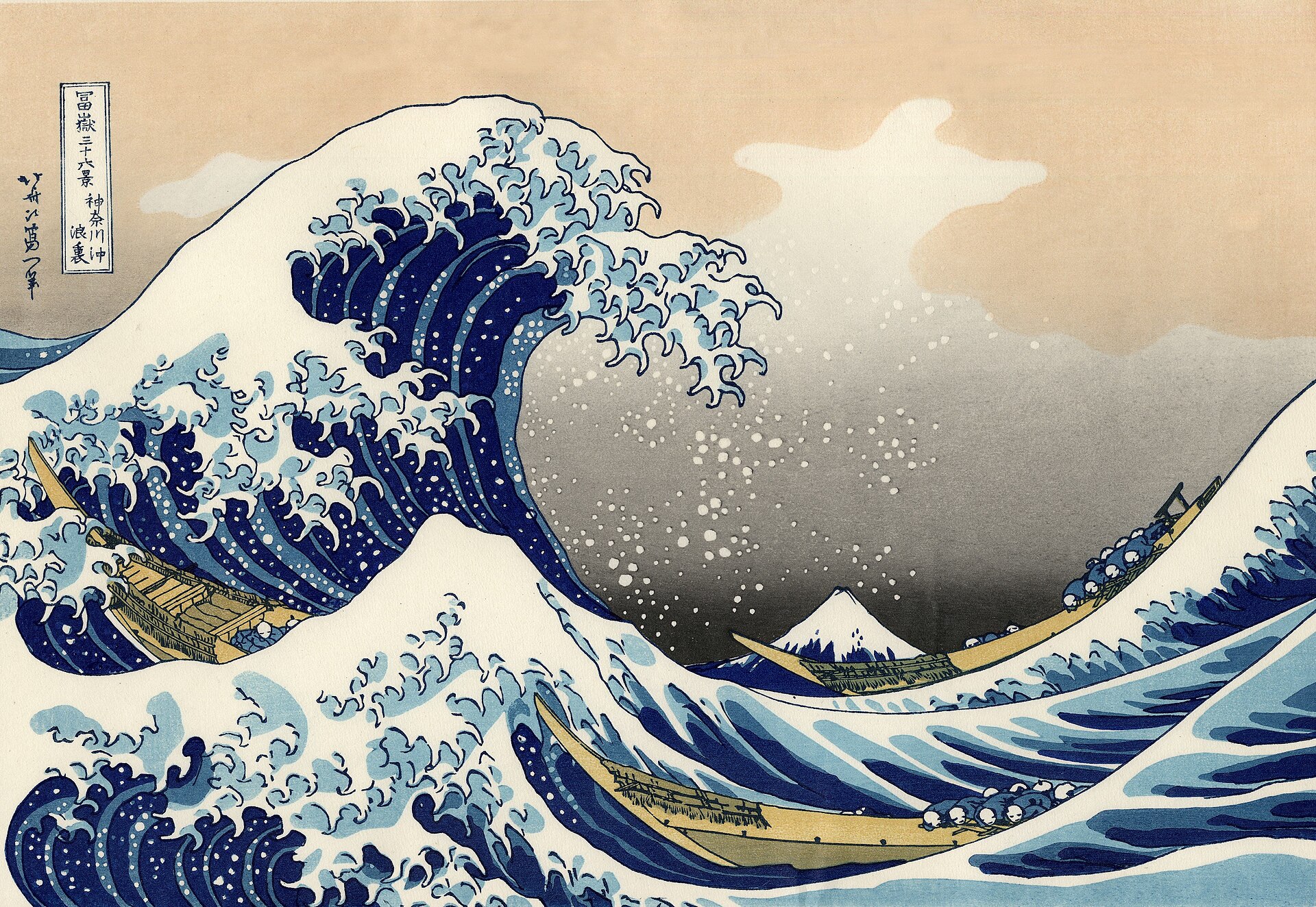
c. 1830-32 · Woodblock print
Metropolitan Museum of Art, New York
Born in the Katsushika district on the eastern edge of Edo, traditionally in the ninth month of Horeki 10.8
Adopted, aged three and for unrecorded reasons, into the household of a hereditary mirror polisher.8
Apprenticed in his early teens to a block-cutter. He learns the craft from the wood before he learns it from the brush.8
Enters the studio of Katsukawa Shunsho at nineteen; the following year begins designing actor prints of his own, signed Shunro.8
Shunsho dies and Hokusai is expelled from the studio shortly afterwards. No reason is recorded.8
Attaches himself to kyoka poetry circles; privately commissioned surimono and illustrated books become his living. Takes the Sori name and is said to study the Rinpa school.8
Transfers the Sori name to a pupil, which was customary practice, and begins signing Hokusai Tokimasa, a name reflecting his faith in Myoken, the Buddhist deity whose realm is the North Star, Hokushin.8
Makes building-sized paintings at large temples and gives a painting performance before the shogun; illustrates the serialised fiction of Kyokutei Bakin.8
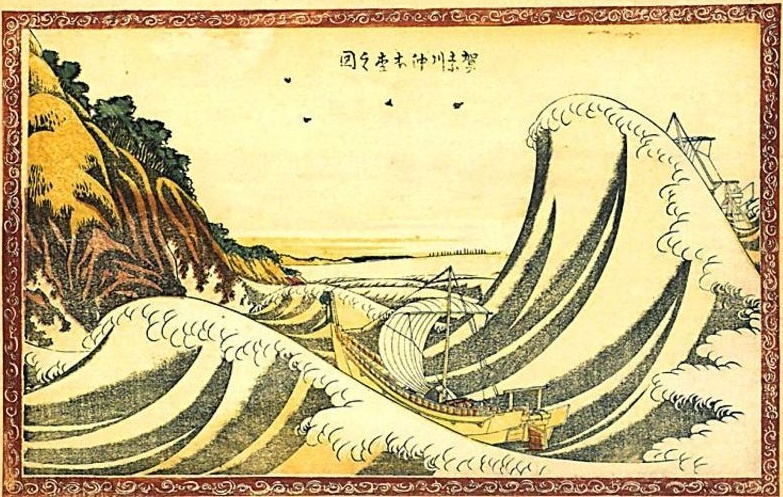
Designs View of Honmoku off Kanagawa, a wave composition with a boat driven under a breaking crest, nearly thirty years before the Great Wave.9
Designs Oshiokuri hato tsusen no zu, a second wave and boat composition that anticipates the Great Wave.10
First uses the name Katsushika Hokusai.8
Adopts the name Taito, which he later passes on; sheets signed Taito are not all his.8
Publishes Ryakuga haya-oshie, basic instruction in sketching, and travels to Nagoya, where Maki Bokusen and others watch him produce hundreds of rapid sketches he calls manga.8
Those Nagoya sketches, compiled by Bokusen and others, become the first volume of the Hokusai manga; fifteen volumes follow, to 1878, with the blocks re-cut and reprinted for decades.8
Turns sixty and takes the name Iitsu, meaning one again, at the turn of the sixty-year calendrical cycle. It is the signature that appears on the Thirty-six Views.8
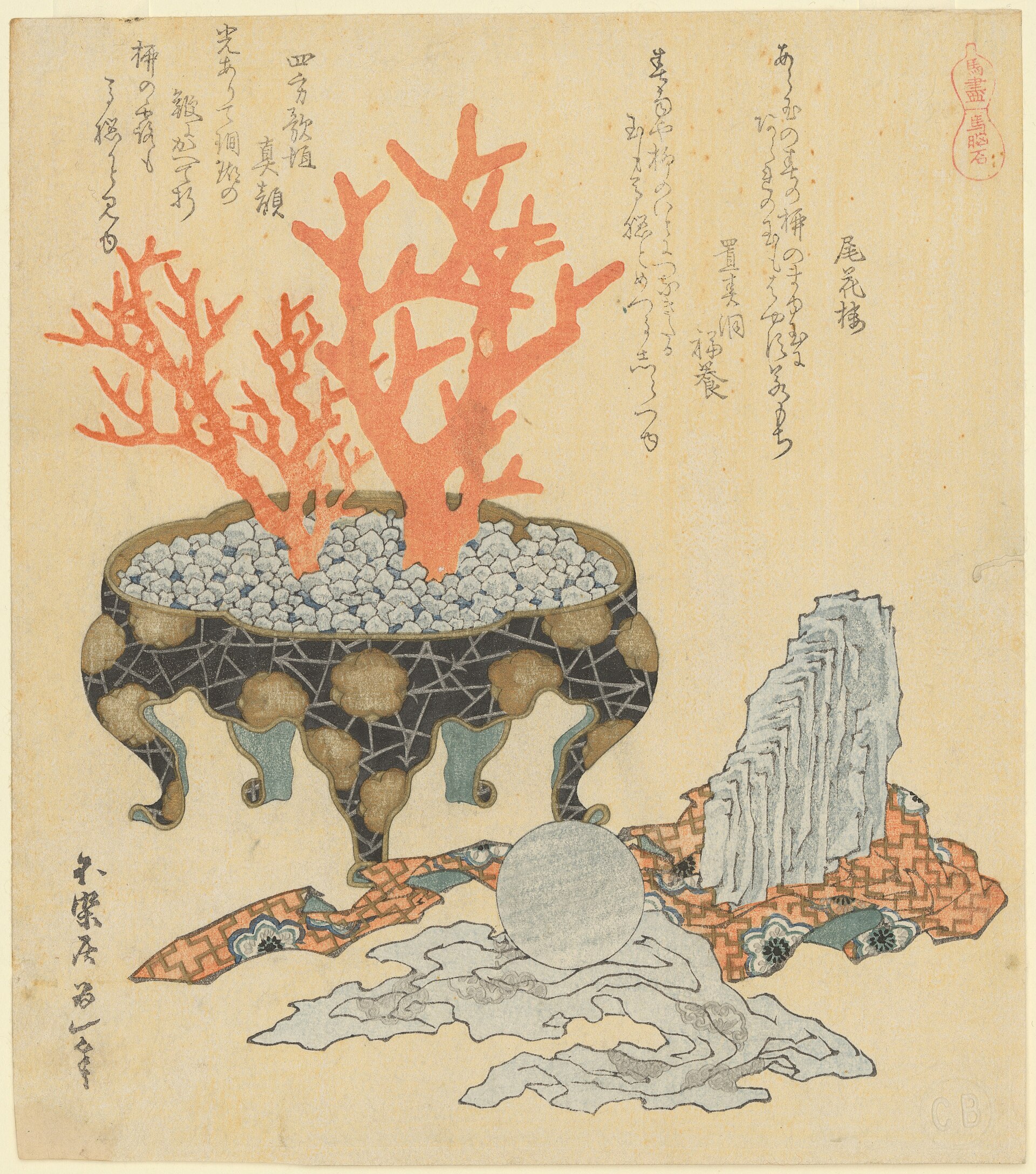
Designs the surimono series All Variety of Horses, privately commissioned and outside the censored commercial system.22
Commissions dry up. A daughter dies, and his second wife; a wayward grandson leaves him with gambling debts; he appears to suffer a stroke. Late in the decade his daughter Oi leaves a failed marriage and returns to work with him.8
Under the Wave off Kanagawa is published by Nishimuraya Yohachi, whose shop name was Eijudo. The British Museum dates it to 1831 and cites Keyes and Morse 2015 for probably late 1831; Sotheby's catalogues it as late 1831.730
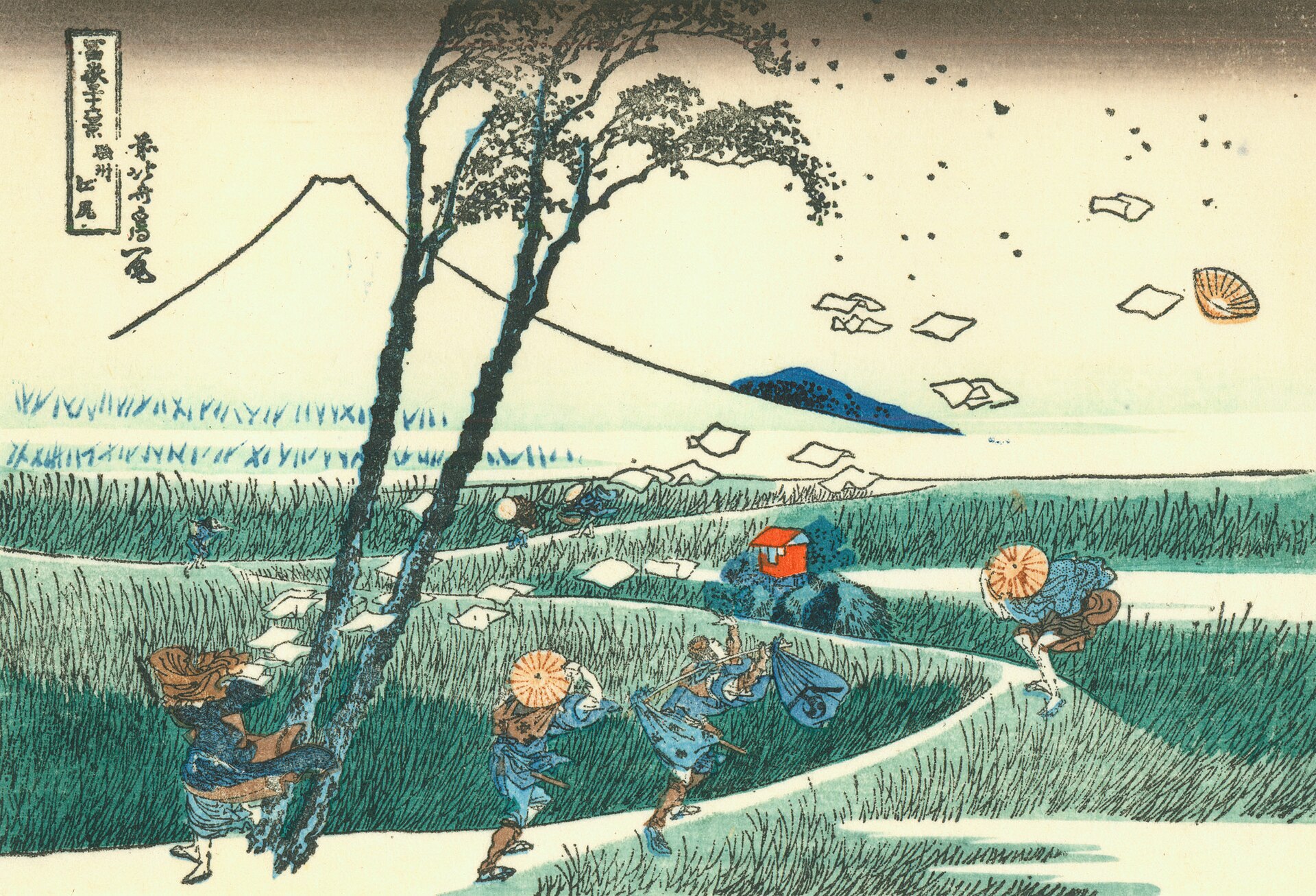
The Thirty-six Views of Mount Fuji appears. Thirty-six designs are published and ten more are added afterwards, so the complete series runs to forty-six sheets.817
Takes the names Manji, everything, and Gakyo rojin, old man crazy to paint.8
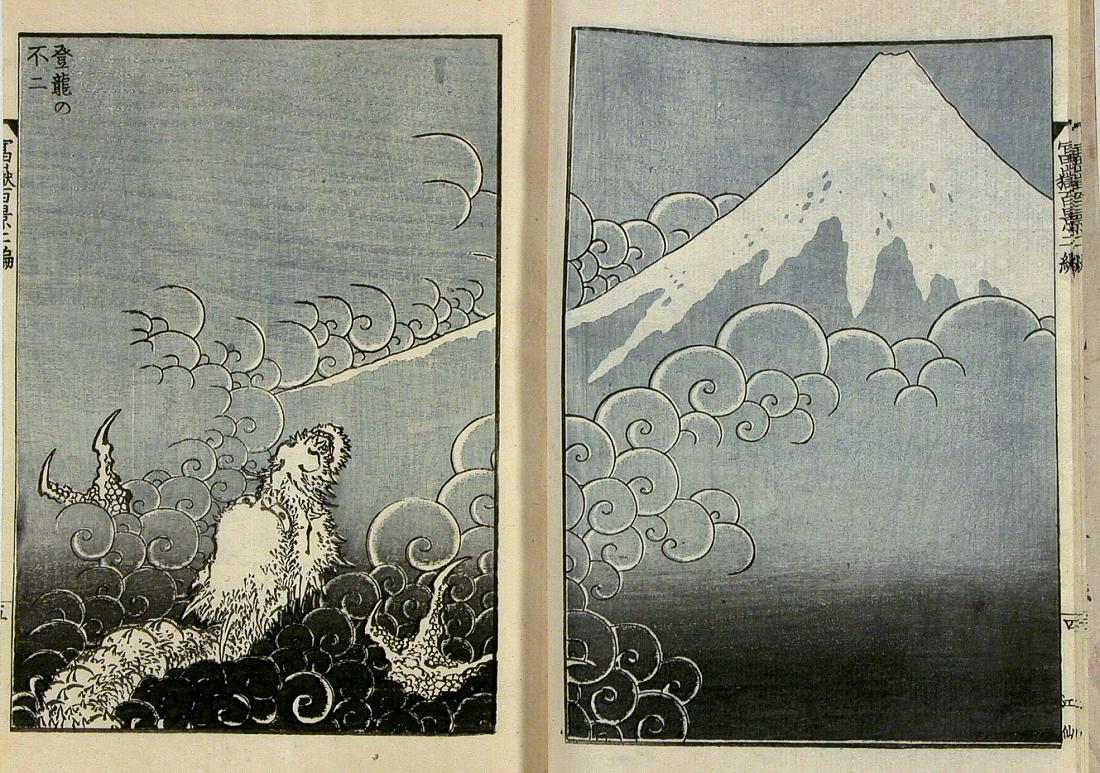
Dragon Ascending Mount Fuji is published in One Hundred Views of Mount Fuji, three volumes.11
A letter records that the publisher Nishimuraya Yohachi was in financial difficulty, in the same decade in which the Great Wave blocks were replaced with markedly cruder ones.1
Draws himself at the foot of a letter to a publisher and signs off as the eighty-three year old Hachiemon, sending with it sketches he says he made at about forty-one or forty-two and calls repetitive and immature.21
Turns increasingly to painting, leaves Edo for at least one extended stay with his patron, the merchant Takai Kozan, in Nagano, and uses a talismanic seal reading Hyaku, one hundred, on the paintings of his last three years.8
A fire in his neighbourhood destroys the majority of his sketches; he and his daughter Oi escape with the clothes they are wearing and a few brushes.45
Dies in Edo on the eighteenth day of the fourth month, in a rented dwelling at Henjoin temple in Asakusa, ninety by traditional and eighty-nine by Western reckoning. About a hundred mourners follow him to Seikyoji.46
Prussian blue becomes available to Japanese publishers at much reduced price from China; the Thirty-six Views is one of the first large-scale ventures to exploit a blue that does not fade.32
William S. and John T. Spaulding give over 6,000 Japanese prints to the Museum of Fine Arts in Boston on the condition that they never be exhibited.53
The painter Charles Hazelwood Shannon bequeaths to the British Museum the impression 1937,0710,0.147, previously owned by Charles Ricketts.32
Alexander von Siebold sells 1,088 Japanese books to the British Library, closing the Dutch channel that had run through Deshima since the 1810s.56
Philippe Burty publishes the first of six articles under the title Japonisme in La Renaissance litteraire et artistique; the series runs to 8 February 1873.57
Vincent van Gogh writes to Theo about Hokusai's lines and drawing, quoting back Theo's description of the waves as claws; the editors of the critical edition identify the print as the Great Wave.51
Iijima Kyoshin publishes Katsushika Hokusai den, the first scholarly biography, compiled from facts, anecdotes and hearsay four decades after the death, and the source of most of what is repeated about the life.45
Edmond de Goncourt publishes Hokousai in Paris, 415 pages, after Hayashi Tadamasa declined to help him out of respect to Siegfried Bing, who had commissioned Iijima's research for a biography of his own.4558
The dealer Kobayashi Bunshichi publishes in Tokyo a woodblock print of Hokusai as an old man leaning on a stick, taken from a drawing in his own collection; it becomes the standard likeness of the artist.1920
Charles Lang Freer buys that print from Kobayashi; it is now Freer Gallery of Art F1904.282. The original drawing is now in the Musee Guimet and its attribution is disputed.1920
The British Museum buys impression 1906,1220,0.533 from the novelist and collector Arthur Morrison.30
Hayashi Tadamasa's Japanese drawings, prints and illustrated books are sold at the Hotel Drouot over five days, with Siegfried Bing named on the title page as the expert.58
Durand et Cie publishes the first edition of Debussy's La Mer with a detail of the Great Wave on the cover, cropped to the wave and omitting Mount Fuji.55
The Metropolitan Museum of Art acquires JP10 on the Rogers Fund; the sheet is later shown to have a retouched cartouche.16
Laurence Binyon catalogues the British Museum sheet as no. 127 in his catalogue of Japanese and Chinese woodcuts in the museum. It is the first entry in this impression's own catalogue history.30
JP1847 enters the Metropolitan with the H. O. Havemeyer bequest.4
JP2569 enters the Metropolitan from the Howard Mansfield Collection, bought with the Rogers Fund; it is a state 1 impression.15
The Library of Congress buys from H. Irving Olds the sheet now numbered jpd.02018, which its own catalogue records as an Adachi modern reprint of the Showa era.2
JP2972 enters the Metropolitan with the bequest of Henry L. Phillips; it is a state 6 impression with retouched clouds.128
The Rijksmuseum acquires RP-P-1956-733, a state 3 impression.118
James A. Michener gives the Honolulu Museum of Art the impression 13695, part of a run of gifts between 1950 and 1991 that make up about half of a collection now above 12,400 prints.54
The British Museum impression is exhibited at the Royal Academy in The Great Japan Exhibition: Art of the Edo Period 1600-1868, as no. 118.30
Matthi Forrer publishes his own five-stage account of the print's deterioration, four stages of which correspond to states defined by Keyes.1
Roger S. Keyes and Peter Morse complete the catalogue raisonne of the single-sheet colour woodblock prints, begun in 1972; it is published as a database by the Art Research Center at Ritsumeikan University.23
The British Museum sheet is treated by conservation on 26 January and lent to Abu Dhabi for Treasures of the World's Cultures, 18 April to 17 July.30
The same sheet is remounted on 10 January and lent to the Hong Kong Heritage Museum for A History of the World in 100 Objects, 15 May to 9 September.30
The British Museum and the Abeno Harukas Art Museum in Osaka show Hokusai: beyond the Great Wave, curated by Timothy Clark, from an Arts and Humanities Research Council project run with SOAS between April 2016 and March 2019. Clark's accompanying book is the source of the figure of up to 8,000 impressions that the later census cites.45
Capucine Korenberg publishes the census of 111 impressions and reduces Keyes's twenty-one states to eight.1
The British Museum opens Hokusai: The Great Picture Book of Everything, built around 103 rediscovered block-ready drawings for an unpublished picture encyclopedia; it runs to 30 January 2022.830
An impression makes 1,110,000 dollars with premium at Christie's New York, the first seven-figure result for the design.40
An impression makes 1.59 million dollars at Christie's, New York, a record for the artist at that date.12
An impression estimated at 500,000 to 700,000 dollars makes 2.76 million dollars at Christie's, New York, against six bidders.1213
A complete set of forty-six prints of the Thirty-six Views makes 3,559,000 dollars with premium at Christie's New York, a new record for the artist.35
Two further impressions come to light after the census closed, taking the located total to at least 113.14
The Bank of Japan issues a new 1,000 yen note carrying the Great Wave on the reverse, replacing a note that carried a photograph of Mount Fuji.27
An impression from the Okada Museum of Art makes 21.7 million Hong Kong dollars at Sotheby's Hong Kong in a sale held to settle its founder's legal bill.15
Start with the finding that contradicts the field's own assumption. Across 2015 to 2026, at every house reachable for this record, no genuine Edo-period impression of the Great Wave sold below about 160,000 dollars, however badly damaged. Sheets that were trimmed, backed onto paper, faded, wormed, folded, soiled and in one case missing paper from the lower edge and stuck to cardboard made 228,600, 250,000 and 508,000 dollars. The spread between the worst genuine impression and the best is roughly thirteen to one. It is not the hundred to one the trade assumes, and a seller who has been told their damaged sheet is worthless has been told something false.
The actual floor of this market is a reproduction. Bonhams Skinner sold one in March 2023, correctly catalogued as a framed reproduction, for 153 dollars. That is the real cliff edge: not condition, but whether the object is an Edo impression at all. Everything else is a difference of degree.
Above the floor it is a market in condition, not in rarity. Around a hundred and thirty impressions are now thought to survive, the figure Sotheby's put in its own catalogue note in 2025. One house sold seventeen of them between 2017 and 2025, from 162,500 dollars to 2,760,000. None of those seventeen catalogue entries states an edition or a state. The price is carried by the condition report, which for the live sales sits behind a login, and by whether the house wrote a lot essay at all. The 2.76 million dollar sheet has a long essay ranking it among the twenty or so best surviving. A sheet that made 252,000 dollars in March 2025 has none.
Hammer and premium. Christie's and Sotheby's publish only the premium-inclusive price for these lots, and Christie's states on its own sale pages that estimates exclude the buyer's premium and that sale totals are hammer plus premium. Every figure below is therefore the price WITH premium unless it says otherwise, and the hammer is recorded as not published. Where a reconstruction is given in a note it is arithmetic against the house's own published premium schedule, clearly labelled, and never presented as a house figure. The method can be checked on the one lot in this group with a published hammer: applying Sotheby's Hong Kong schedule to the stated HK$45,000,000 on the Utamaro reproduces Sotheby's published HK$55,275,000 exactly.
| Date | Sale | Work | Result | Note |
|---|---|---|---|---|
| 21 March 2023 | Christie's, New York, Japanese and Korean Art, sale 21618, lot 122 | Under the Wave off Kanagawa, signed Hokusai aratame Iitsu hitsu, published Nishimuraya Yohachi (Eijudo), horizontal oban 25.1 by 37.1 cm | Hammer not published With premium USD 2,760,000 USD | Christie's publishes only the premium-inclusive figure for this lot; inverting its published premium schedule for the date gives about USD 2,250,000, which is a reconstruction and not a house figure. Estimate USD 500,000 to 700,000; six bidders. Property from a private European collection, the whole published provenance being that it was acquired by the family of the current owner in the early 1900s and thence by descent. Exhibited at the Ny Carlsberg Glyptotek, Copenhagen, 2 June to 31 August 1993, and catalogued there as no. 8. The catalogue ranks it beyond doubt among the twenty or so best impressions surviving today, notes a pink cloud still visible in the sky, and states that there are no breaks in the title cartouche. The sale of nearly 200 lots made about 11.4 million dollars. |
| 22 November 2025 | Sotheby's Hong Kong, Masterpieces of Asian Art from the Okada Museum of Art, sale HK1632, lot 1012 | Under the Wave off Kanagawa, blue outline, circa 1831-33, horizontal oban 26.3 by 38.1 cm, from the Okada Museum of Art, Hakone | Hammer not published With premium HKD 21,720,000, about USD 2,790,000 HKD | The hammer is not published; inverting Sotheby's Hong Kong schedule gives about HKD 17,500,000, a reconstruction and not a house figure. Estimate HKD 5,000,000 to 8,000,000, so roughly three times the high estimate, after more than twenty bids in an eight-minute contest, to a Japanese collector. The catalogue note states that about 8,000 impressions were printed and that the known number extant today is thought to be around 130. Part of a white-glove sale of 125 works totalling HK$688 million, about 88 million dollars. The consignment was made by an agent of court-appointed receivers over the shares of Okada Fine Art Limited so that the museum's founder Kazuo Okada could settle a legal bill of about 50 million dollars, awarded in binding arbitration to the law firm Bartlit Beck and arising from his long feud with Steve Wynn. |
| 19 March 2024 | Christie's, New York, Japanese and Korean Art, sale 22643, lot 135 | A complete set of the Thirty-six Views of Mount Fuji, forty-six sheets, published Nishimuraya Yohachi (Eijudo), c. 1830-34 | Hammer not published by the house; USD 2,900,000 reported by the trade press and reconciling exactly to the published total With premium USD 3,559,000 USD | Estimate USD 3,000,000 to 5,000,000. Property of the Dr Jitendra V. Singh Charitable Remainder Unitrust. The record for the artist at auction, breaking the single-sheet record set at Christie's the year before, and the clearest demonstration that the series is worth more assembled than dispersed: forty-six sheets at an average of about 77,000 dollars each. No provenance, literature or exhibition history was published. Sale total USD 6,662,254. |
| 16 March 2021 | Christie's, New York, Japanese and Korean Art, sale 19824, lot 144 | Under the Wave off Kanagawa, late 1831, horizontal oban 26 by 38.4 cm | Hammer not published With premium USD 1,590,000 USD | The hammer is not published; the schedule gives about USD 1,300,000 as a reconstruction. Estimate USD 150,000 to 200,000, so about ten times the low estimate, and the record for the artist until 2023. No provenance, literature or exhibition history was published for this lot at all, which is worth setting beside the 2023 sheet, where a hundred-year family descent and a Copenhagen exhibition were. Lot 138 in the same sale, a second Great Wave, made USD 437,500 against an estimate of USD 120,000 to 180,000. Sale total about 9.7 million dollars across 187 lots. |
| 7 November 2019 | Christie's, New York, online-only sale 17657, lot 47 | Under the Wave off Kanagawa | Hammer not published With premium USD 250,000 USD | Estimate USD 100,000 to 150,000. Christie's online-only sales are the one venue in this group that publishes a full condition report, and this one reads: lightly trimmed, soiled, toned, faded, especially the yellow and pink colours, with a centre fold and a pinhole. A sheet described in those terms still made a quarter of a million dollars. |
| 25 September 2025 | Christie's, New York, online-only sale 23499, lot 180 | Under the Wave off Kanagawa | Hammer not published With premium USD 508,000 USD | Estimate USD 50,000 to 70,000, so about ten times the low estimate. The published condition report records toning, trimming, soiling, abrasion, backing with a thin sheet of paper, retouched wormholes and paper loss. Backing and paper loss are the two defects a print specialist would normally call disqualifying. It made half a million dollars. |
| 31 March 2026 | Christie's, New York, online-only sale 24872, lot 23 | Under the Wave off Kanagawa | Hammer not published With premium USD 228,600 USD | Estimate USD 40,000 to 60,000. The condition report records an area of missing paper on the lower edge, and the sheet is affixed to cardboard. The most recent result in this record and the clearest statement of where the floor for a genuine Edo impression sits. |
| 2023-03 | Bonhams Skinner | Framed Reproduction of Hokusai's Great Wave, catalogued as a reproduction | Hammer not published With premium USD 153 USD | Recorded because it is the actual floor of this market and it is not a Hokusai. The distance between this lot and the 2,760,000 dollar sheet is the distance between a picture and an object. Anyone valuing an inherited Great Wave should establish which of the two they have before reading any other figure on this page. |
| 22 September 2020 | Christie's, New York, sale 19017, lot 117 | Under the Wave off Kanagawa | Hammer not published With premium USD 1,110,000 USD | Estimate USD 150,000 to 250,000. The first seven-figure result for the design and the point from which the run of records begins. |
| 25 April 2017 | Christie's, New York, sale 13641, lot 19 | Under the Wave off Kanagawa | Hammer not published With premium USD 379,500 USD | Estimate USD 15,000 to 20,000. The estimate is the interesting number: eight years before the design made 2.76 million dollars, a house was prepared to put fifteen thousand on one. |
| 19 March 2019 | Christie's, New York, sale 17148, lots 242 and 246 | Two impressions of Under the Wave off Kanagawa in one sale: lot 242, sheet 24.8 by 38.1 cm, and lot 246, sheet 25.7 by 38.1 cm, the latter from the collection of Drs Seymour and Sylvia Fried | Hammer not published for either lot With premium USD 162,500 for lot 242 and USD 471,000 for lot 246 USD | Estimated USD 40,000 to 60,000 and USD 200,000 to 300,000 respectively. Two sheets of one design, in one room, on one afternoon, at a ratio of nearly three to one, and the cheaper one is the smaller sheet by nearly a centimetre in height. This is the clearest single illustration in the whole record of what condition and margins are worth, and it needs no argument because the variables of date, venue and market are held constant. |
| 18 March 2025 | Christie's, New York, sale 23492, lots 225 and 230 | Two impressions of Under the Wave off Kanagawa in one sale | Hammer not published With premium USD 252,000 and USD 882,000 USD | Estimated USD 60,000 to 80,000 and USD 400,000 to 600,000. Lot 225 carries no catalogue essay and a provenance reading only that it was acquired in Munich in the 1920s and thence by descent. Lot 230 made three and a half times as much on the same day. |
| 14 June 2023 | Christie's, Paris, Art d'Asie, sale 22151, lot 100 | Under the Wave off Kanagawa | Hammer not published With premium EUR 882,000 EUR | Estimate EUR 200,000 to 300,000. Recorded because it is the only result in this group in euros; conversions are derived and date-dependent and none is made here. |
| 22 November 2025 | Sotheby's Hong Kong, sale HK1632, lot 1026 | Kitagawa Utamaro, Fukagawa in Snow, hanging scroll, ink, colour and gofun on paper, circa 1802-06, 198.8 by 341.1 cm; NOT by Hokusai | Hammer HKD 45,000,000 (published) With premium HKD 55,275,000, about USD 7,100,000 HKD | Included because it is the one lot in this group with a published hammer, which is what allows the premium schedule to be tested and the Hokusai hammers to be reconstructed. Estimate HKD 6,000,000 to 8,000,000. Sotheby's calls it a record for Utamaro and the most valuable ukiyo-e painting ever sold at auction. Its published provenance runs from Kamaya Zenno Ihe of Tochigi, who died in 1824, through Samuel Siegfried Bing in Paris in the late 1880s, to Takeo Nagase in Tokyo in 1939 and a Japanese private collection. That is what a documented ukiyo-e chain looks like, and it is the exception. |
| 16 September 2025 | Christie's, New York, sale 23495, lot 112 | Standing Beauty, hanging scroll, ink, gold and colour on paper, signed Katsushika Hokusai, sealed Kimo dasoku, 98.1 by 26 cm | Hammer not published; 27 per cent inverts to USD 350,000 exactly, which is a reconstruction With premium USD 444,500 USD | Estimate USD 100,000 to 150,000. Sold with a double wood box authenticated by Fujikake Shizuya on 3 October 1928, which is the kind of documentation a Hokusai painting has instead of a catalogue raisonne number. |
| 17 September 2024 | Christie's, New York, sale 23151, lot 218 | Swimming Carp, hanging scroll, signed at the age of eighty-one | Hammer not published With premium USD 655,200 USD | Estimate USD 250,000 to 300,000. A late painting with an age signature, which is the closest thing to internal dating evidence the painted work offers. |
| 22 March 2022 | Christie's, New York, sale 20621, lot 153 | Denshin kaishu Hokusai Manga, the complete fifteen volumes, published Eirakuya Toshiro, c. 1814-1878 | Hammer not published With premium USD 19,000 USD | Estimate USD 20,000 to 30,000. It sold BELOW its low estimate. A complete run of the most influential Japanese book in the West made less than one seventieth of a single sheet from the Fuji series in the same period, because the volumes are late printings from re-cut blocks and everybody in the room knew it. |
| 22 September 2021 | Bonhams, New York, Fine Japanese and Korean Art including the Crawford Collection of Surimono | Twenty-six Hokusai surimono, including lot 809, a monkey riding a tortoise, signed Onajimi oyaji Katsushika Iitsu hitsu | Hammer not published With premium USD 1,530 to USD 37,812.50 across the twenty-six lots USD | Bonhams publishes the inclusive figure and does not display estimates on sold lots. The range is the point: the finest printing of the period, in editions of a few dozen, trades for less than a common commercial sheet of the Great Wave. Rarity is not what this market pays for. |
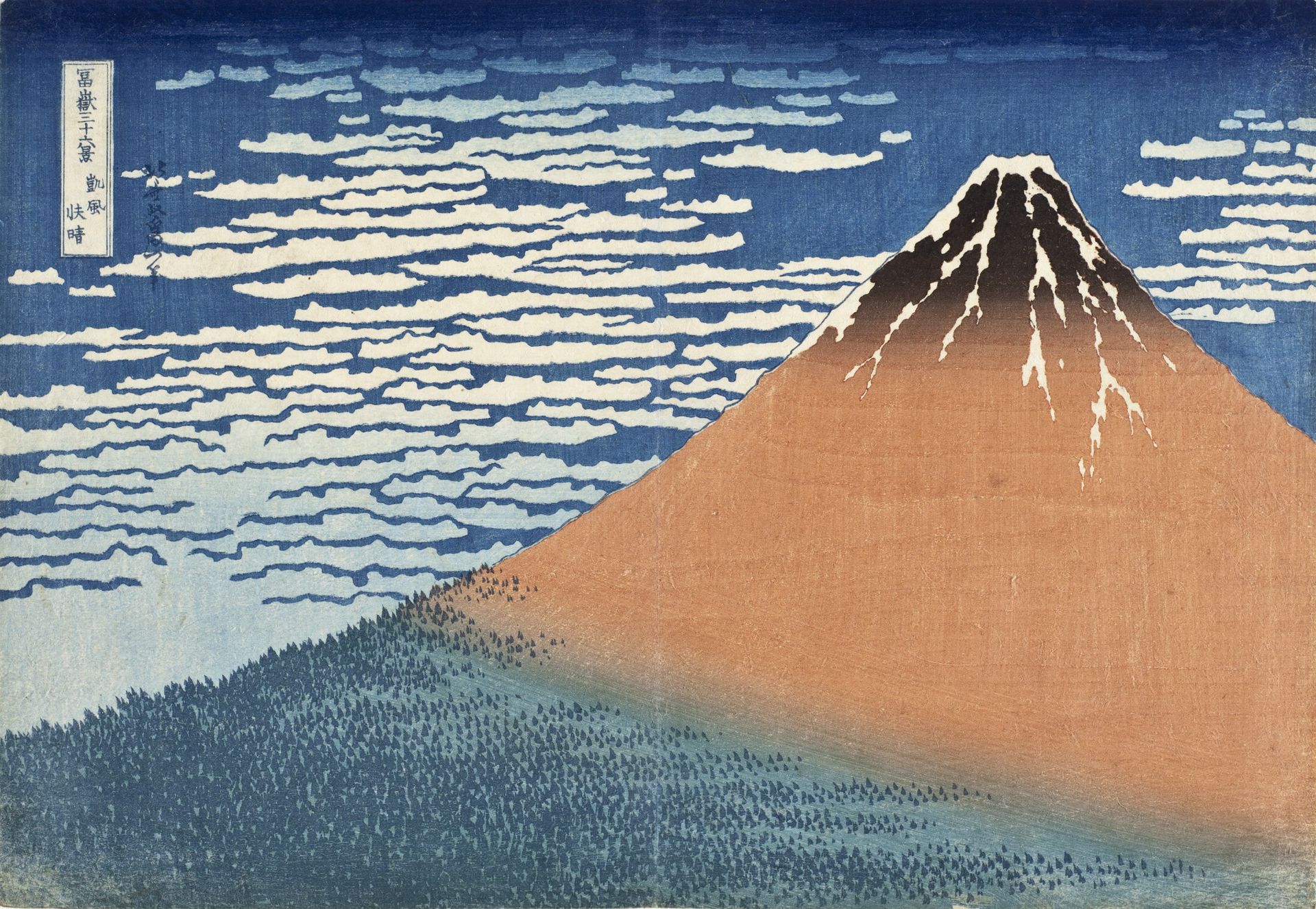
| 2019 | Christie's, New York, and Sotheby's Hong Kong | Gaifu kaisei, Red Fuji, and Sanka hakuu, Black Fuji, other designs from the same series | Hammer not published With premium Red Fuji USD 507,000 (2019), USD 337,500 (2020), USD 250,000 (2021), USD 252,000 (2022 and 2025); Black Fuji USD 550,000 (2021), USD 214,200 (2024) USD | Recorded to correct a piece of trade lore. It is often said that Red Fuji is scarcer and dearer than the Great Wave. No result found here supports that. In the Okada sale of November 2025, Red Fuji made HK$5,715,000, BELOW Black Fuji at HK$7,112,000, and about a quarter of the Great Wave at HK$21.72 million. Christie's own statement, that most connoisseurs find Red Fuji the centrepiece of the series, is an aesthetic judgement and not a price claim. |
Hammer is the price at which the bidding stopped; with premium adds the fee the house charges the buyer on top. Hammer price and buyer's premium in the glossary.
| Institution | City | Holdings | Note |
|---|---|---|---|
| Museum of Fine Arts | Boston | Seven impressions of the Great Wave, the largest single group anywhere, including 21.6765 from the William S. and John T. Spaulding Collection and 21.6764, a state 8 sheet with the brownish pink boats. | Two of the Boston sheets, 34.317 and 21.6765, are among the sixteen impressions the British Museum census identified as retouched. Works on paper; not permanently on view. |
| Metropolitan Museum of Art | New York | Four impressions, confirmed against the museum's own collection: JP1847 (H. O. Havemeyer Collection, bequest of Mrs H. O. Havemeyer, 1929, 25.7 by 37.9 cm), JP2569 (Howard Mansfield Collection, Rogers Fund, 1936, 25.4 by 38.1 cm), JP10 (Rogers Fund, 1914, 24.4 by 35.7 cm) and JP2972 (Henry L. Phillips Collection, bequest of Henry L. Phillips, 1939, 25.1 by 37.8 cm). | JP1847 and JP2569 are state 1. JP10's cartouche was filled in and the retouching was confirmed under a magnifier at the museum. JP2972 is state 6 with retouched clouds whose shape does not match the design. The four sheets range from 24.4 to 25.7 cm high and 35.7 to 38.1 cm wide, which is trimming, not printing, and it is the cheapest available demonstration that margins are a variable. The Met also holds JP2565, an impression of Ushibori in Hitachi Province, which shows how differently other designs in the same series were coloured. |
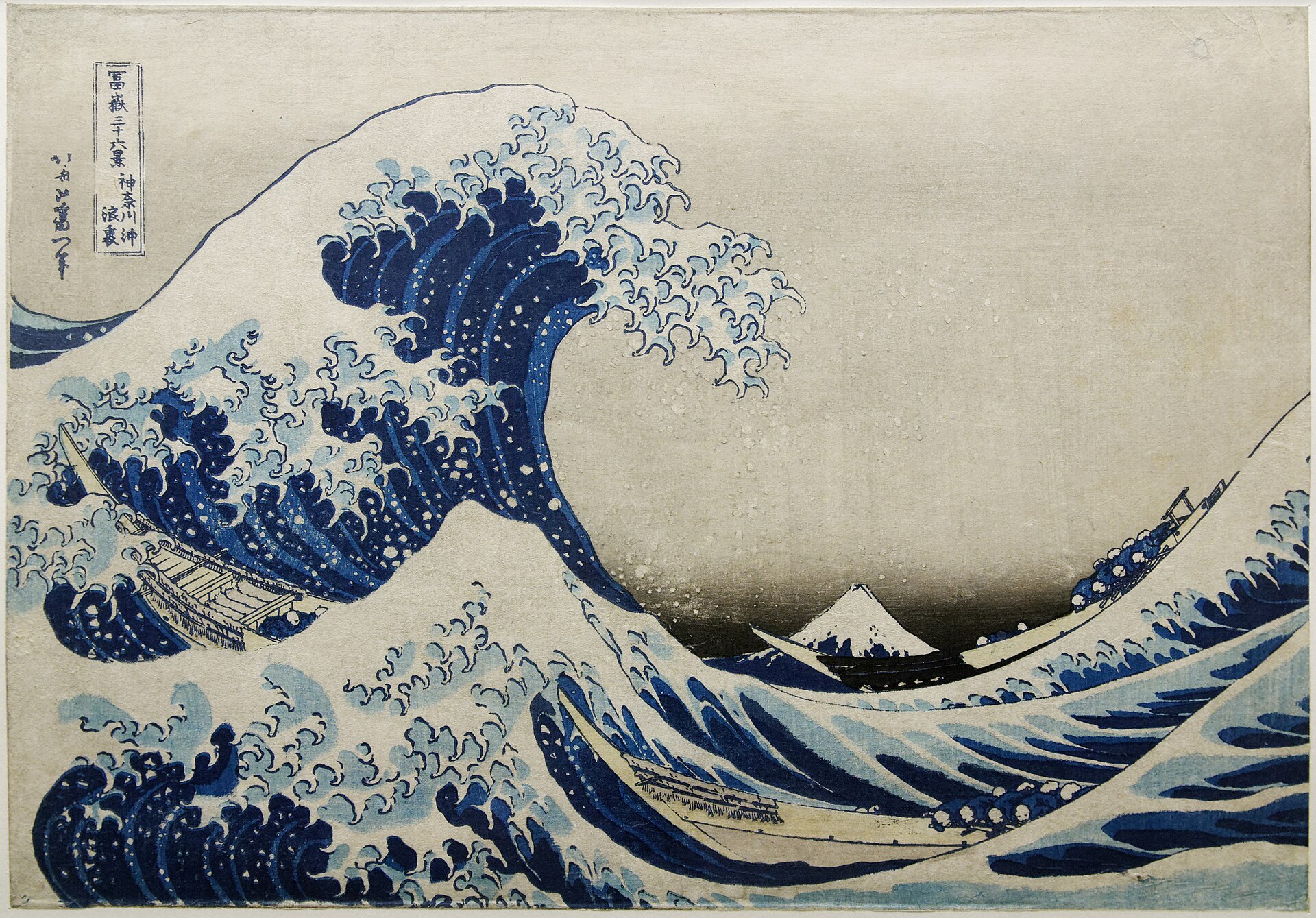
| British Museum | London | Three Edo-period impressions: 2008,3008.1.JA (state 1), 1906,1220,0.533 (state 4, bought from Arthur Morrison in 1906) and 1937,0710,0.147 (state 6). | The three cover the beginning, middle and late-middle of the run, which is why the museum's own study uses them as its reference images. The infrared and ultraviolet imaging published in that study was done on these sheets. |
| Art Institute of Chicago | Chicago | Three impressions: 1925.3245 (state 4), 1928.1086 (state 6) and 1952.343 (state 7, printed with the replacement light blue and yellow blocks). | 1952.343 is the standard published illustration of what the replacement blocks look like. Its clouds appear unfaded, which the census notes may be the result of a restoration rather than of survival. |
| Tokyo National Museum | Tokyo | Three impressions, including 10564-3574 (state 6) and 10569-685 (state 7). | Sixteen impressions are in Japanese institutions in total, spread across the Edo-Tokyo Museum, the Sumida Hokusai Museum, the Ota Memorial Museum, the Hokusai Museum at Obuse, Keio University Library and others. |
| Rijksmuseum | Amsterdam | RP-P-1956-733, acquired in 1956; a state 3 impression, with break 1 and the break in the slope of Mount Fuji but not break 2. | One of the sheets the census uses to fix the order of the two events, because it shows the Fuji break before the second cartouche break. |
| Honolulu Museum of Art | Honolulu | 13695, from the James Michener collection; a state 7 impression. | Michener, the novelist, assembled one of the largest American ukiyo-e collections and gave it to Honolulu. A state 7 sheet in a major collection is a reminder that late impressions are collected, published and loved. |
| Musee Guimet | Paris | Two impressions, EO3285 (state 2) and EO174 (state 4). | France holds five in all, the others at the Bibliotheque nationale (two) and the Musee des impressionnismes at Giverny, which places one within the Monet story. |
| Musee des impressionnismes | Giverny | One impression, state 4. | The institutional trace of the print's reception among the French painters, in the village where Monet kept his own Japanese prints. |
| Harvard Art Museums | Cambridge, Massachusetts | 1916.685, one of only four or five known impressions in state 8, with all three boats printed from a single brownish pink block. | The rarest state of the design, and the one nobody had described before 2020. Rarity here is not value: these are the last sheets off the worn and replaced blocks. |
| Bristol Museum and Art Gallery | Bristol | Mb4452, a state 6 impression. | The break in the wave line has been filled in with blue ink. Also the sheet that resolved a long-standing error: a photograph in Keyes's notes labelled Blackburn was in fact this print, and the actual Blackburn sheet turned out to be a facsimile. |
| Library of Congress | Washington | jpd.02018, catalogued as an Adachi modern reprint of the Showa era, purchased from H. Irving Olds in 1938. | Included here deliberately. It is not an original impression, it is correctly catalogued as a reproduction by the Library, and it is one of the most widely reproduced images of the design in existence. |
The British Museum's published timeline is the most compact reliable account and it is worth following, because almost every popular version of this life is embroidered.He was adopted at three, for...
The British Museum's published timeline is the most compact reliable account and it is worth following, because almost every popular version of this life is embroidered.
He was adopted at three, for unrecorded reasons, into the household of a hereditary mirror polisher, and in his early teens was apprenticed to a block-cutter, which means he learned the craft from the wood end before he learned it from the brush end. In 1777, aged nineteen, he entered the studio of Katsukawa Shunsho, a successful Floating World artist working in actor and beauty prints. The next year he began designing actor prints of his own, signed Shunro. He stayed until shortly after Shunsho's death in 1793 and was then expelled, again for reasons nobody has recovered. Throughout those years he also wrote and illustrated popular fiction.
After the expulsion he lost his direction for a time. What pulled him out was not painting but poetry: in the mid-1790s he attached himself to kyoka circles, the clubs that wrote comic verse, and designing privately commissioned prints and illustrated books for them became his living. He is said to have studied the decorative Rinpa school, and from 1795 he signed as Sori. In 1798 he handed the Sori name to a pupil, which was customary practice and is the reason a name is not a hand, and began signing Hokusai Tokimasa. The British Museum states the reason plainly: the name reflects his faith in the Buddhist deity Myoken, whose realm is the North Star, called Hokushin in Japanese. That is a documented religious affiliation and not an inference from the pictures.
Between 1800 and 1810 he was a public performer as much as a designer. He made building-sized paintings at large temples, of subjects such as Bodhidharma and the lucky god Hotei, and gave a painting performance before the shogun. His illustrations for the serialised adventure fiction of Kyokutei Bakin reached a much larger audience than any print. He first used the name Katsushika Hokusai in 1807.
In 1812 he published Ryakuga haya-oshie, basic instruction in sketching, and travelled west to Nagoya, where a group of painting enthusiasts led by the swordsman and samurai retainer Maki Bokusen watched him produce hundreds of rapid sketches he called manga, drawings off the top of his head. Bokusen and others compiled them, and the result became the first volume of the Hokusai manga, fifteen volumes published between 1814 and 1878. The manga was not a project he planned. It was other people collecting what he threw off.
In 1819 he turned sixty and took the name Iitsu, meaning one again, for the new turn of the sixty-year calendrical cycle. The 1820s were bad. Commissions dried up and relatively little is known from the middle and late years of the decade. A daughter died, and his second wife. A wayward grandson left him with gambling debts. He appears to have had a stroke. Towards the end of the decade his daughter Oi, herself a painter, left a failed marriage and came back to work with him and look after him.
The Thirty-six Views belongs to what happened next. In the early 1830s, past seventy, broke and recently ill, he was commissioned to design landscapes and bird-and-flower prints, and the run of work that followed is the reason anyone outside Japan knows his name. The names Manji, everything, and Gakyo rojin, old man crazy to paint, both appear around 1834.
The last decade went to painting. He was unsteady on his feet and left Edo for at least one long stay with his patron, the wealthy merchant Takai Kozan, in mountainous Nagano. On the paintings of his final three years he used a talismanic seal reading Hyaku, one hundred. He had already lived twice as long as most of his contemporaries and intended to keep going.
Nobody knows how many impressions of Under the Wave off Kanagawa were printed.
Nobody knows how many impressions of Under the Wave off Kanagawa were printed. Japanese publishers did not record edition sizes and no blocks survive. The working estimates come from the economics of the trade: a publisher had to sell at least 2,000 impressions of a design to make a profit, some Kunisada designs are estimated at 3,000 to 4,000, and Hiroshige's Fifty-three Stations of the Tokaido is thought to have been printed 12,000 to 15,000 times. Timothy Clark's figure for the Great Wave, as cited by Korenberg, is up to 8,000 impressions.
Against that, Korenberg located 111. Seventy-seven of them are in national institutions and the remaining thirty-four came from auction sites, dealers, books and private owners. The distribution is lopsided in a way that tells its own story about where nineteenth-century Europe and America put their money: thirty-five in the United States, sixteen in Japan, six in the United Kingdom, five in France, four each in Germany and Italy. The Museum of Fine Arts in Boston holds seven, the largest single group; the Metropolitan holds four; the British Museum, the Art Institute of Chicago and the Tokyo National Museum three each.
Two further impressions have surfaced since that census closed, bringing the count to at least 113. The number will keep moving, because the sheets that have not been found are in private hands and appear only when somebody dies or sells. Roger Keyes, working before digital photography, listed 62 and had photographs of 30.
A state, in this field, is not an artist's revision.
A state, in this field, is not an artist's revision. It is a physical event in the wood: a break, a re-cutting, or the substitution of a new block. Because impressions are neither dated nor numbered, the sequence of those events is the only chronology there is.
Korenberg found that only three of the nineteen cartouche breaks Keyes listed occur systematically, and that they occur in a fixed order. Break 1 is a single break at the bottom left of the cartouche border. Break 2 is a double break on the left. Break 3 is a single break at the bottom right. Between them fall two other reliable events: a break near the peak in the upper right slope of Mount Fuji, which appears after break 1 and before break 2, and a break in the outline of the wave directly behind the stem of the right-hand boat, which appears after break 2 and before break 3.
That gives states 1 to 6. State 7 is the introduction of a new light blue block for the sea and a new yellow block for the boats, probably at the same moment the cloud block was re-cut. State 8, which nobody had described before this study, is a further new block that prints the whole body of all three boats in a brownish pink, replacing the light grey and yellow blocks together. Only five of the 111 are in state 8. Twenty-two are in state 6, the largest single group, and nineteen in state 4.
One counter-intuitive detail is worth carrying into any examination. The break in the slope of Mount Fuji is larger in early impressions and shrinks as the run continues, disappearing altogether in very late ones. The explanation offered is geometric: if the notch in the ridge is wider at the top than deeper down, then as the ridge wears away the break narrows. An examiner who assumes that damage always grows will date such a sheet backwards.
There is also a finding about the mechanism. Examining the impressions in order showed no gradual thinning of a line before it broke. The breaks arrive suddenly, which supports the argument that Japanese blocks deteriorate mainly through the ageing of the wood between printings rather than through the act of printing itself. If that is right, the states are closer to a calendar than to a print counter.
The examination is a sequence and the order matters, because each step can be faked and the faking is caught by the disagreement between steps, not by any single step.Start with the title cartouche...
The examination is a sequence and the order matters, because each step can be faked and the faking is caught by the disagreement between steps, not by any single step.
Start with the title cartouche at the upper left. It was cut from very narrow ridges of wood and it is the first thing to fail, which makes it the clock. Look at the double border for a single break at the bottom left, then for a double break on the left, then for a single break at the bottom right. Those three, in that order, are the only cartouche damage that recurs reliably across a hundred impressions.
Then go to the summit of Mount Fuji and look at the upper right slope for a break near the peak. It arrives after the first cartouche break and before the second. It is large when it first appears and gets smaller as the block wears, so its size is not a measure of lateness and its absence is not proof of earliness.
Then the outline of the wave directly behind the stem of the boat at the right. That break arrives after the second cartouche break and before the third.
Then the colour blocks. Is the light blue of the foam printing rounded shapes or angular ones, particularly at the lower right corner? Angular means the replacement block and therefore state 7 or later. Are whole sections of yellow missing from the boats, specifically all of the yellow on the left-hand boat and the bottom of the bow of the foreground boat? That is the same replacement block. Are all three boats printed in one brownish pink, and has the grey straw mat gone from the rearmost boat? That is state 8, and there are only a handful of those.
Then the graded grey around Fuji. Above the summit is early; below it is later. And look at whether the fine dark blue detail of the rearmost boat is still legible under the grey, or has been buried under black.
Then score the whole thing against itself. Seven separate areas of the design show general wear that accumulates gradually and cannot define a state, but they establish roughly how late a sheet is. If the cartouche says early and the general wear says late, the cartouche has been retouched. That is precisely how the Metropolitan's JP10 was caught, and it was confirmed afterwards under a magnifier at the museum.
Only then look at the two reproduction tests: the two small shapes in the sea that should print in the outline colour rather than the sea blue, and the small dark blue sliver of uncleared wood inside a patch of foam. If either fails, nothing above matters.
None of the original blocks survive. Working from the impressions themselves, Korenberg established that at least seven separate carved surfaces were used for the early printings, most likely four...
None of the original blocks survive. Working from the impressions themselves, Korenberg established that at least seven separate carved surfaces were used for the early printings, most likely four physical blocks with three of them carved on both faces.
The dark blue block or blocks carried the outlines, the title cartouche, the signature, the body of Fuji and the darkest sea. A light blue block and a medium blue block did the rest of the water; the darkest blue in the design is not a fourth ink but dark blue overprinted on medium blue, and the overlap is visible. A light grey block did the two foreground boats. A dark grey block did the straw mat of the rearmost boat and the graded shading of the sky around Fuji, and it was inked and pulled twice. A yellow or beige block did all three boats. A pink or beige block did the clouds, and it was not always used.
The printer David Bull's argument that the outlines and the solid dark blue areas were carved on two different blocks is supported by the prints themselves: in late impressions the outline of a wave has almost gone while the fine detail of the boat beside it survives. Solid areas need more pressure than lines, and a block carrying both would destroy its own lines. The modern workshop at Takahashi Kobo in Tokyo separates them for exactly that reason; the Adachi Institute does not.
The light blue and yellow blocks were both replaced after break 3, and replaced together, which suggests they had been carved on the two faces of one block and were lost as a unit. The replacements are conspicuously careless. The new light blue prints the foam in angular shapes quite unlike the original, particularly at the lower right, and the new yellow simply omits sections of the boats: all the yellow on the left-hand boat, and the bottom of the bow of the boat in front. That is hard to square with Nishimuraya Yohachi's reputation. Laurence Binyon called him a publisher remarkable for the high standard of his engraving and printing. A letter of 1836 records that he was in financial difficulty in the mid-1830s. Whether the blocks passed to another house is unresolved and Korenberg puts it as a question, not a finding.
The blue is the reason this design exists in the form it does, and it is also the source of the most useful single test for a twentieth-century reprint.
The blue is the reason this design exists in the form it does, and it is also the source of the most useful single test for a twentieth-century reprint. Both need stating carefully, because the popular version is wrong.
The pigment first. Prussian blue is synthetic and it does not fade the way indigo and dayflower blue do. The British Museum's account is that it became available to Japanese publishers at much reduced price from China in the late 1820s, imported from China and the Netherlands, the only two countries Japan traded with, and that the Thirty-six Views was one of the first large-scale publishing ventures to exploit it. Henry D. Smith the second reconstructs the trade in detail from the Nagasaki import figures: the Chinese re-enter the market between 1824 and 1828, the price falls from 87 to 31 silver monme a kin, the Dutch withdraw after 1828, and from 1829 the supply is almost entirely Chinese. Kate Bailey's work on Canton puts a Prussian blue factory at the northern gate of the city in about 1825, which is exactly Smith's window and which Smith, writing in 2005, could not have seen. Smith also warns that bero-ai, the term modern Japanese accounts use for the pigment, appears in no surviving Edo text and is probably a modern coinage; the Edo word was konjo and the Dutch records say Berlyns blaauw.
Now the correction. It is repeated everywhere that the blue outlines of the Thirty-six Views are Prussian blue. They are not. The British Museum's infrared imaging of its own 1906,1220,0.533 found the outlines, cartouche, signature and darkest sea printed in one ink rich in indigo. The British Museum and Musee Guimet study of Red Fuji found no significant elements by X-ray fluorescence on the dark blue outline, signature, cartouche and trees, indicating an organic colourant, with false-colour infrared showing indigo and the shape of the reflectance curve between 700 and 900 nanometres indicating a small amount of Prussian blue mixed into it. And a Metropolitan Museum team working with the Victoria and Albert Museum, the Royal Museums of Art and History in Brussels, the Brooklyn Museum and the New York Public Library examined 141 impressions of the series by fibre-optic reflectance spectroscopy, Raman and surface-enhanced Raman, and reported that the blue outlines of the Great Wave are composed of Prussian blue and indigo mixtures. The outlines are a mixture. The sky and the sea are where the Prussian blue is.
That correction is what makes the test work, and this is the single most useful authentication finding in the literature on this print. The same study sorted its 141 impressions statistically and found one cluster, its cluster seven, in which the outline is composed of PURE Prussian blue with no indigo. Those impressions also show anomalies in the design and composition indicating that they were made from re-carved blocks. The team's conclusion is quotable and exact: pure Prussian blue outlines are a significant indication of early twentieth-century reprints.
So the diagnostic is a negative. An Edo impression has a mixed indigo and Prussian blue outline. An outline of pure Prussian blue is a twentieth-century sheet, and the finding is instrumental rather than visual, which means it cannot be argued with by eye and cannot be faked by a printer working from a photograph. It requires reflectance spectroscopy, which is not available to a private buyer, but it is available to any museum and it is the thing to ask a specialist department to run before a seven-figure sheet changes hands.
Two further practical points from the same body of work. The two finest Metropolitan impressions fall in the study's cluster six, which the authors call among the earliest impressions, so the method sorts genuine sheets as well as excluding false ones. And impressions with black sumi outlines were excluded from the analysis altogether, which is a reminder that the ten supplementary designs, printed in black, are a different technical object.
The last thing to understand about the colour is who chose it. The British Museum's position is that the artist chose the colours and the printing effects for the early printings only. After that the publisher made changes, to widen the market or to cut the cost of production. So when a late impression has a more colourful sky, or vivid pink clouds, or a printer has inked the grey block to suggest rain, which happens on the Art Institute of Chicago sheet 1952.343 and is very rare, that is not a Hokusai. It is a print shop.
The Great Wave varies less in colour scheme than other prints in the series.
The Great Wave varies less in colour scheme than other prints in the series. All impressions use three blues in the sea. The lightest can be very pale or quite deep, and that variation does not correlate with how early a sheet is, so it cannot be used for dating.
What does correlate is the graded grey around Mount Fuji. In almost every state 1 and state 2 impression the dark grey band runs slightly above the summit; in later impressions it stops below it. In the same early impressions the dark blue detail of the rearmost boat is still legible through the grey, while later printers used black there and buried it. The obstruction of the artist's own detail is a printer's decision, not a design.
Fading is the great trap, because it looks like refinement. Edo colourants including turmeric and orpiment are light-sensitive; the yellow of the boats and the pink of the clouds go first. Of the 111 impressions, 26 show no clouds at all. Ultraviolet reflectance imaging can settle whether a cloud block was printed and has faded or was never used: on the British Museum sheet 1937,0710,0.147 there is almost no colour left in the sky, and the clouds reappear under UV. In general early impressions have subtler boats and clouds than later ones, but Korenberg is explicit that this may itself be a light effect rather than a printing difference, and that it needs analysis to settle.
The practical consequence for a buyer is that a soft, silvery, tasteful Great Wave is very often a late impression that has been in a frame near a window, and a hard, saturated one can be an early impression that spent a century in an album.
Japanese prints have been retouched to raise their value for well over a century: breaks in the cartouche filled in, faded areas re-coloured.
Japanese prints have been retouched to raise their value for well over a century: breaks in the cartouche filled in, faded areas re-coloured. Sixteen of the 111 impressions show it, and the list includes serious collections: the Museum of Fine Arts in Boston (34.317 and 21.6765), Keio University Library, the Yale University Art Gallery, the Hill-Stead Museum and the Metropolitan Museum of Art (JP10 and JP1849).
The Metropolitan's JP10 is the instructive case. Its cartouche shows only break 1, which would place it very early. But the wave line behind the right-hand boat is broken, and the general wear elsewhere in the sheet is late. The cartouche had been filled in. Examination under a magnifier at the Metropolitan confirmed it. The Bristol Museum and Art Gallery impression, Mb4452, has the break in the wave line filled with blue ink; it is a state 6 sheet.
The method that catches this is the one worth learning. Do not read a single feature. Read the cartouche, the summit of Fuji, the wave line and the seven areas of general wear together, and if one of them disagrees with the rest, the one that disagrees is the one that has been worked on.
It is worth reproducing the substance of a real curatorial reading, because it shows what a specialist notices and how much of it is about cutting and inking rather than about design.Timothy Clark...
It is worth reproducing the substance of a real curatorial reading, because it shows what a specialist notices and how much of it is about cutting and inking rather than about design.
Timothy Clark, writing on the British Museum's 1937,0710,0.147, identifies the boats as oshiokuri-bune, fast skiffs used to carry fresh fish into the city from the Izu and Boso peninsulas. They are not fishing boats in a storm. They are couriers, and they are late.
On the making: to animate the tentacles of foam required a considerable feat of cutting, because the line of each one is deliberately broken very slightly under the tip. That is a decision taken by a block cutter, at a scale of under a millimetre, repeated dozens of times. The pink cloud block appears to have been slightly abraded along parts of its edge to produce a soft graded edge, a technique called ita-bokashi. Neither of those is visible in reproduction and both are the sort of thing that separates an original impression from a recutting.
On a very well known sheet: the pale red on the sides of two of the boats in the frequently reproduced Havemeyer impression at the Metropolitan, JP1847, seems to Clark to have been added by hand. That is hand-colouring on one of the most published Great Waves in the world, noticed by a curator at another museum and printed in the second museum's own catalogue entry.
And a disagreement worth preserving. Clark calls Metropolitan JP2972 a sharp early impression. The British Museum's own later census places JP2972 in state 6, the second-latest damage state before the block replacements, with retouched clouds whose shape does not match the design. Both statements are published by the same institution, twenty years apart, by a curator and by a scientist. This record does not arbitrate between them; it records that a specialist eye and a systematic comparison of a hundred and eleven photographs reached different answers about the same sheet.
One last thing from the same entry, and it is a condition fact about a sheet reproduced on this page: the British Museum notes that its impression 1906,1220,0.533 is very similar to 1937,0710,0.147 but has a vertical fold down the centre. That is an album fold. It is invisible in every photograph of the sheet and it is in the museum's record.
The series title is wrong and everybody has always known it.
The series title is wrong and everybody has always known it. Thirty-six designs were published, the series sold, and ten more were added afterwards, so the complete set is forty-six sheets. The Los Angeles County Museum of Art states the arithmetic plainly in its own catalogue note.
The addition matters technically, because the ten supplementary designs are printed with black outlines rather than blue. The museum's note puts it as a fashion: early impressions of the original thirty-six were printed with a Prussian blue outline, following a brief vogue for the colour, while later impressions and all of the supplementary prints have the usual black. The Rijksmuseum describes its own Great Wave in the same terms, as a colour woodcut with the line block in blue. The census bears this out from the other direction: black outlines occur on some Great Wave impressions, and they are not confined to the late states, since sheets in the Chazen Museum of Art and the Cincinnati Art Museum carry black outlines with the earlier grey and yellow boats.
So a blue keyblock is a mark of the earlier part of the run and a black one is not automatically a defect, and neither on its own dates a sheet. It is one line in the scoring, not a verdict.
Nishimuraya Yohachi, trading as Eijudo, is the name on the sheet and in the Edo print trade the publisher was the principal, not the agent.
Nishimuraya Yohachi, trading as Eijudo, is the name on the sheet and in the Edo print trade the publisher was the principal, not the agent. He commissioned the design, paid the artist, employed the block cutter and the printer, submitted the proof to the censors, owned the blocks, decided how many impressions to pull and when to re-cut, and took the risk. The artist did not own his own image and had no say in a reprint.
That is why the replacement blocks matter beyond connoisseurship. Somebody decided, after the first thousands of impressions, that a crude new light blue block and a yellow block missing whole sections of the boats were good enough to keep selling. Laurence Binyon described Nishimuraya as remarkable for the high standard of his engraving and printing, and a letter of 1836 records that he was in financial trouble in the middle of that decade. The census raises, without settling it, the possibility that the blocks passed to another house.
It also explains the shape of the series. Thirty-six designs were published, they sold, and ten more were added; the supplement is printed with black outlines rather than the blue of the early sheets. That is not an artistic development. It is a publisher extending a successful line.
The Japanese equivalent of a hallmark is a small printed seal, and for this series there are two things to look for.
The Japanese equivalent of a hallmark is a small printed seal, and for this series there are two things to look for. The publisher is Nishimuraya Yohachi, whose shop name was Eijudo, and his mark appears on the sheet. The censor seal is the round kiwame, meaning approved, which the guild censors used from 1791 until the reforms of 1842.
But the kiwame is contested for this series, and the disagreement has to be recorded rather than smoothed. The Metropolitan and Victoria and Albert team that analysed 141 impressions states flatly that seals are absent, as is the case in all prints from the Thirty-Six Views of Mount Fuji, and that in their absence chronology has to be built by connoisseurship instead. Against that, the trade catalogues sheets from the contemporaneous waterfall series by the same publisher as carrying a kiwame censor seal with the Eijudo mark and no date seal. Whether a given Great Wave impression carries a kiwame therefore needs checking on that sheet and should not be assumed. It is precisely because the seal evidence is thin or absent that the chronology of this print has had to be reconstructed from block wear and, latterly, from pigment chemistry.
The important negative fact is that the Thirty-six Views carries no date seal. The combined censor and date seals that let a specialist read a month and a year off a sheet were introduced in 1842, a decade after this series appeared. So the seal evidence for a Fuji print gives you a window, not a date: published by Eijudo, passed by a kiwame censor, therefore before 1842. Everything narrower than that comes from the signature, from advertisements, and from the states.
That is why a bare kiwame seal is not proof of an early impression, and why a dealer who points at it as though it were is either careless or counting on you being. The seal was printed from the same blocks as the rest of the sheet, so it appears identically on the first impression and the eight thousandth. It is carved into the keyblock, not stamped on afterwards, which also means a recut block can carry a recut seal.
One trap in the vocabulary, because it catches people constantly. The word aratame appears in two completely different roles. As a censor seal it means examined. In an artist's signature it means changing to. The Great Wave signature that the Art Institute of Chicago, the Minneapolis Institute of Art and Cleveland all record as Hokusai aratame Iitsu hitsu therefore contains no censor seal at all. It says Hokusai, changed to Iitsu, brush.
For completeness, because a reader will meet other Japanese prints: the system that does allow precise dating runs from 1842. Single censor names from 1842 to 1846, paired names from 1847 to 1853, a round aratame with a separate oval zodiac date seal from late 1853 to 1857, the oval date alone in 1858, and aratame combined with the date in one round seal from 1859. A sheet from those years can often be dated to the month. A Fuji-series sheet cannot be dated by seal at all.
Hokusai changed his art name repeatedly, and because he changed it he signed differently in different decades.
Hokusai changed his art name repeatedly, and because he changed it he signed differently in different decades. On the Fuji series he signs as Iitsu, and the standard form is saki no Hokusai Iitsu hitsu, the former Hokusai, Iitsu, brush. Sotheby's catalogues the design with the variant Hokusai aratame Iitsu hitsu, Hokusai changed to Iitsu.
The signature therefore fixes the sheet inside the Iitsu period rather than to a year, and it is the reason unsigned or differently signed work is so hard to place. Attribution of an unsigned Hokusai depends on knowing which name he was using when, which is why the sequence of names below is a working tool and not a curiosity.
Hokusai used more than thirty art names, on the British Museum's own count.
Hokusai used more than thirty art names, on the British Museum's own count. Six of them are principal signatures on the prints, and Roger Keyes set them out with dates in the notes to his catalogue raisonne, published by the British Museum in 2023. This is the working table, and the sub-forms matter as much as the headings because they narrow a date to a year or two.
Shunro, spring brightness, from the seventh month of 1779 to 1794: as Katsukawa Shunro 1779 to 1792, then Kusamura Shunro 1793 to 1795. Sori, reasoned practice, from the first month of 1795 to the third month of 1798: as Tawaraya Sori in 1795, then Hokusai Sori 1796 to 1798. Hokusai, north studio, from the third month of 1798 to the first month of 1813: as Hokusai Tatsumasa or Tokimasa in 1798, Sori aratame Hokusai in 1799, Saki no Sori Hokusai in 1800, Gakyojin Hokusai 1801 to 1804, Gakyo rojin Hokusai in 1804, Kukushin Hokusai in 1805, and Katsushika Hokusai 1806 to 1809. Kako, yours truly, about 1801 to 1802. Taito, star-blessed, in 1811 and again from the winter of 1813 to 1819. Iitsu, at one or one again, from 1820 to the first month of 1834, with the forms Hokusai aratame Iitsu in 1820, 1823 and 1831, Getchi rojin Iitsu in 1821, Fusenkyo Iitsu in 1822, Hokusai Iitsu 1823 to 1834 and Saki no Hokusai Iitsu 1831 to 1835. Manji, all or everything, on verse from 1824 and as a signature from the third month of 1834 to his death.
Two of those names are religious. Hokusai means north studio and points at Myoken, the Buddhist deity who personifies the pole star, called Hokushin in Japanese. Taito means receiving the Northern Dipper. Lucia Dolce of SOAS reads both as expressions of the same devotional interest, and the British Museum states the Myoken derivation flatly in its own timeline.
Now the part that matters for attribution, and it is not the part usually cited. The documented case of a name handed to a pupil is Sori, not Taito. In the summer of 1798 Hokusai passed the Sori name to his pupil Hishikawa Soji, which was ordinary practice, and announced the change on a surimono of the eighth month signed drawn by Hokusai, changed from Sori. Two contemporaries record it: Takizawa Bakin, in a note in red ink attached to one of Hokusai's own letters, and Shikitei Sanba. The British Museum's own authority record then states the consequence in one sentence: there is controversy over whether certain works signed Sori should be attributed to Hokusai or to Soji.
Taito is a separate problem. Museum authority files treat Katsushika Taito the second as a distinct artist, the Metropolitan giving him as active about 1810 to 1853 in one record and 1810 to 1850 in another, and the Art Institute of Chicago listing him with a dozen alternative names of his own and no dates at all. That there was a second Taito is established. The year Hokusai handed the name over is not, in any source consulted for this record, and it is not asserted here.
The dates in the table are also not settled between institutions. Keyes puts the Sori name from the first month of 1795; the British Museum's own collection database says 1794 to 1798; the Sumida Hokusai Museum says he assumed it in 1794. Keyes gives Katsushika Hokusai as a signature from 1806; the British Museum's timeline says he first used it in 1807. These are one-year discrepancies in the primary reference works of the field, and a sheet dated on the strength of a signature inherits every one of them.
The Great Wave was not an inspiration. It was the third or fourth attempt at a problem Hokusai had been working on for nearly thirty years.About 1803 he designed View of Honmoku off Kanagawa, in...
The Great Wave was not an inspiration. It was the third or fourth attempt at a problem Hokusai had been working on for nearly thirty years.
About 1803 he designed View of Honmoku off Kanagawa, in which a boat is driven under a breaking crest, in the flattened Western-derived perspective he was experimenting with at the time. About 1805 came Oshiokuri hato tsusen no zu, a fast cargo boat driving into a sea that is already breaking into the clawed fingers of foam the later design would make famous. Both are off the same stretch of coast, both put the viewer inside the trough, and both are the same picture with the mountain missing.
What the 1831 design adds is the mountain, and the mountain changes the subject. In the earlier prints the sea is the whole event. In the Great Wave there is a second thing in the frame that does not move, small enough to be mistaken for another crest, and permanent. This is a compositional decision with a meaning attached, and it is the reason the print belongs in a series about Fuji at all rather than in a series about the sea.
The name has drifted in a way that matters for cataloguing. The Japanese title is Kanagawa oki nami ura, which is the underside of the wave off Kanagawa, and the water in it is okinami, an offshore swell. It is not a tsunami and the title does not say it is. The tsunami reading is a twentieth-century Western import, and it has been carried into museum labels and into the earthquake literature. A record that repeats it has taken a modern reading and dressed it as the artist's subject.
The standard answer is that the Thirty-six Views was made for pilgrims, and it is what museum interpretation says.
The standard answer is that the Thirty-six Views was made for pilgrims, and it is what museum interpretation says. The Los Angeles County Museum of Art states in its own catalogue note that during Hokusai's lifetime pilgrims to Fuji were the main customers for these prints, that travel restrictions had relaxed and produced a travel boom in the late 1820s and early 1830s, and that Fuji was a centre of both Shinto veneration and Buddhist mountain worship. That is museum label text, and it should be attributed as such, because the scholarship does not agree with it.
The Fuji cult itself is not in question. Fuji confraternities, the Fuji ko, arose in the eighteenth century and organised pilgrimages; at least a hundred were active and in communication with each other in Edo in the early nineteenth century, about a tenth of them serving as organisational hubs for others, and at least ten operating in Nihonbashi during the Tenpo era. Several thousand people climbed the mountain every summer on the northern trail alone. Those who could not go built miniature Fujis in Edo and climbed those instead. All of that is documented.
What is not documented is the link to this publisher and this series. Kano Hiroyuki has suggested that Nishimuraya Yohachi, who issued the Thirty-six Views, was a member of a Fuji ko and even an officer responsible for one group's finances, and may therefore have pushed Hokusai towards the subject. Janine Anderson Sawada, writing in the British Museum's own research volume, tests the claim and rejects it. The house had passed to a successor, Nishimuraya Yohachi the second, by the time the series appeared; membership registers for these groups are not extant; and Kano's own cited authority gives no source for the claim. Her conclusion is exactly quotable: there is no evidence of any connection between Hokusai's publisher and the Fuji confraternities. She adds that the mountain the confraternity members worshipped, a healing deity and a source of everyday dependability, is not the mountain Hokusai shows, and that the more reasonable reading is a publisher with commercial judgement supplying images of a subject that was selling.
Henry D. Smith the second takes the opposite view from a different direction and also rejects the market explanation. His position is that the Thirty-six Views was above all a personal spiritual quest, driven by a yearning for immortality in a man of seventy, and the result of one man's life cycle rather than of any development in print technology.
Against both stands the series' own advertisement, printed in 1831 and reproduced by Smith himself. It offers Thirty-Six Views of Mt. Fuji by Zen Hokusai Iitsu, single-sheet blue-printed, one view to a sheet, published one after another, showing how the form of Fuji differs from place to place, none of them the same. Then the sales line: these should be useful for those who are learning the art of landscape. And a note that if the blocks keep being cut the total should come to more than a hundred rather than stopping at thirty-six.
So the publisher's own pitch sells the series to amateur landscape draughtsmen on the grounds of pictorial variety, and mentions neither pilgrimage nor merit nor the mountain god. This record does not arbitrate between Smith, Sawada and the museum labels. It records that the pilgrim explanation is interpretive text rather than a scholarly finding, that the one named scholar who argued for a confraternity connection has been answered in print, and that the only contemporary commercial document says something different from all of them.
Hokusai left no written account of this design and never mentioned a philosophical scheme in connection with it.
Hokusai left no written account of this design and never mentioned a philosophical scheme in connection with it. Everything beyond the picture is inference, and it should be graded as such.
The strongest argued case is Benjamin Wai-ming Ng's, that the composition is an ukiyo-e version of the taiji diagram: a reverse S-curve dividing the sheet into a dark, towering, active half and a bright, open, empty one, with the cyclical repetition of the wave forms inside it restating the same alternation at a smaller scale. Ng supports it with Hokusai's own stated preference for S-shaped composition in his drawing manual of 1812, with the pair of male and female wave ceiling paintings of 1847 that Japanese scholars have read as a yin and yang pairing, and with Hokusai's use of Classic of Changes material elsewhere in his work. He cites Takeuchi Takahito, Suwa Haruo and Iinuma Masaharu on the Japanese side.
Ng concedes what has to be conceded: there is no documented study of the Classic of Changes by Hokusai, no statement by him about the taiji diagram, and no primary evidence of formal Chinese philosophical training. The case is circumstantial and rests on resemblance plus a pattern of usage elsewhere. It is a proposal by a named scholar in a citable place, which is worth recording, and it is not a fact about the artist's intention.
What is documented is smaller and more useful. The series was made for people going to a mountain that was understood to be inhabited by a kami and that carried both Shinto veneration and Buddhist mountain-worship practice, and those people were the customers. The name Hokusai means north studio and points at Myoken, the deified pole star of the Nichiren school, whose Edo shrine stood at Yanagishima. A man who names himself after a star and then spends his seventies making forty-six pictures of a sacred mountain for pilgrims does not need a hidden diagram to be doing something other than landscape.
There are four distinct things a buyer will be offered and they are not the same problem.The first is the late original impression: printed from the original blocks, in the 1830s or after, often with...
There are four distinct things a buyer will be offered and they are not the same problem.
The first is the late original impression: printed from the original blocks, in the 1830s or after, often with the replacement blocks of states 7 and 8. It is an original and it is worth a fraction of an early one.
The second is the honest modern reproduction. Several Japanese houses still cut and print the design by traditional methods, among them the Adachi Institute of Woodcut Prints, attached to the Adachi Foundation for the Preservation of Woodcut Printing, founded in 1994, and Takahashi Kobo in Tokyo. Adachi prints the design in eight steps from seven blocks. These are sold as reproductions. The trouble begins when they lose their packaging: the Library of Congress sheet jpd.02018 is an Adachi modern reprint that entered a serious American print collection and then a national library, catalogued correctly and reproduced everywhere as though it were not.
The third is the revamped or rejuvenated print, and this one is documented by a museum rather than by the trade. Julia Meech-Pekarik, writing in the Metropolitan Museum of Art Bulletin in 1982 about Frank Lloyd Wright's Japanese prints, records that several dealers had for years sponsored a studio in the country where craftsmen worked to improve the colour of worn and faded prints. In 1920, buying on behalf of Howard Mansfield, Wright spent fifty thousand dollars in two hours with a Tokyo dealer and was defrauded; Mansfield then reported that some of the prints had pinpricks, indicating revamping. The specialist literature names the dealer as Hayashi Kyugo, who died in 1947, and his collaborator as the collector Takamizawa Enji, 1870 to 1927, who employed highly skilled artisans, and dates the discovery to 1919 with the connoisseur Judson Metzger; Meech-Pekarik dates it to early 1920 and credits Mansfield. Both accounts are recorded here and neither is preferred.
The method matters and the usual description of it overstates what is documented. The scholarly and museum sources describe printing fresh colour from newly cut blocks ONTO a faded but otherwise genuine sheet. The further claim, common in the trade literature, that the sheet was first washed or bleached down to the surviving keyblock impression, appears in no scholarly or museum source found for this record, and is not asserted here.
The detection criteria are a curator's, from the same Bulletin article, and they are worth learning in order. First, pin holes visible on the verso: guidelines for the tracer when cutting the new colour blocks, and the surest clue to a reworked print. Second, an incongruity between the condition of the paper and the condition of the colour, a sheet whose unprinted sky and faces are heavily soiled and worn while the fugitive blue, purple and red look incongruously fresh. Third, bright pink clouds. Fourth, brushwork over the print, outlines strengthened with a single-hair brush, losses patched from behind, and the giveaway that the Met's first curator of Far Eastern art passed to Wright in 1922: painted lines which continue on the mat.
After Takamizawa's death the firm is reported to have moved to frank replicas on thicker paper, sealed on the reverse from 1927 and from 1938 with a seal naming Takamizawa Tadao. Those two dates rest on a single trade source. What is confirmed from a museum record is only that a Takamizawa studio mark exists: the Cleveland Museum of Art's 2007.19, a Chiura Obata of 1930, is inscribed on the verso made and printed in Japan at Takamizawa Color Print Studio.
The fourth is the facsimile: a photomechanical or newly cut copy with no pretence to the original blocks. The Blackburn Museum and Art Gallery sheet is one, and it had been cited in the scholarly literature as an example of a state before a modern photograph exposed it.
Two tests separate a reproduction from an original impression and both are free. First, two small shapes in the sea are printed in the outline colour, a dark grey blue or black, on original impressions; on reproductions they come out in the lighter sea blue. Second, on any high resolution image of an original there is a small dark blue mark inside a patch of foam, which the woodblock cutter David Bull reads as a sliver of wood the carver failed to remove. It is absent from every reproduction Korenberg examined. A modern recut copy of about 1930 has been circulating on Wikimedia Commons for years, correctly labelled in its own file record and constantly used as though it were the print.
There is one hard, bright-line dating criterion for separating a Meiji-era reproduction from an Edo impression, and it is not connoisseurship.From 1876 Japanese prints were required to carry...
There is one hard, bright-line dating criterion for separating a Meiji-era reproduction from an Edo impression, and it is not connoisseurship.
From 1876 Japanese prints were required to carry publication and printing dates and the names and addresses of the artist and publisher. An Edo sheet has none of that. A sheet that does is later than 1876, whatever it looks like.
The Meiji reproduction industry was formal and its ownership is traceable. Matsuba Ryoko, writing in the British Museum volume, records that Okura was granted the right by the government to reproduce Hokusai's designs in 1889, and that three years later, in 1892, ownership of Okura's blocks passed to Sekiguchi Masajiro, who removed Okura's name from them. That is a documented change of hands in a reproduction business, and it is exactly the kind of fact that lets a sheet be placed.
For the illustrated books the equivalent test is the colophon. Ellis Tinios, writing for the Smithsonian, states it precisely: the first printings of all Hokusai's commercially produced books carry colophons, and the colophons were omitted when the books were reprinted by Eirakuya Toshiro of Nagoya, who removed them in order to hide the fact that many of these books were being printed from blocks cut forty years earlier. So on a Hokusai book the absence of a colophon is not a loss. It is positive evidence of a later reprint.
Tinios also supplies the correct vocabulary for what happened to those blocks, and it is narrower than the usual claim. Japanese publishers did not store printed books; they stored the blocks and used them again as demand required, often for decades. The paper grade and size, the presence or absence of colour, the quality of the pigments, the condition of the blocks, the covers and the care taken by the printer all varied from printing to printing. That is reuse, documented. Re-cutting of the manga blocks is not documented, and this record does not claim it. Re-cutting is documented for the Great Wave, where the census caught it in the wood.
The line everybody repeats is that a Great Wave cost about the price of two helpings of noodles.
The line everybody repeats is that a Great Wave cost about the price of two helpings of noodles. It comes from Neil MacGregor, then Director of the British Museum, in the radio series A History of the World in 100 Objects: in 1842 the price of a single sheet was fixed officially at 16 mon, the equivalent of a double helping of noodles. The British Museum's own blog repeats the noodle comparison. Both are worth correcting, in two ways.
First the arithmetic. The best-attested Edo noodle price, from Kitagawa Morisada's Morisada manko, is 16 mon for ONE bowl of kake-soba, rising to 24 by the mid-century. So 16 mon buys one helping, not two. Second and more important, the date. The 16 mon figure is a price cap imposed by the Tenpo reforms, recorded in a public notice of the eleventh month of Tenpo 13, which is 1842, and the same regulations limited publishers to seven or eight colour blocks. The Thirty-six Views was published about 1831. The cap postdates it by eleven years and is not the price of this print.
The nearest thing to an open-market figure comes from Hinohara Kenji, chief curator of the Ota Memorial Museum of Art in Tokyo, who puts an oban sheet at about 20 mon and states plainly that the sources are scarce and nothing definite can be said. He gives Kansei-era guidance of 16 to 18 mon, the smaller hosoban actor prints at about 8 mon, and, for late-Edo deluxe printing, a Kunisada Tokaido design graded at 200 mon for the finest impression, 150 for the middle and 100 for the standard. That last figure is the one to hold on to: even in the 1850s, a print shop was already selling the same design at three prices according to how well it was printed.
For scale, a public bathhouse cost 10 mon and was capped by the same 1842 reforms at 8 mon for an adult. So under the cap, one sheet is about two adult baths. That is the honest comparison, and it is a smaller claim than the one usually made. No retail price for the Great Wave in 1831 has been found in any source consulted here, and it may not be recoverable.
Everything else in this record follows from that. These were not works of art in the sense their buyers would have recognised. They were cheap printed goods, produced for as long as there were customers, and their owners did not look after them. Most were thrown away. Earthquakes and fires did the rest, and Edo had plenty of both. The British Museum's own conclusion is that the majority of impressions of this design have been lost.
The consequence for the modern market is exact and it is not sentimental. About eight thousand were printed, a figure that originates in Timothy Clark's book of 2017 and is cited from him by the census, and about a hundred and thirty are thought to survive, which is a survival rate of under two per cent. That is not scarcity by design. It is scarcity by neglect, and it is why the sheets that did survive tend to be the ones that were bought by foreigners in the 1880s and put in albums, rather than the ones that stayed in Japan and were used.
There is a second consequence, less obvious. If a print cost about the same as two visits to the bathhouse, then the difference between an early impression and a late one meant nothing to the person buying it. The distinctions this record is built on did not exist for the original customers. They were invented afterwards, by collectors, and they are worth seventeen times as much at one auction house today as they were worth to anyone in Edo.
Two impressions of one design can differ in price by two orders of magnitude, and the reasons are mechanical.
Two impressions of one design can differ in price by two orders of magnitude, and the reasons are mechanical. State comes first: an early impression with an intact cartouche is a different commodity from a state 7 sheet with the replacement blue. Colour comes second, and specifically whether the pink of the clouds and the yellow of the boats survive at all. Then margins: an oban sheet is about 25 by 37 centimetres, and prints were routinely trimmed to the image, or trimmed and remargined, which removes the evidence and depresses the value. Then backing, lining and album mounting; then wormholes, foxing and centrefold creases from album binding; then retouching, which is a defect and not a repair.
The market language reflects it. Christie's described the sheet that set the record in 2023 as a well-preserved early impression that ranked, in the house's own words, beyond doubt among the twenty or so best impressions surviving today. That is a claim about position in a census of about a hundred objects, and it is the claim that carries the price.
Margins are worth a paragraph of their own because they are the defect most often invisible in a photograph. The four Metropolitan impressions of this one design measure 24.4, 25.1, 25.4 and 25.7 centimetres high and 35.7, 37.8, 37.9 and 38.1 wide. They were all pulled from the same blocks on paper of the same nominal size. The difference is a knife. A sheet trimmed to the image has lost the evidence of its own edges, and a sheet trimmed and then given new margins has lost it and been dressed to conceal the loss. Any condition report that does not give the sheet size as well as the image size is incomplete.
Retouching should be understood as a defect and not as conservation. Filling a break in the cartouche does not restore anything; it destroys the one piece of evidence that dates the sheet, and it usually raises the apparent state by two or three places. Sixteen of the hundred and eleven located impressions carry it, in collections including Boston, Yale, Keio, Hill-Stead and the Metropolitan. A buyer who pays for state 2 and receives a retouched state 6 has bought the wrong object at the right price for something else.
There is no standard grading scale for Japanese prints, and it is worth saying so on authority rather than pretending otherwise.
There is no standard grading scale for Japanese prints, and it is worth saying so on authority rather than pretending otherwise. The auction houses describe a sheet in terms of impression, colour and condition and attach words like fine, very good, good, moderately good, fair and poor, but those terms have never been consistently defined or applied. The specialist John Fiorillo's own scale runs from fine, near pristine and unfaded and uncommon even in museum collections, down through good, where organic purple has typically faded to reddish brown and blue to bluish grey, to poor, with weakened keyblock lines and poor registration. His summary of the money is the same one this record reaches from the auction results: the same design in two states of preservation can realise prices separated by a factor of ten or more.
Trimming is the commonest defect and the one with a consequence beyond appearance. Edo collectors mounted prints in albums, and trimming usually takes paper off two sides. Where the design had a printed border a cutter would stop there; where it did not, much more was at risk. The point that matters for this page is that trimming can remove the artist's name, the title, and the seals that would date the sheet. A trimmed print has often lost the evidence that would place it. The trade term for an untrimmed sheet is full paper, and dealers note that many collectors value full and faded above trimmed and fresh.
Backing usually means old Japanese paper still on the verso from a nineteenth-century album; anything else is a modern intervention. Remargining is the sheet cut down and then pasted onto new paper to restore the lost edges, and it conceals the trimming it repairs. Album binding leaves stitch holes along one edge but protects the colour by keeping the sheet out of the light, and centre folds arise because prints were folded and carried home inside a kimono, which is why the folded half is often the better preserved. Wormholes are a misnomer: the usual culprit is the deathwatch beetle in Edo furniture. Foxing properly means brown spotting from a saprophytic fungus, though almost any dark spotting gets called foxing in a condition report.
The colourants divide sharply and the divide is diagnostic. Safflower red and turmeric yellow are among the most fugitive materials in any tradition; turmeric carries the worst possible lightfastness rating. Dayflower blue is disputed, described by one study as more fugitive to light than any standard and by later work as only moderately light-sensitive but extremely fugitive to moisture. Indigo sits in the middle. Prussian blue is lightfast and stable to moisture but decomposes in alkali, which is why Japanese prints are among the very few paper objects that must be housed in UNBUFFERED materials rather than the alkaline-buffered board used for everything else. Orpiment looks like a stable mineral and is not: it converts in light to colourless arsenic oxide, which is the standard explanation for Hiroshige foliage that has turned from green to blue, and the conversion can be confirmed non-invasively by testing for arsenic.
One trap for anyone reading fading off a sheet. Do not mistake bokashi, the deliberate graded shading wiped onto the block by hand, for progressive fading. And read the whole sheet, because a single print can carry two reds of very different fastness, one gone and one untouched. The reliable evidence of original colour is the shielded edge: the strip that sat under an album mount, or the inside of a centre fold, and, best of all, the verso, which the Library of Congress demonstrated on a Kiyonaga pillar print where a robe pattern reading warm grey on the front turned out to be deep blue on the back.
The record has moved four times in six years and every move was driven by condition, because the design is not rare.In September 2020 an impression made 1,110,000 dollars with premium at Christie's...
The record has moved four times in six years and every move was driven by condition, because the design is not rare.
In September 2020 an impression made 1,110,000 dollars with premium at Christie's in New York, the first seven-figure result for the design. In March 2021 another made 1,590,000 against an estimate of 150,000 to 200,000, and a second Great Wave in the same room on the same day made 437,500. On 21 March 2023 an impression estimated at 500,000 to 700,000 made 2,760,000 with six bidders. On 19 March 2024 a complete set of the series, forty-six sheets, made 3,559,000 and took the artist's record away from the single sheet. On 22 November 2025 the Okada Museum impression made 21.7 million Hong Kong dollars, about 2.79 million United States dollars, against an estimate a third of that. Every one of those figures is the price with the buyer's premium. No hammer is published for any of them.
The 2023 and 2021 sheets are worth setting side by side, because what separates them is documentation. The 2023 lot came with a hundred-year family descent, a 1993 exhibition at the Ny Carlsberg Glyptotek in Copenhagen, a catalogue number in the Danish publication that accompanied it, and a long essay ranking it beyond doubt among the twenty or so best impressions surviving. The 2021 lot had no published provenance, no literature and no exhibition history at all. It made 1.59 million dollars anyway, but it did not make 2.76.
The complete-set result is the most misread figure in this field. Forty-six sheets made 3,559,000 dollars, an average of about 77,000 a sheet, which is far below what one good Great Wave makes on its own. A complete set is not forty-six good impressions. It is a run assembled to be complete, and completeness is what is being paid for.
The lower half of the market is where the useful information is, and it contradicts what the field assumes. Across the last decade, at every house reachable for this record, no genuine Edo impression sold below about 160,000 dollars however badly damaged. Christie's online-only sales publish full condition reports, and three of them make the point without argument. A sheet lightly trimmed, soiled, toned, faded in the yellows and pinks, with a centre fold and a pinhole, made 250,000 dollars in November 2019. A sheet toned, trimmed, soiled, abraded, backed onto a thin sheet of paper, with retouched wormholes and paper loss, made 508,000 in September 2025, ten times its low estimate. A sheet with an area of missing paper on the lower edge, affixed to cardboard, made 228,600 in March 2026. Backing and paper loss would ordinarily be called disqualifying defects. Here they are not.
So the spread between the worst genuine impression and the best is about thirteen to one, not the hundred to one the trade assumes. The real cliff edge is not condition. It is whether the object is an Edo impression at all. In March 2023 Bonhams Skinner sold a lot correctly catalogued as a framed reproduction of the Great Wave for 153 dollars. That is the floor, and the distance between it and 2.76 million dollars is the distance between owning a picture and owning an object.
Two figures in circulation are deliberately omitted from this record. A result of 889,500 dollars is reported for a New York sale of September 2024; the identical figure appears at one house under two different sale identifiers and could not be resolved to a single lot. A figure of 425,000 dollars circulates for a Heritage sale from the Nelkin collection; the only source traced for it is a blog, and Heritage served a challenge page to every attempt to reach the lot. An unverifiable price in a provenance record is worse than a gap.
The rest of the corpus prices very differently, and the differences are instructive. The hanging scroll Standing Beauty, with a wood box authenticated by Fujikake Shizuya in 1928, made 444,500 dollars in September 2025. Swimming Carp, signed at the age of eighty-one, made 655,200 in September 2024. The complete fifteen-volume Hokusai manga was estimated at 20,000 to 30,000 dollars in March 2022 and sold for 19,000, below its low estimate, because the volumes are late printings from blocks that had been in use for decades and the room knew it. Twenty-six Hokusai surimono in the Crawford collection at Bonhams in September 2021 ran from 1,530 to 37,812 dollars: the finest printing of the period, in editions of a few dozen, for less than a common commercial sheet. Rarity is not what this market pays for.
Finally, a piece of trade lore the results do not support. It is often said that the Red Fuji design is scarcer and dearer than the Great Wave. In the Okada sale of November 2025 Red Fuji made 5,715,000 Hong Kong dollars, below Black Fuji at 7,112,000 and about a quarter of the Great Wave. Christie's own remark, that most connoisseurs find Red Fuji the centrepiece of the series, is an aesthetic judgement and has never been a price claim.
Most of what Hokusai made was not single-sheet prints, and the parts that were not are the parts a Western collector is least equipped to judge.The Hokusai manga is a printed pattern book, the first...
Most of what Hokusai made was not single-sheet prints, and the parts that were not are the parts a Western collector is least equipped to judge.
The Hokusai manga is a printed pattern book, the first volume published in 1814 and the run continuing, with posthumous volumes, to fifteen. Its blocks were re-cut and its volumes reprinted for decades, and Wikimedia Commons dates its own scans of individual pages to a range as wide as 1814 to 1878. A manga volume without an edition analysis is an undated object. It is also the single most influential Japanese book in the West, because it was the manga, not the Great Wave, that reached the Paris studios first.
Surimono are the opposite kind of object: privately commissioned, printed in small numbers for poetry groups and New Year exchange, on thick paper, with metallic pigments and blind embossing, and outside the commercial system entirely. Because they were never sold publicly they were never censored, so a surimono carries no censor seal and usually no publisher's mark. Both of the pieces of printed evidence that date an ordinary commercial sheet are simply absent. The Chester Beatty in Dublin holds a series of 1822, All Variety of Horses, of which J 2174 is one. The reference literature here is John Carpenter's study of surimono with the Marino Lusy catalogue, and Matthi Forrer's catalogue of the Rijksmuseum holdings.
The illustrated books are a third problem. One Hundred Views of Mount Fuji, three volumes published from 1835, contains some of the strongest designs he ever made, including the dragon climbing the mountain in cloud, and it is a book, which means individual leaves reaching the market have usually been cut out of one.
Two events explain why so little of Hokusai's working material survives and why he was poor in the decade that made him famous.From about the spring of 1829 he was entangled in the debts of his...
Two events explain why so little of Hokusai's working material survives and why he was poor in the decade that made him famous.
From about the spring of 1829 he was entangled in the debts of his grandson, the son of his daughter Omiyo and his pupil Yanagawa Shigenobu. Bakin's record says Omiyo came back to live with Hokusai after the divorce, bringing the child, that Hokusai doted on him and that he grew up a wastrel. In a letter of the first month of 1830 Hokusai writes that on the twelfth day he had returned the grandson to Shigenobu and sent them off on a journey from Takasaki in Kozuke to Mutsu, and that he is still afraid the boy will escape on the way and come back to Edo. In another letter of the same year, to a publisher, he complains that the grandson has been led astray and weaves the complaint into a business transaction by emphasising his own poverty. The Thirty-six Views was designed by a man in that situation.
Then, in 1839, a fire in his neighbourhood destroyed the majority of his sketches. He and Oi lost their possessions and escaped with the clothes they were wearing and a few brushes. His patron Takai Kozan came from Nagano to Edo that year with gifts. No inventory of what burned exists, and it is the principal reason that the survival of the 103 block-ready drawings for the unpublished picture encyclopedia matters as much as it does.
For the prints the dating evidence is printed on the sheet.
For the prints the dating evidence is printed on the sheet. For the paintings it is not, and the substitutes are seals and patrons.
Two seals are worth knowing. Hokusai incorporated the outline of Mount Fuji into one of his later seals, and on the paintings of his last three years he used a seal reading Hyaku, one hundred, a talisman about the age he meant to reach. A Hyaku seal is therefore a narrow date bracket at the very end of the life, and it is one of the few pieces of internal evidence a painting carries.
The patron who matters most at that end is Takai Kozan, a wealthy merchant of Obuse in Nagano, with whom Hokusai stayed at least once for an extended period in the 1840s. Work associated with that stay is why a small mountain town holds a Hokusai museum at all, and why Obuse appears in the census of Great Wave impressions alongside Tokyo and Boston.
There is also a corpus event of the last few years that changes what the painted and drawn work looks like. A group of 103 block-ready drawings by Hokusai for an unpublished picture encyclopedia, Banmotsu ehon daizen, covering India, China and the natural world and worked on intermittently from the 1820s, was rediscovered and acquired by the British Museum, the purchase funded by the Theresia Gerda Buch Bequest with support from Art Fund and a contribution from the Wolfson Foundation, and shown in London from September 2021 to January 2022. Block-ready drawings normally do not survive, because the cutter destroys them in the act of cutting. They survive here because the publisher never produced the book. Several of his late projects were abandoned or never printed, which the British Museum reads as his ambitions outrunning his publishers, and which is the accidental reason any finished drawing by him exists at all.
He painted throughout his life and heavily at the end, and the painted work is where the corpus stops being tractable.There is no catalogue raisonne of the paintings with the standing that Keyes and...
He painted throughout his life and heavily at the end, and the painted work is where the corpus stops being tractable.
There is no catalogue raisonne of the paintings with the standing that Keyes and Morse have for the prints. Nagata Seiji's compendium of the hand-painted work, published in 2000, is the nearest thing to one. Gian Carlo Calza has been reported as preparing a catalogue raisonne of the paintings; until it exists, a Hokusai painting offered for sale cannot be checked against a number, and the buyer is buying an opinion.
The practical consequence is that the order of questions inverts. For a print, authenticity is rarely the issue and condition is almost the whole of the value; the work is in placing the sheet in the run. For a painting, the attribution is the issue, there is no reference apparatus to place it against, and condition is a secondary matter. A collector who has learned to buy Hokusai prints has learned almost nothing that transfers to Hokusai paintings.
The names complicate it further at both ends of the career. He was signing as Shunro in the Katsukawa studio from 1779; he was signing as Manji, and as the old man mad about painting, from about 1834 to his death in 1849. Between those lie Sori, Kako, Gakyojin, Taito and Iitsu, and the ones he abandoned were taken up by pupils. Attribution of an unsigned painting depends on knowing which name belongs to which decade, and attribution of a signed one depends on knowing that the signature marks a period and a school before it marks a hand.
Katsushika Oi, born about 1800 and last recorded after 1857, was Hokusai's daughter and a professional painter.
Katsushika Oi, born about 1800 and last recorded after 1857, was Hokusai's daughter and a professional painter. Julie Nelson Davis, writing for the British Museum, is direct about what she was to him: his collaborator during the final two decades of his life, and possibly his ghost brush.
The evidence is not affectionate anecdote. Her art name is a pun on her father's: Hokusai used to call out Oi, Oi, when he wanted her, and she took characters that reproduced the sound and meant loyal to Iitsu. Hokusai himself said that when it comes to paintings of beautiful women he could not compete with her, that she was talented and expert in the technical side of painting. The artist Keisai Eisen, who knew them both, wrote in 1833 that his daughter Eijo is skilled at drawing and, following after her father, has become a professional artist while acquiring a reputation as a talented painter. Eisen calls her an eshi, a picture master, which is a trade term and not a compliment about a hobby. She wrote a letter to a distant pupil explaining how to prepare the colour red, illustrated with fingers demonstrating how to break the raw material down, which raises a real question about how much of Hokusai's own book on painting technique of 1848 she contributed.
She married one of his pupils in 1824, returned about 1827 when the marriage ended, and after her mother died in 1828 took over the care of her father. She was in the studio for the whole of the Manji period, which is the period of the paintings. Attributions between them, and between her and her sisters, are live: one hanging scroll has been given to her sister Tatsu by two scholars and to Oi by a third, on an alternative reading of the signature. There are no records of her birth or her death. Her documented works include a book of 1847, a night scene in the Yoshiwara now in the Ota Memorial Museum of Art, and a painting on silk of the surgeon Hua Tuo operating on Guan Yu's arm, in the Cleveland Museum of Art as 1998.178.
The practical consequence for anyone buying a late Hokusai painting is stated in the British Museum volume's own abstract: a particular focus of the project was the collaborative relationship between Hokusai and his artist daughter. A late painting is not necessarily by one hand, and the second hand has a name.
The prints are the easy part. Beyond them lie three bodies of material that are rarer, less catalogued and much more contested.The Hokusai manga, fifteen volumes of printed sketches issued from 1814...
The prints are the easy part. Beyond them lie three bodies of material that are rarer, less catalogued and much more contested.
The Hokusai manga, fifteen volumes of printed sketches issued from 1814, is not a comic and not a sketchbook: it is a pattern book, and it is the single most reproduced Japanese book in the West. Volumes were reprinted for decades from re-cut blocks, so a manga volume needs its own edition analysis before it means anything.
Surimono are privately commissioned prints, made outside the commercial system for poetry clubs and New Year exchanges, printed in small numbers on thick paper with metallic pigments and blind embossing. They were never censored and carry no publisher's mark, which removes the two pieces of evidence a commercial print gives you. They are correspondingly easier to fake and harder to date.
The paintings are the least secure part of the corpus. He painted throughout his life and intensively at the end, and there is no ratified catalogue with the standing of a Lemoisne or a Bredius. Any painting offered as Hokusai should be treated as an attribution question first and a condition question second, which is the reverse of the order for a print.
A reader who wants to check any of this themselves should know what the available tools actually are, because they are not equal and two of them are actively misleading.The reference of record for...
A reader who wants to check any of this themselves should know what the available tools actually are, because they are not equal and two of them are actively misleading.
The reference of record for the prints is the Catalogue Raisonne of the Single-Sheet Colour Woodblock Prints of Katsushika Hokusai, compiled by Roger S. Keyes and Peter Morse between 1972 and 2007 and published as a searchable database by the Art Research Center at Ritsumeikan University in Kyoto, with support from the British Museum and SOAS. Works are cited by Keyes number, also written RSK number. Thirty-five years of work by two men, one of whom did not live to finish it.
The Ukiyo-e Search engine built by John Resig aggregates museum and dealer images across institutions and is the fastest way to assemble comparanda. It is also where the reproduction problem is worst: of 56 images of the Great Wave it returned during the British Museum census, only 25 were original impressions. The rest were reproductions on dealer sites. Used as a finding aid it is excellent. Used as a census it produces a number that is wrong by more than half.
The database published at hokusai-katsushika.org calls itself a catalogue raisonne and is cited as such in at least one museum library bibliography. It states 2,086 original artworks listed as of 6 September 2025, with at least eight hundred more to come and thousands of replicas to be added for comparison. It names no operator and no institutional affiliation, is not peer reviewed, and offers free appraisals by email. It is a useful index. It is not an authority.
The museum data is uneven in a way that is worth knowing before relying on it. The Metropolitan publishes an open collection interface that returns accession number, credit line, date and dimensions and can be queried directly; it was used here to check every Metropolitan number cited. The Los Angeles County Museum of Art publishes long curatorial notes that contain real information rather than wall text. The Rijksmuseum records the technique of its own sheet down to the colour of the line block. The Library of Congress records that its own famous sheet is a modern reprint, and the reason it can is that its Japanese print descriptions were compiled by Edo print specialists working under Nichibunken sponsorship in 2005 and 2006, a cataloguing campaign whose value is visible every time somebody reads the notes field instead of the title.
Against that: the British Museum, the Museum of Fine Arts in Boston and the Smithsonian all serve their collection data behind challenge pages that a researcher cannot get past with ordinary tools, which is worth stating plainly because it changes what a citation can be checked against. And Wikimedia Commons, which is where most people meet these images, carries user-entered institution fields, dates and media descriptions that are wrong often enough to be treated as a lead rather than a source. Three separate errors in Commons metadata were found and set aside in the course of writing this page.
The one text by Hokusai that everybody quotes is the postscript to the first volume of One Hundred Views of Mount Fuji, written in 1834 and signed, in Tazawa Hiroyoshi's rendering, painted by Old Man...
The one text by Hokusai that everybody quotes is the postscript to the first volume of One Hundred Views of Mount Fuji, written in 1834 and signed, in Tazawa Hiroyoshi's rendering, painted by Old Man Crazy to Paint Manji, changed from the former Hokusai Iitsu, aged seventy-five. Two independent scholarly translations are in print and they differ in ways worth seeing.
Henry D. Smith the second, in the version the British Museum publishes: until the age of 70, nothing I drew was worthy of notice. At 73 years I was somewhat able to fathom the growth of plants and trees, and the structure of birds, animals, insects and fish. Thus when I reach 80 years, I hope to have made increasing progress, and at 90 to see further into the underlying principles of things, so that at 100 years I will have achieved a divine state in my art, and at 110, every dot and every stroke will be as though alive. Those of you who live long enough, bear witness that these words of mine are not false.
Matthi Forrer, in the version the Smithsonian publishes alongside the Japanese: from the age of six I was in the habit of drawing all kinds of things. Although I had produced numerous designs by my fiftieth year, none of my works done before my seventieth is really worth counting. At the age of seventy-three I have come to understand the true form of animals, insects, and fish, and the nature of plants and trees. Consequently, by the age of eighty I will have made more and more progress, and at ninety I will have got closer to the essence of art. At the age of one hundred I will have reached a magnificent level and at one hundred and ten each dot and each line will be alive. I would like to ask those who outlive me to observe that I have not spoken without reason.
It is usually quoted as charm. It was a plan. On the paintings of his last three years he used a seal reading Hyaku, one hundred, and the British Museum's curator of the 2017 exhibition put the point plainly: he was literally willing himself to live ever longer. The last room of that exhibition held painted works made at eighty-eight, eighty-nine and ninety, each signed with his age and stamped with that seal.
He died in Edo on the eighteenth day of the fourth month by the lunar calendar, which was 10 May 1849 in London.
He died in Edo on the eighteenth day of the fourth month by the lunar calendar, which was 10 May 1849 in London. He was ninety by traditional Japanese reckoning and eighty-nine by Western. He was living in a rented dwelling in the precincts of Henjoin temple at Shoden-cho in Asakusa, supported by his daughter Oi.
His last words are recorded as a correction he made to himself. First: if heaven will extend my life by ten more years. Then, after a pause: if heaven will afford me five more years of life, then I will manage to become a true artist.
Oi's note announcing the death survives. It says that Manji was ill, that treatment was to no avail, that he died from his illness early that morning at about four o'clock, and that she wanted quickly to inform the recipient. Beside the addressee's name she added, in smaller characters, that the funeral was the next day at about ten. About a hundred mourners went to the mortuary temple Seikyoji, including samurai with retainers carrying spears and lacquered travelling boxes, which was unheard of for a man living in the back streets of the commoner districts, and the neighbours were envious. The grave is still maintained there.
All of that comes from Iijima Kyoshin's Katsushika Hokusai den of 1893, the first scholarly biography, and this is where a warning belongs that applies to the whole of the life. The British Museum's own research volume describes Iijima's book as an account compiled from a combination of facts, anecdotes and hearsay more than four decades after Hokusai died. The ninety-three changes of address, the deathbed remark, the expulsion from the Katsukawa studio for secretly studying Kano-school methods, the temple visits: all of it passes through that single 1893 channel. Lucia Dolce catches Iijima in a demonstrable error, claiming that Hokusai's own mortuary temple belonged to the Nichiren school when Seikyoji was a Pure Land temple. None of this makes the biography worthless. It makes it a source with a name and a date, to be cited as such rather than repeated as fact.
There is no photograph of him and no securely documented portrait from the life.
There is no photograph of him and no securely documented portrait from the life. What circulates instead are two drawings, and one of them is a case study in how a nineteenth-century market makes an image authoritative.
The first is a brush drawing at the end of a letter, in which he shows himself seated, and signs off as the eighty-three year old Hachiemon with the Manji seal. Matthi Forrer, who identifies the recipient as the publisher Kikuya Kosaburo of Edo on the ground that only one book of assorted sketches after 1842 fits the letter's description, places the drawing in the National Museum of Ethnology in Leiden. The letter accompanied sketches Hokusai said he had made at about forty-one or forty-two and which he described as repetitive and immature. That is a man of eighty-three sending forty-year-old work to a publisher with an apology attached.
The second is the famous image of a bent old man leaning on a stick in a checked jacket and straw sandals, and it is not what it appears to be. The version in the Freer Gallery of Art, accession F1904.282, is a woodblock print, not a drawing, published in Tokyo by the dealer Kobayashi Bunshichi in 1900 from a drawing then in Kobayashi's own collection, and bought from Kobayashi by Charles Lang Freer in 1904. The Honolulu Museum of Art's record of the same print catalogues it as attributed to Hokusai, states that the original drawing is now in the Musee Guimet in Paris, and says plainly that critics disagree on the attribution of that drawing. There is a further suggestion in the literature that the attribution was helped along by dealers who wanted a high price from the French collector Charles Gillot.
So the standard image of the artist is a Meiji-era print made half a century after his death, after a drawing that may not be his, sold by a dealer who also sold the print. The Wikimedia Commons file that carries this image asserts that the original is in the Louvre. The two institutional records say the Musee Guimet. This record follows the museums.
The Western holdings of Hokusai were not assembled by museums.
The Western holdings of Hokusai were not assembled by museums. They were assembled by a small number of private collectors and two or three dealers, and then given away.
The earliest channel was Dutch and it predates japonisme by half a century. Jan Cock Blomhoff, Johan van Overmeer Fisscher and Philipp Franz von Siebold all collected at Deshima in the 1810s and 1820s. Matthi Forrer records a correction that matters for provenance: Siebold is widely credited with acquiring the first ten volumes of the Hokusai manga, but they were in fact a Fisscher acquisition, and most of the other Hokusai books credited to him were bought by Blomhoff. Siebold borrowed their collections in 1836 and simply did not give them back. The Blomhoff books went to the Royal Cabinet in 1826 and the Fisscher and Siebold collections in 1831; Siebold's son sold 1,088 Japanese books to the British Library in 1868.
The Paris channel opened later and ran through dealers. Philippe Burty coined the word japonisme in a series of six articles between May 1872 and February 1873, and said so himself in English in 1875: he did not give the first impulse to the study, but he originated the word for it. Siegfried Bing opened a shop of Far Eastern objects in the rue Chauchat in 1878 and published Le Japon artistique in French, German and English editions from 1888 to 1891. Hayashi Tadamasa went to the Paris Exposition of 1878 as an interpreter, stayed, and opened his own gallery in 1884. The two men worked together: the title page of the sale of Hayashi's Japanese drawings, prints and illustrated books at the Hotel Drouot in June 1902 names Bing as the expert, at 22 rue de Provence.
That address is where Vincent van Gogh saw the material. In a letter of July 1888 he tells Theo that there is an attic at Bing's with a heap of ten thousand Japanese prints in it. On 8 September 1888, in letter 676, he writes: Hokusai makes you cry out the same thing, but in his case with his lines, his drawing, since in your letter you say to yourself: these waves are claws, the boat is caught in them, you can feel it. The phrase about claws is Vincent quoting Theo back at him, not Vincent's own image, and it is misattributed constantly. The editors of the critical edition identify the print Theo had written about as the Great Wave.
The competition between those dealers produced the biography this record has been leaning on. Edmond de Goncourt published a monograph on Utamaro in 1891 with much of its content supplied by Hayashi, then planned one on Hokusai and asked Hayashi for help. Hayashi declined, out of respect to Bing, who had commissioned Iijima Kyoshin to gather material for a Hokusai biography that Bing meant to write himself. Iijima published his own in Japanese in 1893, and Goncourt published Hokousai in Paris in 1896, 415 pages, with a bibliography running to nearly thirty. The first serious life of Hokusai was written because two Paris dealers were racing for it.
The American collections followed. William Sturgis Bigelow gave the Museum of Fine Arts in Boston the majority of its four thousand Japanese paintings and more than thirty thousand ukiyo-e prints. Ernest Fenollosa sold his collection in 1886 to the Boston physician Charles Goddard Weld on condition that it go to the same museum, and became its curator of Oriental art in 1890, the year Boston became the first museum in America to appoint one. William S. and John T. Spaulding gave over six thousand Japanese prints in 1921 on a condition that ought to be famous: that they never be exhibited. That is why the Boston sheets are as fresh as they are, and it is the only recorded case in this record of a donor buying condition with a legal instrument. James Michener gave the Honolulu Museum of Art roughly half of a collection now above twelve thousand four hundred prints, the third largest in the United States, between 1950 and 1991; its Great Wave, 13695, was his gift of 1955. And Kobayashi Bunshichi, the Tokyo dealer who published the 1900 print of Hokusai as an old man, staged an exhibition of Hokusai paintings in Tokyo in 1900 and published the catalogue the following year with a text by Fenollosa.
Almost every Western Great Wave with a nineteenth-century history entered through the same narrow door, and it is worth naming because it is where a provenance chain will begin.The British Museum's...
Almost every Western Great Wave with a nineteenth-century history entered through the same narrow door, and it is worth naming because it is where a provenance chain will begin.
The British Museum's 1906,1220,0.533 was bought in 1906 from Arthur Morrison, the novelist and collector of Japanese art. The Museum of Fine Arts in Boston's 21.6765 came through the William S. and John T. Spaulding Collection. The Metropolitan's JP1847 is from the H. O. Havemeyer Collection, bequeathed by Louisine Havemeyer in 1929; its JP2569 is from the Howard Mansfield Collection, bought with the Rogers Fund in 1936; JP10 came in on the Rogers Fund in 1914. The Honolulu Museum of Art's 13695 came from James Michener. The Rijksmuseum's RP-P-1956-733 was acquired in 1956. The Musee des impressionnismes at Giverny holds one, which is the Monet connection in institutional form.
The pattern is consistent: a European or American collector of the 1880s to the 1930s, then an institution. What is missing from every one of those chains is the Japanese half. Almost none of these sheets can be traced to a named Edo or Meiji owner, and no Western record of the print says who first carried it out of Japan. That gap is not a failure of research; it is a fact about how the material moved.
One name does appear on both sides of it. Kobayashi Bunshichi, a Tokyo dealer and ukiyo-e expert, published the print of Hokusai as an old man in 1900, sold it to Charles Lang Freer in 1904, and owned the drawing it was taken from. The drawing is now in the Musee Guimet in Paris, and the suggestion in the literature is that its attribution to Hokusai was helped along by dealers who wanted a price from the French collector Charles Gillot. The dealer is not a footnote in this chain. He is the chain.
The reception itself is well enough documented that a researcher can follow it without guessing. The route into France ran through the printers and etchers before the painters: Felix Bracquemond and Auguste Delatre's discovery of Japanese prints is the standard starting point, argued by Martin Eidelberg in the Burlington Magazine in 1981. What they discovered first was the manga, not the Fuji series. The consequences are traceable object by object: Henri Riviere's Thirty-Six Views of the Eiffel Tower, made between 1888 and 1902, is the title said twice; Arthur Wesley Dow's Composition, the teaching manual that carried Japanese design principles into American art schools, is the same influence turned into a syllabus; and Vincent van Gogh's own collection of Japanese prints has been catalogued in full, by Chris Uhlenbeck, Louis van Tilborgh and Shigeru Oikawa. The Japanese side of the same story was assembled by Mabuchi Akiko for the National Museum of Western Art in Tokyo in 2017 under the title Hokusai and Japonisme.
For a provenance researcher the practical point is that these are not vague influences. Each is a body of published scholarship with objects attached, and a chain that runs through Bracquemond, Bing, Hayashi Tadamasa or Kobayashi can usually be tested against it.
On 3 July 2024 the Bank of Japan issued a new 1,000 yen note.
On 3 July 2024 the Bank of Japan issued a new 1,000 yen note. The front carries a portrait of the bacteriologist Kitasato Shibasaburo. The back, in the Bank's own words, carries Kanagawa-oki nami ura, Under the Great Wave off Kanagawa, from the series Fugaku sanjurokkei, a Japanese ukiyo-e woodblock print by Katsushika Hokusai. The note is 76 by 150 millimetres, which is smaller than the print by a factor of about six.
The previous 1,000 yen note, issued in 2004, carried Mount Fuji and cherry blossom. The state has now replaced a photograph of the mountain with a print of a wave in which the mountain is a detail, which is a fair measure of how completely the image has displaced its own subject.
This is the end point of a long circulation history and it should be recorded as such, because it feeds back into the market. Every year the design becomes more legible to more people, and every year the gap widens between what the image is worth as a symbol and what a particular sheet of paper is worth as an object. The two are not related. A reader who has just seen a Great Wave on a banknote, a phone case and an emoji, and then hears that one made 2.76 million dollars, will draw the wrong inference unless somebody explains that the money was paid for the condition of one piece of paper about 25 by 37 centimetres, and not for the picture.
One of the more useful things this record can do is say where the high-resolution imagery is, because the answer is not where most people look.The Art Institute of Chicago is the best single source.
One of the more useful things this record can do is say where the high-resolution imagery is, because the answer is not where most people look.
The Art Institute of Chicago is the best single source. It holds three Great Wave impressions, all released under CC0, all with a IIIF image service. 1925.3245 is a state 4 sheet at 6,679 by 4,577 pixels; 1928.1086 is state 6 at 6,645 by 4,597; and 1952.343, the state 7 impression printed from the replacement light blue and yellow blocks, is served at 10,169 by 7,036 pixels, which is the largest file of this design found anywhere. Two of those three are cited by accession number in the British Museum's state table, so the pixels are anchored directly to the published scholarship.
The Rijksmuseum serves RP-P-1956-733, the state 3 sheet, through a IIIF Image API version 3 endpoint at 5,706 by 3,896 pixels, and its Red Fuji at 6,184 by 4,504. Yale University Art Gallery serves 1973.42.39, a state 6 impression, with a clean IIIF Presentation version 3 manifest that declares CC0 rights, at 4,240 by 2,816. The Cleveland Museum of Art has no Great Wave but publishes its Red Fuji, 1930.189, as a 12,310 by 8,433 pixel TIFF of 311 megabytes, with no IIIF and therefore no deep zoom. The Metropolitan matters here for its scholarship rather than its files: JP1847 is a state 1 impression but the largest file it serves is only 3,859 by 2,594, and it publishes no working IIIF manifest at all.
Put together, a student can assemble states 1, 3, 4, 6 and 7 of this design from open sources without an appointment or a fee, which is not true of any other object in this archive. What does not exist anywhere, and should, is an openly downloadable set of the technical imaging: the X-ray fluorescence maps, the hyperspectral data and the raking-light sets exist but are published only as figures inside papers.
The census gives the fullest published map of the design that exists.
The census gives the fullest published map of the design that exists. Thirty-five impressions in the United States, sixteen in Japan, six in the United Kingdom, five in France, four each in Germany and Italy, and one each in Australia, Austria, Belgium, Canada, Israel, the Netherlands and Poland, adding to seventy-seven in national institutions. Thirty-four more are in trade or private hands.
The largest holdings are the Museum of Fine Arts in Boston with seven, the Metropolitan with four, and the British Museum, the Art Institute of Chicago and the Tokyo National Museum with three each. Because these are works on paper, almost none of them is permanently on view, and a reader who wants to see one should assume a rotation and a print room appointment rather than a gallery wall.
The single most useful thing the census did for a working researcher was to attach an accession number to a state. That converts a scholarly argument into a checklist. If a sheet in front of you shows break 1 and the Fuji break but not break 2, you can compare it directly against Rijksmuseum RP-P-1956-733, Los Angeles County Museum of Art M.81.91.2, Victoria and Albert Museum E.4823-1916, Legion of Honor 1969.32.6, Chiossone S 2583-13 or Museum of Fine Arts Boston 06.1283, all of which are state 3. If it shows all three cartouche breaks, the comparison set is National Museum Krakow 06-000486, Yale University Art Gallery 1973.42.39, British Museum 1937,0710,0.147, Museum of Applied Arts Vienna KI 10988, Bristol Mb4452, Maidstone 122, Art Institute of Chicago 1928.1086, Museum of Fine Arts Boston 06.1153, Metropolitan JP 2972, Tokyo National Museum 10564-3574 or RISD 20-1195.
For the replacement blocks the comparison set is short: Honolulu 13695, Cincinnati Art Museum, Art Institute of Chicago 1952.343, Chazen Museum of Art 1980.2386 and Tokyo National Museum 10569-685 for state 7; Harvard Art Museums 1916.685 and Museum of Fine Arts Boston 21.6764 for state 8. Two institutions and five impressions stand between a buyer and the wrong answer about the last state of this print.
Printmaker; Painter; Book illustrator; Designer of surimono. 1760-1849.
Born 1760, traditionally the 23rd day of the ninth month of Horeki 10, Katsushika district, on the eastern edge of Edo, now Tokyo; died 1849, in the fourth month of Kaei 2, Edo.
Takamizawa Enji and the rejuvenated print. Takamizawa Enji, born 1870, opened a business in 1911 that began in print restoration. His method was to wash a faded original down to the impression of its key block and cut fresh colour blocks to reprint over the old paper.
Museum of Fine Arts (Boston); Metropolitan Museum of Art (New York); British Museum (London); Art Institute of Chicago (Chicago); Tokyo National Museum (Tokyo); Rijksmuseum (Amsterdam).
Start with the finding that contradicts the field's own assumption. Across 2015 to 2026, at every house reachable for this record, no genuine Edo-period impression of the Great Wave sold below about 160,000 dollars, however badly damaged.
How many impressions of the Great Wave were actually printed? The estimate of up to 8,000 is an inference from trade economics, not a record.
Fifty-six of the 220 published records in this archive carry an exhibition history.
9 min read
The Metropolitan's own record gives one of its helmets as 11 1/4 inches and 85 centimetres in the same line.
9 min read
The Art Institute of Chicago owns three impressions of the Great Wave and on 7 September 2026 none of them was on view.
12 min read
Last verified 17 September 2026
One artwork and its story every Tuesday, with the picture: who owned it, what it made, and what closes soon in the exhibition calendar. No promotion, and nothing we cannot cite.
We send one email to confirm the address and keep nothing else. Every letter carries a one-click unsubscribe. How we handle your data.


_._Surimono_by_Katsushika_Hokusai_(CBL_J_2174).jpg)