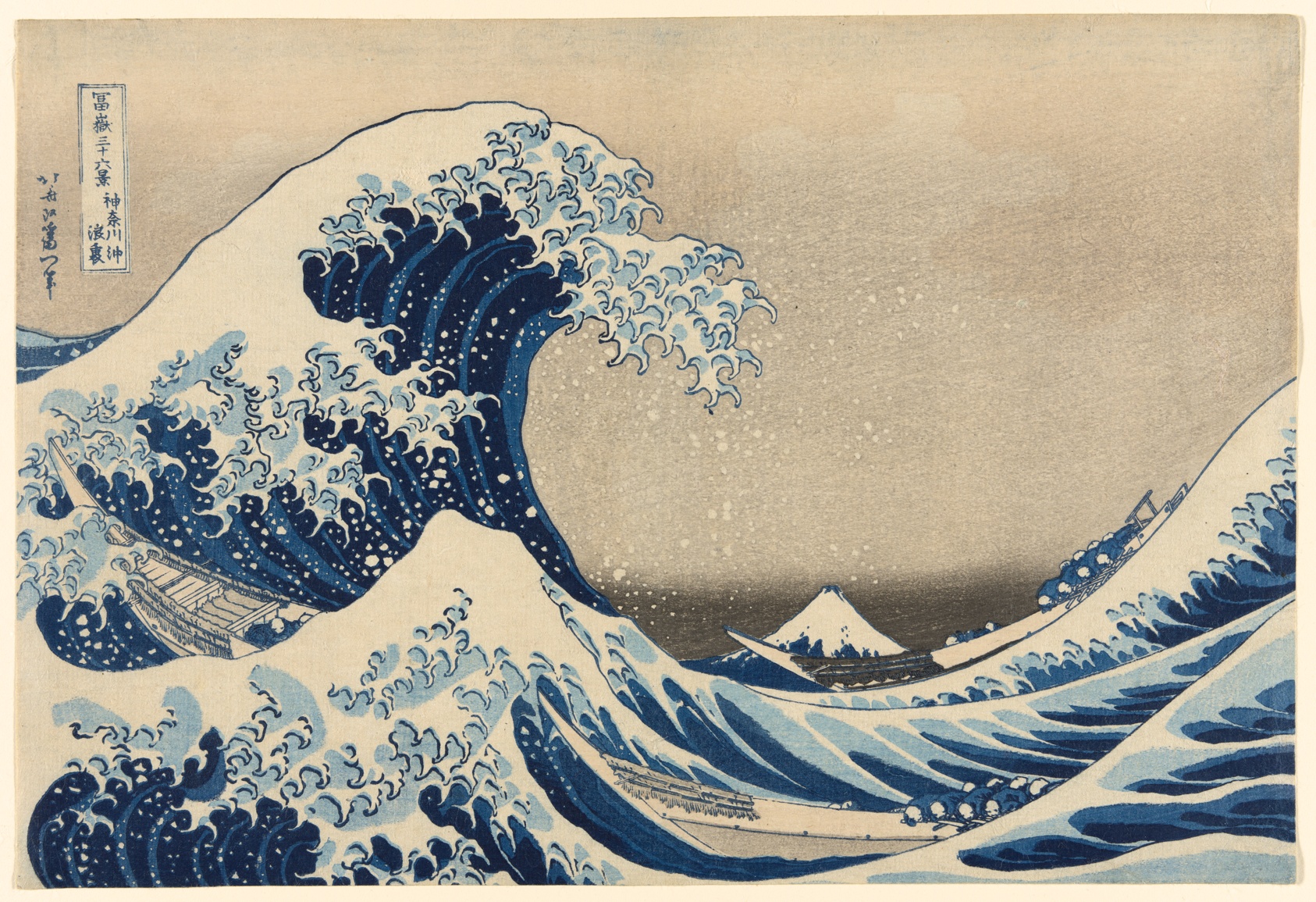
Under the Wave off Kanagawa (Kanagawa oki nami ura), also known as The Great Wave, from the series Thirty-Six Views of Mount Fuji
1830 · Colour woodblock print
Art Institute of Chicago
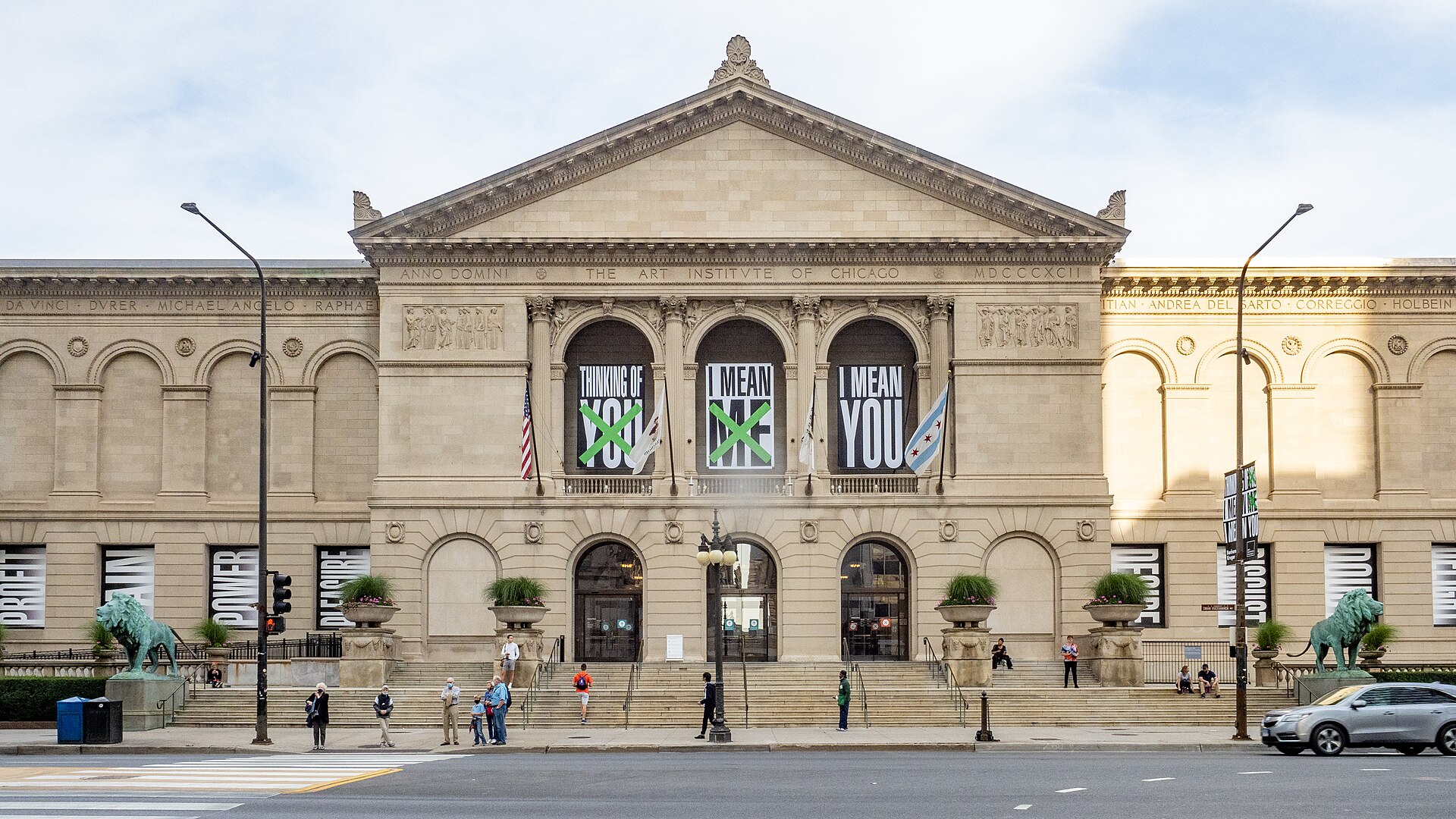
The 1893 Michigan Avenue entrance, with the museum's name and founding date cut into the pediment above the arcade
ajay_suresh, CC BY 2.0Museum · Founded 1879
Open, admission and hours confirmed 11 September 2026 · 18 sources
Close to 300,000 works across eleven curatorial departments and roughly five thousand years, by the museum's own account, built on a scale that lets it be genuinely encyclopedic rather than a European picture gallery with departments attached. Its Impressionist and Post-Impressionist holdings, assembled largely through early Chicago collecting families, are deep enough that critics routinely rank them against the great Paris collections. American art here means two of the most reproduced paintings the country has produced hanging in the same building, and the print, arms and armor, Asian and pre-Columbian departments run just as deep behind them. What distinguishes this collection from a peer of comparable size is the building itself: a Sullivan trading room rescued whole from a demolished skyscraper, a Beaux-Arts shell from the 1893 World's Fair, and a Renzo Piano wing barely two decades old, so that the architecture is not a frame around the collection but a fourth or fifth department in its own right.
| Kind | Museum |
|---|---|
| Founded | 1879, as the Chicago Academy of Fine Arts; moved to the current Michigan Avenue building in 1893 |
| City and country |  Chicago, United States Chicago, United States |
| Address | 111 South Michigan Avenue, Chicago, IL 60603, United States |
| Website | artic.edu |
| Status | Open, confirmed |
| Record last verified |
Prices and hours change. We take them from the institution's own pages and print the day we read them, and you can check the current position at the source we used. Confirm before you travel.
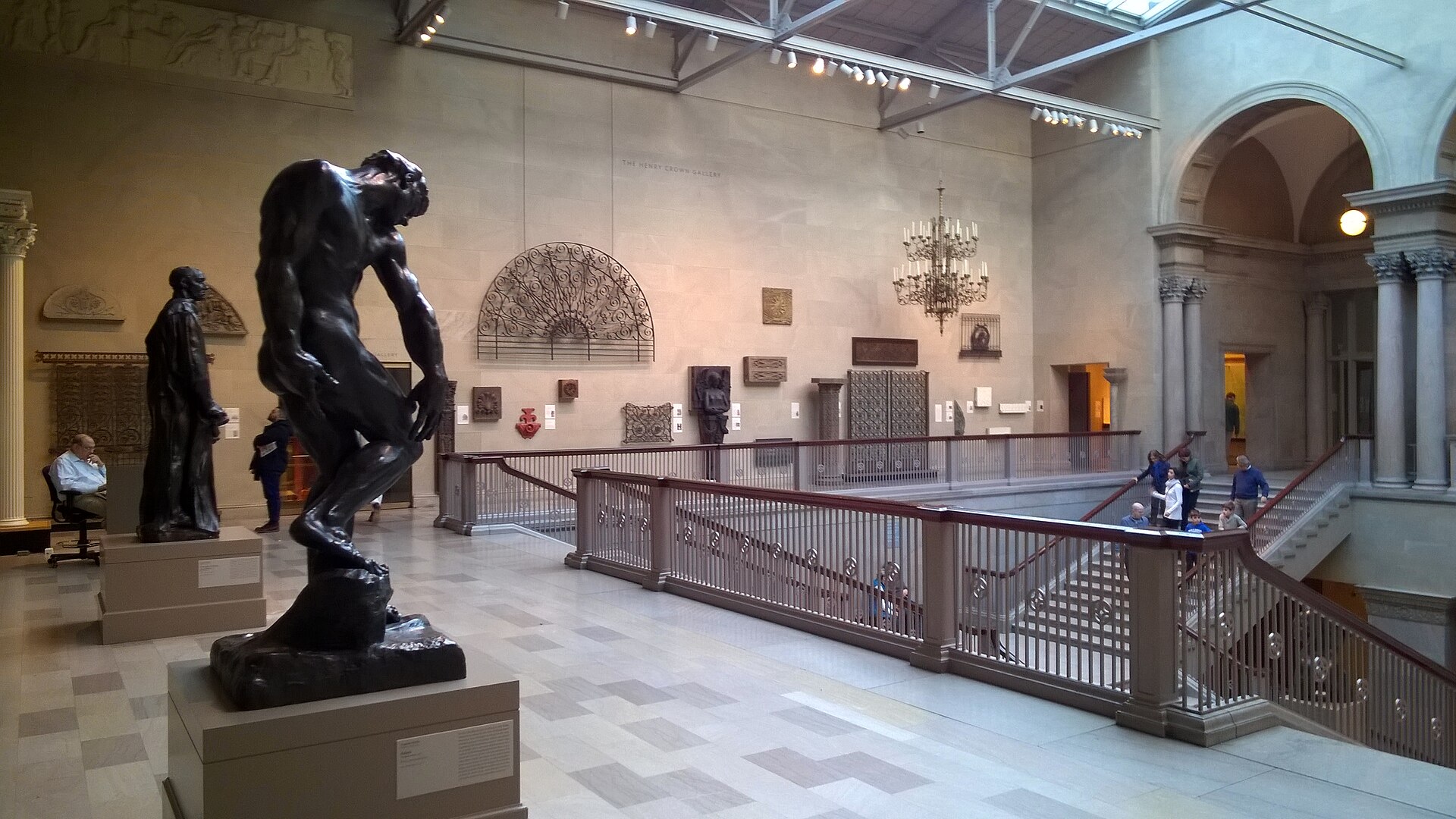
The Beaux-Arts building by the Boston firm Shepley, Rutan and Coolidge, built for the 1893 World's Columbian Exposition and occupied by the museum from the moment the fair closed. Its marble Grand Staircase, flanked by Rodin bronzes on the way up to the European painting galleries, is still the ceremonial route into the collection, and the two bronze lions by Edward Kemeys guarding the Michigan Avenue entrance since 1894 are the most photographed objects the museum owns without being in a gallery at all.
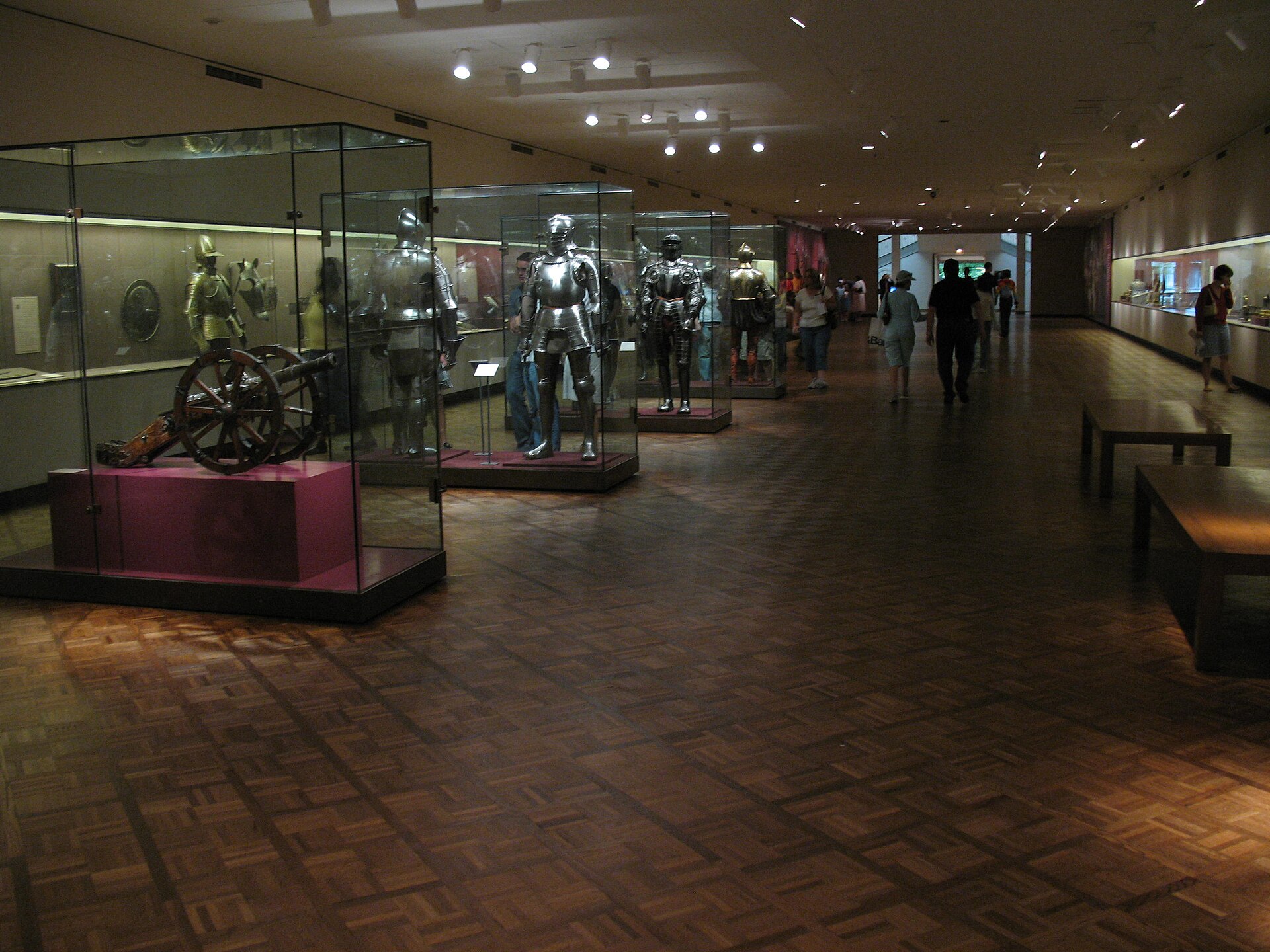
A long top-lit hall of European arms and armor, full suits mounted in glass cases down both sides of a herringbone parquet corridor that runs the length of the original building. It is a permanent-collection hall rather than a special exhibition, and the corridor doubles as one of the main east-west routes through the museum, so most visitors pass through it whether they mean to see it or not.
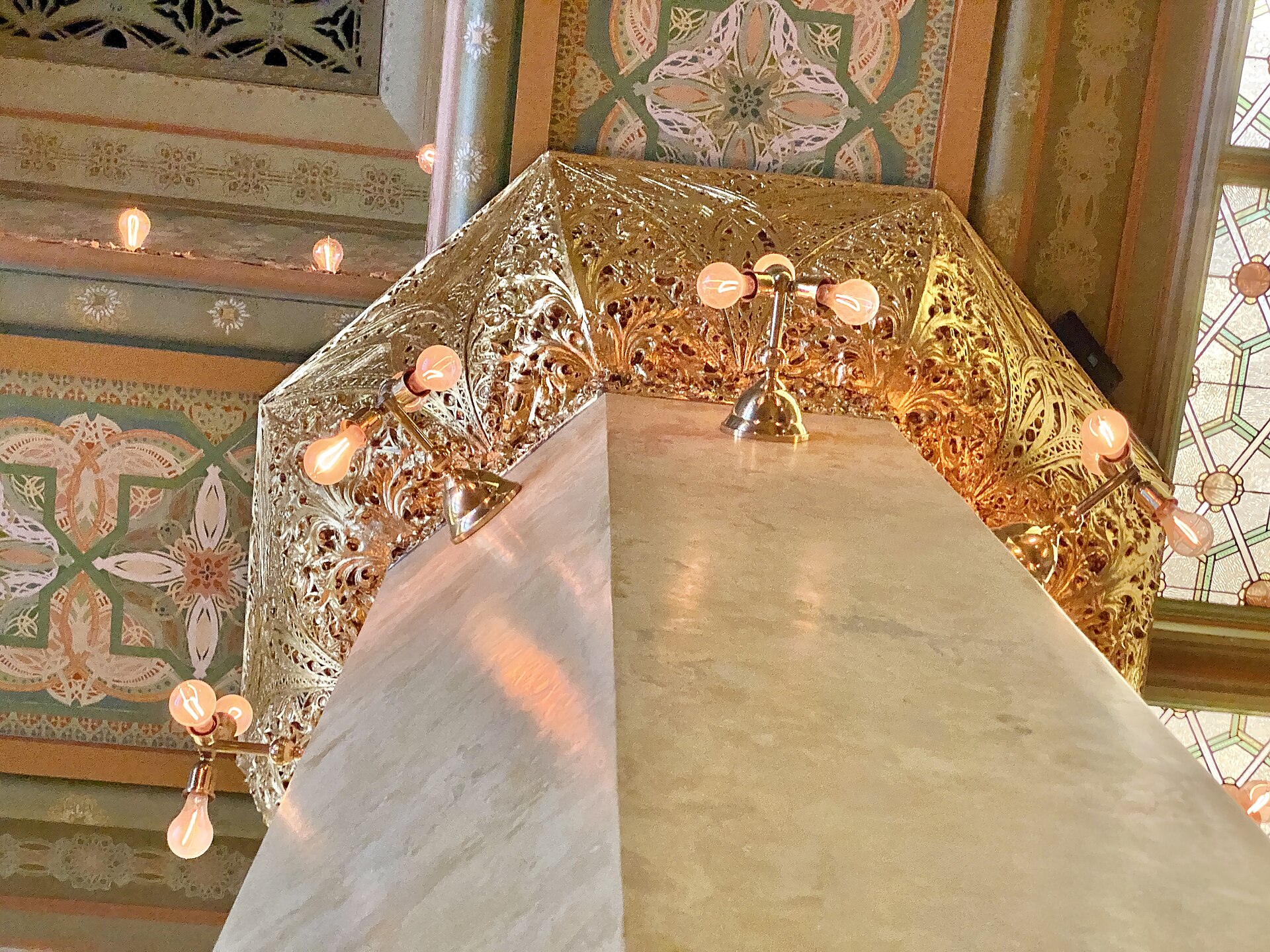
A full double-height trading hall by Dankmar Adler and Louis Sullivan, salvaged when their 1894 Chicago Stock Exchange Building was demolished in 1972 and rebuilt inside the museum's Rubloff Building in a five-year reconstruction completed in 1977. Gilded organic ornament, stenciled walls in more than fifty muted hues, and stained-glass skylights survive because a photographer named Richard Nickel died salvaging the fragments during the original demolition, which is part of why preservationists now watch this room so closely.
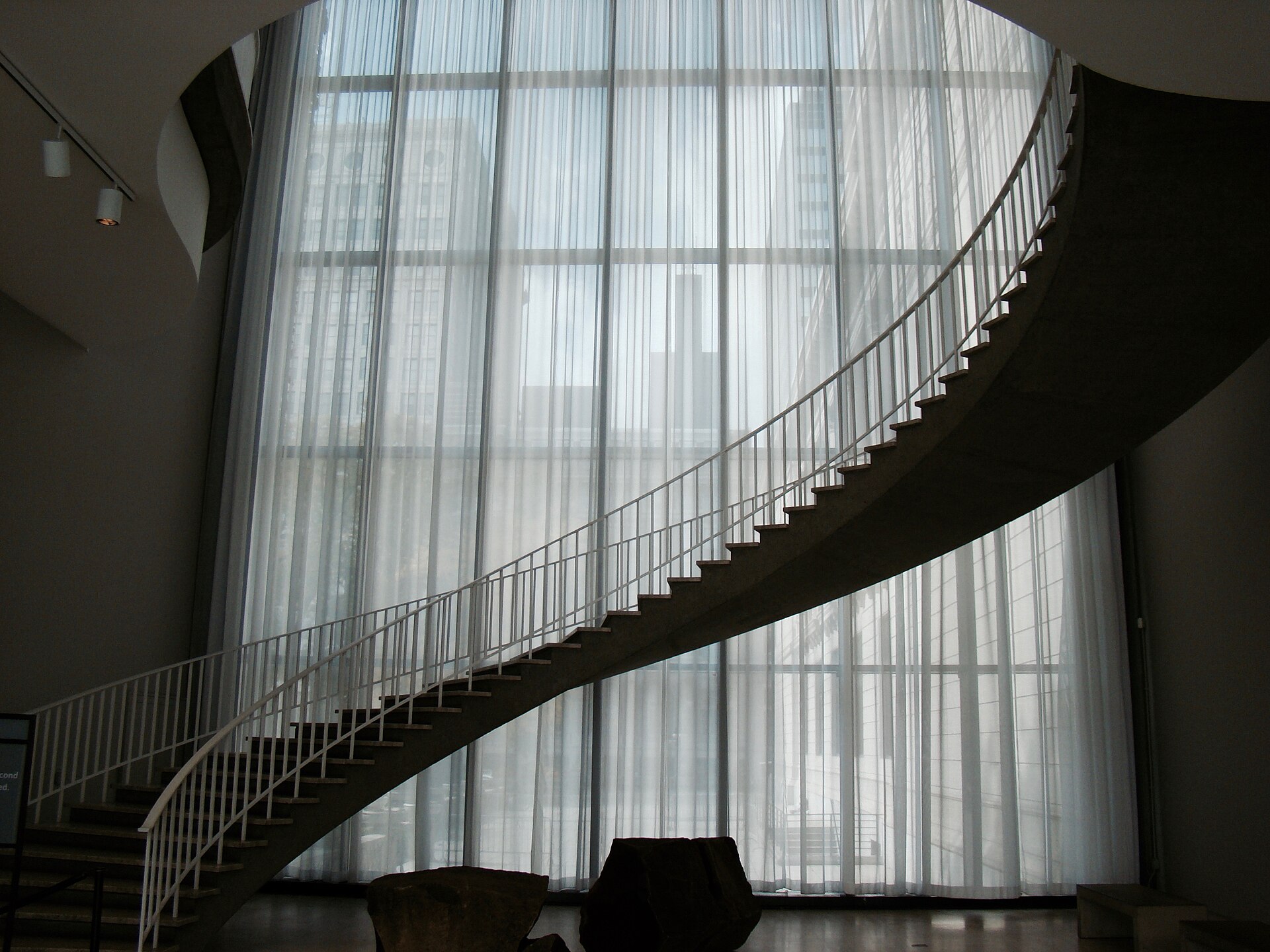
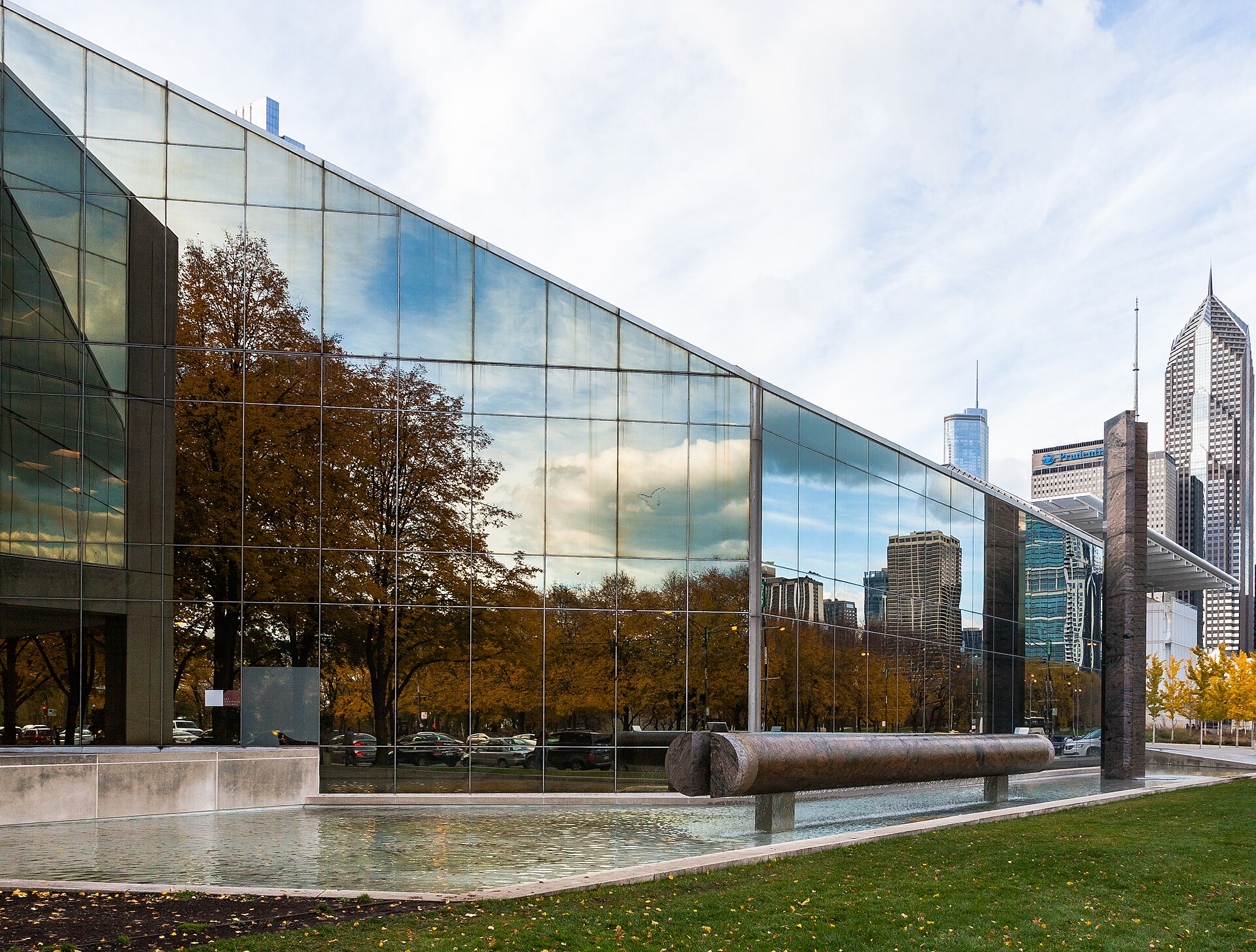
Renzo Piano's 264,000-square-foot addition, opened in 2009, added galleries for modern and contemporary art and for the museum's architecture and design and photography collections, made the museum the second largest in the United States by floor area at the time, and connected to Millennium Park across the street by the Nichols Bridgeway, Piano's own pedestrian bridge over Monroe Street. Griffin Court, the wing's top-lit central hall with its curving concrete stair, is where a Modern Wing visit usually starts and ends.
One of the deepest holdings of French Impressionist and Post-Impressionist painting outside France, built up chiefly through early Chicago collectors, and running from multiple Monets, including canvases from his Haystacks and Water Lilies series, through Georges Seurat's A Sunday on La Grande Jatte to Vincent van Gogh's 1889 Bedroom, the second of the three versions he painted. No verifiable free-licence photograph of the current hang was found for this desk; the paintings themselves are catalogued individually in the highlights below.
The gallery sequence that holds Grant Wood's American Gothic, bought from the artist's 1930 competition entry and never seriously offered for sale since, and Edward Hopper's Nighthawks, bought by the museum for 3,000 dollars in 1942 and now one of the most reproduced paintings of the twentieth century. No verifiable free-licence interior photograph of this specific gallery run was found; the paintings are catalogued individually below.
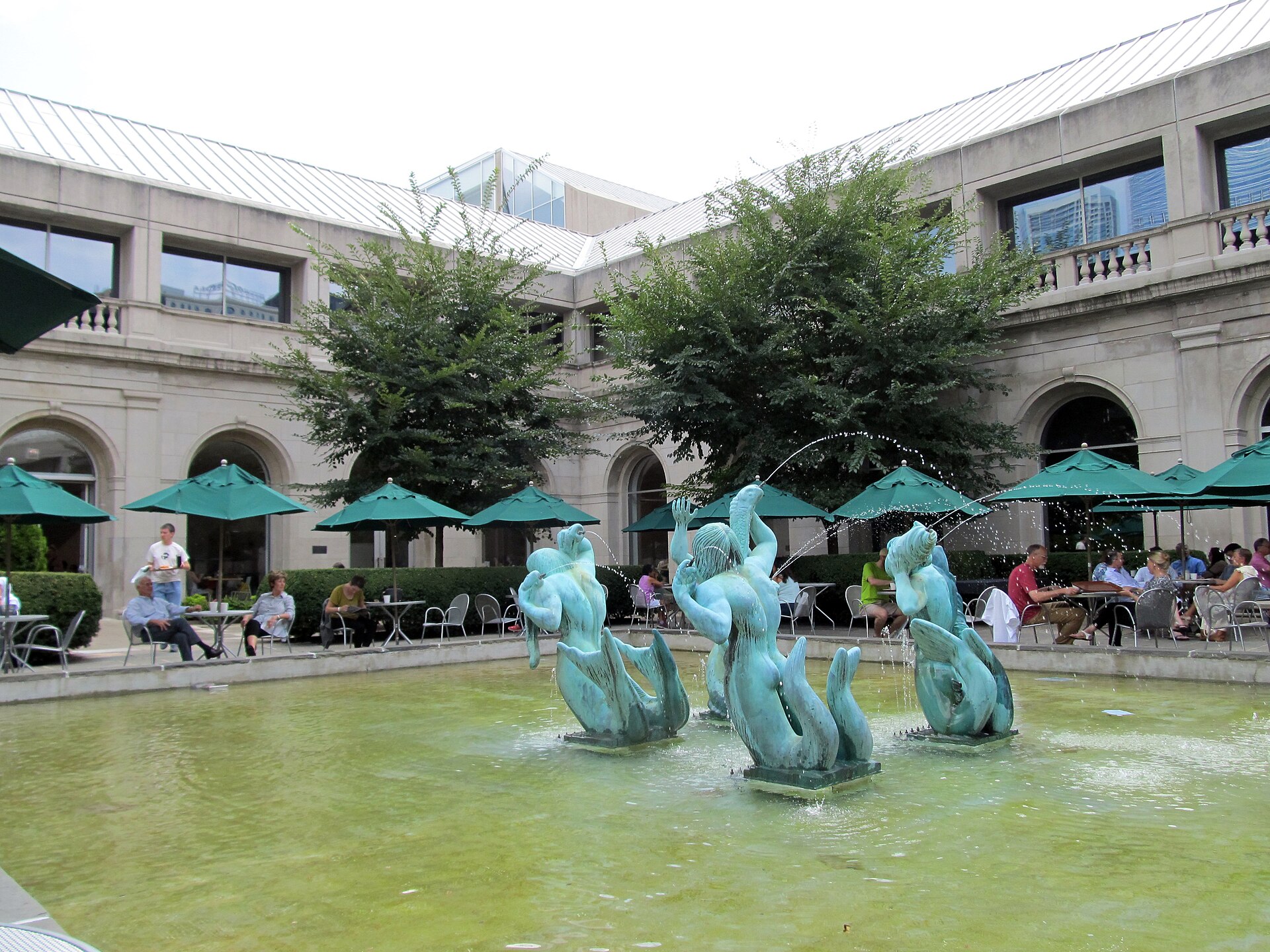
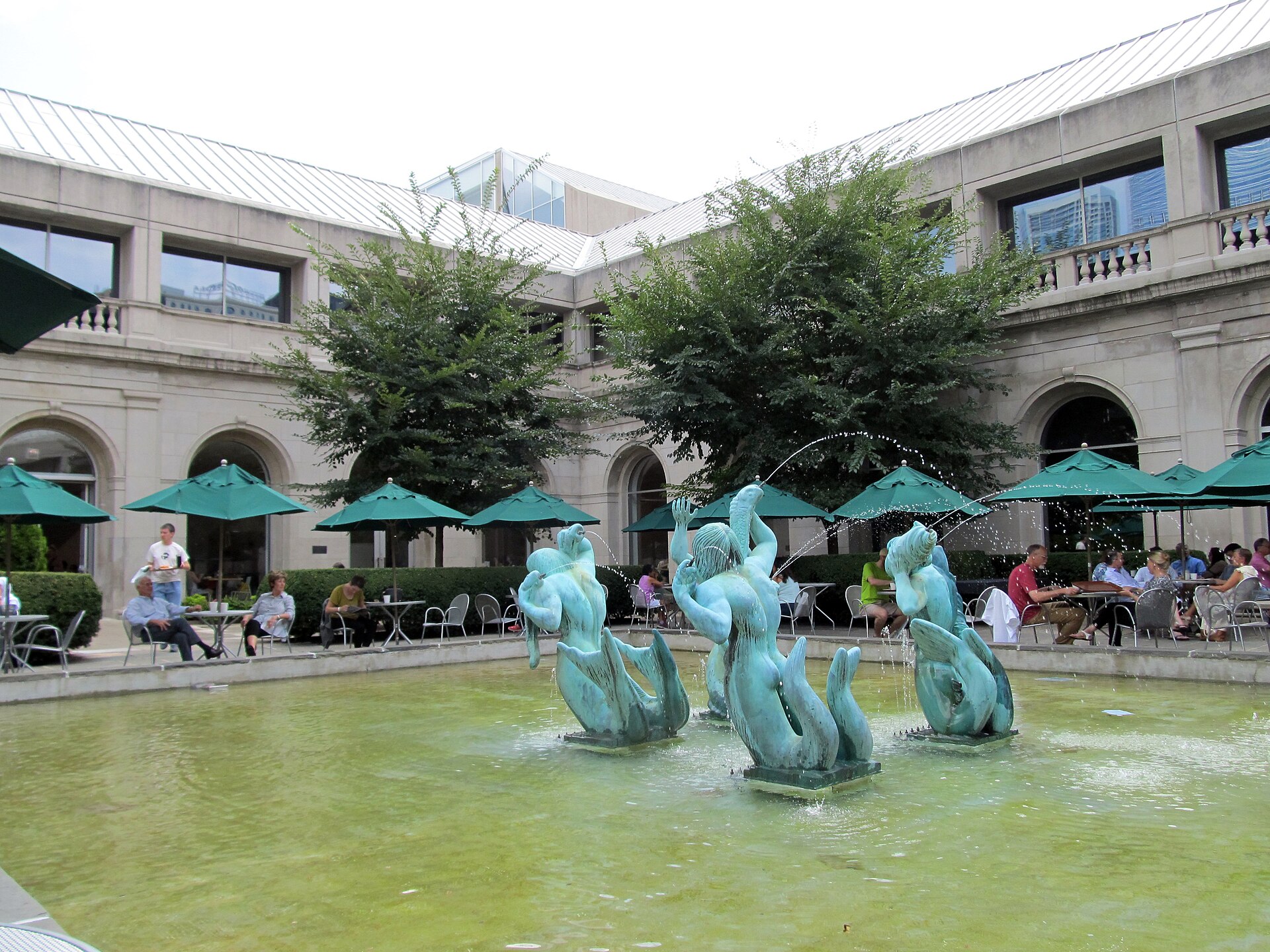
An open-air courtyard behind the original building, ringed by a colonnaded loggia and centred on a bronze fountain of sea nymphs; it doubles as the seasonal outdoor seating for the Cafe on its lower-building side and is one of the few places in the museum where a visitor can sit outside without leaving the grounds.
The museum's own collection page dates it plainly to 1930, the year Wood submitted it to the museum's own annual exhibition and the institution bought it on the spot; it has stayed in Chicago ever since and was not lent outside North America until 2016, so seeing it here has been the only way to see it in person for nearly a century.15
Bought by the museum in the same year Hopper painted it, for 3,000 dollars according to the museum's own account, which makes it one of the rare instances of a painting entering an encyclopedic collection within months of being finished rather than decades later.16
Seurat's largest and most famous pointillist canvas, dated by the museum's own catalogue entry to that specific three-year span including the later border, and the picture that made a Chicago city park a fixed point in the history of painting long before most visitors had ever set foot in Chicago itself.17
The second of three versions Van Gogh painted of his room at Arles, made at the asylum in Saint-Remy after he became convinced the first version, now in Amsterdam, was deteriorating; the third and smallest went to his mother and sister and is now in Paris, which makes the three canvases a rare case where an artist's own repetition of a single composition is split across three continents' worth of museums.18
This archive holds a full record on the museum's own impression, accession 1925.3245 from the Clarence Buckingham Collection. A published survey of 111 surviving impressions worldwide places this specific sheet in a middle printing state, not the earliest, which is the normal condition of any Great Wave a visitor is shown and not a defect particular to Chicago's.10
Full record in this archiveThis archive holds a full record on it, in Gallery 161. A basalt block carved with the date of a Mexica coronation set inside the calendar of the five cosmic eras, bought by the museum from a private collector in 1990 with nothing recorded of its whereabouts before it surfaced at a Los Angeles dealer in 1971, which is exactly the kind of gap a reader should know about before assuming every object with a wall label has a documented life before the sale that brought it here.10
Full record in this archiveA complete Sullivan interior saved from a demolished building rather than a fragment of one, and, as of a March 2026 Chicago Sun-Times report, a room the museum itself has named as the area where an eastward gallery expansion could go, which makes visiting it now rather than assuming it will always be exactly where it is a reasonable piece of advice.13
Two more-than-two-ton bronzes flanking the main entrance since the year after the building opened, one described by the museum's own tradition as standing in defiance and the other as on the prowl; they cost nothing to see, need no ticket, and are the image most people who have never been inside the museum still recognize.10
1830 · Colour woodblock print
Art Institute of Chicago
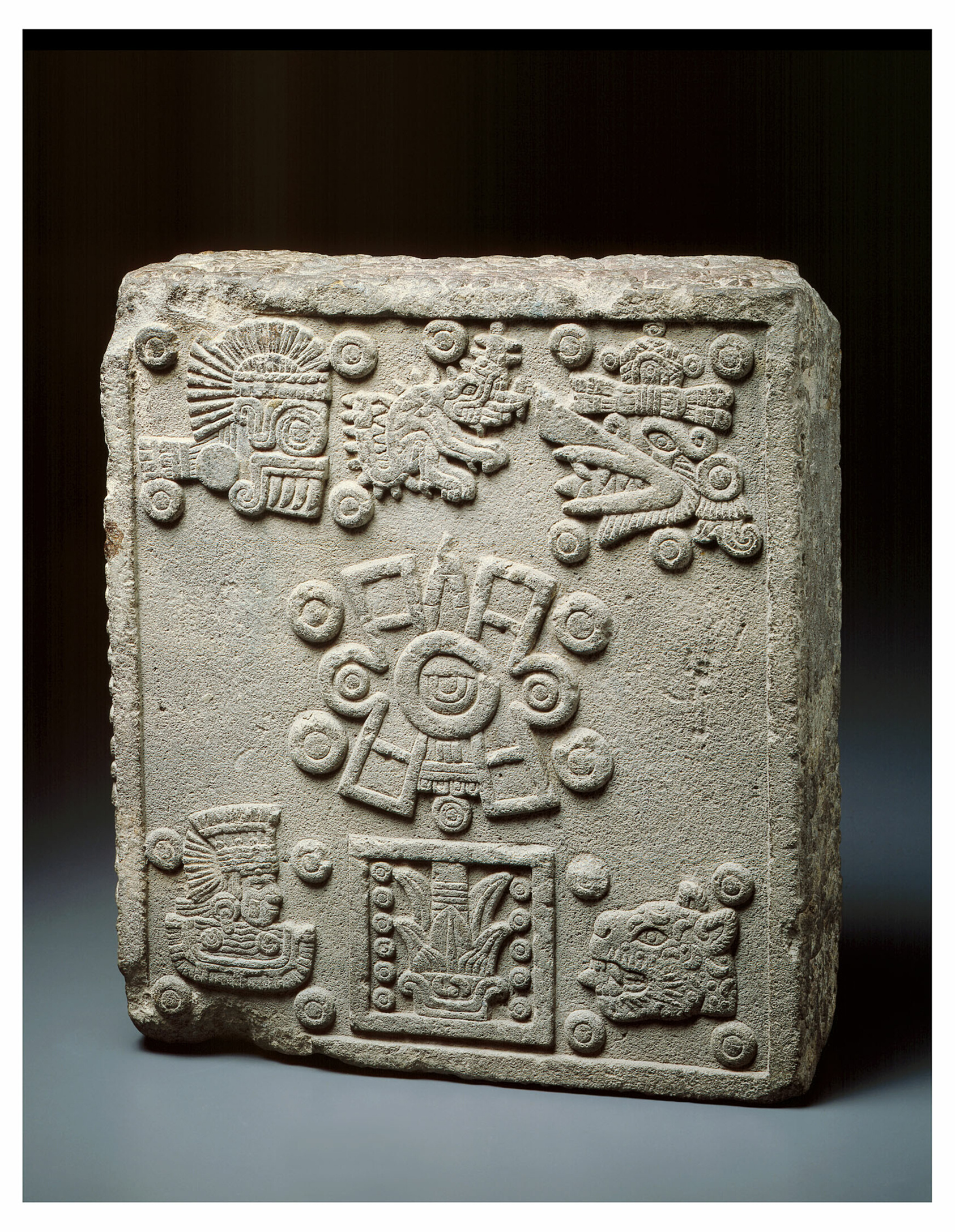
c. 1503 · Basalt
Art Institute of Chicago, Gallery 161
The Art Institute of Chicago began in 1879 as the Chicago Academy of Fine Arts, the successor to an earlier Chicago Academy of Design, and spent its first fourteen years in rented and temporary quarters before the 1893 World's Columbian Exposition gave it an opening. The museum's trustees financed a building on Michigan Avenue jointly with the fair's organizers, on the understanding that the exposition would use it during the fair and the museum would keep it afterward. Shepley, Rutan and Coolidge of Boston designed a Beaux-Arts block faced in limestone, and the museum moved in on 31 October 1893, before the fair had even closed, with an opening reception on 8 December 1893 that featured Theodore Thomas conducting the newly formed Chicago Symphony Orchestra.
Charles L. Hutchinson, the museum's first board president from 1882 to 1924, is generally credited with turning a fairground leftover into a serious institution, recruiting the circle of Chicago merchant families whose names still sit on wings and courts throughout the building. Two bronze lions by the sculptor Edward Kemeys were unveiled at the Michigan Avenue entrance on 10 May 1894, each weighing more than two tons, and have stood there ever since; museum tradition describes the south lion as standing in defiance and the north as on the prowl. By the time the building settled into its final form, it straddled a set of active railroad tracks running beneath its rear courtyards, a detail so odd that the museum still mentions it in its own visitor materials.
Not everything inside the museum was built for it. The Chicago Stock Exchange Trading Room, designed by Dankmar Adler and Louis Sullivan for their 1894 Chicago Stock Exchange Building on LaSalle Street, was salvaged when that building was demolished in 1972, an event during which the architectural photographer and preservation activist Richard Nickel died while helping to remove its ornament. Architects John Vinci and Lawrence Kenney spent five years reconstructing the trading hall inside the museum's Rubloff Building, and it reopened there in 1977: a two-story, hundred-by-seventy-five-foot room of Sullivan's organic ornament, stenciled walls in more than fifty muted hues, and stained-glass skylights, salvaged rather than replicated.
That history is not settled. The Chicago Sun-Times reported in March 2026 that the museum, weighing an eastward expansion, has identified the Trading Room's own location as the area where new gallery space could grow the most, prompting Preservation Chicago to add the room to its 2026 list of the city's most endangered places and its executive director to urge the museum to expand without damaging its most beloved spaces. The museum's own statement was that no decision has been made, and that relocating the room, if it comes to that, would be handled in partnership rather than simply cleared away. A visitor reading this page today is looking at a room whose future the museum itself has said is not yet decided.
Renzo Piano's Modern Wing opened on 16 May 2009, a 264,000-square-foot addition that cost roughly 294 million dollars inside a larger 385 million dollar campaign and made the museum, briefly, the second-largest art museum in the United States by floor area. It gave the museum dedicated galleries for modern and contemporary art, architecture and design, and photography, along with the Nichols Bridgeway, Piano's own pedestrian bridge running from the wing's rooftop sculpture terrace across Monroe Street into Millennium Park. Attendance rose by roughly a third in the wing's opening year.
The wing was not received as an unqualified triumph on opening. Writing for Newcity at the time, the critic Jason Foumberg found parts of the interior cramped, its central stairway too narrow for opening-weekend crowds, and some of its window-louvered galleries dim enough to underlight the work on view; he also read the inaugural modern and contemporary installation as narrower in range than the promise of an inclusive museum, while conceding that the building itself would likely outlast the argument. Griffin Court, the wing's top-lit central hall, is nonetheless where most Modern Wing visits now begin, and its curving concrete staircase against a wall of sheer glass is one of the more photographed interior spaces the museum has added in its second century.
Grant Wood's American Gothic and Edward Hopper's Nighthawks both entered the collection within a decade of being painted, and both did so in ways that now look almost accidental. Wood submitted American Gothic to the museum's own annual exhibition in 1930, where it won a medal despite a genuinely mixed early reception, and the museum bought it outright; it did not travel outside North America until a loan in 2016. The museum bought Nighthawks in 1942, the same year Hopper painted it, for 3,000 dollars, a purchase that the museum's own account credits with launching the painting toward the recognition it has now.
Both paintings hang in the American art galleries alongside deep, less famous holdings, and both are now reproduced so often, on tote bags, in film parody and in advertising, that a first-time visitor sometimes has to be reminded these are the actual canvases and not reproductions. The museum's collection is large enough that a visitor who comes only for these two paintings, or for Seurat's A Sunday on La Grande Jatte and Van Gogh's Bedroom a few galleries over, will still walk past arms and armor, ancient Mexico and Sullivan's stenciled trading hall to reach them.
This museum is a party to provenance, not a neutral host, and its recent record shows it. A New York Supreme Court judge ruled on 23 April 2025 that the museum must return Egon Schiele's 1916 drawing Russian War Prisoner to the heirs of Fritz Grunbaum, the Austrian Jewish cabaret performer from whom the Nazis took it before he was murdered at Dachau in 1941. The court found the museum's account of the drawing's later sale, through Grunbaum's sister-in-law and a dealer whose supporting paperwork investigators concluded had been forged, did not hold up, and rejected the museum's argument that the claim fell outside the Manhattan District Attorney's jurisdiction. The museum has said it is reviewing the ruling and weighing an appeal.
The case sits inside a wider set of Schiele works traced to Grunbaum's collection that have surfaced across other American museums and private collections over the past two decades, several already returned to his heirs by other institutions. It is not this desk's place to predict how the appeal will end, only to record that, as of the date on this page, the museum has lost the claim at first instance and has not conceded it. A reader planning a visit around a specific object should check the museum's own collection pages before travelling, since a drawing under active litigation is exactly the kind of thing that can leave a gallery wall on short notice.
The museum's own federal tax filing for the year ending 30 June 2024 reports total revenue of just under 494 million dollars, total assets of just over 2.07 billion dollars, and a workforce of 3,590 employees supported by 170 volunteers and a 61-member governing board, figures that put it among the largest cultural non-profits in the country rather than a purely civic amenity. The School of the Art Institute of Chicago is legally part of the same corporation, sharing the Art Institute's charter and its website domain on the same filing, which makes it one of the few American institutions where the museum and the art school that trains many of its own future conservators and curators are, on paper, one organization.
None of that scale changes what a visitor actually does at the door: buy a ticket, discounted heavily by residency, age and a long list of partner programmes, or none at all if a free-admission category applies, and walk into a building whose oldest room predates the Model T and whose newest wing is not yet twenty years old.
We reproduce no visitor review prose and cite no invented star average beyond the single aggregate logged below. What is consistent across the museum's own published materials and the named journalism this desk read is that the collection's range, not any single painting, is what visitors and critics both come back to: French Impressionism deep enough to rival Paris, an American art wall carrying two of the most reproduced paintings the country has produced, and departments in arms and armor, ancient Mexico, Chicago architecture and reconstructed Sullivan ornament that a visitor who only came for the paintings did not expect. The friction points are not the admission price, which the museum discounts heavily for residents, students and a long list of free-admission groups, but the building itself: a first-time visitor's most common complaint is simply that there is too much to see in one visit, and the museum's own free daily tours and hour-long self-guided app tour exist because it knows this. On provenance, the record is genuinely open, not settled, and is discussed below rather than smoothed over.
Tripadvisor: 4.8 from 24,789 ratings, read 12 August 2026
A platform average is a tertiary source: it moves, it is not audited, and we quote no visitor's words.
111 South Michigan Avenue, Chicago, IL 60603, United States.
Adult: USD 32; Senior (65+), student with valid ID, or Chicago resident with proof of address: USD 26; Teen (14-17): USD 26; Illinois resident, adult: USD 20; Illinois resident, senior or student: USD 14. As confirmed 11 September 2026.
Monday 11:00-17:00; Tuesday closed; Wednesday 11:00-17:00; Thursday 11:00-20:00; Friday-Sunday 11:00-17:00. Closed: Every Tuesday. The museum states it opens regular hours on Memorial Day, Juneteenth, 4 July and Labor Day rather than closing for them. As confirmed 11 September 2026.
L train: One block west at Adams/Wabash, served above ground by the Brown, Green, Orange, Pink and Purple lines. The Red and Blue lines stop underground a few blocks away at Monroe. Fare is set by the Chicago Transit Authority and was 2.50 dollars per adult ride at last check; Metra commuter rail: The Van Buren and Millennium stations sit underground one to two blocks south and north of the museum along Michigan Avenue; Car and parking: Four underground Millennium Garages sit adjacent to the museum; the Millennium Park Garage at 6 South Columbus Drive is the most convenient, its pedestrian lobby directly across East Monroe Street from the Modern Wing entrance. Members above the base level get a parking discount voucher at the membership desk; Bike share: Several Divvy bike-share docking stations sit within walking distance of both entrances.
American Gothic (Grant Wood, 1930); Nighthawks (Edward Hopper, 1942); A Sunday on La Grande Jatte, 1884 (Georges Seurat, 1884-86, with a painted border added 1888-89); The Bedroom (Vincent van Gogh, 1889); The Great Wave (Katsushika Hokusai, block cut about 1830-33); Coronation Stone of Moctezuma Xocoyotzin (Unrecorded Mexica sculptor, Tenochtitlan, about 1503).
One artwork and its story every Tuesday, with the picture: who owned it, what it made, and what closes soon in the exhibition calendar. No promotion, and nothing we cannot cite.
We send one email to confirm the address and keep nothing else. Every letter carries a one-click unsubscribe. How we handle your data.