On Display Is a Calendar, Not a Place
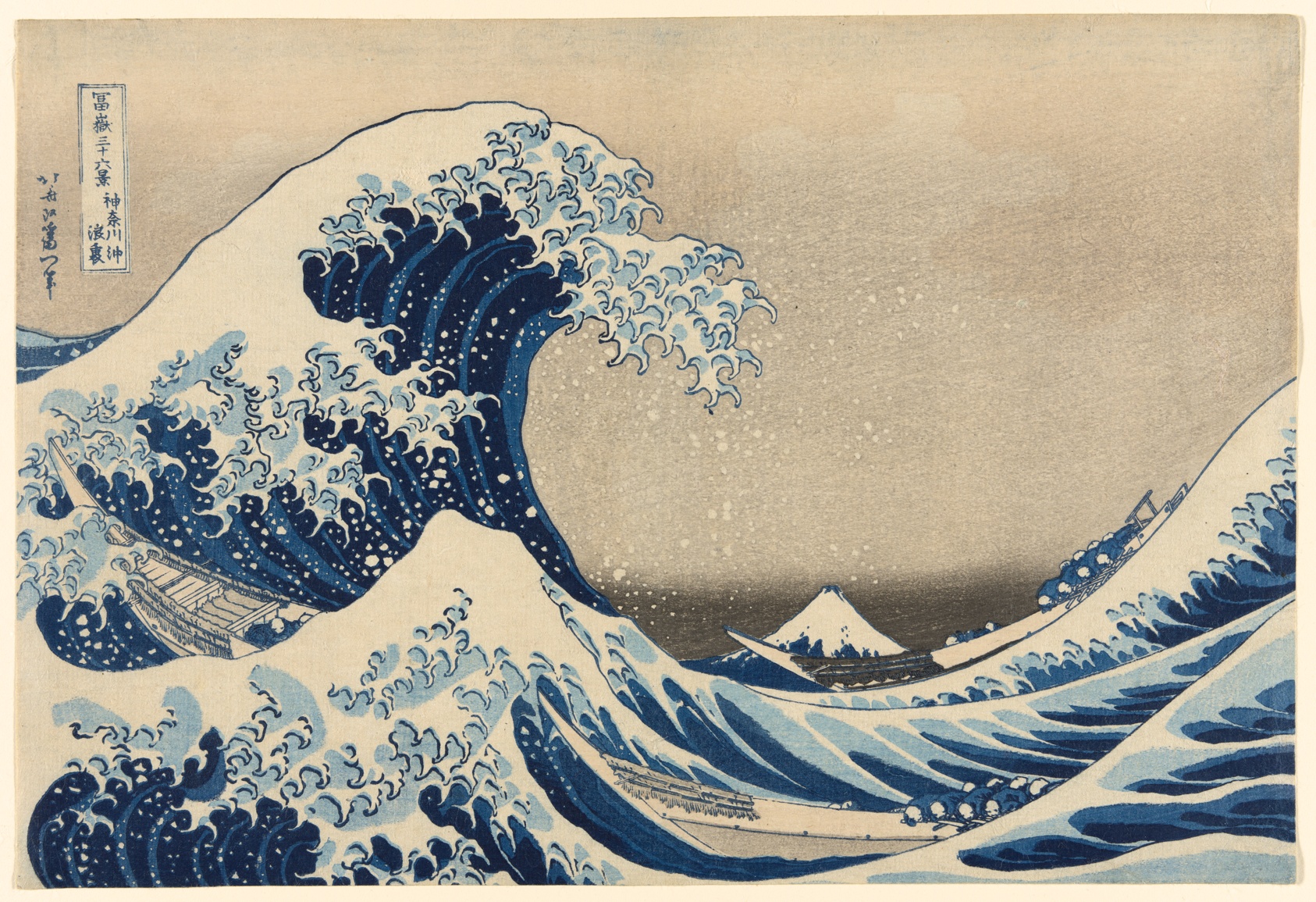
The Art Institute of Chicago owns three impressions of the Great Wave and on 7 September 2026 none of them was on view. For light-sensitive material a permanent collection is a rota, and where an object is and whether it can be seen are two different facts.
Records in this piece: Under the Wave off Kanagawa (Kanagawa oki nami ura), also known as The Great Wave, from the series Thirty-Six Views of Mount Fuji, Irises (Kakitsubata-zu), Minister Kibi's Adventures in China (Kibi daijin nitto emaki), Hereford Mappa Mundi, View from the Window at Le Gras
On this page 10 sections
ContentsClose
In short
- Checked on 7 September 2026 through the museum's own public interface, all three of the Art Institute of Chicago's impressions of Hokusai's Great Wave, accessions 1925.3245, 1928.1086 and 1952.343, return is on view false with no gallery assigned.
- The Nezu Museum showed its National Treasure Irises screens from 11 April to 10 May 2026. Allowing for the Monday closures that is 27 open days, about 7 per cent of the year, and it is the reason the screens have survived three centuries on paper.
- The Canadian Conservation Institute's guidance sets 50 lux as the museum benchmark, chosen sixty years ago because colour science had established that the eye is still within full colour vision at that level, and defines exposure as lux multiplied by hours. Damage is proportional to intensity, so the currency is not brightness but dose.
- The Hereford Mappa Mundi is held at 25 lux, half the benchmark, in a case built around one object at a constant 17 degrees Celsius and 55 per cent relative humidity with ultraviolet-filtering glass throughout.
- Scroll one of the Kibi Daijin emaki at the Museum of Fine Arts, Boston, accession 32.131.1, is 804.9 cm long overall and its record reads NOT ON VIEW. A handscroll cannot be shown whole even in principle, so what a visitor sees is always an editorial selection made by a curator.
- The Niepce heliograph is permanently on view at the Harry Ransom Center in a sealed, monitored, oxygen-free case, and a visitor photograph of it in that case shows a grey sheen and a reflection. The first photograph is one of the most continuously displayed and least visible objects in any collection.
Where an object is and whether it can be seen are two different facts
A collection record answers the question of location and is routinely read as answering the question of access, and for a large class of objects those two answers have nothing to do with each other. A painting in a permanent gallery is on the wall most days of most years. A print, a drawing, a watercolour, a manuscript, a textile or a photograph in the same building is in a box in a store almost all of the time, and appears for a few weeks under lights kept deliberately low.
This is not a failure of museums. It follows directly from the physics of what light does to organic colourants, and any institution that displayed those objects the way it displays its paintings would be destroying them in public. But it does mean that for whole classes of object the honest answer to where can I see this is a date rather than a room, and the catalogue almost never gives you the date.
We publish records of individual objects, so this matters to us practically. An entry that says an object is in a named museum, without saying that the museum shows it for a month every second or third year, has told a reader something true and let them believe something false.
The benchmark is fifty lux, and what accumulates is dose rather than brightness
Fifty lux is the number the museum world settled on, and Stefan Michalski's account for the Canadian Conservation Institute explains where it came from. When lighting guidelines were first explored about sixty years ago, colour science had established that 50 lux was enough to keep the human eye operating well within full colour vision, and conservation adopted it as the benchmark. It was never a claim that 50 lux is safe. It was a claim that below 50 lux you stop seeing in colour properly, so there is no point going lower.
The quantity that actually damages is exposure, and Michalski defines it exactly: the total exposure or dose of light on a surface is the product of light intensity in lux and time in hours, expressed in museums as millions of lux hours. The rate of damage is proportional to intensity. That is why a curator can trade brightness against time, and why the calculation that governs display is a budget rather than a threshold.
Two consequences follow, and they are the whole argument of this piece. A museum that wants to show a sensitive object more often has to show it more dimly, and a museum that wants to show it well has to show it rarely. And because the eye needs more light with age, as Michalski notes, the visitor least able to see at 50 lux is often the one who has waited longest to come.
The framing he puts on the dilemma is the fairest we have read anywhere. It is a balance between the rights of our own generation and the rights of all future generations, and there is no arrangement in which nobody loses.
Three impressions of the most famous print in the world, none of them on view
The Art Institute of Chicago holds three impressions of the Great Wave and on the day we checked, 7 September 2026, none of them was on display. The Museum's public collection interface reports a live on-view flag for every object, and for accessions 1925.3245, 1928.1086 and 1952.343 it returned false, with no gallery assigned to any of the three.
That is a dated observation and not a criticism. Japanese print galleries rotate on a cycle of weeks precisely because the alternative is to fade the impressions, and holding several impressions of one design is what lets an institution keep showing the design while resting the sheets. Owning three is a conservation strategy as much as a collecting one.
But hold the two facts together. The best-known image in Japanese art exists in this collection in triplicate, is catalogued, photographed, published and freely reproduced, and on an ordinary Monday in September a visitor who travelled to Chicago to look at it would have found no impression of it on a wall. The reproduction is permanently available and the object is not.
Our own record for this print carries a related caution we have not been able to resolve: press coverage of a 2024 rotation did not say which accession was shown, and the Museum's artwork pages returned a bot challenge when we tried to check directly. Which sheet the public saw is not currently establishable from the published record.
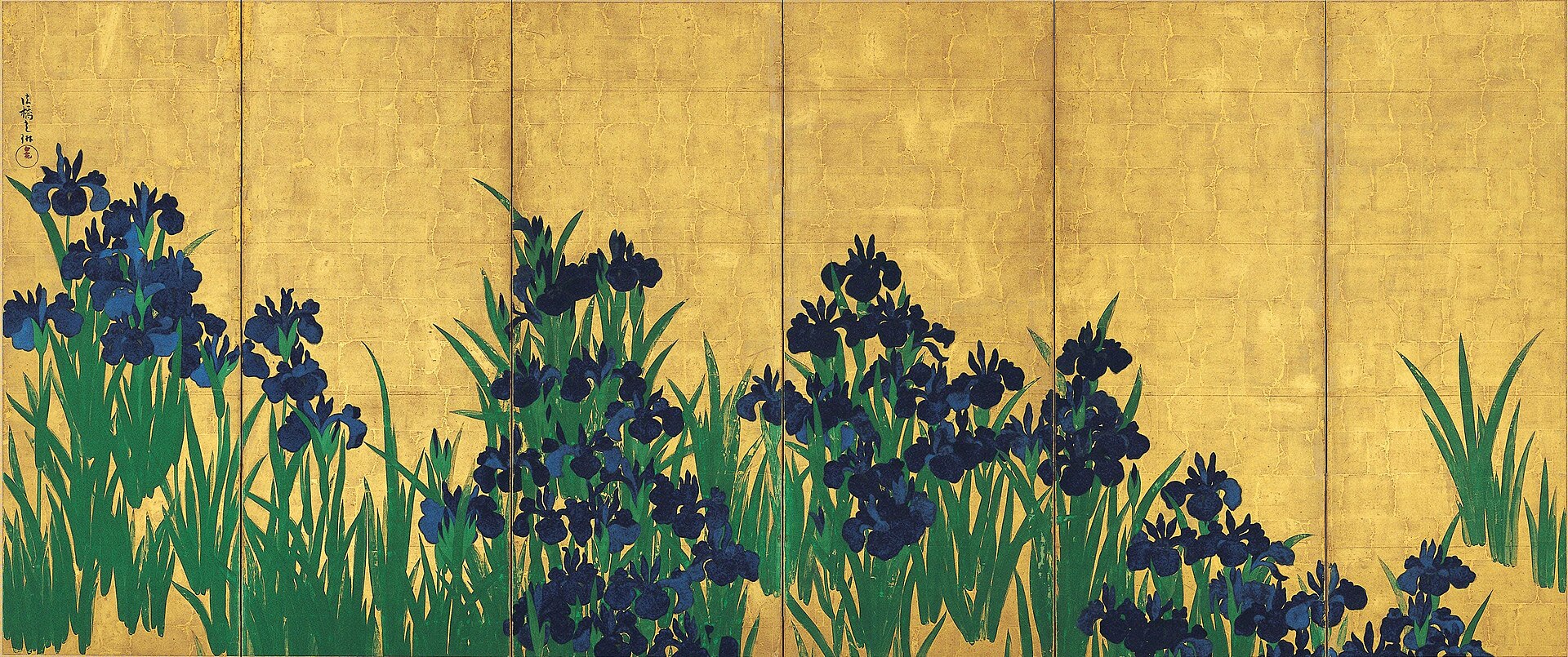
A National Treasure with a season of about four weeks
The Nezu Museum shows Korin's Irises for about a month a year, in spring, when the flowers the screens depict are in season. The 2026 showing ran from Saturday 11 April to Sunday 10 May, inside a special exhibition marking the museum's eighty-fifth anniversary, with the pair hung in galleries 1, 2 and 5 alongside works by Korin's followers, some of them lent back from the Cleveland Museum of Art for the occasion.
Count the days. That is a thirty-day window, and the museum closes on Mondays except for 4 May, which leaves 27 days on which a member of the public could stand in front of them: about seven per cent of the year. For the other three hundred and thirty-eight days one of the defining objects of Japanese painting is in storage.
Ink, mineral pigment and gold leaf on paper is close to the most vulnerable combination a museum handles, and a seasonal showing is the arrangement that has kept a three-hundred-year-old paper object stable enough to still hold National Treasure designation. The pairing of the display season with the flowering season is a piece of curatorial grace on top of a conservation constraint, and it happens to make the constraint legible to a visitor who would otherwise experience it as an absence.
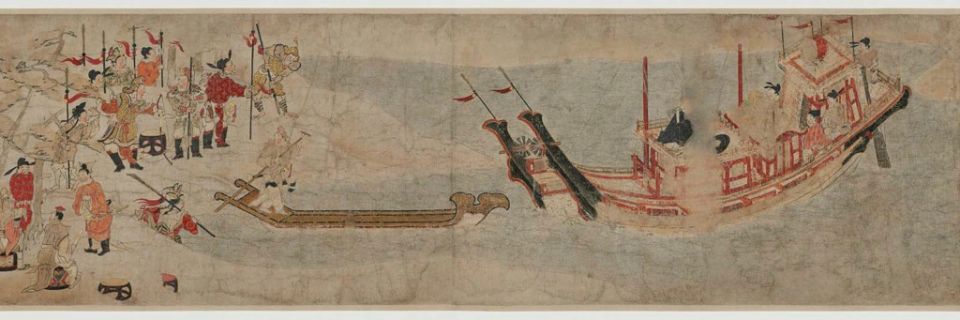
A handscroll cannot be shown whole, so what you see is an edit
Scroll one of the Kibi Daijin emaki is 804.9 cm long, and its record at the Museum of Fine Arts, Boston reads NOT ON VIEW. It is one of four scrolls, so the complete work runs to something on the order of twenty-four metres, and light exposure is only half the reason it is rarely out. The other half is that a handscroll was designed to be unrolled by hand, an arm's length at a time, by one person at a time. A case can hold a metre or two of it.
Which means that display of an emaki is necessarily an act of selection. Somebody decides which passage the public sees, and that decision, repeated over decades, quietly determines which scenes get reproduced, taught, remembered and argued about. The famous section of a scroll is frequently the section that fits a vitrine.
The Museum publishes the work in its Japanese Masterpieces catalogue of 2012 and its Arts of Japan highlights of 2008, so there is no question of its being neglected or unloved. It is simply an object whose full extent lives in reproduction and in scholarship rather than in any exhibition that has ever been mounted.
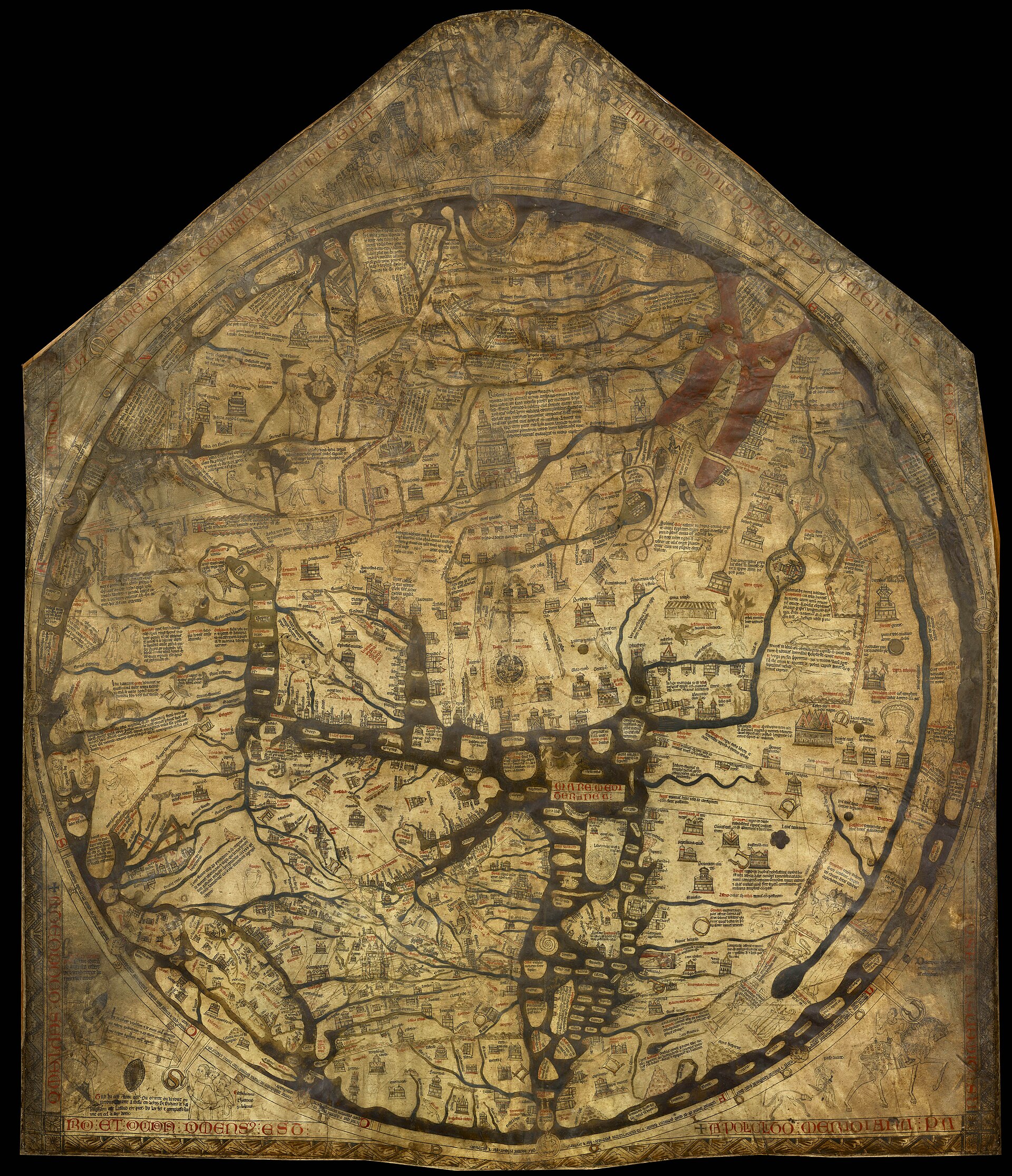
Twenty-five lux, and a case built around one object
Hereford Cathedral displays its Mappa Mundi at 25 lux, half the conservation benchmark. The figure comes from the Cathedral's own management plan, submitted as part of the 2006 UNESCO nomination, which also specifies a constant 17 degrees Celsius, 55 per cent relative humidity and ultraviolet-filtering glass throughout the case. The environment was designed around this single object.
Twenty-five lux is dim. It is roughly the light of a well-lit corridor at night, and a visitor coming in from a bright cloister needs several minutes of dark adaptation before the map resolves into something readable at all. The trade is deliberate: at half the benchmark intensity the same annual dose buys twice the hours, and the map is displayed continuously rather than seasonally.
Set that against the Nezu, which takes the opposite side of the same equation, showing the Irises well for four weeks and not at all for the rest of the year. Both institutions are solving the identical problem and they have chosen different terms. Neither choice is available to a reader of the catalogue, because the catalogue records the room and not the terms.
The first photograph is permanently on view and almost invisible
The Niepce heliograph is one of the most continuously displayed objects in any museum and almost nobody has seen the picture on it. It is a pewter plate, and the image sits in a bitumen layer that reads as an image only under raking light and from a particular angle; tilt it wrongly under ordinary lighting and it returns a blank grey sheen and the viewer's own reflection.
The Ransom Center sent it to the Getty Conservation Institute in 2002 for the first scientific study of its composition and condition ever conducted, and the Institute designed and built the continuously monitored, oxygen-free case that replaced the failing original. The plate went back on view in spring 2003, accompanied by a new official photograph of the object made, for the first time, without manual retouching.
That last detail is the one we keep returning to. For most of the twentieth century the world knew this object through a 1952 copy print made by Kodak's London laboratory, retouched to make the scene legible, and that retouched version is what appears in the histories. The object is on permanent public display and the image everybody has in their head is a photograph of a photograph, improved by hand.
Here the constraint is not a lux budget, since the plate is not fading. It is that visibility and preservation are different problems, and solving the second one perfectly, in a sealed atmosphere behind glass, does not solve the first.
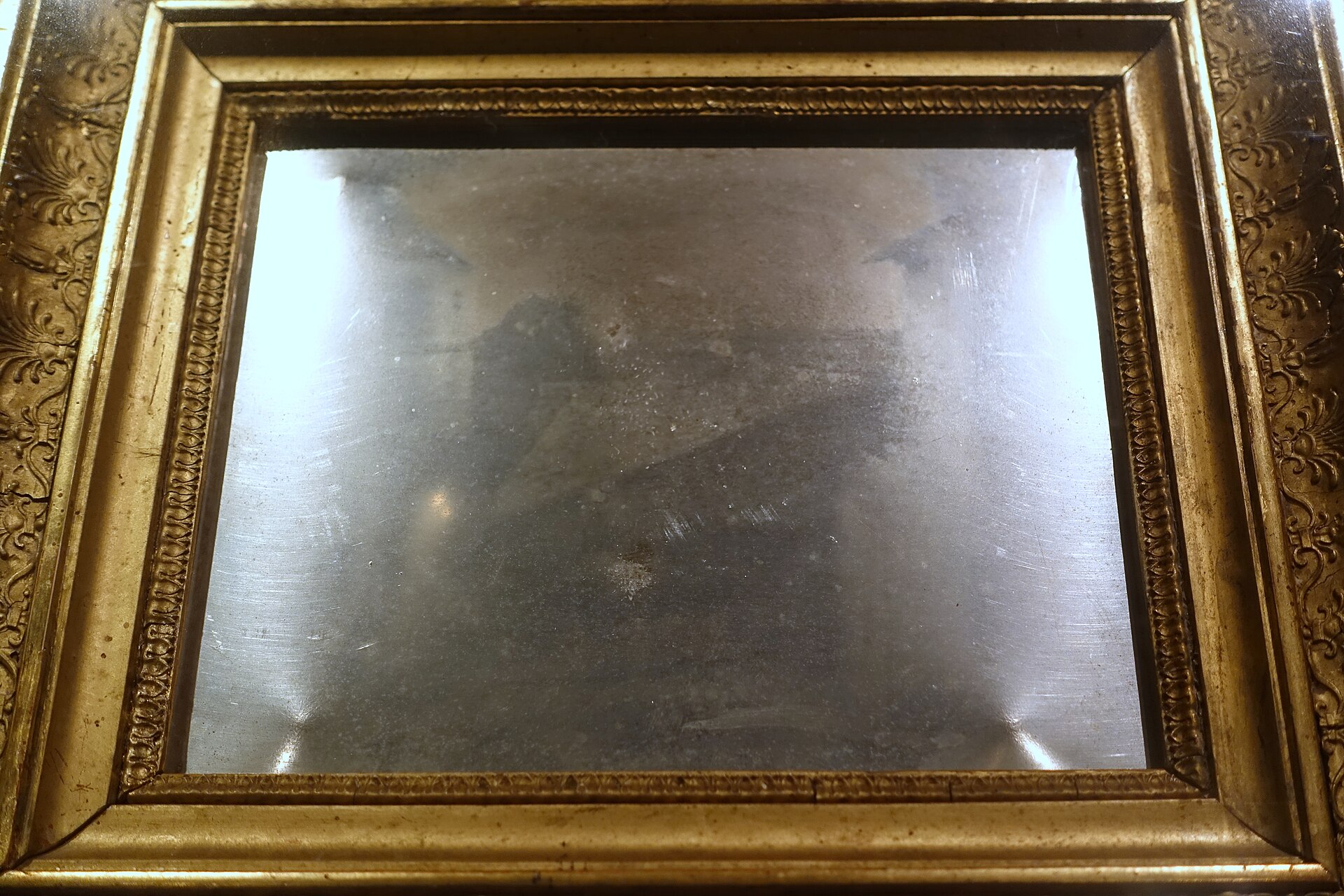
What the rota does to the exhibition record
An exhibition history is evidence, and for light-sensitive material it is systematically thinner than the object's importance would predict. That has a knock-on effect on provenance research, because loan registers and exhibition catalogues are among the few documents that fix an object's location and ownership at a given date. An object shown twice in a century leaves two of those fixes, and an object hung permanently leaves a continuous trail.
| Object | Institution | Accession | On view when checked |
|---|---|---|---|
| Under the Wave off Kanagawa | Art Institute of Chicago | 1925.3245 | No |
| Under the Wave off Kanagawa | Art Institute of Chicago | 1928.1086 | No |
| Under the Wave off Kanagawa | Art Institute of Chicago | 1952.343 | No |
| Minister Kibi's Adventures in China, scroll 1 | Museum of Fine Arts, Boston | 32.131.1 | No |
Four objects, two great museums, one snapshot, and nothing on a wall. Take the same snapshot next month and some of those flags will have flipped, which is exactly the point: the field is live, it is published, and hardly anybody records it with a date attached.
We would rather our own records said so. Where we can establish a display pattern, an object's entry should carry it, in the same way it carries a last-verified date, because a reader planning a journey needs the calendar and not the room number.
How to read on view
Treat an on-view flag as a reading taken at a moment, and write down the moment. Several major museums publish this field live and none of them archives it, so the only durable record of whether an object was accessible on a given day is the one you make yourself. We record ours with the date in the sentence.
For anything on paper, parchment, silk or a photographic support, assume a rota until you find evidence otherwise, and go looking for the exhibition calendar rather than the collection page. Seasonal showings are announced as temporary exhibitions, which is why they are invisible to anybody searching the permanent collection.
Ask what the institution has traded. Continuous display at 25 lux and a four-week season at ordinary gallery levels are two solutions to one equation, and knowing which one an object lives under tells you both when to go and how much you will see when you get there.
And when an object is famous chiefly through a reproduction, find out what the reproduction was made from. The image of the first photograph that circulated for fifty years was a retouched copy print, and the difference between that and the plate in its case is the difference between the picture people remember and the object that exists.
Why this archive is free to read
We do this for everyone who loves art. The people who have studied it for years, and the people who just stopped to look. Iconotheca exists so that what we learn belongs to all of them.
Nobody pays us for this. No ads, no sponsors, no commercial interest. These works belong to all of us, and we would rather share them with as many people as we can than keep them to ourselves.
If it gave you something today, tell us to keep going. Follow us, leave a like, or write a positive comment. We read every one, and they are what keeps us going.
Questions
Because light damage to organic colourants is cumulative and cannot be reversed, and the dose is intensity multiplied by time. The Canadian Conservation Institute sets 50 lux as the museum benchmark and treats exposure as a budget in millions of lux hours, so an institution can show a sensitive object brightly and briefly or dimly and continuously, but not brightly and continuously.
Not when we checked. On 7 September 2026 the Museum's public collection interface returned is on view false, with no gallery assigned, for all three of its impressions: 1925.3245, 1928.1086 and 1952.343. Japanese print galleries rotate on a cycle of weeks, so this will change.
About a month a year, in spring. The Nezu Museum showed them from 11 April to 10 May 2026, and with the Monday closures that is 27 open days, roughly 7 per cent of the year.
It is an illuminance level, roughly that of a dimly lit room. Stefan Michalski's account for the Canadian Conservation Institute records that it was adopted about sixty years ago because colour science had established that the eye still operates within full colour vision at that level, so there was no purpose in going lower. It is a floor for seeing, not a level proved safe.
In practice no. Scroll one of the Kibi Daijin emaki in Boston is 804.9 cm long on its own, and there are four scrolls. A display case shows a passage, so any exhibition of an emaki is an editorial selection of which scenes the public will see.
Sources
- 1Stefan Michalski, Agent of Deterioration: Light, Ultraviolet and Infrared, Canadian Conservation Institute. Read for the origin and meaning of the 50 lux benchmark, the definition of exposure as lux multiplied by hours expressed in millions of lux hours, the statement that the rate of light damage is proportional to intensity, the effect of age on the light a viewer needs, and the framing of the dilemma as a balance between the rights of our own generation and those of all future generations. canada.ca/en/...
- 2Art Institute of Chicago, public collection API, artwork records 24645, 89503 and 77333, corresponding to accessions 1925.3245, 1928.1086 and 1952.343. Queried 7 September 2026 for the is on view flag and gallery title; all three returned false with no gallery. api.artic.edu/api/...
- 3Nezu Museum, Tokyo, special exhibition page for The Korin School: The Irises and Ogata Korin's Followers, marking the museum's eighty-fifth anniversary. Read for the exhibition dates of Saturday 11 April to Sunday 10 May 2026, the Monday closures with the exception of 4 May, the galleries used, and the presence of the National Treasure Irises screens. nezu-muse.or.jp/en/...
- 4Nezu Museum, Tokyo, collection entry for Irises, item 10301. Read for the designation, the medium of ink and colour on gold-foiled paper and the dimensions of 151.2 by 358.8 cm for each screen. nezu-muse.or.jp/en/...
- 5Museum of Fine Arts, Boston, collection record for Minister Kibi's Adventures in China, scroll 1, accession 32.131.1. Read 7 September 2026 for the overall length of 804.9 cm, the medium, the catalogue raisonne reference and the NOT ON VIEW status. collections.mfa.org/objects/...
- 6Harry Ransom Center, University of Texas at Austin, The Niepce Heliograph. Read for the object's display in a sealed, monitored case, the 2002 Getty Conservation Institute study and the new case, the return to view in spring 2003, and the history of the 1952 Kodak copy print. hrc.utexas.edu/niepce-heliograph
More in Museums and Exhibitions
The partThe complete object is a temporary arrangement
For a dispersed set, being complete is an event with a date and a duration. Twelve Renaissance tazze were whole and correct for two days in 2014, and...
When the Holder Is Not a Museum, the Accession Number Is Replaced by Law
Fourteen records here are held by a cathedral, a diocese, a cathedral works, a charitable trust or a monuments agency.
A Closing Date That Moves Both Ways, and Who Actually Moved It
Of 937 exhibitions tracked here, only 7 ever had a date move, and three of those flipped between the same two dates again and again.