Under the Wave off Kanagawa (Kanagawa oki nami ura), also known as The Great Wave, from the series Thirty-Six Views of Mount Fuji
Katsushika Hokusai · 1830/33; the museum gives a range of 1826 to 1836 for the series
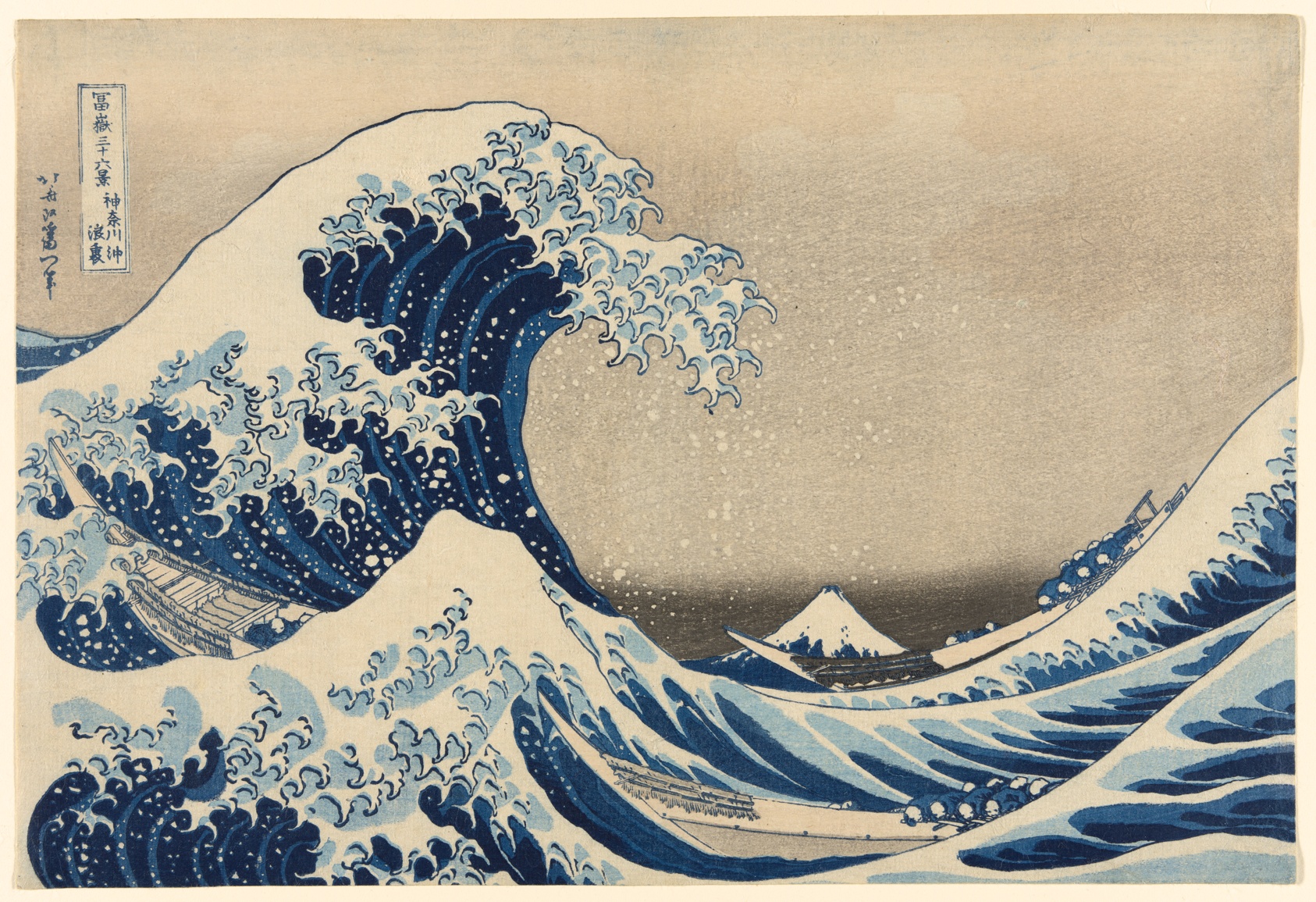
The record subject. Colour woodblock print, oban, 25.4 by 37.6 cm, signed Hokusai aratame Iitsu fude and published by Nishimura-ya Yohachi. Bought from Yamanaka and Company by Clarence Buckingham in December 1905 and given to the museum by his sister in 1925.
| Artist | Katsushika Hokusai |
|---|---|
| Date | 1830/33; the museum gives a range of 1826 to 1836 for the series |
| Medium | Colour woodblock print, oban format |
| Dimensions | 25.4 x 37.6 cm |
| Where it is now | Art Institute of Chicagolast confirmed 4 August 2026 |
| Inventory number | 1925.3245 |
| Attribution | AcceptedSigned in the print itself, Hokusai aratame Iitsu fude, from the brush of Iitsu, formerly Hokusai. Full note |
| Object type | |
| Period | Japanese, Edo period, nineteenth century |
| Cases | Has a provenance gap |
| Inscriptions | Signature: Hokusai aratame Iitsu fude. Publisher: Nishimura-ya Yohachi. |
| Owners on record | 5 links4 documented, 1 unknown |
| Sources | 10 cited |
About this record Last verified 23 August 2026 · 10 sources cited · Change log
On this page 11 sections
ContentsClose
There is no such object as The Great Wave. There is a design cut into blocks about 1830, perhaps eight thousand impressions pulled from them, and the surviving sheets, each with its own printing, condition and owners. This record describes one sheet: the Art Institute of Chicago's 1925.3245, bought from Yamanaka and Company by Clarence Buckingham in December 1905.
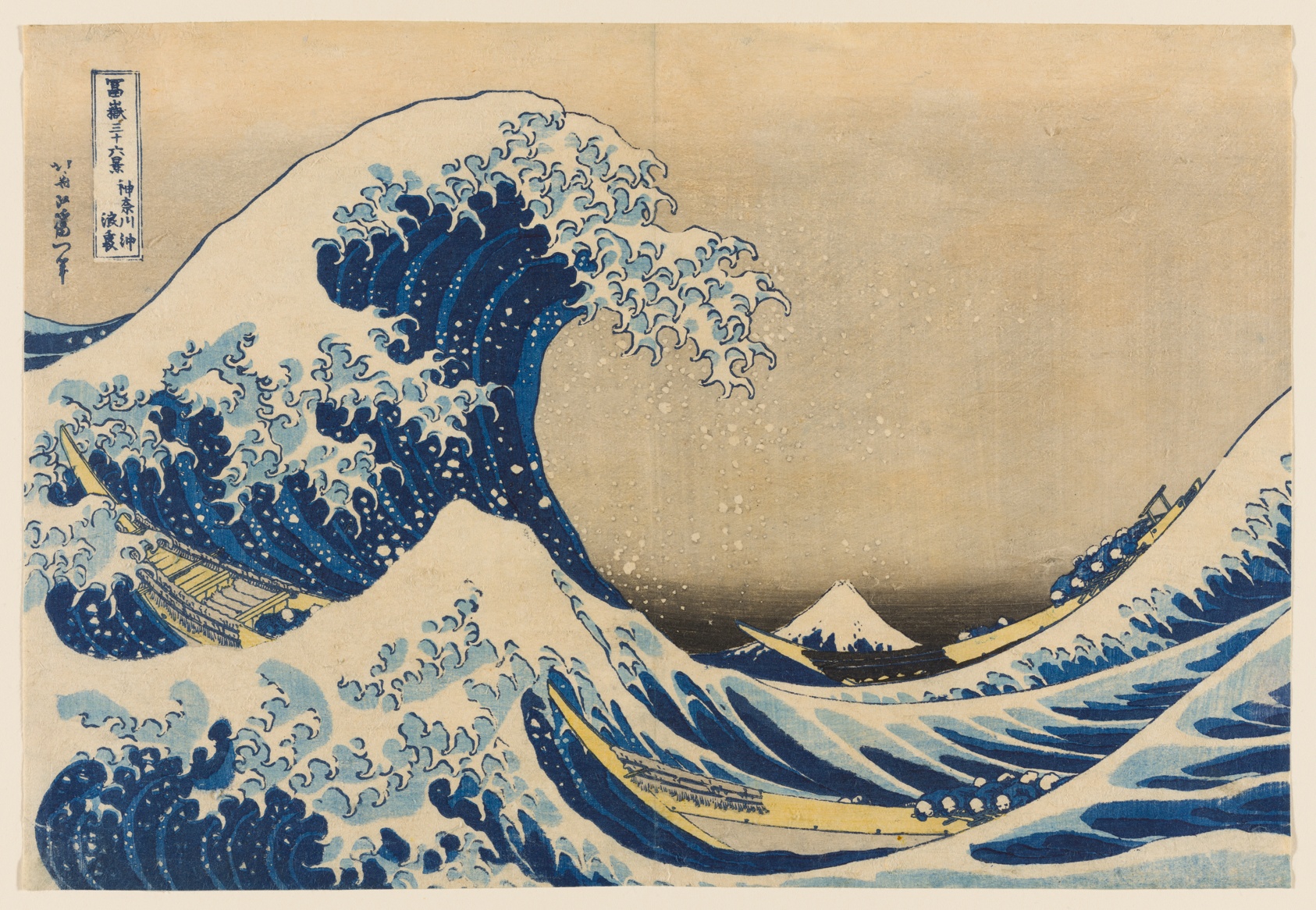
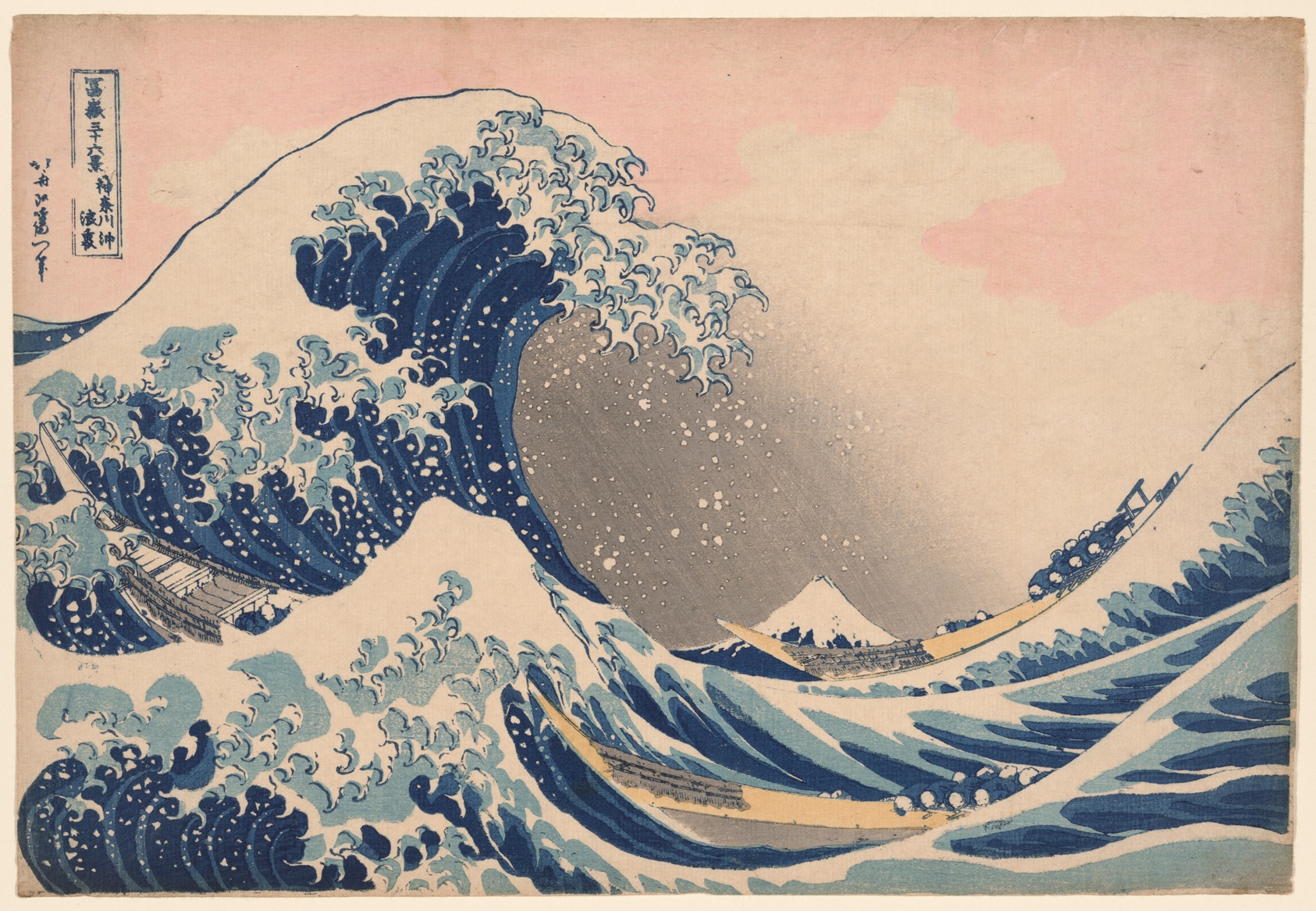
The British Museum scientist Capucine Korenberg located 111 impressions worldwide, reduced Roger Keyes's twenty-one states to eight, and placed this sheet in state 4. The Art Institute holds three impressions, in states 4, 6 and 7, and credits all three to the Clarence Buckingham Collection although Buckingham owned only one of them. Korenberg uses the museum's 1952 sheet as her published illustration of a late printing.
The Christie's New York price of USD 2,760,000, set on 21 March 2023, held the auction record for this design until 22 November 2025, when Sotheby's Hong Kong sold a third impression, dispersed from the Okada Museum of Art, for a reported HKD 21,720,000, about USD 2,800,000, now the standing record. Both are premium-inclusive totals for sheets other than this one; a hammer of USD 2,250,000 can be derived for the Christie's sale on an unverified schedule and is given here as DERIVED, and no equivalent derivation is offered for the Hong Kong sale. Neither price belongs to the Chicago sheet, and neither is evidence of what this one is worth.
Provenance
Each link is graded. Documented: a cited source supports it. Disputed: the identification is argued but not established. Unknown: no owner for that span, and the gap is not smoothed into a narrative. The grades in the glossary.
- c. 1830 - 1905Unknownunknown
Nothing is recorded of this sheet between its printing and its appearance with Yamanaka and Company in New York. That is normal for a commercial print rather than a defect in the research: impressions were sold cheaply and in quantity in Edo, and were not the kind of object whose owners were written down.1
- unknown - 1905Yamanaka and Company, New Yorkdocumented
The first named holder in the museum's chain. Yamanaka was the leading dealer in Asian art in the United States in this period; between 1917 and 1944 its New York gallery occupied two floors at 680 Fifth Avenue with ten viewing rooms and a lecture hall, and the firm also had galleries in Beijing, Shanghai, London and Paris. On 8 July 1942 the Office of Alien Property Custodian used the Trading with the Enemy Act of 1917 to seize the three branches still trading in the United States, at Boston, Chicago and New York, notified at 7 Fed. Reg. 5207 of 9 July 1942. A sale brochure of 1,683 objects followed in 1943, and in 1944 the Custodian engaged Parke-Bernet Galleries in New York to auction the remaining stock in three parts, with the art library sold separately on 6 and 7 June in 1,037 lots. All of that postdates this sale by thirty-six years and does not affect this sheet's title. It is recorded because a reader tracing any Yamanaka provenance needs to know where the firm's American records go.1
- 1905 - 1913Clarence Buckingham (1854-1913), Chicagodocumented
Bought from Yamanaka and Company in December 1905, in a transaction that also brought in at least one other sheet from the same series. Buckingham assembled one of the largest collections of Japanese prints outside Japan.14
- 1913 - 1925Lucy Maud Buckingham (1870-1920) and Kate Sturges Buckingham (1858-1937), Chicagodocumented
Passed by descent to Clarence Buckingham's two sisters on his death in 1913. Lucy Maud Buckingham died in 1920; Kate Sturges Buckingham held the collection until the gift.1
- 1925 - presentArt Institute of Chicagodocumented
Given by Kate Sturges Buckingham in 1925, accessioned 1925.3245 and credited to the Clarence Buckingham Collection. She went on buying for the collection after the gift: she bought a second impression of this design from Alexander G. Mosle on 31 May 1928 and gave it to the museum the same year.13
Prices realised
This sheet has never been offered at auction. It went from a dealer to a private collector in 1905, by descent within one family, and into a museum in 1925. There is no hammer and no premium for it. The two prices that ever existed are private invoices that have not been published: the December 1905 purchase from Yamanaka and Company, and the 31 May 1928 purchase of the museum's SECOND impression from Alexander G. Mosle. The row below is for a DIFFERENT sheet and is recorded so that its figures are never attached to this one.
| Date | Sale | Estimate | Result | Note |
|---|---|---|---|---|
| 21 March 2023 | Christie's Japanese and Korean Art, New York, sale 21618. NOT THIS SHEET., lot not recovered | USD 500,000 - 700,000 | Hammer USD 2,250,000 (DERIVED, see note) With premium USD 510,000 (DERIVED); the published figure of USD 2,760,000 is the premium-inclusive total USD | The auction record for any impression of this design, and NOT the sheet described in this record. Christie's publishes the premium-inclusive total and does not publish hammer. THE HAMMER IS DERIVED and the schedule behind it is UNVERIFIED: Christie's own conditions of sale for March 2023 could not be retrieved, and the only Christie's schedule this record read directly is a 2016 one (25 per cent to USD 150,000, 20 per cent to 3,000,000, 12 per cent above) that was superseded. The derivation assumes 26 per cent of hammer to USD 1,000,000 and 20 per cent above, giving hammer 2,250,000 and premium 510,000. Corroboration: on the same assumption the Korean white porcelain moon jar in the same sale, total USD 4,560,000, resolves to a hammer of USD 3,750,000, and both are ordinary bidding increments. Counter-check: the 2016 schedule gives 2,293,750 and 3,793,750, and the schedule Christie's adopted later in 2023 gives 2,239,669 and 3,727,273; none of those four is a bid anyone would make. The sale totalled USD 11,413,992, 253 per cent hammer above low estimate, with registered bidders from twenty-two countries. |
Hammer is the price at which the bidding stopped; with premium adds the fee the house charges the buyer on top. Hammer price and buyer's premium in the glossary.
Technical evidence
| Attribution note | Signed in the print itself, Hokusai aratame Iitsu fude, from the brush of Iitsu, formerly Hokusai. The publisher's mark is that of Nishimura-ya Yohachi. Authorship of the design has never been in question. What is in question about any individual sheet is which printing it comes from. The Art Institute states that all three of its impressions are later than the first state, and Capucine Korenberg's published survey of 111 impressions places this sheet specifically in her state 4 of 8. |
|---|---|
| Technique | Colour woodblock print, oban format, printed from a keyblock and colour blocks.1 |
| Dimensions | 25.4 x 37.6 cm.1 |
| Signature | Hokusai aratame Iitsu fude: from the brush of Iitsu, formerly Hokusai.1 |
| Publisher | Nishimura-ya Yohachi.1 |
| Series | Thirty-Six Views of Mount Fuji (Fugaku sanjurokkei), begun in 1830 when Hokusai was seventy. The museum dates the series 1826 to 1836 and this sheet 1830/33.1 |
| Pigment | The series makes copious use of the newly affordable Berlin blue, the synthetic pigment known in Europe as Prussian blue, for sky and water.1 |
| State | The Art Institute states that all three of its impressions of this design are later impressions than the first state. It does not rank the three against one another.1 |
| Sister impressions in the same museum | 1928.1086, 25.4 x 37.6 cm; and 1952.343, 25.4 x 37.6 cm with a mat of 50.8 x 71.2 cm. Both carry the same signature and publisher's mark and both are credited to the Clarence Buckingham Collection.23 |
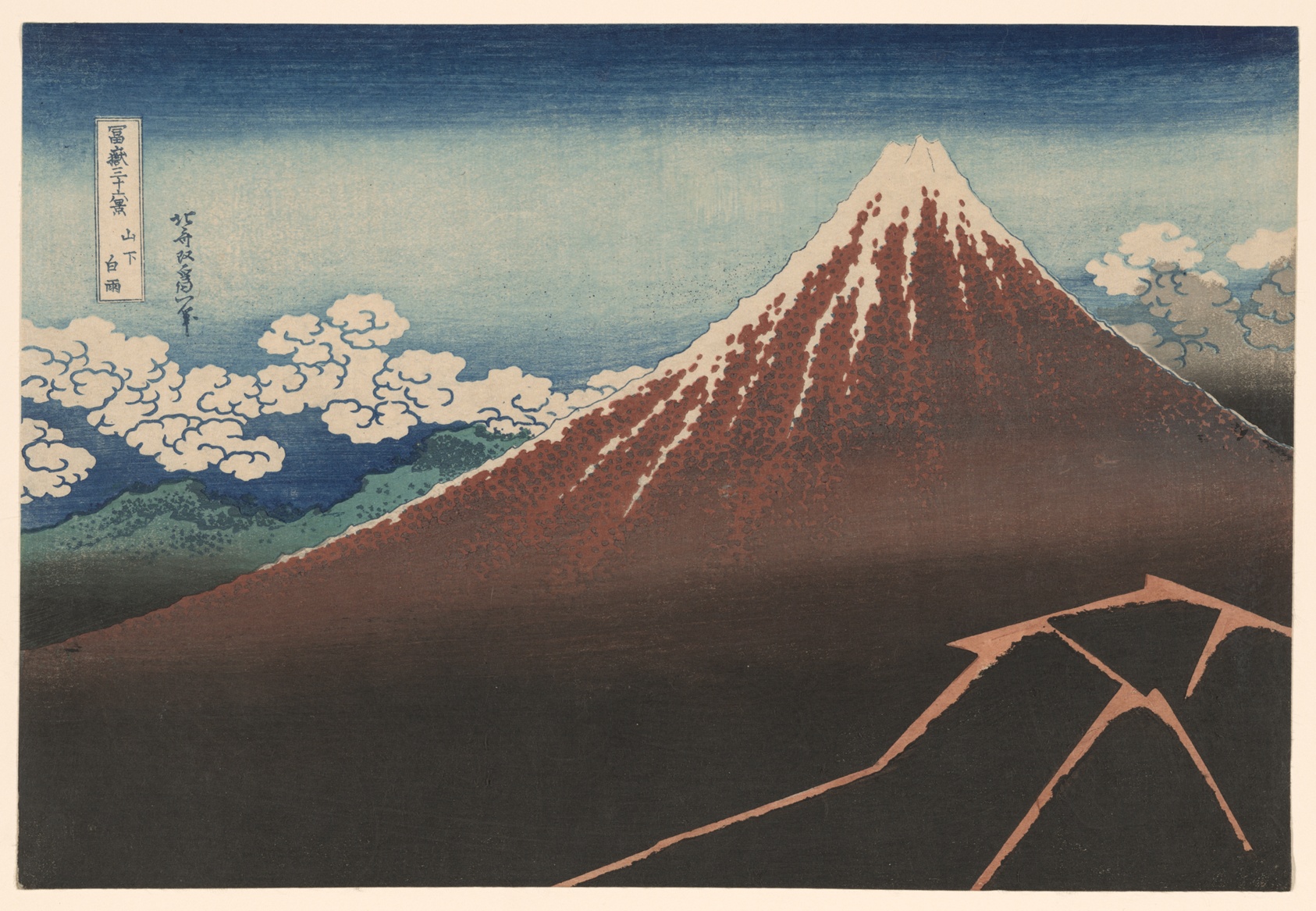
| Companion sheet from the same purchase | Shower Below the Summit (Sanka hakuu), 1925.3244, 25.7 x 37.6 cm, from the same series, bought from Yamanaka and Company by Clarence Buckingham in the same December 1905 transaction.4 |
| State (Korenberg) | State 4 of 8. Korenberg names this accession in her text as an example of a state 4 impression. The museum's other two sheets are state 6 (1928.1086) and state 7 (1952.343).5 |
| Blocks | None of the original woodblocks survives. At least seven carved surfaces were used for the early printings, most likely four physical blocks with three carved on both sides.5 |
| Print run | Experts believe up to 8,000 impressions were made. Keyes gives 2,000 as the minimum a publisher needed to sell to profit; Kunisada designs ran 3,000 to 4,000 and Hiroshige's Tokaido 12,000 to 15,000.5 |
| Located impressions | 77 in national institutions worldwide plus 34 from auction sites, dealers, books and private collectors: 111 studied, 67 in high resolution. The United States holds 35 of the institutional impressions; the Metropolitan has four, the British Museum, the Art Institute and the Tokyo National Museum three each.5 |
| Fading | Of the 111 located impressions, no clouds were discernible in 26. The yellow of the boats and the pink of the clouds are the first colours to go, the pigments being light-sensitive materials such as turmeric and orpiment. Ultraviolet reflectance imaging can recover faded clouds.5 |
| Authenticity tests | In original impressions certain shapes carry the dark grey-blue or black of the outlines, where modern reproductions use a lighter sea blue; and a small dark blue sliver appears in a spot of sea foam, attributed by the cutter David Bull to wood the original carver failed to remove. That flaw is absent from every reproduction examined.5 |
Images
The record in full
Chapter 1Which Great Wave this is
There is no such object as The Great Wave.
There is no such object as The Great Wave. There is a woodblock design, cut about 1830 and printed from those blocks in an unknown number of impressions over decades, and there are the surviving sheets. Each sheet is a separate object with its own printing, its own condition, its own colour and its own owners. Confusing the design with the sheet is the commonest error made about this image, and it is the reason this record exists in the form it does.
This record describes one sheet: the impression in the Art Institute of Chicago, accession 1925.3245, 25.4 by 37.6 centimetres, an oban colour woodblock print from the Clarence Buckingham Collection. It is signed Hokusai aratame Iitsu fude and carries the mark of the publisher Nishimura-ya Yohachi.
The Art Institute holds three impressions of this design. All three are catalogued under the Buckingham name. All three have different provenance. The museum's own catalogue states that all three are later impressions than the first state of the design.
Chapter 2What a later impression means, and why it is a price
A woodblock is a physical object and it wears.
A woodblock is a physical object and it wears. The keyblock carrying the outlines takes the most punishment: fine lines broaden, edges soften, and cracks open and print as white lines. Colour blocks are recut or replaced. An early impression and a late one from the same design can differ enough that specialists treat them as different objects, and the ranking is what the money follows.
The scholarship on this design is unusually good. Roger Keyes compared surviving impressions and deduced a sequence of numbered states, defining a new state as a change caused by woodblock damage, re-carving, or the use of a completely new block; he listed twenty-one. He was working from postcards, book illustrations and small black-and-white photographs. Capucine Korenberg re-examined the problem at the British Museum using digital images of 111 impressions, found that variations corresponding to certain of Keyes's states did not occur consistently, and reduced the sequence to eight states.
One of her incidental findings is worth more to a collector than the states themselves. When the 111 impressions were put in chronological order there was no sign of gradual woodblock damage preceding a break: the lines in the title cartouche did not thin before disappearing. The breaks happened suddenly, probably between printing events rather than during them, which supports the argument that printing is not the main cause of woodblock damage.
Chapter 3Where this sheet sits in the sequence
Korenberg's published table places the Art Institute's three impressions precisely.
Korenberg's published table places the Art Institute's three impressions precisely. This sheet, 1925.3245, is a state 4 impression; she names it in her own text as an example of one. The museum's second sheet, 1928.1086, is state 6. The third, 1952.343, is state 7 of eight.
None of that contradicts the museum, which had already told the public in its own catalogue that all three of its impressions are later than the first state. What it adds is resolution: not later, but fourth, sixth and seventh of eight, in a sequence built from physical damage rather than opinion.
1952.343 has become the discipline's standard illustration of a late Great Wave. Korenberg uses it to show that the light blue areas of the sea in late impressions were not printed from the same block as in early ones, the shapes becoming more angular, and to show that a different yellow block was used for the boats. Sixteen of the 111 impressions she studied were printed with that replacement light-blue block. The very latest impressions have brownish pink boats and black rather than blue outlines, black ink having entered the series when ten further designs were added to it because of its popularity.
She also records, of that same Chicago sheet, that the colour of its clouds appears unfaded but may have been re-applied during a restoration. A conservation caveat published about a named accession is exactly the kind of fact that vanishes from a caption, and it is recorded here.
Chapter 4How many were made, and how many are left
None of the woodblocks used to produce The Great Wave in the 1830s survives.
None of the woodblocks used to produce The Great Wave in the 1830s survives. At least seven carved surfaces were used for the early printings, most likely four physical blocks with three of them carved on both sides.
Keyes's economics give the floor: a publisher had to sell at least two thousand impressions of a design to make a profit. For comparison, designs by Kunisada are estimated to have been printed three to four thousand times, and Hiroshige's Fifty-three Stations of the Tokaido between twelve and fifteen thousand. The working estimate for The Great Wave is up to eight thousand impressions.
Against that, Korenberg located 77 impressions in national institutions worldwide and gathered photographs of 34 more from auction sites, dealers, books and private collectors: 111 in all, of which 67 were available in high resolution. The United States holds 35 of the institutional impressions. The largest single holdings are the Museum of Fine Arts in Boston, then the Metropolitan Museum of Art with four, then the British Museum, the Art Institute of Chicago and the Tokyo National Museum with three each.
111 located is not the same quantity as how many survive, and the two numbers are routinely conflated in press coverage. A census of located impressions is a floor, not a total. Anyone quoting a survival figure for this design should say which of the two they mean.
Chapter 5How to tell an impression from a reproduction
Modern workshops in Japan reprint this design from newly cut blocks using traditional methods, and those reproductions circulate.
Modern workshops in Japan reprint this design from newly cut blocks using traditional methods, and those reproductions circulate. Korenberg identifies two tests that separate them from Edo-period impressions.
The first is colour logic. In original impressions certain shapes are printed in the dark grey-blue or black used for the outlines, the cartouche and the signature; in the reproductions examined, those areas are a lighter blue, the colour used elsewhere for the medium and light blue shapes of the sea.
The second is a flaw. In high-resolution photographs of original impressions a small dark blue shape appears in a spot of the sea foam. The woodblock cutter David Bull attributes it to a sliver of wood the original cutter failed to remove when carving the block. It is present in the originals and absent from every reproduction Korenberg examined. A mistake made in the 1830s is now one of the more reliable ways to authenticate a sheet, which is a general truth about copies worth carrying away from this record.
Chapter 6What has faded, and what that does to a comparison
Edo-period prints were often made with light-sensitive colourants such as turmeric and orpiment, and most surviving Great Waves have been affected by light.
Edo-period prints were often made with light-sensitive colourants such as turmeric and orpiment, and most surviving Great Waves have been affected by light. The parts that go first are the yellow of the boats and the pink of the clouds. Of the 111 impressions located, no clouds at all were discernible in 26, most probably because the ink had faded completely, although it cannot be excluded that they were never printed.
That single figure should change how a reader looks at any two reproductions of this design side by side. Almost a quarter of surviving sheets have lost their sky entirely, and the difference between two photographs may be a century of daylight rather than a difference of state. Ultraviolet reflectance imaging can bring faded clouds back: a British Museum sheet with very little colour left in the sky shows them clearly under UV.
Chapter 7The pigment that made the series possible
The series began in 1830, when Hokusai was seventy.
The series began in 1830, when Hokusai was seventy. What made it look the way it does was a chemical import. The Art Institute points to Hokusai's copious use of the newly affordable Berlin blue in the skies and water throughout the series. Berlin blue, called Prussian blue in Europe and bero-ai in Japan, is a synthetic pigment that reached Japan through the Dutch trade and became cheap enough for commercial printing only shortly before this series was designed.
The blue is therefore not a stylistic choice made in a vacuum. A landscape series printed overwhelmingly in one new blue was, among other things, a demonstration of a newly available material, and the popularity of Japanese landscape prints that followed rests partly on a price change in a chemical works. The museum credits this series with establishing that popularity; before it the commercial print market was dominated by actors and courtesans.
Chapter 8What is actually in the picture
Three boats run under the wave. They are narrow, fast craft with crews at the oars, and the men are bent to their work; not one of them is looking at the wave.
Three boats run under the wave. They are narrow, fast craft with crews at the oars, and the men are bent to their work; not one of them is looking at the wave. The crews are on a delivery run, which is why they are in open water in weather like this.
Mount Fuji sits small and still beneath the crest, at the point where the composition's violence resolves. Across the series the mountain is the protagonist of every sheet, seen near or far, in different weather and seasons and from every direction. Here it is the smallest element in the picture and the only motionless one, and the visual joke, if it is one, is that for a moment the wave looks bigger than the mountain.
Fuji was not scenery to the audience that bought these prints. It was a mountain people climbed as an act of devotion, and a series of thirty-six views of it sold into a market of buyers for whom it was a destination rather than a view. The subject of the series is a pilgrimage as much as a landscape.
Chapter 9Yamanaka and Company, and what happened to it
The first name in this sheet's chain is a firm: Yamanaka and Company, New York, which sold the print to Clarence Buckingham in December 1905.
The first name in this sheet's chain is a firm: Yamanaka and Company, New York, which sold the print to Clarence Buckingham in December 1905. Yamanaka was the most important dealer of Asian art in the United States in the first half of the twentieth century and supplied a very large proportion of the Asian holdings of American museums and private collections in that period.
The firm's American operation did not end commercially. It ended by government action after the attack on Pearl Harbor, when its United States assets were seized under the Trading with the Enemy Act and vested in the Alien Property Custodian, and the stock was sold off. Every American museum object whose provenance begins with Yamanaka and Company sits upstream of that event, and it is one of the largest single interruptions of dealer records in the history of the American art trade.
It does not touch this sheet's title. Buckingham bought in 1905, thirty-six years before the seizure, and the print was in a museum by 1925. The reason to record it is that a reader tracing any Yamanaka provenance needs to know where the firm's American papers go, and the answer is that a large part of them go into a wartime custodianship rather than into a dealer's ledger.
Chapter 10Clarence Buckingham and his sisters
Clarence Buckingham, 1854 to 1913, was a Chicagoan who assembled one of the greatest collections of Japanese prints outside Japan.
Clarence Buckingham, 1854 to 1913, was a Chicagoan who assembled one of the greatest collections of Japanese prints outside Japan. He bought this sheet in December 1905, at the beginning of the period when American collectors were competing seriously for ukiyo-e, and he bought at least one other sheet from the same series in the same transaction.
On his death in 1913 the collection passed by descent to his sisters, Lucy Maud Buckingham, 1870 to 1920, and Kate Sturges Buckingham, 1858 to 1937. Lucy Maud died seven years later. Kate Sturges Buckingham outlived them both by a quarter of a century and gave the prints to the Art Institute of Chicago in 1925.
What kind of collector she was shows in a different sheet's provenance. In 1928, three years after giving the collection away, she bought another impression of the Great Wave from the German collector Alexander G. Mosle and gave that to the museum too. A donor who goes on buying for a collection she has already handed over is behaving as a curator rather than a benefactor, and the Art Institute's Japanese print department is what came of it.
Chapter 11Three impressions, three chains, one museum
Set the three Art Institute sheets side by side and the central problem of this archive is visible inside one collection.1925.3245, this sheet: Yamanaka and Company, New York; sold to Clarence...
Set the three Art Institute sheets side by side and the central problem of this archive is visible inside one collection.
1925.3245, this sheet: Yamanaka and Company, New York; sold to Clarence Buckingham, Chicago, December 1905; by descent to his sisters Lucy Maud and Kate Sturges Buckingham, 1913; given to the Art Institute in 1925.
1928.1086: Alexander G. Mosle, 1863 to 1945, Germany; sold to Kate Sturges Buckingham, Chicago, 31 May 1928; given to the Art Institute in 1928.
1952.343: Frederick Standish Colburn, 1878 to 1957, Evanston, Illinois; sold to the Art Institute in 1952.
Three sheets of the same design, identical to a tenth of a centimetre in the museum's own measurements, carrying the same signature and the same publisher's mark, and every one of them credited to the Clarence Buckingham Collection although only one of them was ever owned by Clarence Buckingham. A credit line records who paid, not who owned. Anyone reading the Buckingham credit as an ownership history will get two of these three wrong, and a caption reading simply the Art Institute's Great Wave identifies nothing at all.
Chapter 12The German collector in the middle chain
The one name in the group a diligence reader should stop on is Alexander G.
The one name in the group a diligence reader should stop on is Alexander G. Mosle, 1863 to 1945, described in the museum's provenance only as of Germany. Mosle assembled a substantial collection of Japanese art in Germany and sold this impression to Kate Sturges Buckingham on 31 May 1928.
The date is the answer to the question the name raises. A 1928 sale by a German collector to an American buyer is a pre-1933 transaction and falls outside the period covered by the Washington Principles and the national frameworks built on them. Nothing in the published record suggests it was anything but an ordinary sale and this record does not imply otherwise. It is set down because German provenance in the interwar decades is the sort of line a checklist flags, and the useful thing an archive can do is give the date rather than leave the flag hanging.
Chapter 13The most reproduced image in the world
Fame has a manufacture and the manufacture is documentable.
Fame has a manufacture and the manufacture is documentable. This design reached Europe in the second half of the nineteenth century with the wave of Japanese imports that produced Japonisme, and European artists and designers absorbed it faster than any other Japanese image. It has since become a book cover, a wallpaper, a tattoo and a character in the Unicode standard.
The consequence for a provenance archive is unwelcome. Universal reproduction means that most people who believe they have seen a Great Wave have seen a photograph of an unspecified sheet, and that captions in books, in the press and online almost never say which impression is illustrated. The image is everywhere and the objects are anonymous, which is the exact inversion of the situation this publication exists to correct.
Chapter 14The record price, and why it is not this sheet's price
The auction record for any impression of this design was set at Christie's New York on 21 March 2023, in a sale of Japanese and Korean art that made USD 11,413,992 in total, 253 per cent hammer above...
The auction record for any impression of this design was set at Christie's New York on 21 March 2023, in a sale of Japanese and Korean art that made USD 11,413,992 in total, 253 per cent hammer above low estimate, with registered bidders from twenty-two countries. The Great Wave brought USD 2,760,000, a figure that stood as the record for two and a half years. A Korean white porcelain moon jar in the same sale made USD 4,560,000, a record for that category.
Both of those figures are premium-inclusive totals. Christie's publishes what a lot fetched and does not publish what the hammer fell at, so the hammer must be derived, and a derived hammer is only as good as the premium schedule assumed. This record could not read Christie's own conditions of sale for March 2023; the house's website refuses automated requests, and the only schedule this record verified directly is a 2016 one that was superseded.
Assuming a New York schedule of 26 per cent of hammer to USD 1,000,000 and 20 per cent above it, the total resolves to a hammer of USD 2,250,000 and a premium of USD 510,000. Two things support that assumption and nothing else does. Under it the moon jar in the same sale resolves to USD 3,750,000, and both figures are ordinary bidding increments. Under the 2016 schedule the same totals give USD 2,293,750 and USD 3,793,750; under the schedule Christie's adopted later in 2023 they give USD 2,239,669 and USD 3,727,273. Neither pair is a bid anyone made.
So: hammer USD 2,250,000 and premium USD 510,000, both DERIVED, on a schedule this record has not verified in the house's own terms. The estimate was USD 500,000 to 700,000.
The Christie's figure was surpassed on 22 November 2025, when Sotheby's Hong Kong sold a third, separate impression as part of Masterpieces of Asian Art from the Okada Museum of Art, a 125-lot, white-glove dispersal from the Okada Museum in Hakone, Japan, reported in the press as a sale the museum's founder Kazuo Okada was required to make to help settle a legal debt arising from a dispute with the casino executive Steve Wynn; the sale totalled HKD 688,000,000, about USD 88,000,000. The Great Wave in it made HKD 21,720,000, reported at the time as approximately USD 2,800,000, against an estimate reported as roughly HKD 5,000,000 to 8,000,000, itself nearly tripled. Press coverage described that sheet as a well-preserved early impression, which if accurate would put it earlier in the printing sequence than any of the three later impressions held in Chicago. Sotheby's reports a premium-inclusive price realized and this record has not read Sotheby's Hong Kong conditions of sale for that date, so no hammer is derived for it; the HKD 21,720,000 figure is left undivided rather than split on an unverified schedule. That is now the auction record for any impression of this design, and it is a third sheet, distinct from both the one Christie's sold in 2023 and the one in Chicago.
None of this is a value for the sheet in Chicago. That one has never been offered at auction: it went from a dealer to a private collector in 1905, passed by descent, and entered a museum in 1925. The two prices that ever existed for it are private invoices that have not been published, and the record impression of 2023 is a different object in a different state.
The artist
Katsushika Hokusai
Hokusai worked for seventy years, under more than thirty names, and produced the most reproduced image in the history of art at about the age of seventy. The name signed on this sheet is not Hokusai but Iitsu, in the formula from the brush of Iitsu, formerly Hokusai, which is why a signature can date a print that carries no date. The dossier below concentrates on what is hard to get: how his name, his publisher and his materials fix a sheet in time, and how little of the object he actually made.
Literature
- Ukiyo-e Taikei, Tokyo, vol. 8, 29; XIII, I. (1975)
- Matthi Forrer, Hokusai, Royal Academy of Arts, London, p. 264. (1988)
- Richard Lane, Hokusai: Life and Work, London, pp. 189, 192. (1989)
- Jim Ulak, Japanese Prints, Art Institute of Chicago, p. 268. (1995)
- James N. Wood, The Art Institute of Chicago: The Essential Guide, rev. ed., p. 86. (2003)
- James Cuno, The Art Institute of Chicago: The Essential Guide, rev. ed., p. 100. (2009)
Related works
| Work | Relation | Where it is |
|---|---|---|
| Under the Wave off Kanagawa Katsushika Hokusai | A different impression of the same design Alexander G. Mosle, Germany; sold to Kate Sturges Buckingham 31 May 1928; given to the museum in 1928. Korenberg state 6. | Art Institute of Chicago, 1928.1086 |
| Under the Wave off Kanagawa Katsushika Hokusai | A different impression of the same design Frederick Standish Colburn (1878-1957), Evanston, Illinois; sold to the museum in 1952. Korenberg state 7, and her published exemplar of a late printing. | Art Institute of Chicago, 1952.343 |
| Shower Below the Summit (Sanka hakuu) Katsushika Hokusai | From the same series, bought in the same 1905 transaction 25.7 x 37.6 cm, same signature and publisher. Yamanaka and Company; sold to Clarence Buckingham December 1905. | Art Institute of Chicago, 1925.3244 |
| Cranes on snow-covered pine Katsushika Hokusai | Another Hokusai in the same 1925 Buckingham gift Included to indicate the scale of the gift, which runs to thousands of sheets. | Art Institute of Chicago, 1925.2331 |
Open questions
- Christie's lot number for the record impression sold on 21 March 2023 was not recovered; the house serves it through scripting that no available transport executes.
- Christie's own conditions of sale for March 2023 were not read, so the premium schedule behind the derived hammer of USD 2,250,000 is inferred from arithmetic rather than from the house's published terms.
- How many impressions survive, as against how many have been located? Korenberg located 111; a November 2025 report on the Okada Museum sale put known survivors at about 130, and other press estimates run to 200 and upwards; the figures measure different, imprecisely defined populations.
- Who cut the blocks and who printed this sheet? The cutter and printer are unrecorded, although the differences between states are their work.
- What did Clarence Buckingham pay Yamanaka and Company in December 1905, and what did Kate Sturges Buckingham pay Alexander G. Mosle in 1928? Neither figure has been published.
- Where was this sheet between about 1830 and 1905, and how did it reach Yamanaka and Company in New York?
- Why do all three impressions carry the Clarence Buckingham credit line when he owned only one of them? The convention is a museum accounting practice and it obstructs provenance reading.
- How large was the 1925 gift? Published figures of about 1,400 and about 2,500 sheets both circulate and were not reconciled here.
- Which of the Art Institute's three Great Wave impressions, 1925.3245 (this sheet), 1928.1086, or 1952.343, was the one shown to the public from 5 September 2024 to 6 January 2025? Press coverage of that rotation did not name the accession, and the museum's own artwork pages returned a Cloudflare bot-challenge rather than content when checked directly on 2026-08-23; not resolved here.
Questions about this object
What is Under the Wave off Kanagawa (Kanagawa oki nami ura), also known as The Great Wave, from the series Thirty-Six Views of Mount Fuji?
Under the Wave off Kanagawa (Kanagawa oki nami ura), also known as The Great Wave, from the series Thirty-Six Views of Mount Fuji is a print, dated 1830/33; the museum gives a range of 1826 to 1836 for the series. Medium: Colour woodblock print, oban format.
Who made Under the Wave off Kanagawa (Kanagawa oki nami ura), also known as The Great Wave, from the series Thirty-Six Views of Mount Fuji, and is the attribution settled?
The attribution to Katsushika Hokusai is recorded here as accepted. Signed in the print itself, Hokusai aratame Iitsu fude, from the brush of Iitsu, formerly Hokusai. The publisher's mark is that of Nishimura-ya Yohachi. Authorship of the design has never been in question. What is in question about any individual sheet is which printing it comes from. The Art Institute states that all three of its impressions are later than the first state, and Capucine Korenberg's published survey of 111 impressions places this sheet specifically in her state 4 of 8.
Where is Under the Wave off Kanagawa (Kanagawa oki nami ura), also known as The Great Wave, from the series Thirty-Six Views of Mount Fuji now?
Art Institute of Chicago. Inventory number 1925.3245. Last confirmed 4 August 2026. Clarence Buckingham Collection; given to the museum in 1925.
What is still unknown about Under the Wave off Kanagawa (Kanagawa oki nami ura), also known as The Great Wave, from the series Thirty-Six Views of Mount Fuji?
Christie's lot number for the record impression sold on 21 March 2023 was not recovered; the house serves it through scripting that no available transport executes.
Sources
- 1Art Institute of Chicago, collection record 1925.3245, Under the Wave off Kanagawa. Tombstone, dimensions, signature and publisher's mark, the museum's description of the series and of the Berlin blue, its statement that all three of its impressions are later than the first state, the full provenance line and the publication history. artic.edu/artworks/...
- 2Art Institute of Chicago, collection record 1952.343, a second impression of the same design. Provenance: Frederick Standish Colburn (1878-1957), Evanston, Illinois; sold to the Art Institute of Chicago, 1952. artic.edu/artworks/...
- 3Art Institute of Chicago, collection record 1928.1086, a third impression of the same design. Provenance: Alexander G. Mosle (1863-1945), Germany; sold to Kate Sturges Buckingham (1858-1937), Chicago, 31 May 1928; given to the Art Institute of Chicago, 1928. artic.edu/artworks/...
- 4Art Institute of Chicago, collection record 1925.3244, Shower Below the Summit (Sanka hakuu), from the same series and the same December 1905 purchase from Yamanaka and Company. artic.edu/artworks/...
- 5Capucine Korenberg, 'The making and evolution of Hokusai's Great Wave', British Museum. The census of 111 impressions, the reduction of Roger Keyes's twenty-one states to eight, the identification of this accession as a state 4 impression, the use of Art Institute 1952.343 as the exemplar of a late printing, the fading figures and the tests separating originals from modern reproductions. Read directly from the PDF. britishmuseum.org/sites/...
- 6Antiques and The Arts Weekly, 'Christie's Asia Week New York Sales Total $66.9 Million'. Confirms the 21 March 2023 sale of Japanese and Korean art, its total of USD 11,413,992 at 253 per cent hammer above low estimate, bidders from twenty-two countries, the Great Wave record of USD 2,760,000 and the moon jar at USD 4,560,000. antiquesandthearts.com/christies-asia-week-new-york-sales...
- 7Antiques and The Arts Weekly, 'Christie's Amends Buyer's Premium Thresholds', 7 September 2016, giving the New York schedule of 25 per cent to USD 150,000, 20 per cent to 3,000,000 and 12 per cent above, effective 19 September 2016. Cited as the only Christie's schedule this record verified directly, and as the schedule the March 2023 arithmetic EXCLUDES. It is not the schedule used in the derivation. antiquesandthearts.com/christies-amends-buyers-premium-th...
- 8Najiba H. Choudhury, 'Seizures and Liquidation Sales in the United States during World War II: Tracking the Fate of Japanese Art Dealership, Yamanaka and Company, Inc.', Journal for Art Market Studies 2 (2020). The 8 July 1942 seizure of the Boston, Chicago and New York branches under the Trading with the Enemy Act, 7 Fed. Reg. 5207 of 9 July 1942, the 1,683-object brochure of 1943, the 1944 Parke-Bernet liquidation and the 680 Fifth Avenue premises. Read from the PDF. fokum.org/wp-content/...
- 9CBS News Chicago, 'The Great Wave returns to display for a few months at the Art Institute of Chicago'. Confirms the 5 September 2024 to 6 January 2025 display of a Great Wave impression from the Buckingham holdings, the museum's stated four-year rotation and the light-sensitivity rationale. Does not name the specific accession shown. Read directly. cbsnews.com/chicago/...
- 10Hypebeast, 'Katsushika Hokusai's The Great Wave Smashes Record, Selling for $2.8 Million USD at Sotheby's Hong Kong', November 2025. Confirms the 22 November 2025 sale in Masterpieces of Asian Art from the Okada Museum of Art, the HKD 21.7 million / USD 2.8 million price realized, the white-glove result and the HKD 688 million / USD 88 million sale total. Read directly. hypebeast.com/2025/...
Last verified 23 August 2026 · Published 4 August 2026
Change log
23 August 2026 - Record deepened to the house standard: narrative sections, technical evidence, artist dossier, related works and open questions added; provenance chain and auction results replaced with the researched versions; sources rebuilt.
2 August 2026 - Record deepened to the house standard: narrative sections, technical evidence, artist dossier, related works and open questions added; provenance chain and auction results replaced with the researched versions; sources rebuilt.
4 August 2026 - Record created at the house standard: researched narrative, technical evidence, maker dossier, graded provenance chain, prices with hammer and premium separated, related works, open questions and sources.