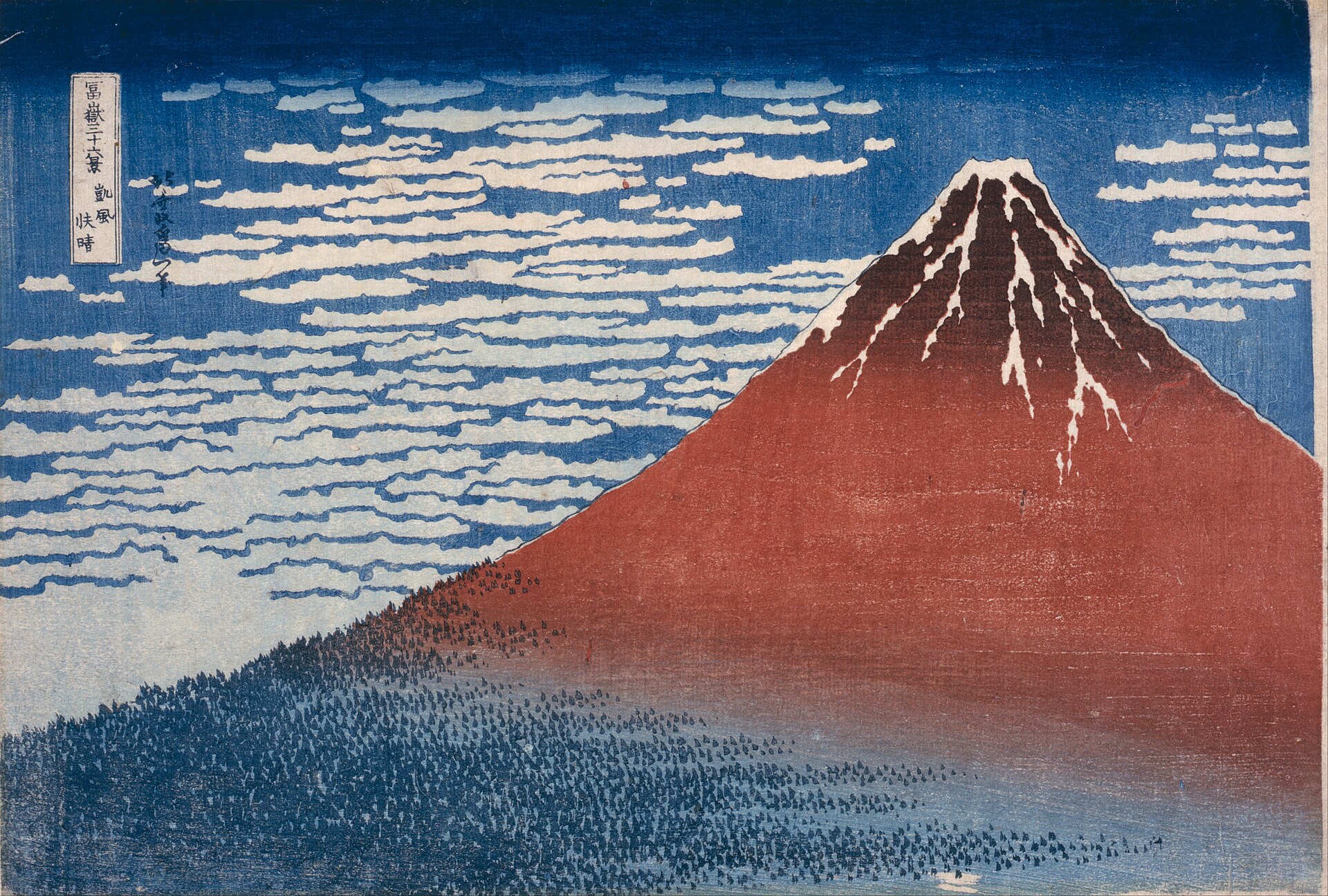
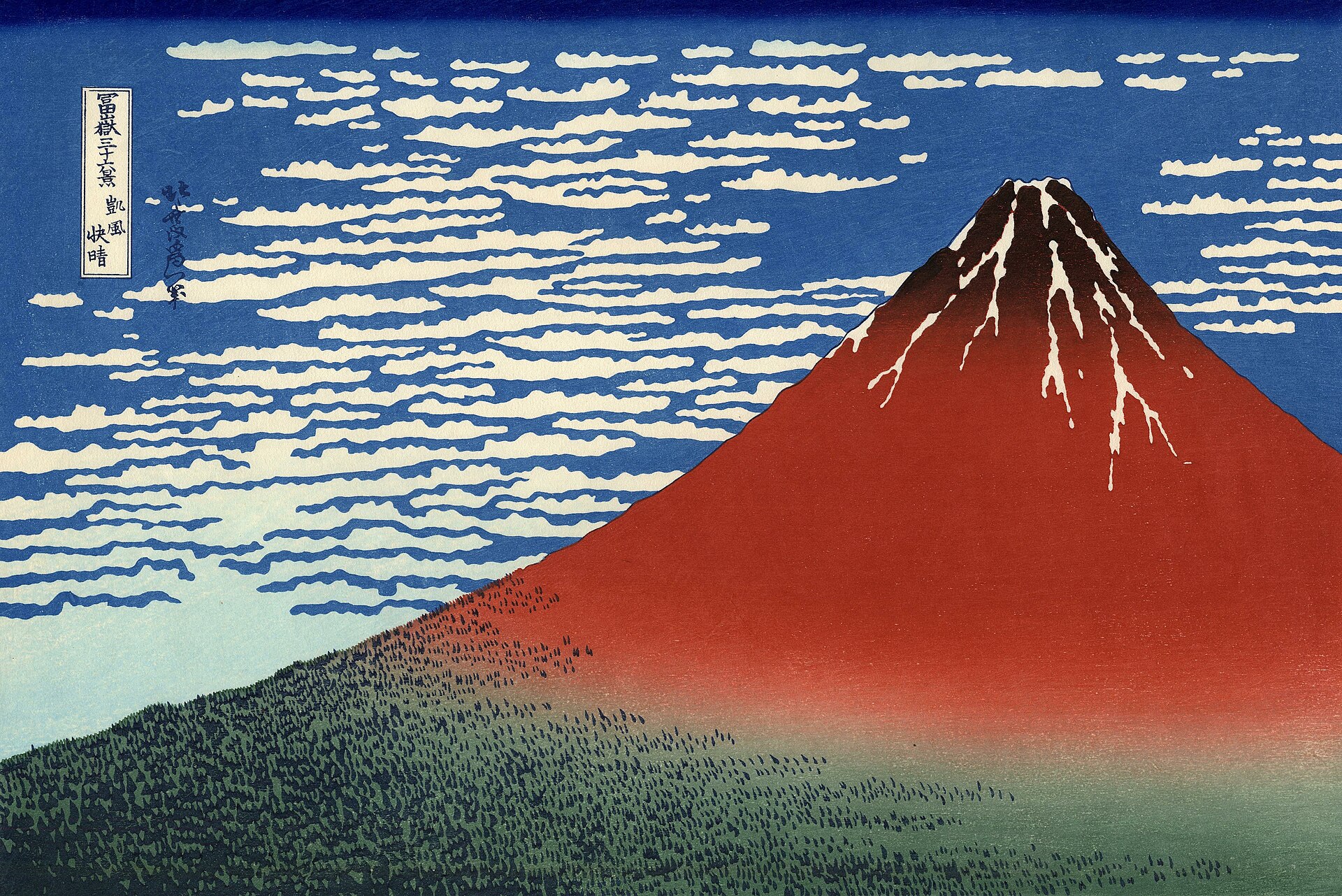
South Wind, Clear Sky (Gaifu kaisei), also known as Red Fuji, from the series Thirty-six Views of Mount Fuji
Katsushika Hokusai · c. 1830-32
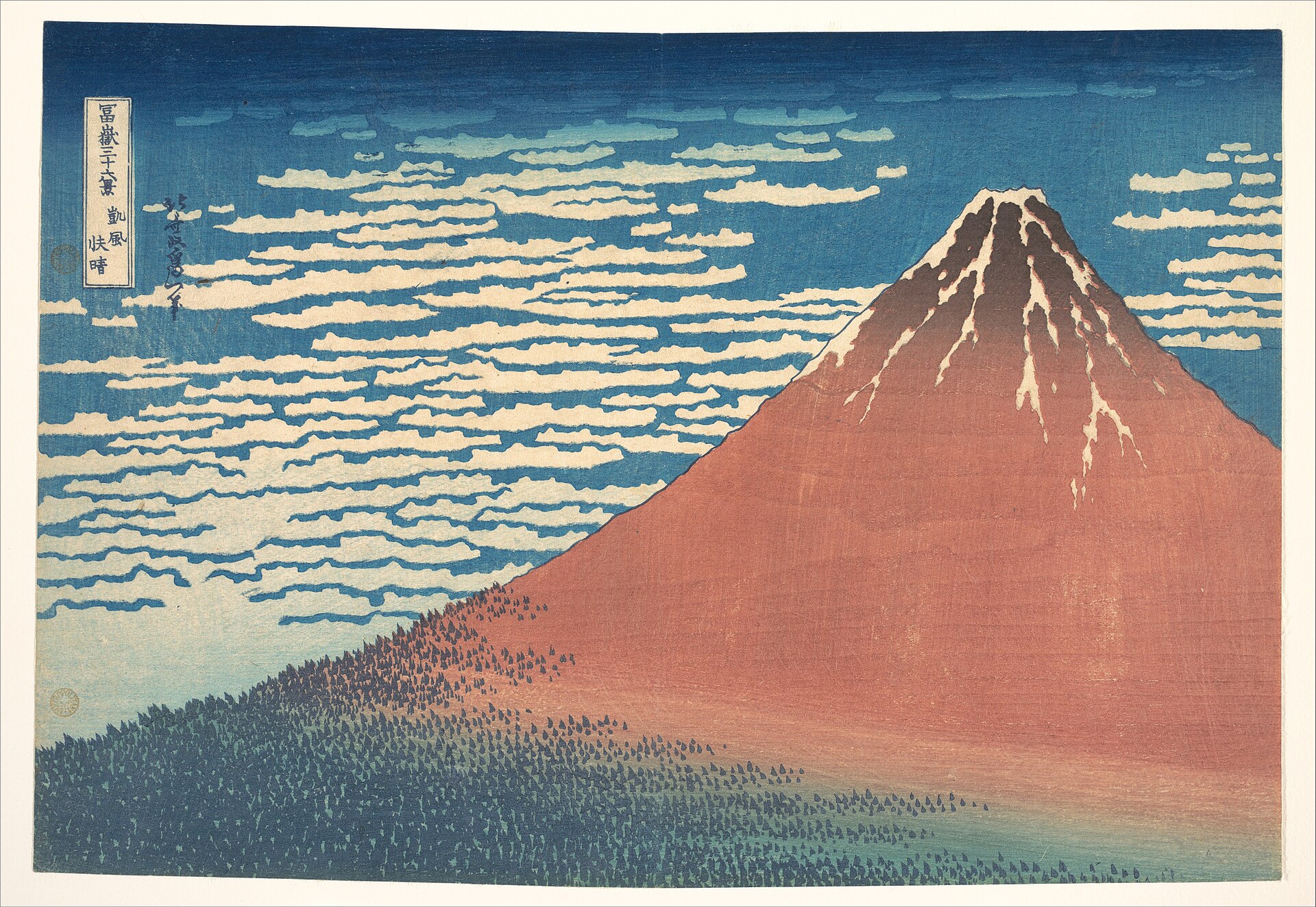
The record subject: the Metropolitan Museum of Art's impression, accession JP9, acquired through the Rogers Fund in 1914. This is the specific sheet this record is anchored on.
| Artist | Katsushika Hokusai |
|---|---|
| Date | c. 1830-32 |
| Medium | Woodblock print (nishiki-e); ink and color on paper, oban format |
| Dimensions | 24.4 x 35.6 cm (9 5/8 x 14 in.), this impression as trimmed and mounted; the nominal oban sheet runs closer to 25.5 x 38 cm and individual impressions vary with trimming |
| Where it is now | Metropolitan Museum of Art, New Yorklast confirmed |
| Inventory number | JP9 |
| Attribution | AcceptedNot disputed. Full note |
| Object type | |
| Period | Japanese, Edo period, 19th century |
| Cases | Has a provenance gap |
| Inscriptions | Series title cartouche reading Fugaku sanjurokkei (Thirty-six Views of Mount Fuji); print title Gaifu kaisei; signature Hokusai aratame Iitsu hitsu; publisher seal of Nishimuraya Yohachi (Eijudo) |
| Owners on record | 3 links2 documented, 1 unknown |
| Sources | 16 cited |
About this record Last verified · 16 sources cited · Change log
On this page 9 sections
ContentsClose
A color woodblock print of about 1830-32 showing Mount Fuji alone, its lower slopes catching the red light of an early autumn dawn, from Hokusai's series Thirty-six Views of Mount Fuji. This record anchors on the impression at the Metropolitan Museum of Art, acquired through the Rogers Fund in 1914 (accession JP9), a separate sheet from the museum's own second impression of the same design (JP2960, given in 1939) and from every other impression discussed here.
The print is best known in the West as Red Fuji, but the mountain's color is not fixed: surviving impressions range from a rare, muted early state called Pink Fuji to the strong red of the standard run, and scholars have used wear in the woodblocks and the choice of pigments to argue over which came first. The mountain itself is built without the black keyblock outline that defines most other shapes in the print; its silhouette is a product of color and gradation printing alone.
This is a different sheet, from the same 46-print series, as the Great Wave off Kanagawa already recorded on this site under a separate Art Institute of Chicago impression. The two share a publisher and a production window and nothing else in their individual object histories.
Provenance
Each link is graded. Documented: a cited source supports it. Disputed: the identification is argued but not established. Unknown: no owner for that span, and the gap is not smoothed into a narrative. The grades in the glossary.
- c. 1830-32 -Nishimuraya Yohachi (Eijudo), publisher, Edodocumented
Published in Edo as part of the series Thirty-six Views of Mount Fuji, under Hokusai's signature name Iitsu. The publisher's seal appears on the sheet.169
- c. 1830s - 1914Unknownunknown
No owner is documented for this specific sheet between its Edo publication and its appearance in the Metropolitan Museum's 1914 accession record. Whether it left Japan soon after printing, passed through a dealer's stock, or was bought directly from a Japanese source is not stated in the sources consulted.1
- 1914 - presentMetropolitan Museum of Art, New Yorkdocumented
Acquired 1914 through the Rogers Fund, an endowment created from the 1901 bequest of Jacob S. Rogers, a New York locomotive manufacturer, and used by the Met for open-market purchases. Accessioned as JP9 in the Department of Asian Art. The individual dealer or seller from whom the Met bought the sheet is not named in the sources consulted; the Met's public catalogue record gives only the fund and the year.1
Technical evidence
| Attribution note | Not disputed. The print carries Hokusai's own signature and publisher seal and is a documented sheet from a named, dated series. The signature reads Hokusai aratame Iitsu hitsu, that is 'drawn by Hokusai, now changed to Iitsu' - one of roughly thirty names and pen-names Hokusai used across his career, and the name he was signing with when this series was designed. |
|---|---|
| Support | Paper, oban format woodblock print sheet.16 |
| Medium | Nishiki-e (full-color woodblock print); ink and color on paper.1 |
| Dimensions (this impression, JP9) | 24.4 x 35.6 cm (9 5/8 x 14 in.), as trimmed; the Met's second impression, JP2960, measures 25.4 x 37.8 cm, illustrating how much individual sheets vary in trimming.12 |
| Publisher | Nishimuraya Yohachi, trading as Eijudo, Edo.69 |
| Signature | Hokusai aratame Iitsu hitsu (drawn by Hokusai, now changed to Iitsu), reflecting Hokusai's practice of adopting a new art-name at intervals through his career.1415 |
| Mountain technique | Hakkake bokashi: a flat color block is printed, then washed and re-inked unevenly and overprinted, producing graduated shading. The mountain's silhouette and its darkened peak are built through this color and gradation technique rather than through a separate carved keyblock outline, unlike most other elements on the sheet.7 |
| Pigments | Prussian blue (bero), an imported synthetic pigment, for the sky; benigara (iron-oxide red) for the mountain in the standard Red Fuji state; orpiment, a more costly mineral pigment, identified in the rarer, earlier Pink Fuji state.816 |
| Documented states | At least three recognized states: Pink Fuji (rare, earliest on current technical evidence), the standard Red Fuji, and a rarer variant sometimes called Blue Fuji in which the mountain's outline is left unprinted and its interior filled with dark blue bokashi instead of red.689 |
Images
The record in full
Chapter 1A mountain built without an outline
Every other shape in this print carries a printed line: the title cartouche, the signature, the band of forest at the mountain's base, the small trees on its lower slopes.
Every other shape in this print carries a printed line: the title cartouche, the signature, the band of forest at the mountain's base, the small trees on its lower slopes. Mount Fuji itself does not. Its silhouette is produced entirely by the meeting of color blocks and by a graduated overprinting technique called hakkake bokashi, in which a flat color is laid down, the same block is washed and re-inked unevenly, and a second pass is printed over the first to create a soft tonal shift. On this print that second pass is what turns the peak from red slope to a dark, almost black summit, and the edge of the mountain against the sky is the edge of the color, not a carved line.
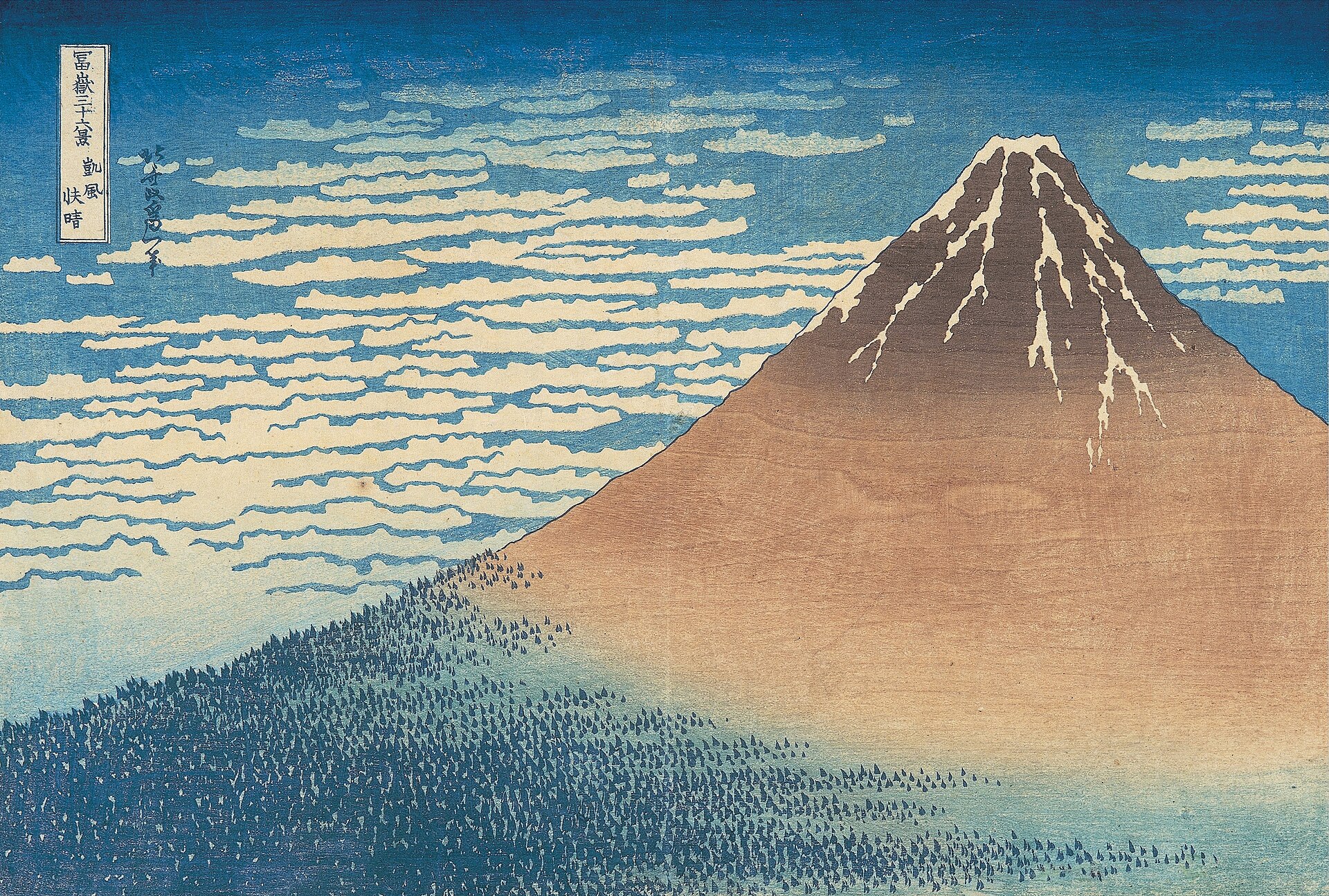
This is worth stating precisely because it is often asserted loosely. What is documented is the technique itself and where it appears - the darkened peak - not a blanket claim that no impression of this print ever carries an outline anywhere near the mountain. Some later or variant impressions do use a fine indigo line to mark the mountain's contour and its tiny trees. What stays constant across the print's history is that the mountain's basic mass and shape read through color and bokashi rather than through the black keyblock line that ordinarily does that job in ukiyo-e printing.
Chapter 2Not one color, three: Pink, Red, and an outlier
Surviving impressions of this design do not agree on what color Mount Fuji is.
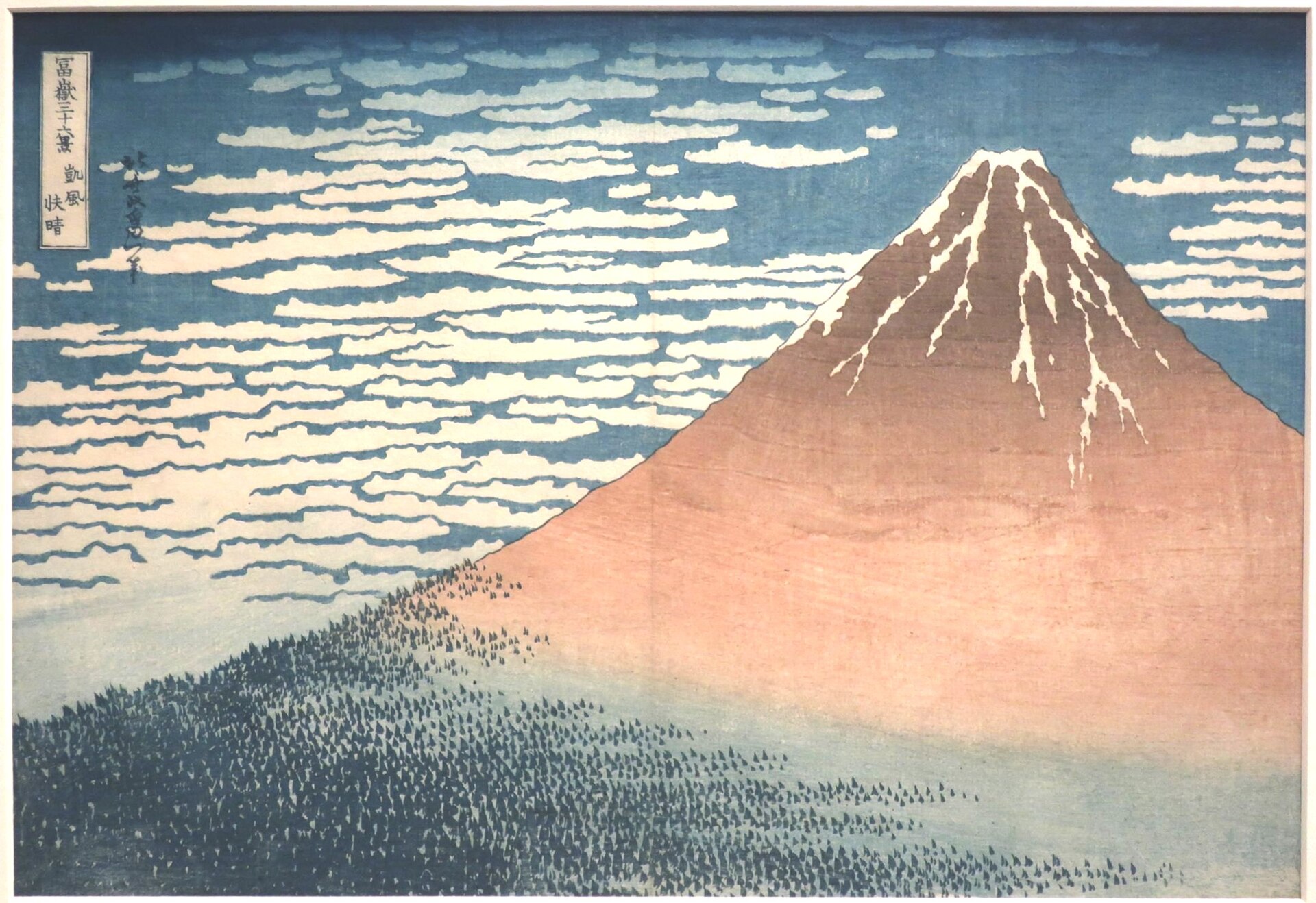
Surviving impressions of this design do not agree on what color Mount Fuji is. Print scholars group them into recognizable states. The rarest and, on current evidence, the earliest is known as Pink Fuji: a muted, close-toned impression in which the mountain runs from green at its base to a soft brown at the summit, printed with the costly pigment orpiment and with a more complex, harder-to-produce gradation than later printings show. The impression most people mean when they say Red Fuji is the strong, even state that gives the print its popular name, colored with benigara, an iron-oxide red. A further, rarer variant departs from both: in it the mountain's outline is left unprinted altogether and its interior is filled with a deep blue bokashi instead of red, a state sometimes called Blue Fuji.
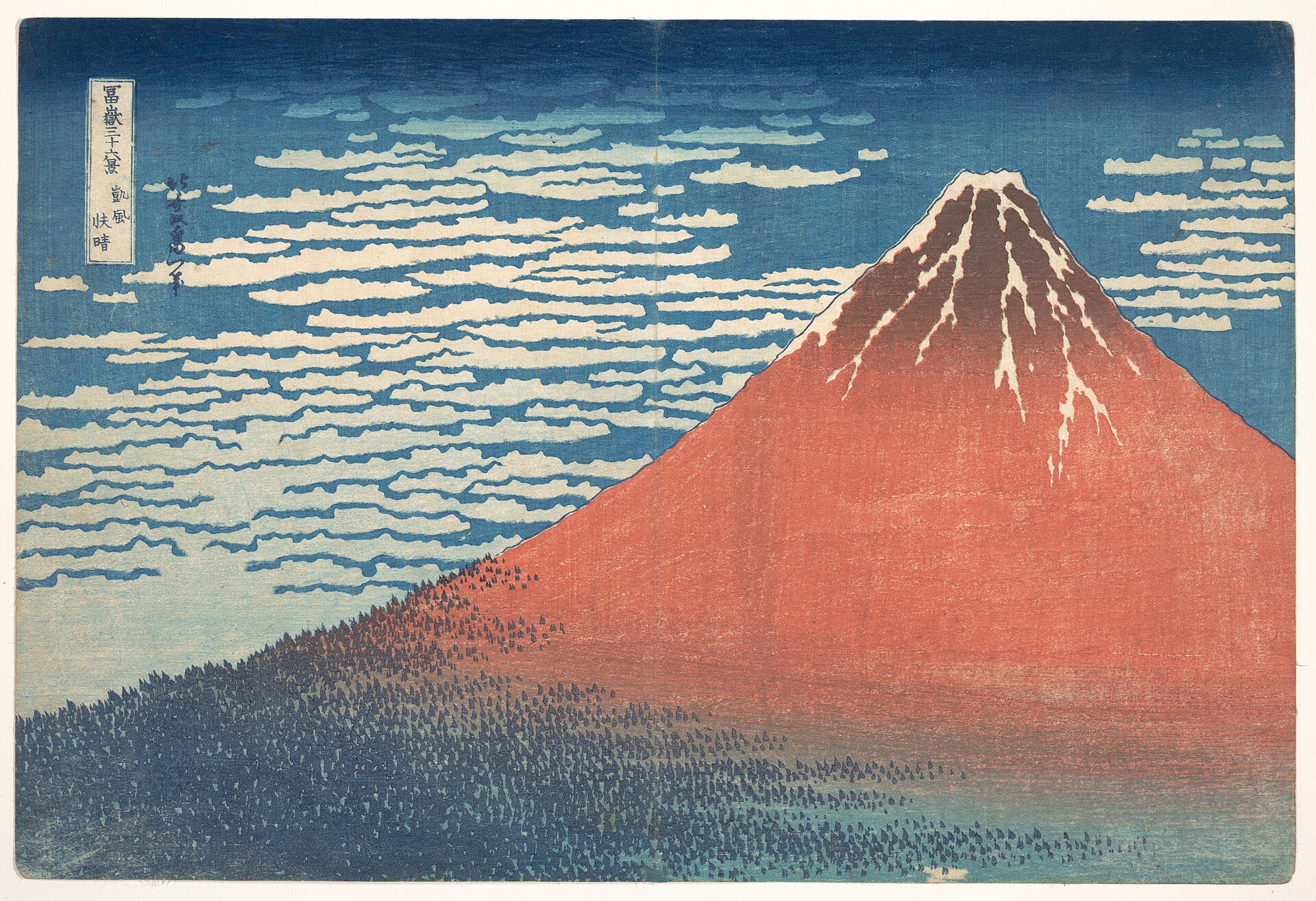
The Metropolitan Museum's own collection holds two separate impressions of this same design under two different accession numbers, JP9 (the sheet this record anchors on, from the Rogers Fund in 1914) and JP2960 (given by the Henry L. Phillips Collection in 1939). They are not the same object photographed twice; they are two separate sheets pulled from the same set of blocks, of slightly different trimmed size, acquired forty-five years apart by different means. Reading which state JP9 itself belongs to would require the kind of side-by-side technical comparison scholars have so far published for other pairs of impressions, not this one specifically - see Open Questions.
Chapter 3Sequencing the states: Keyes and the British Museum's analysis
The print scholar Roger S. Keyes, author of a catalogue raisonne of Hokusai's surviving single-sheet prints, argued in a 2007 article for the journal Impressions that the muted Pink Fuji state was...
The print scholar Roger S. Keyes, author of a catalogue raisonne of Hokusai's surviving single-sheet prints, argued in a 2007 article for the journal Impressions that the muted Pink Fuji state was not a faded accident but the closest surviving witness to what Hokusai actually designed, before a publisher or printer pushed the coloring toward the bolder red that sold better. Keyes titled the piece Pink Fuji: The Print Hokusai Saw, a title that states his conclusion outright.
That argument was tested with physical evidence in 2019, when Capucine Korenberg, a conservation scientist at the British Museum, published a study with colleagues in the journal Heritage Science comparing a Pink Fuji impression held by the Smith College Museum of Art against a Red Fuji impression held by the British Museum. The team examined line quality and signs of wear across the shared woodblocks and analyzed the pigments non-destructively. They found the Red Fuji impression showed more block wear than the Pink Fuji one, and that the Pink Fuji impression used a more expensive and more difficult-to-execute palette - the kind of choice a printer trims away once a design is in full production, not one a workshop would add later. Their conclusion supported Keyes: Pink Fuji came first, and Red Fuji is a subsequent, simplified, commercially adjusted state of the same blocks.
Chapter 4What the series is, and where this print sits in it
Thirty-six Views of Mount Fuji was published by Nishimuraya Yohachi (also known by his shop name Eijudo) beginning around 1830-31.
Thirty-six Views of Mount Fuji was published by Nishimuraya Yohachi (also known by his shop name Eijudo) beginning around 1830-31. It proved successful enough that ten further designs were added afterward, so the finished series runs to forty-six prints under a title that still says thirty-six. This print and The Great Wave off Kanagawa, recorded separately on this site, come from the same series and the same publisher and were designed within the same few years, but they are physically distinct objects with independent histories from the moment each sheet was pulled from the press.
Within the series, this design and one other - Thunderstorm Beneath the Summit, sometimes called Black Fuji - are usually singled out as the two views that show Fuji alone, without travelers, buildings or any human incident, from what appears to be a similar elevated distance. Thunderstorm Beneath the Summit is close in composition to this print but reverses its mood entirely: heavy dark tones, a storm-lit sky, and a mountain apparently seen from its western, unpopulated side, against this print's hazy, populated-implied, eastern-facing calm. Hokusai gave no place name for either view, unlike most of the rest of the series, so the exact vantage point in both cases is not identified in the print itself.
Chapter 5Materials: an imported blue and a mineral red
The sky's blue is Prussian blue, the first synthetic pigment in Western chemistry, discovered by accident in Berlin around 1705 by the color-maker Johann Jacob Diesbach.
The sky's blue is Prussian blue, the first synthetic pigment in Western chemistry, discovered by accident in Berlin around 1705 by the color-maker Johann Jacob Diesbach. It reached East Asia by trade and, reportedly, some smuggling in the early nineteenth century, manufactured more cheaply once workshops in Guangzhou worked out the recipe; in Japan it circulated under the name bero, a corruption of Berlin. Hokusai was among the earliest ukiyo-e printmakers to use it extensively, and this series is one of the works most associated with that adoption, since the pigment let printers render distance and atmosphere in a way the traditional indigo could not match as cheaply.
The mountain's red in the standard state is benigara, an iron-oxide pigment sometimes called Bengal red or red ochre; the rarer, earlier Pink Fuji state instead used orpiment, an arsenic-sulfide mineral pigment that was more expensive and, on the conservation evidence above, associated with the more careful and costly early printing before the design was simplified for volume production.
Chapter 6Reception: esteemed differently at home and abroad
This print and The Great Wave off Kanagawa are frequently named together as the two most internationally recognized images to come out of Japanese printmaking, and both helped shape the vocabulary...
This print and The Great Wave off Kanagawa are frequently named together as the two most internationally recognized images to come out of Japanese printmaking, and both helped shape the vocabulary that European painters drew from during the vogue for Japanese art later in the nineteenth century. But their standing is not identical in the two places. Within Japan, Red Fuji is generally regarded with more esteem than the Great Wave, whose international fame - as a picture of imperiled fishermen under a cresting sea - outweighs its domestic reputation next to a print many Japanese viewers read as a more dignified, more purely national image of the sacred mountain itself.
How ukiyo-e prints as a class reached Western hands is documented for the trade generally, though not for this individual sheet: prints were cheap, mass-produced sheets in Japan, sometimes used to wrap or cushion exported ceramics, and it was in that incidental role that some of the earliest examples reached European buyers before their artistic value was recognized on its own terms. Whether this particular impression, or the Met's JP9 sheet specifically, arrived in the West by that route or through a conventional print dealer's stock is not established in the sources consulted for this record.
Chapter 7This impression: how it entered the Metropolitan Museum
The sheet this record anchors on is accessioned JP9 in the Met's Department of Asian Art, credited to the Rogers Fund and dated 1914.
The sheet this record anchors on is accessioned JP9 in the Met's Department of Asian Art, credited to the Rogers Fund and dated 1914. The fund itself is an endowment created from the 1901 bequest of Jacob S. Rogers, a New York locomotive manufacturer whose fortune the museum used for decades afterward to buy across departments on the open market; it is a purchase fund, not a gift from a named donor of the object itself. The Met's published catalogue record for JP9 states the fund and the year but does not name the dealer or private owner the museum bought the print from, and no fuller acquisition file has been located in the sources consulted for this record.
A second, later impression of the identical design sits in the same museum's collection under accession JP2960, credited to the Henry L. Phillips Collection and dated 1939, twenty-five years after JP9 entered the museum and by an entirely separate route - a bequest rather than a fund purchase. The two prints have different trimmed dimensions (JP9 at 24.4 x 35.6 cm against JP2960 at 25.4 x 37.8 cm), which on its own confirms they are two different physical sheets rather than one object catalogued twice.
Chapter 8The market: a print that is genuinely rare, not merely famous
No sale of the Met's JP9 impression is documented in the sources consulted; it has been museum property since 1914 and this record treats that as the plain state of things rather than a gap to paper...
No sale of the Met's JP9 impression is documented in the sources consulted; it has been museum property since 1914 and this record treats that as the plain state of things rather than a gap to paper over.
Other impressions of the same design do reach the market with some regularity and give a sense of the print's value and its true scarcity. Sotheby's sold an impression in its March 2022 Japanese print sale (lot 19) against an estimate of GBP 150,000 to 200,000, and a second impression in its July 2023 sale (lot 6) against a higher estimate of GBP 450,000 to 500,000; the hammer and premium figures for both are behind a login wall in the sources consulted and are not repeated here as fact. The July 2023 catalogue entry is useful for a different reason: it states that only about ninety-three impressions of this design are documented to survive worldwide, of which roughly twenty-two are thought to remain in private hands, making it markedly scarcer than the Great Wave, of which roughly one hundred thirty impressions are estimated to survive. That census figure comes from an auction house's own research rather than from a museum survey, and this record treats it as reported, not independently verified.
Chapter 9The artist's name on this sheet
Hokusai signed this print Hokusai aratame Iitsu hitsu, drawn by Hokusai, now changed to Iitsu - one instance of a habit that ran through his entire working life.
Hokusai signed this print Hokusai aratame Iitsu hitsu, drawn by Hokusai, now changed to Iitsu - one instance of a habit that ran through his entire working life. He is documented as having used something on the order of thirty different names and pen-names over roughly seventy years of practice, each change typically marking a shift in his style, his patronage, or his sense of what stage of his career he had reached. A cataloguer or a buyer working from the signature alone, without knowing this practice, could reasonably mistake a later Hokusai sheet for the work of an entirely different hand; the name on this print is accurate and it is also not the name most readers know him by.
Chapter 10What the design shows, and what it withholds
The print gives no place name, which sets it apart from most of the rest of the series, where Hokusai typically anchors the view with a named town, road or province in the title.
The print gives no place name, which sets it apart from most of the rest of the series, where Hokusai typically anchors the view with a named town, road or province in the title. Three shades of blue deepen through the sky in a near mirror of three tonal bands on the mountain; a thin line of cloud and, in the earliest state, an uneven, hand-brushed sky give the impression of light and air moving rather than sitting still. Faint remnants of snow are visible near the summit and dark shading marks the tree line lower down, details specific enough that they have been read as placing the scene in early autumn, when Fuji's slopes can briefly redden with sunrise light while old snow still clings near the top and the forest below is still in full shadow. The composition is often described as the most abstracted in the series and, for exactly that reason, the most precisely dated by season of any image in it.
Chapter 11What is not claimed here
This record does not claim the Met's JP9 impression has been placed within the Pink Fuji to Red Fuji sequence by any published study; the technical comparisons cited above were carried out on the...
This record does not claim the Met's JP9 impression has been placed within the Pink Fuji to Red Fuji sequence by any published study; the technical comparisons cited above were carried out on the British Museum, Smith College and comparable impressions, not this one. It does not claim a documented export-as-packing-material story for this specific sheet, only for the ukiyo-e trade in general. And it does not claim knowledge of who sold the print to the Metropolitan Museum in 1914; the museum's own public record does not say, and no other source consulted fills the gap. Recording these as open rather than inferring an answer is the discipline this publication exists to hold to.
The artist
Katsushika Hokusai, born Tokitaro
Hokusai worked for roughly seventy years and, by his own account and that of later cataloguers, changed his working name something like thirty times, each change loosely marking a shift in style or period. He trained in a commercial studio, was expelled from it, spent decades on illustration and popular imagery before landscape work in his seventies made him internationally famous, and by his own late writing regarded himself as still short of mastery at the end of his life. The name on this particular print, Iitsu, is one stop in that sequence, not his best-known one.
Related works
| Work | Relation | Where it is |
|---|---|---|
| Under the Wave off Kanagawa (The Great Wave) Katsushika Hokusai | Same series, same publisher, same production window; a different print and a different physical object with its own separate history Already published on this site as a separate record. The two prints must not be conflated; this record's subject is Red Fuji, not the Great Wave. | Art Institute of Chicago (Clarence Buckingham impression); recorded separately on this site |
| South Wind, Clear Sky (Gaifu kaisei), also known as Red Fuji Katsushika Hokusai | A second, separate impression of the identical design Acquired by the Met in 1939 via the Henry L. Phillips Collection, twenty-five years after and by a different route than the JP9 impression this record anchors on. Different trimmed dimensions confirm it is a distinct physical sheet. | Metropolitan Museum of Art, New York, accession JP2960 |
| Thunderstorm Beneath the Summit (also called Black Fuji) Katsushika Hokusai | The other print in the same series showing Fuji alone, without figures, from a comparable elevated vantage; near-identical composition, opposite mood and apparently the opposite side of the mountain Frequently discussed alongside this print as a deliberate pair, calm dawn against dark storm. | Multiple institutional collections |
| Pink Fuji (an early state of the same design) Katsushika Hokusai | An earlier, rarer printing of the same blocks, argued by Roger Keyes and supported by technical analysis to predate the standard Red Fuji state The impression at the center of the Keyes 2007 and Korenberg et al. 2019 sequencing studies discussed in this record's narrative. | Smith College Museum of Art, Northampton, Massachusetts |
Open questions
- Who sold the print to the Metropolitan Museum in 1914. The museum's public catalogue record credits the Rogers Fund and the year but names no dealer or private seller, and no fuller acquisition file was located in the sources consulted.
- Where the JP9 sheet was between its c. 1830-32 publication and its 1914 accession at the Met. No owner is documented for that interval in the sources consulted.
- Which printed state the Met's JP9 impression itself represents - Pink Fuji, standard Red Fuji, or an intermediate stage. The published technical sequencing work compared the British Museum and Smith College impressions, not this one.
- The precise geographic vantage point of the view. Hokusai supplied no place name for this print, unlike most of the rest of the series, and the location remains unidentified in the sources consulted.
- How reliable the widely repeated figure of about ninety-three surviving impressions is. It derives from a 2023 auction house catalogue note rather than a published museum census.
- Whether this specific sheet passed through Western hands as an incidental wrapping for exported goods, as happened to some ukiyo-e generally, or reached a Western owner by ordinary print-dealer trade. Not documented for this impression specifically.
Questions about this object
What is South Wind, Clear Sky (Gaifu kaisei), also known as Red Fuji, from the series Thirty-six Views of Mount Fuji?
South Wind, Clear Sky (Gaifu kaisei), also known as Red Fuji, from the series Thirty-six Views of Mount Fuji is a print, dated c. 1830-32. Medium: Woodblock print (nishiki-e); ink and color on paper, oban format.
Who made South Wind, Clear Sky (Gaifu kaisei), also known as Red Fuji, from the series Thirty-six Views of Mount Fuji, and is the attribution settled?
The attribution to Katsushika Hokusai is recorded here as accepted. Not disputed. The print carries Hokusai's own signature and publisher seal and is a documented sheet from a named, dated series. The signature reads Hokusai aratame Iitsu hitsu, that is 'drawn by Hokusai, now changed to Iitsu' - one of roughly thirty names and pen-names Hokusai used across his career, and the name he was signing with when this series was designed.
Where is South Wind, Clear Sky (Gaifu kaisei), also known as Red Fuji, from the series Thirty-six Views of Mount Fuji now?
Metropolitan Museum of Art, New York. Inventory number JP9. Last confirmed 25 August 2026. Rogers Fund, 1914.
What is still unknown about South Wind, Clear Sky (Gaifu kaisei), also known as Red Fuji, from the series Thirty-six Views of Mount Fuji?
Who sold the print to the Metropolitan Museum in 1914. The museum's public catalogue record credits the Rogers Fund and the year but names no dealer or private seller, and no fuller acquisition file was located in the sources consulted.
Sources
- 1Metropolitan Museum of Art, collection record for South Wind, Clear Sky (Gaifu kaisei), also known as Red Fuji, accession JP9 (object 36490); data drawn from the Met's public collection pages and API. metmuseum.org/art/...
- 2Metropolitan Museum of Art, collection record for South Wind, Clear Sky (Gaifu kaisei), also known as Red Fuji, accession JP2960 (object 55736), Henry L. Phillips Collection, 1939. metmuseum.org/art/...
- 3British Museum collection record for Red Fuji, accession 1906,1220,0.525, mirrored with the museum's own descriptive text via Google Arts and Culture. artsandculture.google.com/asset/...
- 4Cleveland Museum of Art, collection record for South Wind, Clear Sky from Thirty-Six Views of Mount Fuji, accession 1930.189, Bequest of Edward L. Whittemore. clevelandart.org/art/...
- 5Victoria and Albert Museum, collection record for Fine Wind, Clear Weather (Gaifu), accession E.4813-1916, given by the Misses Alexander. collections.vam.ac.uk/item/...
- 6Wikipedia, 'Fine Wind, Clear Morning'. en.wikipedia.org/wiki/...
- 7Wikipedia, 'Bokashi (printing)', for the hakkake bokashi technique and its documented use on the peak of this print. en.wikipedia.org/wiki/...
- 8Korenberg, Capucine F.; Pereira-Pardo, Lucia; McElhinney, Peter J.; Dyer, Joanne. 'Developing a systematic approach to determine the sequence of impressions of Japanese woodblock prints: The case of Hokusai's Red Fuji.' Heritage Science 7, article 9 (2019). Findings accessed via the BioMed Central companion summary of the study; the full paper itself sits behind a Nature/SpringerOpen login wall not accessible in this research pass. blogs.biomedcentral.com/on-physicalsciences/...
- 9Keyes, Roger S. 'Pink Fuji: The Print Hokusai Saw.' Impressions, no. 29 (2007-08), pp. 68-75. Cited as listed in the Wikipedia bibliography for this print; the article itself is JSTOR-gated and was not independently retrieved for this research pass - flagged for direct verification. en.wikipedia.org/wiki/...
- 10Artelino, 'Hokusai's Red Fuji - South Wind, Clear Sky', dealer/specialist commentary on the print's design and reputation. artelino.com/articles/...
- 11Wikipedia, 'Hokusai', for biographical facts (names, dates, training, the colophon quotation, deathbed words, his daughter Oi). en.wikipedia.org/wiki/...
- 12Wikipedia, 'Japonisme', for the general packing-material discovery narrative and the Bracquemond/Van Gogh reception chronology for ukiyo-e in the West. en.wikipedia.org/wiki/...
- 13Wikipedia, 'Thunderstorm Beneath the Summit', for the pairing and compositional comparison with this print. en.wikipedia.org/wiki/...
- 14Sotheby's, 'Fine Wind, Clear Weather (Gaifu kaisei), also known as Red Fuji', Masters of the Woodblock: Important Japanese Prints, March 2022, lot 19. sothebys.com/buy/...
- 15Sotheby's, 'Fine Wind, Clear Weather (Gaifu kaisei), also known as Red Fuji', Masters of the Woodblock: Fine Japanese Prints, July 2023, lot 6, including the cataloguer's note on approximately ninety-three surviving impressions. sothebys.com/en/...
- 16ABC News (Australia), 'Prussian blue: From the Great Wave to Starry Night, how a pigment changed the world', for the pigment's Berlin origin, its trade route into Japan, and Hokusai's adoption of it. abc.net.au/news/...
Last verified · Published
Change log
25 August 2026 - Record created at the house standard: researched narrative, technical evidence, maker dossier, graded provenance chain, prices with hammer and premium separated, related works, open questions and sources.