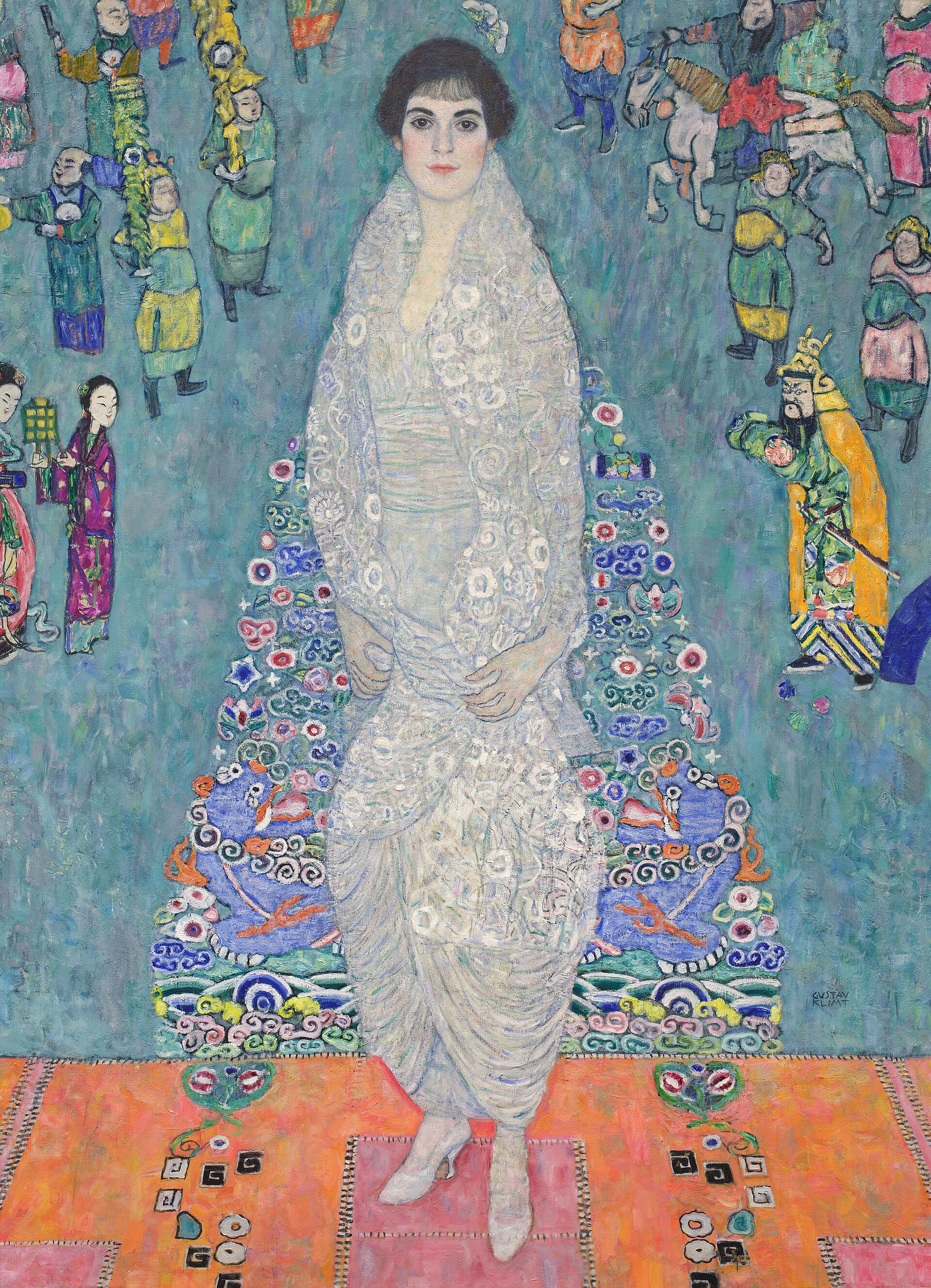
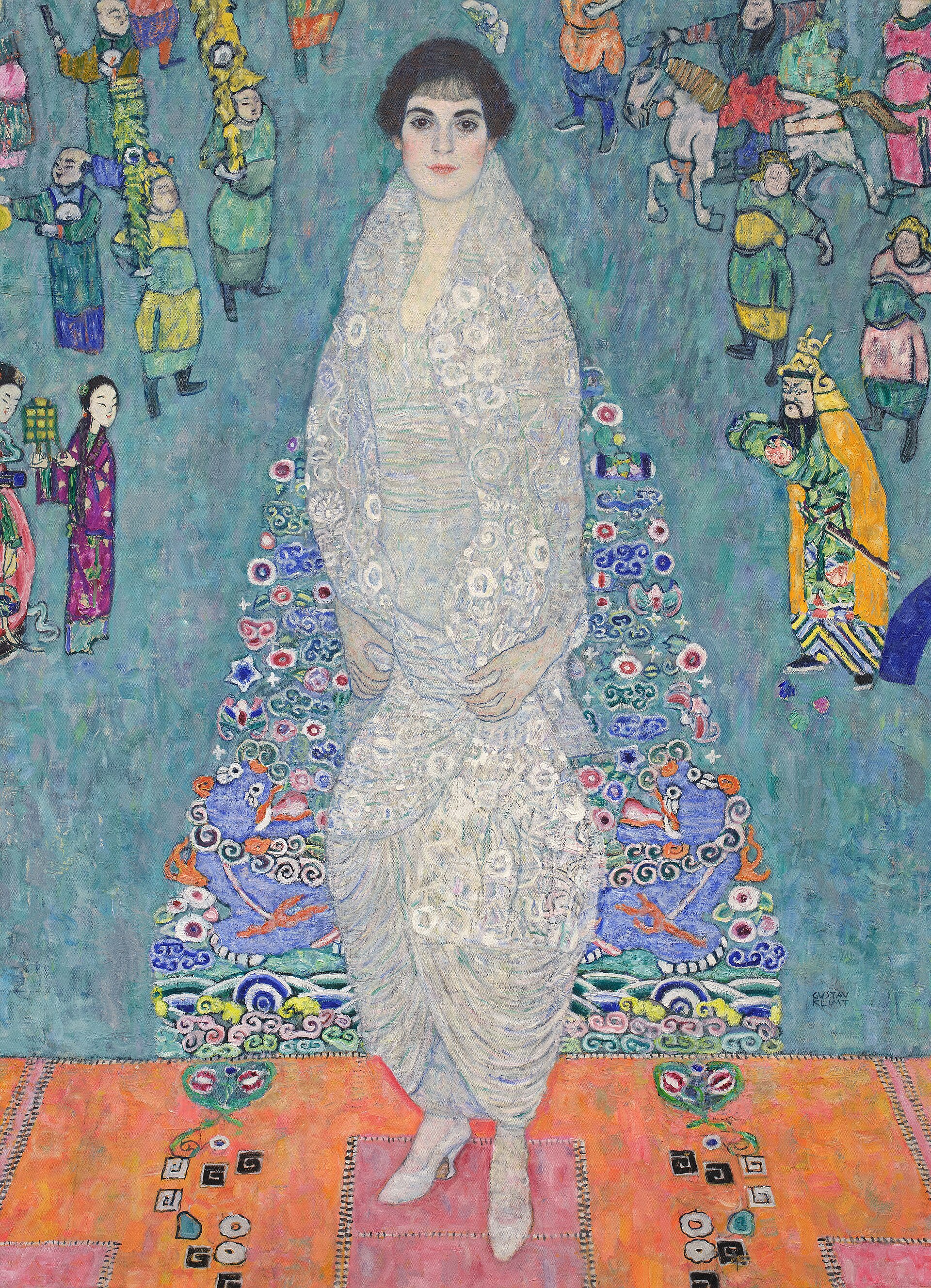
Portrait of Elisabeth Lederer
1914-1916 · Oil on canvas
Private collection
 Austrian · 1862-1918
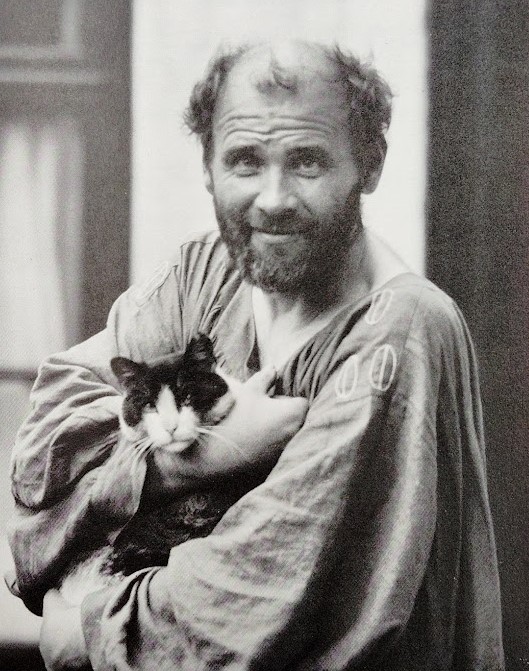
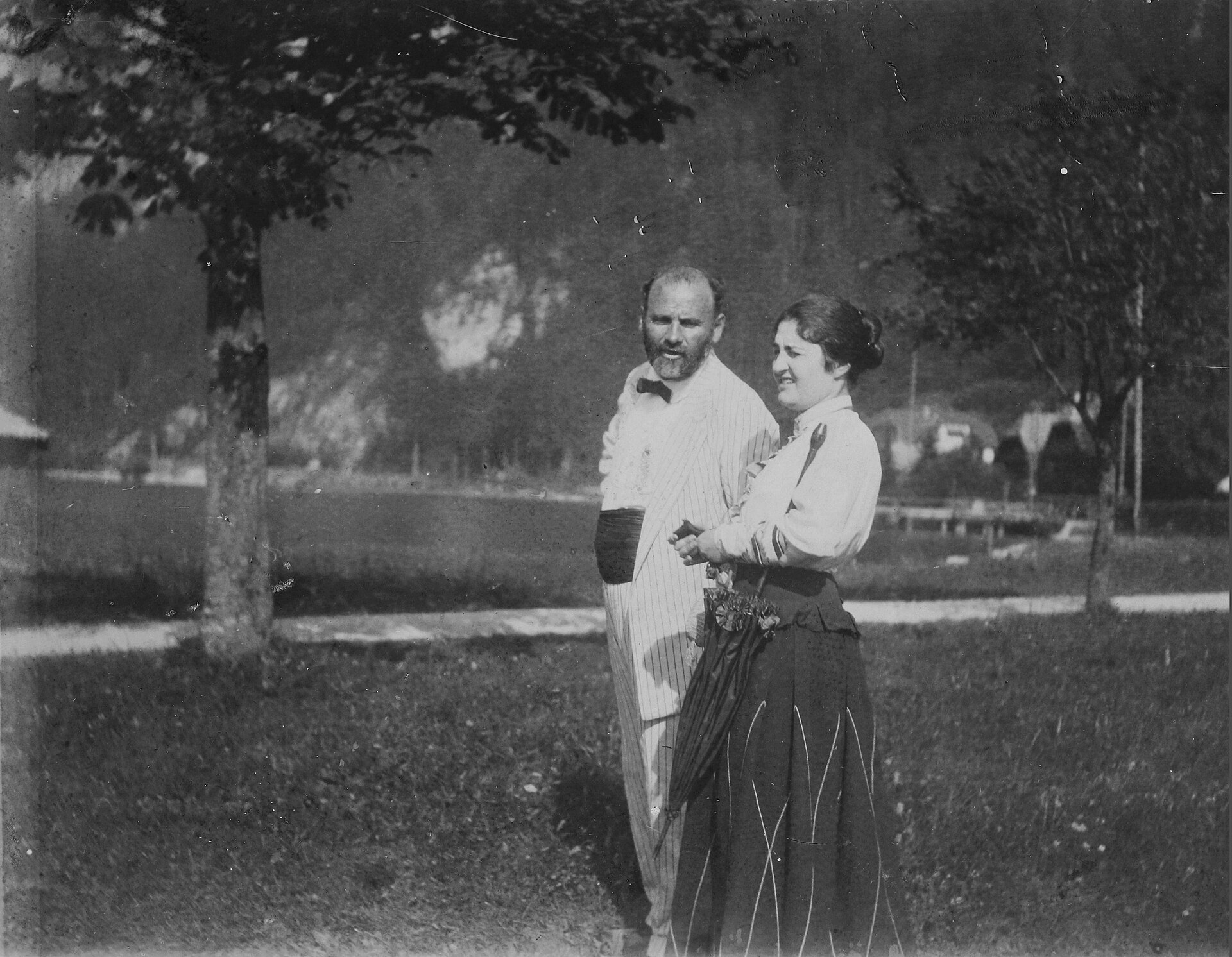
Klimt in the painter's smock he worked in, holding one of his studio cats, at the garden of his studio in Vienna. Attributed to Moriz Nahr, the Secession's photographer of reproductions and Klimt's personal photographer, though the Commons file itself records the author as unknown. The date is contested: the Klimt Foundation's database gives May 1911 at the Josefstadter Strasse studio, Leitz Photographica catalogued a vintage silver print as Vienna 1912, and that print is annotated 1914 in pencil on the reverse in an old hand. The Commons file is dated 1912. There is no doubt at all that the sitter is Klimt.
Wikimedia Commons; licence verified as Public domain from extmetadata.LicenseShortName| Worked as | Painter, Draughtsman, Decorative painter |
|---|---|
| Born | 14 July 1862 · Baumgarten, near Vienna |
| Died | 6 February 1918 · Vienna |
| Nationality | Austrian |
| Movement | Vienna Secession |
| In this archive | 1 artwork |
| Sources | 42 cited |
| Last verified | 16 September 2026 |
About this page 1 artwork in the archive · Last verified 16 September 2026 · 42 sources cited
Gustav Klimt is the most expensive modern painter ever sold at auction, and the reason is not aesthetic. In November 2025 his Portrait of Elisabeth Lederer took a hammer of USD 205 m at Sotheby's New York, USD 236.4 m with fees. In June 2023 Dame mit Facher hammered at GBP 74 m in London, GBP 85.3 m with premium, the highest price for any work of art sold at public auction in Europe. In 2006 five paintings restituted to one woman in Los Angeles produced USD 327 m inside six months. Every one of those pictures was taken from a Jewish family in Vienna between 1938 and 1945.
That is the fact about Klimt that the monographs bury and the auction catalogues state only in a footnote. The blue-chip Klimt market is a restitution market. It exists because Austria was made, slowly and against its will, to give things back, and because the heirs who received them mostly could not afford to keep them. Two of the most valuable Klimts in the world hang today in New York rather than Vienna for that reason and no other.
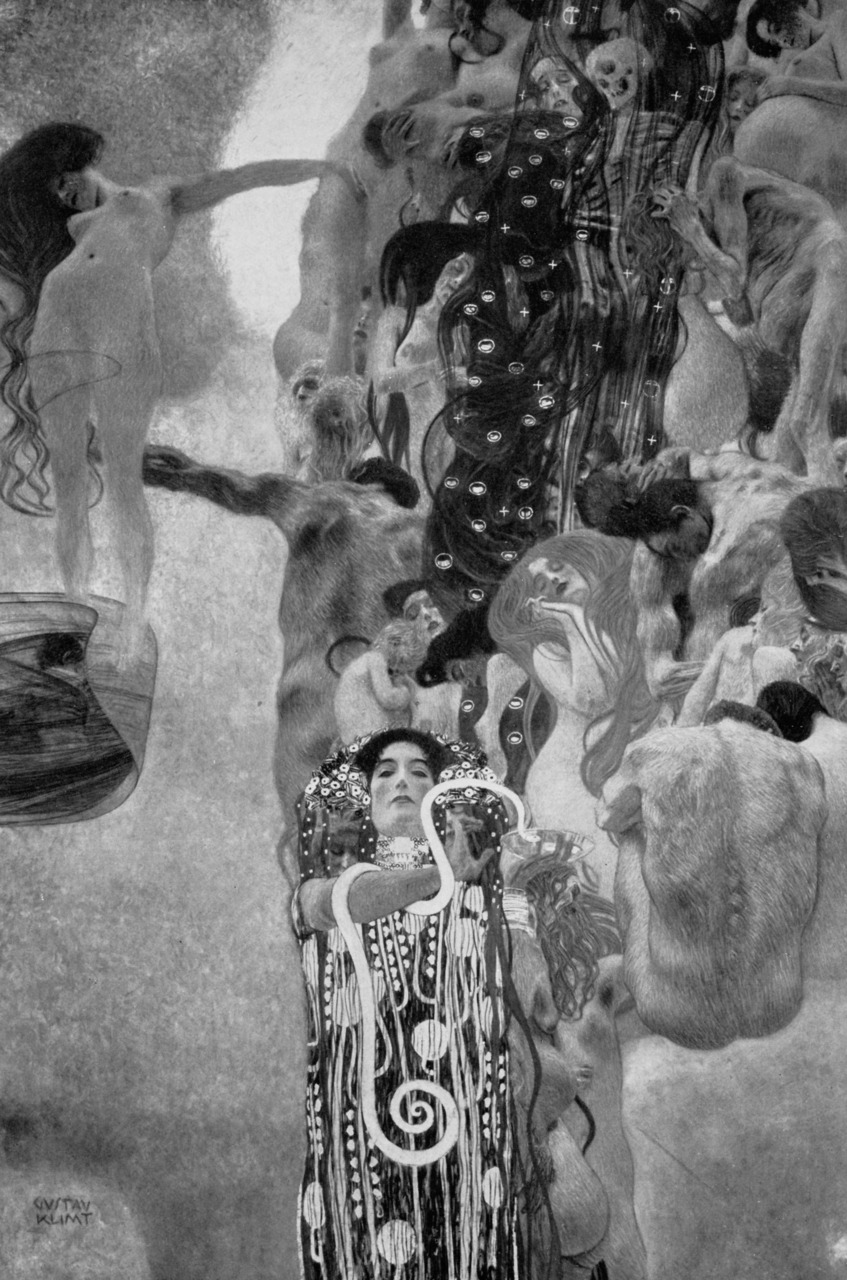
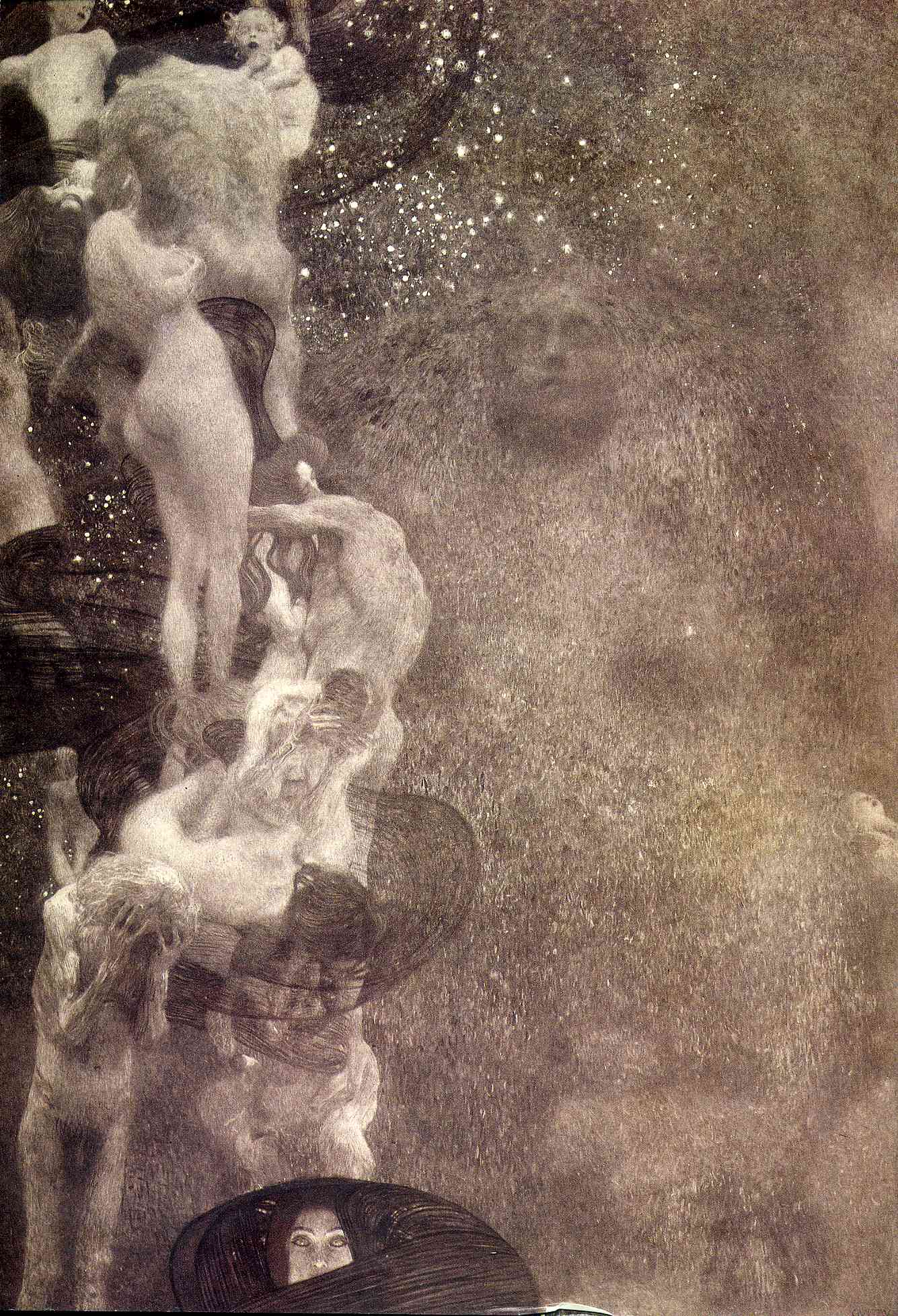
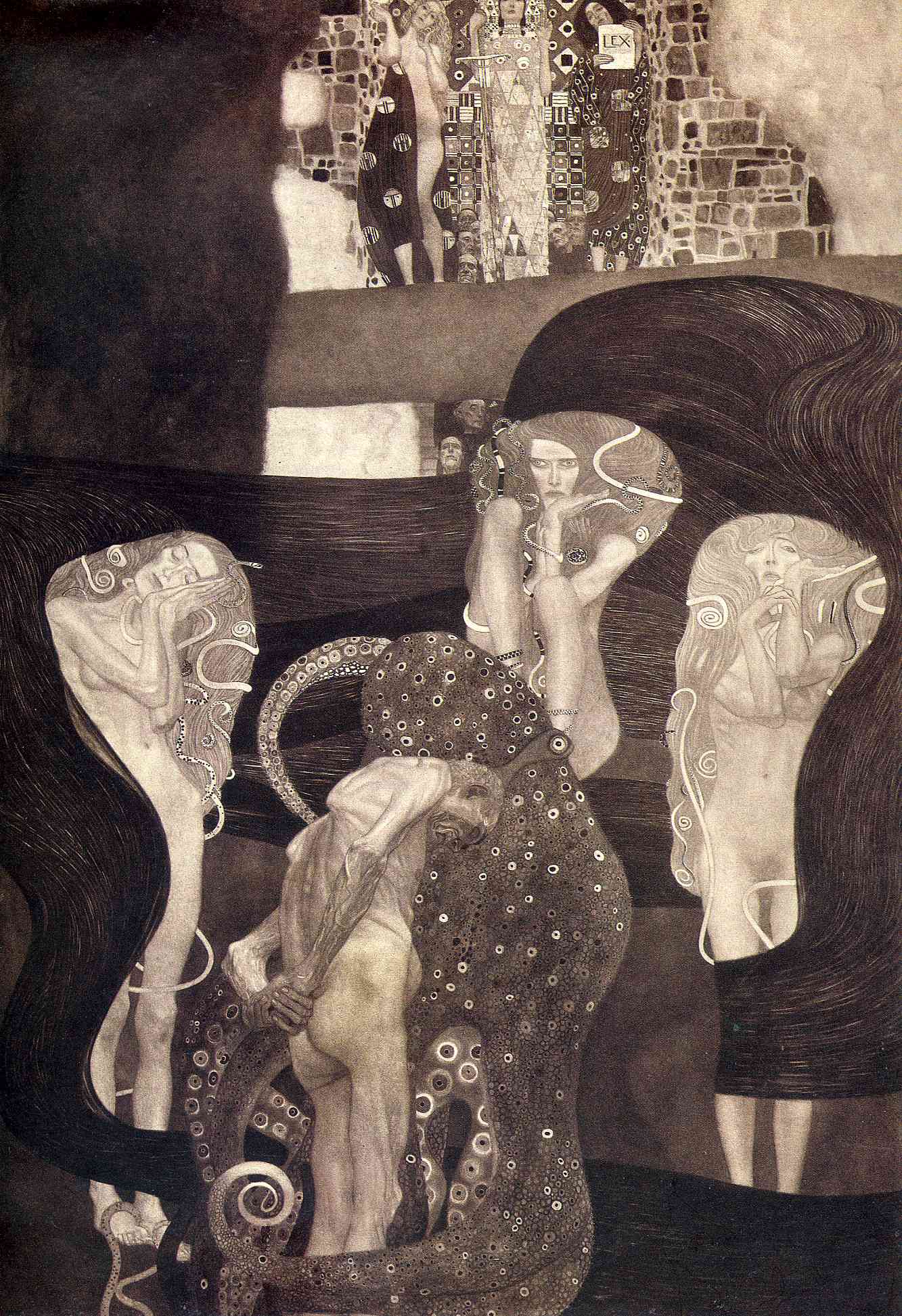
The second fact is subtraction. A substantial part of his monumental work no longer exists. The three Faculty Paintings made for the University of Vienna, the pictures over which he broke publicly with the Austrian state, burned at Schloss Immendorf in May 1945 along with the rest of the Lederer collection stored there. Estimates of how many Klimt paintings went up with them run from at least ten to sixteen and no one has closed the number. What survives of the three largest paintings of his career is photographs.
Born 14 July at Baumgarten near Vienna, second of seven children of Ernst Klimt the elder, a gold engraver from Bohemia.1
Enters the Kunstgewerbeschule in Vienna; studies architectural painting under Ferdinand Laufberger and, after Laufberger's death in 1881, Julius Victor Berger.1
Forms the Kunstlercompagnie with his brother Ernst Klimt and Franz Matsch; the three take decorative commissions across the empire.122
Begins the Burgtheater staircase paintings with the Kunstlercompagnie, completed 1888.1
Awarded the Golden Order of Merit by Franz Joseph I.1
His father dies of a stroke and his brother Ernst of pericarditis in the same year; Klimt takes on both households.1
Commissioned with Franz Matsch to decorate the ceiling of the great hall of the University of Vienna; Klimt is given Philosophy, Medicine and Jurisprudence. The brief is the victory of light over darkness.1627
3 April: resigns from the Kunstlerhaus with eighteen colleagues and founds the Vienna Secession; elected first president.2428
Paints the portrait of Prince William Nii Nortey Dowuona, unknown to scholarship until its rediscovery in 2023.36
January: Ver Sacrum launched, edited by Alfred Roller, with Hermann Bahr and Max Burckhard on the literary council. The Secession building by Joseph Maria Olbrich goes up in six months; Ludwig Hevesi devises the motto set in gold under the dome.222429
26 May: the university art committee asks that Philosophy be made brighter and clearer. On 3 June Klimt agrees to alterations on condition that his artistic freedom be respected.24
Sees the mosaics of San Marco in Venice with Alma Schindler, four years before the Ravenna visit usually credited with beginning the golden style.23
8 March: Philosophy shown at the seventh Secession exhibition; around seventy professors led by Franz Exner, Friedrich Jodl and Emil Reisch petition against it, and Emil Zuckerkandl organises a counter-petition. On 2 April the picture goes to the Paris world exhibition and takes a Grand Prix.2427
Medicine provokes a larger scandal; the affair reaches the Austrian parliament, the first cultural question debated there.16
15 April to 15 June: the fourteenth Secession exhibition, built by Josef Hoffmann around Max Klinger's Beethoven, with Klimt's Beethoven Frieze and Mahler conducting a wind arrangement of the Ninth at the opening. Rodin visits on 6 June.222331
December: visits Ravenna and San Vitale. Carl Reininghaus buys the Beethoven Frieze to prevent its destruction.431
Buys the three Faculty Paintings back from the state with 30,000 kronen provided by August Lederer, who takes Philosophy. Klimt says he refuses all help from the state and renounces everything. In June he leaves the Secession with Hoffmann, Moser and others.172228
Begins the Stoclet Frieze for the dining room of Josef Hoffmann's Palais Stoclet in Brussels, completed 1911.32
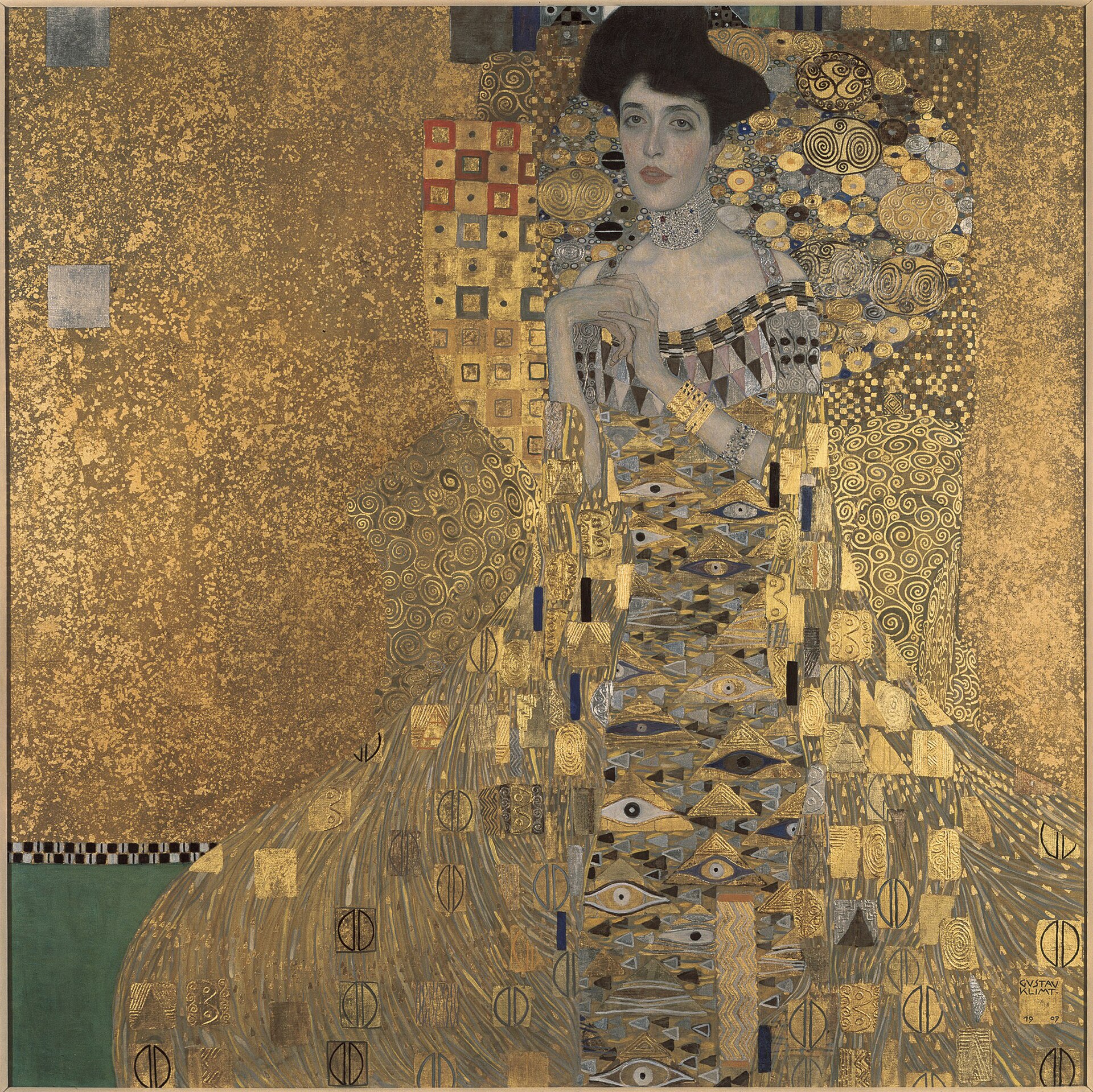
Completes Portrait of Adele Bloch-Bauer I, commissioned by Ferdinand Bloch-Bauer in 1903 and preceded by over a hundred preparatory sketches.4
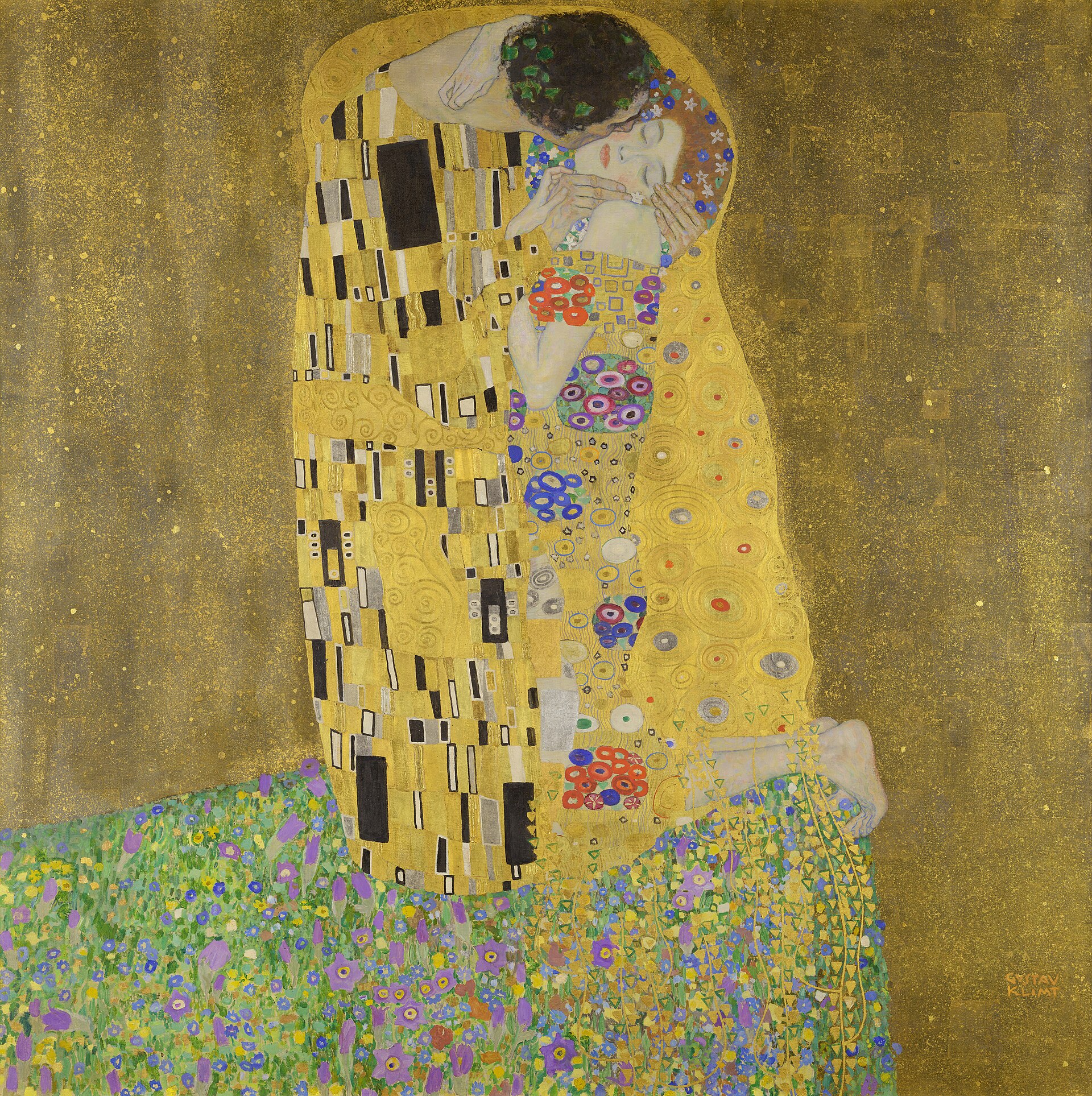
The Kiss is bought for the state from the Vienna Kunstschau by the imperial and royal department for culture and education.38
Moves from the Josefstadter Strasse studio to Feldmuhlgasse 11 in Hietzing.23
August and Serena Lederer buy the Beethoven Frieze with its preparatory sketches.31
11 January: suffers a stroke paralysing his right side. 6 February: dies at the Vienna General Hospital of pneumonia following influenza, aged fifty-five. Dame mit Facher is on the easel in his studio.11425
After Koloman Moser's death the previous October, Medicine is sold by Editha Moser to the Osterreichische Staatsgalerie with funds from Lederer and other patrons; Lederer buys Jurisprudence.23
After the Anschluss, Ferdinand Bloch-Bauer flees and his estate is confiscated on a pretext of tax evasion; the Gestapo seizes from Serena Lederer both Philosophy and Jurisprudence, their sketches, ten further Klimt oils and some two hundred Klimt drawings.323
The museum sends Medicine to Schloss Immendorf for safekeeping, joining the confiscated Lederer works.23
8 to 9 May: Schloss Immendorf burns. All three Faculty Paintings and an unresolved number of other Klimt works are lost; only black-and-white images of the three remain.17181920
Most of the recovered Lederer collection is returned to Erich Lederer in Geneva. Ferdinand Bloch-Bauer's lawyer agrees that Austria may keep several Klimts as donations in exchange for export permits.321
Erich Lederer, denied an export permit since the war, sells the Beethoven Frieze to the Republic of Austria for about USD 750,000.2331
The restored Beethoven Frieze goes on permanent display in a purpose-built basement gallery at the Secession, on loan from the Belvedere.2331
Hubertus Czernin publishes his research in the Austrian gallery's own archives; the Art Restitution Act is adopted on 4 December and the Commission for Provenance Research is established in March.333
The Austrian restitution board refuses Maria Altmann's claim, holding that Adele's will transferred ownership before the occupation.3
7 June: the US Supreme Court decides Republic of Austria v. Altmann, 541 U.S. 677, holding six to three that the Foreign Sovereign Immunities Act applies retroactively.2
15 January: the arbitration panel awards five paintings to the Bloch-Bauer heirs and refuses a sixth. June: Adele Bloch-Bauer I sold privately to Ronald Lauder for a reported USD 135 m. 8 November: the other four make USD 192.7 m at Christie's New York.346
March: the Art Restitution Advisory Board recommends unanimously against returning the Beethoven Frieze to the Lederer heirs.31
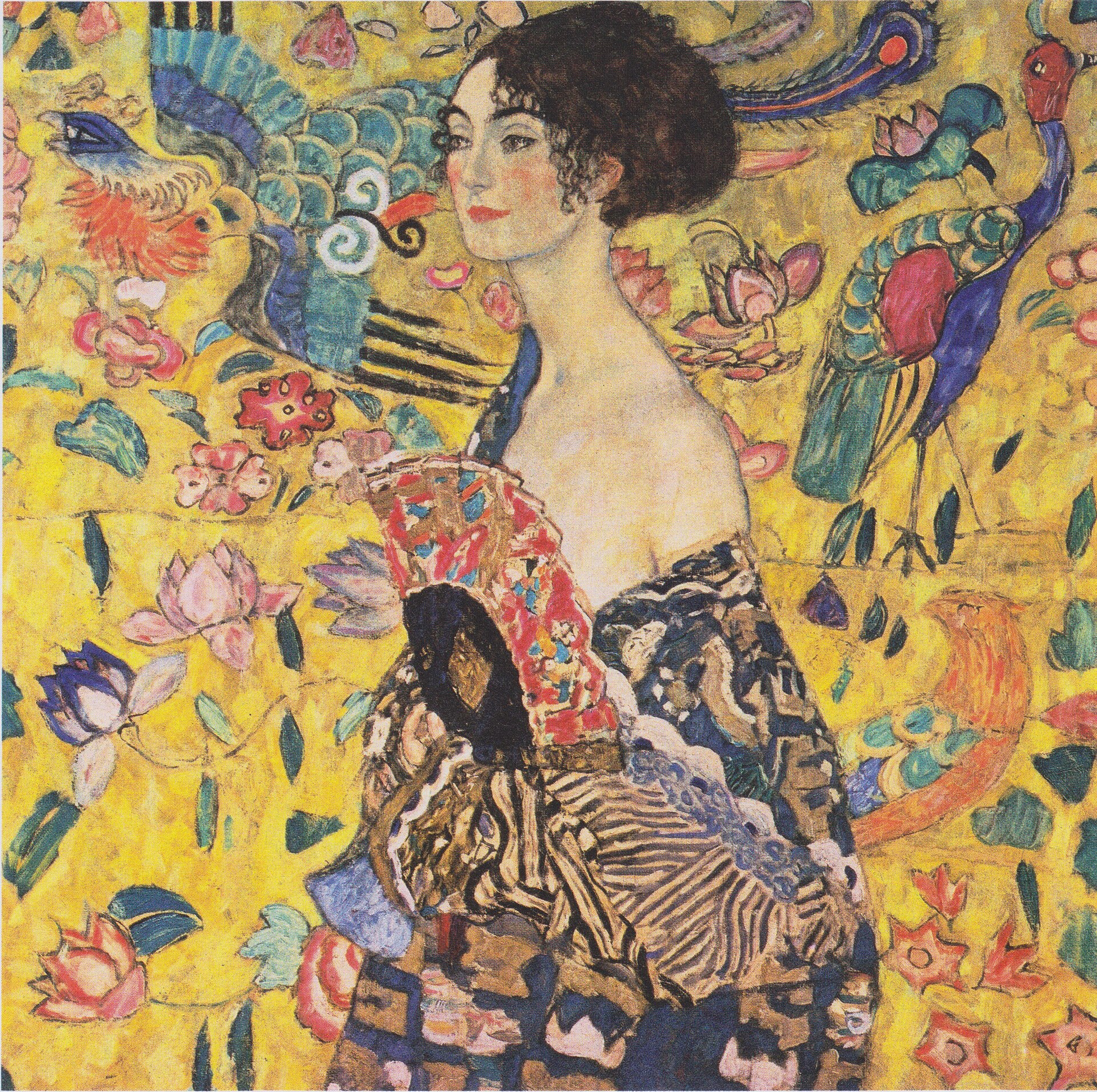
27 June: Dame mit Facher hammers at GBP 74 m at Sotheby's London, GBP 85.3 m with premium, the highest price for any work of art at public auction in Europe.15
24 April: Portrait of Fraulein Lieser sells at im Kinsky, Vienna, for EUR 30 m hammer, about EUR 35 m with fees, a record for any auction in Austria.8
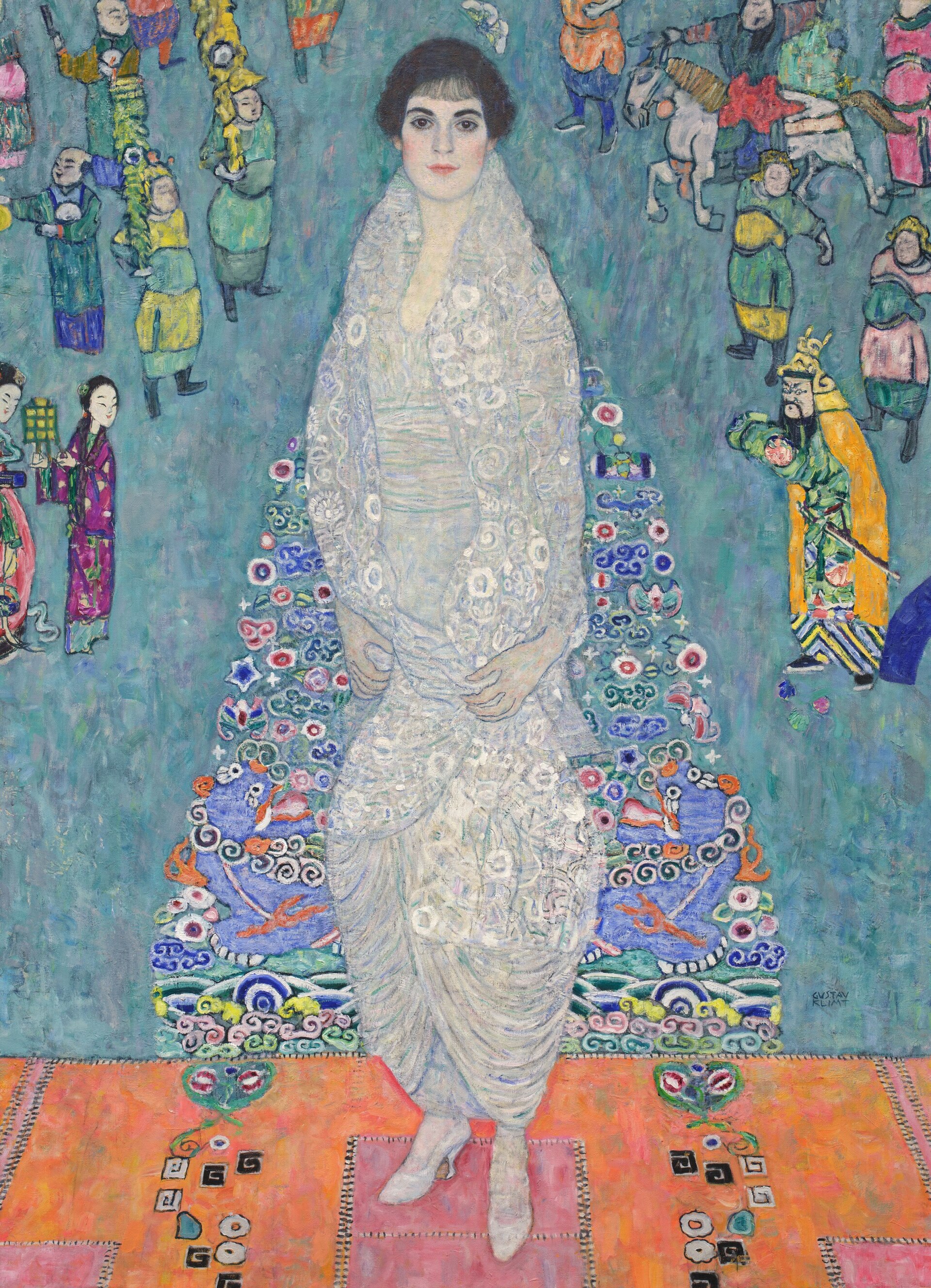
March: the sale of the Lieser portrait collapses after one heir refuses to sign; reported 30 April. 18 November: Portrait of Elisabeth Lederer hammers at USD 205 m at Sotheby's New York, USD 236.4 m with fees, the highest price for any work of modern art at auction.812
4 June: Patricia J. Leahy sues in New York State Supreme Court for restitution of the Lieser portrait, naming the consignor Eva Ropper and im Kinsky as defendants.9
Klimt is a nine-figure artist in a market where very few early modern painters are, and his top end is made almost entirely of pictures with Nazi-era provenance that has been resolved. The pattern of the last twenty years is consistent: a restituted or cleanly restituted-and-sold portrait sets a record; a picture with an open claim does not complete.
Three markets should be kept separate. The great portraits, of which almost none remain in private hands, trade at USD 100 m and above. The landscapes trade in the tens of millions and are the segment Paul Allen's estate tested in 2022. The drawings, of which there are almost five thousand, run from about EUR 3,000 to EUR 200,000 with a record just under USD 1 m; that is a different business with different risks.
Two figures anchor the top. Dame mit Facher hammered at GBP 74 m at Sotheby's London on 27 June 2023 and made GBP 85.3 m with premium, the most ever paid for a work of art at public auction in Europe; it carried a third-party guarantee, so it would have sold in any case. Portrait of Elisabeth Lederer hammered at USD 205 m at Sotheby's New York on 18 November 2025 and made USD 236.4 m with fees, the highest price for any work of modern art at auction and the second highest for any work of art after Salvator Mundi.
The most valuable Klimt transactions of all were private, not public, and neither has been independently confirmed: Ronald Lauder's reported USD 135 m for Adele Bloch-Bauer I in June 2006 and Oprah Winfrey's reported USD 150 m for Adele Bloch-Bauer II in summer 2016. Both figures come from reporting rather than from a bidding record and should be handled as such.
| Date | Sale | Work | Result | Note |
|---|---|---|---|---|
| 11 May 1994 | Sotheby's | Dame mit Facher (Lady with a Fan), 1917-18 | Hammer not published With premium USD 11.6 m USD | New York. Then a record for the artist. Sold from the Wendell Cherry collection; Cherry had bought it from Serge Sabarsky in 1988. |
| 2006-06 | private treaty, not auction | Portrait of Adele Bloch-Bauer I, 1907 | Hammer not applicable With premium USD 135 m reported USD | A negotiated private sale by Maria Altmann to Ronald S. Lauder for the Neue Galerie, New York, five months after the arbitration award. There is no public bidding record and the figure has never been confirmed by the parties. Then the highest price reported for any painting. On display since July 2006. |
| 8 November 2006 | Christie's | Portrait of Adele Bloch-Bauer II, 1912 | Hammer not separately published With premium USD 87,936,000 USD | New York, Impressionist and Modern evening sale. Bought by Oprah Winfrey. The sale totalled USD 491,472,000 and set nine world records. The figure as reported is inclusive of premium. |
| 8 November 2006 | Christie's | Birch Forest (Buchenwald/Birkenwald), 1903 | Hammer not separately published With premium USD 40,336,000 USD | Same sale. Bought by Paul Allen. |
| 8 November 2006 | Christie's | Apple Tree I, 1912 | Hammer not separately published With premium USD 33,056,000 USD | Same sale. |
| 8 November 2006 | Christie's | Houses at Unterach on the Attersee, 1916 | Hammer not separately published With premium USD 31,376,000 USD | Same sale. The four restituted pictures made USD 192,704,000 together; with Lauder's private purchase the five paintings produced about USD 327 m in under six months. |
| 2016 (summer) | private sale | Portrait of Adele Bloch-Bauer II, 1912 | Hammer not applicable With premium USD 150 m reported USD | Reported by Katya Kazakina for Bloomberg on 8 February 2017: Oprah Winfrey sold the picture to an unidentified Chinese buyer. Neither buyer nor price has ever been confirmed. If accurate, a gain of about USD 62 m on ten years and the most valuable Klimt ever sold privately. Winfrey had lent it to MoMA in autumn 2014. |
| 9 November 2022 | Christie's | Birch Forest, 1903 | Hammer not separately published With premium USD 104.6 m USD | New York, from the estate of Paul Allen. Briefly the auction record for the artist, surpassed seven months later. Bought at Christie's in 2006 for USD 40.3 m. |
| 27 June 2023 | Sotheby's | Dame mit Facher (Lady with a Fan), 1917-18 | Hammer GBP 74,000,000 (USD 93.5 m) With premium GBP 85,300,000 (USD 108.4 m, EUR 99.2 m) GBP | London. Estimate in excess of GBP 65 m; bidding opened at GBP 58 m and ran ten minutes between Jen Hua and Patti Wong, Wong's Hong Kong client winning. Backed by a third-party guarantee. The highest price for any work of art at public auction in Europe. Note that the widely quoted GBP 85.3 m is the premium-inclusive figure; some reference sources give it as the hammer, which is wrong. |
| 24 April 2024 | im Kinsky | Portrait of Fraulein Lieser, 1917 | Hammer EUR 30,000,000 (about USD 32 m) With premium about EUR 35,000,000 (USD 37.5 m) EUR | Vienna. Estimate EUR 30-50 m; sold on a single bid under Michael Kovacek to a Hong Kong collector represented by Patti Wong and Associates. A record for any auction in Austria. THE SALE DID NOT COMPLETE: the buyer withdrew in March 2025 after one heir refused to sign an indemnity, and Der Standard estimated the cost to the auction house at about EUR 1.5 m. The picture is said to remain with im Kinsky and is the subject of a New York suit filed in June 2026. |
| 18 November 2025 | Sotheby's | Portrait of Elisabeth Lederer (Bildnis der Elisabeth Lederer), 1914-16 | Hammer USD 205,000,000 With premium USD 236,400,000 USD | New York, the Leonard A. Lauder Collection, inaugurating Sotheby's Breuer building. Estimate in excess of USD 150 m; bidding opened at USD 130 m and ran twenty minutes between two telephone bidders. The highest price for any work of modern art at auction, an artist record roughly doubling the previous one, the most valuable work ever sold by Sotheby's, and the second most expensive work of art ever sold at auction after Salvator Mundi at USD 450.3 m. Restituted to Erich Lederer in 1948; sold by him to Serge Sabarsky in 1983 and acquired by Leonard Lauder in the mid-1980s. |
| 18 November 2025 | Sotheby's | Blumenwiese (1908) and Waldabhang bei Unterach am Attersee (1916) | Hammer not published With premium USD 154.3 m combined USD | Two Austrian landscapes from the same Lauder collection sale. The New York series totalled USD 1.17 bn. |
| 2025-03 | Wienerroither and Kohlbacher, TEFAF Maastricht | Portrait of Prince William Nii Nortey Dowuona, 1897 | Hammer not applicable With premium asking EUR 15 m (about USD 16.4 m) EUR | A dealer asking price, not a result. Rediscovered in 2023, authenticated by Alfred Weidinger on the strength of a Klimt estate stamp, and offered following a restitution settlement with the heirs of Ernestine Klein. No sale had been announced as of May 2025. |
| 2008 | not specified | Klimt drawing, record | Hammer not published With premium just under USD 1 m USD | The record for a Klimt drawing, cited by the Vienna dealers Wienerroither and Kohlbacher. The working range for original drawings is about EUR 3,000 to EUR 200,000, important sheets considerably higher. |
Hammer is the price at which the bidding stopped; with premium adds the fee the house charges the buyer on top. Hammer price and buyer's premium in the glossary.
| Institution | City | Holdings | Note |
|---|---|---|---|
| Belvedere | Vienna | 24 paintings, the largest single collection of Klimt paintings anywhere. | Includes The Kiss, bought for the state from the 1908 Kunstschau; Judith I, Sonja Knips, Fritza Riedler, Adam and Eve, Johanna Staude, Mohnwiese. Also the legal owner of the Beethoven Frieze, which is on loan to the Secession. |
| Secession | Vienna | The Beethoven Frieze, 2.15 by 34.14 m, in the building it was painted for. | Shown since 1986 in a purpose-built basement gallery by Adolf Krischanitz which preserves the proportions of Hoffmann's 1902 room. Restored by Manfred Koller, completed 1984. Built into the wall at ten to fifteen feet, so it is hard to read from the floor. On loan from the Belvedere; a 2015 restitution claim by the Lederer heirs was refused. |
| Leopold Museum | Vienna | One of the largest Klimt holdings after the Belvedere, including On the Attersee (1900), Death and Life and The Blind Man. | Founded 2001 on the collection of Rudolf Leopold, who had owned Dame mit Facher between about 1963 and 1981. |
| Albertina | Vienna | About 170 drawings from every phase, and the institutional home of the Klimt drawings catalogue raisonne. | Klimt's works on paper came to the Albertina in the reorganisation of the former imperial collections begun in 1919. The online catalogue raisonne is free. |
| Neue Galerie New York | New York | Portrait of Adele Bloch-Bauer I, on display since July 2006, with other Klimt and Austrian holdings. | Founded by Ronald S. Lauder and the dealer Serge Sabarsky, opened November 2001 in the William Starr Miller House at Fifth Avenue and 86th Street. Lauder bought the Adele privately from Maria Altmann for a reported USD 135 m. |
| Kunsthistorisches Museum | Vienna | The staircase spandrel paintings by Gustav and Ernst Klimt and Franz Matsch, in situ. | The earliest major Klimt in Vienna and the least visited, because it is thirteen metres above the floor. The museum has periodically built a temporary bridge to allow close inspection. |
| MAK, Austrian Museum of Applied Arts | Vienna | Wiener Werkstatte material relating to the Klimt-Hoffmann collaboration. | One of the eleven Vienna Klimt exhibitions of the 2012 anniversary was mounted here. The MAK is conventionally cited as the holder of the Stoclet Frieze working cartoons; that specific holding could not be verified for this record. |
| Wien Museum | Vienna | A substantial Klimt group including the portrait of Emilie Floge and Pallas Athene. | |
| Osterreichisches Theatermuseum | Vienna | Nuda Veritas (1899). | The museum's single Klimt painting. |
| Klimt Villa | Vienna | The site of his last studio at Feldmuhlgasse 11, Hietzing, used from 1911. | Tina and Felix Klein built a neo-baroque villa over the studio in 1923, keeping the ground-floor rooms; the Kleins fled Nazi persecution, the property was seized and sold in 1939 and returned to them in 1950. It was a school from the 1950s and almost everything original was renovated away; one pre-1918 bathtub survives. Preserved as a memorial since 1999. It is a place, not a collection. |
| University of Vienna, Great Hall | Vienna | Black-and-white photographic replicas of the destroyed Faculty Paintings, installed 2005, around Franz Matsch's surviving central panel. | The nearest thing that exists to seeing the three lost pictures in position. Access is by arranged tour. |
| Palais Stoclet | Brussels | The Stoclet Frieze, 1905-11, in marble, ceramic, gilded tile, enamel, pearl and semi-precious stone, in the dining room. | A private residence, UNESCO World Heritage since 2009, and effectively closed. Museums reconstruct the room; the original is not open. Klimt saw it finished on a visit in May 1914. |
| Museum of Fine Arts, Leipzig | Leipzig | Max Klinger's Beethoven, the cult object at the centre of the 1902 exhibition for which the frieze was painted. | A second marble is in the Museum of Fine Arts, Boston, the gift of Paul Wittgenstein, son of Klimt's and Hoffmann's patron Karl Wittgenstein. |
Klimt left almost no writing. He wrote no manifesto, kept no theoretical notebook, gave few interviews and refused on principle to gloss his own pictures.
Klimt left almost no writing. He wrote no manifesto, kept no theoretical notebook, gave few interviews and refused on principle to gloss his own pictures. The consequence for anyone researching him is severe: nearly every statement about what a Klimt picture means is a statement by somebody else, made later, and must be labelled as such.
Three documented statements of intention survive and they are worth more than any amount of later interpretation. The first is his own description of Philosophy, given when the picture was attacked in 1900: on the left a group of figures, the beginning of life, fruition, decay; on the right the globe as mystery; emerging below, a figure of light, knowledge. That is a programme, stated by the painter, and it is nothing like the one the ministry had ordered.
The second is from an interview in Die Wage the same year, in which he said the painting had to be seen beside its companions and that he would never be forced to make changes against his artistic convictions. The third is the passage now known as the commentary on a non-existent self-portrait: he had never painted himself, he was less interested in himself as a subject than in other people and above all women, there was nothing special about him, he was a painter who painted from morning to night, and whoever wanted to know something about him ought to look carefully at his pictures and try to see in them what he was and what he wanted to do.
Read that last sentence as an instruction rather than modesty and it explains the shape of the literature. He declined to supply the meaning. Everyone since has supplied it for him.
His father Ernst Klimt the elder was a gold engraver from Bohemia.
His father Ernst Klimt the elder was a gold engraver from Bohemia. Gustav was the second of seven children; his brothers Ernst and Georg were also trained metalworkers and craftsmen, and Georg made the metal doors of the Secession building. The family was poor. The gold in Klimt's pictures begins as a family trade, not as a symbol he adopted.
He entered the Kunstgewerbeschule, the Vienna arts and crafts school, in 1876 and stayed until 1883, taught first by Ferdinand Laufberger and after Laufberger's death in 1881 by Julius Victor Berger. The training was decorative-industrial rather than academic: architectural painting, ornament, the discipline of executing another man's programme on a ceiling. With his brother Ernst and their classmate Franz Matsch he formed the Kunstlercompagnie, which took decorative commissions across the empire, worked for the theatre architects Fellner and Helmer, and painted the Burgtheater staircases between 1886 and 1888 and the spandrels of the Kunsthistorisches Museum. In 1888 Franz Joseph gave him the Golden Order of Merit; in 1890 he took the first Kaiserpreis. He was, by thirty, a state-approved decorator.
In 1892 his father died of a stroke and his brother Ernst of pericarditis in the same year, leaving Gustav responsible for two households. The Kunstlercompagnie effectively ended. What follows is one of the sharpest ruptures in nineteenth-century European painting, and the man who made it had spent fifteen years learning to please committees.
The standard account of the gold: Klimt travelled to Ravenna in 1903, saw the Byzantine mosaics of San Vitale, and returned to invent the golden style.
The standard account of the gold: Klimt travelled to Ravenna in 1903, saw the Byzantine mosaics of San Vitale, and returned to invent the golden style. The account is not wrong but it is late. He visited San Vitale in December 1903, and the influence on Portrait of Adele Bloch-Bauer I, begun that year, is real and is generally traced to the mosaic image of the Empress Theodora.
What the neat version omits is that Alma Schindler recorded in her diary a visit with Klimt to San Marco in Venice in 1899, and the golden shimmer of the mosaics there. The interest in the gold ground predates Ravenna by four years. Ravenna intensified and confirmed something already in motion; it did not begin it.
It matters what he was borrowing. The Byzantine gold ground is a theological device. Gold behind a figure is not a background at all: it is the refusal of a background, the removal of the sacred figure from measurable space and light into an uncreated one. Klimt took the device and applied it to living Viennese women, most of them Jewish, in commissions paid for by their husbands. The transfer is the whole point of the golden style and he never once explained it. The reading that the gold ground carries its old sacral charge into a secular portrait is an interpretation, widely held and reasonable, but it is an interpretation. What is documented is the borrowing, the dates and the source.
On 3 April 1897 Klimt and eighteen colleagues resigned from the Kunstlerhaus and founded the Vienna Secession, with Klimt as first president, Carl Moll as vice-president and Rudolf von Alt as...
On 3 April 1897 Klimt and eighteen colleagues resigned from the Kunstlerhaus and founded the Vienna Secession, with Klimt as first president, Carl Moll as vice-president and Rudolf von Alt as honorary president. The founding group included Koloman Moser, Josef Hoffmann, Joseph Maria Olbrich, Max Kurzweil and Wilhelm Bernatzik; Otto Wagner joined shortly after.
The group's self-presentation was consistently quasi-religious and that was deliberate. The journal, launched in January 1898 with Alfred Roller as editor and Hermann Bahr and Max Burckhard on its literary council, was called Ver Sacrum, sacred spring. The phrase is the Italic rite recorded by Livy, Festus, Strabo and Dionysius of Halicarnassus, in which a people under pressure vowed to Mars everything born in one spring; the children so vowed were led to the frontier veiled, at about twenty, and made to found a settlement of their own. A secession of the young that goes out and founds its own place is the exact content of the phrase, and the Secession chose it.
The building by Olbrich, put up in six months in 1898, was conceived by its architect as a temple, on the model of Segesta in Sicily. Under the laurel-leaf dome the critic Ludwig Hevesi devised the motto set in gold letters: to every age its art, to art its freedom. Othmar Schimkowitz's gorgons over the door represent Painting, Architecture and Sculpture linked by snakes.
The temptation is to read all this as a cult of art in the strong sense, a substitute religion. Restraint is required. What the Secession actually committed itself to in print, in the statutes published in the first issue of Ver Sacrum, was more prosaic: lively contact with outstanding foreign artists, and a remedy for what the founders called the disgraceful fact that Austria had not a single illustrated art journal. The sacral apparatus was real, visible and chosen; the documented programme behind it was internationalist and professional. Both are true and neither should be collapsed into the other.
The fourteenth Secession exhibition, 15 April to 15 June 1902, is the clearest surviving evidence of what the group thought it was doing.
The fourteenth Secession exhibition, 15 April to 15 June 1902, is the clearest surviving evidence of what the group thought it was doing. Josef Hoffmann designed the interior and specified the visitor's route. At the centre, in what the arrangement made an inner sanctum, stood Max Klinger's polychrome marble Beethoven, and the visitor was obliged to move around it. Alfred Roller's poster showed a worshipping figure and his painting Sinking Night served as the darkened backdrop. Gustav Mahler, whose own controversial revision of the Ninth Symphony had been heard in Vienna in February 1900, arranged and conducted a wind version of the finale at the opening.
Klimt's contribution ran some eighty-five feet along three walls of the left lateral gallery. Its programme is documented because the exhibition catalogue printed it. The long left wall carries the yearning for happiness and the sufferings of weak mankind, who appeal to a knight in golden armour to take up their cause out of compassion and ambition. The short wall is the hostile forces: the giant Typhoeus, the three gorgons, sickness, madness and death, lasciviousness, wantonness and intemperance, and at the end a female figure of gnawing grief. The long right wall brings poetry and the arts, then the choir of angels, and closes on the embrace and the line from Schiller that Beethoven set: this kiss to the whole world.
The frieze is a translation of Richard Wagner's programmatic reading of the Ninth Symphony into images. That relation is documented in the exhibition's own framing and is not a modern inference. Alessandra Comini has argued that viewers in 1902 would have recognised Mahler in the face of the golden knight; that is a scholarly identification, attributed here to her, not a documented statement by Klimt.
The technique is as unorthodox as the setting. The 1902 catalogue described the materials tersely as casein paint, applied plasterwork and gilding on ornamented plaster panels. Marian Bisanz-Prakken, the Albertina's authority on the drawings, describes contours drawn with brush, charcoal, graphite and pastel, casein set against gold, and applied upholstery tacks, curtain rings, mirror fragments and mother-of-pearl, the last used for the eyes of Typhoeus. For the figure of Poetry, Klimt made nude studies from the model and then abandoned them in favour of his real source: a reproductive print of a Greek vase painting, the kithara player in plate 137 of Eduard Gerhard's Auserlesene griechische Vasenbilder of 1843, a book in the library of the Institute of Classical Archaeology at the University of Vienna. That is what a documented source looks like, as against a resemblance.
The frieze is 2.15 by 34.14 metres and weighs about four tonnes.
In 1894 the ministry commissioned Klimt and Franz Matsch to decorate the ceiling of the great hall of the University of Vienna.
In 1894 the ministry commissioned Klimt and Franz Matsch to decorate the ceiling of the great hall of the University of Vienna. Klimt was given Philosophy, Medicine and Jurisprudence, each over four metres high. The brief was the victory of light over darkness. Wilhelm von Hartel, the liberal minister of education, carried the commission.
Trouble began early and was procedural before it was ideological. An art committee examined the painted drafts on 26 May 1898 and asked that Philosophy be made brighter and rendered more clearly. On 3 June 1898 Klimt agreed to alterations, on condition that his artistic freedom be respected. He then delivered something the committee could not have anticipated: not the triumph of reason but a column of drifting nude bodies, a sphinx-like mass in a starred void, and a single face of knowledge emerging at the bottom.
Philosophy was shown at the seventh Secession exhibition on 8 March 1900 and the scandal was immediate. Around seventy professors, led by the physicist Franz Exner, the philosopher Friedrich Jodl and the classicist Emil Reisch, petitioned against its installation in the auditorium; the figure of eighty-seven signatories is also widely reported and the two counts have not been reconciled. Their stated objections were that the picture did not render philosophy intelligibly and that the composition was unsuited to the architecture. Critics complained of a lack of clear pictorial and formal language, and that the work was largely incomprehensible without the catalogue. The anatomist Emil Zuckerkandl organised a counter-petition among colleagues who were not offended. On 2 April 1900 the picture went to the Paris world exhibition and was given a Grand Prix, which is to say that the same object was condemned in Vienna and decorated in Paris inside two months.
Medicine provoked worse in 1901 and the affair reached the Austrian parliament, the first time a question of art had been debated there. What was at issue was not nudity in the abstract. The faculties had ordered allegories that affirmed their disciplines and Klimt returned allegories in which the disciplines do not master anything: bodies drift, Hygieia turns her back on the viewer, the accused stands helpless before the octopus of the law. Carl Schorske's Fin-de-Siecle Vienna of 1980 made the reading that has dominated English-language scholarship since, that the pictures record the collapse of Viennese liberal rationalism. That is Schorske's argument, and it is a fact about Schorske; the documented fact about Klimt is that he was asked for the victory of light over darkness and did not supply it.
In 1905 he took the pictures back. August Lederer put up the 30,000 kronen that let him repay the state advance, and received Philosophy. Klimt's own account of the decision was that he refused any help from the state and renounced everything. He never took another public commission from the Austrian state.
After 1905 the three pictures dispersed.
After 1905 the three pictures dispersed. Lederer held Philosophy. Koloman Moser bought Medicine and Jurisprudence around 1910 to 1912; after his death in October 1918 his widow Editha sold Medicine to the Osterreichische Staatsgalerie, funded in part by Lederer and other patrons, while Lederer bought Jurisprudence. Two of the three were therefore in Jewish hands in 1938 and the third in a state museum.
After the Anschluss the Nazi authorities confiscated Philosophy and Jurisprudence from Serena Lederer along with their sketches, ten further Klimt oils, some two hundred Klimt drawings and the rest of the collection. In 1943 the museum sent Medicine to join them, for safekeeping, at Schloss Immendorf in Lower Austria, about fifty kilometres north-west of Vienna. The castle held works confiscated from several collections.
On or about 8 to 9 May 1945 Schloss Immendorf burned. The account generally given is that a withdrawing SS detachment fired it as Soviet forces approached; the Austrian National Library's version is that a military unit had placed timed charges in the four corner towers which detonated after the Red Army occupied the site. The building, forty rooms over some 900 square metres, was destroyed.
How much Klimt burned is genuinely unresolved and the published figures do not agree. The Austrian National Library states that most Klimt researchers suspect at least ten works from the Lederer collection burned. The Klimt Villa gives fifteen. The Klimt Foundation is reported to list sixteen lost works. The same National Library account notes inconsistencies in the storage and transport lists that could mean certain pictures, among them Gastein, Malcesine am Gardasee and Aus dem Reich des Todes, never reached Immendorf at all. The Wikipedia article on the ceiling paintings goes further and observes that there is no positive proof the paintings themselves were destroyed, only that the building was. Nothing has surfaced in eighty years, and the working assumption of every institution is that they burned; but a reader should know that the assumption rests on the fire and the absence, not on an inventory of ashes.
What survives is photographic. There is no colour record of the three pictures as they stood. The ceiling voids in the university's great hall remained empty until 2005, the centenary of Klimt's withdrawal, when black-and-white photographic replicas were installed around Matsch's surviving central panel. Colour reproductions of the Faculty Paintings circulate widely and are reconstructions; their colour is inferred, not recorded.
August Lederer, a Jewish industrialist, and his wife Serena Pulitzer Lederer assembled the largest private holding of Klimt in existence.
August Lederer, a Jewish industrialist, and his wife Serena Pulitzer Lederer assembled the largest private holding of Klimt in existence. It included portraits of Serena, of her mother, and of her daughter Elisabeth; two of the three Faculty Paintings; and, from 1915, the Beethoven Frieze, which Carl Reininghaus had bought in 1903 to save it from destruction and had never been able to display. The Lederers were, on the account carried in the current literature, the second wealthiest family in Vienna after the Rothschilds.
August died in 1936. The Gestapo seized objects from the newly widowed Serena's house on 26 November 1938 and stripped the residence a year later; items went first to the depot at the Neue Burg, then to the Reichsbank, then in some cases to the salt mines at Altaussee, the largest Nazi storage site and the intended feed for Hitler's museum at Linz. Serena fled to Budapest in 1940 and died there in 1943.
The family's daughter Elisabeth, whose portrait Klimt painted between 1914 and 1916, survived until 19 October 1944 partly by means of a document, obtained with the help of a former Nazi brother-in-law, stating that Klimt was her father. Her own portrait was confiscated in 1938 but survived, on the account now given, because portraits of Jewish sitters were not thought worth taking.
Much of the collection was recovered and returned to the son, Erich Lederer, by 1948, by then living in Geneva. Austria then refused him an export permit for the Beethoven Frieze, which sat in the Lower Belvedere from 1961 until he sold it to the Republic in 1973 for about USD 750,000. He sold the Elisabeth portrait to the dealer Serge Sabarsky in 1983 and died in 1985; his widow sold the rest, and Lederer objects are now in the Metropolitan Museum, the Getty and elsewhere. In 2025 the Elisabeth portrait became the most expensive work of modern art ever sold at auction.
Austria's mechanism for returning Nazi-era loot from its own collections is the Art Restitution Act of 1998, amended in 2009 and again in 2023.
Austria's mechanism for returning Nazi-era loot from its own collections is the Art Restitution Act of 1998, amended in 2009 and again in 2023. It covers objects in the federal museums, the National Library and the Bundesmobiliendepot which the state acquired during the Nazi period and has not returned, and it explicitly reaches the category that had defeated claimants for fifty years: the works signed over as donations in order to obtain export permits for everything else.
Two bodies do the work. The Commission for Provenance Research, set up in March 1998 by the education minister Elisabeth Gehrer, investigates acquisitions from 1938 onward and assembles the documentary dossier. The Art Restitution Advisory Board, the Beirat, reads the dossier and issues a recommendation to the responsible federal minister. Its members are determined by the minister and include representatives of four ministries plus experts nominated by Universities Austria, with a state attorney in an advisory capacity. The full text of its decisions is published.
The two structural features a claimant needs to understand are that the Beirat recommends rather than orders, and that its recommendation goes to the same minister who is responsible for the museum holding the object. That is the machine Maria Altmann met in 1999, and it refused her.
Adele Bloch-Bauer died in 1925. Her will of 19 January 1923 asked her husband Ferdinand to consider giving the Klimt paintings to the Austrian state gallery.
Adele Bloch-Bauer died in 1925. Her will of 19 January 1923 asked her husband Ferdinand to consider giving the Klimt paintings to the Austrian state gallery. It was a request, made of a man who did not own the pictures under his own understanding until her death, and the arbitrators would eventually find that it bound him to nothing. Ferdinand did give Schloss Kammer am Attersee III to the gallery in 1936, which shows he took the wish seriously and also that he chose what to give.
After the Anschluss he fled and the state confiscated his estate, his sugar business and his art on a pretext of tax evasion. The lawyer Erich Fuhrer, appointed administrator, sold and transferred the pictures: Buchenwald to the City of Vienna in 1942, Adele Bloch-Bauer II to the gallery in 1943, and so on. Ferdinand died in November 1945 leaving his estate to his nephew Robert and his nieces Louise and Maria, and making no mention of paintings he believed lost. In 1948 and 1949 his lawyer, negotiating restitution under the 1946 Annulment Act, agreed that Austria could keep several works as donations in exchange for export permits for the rest.
In 1998 the journalist Hubertus Czernin worked through the gallery's own archives and published what they showed: the museum had known. The Art Restitution Act followed on 4 December 1998. Maria Altmann, Adele's niece, then living in Los Angeles, applied. In 1999 the Austrian board refused her, on the reading that Adele's will had transferred ownership before the occupation. Austrian court fees were set as a percentage of the amount in dispute and would have run to roughly USD 1.6 m, so she withdrew and sued in the United States instead.
Austria argued that a sovereign state could not be sued in an American court for acts committed in 1938. The District Court for the Central District of California denied the motion to dismiss; the Ninth Circuit affirmed in 2002 and denied rehearing en banc in 2003; the Supreme Court took the case. On 7 June 2004, in Republic of Austria v. Altmann, 541 U.S. 677, the Court held six to three that the Foreign Sovereign Immunities Act of 1976 applies to conduct predating both its own enactment and the State Department's adoption of the restrictive theory of immunity in 1952. Stevens wrote for the majority with O'Connor, Scalia, Souter, Ginsburg and Breyer; Rehnquist dissented with Kennedy and Thomas.
The holding is narrow and enormous. It decides nothing about who owns a Klimt. It decides that the expropriation exception in the FSIA reaches back through the whole of the twentieth century, which is the door through which every subsequent American Nazi-era art claim against a foreign state has walked.
In May 2005 the parties agreed to binding arbitration in Austria, under Austrian law, at Austria's cost. The three-member panel, chaired by Peter Rummel with Walter Rechberger and Andreas Nodl, issued its award on 15 January 2006, reported the following day. Adele's will created no legal obligation; Ferdinand's ownership was absolute until his death; Austria therefore held no valid title. Five paintings went to the heirs: Portrait of Adele Bloch-Bauer I (1907), Portrait of Adele Bloch-Bauer II (1912), Buchenwald/Birkenwald (1903), Apfelbaum I (1912) and Hauser in Unterach am Attersee (1916).
A sixth was refused. The panel held that Ferdinand had probably given Amalie Zuckerkandl away voluntarily, with Fuhrer's involvement, to support the sitter's family, and that although the price paid by Viktoria Kunstler looked low it was defensible given the friendship between the parties, the buyer's risk, the persecution and the seller's necessity. That refusal is the part of the case nobody cites and it is the part that shows the panel was not simply handing back everything asked for.
Altmann had said she wanted the pictures to remain visible.
Altmann had said she wanted the pictures to remain visible. Litigation costs and the number of heirs made that impossible. All five were sold within the year and all five went into private hands.
Portrait of Adele Bloch-Bauer I went first, in June 2006, to Ronald S. Lauder for a reported USD 135 m, then the highest price ever paid for a painting. This was a private treaty sale, not an auction, and the figure has never been confirmed by a public bidding record; every account of it is a report of a negotiated price. It went on display at Lauder's Neue Galerie in New York in July 2006 and has hung there since. The Belvedere had shown the picture for sixty years under the title Dame in Gold, a name the gallery adopted to detach it from its Jewish sitter.
The other four were consigned to Christie's New York for the evening sale of 8 November 2006, which totalled USD 491,472,000 and set nine world records. Adele Bloch-Bauer II made USD 87,936,000, Birch Forest USD 40,336,000, Apple Tree I USD 33,056,000 and Houses at Unterach on the Attersee USD 31,376,000: USD 192,704,000 for the four, all figures inclusive of premium as auction houses report them. Adding Lauder's private purchase, the five paintings produced roughly USD 327 m in under six months.
Birch Forest was bought by Paul Allen, and reappeared at Christie's in November 2022 from his estate at USD 104.6 m, which briefly made it the most expensive Klimt at auction. The buyer of Adele Bloch-Bauer II in 2006 was Oprah Winfrey, who lent it to the Museum of Modern Art in autumn 2014 and, according to Katya Kazakina's report for Bloomberg of 8 February 2017, sold it in the summer of 2016 to an unidentified Chinese buyer for USD 150 m. Neither the buyer nor the transaction has ever been confirmed on the record. If the figure is right it is a gain of about USD 62 m on ten years, and the most valuable Klimt ever sold privately.
Not every Klimt claim succeeds, and the Austrian process is not a rubber stamp.
Not every Klimt claim succeeds, and the Austrian process is not a rubber stamp. In 2013 the heirs of Erich Lederer sought restitution of the Beethoven Frieze, arguing that the 1973 sale to the Republic had been made under duress: the frieze had been restituted to Erich after the war, but Austria then refused an export permit, so that the only buyer he could ever have was the state that had blocked him. The price was fifteen million schillings, about USD 750,000, for a work the family regarded as worth vastly more.
In March 2015 the Art Restitution Advisory Board recommended unanimously against return. The frieze remains federal property, on loan from the Belvedere to the Secession, where it has been shown since 1986 in the purpose-built basement gallery by Adolf Krischanitz that preserves the proportions of Hoffmann's 1902 room. The restoration under Manfred Koller was completed in 1984; a one-to-one copy made during that work went to the Venice Biennale the same year.
The export-ban argument is the most consequential unresolved question in Austrian restitution practice, because the same pattern, restitute the object and then forbid it to leave, was used repeatedly. The Beirat has now ruled on it once and against the claimant.
In January 2024 the Vienna auction house im Kinsky announced a discovery: Portrait of Fraulein Lieser, painted in 1917, unfinished and unsigned in Klimt's studio at his death, and known for a century...
In January 2024 the Vienna auction house im Kinsky announced a discovery: Portrait of Fraulein Lieser, painted in 1917, unfinished and unsigned in Klimt's studio at his death, and known for a century only from a black-and-white photograph taken at the Neue Galerie exhibition in Vienna in 1925. On 24 April 2024 it sold on a single bid, under the hammer of Michael Kovacek, for EUR 30 m against an estimate of EUR 30 to 50 m, about EUR 35 m and USD 37.5 m with fees. It was the highest price ever paid at auction in Austria.
The catalogue did not hide the problem; it stated it, and the wording matters. The house recorded that it had not been able to clarify the precise provenance following the 1925 exhibition, that the identity of the sitter was not completely certain, and that the painting's partially unexplained history could leave it open to restitution claims. It also acknowledged that it thought it unlikely the picture had left Lieser family possession before the Anschluss. The gap runs from 1925 to about 1961, when the work is first recorded with the consignor's family; it therefore spans 1938 to 1945 entirely.
The sitter is disputed and the dispute is not decorative, because it determines who the heirs are. Im Kinsky's director Ernst Ploil, an art lawyer, researched the picture and concluded there was no evidence of looting or illegal confiscation, and proposed that Henriette Lieser, called Lilly, the former wife of Justus Lieser, had commissioned it, since the 1925 photograph appears to show it hanging in her house. Henriette was deported in 1942 and murdered; sources differ on whether at Auschwitz or after deportation to Riga on 11 January 1942 with death recorded on 3 December 1943. Der Standard, working from archival material at the Mumok, argued that Henriette sold the picture under duress after her assets were frozen, to Adolf Hagenauer, a Nazi party member whose father-in-law had been her butler, and that he passed it to his daughter, who died in 2022. Against this, the art historians Tobias G. Natter and Alfred Weidinger hold that the sitter is Margarethe Constance Lieser, daughter of Adolf Lieser, who sat nine times between April and May 1917. Neither account is settled.
Before the sale the consignors made a private restitution agreement with legal successors of both Adolf and Henriette Lieser, giving them half of any proceeds, expressly on the footing that any acquisition during the Nazi period was unlawful. Im Kinsky described this as a fair and just solution under the 1998 Washington Principles and stated that all rightful heirs had been identified.
They had not. After the hammer, descendants of Margarethe's brother Hans came forward. The buyer, a Hong Kong collector represented by Patti Wong and Associates, had made completion conditional on indemnities from every known heir. Almost all signed. One heir of Hans Lieser refused. The sale collapsed in March 2025 and was reported on 30 April. Der Standard estimated the cost to im Kinsky at about EUR 1.5 m, or USD 1.7 m; the house denies Der Standard's account.
On 4 June 2026 Patricia J. Leahy of South Carolina, on her own behalf and that of Nickolas Johann Kraft and Hans Lieser, sued in New York State Supreme Court, naming the Austrian consignor Eva Ropper and the auction house as defendants, represented by Baker and Hostetler. Leahy says she is Adolf Lieser's sole great-grandchild and Hans's sole grandchild, that she was never contacted, that she contested the sale before it took place, that she was told all heirs must act through one lawyer, and that she was warned not to approach the press. Her complaint alleges the house never consulted the foremost Klimt experts, describes the USD 37.5 m as well under market, and states the reason the picture went to Vienna rather than to Christie's or Sotheby's: those houses have well-known guidelines on potentially looted art, and Austrian restitution law is less stringent than other jurisdictions'. The painting is said to remain in im Kinsky's possession.
Set the numbers side by side and the complaint's market point is hard to dismiss. A disputed 1917 Klimt portrait made USD 37.5 m in Vienna in 2024 and did not complete. A clean-title 1914 to 1916 Klimt portrait made USD 236.4 m in New York in November 2025. The discount on an unresolved provenance is not a percentage. It is most of the value.
There is no Klimt authentication committee, no foundation with the power to include or exclude, and no single agreed number of paintings.
There is no Klimt authentication committee, no foundation with the power to include or exclude, and no single agreed number of paintings. The figure most often given is around 230; the Albertina, in the context of its drawings project, says approximately 300 paintings against almost 5,000 drawings; a common alternative formulation is that he painted over 200 of which over 160 are known. Anyone quoting a single number for Klimt's paintings is quoting one catalogue's count and should say which.
Three catalogues of the paintings matter. Fritz Novotny and Johannes Dobai, Gustav Klimt, with a Catalogue Raisonne of His Paintings, published in 1967 to 1968 with a later supplement, is the foundation and is the source of the classical numbering. Alfred Weidinger's Gustav Klimt, with a catalogue of works compiled with Michaela Seiser and Eva Winkler, appeared from Prestel in 2007. Tobias G. Natter's Gustav Klimt. The Complete Paintings, Taschen, 2012, 676 pages, is the most recent full attempt and adds early works the three earlier catalogues did not cover; Taschen itself markets it as a monograph containing a complete catalogue of the paintings rather than as a catalogue raisonne superseding its predecessors, and does not publish a count.
For the drawings the authorities are Alice Strobl's four volumes and the continuing supplement by Marian Bisanz-Prakken. The Albertina is publishing a free online catalogue raisonne of the complete drawings; as of the current state it carries everything through 1903 plus the studies for Portrait of Fraulein Lieser, corresponding to Strobl volume I and the relevant part of volume IV, with later groups to follow.
Attribution in practice is therefore done by named individuals. Bisanz-Prakken is the recognised authority on the drawings and a sheet not in Strobl or the supplement must go to her. Weidinger and Natter are the names invoked on the paintings, and they can disagree in public, as they do on the Lieser sitter.
The 2025 rediscovery shows the process. An Austrian couple brought a dirty, badly framed picture to the Vienna dealers Wienerroither and Kohlbacher in 2023 without knowing what it was. The gallery noticed a Klimt estate stamp and had the attribution confirmed by Weidinger. It is a portrait of Prince William Nii Nortey Dowuona, a representative of the Ga people of what is now Ghana, painted in 1897, the year of the Secession's founding; Weidinger described it as marking the transition to a new stage in Klimt's development. It came to TEFAF Maastricht in March 2025 priced at EUR 15 m, about USD 16.4 m, following a restitution settlement with the heirs of Ernestine Klein, a Jewish collector who fled Austria in 1938. The Hungarian magazine HVG then alleged it had been smuggled out of Hungary, where it had been in private hands since the 1950s; Der Standard reported that Hungarian authorities had in fact issued the export clearance in 2023, possibly because the conservators had overlooked the estate stamp and did not realise what they were releasing. The gallery called the smuggling claim an insinuation.
Two things follow. The corpus is still growing, by pictures that come off a wall in a flat. And the gate is a stamp on the back plus one scholar's opinion.
The drawn work dwarfs the painted work. Almost 5,000 drawings are known, against a few hundred paintings, and the Albertina insists on treating them as autonomous works rather than studies.
The drawn work dwarfs the painted work. Almost 5,000 drawings are known, against a few hundred paintings, and the Albertina insists on treating them as autonomous works rather than studies. Its own Klimt holding is about 170 sheets covering every phase. In 1962, at the centenary, Alice Strobl could assemble nearly 250 drawings for the Albertina from public and private collections while the dealer Christian M. Nebehay showed another 150 in his gallery in the Annagasse. That is the scale of the private market: two shows in one city in one autumn accounted for four hundred sheets.
The market is correspondingly broad and correspondingly exposed. The Vienna gallery Wienerroither and Kohlbacher, which has handled over 400 original Klimt drawings in twenty-five years of trading, puts the ordinary range at roughly EUR 3,000 to EUR 200,000, with important sheets considerably higher and a record of just under USD 1 m set in 2008. The same firm warns plainly that countless prints and imitations circulate and are mistaken for originals, and that Klimt is hard to authenticate precisely because he changed his drawing style repeatedly and worked in different materials at different dates.
The structural risk is obvious once stated. A market with thousands of loose, unsigned, small, technically simple sheets by an artist whose name carries this much money, with authentication resting on one scholar and a printed catalogue that is not complete, is the most attackable position in modern draughtsmanship. The published fake cases are few, which is not the same as the fakes being few.
Klimt pioneered the square canvas in his landscapes and then carried it into the portraits.
Klimt pioneered the square canvas in his landscapes and then carried it into the portraits. Portrait of Adele Bloch-Bauer I is about 138 by 138 centimetres; Dame mit Facher is 100.2 by 100.2. The square removes the hierarchy a portrait format normally supplies: nothing is taller than it is wide, so the sitter does not dominate the field and the ornament can occupy as much of the picture as the person does. In Adele Bloch-Bauer I the dress and the ground become one continuous mosaic of gold and silver and the woman is legible only at the face and hands.
The ornament has documented sources and undocumented ones, and they should not be mixed. Klimt owned East Asian objects and used them: the Klimt Foundation records that the background figures of the late portraits derive from Chinese and Korean art, taken both from vases and sculptures he owned and from published reproductions. The Dame mit Facher carries a phoenix and lotus blossoms and reflects, on Sotheby's own account of the picture, his interest in Chinese and Japanese dress and in Japanese woodblock prints. Byzantine mosaic is documented by the Venice and Ravenna visits. Greek vase painting is documented for the Beethoven Frieze down to the specific plate.
Egyptian and Mycenaean readings of the eye and spiral motifs in the gold portraits are common in the literature and rest on visual resemblance rather than on any recorded source, book or acquisition. They are proposals. Likewise, the recurring attempt to connect Klimt to the theosophical and occult-revival circles active in Vienna, Munich and Amsterdam around 1900 has no documentary footing: no membership, no subscription, no correspondence, no book in an inventory. The closest documented link is formal rather than doctrinal, Bisanz-Prakken's observation that the floating genii of the Beethoven Frieze recall the Dutch symbolist Jan Toorop, whose own work drew on those currents. Klimt borrowed a shape. There is no evidence he took anything else, and the absence is worth stating plainly rather than filling in.
He lived austerely and worked constantly.
He lived austerely and worked constantly. He avoided the coffeehouse society of his own circle, wore sandals and a long smock without undergarments at home, demanded long sittings, and kept his affairs private. He fathered at least fourteen illegitimate children, four of whom were legally recognised after his death. He never married. His companion for nearly thirty years was the fashion designer Emilie Floge, whose family he spent every summer with on the Attersee between 1900 and 1916, and where locals called him the Waldschrat, the forest goblin.
Around four hundred postcards from Klimt survive in Floge's estate and are the closest thing to a diary he left. They are how we know that the coffee party for Auguste Rodin in the Prater took place on 6 June 1902, and they carry his own reaction to the finished Palais Stoclet on his visit to Brussels in May 1914: that it was really very, very beautiful, and that postcards gave no conception of it.
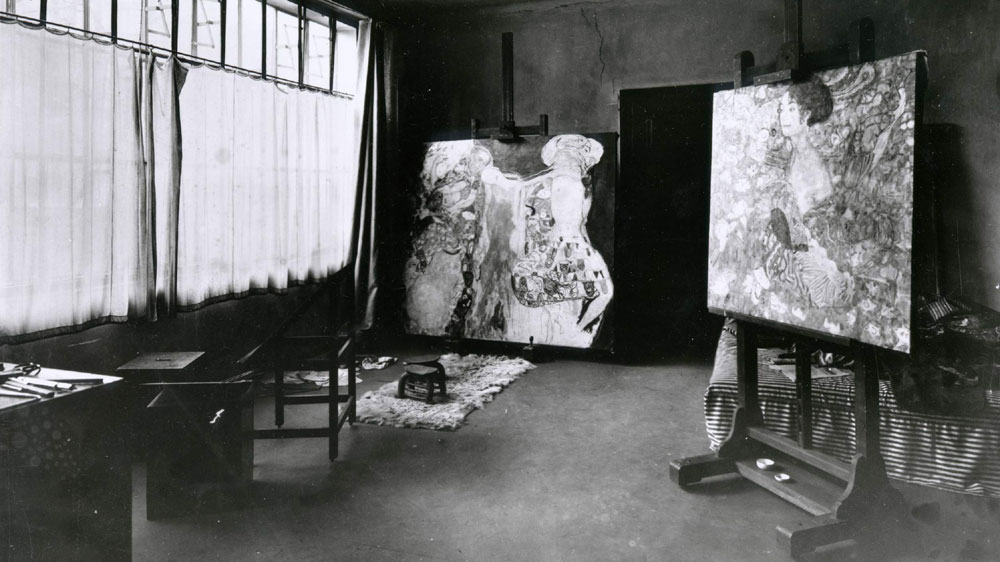
He kept cats in the studio at Josefstadter Strasse 21 and moved to a new studio at Feldmuhlgasse 11 in Hietzing in 1911. Moriz Nahr, the Secession's official photographer of reproductions and Klimt's personal photographer, documented both. The Feldmuhlgasse studio photograph of 1917 or 1918 shows The Bride still on the easel with the low stool and carpet in front of it. Tina and Felix Klein built a neo-baroque villa over the studio building in 1923, keeping the ground-floor rooms; the Kleins fled Nazi persecution, the property was seized and sold in 1939, and it was returned to them in 1950. It served as a school from the 1950s and almost every original trace was renovated away: one pre-1918 bathtub survives. Since 1999 it has been preserved as the Klimt Villa.
He suffered a stroke on 11 January 1918 that paralysed his right side, and died at the Vienna General Hospital on 6 February 1918, of pneumonia following influenza, aged fifty-five. He is buried at Hietzing. Egon Schiele drew him on his deathbed. He left a studio full of unfinished pictures, among them The Bride, Adam and Eve, Dame mit Facher and the Lieser portrait: three of those four have since set or approached records, and the fourth has produced a lawsuit in New York.
Painter; Draughtsman; Decorative painter. 1862-1918.
Born 14 July 1862, Baumgarten, near Vienna; died 6 February 1918, Vienna.
The drawings market. Almost 5,000 known drawings, mostly small, unsigned, quickly made and in ordinary materials, by an artist whose name now carries nine-figure prices on the paintings. The Vienna dealers Wienerroither and Kohlbacher, who have handled over 400 original Klimt drawings, state plainly that countless prints and imitations circulate and are mistaken for originals.
Belvedere (Vienna); Secession (Vienna); Leopold Museum (Vienna); Albertina (Vienna); Neue Galerie New York (New York); Kunsthistorisches Museum (Vienna).
Klimt is a nine-figure artist in a market where very few early modern painters are, and his top end is made almost entirely of pictures with Nazi-era provenance that has been resolved. The pattern of the last twenty years is consistent: a restituted or cleanly restituted-and-sold portrait sets a record; a picture with an open claim does not complete.Three markets should be kept separate.
How many Klimt paintings burned at Schloss Immendorf? The published counts are at least ten (Austrian National Library), fifteen (Klimt Villa) and sixteen (reported for the Klimt Foundation), and nobody has reconciled them.
Most gaps in an ownership history are record loss. One span is a question of title, and the framework built around it is...
7 min read
By the Art Basel and UBS estimates, most art value never passes through a public bid.
8 min read
Iconotheca has covered what the cataloguing terms mean; this reads the same entry as a contract, where the warranty covers only...
8 min read
A restitution is itself an undocumented transfer. This archive holds an object delivered to a family that had never owned it, a...
12 min read
When a catalogue prints no estimate, a number still reaches the press before the sale.
9 min read
Last verified 16 September 2026
One artwork and its story every Tuesday, with the picture: who owned it, what it made, and what closes soon in the exhibition calendar. No promotion, and nothing we cannot cite.
We send one email to confirm the address and keep nothing else. Every letter carries a one-click unsubscribe. How we handle your data.
