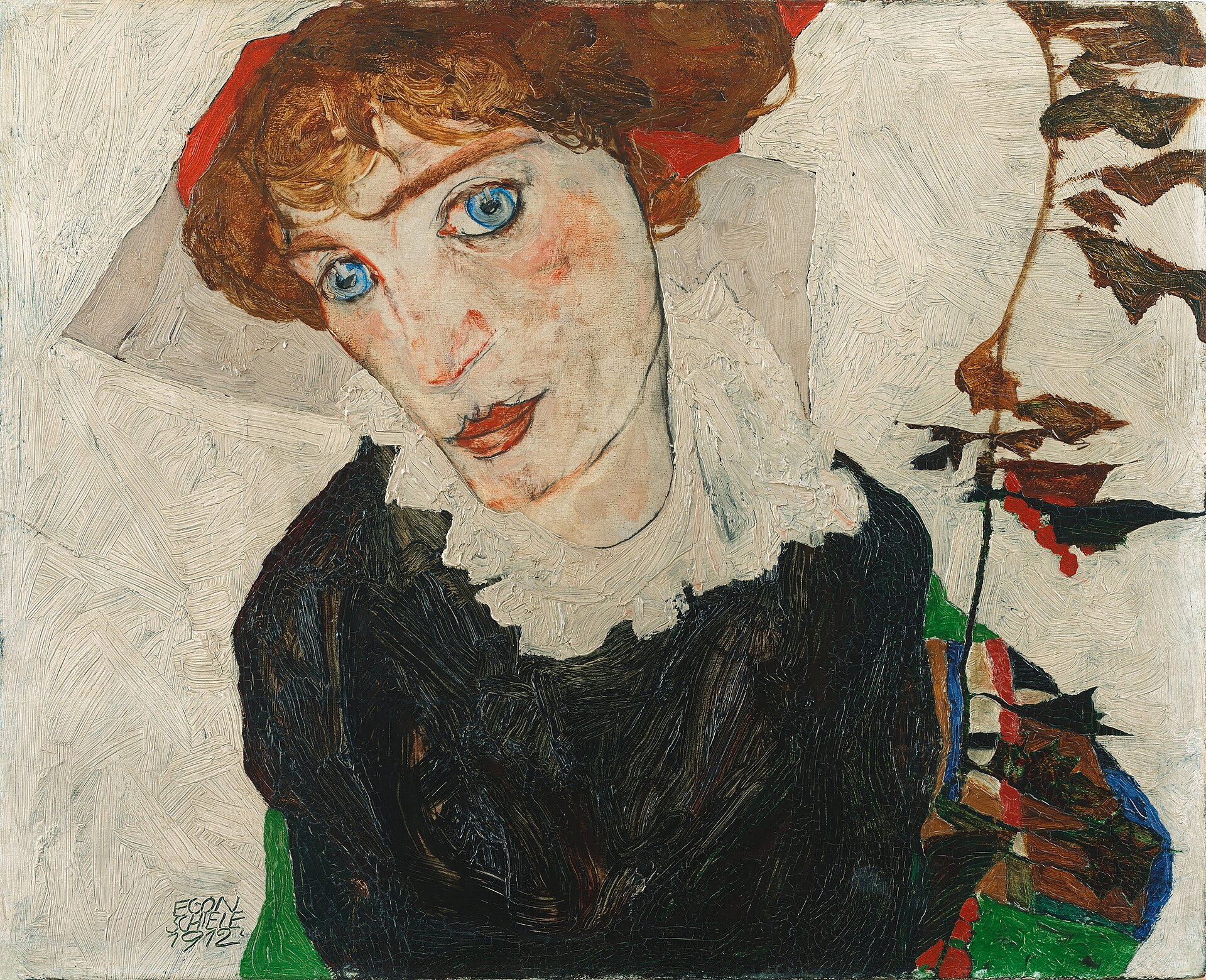
Portrait of Wally Neuzil
1912 · Oil on wood panel
Leopold Museum, Vienna. Owned by the Leopold Museum...
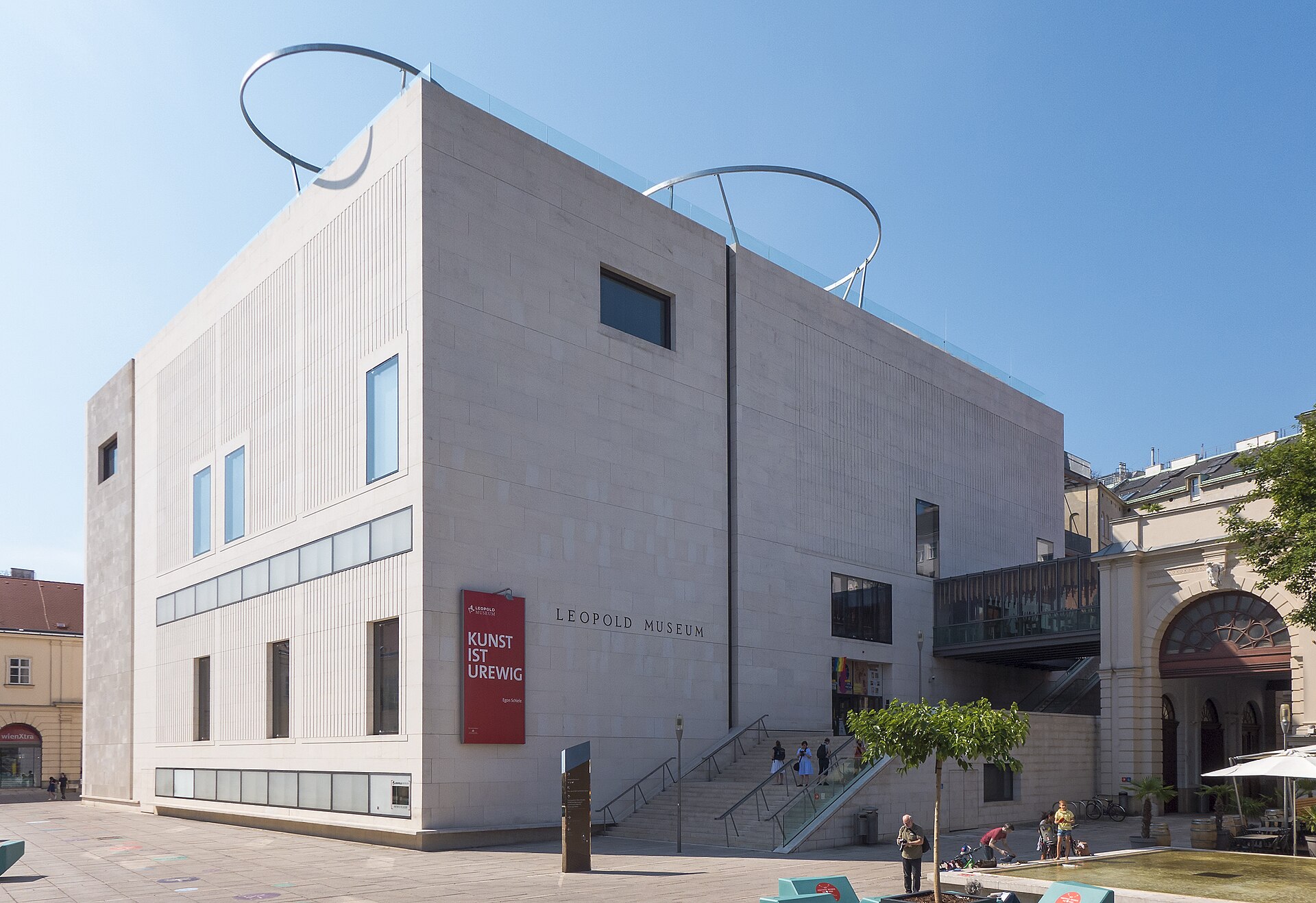
Unmatched globally for Egon Schiele (44 paintings, 200-plus works on paper) and strong in the wider Vienna 1900 circle: Klimt, Kokoschka, Gerstl and the Wiener Werkstatte's design output under Hoffmann and Moser. Weaker and more incidental outside that period: the Biedermeier holdings and the small Non-European collection are both artifacts of Rudolf Leopold's personal buying rather than curated departments in their own right.
| Kind | Museum |
|---|---|
| Founded | 2001 |
| City and country |  Vienna, Austria Vienna, Austria |
| Address | Museumsplatz 1, A-1070 Vienna, Austria |
| Website | leopoldmuseum.org |
| Status | Open, confirmed 31 August 2026 |
| Record last verified | 8 August 2026 |
Prices and hours change. We take them from the institution's own pages and print the day we read them, and you can check the current position at the source we used. Confirm before you travel.
The largest and most comprehensive Schiele holding anywhere: 44 paintings plus more than 200 watercolours, drawings and prints, alongside writings and other papers. This is the collection Rudolf Leopold assembled from the 1950s when Schiele was still a marginal, half-forgotten figure, and it includes Portrait of Wally Neuzil (1912).
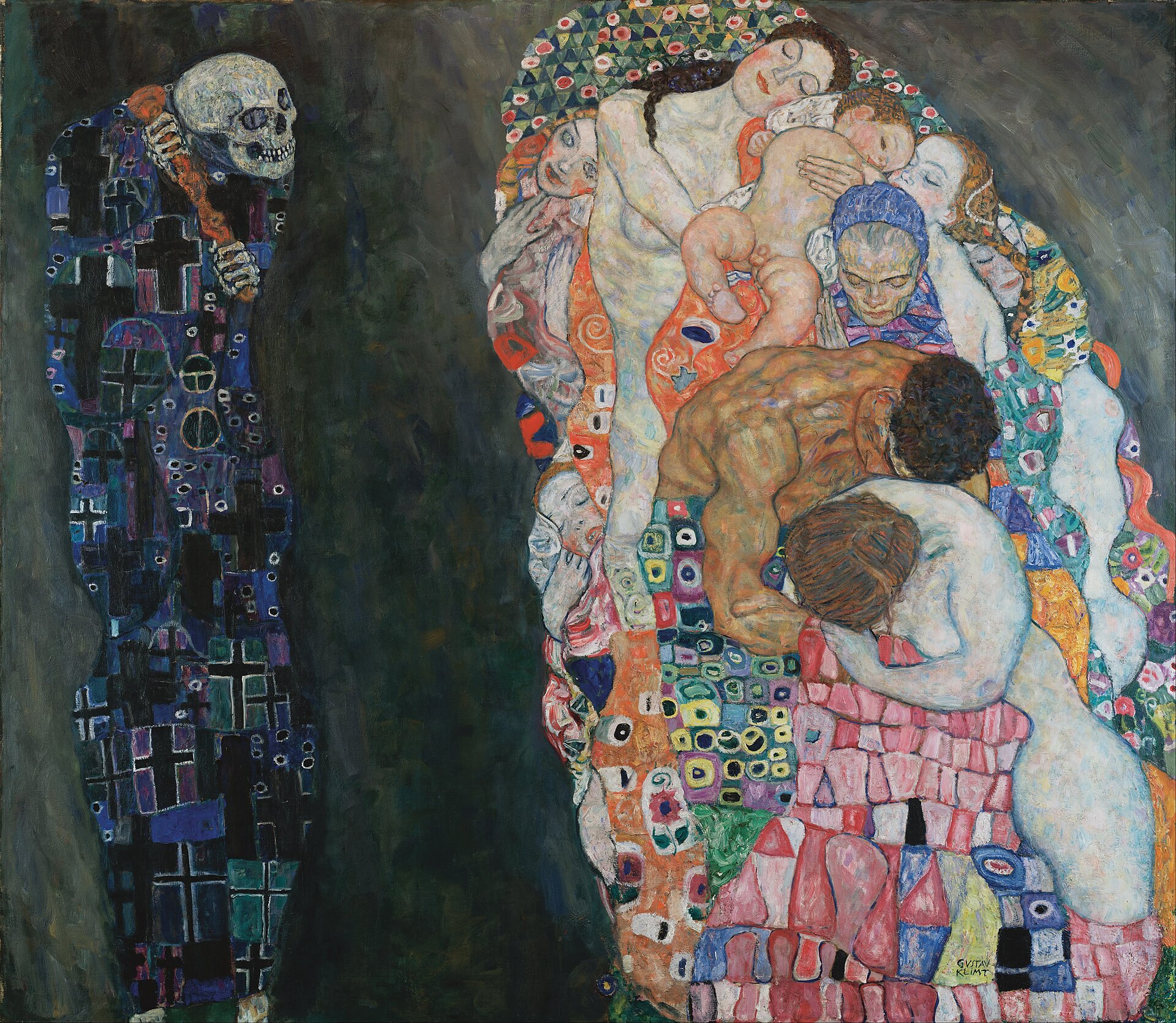
The museum's permanent presentation on the turn-of-the-century Viennese Secession, anchored by Klimt paintings including Death and Life (Tod und Leben, begun 1908, reworked 1915), shown alongside the Vienna Secession's founding circle.
Richard Gerstl, Oskar Kokoschka and Alfred Kubin. The museum's Gerstl holding is unusually deep for an artist who left a small body of work before his suicide at twenty-five in 1908.
Furniture, ceramics, metalwork and graphic design from the Jugendstil and Wiener Werkstatte, principally by Josef Hoffmann and Koloman Moser, shown as objects of the same reforming project as the paintings rather than as a separate applied-arts footnote.
Nineteenth-century Austrian painting predating the Secession, including Ferdinand Georg Waldmuller and Emil Jakob Schindler, the material Leopold collected first before turning to Schiele.
Objects from Africa, Oceania and East Asia, collected by Leopold as part of what the museum describes as a holistic approach to looking at art rather than as a separate ethnographic department.
The single object that a United States federal court found to have been stolen from a Jewish gallery owner in Nazi-annexed Vienna, litigated for over a decade in United States v. Portrait of Wally, and returned to the Leopold Museum only after it paid the owner's estate $19 million in 2010. Already published in this archive.12
Full record in this archiveOne of Klimt's late allegorical paintings and a centerpiece of the Vienna 1900 presentation, showing the shift in his palette after the gold-ground 'golden phase'.6
One of the self-portraits the museum's own collection pages foreground as characteristic of Schiele's preoccupation with his own body and gesture, painted the same year as Wally.7
The Schiele landscape named in a 2008 legal opinion, obtained by the Israelitische Kultusgemeinde Wien after a Green Party politician first raised the case publicly, as property allegedly confiscated from the Jewish collector Jenny Steiner; the museum disputed the claim's legal basis. A live example of an object whose display and whose history are not the same story.11
Chairs, cabinets and metalwork collected by Leopold alongside the paintings, on the museum's own account of its collecting logic: design and fine art from the same reforming circle, not two separate holdings.6
Gerstl killed himself at twenty-five in 1908 and destroyed some of his own work beforehand; what survives is scarce, and the Leopold's holding is among the largest anywhere of an artist visitors consistently say they had not heard of before this museum.6
The museum's standing survey exhibition of the Secession generation, the show the PORR Night free evenings are built around and the throughline visitors and the museum itself point to as the reason to come.10
The Leopold Museum exists because one man's private collection became too large, too indebted and too politically inconvenient to remain private. Rudolf Leopold, a Viennese ophthalmologist by training, began buying Austrian art in the 1950s, when Egon Schiele was still a marginal figure barely two generations removed from his own death in 1918 and largely absent from the international canon. Leopold's 1972 monograph on Schiele was part of the scholarly work that restored the artist's reputation, and by the 1990s his holdings, more than five thousand objects, ran from nineteenth-century Biedermeier painting through the Vienna Secession to Wiener Werkstatte furniture and a smaller collection of African, Oceanic and East Asian material.
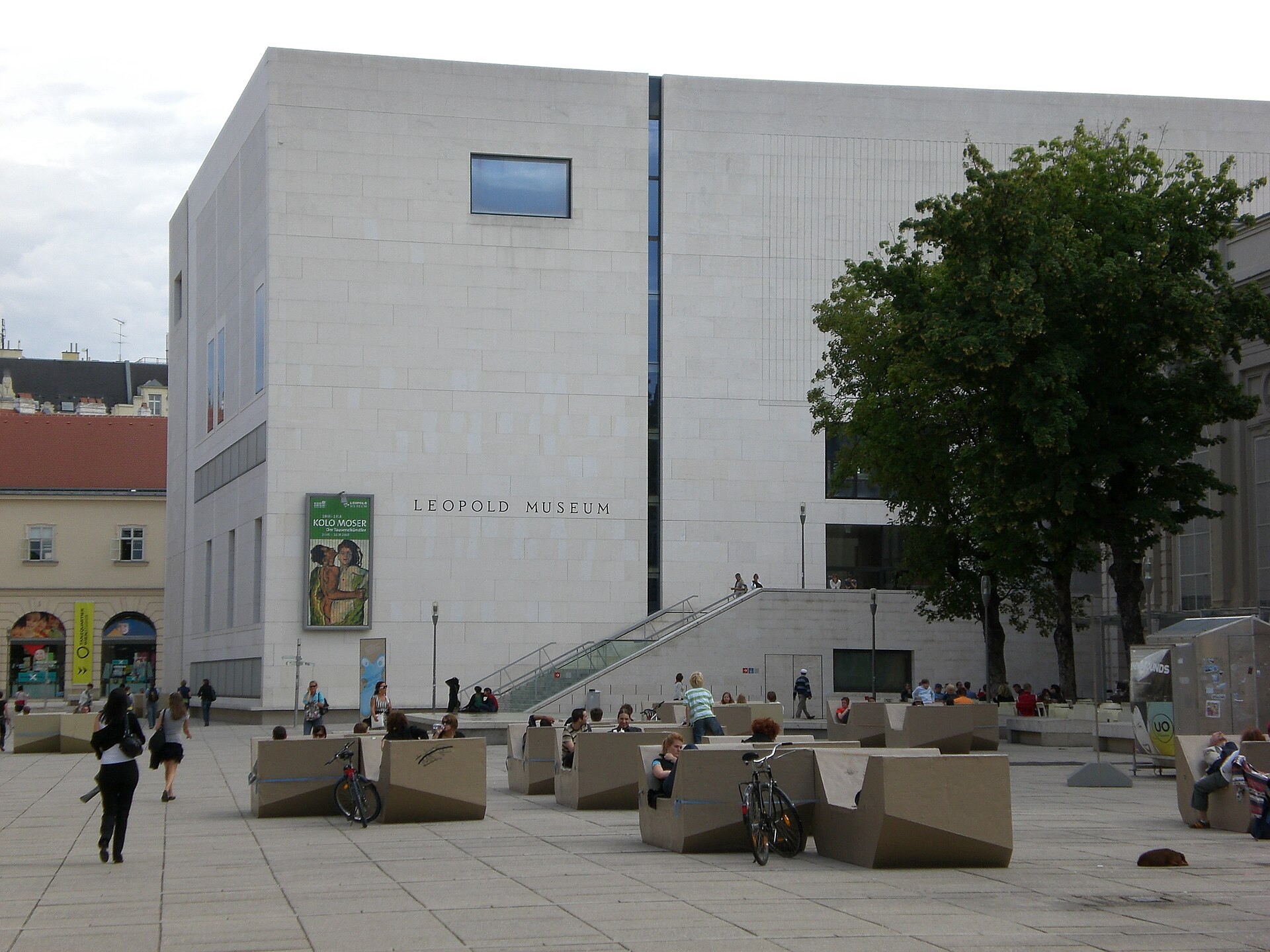
In 1994 the Republic of Austria founded the Leopold Museum Private Foundation to hold Leopold's collection: as founder, Leopold donated the bulk of his holdings, 5,266 works, and in return the Republic pledged 2.2 billion Austrian schillings, which let him clear the bank debt he had taken on to keep buying without encumbering the donated collection. In exchange, the state committed to building and funding a museum to hold the collection. That building, designed by the architects Laurids and Manfred Ortner as a white-limestone cube inside the new MuseumsQuartier, opened to the public in September 2001 (sources disagree on the exact day: Wikidata gives 22 September, the academic Lexikon Provenienzforschung gives 21 September). The arrangement is unusual among Vienna's major museums for what it is not: the collection is not owned by the Austrian state, and the museum is a private foundation that happens to hold the largest Schiele collection in the world.
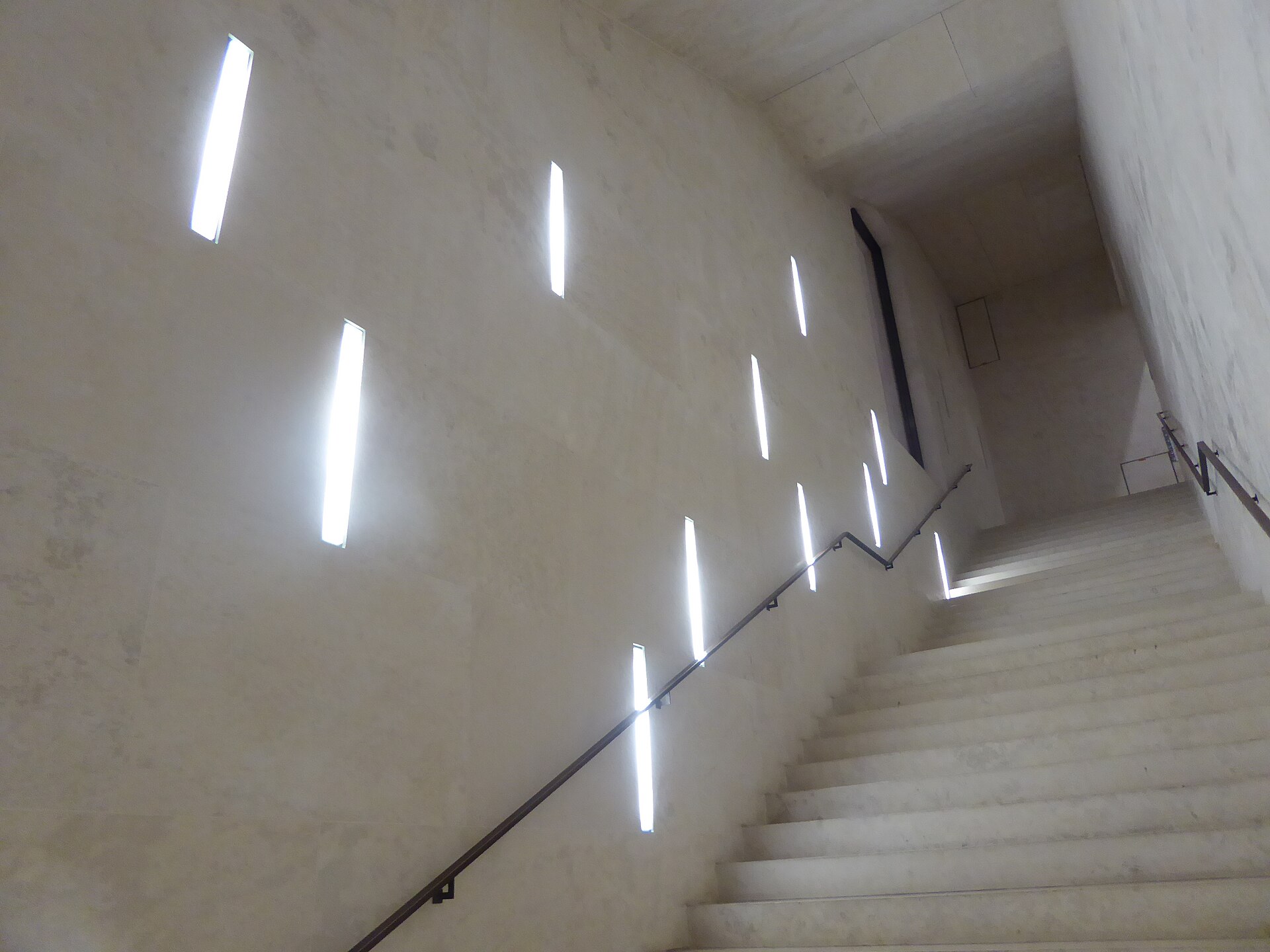
The Ortners' design is a simple, closed cube, roughly forty by forty-six metres in plan, rising twenty-four metres above ground and extending a further thirteen metres below it. Inside, a nineteen-metre atrium lined in the same pale limestone as the exterior runs the full height of the building, with a second, lower atrium below it serving the two basement levels; the galleries are arranged around this central void rather than along a single processional route. Visitors and critics alike single out the staircases and light-slots cut into the atrium walls, and the panorama windows on the upper floors that look out over the MuseumsQuartier's courtyard toward the Ringstrasse and the Hofburg. The building sits inside the wider MuseumsQuartier Wien, a former imperial stable complex converted into a cultural district that also holds the MUMOK and the Kunsthalle Wien, two institutions with their own separate collections and no relationship to the Leopold's holdings beyond shared real estate.
The museum organises its own collection pages around six sections, and this record follows that division. The Egon Schiele holding is the anchor: forty-four paintings and more than two hundred watercolours, drawings and prints, described by the museum itself as the largest and most significant Schiele collection anywhere. Around it sits the Vienna 1900 presentation built on Gustav Klimt, including the late allegorical painting Death and Life, and a room given to Expressionism and New Objectivity, where Richard Gerstl and Oskar Kokoschka sit alongside Alfred Kubin. A Decorative Arts and Design section holds Wiener Werkstatte furniture and metalwork by Josef Hoffmann and Koloman Moser, presented as part of the same reforming project as the paintings rather than a separate applied-arts sideline. A Biedermeier and Atmospheric Realism room covers the nineteenth-century Austrian painting Leopold collected before he turned to Schiele, including Ferdinand Georg Waldmuller and Emil Jakob Schindler. A smaller Non-European Art section holds African, Oceanic and East Asian objects that were part of Leopold's own collecting, on the museum's account, as a matter of looking at art across cultures rather than building a separate ethnographic department. No verified free-licence photograph of any specific gallery interior could be confirmed for this record; a general interior view of the atrium staircase is used instead, and is not attached to any single wing.
Egon Schiele painted Wally, an oil-on-wood panel just under forty centimetres tall, in 1912. It depicts Valerie Neuzil, his companion and model at the time. The painting belonged to Lea Bondi Jaray, a Viennese Jewish gallery owner, from before 1925. After the German annexation of Austria in March 1938, Bondi's Wurthle Gallery was designated non-Aryan under German law and she was forced to sell it, in 1938, to Friedrich Welz, who joined the Nazi party shortly afterward. In 1939, on the eve of her escape to England, Welz went to Bondi's apartment and, on the government's account later accepted by a United States federal court, took Wally from her wall without payment; the Leopold Museum's later legal position was that Bondi had sold the painting to Welz as part of the gallery a year earlier. After the war, American forces seized Welz's collection and, following the standard practice of returning Nazi-seized property to the country of origin rather than to individual claimants, delivered Wally to Austria's state-owned Belvedere gallery.
In 1953, Rudolf Leopold visited Bondi in London. She asked him to help her recover the painting from the Belvedere. Leopold instead arranged a swap with the Belvedere, trading a different Schiele from his own collection for Wally, and kept it. Bondi pursued lawyers against Leopold without success and died in 1969 still trying to recover it. In 1994 Wally passed, with the rest of Leopold's collection, into the new Leopold Museum foundation. In 1997 the museum loaned part of its Schiele holding, including Wally, to New York's Museum of Modern Art; the painting was seized by United States Customs the following year on a federal warrant alleging it was stolen property, and the government filed a civil forfeiture action the day after. The case, United States v. Portrait of Wally, ran until 30 September 2009, when Chief Judge Loretta Preska issued a 109-page opinion rejecting the museum's position that the painting had never been stolen. On the separate question of what Leopold and the museum knew when they imported it, the court went no further than finding a triable issue of fact for a jury, denying both sides' motions for summary judgment on that point rather than resolving it. A trial on that unresolved question of knowledge was scheduled for July 2010; instead, on 20 July 2010, the Leopold Museum Privatstiftung agreed to pay Bondi's estate 19 million United States dollars in exchange for clear title to the painting, and the question of what Leopold knew was never tried to a verdict. It did not have to leave Vienna. The Leopold Museum is bound by the settlement to keep a permanent label recording the court's findings beside the picture.
The irony sits close to the surface and is worth stating rather than passing over: the museum that eventually paid nineteen million dollars to keep a painting a court found to be stolen was built around the collecting practice of a man who, forty years earlier, had used a Holocaust survivor's own request for help to acquire the very same painting for himself.
Wally is the case that reached a federal courtroom, but it was not the only one raised against the museum. On 14 February 2008 the Leopold Museum opened an exhibition of the Austrian painter Albin Egger-Lienz. Six days later Wolfgang Zinggl, a Green Party member of the Austrian parliament, issued a public statement alleging that fourteen works in that exhibition were Nazi-looted, and separately alleged that Schiele's Houses on the Lake, hanging in the permanent collection rather than the Egger-Lienz show, had been confiscated from the Jewish collector Jenny Steiner. Rudolf Leopold responded that he had not known Houses' provenance until Austrian archives opened in 1998. The day after the Green Party's press conference, the museum issued its own press release conceding a narrower but still damaging point: that Leopold had in fact known in 1953, when he bought the painting, that Jenny Steiner was its former owner, though he denied knowing she was Jewish. The Israelitische Kultusgemeinde Wien (IKG), Austria's main Jewish communal body, disputed even that narrower denial, pointing to Leopold's own 1972 Schiele catalogue raisonne, which named Steiner, and to a 1994 interview in which he said he had relied since 1950 on an earlier catalogue that also named her.
Separately from the Steiner allegation, the IKG obtained two legal opinions on the museum's wider holdings: one, delivered to Austria's Ministry of Culture on 1 February 2008, addressed whether Austria's Nazi-era restitution law could apply to a private foundation at all; a second, presented on 10 March 2008, concluded that eleven paintings from six Jewish former owners in the Leopold's collection were Nazi-looted. The museum's legal position, that Austria's 1998 restitution law binds only federal collections and not a private foundation, remains a real distinction even though the museum states that it voluntarily follows the 1998 Washington Conference principles on a case-by-case basis. Whether the Steiner allegation or the wider eleven-painting claim was ever resolved, by restitution, settlement or a sustained rejection, is not established by any source consulted for this record; the museum's own account does not itemise an outcome.
The museum set up a dedicated provenance research position in 2003, and since 2008 the responsible Austrian federal ministry has funded additional researchers to work through the wider Leopold collection specifically for Nazi-era confiscation. The museum states its findings are published through its online collection, though this record was not able to confirm from the museum's own provenance page how many further objects, beyond Wally, have moved through that research to a resolved status. That gap belongs on the page rather than being filled with an assumption either way.
The museum is open daily including Mondays through the summer, with public holidays included; from September it closes on Tuesdays. Regular admission is 19 euros, with a reduced rate for under-26s, over-65s, the unemployed and disabled visitors, and a nominal 2.50 euros for under-19s; children under seven are free, as are ICOM members, Circle of Patrons members and accredited tourist guides. On the first Thursday of every month, from six to nine in the evening, the museum's sponsor PORR AG funds free admission and free guided tours of the Vienna 1900 presentation. Tickets bought online are valid for the selected day; tickets bought at the desk are valid for a year. The building is largely barrier-free, with a wheelchair lift at the rear entrance, loaned wheelchairs, an 89-centimetre-wide lift cabin and an accessible ground-floor restroom. Photography without flash is allowed for personal use. Cafe Leopold, on the second level, is open without a museum ticket, and the ground-floor shop stays open half an hour past closing.
Visitors consistently say the collection is worth the ticket regardless of the price, and just as consistently name the cost, the way a temporary exhibition can eat into gallery space normally given to Schiele and Klimt, and the difficulty of arranging a tour outside German or English as the friction points of a visit. None of that changes what the building holds: the largest Schiele collection anywhere, a serious Klimt and Vienna Secession presentation, and, in Portrait of Wally, an object whose ownership history is itself part of what the museum now is.
Visitors consistently describe the Leopold as the place to see Schiele and Klimt in Vienna, and several say they arrived for Klimt and left having discovered Gerstl and Kokoschka as well. The building itself, its limestone atrium and staircases and its panorama windows over the MuseumsQuartier and toward the Ringstrasse, is called out almost as often as the collection. Complaints cluster around cost, the way special exhibitions can absorb whole rooms and reduce how much of the permanent Schiele and Klimt holding is on view at a given visit, and the difficulty of arranging a guided tour in a language other than German or English. One August 2026 visitor account also described museum security staff behaving differently around visitors they read as gay in front of some of Schiele's more sexually direct works; this is a single reported incident rather than an established pattern, and is noted here rather than smoothed over.
TripAdvisor: 4.5 from 3,371 ratings, read 5 August 2026
A platform average is a tertiary source: it moves, it is not audited, and we quote no visitor's words.
Museumsplatz 1, A-1070 Vienna, Austria.
Regular: EUR 19; Reduced: EUR 16; Youth under 19: EUR 2.5; Children under 7: free; Vienna City Card holders: EUR 17. As confirmed 31 August 2026.
Daily except Tuesday 10:00-18:00. Closed: Tuesday. As confirmed 31 August 2026.
U-Bahn: U3 to Volkstheater, or U2 to Museumsquartier; Tram: Lines 1, 2, D, 49 and 71 to Ring/Volkstheater; Bus: Bus 48A to Ring/Volkstheater; Car: 24-hour parking garage directly in front of the MuseumsQuartier on Museumsplatz.
Portrait of Wally Neuzil (Egon Schiele, 1912); Death and Life (Tod und Leben) (Gustav Klimt, begun 1908, reworked 1915); Self-Portrait with Chinese Lantern Fruit (Physalis) (Egon Schiele, 1912); Houses on the Lake (Haeuser am Meer / a Krumau lake view) (Egon Schiele); Wiener Werkstatte furniture and design (Josef Hoffmann and Koloman Moser); Richard Gerstl paintings (Richard Gerstl).
One artwork and its story every Tuesday, with the picture: who owned it, what it made, and what closes soon in the exhibition calendar. No promotion, and nothing we cannot cite.
We send one email to confirm the address and keep nothing else. Every letter carries a one-click unsubscribe. How we handle your data.

.jpg)
