Portrait of a Lady
Gustav Klimt · 1916-1917
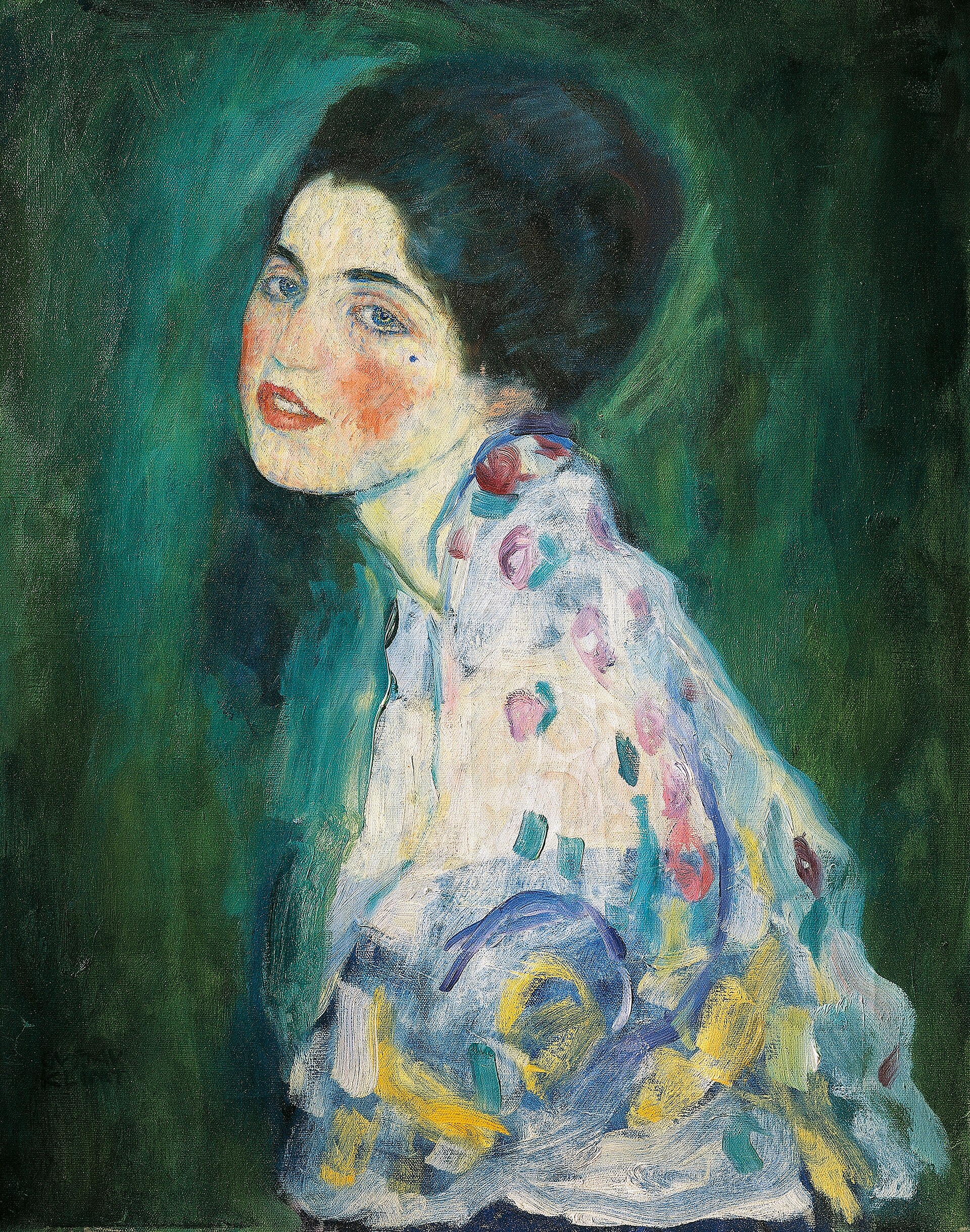
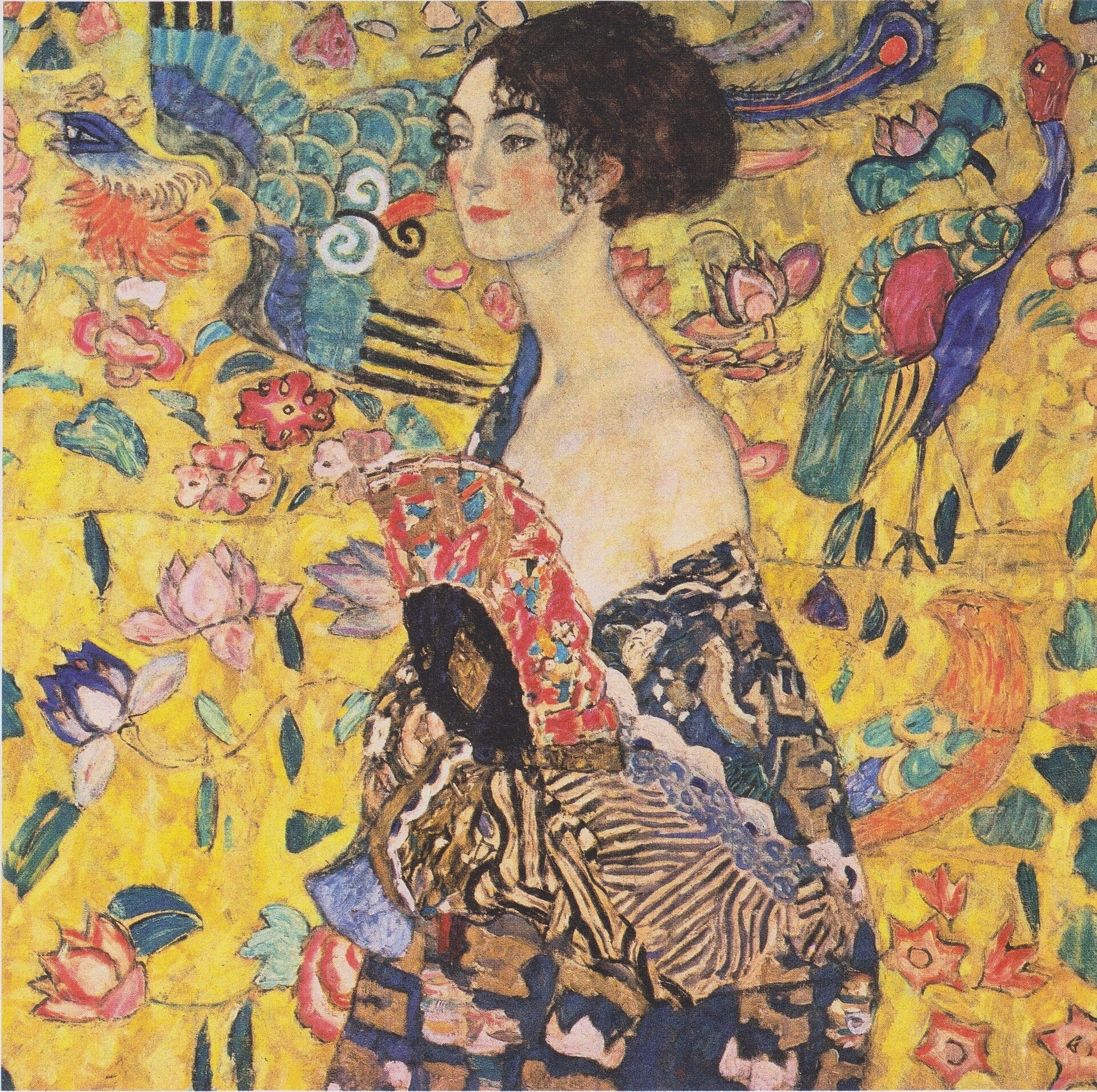
The picture as it hangs in Piacenza: a young woman in three-quarter view against a green ground, painted in 1916 and 1917 over an earlier portrait by the same hand.
| Artist | Gustav Klimt |
|---|---|
| Date | 1916-1917 |
| Medium | Oil on canvas, painted over an earlier portrait by the same artist |
| Dimensions | 68 x 55 cm, as given by the Galleria d'Arte Moderna Ricci Oddi. Other figures are in circulation and do not agree: 60 x 55 cm in the Italian and English Wikipedia entries, about 55 x 65 cm in the museum estimate quoted by news agencies in January 2020, and 40 x 60 cm in the Austrian agency report of December 2019. |
| Where it is now | Galleria d'Arte Moderna Ricci Oddi, Piacenza, Italylast confirmed |
| Attribution | AcceptedNever questioned as a Klimt in the literature, and re-tested in public in January 2020 for a reason no other Klimt has ever needed: to prove that the canvas recovered from a hole in the gallery wall was the canvas taken from the gallery in 1997. Full note |
| Object type | Painting |
| Period | Austrian, early twentieth century |
| Cases | Has a provenance gap |
| Inscriptions | Signed by the artist, the signature reported as authentic by the experts appointed by the Piacenza prosecutor's office in January 2020. On the reverse: the gallery stamp in ink on gesso and a sealing-wax stamp on the stretcher; remains of transport labels naming the carriers Bruno Tartaglia and Ambrosetti; copper anti-theft wires taped to the canvas. The exhibition label at upper left and the number 858 on the stretcher were recorded as absent. |
| Owners on record | 7 links5 documented, 2 unknown |
| Sources | 29 cited |
About this record Last verified · 29 sources cited · Change log
On this page 11 sections
ContentsClose
A late Klimt portrait of an unidentified young woman, bought by the Piacenza collector Giuseppe Ricci Oddi in 1925 and hung in his gallery from 1931. In 1996 a schoolgirl working on her final-year project noticed that it was the same face as a Klimt portrait lost since 1917, and radiography confirmed that Klimt had painted this picture on top of that one. It is the only canvas by him known to hold two of his portraits.
Ten months after that discovery, the BBC reports, on 22 February 1997, the picture vanished from the gallery during preparations for an exhibition. The gallery states that the means were never established. On 10 December 2019 gardeners cutting ivy off the gallery's outside wall opened a small unlocked hatch and found the canvas in a plastic bag. Experts appointed by the Piacenza prosecutor's office announced on 17 January 2020 that it was the stolen painting.
Two men afterwards told the Piacenza newspaper Liberta that they had taken it and returned it. Prosecutors sought no trial: the deadline for prosecuting the theft had passed, and the investigation into three named people was archived by a judge on 18 November 2021 without any finding against them. Nobody has been held responsible for either the taking or the return.
The theft
Found again
Taken from the Ricci Oddi on 22 February 1997 by means the gallery says were never established, and found in the gallery's own outside wall on 10 December 2019.
- 1925Bought Giuseppe Ricci Oddi bought the canvas from the Milanese dealer Luigi Scopinich in 1925, the holding gallery records, and moved it into his new public gallery in Piacenza in 1931.1
- 1997-02-22Stolen The gallery records that on 22 February 1997, during the preparations for an exhibition, the picture disappeared, taken by means that the investigations would never succeed in clarifying; the Guardian reported in 2014 that police could not say whether entry had been through the main door or whether the canvas had been fished through a nearby skylight, and that all that was left was an empty frame carrying a partial fingerprint.18
- 1997-04Seized Border police at Ventimiglia intercepted a package in April 1997 holding what at first appeared to be the painting, Artnet News reported, and what was seized was quickly identified as a recently completed forgery and not this picture; Italian reporting records that the parcel was addressed to the former prime minister Bettino Craxi in Tunisia.725
- 2014-03Lost The Guardian reported in March 2014 that the case had been reopened after more sophisticated testing of the frame, with investigators hoping for a DNA match from the partial fingerprint, and that the picture remained one of the most sought-after stolen works in Italy.8
- 2016-12Claimed Artnet News, summarising a BBC report of December 2016, said a man had told the broadcaster that he had taken the picture with help from a gallery employee and had sold it, and that he predicted its return within months; the claim was never tested in court and the investigation that later examined it ended with no finding against anyone.713
- 2019-12-10Found The gallery records that on 10 December 2019, during gardening work along its outside wall, a plastic bag containing a canvas was found in a small recess closed by a door with no lock; the city administration said the recovery was made by Mohammed Abrjnaz and his colleagues, who were carrying out extraordinary maintenance on the city's instructions.13
- 2020-01-17Identified Three experts appointed by the deputy prosecutor Ornella Chicca announced at the Bank of Italy in Piacenza on 17 January 2020 that the canvas was authentic and was the one taken from the gallery in 1997, IlPiacenza reported, citing the signature, the pigments, the craquelure, the gallery's seal in gesso and sealing wax, the transport labels, the copper anti-theft wires and the confirmed portrait underneath.311
- 2020-01-21Claimed Artnet News reported that two men in their sixties wrote to the Piacenza newspaper Liberta saying they were the authors of the theft and had given the canvas back to the city as a gift, and that their lawyer Guido Gulieri told the Guardian they claimed to have returned it four years earlier; the same report states the letter came after the limitation period for prosecuting the theft had expired.6
- 2021-11-18Archived ANSA reported that on 18 November 2021 the judge Luca Milani, at the request of the prosecutor Ornella Chicca, archived the investigation into three named people, two of whom had died, so no court has found anybody responsible either for the taking or for the return.1314
- 2026-04-04Exhibited Piacenzasera reported that the picture returned to the Ricci Oddi on 4 April 2026 from the My Art Museum in Seoul, and the regional heritage service records that the gallery reopened with a new arrangement of all twenty-two rooms from 28 April 2026.1820
In the official registers: Interpol Stolen Works of Art Database No public entry could be confirmed or excluded on 2026-09-26: the search requires an authorised account · Comando Carabinieri Tutela Patrimonio Culturale, Leonardo database No public entry found on 2026-09-26; the command's Bologna unit took part in the 2020 authentication · FBI National Stolen Art File No entry for any work by Gustav Klimt returned on 2026-09-26. Seen this work? Report it to the police or to the register, not to us.
Provenance
Each link is graded. Documented: a cited source supports it. Disputed: the identification is argued but not established. Unknown: no owner for that span, and the gap is not smoothed into a narrative. The grades in the glossary.
- c. 1910 - 1916Gustav Klimt, Viennadocumented
The support carried a finished portrait of a young girl, known as the Backfisch, which Klimt exhibited and which was reproduced in a German magazine. The Ricci Oddi gallery dates it to about 1910. The commentary by Johannes Dobai of 1967, as reprinted in the Italian edition of the Klimt catalogue, records the work as known only through an illustration in Velhagen und Klasings Monatshefte for 1917 to 1918, page 32, with dimensions and whereabouts unknown, and a dating to 1912 by Franz Servaes.125
- 1916 - 1917Gustav Klimt, Viennadocumented
Klimt repainted the canvas, preserving the face and the background of the earlier picture and altering the dress and the hair, producing the portrait now visible. The gallery states that this transformation has no equal elsewhere in his work.1
- 1917 - 1925Unknown; by 1925 in the stock of Luigi Scopinich, Milanunknown
No source located for this record documents how the picture left Vienna or how it entered the Milanese trade. Klimt died in February 1918. The chain between the studio and the dealer is unrecorded here and is left as a gap rather than bridged.1
- 1925 - 1931Giuseppe Ricci Oddi, Piacenzadocumented
Bought in 1925 from the Milanese dealer Luigi Scopinich. No price is published in the sources consulted. The gallery states that it was first installed in the billiard room of the family palazzo. Ricci Oddi, born in Piacenza in 1869, had begun collecting in 1897 and had been seeking premises for a public gallery since 1913.12
- 1931 - 1997Galleria d'Arte Moderna Ricci Oddi, Piacenzadocumented
Moved into the gallery in 1931, into the room devoted to foreign artists. The gallery, built at the founder's expense to designs by Giulio Ulisse Arata between 1924 and 1931 on the site of the former convent of San Siro, opened to the public on 11 October 1931. The picture hung there without incident until 1996, when the underlying portrait was identified.12
- 1997-02-22 - 2019-12-10Whereabouts unknownunknown
The gallery states that the picture disappeared on 22 February 1997 during preparations for an exhibition, by means the investigations never succeeded in clarifying. Two men later told the Piacenza newspaper Liberta that they had taken it, and their lawyer told the Guardian that they said they had returned it four years before the recovery and had stored it in a house whose address they gave to police. No court has established where it was or who held it. The period is recorded as unknown.1612
- 2019-12-10 - presentGalleria d'Arte Moderna Ricci Oddi, Piacenzadocumented
Recovered on 10 December 2019 from a small unlocked recess in the gallery's external wall and held at the Bank of Italy in Piacenza during the examination. Authenticated as the stolen picture by experts appointed by the Piacenza prosecutor's office on 17 January 2020. Back on public view at the gallery from 28 November 2020, lent to the Museo di Roma from October 2021 to March 2022 and to the My Art Museum in Seoul from December 2025 to March 2026, and returned to Piacenza on 4 April 2026.1316171825
Prices realised
This picture has never been sold at auction. It was bought privately from a dealer in 1925 and has been in one collection ever since. No price is published for that purchase. The figure below is for a different painting by the same artist from the same years, given as the market cohort and not as a value for this object.
| Date | Sale | Estimate | Result | Note |
|---|---|---|---|---|
| 27 June 2023 | Sotheby's Modern and Contemporary Evening Auction, London | In excess of GBP 65 m, as reported in the pre-sale coverage | Hammer GBP 74 m With premium GBP 85.3 m with buyer's premium GBP | Klimt's Dame mit Faecher, his last portrait, of 1917 to 1918. Al Jazeera reported the hammer as GBP 74 m, about USD 94.35 m, and the total with premium as GBP 85.3 m, about USD 108.4 m, and quoted Sotheby's saying that after a ten-minute bidding battle between four clients on the phones and in the room the painting set a new auction record for a work of art in Europe and for Klimt, beating Giacometti's Walking Man I at GBP 65 m with premium in 2010. Dollar figures are conversions at the date of sale and are derived. This is a comparable late portrait, not this object. |
Hammer is the price at which the bidding stopped; with premium adds the fee the house charges the buyer on top. Hammer price and buyer's premium in the glossary.
Technical evidence
| Attribution note | Never questioned as a Klimt in the literature, and re-tested in public in January 2020 for a reason no other Klimt has ever needed: to prove that the canvas recovered from a hole in the gallery wall was the canvas taken from the gallery in 1997. Three experts appointed by the Piacenza prosecutor's office reported that the painted surface, the execution, the signature and the pigments were congruent with Klimt, and that the back of the canvas matched the gallery's own photograph of the original verso down to the seal impressed in gesso. The picture is also the only Klimt known to carry a second, earlier Klimt portrait underneath it, and the multispectral imaging of that buried picture was treated as the decisive mark of identity. |
|---|---|
| Support | Canvas, carrying an earlier finished and exhibited portrait by the same artist beneath the visible picture. The under-painting is the only known case of a double portrait on one support in Klimt's work, according to the holding gallery.1 |
| Medium | Oil. The January 2020 examination reported that the constituent pigments were congruent with the artist's use.13 |
| Dimensions | 68 x 55 cm per the Galleria d'Arte Moderna Ricci Oddi. Conflicting figures are published: 60 x 55 cm (Italian and English Wikipedia, tertiary), about 55 x 65 cm (museum estimate reported by news agencies, January 2020), 40 x 60 cm (Austrian press agency, December 2019).192526 |
| Date | 1916-1917 per the gallery. The underlying portrait is dated about 1910 by the gallery and to 1912 by Franz Servaes as cited in the Klimt catalogue commentary by Johannes Dobai of 1967.125 |
| Signature | Reported as authentic by the three experts appointed by the Piacenza prosecutor's office in their finding of 17 January 2020.3 |
| Verso, gallery marks | Gallery stamp in ink on gesso and in sealing wax on the stretcher. A patch of gesso carrying the impression of the seal. The exhibition label at upper left and the number 858 on the stretcher were recorded as absent in January 2020.3 |
| Verso, transport labels | Remains of two carriers' labels: Bruno Tartaglia at upper right, torn, and Ambrosetti at the left, for the Rome exhibition Ritorno alla seduzione.3 |
| Anti-theft fittings | Copper wires taped to the canvas, recorded in the gallery's own file and found on the recovered canvas in 2020.3 |
| Surface condition evidence | Craquelure photographed in raking light matched the gallery's record at one hundred per cent. Four scratches on the canvas corresponded to the frame left behind at the theft, and traces of silver colour corresponded to paint left by the frame during earlier maintenance.3 |
| Technical imaging | Multispectral non-destructive imaging by the research centre Il Cenacolo, Rome, confirmed the underlying portrait both at the time of the 1996 discovery and again in the 2020 examination. The face of the sitter was reported as the only part of the visible picture not covered by later paint, the cheeks excepted.3 |
| Condition on recovery | Reported in fair condition by the prosecutor's experts in January 2020, who added it would not have been kept in optimal climatic and environmental conditions during the 22 years, and that nothing was established about how long it had lain in the cavity. The gallery director reported it still carried its stamp and seal and was in good condition.39 |
Images
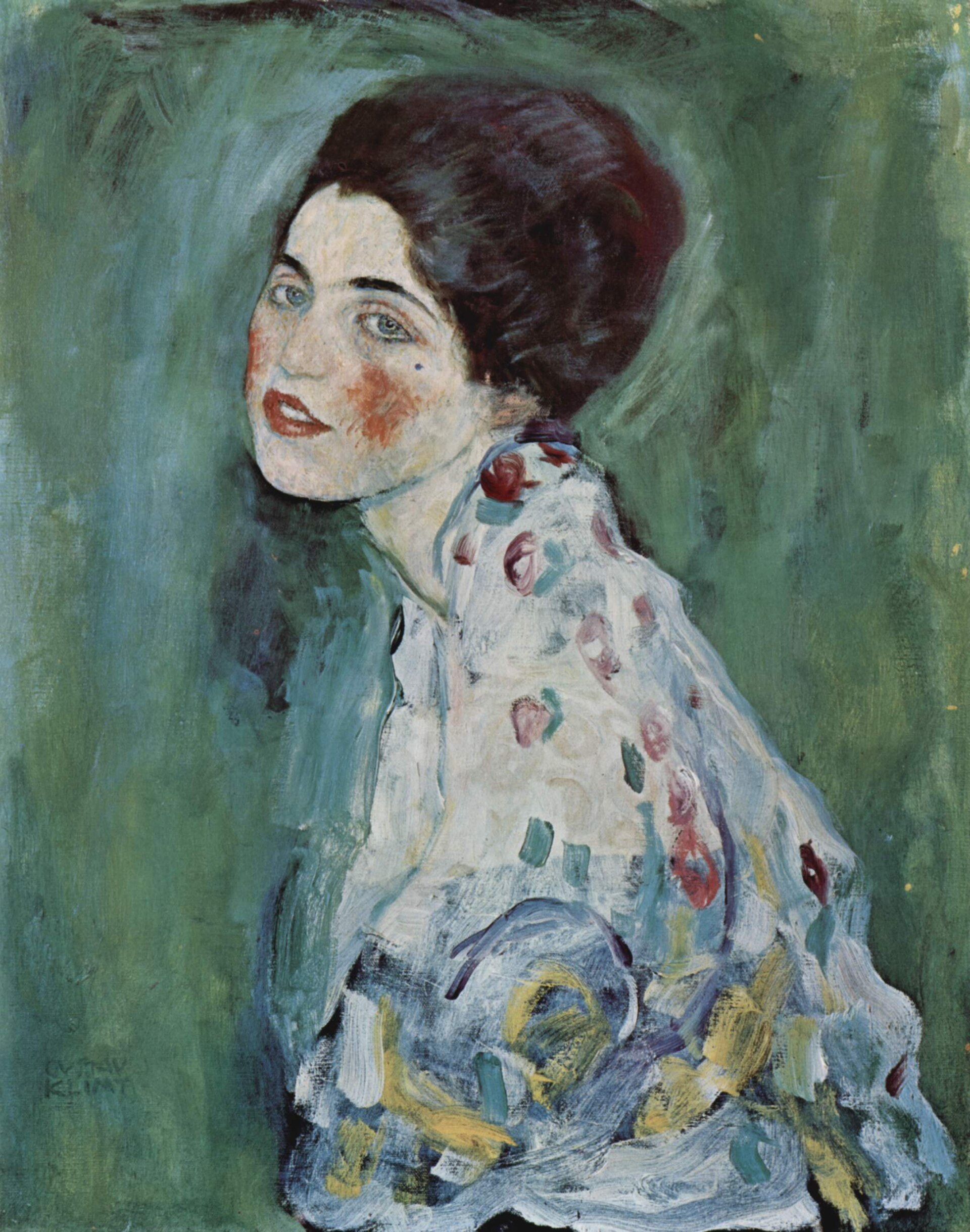

The record in full
Chapter 1One canvas, and two pictures by the same hand
The Galleria d'Arte Moderna Ricci Oddi describes the picture as oil on canvas, 68 by 55 centimetres, made between 1916 and 1917.
The Galleria d'Arte Moderna Ricci Oddi describes the picture as oil on canvas, 68 by 55 centimetres, made between 1916 and 1917. It shows a young woman in three-quarter view, dark-haired, against a green ground, in the manner Klimt used in the last two years of his life after he had put aside the gold of his earlier work. The gallery's own note says that by this date his painting had become less precious and had given itself over to almost hurried brushwork, betraying a more emotional approach open to expressionist suggestion.
The size is not settled. The gallery gives 68 by 55 centimetres. The Italian and English Wikipedia entries give 60 by 55. News agencies quoting the museum in January 2020 described a work of about 55 by 65 centimetres. The Austrian agency report of 11 December 2019 called it 40 by 60. A record that is honest about this picture has to say that four figures are in print and that the holding institution's is the one to prefer.
What is not in doubt is what lies under the paint. The gallery states that beneath this portrait is another portrait by Klimt of a young woman identical in face and pose but differently dressed and differently coiffed, that Klimt preserved the background and the face of the underlying picture, and that he then worked decisively on everything else, arriving at a transformation of the first painting that has no equal anywhere else in his work.
Chapter 2The picture underneath had been missing since 1917
The buried portrait is usually called the Backfisch, a German word for a girl in her early teens.
The buried portrait is usually called the Backfisch, a German word for a girl in her early teens. The Ricci Oddi gallery says it was known until 1996 only through an image published in a German magazine in 1918. The commentary reprinted in the Italian edition of the Klimt catalogue records that Johannes Dobai wrote in 1967 that the dimensions and the whereabouts of the work were unknown and that it survived only through an illustration in Velhagen und Klasings Monatshefte for 1917 to 1918, page 32, with a dating to 1912 by Franz Servaes. The Ricci Oddi gallery itself dates the underlying portrait to about 1910.
So for most of a century the position was this. Art history knew that Klimt had exhibited a portrait of a young girl, had a photograph of it in a magazine, and could not find the painting. It was on the wall in Piacenza the whole time, under another picture, in a room devoted to foreign artists, in a gallery in a provincial Italian city that nobody searching for a lost Klimt had thought to X-ray.
The Austrian Klimt scholar Tobias G. Natter, who compiled the catalogue of Klimt's paintings published by Taschen, told the Austrian press agency in December 2019 that the episode had been, in his words, a little embarrassing for art history. He added that with this work there was truly a disappearing and a finding, a coming and a going.
Chapter 3Claudia Maga saw it in a library, on tracing paper
The person who found the hidden picture was not a scholar.
The person who found the hidden picture was not a scholar. Corriere della Sera reported in December 2019 that Claudia Maga was a final-year pupil at the Colombini art institute in Piacenza, and that she made the discovery in 1996 while preparing her research for her school-leaving examination. In the account she gave at the time and which the paper quotes, she said she was in the library leafing through the pages of a monograph that carried illustrations of both works.
Her method was the simplest available. Corriere reports that she photocopied and enlarged the photographs, then compared them on a sheet of tracing paper on which she had drawn the outline of the vanished portrait, and laid it over the Piacenza picture. The paper quotes her: the face and many other details coincided perfectly, she said, and her heart was in her throat; she told herself to keep calm, that surely some important critic must already have noticed. Nobody had.
The gallery's account credits her with starting the process rather than finishing it. It says that her wish to understand more set off the sequence that clarified the picture's genesis, and that this was then confirmed by the examinations to which the canvas was subjected. IlPiacenza reported in January 2020 that the 1996 discovery was made by Maga together with the gallery's then director Stefano Fugazza, and that the multispectral non-destructive imaging carried out by the research centre Il Cenacolo of Rome had confirmed the under-painting incontrovertibly, both at the time and again in the examination of 2020.
The timing is the cruel part of the story. The discovery made the picture famous, the gallery began arranging an exhibition around it, and the picture disappeared during the preparations.
Chapter 4How it reached Piacenza
The Galleria d'Arte Moderna Ricci Oddi states that Giuseppe Ricci Oddi bought the canvas in 1925 from the Milanese dealer Luigi Scopinich.
The Galleria d'Arte Moderna Ricci Oddi states that Giuseppe Ricci Oddi bought the canvas in 1925 from the Milanese dealer Luigi Scopinich. No purchase price is published in the sources consulted. The gallery says he first installed it in the billiard room of the family palazzo, and moved it in 1931 into the gallery, into the room set aside for foreign artists, where the picture led what the gallery calls a quiet existence until 1996.
How it travelled from Klimt's studio in Vienna to a Milanese dealer's stock in the early 1920s is not documented in any source located for this record. Klimt died in February 1918 with a number of pictures unfinished in the studio, and the dispersal of the studio contents and of the late portraits through the Vienna and Milan trade in the following years is exactly the kind of chain that is usually reconstructed from dealer stockbooks. Here it is a gap, and it is recorded as a gap.
Chapter 5The gallery was built with skylights, and that matters
The Ricci Oddi gallery is not a converted palace.
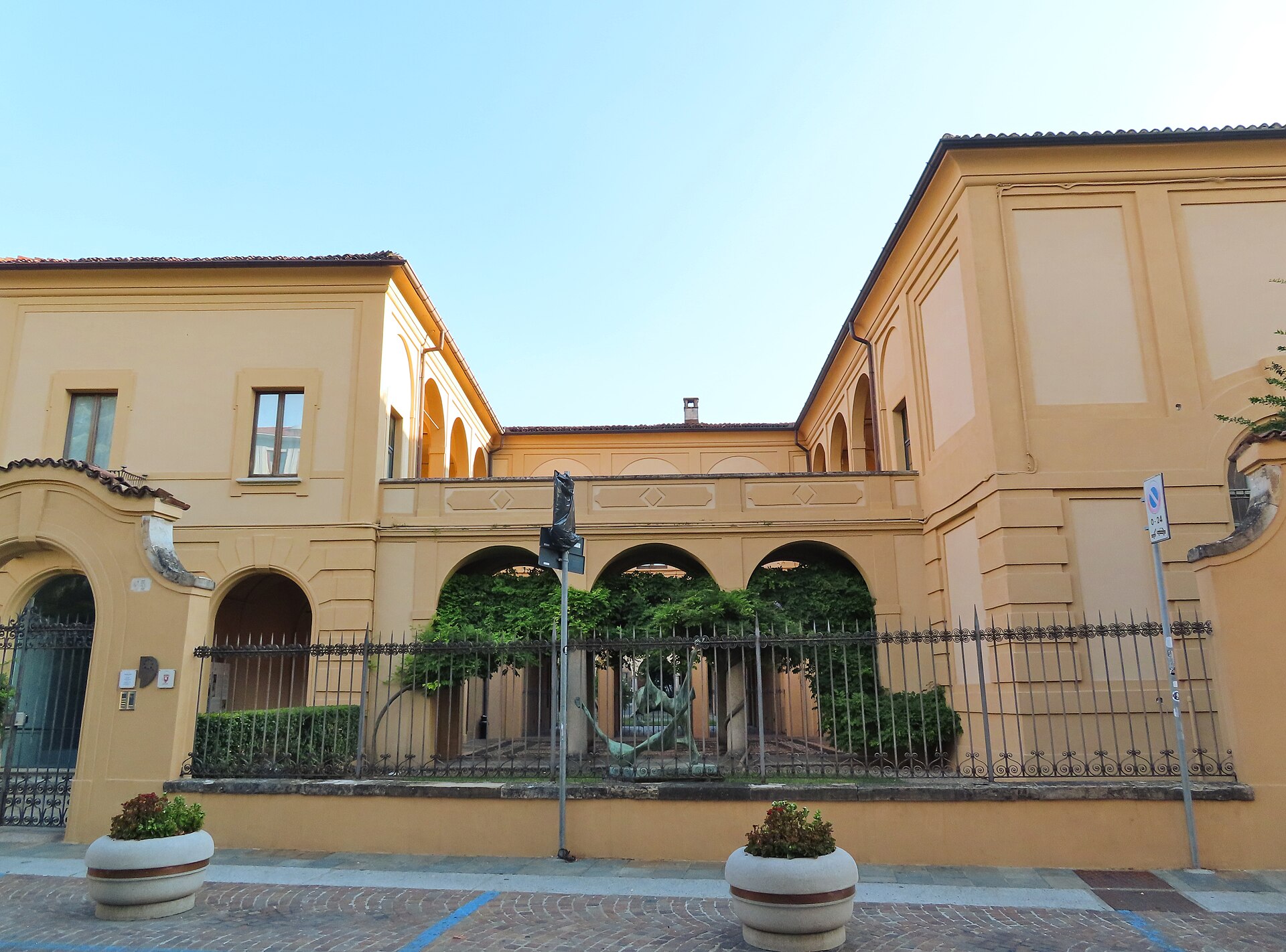
The Ricci Oddi gallery is not a converted palace. Its own history states that Giuseppe Ricci Oddi, born in Piacenza in 1869, had been looking since 1913 for premises for his collection, that the negotiations to buy various buildings all failed, and that he decided to have a new building put up at his own expense on the site of the former convent of San Siro, on land given to him free of charge by the city. The architect was Giulio Ulisse Arata of Piacenza, 1881 to 1962, who the gallery says made himself available without a fee, and the building was carried out between 1924 and 1931.
The gallery's account of the design names one feature in particular. Among the innovative functional choices inside, it says, was natural overhead lighting, strongly urged by the founder himself. A museum lit from above is a museum with skylights, and a great deal of what was later said about how the Klimt left the building in 1997 turns on a skylight. The gallery opened to the public on 11 October 1931. Its founder died on 23 October 1937, struck down while out in the street; at his own wish there were no flowers at the funeral and no speeches.
Chapter 6Nobody can say who she is
The sitter has never been identified, and this record does not choose a name for her.
The sitter has never been identified, and this record does not choose a name for her. The Austrian agency report of December 2019 states plainly that who is shown is not known, and that Tobias G. Natter, the compiler of the Taschen catalogue of the paintings, cannot say either. That is the position of the scholar best placed to have an answer, and it is the position this record takes.
One proposal is on the table and it is a proposal only. The same report notes that Klimt's acknowledged companion until his death in 1918 was Consuela Huber, who bore him the first of three children in 1912, that the title Backfisch would almost fit her, since she was fifteen when she became pregnant, and then immediately undercuts the idea: the conspicuous beauty spot on the cheek in the picture is not to be found on any surviving photograph of her. The suggestion is reported, the objection is reported in the same breath, and nothing has resolved it.
A second story circulates in the English-language press and should be handled with care. Artnet News reported in 2016 that the first portrait was supposedly of a love of Klimt's who had died, repainted out of grief. The word supposedly is the reporter's own, and no source located for this record documents the claim.
The January 2020 examination added one physical fact that bears on her. IlPiacenza reported that the investigations showed the woman's face to be the only part of the painting not covered by the later paint, the cheeks excepted. The face on the wall in Piacenza is the face Klimt painted first, around 1910, and left in place when he painted everything else again six or seven years later.
Chapter 722 February 1997
The gallery's own account is the shortest and the most careful.
The gallery's own account is the shortest and the most careful. On 22 February 1997, during the laborious phases of preparing an exhibition, it states, the Klimt canvas disappeared, taken by means that the investigations would never succeed in clarifying. That sentence is the gallery's, and it is the safest thing anyone has written about the theft.
The accounts that followed do not agree with each other. The Art Newspaper reported in December 2019 that thieves had reportedly used a fishing line to remove the work from display, and that the frame was later found on the gallery roof. Artnet News reported in 2016 that the painting vanished without a trace while its gilded frame was found abandoned on the institution's roof. The Center for Art Law, writing on the case, records the police belief that the portrait was taken by lowering a fishing line from the roof of the gallery and pulling the painting through the building's skylight, and adds that the frame was later found discarded on the gallery roof.
The Guardian's 2014 report is the most sceptical, and it is the one worth reading twice. It states that in the aftermath of the theft the police appeared flummoxed, that they were unable to say whether the thief or thieves had come in through the main entrance or had used a string and hook to fish the painting through a nearby skylight, and that all that was left was an empty frame with a partial fingerprint. On that account the skylight was one of two competing guesses, not a finding.
IlPiacenza's report of the January 2020 examination describes the frame differently again. Among the marks on the canvas that matched the gallery's file, it lists four scratches corresponding to the frame left on the ground on the day of the theft, and traces of silver colour left by the frame from earlier maintenance work. That is the frame on the floor, not the frame on the roof. The English Wikipedia entry, a tertiary source, adds a further detail that is in fact on the record from the investigating officer: that the skylight beside which the frame was found was too small for the painting to have been removed through it.
Two further facts are agreed. The Austrian agency report states that the picture was taken during renovation work, when the alarm system was not functioning, and that the investigators assumed the thieves had escaped over the roof. Artnet News reported that the theft went unnoticed at first because the chaos of the move provided cover and it was initially assumed the painting had been packed up.
Chapter 8Twenty-two years of leads that went nowhere
The gallery's summary of the intervening years is blunt: over the years the investigations continued, and there was no shortage of self-styled informants, fantasists, mediums, extortionists and...
The gallery's summary of the intervening years is blunt: over the years the investigations continued, and there was no shortage of self-styled informants, fantasists, mediums, extortionists and dubious confessions. The documented episodes bear that out.
In April 1997 the border police intercepted at Ventimiglia a package containing what at first sight appeared to be the painting. Artnet News reported that it was quickly shown to be a recently completed forgery. Italian reporting records that the parcel was addressed to the former Italian prime minister Bettino Craxi, then in Hammamet in Tunisia. The case was closed not long afterwards.
It reopened in March 2014. The Guardian reported that more sophisticated testing of the frame had allowed the case to be reopened, and that investigators hoped new results would provide a DNA match with one or more suspects, with the partial fingerprint on the empty frame the only physical trace they had. The Austrian agency report records the same episode from the Italian end, and adds that in 2015 there was a ransom demand, with somebody asking 150,000 euros for information on the picture's whereabouts.
In December 2016 the BBC broadcast an interview with a man who said he had taken the picture. Artnet News, summarising that report, quotes him saying that he stole it months before anybody had noticed, that he had first swapped the Klimt original for a worthless copy with the help of a gallery employee, that nobody blinked and nobody noticed, and that it was an easy and carefully planned inside job; he is reported as saying that he then staged a second, unmissable robbery because he feared the Klimt experts drawn to the coming exhibition would detect the substitution, and that he had quickly sold the painting for cash and cocaine. That is an assertion made to a broadcaster by an interviewee. It was not tested in court, and the investigation that later examined it ended without any finding against anyone. The same report records that the investigations of the time were being run by Colonel Luca Pietranera and that Italian police were said to be pursuing leads connected to a private collection in Europe. Nothing came of it.
Chapter 910 December 2019: ivy, a hatch, a plastic bag
The gallery's account of the recovery is as spare as its account of the theft.
The gallery's account of the recovery is as spare as its account of the theft. On 10 December 2019, it states, gardening work was under way along the outside wall of the gallery, and there, in a small recess closed by a door with no lock, a plastic bag was found with a canvas inside it. It was the Ritratto di signora.
The Art Newspaper reported that a gardener employed at the gallery discovered the painting behind a metal plate on an exterior wall, concealed in a bag within a cavity. Artnet News reported that it was found by gardeners clearing ivy from an external wall, hidden in a rubbish bag inside an alcove behind a panel. The Austrian agency report describes two workers cutting back the ivy growing over an outside wall on the Monday afternoon, discovering a door, and behind it a void in which the picture lay in a black rubbish sack. Liberta describes a niche in the external wall of the gallery on via Santa Franca. The Italian Wikipedia entry, tertiary, says three gardeners and a hatch containing assorted rubbish as well as the bag.
The city administration named the finder. In their statement of 17 January 2020, quoted by IlPiacenza, the mayor Patrizia Barbieri and the culture councillor Jonathan Papamarenghi spoke of the joy at the recovery by Mr Mohammed Abrjnaz and his colleagues, and said the work had been carried out by staff performing extraordinary maintenance at the gallery on the city's instructions.
The first person from the gallery to see it said so afterwards. Dario Gallinaro, a member of the gallery's staff, told the Austrian press agency that when the workmen told him they had found a picture in a hiding place he first thought it was a joke, that when he saw the painting he understood at once that it was Klimt's portrait, that he recognised it immediately, and that his hands were shaking as they took it out of the sack; he added that it was the second most sought-after work in Italy after the Caravaggio stolen in Palermo in 1969. The gallery's director Massimo Ferrari told the same agency that the painting still bore its stamp and seal and was in good condition.
Chapter 10What the experts actually proved, item by item
The announcement came on 17 January 2020, at the Bank of Italy in Piacenza, where IlPiacenza reports the painting was being held for security reasons.
The announcement came on 17 January 2020, at the Bank of Italy in Piacenza, where IlPiacenza reports the painting was being held for security reasons. The finding was delivered by three experts appointed by the deputy prosecutor Ornella Chicca, who was coordinating the investigation.
IlPiacenza names the people who presented the analyses: Major Giuseppe De Gori of the Carabinieri cultural heritage protection unit in Bologna; Diego Cauzzi, technology officer of the Pilotta monumental complex in Parma; Anna Selleri, conservation officer of the Pinacoteca Nazionale in Bologna; and Claudia Collina, art historian and critic, an official of the regional heritage institute specialising in cultural property. With them were Serena Pieri, head of the Piacenza flying squad, and the magistrates Ornella Chicca and Antonio Colonna.
The evidence they set out falls into two halves. On the front: the congruity of the artistic characteristics of the painted surface with the artist's execution, his authentic signature, and the pigments he used. Under raking light, IlPiacenza reports, the craquelure, the pattern of the surface crack network, corresponded one hundred per cent with the gallery's record.
On the back, the match was to the gallery's own photograph of the original verso, and to a list of small things. The gallery's stamp in ink on gesso and in sealing wax on the stretcher. The transport labels, the one from the carrier Bruno Tartaglia at upper right torn, and the one at the left from the carrier Ambrosetti for the Roman exhibition Ritorno alla seduzione. The copper anti-theft wires, stuck to the canvas with adhesive tape. The patch of gesso used to take the impression of the seal. Two things were recorded as absent: the exhibition label at upper left and the number 858 on the stretcher. Four scratches matched the frame. Traces of silver colour matched paint left by the frame during past maintenance.
And then the picture underneath. The under-painting discovered in 1996 was confirmed again by the multispectral examination, and it functioned as the thing no forger could have reproduced. General Roberto Riccardi, head of the Carabinieri cultural heritage protection command, had told Corriere della Sera on 11 December 2019 that the discovery of the hidden painting might hasten the outcome of the examination, and that like an ordinary X-ray it would amount to an almost certain signature, a matter of days. It took five weeks rather than days, and it worked exactly as he said it would.
The experts also reported on condition, and their report has a bearing on the criminal question. IlPiacenza states they found the canvas in a fair state of conservation, though it would not have been kept over the twenty-two years in optimal climatic and environmental conditions, and that nothing was revealed about how long it had actually been in that cavity. The Art Newspaper had reported a month earlier that the gallery's vice president Laura Bonfanti said the painting was in excellent condition because it had been protected, and that asked about insurance she said she did not know at that point and that the documents from twenty-two years ago would need to be checked. Whether any insurance was ever paid on the loss, and what happened to it on the recovery, is not published in the sources consulted.
Chapter 11A letter to a local newspaper, and a clock that had already run out
On 21 January 2020 Artnet News reported that two men had written to the Piacenza newspaper Liberta confessing to the theft.
On 21 January 2020 Artnet News reported that two men had written to the Piacenza newspaper Liberta confessing to the theft. It quotes their letter: we are the authors of the theft of Klimt's Portrait of a Lady, they wrote, and we have given a gift to the city by returning the canvas. The report describes them as being in their sixties and as part of a group responsible for a number of burglaries in the area, and says the letter was addressed to one of the paper's reporters, Ermanno Mariani, who had interviewed one of them years earlier during a burglary trial. The Italian Wikipedia entry, tertiary, records that Mariani had published a book about the missing picture in 2018.
Their lawyer put their version on the record. Artnet News reports that the pair's lawyer, Guido Gulieri, told the Guardian that they claimed to have returned the painting four years earlier and had given police the address of a house where they said it had been stored before that, that they had been obscure about the details but had always maintained the painting was not in the cavity all of that time, and that in his view it would have been damaged if it had been there for all those years. The same report notes that the conservation findings, which described the painting as in good condition, are consistent with that claim.
The timing of the confession is not incidental and nobody involved pretends otherwise. Artnet News reports that the confession came more than twenty years after the theft of 22 February 1997, timed to come after the expiry of the limitation period on the crime, and that the two men were facing sentences in a separate burglary case; it quotes them writing that they decided to tip off the public only once they were sure not to incur further crimes, and that they did not foresee the intervention of the gardener, who, they wrote, only anticipated them a little. Their lawyer is quoted saying that it is a very strange story, that they could have sold it or burned it, and that the good news is that the painting has been found.
The Center for Art Law sets out the mechanism. It cites the Italian penal code for a general limitation period of six years for theft from the commission of the offence, extendable to nine where certain circumstances delay the trial, and observes that for a theft in 1997 that window closed between 2003 and 2006, long before the painting was found. On the lawyers' own account of a return around 2015, that too fell outside any prosecution window. The same analysis reports the speculation that the location of the picture was being held as a bargaining chip against unrelated burglary charges and that the gardening staff found it before the men had agreed to give it up.
Chapter 12Three names, no charges, and a file closed
A second investigation followed the recovery, and it is the part of the story where care is owed to living people.
A second investigation followed the recovery, and it is the part of the story where care is owed to living people. Liberta reported on 3 March 2021 that the Piacenza public prosecutor's office had asked for the case against the three people under investigation for receiving stolen goods and theft to be archived, that the last word lay with the judge for preliminary investigations, that the judge could in theory refuse the request and require the prosecutor to charge one or more of them, and that this was an unlikely prospect. The same report lists the questions that remain open: who took the picture in February 1997, who kept it for almost twenty-three years, and who put it back into a niche in the gallery's external wall on 10 December 2019.
The Art Newspaper had reported in February 2020 that the widow of the former gallery director Stefano Fugazza, named in that report as Rossella Tiadina, had been taken in for questioning by Piacenza police and was under investigation in connection with the robbery with no charges filed, and that the BBC had reported in 2016 that Fugazza, who died in 2009, had written in a diary about the idea that came to him of organising a fake theft of the Klimt just before the opening.
ANSA reported on 18 November 2021 that the judge Luca Milani, at the request of the prosecutor Ornella Chicca, archived the investigation. It names the three: Stefano Fugazza, the former gallery director, who died in 2009, investigated for theft; his wife, whose surname ANSA gives as Tiadima and The Art Newspaper as Tiadina, who ANSA reports died in 2020, investigated for receiving stolen goods; and Valeriano Beltrame, who ANSA describes as having confessed to the theft in an interview and as having then remained silent before the magistrate. ARTnews, citing Italian reporting, stated that prosecutors had dropped charges against three people suspected of involvement in the 1997 theft, that a judge would rule on that decision, and that the case would likely remain cold.
What the archiving means is worth saying plainly, because an archived file is routinely misread as an acquittal or as a conviction depending on who is telling the story. It is neither. It records that the prosecutor did not consider the evidence sufficient to take anyone to trial, and that a judge agreed. No court has found anybody responsible for taking this picture, and no court has found anybody responsible for putting it back. Two of the three people named in the file had died before it closed. This record names nobody as having taken the painting, because no tribunal ever has.
Chapter 13What it is worth, and why that number never mattered
The figures reported around the recovery cluster loosely.
The figures reported around the recovery cluster loosely. The Art Newspaper reported in February 2020 that gallery officials announced in early January 2020 that the work, authenticated as genuine, was valued at 60 million euros. News agency reporting in January 2020 carried a museum estimate of between 60 and 100 million euros. Several English-language reports used a figure of 66 million dollars. None of these is a price. No sale of this picture has taken place since 1925, and no price for that purchase is published in the sources consulted.
The Austrian agency report of December 2019 puts the market question the right way round: the picture is regarded as unsellable precisely because of its fame. That judgment has a practical consequence for the whole story. A canvas that cannot be sold cannot be laundered into a collection, which is why the gallery director's own theory, reported by the Austrian agency, was that the thieves had hidden it in a cavity near the gallery intending to collect it a few days later, and that the press attention and the heavy police presence after the theft left them unable to move it and unlikely to find a buyer.
The market cohort gives the scale without pretending to price this object. Klimt's last portrait, Dame mit Faecher, sold at Sotheby's in London in June 2023 for a hammer price of 74 million pounds, which Al Jazeera reported as about 94.35 million dollars, and 85.3 million pounds including buyer's premium, about 108.4 million dollars. Sotheby's said that after a ten-minute bidding battle between four clients on the phones and in the room the painting had set a new auction record for a work of art in Europe and for Klimt, beating the previous European record of 65 million pounds with premium paid for Alberto Giacometti's Walking Man I at Sotheby's in 2010. That picture is a comparable late portrait by the same painter from the same two years. It is not this picture, and this picture is not for sale.
Chapter 14Where it is now
The painting went back on public view at the Ricci Oddi on 28 November 2020.
The painting went back on public view at the Ricci Oddi on 28 November 2020. It then left Piacenza for the first major loan since the recovery: the Museo di Roma at Palazzo Braschi showed it in Klimt. La Secessione e l'Italia, from 27 October 2021 to 27 March 2022, curated by Franz Smola of the Belvedere, Maria Vittoria Marini Clarelli of the Sovrintendenza Capitolina and Sandra Tretter of the Klimt Foundation, with more than two hundred works and loans from the Belvedere and the Klimt Foundation. ANSA's report of the archiving in November 2021 notes in passing that the painting was at that moment hanging in that Rome exhibition.
Its first showing outside Italy since the recovery was in Korea. The Korea Herald reported that The Miracle of Klimt and Other Treasures From Galleria d'Arte Moderna Ricci Oddi opened on 19 December 2025 at the My Art Museum in Gangnam, Seoul, co-organised with the Piacenza gallery, with about seventy works from a collection of some seven hundred, and that the Klimt would be shown there until 22 March 2026.
Piacenzasera reported that the picture returned to the Ricci Oddi on 4 April 2026, and quotes the gallery's director Lucia Pini saying that the return of the Portrait of a Lady represented for them a moment of great emotion and profound significance. The return coincides with a rebuilding of the museum around it. The regional heritage service of Emilia-Romagna reports that a refurbishment designed by the Milan studio Lissoni and Partners, begun in spring 2025, covered more than a thousand square metres and all twenty-two rooms, with wall restoration, renewed display fittings, recovered period furnishings, bilingual Italian and English labels and a coordinated graphic system, and that the aim was to free Arata's original design from later and unsuitable alterations. It names Massimo Toscani, the gallery's president, as having led the fundraising from twenty-four local businesses and private supporters, and Lucia Pini as having coordinated the museum side. Free admission ran from 28 April to 3 May 2026.
This record does not publish anything about how the picture is now secured, and the gallery does not either.
Chapter 15What the registers say
Three registers are relevant and none of them currently carries a public entry for this painting, which is what one would expect for a work that has been recovered.Interpol's Stolen Works of Art...
Three registers are relevant and none of them currently carries a public entry for this painting, which is what one would expect for a work that has been recovered.
Interpol's Stolen Works of Art database, which the organisation describes as its main tool against the traffic in cultural property and as the only database at international level holding certified police information on stolen and missing art, contained almost 57,000 items at the time of checking. It is not openly searchable: Interpol states that anyone can apply to become an authorised user through its application form, and the search itself sits behind an account. No entry for this picture could therefore be confirmed or excluded from the public side on 26 September 2026.
The Italian national register is the Carabinieri's database of unlawfully removed cultural property, known as Leonardo and run by the Comando Carabinieri Tutela Patrimonio Culturale. Its public portal describes itself as the largest database in the world dedicated to unlawfully removed cultural property. Major Giuseppe De Gori of that command's Bologna unit was one of the officers who presented the authentication findings in January 2020, which places the command squarely inside this case.
The FBI's National Stolen Art File covers works stolen in the United States or reported to the Bureau. A search of the file on 26 September 2026 returned no entry for any work by Gustav Klimt, and none for this picture.
Chapter 16The picture has five names, and that is a documented hazard
Version confusion around this canvas is not an accident of careless writing.
Version confusion around this canvas is not an accident of careless writing. It follows from the fact that every language that has reported the story has used a different title, and that Klimt used the same generic label for many different sitters.
The holding gallery calls it Ritratto di signora, and so do Corriere della Sera and the Piacenza paper Liberta. English-language reporting is split: The Art Newspaper and Artnet News call it Portrait of a Lady, the Guardian in 2014 called it Portrait of a Woman, and Artnet News in 2016 called it simply The Lady. The Austrian agency report of December 2019 uses Bildnis einer Frau in its text and Portraet einer Frau in its caption, in the same article.
The buried picture underneath has at least as many. The gallery calls it Ritratto di ragazza. The report of the January 2020 examination calls it Ritratto di fanciulla adolescente. Artnet News calls it Portrait of a Young Lady. German writing calls it the Backfisch, which is what Tobias G. Natter called it when he spoke to the Austrian press agency. Italian writing sometimes renders that as La Ragazzetta.
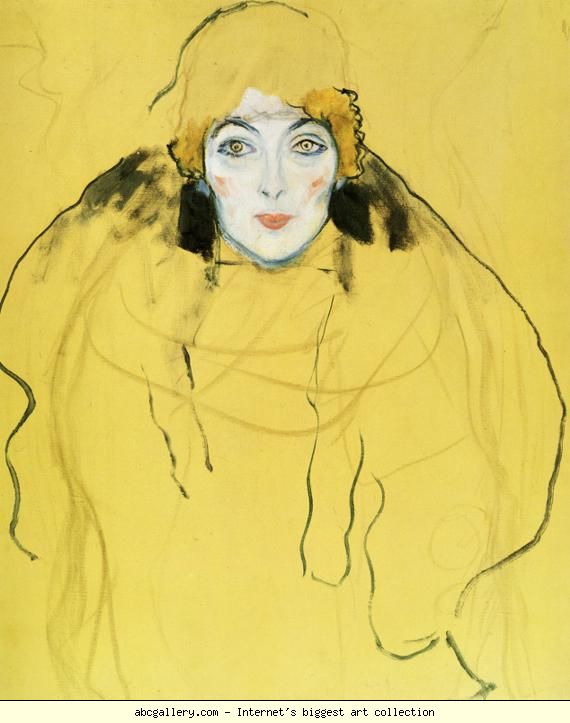
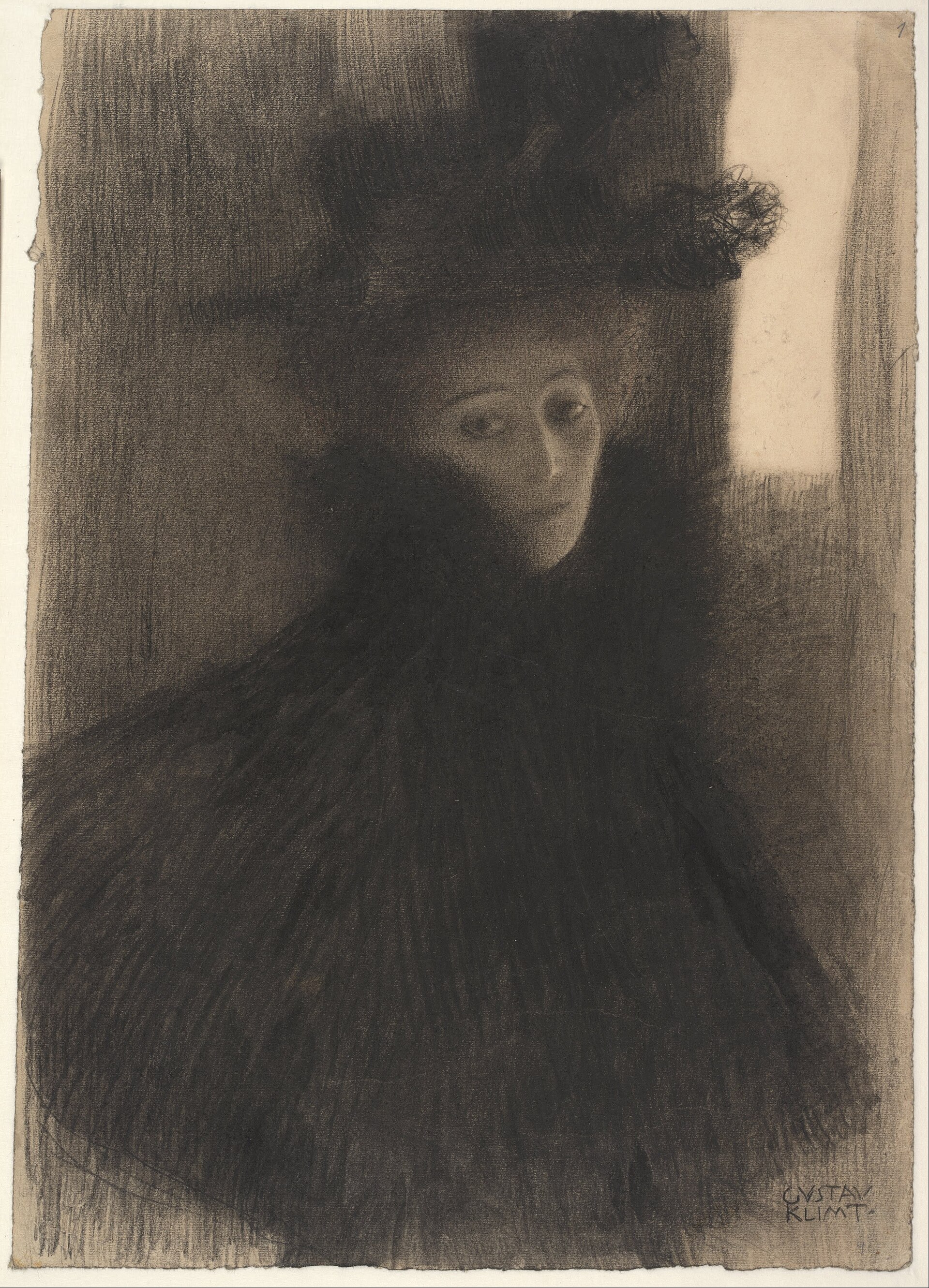
The practical consequence is that a reader searching under any one of these names will be shown pictures that are not this one, and some of those pictures are also by Klimt and also called Portrait of a Lady. This record therefore names the confusable canvases explicitly rather than leaving them to be discovered: the unfinished Portrait of a Lady of 1917 to 1918, the Portrait of a Lady with Cape and Hat of 1897 to 1898, and the Portrait of a Woman of 1893 in Vienna. None of them is the Piacenza picture.
Chapter 17What the recovery did to a provincial gallery
The picture's fame is not the artist's doing.
The picture's fame is not the artist's doing. Until 1996 it hung in a room of foreign artists in a gallery of nineteenth and twentieth-century Italian painting in a city of a hundred thousand people. What made it famous was first the discovery of the picture underneath, then the theft, then the discovery in the wall, in that order, over twenty-three years.
The city said as much within hours of the authentication. In their statement of 17 January 2020 the mayor Patrizia Barbieri and the culture councillor Jonathan Papamarenghi said the interest in the painting, always present, had exploded from the date of its recovery; that the bulk of the resources earmarked for the city's art projects for 2020 would be redirected at once to initiatives around it; that work was under way on a book, a novel, to carry the story; and that a number of film directors around the world had contacted the city in those weeks wanting to work on the case. They described the picture as a chance to make Piacenza an obligatory destination internationally.
The audience followed. The picture went back on view at the Ricci Oddi on 28 November 2020. The Museo di Roma exhibition that borrowed it in 2021 sold out and extended its hours in its final days. It then travelled to Seoul, where the Korea Herald reported it was being shown outside Italy for the first time since the recovery, as the centrepiece of a loan of about seventy works from the Piacenza collection. A gallery that could not previously have placed seventy pictures in a Gangnam museum could place them once it had this one.
The 2026 refurbishment is the last step in that sequence. The regional heritage service describes a rebuilding of all twenty-two rooms around a collection that now has an international draw, and the gallery's director Lucia Pini is quoted by Piacenzasera describing the picture's return as a moment of great emotion and profound significance. The museum that the picture was stolen from is now, in a real sense, the museum the picture rebuilt.
Chapter 18Klimt's last two years
The picture belongs to a small group. The Austrian agency report describes it as part of a series of portraits of women that Klimt made in the last years of his working life, between 1916 and 1918.
The picture belongs to a small group. The Austrian agency report describes it as part of a series of portraits of women that Klimt made in the last years of his working life, between 1916 and 1918. That was the phase after the gold: the Ricci Oddi gallery's own note says that by this date he had abandoned the dazzling gilded stylisations of what is called his golden period, and that his painting became less precious and gave itself over to almost hurried brushwork betraying a more emotional approach, open to expressionist suggestion.
The English Wikipedia article, a tertiary source flagged here for replacement, records that he suffered a stroke on 11 January 1918 which paralysed his right side and died in hospital in Vienna on 6 February 1918, and that numerous paintings were left unfinished at his death. Portrait of a Lady is not one of the unfinished ones, and the distinction matters for this record: a separate, genuinely unfinished Klimt of 1917 to 1918 also carries the title Portrait of a Lady and is a different canvas entirely.
The habit that made this picture possible was his own. Reworking, scraping back and painting over is common enough in any studio. What is not common is doing it to a finished, exhibited, published portrait, keeping the sitter's face and the background, and producing a second public picture on the same support. The gallery states flatly that the transformation finds no equal in any other work by the artist. One canvas in Piacenza holds two Klimts, and only one of them can be seen.
The artist
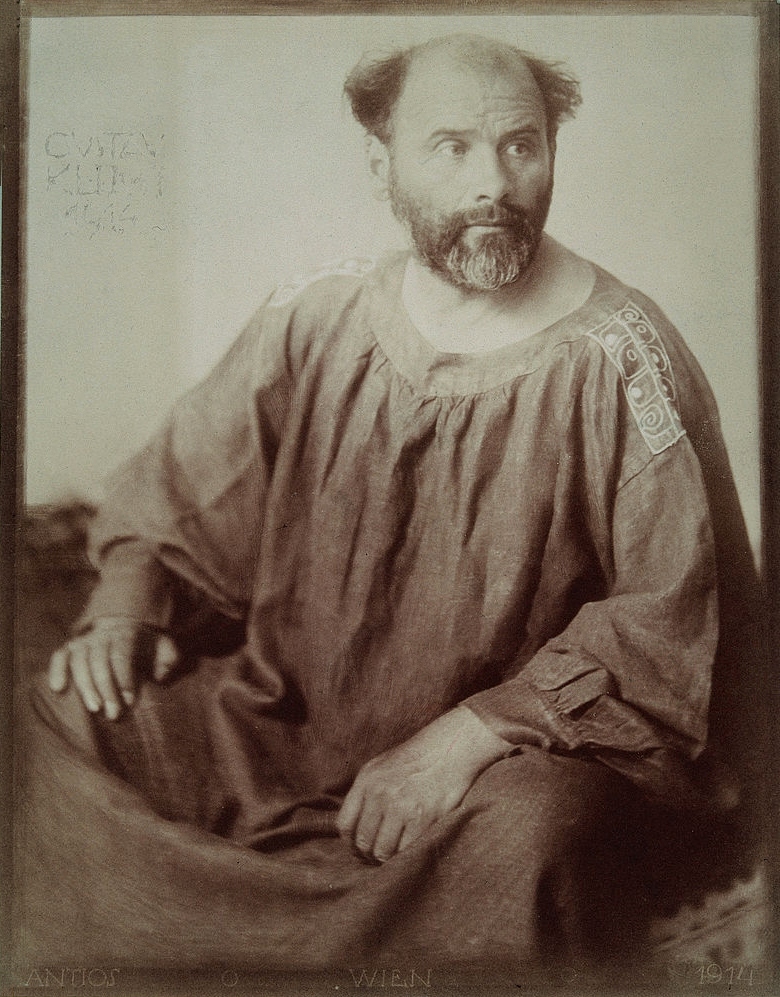
Gustav Klimt
Born in Baumgarten near Vienna in 1862 and dead in Vienna in February 1918, Klimt spent his working life inside a single city's institutions and then in open revolt against them. He trained as a decorative painter, built a successful architectural practice with his brother, then broke with the establishment, led the Vienna Secession, was publicly attacked over a state commission, bought his way out of it, and spent his last twenty years painting the women of Viennese society and the landscape around the Attersee. The Piacenza picture belongs to the very end of that run, after the gold had gone.
Related works
| Work | Relation | Where it is |
|---|---|---|
| Portrait of a Young Lady, known as the Backfisch Gustav Klimt | The picture underneath this one. Same canvas, same face, same background, different dress and hair. Not a different painting on a different support but the earlier state of this one, no longer visible. Dated about 1910 by the holding gallery and to 1912 by Franz Servaes as cited by Johannes Dobai in 1967. Known from 1917 until 1996 only through a magazine illustration. Identified beneath this canvas by Claudia Maga in 1996 and confirmed by radiography and later by multispectral imaging. | Beneath the visible paint of Portrait of a Lady, Galleria d'Arte Moderna Ricci Oddi, Piacenza |
| Portrait of a Lady, unfinished Gustav Klimt | A different canvas of 1917 to 1918 carrying the same English title and left unfinished at the artist's death. Naming it here is the point: the two are routinely confused, and a search for either returns both. Klimt left numerous pictures unfinished when he died in February 1918. This record concerns the finished Piacenza canvas and not that one. | Not the Ricci Oddi |
| Dame mit Faecher, Lady with a Fan Gustav Klimt | His last portrait, from the same final phase, and the benchmark for what the late portraits are worth on the open market. GBP 74 m at hammer, GBP 85.3 m with premium. Al Jazeera reported Sotheby's calling it an auction record for a work of art in Europe and for the artist. | Private collection, sold at Sotheby's London, June 2023 |
| Portrait of a Lady with Cape and Hat Gustav Klimt | An earlier portrait of 1897 to 1898 that shares the English title. A further source of confusion and another reason this record lists every title the Piacenza picture carries. Named here for version safety, not because it bears on the Piacenza picture's history. | Not the Ricci Oddi |
| Ecce puer Medardo Rosso | Bought by Giuseppe Ricci Oddi in 1926, one year after the Klimt, and the object around which the gallery says an unexpected friendship grew between the expansive sculptor and the reserved collector. It shows what kind of buyer brought a Klimt to Piacenza. The gallery's own history names the purchase and the friendship. | Galleria d'Arte Moderna Ricci Oddi, Piacenza |
Open questions
- Who is the sitter? Neither the holding gallery nor the compiler of the Taschen catalogue of Klimt's paintings can name her. The one proposal in print, Consuela Huber, is undercut in the same report that raises it by the absence of the beauty spot from surviving photographs of her.
- How did the picture travel from Klimt's studio in Vienna to the stock of the Milanese dealer Luigi Scopinich by 1925, and what did Giuseppe Ricci Oddi pay for it? Neither is documented in any source located for this record.
- How did the canvas leave the building on 22 February 1997? The gallery states the means were never established. Published accounts variously describe a fishing line through a skylight, an entry through the main door and a frame found on the roof, while the report of the 2020 examination describes marks matching a frame left on the ground.
- Where was the painting between 1997 and 2019? The prosecutor's experts reported in January 2020 that nothing had been established about how long it had lain in the cavity, and noted that its condition was not consistent with twenty-two years in optimal conditions. The men who wrote to Liberta said through their lawyer that it had not been in the cavity all that time.
- Was the loss ever insured, and if so what became of any payment once the picture was recovered? The gallery's vice president said in December 2019 that the documents from twenty-two years earlier would need to be checked, and no answer has been published since.
- What became of the partial fingerprint recovered from the empty frame in 1997 and re-tested with newer methods from 2014? No source located for this record states whether it was ever matched, and the file was archived in November 2021 without any finding.
- What are the picture's true dimensions? Four different measurements are in print, including the holding gallery's own 68 by 55 centimetres. A published measurement taken during the 2020 examination would settle it.
Questions about this object
What is Portrait of a Lady?
Portrait of a Lady is a painting, dated 1916-1917. Medium: Oil on canvas, painted over an earlier portrait by the same artist.
Who made Portrait of a Lady, and is the attribution settled?
The attribution to Gustav Klimt is recorded here as accepted. Never questioned as a Klimt in the literature, and re-tested in public in January 2020 for a reason no other Klimt has ever needed: to prove that the canvas recovered from a hole in the gallery wall was the canvas taken from the gallery in 1997. Three experts appointed by the Piacenza prosecutor's office reported that the painted surface, the execution, the signature and the pigments were congruent with Klimt, and that the back of the canvas matched the gallery's own photograph of the original verso down to the seal impressed in gesso. The picture is also the only Klimt known to carry a second, earlier Klimt portrait underneath it, and the multispectral imaging of that buried picture was treated as the decisive mark of identity.
Where is Portrait of a Lady now?
Galleria d'Arte Moderna Ricci Oddi, Piacenza, Italy. Last confirmed 26 September 2026. Returned to the gallery on 4 April 2026 from the My Art Museum in Seoul, and shown in the gallery's new arrangement from 28 April 2026.
What is still unknown about Portrait of a Lady?
Who is the sitter? Neither the holding gallery nor the compiler of the Taschen catalogue of Klimt's paintings can name her. The one proposal in print, Consuela Huber, is undercut in the same report that raises it by the absence of the beauty spot from surviving photographs of her.
Sources
- 1Galleria d'Arte Moderna Ricci Oddi, 'Gustav Klimt: Ritratto di signora', the holding institution's own page on the object. Gives the dimensions as 68 x 55 cm, the 1925 purchase from Luigi Scopinich, the move into the gallery in 1931, the under-painting, Claudia Maga, the theft of 22 February 1997 by means never clarified, and the recovery of 10 December 2019. riccioddi.it/klimt.php
- 2Galleria d'Arte Moderna Ricci Oddi, 'La storia della Galleria'. Giuseppe Ricci Oddi 1869-1937, the first purchases of 1897, the search for premises from 1913, the building by Giulio Ulisse Arata 1924-1931 on the San Siro convent site, the overhead natural lighting urged by the founder, the opening of 11 October 1931 and the Medardo Rosso friendship. riccioddi.it/museo.php
- 3IlPiacenza, Emanuela Gatti, 'Il Klimt e autentico ed e in discrete condizioni. Dov'e stato per ventidue anni?', 17 January 2020. The fullest account of the authentication: the three experts appointed by Ornella Chicca, the named officials, the evidence item by item, the condition finding and the city's statement naming the finder. ilpiacenza.it/attualita/...
- 4The Art Newspaper, 'Stolen Klimt found hidden in a wall will take a month to authenticate, officials say', 12 December 2019. The gardener, the metal plate, the cavity, the fishing line and the frame on the roof, and Laura Bonfanti on condition and insurance. theartnewspaper.com/2019/...
- 5The Art Newspaper, 'Suspect list in stolen Klimt saga grows', 19 February 2020. The questioning of the former director's widow, the Fugazza diary reported by the BBC in 2016, the January 2020 authentication and the 60 million euro valuation. theartnewspaper.com/2020/...
- 6Artnet News, Naomi Rea, 'In a Twist, Two Serial Art Thieves Confess to Having Hidden Klimt's Portrait of a Lady Inside a Wall So That It Might Be Recovered', 21 January 2020. The letter to Liberta, the lawyer Guido Gulieri, the claimed return four years earlier, the expiry of the limitation period and the separate burglary sentences. Reached through the in-app browser after a 403 on direct fetch. news.artnet.com/art-world/...
- 7Artnet News, Sarah Cascone, 'Confessed Thief in 1997 Gustav Klimt Heist Claims Canvas Will Soon Be Returned', 9 December 2016. Summarises the BBC interview, the Ventimiglia forgery of April 1997, Claudia Maga's discovery, the 2014 reopening and Colonel Luca Pietranera. Reached through the in-app browser. news.artnet.com/art-world/...
- 8The Guardian, Lizzy Davies, 'Gustav Klimt theft case reopens in Italy 17 years on', 16 March 2014. The most careful account of what the police did and did not know: main entrance or skylight, an empty frame, a partial fingerprint. Reached through the in-app browser. theguardian.com/artanddesign/...
- 9Die Presse, APA report, 'Viele Raetsel um wiedergefundenes Klimt-Portraet in Italien', 11 December 2019. Tobias G. Natter on the sitter and on the embarrassment to art history, Dario Gallinaro and Massimo Ferrari on the recovery, the alarm not working, the 2015 ransom demand, the unsellability of the picture and a dimension of 40 x 60 cm. Reached through the in-app browser. diepresse.com/5736738/...
- 10Corriere della Sera, 'Piacenza, il Klimt e l'incredibile storia del quadro nascosto sotto la tela, scoperta da una studentessa 18enne', 11 December 2019. Claudia Maga's own account of the 1996 discovery in her own words, and General Roberto Riccardi on the under-painting as an almost certain signature. Reached through the in-app browser. corriere.it/cronache/...
- 11ANSA, 'E autentico il quadro di Klimt ritrovato a Piacenza', 17 January 2020. The announcement at a press conference in Piacenza and the statement by the mayor Patrizia Barbieri and the culture councillor Jonathan Papamarenghi. ansa.it/emiliaromagna/...
- 12Liberta, 'Klimt, restano i misteri. Chiesta l'archiviazione per i tre indagati', 3 March 2021. The prosecutor's request to archive the case against three people investigated for receiving stolen goods and theft, the role of the judge, and the niche in the external wall. Reached through the in-app browser. liberta.it/news/...
- 13ANSA, 'Klimt sparito e ritrovato, archiviata l'inchiesta a Piacenza', 18 November 2021. The judge Luca Milani, the request by the prosecutor Ornella Chicca, the three people named with their offences and, for two of them, their deaths, and the picture then hanging in the Rome exhibition. ansa.it/emiliaromagna/...
- 14ARTnews, 'Italian Prosecutors to Drop Charges in Stolen Klimt Painting Investigation'. Prosecutors dropping charges against three suspects, a judge to rule on that decision, and the expectation that the case would remain cold. Retrieved by plain GET after a 307 redirect blocked the standard fetch. artnews.com/art-news/...
- 15Center for Art Law, 'Klimt in the Wall: An Account of Return'. The legal analysis: the police theory of the fishing line and skylight, the Italian limitation period of six years for theft extendable to nine, the position of the confession outside any prosecution window, and the unresolved insurance question. itsartlaw.org/art-law/...
- 16Museo di Roma, 'Klimt. La Secessione e l'Italia', exhibition page. Palazzo Braschi, 27 October 2021 to 27 March 2022, curated by Franz Smola of the Belvedere, Maria Vittoria Marini Clarelli and Sandra Tretter of the Klimt Foundation, more than two hundred works, and the Ricci Oddi Ritratto di signora described as stolen in 1997 and recovered in 2019. museodiroma.it/it/...
- 17The Korea Herald, 'Long-lost Gustav Klimt Christmas gift to travel to Seoul for first time'. The Miracle of Klimt and Other Treasures From Galleria d'Arte Moderna Ricci Oddi at My Art Museum, Gangnam, 19 December 2025 to 22 March 2026, about seventy works, and the first showing of the picture outside Italy since the recovery. koreaherald.com/article/...
- 18Piacenzasera, 'Il ritorno a casa della Signora del Klimt: alla Ricci Oddi dal 4 aprile', April 2026. The return from Seoul on 4 April 2026, the director Lucia Pini quoted, and the new arrangement from 28 April 2026. piacenzasera.it/2026/...
- 19Finestre sull'Arte, 'Piacenza, Klimt's Portrait of a Lady is back at the Ricci Oddi Gallery of Modern Art'. Confirms the return on 4 April 2026 from the My Art Museum in Seoul, the Lissoni and Partners refurbishment and the reopening on 28 April 2026. finestresullarte.info/en/...
- 20Patrimonio culturale, Regione Emilia-Romagna, 'Nuova vita per la Galleria d'Arte Moderna Ricci Oddi di Piacenza', 2026. The refurbishment by Lissoni and Partners from spring 2025, more than a thousand square metres and twenty-two rooms, the freeing of Arata's design from later alterations, the free-admission period from 28 April to 3 May 2026, Massimo Toscani and Lucia Pini. patrimonioculturale.regione.emilia-romagna.it/novita/...
- 21Al Jazeera, 'Klimt painting sets European record with $108m price tag', 28 June 2023. Dame mit Faecher at Sotheby's London: hammer GBP 74 m, about USD 94.35 m; GBP 85.3 m with buyer's premium, about USD 108.4 m; the previous European record of GBP 65 m for Giacometti's Walking Man I in 2010; and the Sotheby's statement. aljazeera.com/news/...
- 22Interpol, 'Stolen Works of Art Database'. Described as the only database at international level with certified police information on stolen and missing objects of art, with almost 57,000 items, searchable only by authorised users through an application form. interpol.int/en/...
- 23Comando Carabinieri Tutela Patrimonio Culturale, public database portal. The Leonardo database of unlawfully removed cultural property and the command's history and structure. Checked for an entry on this picture on 26 September 2026. tpcweb.carabinieri.it/SitoPubblico
- 24FBI, National Stolen Art File. Searched on 26 September 2026 for Gustav Klimt through the file's own search and through a domain-scoped web search after the site's own search returned a Cloudflare challenge to a direct fetch; no entry for the artist or this picture was returned. artcrimes.fbi.gov
- 25Wikipedia (Italian), 'Ritratto di signora (Klimt)', read as wikitext through the MediaWiki API. Carries the Dobai 1967 commentary with the Velhagen und Klasings Monatshefte citation and the Servaes dating, the Ventimiglia forgery addressed to Bettino Craxi, the three gardeners and the hatch, and the 2021 archiving. it.wikipedia.org/wiki/...
- 26Wikipedia (English), 'Portrait of a Lady (Klimt)'. Gives dimensions of 60 x 55 cm and the claim that the skylight beside which the frame was found was too small for the painting to pass through, which the BBC reports from the investigating carabiniere Sgt Maj Salvatore Cavallaro at source 29. en.wikipedia.org/wiki/...
- 27Wikipedia (English), 'Gustav Klimt', for the biography, the Kunstgewerbeschule and Kuenstlercompagnie, the Secession presidency of 1897, the University of Vienna ceiling paintings and their destruction at Schloss Immendorf in 1945, the stroke of 11 January 1918 and the death of 6 February 1918, and the text on a non-existent self-portrait. en.wikipedia.org/wiki/...
- 28Every plate proposed for this record was checked individually on 26 September 2026 against the LicenseShortName field, and two candidate files were dropped on the result. commons.wikimedia.org/w/...
- 29BBC News, Max Paradiso, 'The mystery of the stolen Klimt', 8 December 2016. Source for the interval of ten months between Claudia Maga's discovery and the theft, and for the investigating carabiniere Sgt Maj Salvatore Cavallaro's finding on the roof that the frame did not fit through the skylight beside it. Retrieved 26 September 2026. bbc.com/news/...
Last verified · Published
Change log
26 September 2026 - Record created at the house standard: researched narrative, technical evidence, maker dossier, graded provenance chain, prices with hammer and premium separated, related works, open questions and sources.