The Picture Her Father Refused
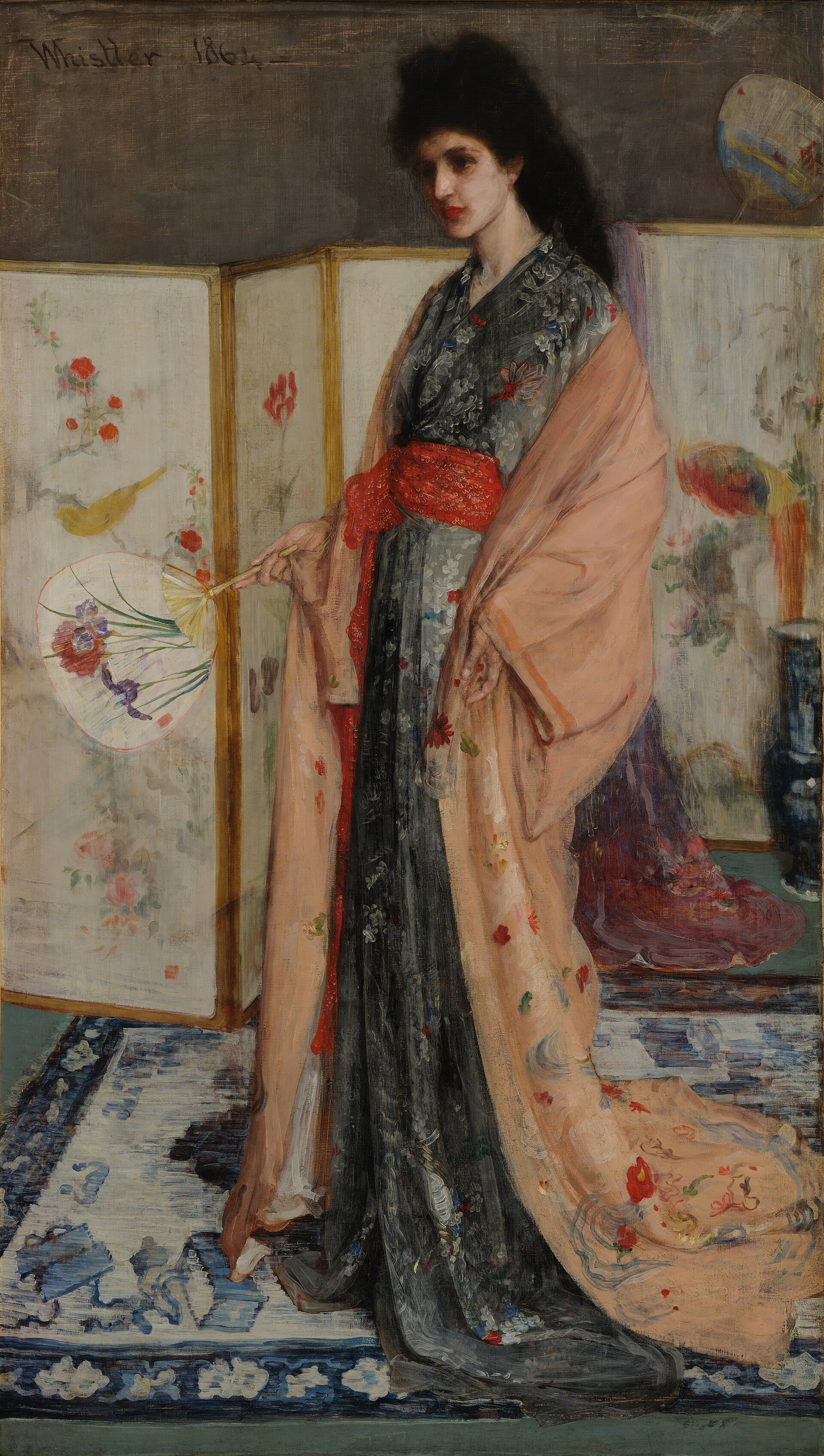
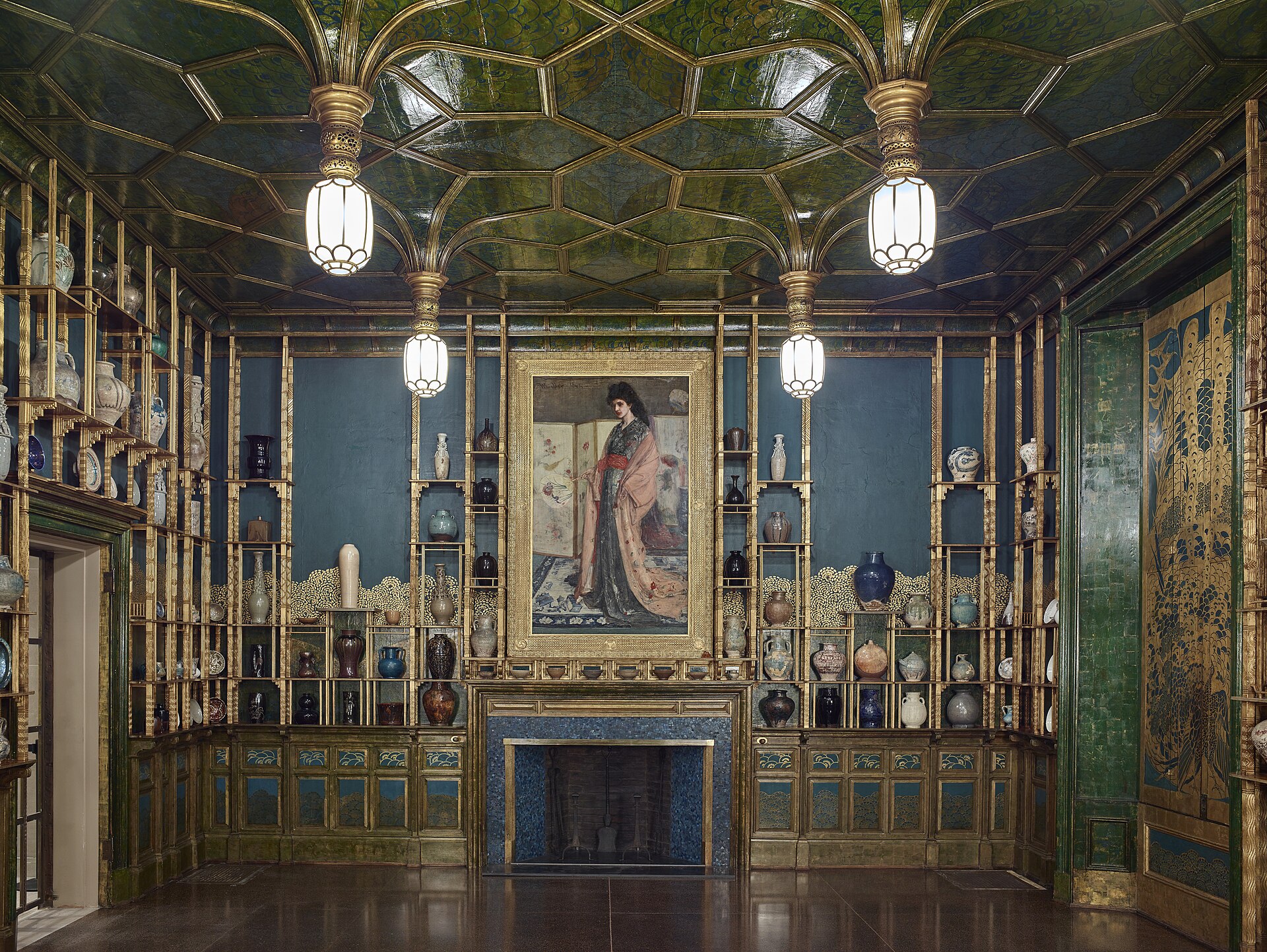
The Peacock Room is built around a portrait of Christine Spartali that her own father declined to buy. The refusal rests on one memoir, and no price was ever named.
Records in this piece: La Princesse du pays de la porcelaine, Portrait of a Lady
On this page 6 sections
ContentsClose
In short
- The most famous decorative interior in American art is built around a portrait the sitter's family would not take. Michael Spartali did not like it and objected to it as a portrait of his daughter, so it went to Rossetti to sell instead.
- That refusal rests on one memoir. The Pennells published it in 1908, forty-four years after the event, reporting the recollection of the sitter's sister. Every later account, the catalogue raisonne included, descends from that one passage.
- No price was ever named for the refusal. The hundred pounds belongs to the next transaction, Rossetti's sale, and Whistler himself could not remember in 1892 whether it was a hundred or fifty. Any figure attached to the offer to her father would be invented.
- The nearest independent corroboration is about other painters. Michael Spartali commissioned four still lifes from Fantin-Latour in 1866 and paid for only two, which the catalogue's editors attribute to Alphonse Legros persuading him they were all alike, and by November 1868 Fantin was asking Whistler whether another buyer was going to be like Spartali, a collector who does not like them.
- She has a documented later life and it is short. She married Comte Edouard Cahen d'Anvers, had two sons, was living in Rome and died at thirty-eight, on 27 September 1884 in the Tyrol on the one genealogical account that records it. Her husband was made Marquis of Torre Alfina five months after she died, so she was never the marquise some genealogies give her.
- Nothing survives in her own voice. The Whistler correspondence indexes her with five documents and every one of them was written by somebody else. There is no record of what she thought of the picture, or whether she ever saw it again.
The refusal is one sentence in one memoir
The reason La Princesse du pays de la porcelaine was available to be bought by a Liverpool shipowner, and so to end up above a fireplace in Washington, is that the sitter's father did not want it. The passage everything rests on was published by Elizabeth Robins Pennell and Joseph Pennell in 1908, in the first volume of their life of Whistler, and it reads: the two girls wanted their father to buy it, but Mr Spartali did not like it, he objected to it as a portrait of his daughter.
That is the whole of the documentary basis. It was printed forty-four years after the sittings, and the Pennells are transmitting the recollection of Marie Spartali Stillman, the sitter's elder sister, who had sat in the room throughout. The University of Glasgow's catalogue raisonne quotes the same sentence, and the scholarly literature on the painting cites the Pennells and the standard monograph on the Peacock Room, which cites the Pennells in turn. A single second-hand memory is carrying a very large building.
It is worth being exact about the objection as reported, because it is not a judgement about painting. He objected to it as a portrait of his daughter. Whatever else the picture is, it was offered to a family as a likeness and refused as one.
No price was ever named for the offer to her father
The figure that circulates in connection with this refusal belongs to a different transaction. After the family declined, Rossetti took the canvas and sold it, and it is that sale which produced the hundred pounds. The Pennells say Whistler agreed to take a hundred pounds and that Rossetti placed the canvas in his own studio. Whistler's own recollection, in a draft letter of 1892, is less firm than his biographers: he writes that the picture was bought at the instigation of Rossetti and that he received for it one hundred pounds, and then corrects himself, or fifty, I forget which.
No source consulted names any sum offered to Michael Spartali. Our own record for the painting stated that the Pennells reported the 1892 result as four times the sum Whistler had originally been paid, and that the original sum is not given in the sources consulted, so the multiple cannot be converted. That was wrong, and it has been corrected: the Pennells give the hundred pounds at volume 1 page 124. The report of the multiple that our record was citing is at volume 2 page 127, and the catalogue raisonne's own note misplaces it in volume 1, which is probably how the two became detached. The arithmetic also favours the higher figure, since 420 guineas is 441 pounds, which is nearer four times a hundred than four times fifty.
| Transaction | Sum | Source |
|---|---|---|
| Offered to Michael Spartali, about 1865 | Not recorded in any source | No source names one |
| Received by Whistler through Rossetti | 100 pounds, or 50 on his own later doubt | Pennell 1908, i.124; Whistler's draft letter of 1892 |
| Christie's, 28 May 1892, lot 39, to Alexander Reid | 420 guineas | Glasgow catalogue raisonne YMSM 050 |
| Charles Lang Freer, 20 August 1903 | 3,750 pounds | Glasgow catalogue raisonne YMSM 050 |
One conflict in that table is worth flagging rather than smoothing. The Pennells give the Freer purchase as five thousand guineas, against the 3,750 pounds in the catalogue raisonne. They are not reconcilable and this article does not settle them.
Refusing pictures had happened before, and that part is primary
The strongest independent evidence about Michael Spartali as a buyer is not about his daughter's portrait at all, and it sits in letters written at the time rather than in a memoir written in 1908. In 1866 he commissioned four still lifes from Henri Fantin-Latour, accepted and paid for two and declined the other two. The catalogue's editors attribute that rejection to Alphonse Legros persuading him the four pictures were all alike, so it is not a clean case of a buyer simply changing his mind. Fantin was left unpaid until another buyer took the rejected pair, and he pressed Whistler about the money in February 1867. Then, in a letter of 16 November 1868 about a different unpaid buyer, he asks Whistler a question that settles the character of the earlier episode: is it like Spartali, a collector who does not like them.
What matters is the second letter rather than the first: whatever the reason in 1866, by 1868 a contemporary painter was using this man's name, in his own hand, as shorthand for a buyer who does not like what he ordered. It does not prove the portrait story, which remains single-rooted, but it makes it a normal event rather than an inexplicable one, and nobody writing about the Peacock Room appears to have set the two beside each other.
One correction to our own record while we are on the father. He was a merchant when his daughter sat, a partner in the London Greek firm Spartali and Company, which had been Spartali and Lascaridi until 1854, and he became Greek consul-general in London only in 1867, after the picture was finished. Our record introduced him with the consulship, which reads as though the sitter were a diplomat's daughter at the time of the sittings.
What the only witness says about the sittings
Everything known about what it was like to be painted as the Princess comes from Marie Spartali Stillman through the Pennells, and the detail is domestic and physical. The sittings ran twice a week through the winter of 1863 to 1864, with Marie always accompanying her sister. The Japanese robe, the rug and the screen were ready on the first day and the pose was given then. Whistler partly closed the shutters to keep out the direct light. Christine stood at one end of the room and Whistler would look at the picture from a distance, then suddenly dash at it, give one stroke, then dash away again. They arrived about half past ten or a quarter to eleven and it was often long after two before they lunched. Raw tomatoes were a surprise to the two Greek girls, who had never eaten them except overcooked, and the canned apricots and cream they had never eaten at all; the roast pheasant belongs to one particular menu rather than to the standing lunch. It was four and later before they were released. He kept her standing while he worked on the head and never let her rest.
The costume was not hers. The Smithsonian's own label describes the series as putting western models in Asian dress surrounded by Chinese and Japanese objects from Whistler's own collections, and the screen behind her was his, sold at his bankruptcy in 1879. No source consulted says the robe belonged to the Spartalis, and Marie's account says only that it was ready.
The one contemporary document that touches the sittings is Whistler's, not hers, and it records that she fell ill. Writing to Fantin-Latour from Lindsey Row early in 1865 he says the Japanese woman is taking him from morning to evening, and that she had been put aside until now because of the model's illness. The catalogue raisonne raises the possibility that a professional model stood in for part of the work and hedges it, and this article leaves that hedge alone.
What became of her, which our record gave in six words
Christine Spartali married Comte Edouard Cahen d'Anvers, of the Paris banking family, in 1868 or 1869, and the forename is worth pausing on because the literature has it wrong. The Pennells called him Edmond in 1908 and the Glasgow project still carries Edmond on the same page where its own header prints Edouard. The man who existed was Edouard Joseph Cahen d'Anvers, 1832 to 1894.
She had two sons, Rodolfo in 1869 and Ugo in 1874. She was living in Rome. She died on 27 September 1884 in the Tyrol, at thirty-eight, and she was buried on 9 October in the Hellenic enclosure at West Norwood Cemetery in London. Her husband was created hereditary Marquis of Torre Alfina by decree of the King of Italy on 8 March 1885, five months after her death, so the marquisate some sources give her was never hers. The genealogical compilation we use elsewhere puts that grant in 1881, which would place it in her lifetime; the 1885 decree is the better attested of the two and the compilation is wrong here, as it is on the husband's forename.
How she died is not settled and this article will not settle it. The entry built on Alice Lege's research describes a severe depression and says she did not survive the treatments of the era, naming morphine and chloral hydrate among them. A genealogical compilation gives the Tyrol and 27 September while offering 22 September as an alternative and asking whether it was Germany, and separately raises both suicide and an overdose of chloral. A blog post by Kirsty Stonell Walker, reporting David Elliott's biography of the Stillmans, describes an overdose of chloral, accidental or otherwise, discreetly covered up, adds that most sources call the cause unexplained, that William Michael Rossetti called it cataleptical and that a rumour of death in childbirth circulated. That last strand reaches us at two removes, through a blog reporting a book we have not read, and it is named here as such rather than laundered into the record. Chloral appears in three of these accounts and none of them is a document. Our record ended her life in six words, that she went on to marry and died in 1884, and it now carries this instead, with the disagreements named.
She was named as the sitter in her own lifetime and just after it, by three different hands. E. W. Godwin, annotating in the room itself on 16 February 1877, labelled the overmantel picture a portrait of M. Spartali in Japanese dress. Ford Madox Brown, writing in 1888, listed among Whistler's best works a portrait of the Countess de Cahen in Japanese costume, using her married name four years after her death. Whistler told his dealer in February 1892 that there was only one picture of his that he cared for in the Leyland collection, the portrait of Miss Spartali in Japanese dress. And then the naming stops, and the room takes over. The archive holds the opposite case in the Klimt at Piacenza, a portrait whose sitter has never been named at all and where there is no father, no refusal and no marriage to follow, only a face. Between the two, being named and then forgotten is not obviously the better outcome.
Four things our own record had wrong
This article was written against our record for the painting and the research found four defects in it, all corrected in the same push. The fourth, her father's consulship, is treated above. The first is the one that made the record contradict itself. It stated that the picture is signed and dated in the lower area of the canvas, attributing that to the catalogue raisonne, while its own narrative elsewhere said a buyer was put off by the size and prominence of Whistler's signature at the top of the canvas. The Smithsonian records the signature at the upper left corner. The catalogue raisonne gives no position at all, so the attribution was also wrong.
The second is the hundred pounds, treated above: the record said the original sum is not given in the sources consulted, and the Pennells give it at volume 1 page 124, one volume before the page the record was citing for the multiple.
The third is a claim about her that no source supports as phrased. Our record said that Christine was, by contemporary account, one of the beauties artists of the day competed to paint. What the sources actually say is that Whistler, like Rossetti, was struck by the beauty of both sisters and asked the younger to sit. Tsui writes that she was noted for her beauty in Pre-Raphaelite circles, which is the germ of it, but the competing is ours. The exclamation about a Spartali sister that gets quoted in this connection is Swinburne's, and every source consulted attaches it to Marie. Christine's documented sittings amount to this painting, a lost pencil drawing and two photographs, one of them by Julia Margaret Cameron in March 1868. That is not a woman artists competed over, and the record should not have said so.
Questions
Christine Spartali, later Comtesse Edouard Cahen d'Anvers, the younger daughter of the Anglo-Greek merchant Michael Spartali. Whistler met her and her elder sister Marie at the Ionides house and asked her to sit; the sittings ran twice a week through the winter of 1863 to 1864. Sources give her birth as either 1845 or 1846 and she died in 1884.
That is what the only account says. The Pennells, writing in 1908 and reporting the recollection of her sister Marie, say the two girls wanted their father to buy it but that Mr Spartali did not like it and objected to it as a portrait of his daughter. No contemporary document records the offer, and every later version of the story descends from that passage. What is independently documented is that Michael Spartali refused pictures by other artists too, having taken only two of four still lifes he commissioned from Fantin-Latour in 1866.
A hundred pounds, on the account of his biographers, from the sale Rossetti arranged after the family declined it. Whistler himself, writing in 1892, said he received a hundred pounds and then added that he believed it was fifty and could not remember. No sum is recorded for the offer made to her father. The picture made 420 guineas at Christie's in May 1892 and Charles Lang Freer bought it in August 1903 for 3,750 pounds.
She married Comte Edouard Cahen d'Anvers in 1868 or 1869, had two sons, lived in Rome and died on 27 September 1884 in the Tyrol at the age of thirty-eight. She was buried in the Hellenic enclosure at West Norwood Cemetery. That date rests on one genealogical compilation, which itself offers 22 September as an alternative and asks whether it was Germany. The cause is not settled either: accounts variously describe a severe depression and the treatments of the era, an overdose of chloral, a possible suicide and a contemporary rumour of death in childbirth.
There is no record of it. The Correspondence of James McNeill Whistler indexes her with five documents and all five were written by other people, and searches on her married name return nothing. She was alive while the painting was exhibited in London in 1872 and hung in the Peacock Room from 1877, so the opportunity existed, but no source says whether she saw it again or what she made of it.
Sources
- 1Elizabeth Robins Pennell and Joseph Pennell, The Life of James McNeill Whistler, volume 1, 1908, pages 121 to 127, read in full text. The single root of the refusal story, reporting Marie Spartali Stillman's recollection: the meeting at the Ionides house, the sittings twice a week through the winter of 1863 to 1864, the robe and screen ready on the first day, the half-closed shutters, the dashing at the canvas, the lunches of roast pheasant, raw tomatoes and canned apricots, the sitter kept standing and never let to rest, the father's refusal, the hundred pounds Whistler agreed to take through Rossetti, the collector who would have bought it had the signature been changed, and the lost pencil drawing of her head. archive.org/download/...
- 2University of Glasgow, The Paintings of James McNeill Whistler, catalogue raisonne YMSM 050, History, Subject and Technical description tabs. Used for the sale at Christie's on 28 May 1892 as lot 39 at 420 guineas to Alexander Reid, the purchase by Charles Lang Freer in August 1903 at 3,750 pounds, the day of the month coming from the Freer's own record at source 6, the sitter's dates as 1846 to 1884, the hedged suggestion of a substitute model and the fact that the catalogue records the signature without giving its position. Note that the same site prints both Edouard and Edmond for the husband's name on a single page. whistlerpaintings.gla.ac.uk/catalogue/...
- 3The Correspondence of James McNeill Whistler, University of Glasgow, document 08040, Whistler to Henri Fantin-Latour, February or March 1865, with the editors' translation. The one contemporary document touching the sittings: the Japanese woman taking him from morning to evening, and the picture set aside until then because of the model's illness. whistler.arts.gla.ac.uk/correspondence/...
- 4The Correspondence of James McNeill Whistler, documents 01083 and 01086, Fantin-Latour to Whistler, 12 February 1867 and 16 November 1868, with the editors' notes citing Druick and Hoog, Fantin-Latour, Paris 1982. Used for Michael Spartali commissioning four still lifes in 1866 and paying for only two, and for Fantin's question in 1868 asking whether another buyer was like Spartali, a collector who does not like them. whistler.arts.gla.ac.uk/correspondence/...
- 5The Correspondence of James McNeill Whistler, document 07450, Whistler's draft letter to an editor, June 1892, in which he says he received one hundred pounds for the picture and then says he believes it was fifty and cannot remember; and document 08216, Whistler to D. C. Thomson, 14 February 1892, naming the portrait of Miss Spartali in Japanese dress as the only picture of his in the Leyland collection that he cared for. whistler.arts.gla.ac.uk/correspondence/...
- 6Smithsonian Institution, National Museum of Asian Art, object record F1903.91a-b, The Princess from the Land of Porcelain, read in a browser after direct fetches were refused. Used for the signature recorded at the upper left corner, for the label describing western models in Asian dress with objects from Whistler's own collections and for the provenance running from Rossetti's studio through an unidentified collector to Leyland from at least 1872, citing curatorial remarks by Susan Hobbs and Lee Glazer. asia.si.edu/explore-art-culture/...
- 7Aileen Tsui, 'Whistler's La Princesse du pays de la porcelaine: Painting Re-Oriented', Nineteenth-Century Art Worldwide 9, no. 2, Autumn 2010, text and notes. Used for the description of the signature in large letters in the upper section of the canvas, for Whistler's failure to persuade Michael Spartali to buy the portrait of his daughter and for Ford Madox Brown's 1888 list naming a portrait of the Countess de Cahen in Japanese costume. 19thc-artworldwide.org/autumn10/...
- 8Alice S. Lege, 'The Cahen d'Anvers in France and Italy', Jewish Country Houses project, University of Oxford, and the INHA Agorha database entry for Hugo Cahen d'Anvers built on the same research. Used for the husband as Edouard Joseph Cahen d'Anvers, 1832 to 1894, for the hereditary marquisate of Torre Alfina conferred by royal decree in 1885, for the two sons Rodolfo and Ugo and for the account of Christine Spartali's severe depression and the treatments of the era including morphine and chloral hydrate. agorha.inha.fr/ark:/...
- 9National Portrait Gallery, London, person record for Christina Spartali and the portrait records NPG x18050, an albumen cabinet card by Julia Margaret Cameron of March 1868, and NPG x203308, an albumen carte de visite by Philip Crellin junior of the 1860s. Read in a browser after direct fetches were refused. Used for the two surviving photographs of her and for the gallery's dating of her birth to 1845, against 1846 elsewhere. npg.org.uk/collections/...
- 10Christopher A. Long, Anglo-Greek genealogy, family group sheets for Michael Spartali and Euphrosyne Varsamis and for Comte Edouard Cahen d'Anvers and Christina Spartali, with the West Norwood Hellenic enclosure burials index. Used for the birth on 19 May 1846 and the baptism of 23 June 1846, for the death on 27 September 1884 in the Tyrol with the alternatives the compiler himself offers, for the burial on 9 October 1884 and for the family's residence at The Shrubbery. A genealogical compilation rather than a scholarly edition, and cited as such. christopherlong.co.uk/gen/...
- 11Elizabeth Robins Pennell and Joseph Pennell, The Life of James McNeill Whistler, volume 2, 1908, page 127, for the report that the 420 guineas of 1892 was four times what Whistler had been paid and for the statement that Freer paid five thousand guineas, which conflicts with the 3,750 pounds in the catalogue raisonne. Cited separately because the catalogue's own note places this passage in volume 1, where it does not appear. archive.org/download/...
- 12Kirsty Stonell Walker, 'Sunday 16th December: Christine Spartali', The Kissed Mouth, 16 December 2018. A blog post, graded as such, reporting David B. Elliott's biography of the Stillmans, which we have not read. The only route we found to the accounts of an overdose of chloral discreetly covered up, of William Michael Rossetti calling the death cataleptical and of a contemporary rumour of death in childbirth. fannycornforth.blogspot.com/2018/...
More in The Women Behind the Art
The partWhat the Opera Paid Marie van Goethem
The model for Degas's Little Dancer is documented in a payroll and two lines of his handwriting.
The Publisher Was the Sitter
Truth sold her own cartes de visite, registered the copyright in her own name and left the photographer unnamed.
The Half That Was Not Sold
Vera Salomons inherited 57 of her father's Breguet watches. Her mother got the other seventy and they were auctioned.