Portrait of Adele Bloch-Bauer I
Gustav Klimt · 1903-1907
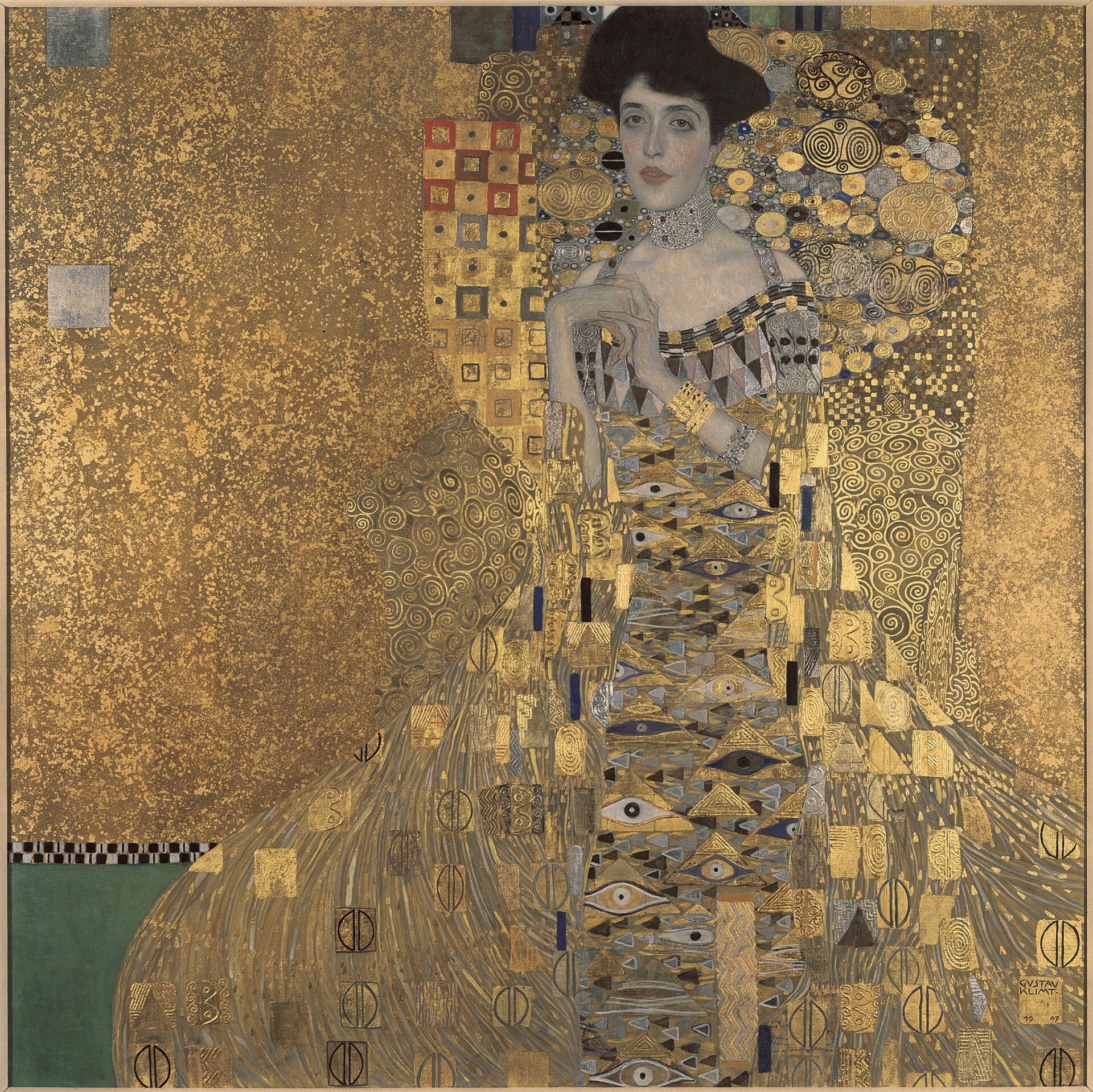
The whole picture in its frame, 140 x 140 cm, as photographed for the Neue Galerie, where it has hung since 2006. The photograph is credited to the museum and shows the mottled, matte surface of the leaf with a neutral colour balance.
| Artist | Gustav Klimt |
|---|---|
| Date | 1903-1907 |
| Medium | Oil, silver and gold on canvas |
| Dimensions | 140 x 140 cm (55 1/8 x 55 1/8 in), as given by LACMA and the Neue Galerie |
| Where it is now | Neue Galerie New Yorklast confirmed |
| Attribution | AcceptedDocumented by the sitter's own letter of 22 August 1903 recording that Klimt would paint her portrait, shown at Mannheim in 1907 and at the Vienna Kunstschau in 1908 as a Klimt, and never questioned in any source consulted. Full note |
| Object type | Painting |
| Period | Austrian, early twentieth century |
| Cases | Seized, looted or confiscated · Restituted or repatriated |
| Inscriptions | Not recorded in the sources consulted. |
| Owners on record | 8 links5 documented, 3 disputed |
| Sources | 32 cited |
About this record Last verified · 32 sources cited · Change log
On this page 11 sections
ContentsClose
A square canvas of gold and silver leaf and oil, 140 centimetres on a side, commissioned in 1903 by a Viennese sugar manufacturer from a Prague family as a portrait of his wife, finished by Klimt in 1907 after a journey to the mosaics of Ravenna. It is the first of two full-length portraits Klimt painted of Adele Bloch-Bauer, and it is the picture the Neue Galerie in New York calls the Woman in Gold.
Its documented life has three parts that are rarely told together. Adele's will of 1923 asked her husband to leave her two portraits and four landscapes to the Austrian State Gallery, and whether that sentence was a binding bequest or a request is the question on which two Austrian bodies reached opposite answers. In 1941 a Nazi-appointed administrator handed the portrait to the gallery and received another Klimt from it in return, and in 1948 the heirs' lawyer acknowledged the gallery's claim while seeking export permits for the rest of the collection. On 15 January 2006 a three-member arbitration court ruled that the conditions of the 1998 Art Restitution Act for return without payment were met for five paintings, and that the Republic had acquired title to them in 1948.
The Neue Galerie announced on 19 June 2006 that it had agreed to acquire the portrait by private sale, at a price reported as 135 million dollars and not stated by the museum. No auction sale appears in its documented ownership chain. The four other restituted Klimts sold at Christie's on 8 November 2006 for 192.7 million dollars together, and the sources disagree on points this record sets out, among them the sitter's death date, the administrator's first name and the picture's wartime titles.
Provenance
Each link is graded. Documented: a cited source supports it. Disputed: the identification is argued but not established. Unknown: no owner for that span, and the gap is not smoothed into a narrative. The grades in the glossary.
- 1903 - 1907Gustav Klimt, Vienna (painted for Ferdinand Bloch)documented
Commissioned in 1903 by Ferdinand Bloch (from 1917 Bloch-Bauer) as a portrait of his wife, first intended as an anniversary present for her parents. Adele's letter of 22 August 1903 survives in the Austrian National Library. The price paid is not recorded in any source consulted.5681012
- 1907 - 1925Ferdinand and Adele Bloch(-Bauer), Viennadisputed
Possession is documented. Which spouse legally owned the picture is the point on which the Republic of Austria and the heirs divided: the Republic argued before the 2006 arbitration court that Adele owned the paintings, the heirs that Ferdinand did. The court found more reason to think Ferdinand did, applied the then-current presumption in favour of the husband, and did not find Adele's ownership strongly probable.161227
- 24 January 1925 - 1938Ferdinand Bloch-Bauer, Vienna and Jungfernbreschandisputed
Adele's will of 19 January 1923 asked her husband after his death to leave her two portraits and four landscapes to the Austrian State Gallery. Her executor stated in probate that this was a non-binding request and that the paintings were the widower's. The 2006 arbitration court held the request non-binding and, applying the presumption in favour of the husband because Adele's ownership was not shown to be strongly probable, treated Ferdinand as the owner; the Advisory Board of 1999 had held that the Republic's title came from the will or Ferdinand's acknowledgment of it.125121617
- 1938 - 1941Ferdinand Bloch-Bauer's property in Vienna under a Nazi-appointed administrator, Dr Erich Fuhrer (tax proceedings of 1938, according to the claimants)documented
Ferdinand left Austria after the Anschluss of 12 March 1938. The claimants in the arbitration stated that tax proceedings began on 27 April 1938 and that Dr Fuhrer was appointed administrator in them; the Neue Galerie timeline dates his appointment to 1939; the Lexikon der Provenienzforschung names him as a lawyer and member of the NSDAP and SS. The Neue Galerie states the Nazis seized five Klimt paintings from the home in 1938. The 2006 arbitration court held that the Annulment Act's element of appropriation was fulfilled for all five paintings, in its analysis of the second element of the 1998 Act. The arbitration award's first name for him (Friedrich) differs from the Lexikon and the Supreme Court (Erich) and the Neue Galerie timeline (Eric).13101216
- 1941 - 1948In the possession of the Osterreichische Galerie (then also called the Moderne Galerie), Vienna, now the Belvedere; Inv. No. 3830. Title passed to the Republic only in 1948, on the 2006 court's findingdocumented
In 1941 Fuhrer gave this picture and Apple Tree I to the gallery and received Schloss Kammer am Attersee III, which he sold to Gustav Ucicky. The arbitration award describes the transfer, which it says the Republic did not dispute in outline, and inclines to the view that Fuhrer 'simply extorted' the exchange picture. The gallery's inventory records the portrait as a 'dedication'. The picture was retitled Woman in Gold (Neue Galerie, Silverman) or Dame in Gold (Wikipedia); the Neue Galerie timeline adds Portrait of a Lady with Gold Background in 1943. The English Wikipedia article gives December 1941 for the transfer; the arbitration award and the Supreme Court say 1941.131012182527
- 10 April 1948 - 2006Republic of Austria, Osterreichische Galerie Belvedere, Viennadisputed
The 2006 arbitration court held that the Republic acquired ownership through the 1948 settlement, not through the will, and that this acquisition is valid in civil law. It also assumed that the pressure of the export procedure was responsible to a large extent for the heirs' representative's concession, so that the conditions of the 1998 Art Restitution Act for return without payment were met. The heirs' side has described the same events as coercion; the Republic's side denied that Rinesch was forced. The Advisory Board refused restitution in 1999. The Austrian Art Restitution Act of 1998 is the statute the court applied.134171831
- 15 January 2006 - June 2006The heirs of Ferdinand Bloch-Bauer (Maria Altmann, Francis Gutmann, Trevor Mantle, George Bentley and others named in the award)documented
The award was signed on 15 January 2006 and became public on 16 January. The departure from Austria in March is stated by the English Wikipedia article on Maria Altmann only. LACMA credited the portrait to the Estate of Ferdinand Bloch-Bauer.1152429
- June 2006 - presentNeue Galerie New York (Ronald S. Lauder, president and co-founder)documented
No auction sale appears in this picture's documented ownership chain, so there is no hammer price or buyer's premium. The sale was negotiated privately; the price is reported as 135 million United States dollars by the New York Times as cited by Al Jazeera, by ARTnews and by Hyperallergic, and the museum's own press release states no price. The credit line records the contribution of the heirs. The four other restituted Klimts were sold at Christie's, New York, on 8 November 2006. The museum's galleries are closed until 12 November 2026.10111421222326
Technical evidence
| Attribution note | Documented by the sitter's own letter of 22 August 1903 recording that Klimt would paint her portrait, shown at Mannheim in 1907 and at the Vienna Kunstschau in 1908 as a Klimt, and never questioned in any source consulted. The question this record is about is not who painted it but who owned it. |
|---|---|
| Support | Canvas, square. Described as 'on canvas' by the Neue Galerie and the Los Angeles County Museum of Art; no source consulted gives the weave, the stretcher or the ground.1015 |
| Medium | Oil, silver and gold. The Neue Galerie's credit and LACMA's caption read 'oil, gold and silver on canvas' and 'oil, silver, and gold on canvas'. The English Wikipedia article says gold and silver leaf with decorative motifs added in bas-relief using gesso, citing Whitford; the museum pages do not use the word gesso.101527 |
| Dimensions | 140 x 140 cm (55 1/8 x 55 1/8 in), as given by LACMA in 2006 and by the Neue Galerie. Some sources round to 138 cm.101527 |
| Metal layers | The Neue Galerie describes jewel-like areas and 'layers of lustrous gold and silver'. For Klimt's gold work in general the Belvedere reports gold leaf, silver, platinum, gold dust and fine gold powder bound in oil and brushed on, over grounds prepared to give smooth, grainy, matte, shiny or raised effects. Which of these were used on this canvas has not been published in the sources consulted.1019 |
| Relief ornament | The initials 'AB' on the cloak are raised in low relief, according to the Neue Galerie.10 |
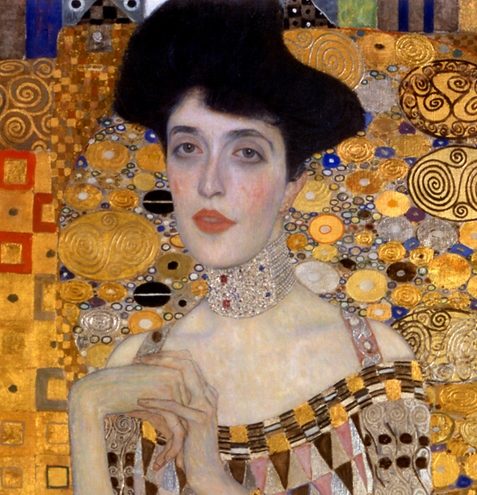
| Painted passages | Face, hair, neckline and hands are in oil. The English Wikipedia article, citing Whitford, puts them at less than a twelfth of the work.1027 |
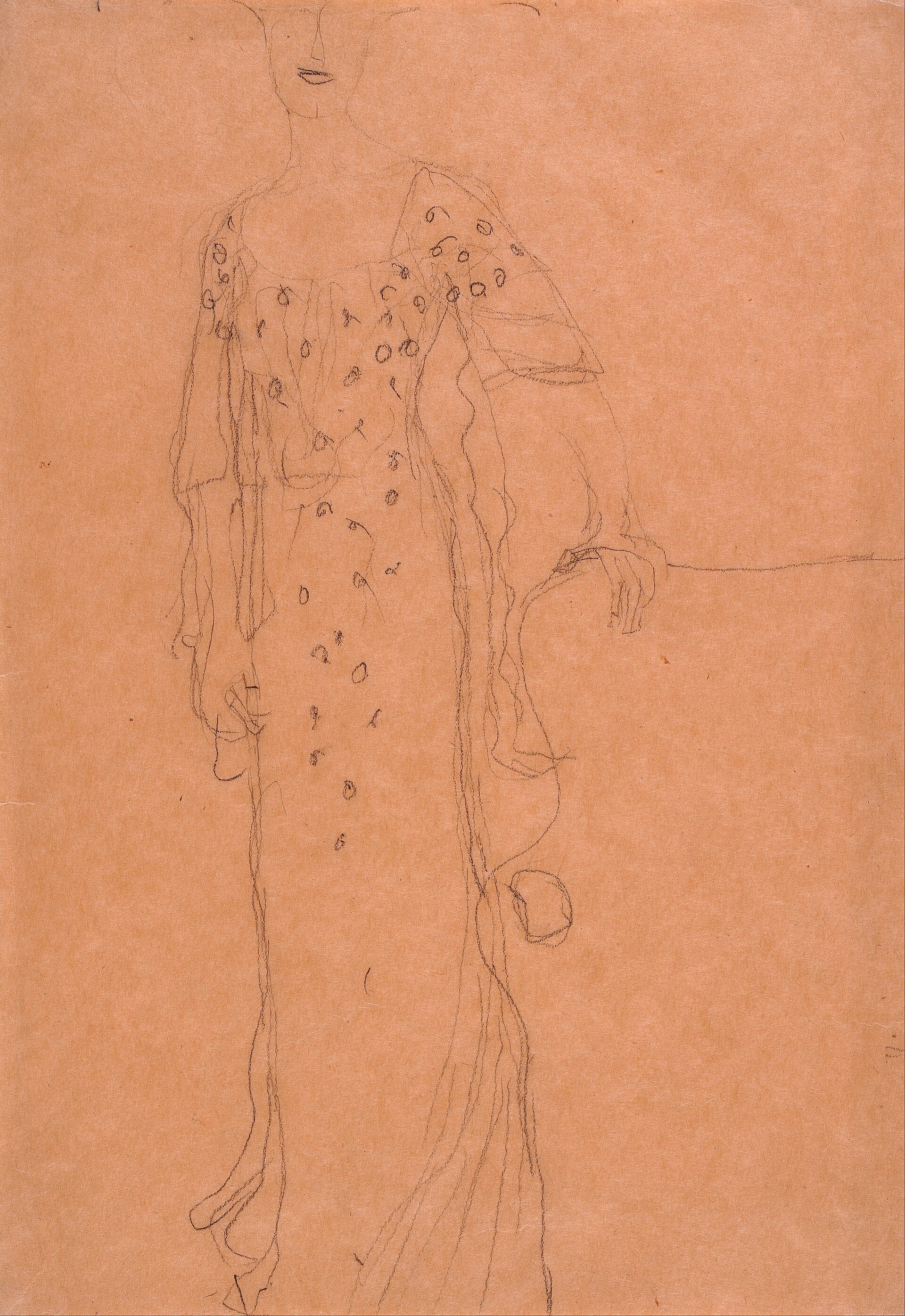
| Preparatory work | About 100 detail studies from the winter of 1903 (Klimt Database). Sixteen Klimt drawings bought from Galerie Miethke in July 1906, some preparatory (Neue Galerie timeline). A charcoal study of 1903 is in the Jewish Museum, New York, and a charcoal sheet of 1903-04 is in the Neue Galerie.5101232 |
| Frame | Based on a design by Josef Hoffmann (Klimt Database); gold-leafed according to the English Wikipedia article. Whether the frame now on the picture is the 1907 frame is not stated in the sources consulted.627 |
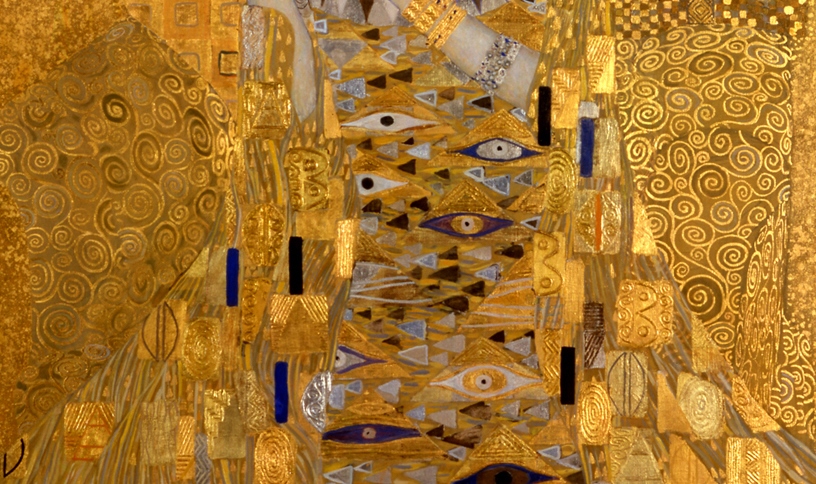
| Pose and costume | Ambiguous: unclear whether the sitter stands or sits in an armchair covered in spirals. Form-fitting dress with eye motifs in golden triangles; diaphanous cloak with 'AB'; black and white trim at lower left recalling Wiener Werkstatte furniture; gold ornament like a halo round the face.10 |
| Hands | Clasped to mask a disfigured finger, per the Neue Galerie.10 |
| Jewellery depicted | A diamond choker, a wedding present from Ferdinand according to the Neue Galerie, which says it later ended up with Hermann Goering.10 |
| Inscriptions | No signature, date or inscription is described by the Neue Galerie, LACMA, the Klimt Database or the Belvedere; none is asserted here.6101518 |
| Inventory numbers | Osterreichische Galerie (Belvedere), Vienna: Inv. No. 3830 (Belvedere restitution list). Neue Galerie New York: credit line 'Acquired through the generosity of Ronald S. Lauder, the Heirs of the Estates of Ferdinand and Adele Bloch-Bauer, and the Estee Lauder Fund'; the museum's accession number was not confirmed from a fetched page.1018 |
| Date | Commissioned 1903, begun in the winter of 1903, completed 1907; shown at Mannheim from May 1907.568 |
Images
The record in full
Chapter 1A square of metal with a face and two hands painted in
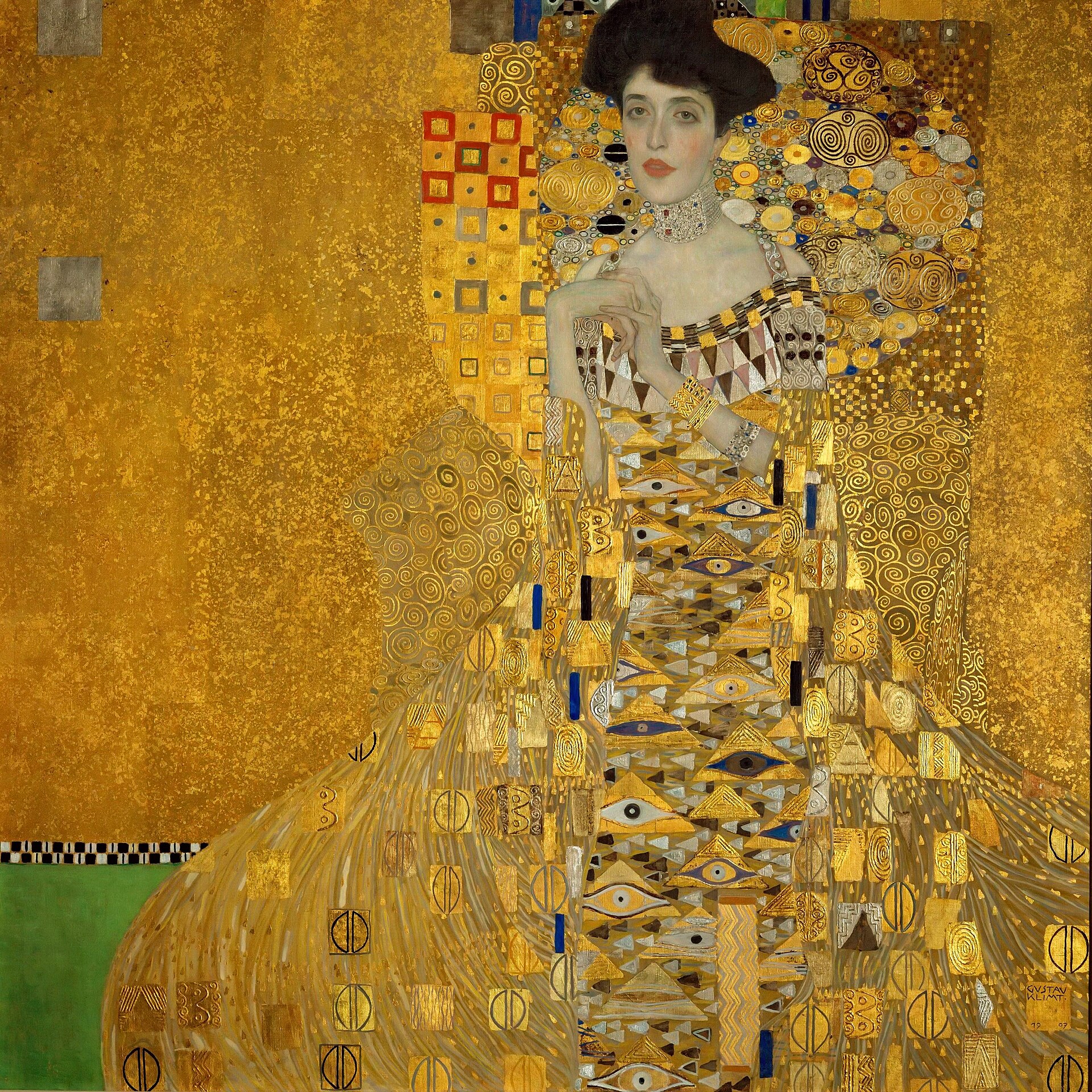
The picture is a square canvas, 140 by 140 centimetres (55 1/8 inches each way) according to both the Los Angeles County Museum of Art and the Neue Galerie, worked in oil with silver and gold.
The picture is a square canvas, 140 by 140 centimetres (55 1/8 inches each way) according to both the Los Angeles County Museum of Art and the Neue Galerie, worked in oil with silver and gold. A woman in a form-fitting sheath is set so far into her surroundings that it is not clear whether she stands or sits in an armchair covered in spirals. The Klimt Foundation's database says the sitter is turned into a "sparkling jewel", a "disembodied apparition". Only her face, hair, neckline and hands escape the pattern. The English Wikipedia article, citing Whitford, says the painted flesh makes up less than a twelfth of the picture.
The Neue Galerie, which owns it, describes jewel-like areas that resemble semi-precious stones set among layers of gold and silver, a gold ornament that circles her face like a halo and a cloak studded with her initials "AB" raised in low relief. The museum adds that her clasped hands are arranged to hide a disfigured finger she was self-conscious about, that the diamond choker at her throat was a wedding present from her husband and that the black and white trim at the lower left edge recalls Wiener Werkstatte furniture from Klimt's studio. The Klimt Database records that the frame was based on a design by Josef Hoffmann.
The picture has carried several names. Klimt's contemporaries called such works "mosaic pictures". The Neue Galerie timeline says it was retitled in Vienna in 1941. The Neue Galerie and Lisa Silverman give the new title as Woman in Gold (Frau in Gold), the English Wikipedia article gives Dame in Gold and the Lexikon der Provenienzforschung calls it the so-called Goldene Adele. This record uses the title of the Neue Galerie and the Klimt Database, Portrait of Adele Bloch-Bauer I, and treats the numeral as part of the name. The numeral matters: a second full-length portrait of the same woman, painted in 1912, is a different canvas in a different style and has a different owner.
Chapter 2Two Jewish families, a bank director's daughter and a Vienna salon
Ferdinand Bloch was born on 16 July 1864 in Jungbunzlau (now Mlada Boleslav), the youngest of six children of the sugar manufacturer and banker David Bloch.
Ferdinand Bloch was born on 16 July 1864 in Jungbunzlau (now Mlada Boleslav), the youngest of six children of the sugar manufacturer and banker David Bloch. The Lexikon der Provenienzforschung, compiled by the Austrian Commission for Provenance Research, records that he entered the family firm in 1881, took charge of it in 1892 and built it into one of the largest sugar companies in Europe. Adele Bauer was born in Vienna on 9 August 1881, the seventh child of Moriz Bauer, a director of the Wiener Bankverein. They married in December 1899 when he was 35 and she was 18, the Klimt Database says; the Neue Galerie's timeline gives 19 December and the Stadttempel and says they had met at the 1898 wedding of her sister Therese to his brother Gustav. The couple had no children. From 9 February 1917 both couples used the double name Bloch-Bauer.
They lived in Vienna at Schwindgasse 10 and later at Elisabethstrasse 18 in the first district. The sources do not agree on the date of the move: the Klimt Database says Ferdinand bought the house in 1919, the Lexikon says the couple had an apartment there from 1922 and the Neue Galerie timeline says 1920. In 1909 Ferdinand bought Schloss Jungfernbreschan (Panenske Brezany) north of Prague, where they lived part of the time and kept part of the collection, and after the First World War both took Czechoslovak citizenship. They collected Biedermeier painting including Waldmuller, Viennese porcelain of the classicist period and sculpture, as well as Klimt.
The Klimt Database says the couple used their standing to run a salon where Vienna's intellectual and artistic elite met, with guests including Gustav Mahler, Arthur Schnitzler, Stefan Zweig and Richard Strauss, and that Adele supported social democrats financially. Her own handwritten will of 19 January 1923 fits that picture: it leaves 50,000 Czechoslovak crowns each to the Vienna workers' association Kinderfreunde and to the society Die Bereitschaft, and asks that her Vienna and Jungfernbreschan libraries go to the Vienna People's and Workers' Library.
Lisa Silverman, writing for the Shared History project of the Leo Baeck Institute as published by the German Federal Agency for Civic Education, reads the commission as part of a wider pattern in which wealthy Viennese Jews supported avant-garde artists, in part as a way of defining a place in Austrian society decades after legal equality in 1867, while antisemitism persisted. She also reports Maria Altmann's childhood memory of her aunt as a sickly, chain-smoking woman who was elegant and haughty and always looking for intellectual stimulation. That is one niece's recollection, reported at second hand, and nothing else in the sources consulted confirms or contradicts it.
Chapter 3A present for her parents that took four years
The commission is documented in the sitter's own hand.
The commission is documented in the sitter's own hand. In a letter of 22 August 1903 written from Elbekosteletz and now in the Austrian National Library, Adele wrote that "originally, us children wanted to give a joint present, but we have since discarded this idea", and, in the passage the Klimt Database quotes in a second translation, that her husband "subsequently decided to have my portrait painted by Klimt, who, however, can only set to work this coming winter." The Neue Galerie says the portrait was first intended as a wedding anniversary present for her parents and that Klimt, notoriously slow, did not finish it in time. The museum's 2006 press release says he worked on it for three years and its 2015 exhibition page says four. The Klimt Database says it is unclear why the family had to wait so much longer.
The recipient of the letter is described differently in the two sources that use it. The Klimt Database calls Julius Bauer a friend and a journalist, and the Neue Galerie timeline calls him Adele's brother. The Klimt Database's biography states that Ferdinand Bloch-Bauer commissioned the first portrait of his wife in 1903.
Klimt began in the winter of that year. The Klimt Database counts about 100 meticulous detail studies, and the English Wikipedia article says he prepared more extensively for this picture than for any other. In July 1906, according to a Galerie Miethke card cited by the Klimt Database, the couple bought sixteen sketches from the dealer, and the Neue Galerie timeline says some were preparatory for the portrait. A charcoal study dated 1903 is at the Jewish Museum in New York, according to the Google Art Project record reproduced on Wikimedia Commons, and the Neue Galerie owns a charcoal sheet dated 1903-04 that shows Adele seated in an armchair resting her temple on her right hand. Klimt completed the canvas in 1907.
What Ferdinand paid is not recorded in any source consulted for this record. The only indication of scale is indirect. When the arbitration court of 2006 discussed whether a tax motive could explain Gustav Bloch-Bauer's 1925 probate statement about who owned the Klimts, it noted that the Republic had not contradicted its statement that the heir's financial position and the "relatively low value of the painting at that time" made it possible to essentially rule out tax evasion as a motive. The singular "painting" in the English translation may refer to the Klimts generally, and the remark concerns relative value in the 1920s, not a price.
Chapter 4Ravenna, and what gold was for
Klimt went to Italy twice in 1903. In May he saw Venice and Ravenna, and from 28 November to 10 December he returned to Ravenna, travelling with the Secession painter Maximilian Lenz and going on to...
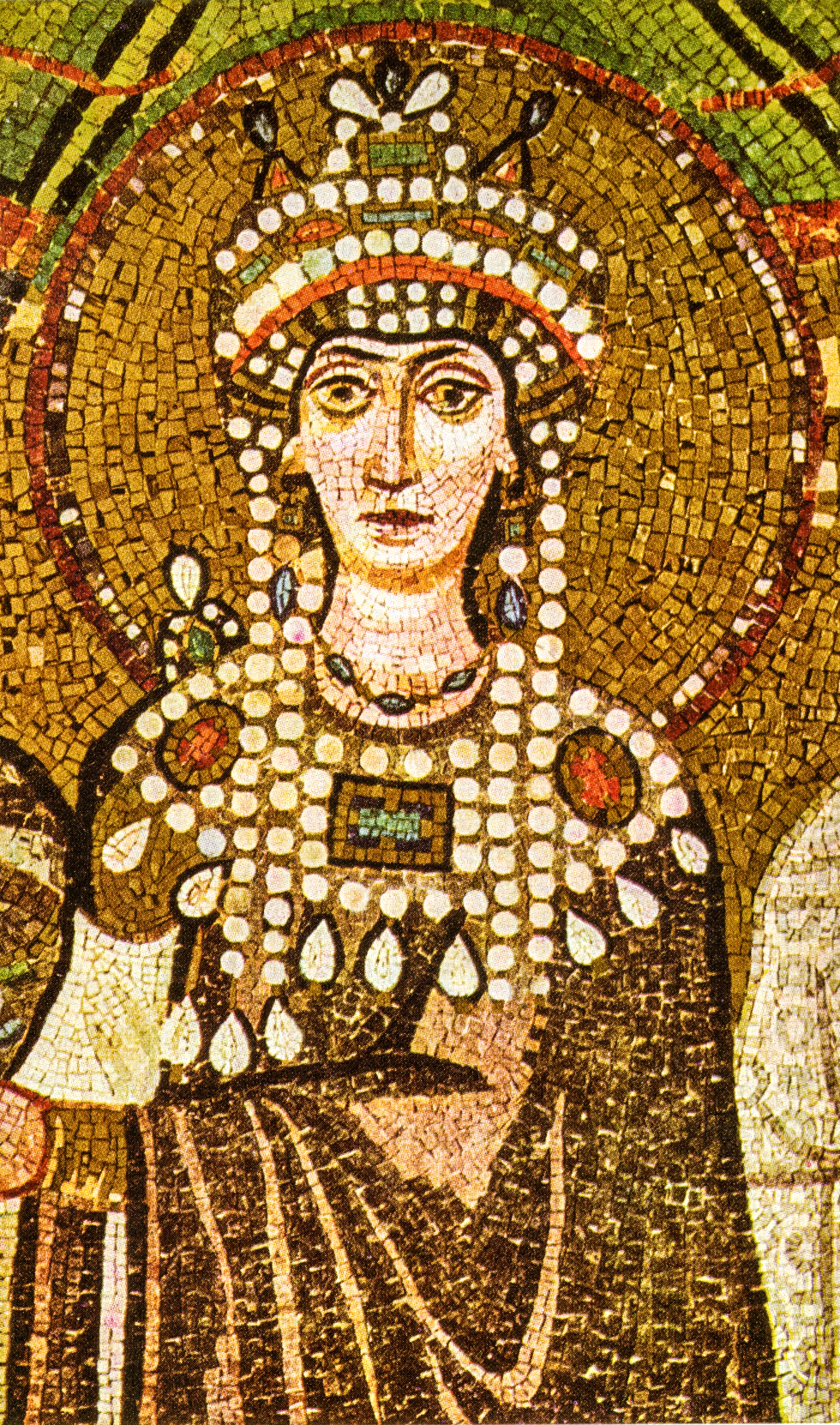
Klimt went to Italy twice in 1903. In May he saw Venice and Ravenna, and from 28 November to 10 December he returned to Ravenna, travelling with the Secession painter Maximilian Lenz and going on to Padua, Florence, Pisa, Mantua and Lake Garda, the Klimt Database records. Lenz kept a diary, published by Wilhelm Dessauer in 1933, and wrote that "Klimt was truly shaken. He did not say a word, but it was plain to see." In his correspondence with Emilie Floge in early December Klimt himself, the Database reports, called the mosaics he studied in San Vitale "of incredible splendor", and the Database elsewhere translates the phrase as "mosaics of a splendor unheard of". The Klimt Database and the Neue Galerie, on its collection page and in its 2006 press release, both connect this visit to the portrait, and the Neue Galerie names the sixth-century mosaic of the Empress Theodora.
That is a documented link between a journey and a style, but the sources are careful about its limits. The Klimt Database lists a wider group of sources for the golden period: Byzantine mosaics, late nineteenth-century painting (including Hans Makart, Fernand Khnopff and the Pre-Raphaelites) and traditional Japanese art. It adds that Orthodox icons, which have always joined painted saints to metal frames, "may have served as an inspiration" for this picture. The Belvedere, in a 2026 essay on Klimt's gold, names Byzantine mosaics, medieval gold grounds, Japanese lacquer and East Asian art. The Belvedere's essay "Who Was Gustav Klimt?" adds that he grew up surrounded by arts and crafts, that his father was an engraver and that he and his brother Ernst both attended the Vienna School of Applied Arts.
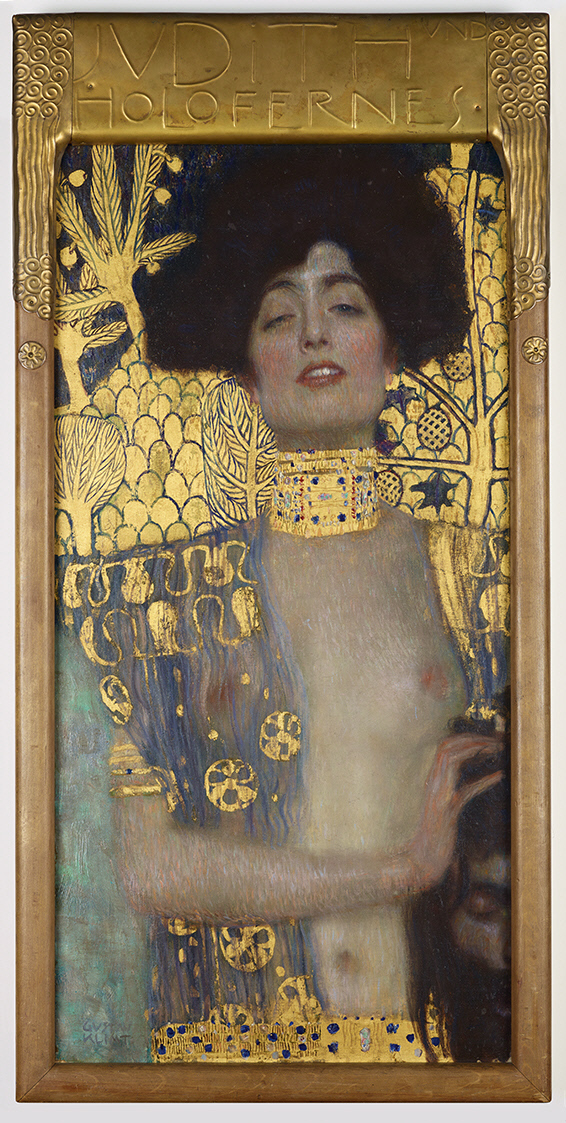
The Belvedere's essay makes a further argument that bears on this picture: after the Renaissance, a painting was supposed to be a window, and real gold works against that, because it shines, reflects light and stresses the flat surface. Klimt, it says, reversed this on purpose. It dates his first large-scale use of real gold leaf to Judith I of 1901, notes that he later added silver and platinum and describes a technique that used gold leaf but also gold dust and fine gold powder bound in oil and applied with a brush, with different grounds so that the metal looks smooth, grainy, matte, shiny or raised. That is a description of Klimt's practice across his golden period, not an analysis of this canvas. The Neue Galerie, for this canvas, names gold and silver only.
The Klimt Database draws a social reading from the technique: by treating a banker's daughter in the idiom once reserved for sacred and royal figures, Klimt presented the rising bourgeoisie in a way earlier reserved for the nobility. It is an argument by the database's authors, not a statement by the artist or the patron, and no text in which either says what the gold was to mean was found for this record.
Chapter 5The eyes, the triangles and the arguments about them
The form-fitting dress is covered with eye shapes set inside golden triangles, and the Neue Galerie calls them "all-seeing eye motifs".
The form-fitting dress is covered with eye shapes set inside golden triangles, and the Neue Galerie calls them "all-seeing eye motifs". The Neue Galerie's 2006 press release adds that the open-eye and almond shapes have sexual connotations and that Adele was "the only woman portrayed twice by Klimt in a full length portrait", and it says it has long been speculated that she and Klimt had an affair and that the picture contains visual clues about it. The press release attributes none of this to a named scholar.
The English Wikipedia article reports that the art historian Elana Shapira describes symbols suggestive of erotica in the background and gown, including triangles, eggs, eyes and almonds, and that Frank Whitford identifies Byzantine, Egyptian, Mycenaean and Greek sources, saying of the eyes on the dress that they are "Egyptian". Those are the claims of two named writers, passed through a tertiary source, and a reader who wants to cite them should go to Whitford's 1990 book and Shapira's 2016 book, both named in the Wikipedia bibliography. The sitter's initials are not an interpretation: the Neue Galerie says "AB" is raised in low relief on the cloak.
The phrase "Eye of Horus" does not appear in the Neue Galerie page, the press release, the Klimt Database entries or in Whitford as quoted. Wikipedia reports Whitford as calling the eyes "Egyptian" and nothing more specific, and his book was not seen. No scholar in the sources consulted ties the motif to the Horus eye specifically, and no letter, notebook or interview in which Klimt explains the eyes has been found for this record. The absence of an explanation from the maker is a finding, and no source consulted explains the eyes more specifically than as eyes in triangles that Whitford calls Egyptian.
The affair is a separate dispute with named positions. The English Wikipedia article reports that Catherine Dean wrote that Adele was "the only society lady painted by Klimt who is known definitely to be his mistress", while Melissa Muller and Monika Tatzkow wrote that "no evidence has ever been produced that their relationship was more than a friendship". The Neue Galerie says only that it has "long been speculated". The Los Angeles Times of 17 January 2006 wrote that historians have suggested she was "probably the artist's lover". The Klimt Foundation database entries consulted do not raise the question at all. This record takes no position.
Silverman reads the portrait differently again. She argues it engages the stereotype of the Jewish woman as seductive and dangerous, the belle juive of central European fiction, and she reports that antisemitic critics paid Klimt the doubtful compliment that he could hide the ugliness of his patrons' wives. That is her argument about reception and stereotype, not evidence about Klimt's intention, and the essay cites no document in which Klimt or the Bloch-Bauers say they had it in mind.
Chapter 6From Mannheim to a private room: 1907 to 1938
The first public showing was at the Mannheim Jubilee Exhibition, held from May to October 1907 for the city's 300th anniversary.
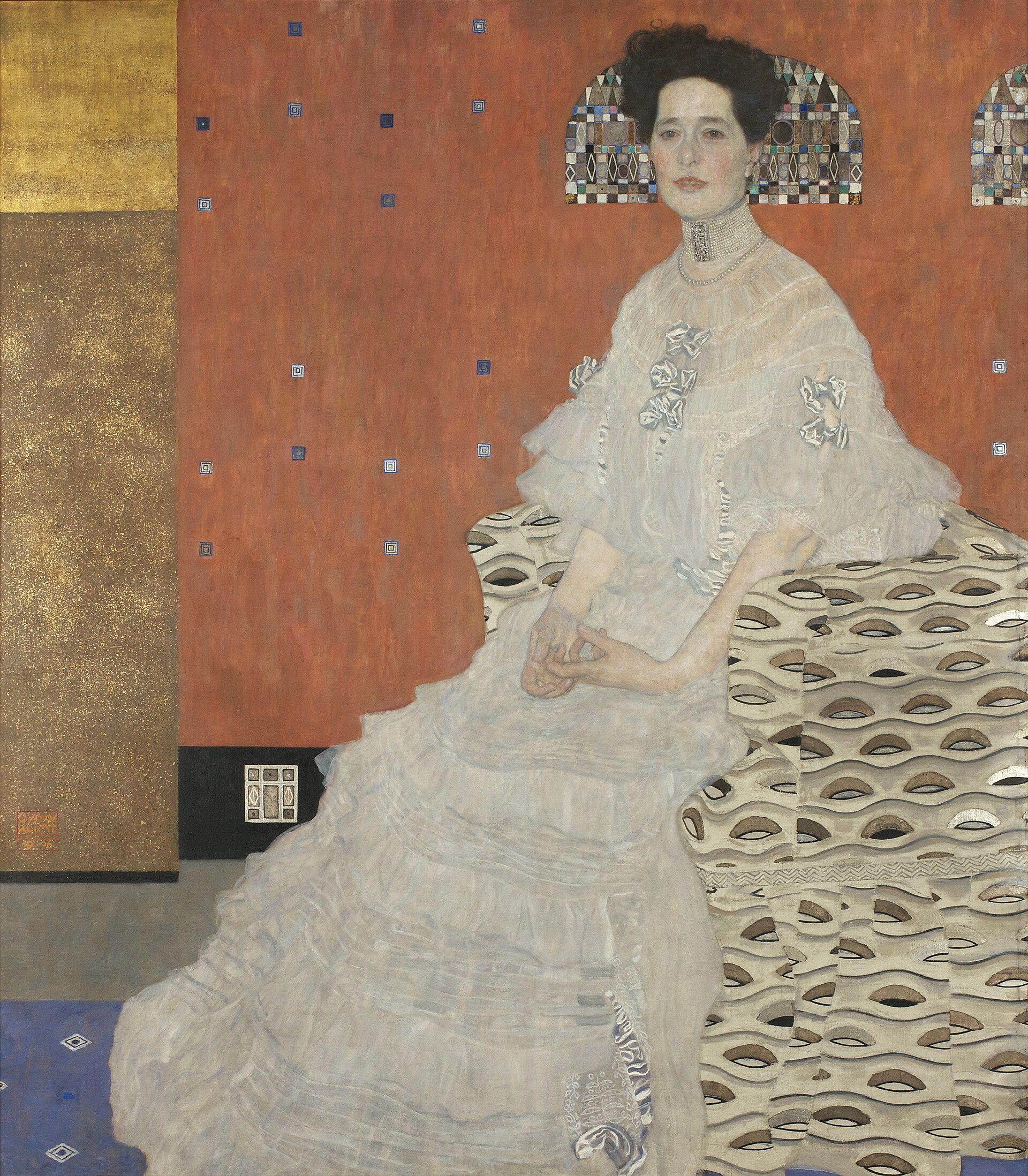
The first public showing was at the Mannheim Jubilee Exhibition, held from May to October 1907 for the city's 300th anniversary. The catalogue listed Klimt as showing "3 mosaic pictures", which photographs of the rooms identify as The Three Ages of Woman, Portrait of Fritza Riedler and this portrait. The Klimt Database quotes the Pester Lloyd of 20 July 1907 saying the Viennese did not yet know them. The English Wikipedia article reports that many critics in Mannheim reacted badly, calling the pictures "mosaic-like wall-grotesqueries", "bizarre" and "absurdities".
In Vienna the portrait hung in the Klimt Room of the 1908 Kunstschau, on a long wall facing the Fritza Riedler portrait, with The Kiss and The Three Ages of Woman on the narrow sides. The Klimt Database attributes the phrase "idol in a scintillating temple shrine" to Berta Zuckerkandl, and its bibliography lists her Kunstschau review in the Wiener Allgemeine Zeitung of 6 June 1908, though the Database does not tie the phrase to that page. The English Wikipedia article calls the Wiener Allgemeine Zeitung reviewer unnamed, so the attribution is a point on which the sources differ. The Neue Galerie timeline records that one critic derided the picture as "more brass than Bloch"; the English Wikipedia article names that critic as Eduard Potzl and adds in a footnote that the art historian Julie M. Johnson states the writer was Karl Kraus.
The Klimt Database says the Kunstschau also showed that Klimt was commercially successful: the Ministry of Culture and Education bought The Kiss for 25,000 crowns, Viktor Zuckerkandl paid 5,000 crowns for Poppies in Bloom and Eduard Ast 8,000 crowns for Danae. The Database converts these to euros (25,000 crowns as about 155,700 euros) without saying what method produced the conversion, so the euro figures are not used here. The Database lists no sale of this portrait, and the English Wikipedia article says it was hung afterwards at the Bloch-Bauer residence in Vienna.
The frame is a small piece of evidence about how the picture was meant to be seen. The Klimt Database says it was based on a design by Josef Hoffmann, the architect who planned the 1908 Kunstschau, and the English Wikipedia article calls it gold-leafed. The sources consulted do not say whether the frame now on the picture is the 1907 frame, when it was last treated or whether it was separated from the canvas in the Belvedere years.
A photograph of Adele by Friedrich Viktor Spitzer, taken in 1906, was published in 1908 in the Photographische Rundschau together with portraits of Klimt, Hermann Bahr and Sonja Knips, according to the Klimt Database, which is the earliest reproduction of the sitter that the sources consulted record.
The sources record only a handful of occasions on which the portrait left the family's rooms between 1907 and 1938. The Neue Galerie says the Klimt paintings originally hung in Adele's private apartment in the Vienna house, and the Klimt Database calls the room the "Klimt Room". The Neue Galerie timeline says that after her death on 24 January 1925 her bedroom, with the Klimt paintings, was kept as a shrine to her memory. The Lexikon and the Klimt Database both give the date of death as 24 January 1925 and the Neue Galerie timeline gives meningitis at the age of forty-three. The date is a point on which the sources differ slightly: the arbitration award's summary of the claimants' case gives 24 January and a letter quoted in the same award gives 25 January.
The occasions it left were these. The Klimt Database records that in 1919 the two portraits and four landscapes were lent to the Osterreichische Staatsgalerie, now the Belvedere, and returned in early 1920. The Lexikon records that Ferdinand lent seven paintings, including both portraits, to the Klimt memorial exhibition at the Secession in 1928, and the Neue Galerie timeline says the portrait went to the Austria in London exhibition in 1934 and to the Paris exposition of 1937. The Lexikon says the Paris show, the Exposition d'Art Autrichien at the Jeu de Paume in May and June 1937, included three Klimt paintings from the Bloch-Bauer collection. The Neue Galerie timeline and Silverman both say Ferdinand gave Adele's diamond necklace to his niece Maria when she married Fritz Altmann in 1937, and the timeline gives the wedding as 9 December. The timeline says the necklace was confiscated by the Gestapo in June and Silverman says Goering took Maria's jewellery for his wife Emmy, while the Neue Galerie's page says the choker ended up with Goering when the Nazis seized the Bloch-Bauer collection; the sources do not reconcile these accounts.
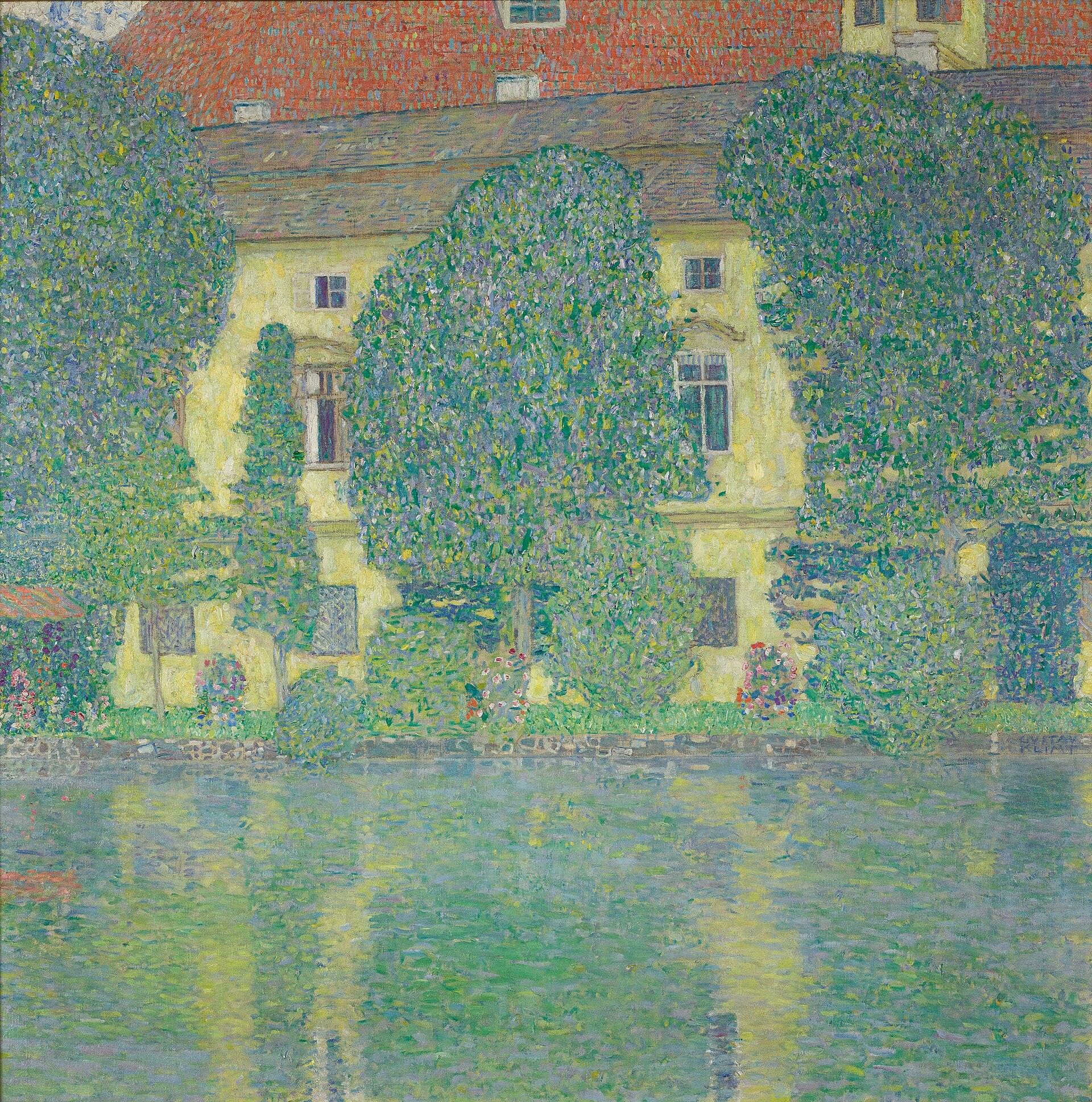
In 1936 Ferdinand gave Schloss Kammer am Attersee III to the Osterreichische Galerie, now the Belvedere. The arbitration court found that the gift was made in fulfilment of his late wife's request and of his promise in the probate proceedings, and it recorded that the gallery's letter of thanks called it a "dedication" by Adele and Ferdinand Bloch-Bauer. That gift, and the exchange that later involved it, is the thread that links the 1923 will to the events of 1941.
Chapter 7Adele's will, and the two stories about who owned the picture
Everything that followed turns on one sentence in a will.
Everything that followed turns on one sentence in a will. Adele wrote it by hand on 19 January 1923, naming her husband sole heir and her brother-in-law Gustav Bloch-Bauer, a lawyer, as executor. The arbitration court of 2006 gave the sentence in English as: "I ask my husband after his death to leave my two portraits and the four landscapes by Gustav Klimt to the Austrian State Gallery in Vienna". In the same paragraph she asks him to leave her libraries to the Vienna People's and Workers' Library. The German verb is bitte, I ask. Her money gifts to the two Vienna associations are drafted as bequests, and in the clause for the alternative heir she binds him to pay them and to hand over the paintings and the library at once, a contrast Welser and Rabl stressed and the court noted.
After her death Gustav told the probate court, in the words the court quotes, that the heir would "faithfully fulfill said requests, though they do not have the binding nature of a testamentary disposition", and that "the Klimt paintings are not the property of the testatrix, but rather of the testatrix's widower". The court reasoned that because the executor categorised it so, very probably by agreement with Ferdinand, the spouses had probably talked it over earlier.
Two readings of that sentence then divided the parties. The Republic, through the Finanzprokuratur, argued in the 2005 arbitration that Adele had herself bought the Klimts and owned them, that her will was therefore a valid reversionary legacy and that Ferdinand's promise in the probate was in any case a promise to donate. The heirs argued that the sentence was a non-binding request, that the pictures were Ferdinand's and that Austrian law at the time presumed property acquired during a marriage to belong to the husband. In 1999 the Austrian Art Restitution Advisory Board had sided with the first reading: its decision of 28 June 1999 says the Republic's title to the Klimt paintings came from the will or from Ferdinand's acknowledgment of it, both long before the Nazi period.
The 2006 court sided with the second reading, on grounds it set out at length. The first was the wording: "I ask". The second was the executor's statement, which the court thought was very probably made with Ferdinand's agreement. It categorised the request as non-binding and the paintings as the widower's, and the court found no plausible reason why he would say so untruthfully. The third was ownership. The court found more reason to think the paintings were Ferdinand's than Adele's, but not strong probability either way, and it applied the presumption in the Austrian civil code of the time that property acquired during a marriage belonged to the husband, because Adele's ownership could not be shown to be strongly probable. It did not treat as decisive Adele's own letter speaking of a landscape "which I purchased from Klimt's estate", the gallery's inventory entry for this portrait ("Dedication, Adele Bloch-Bauer") or statements in exhibition catalogues. It rejected one suggested explanation for the executor's statement, that Ferdinand wished to shield his dead wife from speculation about her relationship with Klimt, as "highly constructed" and "very far-fetched". Its conclusion on this point was that any acquisition by the Republic "cannot be based on Adele Bloch-Bauer's will as title".
Austrian lawyers published opposing opinions, Welser and Rabl for the claimants in a book called Der Fall Klimt and Krejci, whose view the Republic adopted, in Der Klimt-Streit, and the court said it assessed both in depth. Their disagreement turns on points of Austrian civil law that this record does not try to adjudicate. What the file shows is that the sentence, in its wording and its place in the will, was read one way by the Advisory Board in 1999 and the other way by the arbitration panel in 2006, and that the Republic had agreed to be bound by the panel's result.
Chapter 81938 to 1941: seizure, an administrator and an exchange
The United States Supreme Court, summarising the complaint in 2004, gives 12 March 1938 as the day of the Anschluss and says Ferdinand, who was Jewish and had supported efforts to resist annexation...
The United States Supreme Court, summarising the complaint in 2004, gives 12 March 1938 as the day of the Anschluss and says Ferdinand, who was Jewish and had supported efforts to resist annexation, fled and eventually settled in Zurich. The Lexikon der Provenienzforschung says he was persecuted both for his Jewish origin and as a supporter of the Dollfuss-Schuschnigg regime, that his property was secured and tax-evasion proceedings were opened against him and that he went first to Czechoslovakia and then to Switzerland. The claimants in the 2005 arbitration said the Vienna-Wieden tax authorities opened the proceedings on 27 April 1938 as an excuse to confiscate his property, and that in the course of them the lawyer Dr Fuhrer was appointed temporary administrator of the estate and ordered to liquidate and make appropriate use of the "Bloch-Bauer collection". The Neue Galerie timeline dates the appointment to 1939. The Lexikon identifies him as the lawyer Erich Fuhrer, a member of the NSDAP and the SS, and the Supreme Court also calls him Erich and the Neue Galerie timeline Eric; the arbitration award gives his first name as Friedrich.
The Lexikon summarises what became of the property. After the Reich Protectorate was set up on 16 March 1939 the regime also expropriated the castle at Jungfernbreschan, which Reich Protector von Neurath used and, in 1941 and 1942, so did his deputy Reinhard Heydrich. The porcelain, valued at half a million Reichsmark, was auctioned in Vienna in June 1941. Six pictures, a sculpture and a tapestry went to the Sonderauftrag Linz for the planned Fuhrer museum and were restituted in 1949 and 1950, and the Osterreichische Galerie took four Klimt paintings between 1941 and 1943. The Supreme Court, again describing the complaint's allegations, says the sugar company was "Aryanized" and the Vienna house taken over. The Neue Galerie says the Nazis seized five Klimt paintings from the home in 1938, and its 2006 press release says they were stolen. Those are the museum's words.
The Klimts then passed through Dr Fuhrer's hands, and the arbitration award records the sequence, which the Republic's submission called basically undisputed. In 1941, as administrator, he "executed" Adele's will by giving Adele Bloch-Bauer I and Apple Tree I to the Austrian Gallery, then called the Modern Gallery. In return he received from the gallery Schloss Kammer am Attersee III, the picture Ferdinand had given in 1936, and sold it to Gustav Ucicky, a son of Klimt, for 6,000 Reichsmark according to the claimants. In 1942 he sold Birch Forest to the City of Vienna's collection for 5,000 Reichsmark, again on the claimants' figures. In 1943 he sold Adele Bloch-Bauer II to the gallery, a payment the court thought was in effect a release from tax execution, and he kept Houses in Unterach for himself. The English Wikipedia article puts the 1941 transfer in December and says a note with the paintings claimed the will as authority.
The arbitration court characterised the exchange of 1941 with care. It noted that the will, taken as a legacy, was not yet due while Ferdinand lived, and it inclined to the view that the two pictures were surrendered on the strength of the will alone and that Fuhrer "simply extorted" Schloss Kammer III from the gallery. Its evidence included the gallery's own later language: Dr Garzarolli, the gallery's director in 1948, wrote that Fuhrer "demanded it back and it was handed over" and, elsewhere, that it "had to be handed over to him". The Supreme Court's 2004 opinion adds, as an allegation in the complaint, that the articles of the Austrian journalist reported the 1941 receipt of the first portrait to have been accompanied by a letter from Fuhrer signed "Heil Hitler".
Chapter 9A picture with the sitter's name taken off
The title is part of the object's history, and the sources disagree about it.
The title is part of the object's history, and the sources disagree about it. The Neue Galerie timeline says that in 1941 the Belvedere published a book describing the picture as an "awe-inspiring portrait of a woman covered with a shimmering crust of gold" and that it was retitled Woman in Gold, and that in 1943, when the Nazis staged a Klimt retrospective at the Secession, it was renamed Portrait of a Lady with Gold Background; the second Adele portrait was bought a month later and retitled Portrait of a Lady. The Neue Galerie's own collection page says that in Vienna the portrait was renamed "Woman in Gold" to conceal the sitter's identity. Silverman writes that the Nazis gave it the new title Die Frau in Gold to hide its Jewish origin. The English Wikipedia article says the gallery gave it the title Dame in Gold for the same purpose.
Those are three accounts of one event, with a different agent in each (the Nazis, the gallery, unnamed actors in Vienna). None of them cites the book, the catalogue or an inventory entry by shelf mark, and this record has not seen the Belvedere's own files. The arbitration court, which did see the gallery's inventory list, reports that it describes the portrait as "Dedication, Adele Bloch-Bauer", which is a statement of how it was acquired and not a retitling.
The Supreme Court records an allegation that the Belvedere's publications represented the first portrait as having been donated to the museum in 1936 when it had in fact been received in 1941. The Neue Galerie timeline goes further and says that in 1960, after Fritz Novotny became director, the Belvedere's provenance records for the Bloch-Bauer portraits were falsified to show acquisition before the invasion. The timeline does not say who made the changes. That is the Neue Galerie's statement, and the other sources consulted neither confirm nor contradict it. The Neue Galerie timeline also says the files Hubertus Czernin found in 1998 showed that the Belvedere was aware it possessed looted art, and the Supreme Court recites the allegation that gallery officials knew neither Adele nor Ferdinand had donated the pictures. Both are accounts of what the journalist found and not independent readings of the Belvedere's files.
Chapter 101945 to 1949: the heirs, Dr Rinesch and the export bargain
Ferdinand died in Zurich on 13 November 1945.
Ferdinand died in Zurich on 13 November 1945. His last will, written in 1945, left his whole estate to a nephew and two nieces. The English Wikipedia article gives the month as August and says the will made no reference to the pictures, and the Neue Galerie timeline says autumn. The Klimt Database names the heirs as the nieces Louise Baroness Gutmann and Maria Altmann and the nephew Robert Bentley. The arbitration court says Ferdinand never wrote a word about the paintings in his very short and very general will, and that a will drawn up in 1942 contains no instructions about them either, though he then believed all his Viennese assets were lost.
The Vienna lawyer Dr Gustav Rinesch handled the recovery. The Lexikon and the heirs' version in the arbitration say Ferdinand instructed him from Switzerland, and the Supreme Court, summarising the complaint, says Robert Bentley retained him in 1947. The award summarises the correspondence in detail. On 28 September 1945 Rinesch asked the gallery for its cooperation with the replacement of the scattered collection, listing Apple Tree and Birch Forest by name in one version of the attached list of items. On 19 January 1948, now aware that three Klimts were at the gallery, he asked what its attitude would be if his client claimed restitution. The gallery's director Dr Garzarolli replied on 16 February that it had a claim to the outstanding pictures from Adele's legacy. On 2 April 1948 he asked the Federal Office for the Protection of Historical Monuments to refuse export permits for some nineteenth-century paintings held by Karl Bloch-Bauer so as to ease their purchase or exchange, and added: "please adopt a delaying strategy for tactical reasons." On 10 April 1948 Rinesch and Garzarolli reached the agreement that the court later treated as decisive. Rinesch confirmed it in writing on 12 April, acknowledging that the two portraits and Apple Tree were already in the gallery's possession and agreeing to the handover of Houses in Unterach, which Karl Bloch-Bauer had recovered from Fuhrer. The next day he wrote to the Monuments Office that he expected the authorities to apply the protection law in an "obliging manner".
The Albertina's director, Otto Benesch, had written on 12 November 1948 that several hundred Klimt drawings were presented for export, that he allowed the export but asked for sixteen as a donation and that he had regarded those sheets as the Albertina's property since, the more so because Klimt drawings stood low in market value (the Board's German, paraphrased here). The 1999 Advisory Board read that letter as clear documentary proof of a link between the export permit and the gift, and recommended the return of the sixteen drawings. On 13 July 1949 Rinesch argued that the heirs "would certainly have had the leverage to prevent the performance of the legacy" and had refrained, and on 21 July Garzarolli supported release of the heirs' other objects "as a major exception".
The arbitration court weighed what all this showed about the five paintings. It found that none of the five was the subject of an export application and, with the exception of Birch Forest, which the City of Vienna handed over on a request from Rinesch, that none was the subject of an express restitution request; it also found no documentary evidence that Rinesch was explicitly threatened with refusal of an export permit for them. It also found that he used the paintings "so to speak as weapons for negotiation", that the heirs, who were not lawyers, were relatively easy to convince that they were bound and that a federal minister had called the connection between giving up the paintings and the export procedure "obvious" in answer to a parliamentary question. Its conclusion was that it could be assumed "that the pressure of the pending or imminent export proceedings was responsible to a large extent for the concession/acknowledgment by Dr. Rinesch".
Chapter 111998 to 2004: an archive opens and a court decides it can hear the case
Austria's Art Restitution Act, passed on 4 December 1998 and amended since, most recently in 2023, aimed at returning to the original owners or their successors collection objects that came to the...
Austria's Art Restitution Act, passed on 4 December 1998 and amended since, most recently in 2023, aimed at returning to the original owners or their successors collection objects that came to the federal state through or because of the Nazi regime and had not yet been restituted. The act has a first element that the court of 2006 later applied: objects that were restituted, then passed to the Republic without payment after 8 May 1945 in a procedure under the export prohibition law. The English Wikipedia article adds that the government opened its archives to provenance research at the same time.
The journalist Hubertus Czernin was, according to the English Wikipedia article, the first journalist given access to the Austrian Gallery's records. The Neue Galerie timeline says he found documents showing that Ferdinand had not donated the paintings and published a series of articles in the newspaper Der Standard in 1998. The Supreme Court, summarising the complaint, says the series reported that the Gallery's publications had represented the first portrait as donated in 1936 when it was received in 1941. Czernin's book on the case, Die Falschung, appeared in Vienna in 1999, according to the Klimt Database and the Lexikon der Provenienzforschung. He died on 10 June 2006, according to the English Wikipedia article, nine days before the Neue Galerie announced it had acquired the portrait.
Maria Altmann claimed six paintings, the five later arbitrated plus the portrait of Amalie Zuckerkandl. On 28 June 1999 the Advisory Board, with one abstention, recommended the return of sixteen Klimt drawings from the Albertina and a group of porcelain from the Museum of Applied Arts, and declined to recommend the paintings: the Republic's title, it held, came from the will or Ferdinand's acknowledgment of it, long before the Nazi period, and no restitution or export procedure had ever concerned the paintings. The Belvedere's own provenance page records that the committee advised against restitution of the five Klimts from the Bloch-Bauer collection, "which have subsequently been restituted".
Altmann then sued in Austria. The Supreme Court records that Austrian court costs rise with the value of the claim, that the court partly waived them but would still have required roughly 350,000 dollars and that when the government appealed even that partial waiver she withdrew and sued in California. Other sources give other figures for the fee: the Neue Galerie timeline says over 1.5 million dollars at 1.2 percent of the litigated value, and the English Wikipedia article says 1.75 million euros. The sources do not reconcile these figures.
On 7 June 2004 the Supreme Court decided Republic of Austria v. Altmann, in an opinion by Justice Stevens with concurrences by Justices Scalia and Breyer and a dissent by Justice Kennedy. The syllabus states the holding narrowly: the Foreign Sovereign Immunities Act of 1976 applies to conduct, like the alleged wrongdoing here, that occurred before 1976 and before the United States adopted the restrictive theory of sovereign immunity in 1952. The question before the Court was immunity, and it set out the facts as the complaint alleged them. The English Wikipedia article says the Court "determined that the paintings had been stolen", which neither the syllabus nor the passages of the opinion read for this record say. The effect was that Altmann could proceed against Austria in a United States court, and in 2005 both sides agreed to put the dispute to Austrian arbitrators.
Chapter 122005 to 2006: three arbitrators and a ruling of 15 January
The arbitration agreement was signed in May 2005 (the Los Angeles Times of January 2006 dates it to March, and the award's own date is used here).
The arbitration agreement was signed in May 2005 (the Los Angeles Times of January 2006 dates it to March, and the award's own date is used here). The claimants were Maria Altmann, Francis Gutmann, Trevor Mantle and George Bentley, represented by E. Randol Schoenberg and Dr Stefan Gulner, and Dr Nelly Auersperg, who was represented separately; the respondent was the Republic of Austria, represented by the Finanzprokuratur. Dr Auersperg signed but did not take part further, saying she would abide by the ruling. The panel was Dr Andreas Nodl, Professor Walter H. Rechberger and Professor Peter Rummel as chairman. The agreement set two questions: whether and how Austria had acquired ownership of the paintings between 1923 and 1949 or later, and whether the conditions of the 1998 Act for returning them without payment were met. A sixth painting, the Zuckerkandl portrait, went to a separate proceeding before the same court.
Both sides had agreed to accept the findings as final, and the court was explicit about its limits: it was "neither authorized nor qualified to carry out historical investigations and research of its own" and decided on the documents and arguments the parties submitted, under Austrian law. At the oral hearing on 5 September 2005 the parties ruled out a settlement after the Republic said it could not accept the heirs' renewed offer, under which Austria would buy both portraits and release the other three paintings.
The award is dated 15 January 2006 and was signed by all three. It held, first, that the Republic acquired ownership of the five paintings through the settlement with Dr Rinesch in 1948, and not through the will. It held, second, that the conditions of the 1998 Act for return without payment were met, on the ground that, in the court's words, it could be assumed that the pressure of the export proceedings was largely responsible for the 1948 concession. It held that the second element of the Act, which concerns objects lawfully acquired by the Republic that had earlier been the subject of a Nazi-era transaction, was not fulfilled. It ordered the Republic to bear the costs. The court described the first element as politically motivated compensation for what is now seen as the duress of the export proceedings, and it held the 1948 settlement itself incontestable in civil law, so that the return rests on the statute and on the court's reading of the export pressure and not on a finding that the Republic's title was void. The Los Angeles Times reported the ruling on 17 January 2006, saying it had become public on the Monday, 16 January, and that a formal announcement was expected in Austria the next day. The Neue Galerie timeline and the Lexikon give 15 January for the ruling, and the English Wikipedia article on Maria Altmann gives 16 January, which is the day the result became public.
The Times quoted Wilfried Seipel, director of the Kunsthistorisches Museum, telling the Austrian Press Agency that "a precious asset of the Austrian Gallery has been lost" and the decision "should be accepted", and Altmann, then 89, saying "It's about time" and "I would not want any private person to buy these paintings", because it would have been her aunt's wish that they be seen. The Times added that for Austrians, even those who thought the court right, the paintings' move across the Atlantic symbolised the loss of a piece of national heritage. The Lexikon says a repurchase by the Republic was not achieved and the pictures were restituted. The paintings left Austria in March 2006 according to the English Wikipedia article on Altmann, and the Los Angeles County Museum of Art showed the five from 4 April to 30 June 2006, crediting this portrait to the Estate of Ferdinand Bloch-Bauer.
Chapter 13June 2006: one picture by private treaty, four at Christie's
On 19 June 2006 the Neue Galerie announced that it had agreed to acquire the portrait.
On 19 June 2006 the Neue Galerie announced that it had agreed to acquire the portrait. The press release quotes the museum's president and co-founder Ronald S. Lauder: "This is a once-in-a-lifetime acquisition, and a defining moment for the Neue Galerie." The museum's director, Renee Price, said the painting was as important to the Neue Galerie "as the Mona Lisa is to the Louvre". The release does not give a price. Al Jazeera, citing American media reports, gave the price as 135 million dollars, said the New York Times quoted Altmann's lawyer as saying the painting was sold by Altmann and her family, and said it was thought to be the highest price paid for a painting, against a previous record of 104.1 million dollars for Picasso's Boy with a Pipe. Altmann was quoted as saying that "Mr Lauder has a great understanding of Austria and a great love for Klimt". ARTnews, in January 2007, and Hyperallergic, in 2017, both call it a reported 135 million dollars, and Silverman gives it as fact.
It was a private sale negotiated directly, not an auction, so there was no hammer price, no buyer's premium and no published estimate. The only price on record is a reported figure of 135 million United States dollars, which none of the sources consulted has had confirmed by the museum or by the sellers. ARTnews interviewed the buyer and the sellers' adviser. Lauder said the question was how much it would take to buy the painting without going to auction, and that "it took about three seconds." Steven Thomas of Irell and Manella, the Los Angeles firm that advised the heirs after the ruling, said the deal took several weeks of discussions, that the family "did not put a price on the painting", that seven to ten serious international collectors and three to five museums had shown interest, that none of the competing collectors was Austrian and that offers for all five paintings had come from private collectors or investor groups who did not intend permanent public display. He declined to discuss how the price was set. ARTnews quotes the Los Angeles County Museum of Art's director, Michael Govan, saying in June 2006 that he was sad the portrait would not stay in Los Angeles but pleased it would be on view in an American museum. Lauder sold three Schiele works from the Neue Galerie's collection at Christie's in November 2006 to help finance the purchase, which made 39.2 million dollars together, according to ARTnews.
Altmann had said in January 2006 that she would not want a private person to buy the pictures. The Neue Galerie's release quotes her in June as saying it fulfilled her wish that the pictures be seen by a large American audience and that the portrait of her aunt would "remain on permanent view in such a worthy museum", and the museum agreed that the picture would carry a note crediting the heirs' generosity. The Neue Galerie says the picture has been on permanent view since, "adhering to the wishes of the family".
The other four went to auction. Christie's sale of Impressionist and Modern Art in New York on 8 November 2006 realised 491,472,000 dollars. The Christie's release, as reproduced by the publication The Art Wolf, gives these prices for the four Klimts, which are Christie's results inclusive of premium by its usual practice (the Art Wolf copy does not say so, but ARTnews's figure of about 78 million before premium for the first lot confirms it for that lot): Portrait of Adele Bloch-Bauer II, lot 54, 87,936,000 dollars against an estimate of 40 to 60 million; Birch Forest, lot 51, 40,336,000 against 20 to 30 million; Apple Tree I, lot 53, 33,056,000 against 15 to 25 million; and Houses at Unterach on the Attersee, lot 52, 31,376,000 against 18 to 25 million. The four together came to 192,704,000 dollars and all buyers were listed as anonymous. ARTnews adds that for Adele II a telephone bidder handled by Christie's Guy Bennett entered the bidding at 74 million and won with a final bid of around 78 million before the premium. The hammer prices of the other three are not given in the sources consulted. ARTnews counts the five together at more than 327 million dollars and says the heirs chose Christie's partly because of Altmann's friendship with its Americas chairman Stephen Lash.
For scale, the same ARTnews article reports that the previous auction record for a Klimt was 29.1 million dollars in 2003, that a Klimt painting sold in 1984 for 981,646 dollars and that the Museum of Modern Art sold The Park for 500,000 dollars in 1978. The Klimt Database records the Ministry buying The Kiss in 1908 for 25,000 crowns. In 1948 the Albertina's director called Klimt drawings low in market value, in the letter in the 1999 Advisory Board file. Peter Schjeldahl, quoted by ARTnews from a New Yorker column of July 2006, wrote of the Neue Galerie purchase "Is she worth the money? Not yet." Simon de Pury, quoted in the same article, said that "it is a brilliant coup", and Jane Kallir of the Galerie St. Etienne said she was "in no way, shape, or form surprised" by the reported price.
Hyperallergic reported in 2017, citing Bloomberg, a private resale of Adele II in 2016 for about 150 million dollars. The seller and buyer named in that report, and the price, are unconfirmed in the sources consulted.
Chapter 14After 2006: a display, a film and the present tense
The portrait went on view at the Neue Galerie in New York on 13 July 2006 as part of the exhibition of the five Bloch-Bauer paintings, which ran until 18 September 2006, and has since stayed on...
The portrait went on view at the Neue Galerie in New York on 13 July 2006 as part of the exhibition of the five Bloch-Bauer paintings, which ran until 18 September 2006, and has since stayed on permanent view in the museum's Klimt Gallery. In 2015 the museum devoted an exhibition of about fifty works to the painter and the sitter, "Gustav Klimt and Adele Bloch-Bauer: The Woman in Gold", from 2 April to 7 September 2015, timed with the release of the film. In 2016 and 2017 the Klimt Database's bibliography lists a Neue Galerie exhibition on Klimt and the women of Vienna's Golden Age, and Hyperallergic reports that the two Adele portraits hung together there.
The 2015 film Woman in Gold, directed by Simon Curtis, stars Helen Mirren as Maria Altmann and Ryan Reynolds as Randol Schoenberg. Altmann died on 7 February 2011, aged 94, so she did not see it. The English Wikipedia article on the film reports that critics in Austria and Germany pointed to departures from the record, among them Olga Kronsteiner in Der Standard, who wrote that it was the journalist Czernin and not Schoenberg who found the decisive documents and told Altmann, and Thomas Trenkler in Kurier, who said Austria had never had a time limit for restitution claims as the film suggests. The same article notes that Chief Justice Rehnquist dissented in the Supreme Court and did not support Schoenberg as the film shows; the Court's published dissent, written by Justice Kennedy, is joined by the Chief Justice and Justice Thomas, which bears that out. The critics' other claims have not been checked here against the court transcript or the archive.
As of 8 October 2026 the Neue Galerie's website says its galleries are closed and will reopen on 12 November 2026 with a 25th anniversary exhibition running to 11 January 2027, and that the portrait is featured in it. The shop and cafe have resumed regular hours. The museum's page does not say why the galleries are closed. The sources consulted give no technical examination of the canvas, no published condition report and no insurance value, and the Neue Galerie does not publish an open image interface for the painting that this record has found.
The artist
Gustav Klimt
Klimt left no theory of his own gold. What survives is a craft background in a family of engravers, a year of public scandal over three university paintings he never delivered, a journey to Ravenna in 1903 that those around him thought decisive and a run of portraits of the Viennese bourgeoisie in a manner once reserved for saints and emperors. This is the artist as the sources record him, and the picture he finished in 1907 is the best-documented product of that moment.
Exhibited
- 1907Mannheim Jubilee Exhibition, listed in the catalogue as one of three 'mosaic pictures' by KlimtKunsthalle Mannheim, May to October 1907
- 1908Kunstschau Wien 1908, the Klimt RoomVienna
- 1919-1920Loan with the other Klimt paintings of the collectionOsterreichische Staatsgalerie (now Belvedere), Vienna
- 1928Klimt memorial exhibition, tenth anniversary of his deathVienna Secession
- 1934Austria in LondonLondon
- 1937Exposition d'Art AutrichienMusee du Jeu de Paume, Paris, May and June 1937
- 1943Nazi-era Klimt retrospective at the Secession, the occasion the Neue Galerie timeline gives for the retitling as Portrait of a Lady with Gold BackgroundVienna Secession
- 1941-2006Displayed at the Belvedere for decades until 2006, according to the Neue GalerieBelvedere, Vienna
- 2006Gustav Klimt: Five Paintings from the Collection of Ferdinand and Adele Bloch-BauerLos Angeles County Museum of Art, 4 April to 30 June 2006
- 2006Gustav Klimt: Five Paintings from the Collection of Ferdinand and Adele Bloch-Bauer, then permanent displayNeue Galerie New York, from 13 July 2006
- 2015Gustav Klimt and Adele Bloch-Bauer: The Woman in GoldNeue Galerie New York, 2 April to 7 September 2015
- 2016-2017Klimt and the Women of Vienna's Golden Age, 1900-1918Neue Galerie New York, 22 September 2016 to 16 January 2017
- 2026-202725th Anniversary ExhibitionNeue Galerie New York, announced for 12 November 2026 to 11 January 2027
Literature
- Frank Whitford, Klimt (Thames and Hudson, 1990), as cited in the English Wikipedia article; not seen.
- Hubertus Czernin, Die Falschung: Der Fall Bloch-Bauer und das Werk Gustav Klimts (Vienna, 1999); not seen.
- Georg Gaugusch, Wer einmal war: Das juedische Grossbuergertum Wiens 1800-1938, vol. 1 (Vienna, 2011), pp. 104-107, as listed by the Klimt Database; not seen.
- Sophie Lillie, 'The Golden Age of Klimt: The Artist's Great Patrons', in Renee Price (ed.), Gustav Klimt: The Ronald S. Lauder and Serge Sabarsky Collections (Neue Galerie, 2007), pp. 54-89, as listed by the Klimt Database; not seen.
- Welser and Rabl, Der Fall Klimt (Manz, 2005) and Krejci, Der Klimt-Streit (Verlag Osterreich), the two opinions submitted to the arbitration court, as listed in the award; not seen.
Related works
| Work | Relation | Where it is |
|---|---|---|
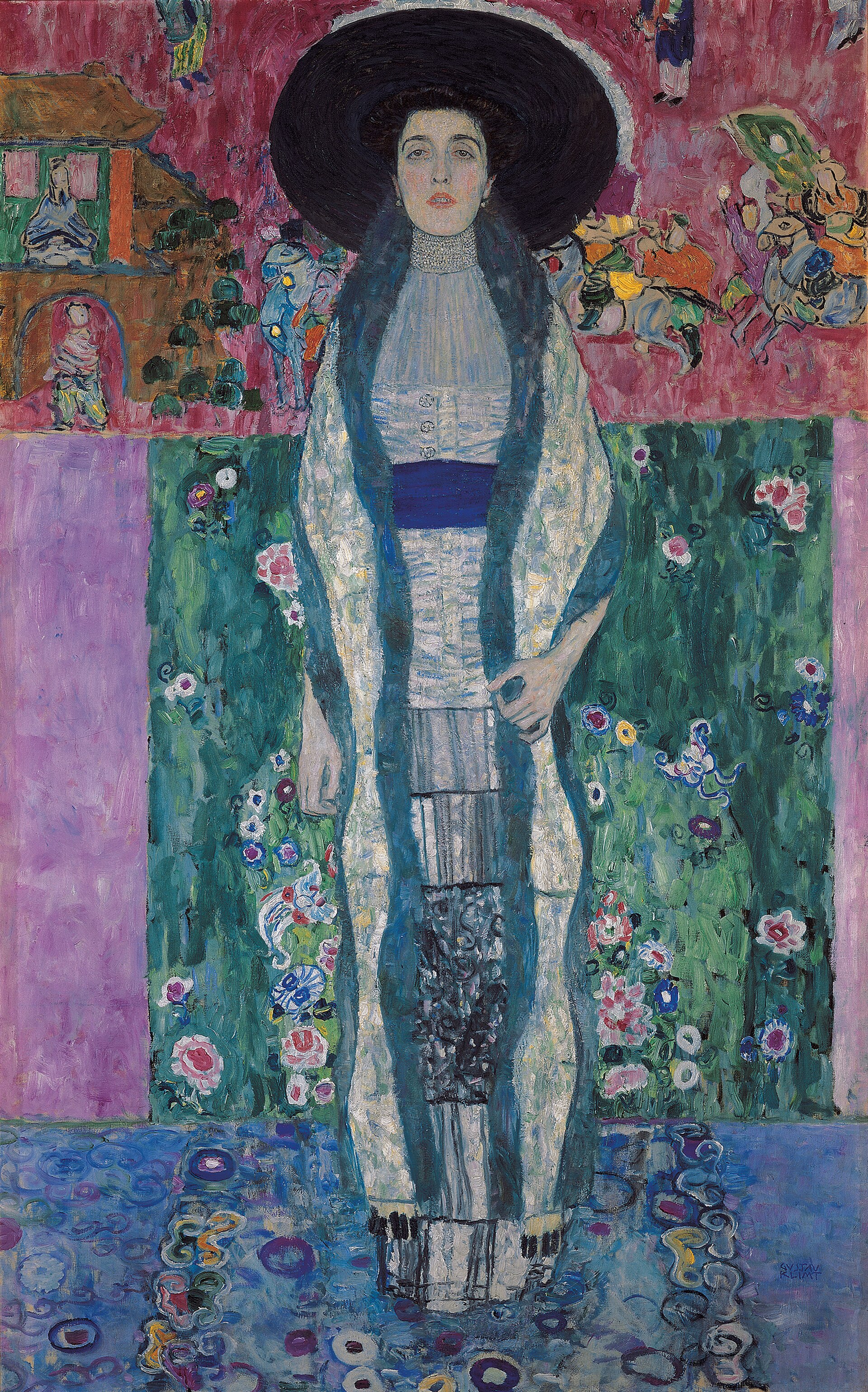
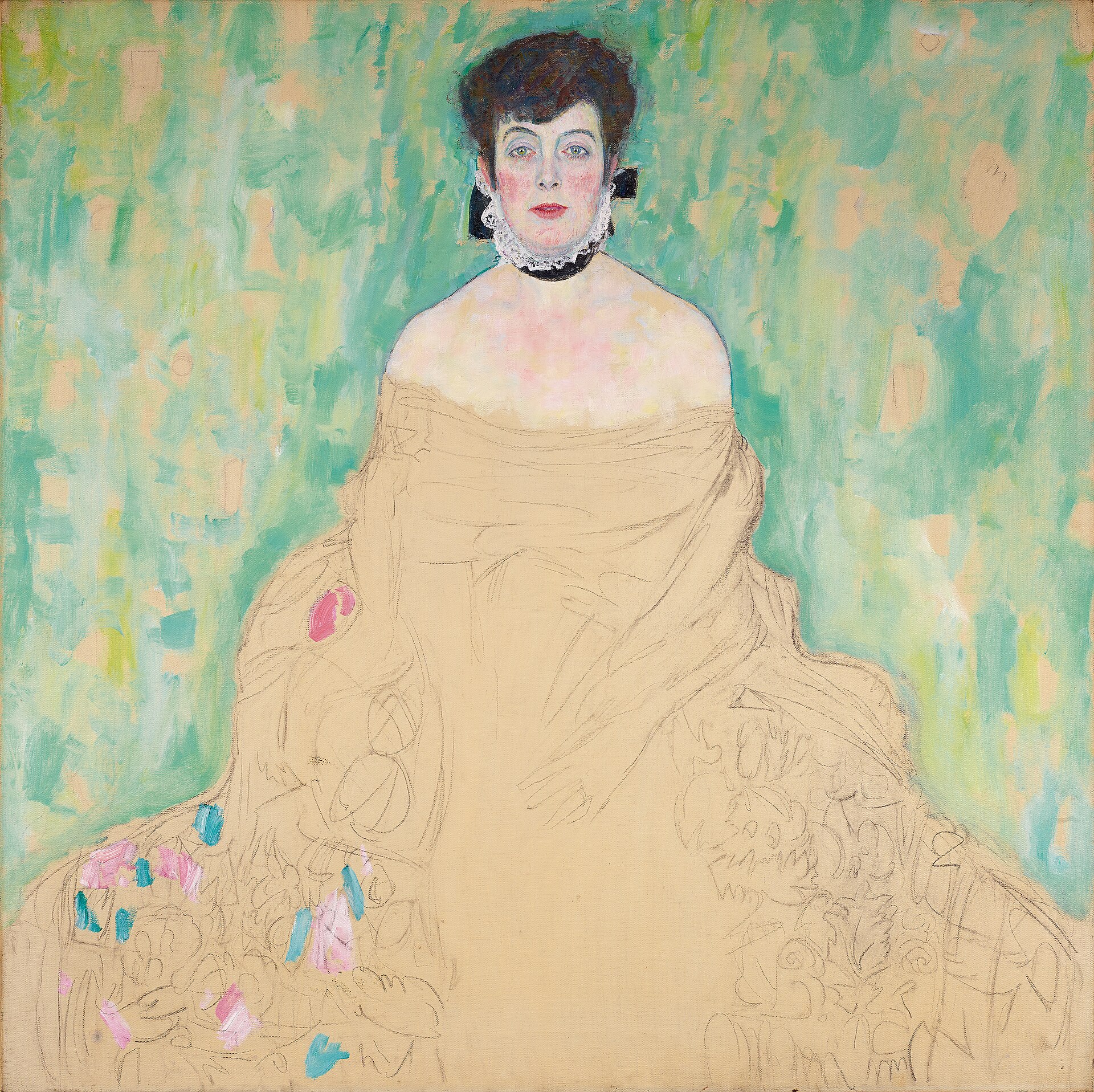
| Portrait of Adele Bloch-Bauer II Gustav Klimt | Companion portrait of 1912, a different canvas in a different style. This record does not cover it. Oil on canvas, in Klimt's later colourful manner; held by the Osterreichische Galerie from 1943, when Dr Fuhrer sold it to the gallery (the award reads the payment as in effect a release from tax execution), restituted 2006, sold at Christie's, New York, on 8 November 2006 as lot 54 for USD 87,936,000 including premium, with a final bid of about USD 78 million before premium according to ARTnews. Hyperallergic, citing Bloomberg, reported a private resale in 2016 for about USD 150 million. | Private collection |
| Judith I Gustav Klimt | First large-scale use of real gold leaf by Klimt, 1901; the Neue Galerie timeline says some scholars believe Adele was the model. Not listed in the Klimt Database's account of the Bloch-Bauer collection; shown here for the gold technique. | Belvedere, Vienna |
| Portrait of Fritza Riedler Gustav Klimt | 1906 portrait in the same gold manner, shown beside this portrait at Mannheim in 1907 and facing it on the long wall of the Klimt Room at the 1908 Kunstschau. Contemporaries called the group 'mosaic pictures'. | Belvedere, Vienna |
| Schloss Kammer am Attersee III Gustav Klimt | The picture Ferdinand gave to the gallery in 1936 and Dr Fuhrer received in 1941 in exchange for this portrait and Apple Tree I. Fuhrer sold it to Gustav Ucicky; the arbitration court inclined to the view that he 'simply extorted' it from the gallery. | Belvedere, Vienna |
| Birch Forest, Apple Tree I and Houses at Unterach on the Attersee Gustav Klimt | The other three landscapes of the five restituted in 2006 with the two Adele portraits. Christie's, 8 November 2006: Birch Forest lot 51 USD 40,336,000; Apple Tree I lot 53 USD 33,056,000; Houses at Unterach lot 52 USD 31,376,000, all including premium and against estimates of 20 to 30, 15 to 25 and 18 to 25 million. | Private collections |
| Portrait of Amalie Zuckerkandl Gustav Klimt | The sixth painting claimed by Maria Altmann; it was the subject of a separate arbitration, and the Belvedere's digital collection credits the image to the Belvedere; the outcome of that proceeding is not reported in the sources consulted. Not covered by the award on the five paintings; the Los Angeles Times reported in January 2006 that another family also claimed it. | Belvedere, Vienna |
| Study for Portrait of Adele Bloch-Bauer I Gustav Klimt | Charcoal study of 1903, a drawing and not this picture. The Neue Galerie owns a further charcoal sheet of 1903-04 showing Adele seated and resting her temple on her right hand. | The Jewish Museum, New York (1997-137) |
| The Kiss (Lovers) Gustav Klimt | The other summit of the golden period, bought by the Ministry for 25,000 crowns at the 1908 Kunstschau. The Belvedere says the golden period reached its peak with Adele Bloch-Bauer I and The Kiss. | Belvedere, Vienna |
| Mosaic of the Empress Theodora, San Vitale Master of San Vitale | The Ravenna mosaic the Neue Galerie names as the starting point of the golden style. Klimt saw it in 1903 on the journey with Maximilian Lenz. | Basilica of San Vitale, Ravenna |
| Portrait of Elisabeth Lederer Gustav Klimt | Another Klimt portrait from a Viennese Jewish patron family whose collection was seized under the Nazi regime; already a record in this archive (slug klimt-portrait-of-elisabeth-lederer). Sold at Sotheby's, New York, on 18 November 2025 at a hammer of USD 205,000,000; see that record for the full sale and sources. | Private collection |
| Portrait of a Lady Gustav Klimt | A different late portrait, also in this archive (slug klimt-portrait-of-a-lady). No connection to the Bloch-Bauers; listed for navigation between Klimt records. Listed so that the two titles are not confused: the Neue Galerie timeline says the second Adele portrait was itself retitled Portrait of a Lady in 1943. | Galleria d'Arte Moderna Ricci Oddi, Piacenza |
Open questions
- What did Ferdinand Bloch-Bauer pay Klimt, and when? No source consulted gives a price or a payment date for the commission, and the only indirect remark, by the 2006 arbitration court, concerns the 'relatively low value of the painting at that time'.
- Is the frame now on the picture Hoffmann's original of 1907? The Klimt Database says the frame was based on a Hoffmann design, and no source consulted records its history, treatment or location during the Belvedere years.
- What did Klimt intend by the eyes and triangles, if anything? No letter, notebook or interview explaining the motifs was found. The Neue Galerie says 'all-seeing eye motifs', Whitford (via Wikipedia) says Egyptian, and the label 'Eye of Horus' was not traced to a named scholar.
- Who retitled the picture, when and in which words? The Neue Galerie timeline gives Woman in Gold in 1941 and Portrait of a Lady with Gold Background in 1943, Silverman attributes the title to the Nazis and Wikipedia to the gallery, and the Belvedere's inventory and publications of those years have not been seen.
- Did the Belvedere's provenance records for the Bloch-Bauer portraits change in 1960, as the Neue Galerie timeline states? The claim rests on that timeline and the 1998 press findings, and the underlying files have not been seen for this record.
- Has the canvas been examined technically? No published pigment, metal-leaf, ground or condition analysis of this painting was found; the Belvedere's account of Klimt's gold technique is general, and who applied the leaf is not recorded.
- What was the actual price in June 2006, and on what terms? The 135 million dollars is reported by the New York Times as cited by others and by ARTnews, and the Neue Galerie's release names no figure; ARTnews says the adviser declined to discuss how it was set.
- Was an export permit required or issued when the paintings left Austria in March 2006? The Lexikon says a repurchase by the Republic did not come about, and the sources consulted say nothing of any export procedure in 2006.
- Who was the recipient of Adele's letter of 22 August 1903, Julius Bauer: her brother (Neue Galerie timeline) or a journalist friend (Klimt Database)?
- When was Dr Fuhrer appointed administrator, and what was his first name? The claimants say April 1938 and the Neue Galerie timeline 1939; the arbitration award says Friedrich and the Lexikon and the Supreme Court say Erich and the Neue Galerie timeline says Eric.
- Has the Belvedere made a statement of its own on the 1941 acquisition? Its provenance page records that the committee advised against restitution and that the pictures 'have subsequently been restituted', and no further public statement by the museum was found.
Questions about this object
What is Portrait of Adele Bloch-Bauer I?
Portrait of Adele Bloch-Bauer I is a painting, dated 1903-1907. Medium: Oil, silver and gold on canvas.
Who made Portrait of Adele Bloch-Bauer I, and is the attribution settled?
The attribution to Gustav Klimt is recorded here as accepted. Documented by the sitter's own letter of 22 August 1903 recording that Klimt would paint her portrait, shown at Mannheim in 1907 and at the Vienna Kunstschau in 1908 as a Klimt, and never questioned in any source consulted. The question this record is about is not who painted it but who owned it.
Where is Portrait of Adele Bloch-Bauer I now?
Neue Galerie New York. Last confirmed 8 October 2026. Acquired by private sale from the heirs of Ferdinand and Adele Bloch-Bauer, announced 19 June 2006. Credit line: acquired through the generosity of Ronald S. Lauder, the Heirs of the Estates of Ferdinand and Adele Bloch-Bauer, and the Estee Lauder Fund. As of 8 October 2026 the museum's website says its galleries reopen on 12 November 2026 and that the portrait is featured in the 25th Anniversary Exhibition.
What is still unknown about Portrait of Adele Bloch-Bauer I?
What did Ferdinand Bloch-Bauer pay Klimt, and when? No source consulted gives a price or a payment date for the commission, and the only indirect remark, by the 2006 arbitration court, concerns the 'relatively low value of the painting at that time'.
Sources
- 1Arbitral award in the matter of Maria V. Altmann, Francis Gutmann, Trevor Mantle, George Bentley and Dr Stefan Gulner, and Dr Nelly Auersperg, against the Republic of Austria; arbitration court Dr Andreas Nodl, Prof. Walter H. Rechberger and Prof. Peter Rummel (chairman); Vienna, 15 January 2006; English text, 46 pages, as hosted by the University of Geneva ArThemis case database (the file title there gives the year as 2004 in error). plone.unige.ch/art-adr/...
- 2Adele Bloch-Bauer, handwritten will, Vienna, 19 January 1923 (German transcript, owner given as Wiener Stadt- und Landesarchiv), as hosted by the University of Geneva ArThemis case database. plone.unige.ch/art-adr/...
- 3Supreme Court of the United States, Republic of Austria v. Altmann, 541 U.S. 677 (2004), argued 25 February and decided 7 June 2004, opinion of the Court by Justice Stevens, Legal Information Institute, Cornell Law School. law.cornell.edu/supct/...
- 4Supreme Court of the United States, Republic of Austria v. Altmann, No. 03-13, syllabus, Legal Information Institute, Cornell Law School. law.cornell.edu/supct/...
- 5Klimt Database (Klimt Foundation, Vienna), 'The Bloch-Bauer Family', in Network Vienna 1900, Benefactors. klimt-database.com/en/...
- 6Klimt Database (Klimt Foundation, Vienna), 'Klimt's Artworks 1907-1909: Gustav Klimt at His Zenith', including the entries on Portrait of Adele Bloch-Bauer I, the Kunstschau Wien 1908 and the Mannheim Jubilee Exhibition 1907. klimt-database.com/en/...
- 7Klimt Database (Klimt Foundation, Vienna), 'Italy', Network Vienna 1900, Places, on Klimt's 1903 journeys to Venice and Ravenna and the Lenz travel diary. klimt-database.com/en/...
- 8Klimt Database (Klimt Foundation, Vienna), 'The Biography', year by year. klimt-database.com/en/...
- 9Klimt Database (Klimt Foundation, Vienna), 'Klimt's Artworks 1910-1913: Expressive Blaze of Colors', including the entry on Portrait of Adele Bloch-Bauer II. klimt-database.com/en/...
- 10Neue Galerie New York, 'Portrait of Adele Bloch Bauer I (1907)', the museum's Woman in Gold page, with credit line and description of the painting; fetched 8 October 2026. neuegalerie.org/womaningold
- 11Neue Galerie New York, press release 'Neue Galerie New York Agrees to Acquire Spectacular Klimt Painting, Adele Bloch-Bauer I', 19 June 2006 (Internet Archive copy of 18 October 2017). web.archive.org/web/...
- 12Neue Galerie New York, 'The Woman in Gold: Historical Timeline' (PDF; Internet Archive copy of 11 May 2016). web.archive.org/web/...
- 13Neue Galerie New York, exhibition page 'Gustav Klimt and Adele Bloch-Bauer: The Woman in Gold', 2 April to 7 September 2015. neuegalerie.org/exhibitions/...
- 14Neue Galerie New York, home page, with the notice of the autumn 2026 reopening and the 25th Anniversary Exhibition; fetched 8 October 2026. neuegalerie.org
- 15Los Angeles County Museum of Art, 'Gustav Klimt: Five Paintings from the Collection of Ferdinand and Adele Bloch-Bauer', 4 April to 30 June 2006, with caption giving medium, 140 x 140 cm and lender. lacma.org/art/...
- 16Leonhard Weidinger, 'Bloch-Bauer, Ferdinand', Lexikon der Provenienzforschung, Kommission fuer Provenienzforschung, Vienna, 20 December 2021 (in German). lexikon-provenienzforschung.org/bloch-bauer-ferdinand
- 17Beschluss des Kunstrueckgabebeirats, Ferdinand Bloch-Bauer, 28 June 1999 (Austrian Art Restitution Advisory Board decision, in German), Kommission fuer Provenienzforschung. provenienzforschung.gv.at/beiratsbeschluesse/...
- 18Belvedere, Vienna, 'Provenance Research', with the list of restitutions and the statement on the Bloch-Bauer Klimts (Adele Bloch-Bauer I, Inv. No. 3830). belvedere.at/en/...
- 19Lisa Ebner-Kollmann, 'Why did Gustav Klimt use gold?', Belvedere, Vienna, 11 June 2026. belvedere.at/en/...
- 20Belvedere, Vienna, 'Who Was Gustav Klimt?', 28 March 2026. belvedere.at/en/...
- 21Eileen Kinsella, 'Gold Rush', ARTnews, 1 January 2007. artnews.com/art-news/...
- 22Christie's, press release on the Impressionist and Modern Art sale of 8 November 2006, with top ten prices, lot numbers and estimates, as reproduced by The Art Wolf, 15 November 2006. Christie's own lot pages were not reached. theartwolf.com/news/...
- 23Al Jazeera, 'Klimt painting sold for record $135m', 19 June 2006, citing the New York Times. aljazeera.com/news/...
- 24Diane Haithman and Christopher Reynolds, 'Court Awards Nazi-Looted Artworks to L.A. Woman', Los Angeles Times, 17 January 2006. latimes.com/archives/...
- 25Lisa Silverman, 'Gustav Klimt, Adele Bloch-Bauer I', Shared History project of the Leo Baeck Institute New York | Berlin, published by the Bundeszentrale fuer politische Bildung (in German). bpb.de/themen/...
- 26Benjamin Sutton, 'Oprah Winfrey Sold Klimt Painting for $150M', Hyperallergic, 8 February 2017, citing Bloomberg. hyperallergic.com/oprah-winfrey-sold-klimt-painting-for-150m
- 27Wikipedia, 'Portrait of Adele Bloch-Bauer I'. en.wikipedia.org/wiki/...
- 28Wikipedia, 'Woman in Gold (film)'. en.wikipedia.org/wiki/...
- 29Wikipedia, 'Maria Altmann'. en.wikipedia.org/wiki/...
- 30Wikipedia, 'Hubertus Czernin'. en.wikipedia.org/wiki/...
- 31Kommission fuer Provenienzforschung, 'Kunstrueckgabegesetz' (Art Restitution Act of 1998, last amended 2023), with links to the consolidated texts in German and English. provenienzforschung.gv.at/empfehlungen-des-beirats/...
- 32Wikimedia Commons, file page 'Gustav Klimt - Study for Portrait of Adele Bloch-Bauer I - Google Art Project.jpg', which carries the Google Art Project record for The Jewish Museum, New York (charcoal on paper, 1903, museum number 1997-137). commons.wikimedia.org/wiki/...

Last verified · Published
Change log
8 October 2026 - Record created at the house standard: researched narrative, technical evidence, maker dossier, graded provenance chain, prices with hammer and premium separated, related works, open questions and sources.