Portrait of Elisabeth Lederer
Gustav Klimt · 1914-1916
Last verified 10 August 2026 · 21 sources cited · Change log
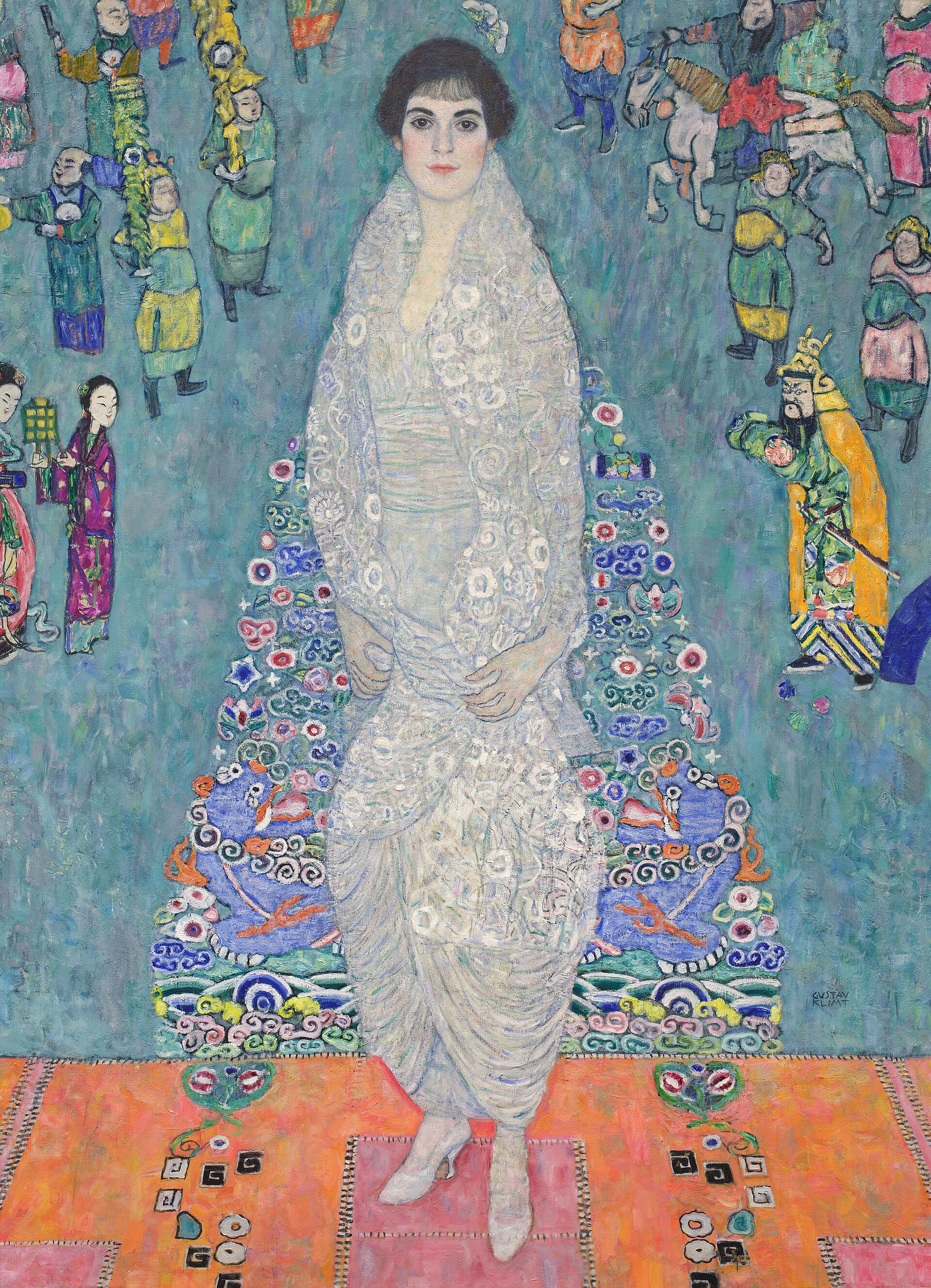
The record subject. Oil on canvas, 180.4 x 130.5 cm, signed lower right. The blue train is a late Qing dragon robe; the two dragons rising from crested waves identify it as an emperor's cloak, the only instance of imperial iconography in a Klimt portrait.
| Artist | Gustav Klimt |
|---|---|
| Date | 1914-1916 |
| Medium | Oil on canvas |
| Where it is now | Private collectionlast confirmed 2 August 2026 |
| Attribution | acceptedAccepted as autograph Klimt. |
| Object type | Painting |
| Period | Viennese Modernism (Wiener Moderne), 1897-1918 |
| Cases | Seized, looted or confiscated · Restituted or repatriated |
| Culture | Austrian |
| Genre | portrait |
- Where it is now
- Private collectionlast confirmed 2 August 2026
- Attribution
- accepted
- Provenance
- 8 links8 documented
- At auction
- Hammer USD 205,000,000, 18 November 2025
- Sources
- 21 cited
- Last verified
- 10 August 2026Change log
On this page 10 sections
The second most expensive work of art ever sold at auction, and a painting whose price is inseparable from the reason it still exists. Klimt was commissioned in 1914 by August and Serena Lederer, his principal patrons, to paint their twenty-year-old daughter. He worked on it for two years, would not call it finished, and it was reportedly taken off his easel in 1916 by Serena. The Lederers were the only family for whom Klimt painted three generations of women, and after his death in 1918 Serena bought his estate.
The collection was impounded at the family's Vienna apartment on 26 November 1938 and seized by the courts a year later. Most of the Lederer Klimts, including the three Faculty Paintings, burned at Schloss Immendorf on 8 May 1945. This canvas was not sent there, because under Nazi rules a portrait of a Jewish sitter was not worth confiscating; it survived because the regime that stole it did not want it. Elisabeth herself survived the deportations in Vienna by petitioning to have Klimt recognised as her father, a fiction her mother swore to from exile, which in 1940 got her reclassified as half-Jewish while her brothers remained full Jews. She died of illness in October 1944.
The seizure was terminated on 30 September 1948 and the painting returned to her brother Erich in Geneva. Serge Sabarsky bought it from him by 1983; Leonard Lauder bought it from Sabarsky in December 1985 and kept it for forty years. On 18 November 2025 it came to auction for the first time in its existence, hammering at 205 million dollars and totalling 236,360,000 with fees. It is not the Adele Bloch-Bauer case: there was no sixty-five-year fight with a state museum here, and that difference is precisely what the buyer was paying for.
Provenance
Each link is graded. Documented: a cited source supports it. Disputed: the identification is argued but not established. Unknown: no owner for that span, and the gap is not smoothed into a narrative. The grades in the glossary.
- 1914 - 1916August and Serena Lederer, Viennadocumented
Commissioned by the sitter's parents in 1914 and acquired by them in 1916. Klimt was paid 35,000 crowns. He did not consider the picture finished; Serena Lederer is reported to have removed it from the studio.1311
- 1916 - 1938Lederer collection, Bartensteingasse 8, Viennadocumented
Hung in the family's principal Vienna residence, photographed there in Serena Lederer's salon around 1930 by Martin Gerlach. August Lederer died on 30 April 1936. The picture left the collection only once in this period, for the Austrian art exhibition at the Liljevalchs Konsthall, Stockholm, in 1917, catalogue no. 104. Sotheby's records a possible showing at the Verein der Museumsfreunde, Vienna, in 1936.1811
- 1938-11-26 - 1939-12-10Impounded in situ; Zentralstelle fuer Denkmalschutzdocumented
Impounded where it hung at Bartensteingasse 8 on 26 November 1938, eight months after the Anschluss. Serena Lederer had fled to Budapest; the collection was formally confiscated from her in 1940. In the same year the sitter obtained a certificate of descent naming Klimt as her father, which reclassified her as a Mischling of the first degree while her brothers Erich and Fritz remained classified as full Jews. It had no effect on the ownership of the painting.131216
- 1939-12-10 - 1948-09-30Seized by the Landesgericht Wien; deposited at Kirchner and Co, Viennadocumented
Seized by the Vienna regional court and deposited at Kirchner and Co on 10 December 1939. Not sent to Schloss Immendorf with the bulk of the Lederer Klimts, because under the applicable Nazi rules portraits of Jewish sitters were not treated as worth confiscating. That exclusion is why it survived the fire of 8 May 1945. Secondary accounts place it at the Dorotheum by 1948, where it and the Serena Lederer portrait were scheduled for sale; Sotheby's published chain does not record the Dorotheum stage.171118
- 1948 - 1983Erich Lederer, Genevadocumented
Seizure terminated 30 September 1948; restituted in 1948 to Erich Lederer, the sitter's brother, then resident in Geneva. He stopped the Dorotheum sale of the two family portraits and secured their return. No litigation and no adversary museum were involved; this was a court terminating its own seizure. Restitution did not carry a right of export: the Beethoven Frieze was returned to Erich in the same period but held in Austria until he sold it to the state in 1973 at roughly half market value in exchange for Chancellor Kreisky granting export licences for the family's other Klimts. Whether this canvas was covered by that arrangement, or had left Austria earlier, is not established in the sources consulted. Erich died in Geneva on 19 January 1985.1371315
- by 1983 - 1985-12Serge Sabarsky Gallery, New Yorkdocumented
Acquired from Erich Lederer. Sotheby's records the gallery as having acquired it by 1983. Price undisclosed. Sabarsky (1912-1996) was a Vienna-born dealer who fled the Nazis in 1938 and became the principal American dealer in Austrian modernism; he later planned the Neue Galerie with Ronald Lauder.11117
- 1985-12 - 2025-11-18Leonard A. Lauder, New Yorkdocumented
Acquired from the Serge Sabarsky Gallery in December 1985 for an undisclosed sum. Hung in his Fifth Avenue apartment. Lent anonymously to Klimt's Women at the Belvedere, Vienna, 2000-01; to Neue Galerie New York exhibitions including Klimt and the Women of Vienna's Golden Age, 2016-17; and on long-term loan to the National Gallery of Canada, Ottawa, from 2017 until the sale. Lauder died on 14 June 2025, aged ninety-two.1471120
- 2025-11-18 - presentPrivate collectiondocumented
Bought at Sotheby's New York, lot 8 of the Leonard A. Lauder, Collector evening auction, by an undisclosed telephone bidder represented by Sotheby's vice chairman Julian Dawes. The buyer has not been identified publicly. Proceeds went to the Lauder trust.245
Prices realised
| Date | Sale | Estimate | Result | Note |
|---|---|---|---|---|
| 18 November 2025 | Sotheby's Leonard A. Lauder, Collector | Evening Auction, New York (Breuer building), lot 8, lot 8 | Published as Estimate Upon Request; briefed to the press in the region of USD 150 m | Hammer USD 205,000,000 With premium USD 236,360,000 with buyer's premium USD | First appearance at auction in the painting's existence. The lot carried both of Sotheby's disclosure symbols, guaranteed property and an irrevocable bid; neither the guarantee level nor the identity of the irrevocable bidder is disclosed. Bidding was opened at USD 130 m by Oliver Barker and ran about twenty minutes, resolving into a contest between two telephone bidders held by David Galperin and Julian Dawes; Dawes's client won. Most coverage reports only one figure and rounds it differently: Sotheby's and ARTnews give USD 236.4 m, The Art Newspaper and The Value give USD 236.3 m. Both are the same 236,360,000. Records set: most expensive work of modern art at auction; second most expensive work of art of any kind at auction, behind the Leonardo Salvator Mundi at USD 450.3 m in 2017; most valuable work Sotheby's has sold. It roughly doubled Klimt's previous auction record of GBP 85.3 m with fees, about USD 108.4 m, for Lady with a Fan at Sotheby's London in June 2023, a figure Sotheby's own release rounds to USD 108.8 m. The twenty-four-lot evening sale was a white glove at USD 456.2 m hammer and USD 527.4 m with fees; Sotheby's puts the Lauder collection total at USD 531.3 m across two sessions. |
Hammer is the price at which the bidding stopped; with premium adds the fee the house charges the buyer on top. Hammer price and buyer's premium in the glossary.
Technical evidence
| Support and medium | Oil on canvas. Signed Gustav Klimt towards the lower right.1 |
|---|---|
| Dimensions | 180.4 x 130.5 cm (71 by 51 3/8 inches). Full-length and life-size; among the largest formats Klimt used for a private portrait commission.13 |
| Date and execution | Commissioned 1914, executed 1914-16. Klimt did not regard it as finished; the picture is reported to have been removed from his studio by Serena Lederer in 1916 over his objection. The upper background is correspondingly unresolved.111 |
| Underdrawing and revision | Infrared reflectography shows Klimt painted out additional background figures that originally occupied the empty area above the carpet. Traces of charcoal or conte underdrawing remain visible in the white garment. Ornament was developed directly on the canvas rather than transferred from studies, although many preparatory drawings of the sitter exist.11 |
| Ornament sources | The blue train is identified as a late Qing dragon robe of the Guangxu period. Two light blue dragons rise from crested waves, which with the accompanying symbols identifies it as an emperor's cloak. Background figures derive from Chinese material culture and Peking opera. This is the only Klimt portrait carrying imperial Chinese iconography.17 |
| Dress | Contemporary Parisian fashion after Paul Poiret. The trouser-like fall of the skirt derives from the hobble skirt; the shawl and tunic line follow Poiret's Chinese-inflected designs of the early 1910s. The carpet borders recall Hoffmann and Wimmer-Wisgrill designs for the Wiener Werkstaette.11 |
| Fee | Klimt was paid 35,000 Austro-Hungarian crowns for the picture.11 |
| Catalogue raisonne | Novotny and Dobai (1968) no. 188; Dobai, L'Opera completa di Klimt (1978) no. 174; Natter, Gustav Klimt, The Complete Paintings (2012) no. 212.1 |
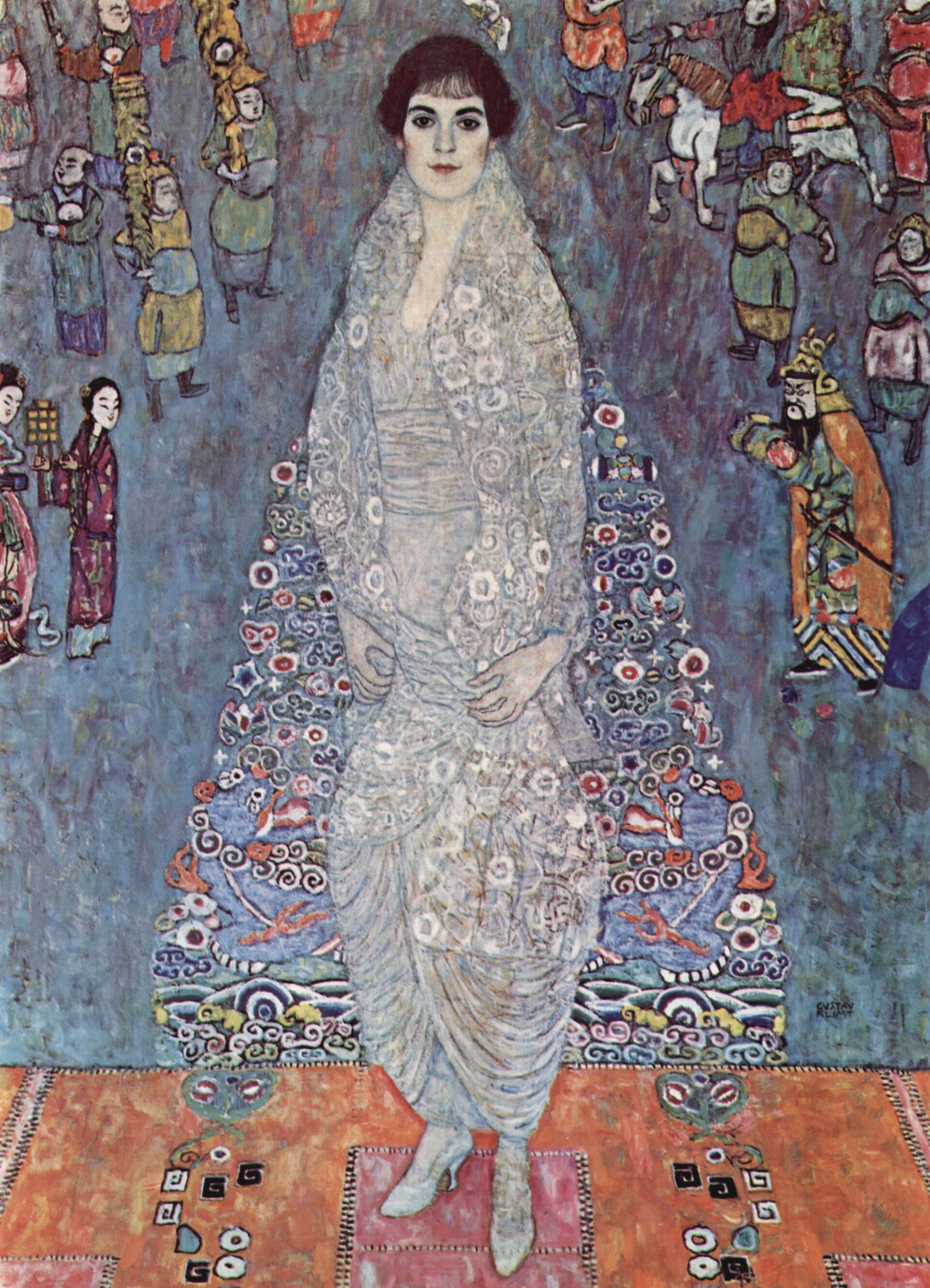
| Titles in use | Bildnis Elisabeth Lederer and Portrait of Elisabeth Lederer are the catalogue titles. Bildnis Baronin Elisabeth Bachofen-Echt and Portrait of Baroness Elisabeth Bachofen-Echt refer to the same picture and the same sitter under her married name, which she acquired in 1921, five years after the picture was painted and three years after Klimt died.1911 |
Images
The record in full
A commission that took three years and had to be taken away from him
Oil on canvas, 180.4 by 130.5 centimetres, signed Gustav Klimt towards the lower right. That is roughly six feet by four: a full-length, life-size standing portrait, which in Klimt's practice is the largest and most expensive thing a private client could commission. August and Serena Lederer ordered it in 1914, when their daughter Elisabeth was twenty and still living at home. Klimt was paid 35,000 crowns.
He then worked on it for two years and would not call it finished. The story preserved in the literature is that in 1916 Serena Lederer went to the studio, decided the picture was done, and took it off the easel over the artist's objection. It is the sort of anecdote that usually dissolves under checking; this one is carried in Tobias Natter's complete-paintings catalogue, in the National Gallery of Canada's account, and in Sotheby's own 2025 lot essay, and it is consistent with the physical evidence. The upper background is unresolved in a way the rest of the canvas is not.
Klimt died in February 1918, two years after the picture left his studio. He never got it back to finish.
Klimt painted three generations of this one family
August Lederer was a Bohemian-born industrialist who built a fortune on distilleries; by the 1910s the Lederers were reckoned the second wealthiest family in Vienna after the Rothschilds. Serena Pulitzer Lederer, whom Josef Hoffmann called the best-dressed woman in Vienna, was the driving force behind the collection. They lived at Bartensteingasse 8, minutes from Klimt's studio, with a room in the flat given over to Klimt and the interiors executed by the Wiener Werkstaette circle.
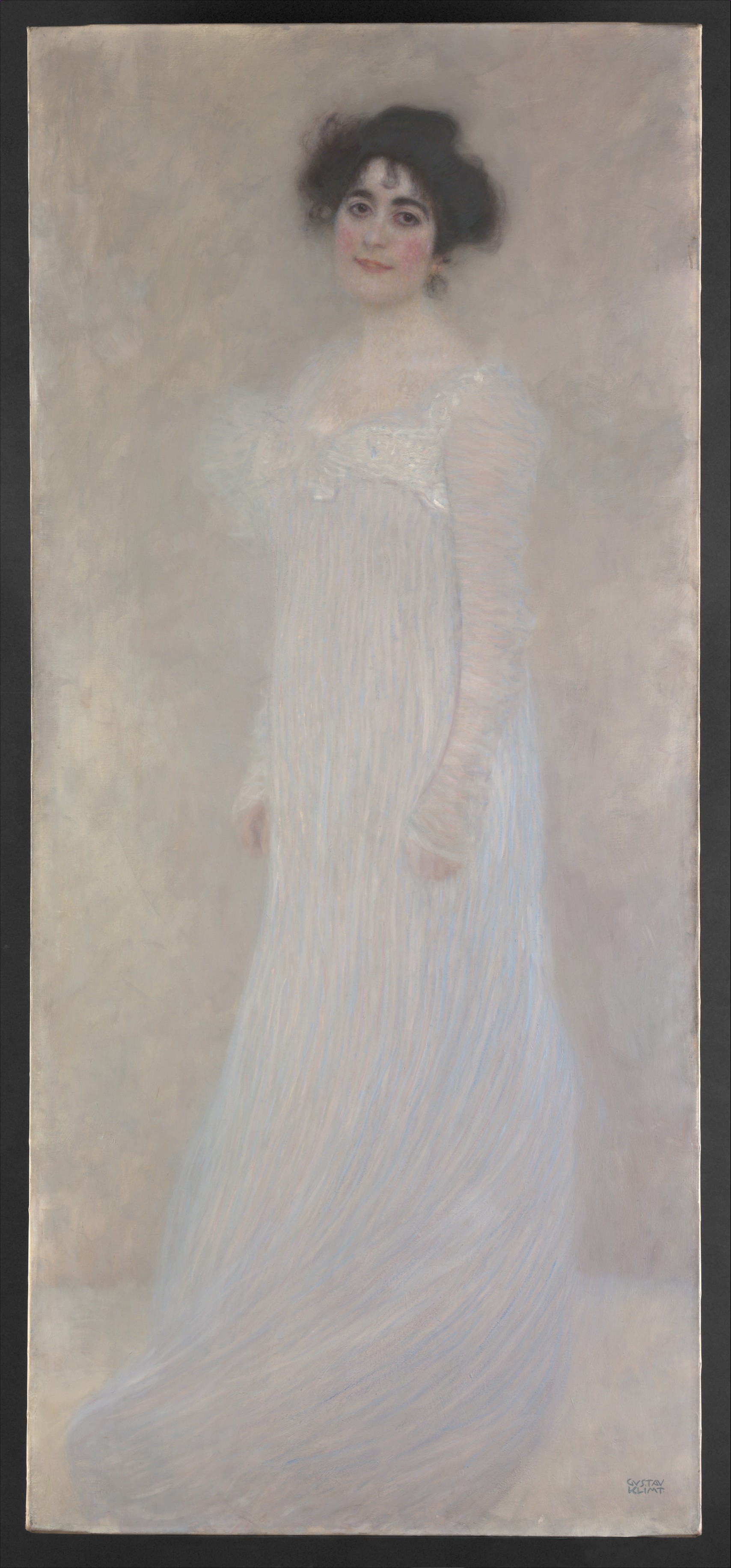
Klimt painted Serena in 1899, a picture that is now in the Metropolitan Museum of Art. He painted Elisabeth between 1914 and 1916. He painted Serena's mother, Charlotte Pulitzer, in 1917. Three generations of women in one family, which Sotheby's calls a distinction unparalleled in his career. The only other sitter he painted more than once was Adele Bloch-Bauer.
The scale of the patronage matters for reading the price. The Lederer collection held Philosophy and Jurisprudence from the Faculty Paintings, the Beethoven Frieze, Music, Schubert at the Piano, Water Snakes I, Friends II, the family portraits, landscapes, and more than twenty-five major drawings acquired in 1919. When Klimt died, Serena Lederer bought his estate. For a period of about twenty years, one Viennese family was the single largest private repository of this artist's work in the world, and Klimt in turn depended on them: writing to Serena for an advance on her mother's portrait, he asked for what he called the meagre rest of the fee, saying he was waiting for it like the devil for a poor soul.
An emperor's robe, and what infrared found under it
Elisabeth stands frontally at the centre, in a close-fitting white top and skirt under a floral chiffon shawl, on a pink and orange carpet whose green and white roundels recall Chinese jade and whose borders recall Hoffmann and Wimmer-Wisgrill designs for the Wiener Werkstaette. The dress is contemporary Parisian: the ambiguous trouser-like fall of the skirt derives from Paul Poiret's hobble skirt and his Chinese-inflected tunics, which were the height of fashion in the early 1910s.
Behind her stands a field of small figures drawn from Chinese material culture and Peking opera, scholars and low-ranking military types and courtiers with lanterns, each separate, all attending on her. Klimt owned ukiyo-e prints, kimonos, Qing court robes and a library of East Asian art books, and the blue garment forming her train has been identified as a late Qing dragon robe of the Guangxu period. Kirsten Appleyard of the National Gallery of Canada makes the sharper point: two light blue dragons rise from crested waves on the robe, and with the other symbols present that makes it an emperor's cloak. Klimt used Asian motifs in several late pictures. This is the only portrait in which he put imperial iconography on the sitter.
Infrared reflectography shows he changed his mind. Additional background figures once occupied the empty space above the carpet and were painted out. Traces of underdrawing remain visible in the white garment. Klimt made many preparatory drawings of Elisabeth but developed the ornament directly on the canvas, which is the opposite of the procedure a decorator would follow and part of why the picture took three years.
It left the Lederer collection exactly once before the war, travelling across a Europe at war to the Austrian art exhibition at the Liljevalchs Konsthall in Stockholm in 1917, where the Swedish art historian Andreas Lindblom described a figure who had walked on a road of flowers to her magic carpet, the precious stones of her eyes betraying her humanity.
What is documented about how Elisabeth Lederer survived
This is the part that press coverage compresses into a sentence, and the compression loses the whole point.
Elisabeth Franziska Lederer was born in Vienna on 20 January 1894. She trained at the Imperial-Royal School of Arts and Crafts under Michael Powolny, on Klimt's suggestion, and worked as a sculptor. In 1921 she married Baron Wolfgang von Bachofen-Echt and converted to Protestantism. Their only child, August Anton, died in 1938 at the age of four; the marriage ended in divorce the same year. Her father was already dead. After the Anschluss her mother fled to Budapest and her brothers left the country. She was a divorced Jewish woman alone in Vienna in 1938, which under the Nuremberg framework was close to the worst position available.
What she then did is documented, and it is more specific than the shorthand suggests. In 1939 she wrote a memoir of her childhood emphasising her closeness to Klimt. She submitted it as part of a petition to have Gustav Klimt, who was not Jewish, recognised as her biological father. Serena Lederer, writing from exile in Hungary, swore an affidavit that Elisabeth was the product of an adulterous affair with the painter. The Reich office for genealogical research accepted the petition, and in 1940 Elisabeth received a certificate of descent. She was also, on one account, assisted by a senior Nazi official who was a former brother-in-law.
The precise legal effect is the fact worth carrying. The certificate did not make her Aryan. It reclassified her as half-Jewish, a Mischling of the first degree, while her brothers Erich and Fritz remained classified as full Jews. That reclassification was enough to keep her out of the deportations. She stayed in Vienna and died there of illness on 19 October 1944, at fifty, seven months before the end of the war in Europe. She is buried at Hietzing cemetery, near Klimt.
Two things should be kept apart. That the petition was made, that Serena swore to it, that the certificate was issued in 1940, and that it produced a Mischling classification are all documented. That Klimt was actually her father is not: art historians have concluded it was a fiction, invented to save her life and corroborated under oath by a mother who knew exactly what she was signing. The claim survives as family legend precisely because it worked. It should not be repeated as biography.
Why this picture is not ash
The confiscation is documented to the day. The painting was impounded in situ at Bartensteingasse 8 by the Zentralstelle for the protection of monuments on 26 November 1938. It was seized by the Vienna Landesgericht and deposited at Kirchner and Co in Vienna on 10 December 1939. Serena Lederer's collection was formally confiscated from her in 1940.
The bulk of the Lederer Klimts went to Schloss Immendorf in Lower Austria, the country seat of the Freudenthal family, used as a supposedly safe wartime depot. On 8 May 1945, the last day of the war in Europe, the castle burned. The cause has never been established; the standing presumption is arson by retreating German troops, possibly the Feldherrnhalle tank corps, to keep the contents from the Red Army.
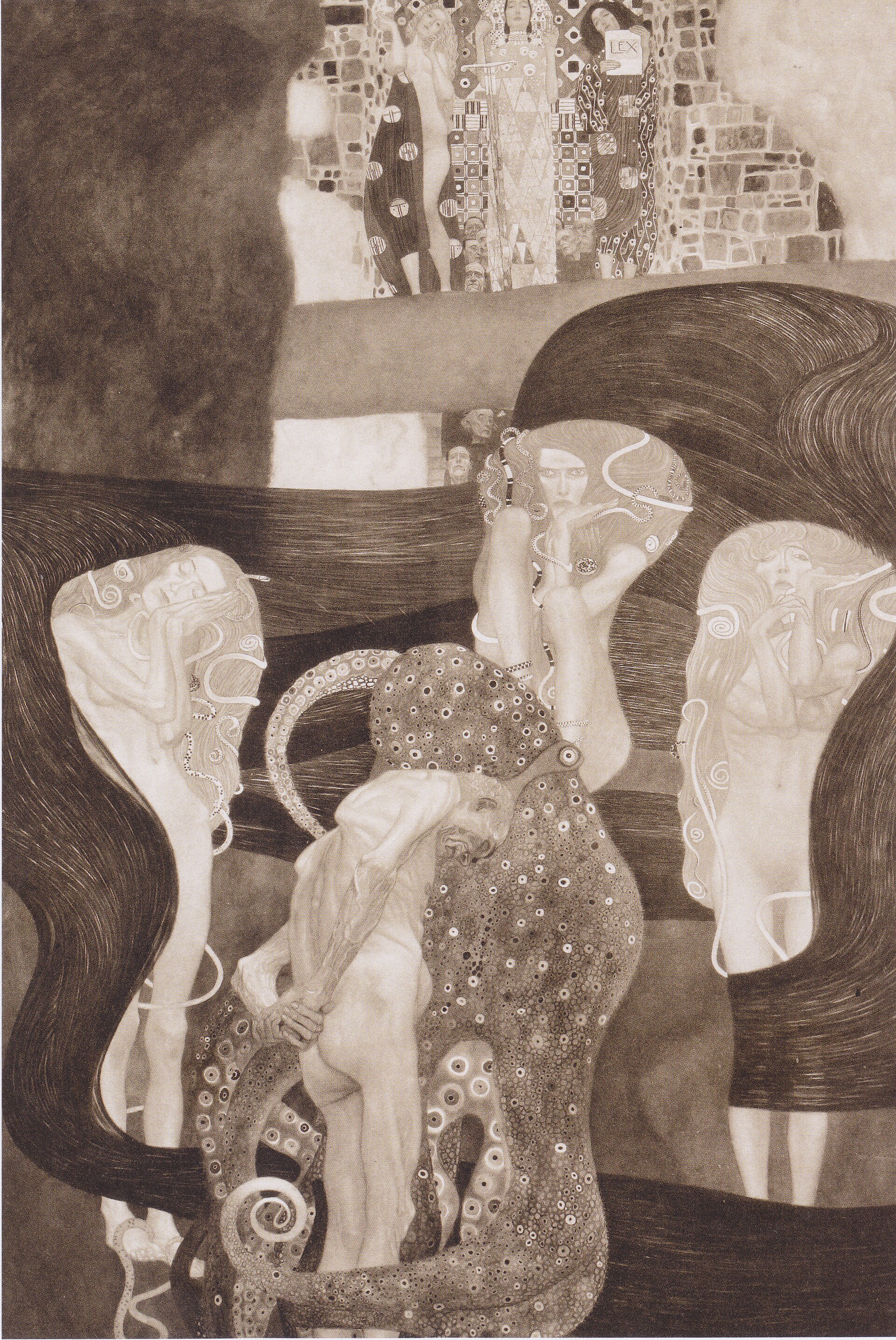
What burned there is the reason Klimt's late work is scarce. The three Faculty Paintings for the university's ceremonial hall went, with their composition studies. So did the overdoor paintings Music and Schubert at the Piano from the Dumba palace, and, from the expropriated Lederer collection, The Golden Apple Tree (1903), Country Garden with Calvary (1912), Wally (1916), Friends II (1916/17), Garden Path with Chickens (1916) and Leda (1917). Accounts of the total range from about ten Klimts to fifteen depending on what is counted.
This portrait was never sent to Immendorf. The reason is grotesque and it is the single most important fact in the object's history. Under the applicable Nazi rules, portraits of Jewish sitters were not considered worth confiscating for the Reich's own collections. Being a picture of a Jewish woman disqualified it from the treatment that destroyed the rest of the collection. It stayed in Vienna, ending up at the Dorotheum, and it survived because the regime that stole it did not want it.
1948, and the price Austria charged for the door
The seizure was terminated on 30 September 1948 and the painting restituted that year to Erich Lederer, Elisabeth's brother, then living in Geneva. Both surviving Lederer portraits, Serena's and Elisabeth's, had been scheduled for a Dorotheum sale in Vienna in 1948; Erich stopped it and secured their return. Serena had died in Budapest in 1943 and never saw any of it back.
Restitution and export are two different things, and Austria kept them apart deliberately. The Beethoven Frieze, recovered from the Altaussee salt mine in 1945, was formally returned to Erich Lederer but could not leave the country. He spent a quarter of a century trying. In 1973 he sold the frieze to the Austrian state for 750,000 dollars, described by the family as roughly half its market value, in exchange for Chancellor Bruno Kreisky granting export licences for the family's other Klimt pictures. Members of the family lodged a claim for the frieze in 2013; the Austrian art restitution advisory board rejected it in 2015, finding that Erich had negotiated the price voluntarily, and the government upheld that.
So the Lederer restitution is not a clean story with a happy ending. It is a partial recovery obtained at a discount, from a state that used its export regime as leverage, and the reckoning over that leverage was still running in 2015. Whether this specific portrait was among the pictures whose export licences were granted under the 1973 arrangement is not established in the published sources, and this record does not assume it.
Sabarsky, Lauder, and forty years off the market
Erich Lederer sold the portrait to the Serge Sabarsky Gallery in New York; Sotheby's records it acquired by 1983, and Erich died in Geneva in January 1985. Sabarsky is the right dealer for this object in a way that is not coincidence. Born Siegfried Sabarsky in Vienna in 1912, he worked as a clown and set designer at the Simplicissimus cabaret, fled the Nazis in 1938 to Paris and in 1939 to New York, and opened a Madison Avenue gallery in 1968 that did more than any other to build an American market for Klimt, Schiele and Kokoschka. With Ronald Lauder he planned the Neue Galerie, which opened in 2001, five years after his death in 1996.
Leonard A. Lauder, Ronald's elder brother, acquired the painting from Sabarsky in December 1985 for an undisclosed sum. It hung above his dining table on Fifth Avenue for four decades. He lent it, always anonymously, to the Belvedere's Klimt's Women in Vienna in 2000 to 2001, to several Neue Galerie shows including Klimt and the Women of Vienna's Golden Age in 2016 to 2017 where it was reunited with Serena's portrait, and then on long-term loan to the National Gallery of Canada in Ottawa from 2017 until the sale. Lauder died on 14 June 2025 at ninety-two, having already given a Cubist collection valued at over a billion dollars to the Metropolitan Museum. The remaining fifty-five works, valued at more than 400 million dollars, went to Sotheby's, with proceeds to the Lauder trust.
The sale
Lot 8, Leonard A. Lauder, Collector, Evening Auction, Sotheby's New York, 18 November 2025, the sale that inaugurated the house's new headquarters in the Breuer building. The estimate was published as Upon Request; the figure briefed to the press before the sale was in the region of 150 million dollars. The lot carried both of Sotheby's disclosure symbols: guaranteed property, and an irrevocable bid. Neither the guarantee level nor the identity of the irrevocable bidder is disclosed.
Oliver Barker opened it at 130 million dollars. It ran about twenty minutes and came down to two telephone bidders, one with David Galperin and one with Julian Dawes. Dawes's client won.
The hammer was 205,000,000 dollars. With buyer's premium the total was 236,360,000 dollars. Both figures matter and most coverage carries only one: Sotheby's rounds it to 236.4 million, The Art Newspaper and others truncate to 236.3 million, and the two are the same number. It is the most expensive work of modern art ever sold at auction and the second most expensive work of art of any kind, behind the Leonardo Salvator Mundi at 450.3 million dollars in 2017. It roughly doubled Klimt's previous auction record, 85.3 million pounds with fees, about 108.4 million dollars, for Lady with a Fan at Sotheby's London in June 2023. It was also the most valuable work Sotheby's has ever sold.
It was the picture's first appearance at auction in its existence. The twenty-four-lot evening sale was a white glove, 456.2 million dollars hammer and 527.4 million with fees; Sotheby's puts the Lauder collection at 531.3 million dollars across two sessions.
One caution belongs on the currency. Every dollar figure here is the sale currency, and any euro or sterling equivalent a reader encounters is derived and depends on the day it was converted.
This is not the Woman in Gold case
Press coverage and general readers routinely fold this picture into the story of Portrait of Adele Bloch-Bauer I and Maria Altmann. They are different cases in nearly every structural respect, and the difference is the whole reason this painting could be sold in a public saleroom in 2025 without a cloud on it.
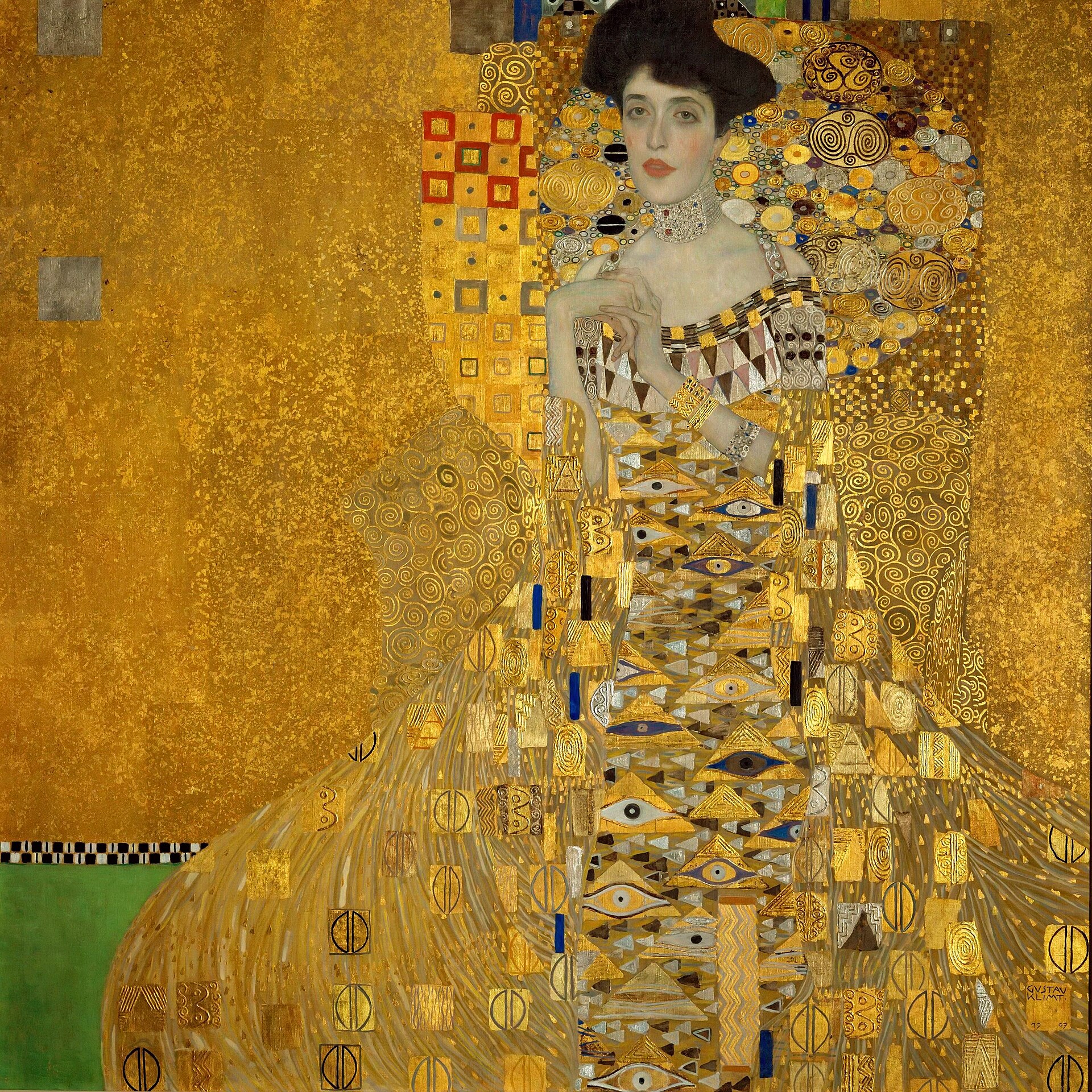
The Adele case was a dispute with the Republic of Austria that ran for sixty-five years. The picture went to the Austrian Gallery Belvedere in December 1941 under a claimed reading of Adele Bloch-Bauer's 1923 will, which had expressed a wish rather than a binding bequest and which in any event concerned works Ferdinand owned, not she. The museum kept it, renamed it Dame in Gold to obscure the sitter, and denied it was looted. It took Hubertus Czernin's archival work in 1998, a claim by Ferdinand's niece Maria Altmann with E. Randol Schoenberg, a ruling by the United States Supreme Court in 2004 that Austria could be sued at all, and an Austrian arbitration panel in 2006 before five paintings were returned. Altmann then sold the Adele portrait to Ronald Lauder for 135 million dollars so that it would sit in a public museum, the Neue Galerie, where it is today.
Elisabeth Lederer's portrait was restituted in 1948, three years after the war, by a court terminating its own seizure, to the family's own heir, without litigation and without an adversary museum. Austria's leverage over the Lederers was exercised on export, and above all on the Beethoven Frieze, not on this canvas. The title has then been unbroken through two owners for seventy-seven years, forty of them in one American collection, with no claim ever brought against it in the sources consulted.
That is what a resolved Nazi-era break in title looks like, and it is worth being precise about how rare it is. The overwhelming majority of works taken between 1938 and 1945 have no such record: they were destroyed, like ten to fifteen of this family's other Klimts at Immendorf; or they are still contested, like the frieze in 2015; or they simply vanished, like Klimt's portrait of Charlotte Pulitzer, missing since 1945 and never found. A documented seizure with a documented termination is not a blemish on this picture's provenance. In this market it is the strongest condition a Nazi-era object can be in, and part of what 236 million dollars bought.
The artist
Gustav Klimt
Klimt is the rare case where the market price and the art-historical position point the same way, and both rest on a very small body of surviving late work. He was a decorator's son who became the most fashionable portraitist in Vienna, was publicly humiliated over a state commission, walked away from public commissions altogether, and spent the last fifteen years of his life painting almost exclusively for a circle of assimilated Jewish industrialist families. That circle was dispossessed between 1938 and 1945. A large part of what he made in his maturity was burned, looted or lost in consequence, which is why an intact, documented, life-size late portrait is not simply expensive but structurally scarce.
Related works
| Work | Relation | Where it is |
|---|---|---|
| Portrait of Serena Lederer Gustav Klimt | The sitter's mother, by the same artist for the same family 1899, oil on canvas. Dubbed Symphony in White by critics at the tenth Secession exhibition in 1901 for its debt to Whistler. Also seized in 1938, also survived, also restituted to Erich Lederer in 1948. Reunited with the Elisabeth portrait at the Neue Galerie in 2016. | Metropolitan Museum of Art, New York |
| Portrait of Charlotte Pulitzer Gustav Klimt | The sitter's grandmother; the third of the three Lederer generations 1917. Known from a Max Eisler photogravure of 1931. Considered lost since the Nazi administration of the Lederer collection. Never confirmed as destroyed at Immendorf. | Lost; whereabouts unknown since 1945 |
| Portrait of Adele Bloch-Bauer I Gustav Klimt | The case this one is constantly confused with 1907. Held by the Austrian Gallery Belvedere from 1941, restituted to Maria Altmann by arbitration in 2006 after a sixty-five-year dispute, sold to Ronald Lauder for 135 million dollars. A contested restitution against a state museum, not a court-terminated seizure returned to the family in 1948. | Neue Galerie New York |
| Portrait of Adele Bloch-Bauer II Gustav Klimt | The only other full-length Klimt portrait commission in private hands 1912. Bought by Oprah Winfrey at Christie's in 2006 for 87.9 million dollars, then an artist record; sold privately for a reported 150 million dollars, dated 2016 by Artnet and 2017 by The Value. | Private collection, Hong Kong (HomeArt) |
| Beethoven Frieze Gustav Klimt | The other Lederer Klimt with a restitution history, and the one Austria used as leverage 1902, acquired by August Lederer from Carl Reininghaus in 1915. Recovered from the Altaussee salt mine in 1945 and returned to Erich Lederer, who could not export it. Sold to the Austrian state in 1973 for 750,000 dollars in exchange for export licences for the family's other Klimts. A family claim was rejected by the Austrian advisory board in 2015. | Secession Building, Vienna |
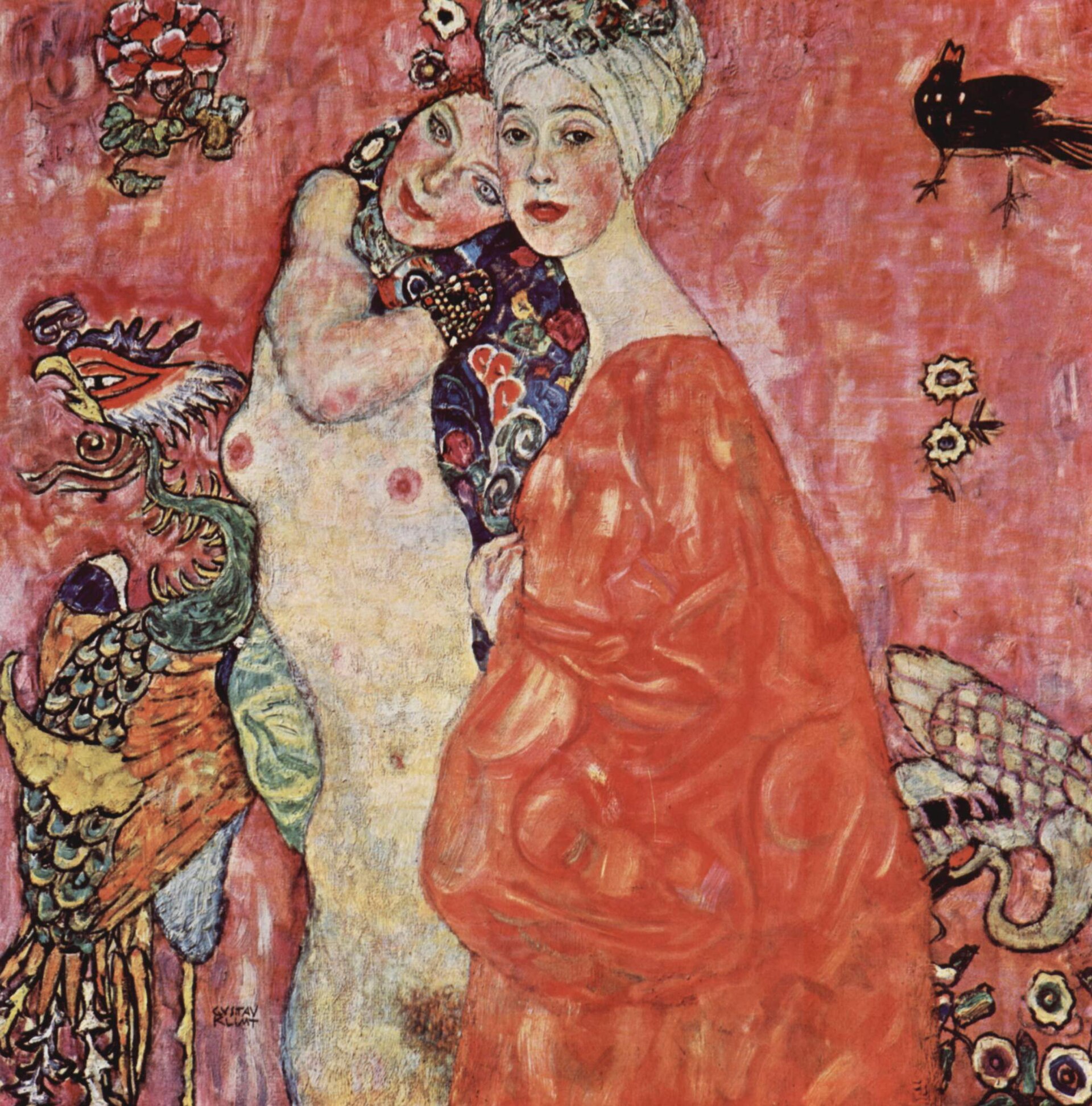
| Friends II (Die Freundinnen) Gustav Klimt | Sibling late work from the same collection, destroyed 1916-17. The closest surviving comparison for what the Elisabeth portrait does with East Asian ornament, and it exists now only as a colour reproduction. | Destroyed, Schloss Immendorf, 8 May 1945 |
| Jurisprudence Gustav Klimt | Faculty Painting owned by the Lederers, destroyed 1903-07. One of the three university ceiling paintings Klimt bought back from the state after the 1900-01 scandal. Survives only in black-and-white photographs. | Destroyed, Schloss Immendorf, 8 May 1945 |
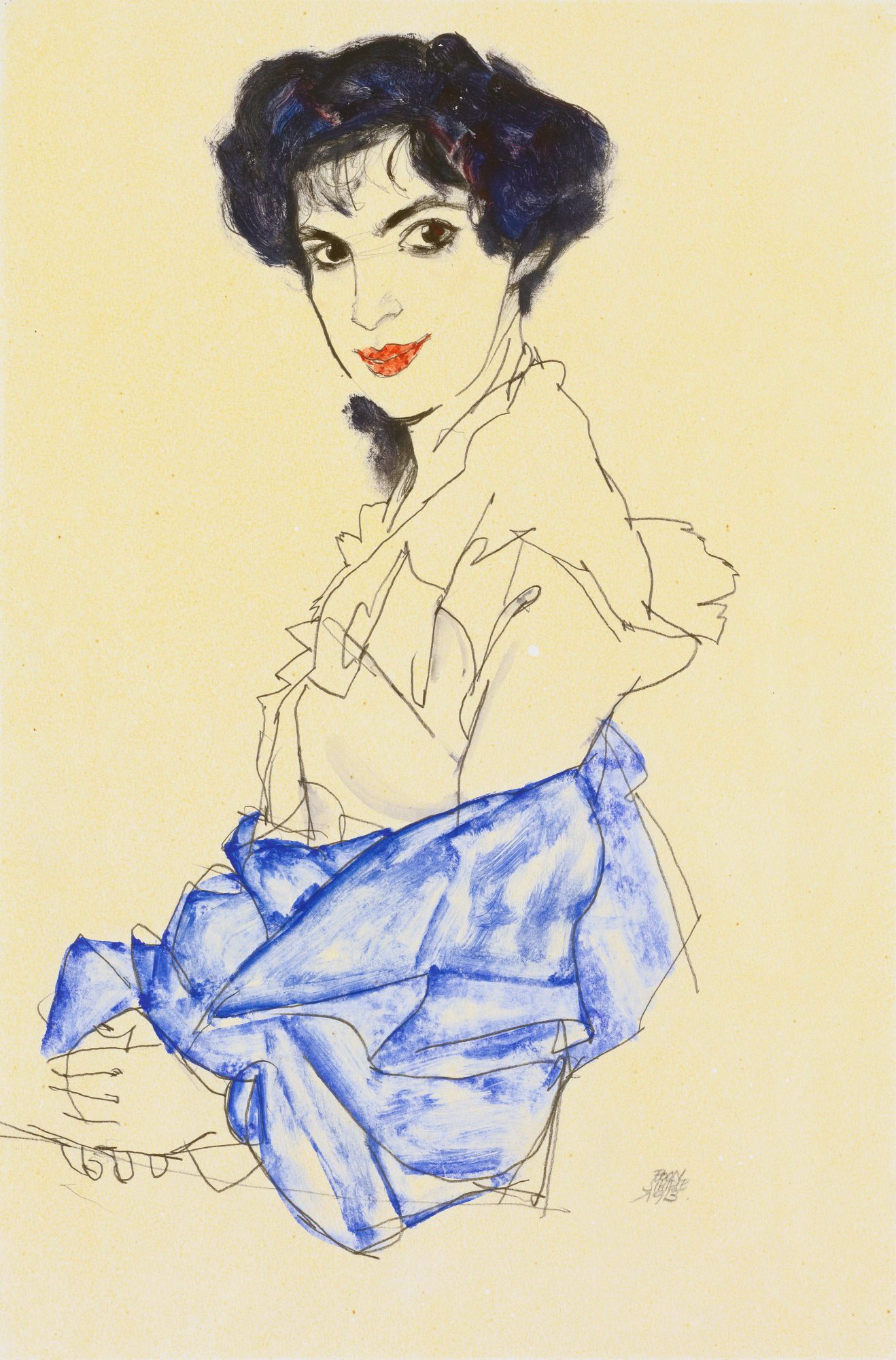
| Portrait of Elisabeth Lederer Egon Schiele | The same sitter, by the other artist the Lederers patronised 1913, gouache and pencil. Klimt introduced Schiele to the Lederers in 1912; Schiele gave Erich Lederer drawing lessons and painted both Erich and August. | Reproduced from a Sotheby's image; present location not established here |
| Portrait of Friederike Maria Beer Gustav Klimt | Closest stylistic sibling among the surviving late portraits 1916. Painted alongside the Elisabeth portrait and using the same device of a dense figured ground drawn from East Asian ceramic decoration. | Tel Aviv Museum of Art |
| Blumenwiese (Blooming Meadow) Gustav Klimt | Lot 11 in the same 2025 sale, also bought from Sabarsky in December 1985 c. 1908. Sold for 86 million dollars with fees. Its published chain runs through Broncia Koller-Pinell and Hugo Koller rather than the Lederers. Included here as a same-sale comparator, not as a related object. | Private collection |
Open questions
- Was this painting among the Lederer Klimts whose Austrian export licences were granted under the 1973 arrangement in which Erich Lederer sold the Beethoven Frieze to the state at roughly half market value? Erich was restituted the portrait in 1948 and was resident in Geneva; no source consulted states when or under what permission the canvas left Austria.
- What did the Serge Sabarsky Gallery pay Erich Lederer in or before 1983, and what did Leonard Lauder pay Sabarsky in December 1985? Both prices are undisclosed. Sotheby's provenance gives only the dates.
- Who bought the painting on 18 November 2025? The buyer was an undisclosed telephone bidder represented by Julian Dawes. Nothing further is public.
- At what level was the guarantee set, and was the irrevocable bidder the eventual buyer? The lot carried both a house guarantee and an irrevocable bid, but Sotheby's discloses the existence of these arrangements and not their terms.
- How many Klimt paintings burned at Schloss Immendorf? The MAK and Klimt Foundation name three Faculty Paintings plus six further canvases from the Lederer collection and two Dumba overdoors; Artnet says as many as ten Klimts; the Wikipedia article says fifteen. No source consulted publishes an authoritative inventory.
- Where is Klimt's Portrait of Charlotte Pulitzer of 1917? It has been missing since the end of the war and has never been confirmed as an Immendorf loss.
- Did Elisabeth Lederer return to Judaism after her 1938 divorce, as the Wikipedia article states? Under the Nuremberg framework a Mischling of the first degree who belonged to the Jewish religious community counted as a Geltungsjude and was treated as a full Jew, which would cut directly against the effect of the 1940 certificate. The two accounts are not reconciled in any source consulted.
- Who was the senior Nazi official, described as a former brother-in-law, who is said to have assisted Elisabeth Lederer? No source consulted names him.
- Did the painting appear in the 1936 exhibition of the Verein der Museumsfreunde in Vienna? Sotheby's lists it with the qualifier possibly.
- What happened to the canvas between its deposit at Kirchner and Co on 10 December 1939 and its appearance in the abandoned 1948 Dorotheum sale? Sotheby's published chain jumps from the 1939 deposit to the 1948 termination of seizure; the Dorotheum stage comes from secondary accounts.
Questions about this object
What is Portrait of Elisabeth Lederer?
Portrait of Elisabeth Lederer is a painting, dated 1914-1916. Medium: Oil on canvas.
Who made Portrait of Elisabeth Lederer, and is the attribution settled?
The attribution to Gustav Klimt is recorded here as accepted. Accepted as autograph Klimt.
Where is Portrait of Elisabeth Lederer now?
Private collection. Last confirmed 2 August 2026. Bought at Sotheby's New York, 18 November 2025.
What has Portrait of Elisabeth Lederer sold for?
Hammer USD 205,000,000; with premium, USD 236,360,000 with buyer's premium. Sotheby's, 2025-11-18.
What is still unknown about Portrait of Elisabeth Lederer?
Was this painting among the Lederer Klimts whose Austrian export licences were granted under the 1973 arrangement in which Erich Lederer sold the Beethoven Frieze to the state at roughly half market value? Erich was restituted the portrait in 1948 and was resident in Geneva; no source consulted states when or under what permission the canvas left Austria.
Sources
- 1Sotheby's, lot 8, Gustav Klimt, Bildnis Elisabeth Lederer (Portrait of Elisabeth Lederer), Leonard A. Lauder, Collector, Evening Auction, New York, 18 November 2025. Published provenance, exhibition history, selected literature, catalogue essay, estimate wording and the guaranteed property and irrevocable bid symbols. sothebys.com/buy/...
- 2Sotheby's, 'A 236.4 Million Dollar Klimt Portrait Sets Records as Sotheby's Inaugurates the Breuer'. House account of the bidding, the records set and the Lauder collection total. sothebys.com/en/...
- 3Kayan Wong, The Value, 'At US$236.3m, Klimt's Portrait of Elisabeth Lederer becomes the second most expensive work ever auctioned'. Carries the exact figures, hammer USD 205,000,000 and sold USD 236,360,000, and reprints the full lot provenance. en.thevalue.com/articles/...
- 4Daniel Cassady, ARTnews, 'Gustav Klimt's Portrait of Elisabeth Lederer Sells for $236.4 M., Highest Price for Any Work of Modern Art Sold at Auction', 18 November 2025. artnews.com/art-news/...
- 5The Art Newspaper, 'Record $236.3m Klimt leads Sotheby's first night of auctions in Breuer Building', 18 November 2025. Hammer and premium separated, sale totals and white-glove result. theartnewspaper.com/2025/...
- 6Aaron Short, Hyperallergic, 'Klimt Painting Becomes Second Most Expensive Artwork Ever Sold', 18 November 2025. hyperallergic.com/klimt-painting-becomes-second-most-expe...
- 7Sarah Cascone, Artnet News, 'This Fabulous Gustav Klimt Portrait Is Set to Smash Auction Records. Here's the Incredible Story Behind It', 19 September 2025. The paternity petition, Serena's sworn affidavit, the Reich department for genealogical research, Serena's purchase of Klimt's estate, the abandoned 1948 Dorotheum sale, and Kirsten Appleyard of the National Gallery of Canada on the emperor's cloak. news.artnet.com/art-world/...
- 8Gustav Klimt-Datenbank (Klimt Foundation, Vienna), 'The Lederer Family'. Family dates, the contents of the collection, Bartensteingasse 8, the faked family tree, the Immendorf loss and the abandoned 1948 Dorotheum sale. klimt-database.com/en/...
- 9Gustav Klimt-Datenbank (Klimt Foundation, Vienna), 'The Final Years'. Wartime collapse of income, the turn to portrait commissions, the Asian motifs of the late portraits, and the letter to Serena Lederer requesting an advance. klimt-database.com/en/...
- 10MAK Museum Vienna with the Klimt Foundation, 'Gustav Klimt, the MAK, and Immendorf Castle: Burnt, Destroyed, Vanished?', exhibition 16 July to 21 September 2025. Names the individual works destroyed on 8 May 1945. mak.at/en/...
- 11Wikipedia, 'Portrait of Elisabeth Lederer' (a Good Article, citing Natter 2018, Braun 2016, Whitford 1990, Fliedl 1998, Loebl and Wilentz 2025 and Dale for the National Gallery of Canada). TERTIARY: replace with Emily Braun, 'Empire of Ornament: Klimt's Portrait of Elisabeth Lederer', in Natter ed., Klimt and the Women of Vienna's Golden Age 1900-1918 (Prestel, 2016), pp. 56-79, and Natter, Gustav Klimt: The Complete Paintings (Taschen, 2018), p. 289. en.wikipedia.org/wiki/...
- 12Wikipedia, 'August Lederer', for the 1940 certificate of filiation, the resulting half-Jewish classification, and the contrasting full-Jewish classification of Erich and Fritz. TERTIARY: replace with the Austrian archival record of the Reichsstelle fuer Sippenforschung file and with Sophie Lillie, Was einmal war: Handbuch der enteigneten Kunstsammlungen Wiens (Vienna, 2003). en.wikipedia.org/wiki/...
- 13Wikipedia, 'Beethoven Frieze', for the Altaussee recovery, the 1973 sale to the Austrian state in exchange for Kreisky's export licences, and the 2015 rejection of the family claim. TERTIARY: replace with the Austrian Kunstrueckgabebeirat decision of March 2015 and BBC coverage of the same date. en.wikipedia.org/wiki/...
- 14Wikipedia, 'Portrait of Adele Bloch-Bauer I', for the Altmann chronology: the 1923 will, the 1941 transfer to the Belvedere, Czernin in 1998, Republic of Austria v. Altmann (2004), the 2006 arbitration and the 135 million dollar sale. TERTIARY: replace with the arbitration award text and Anne-Marie O'Connor, The Lady in Gold (2012). en.wikipedia.org/wiki/...
- 15Wikipedia, 'Erich Lederer'. TERTIARY. Flight to Geneva, the restitution effort, the export ban and the frieze sale, death in Geneva 19 January 1985. en.wikipedia.org/wiki/...
- 16Wikipedia, 'Serena Lederer'. TERTIARY. The Bartensteingasse residence, the composition of the collection, the 1940 confiscation and her flight to Budapest. Replace with Christian M. Nebehay, Gustav Klimt, Egon Schiele und die Familie Lederer (Bern, 1987). en.wikipedia.org/wiki/...
- 17Wikipedia, 'Serge Sabarsky'. TERTIARY. Born Vienna 1912, fled 1938, Madison Avenue gallery from 1968, planned the Neue Galerie with Ronald Lauder, died 1996. Replace with the New York Times obituary of 26 February 1996. en.wikipedia.org/wiki/...
- 18Wikipedia, 'Schloss Immendorf'. TERTIARY. The Freudenthal ownership, the contents of the depot and the fire of 8 May 1945. en.wikipedia.org/wiki/...
- 19Wikipedia, 'Gustav Klimt'. TERTIARY, used for the biography, the Kuenstlercompagnie, the Secession, the Faculty Paintings, the golden phase, Emilie Floege, the fourteen children and the circumstances of his death. Replace with Natter's complete paintings and Nebehay's Gustav Klimt: Dokumentation (Vienna, 1969). en.wikipedia.org/wiki/...
- 20Neue Galerie New York, 'Klimt and the Women of Vienna's Golden Age, 1900-1918', 22 September 2016 to 16 January 2017. Confirms the Elisabeth Lederer portrait in the show alongside the Serena Lederer portrait and both Bloch-Bauer portraits. neuegalerie.org/exhibitions/...
- 21Sotheby's, lot 11, Gustav Klimt, Blumenwiese (Blooming Meadow), same sale. Used only for the same-sale comparator and its Koller-Pinell provenance. sothebys.com/buy/...
Last verified 10 August 2026 · Published 2 August 2026
Change log
2 August 2026 - Record deepened to the house standard: narrative sections, technical evidence, artist dossier, related works and open questions added; provenance chain and auction results replaced with the researched versions; sources rebuilt.
5 August 2026 - Re-verified. Fresh searches turned up no confirmed identification of the 18 November 2025 buyer; the only new material is unconfirmed trade-press speculation (the newsletter Baer Faxt, reported via NewsNation and other outlets in early 2026) linking the purchase to Abu Dhabi and the forthcoming Guggenheim Abu Dhabi. Recorded as tertiary and unconfirmed in the relevant open question rather than treated as fact. No change to location, attribution or sale figures.
2 August 2026 - Images added, all public domain and self-hosted. Lead plate is the work itself.
2 August 2026 - Record created. Restitution chronology currently rests partly on a tertiary source and is flagged for replacement with the primary restitution record.
10 August 2026 - Re-checked. current_location unchanged: still an undisclosed private buyer from the 18 November 2025 Sotheby's sale; no post-sale placement, loan, resale or institutional announcement found (unconfirmed market speculation naming possible buyers is not reported here, per house rule against publishing unverified claims). Attribution unchanged, no challenge found. No litigation or dispute specific to this painting found (a separate, unrelated Klimt restitution matter involving a different sitter, Margarethe Lieser, was checked and is not this object). Searched again for a primary restitution record (an Austrian court order or the Lederer family's own papers) for the 1948 restitution to Erich Lederer; none surfaced. The record's best source for the exact seizure and restitution dates remains Sotheby's own lot note, already source 1; the Wikipedia citations flagged tertiary stay flagged. Gap stands, not fixed.