What Wally Neuzil Left in Her Own Hand
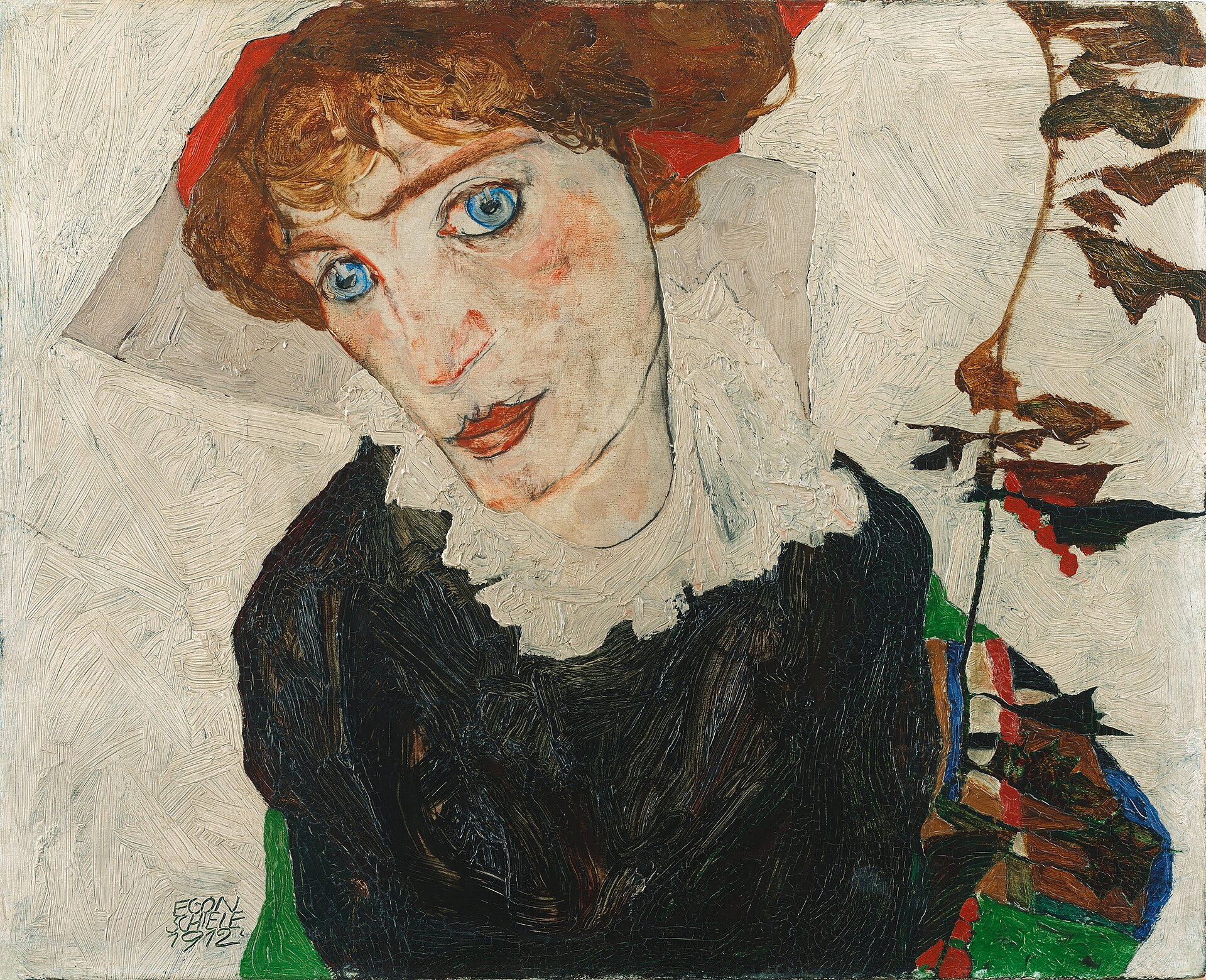
Schiele's Portrait of Wally settled for 19 million dollars in 2010. The Wally-Neuzil-Society counts about six surviving documents in her own handwriting, and her grave in Sinj was located only in 2015.
Records in this piece: Portrait of Wally Neuzil, Portrait of a Lady
On this page 10 sections
ContentsClose
In short
- The Wally-Neuzil-Society, which is headed by the provenance researcher who worked on the New York case, states that very few sources in Wally Neuzil's own handwriting are available or documented: probably three of the sixteen Vienna registration forms, one receipt, one letter of 1915 and a few words on a New Year postcard.
- Her grave was located only in 2015, by the Croatian journalist Lana Bunjevac, in Sinj north of Split. Robert Holzbauer visited it in 2016 and found the corresponding entry in the Book of the Dead of the city of Sinj.
- Restoring the grave was costed at around 2,000 euros in 2017. The picture of her had settled seven years earlier for 19 million dollars.
- Our own record repeated that she had modelled for Klimt. The Wally-Neuzil-Society says that story seems very doubtful, because no work by Klimt showing Wally Neuzil is known. The caption is corrected in this push.
- The Leopold Museum dates her modelling for Schiele to early 1911. The Wally-Neuzil-Society's biography page puts the meeting in 1912 and finds evidence she was in Vienna during 1911, but two other Society texts, including its chairman's own published abstract, say around 1911. The date is a range, not a settled fact.
- She was born in Tattendorf on 18 August 1894 to Thekla Pfneisl, a day-labourer, and Josef Neuzil, an elementary school teacher, who married on 11 March 1895, after her birth.
The panel has a fuller record than the woman in it
Egon Schiele's Portrait of Wally Neuzil has a long and well kept documentary record, and the woman it shows has almost none.
The panel has an inventory number, a catalogue history, a seizure, a federal forfeiture action, a settlement figure, a postage stamp and a museum campaign built on its face. This archive's own record for it runs to tens of thousands of words, most of them about title. Set beside that, the paper trail for Walburga Neuzil is a parish entry, a handful of registration forms, one receipt, one letter, a postcard signature, a military hospital posting and a line in a death book.
That asymmetry is the subject here. It is not a complaint about scholarship, which has in fact gone looking, and it is not an argument that the litigation was unimportant. It is a measurement of what an object can carry and what it cannot, and the answer is that a picture remembers its owners far better than it remembers its sitter.
She was born in Tattendorf before her parents married
Walburga Neuzil was born on 18 August 1894 in Tattendorf, a village of about 800 people some 35 kilometres south of Vienna.
The Wally-Neuzil-Society, working from the parish register of Tattendorf, gives her mother as Thekla Pfneisl, a day-labourer who lived from 1872 to 1933, and her father as Josef Neuzil, an elementary school teacher from South Bohemia who lived from 1863 to 1902. She was baptised in the village church and named Walburga. Her parents married on 11 March 1895, which is to say after she was born, and she took her father's surname then. The Leopold Museum's own exhibition material reproduces the baptismal entry and dates it 19 August 1894, the day after the birth the Society gives.
She had four sisters, Anna Emilia, Antonia, Maria and Berta, and the Society gives her two brothers as half-brothers, with the qualification its own page carries; both were born after her father's death. Her father was given charge of the elementary school at Sparbach in September 1901 and died in the hospital at Moedling in February 1902. His widow drew an official's widow pension until her death in 1933 and moved with her daughters to Vienna, where, the Society states, they changed address frequently and lived in the poorer districts.
None of that is remarkable, and that is the point. The documents that record her are the documents that record everybody: a baptism, an address, a pension.
She had a job in a shop while she sat for him
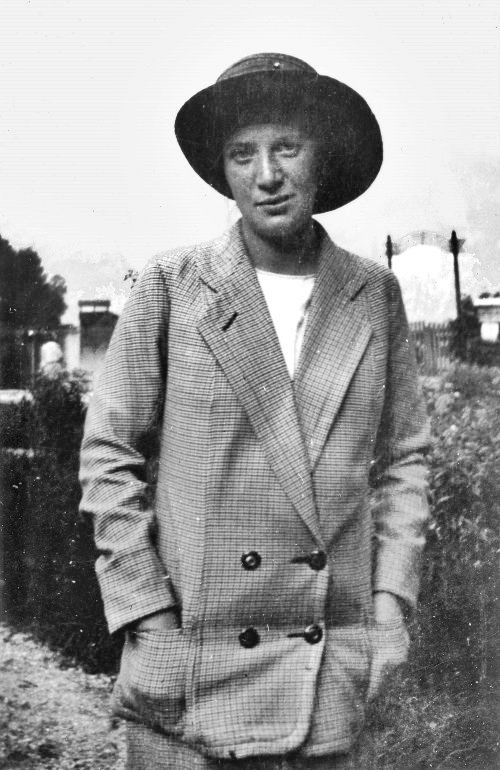
The Leopold Museum states that while she modelled for Schiele, Wally Neuzil was also working as a sales assistant, a cashier and a mannequin at a clothing store.
That single sentence does more to place her than most of what has been written about her. On the museum's account modelling was not her whole income. The museum also states that she stood by Schiele during his imprisonment at Neulengbach in April 1912, and the Society records what she carried in: the materials for the thirteen prison drawings now in the Albertina, and an orange, on which he wrote that the one orange was the only light.
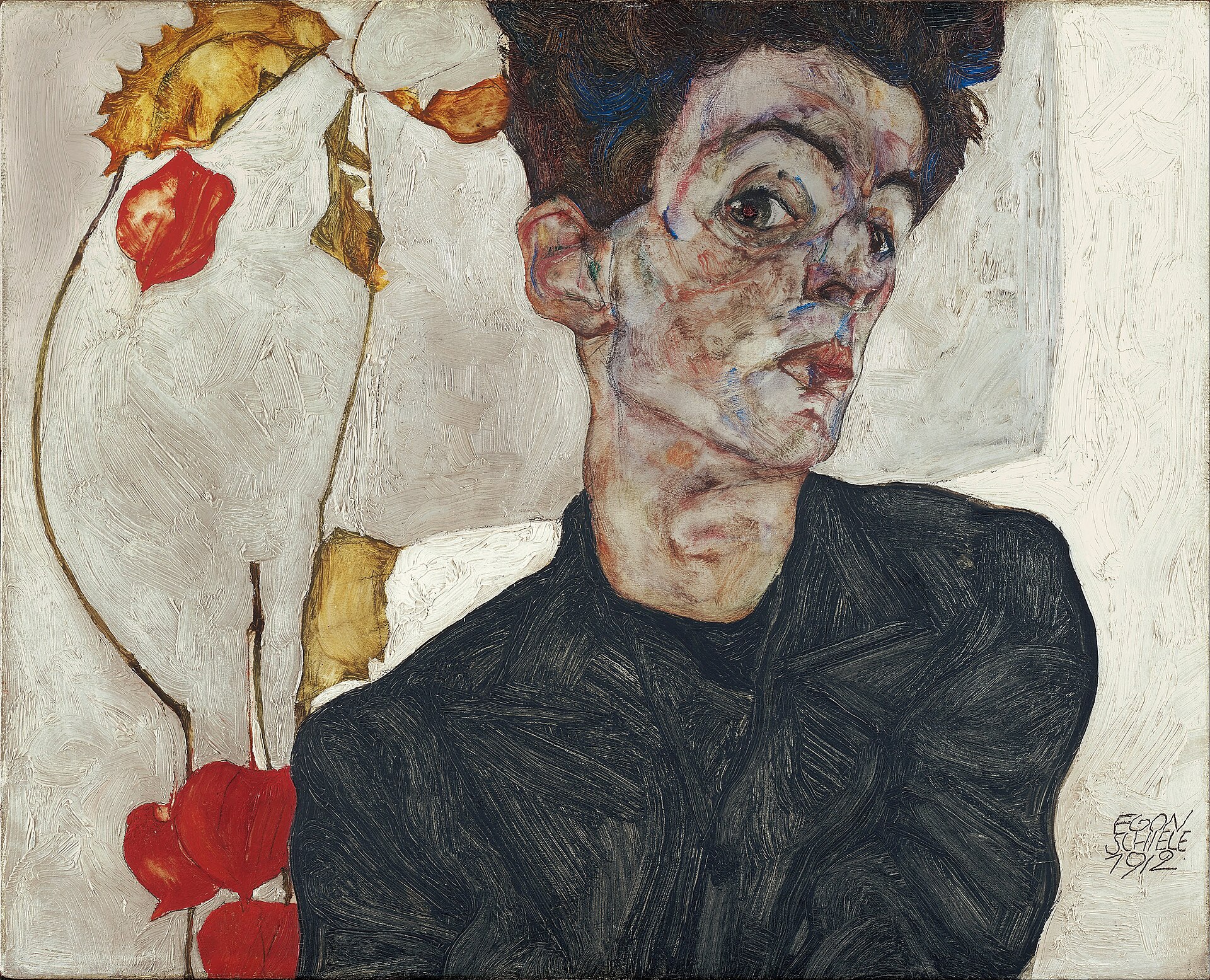
Schiele had been arrested on 12 April 1912 on an allegation of abducting and dishonouring an under-age girl. He was acquitted of those charges and punished instead for displaying indecent drawings where children could see them. The picture in this record was painted in that year.
Our own record said she had modelled for Klimt, and the specialists doubt it
This archive's record for the panel carried a caption stating that Wally Neuzil had modelled for Gustav Klimt, and the body that researches her says that claim is doubtful.
The Wally-Neuzil-Society addresses the story directly. It calls the idea that Klimt passed his model to Schiele a common myth, says it seems very doubtful, and gives two reasons: Klimt was not working with very young models at that time, and no work by Klimt showing Wally Neuzil is known. One Klimt does carry her name. A Portrait of Wally of 1916, from the Lederer collection, burned at Schloss Immendorf in 1945 and survives only in a black and white photograph, and the older literature identifies the sitter as her. The Klimt Foundation's own catalogue database does not: it states that the title does not allow the sitter to be identified, and that the assumption that she was Wally Neuzil has been made repeatedly but rests on no evidence. So two specialist bodies say the same thing, the one that researches her and the one that catalogues him. We had the claim from the general literature, and the Leopold Museum's own 2015 press text keeps a softer version alive by suggesting she became Schiele's model perhaps through Klimt's mediation. It should not have been stated by us as fact. The caption is corrected in the same push as this article, and the correction is recorded here rather than made quietly.
A second disagreement is live and we are not going to settle it. The Leopold Museum, which holds the painting, dates her to Schiele from early 1911 and says she moved with him to Krumau in the spring of that year. The Wally-Neuzil-Society's biography page puts the meeting in 1912 and states there is some evidence she was staying in Vienna in 1911. The Society is not consistent on it: its own research page reproduces a City of Baden release giving around 1911, and the abstract of its chairman's Sinj publication dates the relationship from around 1911. So the honest answer is a range, 1911 to 1912, with only one page of one specialist site arguing for the later date.
Six pieces of handwriting, as far as anyone has found
The Wally-Neuzil-Society states plainly that very few handwritten sources in her handwriting are available or documented, and then lists them.
There are sixteen registration forms in the archives of the city of Vienna, of which the Society judges probably three to be in her hand. There is a receipt made out for Schiele's landlord Moritz Otto Kuntschik. There is a letter to the painter Felix Albrecht Harta, dated 1915. And there is a postcard Schiele sent to his lawyer and collector Alfred Spitzer on 31 December 1912, now in the Egon-Schiele-Archiv of the Albertina with the inventory number DG2003/2798, carrying a New Year greeting in Schiele's hand and, below it, four words in hers: also from Wally Neuzil. The Society notes that the Leopold Museum's database of Schiele autographs corrected its presentation of that card, including its date, after the Society asked.
That is the whole surviving voice, and the table is short enough to print.
| Document | Date | Where it is |
|---|---|---|
| Registration forms, probably three of sixteen | 1911 to 1917 | Archives of the city of Vienna |
| Receipt for Schiele's landlord Moritz Otto Kuntschik | Not given | Recorded, location not stated |
| Letter to the painter Felix Albrecht Harta | 1915 | Recorded, location not stated |
| Four words on a postcard to Dr Alfred Spitzer | 31 December 1912 | Albertina, Egon-Schiele-Archiv, DG2003/2798 |
A reader used to provenance work will recognise the shape. This is what a chain of custody looks like when the object is a person: four entries, two of them without a stated location, and one of them a signature four words long.
In 1915 he married someone else and she became a nurse
Schiele ended the relationship in 1915 in order to marry Edith Harms, and Wally Neuzil signed up as an auxiliary nurse.
The Society quotes his own letter writing that he meant to marry, but maybe not Wally. The Leopold Museum describes the separation as a devastating scene and says he was drafted soon after, which it treats as one reason for the speed of the wedding. What she did next is documented rather than inferred. She served in military hospitals in Vienna. In August 1917 her mother Thekla signed a registration form recording that Wally was moving to Sebenico in Dalmatia, today Sibenik, and she arrived around her twenty-third birthday. Robert Holzbauer's private collection holds a copy of that form from the Vienna city and provincial archive.
Schiele's collector Heinrich Benesch wrote her a postcard there addressing her as a nurse at the military hospital in Sebenico, and the Society reproduces it. She was then moved inland to Sinj, to the regional defence force's hospital, the k. k. Landwehr-Marodenhaus, where the Austrian war archive records her serving under the commander's office. Those are thin records and they are real ones, and they are the reason anybody knows where to look for her grave.
She died on Christmas Day 1917 and was buried two days later
Wally Neuzil died of scarlet fever in the military hospital at Sinj on 25 December 1917, aged 23.
According to the death book of the city of Sinj she was buried in St Francis Cemetery on 27 December. The Leopold Museum's own account says only that she volunteered to go to Dalmatia in 1917 and died towards the end of that year from scarlet fever aged only 23, which is accurate and stops one step short of the grave. Schiele and Edith Harms both died of influenza in Vienna in 1918, he at twenty-eight.
Her mother and two of her sisters, Antonia and Berta, are buried in the town cemetery of Baden. The Society found them through a notice in the Badener Zeitung of 1933, which is a good example of how this kind of research actually proceeds: not through a museum file but through a local newspaper and a cemetery register.
Nineteen million dollars for the picture, about two thousand euros for the grave
The two figures that describe this case best are 19 million dollars and 2,000 euros.
On 19 July 2010 the Leopold Museum Privatstiftung settled the New York forfeiture action by paying the estate of Lea Bondi Jaray 19 million dollars, and kept the panel. The Austrian government issued a postage stamp of the portrait the following year to mark the tenth anniversary of the museum's opening. In 2015 the museum devoted an exhibition to her, and in 2017 it was reported still to be using the picture in its promotional campaigns.
Meanwhile the grave was lost. The Art Newspaper reported on 22 November 2017 that the Croatian journalist Lana Bunjevac had tracked it down in Sinj two years earlier, that the Viennese provenance researcher Robert Holzbauer had launched a campaign to restore the site at a cost of around 2,000 euros, and that Tattendorf had committed funds towards it. Holzbauer, whom a City of Baden press release credits with scientifically supervising the research in the New York case for many years, visited the grave in 2016 while a visiting lecturer at the University of Zadar and found the corresponding entry in the book of the dead. The abstract of his own publication for the Sinj exhibition records that the Society renovated her tomb in 2017, and the exhibition, Who Was Wally Neuzil?, was due to open at the Galerija Galiotovic in Sinj on 19 December 2017, six days before the centenary of her death.
| Date | Event | Sum |
|---|---|---|
| 19 July 2010 | Settlement of the New York forfeiture action, museum keeps the panel | 19,000,000 US dollars |
| 2011 | Austrian postage stamp of the portrait, tenth anniversary of the museum | Not published |
| 2015 | Grave located in Sinj by Lana Bunjevac | No cost reported |
| 2017 | Restoration of the grave, costed by the Wally-Neuzil-Society | About 2,000 euros |
We are not claiming the museum owed her an estate. The settlement was paid to the heirs of a dealer from whom the picture had been taken, which is what a restitution settlement is for. The comparison is worth printing anyway, because it is the true scale of the interest the object attracted and the interest the person attracted, and the second figure was raised by a small association and an Austrian village rather than by anyone who had profited from her face.
The institution that owns the portrait also narrates her
The Leopold Museum's exhibition text tells the reader what Wally Neuzil was like, and for that passage its evidence is the painting it owns. The exhibition itself went much wider, to the parish register, the registration forms and the war archive.
The museum writes that her mirror gaze shows her to be at peace with herself, that she looks calmly and inquiringly at her companion, and that the enigmatic power of the look makes her a modern Mona Lisa. It also describes what she revealed to Schiele in terms of his development as an artist. Those are readings of a picture, offered by the body that holds it, and they are not documents about a person. Robert Holzbauer, whose association did the archival work, announced a 2021 lecture under a title that says the same thing more bluntly: whoever spreads unprovable stories about Wally could also damage the biography of Egon Schiele.
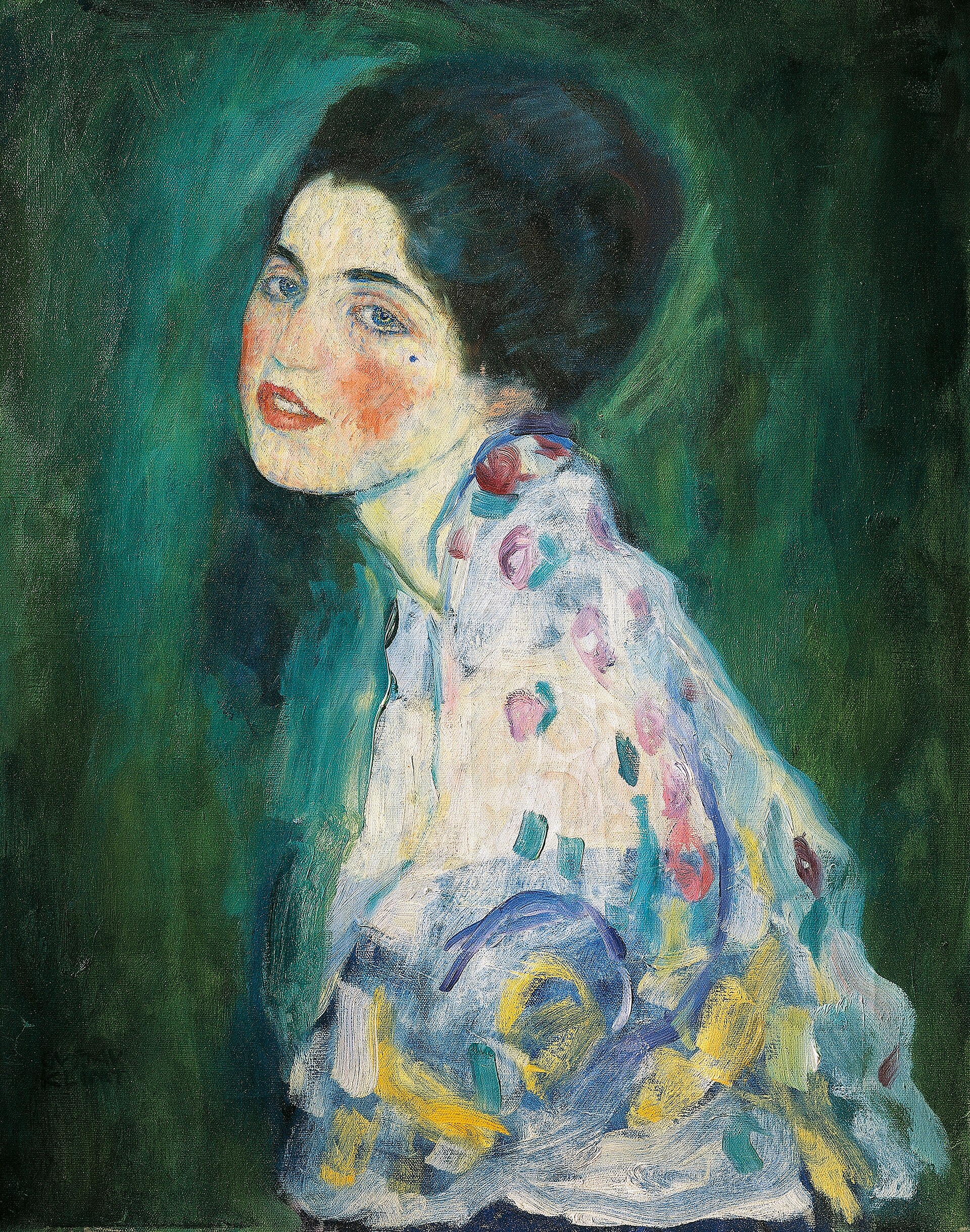
This archive holds a picture that shows the alternative. Klimt's Portrait of a Lady in Piacenza is a portrait of a young woman nobody has ever identified, painted over an earlier portrait of what radiography showed to be the same face. Her identity has not been recovered, and because it has not, nothing has been invented for her. Wally Neuzil has the opposite problem. Her name is known, which makes a biography feel available, and the six documents are what is actually there.
Why this archive is free to read
We do this for everyone who loves art. The people who have studied it for years, and the people who just stopped to look. Iconotheca exists so that what we learn belongs to all of them.
Nobody pays us for this. No ads, no sponsors, no commercial interest. These works belong to all of us, and we would rather share them with as many people as we can than keep them to ourselves.
If it gave you something today, tell us to keep going. Follow us, leave a like, or write a positive comment. We read every one, and they are what keeps us going.
Questions
Walburga Neuzil, 18 August 1894 to 25 December 1917, was Egon Schiele's model and companion from 1911 or 1912 until 1915, and the sitter for his Portrait of Wally Neuzil of 1912. The Leopold Museum records that while she modelled for him she was also working as a sales assistant, a cashier and a mannequin at a clothing store. After the relationship ended she trained as an auxiliary nurse, served in military hospitals in Vienna, went to Dalmatia in 1917 and died of scarlet fever at Sinj, aged 23.
She died of scarlet fever on 25 December 1917 in the military hospital at Sinj in Dalmatia, then part of Austria-Hungary, where she was serving as an auxiliary nurse. The death book of the city of Sinj records her burial in St Francis Cemetery on 27 December 1917.
She is buried in St Francis Cemetery in Sinj, in what is now Croatia. The grave's location was not generally known until 2015, when the Croatian journalist Lana Bunjevac tracked it down. The provenance researcher Robert Holzbauer visited it in 2016 and matched it to the entry in the city's book of the dead, and the Wally-Neuzil-Society renovated the tomb in 2017 at a cost put at around 2,000 euros.
Two specialist bodies say there is no evidence that she did. The Wally-Neuzil-Society calls the story that Klimt passed her on to Schiele a common myth and says it seems very doubtful, on the grounds that Klimt was not using very young models at that time and that no work by Klimt showing Wally Neuzil is known. The Klimt Foundation's catalogue database, addressing the Portrait of Wally of 1916 that burned at Immendorf, states that its title does not allow the sitter to be identified and that the assumption that she was Wally Neuzil rests on no evidence. This archive had repeated the claim and has corrected it.
Very little. The Wally-Neuzil-Society lists probably three of the sixteen registration forms held by the archives of the city of Vienna, a receipt for Schiele's landlord Moritz Otto Kuntschik, a letter of 1915 to the painter Felix Albrecht Harta, and four words added to a postcard Schiele sent to Alfred Spitzer on 31 December 1912, now Albertina inventory DG2003/2798.
The panel passed through the Viennese dealer Lea Bondi Jaray, was taken from her under National Socialism, and ended in the collection of Rudolf Leopold and then the Leopold Museum. It was subpoenaed in New York in January 1998 while on loan to the Museum of Modern Art, seized on a federal warrant in September 1999 after the Court of Appeals quashed that subpoena, and held by the United States for almost eleven years while United States v. Portrait of Wally proceeded. Title was never adjudicated. On 19 July 2010 the museum paid the Bondi Jaray estate 19 million dollars in settlement and kept it. None of that ownership history involves her.
Sources
- 1Wally-Neuzil-Gesellschaft / Wally-Neuzil-Society, "About Wally Neuzil", for the birth at Tattendorf on 18 August 1894 from the parish register, Thekla Pfneisl as a day-labourer and Josef Neuzil as an elementary school teacher, the marriage of 11 March 1895 after the birth, the sisters and half-brothers, the father's death at Moedling in February 1902 and the widow's pension, the doubt cast on the Klimt story, the prison drawings and the orange, the August 1917 registration form for Sebenico, the Benesch postcard, the posting to the k. k. Landwehr-Marodenhaus at Sinj in the Austrian war archive, the death on 25 December 1917 and the burial in St Francis Cemetery on 27 December per the death book of Sinj. wallyneuzilenglish.weebly.com/about-wally-neuzil.html
- 2Wally-Neuzil-Gesellschaft / Wally-Neuzil-Society, "Research", for the count of surviving autographs (sixteen registration forms in the archives of the city of Vienna, probably three in her hand; the receipt for Moritz Otto Kuntschik; the letter to Felix Albrecht Harta of 1915), the postcard to Dr Alfred Spitzer of 31 December 1912 at the Albertina under DG2003/2798 with the words also from Wally Neuzil, the correction made to the Leopold Museum's autograph database, Holzbauer's supervision of the New York case and his 2016 visit to the grave while lecturing at the University of Zadar, the discovery of the mother's and sisters' graves in Baden through the Badener Zeitung of 1933, and the 2021 lecture title on myths and facts. wallyneuzilenglish.weebly.com/research.html
- 3David D'Arcy, "The grave of Schiele's muse, Wally Neuzil, found in Croatia", The Art Newspaper, 22 November 2017, for Lana Bunjevac tracking down the grave in Sinj north of Split two years earlier, Robert Holzbauer's restoration campaign at a cost of around 2,000 euros, the exhibition Who Was Wally Neuzil? at Galerija Galiotovic reported as opening on 19 December, Tattendorf's committed funds, the death of scarlet fever on Christmas Day 1917, and the 19 million dollar settlement of 2010 followed by the Austrian postage stamp of 2011. Read 26 September 2026. theartnewspaper.com/news/...
- 4Leopold Museum, exhibition archive, "WALLY NEUZIL" (27 February to 7 September 2015), curated by Diethard Leopold, Stephan Pumberger and Birgit Summerauer, for the museum's dating of her modelling to early 1911, the move to Krumau in spring 1911, her work as a sales assistant, cashier and mannequin at a clothing store, her support during the imprisonment of April 1912, the separation of 1915, her nurse training and war hospital work in Vienna, her volunteering for Dalmatia in 1917 and death from scarlet fever aged 23, and the museum's mirror gaze and modern Mona Lisa readings. leopoldmuseum.org/en/...
- 5Leopold Museum, press materials, "WALLY NEUZIL. Her Life with Egon Schiele", for the exhibition, which ran from 27 February 2015 to 1 June and was extended to 7 September, and for the reproduced baptismal record of the parish of Tattendorf with the entry for Wally Neuzil dated 19 August 1894, Tomus V 1894 to 1932, which sits in the press image list PDF 415_WN_Bilderliste_verlaengert.pdf hanging off this page. The same press text keeps the Klimt story alive in hedged form, saying she became Schiele's model perhaps through Klimt's mediation. leopoldmuseum.org/en/...
- 6Robert Holzbauer, "TKO JE BILA WALLY NEUZIL? / WHO WAS WALLY NEUZIL?", 11 pages, abstract read on Academia.edu, for the publication having been made for an exhibition in the town of Sinj where the Wally-Neuzil-Society renovated her tomb in 2017. academia.edu/37333626/...
- 7Klimt Foundation, Vienna, Klimt catalogue database, entry covering the final years, for the statement that the title of the Portrait of Wally of 1916 does not allow the sitter to be identified and that the repeated assumption that she was Egon Schiele's model and lover Wally Neuzil rests on no evidence. The painting was in the Lederer collection, burned at Schloss Immendorf in 1945 and survives in a black and white photograph; it is Novotny and Dobai, Gustav Klimt, 1968, catalogue number 200. klimt-database.com/en/...
More in The Women Behind the Art
The partWhat the Opera Paid Marie van Goethem
The model for Degas's Little Dancer is documented in a payroll and two lines of his handwriting.
The Publisher Was the Sitter
Truth sold her own cartes de visite, registered the copyright in her own name and left the photographer unnamed.
The Half That Was Not Sold
Vera Salomons inherited 57 of her father's Breguet watches. Her mother got the other seventy and they were auctioned.