What a Collector's Name Is Worth as Evidence
One family name appears in nine records in this archive across seven object classes. It carries three completely different evidentiary weights, and the museums holding the objects do not always mark the difference.
Records in this piece: The Rothschild Prayerbook, The Lycurgus Cup, The Astronomer, The Hours of Jeanne d'Evreux, Queen of France, The Holy Thorn Reliquary, Cabinet, Potpourri Vase (Vase potpourri a vaisseau), "Tahmuras Defeats the Divs", Folio 23v from the Shahnama (Book of Kings) of Shah Tahmasp
On this page 6 sections
ContentsClose
In short
- The same collector's name carries three different evidentiary weights in this archive. It can be anchored to a published catalogue number, it can appear with no date and no citation at all, or it can rest solely on the assertion of the dealer who was selling the object.
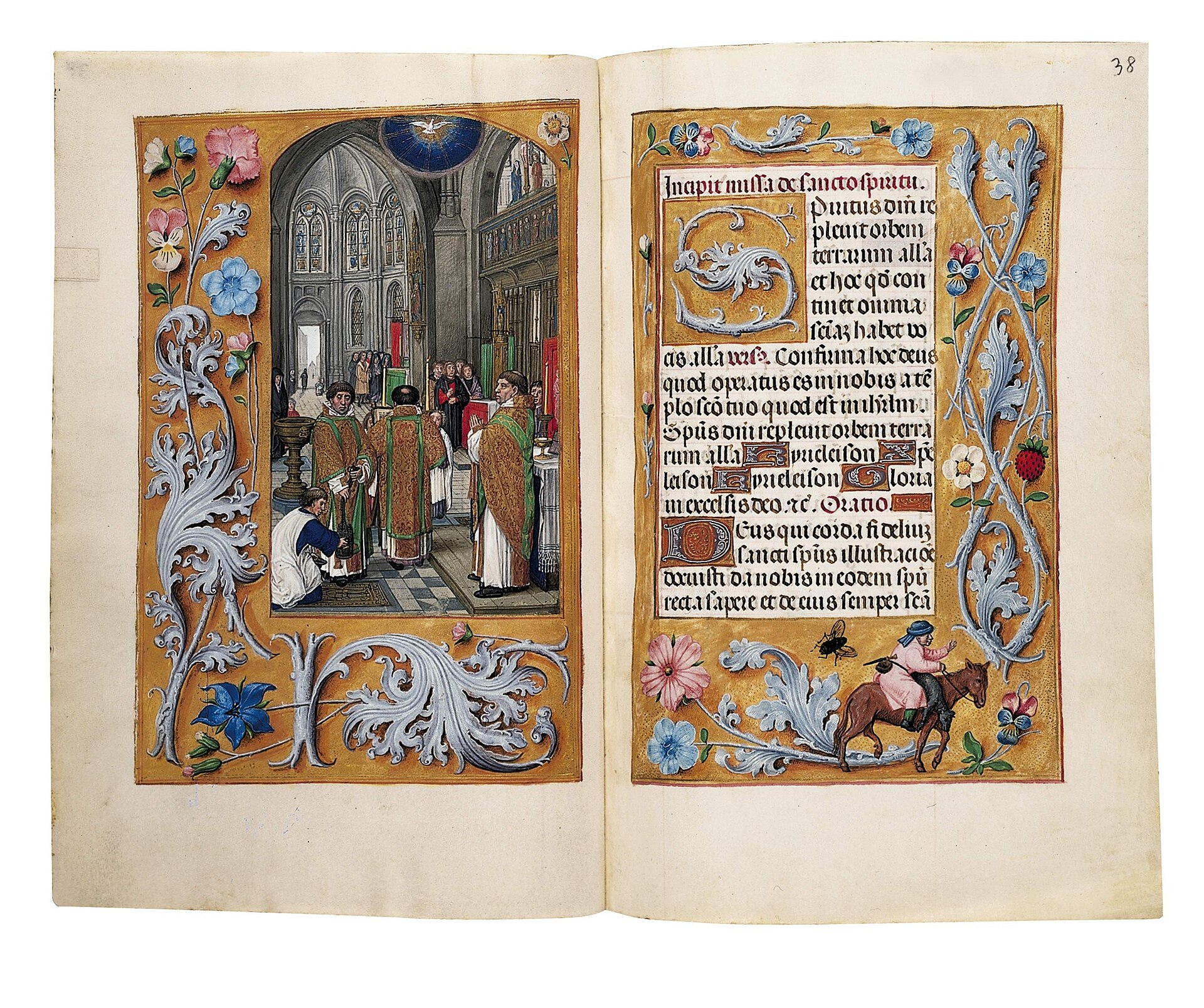
- Where a collection catalogued itself, the documentation reaches the object's surface. The Rothschild Prayerbook is number 597 in Schestag's 1872 catalogue and number 452 in the February 1906 estate inventory, valued at 150,000 Kronen, and it still carries the palace inventory marks 927 on a label and AR3390 in pencil on the front flyleaf.
- Cleveland's own record for its Boulle cabinet gives two consecutive Rothschild owners with no dates and no citations attached to either. The Walters record for its Sevres nef states that the date and mode of acquisition are unknown and that the provenance is unconfirmed, sourced to the vendor's own 1927 sale catalogue.
- How long restitution took tracked the documentation, not the loss. Vermeer's Astronomer was returned in 1946 to the man it was taken from, the Hours of Jeanne d'Evreux in 1948, and the Rothschild Prayerbook not until 1999, sixty-one years after it was appropriated.
- The Austrian statute that released the Prayerbook exists for a specific mechanism. Section 1 of the Kunstrueckgabegesetz of 1998 covers objects that had been restituted to their owners after 8 May 1945 and then passed into federal ownership without payment in the course of a procedure under the 1918 law prohibiting the export of cultural property.
One family name, nine objects, three kinds of evidence
One family name appears in the provenance of nine records in this archive, across seven object classes. The objects have almost nothing else in common: a Flemish book of hours, a late Roman glass cup, a Vermeer, a fourteenth-century French manuscript, a reliquary, a silver ewer, a Boulle cabinet, a Sevres porcelain nef and a folio from a Persian Shahnameh. What the name is worth as evidence differs completely from one to the next, and the difference is not a matter of how famous the object is.
| Object | Class | Holder | What the collector step rests on |
|---|---|---|---|
| Rothschild Prayerbook | Manuscript | Private | Published catalogue number, dated estate inventory, marks on the binding |
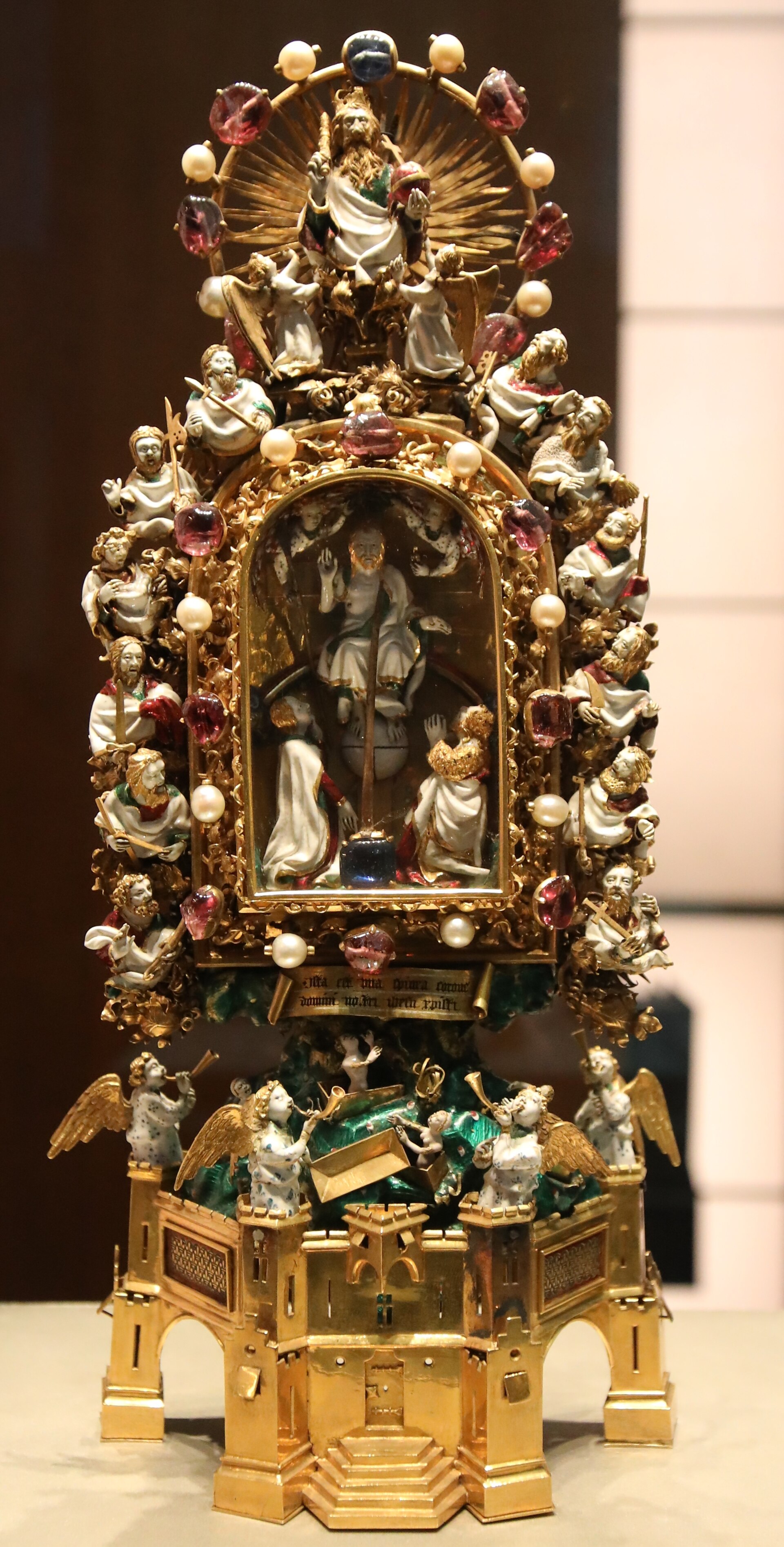
| Holy Thorn Reliquary | Goldsmith's work | British Museum | The collector's own published catalogue of his collection |
| The Astronomer | Painting | Louvre | Named dealer, in the collector's possession by 1888, then unbroken descent |
| Lycurgus Cup | Glass | British Museum | First and last owner named by the museum; the holders between them not named |
| Hours of Jeanne d'Evreux | Manuscript | Metropolitan Museum | Which member of the family acquired it is disputed between sources |
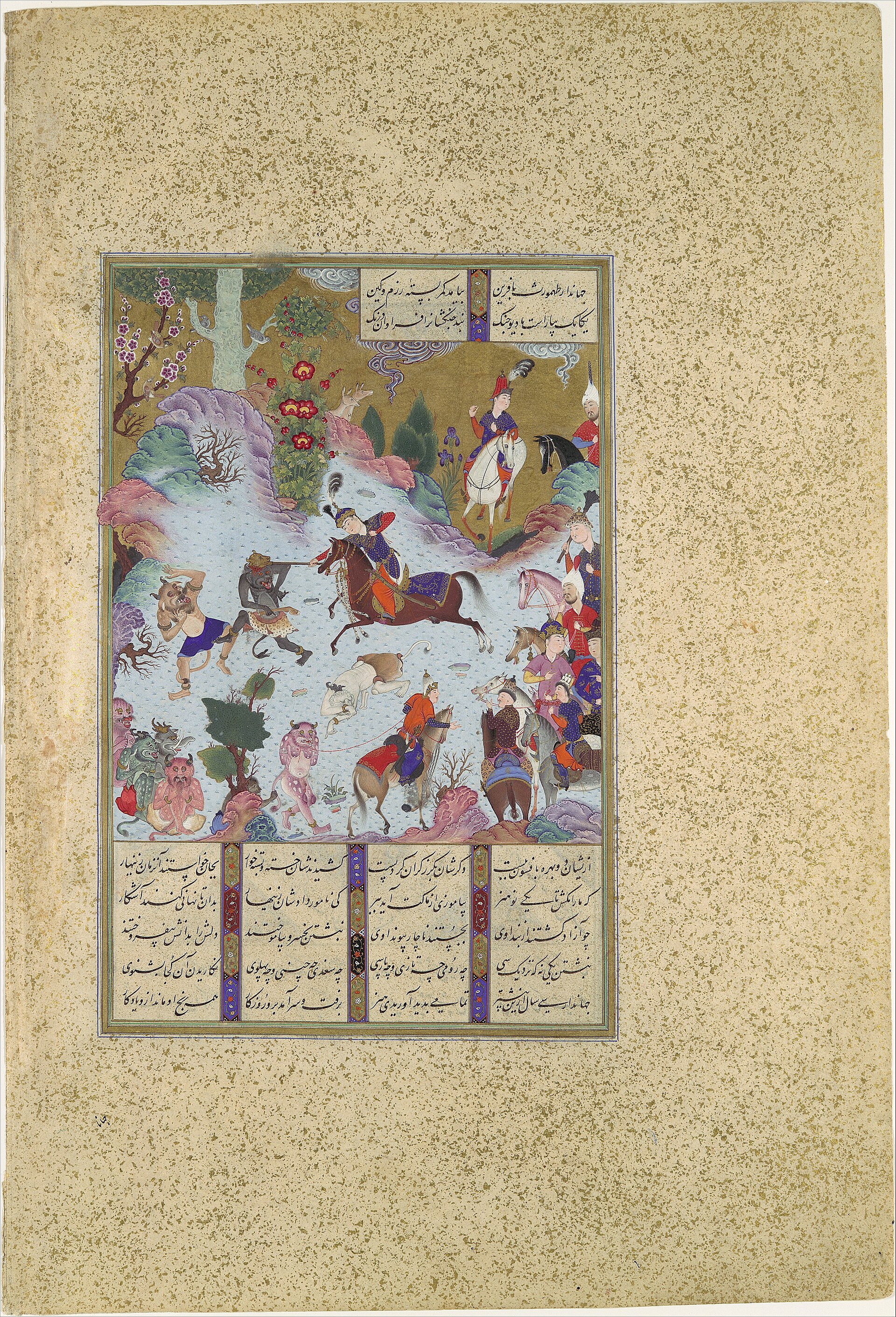
| Shahnameh folio | Manuscript | Metropolitan Museum | Family descent across three generations, one step flagged for confirmation |
| Aspremont-Lynden ewer | Silver | British Museum | Named seller, purchase date unrecorded |
| Boulle cabinet | Furniture | Cleveland Museum of Art | Two names, no dates, no citations |
| Sevres nef | Ceramic | Walters Art Museum | The vendor's own sale catalogue, flagged by the museum as unconfirmed |
Read down the last column and the ranking has nothing to do with the collector. It has to do with whether anyone wrote the transaction down at the time, and whether the institution that ended up with the object preserved what was written.
The collection that catalogued itself
A collection that publishes its own catalogue converts a family name into a citable document, and the Vienna Rothschild collection did exactly that. The catalogue note for the Rothschild Prayerbook records that the manuscript was number 597 in Schestag's 1872 catalogue of Baron Anselm von Rothschild's art collection, that the London Hours now in the British Library was number 599 in the same catalogue, and that number 595, a prayerbook illuminated for Cardinal Albrecht von Brandenburg and now in the Getty, had been bought in 1868. That last date is what allows the acquisition of number 597 to be placed shortly after it, rather than guessed at.
| Manuscript | Schestag 1872 number | 1906 estate inventory | 1906 valuation |
|---|---|---|---|
| Rothschild Prayerbook | 597 | 452 | 150,000 Kronen |
| Brandenburg Prayerbook, now Getty Ludwig IX 19 | 595 | 453 | 80,000 Kronen |
| London Hours, now British Library Add. MS 35313 | 599 | not stated | not stated |
The February 1906 inventory of Baron Nathaniel von Rothschild's estate goes further than an ownership claim. It records the Prayerbook as number 452, hanging in the Galerie of the palace in the Theresianumgasse, and valued at 150,000 Kronen against 80,000 for the Brandenburg book beside it, which fixes not only where the object was but what its owners thought it was worth relative to its neighbour.
Two later palace inventories left their numbers on the object itself: 927 on a label at the upper corner of the lower cover, and AR3390 in pencil on the front flyleaf. A provenance step that can be checked against a mark on the binding is a different class of evidence from a name in a list, and it is the reason this manuscript's ownership history survives the twentieth century intact while others in the same collection do not.
The name with no date attached
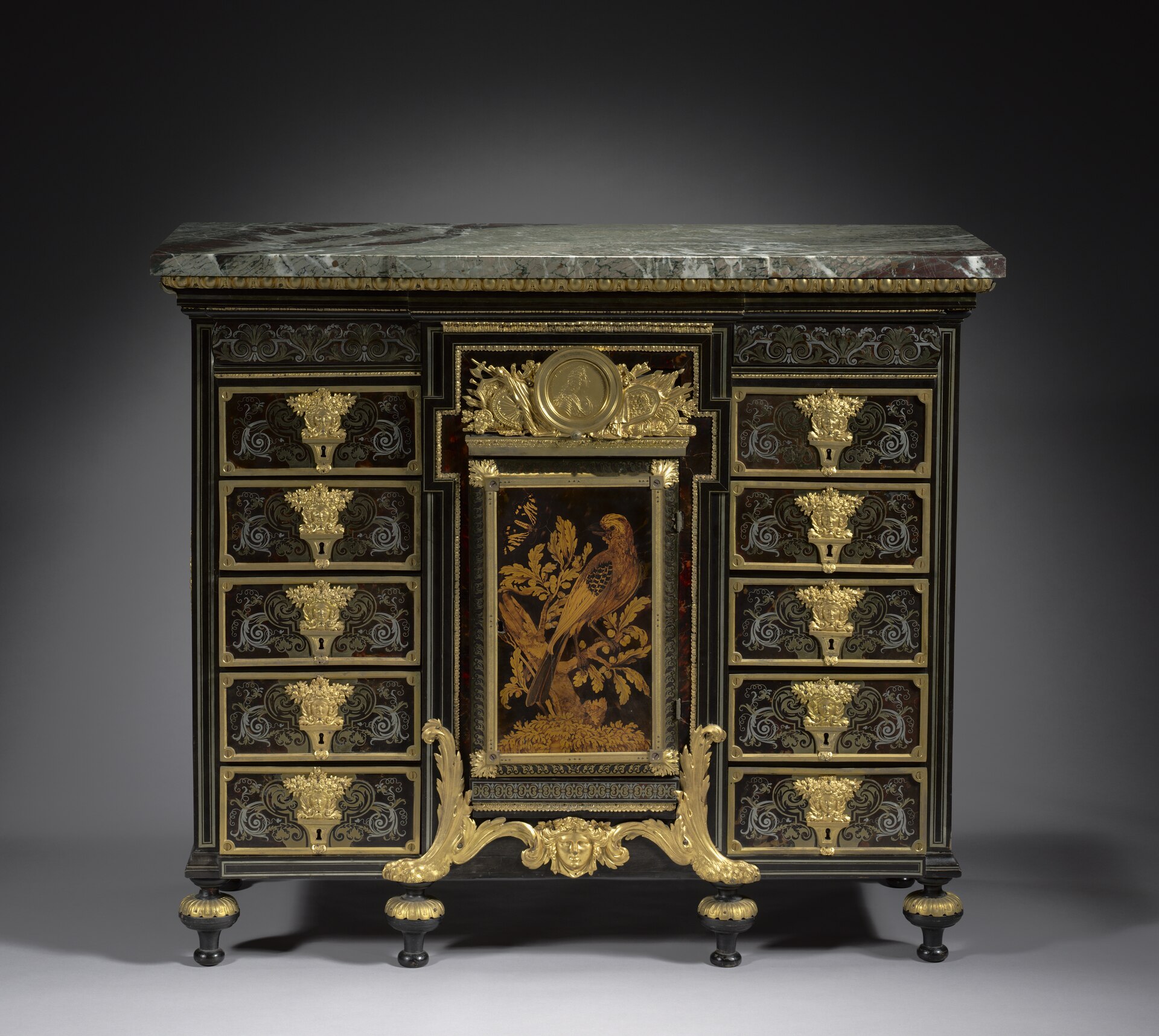
Cleveland's record for its Boulle cabinet names two consecutive owners and dates neither of them. The museum's own open access interface returns the whole provenance for accession 1949.539 as two entries: Baron Nathaniel de Rothschild, and Baron Alphose de Rothschild, Vienna (Rosenberg and Stiebel, Inc., New York). Both carry a null date field, neither carries a citation, and the second misspells the given name.
This is not a criticism of a museum that has published its provenance in machine-readable form, which most have not. It is an observation about what the record can and cannot support. A cabinet made around 1695 and acquired by Cleveland in 1949 has two and a half centuries of history compressed into two undated names, and the fullest published study of the piece, William Milliken's 1951 account in the museum's own Bulletin, begins at the same place. Nothing in the record distinguishes an ownership of forty years from one of four.
The consequence is specific and it is not academic. Which Nathaniel and which Alphonse are named decides whether this object was in Vienna in March 1938, and the record as published does not answer it. A researcher who wants to know cannot proceed from the museum's provenance; they have to reconstruct the family from outside it and then argue the identification, which is a different and far weaker kind of claim than reading a number off a binding.
The name the vendor supplied
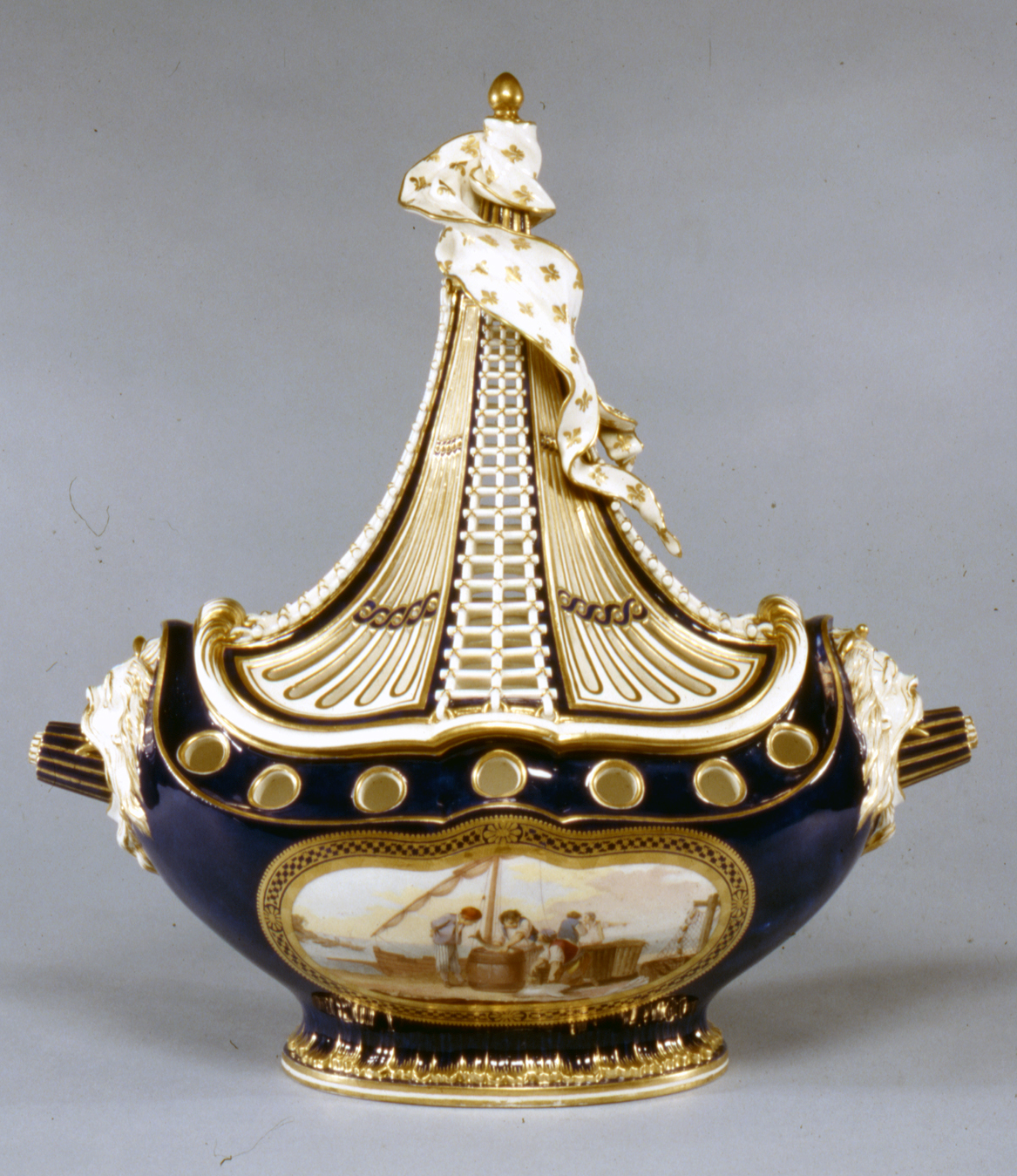
The weakest form of the collector step is the one where the only authority for it is the person who was selling the object, and the Walters Art Museum says so on the page. Its record for the Sevres potpourri vase in the form of a ship, accession 48.559, opens the provenance with the collection of Sir Anthony Nathan de Rothschild, 1st Baronet, and marks it date and mode of acquisition unknown, with a footnote.
That footnote is the most useful sentence in the record. It states that the provenance is not confirmed and gives its source: the vendor Edwin Marriott Hodgkins's own 1927 sale catalogue of his Sevres porcelain, number 30, which described the vase as formerly in the collection of Sir Anthony de Rothschild. The museum then traces the documented chain it can stand behind, from Hodgkins in Paris by 1927, through A. Seligmann, Rey and Co. in New York by 1928, to Henry Walters's purchase in 1928 and his bequest in 1931.
A collector's name in a dealer's catalogue is a price argument before it is a historical claim, and it is worth remembering which direction the incentive runs. The Walters has done the one thing that keeps such a claim usable: it has published the assertion, named who made it, dated it, and declined to adopt it. A record that quietly promoted the same sentence into an unqualified provenance line would look stronger and be worth less.
The name that becomes the object's label
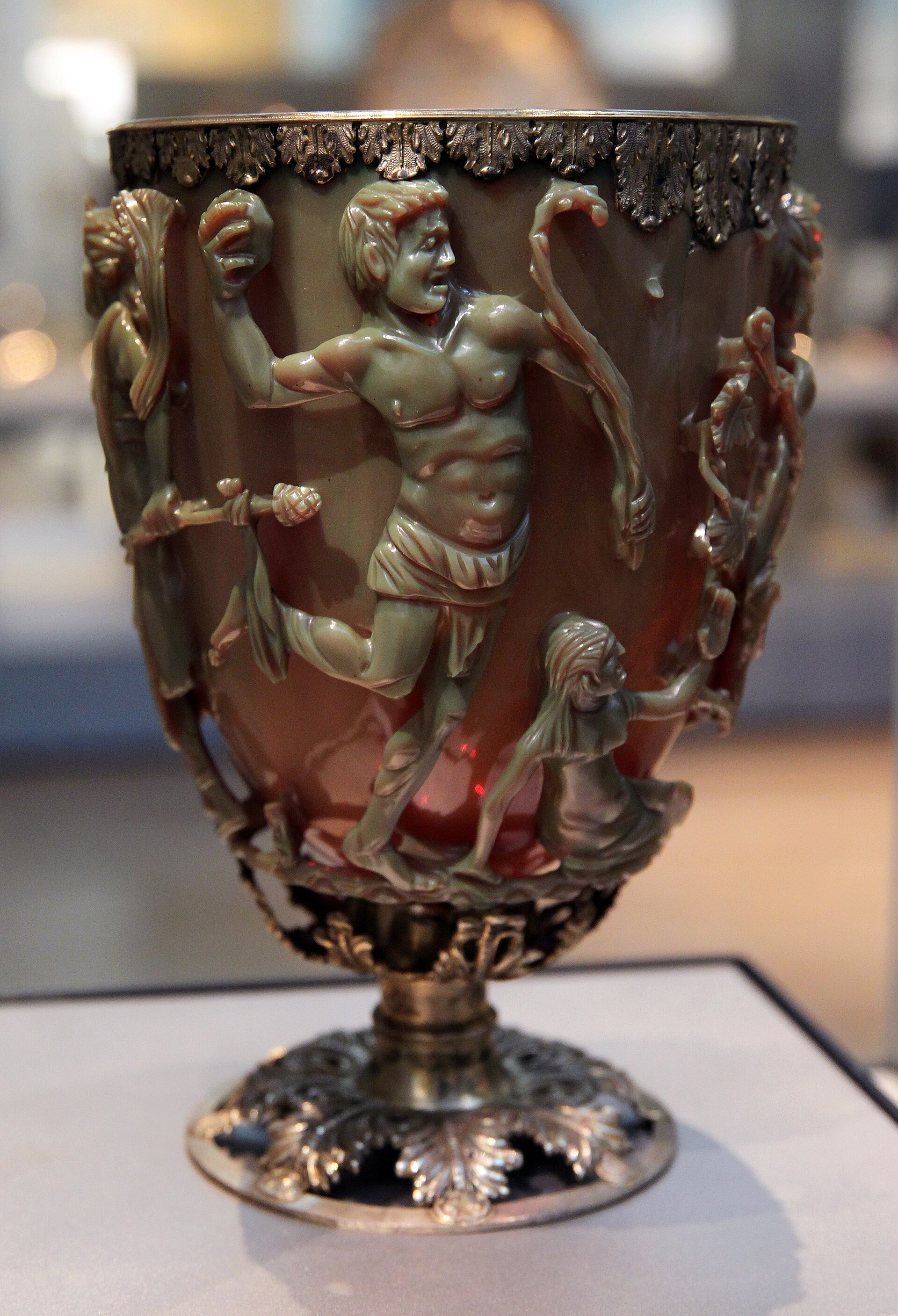
A collector's name can outlast the ownership it records and end up as the object's name in the scholarly literature. The British Museum's record for the Lycurgus Cup, registration 1958,1202.1, gives the acquisition as a purchase from Victor, 3rd Lord Rothschild, with a contribution from the body now called the Art Fund, and its acquisition note states that the cup was originally acquired by Baron Lionel Nathan de Rothschild, who died in 1879.
What the museum does not do is fill in the middle. It names the first owner and the seller nearly eighty years later, and leaves the holders in between unnamed, which is why this archive's own entry records that span as a documented family descent rather than as a list of owners it cannot support. The standard technical study of the object, published by Harden and Toynbee, is nonetheless titled after the family, so the name now travels with the cup through the bibliography while the ownership it describes remains only partly recorded.
That is a common and underrated hazard. A name repeated in citations acquires the look of established provenance without any new evidence entering the record, and the only defence is to go back to the acquisition note and see how much of the chain the holding institution actually claims.
What the rupture did to each tier
Three of these nine objects were taken from their owners between 1938 and 1940, and the time each took to come back tracked the paperwork rather than the loss. The Vienna palace holdings were appropriated in 1938. The Paris collections were seized from 1940 and processed by the Einsatzstab Reichsleiter Rosenberg, the confiscation agency that ran looted French collections through the Jeu de Paume.
| Object | Taken | Returned | Returned to | Interval |
|---|---|---|---|---|
| Vermeer, The Astronomer | Paris, 1940 | 1946 | Baron Edouard de Rothschild, the owner himself | 6 years |
| Hours of Jeanne d'Evreux | Paris, 1940 | 1948 | Maurice de Rothschild | 8 years |
| Rothschild Prayerbook | Vienna, 1938 | 1999 | The heirs | 61 years |
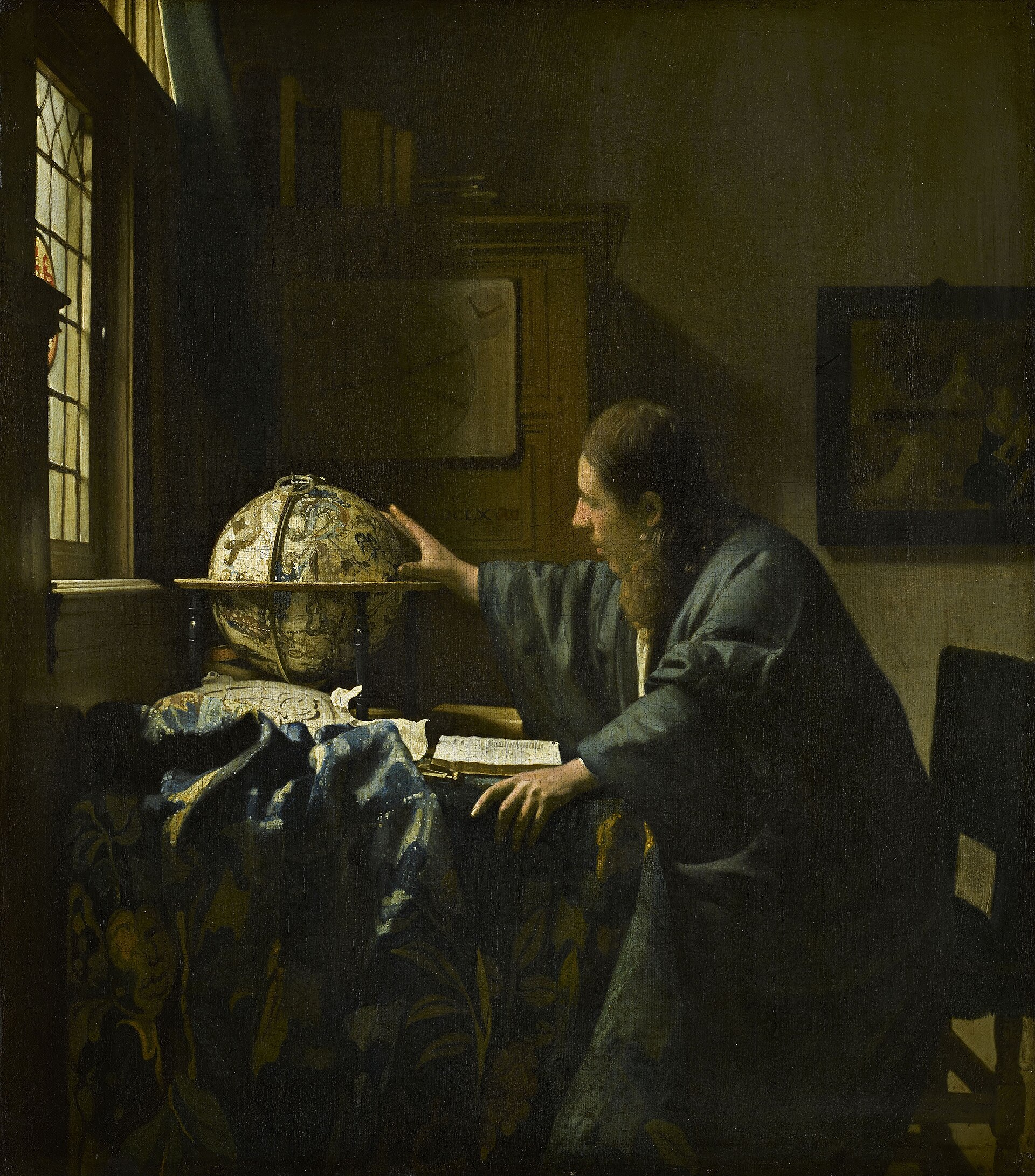
The Louvre's own record for The Astronomer sets out the chain without softening it: seized in 1940 for the museum planned at Linz, recovered by the Allies in 1945, restituted to Baron Edouard in 1946, inherited by Guy de Rothschild, and acquired from him by dation en paiement of transfer duties in 1982 to 1983, which is how it came to the French State as inventory RF 1983 28 with no sale and therefore no price. The Hours of Jeanne d'Evreux was found at Neuschwanstein by an Allied Monuments, Fine Arts and Archives officer, restituted to Maurice de Rothschild in 1948, and reached the Metropolitan Museum in 1954 as accession 54.1.2.
The Vienna object is the outlier by more than half a century, and the reason is a legal mechanism rather than a lost file. Section 1 of the Austrian Kunstrueckgabegesetz, published as BGBl. I Nr. 181/1998 and in force from 5 December 1998, authorises the transfer back to original owners or their heirs of objects in federal museums and collections that had been restituted after 8 May 1945 and had then passed into federal ownership without payment in the course of a procedure under the 1918 law prohibiting the export of objects of historical, artistic or cultural significance. The statute names the mechanism it exists to undo. Once it was in force the Vienna holdings moved quickly: Christie's sold the collection of the Barons Nathaniel and Albert von Rothschild in London on 8 July 1999.
Questions
Only when something dates it. In this archive the same family name appears attached to a published catalogue number and a valuation in Kronen, and also attached to nothing at all beyond a dealer's sale catalogue. The name is a lead in every case and evidence in some of them, and the record has to say which.
Usually because that is what the acquisition file contains. A record compiled in the 1940s from a dealer's invoice preserves the names the dealer supplied and rarely more, and a museum that publishes it as it stands is being accurate about its own holdings. The alternative, which is to infer dates that no document supports, produces a smoother line and a less reliable one.
No, and removing it destroys information. The Walters record for its Sevres nef is the model: it prints the claim, names the 1927 vendor catalogue it came from, states that it is unconfirmed, and then sets out the documented chain separately. A reader can see both the assertion and its standing, which is what makes the entry usable by someone checking it against their own file.
Sources
- 1Christie's, catalogue note and provenance for lot 157, 'THE ROTHSCHILD PRAYERBOOK, a Book of Hours, use of Rome, in Latin, ILLUMINATED MANUSCRIPT ON VELLUM', sale 2819, Renaissance. Records the Schestag 1872 catalogue numbers 595, 597 and 599, the February 1906 estate inventory number 452 and the 150,000 and 80,000 Kronen valuations, the palace inventory marks 927 and AR3390, the appropriation of 1938, and the sale of the Vienna collection at Christie's London on 8 July 1999. christies.com/en/...
- 2The Cleveland Museum of Art, Open Access API, object record 127221, Cabinet, accession 1949.539. Queried 22 August 2026: provenance returned as two entries, 'Baron Nathaniel de Rothschild' and 'Baron Alphose de Rothschild, Vienna (Rosenberg & Stiebel, Inc., New York)', both with a null date and no citations. openaccess-api.clevelandart.org/api/...
- 3The Walters Art Museum, object record for Potpourri Vase (Vase potpourri a vaisseau), accession 48.559. Provenance section and footnote 1, which states that the provenance is not confirmed and cites Edwin Marriott Hodgkins, 'Catalogue of an Important Collection of Old Sevres Porcelain, Louis XV and Louis XVI Period, Belonging to E.M. Hodgkins', Paris 1927, number 30. art.thewalters.org/object/...
- 4The British Museum, collection record for the Lycurgus Cup, drinking-cup, registration 1958,1202.1. Acquisition name 'Purchased from: Victor, 3rd Lord Rothschild', funder recorded as the Art Fund (as NACF), and acquisition notes naming Baron Lionel Nathan de Rothschild (1808-1879) as the original acquirer. britishmuseum.org/collection/...
- 5Musee du Louvre, collections database, entry for L'Astronome, RF 1983 28, Departement des Peintures. Provenance records the 1940 seizure for the museum projected at Linz, Allied recovery in 1945, restitution to Baron Edouard in 1946, and acquisition from Guy de Rothschild by dation en paiement of transfer duties in 1982 to 1983. collections.louvre.fr/en/...
- 6Kunstrueckgabegesetz (KRG), Section 1, published as BGBl. I Nr. 181/1998, in force from 5 December 1998. Consolidated federal law text in the Austrian legal information system of the Federal Chancellery. ris.bka.gv.at/eli/...
- 7The Metropolitan Museum of Art, collection record for The Hours of Jeanne d'Evreux, Queen of France, accession 54.1.2, The Cloisters, for the 1954 accession and the Pucelle attribution. metmuseum.org/art/...
More in Collectors and Collections
The partThe credit line names the collector, and the accession number tells you what happened
Morgan died in March 1913, and the Metropolitan credits him with gifts made in 1917. The credit line names the collector.
The Longest Ownership Links Here Belong to Owners That Were Not People
The 28 longest institutional ownership links in this archive run 7,434 years between them. Three end in a completed sale.
The Name in the Buyer's Column Is Often an Employee
Across 126 years of sales in this archive the winning bidder is repeatedly not the owner.