The Lycurgus Cup
Unrecorded Roman cage-cup workshop · 4th century AD
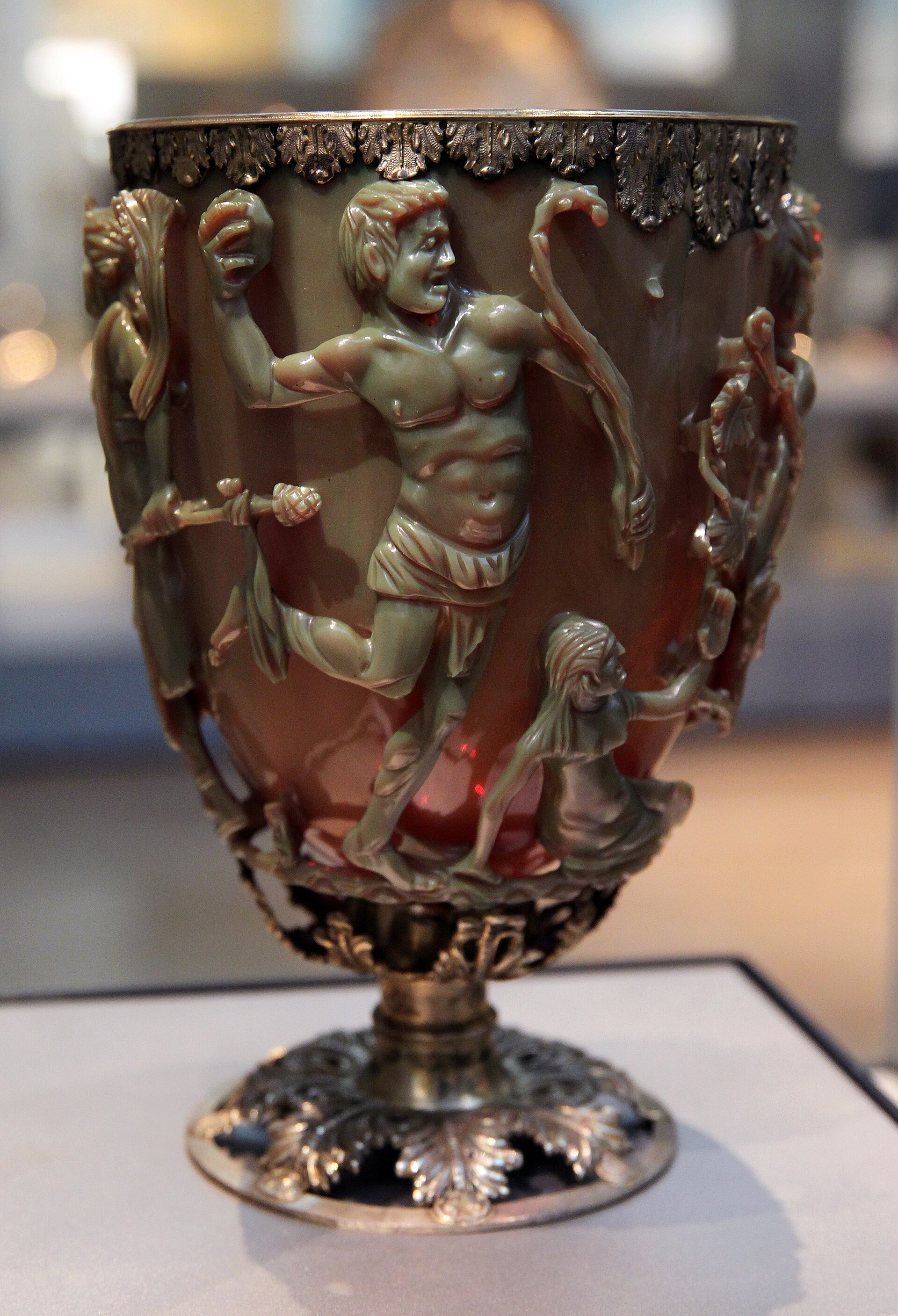
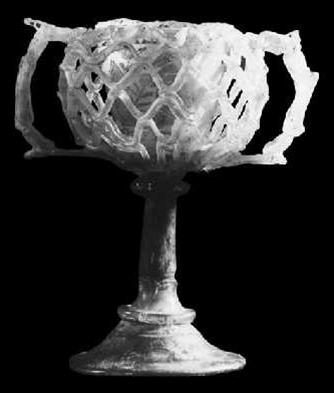
The record subject, photographed in Room 41 of the British Museum with the light in front of it. In this state the cup reads olive green and the ground behind the figures reads warm brown; only the thinnest undercut passages transmit red. The satyr swings a rock at the centre, Ambrosia kneels at the lower right, and the silver-gilt rim band and openwork foot, both long post-Roman, are clearly visible.
| Maker | Unrecorded Roman cage-cup workshop |
|---|---|
| Date | 4th century AD |
| Medium | Dichroic glass containing colloidal gold and silver, cut and ground as a cage cup; silver-gilt rim band and silver-gilt openwork foot added long after antiquity |
| Dimensions | Height 158.80 mm; maximum diameter 132 mm; weight 700 g |
| Where it is now | British Museum, London. On display, Room 41, Europe AD 300-1100, Section 5, The Byzantine Empire, Case 11last confirmed 4 August 2026 |
| Inventory number | 1958,1202.1 (the foot separately numbered 1958,1202.1.a) |
| Attribution | UnknownNo maker, workshop or patron is recorded, and no cage cup anywhere carries a maker's name. Full note |
| Object type | Glass |
| Period | Late Roman, 4th century AD |
| Cases | Has a provenance gap |
| Inscriptions | None. The cup carries no inscription, which separates it from most of the surviving cage cups, several of which are inscribed with drinking toasts. |
| Owners on record | 6 links3 documented, 1 disputed, 2 unknown |
| Sources | 10 cited |
About this record Last verified 4 September 2026 · 10 sources cited · Change log
On this page 12 sections
ContentsClose
A late Roman drinking cup, 15.9 centimetres high and weighing 700 grams, cut so that a scene of the death of King Lycurgus stands almost free of the vessel wall, joined to it only by hidden bridges. It is the one complete surviving object made of Roman dichroic glass: lit from the front it is a dull jade green, lit from behind it turns translucent wine red. The colour change is caused by particles of a gold and silver alloy about seventy nanometres across, suspended in the glass at a few hundred parts per million.
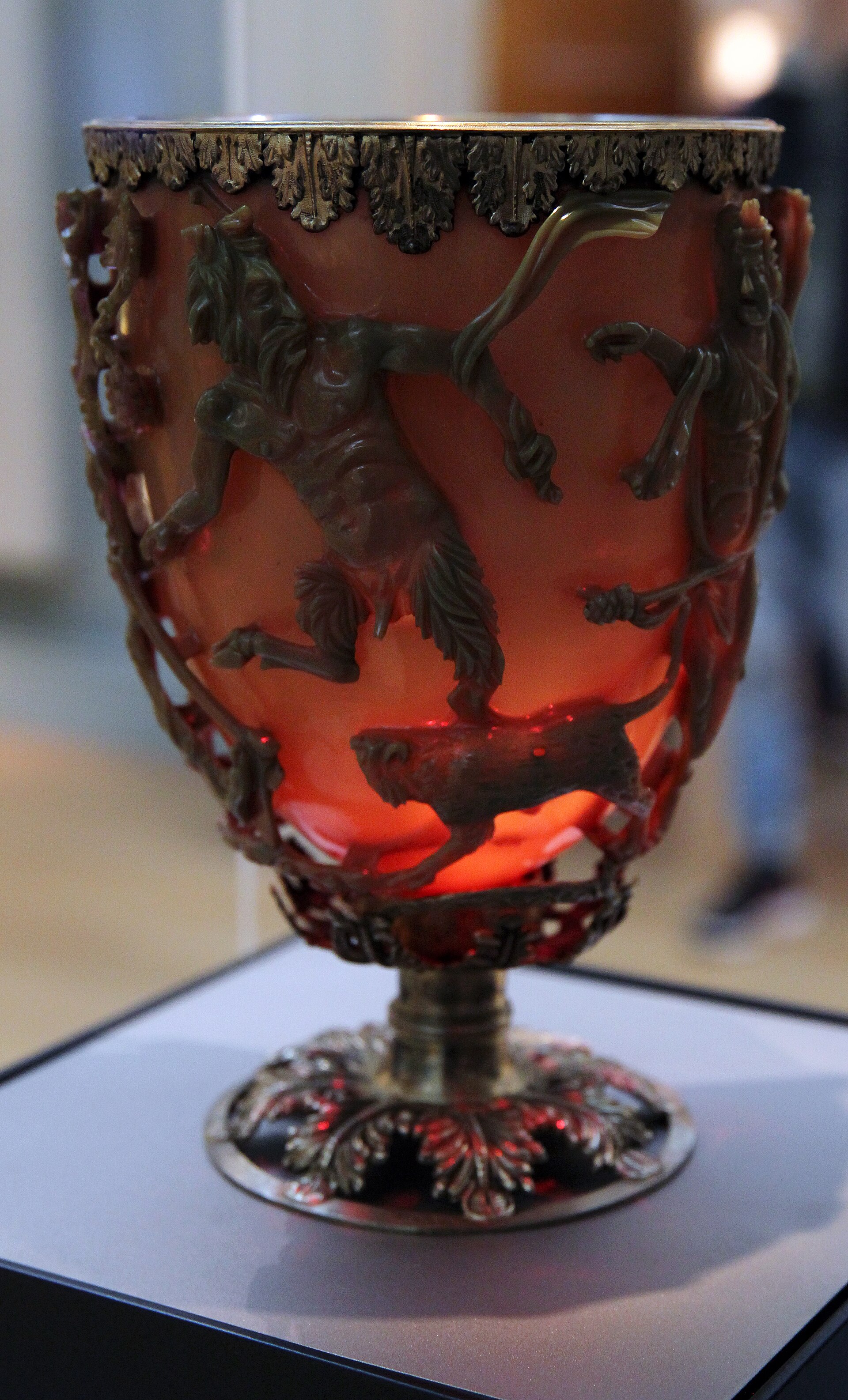
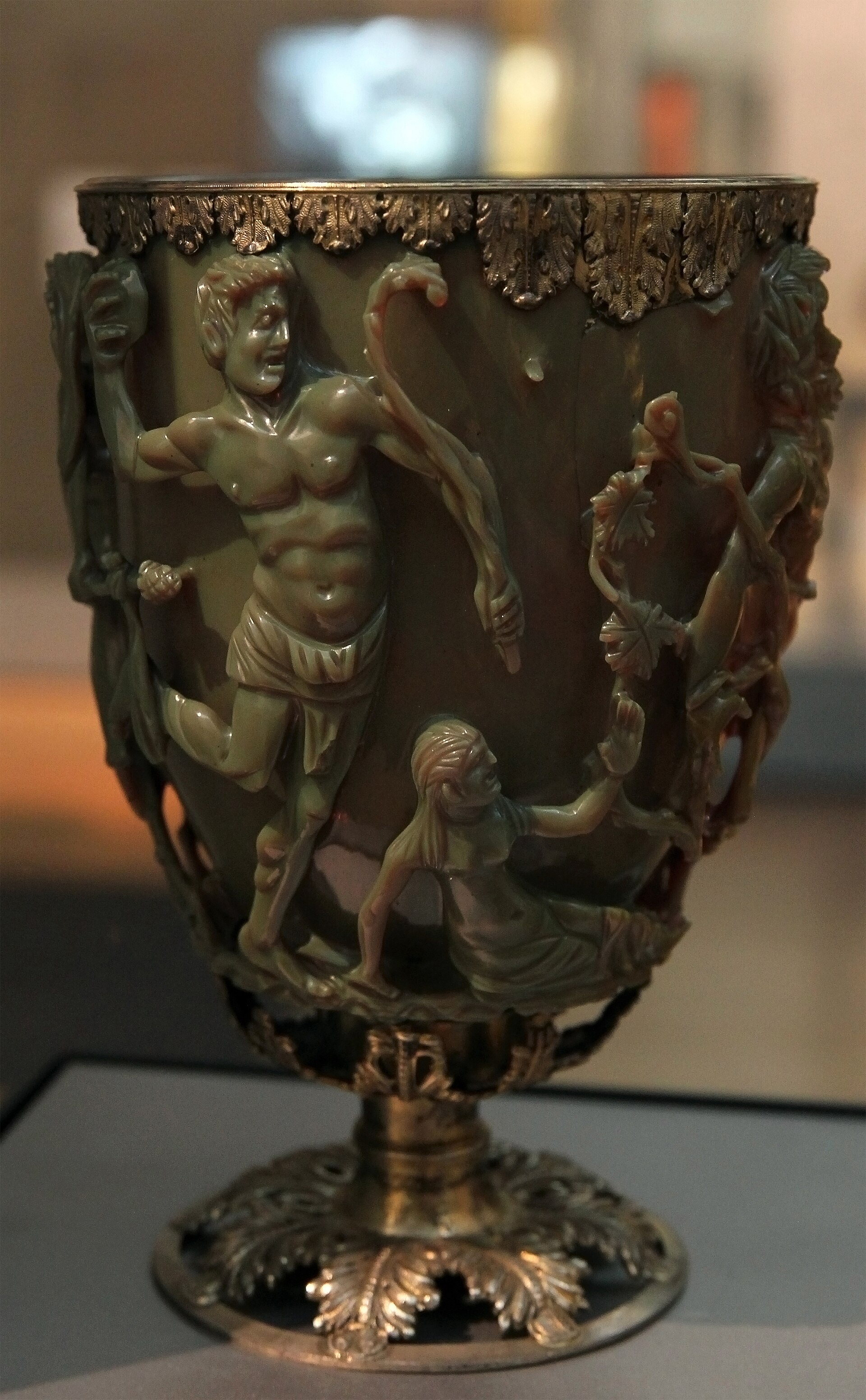
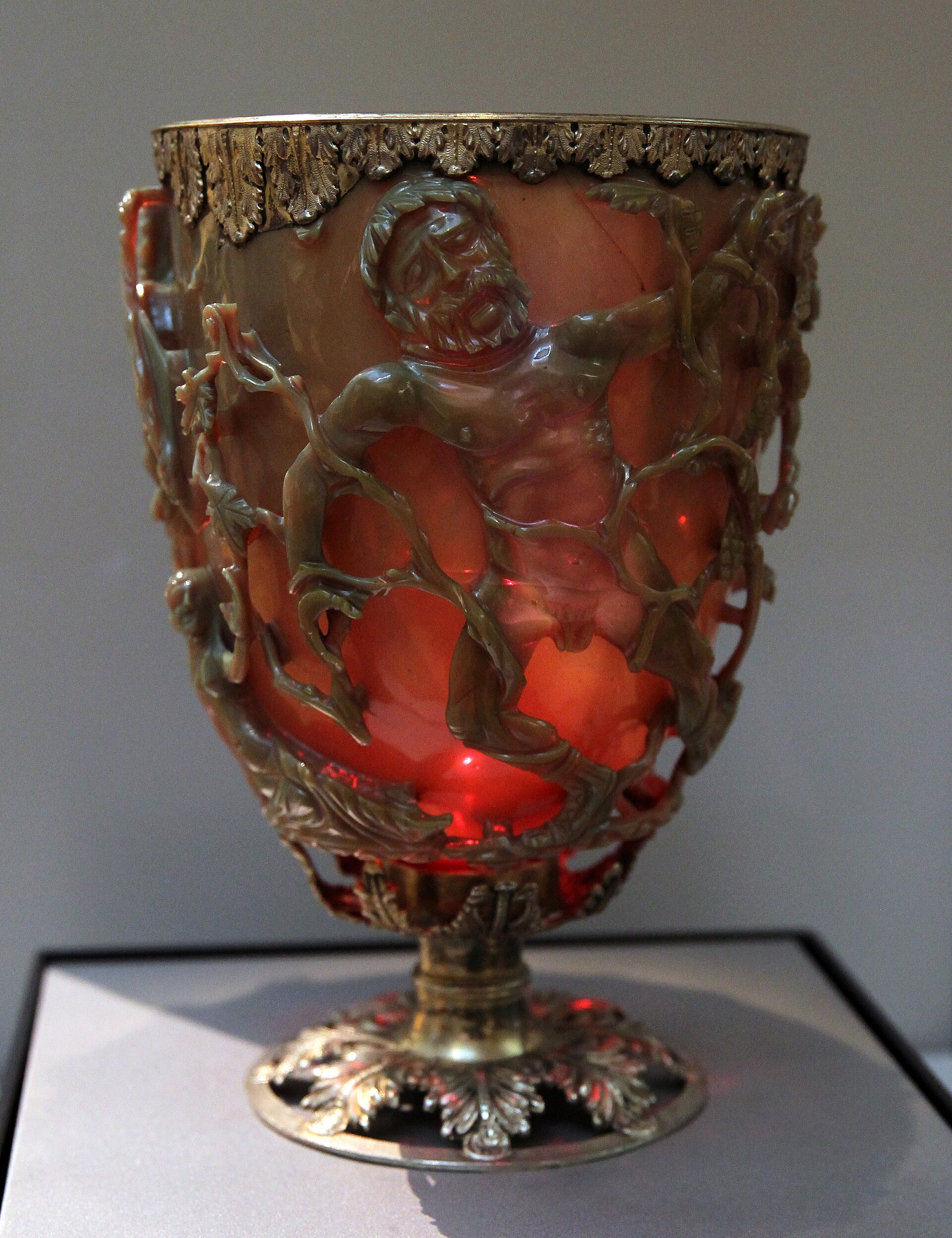
The two states do not look like one object. They look like two, and that is the practical problem this record has to solve before it can show a reader anything: almost every photograph of the Lycurgus Cup in circulation is either the green cup or the red cup, and captions rarely say which. Every plate here says which lighting it shows.
Its documented history is short and almost entirely English. It surfaces in 1845 in the hands of a M. Dubois, is exhibited at the Society of Arts in London in 1850, and is with Baron Lionel Nathan de Rothschild by 1857. It stayed in the Rothschild family for about a century, was described in the literature as the Rothschild Lycurgus Cup, and was bought by the British Museum from Victor, 3rd Lord Rothschild in 1958. Where it was for the fourteen hundred years before 1845, and where it was found, are not recorded anywhere.
Provenance
Each link is graded. Documented: a cited source supports it. Disputed: the identification is argued but not established. Unknown: no owner for that span, and the gap is not smoothed into a narrative. The grades in the glossary.
- 4th century AD -Made, place unknownunknown
No maker, workshop, patron or place of manufacture is recorded. The British Museum dates the cup to the fourth century and gives no findspot. Cologne and Trier are the usual candidates for cage-cup production on the strength of findspot distribution, but that reasoning cannot be applied to an object with no findspot.13
- 4th century AD - 1845Unknownunknown
Roughly fourteen centuries with no recorded owner, no recorded location and no recorded excavation. The silver-gilt mounts, dated in the literature to the late eighteenth century or about 1800, are the only physical evidence of what happened in the interval, and the suggestion that the cup left a church treasury in the French Revolution is an inference from that remounting rather than a documented event.12
- 1845 -M. Duboisdisputed
A French writer records seeing the cup in the hands of a M. Dubois in 1845. This is the first appearance of the object in the record. No first name, no price, no source of acquisition and no duration of ownership are given, and the notice is transmitted through a tertiary source.2
- by 1857 - 1879Baron Lionel Nathan de Rothschild (1808-1879), Londondocumented
The British Museum's acquisition note states that the cup was originally acquired by Baron Lionel Nathan de Rothschild. Gustav Friedrich Waagen saw it in his collection in 1857. The cup had already been publicly exhibited at the Society of Arts in London in 1850, as number 626 in the catalogue of that exhibition.12
- 1879 - 1958The Rothschild family, by descent, to Victor Rothschild, 3rd Baron Rothschild (1910-1990)documented
That the cup stayed in Rothschild ownership until 1958 is documented by the museum's acquisition note, which names the first and the last owner. The intervening holders are not named in the sources consulted here and are not guessed at. The object was in a Rothschild house and effectively out of scholarly view until 1950, when its rediscovery there prompted Harden and Toynbee's study and the first treatment of cage cups as a class.13
- 1958 - presentBritish Museum, Londondocumented
Purchased from Victor, 3rd Lord Rothschild, with a contribution from the National Art Collections Fund, now the Art Fund. Registered 1958,1202.1, the foot separately as 1958,1202.1.a. The price is given in a tertiary source as 20,000 pounds with 2,000 pounds from the NACF; the museum's own record states the seller and the funder but not the figure. This was a negotiated private purchase, not an auction.12
Prices realised
The Lycurgus Cup has never been offered at public auction in any source consulted for this record. The only price attached to it is the 1958 purchase from Victor, 3rd Lord Rothschild, reported in a tertiary source as 20,000 pounds with 2,000 pounds contributed by the National Art Collections Fund. That is a negotiated private figure and is neither a hammer price nor a premium-inclusive total; the two concepts do not apply to it. No estimate, no reserve and no competing offer is recorded. For a market benchmark on this class of object, the only available comparison is the Constable-Maxwell cage cup, which has its own record in this archive.
Technical evidence
| Attribution note | No maker, workshop or patron is recorded, and no cage cup anywhere carries a maker's name. The object is anonymous and always has been. Two operations were required and probably two trades: a glasshouse to produce the thick blank, and a lapidary to cut the cage and the figures free of the body. Whether one establishment did both is unknown. The cup is catalogue number 13 in David Whitehouse's Cage Cups: Late Roman Luxury Glasses (Corning, 2015), the standing corpus of the type. |
|---|---|
| Material | Dichroic glass: a conventional Roman soda-lime glass carrying a colloidal suspension of gold and silver. Reported additions are of the order of 330 parts per million of silver and 40 parts per million of gold.2 |
| Particle size | The metal particles responsible for the colour are approximately 70 nanometres across and behave as a colloid. The mechanism is surface plasmon resonance: light reflected from the surface and light transmitted through the wall are differently coloured.2 |
| Dichroism | Opaque green in reflected light; translucent red in transmitted light. The British Museum's gallery text puts it as: the glass contains a tiny amount of gold and silver which cause it to turn from opaque green to translucent red when light is shone through.16 |
| Dimensions | Height 158.80 mm; maximum diameter 132 mm.1 |
| Weight | 700 g (given by the museum also as 1.60 pounds).1 |
| Technique | Cage cup (diatretum). The decoration stands free of the vessel wall and is joined to it only by concealed bridges. The orthodox account is cutting and grinding from a thick blank, first described in detail by Fritz Fremersdorf in 1956; a minority position holds that the blanks were moulded.34 |
| Subject | The death of King Lycurgus of Thrace, bound by the vine into which the nymph Ambrosia has been transformed, with Dionysos, Pan, a satyr with a rock, and a panther whose face is lost.12 |
| Mounts | A rim band of leaf ornament and an openwork foot of vine leaves, neither ancient. The British Museum describes both as silver-gilt. Other published descriptions give gilded silver added in the late 1700s, and gilt-bronze added about 1800. The three do not agree.126 |
| Inscription | None. Several other cage cups carry cut inscriptions that are drinking toasts; this one carries nothing.15 |
| Condition and interventions | The foot was removed from the cup by the museum's Research Laboratory in 1958 and reunited in 1973; it was given its own number, 1958,1202.1.a, in 1958. Recorded conservation treatments 3 November 1999 and 9 March 2012.1 |
| Corpus number | Catalogue number 13 in David Whitehouse, Cage Cups: Late Roman Luxury Glasses (Corning Museum of Glass, 2015).1 |
| Findspot | None recorded. The British Museum's record gives no findspot and no ancient context; the object first appears in the modern record in 1845.12 |
| Recent scholarship | A 2026 physics/machine-learning study (Applied Physics A) modelled the gold-silver nanoparticle composition needed to reproduce the cup's dichroism, and found only about 0.05 percent of the tested compositions could match both the reflected and transmitted colour at once - a quantified account of how narrow the working window was, consistent with the standing view that the technique was never widely repeated.10 |
Images
The record in full
Chapter 1The cup is two colours and the glass is only one of them
Stand in front of the case in Room 41 with the gallery lights on the front of the cup and the Lycurgus Cup is an opaque, slightly muddy jade green, the colour of old bottle glass.
Stand in front of the case in Room 41 with the gallery lights on the front of the cup and the Lycurgus Cup is an opaque, slightly muddy jade green, the colour of old bottle glass. Put a light behind it and the same vessel becomes translucent and wine red, so red that the thin passages between the vine stems glow like coals. Nothing has been added, removed or restored between the two states. The light has moved.
The cause is in the glass itself. It carries a colloidal suspension of gold and silver particles roughly seventy nanometres across, present in tiny quantity: the figures usually given, derived from analysis of the glass, are about 330 parts per million of silver and 40 parts per million of gold added to an otherwise conventional Roman glass batch. Particles at that scale scatter and absorb light selectively, so the light bounced back off the surface and the light pushed through the wall are different colours. The modern name for the mechanism is surface plasmon resonance.
The consequence for anyone using pictures of this object is immediate and severe. The green cup and the red cup photograph as two different vessels in two different materials, and a reader who has seen only one will not recognise the other. This is not a version problem of the ordinary kind, where two similar objects get confused. It is one object that produces two irreconcilable images of itself, and the discipline the case demands is exactly the discipline this publication applies to versions: say which is which, every time.
Chapter 2It is a cage cup, which is a different problem from a cameo vessel
The Lycurgus Cup belongs to a class of late Roman luxury glass called cage cups, or diatreta.
The Lycurgus Cup belongs to a class of late Roman luxury glass called cage cups, or diatreta. In a cage cup the decoration does not sit on the wall of the vessel; it stands away from it. An outer shell of figures, or of an openwork mesh, is separated from the inner beaker by an air gap and connected to it only by short bridges, deliberately placed where the design will hide them. Hold a cage cup up and you can see daylight between the ornament and the cup.
That is a categorically harder thing to make than the cameo glass of the Portland Vase, which is a two-layer blank with the outer layer carved back. A cameo cutter removes an overlay. A cage-cup cutter has to remove the glass behind the ornament without breaking the ornament, working blind into an undercut, with no way to repair a slip. Both classes are cut with the same lapidary equipment, a rotating disc charged with abrasive slurry, and both were probably cut by men trained on hardstone. There the resemblance ends.
The two classes also do not overlap in time. Roman cameo glass is concentrated in the early first century. Cage cups are late: the dates in the literature run from about the middle of the third century to the middle of the fourth, with a small and contested group of much earlier vessels from graves in the Netherlands and Belgium that some researchers read as precursors.
Chapter 3Being the only one of something, stated precisely
The British Museum describes this cup as the only complete Roman object in dichroic glass and as the only figural example of a cage cup.
The British Museum describes this cup as the only complete Roman object in dichroic glass and as the only figural example of a cage cup. Both claims are worth pinning down, because they are repeated everywhere in a looser form that is not true.
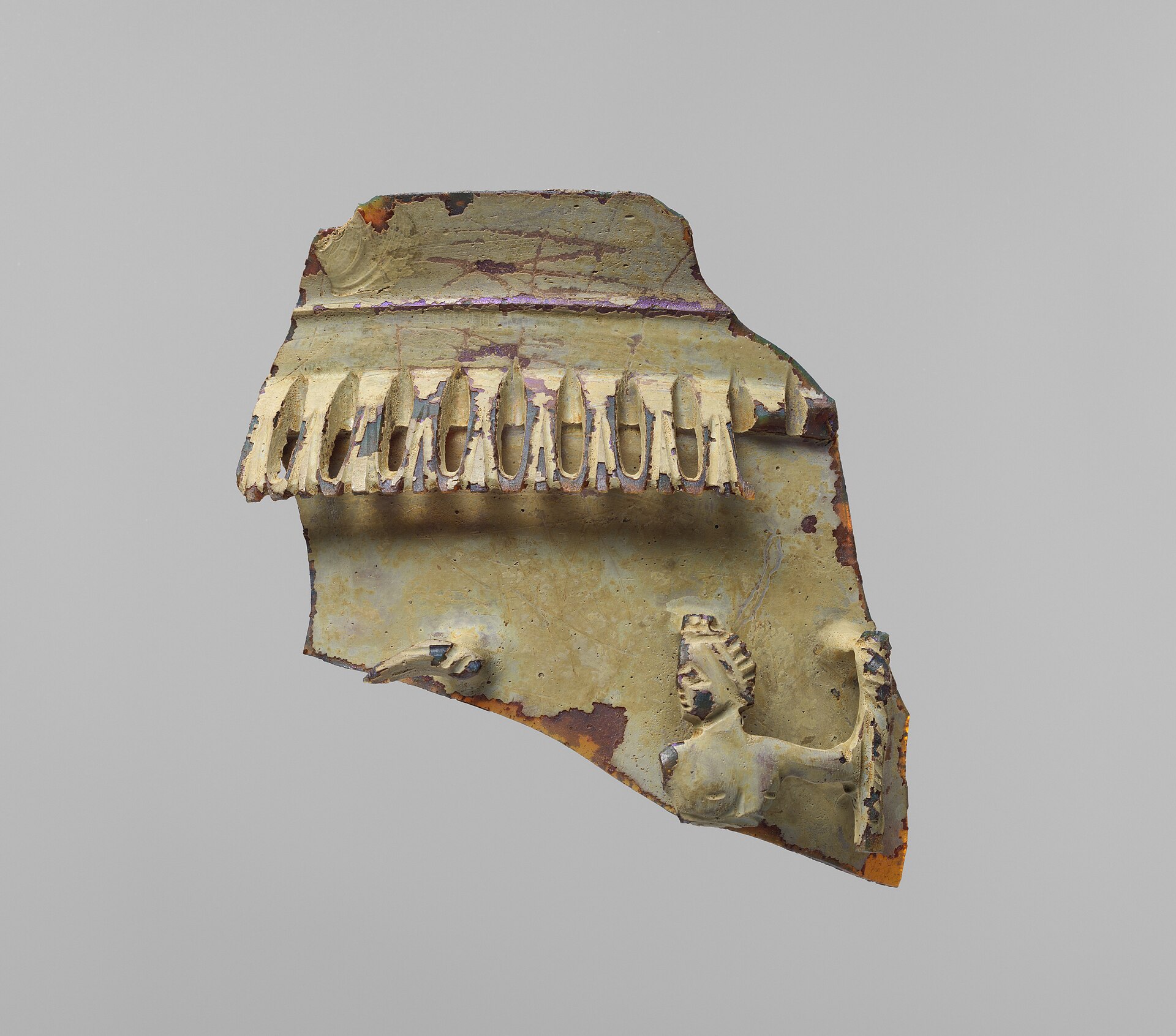
Dichroic Roman glass survives in other pieces, but in fragments. The Metropolitan Museum of Art holds a fragment of a cage cup, accession 26.60.95, catalogued as glass, dichroic, late third to fourth century, acquired with the Fletcher Fund in 1926, and it carries an ovolo frieze and part of a human figure in relief. So there was at least one other figural dichroic cage cup, and it did not survive whole.
The classification behind the figural claim is Donald Harden and Jocelyn Toynbee's. Publishing the cup in Archaeologia in 1959, they divided the known cage cups into two classes: Group A, with figured decoration, with or without an inscription in the network, and Group B, with network only. A Group A therefore existed as a category. What the Lycurgus Cup is, exactly, is the only one of that group that survives as a complete vessel with its whole figural scene intact.
Say it that way and the object gets more interesting rather than less. The point is not that the Romans made one of these. It is that they made an unknown number, of which we have one.
Chapter 4A king strangled by a vine, and why the subject is unusual
The scene running round the cup is the punishment of Lycurgus, king of the Thracian Edonians, who attacked Dionysos and his followers.
The scene running round the cup is the punishment of Lycurgus, king of the Thracian Edonians, who attacked Dionysos and his followers. In the version cut here Lycurgus has been caught and is being pulled down and bound by vine shoots that grow around his legs and body. The nymph Ambrosia, whom he attacked, is the vine: transformed into it, she is shown at smaller scale at his feet, one arm raised. Around him are Dionysos himself with the thyrsus, Pan, a satyr swinging a rock, and a panther, whose face is lost.
Two features of the cutting matter more than the story. First, the figures are almost entirely undercut, standing free of the wall except at hidden points, so that a viewer looking down through the rim sees the reverse of the relief as a set of hollows in an otherwise smooth interior. Second, the modelling exploits the dichroism: the thin, high-standing limbs and drapery read reddish while the thick body of the cup behind them reads green, so the figures separate from the ground in colour as well as in relief. Whether the cutter knew he was doing that or discovered it is not recoverable.
The subject is a warning. Lycurgus is the impious king who refused the god and was destroyed by him, and the cup shows the moment of destruction, not of resistance. A vessel for wine decorated with what happens to a man who refuses wine is not a subtle programme, but it is a coherent one, and it is the ordinary late antique use of the myth. The reader should be told plainly that there is nothing hidden here: the scene means what a fourth-century Roman would have said it meant.
Chapter 5The Licinius reading, and the grade it deserves
A political reading has been in circulation for decades.
A political reading has been in circulation for decades. It proposes that the choice of a scene showing a bound and defeated king alludes to the defeat in 324 of the co-emperor Licinius by Constantine, and to Licinius's death in 325 after a period under close guard. On that reading the cup is a piece of imperial triumphalism disguised as myth, and its date is fixed to within a year or two.
This record grades that as argued and not documented. There is no inscription on the cup, no ancient text linking the object to the event, and no findspot to place it in a context that would support or refute the identification. The scene is a standard myth with an independent iconographic tradition; the resemblance between a defeated Thracian king in art and a defeated eastern emperor in politics is a resemblance, and a resemblance is not a source.
What can be said without argument is that the Lycurgus subject is uncommon, and that the cup was made in the century in which the event happened. Those two facts are what the reading is built on. They are not nothing, and they are not proof.
Chapter 6The mounts are modern, and the sources do not agree what they are made of
The cup does not stand on Roman glass. It stands on a metal foot, and its rim is bound by a metal band of leaf ornament.
The cup does not stand on Roman glass. It stands on a metal foot, and its rim is bound by a metal band of leaf ornament. Neither is ancient.
The British Museum's own record describes both as silver-gilt: a silver-gilt band of leaf ornament at the rim, and a silver-gilt foot with openwork vine leaves. The Commons record of the photographs used in this entry, written from the museum's gallery text, gives gilded silver added probably in the late 1700s. The Wikipedia article gives gilt-bronze added about 1800. The metal is visibly white under the gilding in the plates below, which is consistent with silver rather than bronze, but this record follows the holding institution and notes that at least three published descriptions of the same two mounts are in circulation and they do not agree.
The date, wherever it is precisely placed, carries an inference. A late eighteenth or early nineteenth-century remounting of a Roman glass vessel usually means the object had been in an ecclesiastical treasury and was dispersed, and the suggestion in the literature is that the cup left a church treasury during the upheavals of the French Revolution. That is a plausible route, not a documented one, and no treasury inventory naming this cup has been produced.
Chapter 71845, 1850, 1857: how the cup entered the record
The first notice of the cup is French and casual.
The first notice of the cup is French and casual. In 1845 a French writer records seeing it in the hands of a M. Dubois. Nothing else about that transaction is recorded: not what was paid, not where Dubois had it from, not his first name.
Five years later it was in London and on public view. The British Museum's curatorial file records it exhibited at the Society of Arts in 1850, catalogued as number 626 in the Catalogue of Works of Ancient and Mediaeval Art exhibited at the Society's house, and illustrated in the Illustrated London News of 13 April 1850. By 1857 the art historian Gustav Friedrich Waagen had seen it in the collection of Baron Lionel Nathan de Rothschild, and in 1862 it was lent to the great special exhibition at South Kensington.
What that sequence gives is a firm terminus: the cup was above ground, in western Europe, and known to specialists from the 1840s. What it does not give is any information at all about the preceding fourteen centuries. There is no findspot for the Lycurgus Cup. Nobody knows what soil it came out of, or whether it came out of soil at all rather than passing hand to hand above ground from antiquity.
Chapter 8The Rothschild century, and the name in the literature
Baron Lionel Nathan de Rothschild, who died in 1879, is the first securely documented owner.
Baron Lionel Nathan de Rothschild, who died in 1879, is the first securely documented owner. The cup then remained in Rothschild ownership until 1958, when the British Museum bought it from Victor Rothschild, 3rd Baron Rothschild. The museum's acquisition note names those two men and no one in between; which members of the family held it across the intervening eighty years is not stated in the sources consulted here, and this record does not guess.
The length of that tenure is why the scholarly literature does not call the object the Lycurgus Cup at all. Harden and Toynbee's foundational paper of 1959 is titled The Rothschild Lycurgus Cup; so is Harden's own addenda and corrigenda in the Journal of Glass Studies in 1963, and so is the Chirnside and Proffitt analytical paper in the same volume. A researcher searching only for the popular name will miss the primary literature on the object, which is a small, avoidable and very common error.
There is also a rediscovery in this chain that is usually left out. The cup was in a Rothschild house, unstudied, until 1950; the Bonhams catalogue note for a related cage cup records that cage cups were first discussed as a group by Harden and Toynbee in 1959 only after the Lycurgus Cup was rediscovered in a home of Lord Rothschild in 1950. The modern study of an entire class of Roman glass therefore begins with somebody noticing what was on a shelf.
The purchase price in 1958 is given as 20,000 pounds, with 2,000 pounds contributed by the National Art Collections Fund, now the Art Fund. Those figures come from a tertiary source and this record flags them for replacement with the museum's own acquisition papers. Note also what the figure is and is not: a negotiated private purchase from a family trust, not a hammer price. The Lycurgus Cup has never been sold at public auction in any source consulted for this record.
Chapter 9The foot came off in 1958 and went back on in 1973
The condition line in the British Museum's record is one sentence long and worth reading slowly: the foot was removed from the cup by the Research Laboratory in 1958 and reunited in 1973, and was...
The condition line in the British Museum's record is one sentence long and worth reading slowly: the foot was removed from the cup by the Research Laboratory in 1958 and reunited in 1973, and was given its own registration number, 1958,1202.1.a, in 1958.
That is not a conservation accident. It is what happens when a museum acquires an object it intends to analyse. Taking the foot off gave the laboratory access to the base of the glass, and separating the modern mount from the ancient vessel in the register is the correct cataloguing decision, because they are two objects of different dates that happen to be screwed together. Fifteen years passed before the two were put back.
The analytical programme that followed is the reason this cup is famous outside archaeology. Chirnside and Proffitt published an analytical investigation in 1963, Robert Brill reported on the chemistry of the cup at the international glass congress in Brussels in 1965, and Barber and Freestone identified the colloidal gold and silver particles by analytical electron microscopy in Archaeometry in 1990. Freestone, Meeks, Sax and Higgitt published the summary account under the title The Lycurgus Cup - A Roman Nanotechnology in the Gold Bulletin in 2007. Two further conservation treatments are recorded, on 3 November 1999 and 9 March 2012.
Chapter 10The nanotechnology claim, stated exactly
The phrase Roman nanotechnology is the title of a paper, and it has been carried into headlines in a form the paper does not support.
The phrase Roman nanotechnology is the title of a paper, and it has been carried into headlines in a form the paper does not support. What the analytical work establishes is that the colour behaviour is caused by metal particles at the nanometre scale, and that those particles are an alloy of gold and silver. What it does not establish is that any Roman knew that, or could do it again on demand.
The concentrations involved are minute and the effect is exquisitely sensitive to them. The usual reading is that the Roman glassmakers did not target these quantities but arrived at them by dilution, most plausibly by reusing or diluting a batch that carried much higher concentrations of precious metal, and that the result was neither predictable nor repeatable. The survival of exactly one complete dichroic vessel, against a corpus of over fifty cage cups of which the rest are not dichroic, is itself evidence for that reading: a workshop with a reliable recipe would have produced more.
The cup has since been cited in the physical-sciences literature as a precedent for plasmonic sensing, and modern papers on the optics of the glass continue to appear. That is a genuine afterlife for a Roman drinking vessel, and it should be described as what it is: modern researchers finding a well-preserved natural experiment, not ancient chemists anticipating a modern field.
Chapter 11Drinking cup, or lamp
The British Museum catalogues the object as a drinking-cup and it is beaker-shaped, which in the cage-cup corpus is the form associated with drinking.
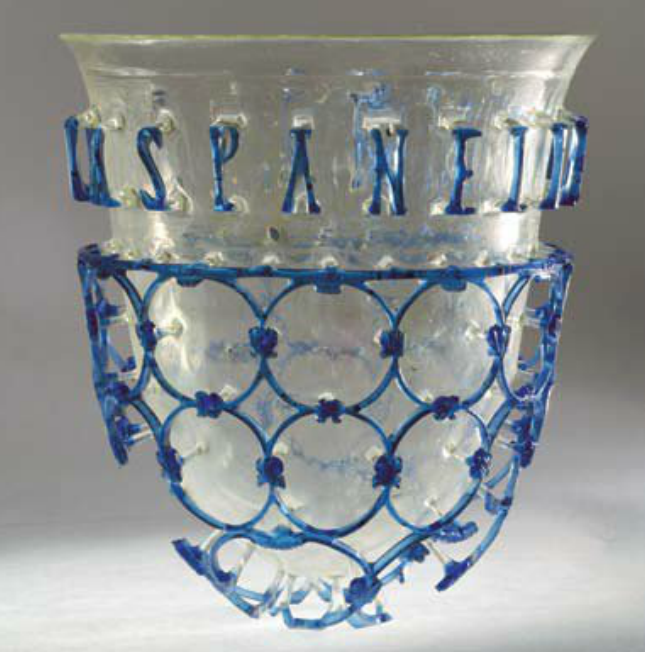
The British Museum catalogues the object as a drinking-cup and it is beaker-shaped, which in the cage-cup corpus is the form associated with drinking. Several beaker-form cage cups carry inscriptions cut into the network that are drinking toasts, and those inscriptions settle the question for that form: the Trivulzio cup in Milan reads BIBE VIVAS MVLTIS ANNIS, the Cologne cup from Koln-Braunsfeld carries the equivalent in Greek, and a cup from Pljevlja in Montenegro reads VIVAS PANELLENI BONA. The Lycurgus Cup has no inscription.
Against that, the alternative reading of the class is that some cage cups were hanging lamps. The Corning cage cup carries a copper-alloy collar attached to the vessel in antiquity, with a lamp-hanger of hooks and loops, which is physical evidence of suspension for at least one bowl-form example. Christian Steckner published on cage cups as light vessels in 1999.
For this cup specifically the lamp reading has an argument the others do not, and it comes out of the physics. The dichroism only performs when the light is behind the glass. A green cup on a table is an inert green cup; the red only appears when the source is inside or beyond the wall. Whitehouse asked in 1989 whether two ancient descriptions of dichroic glass survive, and the question of whether a Roman ever saw this vessel red is not idle. If it was ever filled with a lamp flame or held against one, its owner saw the effect. If it was only ever filled with wine and looked at across a table, he may not have.
This record does not resolve it. It notes that the shape argues for drinking, that the class contains at least one documented suspended example, and that the optical property of this particular cup is invisible in ordinary reflected light.
Chapter 12Cut, or cast: the argument this object cannot settle
The orthodox account of cage-cup manufacture was set out by Fritz Fremersdorf in 1956 and has stood since: a thick-walled blank was made, and the cage, the struts and the figures were then cut and...
The orthodox account of cage-cup manufacture was set out by Fritz Fremersdorf in 1956 and has stood since: a thick-walled blank was made, and the cage, the struts and the figures were then cut and ground out of the solid, an enormously slow process with no recovery from an error. David Whitehouse's posthumous corpus of 2015 argues that position throughout.
The minority position is Rosemarie Lierke's. She has held since the 1990s that these vessels were not cut from a solid blank at all but formed in moulds, and she published specifically on the making of the diatreta and on the Lycurgus Cup itself in 2013. Reviewing Whitehouse's corpus for the Journal of Roman Archaeology in 2020, Sylvia Fuenfschilling set out the features on original vessels that in her view cutting does not explain: bubbles that have not been cut open but are horizontally elongated; the wall of the inner cup running parallel to the inner wall of the mesh; a completely smooth inner surface to the mesh; struts with rounded ends that do not reach the outer cage; a spiral structure visible inside the struts under a microscope; the uneven ledge below the rim; and the sheer quantity of glass that the cutting hypothesis requires to be thrown away.
Her methodological point is the one that travels. Modern replicas of cage cups have been cut successfully by George Scott and by Josef Welzel, and that is regularly produced as proof of the cutting hypothesis. Fuenfschilling's answer is that a successful replica shows a method was possible, not that it was used, and that modern tools, modern glass and modern habits of thought are not the ancient ones. Exactly the same objection applies to the experimental reconstruction of the Portland Vase.
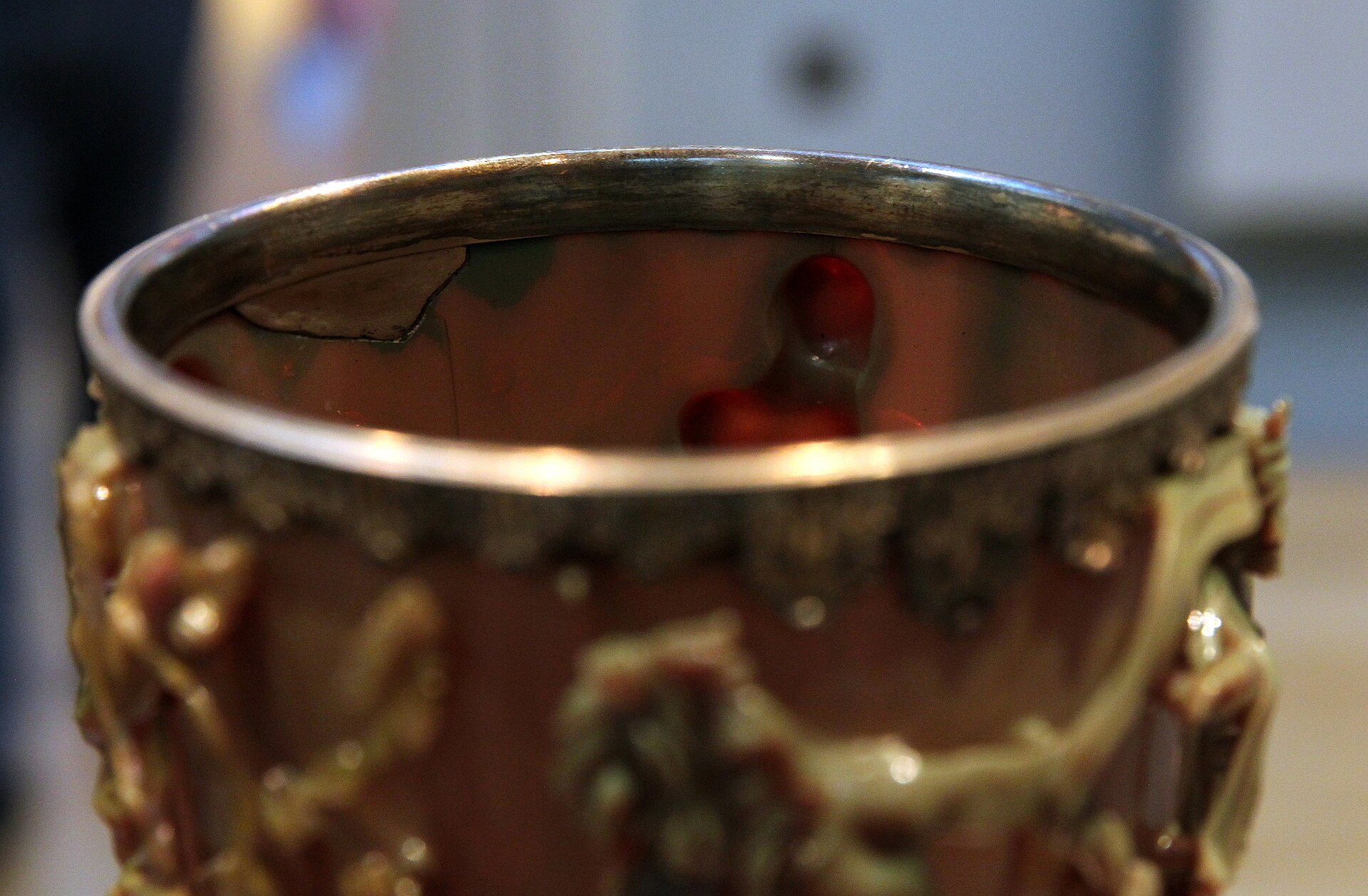
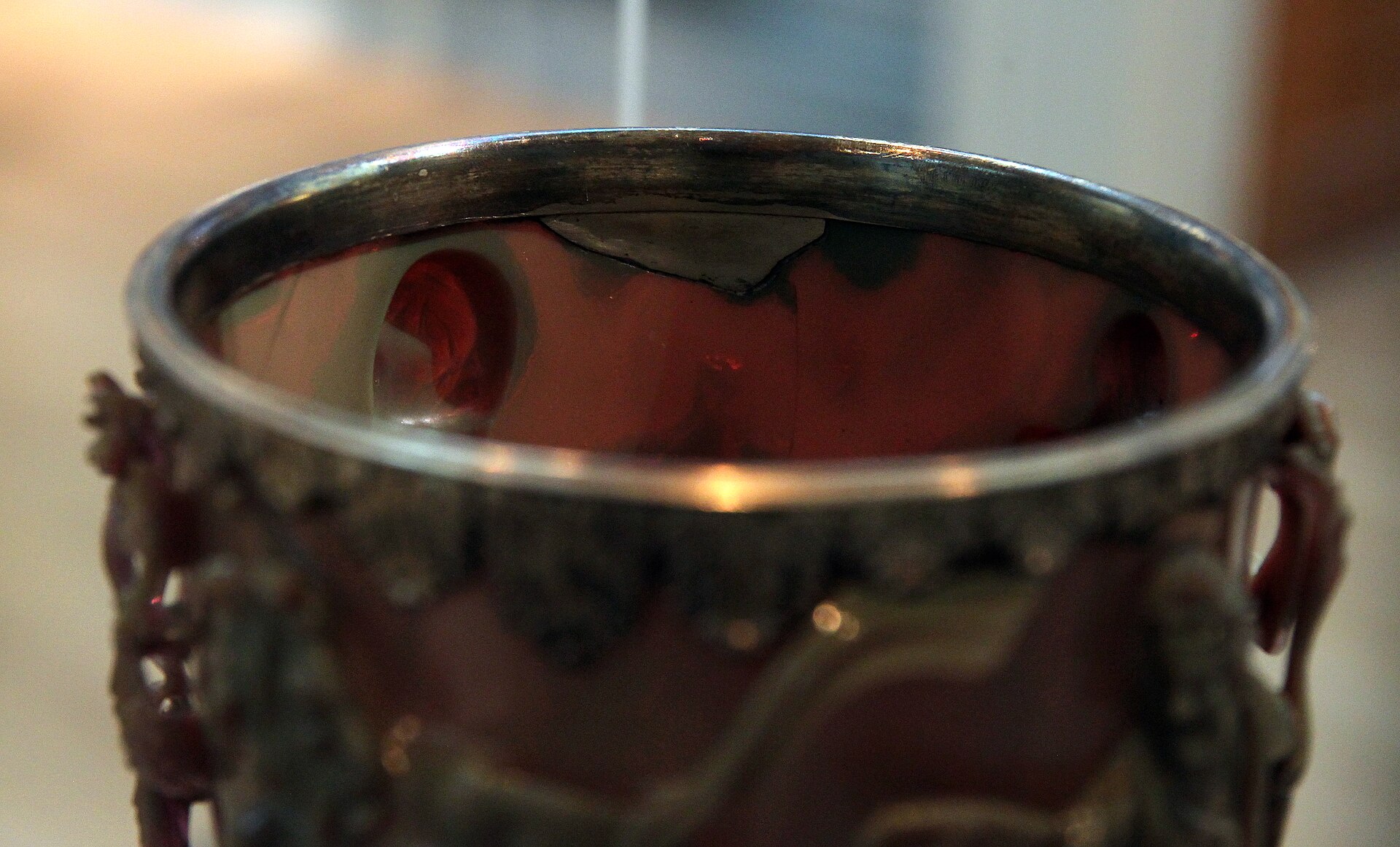
Two of the plates in this record show the inside of the Lycurgus Cup through the rim. The interior wall is smooth and the figures read from within as shallow hollows. That observation is evidence in the argument; it is not a verdict, and this record does not pretend to give one.
Chapter 13Why the pictures in this record disagree with each other
Every photograph below is of this cup, in the British Museum, taken in Room 41 on the same day by the same photographer, and released under CC0.
Every photograph below is of this cup, in the British Museum, taken in Room 41 on the same day by the same photographer, and released under CC0. Put side by side they look like a green cup, a red cup, and a brown cup with green figures. All three are the same object.
The green plates are lit from in front; the red plate is lit from behind; the intermediate plates are lit obliquely, so that the thick body reads green and brown while the thin undercut passages transmit and glow red. That gradation is the most useful thing a reader can be shown about this object, because it demonstrates that the two famous states are the ends of a continuum and not two settings of a switch.
Anyone cataloguing this cup, or buying a photograph of it, should record the lighting. A file captioned only Lycurgus Cup is an incomplete record of what the picture shows.
The artist
Unrecorded Roman cage-cup workshop, place of manufacture unknown
There is no maker to name here and there is not going to be. Not one of the sixty-odd surviving cage cups carries a signature, and no ancient text names a workshop that produced them. What can be written instead is the class: how many exist, where they were found, what they cost in labour, and what the current argument about their manufacture actually turns on. The Portland Vase record in this archive covers the neighbouring class of Roman cameo glass and its anonymous makers; this dossier covers the later, rarer and technically harder class, and does not repeat that ground.
Exhibited
- 1850Works of Ancient and Mediaeval Art, catalogue no. 626Society of Arts, London
- 1862Special Exhibition of Works of ArtSouth Kensington Museum, London
- 1987-1989Glass of the CaesarsCorning Museum of Glass; British Museum, London; Romisch-Germanisches Museum, Cologne; Museo Capitolino, Rome
- 2003-2004Saved! 100 Years of the National Art Collections FundHayward Gallery, London
- 2007-2008Reflecting Antiquity: Modern Glass Inspired by Ancient RomeJ. Paul Getty Museum at the Getty Villa, Malibu; Corning Museum of Glass
- 2012-2013Tradition Transformed: Late Roman and Early Byzantine Treasures from the British MuseumArt Institute of Chicago
Literature
- D. B. Harden and J. M. C. Toynbee, 'The Rothschild Lycurgus cup', Archaeologia 97 (1959), 179-212, esp. 207.
- D. B. Harden, 'The Rothschild Lycurgus cup: addenda and corrigenda', Journal of Glass Studies 5 (1963), 9-17.
- R. G. Chirnside and P. Proffitt, 'The Rothschild Lycurgus cup: an analytical investigation', Journal of Glass Studies 5 (1963), 18-23.
- R. Brill, 'The chemistry of the Lycurgus cup', Proceedings of the 7th International Congress on Glass, Brussels, 1965, paper 223.
- K. Painter, 'The Lycurgus cup', in D. B. Harden et al., Glass of the Caesars, exhibition catalogue, Milan, 1987, no. 139.
- D. Whitehouse, 'Roman dichroic glass: two contemporary descriptions?', Journal of Glass Studies 31 (1989), 119-21.
- D. Barber and I. C. Freestone, 'An investigation of the origin of the colour of the Lycurgus cup by analytical electron microscopy', Archaeometry 32 (1990), 33-45.
- G. D. Scott, 'A study of the Lycurgus cup', Journal of Glass Studies 37 (1995), 51-64.
- M. Vickers, 'Rock crystal: the key to cut glass and diatreta in Persia and Rome', Journal of Roman Archaeology 9 (1996), 48-65.
- C. Steckner, 'Diatrete als Lichtgefasse', in R. Lierke et al., Antike Glastopferei, Mainz, 1999, 110-14.
- V. Rondot, 'Le dieu a la bipenne, c'est Lycurgue', Revue d'Egyptologie 52 (2001), 219-49.
- I. C. Freestone, N. Meeks, M. Sax and C. Higgitt, 'The Lycurgus cup - a Roman nanotechnology', Gold Bulletin 40 (2007), 270-7.
- J. Elsner, 'The Lycurgus cup', in C. Entwistle and L. James (eds), New Light on Old Glass, British Museum Research Publication 179, London, 2013, 103-11.
- R. Lierke, 'On the manufacture of diatreta and cage cups from the Pharos beaker to the Lycurgus cup', in the same volume, 89-102.
- D. Whitehouse, Cage Cups: Late Roman Luxury Glasses, Corning Museum of Glass, 2015, no. 13.
Related works
| Work | Relation | Where it is |
|---|---|---|
| The Portland Vase Unrecorded Roman cameo-glass workshop | The neighbouring class of Roman luxury glass; cut, not cage-cut Cameo glass of the early first century, in the same museum. The two objects are routinely mentioned in the same breath as feats of Roman glass cutting, and they are three centuries and one technique apart. The Portland Vase has an overlay carved back; the Lycurgus Cup has its ornament cut free of the wall. | British Museum, London, 1945,0927.1 |
| Cage cup fragment, accession 26.60.95 Unrecorded Roman cage-cup workshop | Another dichroic cage cup, figural, surviving only as a fragment Late third to fourth century, glass, dichroic, 5.6 x 7.6 cm, Fletcher Fund 1926. Carries an ovolo frieze and part of a figure in relief. Its existence is the reason the Lycurgus Cup should be described as the only complete figural dichroic cage cup rather than the only one. | Metropolitan Museum of Art, New York |
| The Trivulzio cage cup Unrecorded Roman cage-cup workshop | Beaker-form cage cup with a drinking inscription Inscribed BIBE VIVAS MVLTIS ANNIS. Reported as the only cage cup with no damage at all. The inscription is the strongest evidence that beaker-form cage cups were drinking vessels. | Museo Archeologico, Milan |
| The Cologne cage cup from Koln-Braunsfeld Unrecorded Roman cage-cup workshop | Beaker-form cage cup with the equivalent Greek toast Found in a grave in the family cemetery of a villa rustica. Cologne and Trier are the two usual candidates for the workshops, on the strength of the Rhineland concentration of findspots. | Romisch-Germanisches Museum, Cologne |
| The Corning cage cup Unrecorded Roman cage-cup workshop | Bowl-form cage cup with an ancient suspension fitting Rim diameter 12.2 cm, with a copper-alloy collar attached in antiquity and a lamp-hanger of three hooks and loops. The single best piece of physical evidence that some vessels of this class were hung and lit rather than drunk from. | Corning Museum of Glass, New York |
| The Constable-Maxwell cage cup Unrecorded Roman cage-cup workshop | The one cage cup in private hands, and the only one with a market history Sold Sotheby's London 1979 and Bonhams London 2004. It has its own record in this archive. | Private collection |
| The Goluchow diatretum Unrecorded Roman cage-cup workshop | A cage cup that no longer exists Third-century green glass, 18.5 cm, from Cologne. Catalogued among Polish wartime losses. It survives as a photograph and nothing else, which is a useful corrective to any count of the corpus. | Formerly the Czartoryski collection at Goluchow, National Museum in Poznan; lost 1940 |
Open questions
- Where was the cup found? No findspot is recorded anywhere, and there is no ancient context to date it against.
- Where was it between the fourth century and 1845? Fourteen centuries are unaccounted for. The remounting of about 1800 suggests a European treasury, but no inventory naming it has been produced.
- Who was M. Dubois, what did he pay, and where did he get it? The 1845 notice is a single sentence in a French account.
- Which members of the Rothschild family held the cup between 1879 and 1958? The museum's acquisition note names Lionel Nathan de Rothschild and Victor, 3rd Lord Rothschild, and nobody in between.
- Are the mounts silver-gilt or gilt-bronze, and were they added in the late 1700s or about 1800? Three published descriptions of the same two objects disagree.
- Was the 1958 price of 20,000 pounds the whole consideration, and was any part of the transaction a gift, a tax arrangement or a private treaty concession? Only the headline figure and the 2,000 pound Art Fund contribution appear in the sources consulted, and both come from a tertiary source.
- Was the blank blown, cast or moulded before cutting? Fremersdorf's cutting orthodoxy and Lierke's mould-pressing hypothesis both remain in print, and the features Fuenfschilling lists have not been answered.
- Was it a drinking cup or a hanging lamp? The beaker shape and the drinking toasts on related cups argue for drinking; the dichroism is only visible with the light behind the glass.
- Does the scene allude to the fall of Licinius in 324? The reading is argued, not documented, and rests on the rarity of the subject and the century.
- How many figural cage cups were made? One survives complete and at least one other is known from a fragment. The denominator is unknown.
Questions about this object
What is The Lycurgus Cup?
The Lycurgus Cup is a glass, dated 4th century AD. Medium: Dichroic glass containing colloidal gold and silver, cut and ground as a cage cup; silver-gilt rim band and silver-gilt openwork foot added long after antiquity.
Who made The Lycurgus Cup, and is the attribution settled?
The attribution to Unrecorded Roman cage-cup workshop is recorded here as unknown. No maker, workshop or patron is recorded, and no cage cup anywhere carries a maker's name. The object is anonymous and always has been. Two operations were required and probably two trades: a glasshouse to produce the thick blank, and a lapidary to cut the cage and the figures free of the body. Whether one establishment did both is unknown. The cup is catalogue number 13 in David Whitehouse's Cage Cups: Late Roman Luxury Glasses (Corning, 2015), the standing corpus of the type.
Where is The Lycurgus Cup now?
British Museum, London. On display, Room 41, Europe AD 300-1100, Section 5, The Byzantine Empire, Case 11. Inventory number 1958,1202.1 (the foot separately numbered 1958,1202.1.a). Last confirmed 4 August 2026. Purchased in 1958 from Victor, 3rd Lord Rothschild, with a contribution from the Art Fund, then the National Art Collections Fund.
What is still unknown about The Lycurgus Cup?
Where was the cup found? No findspot is recorded anywhere, and there is no ancient context to date it against.
Sources
- 1British Museum, collection record for the Lycurgus Cup, drinking-cup, registration 1958,1202.1, with curator's comments, bibliography, exhibition history, condition, acquisition name and acquisition notes. The URL returns HTTP 403 to automated retrieval; the record was read in full in the in-app browser on 4 August 2026. britishmuseum.org/collection/...
- 2Wikipedia, 'Lycurgus Cup'. TERTIARY. Used for the 1845 Dubois notice, Waagen's sighting in 1857, the 1862 South Kensington loan, the 1958 price of 20,000 pounds and the 2,000 pound Art Fund contribution, the 330 and 40 parts per million figures, the 70 nanometre particle size, and the Constantine and Licinius suggestion. Flagged for replacement with Harden and Toynbee 1959 and the museum's acquisition papers. en.wikipedia.org/wiki/...
- 3Bonhams, lot record and catalogue footnotes for lot 18, The Constable-Maxwell Cage-Cup, Antiquities, London New Bond Street, 14 July 2004. Used for Harden and Toynbee's Group A and Group B, Doppelfeld's sub-groups, Fremersdorf 1956, the 1950 rediscovery of the Lycurgus Cup in a Rothschild house, the Hohensulzen grave, the Corning lamp fittings, the corpus figure of over fifty, and the workshop candidates. bonhams.com/auction/...
- 4Sylvia Fuenfschilling, 'Diatreta (cage cups): the debate continues', review article of David Whitehouse, Cage Cups: Late Roman Luxury Glasses (Corning, 2015), Journal of Roman Archaeology 33 (2020), 931-938. Open access PDF, full text read. Used for the corpus count, the list of features unexplained by cutting, the replica objection, the Latin trade-name argument, the lamp question, the early Netherlands and Belgium cups, and Appendix 8's four probable forgeries. journalofromanarchaeology.com/wp-content/...
- 5Wikipedia, 'Cage cup'. TERTIARY. Used for the inscriptions on the Trivulzio, Cologne and Pljevlja cups, the Rhineland concentration of findspots, and the beaker and bowl forms. Flagged for replacement with Whitehouse 2015. en.wikipedia.org/wiki/...
- 6Wikimedia Commons file record for the CC0 photographs of the Lycurgus Cup by User:Vassil, taken in Room 41 of the British Museum, which transcribes the museum's gallery text and dates the gilded silver mounts to the late 1700s. commons.wikimedia.org/wiki/...
- 7Metropolitan Museum of Art, cage cup fragment, accession 26.60.95, glass, dichroic, late third to fourth century AD, 5.6 x 7.6 cm, Fletcher Fund 1926, Greek and Roman Art. Record consulted through the Wikimedia Commons file page carrying the museum's own metadata and CC0 release. metmuseum.org/art/...
- 8Wikimedia Commons file record for the Goluchow cage cup, citing Maria Romanowska-Zadrozna (ed.), Wartime losses. Ancient art. Objects lost in Poland in the years 1939-1945, Polish Ministry of Culture, Art and National Heritage, ISBN 83-88163-44-2. Third century, Cologne, green glass, 18.5 cm, Czartoryski collection at Goluchow, lost 1940. commons.wikimedia.org/wiki/...
- 9Wikimedia Commons file record for the Pljevlja cage cup, from Museums of Montenegro, Ministry of Culture, Sport and Media, Podgorica, 2007, photograph by Lazar Pejovic. Fourth century, necropolis Komini II, inscription VIVAS PANELLENI BONA. commons.wikimedia.org/wiki/...
- 10Physics-based inverse modelling of dichroic glass: machine learning emulation of the Lycurgus Cup link.springer.com/article/...


Last verified 4 September 2026 · Published 4 August 2026
Change log
4 August 2026 - Record created at the house standard: researched narrative, technical evidence, maker dossier, graded provenance chain, prices with hammer and premium separated, related works, open questions and sources.
4 September 2026 - Re-verified. Ownership, registration (1958,1202.1) and the British Museum's own attribution unchanged since creation. Added one new source: a 2026 Applied Physics A machine-learning study modelling the dichroic nanoparticle composition, which quantifies how narrow the successful compositional window was. No ownership, location or attribution change to report.