Potpourri Vase (Vase potpourri a vaisseau)
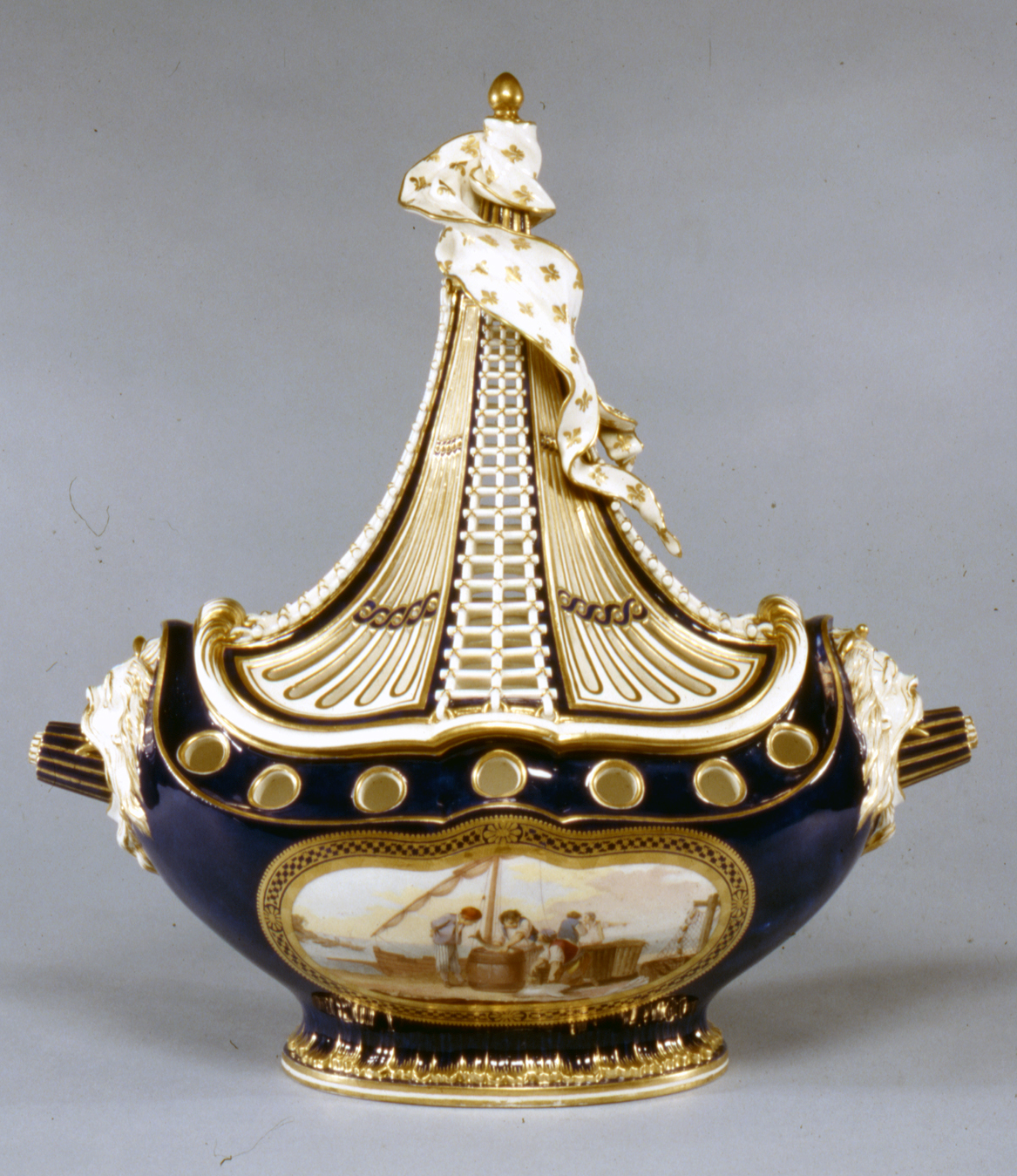
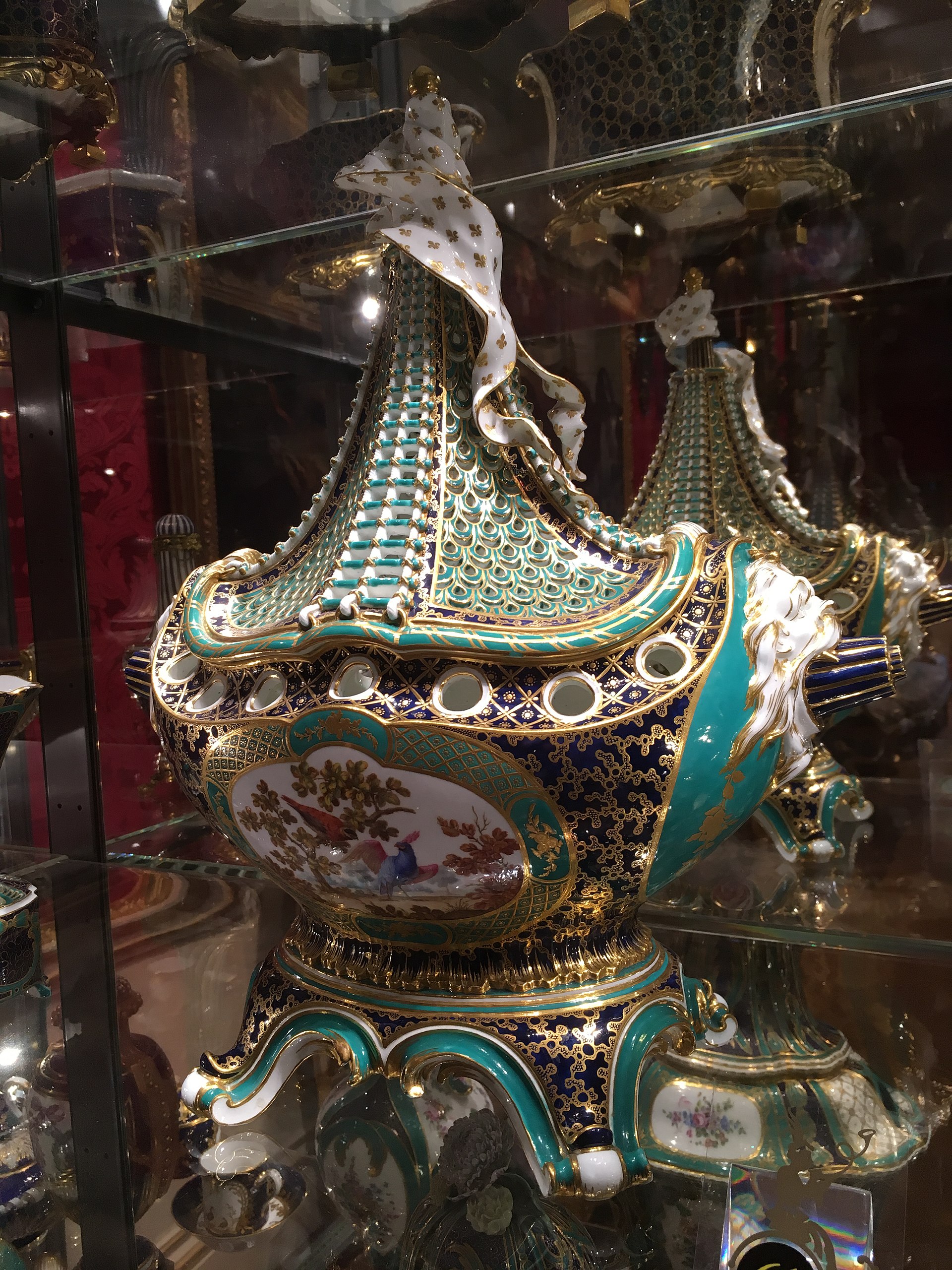
The record subject, front view. Sevres, 1764, soft-paste porcelain with enamels and gilding. The Walters Art Museum's own object page states the image rights for this photograph as Creative Commons Zero (CC0).
| Artist | Sevres Porcelain Manufactory (form designed by Jean-Claude Duplessis le Pere; painted decoration by Jean-Louis Morin) |
|---|---|
| Date | 1764 |
| Medium | Soft-paste porcelain (pate tendre), polychrome enamels, and gilding; replacement stand of carved and gilt wood |
| Dimensions | Overall with stand: H 45.2 x W 35 x D 17.3 cm (17 13/16 x 13 3/4 x 6 13/16 in). Vase alone, without the later stand: H approximately 38.9 cm (15 5/16 in). |
| Where it is now | The Walters Art Museum, Baltimore, Marylandlast confirmed |
| Inventory number | 48.559 |
| Attribution | AcceptedThe manufacture, form and decorator are established by the factory's own marking system rather than by connoisseurship. Full note |
| Object type | Ceramic |
| Period | French, Louis XV, 1764 |
| Inscriptions | Manufacturer's mark: interlaced Ls in underglaze blue, the monogram of Louis XV under whose crown ownership the factory operated from 1759. Date mark: the letter L within the interlaced Ls, read by the Walters Art Museum as the date letter for 1764. Painter's mark: the letter M at the apex of the Ls, for Jean-Louis Morin. |
| Owners on record | 6 links6 documented |
| Sources | 17 cited |
About this record Last verified · 17 sources cited · Change log
On this page 9 sections
ContentsClose
A ship modeled entirely in soft-paste porcelain, complete with rigging, portholes and a pierced pennant, made at Sevres in 1764 to a form Jean-Claude Duplessis le Pere had designed seven years earlier. Only about twelve examples were ever produced and only ten are known to survive; this is the one now in Baltimore, and the only one of the ten that the curator who has personally examined the other nine has not yet seen in the porcelain.
Its documented history runs from an English Rothschild collection through two Paris and New York dealers to Henry Walters, who bought it in 1928 and left it, with the rest of his museum, to the City of Baltimore on his death in 1931. The Walters Art Museum's own provenance note leaves the Rothschild acquisition itself undated and unexplained, which this record preserves as a gap rather than closing it with a guess.
The form is documented, priced by its own difficulty, and imitated by name since the nineteenth century, yet this specific vase has not been the subject of a single further recorded transaction in ninety-eight years. That is itself a market history, and it is recorded here as one.
Provenance
Each link is graded. Documented: a cited source supports it. Disputed: the identification is argued but not established. Unknown: no owner for that span, and the gap is not smoothed into a narrative. The grades in the glossary.
- 1764 -Sevres Porcelain Manufactorydocumented
Made at Sevres in 1764, the factory's marks (interlaced Ls, date letter L, painter's mark M for Jean-Louis Morin) establishing both manufacturer and date without reliance on connoisseurship.1
- Sir Anthony Nathan de Rothschild, 1st Baronet (1810-1876)documented
Named as an owner in the Walters Art Museum's own published provenance, which explicitly flags the date and mode of his acquisition as unknown. Sir Anthony was of the English Rothschild banking branch, a director of N M Rothschild and Sons and owner of Aston Clinton House, Buckinghamshire, where he assembled a broader collection of paintings and decorative arts including rare French faience. He is not the same Rothschild connected to the Louvre's own, different vaisseau a mat, which passed through Baron Alphonse de Rothschild of the French branch.11112
- - 1927Edwin Marriott Hodgkins (1860-1932), Parisdocumented
Hodgkins was a specialist Old Sevres Porcelain dealer, trading from Old and then New Bond Street, London, from about 1897 to 1920, publishing a catalogue of his own Sevres collection in 1910, before relocating his business to Paris around 1920 and operating from 3 Rue de Berri by 1928. His personal Sevres holdings passed substantially into the Walters Art Museum's collection over time.110
- 1927 - 1928A. Seligmann, Rey and Co., New Yorkdocumented
The New York branch, established 1921, of Arnold Seligmann and Cie., Place Vendome, Paris. Arnold Seligmann was the younger brother and former partner of Jacques Seligmann, the leading Paris dealer in French eighteenth-century decorative arts until his death in 1923; the brothers' firms split after a 1912 dispute. Henry Walters bought at least one other Sevres piece from this same firm in 1928.11316
- 1928 - 1931Henry Walters, Baltimoredocumented
Purchased by Henry Walters in 1928 from A. Seligmann, Rey and Co. No price is recorded in the sources consulted. This purchase fits Walters's documented pattern of concentrated buying from the Seligmann dealer network in the 1920s.116
- 1931 - presentThe Walters Art Museum, Baltimoredocumented
Henry Walters died 30 November 1931, bequeathing his entire collection and museum building to the City of Baltimore; the vase entered the Walters Art Museum's collection at that point and has remained there since, accession number 48.559.1
Technical evidence
| Attribution note | The manufacture, form and decorator are established by the factory's own marking system rather than by connoisseurship. The underside carries the interlaced-Ls manufacturer's mark of Sevres in underglaze blue, a date letter L for 1764 within the Ls, and a painter's mark M at the apex of the Ls for Jean-Louis Morin, as recorded by the Walters Art Museum. The form itself, the vaisseau a mat, is documented in factory design history as originating in 1757, generally credited to Jean-Claude Duplessis le Pere, artistic director and modeler at Sevres from the Vincennes years until his death in 1774. No attribution dispute concerning this specific vase was found in the sources consulted. |
|---|---|
| Paste | Soft-paste porcelain (pate tendre), the body used at Sevres throughout this period, distinct from the hard-paste porcelain the factory adopted only later in the eighteenth century and distinct from the hard-paste bodies used by nineteenth-century imitators such as Samson.114 |
| Manufacturer's mark | Interlaced Ls in underglaze blue on the underside, the Sevres factory mark referencing Louis XV, under whose crown the manufactory operated from 1759.1 |
| Date mark | The letter L within the interlaced Ls, read by the Walters Art Museum as the factory's date letter for 1764, placing this vase at the very end of the form's 1757-1764 production run.1 |
| Painter's mark | The letter M at the apex of the interlaced Ls, identifying Jean-Louis Morin (1732-1787) as the painter of both reserves.1 |
| Dimensions, with stand | H 45.2 x W 35 x D 17.3 cm (17 13/16 x 13 3/4 x 6 13/16 in), including the later replacement wood and gilt stand.1 |
| Dimensions, vase alone | Approximately H 38.9 cm (15 5/16 in) for the porcelain vase without its later stand.2 |
| Stand | The current wood and gilt stand is a replacement, not original to the vase; the Walters Art Museum's own materials description separates it from the porcelain vase.1 |
| Size classification | Comparable surviving examples are individually described by their own institutions as of the first size (Wallace Collection), the second size, deuxieme grandeur (Getty Museum), and the third size, troisieme grandeur (Louvre), confirming that Sevres produced the vaisseau a mat in at least three graduated sizes. The Walters Art Museum's own record does not state a size classification for 48.559; based on its dimensions with stand, which fall close to the Wallace and Royal Collection examples, a first-size classification is plausible but not confirmed by the holding institution, and is recorded here as unconfirmed rather than assumed.1689 |
| Firing difficulty | The form's extensive openwork piercing through the hull, rigging and pennant left the unfired body structurally weak, and pieces of this design were prone to collapse in the kiln, making a successful firing costly and the finished vase one of the most expensive models the factory sold.23 |
Images
The record in full
Chapter 1What it is
The vase takes the form of a stylized sailing ship set on a wave-form base, rigged in porcelain rather than rope.
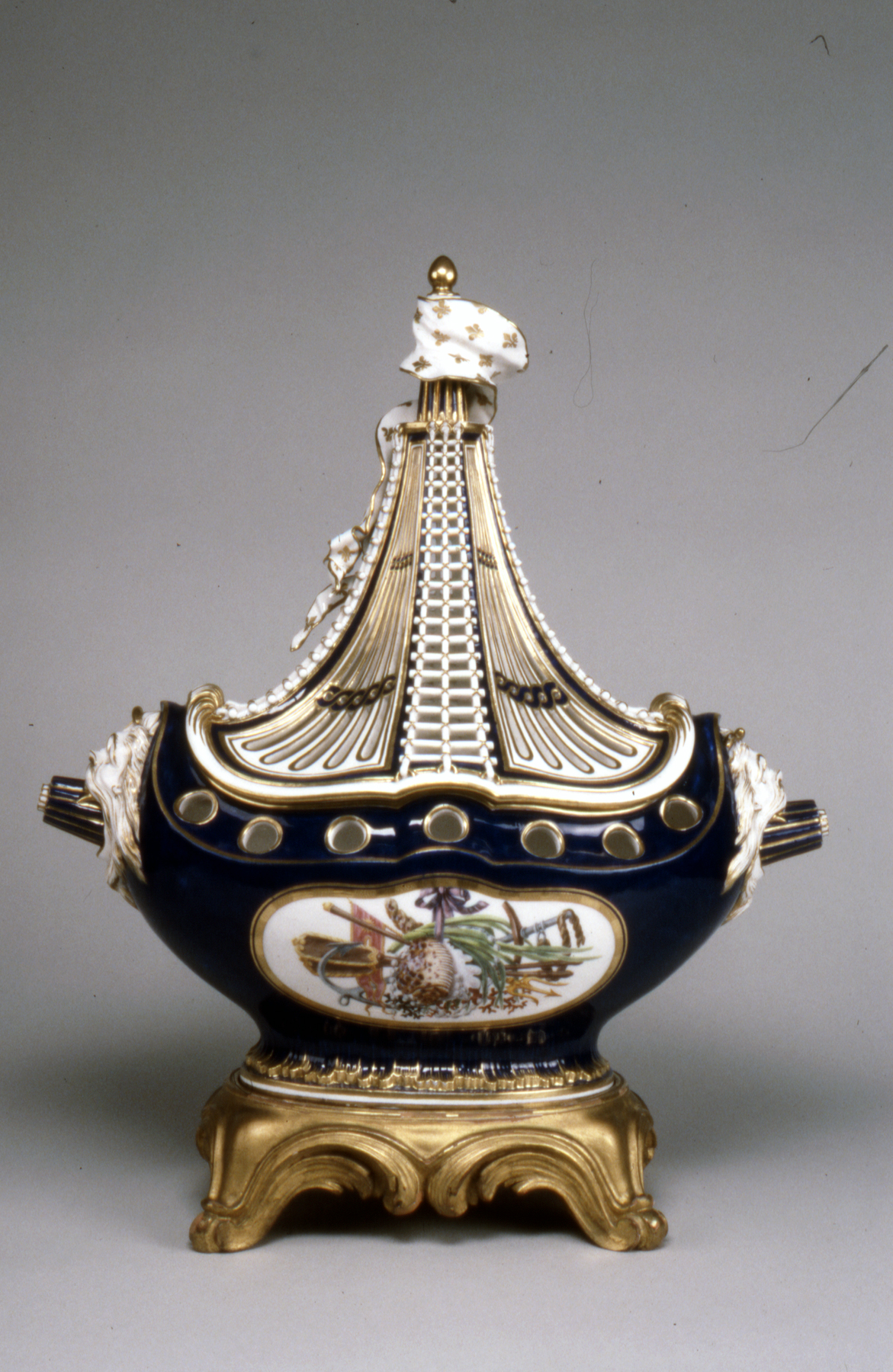
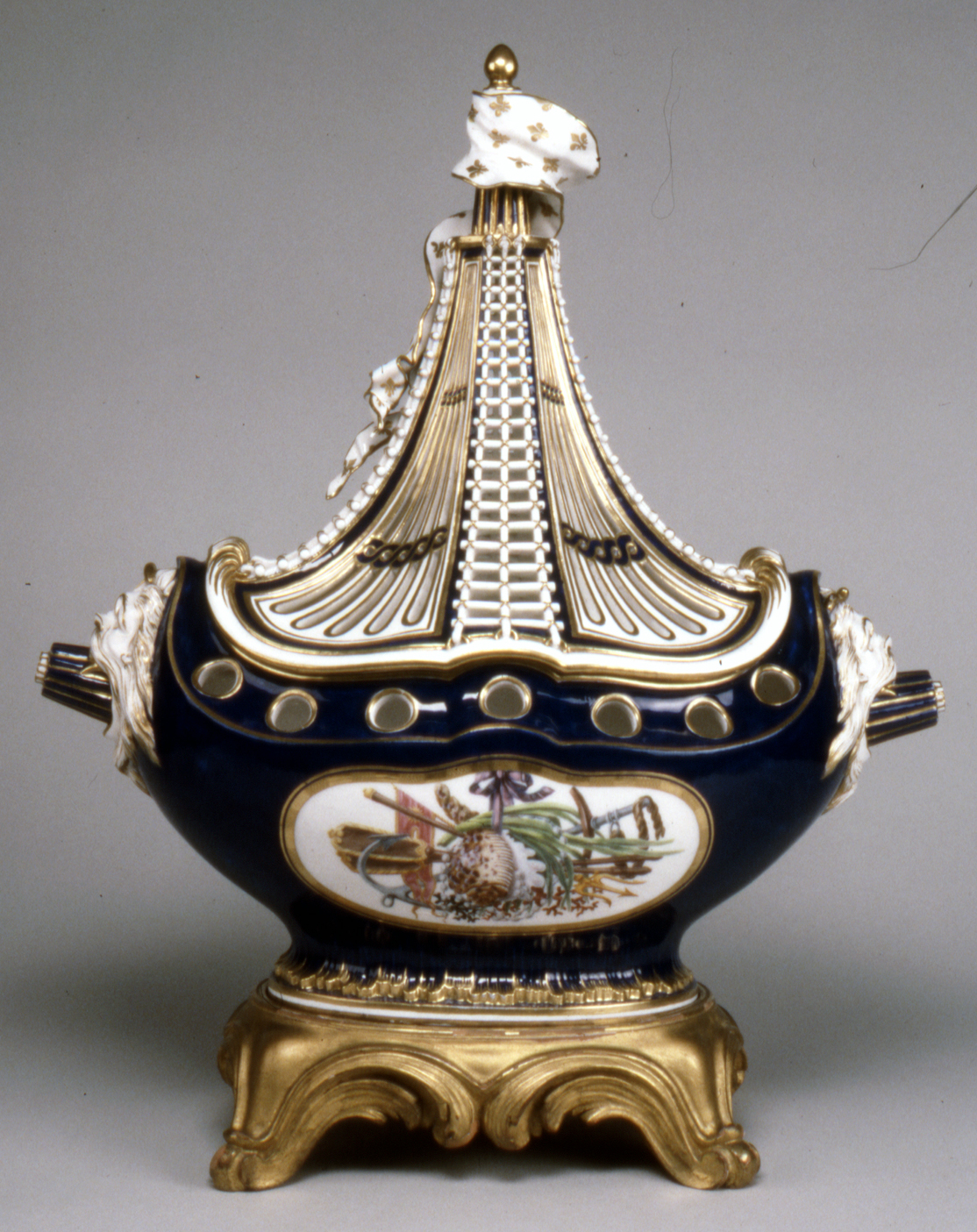
The vase takes the form of a stylized sailing ship set on a wave-form base, rigged in porcelain rather than rope. At each side a lion-like beast mask, crowned with reeds, grips a tapered spar in its mouth in place of a bowsprit. The hull carries two painted reserves: on the front, within a cartouche, sailors work on a dock with a ship behind them; on the back, a marine trophy of a shell, an anchor, strands of seaweed, two crossed oars, a flag and a trident, bound together with a painted ribbon. Both scenes are the work of Jean-Louis Morin, one of the leading figure and marine painters on the Sevres payroll in the 1760s. Above the hull, a pierced cover in the shape of furled rigging is topped by a long, wind-blown pennant, also pierced, so that the whole superstructure reads as sail and cordage rendered solid.
The body is soft-paste porcelain, the eighteenth-century Sevres paste, built up with polychrome enamel grounds and extensive gilding. The vase now stands on a later, non-original stand of carved and gilt wood; the Walters Art Museum's own cataloguing separates this replacement mount from the porcelain vase itself in its materials description, which is the correct way to read the piece, since a plinth is not evidence about the object it carries.
Chapter 2How a ship became a perfume box
The pierced cover is not only ornamental.
The pierced cover is not only ornamental. This is a pot-pourri vase, a container for scented dried petals, herbs and spices, and the openwork rigging is engineered to let the scent escape into a room while keeping the contents out of sight. Eighteenth-century women commonly compounded their own pot-pourri mixtures at home, sometimes ageing a blend for years before it was considered ready, and a vase of this kind was made to be filled, refreshed and used, not only displayed.
It was also designed to be seen as part of a set. Vases of differing shapes, this one among them, were sold by Sevres to form a garniture across a mantelpiece or side table, arranged for visual rhythm rather than function alone. The documented case of the type is the example now in the Louvre, delivered on 30 May 1760 to Madame de Pompadour as the centerpiece of a five-piece garniture for her bedroom at the Hotel d'Evreux, the building now the Elysee Palace. There is no equivalent documentation placing the Walters vase in a specific eighteenth-century garniture; this is stated as a fact about the type, not assumed for this individual vase.
Chapter 3Duplessis's ship, and why a boat
The vaisseau a mat form was designed in 1757, and the design is generally credited to Jean-Claude Duplessis le Pere, a goldsmith by training who held the title Goldsmith to the King before becoming...
The vaisseau a mat form was designed in 1757, and the design is generally credited to Jean-Claude Duplessis le Pere, a goldsmith by training who held the title Goldsmith to the King before becoming artistic director and chief modeler at Sevres. The factory's own institutional history of the form describes it as evoking the precious-metal ship-form table ornaments, the nef, that had adorned royal and noble tables since the Renaissance; the Frick Collection's catalogue entry for its own example uses the same word, stating plainly that the shape partly derives from the nef.
A second reading, reported by more than one secondary source but stated with consistent hedging in each, connects the ship to the coat of arms of the City of Paris, which bears a ship, and proposes that Duplessis's design gestures at this civic emblem, or alternatively at France's naval engagement in the Seven Years' War, which ran from 1756 to 1763 and so overlaps the form's entire production run. No source consulted in this research states a documented, contemporary written justification from Duplessis or the factory for the choice of a ship; the arms-of-Paris and Seven Years' War readings are both argued by later cataloguers rather than demonstrated from an eighteenth-century document, and this record states them as arguments, not facts. What is documented without qualification is the nef association and the vase's court and aristocratic clientele.
Chapter 4An engineering problem disguised as a centerpiece
The vaisseau a mat was one of the most technically difficult forms Sevres ever put into production.
The vaisseau a mat was one of the most technically difficult forms Sevres ever put into production. The multiple open piercings through the hull, rigging and pennant weakened the unfired body at exactly the points where the kiln's heat could cause it to sag or collapse before firing was complete. Losses in the kiln were common, and the difficulty and cost of a successful firing made the finished vase one of the most expensive models the factory sold in this period, despite carrying gilded fleurs-de-lis that might suggest a piece reserved for the crown; it was not, in fact, sold exclusively to the royal family.
Between 1757 and 1764, the span this vase's own 1764 date mark places it at the very end of, roughly twelve examples of the form are recorded as having been produced in total. Ten are known to survive today. That is an unusually high loss rate even by the standards of eighteenth-century porcelain, and it is a direct consequence of the design's structural ambition rather than of later accident or war.
Chapter 5Ten ships, eight collections
The ten surviving vaisseaux a mat, cross-checked here against each holding institution's own published catalogue record rather than a single secondary list, are: three at Waddesdon Manor...
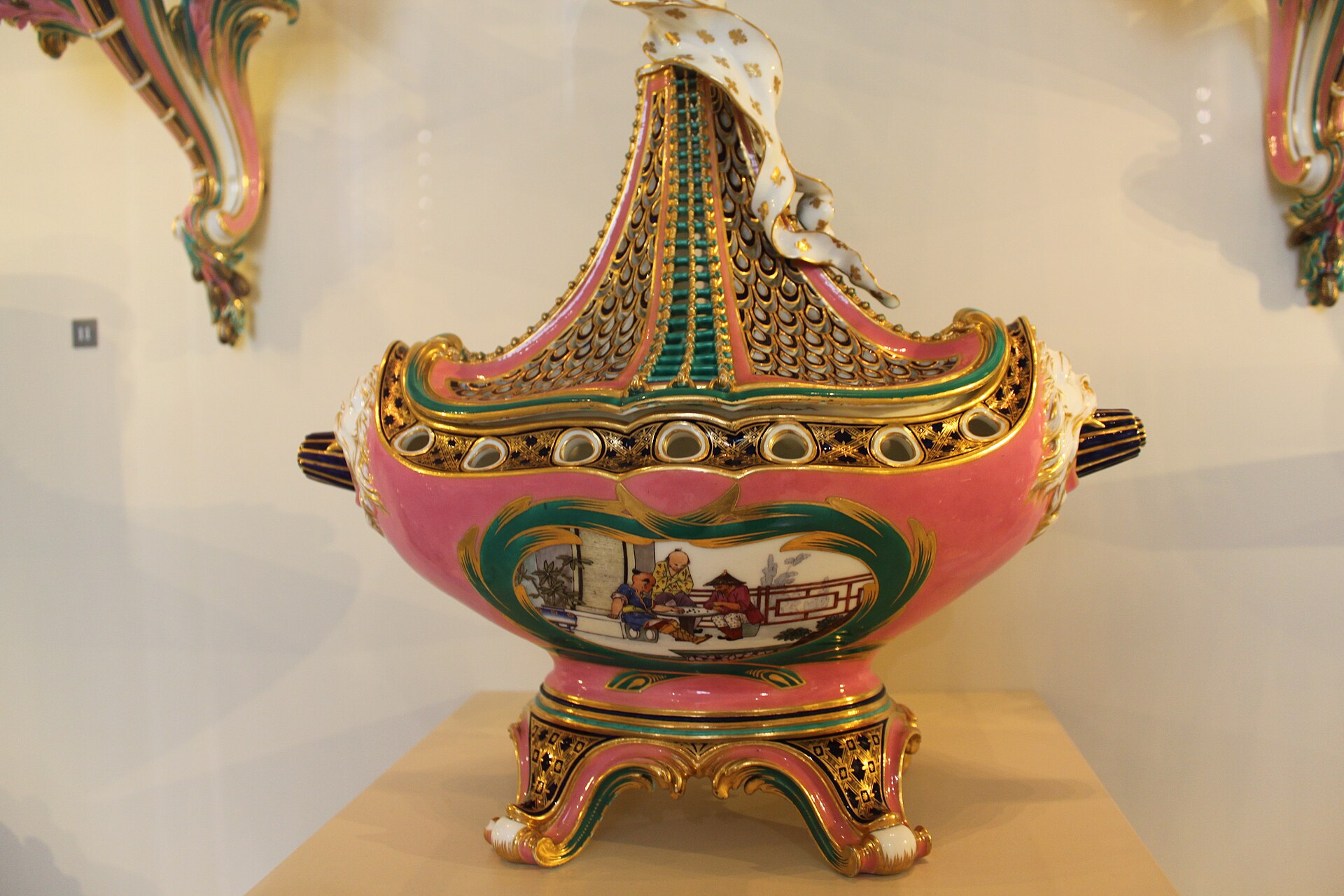
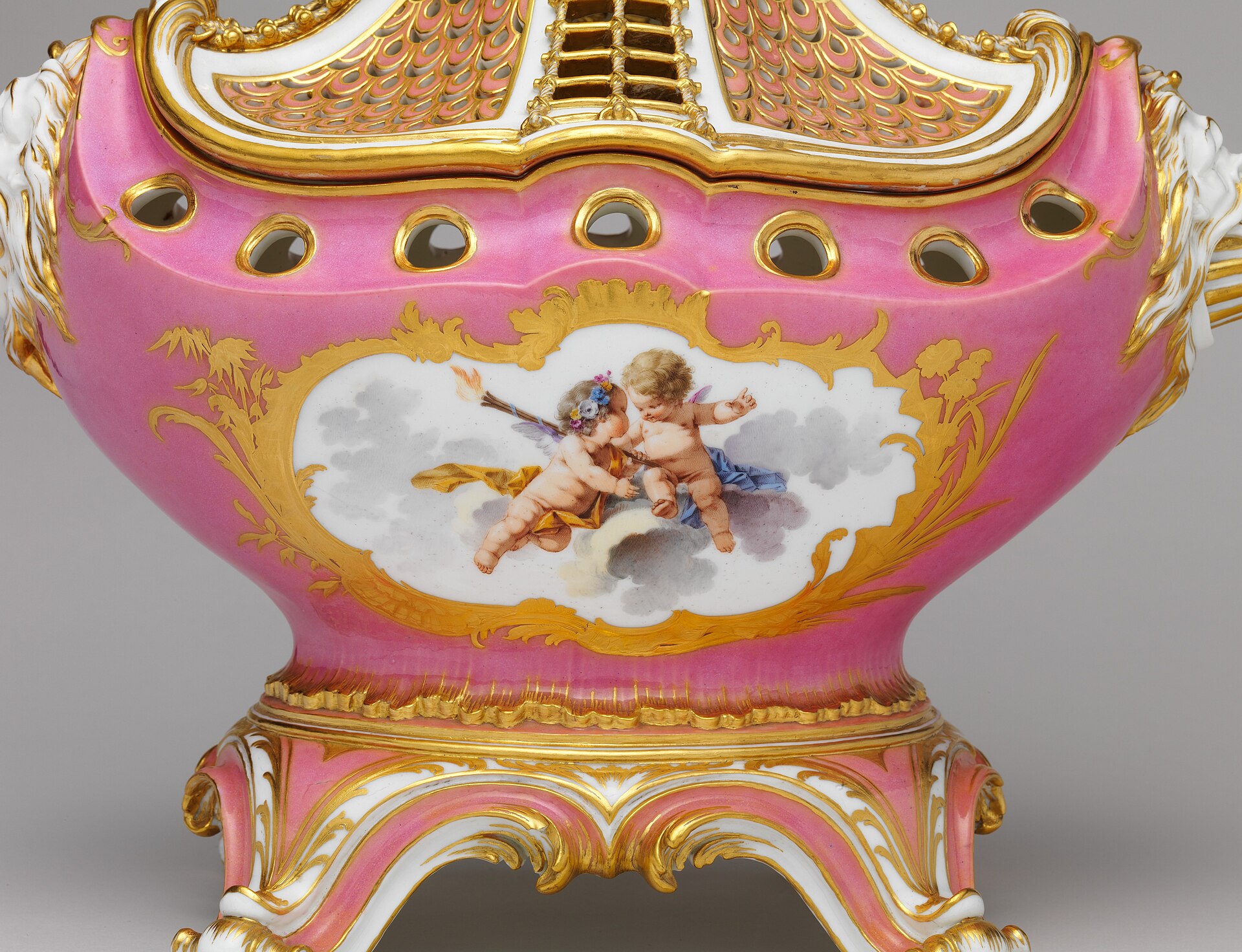
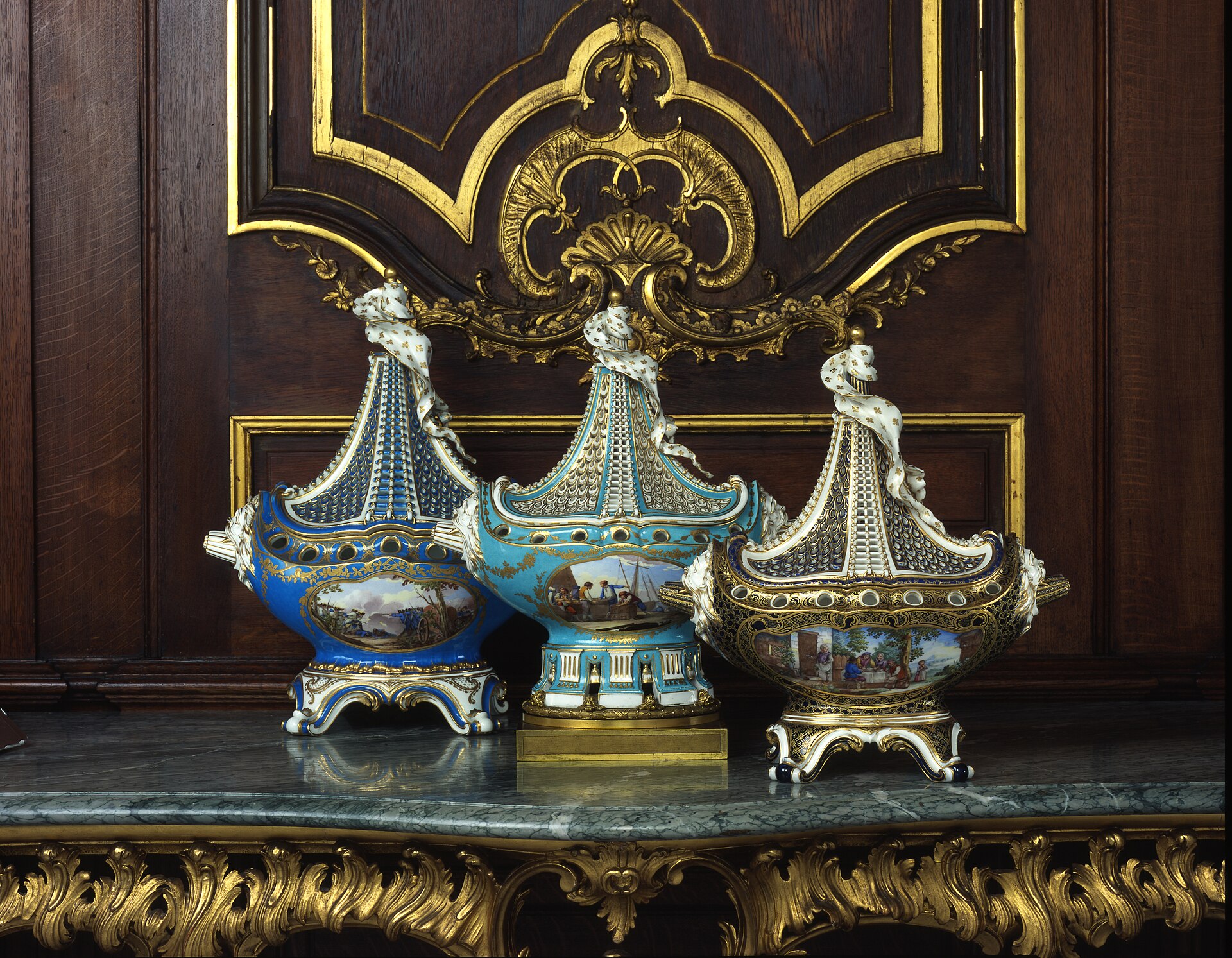
The ten surviving vaisseaux a mat, cross-checked here against each holding institution's own published catalogue record rather than a single secondary list, are: three at Waddesdon Manor, Buckinghamshire, in bleu celeste, dark blue and petit vert grounds, of about 1761 to 1763; one at the Louvre, Paris, described by the museum as third size and dated about 1760, delivered to Madame de Pompadour in that year; one at the Wallace Collection, London, described in the museum's own title as of the first size, about 1761; one in the Royal Collection at Buckingham Palace, in a bleu lapis and green ground with gilded oeil-de-perdrix diaper, of about 1758 or 1759, part of George IV's Sevres purchases; one at the Metropolitan Museum of Art, New York, a pink-ground example of about 1757 to 1758 given by the Samuel H. Kress Foundation in 1958; one at the Frick Collection, New York, in green and blue grounds highlighted in gold, about 1760, bought by Henry Clay Frick in 1916; one at the J. Paul Getty Museum, Los Angeles, catalogued by the Getty itself as vaisseau a mat, deuxieme grandeur, about 1760, with front-panel painting attributed to Charles-Nicolas Dodin; and this vase at the Walters Art Museum, Baltimore, dated 1764 by its own factory mark, the latest-dated of the group in the sources consulted.
One tertiary source used in this research states that by the mid-nineteenth century all ten known examples had passed through English collections, and that today one is in France, five are in the United Kingdom and four are in the United States. Counting the institutions above independently against that claim gives exactly that split, which is a useful internal check even though the claim itself is not independently sourced beyond that one tertiary reference.
A closely related but separate object should not be confused with the ten: in 1895 the English firm Minton produced a facsimile of the Royal Collection's vaisseau a mat, made with Queen Victoria's permission and with access to the original for Minton's own artists, whose preparatory drawings survive in the Minton archive. That facsimile, documented at auction by Bonhams, is a nineteenth-century copy openly made and openly sold as such. It is not one of the ten eighteenth-century survivors and is not counted as one here.
Chapter 6Before Henry Walters: the Rothschild question
The Walters Art Museum's own published provenance for this vase opens with a Rothschild owner, and names him precisely: Sir Anthony Nathan de Rothschild, 1st Baronet, 1810 to 1876, of the English...
The Walters Art Museum's own published provenance for this vase opens with a Rothschild owner, and names him precisely: Sir Anthony Nathan de Rothschild, 1st Baronet, 1810 to 1876, of the English banking branch, a director of N M Rothschild and Sons and, from the early 1850s, owner of Aston Clinton House in Buckinghamshire, where he and his wife Louise built a substantial collection of paintings, faience and other decorative arts alongside a career that also included the High Shrievalty of Buckinghamshire and a stable of successful racehorses.
The Walters record itself, however, brackets this link with an explicit caveat: the date and mode of Sir Anthony's acquisition of the vase are unknown. This record follows that caveat rather than smoothing over it. The ownership by Sir Anthony is treated here as documented, because it is stated without qualification by the object's own holding institution; the manner and date by which he acquired it is treated as unknown, because the same institution says so.
This is the point at which version confusion becomes a real risk for this object, and it is worth stating plainly. The Louvre's own vaisseau a mat, a different vase entirely, of a different size and a different decade of production, passed at one point through the collection of Baron Alphonse de Rothschild, a member of the French branch of the family, before reaching the Louvre in 1984. Sir Anthony Nathan de Rothschild and Baron Alphonse de Rothschild are different men from different branches of a large family that collected Sevres porcelain broadly and in depth across generations. Nothing in the sources consulted here connects Sir Anthony to the Louvre vase or Baron Alphonse to the Walters vase, and no such connection should be inferred from the shared surname.
Chapter 7The dealers: Hodgkins and Seligmann Rey
From the Rothschild collection, the Walters Art Museum's provenance places the vase next with Edwin Marriott Hodgkins, in Paris, by 1927, again with the date and mode of acquisition unrecorded.
From the Rothschild collection, the Walters Art Museum's provenance places the vase next with Edwin Marriott Hodgkins, in Paris, by 1927, again with the date and mode of acquisition unrecorded. Hodgkins is not an invented or vague name; he was a known specialist. Trading from 43 Old Bond Street from about 1900 and then 158b New Bond Street from 1904 to 1920, he built his reputation specifically in Old Sevres Porcelain, publishing a catalogue of his own Sevres collection in 1910. He relocated his business to Paris around 1920, and by 1928 was operating from 3 Rue de Berri. His personal Sevres holdings were substantially absorbed, over time, into the Walters Art Museum's own collection, which places this transaction inside a documented, ongoing relationship between Hodgkins and Henry Walters rather than a one-off sale.
From Hodgkins, the vase passed to A. Seligmann, Rey and Co. in New York, which had it in stock by 1928, the year Henry Walters bought it. This firm was the New York branch, established in 1921, of Arnold Seligmann and Cie. at 23 Place Vendome in Paris. Arnold Seligmann was the younger brother and former partner of Jacques Seligmann, who was, until his death in 1923, the leading Paris dealer in French eighteenth-century decorative arts and a dealer with whom Henry Walters did an enormous volume of business. A 1912 family dispute split the brothers' firms; Arnold continued independently at the Place Vendome address and, through the New York branch, continued to place major French decorative arts with American collectors, Walters among them, through the 1920s, 30s and into the 1940s.
Chapter 8Henry Walters, 1928
Henry Walters (1848-1931) did not start this collection; he inherited its foundation from his father, the Baltimore shipping and railroad magnate William T.
Henry Walters (1848-1931) did not start this collection; he inherited its foundation from his father, the Baltimore shipping and railroad magnate William T. Walters (1820-1894), and spent much of his own life extending it into a deliberate, comprehensive survey of art history rather than a personal taste collection alone. In September 1900 he bought adjoining houses in the Mount Vernon neighborhood of Baltimore and had them adapted into a purpose-built, palazzo-style gallery, which opened to the public in 1909, so that by the time the vaisseau a mat entered the collection in 1928 the building meant to hold it already existed and was already operating as a public museum.
By the 1920s Walters was a major, repeat buyer of French eighteenth-century decorative arts from the Seligmann dealer network, a pattern this vase's route through Arnold Seligmann's successor house fits. The same year, 1928, Walters also bought a later Sevres eared vase from the same firm, A. Seligmann, Rey and Co., a second, independently documented purchase from the same dealer in the same twelve months that corroborates rather than merely illustrates the buying pattern.
No price for this specific vase was found in any source consulted for this record, whether from Hodgkins, from Seligmann Rey, or as a total paid by Walters, and none is asserted here. This is recorded as an open question rather than estimated. Walters died on 30 November 1931, bequeathing his entire collection, by then numbering more than 22,000 objects, along with the museum building and an endowment, to the City of Baltimore; the Maryland General Assembly incorporated the Trustees of the Walters Art Gallery in 1933, and the institution opened in its present public form in 1934, with the vaisseau a mat among the objects that made that transfer.
Chapter 9Faking a masterpiece: Samson, and the Minton exception
Sevres soft-paste porcelain of this quality has been extensively imitated since the middle of the nineteenth century, most prominently by the Paris firm founded by Edme Samson, active from the 1840s...
Sevres soft-paste porcelain of this quality has been extensively imitated since the middle of the nineteenth century, most prominently by the Paris firm founded by Edme Samson, active from the 1840s onward, whose output is now understood to make up a large share of the material sold on the open market as Sevres. Samson's wares are technically distinguishable: Samson used hard-paste porcelain rather than the soft paste of the genuine eighteenth-century factory, its glazes tend to be glassier and more glossy than the original, its modeling can be stiffer or run to the wrong scale, and its color and gilding are frequently heavier or less accurate than the period original, even where a Samson piece has had its own marks removed or altered to pass as authentic.
No source consulted in this research raises any authenticity concern specific to Walters 48.559. Its factory marks, the interlaced Ls, the date letter and the painter's monogram, are recorded by the museum without qualification, and no dealer, cataloguer or scholarly source in this research questions the vase's status as an eighteenth-century Sevres original. The one documented copy connected to the vaisseau a mat form as a whole is the 1895 Minton facsimile of the Royal Collection's example discussed above, made openly and with the Royal Collection's cooperation; it is a legitimate historical reproduction, not a case of intended deception, and it is unconnected to the Walters vase specifically.
Chapter 10A market that essentially does not exist
No auction sale of this vase, and no auction sale of any of the other nine surviving vaisseaux a mat, was found in the sources consulted for this record.
No auction sale of this vase, and no auction sale of any of the other nine surviving vaisseaux a mat, was found in the sources consulted for this record. Since Henry Walters's purchase in 1928, this specific vase has not changed hands again; it passed directly from his private collection into a public museum by bequest three years later and has remained there for ninety-five years since. Of the other nine, all are now held by museums or by the National Trust at Waddesdon Manor, none of which are active sellers of core collection pieces of this rarity.
That absence is itself informative rather than simply a gap. A form of which only ten examples were ever made and only ten survive, all now inside institutional walls, is a form that has effectively been removed from the market for the better part of a century. Where a modern comparable price might otherwise anchor a valuation, none exists in the record, and this record does not manufacture one.
The artist
Sevres Porcelain Manufactory, with the vaisseau a mat form attributed to Jean-Claude Duplessis le Pere and this vase's decoration by Jean-Louis Morin
This is a workshop object in the fullest sense: no single hand made it. A modeler designed the form, a thrower and repairer built and assembled the porcelain body, painters executed two figurative reserves, gilders finished the piece, and a factory mark, a date letter and a painter's monogram were applied so that all of this could later be reconstructed from the object itself. The manufactory, not an individual, is the correct primary attribution, and its own marking system is also the best available tool for telling a genuine example from an imitation.
Related works
| Work | Relation | Where it is |
|---|---|---|
| Pot-pourri vase (vaisseau a mat), first size Sevres Porcelain Manufactory, design by Jean-Claude Duplessis le Pere | Surviving example of the same form, about 1761 Catalogued by the Wallace Collection itself as of the first size, providing the closest documented size comparison for the Walters vase. | Wallace Collection, London |
| Pot-pourri a vaisseau, delivered to Madame de Pompadour Sevres Porcelain Manufactory, design by Jean-Claude Duplessis le Pere | Surviving example of the same form, third size, delivered 30 May 1760 as the centerpiece of a five-piece garniture for Pompadour's bedroom at the Hotel d'Evreux Later owned by Lord Crewe and by Baron Alphonse de Rothschild, of the French Rothschild branch, before entering the Louvre in 1984. A different Rothschild owner from Walters 48.559's Sir Anthony Nathan de Rothschild; the two provenances should not be conflated. | Musee du Louvre, Paris |
| Pot-pourri vase and cover (pot-pourri a vaisseau or pot-pourri en navire) Sevres Porcelain Manufactory, design by Jean-Claude Duplessis le Pere | Surviving example of the same form, about 1758-59, in bleu lapis and green with gilded oeil-de-perdrix ground Bought as part of George IV's Sevres purchases, which he began at age 21 and continued throughout his life. | Royal Collection, Buckingham Palace |
| Potpourri vase (pot-pourri a vaisseau) Sevres Porcelain Manufactory, design by Jean-Claude Duplessis le Pere | Surviving example of the same form, about 1757-58, pink ground Given by the Samuel H. Kress Foundation in 1958; associated by some sources with an early owner, the Prince de Conde, though this record has not independently verified that specific ownership claim. | Metropolitan Museum of Art, New York |
| Pot-pourri a Vaisseau Sevres Porcelain Manufactory, design by Jean-Claude Duplessis le Pere | Surviving example of the same form, about 1760, green and blue ground Provenance recorded by the Frick as J. Auriol; Hon. G. Byng M.P., Wrotham Park; Alexander Barker; Earl Dudley; bought by Henry Clay Frick in 1916, a different and independently documented English collecting chain from the Walters vase's Rothschild-Hodgkins-Seligmann Rey route. | Frick Collection, New York |
| Lidded Pot-pourri Vase (vaisseau a mat, deuxieme grandeur) Sevres Porcelain Manufactory, painting attributed to Charles-Nicolas Dodin | Surviving example of the same form, second size, about 1760 The Getty's own title identifies this as the second-size version, one documented data point in the form's three known size classes alongside the Louvre's third-size and the Wallace's first-size examples. | J. Paul Getty Museum, Los Angeles |
| Three pot-pourri vases (vaisseau a mat) Sevres Porcelain Manufactory, design by Jean-Claude Duplessis le Pere | Three surviving examples of the same form, about 1761-1763, in bleu celeste, dark blue and petit vert grounds Held by the National Trust; Waddesdon holds three of the ten known surviving examples, more than any other single collection. | Waddesdon Manor, Buckinghamshire |
| Minton 'Vaisseau a mat' ship vase and cover Minton, after the Royal Collection's Sevres original | Authorized nineteenth-century facsimile, not one of the ten eighteenth-century survivors Made about 1895 with Queen Victoria's permission and access to the Royal Collection original; a legitimate historical copy, included here so it is not mistaken for an eleventh eighteenth-century example. | Documented at auction (Bonhams) |
Open questions
- What was the date and mode of Sir Anthony Nathan de Rothschild's acquisition of the vase? The Walters Art Museum's own provenance note leaves this unrecorded.
- What price did Henry Walters pay in 1928, whether to Hodgkins, to A. Seligmann, Rey and Co., or in total? No figure was found in the sources consulted.
- Does the Walters Art Museum's own record classify this vase by size (first, second or third grandeur) anywhere in its internal files, beyond what is stated on its public object page, which gives no size class?
- Was this specific vase part of a documented royal or court commission, or made for open sale on the factory's ordinary trade floor? The factory's own sales ledgers for 1764 were not examined for this record.
- What became of the roughly two examples of the twelve produced between 1757 and 1764 that are not among the ten known survivors? No documentary trace of their fate was found.
- Has any of the ten surviving vaisseaux a mat, including this one, been the subject of a documented private-treaty sale or valuation since entering its present institution? No such transaction was found in the sources consulted.
- What is the conservation and condition history of this specific vase since 1931? No conservation record was found in the sources consulted, beyond the fact that its stand is a later replacement.
Questions about this object
What is Potpourri Vase (Vase potpourri a vaisseau)?
Potpourri Vase (Vase potpourri a vaisseau) is a ceramic, dated 1764. Medium: Soft-paste porcelain (pate tendre), polychrome enamels, and gilding; replacement stand of carved and gilt wood.
Who made Potpourri Vase (Vase potpourri a vaisseau), and is the attribution settled?
The attribution to Sevres Porcelain Manufactory (form designed by Jean-Claude Duplessis le Pere; painted decoration by Jean-Louis Morin) is recorded here as accepted. The manufacture, form and decorator are established by the factory's own marking system rather than by connoisseurship. The underside carries the interlaced-Ls manufacturer's mark of Sevres in underglaze blue, a date letter L for 1764 within the Ls, and a painter's mark M at the apex of the Ls for Jean-Louis Morin, as recorded by the Walters Art Museum. The form itself, the vaisseau a mat, is documented in factory design history as originating in 1757, generally credited to Jean-Claude Duplessis le Pere, artistic director and modeler at Sevres from the Vincennes years until his death in 1774. No attribution dispute concerning this specific vase was found in the sources consulted.
Where is Potpourri Vase (Vase potpourri a vaisseau) now?
The Walters Art Museum, Baltimore, Maryland. Inventory number 48.559. Last confirmed 19 August 2026. Bequest of Henry Walters to the City of Baltimore, 1931.
What is still unknown about Potpourri Vase (Vase potpourri a vaisseau)?
What was the date and mode of Sir Anthony Nathan de Rothschild's acquisition of the vase? The Walters Art Museum's own provenance note leaves this unrecorded.
Sources
- 1The Walters Art Museum, object record for Potpourri Vase (Vase potpourri a vaisseau), accession 48.559, Sevres Porcelain Manufactory, form by Jean-Claude Duplessis le Pere, decoration by Jean-Louis Morin, 1764, acquired by Henry Walters 1928. art.thewalters.org/object/...
- 2Wikipedia, 'Sevres pot-pourri vase in the shape of a ship'. en.wikipedia.org/wiki/...
- 3Sevres - Cite de la Ceramique (the Sevres manufactory's own institutional site), 'Le Vaisseau a mat'. sevresciteceramique.fr/en/...
- 4The Frick Collection, object record for Pot-pourri a Vaisseau, accession 1916.9.07 (object page 572). collections.frick.org/objects/...
- 5Musee du Louvre, Collections online, 'Pot-pourri a vaisseau', OA 10965. collections.louvre.fr/en/...
- 6Royal Collection Trust, 'Pot-pourri vase and cover (pot-pourri a vaisseau or pot-pourri en navire)', RCIN 2360. rct.uk/collection/...
- 7The Metropolitan Museum of Art, 'Potpourri vase (pot-pourri a vaisseau)', accession 58.75.89a, b. metmuseum.org/art/...
- 8The J. Paul Getty Museum, 'Lidded Pot-pourri Vase (vase or pot-pourri vaisseau a mat, deuxieme grandeur)'. getty.edu/art/...
- 9Wallace Collection Online, potpourri vase 'pot pourri a vaisseau' (of the first size), object C256. Accessed via indexed search excerpt; the museum's own object-detail page could not be directly retrieved during this research and should be consulted directly to verify. wallacelive.wallacecollection.org
- 10University of Leeds, Antique Trade Directory, dealership record for Edwin Marriot Hodgkins. antiquetrade.leeds.ac.uk/dealerships/...
- 11The Rothschild Archive, family history, 'Anthony Nathan (Billy) de Rothschild (1810-1876)'. family.rothschildarchive.org/people/...
- 12Wikipedia, 'Sir Anthony de Rothschild, 1st Baronet'. en.wikipedia.org/wiki/...
- 13Dumbarton Oaks, Bliss-Tyler correspondence, annotation for 'Arnold Seligmann, Rey and Co.'. doaks.org/resources/...
- 14Encyclopedia of Design, 'Introduction to Emile Samson and the Legacy of Samson Ceramics'. encyclopedia.design/2024/...
- 15Bonhams, auction lot record, 'A remarkable Minton Vaisseau a mat ship vase and cover, circa 1895'. bonhams.com/auctions/...
- 16The Walters Art Museum, object record for Sevres Eared Vase, accession 48.611, acquired by Henry Walters 1928 from A. Seligmann, Rey and Co., used here to corroborate the dealer relationship and the 1928 buying pattern. art.thewalters.org/object/...
- 17Wikipedia, 'Henry Walters'. en.wikipedia.org/wiki/...
Last verified · Published
Change log
19 August 2026 - Record created at the house standard: researched narrative, technical evidence, maker dossier, graded provenance chain, prices with hammer and premium separated, related works, open questions and sources.