The Holy Thorn Reliquary
Unknown Parisian goldsmith, Valois court · Sources vary within a c. 1390-1410 window: Google Arts & Culture (British Museum partner content) gives 'before 1397'; the Wikipedia synthesis of Tait and Cherry gives 'probably in the 1390s'; Cherry's 2010 monograph title dates it '1400-10'. This record uses c. 1400-1410 as the commonly cited range and flags the spread for the editor.
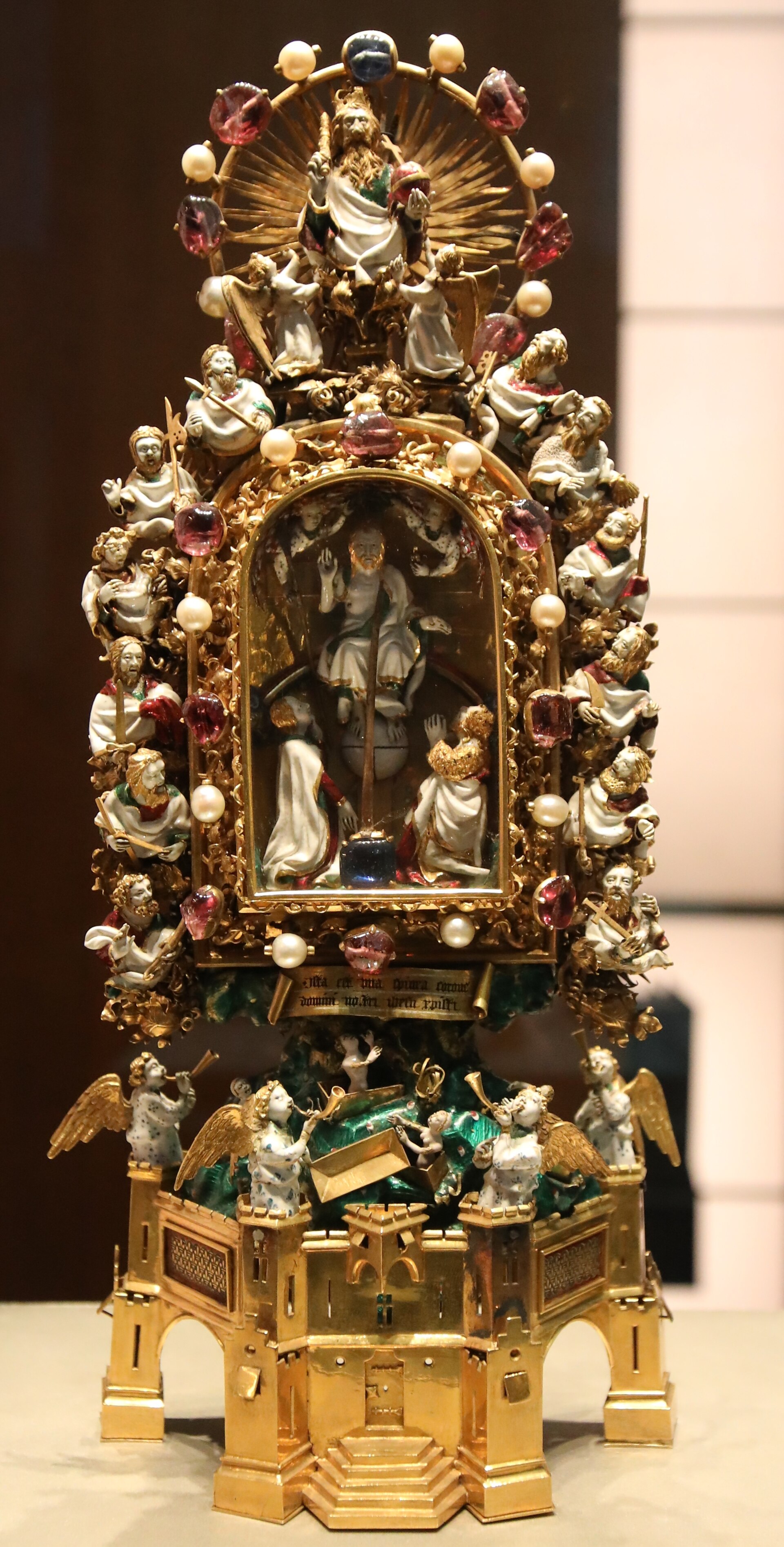
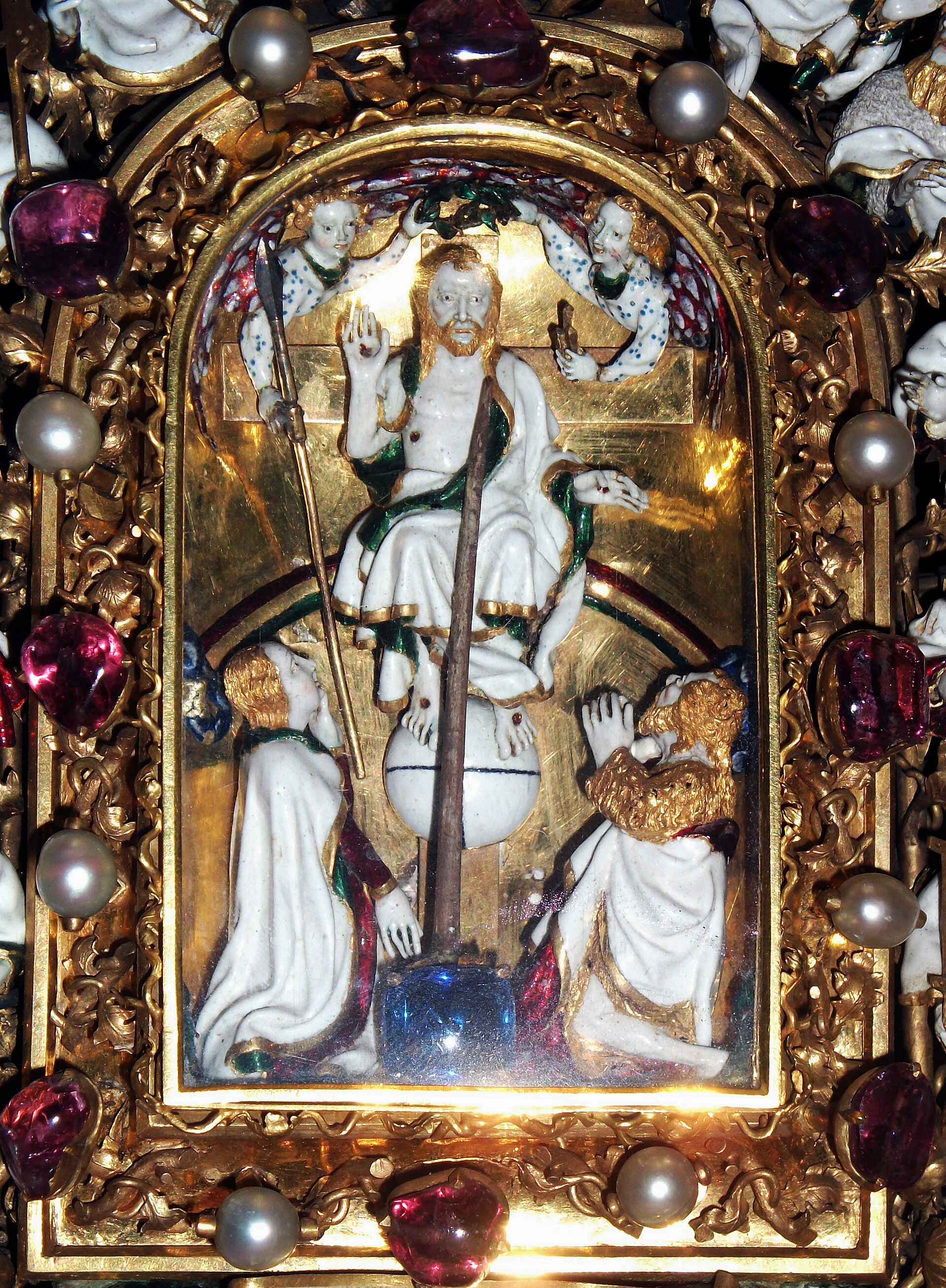
The reliquary as displayed in the Waddesdon Bequest Gallery, British Museum. The rock-crystal window at centre encloses the thorn; the Last Judgment programme surrounds it.
Photograph by Geni, Wikimedia Commons, CC BY-SA 4.0| Artist | Unknown Parisian goldsmith, Valois court |
|---|---|
| Date | Sources vary within a c. 1390-1410 window: Google Arts & Culture (British Museum partner content) gives 'before 1397'; the Wikipedia synthesis of Tait and Cherry gives 'probably in the 1390s'; Cherry's 2010 monograph title dates it '1400-10'. This record uses c. 1400-1410 as the commonly cited range and flags the spread for the editor. |
| Medium | Gold (used throughout the structural framework, not just the applied decoration), email en ronde bosse (enamel in the round) over cast gold figures, rock crystal, pearls, rubies, sapphires |
| Dimensions | Just over 30 cm high (one source gives 30.5 x 15 x 7 cm); weight 1.4 kg |
| Where it is now | British Museum, London, Room 2A (Waddesdon Bequest Gallery)last confirmed 8 August 2026 |
| Inventory number | WB.67 |
| Attribution | UnknownThe reliquary is unsigned and unmarked, as was normal for goldsmiths of the period, and no maker's name is recorded against it in any surviving document. Full note |
| Object type | Goldsmith's work |
| Period | Late medieval, French, Valois court, c. 1400 |
| Cases | Has a provenance gap |
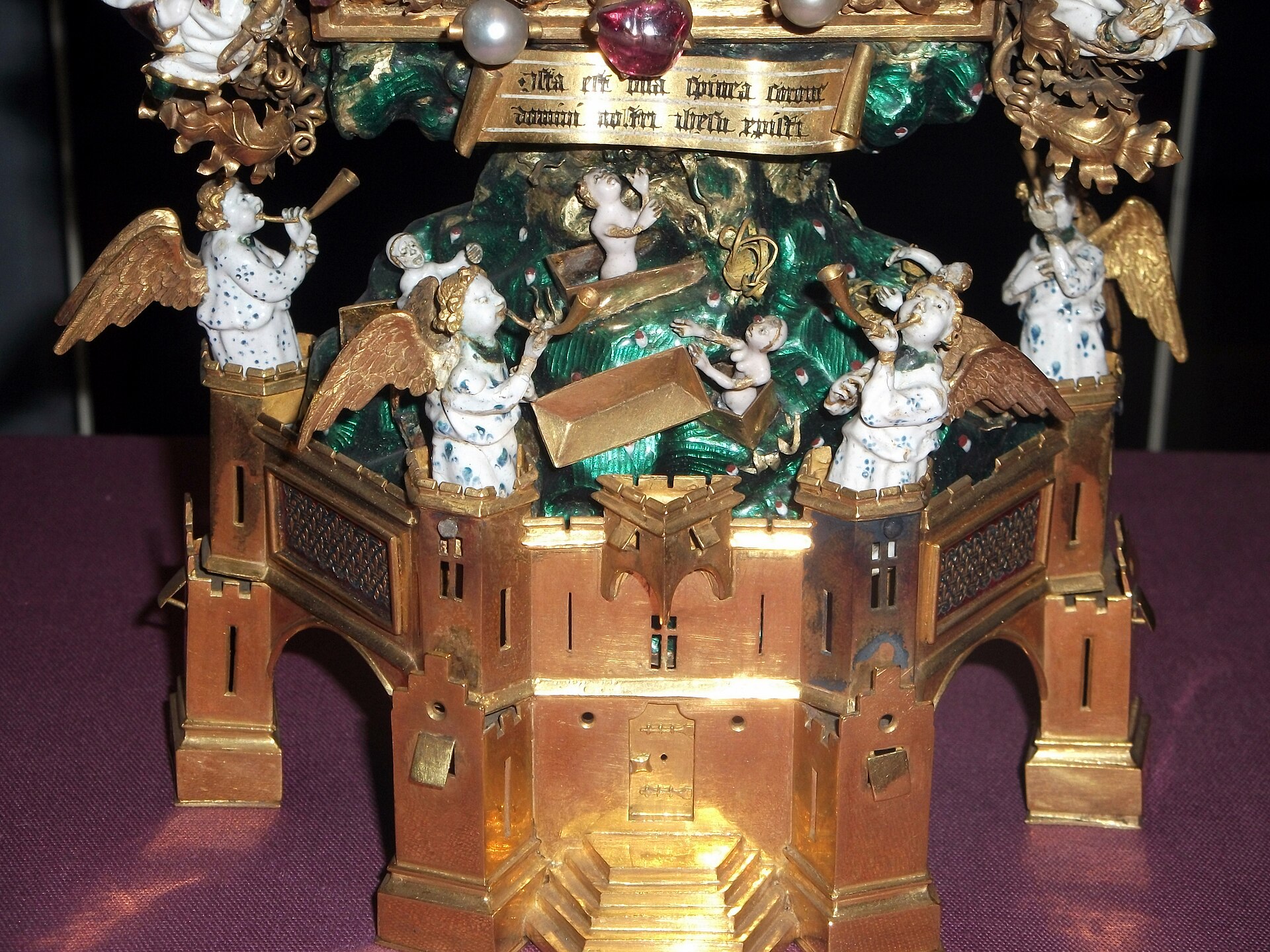
| Inscriptions | A banner beneath the resurrection scene reads ISTA EST UNA SPINEA CORONE DOMINI NOSTRI IHESU XPISTI ('This is one of the thorns of the crown of our Lord Jesus Christ'), identifying the relic housed inside. |
| Owners on record | 9 links7 documented, 1 disputed, 1 unknown |
| Sources | 7 cited |
About this record Last verified 8 August 2026 · 7 sources cited · Change log
On this page 9 sections
ContentsClose
A gold reliquary just over 30 centimetres high, made in Paris around 1400-1410 to hold a single thorn believed to be from the Crown of Thorns, and one of the finest surviving examples of email en ronde bosse, enamel in the round, at the height of its brief technical peak. Heraldic plaques on its base carry the arms of Jean, duc de Berry, though the piece appears in none of his own surviving inventories.
It passed into the Habsburg Imperial Treasury in Vienna by 1544 and stayed there for over three centuries, until the Vienna dealer Salomon Weininger secretly substituted a copy for the original sometime between 1863 and 1872 and sold the genuine piece, which reached Baron Anselm von Rothschild and then his son Ferdinand, who bequeathed it to the British Museum in 1898 as part of the roughly 300-object Waddesdon Bequest. For decades afterward the London reliquary and the Vienna forgery coexisted, each institution uncertain of its own object's status, until scholarship beginning with Joseph Destree in 1927 established which was which.
The reliquary's own authenticity as a c. 1400 goldsmith's masterpiece is now settled. Its maker is not: unsigned, unmarked, and the subject of one disputed and largely unaccepted attribution. What the thorn inside it actually is remains, as it always has been, a separate question of faith rather than of goldsmith's craft.
Provenance
Each link is graded. Documented: a cited source supports it. Disputed: the identification is argued but not established. Unknown: no owner for that span, and the gap is not smoothed into a narrative. The grades in the glossary.
- c. 1400-1410 -Unknown Parisian goldsmith, Valois courtdocumented
Made in Paris for the Valois court milieu; heraldic plaques on the base bear the arms of Jean, duc de Berry. The reliquary itself is the primary evidence for its own attribution; no contract or commission document survives.16
- c. 1400-1410 - 1416Jean, duc de Berry (attributed, by heraldry)disputed
The heraldic arms on the base are the sole evidence for Berry's ownership. The object does not appear, under any matching description, in either of his two surviving detailed inventories, 1401-1403 or 1413-1416 (the year of his death). One inventory entry for 'a thorn in a large gold jewel' has been proposed as a possible match but is dated after 1401, in tension with the date suggested by the heraldry.16
- 1416 - 1544Unknownunknown
No owner or location is documented for this period. The reliquary next surfaces in an inventory belonging to the Holy Roman Emperor Charles V, most plausibly having passed through the Valois dukes of Burgundy, who inherited much of Berry's collection, but this route is inferred, not documented.1
- 1544 - 1860sHabsburg Imperial Treasury / Ecclesiastical Treasury (Geistliche Schatzkammer), Viennadocumented
Recorded in the 1544 inventory of Charles V and repeatedly thereafter, including continuously in Schatzkammer inventories from 1677 onward. By the early twentieth century, institutional confidence in the object's medieval date had nonetheless eroded: a transfer-inventory note and the 1909 Treasury guide both mis-dated it to the nineteenth century.16
- 1863 - 1872Salomon Weininger workshop, Vienna (theft by substitution)documented
Given access to the Ecclesiastical Treasury's holdings for restoration, Weininger's workshop produced a close copy and secretly substituted it for the original, retaining and selling the genuine reliquary. The dating of 1863-1872 is fixed by Weininger's 1863 release from an earlier prison term and by the original's documented appearance in Anselm von Rothschild's 1872 catalogue addendum. The caster is identified from 1877 trial testimony as Karl Kuthmayer; the enamelling is attributed to Simon Grunwald or Karl Bender.6
- by 1872 - 1874Baron Anselm von Rothschild, Viennadocumented
Listed as item 607 in a published 1872 addendum to the catalogue of Anselm von Rothschild's art collection, which fixes the terminus ante quem for his acquisition. Court records from Weininger's 1877 trial place Weininger in business dealings with Rothschild, via the dealer Georg Plach, before 1874; whether the reliquary itself passed through this specific channel is not established. A contemporary court report states that Rothschild was aware Weininger dealt professionally in forged antiques.6
- 1874 - 1898Baron Ferdinand de Rothschild, Waddesdon Manor, Buckinghamshiredocumented
Inherited on Anselm von Rothschild's death in 1874, along with the rest of his father's collection.1
- 1898 - presentBritish Museum, London (Waddesdon Bequest)documented
Bequeathed on Ferdinand de Rothschild's death in December 1898; received by the Museum in 1899 as part of the roughly 300-object Waddesdon Bequest. At the time of accession its origins were 'completely lost' and it was catalogued as 'Spanish, 16th Century.' The Bequest's binding terms require the whole collection to be kept together, in a dedicated room, in perpetuity, and forbid any part of it leaving the Museum.1
- 1927 - 1959 (per secondary sources, unverified in this research pass)British Museum (identity confirmed)documented
Joseph Destree published the first identification of the London reliquary as the genuine object recorded in the old Vienna inventories, and of the Vienna piece as Weininger's copy, in a 1927 Connoisseur essay. Multiple secondary sources, not independently verified here against a primary account, state the matter was finally settled in 1959 when the Vienna copy was brought to London and compared by a panel of British Museum, V&A and Kunsthistorisches Museum experts.1
Technical evidence
| Attribution note | The reliquary is unsigned and unmarked, as was normal for goldsmiths of the period, and no maker's name is recorded against it in any surviving document. The one named proposal is Renate Eikelmann's suggestion that it is the work of Rennequin de Harlem, a Netherlandish goldsmith active in Paris who worked for both Jean, duc de Berry and Philip the Bold, duke of Burgundy. Paulus Rainer, curator at the Kunsthistorisches Museum Wien, notes in 2014 that this attribution is 'generally ignored in related literature.' Hugh Tait's 1986 British Museum catalogue of the Waddesdon Bequest jewels, the standard reference on the object, does not take Eikelmann's thesis into account at all. The attribution to a named hand should therefore be treated as argued and disputed, not accepted. |
|---|---|
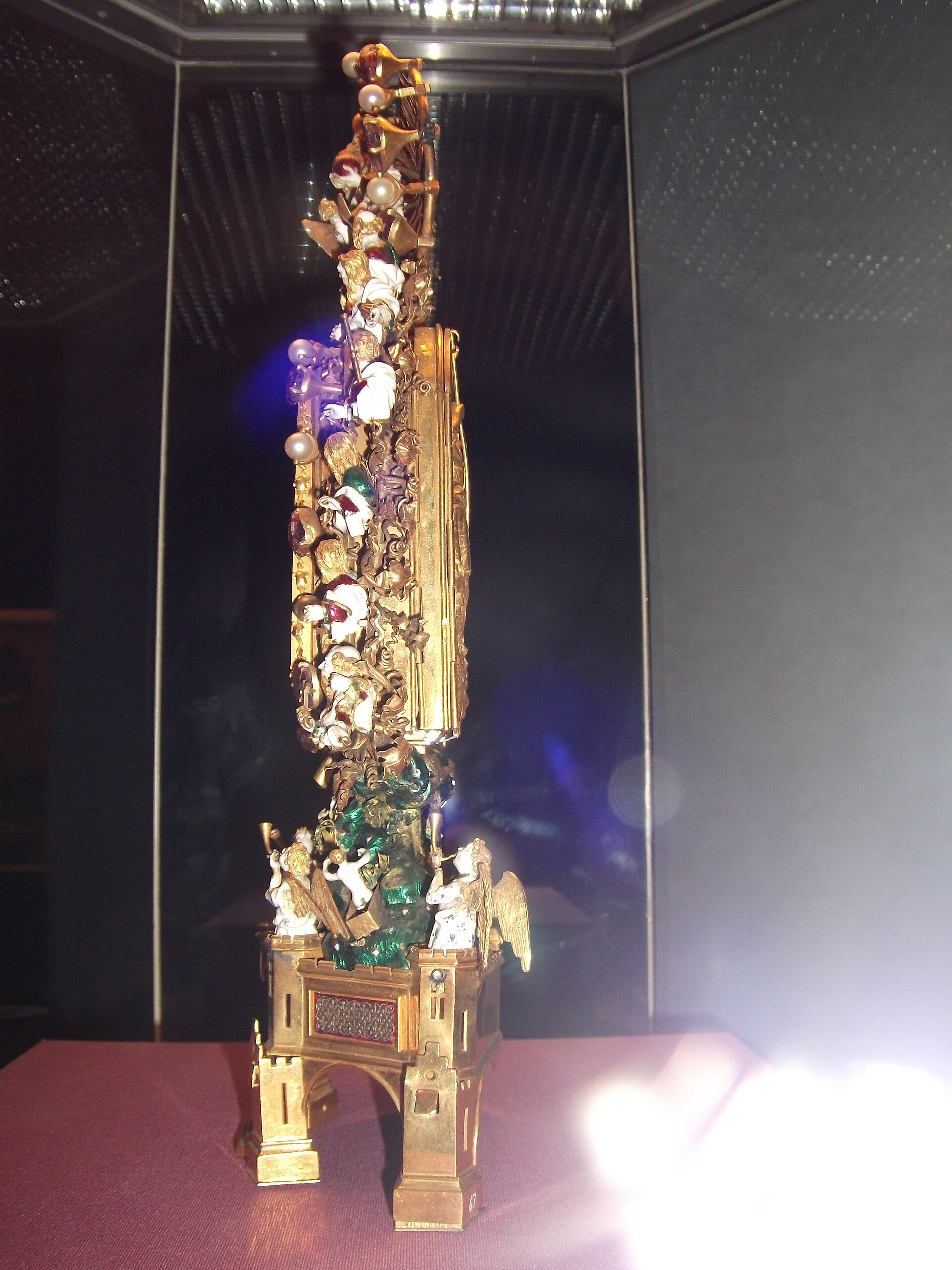
| Structure | Built entirely in solid gold, including the structural framework, rather than the silver-gilt normal even in royal commissions of comparable scale at this period.1 |
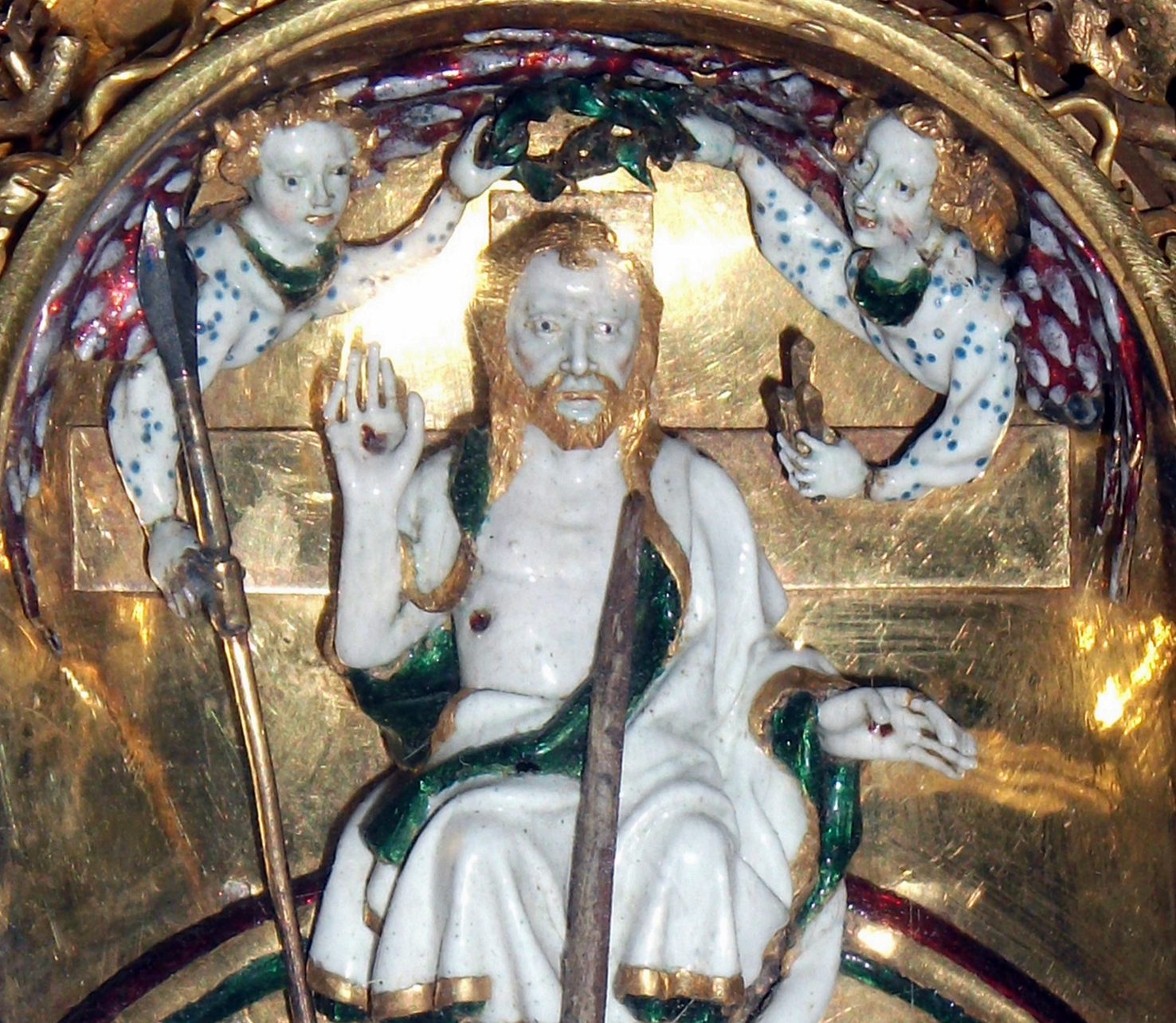
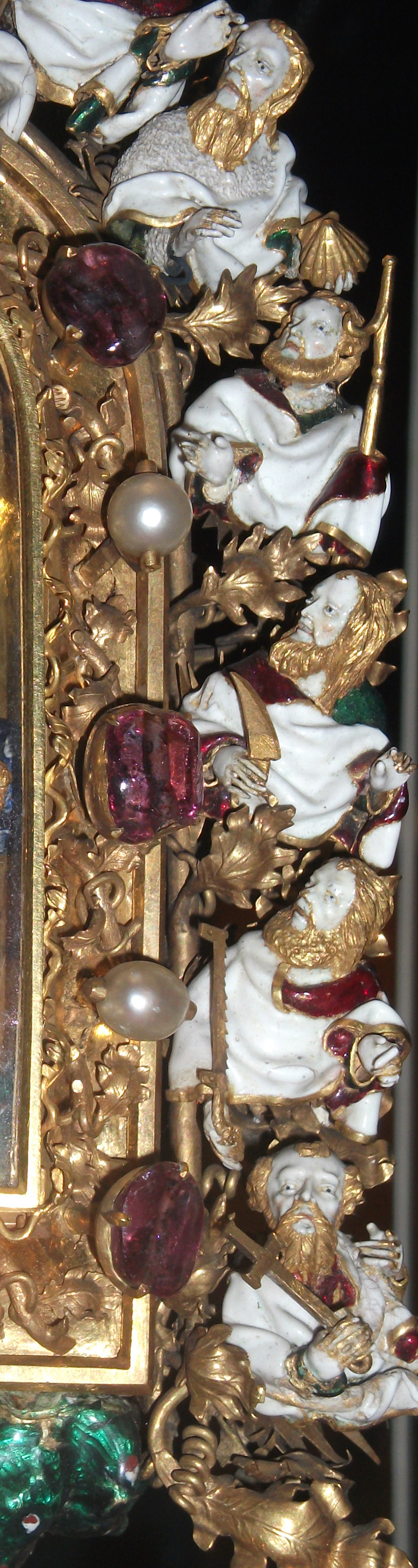
| Enamel technique | Email en ronde bosse (enamel in the round / encrusted enamelling): cast or modelled three-dimensional gold figures, some on a wire-thin core, coated in fired enamel. 28 such figures survive on the piece, most in white enamel, a colour only recently perfected when this object was made.16 |
| Gemstones | 2 large sapphires; 14 rubies alternating with 14 pearls around the window frame. All are drilled through as though for threading on a necklace, indicating they were reused from an earlier piece of jewellery rather than cut new for this setting.1 |
| Dimensions and weight | Just over 30 cm high (one source specifies 30.5 x 15 x 7 cm); 1.4 kg.14 |
| Heraldic evidence | Enamelled plaques bearing the coat of arms of Jean, duc de Berry are applied to the castle base. This heraldry, not a documentary record, is the primary evidence for the traditional attribution of ownership and for the c. 1400 date.16 |
| Inscription | A scroll below the resurrection scene reads ISTA EST UNA SPINEA CORONE DOMINI NOSTRI IHESU XPISTI, identifying the enclosed relic as a thorn from the Crown of Thorns.1 |
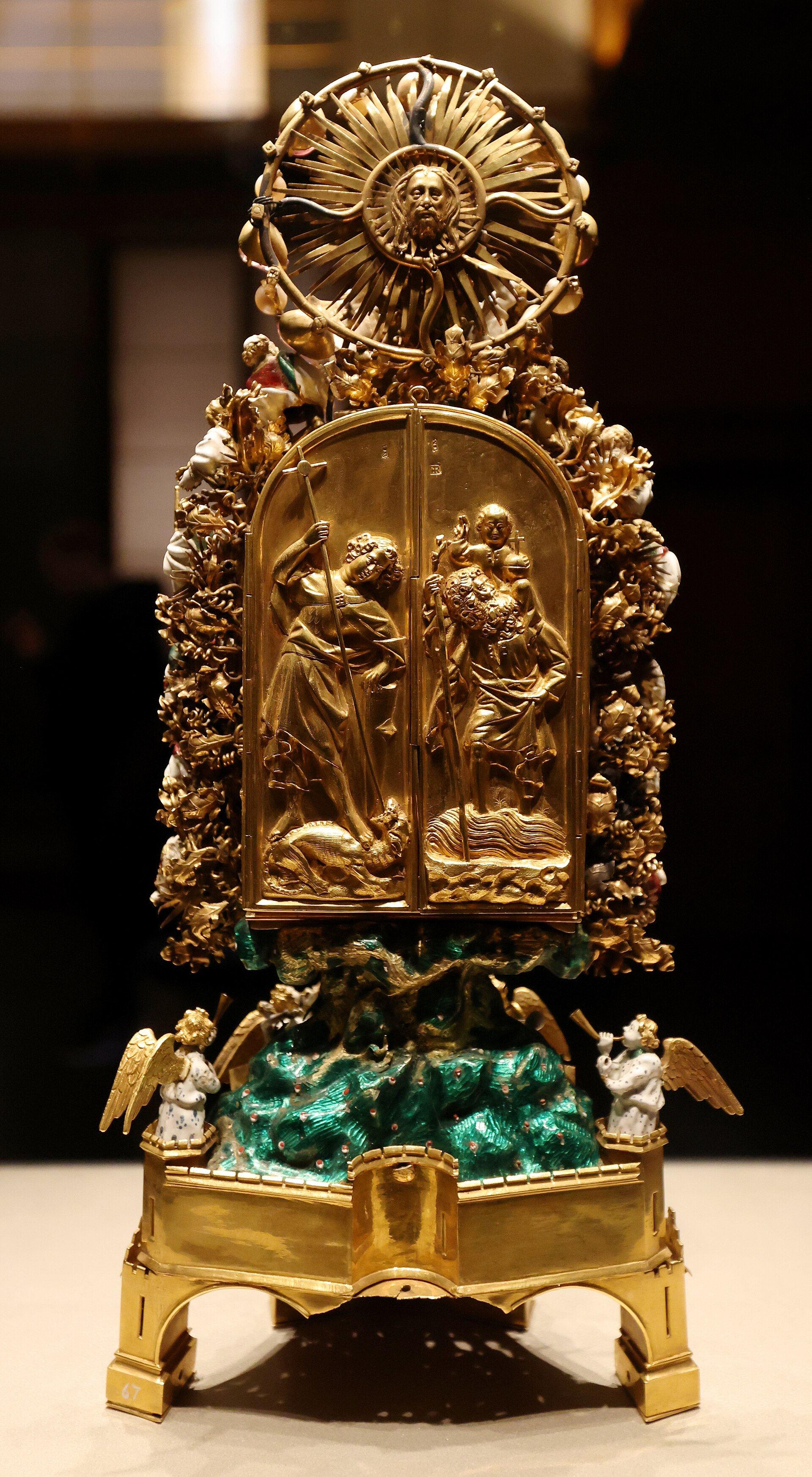
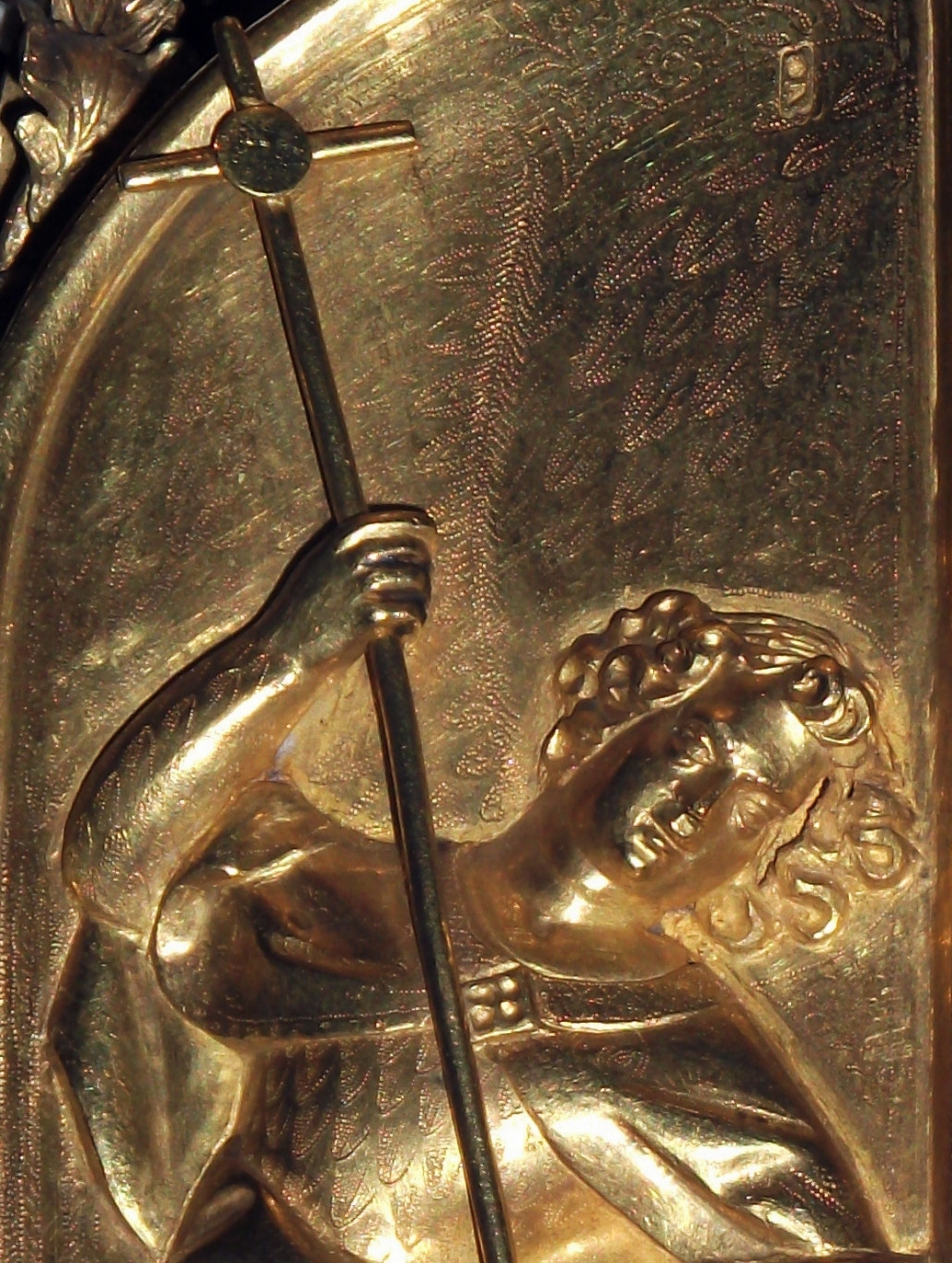
| Rear doors | The crystal window is closed from behind by two hinged gold doors decorated with reliefs of a dragon-slaying knight (identified as Michael by Tait 1986 and Eikelmann, but as George in the historic Vienna Ecclesiastical Treasury inventories) and Saint Christopher carrying the Christ child. A flat object once fixed behind the doors, possibly a second relic such as a Veil of Veronica image, is now missing.16 |
| The Weininger copy, for comparison | A closely related but distinguishable copy exists in the Kunsthistorisches Museum Wien, Ecclesiastical Treasury (Inv. No. D 129), made by the workshop of the Vienna forger Salomon Weininger between 1863 and 1872. It differs from the original in enamelled (rather than plain gold) rear doors and angel wings, additional enamelled foliate ornament, and the omission of Christ's stigmata.6 |
Images
The record in full
Chapter 1What it is
A gold reliquary just over 30 centimetres high, built as a small castle whose towers support a great rock-crystal window, itself crowned by a burst of gold rays holding God the Father in majesty.
A gold reliquary just over 30 centimetres high, built as a small castle whose towers support a great rock-crystal window, itself crowned by a burst of gold rays holding God the Father in majesty. It is one of the very few surviving goldsmith's works of this ambition and quality from the Valois court around 1400, and one of still fewer made in solid gold throughout rather than the cheaper silver-gilt normal even in royal commissions of the period.
Twenty-eight small three-dimensional figures, most of them in white enamel, cover the piece: Christ in Judgment, the Virgin and John the Baptist kneeling in supplication at his feet, the twelve Apostles carrying their attributes around the rim of the window, God the Father and two adoring angels above, and a crowd of the resurrected dead climbing from their graves below, roused by four angels blowing the Last Trump from the castle's turrets. At the centre of all of it, behind the crystal window, sits a single thorn.
Chapter 2How it was made
The figures are executed in email en ronde bosse, enamel in the round: a technique in which a goldsmith casts or models a fully three-dimensional figure in gold, sometimes on a core no thicker than...
The figures are executed in email en ronde bosse, enamel in the round: a technique in which a goldsmith casts or models a fully three-dimensional figure in gold, sometimes on a core no thicker than gold wire, lightly roughens its surface so that enamel will key to it, then coats the figure in enamel paste and fires it. The result is not a flat enamelled plaque but a small enamelled sculpture, and it was, around 1400, a very new and very fashionable thing to be able to do.
The technique had only been developed a decade or two before this reliquary was made, and the goldsmiths working for the French royal dukes were pushing it to its technical limits right at the point this piece was produced. White enamel, the dominant colour on the figures here, was itself a recent achievement. What survives of the technique at this level of ambition is a small, closely watched group: this reliquary, the Goldenes Rossl at Altotting, the Dunstable Swan Jewel, and a handful of others, most of them royal or ducal commissions, because only a court could afford the material and the specialist labour it demanded.
Chapter 3The iconographic programme
The subject is the General Resurrection following the Last Judgment, and the choice of subject is not incidental to what the object holds.
The subject is the General Resurrection following the Last Judgment, and the choice of subject is not incidental to what the object holds. Christ is shown seated on a rainbow, displaying the wounds of his Passion, with two angels above him bearing the instruments of that Passion: the same instruments, doctrinally, that produced the thorn enclosed just below. The Virgin and John the Baptist kneel to either side in the traditional Deesis pose of intercession, pleading on behalf of the souls shown rising from their graves at the base, summoned by trumpeting angels standing on the reliquary's own castle turrets.
Medieval belief held that a relic of the Crown of Thorns, and by extension the reliquary that displayed it, was in a sense only on loan to the earthly kingdom that held it, to be reclaimed by Christ at his return. Housing the thorn inside a vision of exactly that moment of return was therefore not simply an attractive subject: it stated, in gold and enamel, what the relic's owner believed the object to be for. On the reverse, two more figures continue a protective and devotional programme: a knight spearing a dragon, and Saint Christopher carrying the Christ child on his shoulder, patron of travellers and, by tradition, a saint whose image was believed to protect against sudden death.
The identity of the dragon-spearing knight is not as settled as the standard literature suggests. Hugh Tait's 1986 catalogue and Renate Eikelmann both identify him as the Archangel Michael, which fits the Last Judgment theme neatly, since Michael weighs souls at the Judgment. But Paulus Rainer, writing in 2014 from the Kunsthistorisches Museum Wien, points out that the historic inventories of the Vienna Ecclesiastical Treasury, where the piece was recorded for over three centuries, describe the same figure as Saint George. Both readings are held by named scholars and this record does not arbitrate between them.
Chapter 4The patron: Jean, duc de Berry
The case for Jean, duc de Berry (1340-1416), third son of King John II of France and brother of Charles V, as the reliquary's original owner rests on physical evidence on the object itself, not on a...
The case for Jean, duc de Berry (1340-1416), third son of King John II of France and brother of Charles V, as the reliquary's original owner rests on physical evidence on the object itself, not on a documentary record of the commission. Enamelled heraldic plaques on the castle base carry his coat of arms, and it is this heraldry, not an inventory entry, that anchors both the attribution and the c. 1400 date.
That matters because the reliquary is conspicuously absent from where a reader would expect to find it. Extremely detailed inventories of Berry's possessions survive from 1401 to 1403 and again from 1413 to 1416, the year of his death, and none contains an entry that clearly matches this object. One item recorded among his goldsmiths' work, 'a thorn in a large gold jewel,' has been proposed as a possible match, but it is dated in the inventory to after 1401, which sits awkwardly against the date the heraldry suggests. Berry was one of the most voracious collectors of the medieval world and gave objects away constantly, including to the Sainte-Chapelle he built at Bourges, so an ungifted attribution absent from his own accounts is not unusual for him specifically. It does mean the object's status as 'the Berry reliquary' is an argument built on his arms, not a chain of custody proven by his own paperwork.
Chapter 5Materials as meaning
Pure gold used through the entire structural framework, not merely in applied decoration, was itself a statement: most goldsmiths' work of comparable scale and even comparable royal status was built...
Pure gold used through the entire structural framework, not merely in applied decoration, was itself a statement: most goldsmiths' work of comparable scale and even comparable royal status was built in silver-gilt to save weight and cost, gold being reserved for the visible surface. Building the whole object solid was a deliberate extravagance.
The gemstones tell a different story from the gold. Two large sapphires, and fourteen rubies alternating with fourteen pearls, are set around the reliquary, and every one of them is drilled through, as though for threading on a necklace or rosary. That is not how a goldsmith commissioning stones for a purpose-built setting would specify them cut. The drilling strongly suggests the stones were not bought new for this object but taken from an existing piece of jewellery, whether Berry's own or another's, and reset. If so, the reliquary's materials carry two histories at once: the gold built new for this specific devotional purpose, and gemstones inherited from something that came before it and no longer survives in its own right.
Chapter 6Habsburg Vienna, 1544 to the 1860s
Where the reliquary went after Berry's death in 1416 is not documented.
Where the reliquary went after Berry's death in 1416 is not documented. It resurfaces in 1544, in an inventory belonging to the Holy Roman Emperor Charles V, most plausibly having reached the Habsburgs through the Valois dukes of Burgundy, who inherited much of Berry's collection. From 1677 it is recorded repeatedly in the inventories of the Imperial Schatzkammer, the treasure chamber, in Vienna, and later in the Geistliche Schatzkammer, the Ecclesiastical Treasury of the Hofburg.
Even inside that continuous institutional custody, the object's identity was not stable. An inventory note made when the Ecclesiastical Treasury's holdings were transferred toward the modern Kunsthistorisches Museum dated the reliquary to the nineteenth century. The Treasury's own 1909 guide called it a nineteenth-century work, if an early one; later guides retreated to describing it only as made 'in a late Gothic style.' The institution holding the piece for three centuries had, by the early twentieth century, lost confidence in its own object's age.
Chapter 7The Weininger substitution
The reason for that lost confidence has a name: Salomon Weininger, a Viennese dealer and restorer with a workshop of skilled goldsmiths and gem-cutters, who gained access to the Ecclesiastical...
The reason for that lost confidence has a name: Salomon Weininger, a Viennese dealer and restorer with a workshop of skilled goldsmiths and gem-cutters, who gained access to the Ecclesiastical Treasury's holdings for restoration and used that access, between 1863 and 1872, to make copies of at least several major pieces and quietly substitute them, keeping and selling the originals. The Holy Thorn Reliquary was one of at least two Ecclesiastical Treasury objects treated this way; the other identified so far is a reliquary-ostensorium set with a Fatimid rock crystal sphere. Related work by the Kunsthistorisches Museum's own curators has since traced several more Weininger-circle substitutions across other Treasury pieces, including a rock-crystal casket now in the Art Institute of Chicago and an Annunciation group now in the Fitzwilliam Museum, Cambridge, both taken by the same method.
Weininger's copy of the Holy Thorn Reliquary is an accomplished piece of work in its own right, close enough in technique and iconography that it went unquestioned in the Treasury for decades. It also carries tells that give it away on close comparison: the copy's rear doors, unlike the original's plain gold, are enamelled in blue, green and red; its angel wings are coloured where the original's are plain gold; its foliate frame carries ornament the original lacks; and, tellingly, the forger omitted Christ's stigmata from the Judgment figure, apparently not understanding what the wound marks signified within the composition he was copying. Weininger was convicted of separate forgery offences in 1877 and died in prison in Vienna in 1879. His fraud in the Ecclesiastical Treasury went undetected through his own lifetime; nobody with the standing or motive to investigate seems to have wanted to.
The original reliquary, meanwhile, had entered the Vienna art market. Business records place Weininger in transactions with Baron Anselm von Rothschild through the dealer Georg Plach before 1874, and a 2014 study by the Kunsthistorisches Museum notes drily that Anselm 'knew that Weininger professionally dealt in forgeries of antiques' even as he was acquiring pieces through channels connected to him. Whether Weininger sold the Holy Thorn Reliquary to Rothschild directly or through an intermediary cannot now be established.
Chapter 8Identifying the fake, and the genuine article
The Rothschild original and the Vienna copy coexisted, each institution unaware of or unable to prove the other's status, for over half a century.
The Rothschild original and the Vienna copy coexisted, each institution unaware of or unable to prove the other's status, for over half a century. The first scholar to state in print that the London reliquary was the genuine object recorded in the old Viennese inventories, and that the Vienna piece was Weininger's copy, was the Belgian art historian Joseph Destree, in a 1927 essay in The Connoisseur. Even that publication did not immediately settle the matter for the institutions holding the two objects.
Multiple secondary accounts, though not the primary Kunsthistorisches Museum literature consulted for this record, state that the question was 'not finally settled until 1959,' when the Vienna reliquary was brought to London for direct side-by-side comparison, and that a panel of experts drawn from the British Museum, the Victoria and Albert Museum and the Kunsthistorisches Museum in Vienna examined both pieces together and agreed that the London reliquary was the original. This record has not been able to independently verify that date, that panel's composition, or the specific technical methods used, from a primary or scholarly source, and flags this explicitly rather than presenting it as more solidly documented than it is.
Chapter 9Anselm and Ferdinand de Rothschild, and the Bequest
Baron Anselm von Rothschild of Vienna owned the genuine reliquary by 1872 at the latest; that date is fixed by its listing, under item number 607, in a published addendum to the catalogue of his art...
Baron Anselm von Rothschild of Vienna owned the genuine reliquary by 1872 at the latest; that date is fixed by its listing, under item number 607, in a published addendum to the catalogue of his art collection. When Anselm died in 1874 his collection, including the reliquary, passed to his son Baron Ferdinand de Rothschild, who had by then settled in England and built Waddesdon Manor in Buckinghamshire.
Ferdinand died in December 1898 and left his entire collection of around 300 works, the finest of them Renaissance and late-medieval goldsmiths' work, jewels and glass, to the British Museum. The bequest, universally known since as the Waddesdon Bequest, came with an unusually specific and legally binding condition attached to his will: the collection was to be placed in a room to be called the Waddesdon Bequest Room, kept there separate and apart from the rest of the Museum's holdings, in perpetuity, on pain of the bequest becoming void if the condition was broken. That stipulation has been honoured through every move the collection has made since, from Room 40 in 1900 to the North Wing in 1921, to Room 45 in 1973, to its current home in Room 2A since 2015. It is also why the Holy Thorn Reliquary was left off the itinerary when the Treasures of Heaven exhibition travelled to Cleveland and Baltimore in 2011: under the terms of the Bequest, it cannot leave the Museum at all.
Chapter 10The relic, kept separate from the reliquary
The reliquary's own authenticity as a piece of goldsmith's work made c.
The reliquary's own authenticity as a piece of goldsmith's work made c. 1400 is now settled among the sources consulted for this record. What it was made to contain is a different and separate question, and the two should not be run together. Medieval French royal tradition held that Louis IX bought what was believed to be Christ's actual Crown of Thorns from the Latin Emperor of Constantinople, Baldwin II, in 1239, at enormous cost, and housed it in the Sainte-Chapelle he built for the purpose in Paris. Individual thorns were subsequently given away as diplomatic and devotional gifts by later French kings, and it is one of those distributed thorns that this reliquary was made to hold and display.
Whether the Crown itself is the object it was believed to be in the thirteenth century, and whether any thorn distributed from it is what it was claimed to be, are questions of religious tradition and disputed early source material stretching back to a fifth-century account by Bishop Paulinus of Nola, not questions this record can resolve or needs to. The reliquary is a genuine, extraordinary object of c. 1400 regardless of the answer; that is the finding this record makes, and it is a finding about the goldsmith's work, not about the thorn inside it.
Chapter 11What is still unresolved
No maker is named for the reliquary and the one scholarly proposal, Rennequin de Harlem, has not been taken up by the field.
No maker is named for the reliquary and the one scholarly proposal, Rennequin de Harlem, has not been taken up by the field. No document places it in Jean de Berry's own hands, only his arms on its base. The three centuries between Berry's death and the reliquary's first appearance in a Habsburg inventory are undocumented. The precise mechanics of the 1959 authentication, repeated across secondary sources but not confirmed here against a primary account, need verification against Tait's 1986 catalogue or the British Museum's own object record. And the identity of the armed figure on the reverse, Michael or George, remains an open disagreement between named scholars rather than a settled point. None of this diminishes the object. It is the ordinary condition of a six-hundred-year-old piece of goldsmith's work that survived by luck, forgery and inheritance rather than by an unbroken paper trail, and this record states the gaps as gaps rather than closing them with invention.
The artist
Unknown; a Parisian goldsmith or workshop of the Valois court, c. 1400
No goldsmith's name is attached to the Holy Thorn Reliquary by any signature, mark or surviving contract, which was normal practice for the period rather than a gap peculiar to this object. What can be said is where and for whom such work was made: the courts of the French royal dukes around 1400, Jean de Berry chief among them, employed goldsmiths capable of pushing the still-new technique of email en ronde bosse to its technical limit, working in solid gold at a cost only a handful of patrons in Europe could meet. The maker of this piece belongs to that milieu even though he cannot be named with confidence.
Related works
| Work | Relation | Where it is |
|---|---|---|
| Goldenes Rossl (Little Golden Horse) Unknown French court workshop | The other major surviving example of email en ronde bosse at this scale and ambition Dated 1404 by inscription; a gift from Isabeau of Bavaria to her husband Charles VI of France. Gives the closest sense of the class of object and patron the Holy Thorn Reliquary belongs to. | Schatzkammer, Altotting, Bavaria |
| Dunstable Swan Jewel Unknown English or French workshop | Smaller-scale comparanda in the same enamel-in-the-round technique c. 1400. A badge rather than a reliquary, but demonstrates the same ronde bosse method applied to a different courtly object. | British Museum, London |
| Montalto Reliquary Unknown workshop | Comparanda cited alongside the Holy Thorn Reliquary as a major ronde bosse survival Listed with the Goldenes Rossl and the Holy Thorn Reliquary among the small surviving group of grand ronde bosse commissions c. 1400. | Not specified in sources consulted |
| The Weininger forgery of the Holy Thorn Reliquary Karl Kuthmayer (casting), Simon Grunwald or Karl Bender (enamelling), workshop of Salomon Weininger | The nineteenth-century copy substituted for the original in Vienna between 1863 and 1872 Close enough to pass as genuine in the Vienna Treasury for decades; distinguishable by its enamelled rear doors and angel wings and by the omission of Christ's stigmata. | Kunsthistorisches Museum Wien, Ecclesiastical Treasury, Inv. No. D 129 |
| Reliquary-ostensorium with a Fatimid rock crystal sphere Unknown; forged by the Weininger circle | The other Ecclesiastical Treasury object identified as a Weininger substitution alongside the Holy Thorn Reliquary Identified together with the Holy Thorn Reliquary substitution by Arpad Weixlgartner in 1929; the genuine original's current location as given in the source consulted is the Germanisches Nationalmuseum. | Kunsthistorisches Museum Wien, Ecclesiastical Treasury, Inv. No. D 103 |
| Annunciation Group (Mary and the Angel) Unknown Burgundian-Dutch workshop, 15th century; Weininger-circle forgery of the same object in Vienna | Another genuine ronde bosse piece recovered from a Weininger-circle substitution, useful comparanda for how the forgery operation worked Original first identified by John F. Hayward. At least two further Weininger-circle copies of this group are known, in Madrid and formerly in the Linsky Collection, New York. | Fitzwilliam Museum, Cambridge (original); Kunsthistorisches Museum Wien, Ecclesiastical Treasury, Inv. D 191 (forgery) |
Open questions
- Who made it? No goldsmith is named or signed on the object. The one scholarly proposal, Rennequin de Harlem, is described by a Kunsthistorisches Museum curator as generally ignored in the literature and is not accepted by Hugh Tait's standard 1986 catalogue.
- Was it made for Jean de Berry directly, or acquired or appropriated by him after being made for someone else? His arms appear on the object, but it does not appear in either of his two surviving detailed inventories (1401-1403 and 1413-1416).
- Where was the reliquary between Jean de Berry's death in 1416 and its first documented Habsburg appearance in a 1544 inventory of Charles V? No owner is recorded for this gap of well over a century.
- What was the second object once fixed behind the now-missing panel on the reliquary's rear doors, proposed as possibly a Veil of Veronica image? It is lost and undescribed in the sources consulted.
- Is the armed figure on the reverse Saint Michael, as Tait 1986 and Eikelmann identify him, or Saint George, as the historic Vienna Ecclesiastical Treasury inventories describe the same figure? Named scholars disagree and this record has not resolved it.
- What exactly happened in 1959? Multiple secondary sources describe a side-by-side comparison in London by experts from the British Museum, the V&A and the Kunsthistorisches Museum that settled the authenticity question, but this record could not verify the date, the individuals involved, or the technical methods used against a primary or first-rank scholarly source.
- How did Salomon Weininger obtain access to sell the genuine reliquary, and did he sell it to Anselm von Rothschild directly or through an intermediary dealer? A 2014 Kunsthistorisches Museum study states this 'cannot be ascertained' from the surviving 1877 trial records.
Questions about this object
What is The Holy Thorn Reliquary?
The Holy Thorn Reliquary is a goldsmith's work, dated sources vary within a c. 1390-1410 window: Google Arts & Culture (British Museum partner content) gives 'before 1397'; the Wikipedia synthesis of Tait and Cherry gives 'probably in the 1390s'; Cherry's 2010 monograph title dates it '1400-10'. This record uses c. 1400-1410 as the commonly cited range and flags the spread for the editor.. Medium: Gold (used throughout the structural framework, not just the applied decoration), email en ronde bosse (enamel in the round) over cast gold figures, rock crystal, pearls, rubies, sapphires.
Who made The Holy Thorn Reliquary, and is the attribution settled?
The attribution to Unknown Parisian goldsmith, Valois court is recorded here as unknown. The reliquary is unsigned and unmarked, as was normal for goldsmiths of the period, and no maker's name is recorded against it in any surviving document. The one named proposal is Renate Eikelmann's suggestion that it is the work of Rennequin de Harlem, a Netherlandish goldsmith active in Paris who worked for both Jean, duc de Berry and Philip the Bold, duke of Burgundy. Paulus Rainer, curator at the Kunsthistorisches Museum Wien, notes in 2014 that this attribution is 'generally ignored in related literature.' Hugh Tait's 1986 British Museum catalogue of the Waddesdon Bequest jewels, the standard reference on the object, does not take Eikelmann's thesis into account at all. The attribution to a named hand should therefore be treated as argued and disputed, not accepted.
Where is The Holy Thorn Reliquary now?
British Museum, London, Room 2A (Waddesdon Bequest Gallery). Inventory number WB.67. Last confirmed 8 August 2026. Bequeathed to the British Museum in 1898 by Baron Ferdinand de Rothschild as part of the Waddesdon Bequest; on permanent display in the dedicated Waddesdon Bequest room since the Bequest's terms require it to be kept together and cannot leave the Museum.
What is still unknown about The Holy Thorn Reliquary?
Who made it? No goldsmith is named or signed on the object. The one scholarly proposal, Rennequin de Harlem, is described by a Kunsthistorisches Museum curator as generally ignored in the literature and is not accepted by Hugh Tait's standard 1986 catalogue.
Sources
- 1Wikipedia, 'Holy Thorn Reliquary'. Tertiary source, consolidating Tait 1986 and Cherry 2010 among others; flagged for replacement with those primary catalogues and with the British Museum's own online collection record, which could not be accessed directly in this research pass (britishmuseum.org returned HTTP 403 to automated fetch; wb.britishmuseum.org returned a certificate error). en.wikipedia.org/wiki/...
- 2Wikipedia, 'Waddesdon Bequest', for the terms of Ferdinand de Rothschild's 1898 will and the Bequest's display history through Rooms 40, the North Wing, 45 and 2A. Tertiary source. en.wikipedia.org/wiki/...
- 3Columbia University, 'Treasures of Heaven' project, 'The Holy Thorn Reliquary', for the Jean de Berry inventory detail and the theological reading of the Last Judgment programme in relation to the relic. Academic project page, secondary source. projects.mcah.columbia.edu/treasuresofheaven/...
- 4Google Arts & Culture (British Museum partner content), 'Holy Thorn Reliquary of Jean, duc de Berry'. Secondary source republishing museum-derived description; used for dimensions and iconography cross-check. artsandculture.google.com/asset/...
- 5Wikipedia, 'Ronde-bosse', for the technique's origins, development and the roster of major c. 1400 survivals (Goldenes Rossl, Dunstable Swan Jewel, Montalto Reliquary). Tertiary source. en.wikipedia.org/wiki/...
- 6Paulus Rainer (curator, Kunsthistorisches Museum Wien), article on Salomon Weininger's forgeries in the Vienna Ecclesiastical Treasury (Part 2), Silver Society of Canada Journal, Volume 17, 2014, pp. 70-83. The most rigorous single source consulted: names the forger's workshop artisans, dates the substitution to 1863-1872, cites Destree 1927 and the Eikelmann/Rennequin de Harlem attribution and its rejection by Tait 1986, and identifies the Michael/George iconographic disagreement. Primary scholarly article, read in full. silversocietyofcanada.ca/sites/...
- 7Wikimedia Commons, Category:Holy Thorn Reliquary (London), used to identify and verify the licence and named photographer of every image entry in this record via the Commons API extmetadata (LicenseShortName field). commons.wikimedia.org/wiki/...
Last verified 8 August 2026 · Published 8 August 2026
Change log
8 August 2026 - Record created at the house standard: researched narrative, technical evidence, maker dossier, graded provenance chain, prices with hammer and premium separated, related works, open questions and sources.