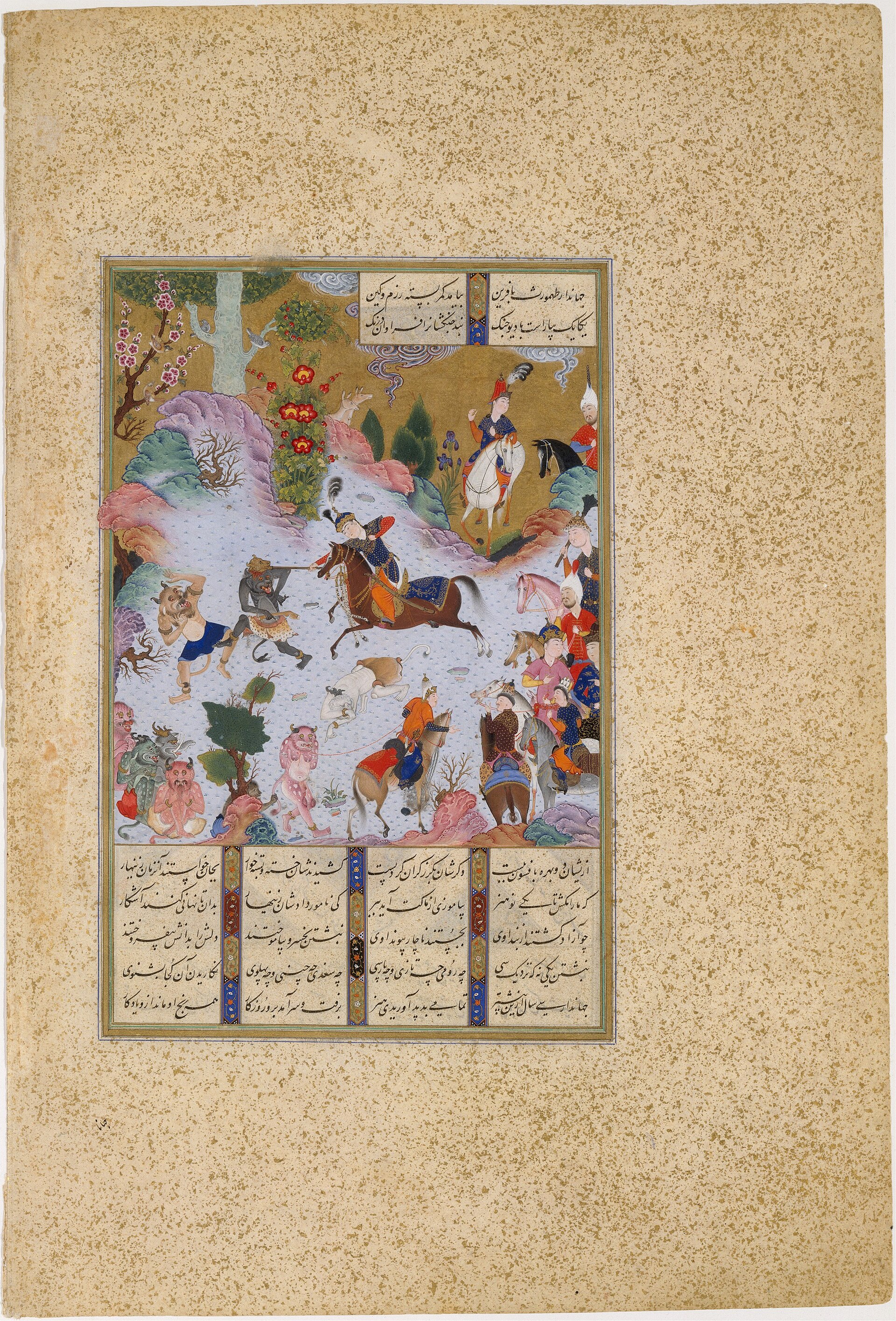
"Tahmuras Defeats the Divs", Folio 23v from the Shahnama (Book of Kings) of Shah Tahmasp
Sultan Muhammad · ca. 1525
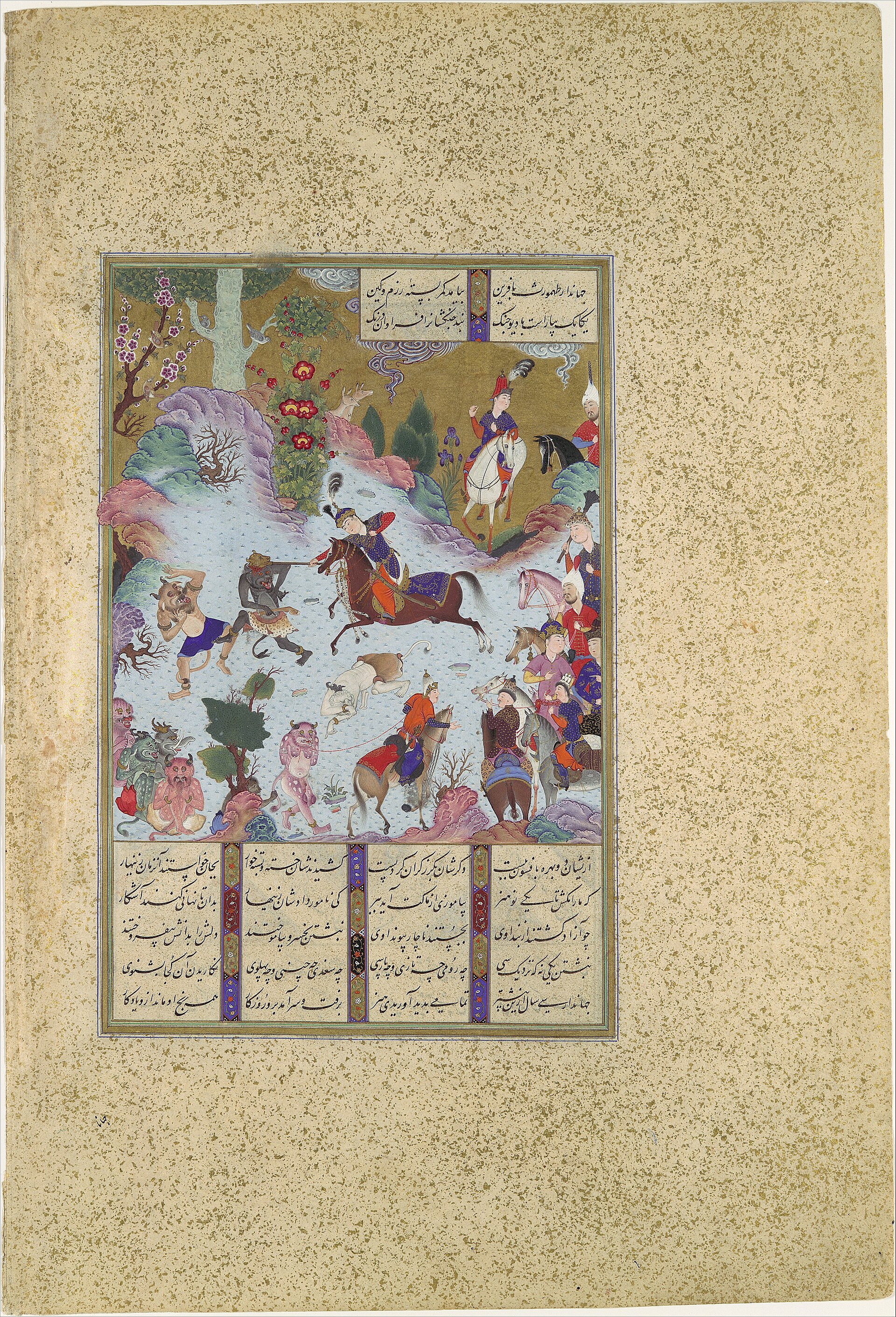
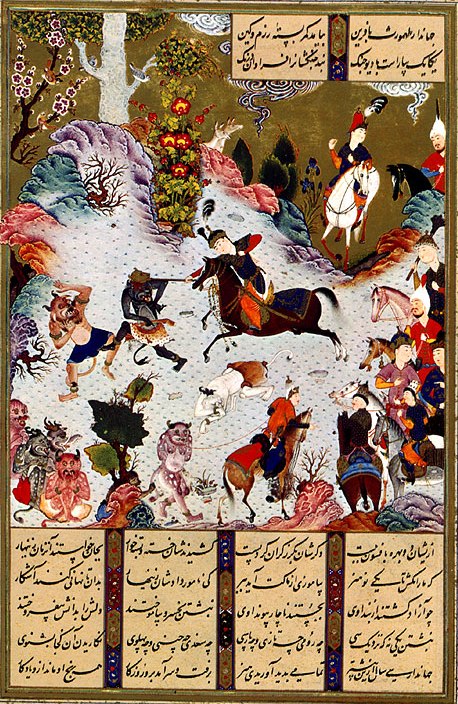
The folio described in this record. Opaque watercolor, ink, silver and gold on paper, ca. 1525, attributed to Sultan Muhammad. Metropolitan Museum of Art, accession 1970.301.3.
| Artist | Sultan Muhammad |
|---|---|
| Date | ca. 1525 |
| Medium | Opaque watercolor, ink, silver, and gold on paper |
| Dimensions | Painting: 28.3 x 18.6 cm (11 1/8 x 7 5/16 in). Full folio: 47 x 32.1 cm (18 1/2 x 12 5/8 in). |
| Where it is now | Metropolitan Museum of Art, New York, Department of Islamic Artlast confirmed |
| Inventory number | 1970.301.3 (Met object ID 452112) |
| Attribution | AcceptedThe Metropolitan Museum's own catalogue record attributes the painting to Sultan Muhammad, the artist generally identified as director of the manuscript's workshop for its opening folios. Full note |
| Object type | Manuscript |
| Period | Safavid Iran, Tabriz, ca. 1522-1535 |
| Cases | Has a provenance gap |
| Inscriptions | Persian text in nasta'liq script, recto and verso, from Ferdowsi's Shahnama, framing and below the painted field. The exact verse lines transcribed on this specific folio were not verified against a published transcription in the sources consulted for this record. |
| Owners on record | 11 links10 documented, 1 unknown |
| Sources | 24 cited |
About this record Last verified · 24 sources cited · Change log
On this page 9 sections
ContentsClose
A single leaf, folio 23 verso, from the grandest illustrated manuscript of Persia's national epic ever made: the Shahnama produced for Shah Tahmasp I in the royal Tabriz workshop between about 1522 and 1535. The painting, attributed to Sultan Muhammad, shows the legendary king Tahmuras defeating the divs and winning the art of writing from them as ransom, one of a cluster of early folios in which this painter staged the poem's founding-kings sequence as an argument for civilization arriving through royal conquest, at the very moment a new dynasty's workshop was asserting its own authority.
The manuscript was sent as a diplomatic gift to the Ottoman Sultan Selim II in 1568, resurfaced in the Rothschild collection in Paris by 1903 after an undocumented gap of centuries, and was sold to the American collector Arthur A. Houghton Jr. in 1959. Houghton gave this folio to the Metropolitan Museum in 1970 as part of a larger gift of 78 illustrations, then spent the following two decades selling the remaining folios individually, an act described by one journalist as an extraordinary act of vandalism, before his heirs exchanged what was left of the physical manuscript with the Iranian government in 1994 for Willem de Kooning's Woman III. Folios from the same book are now scattered across at least a dozen public collections and the private market, where a single leaf has sold for more than seven million pounds.
This folio's own story since 1970 is the simplest part of that history: it has never left the Metropolitan Museum, the one piece of a dismembered masterpiece that was never put back on the market at all.
Provenance
Each link is graded. Documented: a cited source supports it. Disputed: the identification is argued but not established. Unknown: no owner for that span, and the gap is not smoothed into a narrative. The grades in the glossary.
- ca. 1522 - ca. 1535The manuscript in productiondocumented
Produced in the royal kitabkhana in Tabriz, begun under Shah Ismail I and continued under Shah Tahmasp I. This folio, from the manuscript's opening sequence, is generally dated to about 1525 within that span.3423
- 1535 - 1568Safavid royal librarydocumented
Retained as a royal manuscript following completion, prior to the 1568 gift.43
- 1568 -Sultan Selim II, Ottoman Empiredocumented
Sent to Istanbul as a diplomatic gift, recorded arriving at the Iranian embassy in February 1568 accompanied by thirty-four camels of further gifts.4
- 1568 - by 1800Topkapi Palace library, Istanbuldocumented
Held in the Ottoman royal library. A further step of custody, from Selim II to Sultan Selim III by about 1800, is reported in a Metropolitan Museum catalogue chain summarized in the sources consulted, but was not independently verified against a directly fetched primary Museum page for this record, and is flagged accordingly.4
- by 1800 - by 1903Unknownunknown
No source consulted documents how, when, or through whom the manuscript left Ottoman custody and entered the European art market. This is an undocumented gap of at least a century in the sources available for this record.
- by 1903 - 1934Baron Edmond James de Rothschild, Parisdocumented
First securely documented European private owner. Held until his death in 1934.4
- 1934 - 1957Baron Maurice de Rothschild, Paris and Pregny (Geneva)documented
By descent from his father. Held until his own death in 1957.4
- 1957 - 1959Baron Edmond Adolphe de Rothschilddocumented
Reported as a brief further step within the Rothschild family before sale; sourced to catalogue-chain material summarized in the sources consulted rather than a directly fetched primary record, and flagged for confirmation.4
- 1959 -Arthur A. Houghton Jr., New Yorkdocumented
Sold in New York, November 1959, through the dealers Rosenberg and Stiebel (reported elsewhere as Stiebel Ltd.), on the dispersal of the Rothschild manuscript holdings following Maurice de Rothschild's death. A purchase price of 350,000 dollars is reported in one source consulted and is not independently confirmed here.45
- 1959 - 1970Arthur A. Houghton Jr., New Yorkdocumented
Held as a bound manuscript. In 1974, after this folio had already left his hands, Houghton offered the remaining, by-then-incomplete manuscript for sale intact at an asking price reported at 28.5 million dollars; no buyer emerged at that price.58
- 1970 - presentMetropolitan Museum of Art, New Yorkdocumented
This folio, together with 75 further folios carrying a total of 78 illustrations, given by Arthur A. Houghton Jr. in 1970; accessioned 1970.301.3. In continuous Museum custody since, with no recorded sale, exchange, or deaccession in the sources consulted for this record.12
Technical evidence
| Attribution note | The Metropolitan Museum's own catalogue record attributes the painting to Sultan Muhammad, the artist generally identified as director of the manuscript's workshop for its opening folios. As with almost every painting in this manuscript, the sheet carries no signature; the attribution rests on connoisseurship, consistent since Stuart Cary Welch's 1972 checklist, based on the drawing of the demons' faces, the palette, and comparison with the artist's other securely associated pages in the same opening sequence, including the folio immediately before this one. |
|---|---|
| Support | Paper, of the fine gold-sprinkled type used throughout the manuscript.102 |
| Medium | Opaque watercolor and ink, with passages of silver (now oxidized in places) and gold.12 |
| Dimensions, painting | 28.3 x 18.6 cm (11 1/8 x 7 5/16 in).12 |
| Dimensions, full folio | 47 x 32.1 cm (18 1/2 x 12 5/8 in).12 |
| Text | Persian nasta'liq script, recto and verso, transmitting Ferdowsi's Shahnama around and beneath the painted field.310 |
| Classification | Catalogued by the Metropolitan Museum under Classification: Codices, Department of Islamic Art.2 |
| Sequence position | Folio 23 verso, the sixth illustration in the manuscript's physical sequence, between folio 22v (Feast of Sada, same hand) and folio 29v (Zahhak is Told His Fate, same hand).1415 |
| Attribution basis | Unsigned, as is normal for the manuscript. Attributed to Sultan Muhammad by the Metropolitan Museum's own catalogue, consistent with Welch's 1972 checklist; based on style and on the folio's place within a small cluster of consecutively catalogued, stylistically related early folios.1219 |
| Rights status | Marked isPublicDomain: true in the Metropolitan Museum's own collection API; the Museum's photographs of the folio are released for open, unrestricted use and are mirrored on Wikimedia Commons under a Public Domain Mark.21112 |
Images
The record in full
Chapter 1What the folio is
This is a single leaf from a manuscript, not a picture that was ever meant to be seen alone.
This is a single leaf from a manuscript, not a picture that was ever meant to be seen alone. The painting occupies roughly two-thirds of the sheet, 28.3 by 18.6 centimeters, set into a full folio of 47 by 32.1 centimeters whose remaining surface carries Ferdowsi's Persian verse in nasta'liq script, framing the image on the recto and continuing on the verso. The support is paper, worked in opaque watercolor with ink outlining and passages of silver and gold, the silver now oxidized in places to a dull grey where it once read as bright metal, a change common across manuscripts of this class and period.
The composition shows a mounted king galloping across a meadow strewn with rocky outcrops, spotted and mottled demons cowering, fleeing, or already bound around him. It is one opening of a manuscript that originally ran to 759 pages with 258 such illustrations, of which this is folio 23 verso, meaning it falls very early in the physical sequence: the sixth of the manuscript's opening cycle of legendary kings.
Chapter 2The scene: Tahmuras and the gift of writing
The subject is Tahmuras, the third king of Ferdowsi's mythic Pishdadian dynasty, known in the poem by the epithet div-band, the demon-binder.
The subject is Tahmuras, the third king of Ferdowsi's mythic Pishdadian dynasty, known in the poem by the epithet div-band, the demon-binder. Ferdowsi's narrative has Tahmuras make war on the divs, the demons of Iranian myth, and defeat them in battle. Rather than kill his captives outright, he accepts a ransom: in exchange for their lives, the divs teach him the art of writing, an origin story the poem extends to thirty scripts, among them Arabic, Chinese, Greek, Persian, and Sogdian, so that Tahmuras becomes, in the epic's telling, the point at which human beings first receive the alphabet.
Sultan Muhammad's picture catches the king mid-gallop rather than at a moment of static triumph, his horse crossing broken ground scattered with cowering figures whose faces the painter has pushed toward caricature: mottled, spotted skin, gaping mouths, and expressions closer to comic terror than to menace. The Metropolitan Museum's own published description of the sheet singles this out specifically, noting that the humor of the divs' ghastly faces and gestures, and the painterly treatment of their spotty skin, are typical of the artist's style. It is a scene about civilization acquired by force from a defeated supernatural order, and the painter has chosen to make its villains ridiculous rather than terrifying, which is itself a reading of the text.
Chapter 3Where it falls in the manuscript: a dynasty's opening argument
The Shahnama's narrative opens with a sequence of legendary kings who, in Ferdowsi's telling, are less historical rulers than personifications of the stages by which human civilization was built...
The Shahnama's narrative opens with a sequence of legendary kings who, in Ferdowsi's telling, are less historical rulers than personifications of the stages by which human civilization was built: Gayumars, the first man and first king; Hushang, who discovers fire by accident and founds the fire-festival of Sada in celebration; Tahmuras, who wins writing from the divs; and Jamshid, who is credited with the crafts, the calendar, and the division of society into orders, before the cycle turns dark with the tyrant Zahhak.
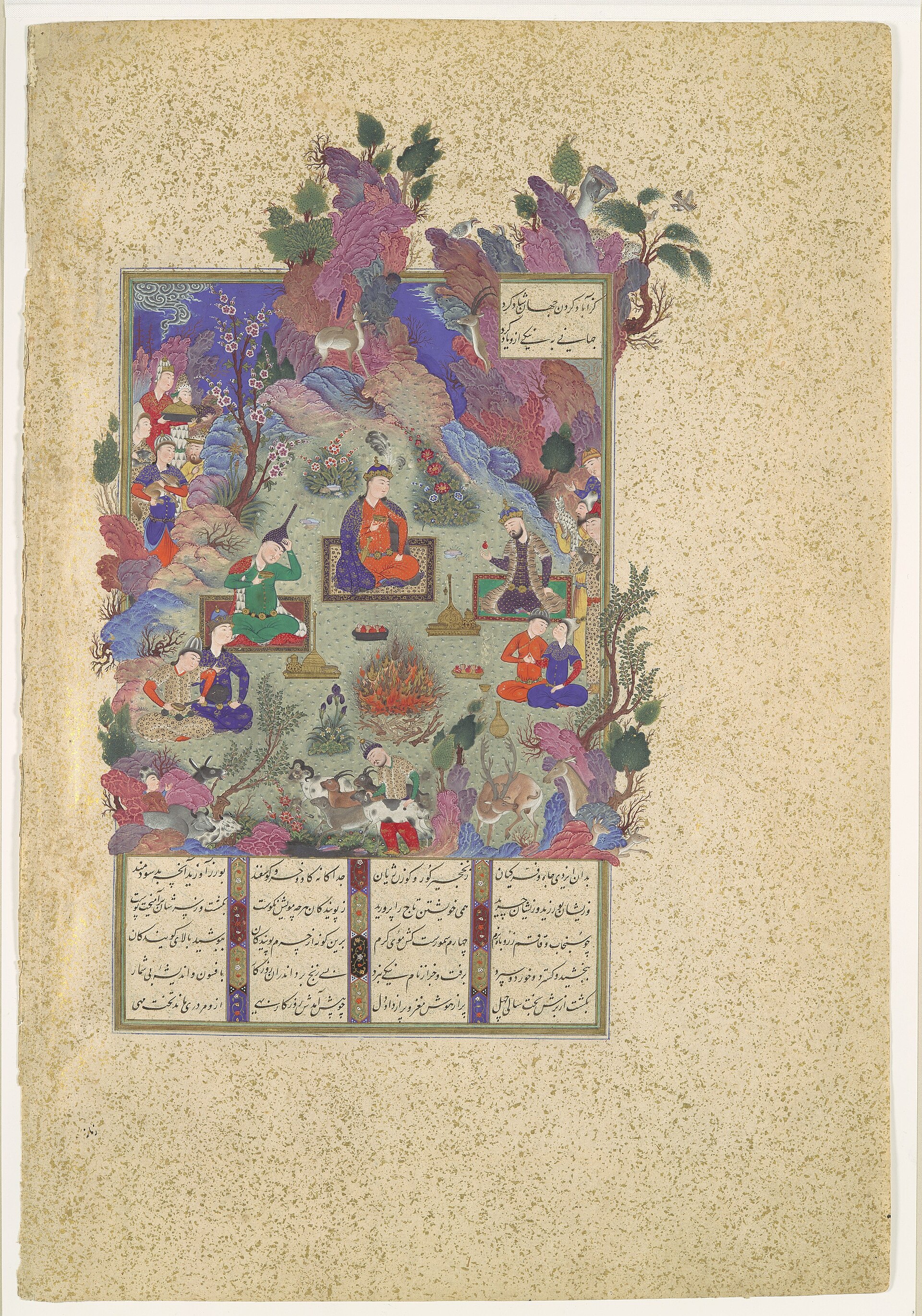
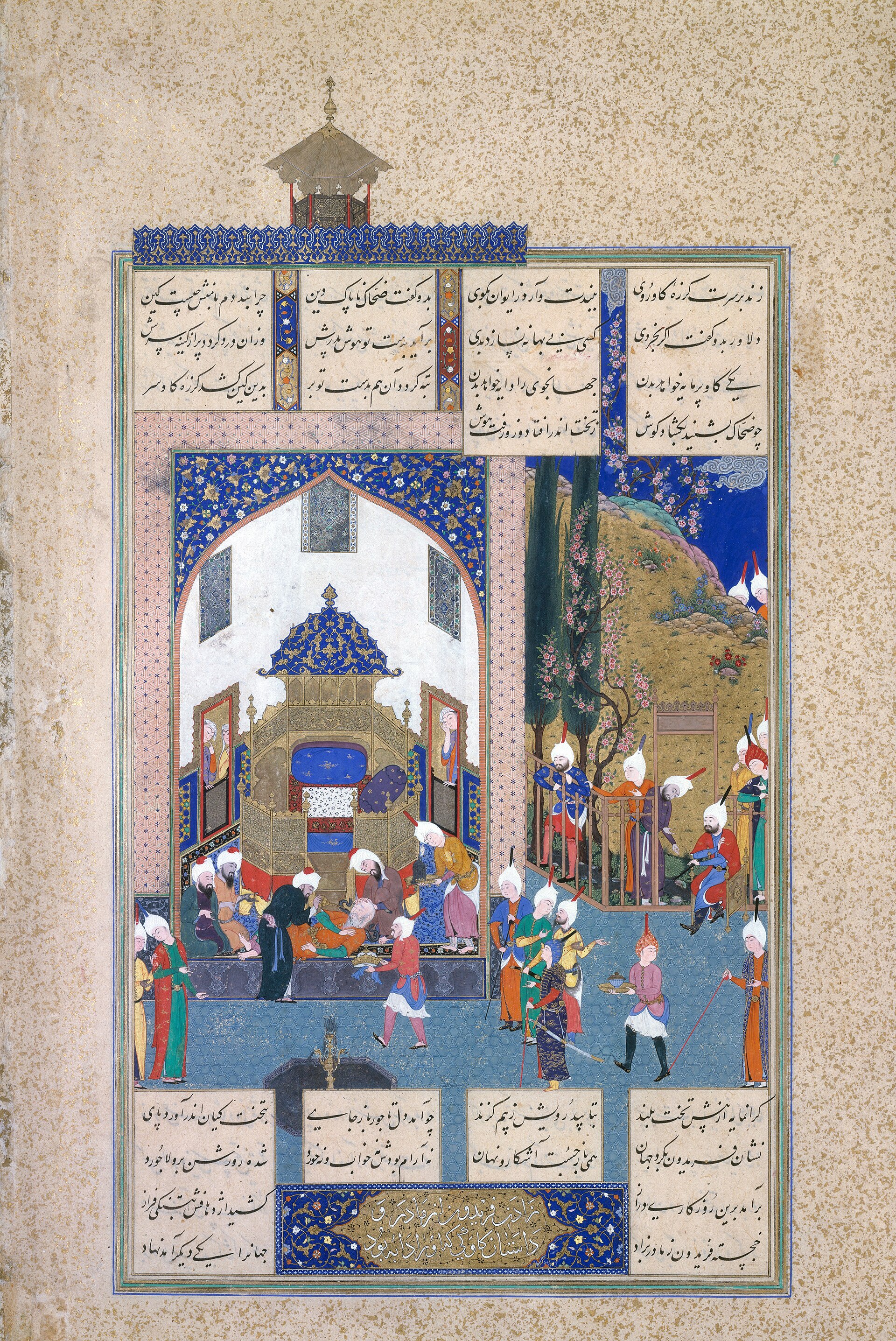
In this particular manuscript, that sequence receives outsized pictorial weight at the very point a new royal workshop was establishing its own authority. The folio immediately before this one, folio 22v, shows Hushang's Feast of Sada, the fire-discovery scene; folio 23v shows Tahmuras winning writing; both are attributed to the same painter, Sultan Muhammad, and both entered the Metropolitan Museum in the same 1970 gift as consecutive numbers, 1970.301.2 and 1970.301.3. A few folios later, folio 29v shows Zahhak being told the prophecy of his own downfall, also Sultan Muhammad's hand. Read in sequence, the manuscript's opening does not merely illustrate Ferdowsi's poem; it stages, for a newly established Safavid dynasty commissioning the grandest copy of the national epic ever made, an argument that kingship itself is the vehicle of civilization, arriving stage by stage through combat, sacrifice, and the taming of chaos. This record follows the discipline of grading such readings: the parallel between Tahmuras winning writing from the divs and a young dynasty asserting its own civilizing legitimacy is an argued interpretation available from the sequence and subject matter as documented, not a statement of what Sultan Muhammad or his patrons wrote down as intent, which is not recorded.
Chapter 4The royal workshop that made it
The manuscript was produced in the royal kitabkhana, the combined library and design atelier of the Safavid court, in Tabriz, beginning under Shah Ismail I and continuing under his son and successor...
The manuscript was produced in the royal kitabkhana, the combined library and design atelier of the Safavid court, in Tabriz, beginning under Shah Ismail I and continuing under his son and successor Shah Tahmasp I, who inherited the project as a young prince and appears to have taken a close personal interest in it as an adult ruler. Work is generally dated across the years 1522 to 1535, though production and completion of the whole manuscript, including its text and binding, is sometimes extended in the literature to as late as 1537 or beyond.
The kitabkhana at its fullest brought together an estimated fifteen painters alongside calligraphers, illuminators, book-binders, and the specialist gilders, margin-rulers, and burnishers whose labor is rarely named at all in the historical record. Named painters associated with the project include Sultan Muhammad, Mir Musavvir, Aqa Mirak, Mir Sayyid Ali, Dust Muhammad, and, joining later, Mirza Ali, Sultan Muhammad's own son. Sultan Muhammad is generally credited with directing the workshop for approximately its first hundred folios, the section into which this folio falls, before oversight of later sections passed to Mir Musavvir and Aqa Mirak. No contract, payroll, or workshop ledger for the manuscript survives in the sources consulted; the number and division of hands is a scholarly reconstruction built from style, not from a document that names who was paid to do what.
Chapter 5Sultan Muhammad's hand
Sultan Muhammad is the single artist most closely associated with this manuscript's most celebrated pages, including the Court of Gayumars, folio 20v, now in the Aga Khan Museum in Toronto and widely...
Sultan Muhammad is the single artist most closely associated with this manuscript's most celebrated pages, including the Court of Gayumars, folio 20v, now in the Aga Khan Museum in Toronto and widely described in the literature as the outstanding picture of the whole book. That folio is a different object from the one described in this record, made by the same hand for the same manuscript, and it must not be read as a picture of this folio's subject; the two should never be conflated.
What connects them is a single painter's opening run through the manuscript's founding-kings sequence. The attribution of this folio to Sultan Muhammad is not disputed in the sources consulted, and it sits inside a small, internally consistent group: the Feast of Sada immediately preceding it, this folio, and Zahhak is Told His Fate six folios later, all catalogued by the Metropolitan Museum to the same hand, all part of the same 1970 gift, and all occupying the same early narrative position that later scholarship assigns to Sultan Muhammad's direction of the workshop. The attribution is therefore not resting on this folio in isolation but on a cluster of stylistically and physically related sheets that entered the same collection together.
Chapter 6The scholarship: Welch, Dickson, and what came after
The foundational modern study of this manuscript is a direct product of its own dispersal.
The foundational modern study of this manuscript is a direct product of its own dispersal. Stuart Cary Welch, then a curator at the Fogg Art Museum and later at the Metropolitan, published A King's Book of Kings in 1972, timed to the 2,500th anniversary of the Persian monarchy and drawing heavily on the folios Houghton had just given the Met, with a checklist of all 258 known paintings. Welch went on to co-author, with the Princeton historian Martin Bernard Dickson, the fuller scholarly reckoning: The Houghton Shahnameh, two volumes published by Harvard University Press in 1981 in a limited run of 750 copies, running to well over 800 pages combined with color and monochrome collotype plates. It remains the standard reference for the manuscript's chronology, the identification of individual painters, and the internal evidence for how the workshop was organized, and it is the source this record leans on most heavily for the workshop's structure and Sultan Muhammad's role within it.
Sheila Canby, later the Met's own curator of Islamic art, has written on the manuscript repeatedly since, including a reduced-format study for the Museum published through Yale University Press, generally affirming the Dickson and Welch narrative while adding archival and historical context drawn from Ottoman and Safavid sources unavailable or underused in 1981. More recent scholarship, including a 2016 paper by Abolala Soudavar explicitly framed as a defense of Dickson and Welch against several papers attempting to revise their conclusions, indicates the manuscript's attribution history is still an active scholarly argument rather than a settled catalogue, though the disputes concern chronology and hands elsewhere in the book rather than a challenge to the attribution of this specific folio.
Chapter 7A gift to the Ottoman Sultan, 1568
The manuscript left Safavid royal hands within a generation of its completion.
The manuscript left Safavid royal hands within a generation of its completion. It was sent to Istanbul as a diplomatic gift to the Ottoman Sultan Selim II in 1568, part of a much larger consignment: Ottoman records describe its arrival at the Iranian embassy in February 1568 accompanied by thirty-four camels of other gifts, a scale that marks the manuscript as one item within a formal state exchange rather than an isolated present. It then remained within the Ottoman royal library at the Topkapi Palace for an extended period; a chain reported through Metropolitan Museum catalogue material carries it further, from Selim II's custody to that of Sultan Selim III by around 1800, though this record was not able to independently verify that second Ottoman step against a directly consulted Museum page, and it is flagged accordingly.
Why a masterpiece of a rival dynasty's royal workshop was sent as a diplomatic gift, and what political message the gift itself carried between two states that had fought repeated wars across the sixteenth century, is a question this record does not attempt to resolve; the sources consulted record the fact and date of the gift without analysing Ottoman-Safavid diplomatic intent behind it.
Chapter 8An undocumented passage to Europe
Between an Ottoman royal library and its first securely documented appearance in a private European collection lies a gap the sources consulted do not close.
Between an Ottoman royal library and its first securely documented appearance in a private European collection lies a gap the sources consulted do not close. The manuscript surfaces in the collection of Baron Edmond James de Rothschild in Paris by 1903, a full three and a half centuries after the 1568 gift and against the backdrop of the Ottoman Empire's political decline in the same period. No source consulted for this record documents how, when, or through whom the manuscript passed out of Ottoman custody and into the international art trade, or how it reached the Rothschild family specifically. That is a genuine, extended gap in the chain, not a smoothed-over transition, and it is recorded as one below rather than bridged with a guess.
Chapter 9The Rothschilds, and the sale to Houghton
Once in Rothschild hands the descent is more legible.
Once in Rothschild hands the descent is more legible. Baron Edmond James de Rothschild held the manuscript in Paris from by 1903 until his death in 1934, when it passed to his son Baron Maurice de Rothschild, who kept it in Paris and at Pregny near Geneva until his own death in 1957; a further brief passage to Baron Edmond Adolphe de Rothschild is reported in the catalogue chain consulted, covering 1957 to 1959. On the dispersal of the Rothschild manuscript holdings that followed Maurice de Rothschild's death, the book was sold in New York in November 1959 through the dealers Rosenberg and Stiebel to the American collector and bibliophile Arthur A. Houghton Jr., a Steuben Glass executive, trustee and later president of the Metropolitan Museum, and a major manuscript collector in his own right as founder of Harvard's Houghton Library. A reported purchase price of 350,000 dollars appears in one source consulted, The Critic magazine's 2024 account of the manuscript's history; this record treats that figure as reported rather than independently confirmed against a primary sale record, and flags it for a second source.
Chapter 10The decision to take the manuscript apart
Houghton owned the complete manuscript for eleven years before making the first move that would end its physical unity: in 1970 he gave 76 folios, carrying 78 of the manuscript's 258 illustrations...
Houghton owned the complete manuscript for eleven years before making the first move that would end its physical unity: in 1970 he gave 76 folios, carrying 78 of the manuscript's 258 illustrations, to the Metropolitan Museum, this folio among them, formalized in the credit line the Museum still carries today, Gift of Arthur A. Houghton Jr., 1970. Structured correctly, a gift of this scale to a public institution functions as a form of tax relief for the donor as well as a benefaction to the Museum; the sources consulted describe the later individual sales explicitly in tax terms, and there is no reason given in any source consulted to read the 1970 gift differently.
Houghton kept the remainder, by most accounts around 118 to 120 illustrations plus the text and binding. In 1974 he attempted to sell what remained as a single intact unit, with an asking price reported at 28.5 million dollars; no buyer emerged. Following that failed sale, Houghton began disposing of individual folios one at a time, by outright sale and by further gift, over the following two decades. Christie's in London auctioned seven folios on 17 November 1976 for a combined 785,000 pounds, with the single best folio making 280,000 pounds, a price reported at the time as a record for any work of Persian or Islamic art. A second Christie's sale in October 1988 dispersed fourteen further folios for a combined 986,800 pounds, individual lots ranging from 14,300 to 253,000 pounds. The journalist Michael Prodger, writing in The Critic magazine in 2024, characterizes the whole course of action starkly, describing Houghton's 1974 decision as an extraordinary act of vandalism; a separate account, published on the manuscript-history blog The Books In My Life, states its author's position just as plainly: I remain disgusted by the destruction of a unique, precious book. Both are argued positions rather than neutral description, and this record names them as such rather than adopting the judgment as its own; but neither is a fringe reading. The manuscript that had taken a Safavid royal workshop over a decade to make, and that survived four centuries of documented and undocumented transit, was broken into market-tradeable units by its twentieth-century private owner, over the course of roughly twenty years, for financial reasons the sources consulted state without dispute.
Chapter 11This folio's own path since 1970
Set against that history, this specific object's own provenance since 1970 is unusually simple.
Set against that history, this specific object's own provenance since 1970 is unusually simple. It has remained in the Metropolitan Museum's collection continuously since the 1970 gift, under the accession number 1970.301.3, with no recorded sale, loan for sale, exchange, or deaccession in the sources consulted. Where the manuscript as a whole is a story of dismemberment and dispersal across dozens of institutions and private hands, this folio's individual history after 1970 is the story of an object that simply stayed where it was given, which is itself worth stating plainly rather than assuming: not every folio from this manuscript can say the same.
Chapter 12Where the rest of the manuscript went
The 78 illustrations given to the Met in 1970 and the individual lots sold at Christie's in 1976 and 1988 account for only part of the original 258.
The 78 illustrations given to the Met in 1970 and the individual lots sold at Christie's in 1976 and 1988 account for only part of the original 258. Further folios entered public and private collections across the following decades: ten folios are now in the Khalili Collection of Islamic Art, assembled by Nasser David Khalili, spanning several of the manuscript's named painters including Sultan Muhammad, Mir Sayyid Ali, Mir Musavvir, Aqa Mirak, and Mirza Ali, among them the manuscript's only dated folio. Other leaves are recorded in the Museum fur Islamische Kunst in Berlin, the Freer and Sackler Galleries of the Smithsonian Institution in Washington, the Los Angeles County Museum of Art, the David Collection in Copenhagen, the Museum of Fine Arts in Richmond, Virginia, the Museum of Islamic Art in Doha, the Reza Abbasi Museum in Tehran, and Harvard Art Museums, successor to the Fogg where Welch first worked on the material, alongside further leaves in private hands whose current whereabouts are not published. The Court of Gayumars, the manuscript's single most reproduced page, is in the Aga Khan Museum in Toronto; it is a different folio from the one described in this record and is discussed here only for that reason, to prevent the two being confused.
Chapter 13Vienna, 1994: the exchange for a de Kooning
Houghton died in 1990, still holding the manuscript's remaining text, binding, and roughly 118 paintings.
Houghton died in 1990, still holding the manuscript's remaining text, binding, and roughly 118 paintings. His heirs first tried an intact sale again, reportedly seeking around 20 million dollars in 1991-1992, again without a buyer at that price. What followed instead was a negotiation, running from 1991 through 1994, conducted by the London dealer Oliver Hoare on behalf of the Houghton estate with officials of the Islamic Republic of Iran. Iran held, in the collection of the Tehran Museum of Contemporary Art, Willem de Kooning's 1953 abstract expressionist painting Woman III, acquired in 1977 under the pre-revolutionary government of Shah Mohammad Reza Pahlavi and Empress Farah Pahlavi as part of a major purchase of Western modern art; after the 1979 revolution the painting sat in a collection whose figurative Western holdings had become, at minimum, politically and religiously awkward for its new government to display.
The exchange itself took place on the tarmac of Vienna's airport on 28 July 1994: crates containing the remaining Shahnameh text, binding, and 118 paintings were handed to Iranian officials, and Woman III was handed to the American side, with the de Kooning reportedly moved quickly to a dealer in Switzerland out of concern the United States government might attempt to seize it against other disputed claims between the two countries. Farah Pahlavi has since criticized Hoare's role in the deal as disrupting the unity of her collection, a criticism aimed at the exchange itself rather than at the original 1970s breakup. The remaining manuscript material returned to Iran as a result; this record was not able to confirm a single specific current repository for it within Iran, beyond its delivery to the Iranian government via the Tehran Museum of Contemporary Art's negotiators, and that is recorded below as an open question rather than resolved with an assumption.
Chapter 14Reproduction: the book that survived the breakup on paper
Two publications, both tied directly to Houghton's ownership, mean the manuscript's dispersal is not the last word on it.
Two publications, both tied directly to Houghton's ownership, mean the manuscript's dispersal is not the last word on it. Stuart Cary Welch's A King's Book of Kings appeared in 1972, two years after this folio and its companions entered the Metropolitan Museum, and used the newly accessible Met folios as its core illustrations while offering a full checklist of all 258 paintings, wherever they then stood. Welch and Martin Bernard Dickson followed in 1981 with The Houghton Shahnameh, a two-volume deluxe facsimile from Harvard University Press, limited to 750 numbered copies and priced at 2,000 dollars a set on publication, reproducing 20 plates in color collotype and hundreds more in monochrome across more than 800 combined pages of text and image.
That timing is worth noticing. The facsimile was compiled and published in the same decade Houghton was actively selling the physical folios at Christie's, which means the fullest scholarly record of the manuscript as a single object was assembled concurrently with, not after, its physical dismantling. A reader today can reconstruct the entire sequence of 258 paintings from Dickson and Welch's plates even though no single institution or owner holds the whole thing; the facsimile is, in a real sense, the only complete copy of the manuscript that still exists in one place.
Chapter 15What was not found
Two absences are worth recording rather than leaving silent.
Two absences are worth recording rather than leaving silent. No source consulted for this record reports a published pigment analysis, X-radiography, or infrared examination of this specific folio; the technical literature on the manuscript's materials, where it exists, was not located in the sources available for this record, and the medium and materials given here rest on the Metropolitan Museum's own cataloguing rather than an independent technical study. Second, nothing in the sources consulted suggests a colonial-extraction dimension to this object's own path out of its country of production: it moved by diplomatic gift in 1568, by private sale among European and American collectors and dealers from the 1900s onward, and by museum gift in 1970, a chain documented, where it is documented at all, as commerce and diplomacy between willing parties rather than as seizure. That absence is itself worth stating plainly, since the manuscript's later history, the 1994 exchange, does raise real questions about an Iranian institution's post-revolutionary hand being forced by a de-luxe manuscript's market value against a painting its own government could no longer display; those questions belong to that later episode and are not evidence of anything at the point this folio itself changed hands.
Chapter 16What a folio from this manuscript sells for now
The individual-folio market this dispersal created has continued to set records in its own right.
The individual-folio market this dispersal created has continued to set records in its own right. A folio attributed to Aqa Mirak, Faridun in the Guise of a Dragon Tests His Sons, from folio 42 of the same manuscript, sold at Sotheby's London in 2011 as the star lot of the Stuart Cary Welch collection sale for 7.4 million pounds, reported at roughly 12 million dollars, described at the time as a record for any work of Islamic art on paper. That is the strongest documented comparandum for what a single leaf from this specific manuscript can command decades after the breakup, and it stands in the same market lineage as the 1976 sale that first proved individual folios had a price at all. No sale of this folio itself, 1970.301.3, appears in the sources consulted; it has never left the Metropolitan Museum's collection to be tested against that market.
The artist
Sultan Muhammad (also transliterated Sultan Mohammad; sometimes called Sultan Muhammad Iraqi or Sultan Muhammad Tabrizi)
Sultan Muhammad is the painter most closely associated with the opening of the Shahnameh of Shah Tahmasp, and with what is generally considered its single greatest page. Almost nothing about his life is documented outside his work: no birth record, no signed contract, no portrait confirmed to be of him. What survives is a body of attributed paintings, a handful of near-contemporary references by other court writers, and the internal evidence of a workshop whose early direction scholars have reconstructed largely from his hand.
Related works
| Work | Relation | Where it is |
|---|---|---|
| "The Feast of Sada", Folio 22v Sultan Muhammad | Same manuscript, same painter, immediately preceding folio in narrative sequence; entered the Met in the same 1970 Houghton gift Shows Hushang's accidental discovery of fire and the feast held to celebrate it; the first of the manuscript's founding-kings civilizing episodes. | Metropolitan Museum of Art, New York (1970.301.2) |
| "Zahhak is Told His Fate", Folio 29v Sultan Muhammad | Same manuscript, same painter, six folios later; entered the Met in the same 1970 Houghton gift Shows the tyrant Zahhak fainting on learning of the prophecy of his own downfall; marks the turn from the civilizing kings toward the manuscript's central tyranny narrative. | Metropolitan Museum of Art, New York (1970.301.4) |
| The Court of Gayumars, Folio 20v Sultan Muhammad | Same manuscript, same painter; the manuscript's most celebrated single page This is NOT the picture described in this record. It is a different folio, showing the manuscript's first legendary king, made by the same hand for the same manuscript. Included here to prevent the two being confused, a documented risk with this artist's work. | Aga Khan Museum, Toronto |
| Faridun in the Guise of a Dragon Tests His Sons, Folio 42 Attributed to Aqa Mirak | Same manuscript, different painter and section; the strongest documented market comparandum for this manuscript's individual folios Sold for GBP 7.4 million, reported at roughly USD 12 million, a record at the time for any Islamic work of art on paper. | Sold Sotheby's London, 2011 (Stuart Cary Welch collection); present owner not published |
| Ten folios from the same manuscript Various, including Mir Sayyid Ali, Mir Musavvir, Aqa Mirak, Mirza Ali, and Sultan Muhammad | Same manuscript, dispersed by the same 1970s-1980s sales Includes the manuscript's only dated folio; illustrates how widely the book's illustrations were scattered by the breakup. | Khalili Collection of Islamic Art |
| The manuscript's binding, text, and remaining paintings (the "rump") Multiple hands and the workshop's calligraphers and illuminators | The physically surviving remainder of the same original manuscript after this folio and hundreds of others had already been separated from it Exchanged in Vienna on 28 July 1994 for Willem de Kooning's Woman III (1953), then in the collection of the Tehran Museum of Contemporary Art. | Returned to the government of Iran in 1994; specific current repository not confirmed in the sources consulted |
Open questions
- What is the manuscript remainder's specific current repository within Iran, following its 1994 return? Sources consulted confirm delivery to Iranian government representatives via the Tehran Museum of Contemporary Art's negotiators, but not a specific museum, library, or palace as its present physical home.
- How, when, and through whom did the manuscript leave Ottoman royal custody in Istanbul and reach the Rothschild collection in Paris by 1903? This is an undocumented gap of well over three centuries in the sources consulted.
- Do the published figures for the manuscript's dispersal actually reconcile? Sources report 258 total illustrations, 76 to 78 folios (78 illustrations) given to the Met in 1970, roughly 118 to 120 retained by Houghton until 1994, and further folios sold at Christie's in 1976 and 1988; these figures do not cleanly sum to 258 across the sources consulted, and no single source reconciles them.
- Is the reported 1959 purchase price of 350,000 dollars, and the reported 1974 asking price of 28.5 million dollars, confirmed by a primary sale record, or does it rest solely on the single secondary source (The Critic magazine, 2024) consulted for this record?
- Has any scholar since Welch and Dickson (1981) proposed a different or a collaborating hand for this specific folio, as distinct from the wider chronology disputes that Soudavar (2016) addresses for the manuscript generally? No such proposal was found in the sources consulted.
- What did the manuscript's production actually cost the Safavid treasury, in period terms, and how were its painters, calligraphers, and gilders paid? No payroll, contract, or workshop account for this manuscript was found in the sources consulted.
Questions about this object
What is "Tahmuras Defeats the Divs", Folio 23v from the Shahnama (Book of Kings) of Shah Tahmasp?
"Tahmuras Defeats the Divs", Folio 23v from the Shahnama (Book of Kings) of Shah Tahmasp is a manuscript, dated ca. 1525. Medium: Opaque watercolor, ink, silver, and gold on paper.
Who made "Tahmuras Defeats the Divs", Folio 23v from the Shahnama (Book of Kings) of Shah Tahmasp, and is the attribution settled?
The attribution to Sultan Muhammad is recorded here as accepted. The Metropolitan Museum's own catalogue record attributes the painting to Sultan Muhammad, the artist generally identified as director of the manuscript's workshop for its opening folios. As with almost every painting in this manuscript, the sheet carries no signature; the attribution rests on connoisseurship, consistent since Stuart Cary Welch's 1972 checklist, based on the drawing of the demons' faces, the palette, and comparison with the artist's other securely associated pages in the same opening sequence, including the folio immediately before this one.
Where is "Tahmuras Defeats the Divs", Folio 23v from the Shahnama (Book of Kings) of Shah Tahmasp now?
Metropolitan Museum of Art, New York, Department of Islamic Art. Inventory number 1970.301.3 (Met object ID 452112). Last confirmed 19 August 2026. Gift of Arthur A. Houghton Jr., 1970, per the Metropolitan Museum's own collection record and credit line. In continuous Museum custody since accession; not deaccessioned, loaned for auction, or otherwise moved in the record consulted.
What is still unknown about "Tahmuras Defeats the Divs", Folio 23v from the Shahnama (Book of Kings) of Shah Tahmasp?
What is the manuscript remainder's specific current repository within Iran, following its 1994 return? Sources consulted confirm delivery to Iranian government representatives via the Tehran Museum of Contemporary Art's negotiators, but not a specific museum, library, or palace as its present physical home.
Sources
- 1The Metropolitan Museum of Art, collection record for "Tahmuras Defeats the Divs", Folio 23v from the Shahnama (Book of Kings) of Shah Tahmasp, accession 1970.301.3, object ID 452112. metmuseum.org/art/...
- 2The Metropolitan Museum of Art, Collection API, object record for object ID 452112 (fetched directly; confirms isPublicDomain: true, credit line, medium, dimensions, department, and classification). collectionapi.metmuseum.org/public/...
- 3The Metropolitan Museum of Art, curatorial essay, "The Shahnama of Shah Tahmasp". metmuseum.org/essays/...
- 4Wikipedia, "Shahnameh of Shah Tahmasp". en.wikipedia.org/wiki/...
- 5Michael Prodger, "Art of the deal", The Critic Magazine, November 2024. thecritic.co.uk/art-of-the-deal
- 6The Art Newspaper, "How a Persian manuscript was swapped for a Willem de Kooning owned by the Iranian government", 12 November 2024. theartnewspaper.com/2024/...
- 7The Art Newspaper, "The Book of Kings returned to Iran by US in exchange for de Kooning painting", 1 October 1994. theartnewspaper.com/1994/...
- 8Thomas E. Stone, "The Houghton Shahnameh, The Whole Is Greater Than the Parts but Sometimes the Parts are more Marketable: Book Destruction for Profit", The Books In My Life (blog), 2011. Personal opinion piece by a books/manuscripts writer; cited for its timeline detail and as a documented example of the critical reaction to the breakup, flagged as a secondary, non-scholarly source. thebooksinmylife.com/2011/...
- 9Sotheby's, lot 78, "Faridun in the Guise of a Dragon Tests His Sons: Illustrated Folio (f.42) from the Shahnameh of Shah Tahmasp, Attributed to Aqa Mirak", Collection of Stuart Cary Welch Part II, 2011. sothebys.com/en/...
- 10Khalili Collections, "Ten Folios from the Copy of Firdawsi's Shahnamah Made for Shah Tahmasp" (MSS 1030). khalilicollections.org/collections/...
- 11Wikimedia Commons, Category:"Tahmuras Defeats the Divs", Folio 23v from the Shahnama (Book of Kings) of Shah Tahmasp (MET 1970.301.3), listing the Museum's photographs of this folio and their licensing. commons.wikimedia.org/wiki/...
- 12Wikimedia Commons, File:Tahmuras Defeats the Divs.jpg, licence and metadata verification (Public Domain Mark, LicenseShortName CC-PD-Mark). commons.wikimedia.org/wiki/...
- 13Wikimedia Commons, Category:Shah Tahmasp's Shahnameh in the Metropolitan Museum of Art. commons.wikimedia.org/wiki/...
- 14The Metropolitan Museum of Art, collection record for "The Feast of Sada", Folio 22v from the Shahnama (Book of Kings) of Shah Tahmasp, accession 1970.301.2, object ID 452111. metmuseum.org/art/...
- 15The Metropolitan Museum of Art, collection record for "Zahhak is Told His Fate", Folio 29v from the Shahnama (Book of Kings) of Shah Tahmasp, accession 1970.301.4, object ID 452113. metmuseum.org/art/...
- 16Wikimedia Commons, Category:"The Feast of Sada", Folio 22v from the Shahnama (Book of Kings) of Shah Tahmasp (MET 1970.301.2), listing the Museum's photographs of this folio and their licensing. commons.wikimedia.org/wiki/...
- 17Wikimedia Commons, File:"Zahhak is Told His Fate", Folio 29v from the Shahnama (Book of Kings) of Shah Tahmasp MET DT11224.jpg, licence and metadata verification. commons.wikimedia.org/wiki/...
- 18Smarthistory, "The Court of Gayumars", on the folio now in the Aga Khan Museum, Toronto, consulted specifically to confirm this is a distinct folio from the one described in this record. smarthistory.org/the-court-of-gayumars
- 19Stuart Cary Welch, A King's Book of Kings: The Shah-nameh of Shah Tahmasp (Metropolitan Museum of Art / Thames and Hudson, 1972), full text consulted via the Internet Archive. archive.org/stream/...
- 20Martin Bernard Dickson and Stuart Cary Welch, The Houghton Shahnameh, 2 vols. (Cambridge, MA and London: Harvard University Press, 1981). The landmark scholarly study of the manuscript; consulted here via a Cambridge University Press review listing giving its full collation and scope, not read in full for this record. cambridge.org/core/...
- 21Yale Books Blog, "The Shahnama of Shah Tahmasp: Reconstructing a masterpiece of Iranian literature and art", on Sheila Canby's study of the manuscript. yalebooksblog.co.uk/2011/...
- 22Wikidata, Q29385199, structured data entry for this folio. wikidata.org/wiki/...
- 23Wikipedia, "Sultan Mohammed" (painter). en.wikipedia.org/wiki/...
- 24Encyclopaedia Britannica, "Sultan Muhammad". britannica.com/biography/...

_of_Shah_Tahmasp_MET_DT11224.jpg)
Last verified · Published
Change log
19 August 2026 - Record created at the house standard: researched narrative, technical evidence, maker dossier, graded provenance chain, prices with hammer and premium separated, related works, open questions and sources.